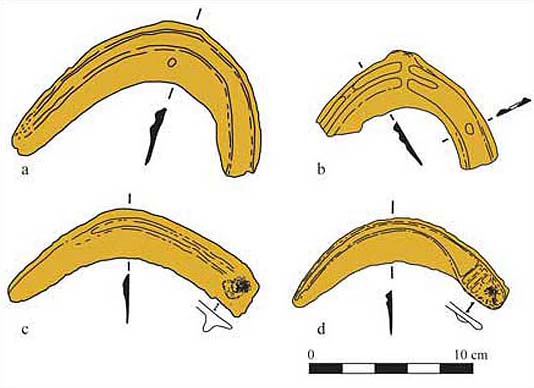


Late Bronze Age bronze sickles from the Bourget lake and especially from the site of Grésine (Savoie, France) (b,c and d) (after Reference KerouantonKerouanton 2002).

It is always difficult to identify the tools used for harvesting in prehistoric times. Different kinds of implements and practices can occur, from the use of the hands to wooden, lithic or metallic tools (Reference SigautSigaut 1991). Harvesting by hand or even with wooden objects can hardly be known from prehistoric settlements. On the other hand, the cutting stone or metallic tools, usually regarded as sickles or sickle elements from their morphology alone, are not necessarily linked to the harvest. They may have been used to cut any kind of plant material (crops, forage, branch wood, plants for roofing, etc.). Specifically it has been suggested that, despite appearances, bronze sickles were not used for harvesting cereals. It can be argued firstly that we do not know any ethnographic harvest cutting tool that is not made of iron or stone, and secondly that the use of the sickle is linked to an agricultural technical system which involves the collection and transportation of straw and only appears later. (Reference SigautSigaut 1988a; 1988b). Bronze sickles could have been better employed to collect fodder (most probably leaf or twig foddering) for working animals, especially horses. In the late Bronze Age (Bronze final IIIb) lakeshore site of Grésine (Bourget lake, Savoie, France), the presence together of bronze sickles and of botanical remains of crops and weeds (Bouby & Billaud 2001) reopens the discussion of the use of sickles for harvesting grain.
Reaping level of the winter cereals in Southern France Bronze Age settlements as inferred from the maximal growing height of the weeds. The lowest weed harvested with the crop indicates the height under which the cutting of straw has been done. Romagnat, Puy-de-Dôme, early Bronze Age (BA) (Bouby 2002); Les Cazals, Aude, middle Bronze Age (BM) (Van Zeist et al. 1983); BPNL (Boulevard Périphérique Nord de Lyon, Rhône, late Bronze Age (BF I) (Jacquet et al. 1998); Balme Gontran, Ain, late Bronze Age (BF IIb-IIIa) (Bouby unpublished); Baume Layrou, Gard, late Bronze Age (BF II) (Bouby unpublished); La Fangade, Hérault, late Bronze Age (BF II) (Bouby et al. 1999); Grésine, Savoie, late Bronze Age (BF IIIb) (Bouby & Billaud 2001); Chindrieux, Savoie, late Bronze Age (BF IIb) (Reference JacquotJacquot 1994).

The height of cutting can be inferred from the maximal growing height of the weeds unintentionally collected with the crop. In Grésine, many of the typical weeds of winter cereals do not grow higher than 30 or 40 cm (e.g. Aphanes arvensis, Chaenorrhinum minus, Papaver argemone, Scleranthus annuus, Stachys annua or Viola cf. tricolor), indicating that the straw was cut lower than this. Such a low reaping level necessarily implies the use of a sharp tool. Bronze sickles have been discovered in the settlement of Grésine and in other neighbouring sites of the Bourget lake (Figure 1; Reference KerouantonKerouanton 2002). It is all the more probable that these sickles were used to cut cereals as the lithic tools, likely to be used for this purpose, become extremely rare at that time in the area. In Switzerland, the early and middle Bronze Age denticulate flint blades which could represent sickle pieces disappeared during the late Bronze Age (Hochuli & Maise 1998). Moreover, the production of bronze sickles cannot be explained by the beginning of foddering because the collection of leaf and twig forage for livestock was already well established in the Alpine area during Neolithic times (Reference RasmussenRasmussen 1993; Akeret et al. 1999). The use of sickles to harvest cereals is connected with a quite low reaping level and with the need to collect straw (Reference SigautSigaut 1988a; Alonso I Martinez 1999).
A question however remains. Was all the harvest collected in only one operation or was there first of all a high gathering of the ears of grain and then, in a second operation, a low cut of the straw? This question can be answered by the study of storage assemblages where the associated grain and weeds have necessarily been collected together. Two late Bronze Age storage context from Southern France, Baume Layrou and Balme Gontran (Figure 2) contained both cereals and low growing weeds; therefore the harvest was made in a single operation.
In Figure 2, the three assemblages from early to late Bronze Age I point to a high reaping level while in all the sites from late Bronze Age II onwards low cutting is documented. The hypothesis needs to be consolidated by new analysis but a change from high to low reaping seem to have occurred around the beginnings of the late Bronze Age. This is roughly coincident with the arrival of bronze sickles, which appear in France during middle Bronze Age (Reference GuilaineGuilaine 1991). Even if bronze sickles were never very common in Southern France and if low cutting of cereals is already evidenced in some Neolithic sites (e.g. Jacomet et al. 1989), one may consider that some kind of relation probably existed between the adoption of bronze sickles on the one hand and the development of low reaping and of straw harvesting on the other hand.
Acknowledgements
I would like to thank Yves Billaud (DRASSM) for providing the beautiful samples from Grésine and information about harvesting tools in Switzerland. I am also grateful to Gérard Roussel for his comments on the English text.