

Introduction
Allanite-(Y), ideally CaY(Al2Fe2+)(SiO4)(Si2O7)O(OH), is a member of the allanite group belonging to the epidote-supergroup characterised by monoclinic symmetry with space group P21/m. The general formula of the epidote supergroup minerals is A2M3(T2O7)(TO4)(O,F)(OH,O), where A1 = (Ca2+, Mn2+), A2 = (Ln 3+, Y3+, Th4+, U4+, Sr2+, Pb2+); M1 = (Al3+, Fe3+, Ti4+, V3+, Mn3+, Cr3+), M2 = (Al3+), M3 = (Fe2+, Fe3+, Mg2+, Mn2+, Al3+, V3+, Sc3+, Cr3+), T1 = (Si4+), T2 = (Si4+) and T3 = (Si4+, Al3+) (Deer et al., Reference Deer, Howie and Zussman1986; Ercit, Reference Ercit2002; Franz and Liebscher, Reference Franz and Liebscher2004; Armbruster et al., Reference Armbruster, Bonazzi, Akasaka, Bermanec, Chopin, Gieré, Heuss-Assbichler, Liebscher, Menchetti, Pan and Pasero2006; Orlandi and Pasero, Reference Orlandi and Pasero2006; Revheim and King, Reference Revheim and King2016).
Allanite-(Y) was technically first defined by Levinson (Reference Levinson1966) who assigned the name allanite-(Y) to a previously characterised Y-dominant allanite-group mineral from the Åskagen pegmatite, Sweden (Neumann and Nielssen, Reference Neumann and Nilssen1962). The material was originally referred to as ‘lombaardite’ based on powder X-ray diffraction data (Neumann and Nielssen, Reference Neumann and Nilssen1962) but neglecting its REE-rich composition (‘lombaardite’ was originally defined as a REE-free mineral from the Zaaiplaats tin mine, South Africa; Nel et al., Reference Nel, Strauss and Wickman1949). Since 1966, allanite-(Y) has been a generally accepted species (Levinson, Reference Levinson1966; Ercit, Reference Ercit2002; Armbruster et al., Reference Armbruster, Bonazzi, Akasaka, Bermanec, Chopin, Gieré, Heuss-Assbichler, Liebscher, Menchetti, Pan and Pasero2006; Škoda et al., Reference Škoda, Cempírek, Filip, Novák, Veselovský and Čtvrtlík2012; Pieczka et al., Reference Pieczka, Gołębiowska, Włodek, Stachowicz, Jokubauskas, Kotowski, Nejbert, Szuszkiewicz and Woźniak2025).
Since the first description by Neumann and Nielssen (Reference Neumann and Nilssen1962), no additional data on the allanite-(Y) crystal structure, optical properties, or chemical composition have been published. In this paper, we report the first data on the allanite-(Y) structure determined using single-crystal X-ray diffraction (SC-XRD) and provide a detailed characterisation of its physical properties and crystal chemistry from its type locality, the Åskagen pegmatite, Sweden.
Occurrence and paragenesis of allanite-(Y)
In addition to allanite-(Y), the Åskagen pegmatite is the type locality for allanite-(Nd) (Škoda et al., Reference Škoda, Cempírek, Filip, Novák, Veselovský and Čtvrtlík2012), and another REE-rich mineral of the epidote supergroup – åskagenite-(Nd) (Chukanov et al., Reference Chukanov, Göttlicher, Möckel, Sofer, Van and Belakovskiy2010). Allanite-(Y) occurs as an accessory phase in the blocky zone of the NYF-family granitic pegmatite near Åskagen (GPS N59°42′34′′, E14°21′23′′), Värmland, Sweden. The pegmatite forms a ca. 20 m thick and 200 m long lenticular body, cross-cutting leptite and contains other minerals such as albite, ‘biotite’, muscovite, gadolinite-(Y), allanite-(Ce), allanite-(Nd), bismuth, topaz, yttrocrasite-(Y), thalénite-(Y), keiviite-(Y), and secondary REE-carbonates (Wilke Reference Wilke1997; Chukanov et al., Reference Chukanov, Göttlicher, Möckel, Sofer, Van and Belakovskiy2010; Škoda et al., Reference Škoda, Cempírek, Filip, Novák, Veselovský and Čtvrtlík2012).
The allanite-(Y) forms rims around crystals and aggregates of altered thalénite-(Y). It replaced primary thalénite-(Y) during an episode of hydrothermal activity. Other associated minerals include iimoriite-(Y), allanite-(Nd), gadolinite-(Y), albite and microcline.
Samples and experimental methods
In this study, we examined allanite-(Y) from two sources: (1) the sample earlier referred to as ‘lombaardite’ by Neumann and Nilssen (Reference Neumann and Nilssen1962), obtained from the collection of the Natural History Museum Oslo (catalogue no. NHM028251), and (2) the samples collected by authors at the locality in early 2000s; the characterised sample RS007 was deposited in the collections of the Department of Mineralogy and Petrography, Moravian Museum, Zelný trh 6, 659 37 Brno, Czech Republic, catalogue number B12614.
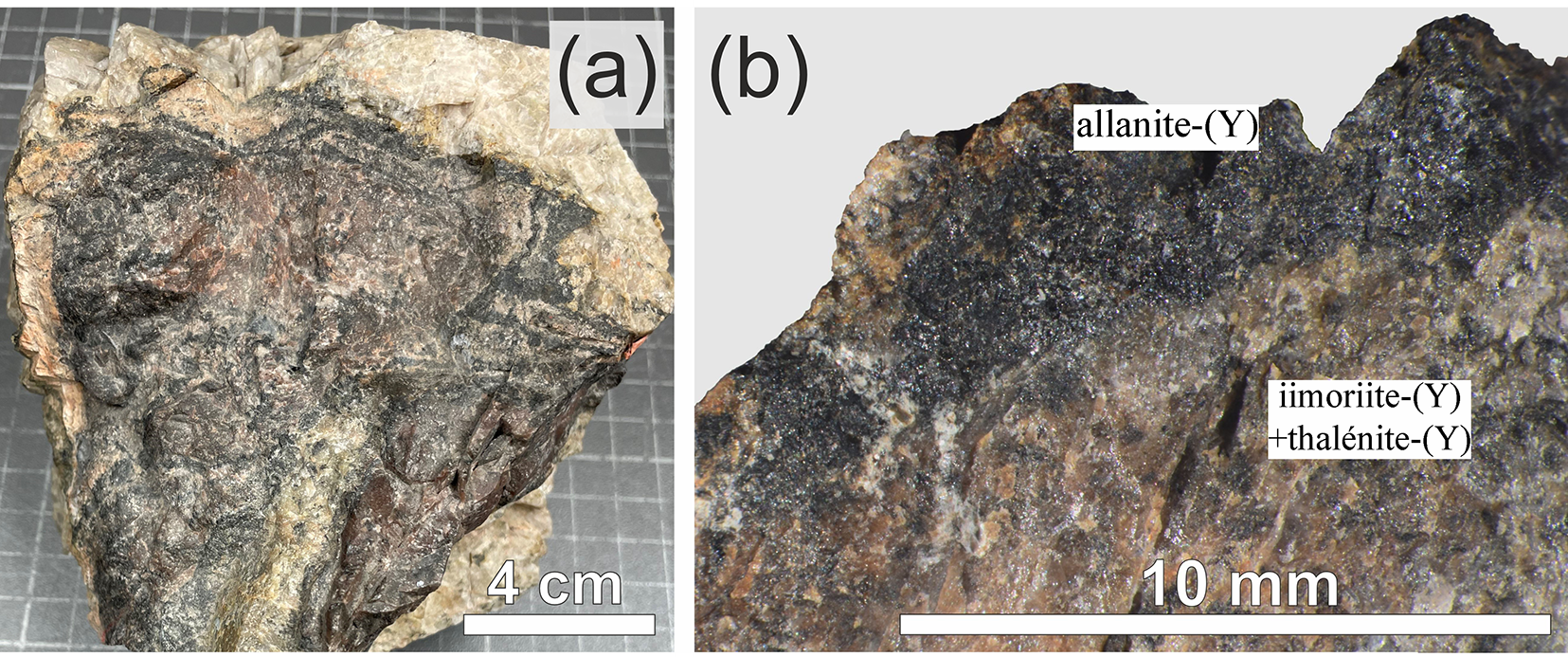
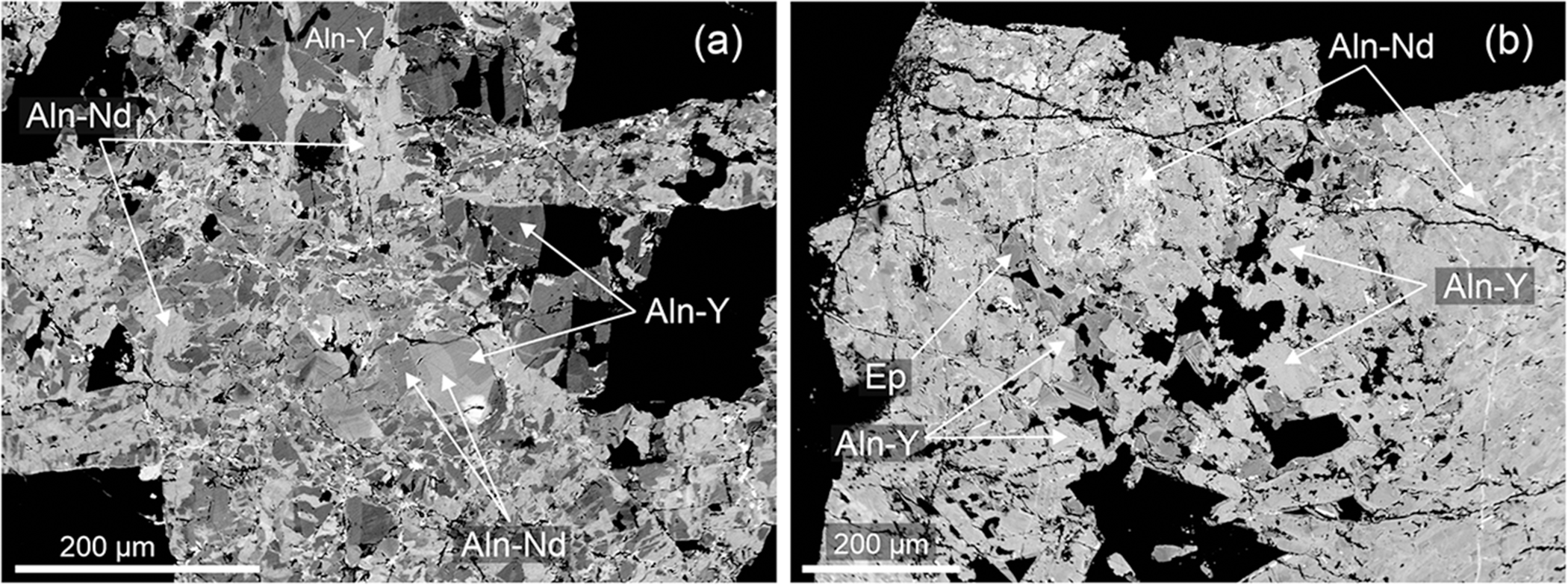
Examination of the sample NHM028251 (Fig. 1a) using back-scattered electrons (BSE) (Fig. 2) showed its extreme chemical heterogeneity. Therefore, this sample was analysed using only electron probe microanalyses (EPMA), and was not used for the further studies. From the material collected at the locality by authors (Fig. 1b), several samples with centimetre-sized fragments of thalénite-(Y) altered grains with macroscopically visible black rims of allanite-group minerals were initially examined using EDX scanning electron microscopy; from ca. ten samples only two contained a few millimetre-sized domains with allanite-(Y). In the remaining ones the black rims correspond to allanite-(Nd). Samples with the allanite-(Y) domains were mounted in an epoxy disc and analysed using EPMA. This material was more chemically homogeneous than sample NHM028251; therefore, allanite-(Y) crystals for single-crystal X-ray diffraction and optics (sample RS007), and powder for Mössbauer spectroscopy (sample RSMS) were separated from this material.
Images of allanite-(Y) samples: (a) sample NHM028251 of Neumann and Nilssen (Reference Neumann and Nilssen1962); and (b) the studied sample chosen from the collected material. Photos by H. Friis and R. Škoda.
Back-scattered electron (BSE) images of allanite-(Y) from the Åskagen pegmatite. (a) Heterogeneous patchy-zoned allanite-(Y) and allanite-(Nd) (shades of dark grey in BSE) replaced by the late-stage allanite-(Nd) (brightest grey in BSE) in the sample NHM028251. The dark colour of one of the allanite-(Nd) grains is caused by high Ca content and boundary Y/(Y+Nd) ratio (∼0.48). (b) Patchy-zoned allanite-(Y) (sample RS007, source material for SC-XRD) replaced by fracture-filling allanite-(Nd) and later void-filling oscillatory-zoned crystals of REE-rich epidote.
Unless specifically referred as holotype sample, all data presented in this study refer to the samples collected by authors at the locality. Technically, the sample NHM028251 first studied by Neumann and Nilssen (Reference Neumann and Nilssen1962) is the holotype of allanite-(Y). As the sample B12614 allowed the first detailed characterisation of the allanite-(Y) species, it should be regarded as the co-type.
57Fe Mössbauer spectroscopy
The transmission 57Fe Mössbauer spectrum of powdered allanite-(Y) (ground under acetone in an agate mortar) was recorded in a constant acceleration mode at room temperature using a MS2007 instrument (Pechoušek et al., Reference Pechoušek, Procházka, Jančík, Frydrych and Mashlan2010), equipped with a 57Co(Rh) source and a fast YAlO3:Ce detector. The isomer shift value was calibrated against an α-Fe foil. The spectrum was fitted with Lorentz functions (Table 1) using the computer program CONFIT2000 (Žák and Jirásková, Reference Žák and Jirásková2006).
Results of room-temperature Mössbauer spectroscopy

Note: δ = isomer shift (± 0.25 mm.s–1), ΔEQ = quadrupole splitting (± 0.25 mm.s–1), Γ = peak width (± 0.25 mm.s–1).
Electron microprobe
The polished discs with allanite aggregates were analysed using a CAMECA SX100 electron probe microanalyser in the Electron Microprobe Laboratory of the Department of Geological Sciences, Masaryk University, Brno. Allanite-(Y) was analysed in wavelength-dispersive mode, with an accelerating voltage of 15 kV, a beam current of 20 nA, and a beam size 3 μm. The chemical composition, detection limits and standard deviations of allanite-(Y) are listed in Table 2. The following standards, lines, and monochromators were used for the measurement of allanite-(Y): sanidine (Si, Al; Kα/TAP), anatase (Ti; Kα/LPET), YAG (Y; Lα/TAP), LaPO4 (La; Lα/LPET), CePO4 (Ce; Lα/LPET), PrPO4 (Pr; Lβ/LLIF), NdPO4 (Nd; Lβ/LLIF), SmPO4 (Sm; Lβ/LLIF), GdPO4 (Gd; Lα/LLIF), TbPO4 (Tb; Lα/LLIF), DyPO4 (Dy; Lβ/LLIF), HoPO4 (Ho; Lβ/LLIF), ErPO4 (Er; Lα/LLIF), YbPO4 (Yb; Lα/LLIF), andradite (Fe, Ca; Kα/LLIF, LPET), Mn2SiO4 (Mn; Kα/LLIF), Mg2SiO4 (Mg; Kα/TAP), albite (Na; Kα/TAP).
Contents of other elements with atomic numbers >8 (including Eu, Tm and Lu) are below detection limits. The peak counting times varied from 10 s for main elements to 60 s for minor elements and high and low energy background was counted for a ½ of the peak counting time of a relevant analytical line. Empirically determined correction factors were applied to the inter-REE coincidences. Matrix correction using the X-PHI algorithm (Merlet, Reference Merlet1994) was applied to the data.
The mineral formula was calculated based on the sum of cations at the (A+ M + T) sites = 8 atoms per formula unit (apfu). The Fe oxidation state was determined using Mössbauer spectroscopy as Fe2+ only (see below); however, the elevated Ca contents (∼1.1–1.3 apfu) requires the presence of equivalent Fe3+ contents (epidote component). The final Fe3+/Fe2+ ratios and H2O contents (Table 2) were therefore calculated based on the ideal stoichiometry with 13 anions and OH = 1 apfu.
Selected representative chemical compositions of the allanite-(Y) and the mean composition used for SC-XRD refinement
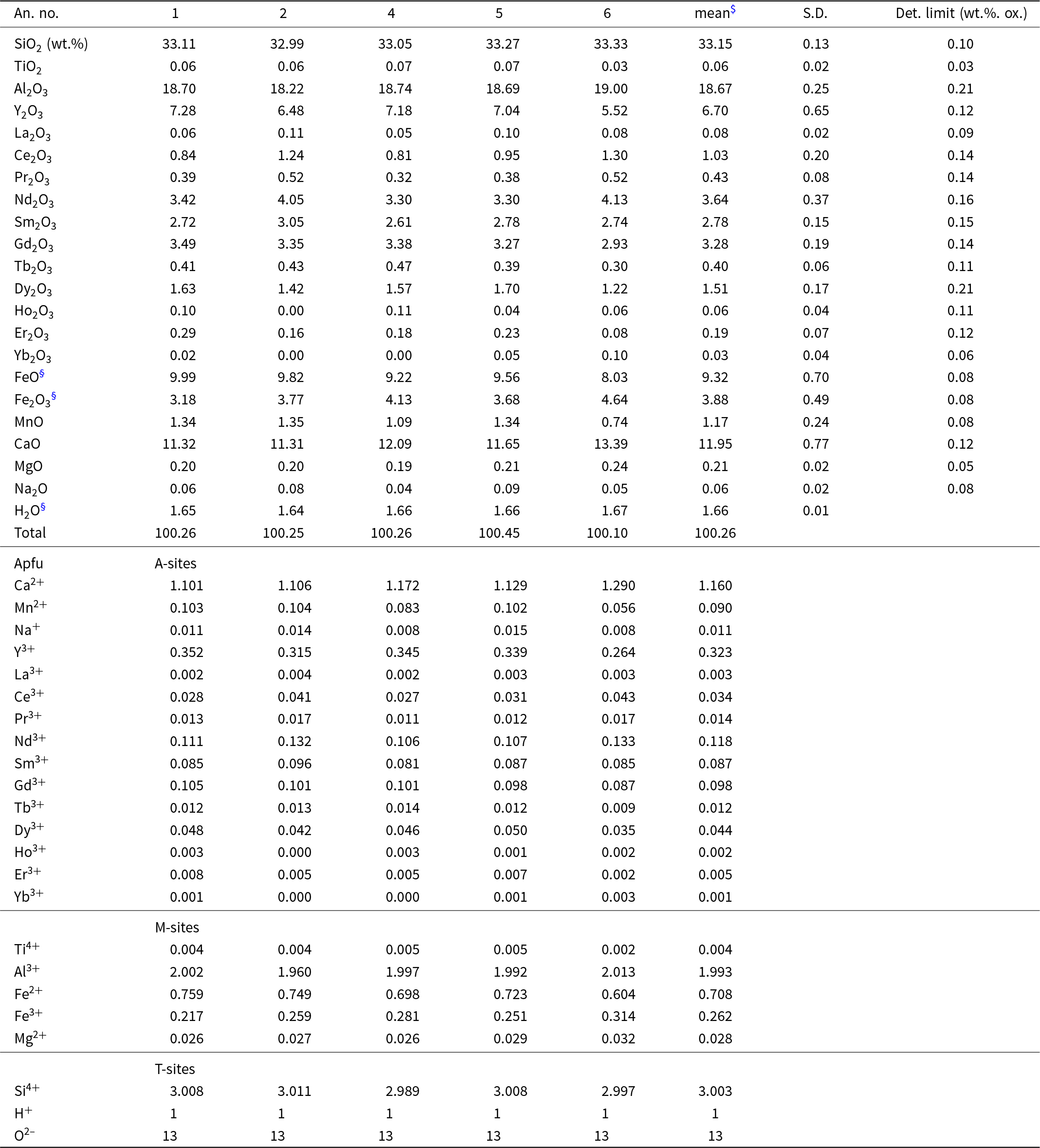
$ used for SC-XRD; n = 5.
§ calculated based on the ideal stoichiometry.
Raman spectroscopy
The Raman spectra of allanite-(Y) were obtained by means of a Horiba Labram HR Evolution spectrometer. This dispersive, edge-filter-based system is equipped with an Olympus BX 41 optical microscope, a diffraction grating with 600 grooves per millimetre, and a Peltier-cooled, Si-based charge-coupled device (CCD) detector. The Raman signal was excited by a 532 nm laser. The nominal laser beam energy of 50 mW was attenuated to 10% using a neutral density filter to avoid the thermal damage of the analysed area. Wavenumber calibration was done using the Rayleigh line and low-pressure Ne-lamp emissions. The wavenumber accuracy was < 0.5 cm–1, and the spectral resolution was ∼2 cm–1. The Raman signal was collected with a 100× objective with the system operated using confocal mode; beam diameter was ∼2.6 μm and the axial resolution ∼5 μm. Time acquisition was 120 s per spectral window, 4 accumulations and 7 spectral windows were applied to cover the 100–4000 cm–1 range. Some of the features observed in the 1800–4000 cm–1 region might be caused by REE-induced luminescence (Lenz et al., Reference Lenz, Nasdala, Talla, Hauzenberger, Seitz and Kolitsch2015); therefore, we verified the spectrum shape in the OH region using the 473 nm laser. Band fitting was done after appropriate background correction, assuming combined Lorentzian-Gaussian band shapes using the Voight function (PeakFit; Jandel Scientific Software).
Single-crystal X-ray diffraction
An optically anisotropic fragment of allanite-(Y) was selected for the single-crystal X-ray diffraction (SC-XRD) study. Single-crystal X-ray diffraction measurements of Åskagen allanite-(Y) were done at Dipartimento di Scienze della Terra, Sapienza Università di Roma, using a Bruker KAPPA APEX-II single-crystal diffractometer equipped with a Photon II CCD area detector and a graphite crystal monochromator, using MoKα radiation from a fine-focus sealed X-ray tube. Final unit-cell parameters were refined by means of the Bruker AXS SAINT program using reflections with I > 2σI in the range 8.2° < 2θ < 80.6°. The intensity data were processed and corrected for Lorentz, polarisation, and background effects with the APEX3 software program of Bruker AXS. The data were corrected for absorption using a multi-scan method (SADABS). Data collection and reduction details are summarised in Tables 3 and 4.
Crystal data for allanite-(Y)
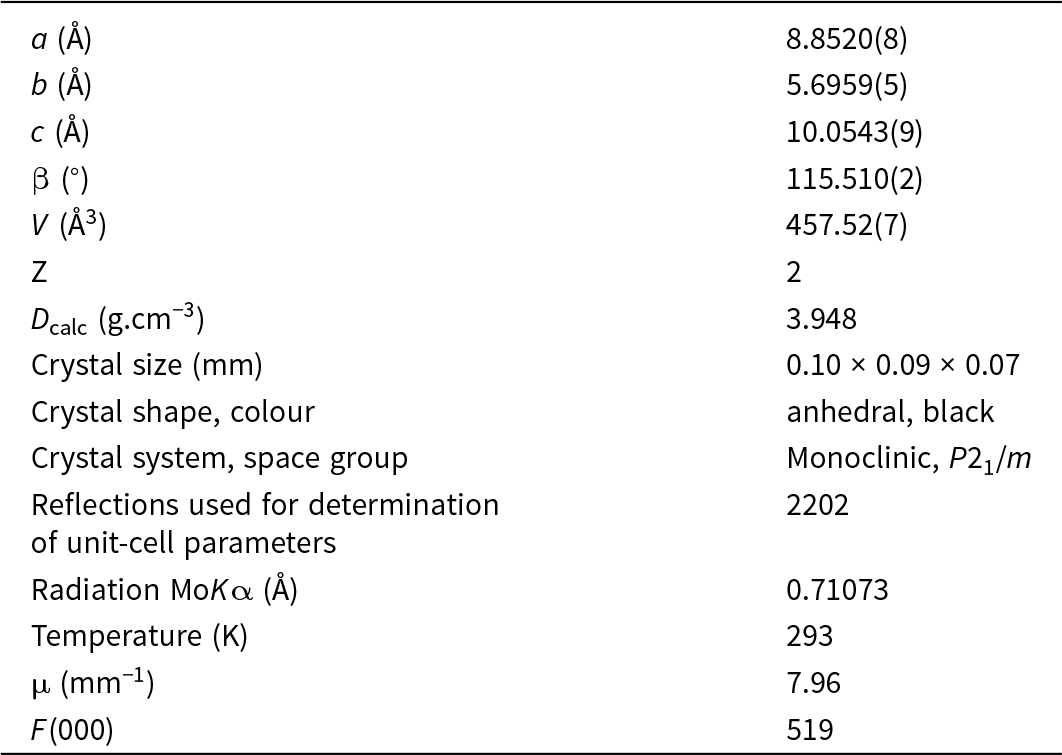
SC-XRD data collection and refinement parameters
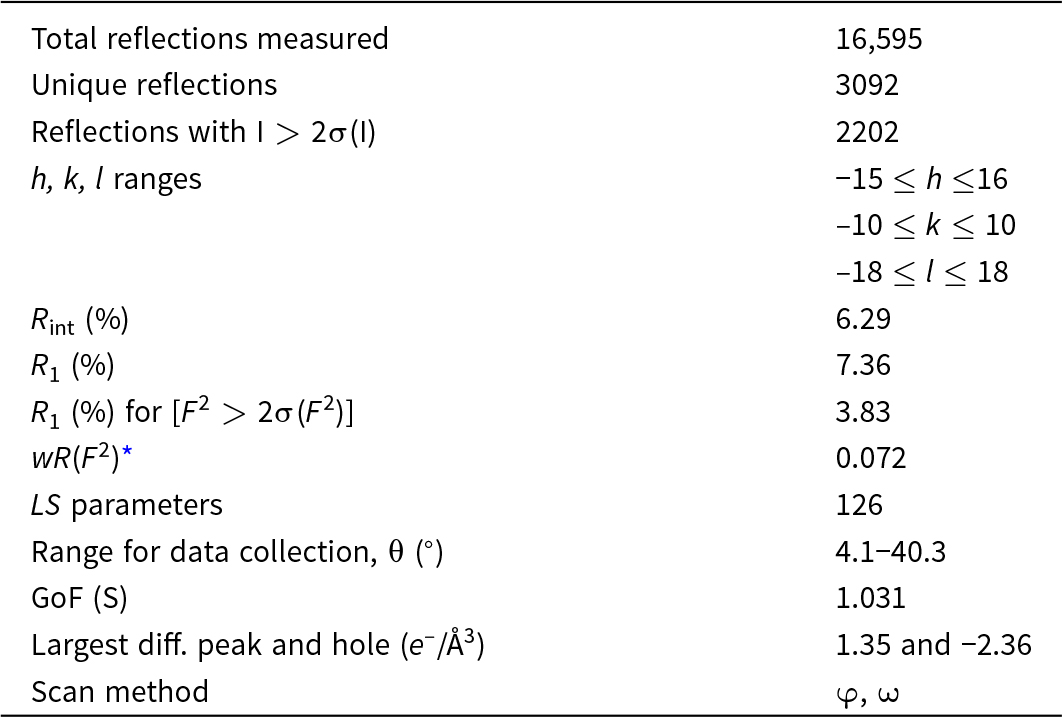
* Weighting scheme: w = 1/[σ2(F o2) + (0.024P)2 + 0.8556P] where P = (F o2 + 2F c2)/3
Appearance and physical properties
Allanite-(Y) forms black crystalline aggregates rimming altered grains of former primary thalénite-(Y); the assemblage formed by intensive replacement of thalénite-(Y) by allanite-group minerals and iimoriite-(Y) (Fig. 1). The size of individual grains does not exceed 1 mm. The individual grains are characterised by a black colour with vitreous lustre and greyish-brown streak. The very thin translucent fragments have a dark brown tint. The crystals are typically non-fluorescent, brittle with imperfect cleavage along {001} and conchoidal fracture, and locally altered. The refractive indices and optical properties were determined using a spindle stage and 589 nm light source by the Δt-variation immersion method and dispersion staining. Refractive indices of the immersion liquid were determined using the smithsonite micro-refractometer directly in the immersion cell.
The density calculated using the observed cell volume and empirical formula is D calc = 3.945 g.cm–3. Allanite-(Y) is biaxial (–) with α = 1.760(3), β = 1.784(3) and γ = 1.799(2) measured using a 589 nm bandpass filter. The angle 2V was measured using the spindle stage extinction data process by EXCALIBRW (Gunter et al., Reference Gunter, Bandli, Bloss, Evans, Su and Weaver2004) is 55(2)°. Dispersion is distinct r > v. Allanite-(Y) is weakly pleochroic, pale yellowish-brown colour with absorption Z∼Y>X.
The compatibility index reflecting the difference between the physical (Kp) and the chemical specific-refractivity (Mandarino, Reference Mandarino1981) is 0.001, corresponding to the superior category. Table 5 shows a comparison of the allanite-(Y) optical properties with other members of the allanite group.
Comparison of allanite-(Y) optical properties with other allanite-group minerals
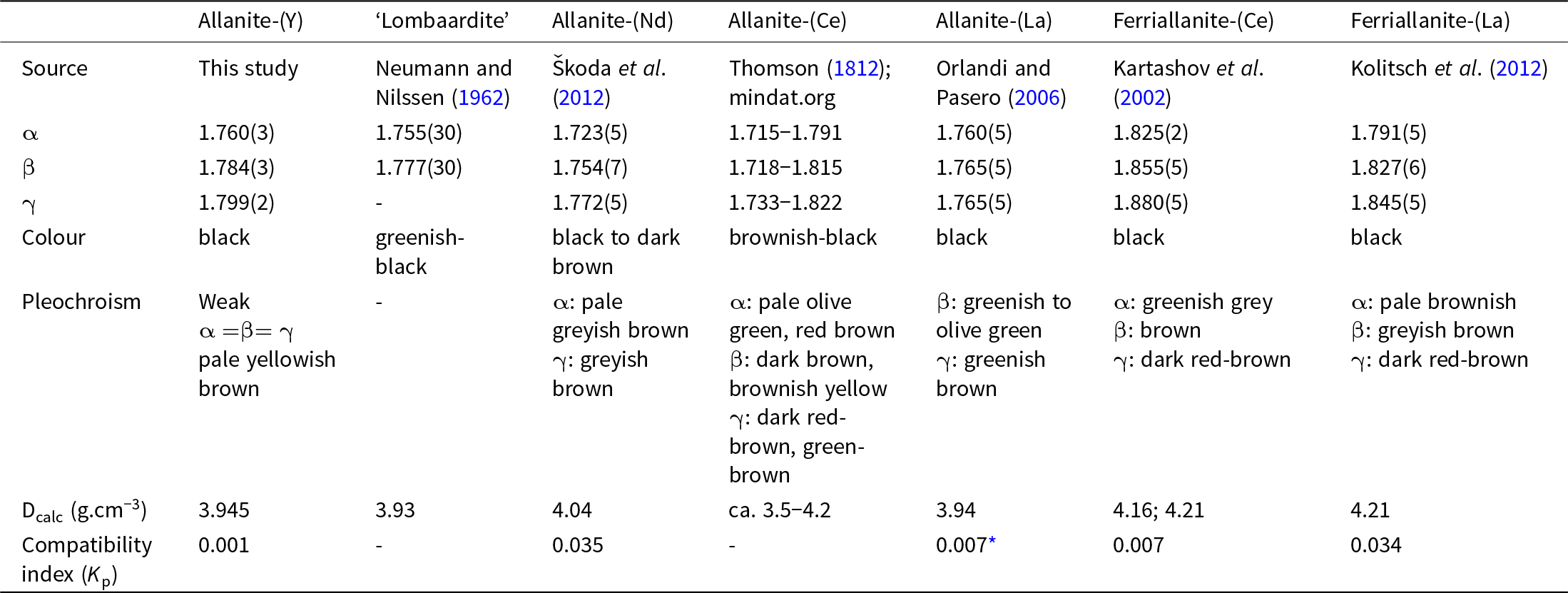
* Not given in the original paper
Mössbauer spectroscopy
The acquired spectrum was fitted with one doublet corresponding to [6]Fe2+ (Fig. 3, Table 1). Iron atoms are thought to occupy up to three independent octahedral sites in the allanite structure (e.g. Kartashov et al., Reference Kartashov, Ferraris, Ivaldi, Sokolova and McCammon2002; and references therein). In the observed 57Fe Mössbauer spectrum, Fe3+ was not clearly evident. However, its presence is expected based on the elevated Ca contents (∼1.1–1.3 apfu; Table 2) in the allanite-(Y) studied and based on studies of related minerals in the Åskagen pegmatite such as ferriallanite-(Ce), åskagenite-(Nd) and allanite-(Nd) (cf. Kartashov et al., Reference Kartashov, Ferraris, Ivaldi, Sokolova and McCammon2002; Chukanov et al., Reference Chukanov, Göttlicher, Möckel, Sofer, Van and Belakovskiy2010; Škoda et al., Reference Škoda, Cempírek, Filip, Novák, Veselovský and Čtvrtlík2012), where Fe3+ is typically assigned to the less distorted M1 polyhedron (Škoda et al., Reference Škoda, Cempírek, Filip, Novák, Veselovský and Čtvrtlík2012). Small amounts of Fe3+ could also be expected from residua at the low-velocity part of the spectrum (not fitted owing to low quality of the spectrum); these, however, could also indicate the presence of other spectral components representing impurities/admixtures of other Fe-bearing minerals. Therefore, we interpret the Fe oxidation state in the observed spectrum of allanite-(Y) as Fe2+ only; the absence of the Fe3+ doublet might be due to the weak signal resulting in the high background (Fig. 3).
Room-temperature Mössbauer spectrum of allanite-(Y).
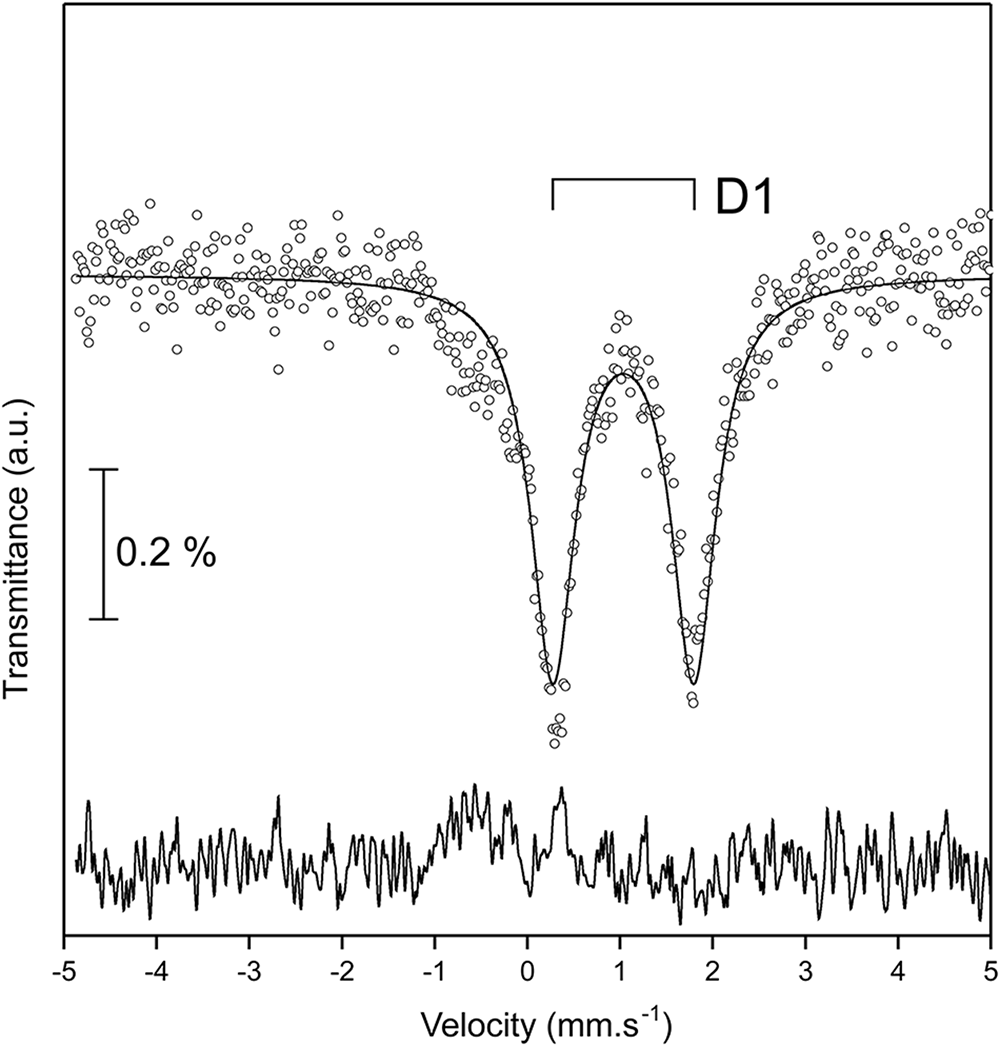
The Fe2+ doublet in the 57Fe Mössbauer spectrum of allanite-(Y) indicates that ferrous iron atoms are present almost exclusively in the most distorted M3 polyhedron (as previously suggested by Dollase, Reference Dollase1971), probably with different next-nearest-neighbour configurations of atoms (i.e. M1, A1, T, and especially A2 sites with multiple different occupants and differing significantly in electron densities; cf. Ca vs. REEs) as obvious from the broad spectral line (0.575 mm/s). The presence of Fe2+ at the M3 site is in accordance with the results of structure refinement (see below). Values of isomer shift δ = 1.035 mm/s and quadrupole splitting ΔEQ = 1.520 mm/s for the Fe2+ doublet are comparable to hyperfine parameters published for Fe2+ at the M3 site of ferriallanite-(Ce) (Kartashov et al., Reference Kartashov, Ferraris, Ivaldi, Sokolova and McCammon2002).
Chemical composition
The chemical composition of the epidote-supergroup minerals rimming altered thalénite-(Y) is highly heterogeneous and varies from allanite-(Y) to allanite-(Nd) with the rare presence of REE-rich epidote (Figs 2 and 4). The chemical composition of allanite-(Y) from samples RS007 and RSMS varies moderately, mainly due to the distribution of Ln+Y, and Ca/REE ratio variation (Fig. 4a,b), but Y is always dominant among REE in the material studied (Fig. 4a). This variability is represented by patchy zoning in the BSE image (Fig. 2). The ternary diagram of Ce, Y and Nd (Fig. 4a) shows a high variability among Y and Nd, forming a continuous compositional trend from allanite-(Y) to Ce-rich allanite-(Nd). Unpublished analyses of allanite-(Y) to allanite-(Nd) acquired during the study of allanite-(Nd) from the same locality and paragenesis by Škoda et al. (Reference Škoda, Cempírek, Filip, Novák, Veselovský and Čtvrtlík2012) were used to supplement the compositional field.
Compositional diagrams for allanite-(Y) from the black rims around decomposed thalénite-(Y). (a) The ternary diagram showing the relative content of Y against Nd and Ce; (b) The Altot vs. REE diagram showing solid solutions among the epidote- and allanite-group minerals. The grey lines are isolines for the Fe3+/(Fe3+ + Fe2+) ratios indicated by grey numbers (after Ondrejka et al., Reference Ondrejka, Putiš, Uher, Schmiedt, Pukančík and Konečný2016).
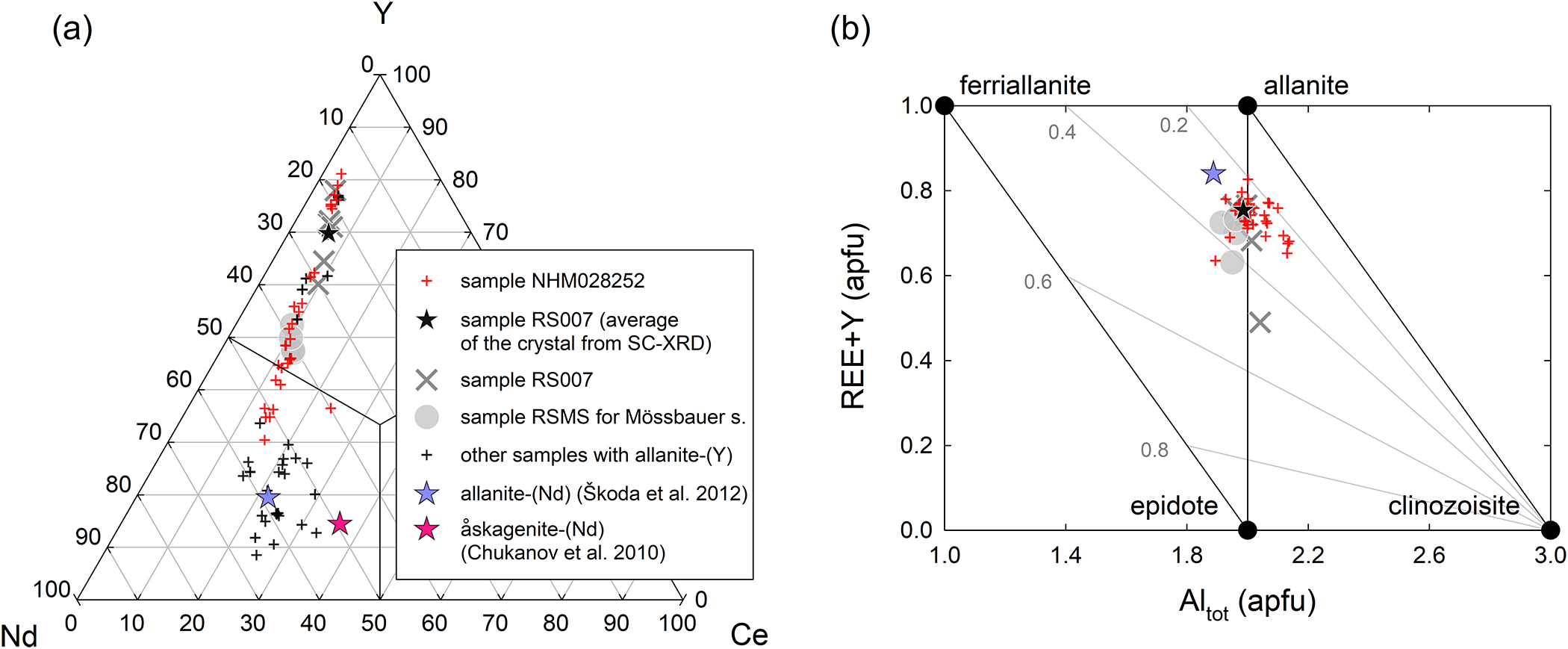
Crystal chemistry of allanite-(Y) from sample RS007 (source material for the SC-XRD study; n = 5) is characterised by a good stoichiometry (cation assignment after Armbruster et al., Reference Armbruster, Bonazzi, Akasaka, Bermanec, Chopin, Gieré, Heuss-Assbichler, Liebscher, Menchetti, Pan and Pasero2006). The T-sites are almost fully occupied by Si4+ (2.96–3.01 apfu). A slight deficiency in Si4+ may be compensated by minor amount of Al3+ at the T3 site (e.g. Ercit, Reference Ercit2002). The M-sites are dominated by Al3+ (1.96–2.01 apfu), Fe2+ (0.60–0.76 apfu), and Fe3+ (0.22–0.32 apfu), with minor Mg2+ (up to 0.032 apfu) and Ti4+ (up to 0.009 apfu). The A1-site is dominated by Ca2+ (0.88–0.97 apfu) and minor Mn2+ and Na+. The A2-site is occupied by dominant Y3+ (0.26–0.35 apfu), Ca2+ (0.22–0.32 apfu) and Ln cations, especially by Nd3+ (0.11–0.15 apfu), Sm3+ (0.08–0.11 apfu) and Gd3+ (∼0.11 apfu); the content of remaining REE cations is 0.11–0.14 apfu (see Table 2). The presence of Ca2+ along with trivalent cations at the A2-site is compensated by exchange of Fe3+ for a divalent cation at the M3-site to maintain the electroneutral formula; the substitution can be expressed as Ca2+ + (Fe3+, Al3+) ↔ REE3+ + (Fe2+, Mg2+) (Bonazzi and Menchetti, Reference Bonazzi and Menchetti1994).
The resulting empirical formula using the site distribution from the structural refinement below, is:
A1(Ca0.900Mn0.090Na0.010)Σ1.000A2(Y0.323Ca0.260Nd0.118Sm0.087Gd0.098Dy0.044Ce0.034Pr0.014Tb0.012Er0.005La0.003Ho0.002Yb0.001)Σ1.001 M1(Al0.921Fe2+0.070Ti0.003)Σ0.994M2(Al1.000)M3(Fe2+0.638Fe3+0.262Al0.072Mg0.028)Σ1.000T1(Si1.000)T2(Si1.000)T3(Si1.003)O12.000(OH)1.000.
The ideal formula is CaY(Al2Fe2+)(Si2O7)(SiO4)O(OH), which requires CaO 10.54, Y2O3 21.22, Al2O3 19.16, FeO 13.50, SiO2 33.88, H2O 1.69, total 100.00 wt. %.
Raman spectra
Raman spectra of allanite-(Y) are visually similar to those published for well-crystalline allanite-group minerals (e.g. Škoda et al., Reference Škoda, Cempírek, Filip, Novák, Veselovský and Čtvrtlík2012; Čopjaková et al., Reference Čopjaková, Škoda, Galiová, Novák and Cempírek2015; Sobek et al., Reference Sobek, Losos, Škoda, Holá and Nasdala2023).
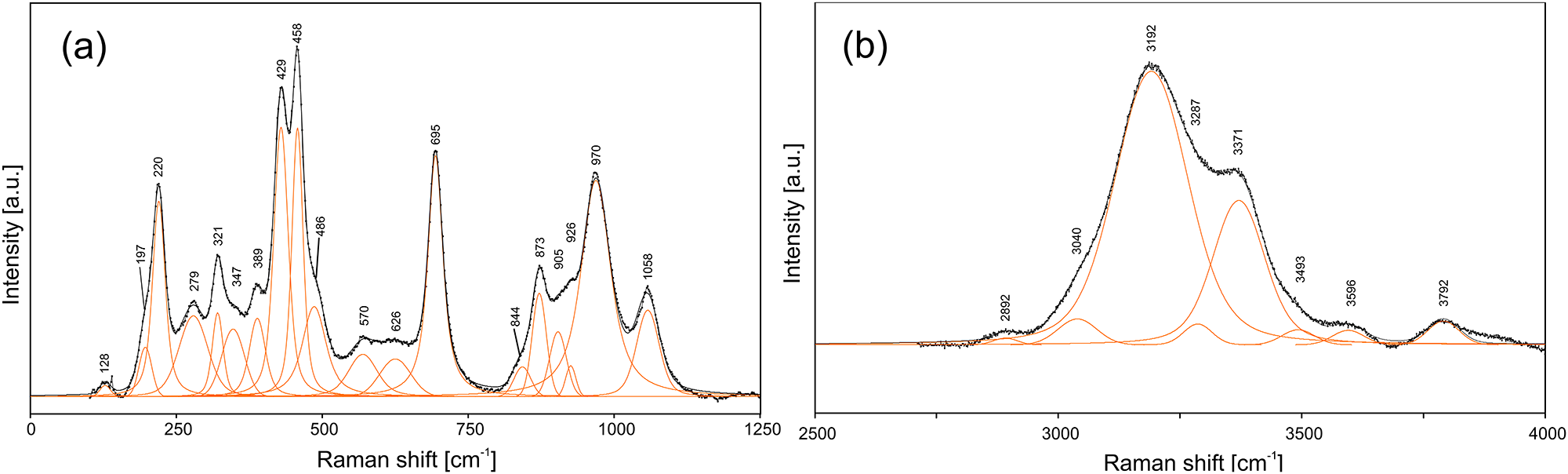
The Raman bands of allanite-(Y) were tentatively assigned according to Makreski et al. (Reference Makreski, Jovanovski, Kaitner, Gajović and Biljan2007), Nagashima and Mihailova (Reference Nagashima and Mihailova2023) and Sobek et al. (Reference Sobek, Losos, Škoda, Holá and Nasdala2023). The region 1058–844 cm–1 arises from symmetric and anti-symmetric stretching vibrations Si–O from (Si2O7)6– and (SiO4)4– groups (Fig. 5a). The strong band at 695 cm–1 and bands at 570 and 626 cm–1 represent antisymmetric stretching vibrations and deformation modes of Si–O–Si, respectively. The region of 486–321 cm–1 comprises several overlapping bands belonging to vibrational modes of M–O, and to Si–O–Si bending modes. The vibrations at lower frequencies correspond to lattice modes. The two major vibration bands in the OH region (Fig. 5b) originate from stretching of the O10–H10···O4 hydrogen bond; the wide range of the OH region and broad band shapes can be explained by the observed variability in atom occupancy and charge (Y+REE3+ vs. Ca2+) at the A2 site bonded to the O10 oxygen. The weak bands above 3450 cm–1 are of questionable origin; Nagashima et al. (Reference Nagashima, Morifuku and Mihailova2024) interpreted them as a result of the O10–H10···O2 hydrogen bond.
Raman spectra of allanite-(Y): (a) region 100–1250 cm–1; (b) region 2500–4000 cm–1.
Crystal structure refinement and bond valence optimisation
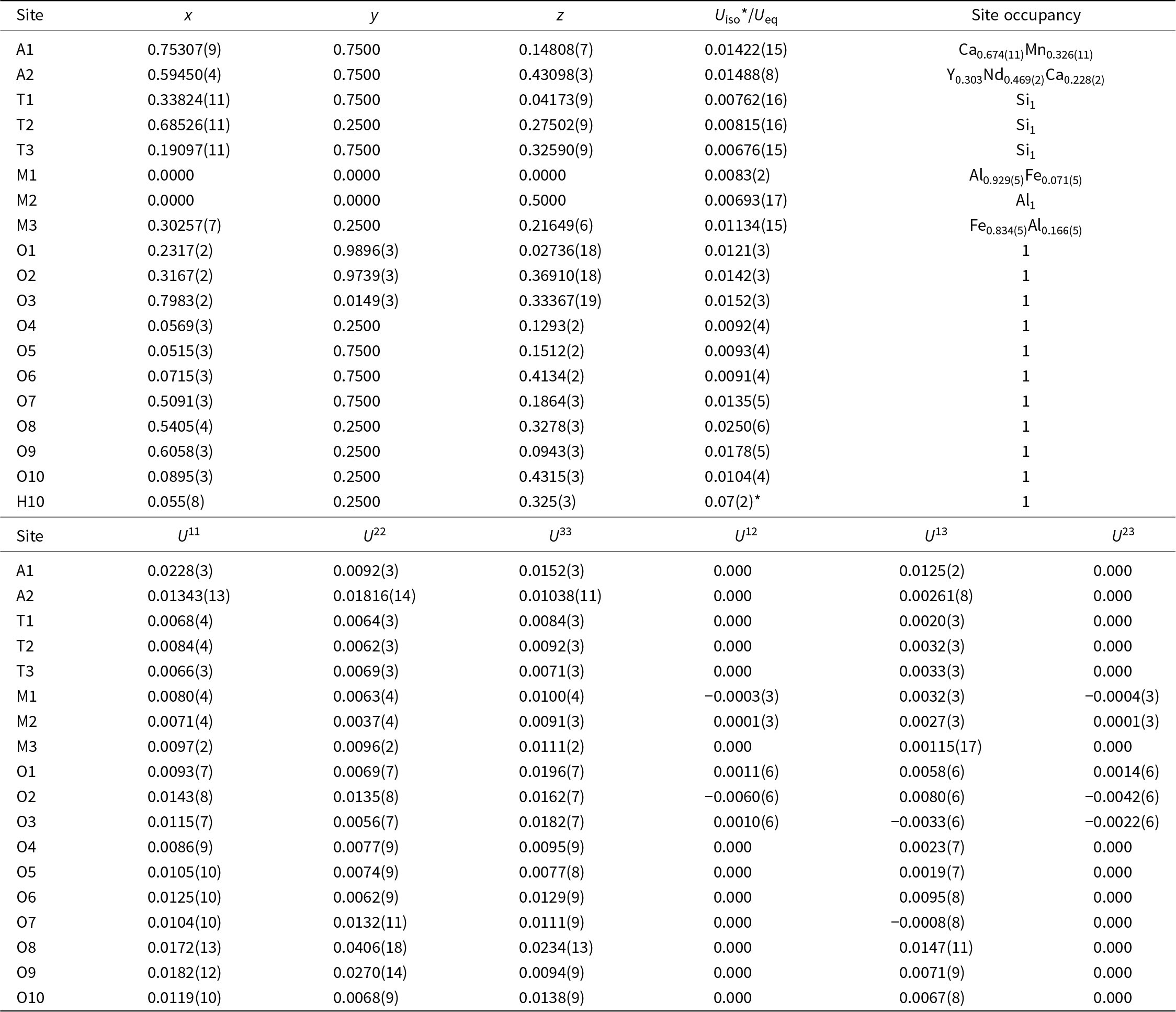
The allanite-(Y) structure was refined in space group P21/m using the SHELXL-2013 program (Sheldrick, Reference Sheldrick2015) employing neutral scattering factors for cations and ionised scattering factors for oxygen atoms. After refinement of the isotropic model, anisotropic refinement was carried out. The final R index is 3.83%. Occupancies of A1-, A2-, M1- and M3-cation sites were refined as free variables. Occupancies of A2, M1 and M3 sites were refined using two major elements at the respective sites, i.e., Ca vs Nd with fixed Y at the A2 site, and Al vs Fe at the M1, M3 sites. The hydrogen atom was located in a difference-Fourier map. Final fractional atom coordinates, site occupancies and displacement parameters are listed in Table 6. The crystallographic information file has been deposited with the Principal Editor of Mineralogical Magazine and is available as Supplementary material (see below).
Fractional atomic coordinates, isotropic/equivalent isotropic displacement parameters (Å2), and anisotropic atomic displacement parameters (Å2) of allanite-(Y)
The results were used for assignment of real compositions to the refined structure with the bond-valence model (Brown, Reference Brown2016) using bond-valence parameters provided by Gagné and Hawthorne (Reference Gagné and Hawthorne2015), Mössbauer spectra of bulk allanite-(Y), and the refined electron densities on individual sites. All Mn was placed at the A1 site, iron was treated as Fe2+ for both M1 and M3 sites. Bond lengths and bond valence parameters of the refined formula are listed in Tables 7 and 8. The comparison of mean bond lengths of allanite-(Y) with other allanite-group minerals is listed in Table 9. Powder diffraction data generated using PLATON (Spek, Reference Spek2003) from the observed SC-XRD intensities as well as theoretical values based on the final structure model are provided in Table 10.
Bond distances (Å) of allanite-(Y)
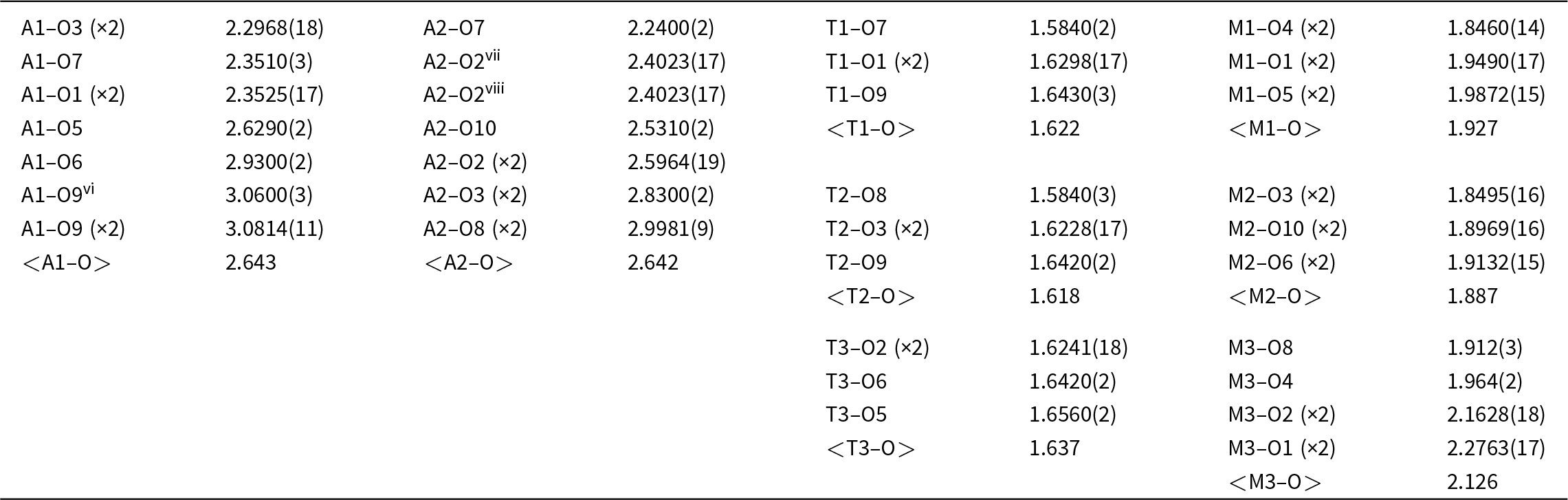
Symmetry codes: (vi) −x+1, −y+1, −z; (vii) −x+1, −y+2, −z+1; (viii) −x+1, y−½, −z+1.
Empirical weighted bond valences (in valence units, vu) and other structural site parameters for allanite-(Y)*
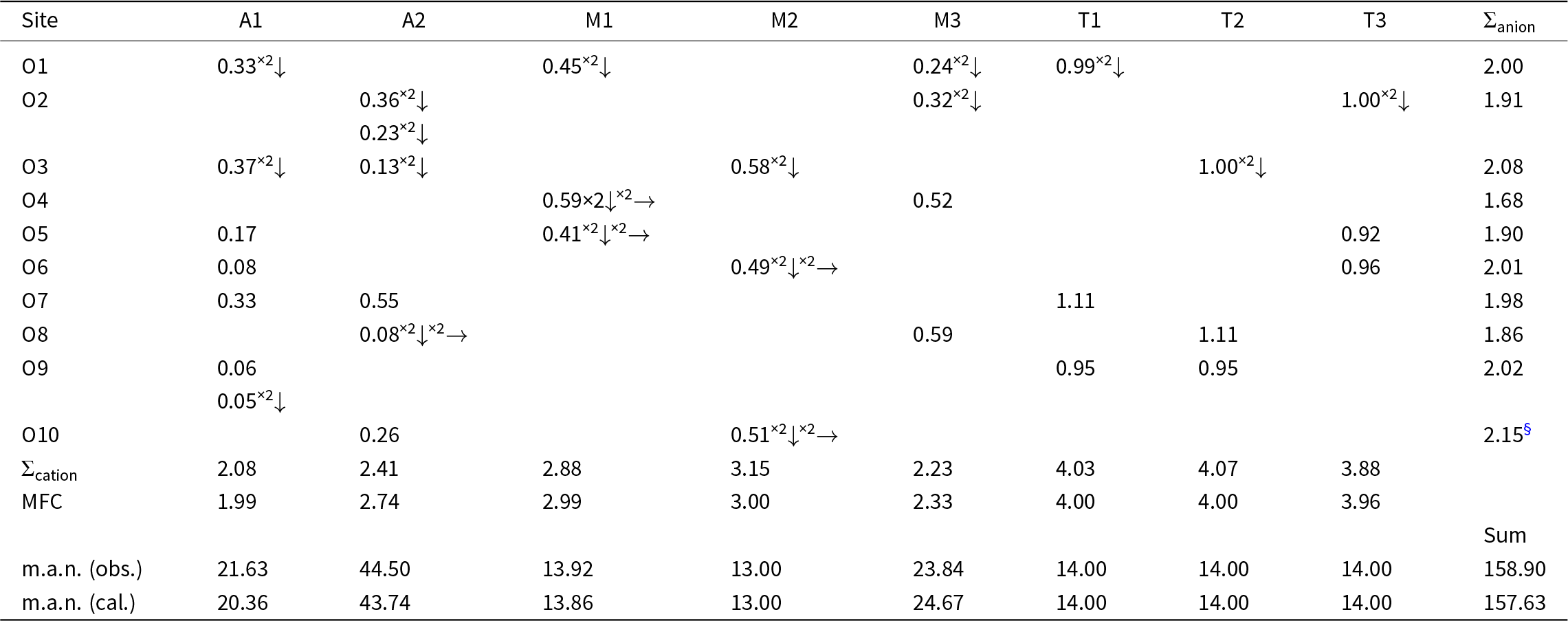
* Note: MFC = mean formal charge; m.a.n. = mean atomic number; obs. = observed; cal. = calculated.
§ Includes 0.87 vu contribution from H10.
Comparison of structural parameters and mean bond lengths of allanite-(Y) with other allanite-group minerals
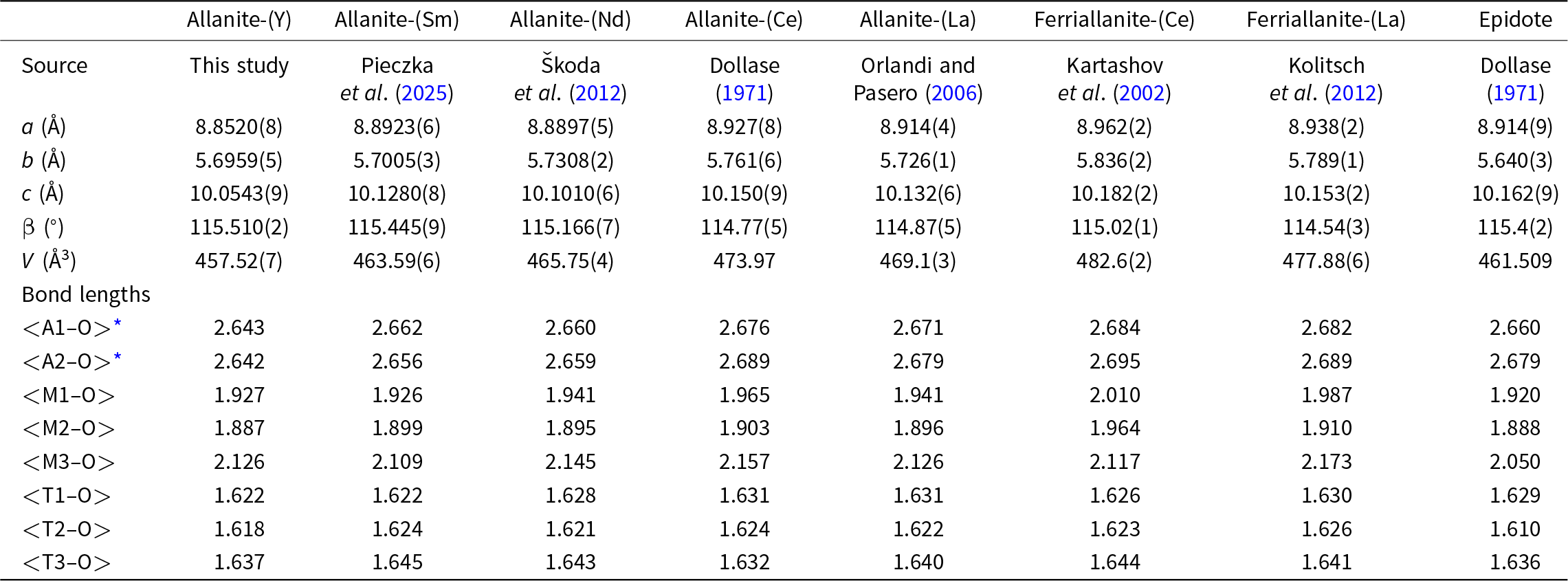
* averages for ten-fold coordination
Calculated powder X-ray diffraction data (d calc in Å) for allanite-(Y) from Åskagen
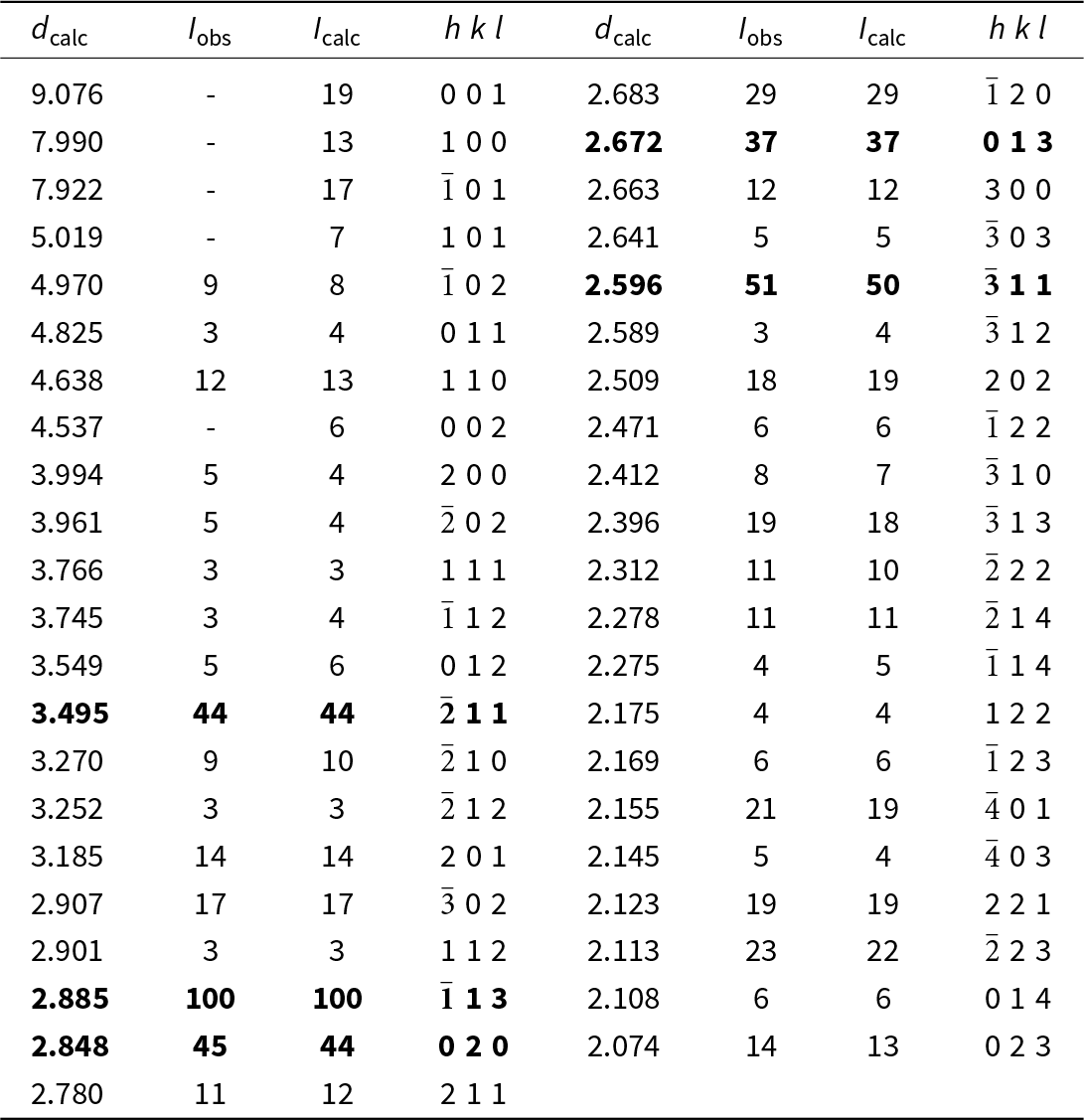
Notes: Bold – strongest reflections. Lines with I calc < 3 are not shown. The I obs values were generated from the observed single-crystal XRD intensities whereas I calc are theoretical values based on the refined structure model.
The allanite-(Y) structural parameters are in good agreement with other minerals of the allanite group (e.g. Dollase, Reference Dollase1971; Bonazzi and Menchetti, Reference Bonazzi and Menchetti1994, Reference Bonazzi and Menchetti1995; Kartashov et al., Reference Kartashov, Ferraris, Ivaldi, Sokolova and McCammon2002; Franz and Liebscher, Reference Franz and Liebscher2004; Orlandi and Pasero, Reference Orlandi and Pasero2006; Bonazzi et al., Reference Bonazzi, Holtstam, Bindi, Nysten and Capitani2009; Kolitsch et al., Reference Kolitsch, Mills, Miyawaki and Blass2012; Škoda et al., Reference Škoda, Cempírek, Filip, Novák, Veselovský and Čtvrtlík2012; Pieczka et al., Reference Pieczka, Gołębiowska, Włodek, Stachowicz, Jokubauskas, Kotowski, Nejbert, Szuszkiewicz and Woźniak2025; see also Table 9). The change of the unit cell parameters shows a linear increase from allanite-(Y) through allanite-(Sm), allanite-(Nd) to allanite-(Ce); however, those of allanite-(La), ferriallanite-(La) and ferriallanite-(Ce) significantly deviate from the trend, most likely due to their variability in occupancies of the M1- and M3-sites. The unit cell volume and mean octahedral and tetrahedral bond-lengths are shorter than those representative for allanite-ferriallanite (Table 9); this results from the absence of REE ions with a large ionic radius (La3+, Ce3+) in allanite-(Y) that are dominant in most other samples. Incomplete A2 occupancy by REE and low total Fe content are other key factors that decrease the octahedral distances and unit cell volume (Bonazzi and Menchetti, Reference Bonazzi and Menchetti1995). The unit cell parameters of allanite-(Y) are similar to those of epidote (especially the b and V; see Table 9) which might be the key reason why Neumann and Nilssen (Reference Neumann and Nilssen1962) mistakenly related the Y-dominant allanite from Åskagen, Sweden, to the REE-free ‘lombaardite’ (most likely epidote) from Zaaiplaats tin mine, South Africa (Nel et al., Reference Nel, Strauss and Wickman1949).
The A1- and A2-sites feature six short bonds; the additional, more distant, 3 and 5 oxygen atoms are regarded as important bond carriers by various authors, resulting in coordination numbers ranging from 6 to 10 (A1 site) and 8 to 11 (A2 site), respectively (e.g. Dollase, Reference Dollase1971; Bonazzi and Menchetti, Reference Bonazzi and Menchetti1994, Reference Bonazzi and Menchetti1995; Kartashov et al., Reference Kartashov, Ferraris, Ivaldi, Sokolova and McCammon2002; Franz and Liebscher, Reference Franz and Liebscher2004; Orlandi and Pasero, Reference Orlandi and Pasero2006; Bonazzi et al., Reference Bonazzi, Holtstam, Bindi, Nysten and Capitani2009; Kolitsch et al., Reference Kolitsch, Mills, Miyawaki and Blass2012; Škoda et al., Reference Škoda, Cempírek, Filip, Novák, Veselovský and Čtvrtlík2012). The mean of 10 shortest bond lengths of the A1- and A2-sites (the coordination 6+4) are compared in Table 9. The A1-site is predominantly occupied by Ca2+ with minor Mn2+ and Na+. The presence of Mn2+ is also confirmed by the mean atomic number (21.63 e –) because a value higher than 20.0 e – is an indicator of a possible presence of Mn2+, Fe2+ or REE (Bonazzi and Menchetti, Reference Bonazzi and Menchetti1995). The mean <A1–O> bond length of 2.643 Å is hardly affected by presence of Mn because both cations have similar ionic radii. The A2-site hosts the Y3+ and REE3+, along with minor Ca2+; in allanite-(Y), the <A2–O> mean bond length is slightly lower (2.642 Å) than is usual in other allanite-group minerals (2.657–2.689 Å; Table 9). In addition to the lower ionic radius of Y compared to LREE, this is probably also caused by shortening of the <A2–O2> distance in order to compensate charge disbalance and maintain the electroneutrality of the structure (Bonazzi and Menchetti, Reference Bonazzi and Menchetti1995) as the presence of larger divalent cations at the M3-site (typically Fe2+ and Mg2+) moves the oxygen O2 towards the A2-octahedron (Bonazzi and Menchetti, Reference Bonazzi and Menchetti1994). The mismatch between the calculated bond valence sums (BVS) and MFC (Table 8) might be caused by heterogeneity of the measured crystal.
Discussion and implications
Composition of allanite-group minerals is typically dominated by Ce, La, or Nd (Gieré and Sorensen, Reference Gieré and Sorensen2004; Armbruster et al., Reference Armbruster, Bonazzi, Akasaka, Bermanec, Chopin, Gieré, Heuss-Assbichler, Liebscher, Menchetti, Pan and Pasero2006; Orlandi and Pasero, Reference Orlandi and Pasero2006; Škoda et al., Reference Škoda, Cempírek, Filip, Novák, Veselovský and Čtvrtlík2012) whereas HREE and Y are usually low. Predominance of Y over individual LREE at Åskagen shows that Y fractionation is not always caused by structural constraints of the allanite-group (or epidote-supergroup) minerals but largely depends on the local system composition.
Allanite-group minerals commonly occur in a metamict state. Metamictisation, a radiation-induced amorphisation of the pristine crystalline lattice, is a cumulative function of the actinide content and a geological time (Gieré and Sorensen, Reference Gieré and Sorensen2004; Beirau et al., Reference Beirau, Paulmann and Bismayer2011). In the Åskagen pegmatite, primary thalénite-(Y) (of low actinide content) is associated with metamict gadolinite-(Y) and large magmatic crystals of metamict allanite-(Nd) and åskagenite-(Nd) characterised by elevated actinide contents (≤0.15 wt.% UO2 and ≤1.26 wt.% ThO2; Chukanov et al., Reference Chukanov, Göttlicher, Möckel, Sofer, Van and Belakovskiy2010 and unpublished data of the authors). On the other hand, allanite-(Y) has low actinide content (usually below the detection limit of the EPMA) and occurs in good crystalline form. Such low actinide content and textural relations in thalénite-(Y) rims indicate that the observed allanite assemblage is clearly of metasomatic origin and formed at the expense of thalénite-(Y) which was affected by residual subsolidus fluids (see also Škoda et al., Reference Škoda, Cempírek, Filip, Novák, Veselovský and Čtvrtlík2012, Reference Škoda, Plášil, Jonsson, Čopjaková, Langhof and Vašinová Galiová2015; Raschke et al., Reference Raschke, Anderson, Van Fosson, Allaz, Smyth, Škoda, Persson and Becker2018).
Allanite-(Y) was in the subsequent late-hydrothermal stage partially dissolved and replaced along fractures by allanite-(Nd) (note the texture of the brightest allanite-(Nd) in Fig. 2). This event probably corresponds to additional alteration of the thalénite-(Y) assemblage linked with formation of iimoriite-(Y) and release of light and medium REE along with Y, Si and F.
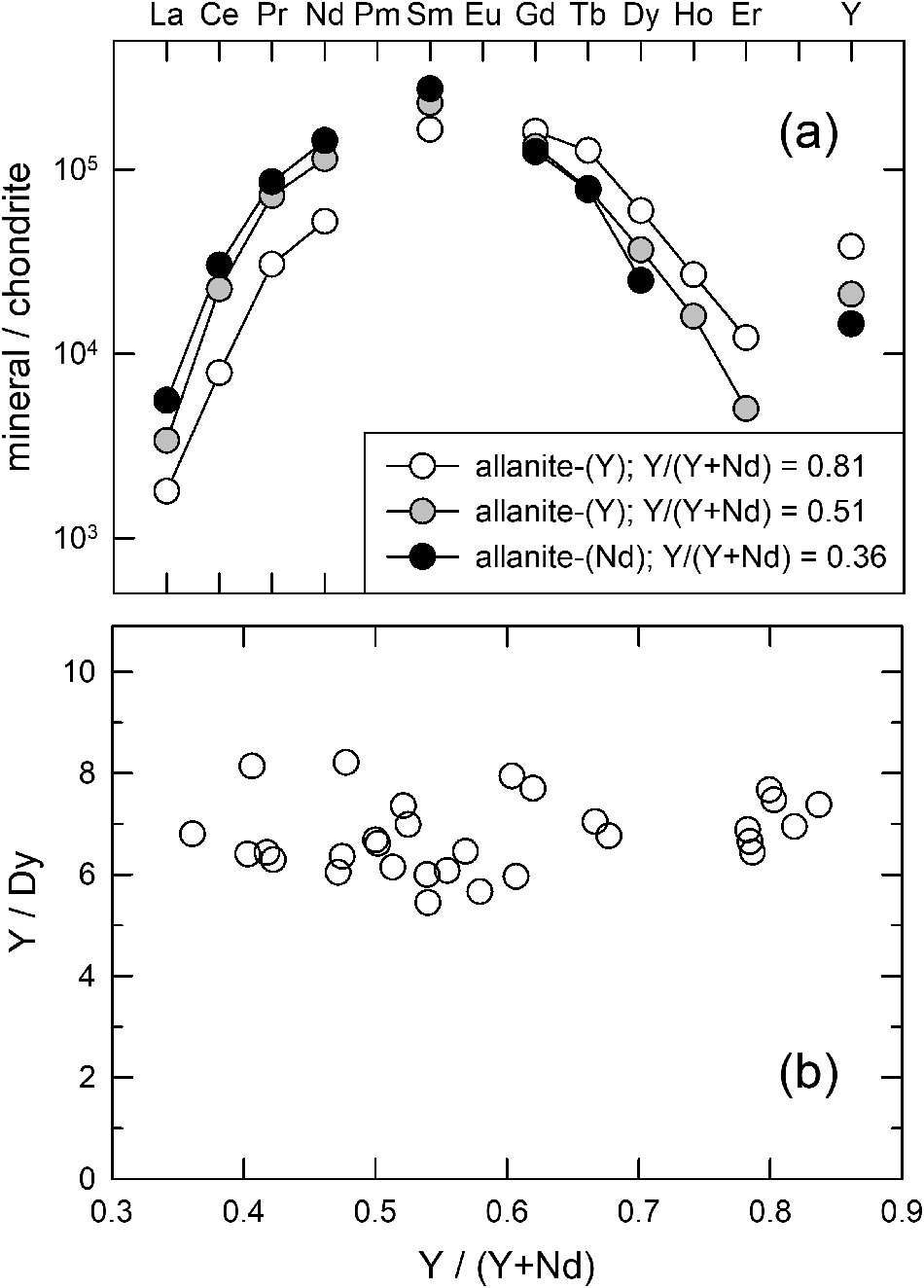
The heterogeneity of the metasomatic allanite and its variability in the Y/Nd ratio shows effective fractionation of Y and HREE from Nd and LREE by hydrothermal replacements of the same precursor. Similar depletion in LREE was found in secondary REE-epidote by Guastoni et al. (Reference Guastoni, Nestola and Schiazza2017). The chondrite-normalised REE pattern (after McDonough and Sun, Reference McDonough and Sun1995) of allanite-group minerals from the assemblage studied shows a strong negative Eu anomaly and a bell-shaped REE pattern with a theoretical maximum between Sm and Gd (Fig. 6a). Allanite-(Y) pattern is more depleted in lightest REE and more enriched in heavier REE with respect to allanite-(Nd). The Y/Dy ratio is similar for the whole compositional range (Y/Dy ∼5–8) without any clear trend (Fig. 6b). Such behaviour indicates the limited influence of the fluoride complexation of the REE ions in hydrothermal solution (Gramaccioli et al., Reference Gramaccioli, Diella and Demartin1999) for the REE fractionation and highlights the influence of the crystal-structural constraints.
REE+Y ratios and patterns of allanite-group minerals from Åskagen: (a) chondrite-normalised REE+Y pattern (chondrite data after McDonough and Sun, Reference McDonough and Sun1995); (b) variations of Y/Dy and Y/(Y+Nd) ratios.
Supplementary material
The supplementary material for this article can be found at https://doi.org/10.1180/mgm.2025.20.
Acknowledgements
We are very grateful to Dr. Dan Holstam (Swedish Museum of Natural History, Stockholm) for his help in searching the original sample of ‘lombaardite’ from the Åskagen pegmatite studied by Neumann and Nilssen (Reference Neumann and Nilssen1962). Comments of the Associate Editor Mihoko Hoshino and both reviewers significantly improved the quality of the manuscript.
We would like to dedicate this paper to the memory of Dr. Alessandro Guastoni, an expert on pegmatites and new minerals, as well as a dear friend.
The study was supported by the Masaryk University projects MUNI/IGA/1607/2020 to LS and MUNI/A/1725/2024 to RŠ. FB acknowledges funding by Sapienza University of Rome (Prog. Università 2023) and by the Italian Ministry of Education (MIUR)–PRIN 2020, ref. 2020WYL4NY.
Competing interests
The authors declare none.


 Open access

