


Three major issues (or “battlegrounds”) emerge that are relevant to the argument that the majority of conceptions of democracy in the world share a normative core (Reference Osterberg-Kaufmann, Toralf and ChristophOsterberg-Kaufmann et al. 2021). First, the prevailing understanding of democracy is closely linked to the formative canon of liberal political theory. Second, power imbalances strongly affect how people understand democracy. Third, knowledge production follows a Eurocentric hegemony (Reference ChakrabartyChakrabarty 2008); it feeds into the classical western canon of democratic theory. As such, it also influences the conceptualization and operationalization of democracy in empirical studies of democracy in how it is understood, supported, and measured for quality (e.g., Reference Osterberg-Kaufmann, Toralf and ChristophOsterberg-Kaufmann et al. 2020).
However, the existence of multiple meanings of democracy interrupts the Eurocentric, hegemonic sovereignty of interpretation and the idea of recognizing difference enters the thinking and discourse about democracy. Procedural liberal democracy as institutionalized in a substantial number of western countries loses its model character as the best system for granting human rights (e.g., Reference Stark, Norma and SusanneStark, Osterberg-Kaufmann, and Pickel 2022). This outcome should be understood not only as a danger but also as an opportunity. For example, the inclusion of a postcolonial perspective in the question of what actually constitutes democracy is, as Reference FleuβFleuβ (2021) argues, long overdue and can help to strengthen the reform potential of democracy.
To get to a globally applicable core concept of democracy, we need to know the entire texture (Reference KurkiKurki 2010) and look beyond the dominant theoretical tradition of liberalism with different research methods. This enables us to elaborate a singular concept to which all plural conceptions can be connected. Researchers like Reference GagnonJean-Paul Gagnon (2018) focus on specific texts to discover the total texture of democracy. At the same time, we need to consider the subjectively perceived meaning of democracy. This is because it fills in the gaps by also considering oral traditions, publication asymmetries, and people's perspectives on democracy. Nonetheless, it is not enough to collect vast amounts of data on democracy. This data must also be taxonomized, synthesized, and theorized. The global concept of democracy needs to exhibit what Laurence Whitehead called the “timeless essence of democracy” (2021). This comes closest to the singular theory we need to understand and explain the overall texture of democracy, its plural conception. In the spirit of Reference SartoriGiovanni Sartori's (1987) ladder of abstraction, we need to break down the core principles underlying the various conceptions of democracy until the one core principle becomes visible.
How can we achieve this? We need to collect enough data to gain insights into the overall structure of democracy and generate issues of democracy from these data. This requires collaboration among a variety of disciplines and sub-disciplines with different methodological competencies. As Michael Saward pointed out, we need “a new, interdisciplinary way of thinking about democracy” (2021). This also means that we need to break down the constructed oppositions between qualitative and quantitative research, and between theory and empiricism.
Our classifications lead to a global, valid core concept of democracy and therefore have to allow for top-down and bottom-up knowledge production. This implies a permanent interplay of deductive and inductive methods and a constant dialogue between theory and empiricism.
An offer of dialogue to mediate between the two positions of transcultural political theory and empirical democracy research could consist in moving away from the idea of the superiority of liberal democracy, which still serves as the standard of empirical democracy research, since liberal democracy theory alone cannot offer any equivalence of objects. This would also mean looking at the procedural and institutional consequences of the liberal understanding of democracy, which, for example, focuses on voting and party competition and defines the former as the minimum criterion of democracy (Reference Berg-SchlosserBerg-Schlosser 2004; Reference Collier and StevenCollier and Levitsky 1997; Reference DahlDahl 1971; Reference Diamond and LeonardoDiamond and Morlino 2004; Reference Diamond, Juan J. and Seymour MartinDiamond et al. 1990; Reference Di PalmaDi Palma 1990; Reference HuntingtonHuntington 1991; Reference LauthLauth 2015; Reference MerkelMerkel 2004; Reference NorrisNorris 2012; Reference PrzeworskiPrzeworski 1991; Reference Rueschemeyer, Evelyne Huber and John D.Rueschemeyer et al. 1992).
The argument of this article is that a globally valid core concept of democracy must refer to the actual meaning of the term, thus focusing on the self-efficacy of the citizen. We are convinced that alternative forms of political decision-making and participation can complement or, under certain circumstances, replace the fundamental nature of elections. In this respect, we open the view not only to the currently dominant idea of liberalism but also to the ideas of republicanism and communitarianism. These basic ideas of democracy ultimately differ primarily in how the goal, namely rule by, of and for the people (Lincoln, “Gettysburg Address”, November 19, 1863), or the political self-efficacy of the individual, can be achieved (Reference Stark, Norma and SusanneStark et al. 2022).
The main difference between liberalism and republicanism lies in the design of the democratic organization against the background of the question of how, in democratic societies, a unity of state decision-making can emerge from many individual interests. The institutional conditions depend exclusively on this question and can therefore vary globally. A section on the essentially contested character of democracy prepares this argument, and another on the differences and similarities of liberalism, republicanism, and communitarianism derives the minimal criterion of political self-efficacy underlying all of them, beyond the specific institutionalization of this principle.
To translate these considerations into a conceptual framework, which we propose here as configurations of democracy, the three theoretical approaches—liberalism, republicanism, and communitarianism—are made visible in their underlying principles through combinations of different elements and institutionalizations to achieve the democratic goal of rule by, of, and for the people and, more fundamentally, the political self-efficacy of each individual, and revealed in terms of their democratic potential. For the moment, we will refer to models of democracy that exist beyond the standard model, such as the liberal or social democratic model (Esping-Andersen and van Kersbergen 1992; Reference SchmitterSchmitter 1995). This includes in particular models like participatory democracy (Reference BarberBarber 2003; Reference PatemanPateman 1970), deliberative democracy (Reference WarrenWarren 2008) or cosmopolitan democracy (Reference ArchibugiArchibugi 2004; Patomäki and Teivainnen 2002). In subsequent considerations, the goal is to include feminist or Confucian ideas (Reference BellBell 2006; Reference HumphreyHumphrey 2007) in the concept as well or to develop entirely new concepts.
Democracy as an Essentially Contested Concept and its Conceptual Consequences
The battlegrounds of democracy research as outlined in the introduction show that “the end point of mankind's ideological evolution and the universalization of western liberal democracy as the final form of human government” was a misjudgment or at least an illusion of the early 1990s (Reference FukuyamaFukuyama 1989, p. 4). The theoretical debate about the people's understanding of democracy has shifted significantly since then (Reference DallmayrDallmayr 1997; Dallmayr et al. 2009; Reference Ercan and Jean-PaulErcan and Gagnon 2014). In the wake of the partly contradictory results of the numerous large surveys of support for democracy that have been available since the 2000s, the empirical debate has also opened to the theoretical considerations that there are obviously not only different understandings but also different meanings of democracy worldwide (Reference BraizatBraizat 2010; Reference BrattonBratton 2010; Reference Chu and Min-huaChu and Huang 2010; Reference Lu and Yun-HanLu and Chu 2021; Reference Osterberg-Kaufmann and UlrichOsterberg-Kaufmann and Stadelmaier 2020; Reference Osterberg-Kaufmann and Kay KeyOsterberg-Kaufmann and Teo 2022; Reference Shi and JieShi and Lu 2010).
The first findings of these multiple meanings of democracy have already been provided by empirical research (e.g., Reference CanacheCanache 2012; Reference Canache, Jeffery J. and Mitchell A.Canache et al. 2001; Reference ChoCho 2015; Reference Diamond and Marc F.Diamond and Plattner 2008; Reference Ferrín and HanspeterFerrín and Kriesi 2016; Reference Schubert, Sybille de La, >Sophia and HolgerSchubert 2016; Reference ZakariaZakaria 1997). Instead of agreeing with the liberal-procedural concept of democracy, which has so far functioned as a benchmark in empirical democracy research, citizens in some countries would like the democratically elected elites to be supported by the expertise of religious leaders or even by the military assuming power (e.g., Reference Mohamad-KlotzbachMohamad-Klotzbach 2022) if the government proves incompetent. Still others reject the equality of all social groups or think that a democratic regime implies that people must obey their rulers. Further deviations from the liberal-procedural concept, on the other hand, do not violate the liberal concept but seek to reinforce the importance of core democratic norms by strongly emphasizing participatory (Reference PatemanPateman 1970), deliberative, ecological, or social elements (Reference Ferrín and HanspeterFerrín and Kriesi 2016). The challenges posed by this shift in the debate are manifold. The overwhelming global support for democracy that especially scholars from Europe and Northern America have believed for a long time is no longer valid in the face of the recognition of different meanings of democracy. Although many terms associated with democracy have become accepted in global discourse (Reference KurkiKurki 2010), research shows us that understandings of what these terms mean can vary widely (Reference Bratton and RobertBratton and Mattes 2001; Reference Dalton, C. Shin and WillyDalton et al. 2007; Reference Ferrín and HanspeterFerrín and Kriesi 2016; Reference GagnonGagnon 2018; Reference Pickel, Wiebke and TheresiaPickel et al. 2016; Reference RobbinsRobbins 2015; Reference SchafferSchaffer 1998; Reference Schedler and RodolfoSchedler and Sarsfield 2007; Reference Schubert, Alexander, Sophia and AlexanderSchubert and Weiβ 2016; Reference Shastri, Suhas and SanjayShastri et al. 2017), leaving researchers and practitioners unclear about what exactly people support when the term democracy is mentioned.
The consequences of this newly recognized diversity of democracy, which means that in fact we have an always essentially contested concept (Reference Collier, Fernando Daniel and Andra OliviaCollier et al. 2006; Reference GallieGallie 1956), are considerable for comparative democracy research theoretically, conceptually, and methodologically. What can be observed and measured depends on the democratic theory that builds the theoretical framework for empirical survey design. If the theory of democracy loses its adequacy to the object, it is very likely that the corresponding concepts of democracy and the measurements or aggregation rules corresponding to them will also lose their validity (Reference Achen and Larry M.Achen and Bartels 2017; Reference Fleuβ, Gary S. and KarolineFleuβ et al. 2019). The conceptual history of democracy has already undergone several comprehensive transformations of meaning. The most serious transformation was probably from small-scale, direct-democratic models to large-scale, representative models of democracy (Reference DahlDahl 1989; Reference KeaneKeane 2009). The next big step will be the expansion of the discourse on the meaning of democracy beyond the western context, where we will be confronted with globally different conceptions or better multiple meanings of democracy (Reference LittleLittle 2018; Reference Weiβ, Beate, Anna and GiselaWeiβ 2020) that will typically sideline the nation-state as its locus operandi.
What is at stake is nothing less than the search for the (new) limits of a normative concept of democracy and a core meaning of democracy that can claim global validity, renouncing any hegemonic bias, without at the same time conceptually stretching the concept of democracy.
Through our elaboration of a new global valid core of democracy, we aim to initiate a dialogue between a more relativistically oriented transcultural political theory and more universalistically oriented empirical research on democracy. This dialogue is necessary because, on the one hand, democratic theory should respond to results of empirical democracy research and integrate them into theory development, and, on the other hand, any empirical examination of democratic systems depends on conceptual frameworks offered by available theories of democracy (Reference Fleuβ, Gary S. and KarolineFleuβ et al. 2019; Mc Kay 2021). The V-Dem Project, for example, responds to this context by measuring the quality of democracy with different indicators, depending on the presumed conception of democracy (Reference Coppedge, John, David, Michael, Steven and AllenCoppedge et al. 2011). Even though the V-Dem adopts a new approach compared to other well-established indices (e.g., Sustainable Governance Indicators, Bertelsmann Transformation Index, Freedom House, Polity), it continues to measure the core of the western understandings of democracy and their associated institutional frameworks (Reference WolffWolff 2022). On top of electoral democracy, V-Dem proposes four other concepts (liberal, deliberative, egalitarian, and participatory) for measuring democracy. This is precisely where the criticism lies. Although alternative forms of participation are included, through which political self-efficacy can be strengthened, elections remain a fundamental component to declare a country as a democracy. Thus, a political system without elections cannot be democratic. However, this statement should not be understood to mean that political elections are not necessary conditions for democracies unless they are adequately replaced by other forms of participation. Consequently, we cannot be sure that elections are a sufficient condition for classifying political systems as democracies.
The republican model of democracy, for instance, as a shared public project that leaves individual interests behind, is based on the idea that citizens form a unified political will. Consequently, only what is consistent with the interests of the majority of citizens and thus corresponds to the common good is carried into the public sphere (Reference HeldHeld 2006; Reference Honohan, Ayelet, Rainer, Irene and Maarten PeterHonohan 2016; Reference PettitPettit 1993a, Reference Pettit1993b).
Liberalism, Republicanism and Communitarianism
We are convinced that the institutional arrangement of the procedural, representative democracy (Reference MorlinoMorlino 2011), with its in most countries established set of institutions, has to some extent forfeited its capacity for reform. In the debate about its development potential, the proposals for adjustment focus primarily on the modification of political institutions without reconsidering the liberal normative foundations. Suitable answers to the persistent crisis of responsiveness or the pluralization of society are apparently available but not recognized in the discussion. The strengthening of the fundamental idea of a democracy, namely the role of the citizen in achieving the common good, seems to be ignored.
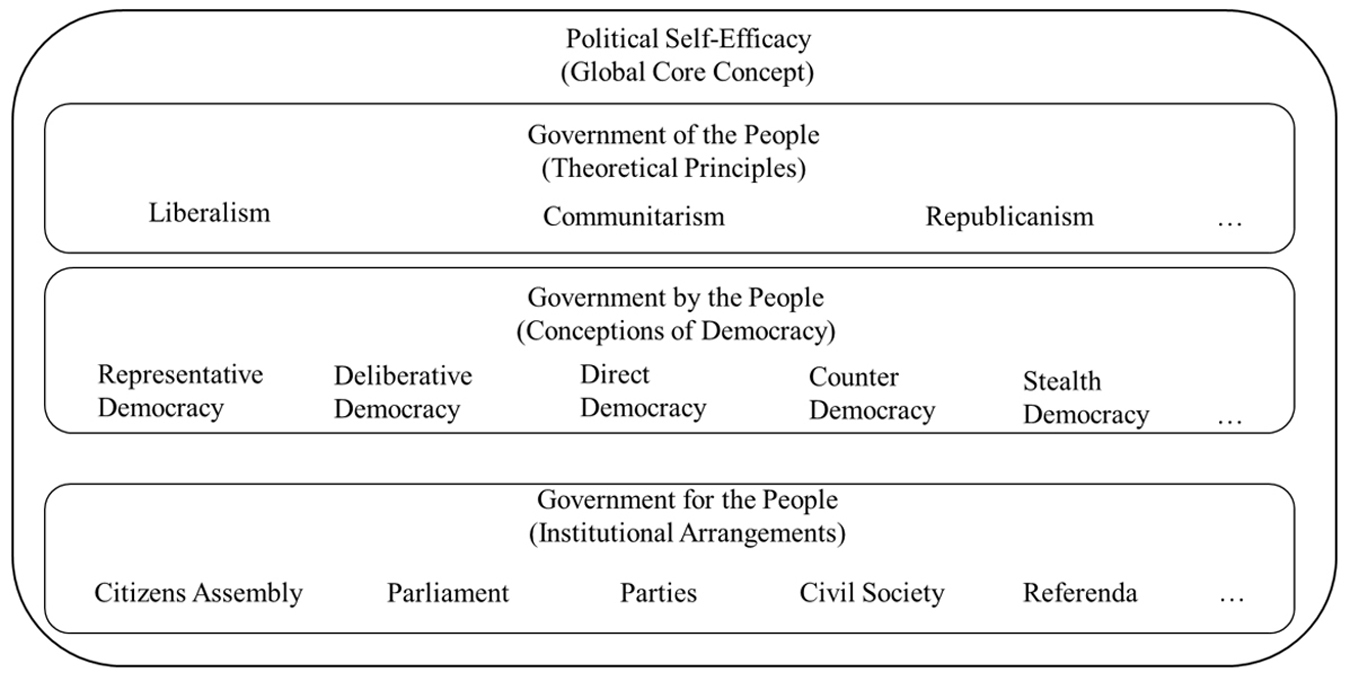
Reference YoungsYoungs (2015: 144ff) describes the achievements of liberalism, provided that they are related to the concepts of tolerance, pluralism, effective participation, and protection against injustice and repression, as the “liberalism-plus” notions. A democracy that claims global validity must focus its democratic reform on promoting political self-efficacy. Accordingly, the conceptual proposal outlined in Figure 1, “Configurations of Democracy,” takes up the basic norms of liberalism and hopes to provide theoretical stimuli for the normative, institutional, and procedural reconceptualization of democracy.
In order to illustrate our idea, we additionally refer to the concepts of republicanism (Reference SandelSandel 2015) and communitarianism (Reference EtzioniEtzioni 2014). This is only a first step, as in further considerations, it is also conceivable to integrate non-western concepts of democratic theory into the concept. In doing so, we aim to open up the so far hegemonically determined discourse to a more global perspective and enable it to be connected to other democratic conceptions according to the principle of political self-efficacy. As a result, this procedure is intended to enable new forms of political will-forming and decision-making processes, processes of social change such as digitalization, as well as cultural and social peculiarities of societies.
As indicated, the debate between liberalism, communitarianism and republicanism is by no means a new one and was significantly shaped by the work “Liberalism and the Limits of Justice” by Reference SandelMichael Sandel (2010). Sandel invokes the concept of communitarianism, which emphasizes a sense of community and social virtues and seeks a renewal of social institutions oriented toward the common good beyond liberal and state programs. By means of a critique of Reference RawlsRawls (1971) and his understanding of the unencumbered self, he argues that an individual must recognize for him or herself why he or she benefits him or herself as well as others by sharing his or her own privileges. This requires a moral foundation that evolves in belonging to a community, that is, family, nation or society (Reference SandelSandel 2010). In essence, liberalism, republicanism, and communitarianism are about the differences in how diverging individual interests and moral values can be reconciled without restricting the freedom of the individual too much.
In the model of liberal democracy, the democratic process is essentially oriented toward the mediation of individual particular interests, formed in the socioeconomic and social sphere and carried into the political sphere as a requirement for state action. The political system functions as a moderating actor that mediates between particular interests by means of a democratically legitimized institutional arrangement. The goal is not to mediate between different individual positions, but pluralism allows everyone to fight for their majorities. The compromises negotiated in the political sphere do not serve to change individual interests. Conversely, a liberal model of rule also runs the risk of being perceived as a threat to the realization of individual interests, especially if it fails to develop a shared idea of the “good life” that will have an impact in the future (Reference Sandel and ThomSandel 2017). Consequently, the focus here is on the relationship between the citizen and the state, that is, the mechanisms by which the individual gains access to the political will-forming and decision-making process.
The approach of republicanism is contrasted with liberalism's more egoistic approach, which is best described by the notion of the ideal of autonomy. In the liberal sense, autonomy serves individual preferences, while in the republican logic, civic virtue prevails over individual will. Thus, the unbreakable protection of individual freedoms has priority over the integrity of communal social structures with collective self-determination. In terms of political order, this means that liberalists strive for the greatest possible non-interference by state institutions, whereas republicans place their own rights to freedom behind the protection of collective community interest (Reference HausHaus 2003). This forms the basis for a common social structure with the republic ranking higher than private particular interests. The ultimate goal is the common good, which, understood as virtue, constitutes citizenship. This implies that each individual pursues his or her own interests only to the extent that can be desired by the other individuals, without their subordination. Mechanisms of institutional control are not intended here (Reference Honohan, Ayelet, Rainer, Irene and Maarten PeterHonohan 2016).
Communitarianism and republicanism are closely related schools. Communitarians are concerned with communitas, the common life of people who form a community; republicans are concerned with res publica, the common good. So, what matters to the republican is not the community per se, but the community of self-governing, common good-oriented citizens. Thus, while republicanism is based on the political self-efficacy of each individual and therefore enables and protects it, communitarianism is not oriented toward the individual but only toward the community. What they have in common is the emphasis on the social person as opposed to the freedom and individual rights of liberalism (Reference Dagger, Gerald F. and ChandranDagger 2004). In contrast to earlier readings of communitarianism, Reference EtzioniAmitai Etzioni (1999) does see compatibility between the emphasis on universal individual rights and the recognition of particular obligations. However, striking a balance between individuality and social responsibility is a constant challenge for society (Reference EtzioniEtzioni 1999). In addition to the question of how the community is structured in terms of size, creative power, and heterogeneity of its members, the relationship between the individual and the community also needs to be considered.
At this point, it is not intended to go into the theoretical argumentations of the pros and cons of those concepts more extensively. The literature repeatedly notes that, in addition to the separating aspects (Aronowitch 2000), there are a number of unifying features (Reference Honohan, Ayelet, Rainer, Irene and Maarten PeterHonohan 2016; Reference SandelSandel 2015), which will also tend to be the focus of the following. Toward this end, the focus turns to a central point of criticism of the liberal model against the basic republican idea, which illustrates the potential of linking the two models (Reference SandelSandel 2015). One of the major criticisms of republicanism is its implicit presupposition of political participation. Republicanism assumes an intrinsic motivation of the individual to willingly assume his or her role in the community, which as a result serves to secure the common good. Nevertheless, the study of I and We, which means the position of the individual within the group, is one major issue communitarians are confronted with (Reference BuberBuber 2012).
Political liberalism in its western understanding, in turn, defines participation in terms of having a say, that is, the possibility of exerting political influence. Thus, the political system must provide the necessary institutions and legal norms, but individuals do not need to actually participate. This mechanism of participation has long been limited to the institution of election. Hence, it was not the totality of society's members, guided by civic virtues, who were responsible for creating the common good (self-government), but political responsibility was rather delegated. In terms of the history of ideas, representation, which appears to us today in the liberal tradition as such a valuable good, is nothing other than a principle for excluding the people from any exercise of power. Consequently, representative democracy is characterized by keeping the plebs out and can be considered a purely aristocratic idea (Reference DunnDunn 2005; Reference ManowManow 2020; Ranciére 2012).
New participative mechanisms of influence have emerged only in the twentieth century and always with the aim of increasing the citizens’ self-efficacy (Reference StarkStark 2019). Theoretically, these forms of participation, such as participatory councils or participatory budgets, can be linked to the concept of deliberative democracy (Reference Cohen, Alan and PhillipCohen 1989; Reference HabermasHabermas 1996). Similar to communitarianism and in contrast to liberalism, it focuses on the consideration of individual and collective interests, which need to transform into a collective consensus by means of discussions (Reference MorlinoMorlino 2011). In sum, it becomes clear that the current political liberal model of democracy does not fully meet these requirements. Consequently, the following section will attempt, based on the basic principles previously outlined, to design a more open concept of democratic systems that also includes the possibility of embracing empirical conceptions of democracy beyond the familiar institutional setting of liberal democracies.
The Configuration of Democracy
Any valid measurement of democracy requires definition. Following Gerardo Munck and Jay Verkuilen (2002), this definition forms the basis for the development of a concept tree, which in turn successively specifies the concept of democracy and operationalizes it empirically.
The starting point for configuring a global concept of democracy is the question: What is democracy good for? As a preliminary consideration we suggest that democracy primarily describes a political system that enables political self-efficacy. Democracy, when understood as rule by the people, presupposes that citizens participate in the political decision-making process. This requires individuals to be convinced of their political competence and influence (Reference Campbell, Gerald and Warren E.Campbell et al. 1954). These are grounded in the combination of the liberal view, which provides an institutional framework for achieving compromises between different individual needs, and the republican idea of citizenship, which is based on civic virtues and the pursuit of the common good. To develop these, a systemic and cultural framework is needed to foster the development of such citizens’ competencies.
To remain in the language of the concept tree (see Figure 1), a minimalist definition includes only one branch, since the theoretical norm of self-efficacy is here institutionalized only through elections, at least in the liberal interpretation. However, if democracy comes to be understood as a substantive concept that includes not only elections but also other forms of institutional arrangements and social practices for the political decision-making process, the tree gets considerably more comprehensive (Reference Collier and StevenCollier and Levitsky 1997; Reference SartoriSartori 1987). Through the idea of configurations presented here, it becomes possible to improve the reconnection of the different readings of democracy, that is, the instrumental and the intrinsic (Reference KimKim 2017). With this approach, we follow the idea of Dewey, who demands to “get rid of the habit of thinking of democracy as something institutional and external and acquire the habit of treating it as a way of personal life” (Reference DeweyDewey 1981: 228).
Concept tree of configurations of democracy.

To include different considerations of democracy, we need the greatest possible conceptual openness. At this point, we refer to the still frequently cited “Gettysburg Address” of US President Abraham Lincoln (November 19, 1863) as a constructional framework, since it provides us with three subordinate principles that can be extracted from the liberal concept of democracy. Reference SartoriWhat Sartori (1987) criticizes in his theories of democracy about the notion of democracy in the sense of “government of, by and for the people” as encompassing the entire spectrum of politics, we would interpret here in its openness as an opportunity. It is precisely this openness that allows us to unlock the principal core idea behind the various conceptions for a transglobal comparative theory of democracy.
From Lincoln's speech, democracy is understood as “government of, by and for the people”. Normatively, it is only about the role of the citizen and the nature and importance of his interests, without the institutions and processes that might be helpful or even necessary to achieve them. As has already become clear in the previous section, we understand democratic institutions and processes as historically contingent realizations of an abstract democratic core principle in the sense of the traveling premise of Reference Schubert, Alexander, Sophia and AlexanderSchubert and Weiβ (2016). However, how this core principle is realized through formal or even informal institutions depends on the respective socio-political contextual conditions.
Of, by, and for the people are those levels of democracy at which the democratic core concept can be implemented. From this level, possible institutionalizations can be derived that make it possible to implement the global core concept, which in the last consequence produces the conviction of political self-efficacy.
The frame “government of the people” refers to the composition of the norms and values, derived from western and non-western theories of democracy (e.g., Reference Chou and EmilyChou and Beausoleil 2015). These establish the basis for various democratic conceptions. The idea of configurations of democracy is based here on the democratic theoretical principles of liberalism, republicanism, and communitarianism. From the latter is taken the intrinsic conviction that citizens in the political sphere have the competence to stand up for their own political persuasions and are willing to adapt them in the context of deliberative negotiation processes to achieve the common good. This is precisely where this theoretical approach complements the basic liberal idea according to which compromises have to be made in the political sphere, but these do not have any impact on personal convictions. Thus, it can be assumed that if the implemented compromises do not permanently conform to individual beliefs, even if extensive influence has been exerted on the actors, political self-efficacy will suffer. In addition, the basic norms of equal participation, the associated freedom and a legal safeguard must be adopted from the liberal concept. Finally, the idea of who belongs to “the ordinary people” has changed repeatedly until today.
In the conceptual development of democracy, it was mostly only male members of the citizenry who were allowed to participate in the political decision-making process. It was Australia, for example, that was the first country to introduce women's suffrage as recently as 1902 and only from this time on, more and more societal groups gained the right to political participation, for example, through the introduction of women's suffrage. However, even today it is highly controversial who belongs to the common people or who is part of the citizenry (Reference Bayer, Oliver and ToralfBayer et al. 2021). In addition to the debate about lowering the legal voting age, the inclusion of people with disabilities, prisoners or non-citizens are also constant topics of debate.
Thus, it needs to be clarified that a democratic system “by the people” refers to who chooses the people that form the government and includes the participation of citizens in the political opinion and decision-making process through elections, votes, negotiation processes, etc. In essence, both principles mean that it is a government made up of ordinary people, elected by ordinary people.
The government “for the people” focuses on the motivation behind a decision or its goal. This is based on what premise the decisions are made, who benefits from these decisions, who can participate in the decision-making process, and how it is affected. With the reference to liberalism, republicanism, and communitarianism, we have two modes of participation and decision-making. The particular interests of the majority are implemented (liberal democracy) or the particular interests are placed behind a generally recognized common good (republican and communitarian democracy). The deliberative democracy, as it is introduced earlier, serves as an intermediate conception of democracy, since the common good is negotiated in a moderated process. According to Rodan, “the relationship between forms of participation and ideologies of representation” should be central, because “implicitly or explicitly, ideologies of representation provide justifications for the privileging, marginalization or exclusion of particular interests or conflicts from political processes” (2018: 28). This also includes alternatives to liberal representative democracy. All of these concepts are ultimately to be evaluated in the sense of “government of and by the people” with regard to their enabling of political self-efficacy of each citizen.
Conclusion
In this article we present a new global core concept of democracy that focuses on the role of citizens’ self-efficacy. In it we suggest to take established western and non-western theoretical principles (governance of the people) into account and create new conceptions of democracy (governance by the people) and its corresponding institutional arrangements (governance for the people). Political self-efficacy is the starting point of our concept, since we are convinced that democracy, at the core of its understanding, refers to the citizens’ central role in political opinion-forming and decision-making processes.
The reduction of liberal democracy to its procedural decision-making mechanisms with their associated institutions, known to us as representative systems of government, seems to have lost sight of this self-efficacy of the citizens. Liberalism in its original idea, however, assumes that citizens are capable of articulating their particular interests and successfully contributing them to the political system through civil society and political actors.
In doing so, it is then the responsibility of the political sphere to translate these particular interests into a common good-oriented output through consensus or compromise building. Whereas liberalism achieves the common good through the implementation of particular interests capable of gaining a majority, republicanism presupposes the existence of a common good to which all citizens voluntarily subordinate their particular interests. The idea of this form of common good is to create the best possible conditions for the realization of the citizens’ self-governance, which ultimately enables them to achieve political self-efficacy. From the institutional perspective, this implies the following: From the liberalism perspective, we find this setting in liberal democracy, which is guided by the logic of presidentialism and parliamentarism. In contrast, republicanism finds its institutional equivalent in deliberative models of democracy. Consequently, the idea of configurations of democracy is to move away from the institutional definition of minimum institutional criteria and to put the normative core, the self-efficacy of citizens, back into the center of democracy.
These considerations can be connected to debates in democratic theory in the following aspects. First, a link can be established to the debate on democratic innovations, concerning the (re)democratization of (liberal) democracy. Second, the disentanglement from certain democracy-defining institutional settings and the return to the underlying principle of citizens’ political self-efficacy allows us to open the concept of democracy to globally different contexts.
The idea of placing political self-efficacy at the center of a global configuration of democracy broadens the view of the concept of democracy and also allows more conceptual flexibility. On this basis, it is possible to examine the degree of political self-efficacy that respective political systems ensure and to better understand the different ways in which these possibilities are institutionalized in the context of different social values and norms.
Acknowledgments
We would like to express our sincere thanks to the editors of the Special Issue, and the anonymous reviewers for their valuable comments.

 Open access

