

1. Introduction
Jurassic magmatism in the Northern Andes is widely exposed in the central and eastern segments of the Colombian Cordilleras, representing the vestiges of the subduction history of the Farallon Plate under the South American continent, after the amalgamation and the beginning of the break-up of the Pangea supercontinent (Bustamante et al. Reference Bustamante, Cardona, Bayona, Mora, Valencia, Gehrels and Vervoort2010; Cochrane et al. Reference Cochrane, Spikings, Gerdes, Winkler, Ulianov, Mora and Chiaradia2014a; Spikings et al. Reference Spikings, Cochrane, Villagomez, Van der Lelij, Vallejo, Winkler and Beate2015; Bustamante et al. Reference Bustamante, Archanjo, Cardona and Vervoort2016; Zapata et al. Reference Zapata, Cardona, Jaramillo, Valencia and Vervoort2016; Quandt et al. Reference Quandt, Trumbull, Altenberger, Cardona, Romer, Bayona, Ducea, Valencia, Vásquez, Cortes and Guzman2018; Rodríguez et al. Reference Rodríguez, Arango, Zapata and Bermúdez2018; García-Chinchilla and Vlach, Reference García-Chinchilla and Vlach2019; Leal-Mejía et al. Reference Leal-Mejía, Shaw, Melgarejo, Cediel and Shaw2019; Rodríguez-García et al. Reference Rodríguez-García, Correa-Martínez, Zapata-Garcia, Arango-Mejía, Obando-Erazo, Zapata-Villada, Bermudez, Gómez and Mateus–Zabala2020a; Restrepo et al. Reference Restrepo, Bustamante, Cardona, Beltrán-Triviño, Bustamante, Chavarría and Valencia2021; Rodríguez-García et al. Reference Rodríguez-García, Ramírez, Zapata, Correa-martínez, Sabrica, Obando, Estudios, Especiales and Colombiano2022). The spatial-temporal and compositional characteristics of the Jurassic plutonic rocks in southeastern Colombia reveal a protracted arc-related magmatic history spanning ∼60 Ma. This magmatic activity initiated around 195 Ma and continued into the early Cretaceous (∼130 Ma), with distinct tectono-magmatic processes occurring during two main intervals. The older phase, which persisted until ∼165 Ma, is marked by predominantly calc-alkaline high-K granitoids. The spatial distribution of these granitoids has been attributed to either an eastern cratonward migration of the arc coupled with subduction erosion (Rodríguez et al. Reference Rodríguez, Arango, Zapata and Bermúdez2018) or as part of a long-term stationary arc where magmatic fluxes varied over time (Bustamante et al. Reference Bustamante, Cardona, Bustamante and Vanegas2019). Plutonic bodies associated with the youngest interval (∼165 to 145 Ma) are also calc-alkaline medium-K arc-related. Some of them exhibit particularly complex deformational relations and are contemporaneous with a regional metamorphic event (Blanco-Quintero et al. Reference Blanco-Quintero, García-Casco, Toro, Moreno, Ruiz, Vinasco, Cardona, Lázaro and Morata2014; Bustamante et al. Reference Bustamante, Archanjo, Cardona and Vervoort2016; Quandt et al. Reference Quandt, Trumbull, Altenberger, Cardona, Romer, Bayona, Ducea, Valencia, Vásquez, Cortes and Guzman2018; Rodríguez-García et al. Reference Rodríguez-García, Correa-Martínez, Zapata-Garcia, Arango-Mejía, Obando-Erazo, Zapata-Villada, Bermudez, Gómez and Mateus–Zabala2020a; Restrepo et al. Reference Restrepo, Bustamante, Cardona, Beltrán-Triviño, Bustamante, Chavarría and Valencia2021).
Despite the major advances in the reconstruction of this tectono-magmatic evolution and the paleogeographic configuration of the Northern Andes between the Jurassic and the Early Cretaceous (Bayona et al. Reference Bayona, Bustamante, Nova, Salazar-Franco, Gómez and Mateus–Zabala2020), there are still unresolved aspects that need further investigation. These include the rigorous testing of different hypotheses regarding the petrological processes involved in the formation of arc magmas, i.e. magma sources, the role of fractional crystallization, recharge, crustal assimilation or magma mixing/mingling processes, that can be used as a first-order input for the regional tectonic models. Additionally, the influence of exhumation events on the current crustal architecture, particularly the structural levels exposed by various plutonic and volcanic units that constitute different remnants of the arc, and their relationship with the Andean history, needs to be thoroughly examined.
Mineral chemistry of magmatic phases in igneous rocks offers valuable tools to investigate crystallization conditions and magmatic processes. The compositions of feldspars, pyroxene, amphibole, biotite and Fe–Ti oxides minerals have been widely used to estimate key intensive parameters such as crystallization pressure and temperature of intrusive rocks in arc magmatic systems (Kazemi et al. Reference Kazemi, Kananian, Xiao and Sarjoughian2018; Bastos et al. Reference Bastos, Koester, Lenz, Dal Olmo-Barbosa, Porcher, Loureiro, Vieira, Ramos and Cedeño2021; Cui et al. Reference Cui, Sun, Zhao, Zhang and Yao2021; Lima et al. Reference de Lima, de Pinho Guimarães, Neves, Santos, Brainer and Dantas2021; Molina et al. Reference Molina, Cambeses, Moreno, Morales, Montero and Bea2021; Schaaf et al. Reference Schaaf, Corona-Chávez, Ortiz Joya, Solís-Pichardo, Arrieta García, Hernández Treviño and Poli2021; Zandomeni et al. Reference Zandomeni, Moreno, Verdecchia, Baldo, Dahlquist, Morales Cámera, Balbis, Benítez, Serra-Varela and Lembo Wuest2021; Yan et al. Reference Yan, Wei, Zhang, Zhao, Turlin, Li, Li, Xu, Zhang and Moritz2022; Zaheri-Abdehvand et al. Reference Zaheri–Abdehvand, Hassanpour, Rassa and Rajabpour2022). In detail, compositions of magmatic amphibole serve as another proxy to determine the redox conditions and water contents of the parental magmas in arc-related rocks (Ridolfi et al. Reference Ridolfi, Renzulli and Puerini2010; Ridolfi and Renzulli, Reference Ridolfi and Renzulli2012; Erdmann et al. Reference Erdmann, Martel, Pichavant and Kushnir2014; Ridolfi, Reference Ridolfi2021).
This contribution focuses on the examination of textural and chemical features of rock-forming mineral phases such as feldspar, pyroxene, amphibole and biotite group-minerals of selected samples from 12 calc-alkaline I-type occurrences exposed in the southern region of Colombia with ages between ∼195 to 165 and ∼165 to 145 Ma, to discuss crystallization conditions and emplacement depths. This will allow us to understand the different magmatic processes that formed these granitoids and specially evaluate the processes that may have caused the differences between the two major magmatic intervals. Due to the local discordant relations of these intrusive bodies and their associated volcanic rocks with Early Cretaceous clastic sediments, we will explore the nature and significance of Late Jurassic to Early Cretaceous exhumation event and its relationship with the complex re-organization experienced by the margin during this time interval (Bayona et al. Reference Bayona, Bustamante, Nova, Salazar-Franco, Gómez and Mateus–Zabala2020).
2. Geological setting
The Northern Andes has been an active convergent margin since the Paleozoic, recording a prolonged subduction at the western margin of Gondwana. This region has been characterized by the development of continental magmatic arcs, marked by the emplacement of extensive volumes of igneous rocks (Bustamante et al. Reference Bustamante, Archanjo, Cardona and Vervoort2016; Leal-Mejía et al. Reference Leal-Mejía, Shaw, Melgarejo, Cediel and Shaw2019; Rodriguez-Garcia et al. Reference Rodriguez-Garcia, Correa-Martinez, Zapata-Villada, Obando-Erazo, Gómez and Mateus–Zabala2019; Spikings and Paul, Reference Spikings, Paul, Gómez and Mateus–Zabala2019; Bayona et al. Reference Bayona, Bustamante, Nova, Salazar-Franco, Gómez and Mateus–Zabala2020; Rodríguez-García et al. Reference Rodríguez-García, Correa-Martinez, Zapata-Garcia, Arango-Mejía, Obando-Erazo, Zapata-Villada, Bermudez, Gómez and Mateus–Zabala2020b; Restrepo et al. Reference Restrepo, Bustamante, Cardona, Beltrán-Triviño and Valencia2023). As a result, the geological and structural configurations of the Colombian Andes, which encompass the Western, Central and Eastern Cordilleras (WC, CC and EC; Fig. 1a), have been shaped by this subduction zone.
Geological setting of the Northern Andes and location of the study area. (a) The main topographic features of the region highlight the Western (WC), Central (CC), and Eastern (EC) Cordilleras of Colombia. (b) Distribution of the late Triassic to Early Cretaceous plutonic belt in the Colombian Andes with the main tectono-magmatic domains and faults systems (adapted from García-Delgado et al., Reference García-Delgado, Velandia, Bermúdez and Audemard2022). Abbreviations: SM, Santander Massif; SMM, Santa Marta Massif; SB, Segovia Batholith; SLB, San Lucas Batholith; UMV, Upper Magdalena Valley; SSC, Southern Central Cordillera; GM: Garzon Massif; OF, Otu Fault; CPF, Cali-Patia Fault; UF, Uramita Fault; CAF, Cauca-Almaguer Fault; CF, Cimitarra Fault; PF, Palestina Fault; IB, Ibague Fault; GF, Guaicaramo Fault; BF, Bucaramanga Fault; AF, Algeciras Fault. (c) Geological map of the Southern Colombian Andes (adapted from Gomez et al., Reference Gomez, Schobbenhaus and Montes2019). The map indicates the collected samples from the studied Jurassic arc-related plutonic occurrences.

The long-term subduction of the Farallon plate beneath the western margin of South America, inferred from whole-rock geochemical and geochronological data is associated with extensive arc-like magmatism during late Triassic to early Cretaceous (Bustamante et al. Reference Bustamante, Cardona, Bayona, Mora, Valencia, Gehrels and Vervoort2010; Cochrane et al. Reference Cochrane, Spikings, Gerdes, Winkler, Ulianov, Mora and Chiaradia2014a; Bustamante et al. Reference Bustamante, Archanjo, Cardona and Vervoort2016; Zapata et al. Reference Zapata, Cardona, Jaramillo, Valencia and Vervoort2016; Quandt et al. Reference Quandt, Trumbull, Altenberger, Cardona, Romer, Bayona, Ducea, Valencia, Vásquez, Cortes and Guzman2018; Rodríguez et al. Reference Rodríguez, Arango, Zapata and Bermúdez2018; Leal-Mejía et al. Reference Leal-Mejía, Shaw, Melgarejo, Cediel and Shaw2019; Ramírez et al. Reference Ramírez, Correa-Martínez, Zapata-Villada and Rodríguez2020; Rodríguez-García et al. Reference Rodríguez-García, Ramírez, Zapata, Correa-martínez, Sabrica, Obando, Estudios, Especiales and Colombiano2022). This period witnessed the emplacement of I- and minor S-type intrusions together with mafic, intermediate and acid volcanic and subvolcanic rocks. Overall, they are calc-alkaline rocks with metaluminous signatures, suggesting a continental volcanic arc affinity (Rodríguez-García et al. Reference Rodríguez-García, Correa-Martínez, Zapata-Garcia, Arango-Mejía, Obando-Erazo, Zapata-Villada, Bermudez, Gómez and Mateus–Zabala2020a).
Chavarria et al. (Reference Chavarría, Bustamante, Cardona and Bayona2021) suggest that the initial phase of Early Jurassic arc magmatism involved crustal thickening due to the underplating of high volumes of magmas until ∼165 Ma. Then, the subduction in the Middle Jurassic was marked by a more oblique convergence between the northwestern margin of Gondwana and the Farallon plate, resulting in a reduction of the magma volumes (Bustamante et al. Reference Bustamante, Archanjo, Cardona and Vervoort2016). An additional Late Jurassic tectonic event (c. 158 Ma) involved the formation of a collision-related metamorphic belt, which has been identified in faulted contact with the arc-related batholiths (Blanco-Quintero et al. Reference Blanco-Quintero, García-Casco, Toro, Moreno, Ruiz, Vinasco, Cardona, Lázaro and Morata2014; Bustamante et al. Reference Bustamante, Archanjo, Cardona, Bustamante and Valencia2017, Reference Bustamante, Cardona, Restrepo, Zapata, Beltrán-triviño, Bustamante, Valencia, Bustamante, Cardona, Restrepo, Zapata and Beltrán-triviño2023; Restrepo et al. Reference Restrepo, Bustamante, Cardona, Beltrán-Triviño, Bustamante, Chavarría and Valencia2021). This regional metamorphism may have occurred due to the oblique collision of a para-autochthonous terrane during the evolution of the northwestern margin of Gondwana (Blanco-Quintero et al. Reference Blanco-Quintero, García-Casco, Toro, Moreno, Ruiz, Vinasco, Cardona, Lázaro and Morata2014), also causing the deformation of some of the Jurassic plutonic occurrences in the region (e.g. Sombrerillo and Ibague Batholiths; Restrepo et al. Reference Restrepo, Bustamante, Cardona, Beltrán-Triviño, Bustamante, Chavarría and Valencia2021; Bustamante et al. Reference Bustamante, Cardona, Restrepo, Zapata, Beltrán-triviño, Bustamante, Valencia, Bustamante, Cardona, Restrepo, Zapata and Beltrán-triviño2023). After this collision, the margin may have experienced a crustal thinning event, leading to a progressive decrease in the magmatic activity until Early Cretaceous Period (∼129 Ma) (Bustamante et al. Reference Bustamante, Archanjo, Cardona and Vervoort2016; Chavarría et al. Reference Chavarría, Bustamante, Cardona and Bayona2021).
The long-lived Mesozoic magmatic record can be also separated in two main regions comprising the southern plutons between ∼1 and 5° N and those exposed in the northern part between ∼6 and 12° N of latitude (Fig. 1b). For this study, we focus on the widely exposed calc-alkaline I-type bodies in the southern region of Colombia (Fig. 1c), which were emplaced between ∼195 to 165 and ∼165 to 140 Ma in the Upper Magdalena Valley (UMV) and the Southern Central Cordillera (SCC) domains, respectively.
The UMV domain is a hinterland basin located between the CC and the EC of Colombia formed during the Miocene (e.g. Espitia et al. Reference Espitia, Cortés, Beltrán, Higuera Díaz and Arias2022; Ramon and Rosero, Reference Ramon and Rosero2006; Saeid et al. Reference Saeid, Bakioglu, Kellogg, Leier, Martinez and Guerrero2017; Villamizar-Escalante et al. Reference Villamizar-Escalante, Bernet, Urueña-Suárez, Hernández-González, Terraza-Melo, Roncancio, Muñoz, Peña, Amaya and Piraquive2021). This tectonic domain includes diverse crustal lithologies varying from Meso- and Neoproterozoic high-grade metamorphic basement rocks (Ibañez-Mejia, Reference Ibañez-Mejia, Gómez and Mateus–Zabala2020); Paleozoic sedimentary units (Villamizar-Escalante et al. (Reference Villamizar-Escalante, Bernet, Urueña-Suárez, Hernández-González, Terraza-Melo, Roncancio, Muñoz, Peña, Amaya and Piraquive2021); Permian high-grade metamorphic and plutonic rocks (Restrepo et al. Reference Restrepo, Bustamante, Cardona, Beltrán-Triviño and Valencia2023; Rodriguez-Garcia et al. Reference Rodriguez-Garcia, Correa-Martinez, Zapata-Villada, Obando-Erazo, Gómez and Mateus–Zabala2019; Rodríguez et al. Reference Rodríguez, Zapata, Arango and Bermúdez2017); and Triassic sedimentary formations. These basement rocks were intruded by intermediate to felsic Jurassic plutons formed from ∼195 to 169 Ma (Rodríguez et al. Reference Rodríguez, Arango, Zapata and Bermúdez2018) and covered by contemporaneous and associated volcanic and volcano-sedimentary sequences (Rodríguez-García, Reference Rodríguez-García2018). Aptian-Albian sedimentary units overlap Jurassic intrusive rocks. These Cretaceous unconformities were observed overlaying several of the basement blocks containing the Jurassic plutonic units (Fig. 1c).
The SCC domain is mostly composed of Permian and Triassic low- to high-grade metamorphic and plutonic basement rocks (Bustamante et al. Reference Bustamante, Archanjo, Cardona, Bustamante and Valencia2017, Reference Bustamante, Cardona, Restrepo, Zapata, Beltrán-triviño, Bustamante, Valencia, Bustamante, Cardona, Restrepo, Zapata and Beltrán-triviño2023; Rodriguez-Garcia et al. Reference Rodriguez-Garcia, Correa-Martinez, Zapata-Villada, Obando-Erazo, Gómez and Mateus–Zabala2019). This basement is intruded by the Jurassic-early Cretaceous Ibague batholith and locally by the Payande stock, both characterized by mafic to intermediate compositions (Bustamante et al. Reference Bustamante, Cardona, Bayona, Mora, Valencia, Gehrels and Vervoort2010; Cochrane et al. Reference Cochrane, Spikings, Gerdes, Ulianov, Mora, Villagómez, Putlitz and Chiaradia2014b; Bustamante et al. Reference Bustamante, Archanjo, Cardona and Vervoort2016; Leal-Mejía et al. Reference Leal-Mejía, Shaw, Melgarejo, Cediel and Shaw2019; Rodríguez-García et al. Reference Rodríguez-García, Correa-Martínez, Zapata-Garcia, Arango-Mejía, Obando-Erazo, Zapata-Villada, Bermudez, Gómez and Mateus–Zabala2020a, Reference Rodríguez-García, Ramírez, Zapata, Correa-martínez, Sabrica, Obando, Estudios, Especiales and Colombiano2022). The batholith is divided into the southern (∼171 to 150 Ma) and northern (∼152–137 Ma) segments (Rodríguez-García et al. Reference Rodríguez-García, Correa-Martínez, Zapata-Garcia, Arango-Mejía, Obando-Erazo, Zapata-Villada, Bermudez, Gómez and Mateus–Zabala2020a, Reference Rodríguez-García, Ramírez, Zapata, Correa-martínez, Sabrica, Obando, Estudios, Especiales and Colombiano2022), in which the latter has been spatial-temporally related to a regional metamorphic event forming late Jurassic units with low- to medium-grade metamorphic rocks (Blanco-Quintero et al. Reference Blanco-Quintero, García-Casco, Toro, Moreno, Ruiz, Vinasco, Cardona, Lázaro and Morata2014; Bustamante et al. Reference Bustamante, Archanjo, Cardona, Bustamante and Valencia2017; Zapata-García et al. Reference Zapata-García, Rodríguez-García and Arango-Mejía2017; Bustamante and Bustamante, Reference Bustamante, Bustamante, Gómez and Mateus–Zabala2019; Restrepo et al. Reference Restrepo, Bustamante, Cardona, Beltrán-Triviño, Bustamante, Chavarría and Valencia2021). Field and petrography evidence suggest the development of magmatic to submagmatic foliation and solid-state mylonitic deformational fabrics within the northern segment of this batholith (Rodríguez-García et al. Reference Rodríguez-García, Correa-Martínez, Zapata-Garcia, Arango-Mejía, Obando-Erazo, Zapata-Villada, Bermudez, Gómez and Mateus–Zabala2020a, Reference Rodríguez-García, Ramírez, Zapata, Correa-martínez, Sabrica, Obando, Estudios, Especiales and Colombiano2022).
Well-defined angular discordances between Triassic and Jurassic sediments and volcanic rocks of the Jurassic plutons and Early Cretaceous (Albian-Aptian) sediments have been also documented in these regions (Bayona et al. Reference Bayona, Bustamante, Nova, Salazar-Franco, Gómez and Mateus–Zabala2020). Despite these unconformities imply the exhumation of the Jurassic volcanic arc, the limited sedimentary record and the thermal resetting of low-temperature thermochronological systems during the Early Cretaceous have hindered the reconstruction of the Late Jurassic to Early Cretaceous exhumation and deformation histories of the NW South America continental margin (∼160 to 120 Ma). Since the middle to Late Cretaceous, the onset of the Andean orogenic phases promoted the uplift and exhumation of basement units in the Central Cordillera and the UMV, causing a vertical re-organization of the Jurassic magmatic arc (Ramon and Rosero, Reference Ramon and Rosero2006; Montes et al. Reference Montes, Rodriguez-Corcho, Bayona, Hoyos, Zapata and Cardona2019; Villamizar-Escalante et al. Reference Villamizar-Escalante, Bernet, Urueña-Suárez, Hernández-González, Terraza-Melo, Roncancio, Muñoz, Peña, Amaya and Piraquive2021; Zapata et al. Reference Zapata, Calderon-Diaz, Jaramillo, Oboh-Ikuenobe, Piedrahita, Rodríguez-Cuevas, Cardona, Sobel, Parra, Valencia, Patiño, Jaramillo-Rios, Flores and Glodny2023).
3. Sampling, methods and data analysis
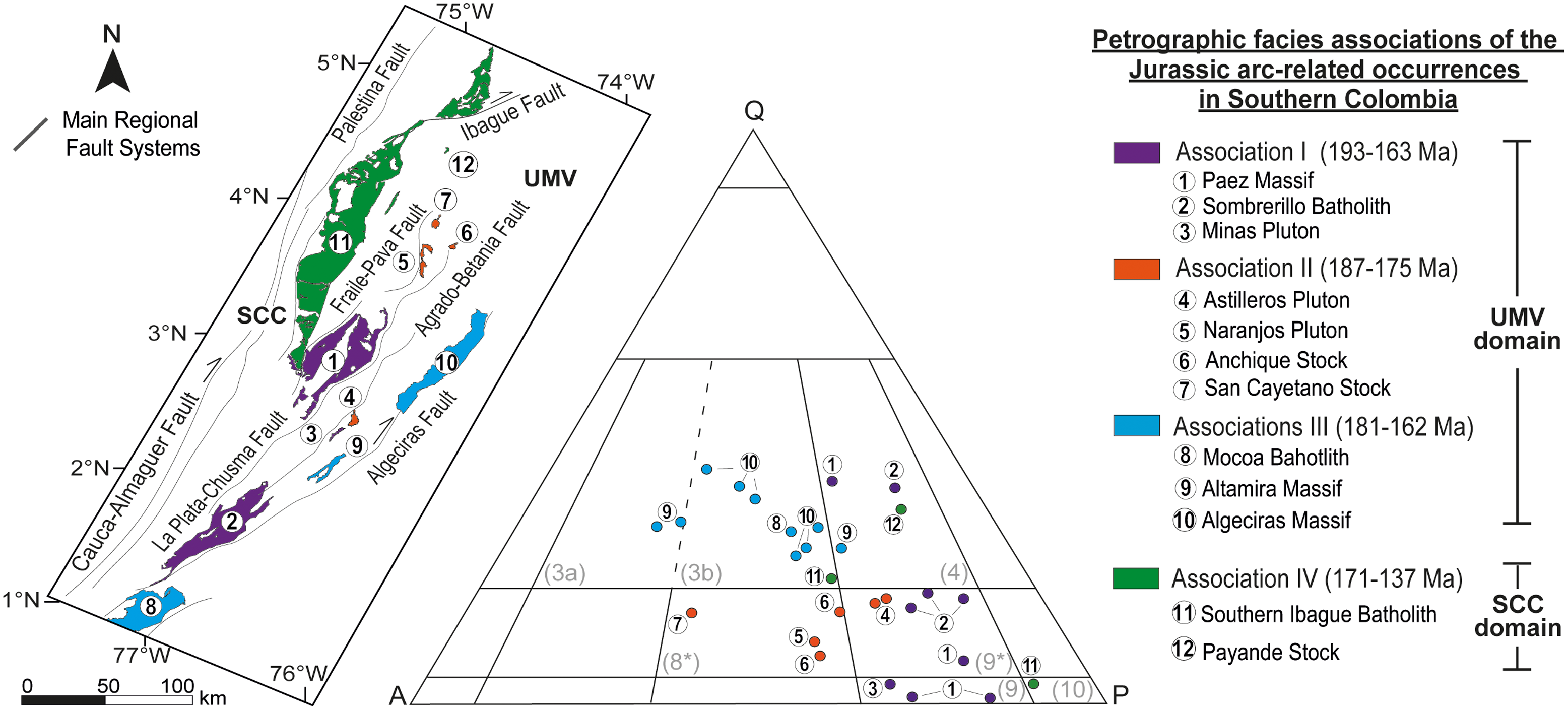
We studied 12 different Jurassic intrusive bodies along the UMV and SCC domains shown in Fig 1c, including the (1) Paez Massif, (2) Sombrerillo Batholith, (3) Minas Pluton, (4) Astilleros Pluton, (5) Naranjos Pluton, (6) Anchique stock, (7) San Cayetano Stock, (8) Mocoa Batholith, (9) Algeciras Massif and (10) Altamira Massif within the UMV domain, and the (11) Southern Ibague Batholith and (12) Payande Stock located within the SCC domain. These intrusive bodies are bounded by regional fault systems, namely: the Algeciras Fault, Agrado-Betania Fault, La Plata-Chusma Fault, Frailes-Pava Fault and Ibague Fault (Fig. 2). Essential geochemical and geochronological (U-Pb in zircon ages) data from the studied plutonic occurrences are summarized in Table 1.
Modal classification of the studied samples in the QAP modal classification diagram (Le Maitre et al., Reference Le Maitre, Streckeisen, Zanettin, Le Bas, Bonin, Bateman, Bellieni, Dudek, Efremova, Keller, Lameyre, Sabine, Schmid, SØrensen and Woolley2002; Streckeisen, Reference Streckeisen1976) and the distinction of the four main petrographic facies associations proposed for the Jurassic arc-related occurrences in Southern Colombia. Numbered fields: (3a) syenogranite; (3b) monzogranite; (4) granodiorite; (8*) quartz monzonite; (9*) quartz monzodiorite; (9) monzodiorite; (10) gabbro/diorite.
Compilation of the geochemical and geochronological (U-Pb in zircon ages) data of the studied Jurassic arc-related occurrences

Mg#: molar(100×MgO/(MgO+FeOT); ASI: molar Al2O3/(Na2O+K2O+CaO); LILEs and REEs in ppm. Data from Bustamante et al. (Reference Bustamante, Cardona, Bayona, Mora, Valencia, Gehrels and Vervoort2010, Reference Bustamante, Archanjo, Cardona and Vervoort2016); Chavarría et al. (Reference Chavarría, Bustamante, Cardona and Bayona2021); Leal-Mejía et al. (Reference Leal-Mejía, Shaw, Melgarejo, Cediel and Shaw2019); Restrepo et al. (Reference Restrepo, Bustamante, Cardona, Beltrán-Triviño, Bustamante, Chavarría and Valencia2021); Rodríguez et al. (Reference Rodríguez, Arango, Zapata and Bermúdez2018); Rodríguez-García et al. (Reference Rodríguez-García, Correa-Martinez, Zapata-Garcia, Arango-Mejía, Obando-Erazo, Zapata-Villada, Bermudez, Gómez and Mateus–Zabala2020b, Reference Rodríguez-García, Ramírez, Zapata, Correa-martínez, Sabrica, Obando, Estudios, Especiales and Colombiano2022).
Sampling for this study was conducted on representative localities (see locations in Fig 1c). The selection of sample sites considered previous petrographic, geochronological and geochemical information (Table 1). The complete dataset comprises 25 samples obtained from 10 occurrences located in the easternmost UMV domain. In this region, the plutonic rocks intrude Precambrian basement rocks and are spatially related to Jurassic volcanic sequences (Fig. 1c). Additionally, three samples were collected from two occurrences in the SCC domain, which are exposed in the westernmost part of the study area, where they intruded Triassic to Permian metamorphic and plutonic basement rocks, respectively (Fig. 1c). Collected plutonic samples were then subjected to broad petrography and mineral chemistry analysis.
3.a. Petrographic associations
A petrographic facies refers to a descriptive unit, which can be recognized and described in hand samples and in field outcrops through its structural, textural and mineralogical features. Conversely, a petrographic-facies association represents a mapping unit for a given map scale and may group one or more petrographic facies (Ulbrich et al. Reference Ulbrich, Vlach and Janasi2001).
Among the studied intrusive occurrences, the Altamira and Algeciras Massifs in the Eastern Cordillera of Colombia are the unique occurrences mapped in some detail (García-Chinchilla and Vlach, Reference García-Chinchilla and Vlach2019), using the concepts of petrographic-facies and facies associations. The other intrusive bodies, in spite of the available petrographic, geochemical and geochronological information, have not been mapped in any detail and thus the constituting petrographic facies (e.g. dioritic, tonalitic, granodioritic and granitic varieties), their relative proportions and structural relations, as well as the main constituting intrusive units or plutons are not properly known.
Considering these limitations and the available information, we chose to group the studied occurrences according to some general petrographic associations, defined mainly by their geographic distribution, petrographic, compositional and age variation ranges. In these senses, these petrographic associations are descriptive geological units which may arguably correspond to the units and super-units as defined in the Coastal Batholith of Peru (e.g. Cobbing and Pitcher, Reference Cobbing and Pitcher1983), as more basic geological data are acquired. This approach allowed us to define four main petrographic-facies associations I, II, III and IV, within the studied Jurassic occurrences in southern Colombia; among them, three crops out in the UMV domain and the other in the SCC domain.
3.b. Petrography and mineral chemistry
Petrography analyses focused on mineralogical and textural properties to define petrographic facies and magma series (see the following section). All samples were examined in polished thin (30 μm in thick) sections under a petrographic microscope, using transmitted and reflected lights. Quantitative modal data were obtained with a chariot and a manual point counter and are depicted in Fig. 2 and presented in Supplementary Table S1. After the petrography work, the thin-sections were carbon coated for electron microprobe (Electron Probe Micro-Analyzer - EPMA) analysis, which included electron-backscattering imaging and spot analysis by qualitative energy-dispersive spectrometry and quantitative wavelength-disperse spectrometry (WDS).
The EPMA work was done in two separate analytical phases. Twenty-four samples were analyzed using a field emission JEOL JXA-FE-8530 microprobe at the laboratories of the GeoAnalitica core facility, Institute of Geosciences of the University of São Paulo, Brazil. WDS analysis was performed with 15 kV, 20 nA and 5 µm for the column acceleration voltage, beam current and beam diameter, respectively. Total counting times, equally distributed for peak and background readings, varied from 10 s (major and light elements) to 40 s (minor elements); matrix effects were corrected with the PROZA PRZ/Armstrong software. We used natural and synthetic standards from both the Smithsonian and the GellerTM collections: hornblende (Si and Al in amphiboles), diopside (Mg), fayalite (Fe and Mn), anorthoclase (Al), wollastonite (Ca), orthoclase (K), rutile (Ti), albite (Na), zircon (Zr), willemite (Zn), benitoite (Ba), glass_synthetic (Ni) sodalite (Cl) and fluorapatite (F). Other four samples were analyzed with a conventional JEOL JXA-8230 microprobe at the Department of Petrology and Metalogenesis, Institute of Geosciences of the University of Rio Claro, Brazil, under the same analytical conditions, except for the counting times settled at 10 s and 20 s for major and minor elements, respectively, and the standards used for element calibrations, which were wollastonite (Ca), orthoclase (Si and K), albite (Na), diopside (Mg), anorthite (Al), ilmenite (Ti and Fe), chromite (Cr), rhodonite (Mn), synthetic NiO (Ni), sodalite (Cl) and barite (Ba). Of note, Al was repeaked over hornblende from the samples to avoid Al peak shift in this latter case.
Mineral formulae for the analyzed pyroxene, feldspar, biotite and amphibole-group minerals were determined based on 6, 8, 11 and 24 atoms per formulae unit (apfu), respectively. The classifications of pyroxenes, feldspars and biotite follow Rock (Reference Rock1990), Deer et al. (Reference Deer, Howie and Zussman2013) and Tischendorf et al. (Reference Tischendorf, Förster, Gottesmann and Rieder2007), respectively. In the case of biotite mineral formulae, Tischendorf’s formula [Li2O = 2.1/(0.356 + MgO) − 0.088] has been used to estimate the Li contents (Tischendorf et al. Reference Tischendorf, Rieder, Foster, Gottesmann and Guidotti2004). The amphibole-group classification was considered according to the scheme of Hawthorne et al. (Reference Hawthorne, Oberti, Harlow, Maresch, Martin, Schumacher and Welch2012), by using the Excel spreadsheet of Locock (Reference Locock2014). The compositional results for all minerals and their calculated structural formulae are given in Supplementary Tables S2b to S2d.
Thermobarometry calculations were applied to selected minerals in most of the studied rocks using the Online MagMin_PT Geothermobarometry Program for magmatic rocks developed by Gündüz and Asan (Reference Gündüz and Asan2022). Compositions of clinopyroxene were useful to calculate magma pressures and temperatures according to the thermobarometer of Wang et al. (Reference Wang, Hou, Wang, Zhang, Zhang, Pan, Marxer and Zhang2021). We selected plagioclase–hornblende pairs for temperature estimations using the thermometry model of Holland and Blundy (Reference Holland and Blundy1994) (expression B) and for pressure estimations, we applied the barometric expression of Molina et al. (Reference Molina, Moreno, Castro, Rodríguez and Fershtater2015). These pairs were based on the compositions of plagioclase and amphibole crystal rims in contact, where the two phases are most likely to have been in textural exchange reaching magmatic equilibrium conditions (Blundy and Cashman, Reference Blundy and Cashman2008). Amphibole compositions from crystal rims were also used to compare the above P-T estimations with those of the Al-in-hornblende barometer of Mutch et al. (Reference Mutch, Blundy, Tattitch, Cooper and Brooker2016) and Ti-Amp thermometer of Liao et al. (Reference Liao, Wei and Rehman2021) as well as to constraint some physicochemical crystallization conditions such as log f O2 and H2O-in-melt, applying the chemometric empirical expressions of Ridolfi (Reference Ridolfi2021).
4. Results
Based on the available geologic information and the newly obtained petrography and mineralogical data, we defined four distinct Jurassic petrographic associations in southern Colombia, as described in the following section. The UMV domain includes three of these associations (I, II and III) with emplacement ages spanning from ∼193 to 162 Ma. In contrast, the fourth association (IV), situated in the SCC domain, presents somewhat younger ages ranging from ∼171 to 137 Ma (Fig. 2).
4.a. Petrography
The modal classification of the studied samples is illustrated in Fig. 2, which provides a visual representation of the spatial-temporal variations and compositional features observed among the studied plutons.
The petrographic association I is made up of mesocratic and leucocratic dark-grey and greyish-coloured rocks, including massive to slightly foliated monzodiorites, quartz monzodiorites and granodiorites from the Paez Massif, Sombrerillo Batholith and Minas Pluton in the western part of the UMV domain (Fig. 2). These rocks are primarily intrusive into Precambrian basement rocks and record the older magmatic activity, between c. 193 and 163 Ma. The petrographic association II includes mesocratic to leucocratic grey- and pinkish-coloured quartz monzodiorites and quartz monzonites from the San Cayetano and Anchique stocks, and the Naranjos and Astilleros plutons exposed in the central part of the UMV domain (Fig. 2). The plutons characterized by this facies group were emplaced from ∼185 to 175 Ma and intrude relatively contemporaneous Jurassic volcanic rocks of the Saldaña Formation to whom they are probably related (Fig. 1c). The petrographic association III comprises leucocratic grey- and pinked-coloured granodiorites and granites from the Mocoa Batholith, and the Algeciras and Altamira massifs, cropping out in the eastern part of the UMV domain (Fig. 2). They record emplacement ages ranging from 181 to 162 Ma, intrude Precambrian rocks and are also closely associated with the volcanic rocks of the Saldaña Formation (Fig. 1c). The last association IV presents the most expanded compositional variation, including mesocratic and leucocratic dark-green- and grey-coloured diorites, granodiorites and monzogranites, respectively, from the southern Ibague Batholith and the Payande Stock located in the SCC domain (Fig. 2). These occurrences represent the latest magmatic record in the study area (c. 171–137 Ma) and intrude mainly Triassic to Permian basement rocks. The main petrographic characteristics of these associations are summarized in Supplementary Table S2. Some additional petrographic features are provided below.
4.a.1. Association I
This association include medium-to-coarse-grained and equi-to-inequigranular textures (Table S2). The quartz monzodiorite and monzodiorite facies exhibit well-developed corona textures, where euhedral to subhedral orthopyroxene and/or clinopyroxene crystals are rimmed and partially replaced by amphibole or biotite (Fig. 3a,b). Of note, orthopyroxene was exclusively found in quartz monzodiorites from the Sombrerillo Batholith, which are the unique two-pyroxene-bearing rocks known in the whole studied area. Some clinopyroxene crystals display exsolution lamellae of pigeonite and sieved cores and occasionally occur in intergrowths with plagioclase. Plagioclase is euhedral to subhedral and has tabular habits. It exhibits concentric or discontinuous oscillatory zoning patterns (Fig. 4a), especially in the granodiorite facies, where crystals show strong saussurite alteration (Fig. 3c). Amphibole is the most abundant mafic phase in all facies occurring either as isolated crystals or forming mafic aggregates with biotite, Fe–Ti oxides and titanite. They usually form euhedral to subhedral crystals with prismatic habits and brownish-green pleochroism (Fig. 3c). Biotite is commonly found in association with amphibole, displaying textures suggestive of co-precipitation (Fig. 3a). It forms subhedral platy crystals of fine to medium grain size, showing brownish-green pleochroism and containing small inclusions of euhedral apatite and zircon. Biotite often undergoes chlorite alteration. K-feldspar is late magmatic and anhedral. In the monzodiorite and quartz monzodiorite facies, it occurs interstitial to plagioclase and amphibole euhedral crystals, resembling some extent cumulate textures (Fig. 3c and Fig. 4b), whereas, in the granodioritic facies, it usually forms subhedral coarse-grained crystals, partially sericitized and closely related with quartz. The accessory minerals in this group are mainly magnetite, titanite, apatite and zircon. Chlorite, epidote, carbonates, sericite/muscovite and albite are post-magmatic substituting the primary phases.
Microtextural features of rock-forming minerals from the Jurassic arc-related plutonic occurrences in southern Colombia. Photomicrographs under crossed polarized light: (a) Orthopyroxene crystals in reaction texture within hornblende and biotite. (Association I - Sample JR5); (b) Corona of hornblende around clinopyroxenes (Association I - Sample JR1); (c) Euhedral plagioclase crystals and aggregates of amphibole and opaques minerals enclosed by interstitial K-feldspar (Association I – Sample JR3); (d) Clinopyroxene grouped crystals with inclusions of apatite and in close relation with biotite and opaque minerals (Association II - Sample JR14); (e) Graphic quartz-orthoclase intergrowth and isolated clinopyroxenes crystals partially replaced by chlorite (Association II - Sample JR15); (f) Prismatic amphibole with inclusions of opaques and in reaction with pseudomorphic chlorite crystals after biotite (Association II - Sample JR13); (g) Inequigranular texture with concentric zoning plagioclase and perthitic alkali feldspar phenocrysts and isolated amphibole and biotite crystals (Association III - Sample JR17); (h) Mafic aggregate of amphibole, biotite, titanite and opaques crystals (Association III - Sample JR25); (i) Amphibole with inclusions of opaques and zircon and in co-precipitation texture with pseudomorphic chlorite after biotite (Association III – Sample JR16); (j) Coarse-grained hornblende and plagioclase grouped crystals forming cumulate-like texture (Association IV - Sample JR26); (k) Amphibole grouped crystals showing prismatic and elongated habits and in close relation to primary plagioclase (Association IV - Sample JR27); (l) Oscillatory zoning in plagioclase phenocryst in contact with primary biotite crystals (Association IV - Sample JR28). Mineral abbreviations according to Warr (Reference Warr2021).

4.a.2. Association II
This association present a predominant massive structure and fine- to medium-grained inequigranular, porphyritic textures (Table S2). Clinopyroxene occurs as grouped subhedral crystals closely related to Fe–Ti oxides, amphibole and biotite. Many of the crystals also exhibit exsolution lamellae and are partially replaced either by biotite or chlorite along cleavage planes (Fig. 3d). Clinopyroxene rimmed by chlorite is also found (Fig. 4c). Plagioclase occurs as large subhedral tabular crystals, showing microcracks, saussuritic cores and reabsorbed rims (Fig. 3e). Amphibole occurs in two textural types: the first consists of large prismatic individual crystals with slight greenish pleochroism, sometimes showing poikilitic textures with abundant small magnetite and apatite inclusions. Some crystals occur in equilibrium texture with biotite (Fig. 3f), suggesting co-precipitation. The second type of amphibole is present as colourless fine intergrowths within primary amphiboles or as acicular interstitial crystals between felsic minerals in the groundmass, suggesting a post-magmatic origin. Biotite also exhibits two textural types: one group consists of subhedral lamellar medium-grained greenish-brownish crystals, closely associated with the first generation of amphibole and partially altered to chlorite (Fig. 3f), while the other type is characterized by aggregates of fine-grained flakes intergrowing with chlorite or epidote and replacing clinopyroxene, indicating a likely post-magmatic, hydrothermal origin (Fig. 3d). Mymerkite intergrowths along perthitic K-feldspar and plagioclase boundaries and graphic intergrowths between K-feldspar and quartz are widespread in these rocks (Fig. 3e). Euhedral magnetite showing trellis-type lamellae of exsolved ilmenite (Fig. 4d) and titanite are the main accessories for these rocks, being accompanied by minor allanite, apatite and zircon. Samples from this group are also characterized by strong pervasive hydrothermal alteration leading to the precipitation of a significant amount of hydrothermal minerals, which besides those observed in Association I include common prehnite.
BSE images of rock-forming minerals from the Jurassic arc-related plutonic occurrences in southern Colombia. (a) Euhedral plagioclase showing oscillatory zoning pattern (Association III - Sample JR24); (b) Poikilitic groundmass K-feldspar including several hornblende crystals (Association I - Sample JR3); (c) Reaction rims of biotite-chlorite around clinopyroxene (Association II - Sample JR12); (d) Magnetite host crystals (light white) with thin trellis-type lamellae exsolution of ilmenite in dark grey ( Association II - Sample JR14); (e) Subhedral hornblende crystals with patchy zoning pattern and microcracks (Association III - Sample JR17); (f) Euhedral biotite crystal partially replaced by chlorite represented by the main darker area (Association III - Sample JR25). Mineral abbreviations according to Warr (Reference Warr2021).

4.a.3. Association III
The rocks in this association exhibit massive structures with variable fine- to coarse-grained equi- to inequigranular textures (Table S2). Amphibole is the predominant mafic phase, occurring either as individual crystals or forming mafic clots along with biotite, Fe–Ti oxides and titanite (Fig. 3g). The crystals are euhedral to subhedral with prismatic habits and contain inclusions of zircon, Fe–Ti oxides and allanite (Fig. 3h). Some amphiboles display patchy and/or reabsorbed textures and related microcracks (Fig. 4e) and may show exsolution Fe–Ti oxides along cleavage planes. Plagioclase occurs as large euhedral to subhedral tabular crystals with oscillatory and concentric zoning patterns. In some cases, plagioclase crystals show highly altered cores and unaltered rims (Fig. 3g). Biotite is a late-crystallized mafic, forming interstitial subhedral to anhedral platy fine-grained crystals that are commonly replaced by chlorite (Fig. 3i and 4f). K-feldspars form subhedral medium-grained perthitic crystals, occurring in close relation with quartz (Fig. 3h). Locally, mymerkite intergrowths are observed. The accessory phases are the same as described for the previous associations; however, some magnetite crystals are rimmed and partially substituted by titanite. The alteration minerals also include some hematite and pyrite.
4.a.4. Association IV
The rocks included in this association have massive structures and fine- to coarse-grained inequigranular textures (Table S2). Some rocks of the diorite facies present coarse euhedral plagioclase and amphibole aggregates, resembling cumulate-like textures (Fig. 3j). Amphibole is also the main mafic mineral, crystallizing as groups of relatively larger prismatic, euhedral to subhedral, twinned crystals with dark green to brown pleochroism (Fig. 3k). Some among them display poikilitic textures with a significant number of inclusions of Fe–Ti oxides, titanite, apatite and some allanite. Fe–Ti oxides (mainly ilmenite) are observed along their cleavage planes (Fig. 3j). Biotite occurs in two different types: one consists of large subhedral crystals with small mineral inclusions of apatite and zircon, showing yellow-brown pleochroism and placoid habits; the other forms aggregates of fine-grained flakes interstitial between the felsic minerals, associated with secondary chlorite, epidote and/or carbonates (Fig. 3l). Plagioclase crystallizes as large well-formed tabular crystals with distinct concentric, oscillatory zoning textures and strongly saussuritic cores (Fig. 3l). K-feldspar is present as subhedral medium-grained twinned crystals closely associated with quartz and shows some albite lamellae exsolution. Pseudomorphic chlorite after biotite is observed in all samples from this petrographic association.
4.b. Mineral compositions
Our EPMA dataset includes chemical analyses of feldspar (518), pyroxenes (39), amphiboles (310) and biotite (182) group minerals, with their corresponding structural formulae (see Supplementary Table S3). Additionally, for the purpose of discussion, we have included plagioclase and amphibole chemical data published by Chavarría et al. (Reference Chavarría, Bustamante, Cardona and Bayona2021) on the same sample of the Payande Stock from the Southern SCC magma series. The analyzed minerals exhibit significant compositional variations among the four petrographic associations, which we describe in the following.
4.b.1. Feldspars
Plagioclase in all facies exhibits significant compositional variations, with common labradorite-andesine in the cores transitioning to oligoclase-albite compositions at the rims, as depicted in the An–Ab–Or ternary diagram (Fig. 5). As expected, the evolutionary trends are more pronounced in Associations I and III, where anorthite (An) contents range from An57.5-12 and An46-1.3, respectively. In Association II, the An contents range from An60.8-24.5, while in Association IV, they range from An59.8-14.5. Moreover, there are significant differences in the orthoclase (Or) content. Associations III and II display the highest Or values, up to 10.4 and 7.9, respectively, while I and IV have Or values up to 1.1 and 1.5, respectively, which indicate contrasted intensive parameters during their crystallization. Among the studied facies, the K-feldspar crystals exhibit relatively homogenous compositions in the Associations I, II and III, being K-rich in IV with Or content ranges of Or97.6-59.5, Or98.4-62.8, Or97.8-52.5 and Or93.7-91.1, respectively, see Table S3a.
Anorthite (An) – Albite (Ab) – Orthoclase (Or) molecular ternary plot (Deer et al., Reference Deer, Howie and Zussman2013) for feldspar crystals from the petrographic associations I (a), II (b), III (c), and IV (d) from the Jurassic arc-related plutonic occurrences in southern Colombia.

4.b.2. Pyroxenes
The compositions of pyroxenes found in Associations I and II are illustrated on the Wo–En–Fs quadrilateral diagram in Fig. 6a. The orthopyroxene corresponds to ferroan enstatite, exhibiting average enstatite (En) contents of En52 and En56 (Table S3b). The clinopyroxenes mainly fall into the calcic Mg-rich augite compositional field, with average compositions of Wo40En39Fe18 in I and Wo43En38Fe17 in II. Of note, ferroan diopside compositions are prevalent in crystal rims, ranging from Wo45En41Fe12 in the monzodiorite facies to Wo46En31Fe20 in the quartz monzodiorite facies of Association I. A single data point, obtained over the thickest exsolution lamellae observed, corresponds to an Mg-rich pigeonite (Fig. 6a and Table S3b). In the case of the two-pyroxene-bearing quartz monzodiorites from Association I, the Mg# [=Mg/(Mg+FeT)] values of the clinopyroxenes are distinctively higher than those measured for the orthopyroxene (Fig. 6a), with the exception of one analysis with low analytical precision (e.g. low CaO wt %), derived from an exsolution intergrowth of clinopyroxene into an orthopyroxene crystal (Table S3b).
Composition of pyroxene crystals from the Jurassic arc-related plutonic occurrences in southern Colombia: (a) Ferrosilite (Fs) – Wollastonite (Wo) – Enstatite (En) molecular ternary plot (Rock, Reference Rock1990).

4.b.3. Amphiboles
The amphiboles in all the studied plutons are calcic (0.83 ≤ BCa/B(Ca + Na) ≤ 0.98) and exhibit significant compositional variations among the different petrographic facies (Table S3c). Accordingly, ferro-ferri-hornblende and magnesium-ferri-hornblende occur in all petrographic facies, while Ti-rich-ferri-tschermakite along with ferri-tschermakite, with the lower alkali contents, and magnesium-hastingsite occur mainly in the Associations IV and III, respectively. The post-magmatic amphibole in Association IV is an actinolite (Fig. 7a). These amphiboles exhibit a strong negative correlation between AlT and Si + C(Mg + Fe2+) and between ivAl + (Na + K) and Si + A[ ] (vacancy in the A site), indicating contributions of both the pressure-sensitive Tschermak and the temperature-sensitive edenite exchanges (Fig. 7b,c; see also Gilbert et al. Reference Gilbert, Helz, Popp, Spear, Veblen and Ribbe1982; Holland and Blundy, Reference Holland and Blundy1994). In Association IV, the diorite facies show the highest AlT contents among the studied rocks, reaching up to 2.2 apfu. In comparison, the granodiorite and monzogranite facies have lower values up to 1.6 apfu. In contrast, Associations I, II and III, display intermediate to low AlT contents, ranging up to 1.8, 1.4 and 0.7 apfu, respectively (Table S3c). Primary amphiboles have average mg# [=Mg/(Mg+Fe2+)] numbers of ∼0.55 in Association I, ∼0.62 in Association II, ∼0.64 in Association III and ∼0.63 in Association IV (Table S3c).
Main compositional variations (apfu) of amphiboles from the Jurassic arc-related plutonic occurrences in southern Colombia: (a) Classification diagram according to Hawthorne et al. (Reference Hawthorne, Oberti, Harlow, Maresch, Martin, Schumacher and Welch2012); (b) Cationic ivAl + viAl vs. Si + Mg + Fe2+)C plot indicating the Al-Tschermak exchange. (c) ivAl + (Na + K) vs. Si + [ ]A plot showing the edenite-type exchange (Gilbert et al., Reference Gilbert, Helz, Popp, Spear, Veblen and Ribbe1982; Holland and Blundy, Reference Holland and Blundy1994).

4.b.4. Biotite
The biotite crystals analysed in this study were initially classified using the ternary 10*TiO2 − MgO − FeOT + MnO diagram proposed by Nachit et al. (Reference Nachit, Ibhi, Abia and Ben Ohoud2005) to distinguish between primary, re-equilibrate (primary biotite modified by hydrothermal fluids) and secondary biotite. According to this classification, the compositions of biotite in most facies of Associations I and IV plot within the primary magmatic biotite field. In the granodiorite facies of Association I, and in all plutonic facies of Associations II and III, biotite crystals are predominantly re-equilibrated (Fig. 8a). These findings are consistent with the observed textural relationships, where re-equilibrated biotite crystals commonly display varying degrees of hydrothermal alteration (Figs. 3 and 4). Figure 8b depicts the feal vs mgli classification diagram proposed by Tischendorf et al. (Reference Tischendorf, Förster, Gottesmann and Rieder2007). In this diagram, the primary biotite crystals are classified as Mg-rich annite. They have average mg# [=Mg/(Mg+Fe2+)] numbers and AlT (apfu) contents of ∼0.48 and ∼1.35 in Association I, and ∼0.51 and ∼1.26 in Association IV, respectively. On the other hand, re-equilibrated biotite is predominantly represented by Fe-rich phlogopite (Fig. 8b). These types show average mg# and AlT (apfu) contents of ∼0.43 and ∼1.39 in Association I, ∼0.66 and ∼1.16 in II and ∼0.60 and ∼1.19 in III, respectively (Table S3d).
Composition of biotite from the Jurassic arc-related plutonic occurrences in southern Colombia: (a) 10*TiO2 – FeO – MgO ternary diagram (Nachit et al., Reference Nachit, Ibhi, Abia and Ben Ohoud2005); (b) Classification feal (FeT + Mn + Ti - viAl) vs. mgli (Mg - Li) diagram according to Tischendorf et al. (Reference Tischendorf, Förster, Gottesmann and Rieder2007).

5. Discussion
5.a. Estimation of physicochemical crystallization conditions
Using the available thermobarometric models and the obtained compositions for clinopyroxene and amphibole, we were able to estimate the prevailing temperatures, pressures, oxygen fugacities and the water contents of the crystallization environments related to each of the studied plutons. These constraints are crucial for understanding the processes that control magma generation and evolution and for reconstructing the thermal and emplacement history of the Jurassic plutonic rocks exposed in southern Colombia. The results (average values) are summarized in Table 2; the full dataset is listed in supplementary Tables S2b and S2c.
Estimated mean values of crystallization physicochemical parameters of the studied Jurassic arc-related plutonic occurrences

Thermobarometry calculations based on: T1 and P1 = Cpx-thermobarometry calibrations by Wang et al. (Reference Wang, Hou, Wang, Zhang, Zhang, Pan, Marxer and Zhang2021); T2 = amphibole-plagioclase thermometer by Holland and Blundy (Reference Holland and Blundy1994) (expression B); P2 = Al-in-hornblende barometer by Mutch et al. (Reference Mutch, Blundy, Tattitch, Cooper and Brooker2016); Depths were determined based on pressure conditions, assuming an equivalent 3.8 km pressure gradient for the average crustal density of 2.7 g cm− 3; Physico-chemical conditions of magmas (logf O2, H2Omelt) according to amphibole-only calibrations by Ridolfi (Reference Ridolfi2021).
5.a.1. Temperature
Petrographic observations have indicated that clinopyroxene is an early-crystallized phase found exclusively in the monzodiorite, quartz monzodiorite and quartz monzonite facies of Associations I and II from UMV. Therefore, by measuring the crystallization temperature of clinopyroxene, it is possible to estimate the near-liquidus temperature of the parental magmas for the corresponding magma series. The model proposed by Wang et al. (Reference Wang, Hou, Wang, Zhang, Zhang, Pan, Marxer and Zhang2021), unlike other thermometers that rely on additional information from melt compositions or coexisting minerals (e.g. Liang et al. Reference Liang, Sun and Yao2013; Putirka et al. Reference Putirka, Johnson, Kinzler, Longhi and Walker1996; Putirka, Reference Putirka2008), depends solely on the clinopyroxene compositions and the resulting temperatures appear to be more accurate on the average, as evidenced by comparisons in Wieser et al. (Reference Wieser, Kent and Till2023). In our calculations, we assumed an average H2O content in the melt of ∼4.0 wt %, according to the broadly estimated water contents in mafic arc magmas (Plank et al. Reference Plank, Kelley, Zimmer, Hauri and Wallace2013). The estimated clinopyroxene temperatures in both associations overlap but are higher on average for the monzodiorite and quartz monzodiorite rocks of Association I (970°C–1087°C) as compared to those quartz monzodiorites and monzonites of Association II (988°C–1011°C) see Table 2. Considering that clinopyroxenes were among the first crystallized mineral phases, these results are interpreted to represent thermal conditions near the liquidus of the older magmas within the UMV domain.
The amphibole-plagioclase thermometer developed by Holland and Blundy (Reference Holland and Blundy1994) is a widely accepted model for estimating the close-to-solidus crystallization temperatures of hydrous magmas within arc magmatic systems. In our study, the criteria for its application have been consistently met in all investigated plutonic rock samples, defined by the typical mineral assemblage of quartz + plagioclase + K-feldspar + hornblende + biotite + titanite + magnetite + apatite. For comparison, the new Ti-Amp thermometer of Liao et al. (Reference Liao, Wei and Rehman2021), which is based on the titanium content of calcic amphibole-bearing igneous and high-grade metamorphic rocks, was also applied in this study.
We obtained variable crystallization temperatures for the distinct plutons in which mostly diorite, monzodiorites and quartz monzodiorites facies record higher T conditions relative to quartz monzonites, granodiorites and granites. Temperatures determined by the plagioclase-hornblende thermometer in the plutonic occurrences constituted by Association IV display the highest temperatures, ranging from 691°C to 761°C (±40), followed by Association I and III, with temperatures between 656°C–747°C (±40) and 655°C–708°C (±40), respectively. In contrast, Association II results in the lowest temperatures range from 647°C to 673°C (±40). Regarding the amphibole-only thermometer, the calculated crystallization temperatures are mostly consistent with those mentioned above, with plutons in Association IV yielding 671°C–873°C (±35), Association I 656°C–766°C (±35) and Association III 601°C–691°C (±35), except for samples in Association II, which exhibit considerable underestimations about the close-to-solidus temperature conditions between 467°C and 517°C (±35). Of note, there are underestimations in specific samples from Associations I and III from the obtained temperatures by using the model of Liao et al. (Reference Liao, Wei and Rehman2021), as evidenced by the greater standard deviations of the data compared to those obtained using the Holland and Blundy (Reference Holland and Blundy1994) model (see Supplementary Table S4). Therefore, we opted to show only the plagioclase-hornblende temperature estimations in Table 2 and Fig. 9a.
Crystallization conditions for the distinctive petrographic facies associations of the Jurassic arc-related plutonic occurrences in southern Colombia: (a) Temperature vs pressure vs depth diagram. Dotted curves correspond to the H2O contents necessary for water saturation of the melt taken from Holtz et al. (Reference Holtz, Behrens, Dingwell and Johannes1995); (b) logfO2 vs. temperature showing the Ni-NiO (NNO) and QFM (Quartz-Fayalite-Magnetite) buffers for amphibole compositions from Ridolfi et al. (Reference Ridolfi, Renzulli and Puerini2010); (c) Pressure dependence of H2O solubility diagram at 800°C after Holtz et al. (Reference Holtz, Behrens, Dingwell and Johannes1995).

Differences in temperature crystallization conditions among the four association groups can be attributed to variations in the magmatic processes and/or the degree of fractionation that occurred in each plutonic body. They may suggest that the entire Jurassic plutonic arc magmatic system in southern Colombia underwent distinct thermal histories, which influenced the observed contrasting mineral compositions and textures. In the case of the clinopyroxene-bearing rocks, the amphibole-derived temperatures are in general agreement with those clinopyroxene-derived, as amphibole was relatively late in the crystallization sequence; however, in the case of Association II, the amphibole temperatures are significantly lower approaching the expected close-to-solidus temperatures, and the resulting temperature gap is much large (up to c. 300°C), suggesting amphibole late re-equilibration. On the other hand, thermal conditions recorded by the amphibole-bearing rocks, in which amphibole crystallized at intervals above the solidus temperatures ranging between ≥700°C and ≤800°C, in general, suggest an early crystallization stage of this phase in the mineral sequences of Associations I and IV. In this sense, when compared to the zircon saturation temperatures recorded by these rocks (with mean values of 718°C, Table 1; see also Chavarría et al. Reference Chavarría, Bustamante, Cardona and Bayona2021), zircon appears to be a relatively late magmatic phase in the crystallization history of the more evolved granites in the studied region.
5.a.2 Pressure
We also used the model by Wang et al. (Reference Wang, Hou, Wang, Zhang, Zhang, Pan, Marxer and Zhang2021) to determine the crystallization pressures of the clinopyroxenes. However, we found limitations in the case of the monzonite facies in Association II due to the relatively high uncertainty errors associated with its clinopyroxene compositions. Nevertheless, reliable crystallization pressures were computed for the clinopyroxene-bearing monzodiorite and quartz monzodiorite facies of Association I. The zoned clinopyroxene in the monzodiorite facies from the Paez Massif indicates high pressures of ∼6.3 kbar for the augite cores and low pressures of ∼2.5 kbar for the diopside rims (Table 2). The observed pressure differences between the core and rim zones in the Paez Massif may be attributed to magma crystallization under deeper conditions in an initial stage, followed by magma ascending to a shallower magma chamber while fractionating, as expected in natural magmatic plumbing systems. As for clinopyroxenes in the quartz monzodiorite facies from the Sombrerillo Batholith, we obtained a lower pressure of 1.6 (±1.6) kbar relative to the Paez monzodiorite rock (Table S3c). However, this result should be interpreted with caution, as the analysed clinopyroxene crystals are overgrown by hornblende, forming the typical corona textures in this rock (Fig. 3). In fact, a relatively higher pressure was derived from amphibole thermobarometry for this plutonic facies, as we described below.
By using the selected amphibole–plagioclase pairs, we estimated the pressure conditions at which these mineral phases coexist during the crystallization evolution of the plutons employing the barometer developed by Molina et al. (Reference Molina, Moreno, Castro, Rodríguez and Fershtater2015). Empirical and experimental studies have demonstrated that the Al-in-hornblende barometer is a reliable tool for estimating the pressure of calc-alkaline igneous rocks (Hammarstrom and Zen, Reference Hammarstrom and Zen1986; Schmidt, Reference Schmidt1992; Anderson and Smith, Reference Anderson and Smith1995; Mutch et al. Reference Mutch, Blundy, Tattitch, Cooper and Brooker2016). Among the classical models, the Al-in amphibole barometer revisited by Mutch et al. (Reference Mutch, Blundy, Tattitch, Cooper and Brooker2016) incorporates a wider range of mineralogical and chemical variables, leading to comprehensive and reliable pressure estimations. This model has lower uncertainty values and better accuracy at higher pressures. Therefore, we compare the model of Mutch et al. (Reference Mutch, Blundy, Tattitch, Cooper and Brooker2016) with the one presented by Molina et al. (Reference Molina, Moreno, Castro, Rodríguez and Fershtater2015), considering its applicability to our samples, characterized by a mineral assemblage of hornblende + plagioclase (An10-60) + biotite + Fe–Ti oxides + titanite + apatite + alkali feldspar + quartz. The calculated crystallization pressures generally align between the two barometric models, although higher-P values were predominantly obtained with the amphibole–plagioclase pairs compared to the amphibole-only calibration (see Supplementary Table S4). We primarily considered the pressure values obtained with the amphibole-only barometer of Mutch et al. (Reference Mutch, Blundy, Tattitch, Cooper and Brooker2016) in Table 2 and Figure 9, given their overall accuracy and systematic results across all investigated samples.
Association IV in the SCC domain exhibits the highest and most contrasted pressures of 3.9–2.8 (±0.5–1.5) kbar for the diorite facies and 2.0–1.1 (±0.5–1.5) kbar for the granodiorite and monzogranites (Table 2). For plutons in the UMV domain, Association I shows variable values with pressure values ranging from 3.6–2.2 (±0.5–1.5) kbar in monzodiorite, quartz monzodiorites and granodiorites to 1.3 (±0.5) kbar for a monzodiorite rock. Association III presents similar pressure conditions among all granodiorite and granitic facies with values between 2.8 and 1.5 (±0.5–1.5) kbar. Finally, quartz monzodiorites and quartz monzonites in Association II yielded the lowest pressure conditions of 1.0–0.7 (±0.5) kbar (Table 2). Figure 9a shows a partial positive correlation between the calculated amphibole crystallization temperatures and pressure conditions. As for above, the differences in the estimated pressures, particularly from the Paez Massif and Southern Ibague Batholith, may be compatible with the evolution of magma series at different crustal levels within the plumbing systems and suggest late-fractionation processes during the full solidification of these plutonic rocks in the southern Colombian region.
The obtained crystallization pressures were converted to emplacement depths for each studied occurrence considering an average density of 2.7 g cm−³ for the crustal column, and the results are listed in Table 2. Overall, plutonic occurrences from the UMV domain including Association I had emplacement depths ranging from 12–8 km (Sombrerillo Batholith), 11–5 km (Paes Massif) and 8 km (Minas Pluton). Association III has estimated depths ranging from 10–7 km (Algeciras Massif) to 6 km and 7–5 km (Mocoa Batholith and Altamira Massif, respectively). Lastly, the smaller occurrences in Association II (Astilleros and Anchique stocks) were estimated to have emplacement depths of around 3 km (Table 2). As for the plutons in the SCC domain grouped in Association IV, the estimated emplacement depths range from 15–8 km (Southern Ibague Batholith) to 4 km (Payande Stock; Chavarría et al. (Reference Chavarría, Bustamante, Cardona and Bayona2021). Of note, Chavarria et al. (Reference Chavarría, Bustamante, Cardona and Bayona2021) reported generally high pressures, up to 6.7 kbar and emplacement depths of 25 km, from amphiboles in tonalite/granodiorite facies from the Northern Ibague Batholith, located within the SCC tectonic domain, in the northernmost part of the study area.
5.a.3. Oxygen fugacity (fO2) and water contents (H2Omelt)
Oxygen fugacity and water concentration are important parameters that significantly influence the generation, storage and differentiation of subduction-related magmas (Sisson and Grove, Reference Sisson and Grove1993; Stolper and Newman, Reference Stolper and Newman1994; Parkinson and Arculus, Reference Parkinson and Arculus1999; Kelley and Cottrell, Reference Kelley and Cottrell2009; Zimmer et al. Reference Zimmer, Plank, Hauri, Yogodzinski, Stelling, Larsen, Singer, Jicha, Mandeville and Nye2010; Grocke et al. Reference Grocke, Cottrell, de Silva and Kelley2016; Waters and Lange, Reference Waters and Lange2016). To constraint these parameters in our cases, we used the updated experimental calibrations of Ridolfi (Reference Ridolfi2021), following the works of Ridolfi et al. (Reference Ridolfi, Renzulli and Puerini2010) and Ridolfi and Renzulli (Reference Ridolfi and Renzulli2012), which provide the amphibole-only control on log f O2 and wt % H2O in melt for calc-alkaline magmas.
The compositions of magmatic amphiboles from the Jurassic plutons with mg# > 0.50 suggest a primary oxidized crystallization environment for the parental magmas, close to or above the Ni-NiO (NNO) buffer, considering the previously estimated crystallization temperatures (Fig. 9b). Significant differences are observed for some among the studied rocks in both the UMV and SCC domains. On average, amphibole compositions from Association III exhibit the highest log f O2 oxidation conditions, ranging between −12 and −14 (ΔNNO = +0.1 to +1.4). Associations I and II record average log f O2 values of −12 to −15 (−0.1 ≤ ΔNNO ≤ +1.3) for their amphibole compositions. By contrast, the occurrences of Association IV show the lowest oxygen fugacity conditions in the two studied tectonic domains, with log f O2 values ranging from −13 to −16 (−0.8 ≤ ΔNNO ≤ −0.7; Table 2).
Overall, these estimates are compatible with the observed mineral assemblages and the titanite–magnetite–quartz–amphibole–ilmenite buffer (Wones, Reference Wones1989; Anderson et al. Reference Anderson, Barth, Wooden, Mazdab, Barth, Wooden and Mazdab2008) as expected (Table S2), as well as with the relatively high redox conditions deduced from clinopyroxene compositions (cf. Fig. 6b). The Mg-rich compositions of primary biotite and the abundance of magnetite among the Fe–Ti oxides further support the conclusion that the studied rocks were formed under relatively oxidizing conditions, similar to the crystallization systems of granitic rocks of the magnetite series (Ishihara, Reference Ishihara1977).
Finally, we obtained a wide range of water concentrations from 3.7 to 8.2 wt % H2O in the amphibole-precipitation melts from the study plutons. Amphiboles from the diorite, monzodiorite and quartz monzodiorite rocks recorded the highest H2O wt % values relative to the granites (Supplementary Table S3c). However, some water estimates from the mafic rocks fell outside the thermal stability field of Ridolfi’s model. To validate our results, in Fig. 9a, we compared the pressure estimated with experimentally reported water solubility curves for granitic melts proposed by Holtz and Johannes (Reference Holtz and Johannes1994). After assessment, we observed that water estimations between 7 and 8 wt % from the shallower monzodiorite, quartz monzodiorite and quartz monzonite plutons in Associations I and II, respectively, are inconsistent with experimental evidence, resulting in significant overestimations. Therefore, they were not considered for discussion purposes. Data filtering is presented in Fig. 9c, showing H2O concentrations of 6.6–4.9 wt % in plutons from Association I, 6.1–4.9 wt % in Association IV and 5.7–3.9 wt % H2O in Association III (Table 2). Our results indicate the presence of highly hydrous melts within the Jurassic arc magmatic system, with H2O concentrations of ∼5.38 wt %.
5.b. Plutonic evolution and implications for the Jurassic magmatic arc in southern Colombia
The physicochemical conditions and observed textural and compositional variations of minerals within the studied occurrences provide valuable insights into the petrogenetic processes that controlled the magmatic history and differentiation of the Jurassic arc in southern Colombia. In particular, the estimated crystallization parameters indicate that plutons within the UMV and SCC domains were formed in distinct magma reservoirs, where fractionation processes occurred at multiple crustal depths along the arc plutonic system, arguably related to different plumbing systems.
The differences in the emplacement depths between these domains can be explained by internal structural controls, in which the regional fault systems (Fig. 2) that extend along the region seem to be separating the UMV and SCC crustal blocks. In this section, we provide a broad understanding of the tectono-magmatic evolutionary history during the construction of the Jurassic arc by integrating the available field observations, whole-rock elemental and isotopic compositions and U-Pb zircon crystallization ages of the studied plutonic occurrences with the acquired mineral compositions and related thermobarometry. Additionally, for comparison, we illustrated the mineral compositional evolutionary paths observed of the main rock-forming phases in terms of Mg# and An parameters, as shown in Fig. 10.
Summary of Mg# numbers of clinopyroxene, orthopyroxene, amphibole, biotite and An content of plagioclase for the analyzed samples and their reported zircon U-Pb ages of Jurassic arc-related plutonic occurrences in southern Colombia. Of note, unfilled symbols correspond to plagioclase and amphibole data from Chavarría et al. (Reference Chavarría, Bustamante, Cardona and Bayona2021).

Magma generation in the UMV domain has been linked to a tectonic episode of crustal thickening during the early phase subduction that occurred between 190 and 180 Ma and resulted in the development of an arc crustal column of about ∼40 to 50 km paleodepth (Chavarría et al. Reference Chavarría, Bustamante, Cardona and Bayona2021). We propose that in this scenario of thick crust, the massive influx of magma prompted the partial melting of ancient Precambrian rocks at relatively high pressures, causing the generation of high-K (up to 5.3 wt % K2O, cf. Table 1) metaluminous calc-alkaline magmas within a well-defined MASH zone (melting, assimilation, storage, homogenization; Hildreth and Moorbath, Reference Hildreth and Moorbath1988) found in this older magmatic episode. It is argued that the estimated high-pressure crystallization of clinopyroxene (∼6 kbar) from the more primitive monzodiorite rock in Association I (Table 2) reflects the initial fractionation of its deep MASH zone as illustrated in Fig. 11. Therefore, we hypothesize that crustal assimilation and/or magma mixing processes played significant roles in the differentiation of the UMV magmas.
Conceptual approach to the magmatic arc system and processes involved in the Jurassic plutonism in southern Colombia.

The constraints on magma reservoir conditions, derived from the amphibole compositions, indicated that UMV magmas appeared to be relatively oxidized and enriched in water content (Fig. 9 and Table 2). The subsequent fractional crystallization of these magmas resulted in the differentiation of the three distinct Associations I, II and III, under varying high to low pressure and temperature conditions, with emplacement depths ranging from mid- to upper-crustal levels along the arc column. During magma ascent, UMV melts likely incorporated significant crustal materials as suggested by the heterogeneous positive and negative Hf isotopic compositions from plutons in Association III (Garcia, unpub. PhD thesis, São Paulo Univ. Brazil, 2018), the presence of inherited Neoproterozoic zircons in plutons of Association III (Rodríguez et al. Reference Rodríguez, Arango, Zapata and Bermúdez2018), unradiogenic Nd isotopic values of most of the arc-related rocks in the region (Leal-Mejía et al. Reference Leal-Mejía, Shaw, Melgarejo, Cediel and Shaw2019) and elevated concentrations of large ion lithophile elements (LILEs) and rare earth elements (REEs), reaching up to 2186 and 265 ppm, respectively, within all UMV plutonic rocks (Table 1). The presence of Precambrian metamorphic rocks and Paleozoic sediments in the region (Gomez et al. Reference Gomez, Schobbenhaus and Montes2019; Ibañez-Mejia, Reference Ibañez-Mejia, Gómez and Mateus–Zabala2020) suggests the availability of fertile lithologies that can undergo partial melting within the lower crust, especially when mantle-derived magmas are emplaced into the crust.
Evidence of the magma mixing process during the formation of the UMV plutons include the widespread occurrence of microgranular mafic (dioritic) enclaves (Table S2) and related mafic and felsic syn-plutonic dikes from field observations (e.g. García-Chinchilla and Vlach, Reference García-Chinchilla and Vlach2019; Rodríguez-García et al. Reference Rodríguez-García, Correa-Martínez, Zapata-Garcia, Arango-Mejía, Obando-Erazo, Zapata-Villada, Bermudez, Gómez and Mateus–Zabala2020a). The corona and sieve textures observed in ortho- and/or clinopyroxenes, showing partial replacement by amphibole or biotite (Figs. 3, 8a and 10) are also potential indicators of magma reservoirs undergoing magma mixing/mingling processes (Baxter and Feely, Reference Baxter and Feely2002; Kamacı and Altunkaynak, Reference Kamacı and Altunkaynak2019; Schaaf et al. Reference Schaaf, Corona-Chávez, Ortiz Joya, Solís-Pichardo, Arrieta García, Hernández Treviño and Poli2021; Koua et al. Reference Koua, Sun, Li, Li, Xie, Sun, Li, Yang, Zhang and Mondah2022; Sousa et al. Reference Sousa, Conceição, Soares, Fernandes and da Silva Rosa2022). Additionally, the changing magmatic conditions recorded in the compositional zoning of clinopyroxenes and amphiboles in Associations I and III likely suggest the replenishment of magma batches into pre-existing magma reservoirs, leading to disequilibrium conditions and mixing processes during the crystallization of primitive UMV magmas. Based on the petrological features described above, along with the similar geochemical trace element compositions (Table 1) and coexisting fractionation patterns observed in the different mafic and felsic rocks from the UMV domain (see Rodríguez et al. Reference Rodríguez, Arango, Zapata and Bermúdez2018), we argue that the mixing/mingling of magmas might serve as a complementary petrological process in the lower crust MASH zone, contributing to the magmatic evolutionary history of the UMV rocks. This process may potentially explain the wide variability of the plutonic rocks in the region. However, to fully evaluate the specific contributions of the role of mixing and/or crustal assimilation, further investigations should employ geochemical and isotopic models.
During the first interval of magmatic evolution from c. 195 to 183 Ma, mineral chemistry results reveal the significant role of clinopyroxene, fractionating at different pressures between 6 and 2 kbar (Table 2), in driving the differentiation of early-formed monzodiorite, quartz monzodiorite (Association I) and monzonite and quartz monzonite (Association II) rocks. The observed evolutionary trends in these rocks include the extensive crystallization of clinopyroxene with a range of Mg# values from 0.78 to 0.53, plagioclase with varying An57-12 contents and the subsequent crystallization of Mg-rich amphiboles (Mg# = 0.75–0.44; Fig. 10). Crystallization of Mg-rich annite with Mg# evolutionary trends from 0.57 to 0.41 record the next stage of solidification of the early UMV magmas in the arc system. Moreover, this early magmatism is notably characterized by distinct intrusion events of Association I and II intrusions at mid- to upper-crustal depths, as previously estimated. Considering the established steady-state scenario that characterized the onset of subduction-driven magmatism within this Jurassic arc (Bustamante et al. Reference Bustamante, Cardona, Bustamante and Vanegas2019), we can only speculate about the existence of localized structural heterogeneities within the arc crustal column. These variations in the stress regime might have facilitated the continuous ascent of less voluminous magmas along vertically arc-parallel faults, such as the Agrado-Betania and Fraile-Pava faults, depicted in Fig. 2. Consequently, smaller, and relatively more, homogeneous intrusions and stocks like those grouped in Association II were emplaced at shallower crustal levels in the central UMV region (Fig. 11). This hypothesis gains support from the spatial relationships observed, where Association II bodies intruded the volcanic sequences of the Saldaña Formation, representative of the primary component of the arc volcanic front within the Jurassic magmatic system.
Between ∼180 and 165 Ma, the magmas in the UMV domain evolved through plagioclase and amphibole-dominated fractionation, reflected in the compositional trends of An46-1 and Mg# 0.74–0.49, respectively (Fig. 10), resulting in the formation of granodiorite and granite rocks (Association III). Of note, the more evolved granites exhibit slight variations in the intensive crystallization parameters, characterized by higher f o2 oxidation but lower H2Omelt values when compared to the intermediate rocks of Associations I and II (Fig. 9 and Table 2). These differences are arguably attributed to enhanced crustal assimilation interactions during magma ascent within the plumbing system (Blatter et al. Reference Blatter, Sisson and Hankins2013; Humphreys et al. Reference Humphreys, Brooker, Fraser, Burgisser, Mangan and McCammon2014; Grocke et al. Reference Grocke, Cottrell, de Silva and Kelley2016). These processes caused the destabilization of the amphibole crystals and the subsequent formation or re-equilibrate biotite, as evidenced in the shallower emplacement plutons of Associations II and III (Figs. 3, 8 and 10). Comparing the crystallization sequences of the UMV plutonic rocks, we have observed overlapping mineral evolutionary trends among contemporaneous granodiorites of Association I and granites of Association III emplaced at ∼162 to 163 Ma (Fig. 10). This suggests similar magmatic differentiation trends occurred in both the western and eastern parts of the UMV domain, supporting the idea that the older (∼195 to 165 Ma) Jurassic magmatic episode of arc construction in southern Colombia was developed within a stationary subduction setting (Bustamante et al. Reference Bustamante, Cardona, Bustamante and Vanegas2019).
Bustamante et al. (Reference Bustamante, Archanjo, Cardona and Vervoort2016) suggest that the tectonic regime changed to a more oblique subduction setting during the younger (∼165 to 145 Ma) Jurassic magmatic episode. This tectonic scenario could have potentially led to the underplating of new mantle-derived melts and the formation of a distinct magma reservoir within a thinned crust, at depths of ∼25–45 km (Chavarría et al. Reference Chavarría, Bustamante, Cardona and Bayona2021). Isotopic data from Sr, Nd, Pb and Hf compositions consistently indicate an increasingly juvenile signature in the magmatic record between 165 and 129 Ma (Cochrane et al. Reference Cochrane, Spikings, Gerdes, Winkler, Ulianov, Mora and Chiaradia2014a; Bustamante et al. Reference Bustamante, Archanjo, Cardona and Vervoort2016; Quandt et al. Reference Quandt, Trumbull, Altenberger, Cardona, Romer, Bayona, Ducea, Valencia, Vásquez, Cortes and Guzman2018; Leal-Mejía et al. Reference Leal-Mejía, Shaw, Melgarejo, Cediel and Shaw2019). This is further supported by the distinct redox conditions recorded by the plutonic occurrences of Association IV (Fig. 9 and Table 2). These conditions reflect the addition of less oxidizing slab fluids ascending in the mantle wedge, resulting in the formation of moderately oxidized and hydrous calc-alkaline medium-K magmas (up to 3.9 wt % K2O), with discrete LILEs and REEs concentrations (reaching up to 1197 and 119 ppm, respectively; Table 1). Subsequently, the development of magma fractionation processes within a mid-crustal MASH zone likely led to the crystallization of the younger Jurassic plutons within the SCC domain.
Although the examined samples of Association IV from the Ibague Batholith and Payande Stock in the SCC domain are limited, we were able to identify key aspects that provide insights into the potential magmatic processes involved in the formation of these younger Jurassic plutons. Our mineral chemistry data suggest that SCC magmas have been differentiated by primary fractionation of plagioclase with varying An57-12 contents, and amphibole and biotite with Mg# values from 0.69 to 0.54 and 0.54 to 0.58, respectively (Fig. 10). We hypothesize that the diorite facies, with cumulate amphibole + plagioclase texture and crystallized under high pressure, records the accumulation of crystal from the melt at the base of the younger magma chamber. Thermobarometry supports this interpretation, suggesting that this rock likely represents the root of the intrusive Southern Ibague Batholith established at mid-crust levels (Table 2). Previous studies suggest that the formation of this intrusive body in the region involved multiple intrusions, evidenced by continuous magma pulses from c. 171 to 137 Ma (Leal-Mejía et al. Reference Leal-Mejía, Shaw, Melgarejo, Cediel and Shaw2019; Rodríguez-García et al. Reference Rodríguez-García, Ramírez, Zapata, Correa-martínez, Sabrica, Obando, Estudios, Especiales and Colombiano2022). These multiple injection events are further supported by the contrasting crystallization pressure and temperature conditions of the diorite and monzogranite rocks in the Southern Ibague Batholith, indicating a late magmatic re-equilibration process, as discussed in the previous section. Indeed, the common occurrence of concentric-zoned plagioclase crystals within this association (Figs. 3 and 4) suggests extensive crystal fractionation during the evolution of the SCC magmas. Therefore, we propose that magmatic differentiation may have persisted after the early magma injections, allowing later, more evolved magmas to ascend and reach the uppermost crust. This is supported by the shallower emplacement depths of the granodiorite and monzogranite rocks in the SCC domain (Fig. 11).
5.c. Late Jurassic to Early Cretaceous fragmentation and exhumation of the magmatic arc
Our constraints on the emplacement depth of the Jurassic plutonic rocks from the UMV and SCC domains in southern Colombia have provided minimum exhumation values for several segments of the Jurassic magmatic arc. The inferred paleodepths exhibit a total exhumation pattern that partially aligns with the modern geomorphic provinces of the Northern Andes. The westernmost plutonic basement rocks of the SCC domain exhibit the highest amount of total exhumation of ∼15 km, while the eastern basement rocks of the UMV demonstrate total exhumation values ranging from 12 to 5 km, with minor intra-basin exhumation between 2 and 4 km within the UMV. These results support the models suggesting that the Central Cordillera in the SCC domain has undergone more prolonged deformation and exhumation compared to other provinces in the Northern Andes (Zapata et al. Reference Zapata, Zapata-Henao, Cardona, Jaramillo, Silvestro and Oboh-Ikuenobe2021).
Six of the investigated occurrences are situated within coherent structural basement blocks overlain by Cretaceous strata, indicating rock exhumation between magma crystallization and sediment deposition. Hence, the inferred paleodepth values presented in this study provide a constraint on the magnitude of deformation during this period. The Late Jurassic to Early Cretaceous exhumation inferred from thermobarometry data includes ∼10 km in the Sombrerillo Batholith and the Paez and Algeciras Massifs, ∼6 km in the Mocoa Batholith and the Altamira Massif and >4 km in the Astilleros, Anchique and Payande Stocks. The absence of distinct Cretaceous unconformities in the remaining structural blocks domain precludes any inferences about this exhumation event.
This major exhumation event can be correlated to either terrane collision and crustal thickening during the Late Jurassic (Blanco-Quintero et al. Reference Blanco-Quintero, García-Casco, Toro, Moreno, Ruiz, Vinasco, Cardona, Lázaro and Morata2014; Bustamante et al. Reference Bustamante, Archanjo, Cardona and Vervoort2016), the onset of crustal extension (Zapata et al. Reference Zapata, Patiño, Cardona, Parra, Valencia, Reiners, Oboh-Ikuenobe and Genezini2020) or a combination of both. Detrital zircon fission-track ages obtained from the Cretaceous strata in the Upper Magdalena Basin suggest a Jurassic to Early Cretaceous exhumation event (Calderon-Diaz et al. Reference Calderon-Diaz, Zapata, Cardona, Parra, Sobel, Patiño, Valencia, Jaramillo-Rios and Glodny2024). Nevertheless, these age populations lack the resolution to determine whether this exhumation was triggered by collisional or extensional tectonic processes. A zircon fission-track age derived from the Astilleros Pluton implies that in this specific structural block, exhumation took place around 124 Ma. This finding aligns more closely with exhumation associated with extensional tectonic activity (Valencia-Gómez et al. Reference Valencia-Gómez, Cardona, Zapata, Monsalve, Marín, Rodríguez-Cuevas, Sobel, Parra and Glodny2024).
Several questions and observations can be addressed based on this dataset. The eastern segment of the Central Cordillera and the Algeciras Massif exhibit higher exhumation values, followed by the Mocoa Batholith, while lower values are observed within the Upper Magdalena Basin. This pattern resembles the modern basin configuration, suggesting a plausible control of these past events on subsequent deformation phases. Moreover, it implies a long-lived deformation history of the fault systems limiting these structural blocks (e.g. La Plata-Chusma, Agrado-Betania and Algeciras Fault systems). In either compressional or extensional tectonics, such amounts of exhumation would have resulted in a substantial sedimentary influx into extensional or flexural basins associated with the exhumed blocks. However, the absence of sedimentary strata from this period remains enigmatic. We present compelling evidence of significant Late Jurassic to Early Cretaceous rock exhumation. Nonetheless, the tectonic precursors, refined spatial-temporal patterns and the absence of associated sedimentation remain as open research questions.
6. Conclusions
Petrographic and mineral chemistry data from representative samples of calc-alkaline I-type plutons in southern Colombia, formed during two main Jurassic magmatic episodes (∼195 to 165 and ∼165 to 145 Ma) in the Northern Andes, allow significant conclusions regarding their crystallization conditions to be drawn. Coupled with the available geochemical and geochronological data, these results provide a better understanding of the petrogenesis and the regional geological and geomorphological configuration of this region in Colombia.
-
The investigated Jurassic plutons can be grouped according to four main distinct petrographic associations each with its proper compositional range. The older occurrences (∼195 to 165 Ma) exposed in the UMV domain of the southern Colombian region include monzodiorites, quartz monzodiorites and granodiorite compositions (I), quartz monzodiorites and quartz monzonites (II) and granodiorite and granites (III) and crops out as large batholiths, plutons or stocks. The younger occurrences (∼165 to 145 Ma) exposed in the SCC domain of the region comprise relatively large and small occurrences made up of diorites, granodiorites and monzogranites.
-
The main rock-forming minerals in these plutons exhibit significant compositional variations, which are interpreted to reflect initial magma compositions, contributions acquired from crustal assimilation, magma mixing and fractional crystallization conditions to extents that need further quantitative improvements.
-
Constraints in physiochemical conditions indicate that the studied plutons were formed in distinct magma reservoirs. The older Jurassic plutons crystallized from highly oxidized and hydrous mixed mantle-crustal source magmas, while the younger Jurassic plutons were derived from subduction-modified mantle sources with relatively lower oxidation states and hydrous contents.
-
The thermobarometry data give new insights into the Jurassic arc-related magmatism in southern Colombia, revealing a heterogeneous crustal architecture. The recorded temperatures and pressures of the Jurassic occurrences range from 669°C to 1051°C and from 0.7 to 6.3 kbar, highlighting significant thermal variations and plutonic emplacement at mid- to upper-crustal levels during the magmatic evolution.
-
Emplacement plutonic depths suggest up to 10 km of exhumation between the Late Jurassic and the Early Cretaceous exhumation in southern Colombia, a period where the upper crust deformation is poorly known.
Supplementary material
To view supplementary material for this article, please visit https://doi.org/10.1017/S0016756824000256
Acknowledgements
This research was supported by the Ministerio de Ciencia, Tecnología e Innovación de Colombia, MINCIENCIAS (Grant No. 80740-152-2021). Thanks to L. Calderon and D. Pinto, colleagues from the EGEO research group, for their support in the field. The authors thank the staff of the GeoAnalitica Core Facility of the Institute of Geosciences at the University of São Paulo (Brazil) and the Dr Godoy of the Instituto de Geociências e Ciências Exatas at the University at Rio Claro (Brazil) for analytical support. D.A. García-Chinchilla benefits from a PhD scholarship from the Conselho Nacional de Desenvolvimento Científico e Tecnológico, CNPq (Proc. 142098/2013-2). We appreciated the valuable comments from Veronica Oliveiros and two Anonymous reviewers, which helped substantially improve this manuscript.
Competing interests
The authors declare that they have no known competing financial interests or personal relationships that could have appeared to influence the work reported in this paper.


 Open access

