


Introduction
A growing literature concerns the politicisation of the European Union in the Member States (e.g., Hooghe & Marks Reference Hooghe and Marks2009; Green‐Pedersen Reference Green‐Pedersen2012; Hutter & Grande Reference Hutter and Grande2014). In our understanding, a fundamental part of such a politicisation process is an ‘increase in polarization of opinions, interests or values and the extent to which they are publicly advanced towards policy formulation within the EU’ (De Wilde Reference Wilde2011: 559). Given the fundamental change that has occurred in Europe over the last decades, it has puzzled scholars why this integration process has not stirred up more debate over what route the EU should take. Undoubtedly, conflicts regarding a new European constitution, whether to give Greece bail‐out loans, asylum issues and so on have to some extent created debates (at least in some countries), but apart from this the overall discussion over EU matters has been very limited. Follesdal and Hix (Reference Follesdal and Hix2006: 546) argue: ‘With no articulation of positions on several sides of a policy debate, it is no wonder that a debate over a particular policy area does not exist and that issues lack voter salience.’ This article connects to this debate and asks why some political parties avoid the debate while others are active in giving EU issues attention. Or, put differently, when and why do political parties discuss Europe in national election campaigns?
Our hypothesis states that, all other things being equal, parties that experience severe intraparty conflict – if this conflict is paralleled by a corresponding conflict within the party's electorate – will be most present in the debate over Europe. We test this hypothesis using a new dataset that relies on quantitative content analysis of quality newspapers during the national election campaigns in France, Germany, the United Kingdom and Sweden for the period 1983–2010. In contrast to data originated from experts’ evaluation of the importance of particular issues for a party (expert studies) or strategic documents from the parties themselves (party manifesto data), our data allows us to study directly the salience of European issues in election campaigns. Our results confirm the hypothesis: parties with a high degree of internal dissent on European issues, and with an equally divided electorate, are the most present in the debate. Hence, our results indicate that in order to understand fully the difference in attention towards European issues in national election campaigns, one has to take into account the fact that parties do not have one generic response to electorate opinion, as this is dependent on how divisive the issue is for a party.
This article is organised as follows. In the next section, we present our theoretical point of departure, give an overview of the literature, as well as explain in more detail why a party's attention to European issues is assumed to be conditional on the relationship between the degree of intraparty conflict and the degree of disunity among the party's voters. We then discuss the data and methods, present the empirical results and conclude with suggestions for further research.
Theoretical point of departure
We assume that parties, or more precisely party leaderships, seek multiple goals ranging from influencing policy (policy‐seeking), to maximising their share of the popular vote (vote‐seeking) and acquiring and holding government office (office‐seeking), but also keeping the party together as a strong and united organisation (internal cohesion) (Downs Reference Downs1957; Sjöblom Reference Sjöblom1968; Strøm Reference Strøm1990; Müller & Strøm Reference Müller and Strøm1999). It is obvious that a party does not have one singular goal, but needs to balance these various ambitions in order to satisfy its primary target. One tool for the party leadership to manage this balancing act is to control the debate within the party as well as the signals sent towards its supporters. In this respect, we know that issues concerning the EU have constituted a major problem for a number of parties (Szczerbiak & Taggert Reference Szczerbiak and Taggart2008; Mattila & Raunio Reference Mattila and Raunio2012). One important reason for this is that the divide between opposing views on the EU does not correspond to the normal conflict dimensions in most member countries (i.e., left and right). Thus, the party leadership may find itself at odds with a substantial number of its members or its supporters regarding EU issues, and the soundest strategy, from a party leadership's perspective, is to find ways to de‐emphasise issues concerning the EU. One way to do this is to de‐politicise and reframe the issue or to simply try to avoid the debate (Mair Reference Mair2000; Ladrech Reference Ladrech2007: 949). It is reasonable to argue that the success of such a strategy is dependent on how severe the conflict is concerning the EU. If a party experiences a strong antagonism among its members and/or electorate regarding how to view the Union, it is simply harder for the party leadership to control the debate. On an aggregated level, this in turn influences the level of salience regarding EU issues in a country. Previous research on why some parties talk about European issues, while others do not, has touched on the same argument, but without fully appreciating how party leaderships balance various aims in order to fulfil a certain overarching goal. Consequently, previous research has not been able to specify a general argument that explains when parties talk about the EU. In this article we try to move a little bit closer to such a more general explanation.
Much of the current debate on what influences partisan debate over Europe is focused on party system characteristics – that is, the presence of extreme right or extreme left parties (Hooghe et al. Reference Hooghe, Marks, Wilson, Marks and Steenbergen2004; De Vries & Edwards Reference Vries and Edwards2009; Hooghe & Marks Reference Hooghe and Marks2009; Statham & Koopmans Reference Statham and Koopmans2009). These parties tend to take a more critical position towards further European integration for the reason that they may gain from emphasising oppositional positions on the issue and are thus prone to do so (Taggart Reference Taggart1998; Wagner Reference Wagner2012). This obviously also changes the environment for the mainstream parties and sometimes forces them to discuss EU integration so as not to risk their electoral base. This ‘pulling factor’, called ‘systemic salience’ in the literature, has been shown to have at least some importance in explaining parties’ attention to European issues (Steenbergen & Scott Reference Steenbergen, Scott, Marks and Steenbergen2004; Netjes & Binnema Reference Netjes and Binnema2007; Adam et al. Reference Adam2013). This is also in line with the opinion of Van der Eijk and Franklin (Reference der Eijk, Franklin, Marks and Steenbergen2004) that the political elite can manage to downplay the issue and thereby limit the opportunities for political entrepreneurs to capitalise on this conflict. However, as we argue above, it seems like the success of this strategy depends on the overall political contestation over the EU issue. This is also supported in a study by Schuck et al. (Reference Schuck2011), which focuses on the 2009 European Parliament election campaign, which shows that parties try to keep the EU issue off the agenda and compete on national issues, but when the conflict over Europe reaches a certain level, this strategy backfires and the debate escalates. The conclusion surrounding fringe parties and systematic salience is interesting, but we still have a number of unanswered questions. First and foremost, we agree with Green‐Pedersen (Reference Green‐Pedersen2012) that this hardly explains why the EU is discussed in many countries that lack these fringe parties (see also Kriesi Reference Kriesi2007; Hutter & Grande Reference Hutter and Grande2014).
Another explanation in the literature is that we might expect that the party salience of European issues decreases as the distance between the party's position and that of the electorate increases. Theoretically, according to spatial models of party competition, parties are assumed to have a strong incentive to take their constituents into account in deciding whether or not to emphasise an issue (Downs Reference Downs1957; Steenbergen & Scott Reference Steenbergen, Scott, Marks and Steenbergen2004). Empirically, Van de Wardt (Reference de Wardt2014) shows that a party tends to de‐emphasise EU issues if its supporters are much divided, whereas Steenbergen and Scott (Reference Steenbergen, Scott, Marks and Steenbergen2004) found that a party hampers the debate when the positions of the party and its voters differ. To be successful in the electoral arena is obviously a political party's raison d’être. However, it is one goal among others and to preserve internal cohesion is another, which also connects to a final suggestion in the literature concerning parties’ willingness to discuss the EU. When a party is unified in its position it is expected to be more prone to stress the issue (if it is perceived as electorally beneficial), but the more internally divided a party is on European issues, the less eager it is to further the debate (Van der Eijk & Franklin Reference der Eijk and Franklin1996; Ray Reference Ray2003; Steenbergen & Scott Reference Steenbergen, Scott, Marks and Steenbergen2004). This conclusion was to some extent supported in the Steenbergen and Scott (Reference Steenbergen, Scott, Marks and Steenbergen2004) study, but with one very important limitation. Although parties have a tendency to try to de‐emphasise the EU issue when the party is moderately split on it, this strategy appears to fail when a party experiences too large intraparty conflict as these differences in opinion set off extensive debate over the issue.
These various conclusions are interesting, but we argue that they are still bits and pieces of a more general argument. Let us instead reframe these two last conclusions in terms of different party goals, which we use as a point of departure in this article. First, a party is expected to have less incentive to have a public debate if it runs the risk of losing general support by voicing its position on EU issues. Second, a party that is internally split on the issue has an incentive to downplay the issue in order to display a cohesive front. A party that manages to meet these aims obviously succeeds in keeping the balance between different goals. However, it is empirically obvious that all parties are not so successful in this endeavour and damage control fails. The question for this article is: during which circumstances is the risk of failure most critical? Thus, in our analysis we mainly focus on the last two of these factors: a party's incentive to uphold (or strengthen) electoral support and to balance various opposing positions within the party. In parties that experience severe intraparty dissent, the party leadership loses control over the debate within the party. This might of course have to do with weak leadership, a party's tradition (acceptance of factions) and so on; however, we seek a more general explanation to this phenomenon. We suggest that we need to account for the relationship between intraparty conflict and the attitudes among a party's electoral supporters. In other words, we argue that the problem becomes most critical during a situation when party leaderships do not manage to keep the balance between goals in the intraparty arena and goals in the electoral arena.
Intraparty dissent and internal divisions among party supporters
In some situations, when a party is harbouring groups with very different stands on an issue, it may give rise to severe conflicts within the party and may certainly present a problem for a party's leadership. However, by controlling the debate, the party leadership might manage the situation. One important instrument for the party leadership in this situation is to refer to the importance of meeting various goals of the party and to use its agenda‐setting power. One such obvious goal is to demonstrate uniformity towards the electorate and, by that, win (or not lose) support. Another such goal could be to manage a governing position together with other parties in a coalition. From the perspective of the disobedient individual party member there is a trade‐off between ‘the attractions of the collective goods offered by legislative parties – and the need, therefore, to stick with the party and sustain its cohesion – and the loss of discretion and freedom of action to follow one's conscience’ (Owens Reference Owens2003: 14). Thus, it is reasonable to argue that the loyalty towards the party will increase in election times or, put differently, we expect that intraparty conflicts are more effectively suppressed during this situation. It is not hard to find anecdotal evidence from a number of parties and countries that support this claim, and even though the systematic studies are few, it has been demonstrated that party cohesion among legislators is highest just before elections (at least in some countries) (Skjæveland Reference Skjæveland2001; Steenbergen & Scott Reference Steenbergen, Scott, Marks and Steenbergen2004: 186; Lindstädt et al. Reference Lindstädt, Slapin and der Wielen2011; Traber et al. Reference Traber, Hug and Sciarini2014).
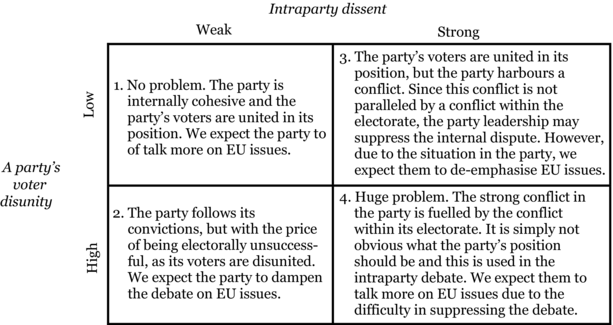
In some situations, though, this strategy falls flat and the party leadership fails to control the debate even at election times. In order to understand when a suppressing strategy is not successful we need expand the analysis further than the intraparty environment. Instead, we hypothesise that it is how the intraparty conflict interacts with the external environment that explains why a party leadership ends up in this troublesome situation. The most important external arena in this context is a party's supporters and voters. Figure 1 gives an overview of our expectations of a party's salience of European issues, and shows to what extent the issues are divisive for the party (intraparty dissent) compared to whether the electorate is split on the issue or not (disunity among a party's electorate).
The voter disunity–intraparty dissent matrix.

Steenbergen and Scott (Reference Steenbergen, Scott, Marks and Steenbergen2004) argue that parties that are facing major internal divisions may be unable to de‐emphasise European issues, as these differences set off extensive debate within the party. As argued above, we claim that this is not necessarily the case. In a situation where a party's voters are unified, but the issue is divisive within the party organisation (cell 3), the party leadership is able to suppress the internal opposition and avoid the conflict from bursting out. During election time in particular, when success in the electoral arena probably has the highest priority, this could be an even more effective strategy. In such a situation, party leadership tries to focus the campaign on issues other than the EU and consequently we expect the party to be less active in the EU debate.
However, when a party experiences severe intraparty conflict and if this conflict is paralleled by a corresponding conflict within the party's electorate (cell 4), the situation is more troublesome for the party leadership. In this situation, the party's position is contested both internally and externally and the intraparty conflict is fuelled by the external pressure from a substantial part of the party's potential voters. The external pressure legitimises the intraparty opposition to contest the party leadership's position and it is not entirely clear what the position of the party should be. In other words, the party leadership fails to balance its different goals. Accordingly, we expect the most intense debate on European issues among parties that are situated in cell 4.
If the party has a low level of internal dissent, the situation is obviously more comfortable, especially if its voters are united as well (cell 1). In this situation, the party may be active on European issues without the risk of any severe trade‐off – that is, this party might give its policy‐seeking goal priority. If the party is united in its position, but the electorate is divided, the party is in a more delicate situation (cell 2). It is reasonable to believe that this party would be less eager to promote its position because the result could mean electoral loss. To avoid the issue by, for example, promoting other issues is a wise strategy. Thus, we expect that parties in cell 2 will speak less about the EU.
Accordingly, we will now investigate how parties’ public salience over Europe not only depends on intraparty dissent (Steenbergen & Scott Reference Steenbergen, Scott, Marks and Steenbergen2004) or internal divisions among their supporters (Van de Wardt Reference de Wardt2014), but on how these two factors act together.
Data, measurements and methods
In order to study party presence in the debate on European issues in election campaigns, we developed a longitudinal cross‐sectional dataset containing information on political parties and voters in France, Germany, the United Kingdom and Sweden, for national election campaigns between 1983 and 2010. The four countries in the study differ in terms of public opinion regarding the EU and the level of debate on EU issues, so we can test the argument on cases where parties obviously deal with the issue differently and where the citizens react differently to European integration. In total, our sample contains 38 political parties (and 169 cases) and the relationships between them in terms of size, position and influence have changed during the time period we analyse. If parties show similar behaviour, despite these differences, this would strengthen our main argument.
Concerning our dependent variable, when measuring the salience political parties attach to European issues, a number of different alternatives exist (i.e., expert surveys, party manifestos and media data). In this study, we use the last alternative by looking at the national public debates in the mass media during election campaigns. These alternatives measure different things and are therefore appropriate for different research purposes. Contrary to expert survey data, media content data directly indicates the party contestation that is related to European integration rather than experts’ evaluations of the general importance of these issues for political parties. Moreover, media data has been shown to reflect contemporaneous salience better than expert data (Helbling & Tresch Reference Helbling and Tresch2011). Also, expert data on the electoral context that we are interested in is not available. Similar to party manifesto data, however, media content data relating to election campaigns indicates parties’ attention to issues in an electoral context. Nonetheless, as party manifestos are strategic documents with self‐declared positions and emphasis on issues, or lack thereof, solely spelled out by political parties themselves, media data indicates issue salience in public debates as conveyed by the media and not fully controlled by the parties – they are often asked to position themselves towards certain issues, as, for instance, when they are asked to respond to other parties’ attacks or to questions from the media itself – thereby probably being a more suitable source of the actual public debate. However, media data has some shortcomings as well. Although, we are confident in our selection process (Woolley Reference Woolley2000), parties may also use the media strategically. Journalists often try to stress positional differences between political parties, as well as within parties, since conflicts are most often their primary interest (as it often makes better news). Though, for our purposes this is less of a problem because we are interested in explaining the differences when parties publicly debate Europe, and as argued in previous literature, mass media represents the most important arena for public debate on political issues, and topics that the media chooses to ignore are probably irrelevant to the public debate as well as to a broader public audience (Kriesi et al. Reference Kriesi2006; Helbling et al. Reference Helbling, Hoeglinger and Wüest2010).
The media data used in this study comes from a large‐scale research projectFootnote 1 covering all elections since the early 1970s to 2010 in six Western European countries (Austria, France, Germany, Sweden, Switzerland and the United Kingdom).Footnote 2 We examine here four of these countries as comparable voter data is lacking for two countries (Austria and Switzerland). Our data originates from quantitative content analysis of quality daily newspapers in the respective countries: Le Monde (France), Süddeutsche Zeitung (Germany), Svenska Dagbladet and the debate section in Dagens Nyheter (Sweden), and The Times (United Kingdom).Footnote 3 From these newspapers, we selected all articles that reported on political actors and European issues which were published within a two‐month period before the national election day. The positions and salience of political actors were coded using core sentence analysis (e.g., Kleinnijenhuis & Pennings Reference Kleinnijenhuis, Pennings and Laver2001; Kriesi et al. Reference Kriesi2008). In the content analysis, each grammatical sentence of a news article is reduced to one or more core sentence(s), which contain the political actor, the political issue and/or another political actor, as well as the position that the actor has on an issue (or on another political actor). Different from manifesto data, which also focuses on the actual election campaigns, core sentences analysis is an inductive approach that captures the salience of issues without assuming any theoretical a priori categories. We therefore also have information on the specific issues and political actors upon which representatives from political parties have an opinion. In this study, however, we analyse all EU‐related issues regardless of the specific issue at stake as we are interested in the overall public salience parties attach to Europe. In addition, although we coded the direction (ranging from negative to positive with intermediate positions) that the political actors expressed on European issues or on another political actor, we do not differentiate between negative, status quo or positive statements for the same reason. A more detailed description of the data collection strategy and descriptive statistics can be found in Hutter and Grande (Reference Hutter and Grande2014).
The dependent variable used in this study, relative presence, measures the visibility of the political parties on European issues in the election campaigns. More precisely, we first measure the intensity of European issues by the number of core sentences coded for each party in each election campaign (its presence). However, this proxy is imperfect in the sense that it is only suitable for within‐country comparisons because it is dependent on the size and style of the newspaper – that is, larger newspapers (e.g., The Times) are biased towards a larger share of coded core sentences than relatively smaller ones (i.e., Svenska Dagbladet). To account for this, we define relative presence as the relative share of coded core sentences for each party and election – which gives a measurement that can be used in cross‐country comparisons. This proxy thus indicates the proportion or percentages of the overall debate on European issues (as presented by the printed media) attributed to each individual party in each election.Footnote 4
The independent variables we use originate from various established sources. First, our main variable at the party level, intraparty dissent, comes from the Chapel Hill Expert Surveys (CHES; Steenbergen & Marks Reference Steenbergen and Marks2007; Hooghe et al. Reference Hooghe2010; Bakker et al. Reference Bakker2012), in which experts (i.e., political scientists) in different countries were asked to assess the degree of dissent over European issues within each party.Footnote 5 However, as the scale of the measurement differs between surveys (i.e., changes over time from 1 to 5 to 0 to 10), we have recoded this variable (to range from 0 to 10) to be comparable over time.
Our main predictor at the voter level, voter disunity, measures the amount of disunity within each party's voters. This measurement is calculated by taking the share of voters who think that the EU is a good thing compared to those who think it is a bad thing. The disunity measurement takes a value of 0 if 100 per cent of the voters have a similar position and 1 if a party's electorate is equally split (50‐50) in their opinions.Footnote 6 A party's voters are matched to the parties according to the stated voting intentions in general elections as indicated by the survey used. These surveys include the Eurobarometer and various national election surveys as no single study fully covers the time period under study (the sources used to measure voter opinions are listed in the online appendix).
As it is reasonable to believe that political parties that consider Europe to be important are also more present in the debate before the national elections, we include a measurement for intra‐party salience from the CHES dataset in the estimated models.Footnote 7 Moreover, parties in congruence with their electorate may gain from emphasising the issue, while the larger the distance to its voters, the less likely parties are to mobilise on the issue. Consequently, we include a measurement, party‐voter congruence, which measures whether or not a party has a similar position on Europe to its supporters. We follow Steenbergen and Scott (Reference Steenbergen, Scott, Marks and Steenbergen2004: 173–174) and create a proxy by comparing the position on European integration as measured by the CHES study to the mean response of voters to the survey question asking if one's own country's membership in the EU is a good thing, neither good nor bad, or a bad thing. As these two measurements do not have the same response scales, we standardise the measurements before subtracting and taking the square to create a Euclidian distance metric.Footnote 8
We also expect that it becomes harder for an individual party to ignore European issues if other parties stress the issue. We therefore include a proxy for systemic salience. It is measured as the mean ‘salience’ of all parties in the party system according to each individual party's attention to European issues in its electoral manifesto (Volkens et al. Reference Volkens2014), not including the particular party under consideration (see Steenbergen & Scott Reference Steenbergen, Scott, Marks and Steenbergen2004: 179).Footnote 9
Furthermore, whether a party is in government or opposition has also been raised as an explanatory factor for whether a party will emphasise or downplay Europe in election campaigns. Specifically, in most cases, incumbents are expected to downplay issues on Europe (e.g., Netjes & Binnema Reference Netjes and Binnema2007: 43–44). We include a dummy variable, government party, to indicate whether or not a party is in government or not at the time of the election campaign. In addition, we also include a dummy variable for ideological fringe parties, radical party, which takes on a value of 1 if a party can be classified as a radical left/communist party or a populist radical right party, and 0 otherwise. To account for changes over time, and especially the increasing attention to European issues in election campaigns that followed the Maastricht Treaty becoming effective (Hooghe & Marks Reference Hooghe and Marks2009: 7), we also include a temporal dummy variable in our models. Descriptive statistics for all variables used in the analysis are listed in Table A2 in the online appendix.
A final methodological note concerns the dependent variable used in the empirical models, relative presence. As this variable is bounded between 0 and 1 (or 0 to 100 per cent), or is a proportion, using linear regression techniques might produce biased and inconsistent estimates (i.e., we may obtain predictions that are not bounded between 0 and 1 or 0 and 100 per cent). We therefore estimate fractional logit models, a general linear model (GLM) based on a logit transformation (Papke & Wooldridge Reference Papke and Wooldridge1996; Baum Reference Baum2008) that assumes a binomial distribution for the dependent variable and is therefore suitable for the data at hand. Nonetheless, as the interpretation of these models is not as straightforward as the case of the linear models, and as these often yield analogous results, we report both fractional logit estimates as well as supplementary linear regression estimates.
Empirical analysis
The empirical analysis is structured as follows. We start by giving an overall picture of the partisan debate on EU issues during national election campaigns in the four countries, and then proceed to the empirical test of our argument presented in the theoretical section.
Political parties giving salience to the EU issue in national elections
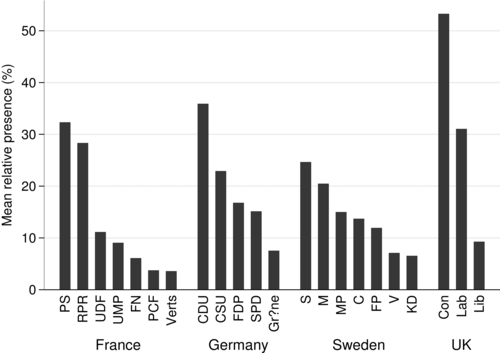
Figure 2 shows the relative presence (i.e., the relative share of coded core sentences for each party) for the individual parties on EU issues over the whole time period studied. In the figure we can see that most parties are more or less involved in the discussion of EU issues in the election campaigns. To a certain degree, the level of involvement is influenced by size. Larger parties, in all four countries, are more present in the public debate in the media vis‐à‐vis smaller parties. At the same time, this is far from a clear‐cut picture. Some larger parties are more present than equally strong parties and, in some cases, small parties are as present as relatively large parties.Footnote 10
Relative presence of parties in EU debate in national elections, 1983–2010.

The relationship between the disunity of the voters, dissent in parties and party behaviour
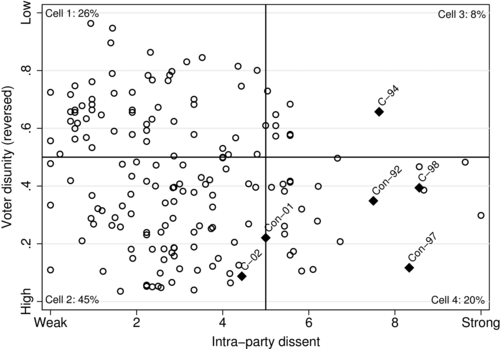
As we already stated, the level of attention a party gives to EU issues has to do with a party's ambition to balance the goal to win (or not to lose) electoral support and the goal to preserve internal cohesion. Before investigating this, however, we need to establish how the two independent variables (disunity of voters and intraparty dissent) relate to each other. This is important because we need to ensure that we have a reasonable distribution of cases along the two dimensions. Figure 3 shows the relationship between these two variables.
The cases in voter disunity‐intraparty dissent matrix.

The organisation of the scatter plot in Figure 3 is coherent with Figure 1 in order to facilitate understanding:
-
• Cell 1 means a low level of disunity among a party's voters and a low level of intraparty dissent. One‐quarter of the cases (26 per cent) correspond to this description. These are the parties that have less of a problem with the EU issue and therefore do not run the risk of losing voters if propagating the party's position.
-
• Cell 2 means a high level of disunity among a party's voters and a low level of intraparty dissent. This is the most common case and 45 per cent correspond to this description. This shows that a significant number of parties are, at least at some point, not in agreement with a fraction of their electorate on EU issues. This is not a surprise since we know that the EU issue has a tendency to cross the traditional dimension of left and right (Van der Brug & Van Spanje Reference der Brug and Spanje2009). In other words, national party systems are not organised according to the EU dimension.
-
• Cell 3 includes cases where the disunity of the voters is low, but the intraparty dissent is high. Only 8 per cent of the cases correspond to this description. This is perhaps not so puzzling. Even though there are cases that have an intraparty conflict but a more united electorate exists, which the data confirms, it is reasonable to think that this position is the least likely to be stable. Either the intraparty conflict spreads to the extraparty arena or the intraparty conflict becomes reconciled in the light of the more unified electorate.
-
• Cell 4 includes cases where the voters are highly disunited and the party has a high level of dissent. About 20 per cent of the cases correspond to the description. This is theoretically the worst situation since the intraparty conflict may be fuelled by the disunited electorate and vice versa.
Overall, we have a fairly good contribution of cases. The exception is in cell 3, and it would of course be preferable to have more cases representing this configuration. Still, there are some cases that fall within this category and it is reasonable to continue the analysis and the question is whether these differences in our independent variables can explain why parties give the EU issue attention or not.
However, before proceeding with our empirical analysis we discuss two illustrative examples of parties’ movement over time as indicated in Figure 3. First, the British Conservative Party has for a long time fostered a more sceptical view on the EU, but it has also been divided on the issue (Lynch & Whitaker Reference Lynch and Whitaker2013). In 1992, it was among the parties with the strongest intraparty dissent among the investigated parties and its voters were also fairly divided. In 1997, the situation became even more troublesome. The short‐lived Eurosceptic Referendum Party gathered support from traditional conservative voters, which tended to fuel the conflict in the Conservative Party (McAllister & Studlar Reference McAllister and Studlar2000). The difficult situation also resulted in that the Conservative Party increasingly publicly debated EU issues (see Figure A2 in the online appendix). In the next election in 2001, the conflict was reduced within the party but voters remained divided in their opinions (i.e., the party moved towards the second quadrant in Figure 3), which according to our predictions, means that it should then be less active in debating EU issues, which is also substantiated in our material.
The second example is the Swedish Centre Party, which took a positive stance in the EU membership referendum in 1994. Although the party was internally divided, its voters were less so and consequently it ends up as one of few parties clearly situated in the third quadrant in 1994. In 1998, the situation became worse and the internal division grew as well as the divisions among its voters. This also meant that the party became more present in the debate on the EU, as expected from our theoretical argument. Interesting, however, is that in the following years, the Centre Party tried to balance a more positive stance with a somewhat Eurosceptic message. The party ended up against Sweden joining the economic and monetary union (EMU) in the referendum in 2003, although, just after this, the party argued for more federalism in Europe – ‘albeit a version that would involve a “leaner but sharper” Union’ (Aylott et al. Reference Aylott, Blomgren and Bergman2013: 161). This mixed message reconciles the party to some degree, but its voters were still divided (which puts the party in the second quadrant in Figure 3). This would imply, according to our theoretical argument, that the party should become less active in the debate on EU issues, and our data proves this to be very much the case (see Figure A2 in the online appendix).
If our expectations are correct, we would expect that this holds up generally as well. In other words, parties that experience a low level of internal dissent are more present in the public debate in the media if the party's voters are disunited on the issue (cell 3), but the opposite occurs if the intraparty conflict corresponds to a conflict within the electorate (cell 4). If the party experiences a low level of dissent and its electorate is united in its position (cell 1), we might expect the party to speak more of the EU than in the opposite case, where the electorate is not unified in the party's position (cell 2).
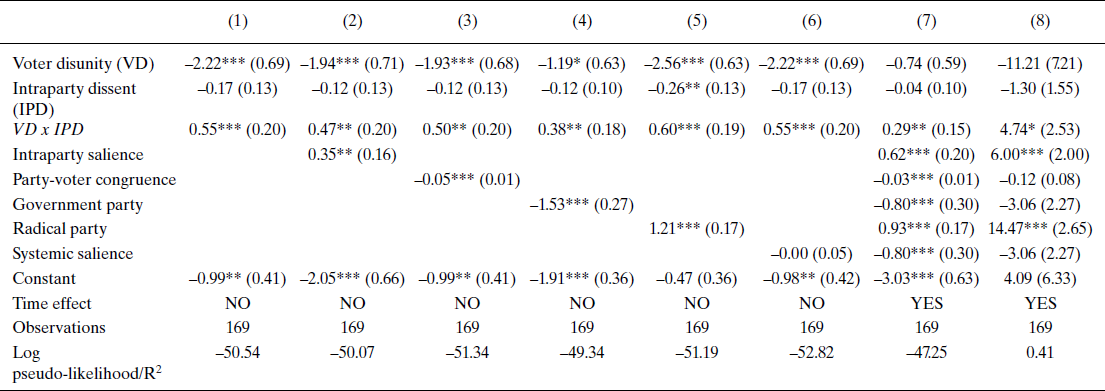
We test these hypotheses by estimating multiple interaction regression models, which show the effect of intraparty dissent on party presence in the debate as the degree of voter disunity changes. Table 1 shows the main results for the conditional effect of disunity among voters and intraparty dissent over Europe. Due to a fairly low number of cases, models 1 to 7 show the multipliable interaction effect with none (model 1) or one additional variable (models 2–7), whereas models 8 and 9 include a full set of covariates. The variables systemic salience and party voter congruence at the national level (i.e., the median voter) are excluded in the last two models because they appear to have no effect on party presence in the election campaigns. All models, except model 9, are based on fractional logit models. Model 9 is estimated using linear regression and uses the relative presence in the debate in percentages as a dependent variable (rather than proportions).
Parties’ presence in national election debates on European issues (fractional logit/ordinary least squares)

Notes: Robust standard errors in parentheses; ***p < 0.01; **p < 0.05; *p < 0.1. Dependent variable is the relative presence of political parties in the election campaigns, measured in proportions (models 1–7) or percentages (model 8).
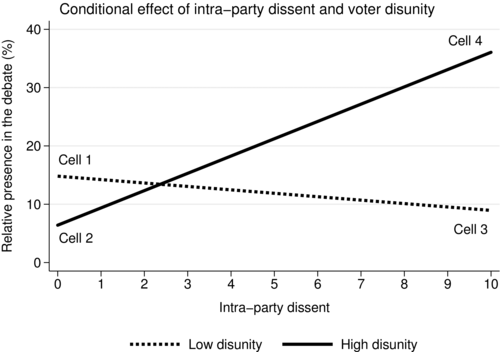
The results presented in Table 1 indicate that all of the coefficients have the predicted signs and are statistically significant, except for systemic salience (which is not statistically significant) and radical party (which shows a negative effect, but this is not surprising given such parties have, on average, low presence in the debate as indicated in Figure 2). Additionally, all models show a substantial and statistically significant effect for the variable of interest: voter disunity x intraparty dissent (VD x IPD). However, rather than interpreting the fractional logit results in Table 1, we can get much more substantively meaningful information if we plot the conditional effect, as multiple interaction effects are not easily interpreted from regression estimates. For this reason, in Figure 4 we plot the effect on the relative presence of parties on the debate over Europe in national election campaigns, as internal dissent goes from low values (the party was unified) to high values (the party was divided), at two levels of disunity among party supporters (i.e., low and high disunity). As models 7 and 8 in Table 1 produce nearly analogous predictions for the interaction effect under consideration, and as results from linear regression are more easily interpreted, these are displayed in Figure 4.
Intraparty dissent and voter disunity.

In Figure 4 it becomes clear that if a conflict within a party corresponds to a conflict within its electorate, the party is substantially more active in the debate concerning European issues (cell 4) compared to if it has a more unified electorate (cell 3). On the other side, if the dissent within a party is low, it will be more present in the debate if the electorate is more unified (cell 1). Finally, if the party has a low dissent but has a more disunited electorate, the party will speak less on EU issues (cell 2). This means that the data, as described in Figure 4, verifies that the parties behave according to our expectations. Thus, if a party is publicly discussing EU issues is conditional on how the level of intraparty dissent interacts with the level of disunity among this party's electorate. A corresponding predicted plot with confidence intervals, supplementary empirical tests and robustness tests can be found in the online appendix.
Conclusion
This article set out to better understand when political parties are present in the EU debate and when they try to avoid the issue. Previous literature has concluded that parties that are very cohesive when it comes to EU issues are more active (Steenbergen & Scott Reference Steenbergen, Scott, Marks and Steenbergen2004). Based on this, we would expect that parties where members are in agreement with the party's official position and where its voters concur would be the ones most present in the debate. Our data suggests otherwise, which could be seen as a bit puzzling both in terms of the result in previous studies as well as rational party behaviour. However, the fact that there is no severe opposition towards the party's position does not necessarily mean that the party speaks more about EU issues. Even though further analysis is necessary, one probable conclusion is that EU issues are not viewed as a strong selling point in a national election campaign. Even though a party does not run the risk of losing voters’ support, it does not expect to win new support either. Therefore, the party may concentrate its efforts on other issues. A party that is united in its position on EU issues, but has its voters less in agreement, should, according to our argument, try to focus the campaign on issues that do not concern the EU. Our results strongly confirm this strategic behaviour: these parties are the least present in EU debate compared to others.
In addition, it has previously been shown in studies using expert data that in parties which are moderately split on the EU issue, their leaders are able to contain the debate, but at some point, when the conflict becomes too severe, the debate erupts (Steenbergen & Scott Reference Steenbergen, Scott, Marks and Steenbergen2004; Netjes & Binnema Reference Netjes and Binnema2007). Here, however, we go one step further in order to more fully understand when intraparty dissent matters. Our point of departure is that we need to take into account the conditional relationship between the pressure the party leadership experiences from the intraparty environment and the pressure from the electoral arena. This study clearly supports this suggestion. Severe intraparty conflict does not necessarily lead to increased attention to European issues as this has to do with the circumstances under which such dissent is expressed. We suggest that the reason for the different behaviour of political parties is that the party leadership's room for manoeuvre differs substantially. If an intraparty conflict is not paralleled by a conflict within the electorate, the party leadership may suppress the internal dispute not least by using the argument that a strong tension within the party, and mixed messages from its representatives, will risk the party's electoral success. On the other hand, if the strong intraparty conflict is fuelled by the same conflict within a disunited electorate, the conflict is harder to contain. The party's position is contested within, as well as outside, the party.
This conclusion points in a promising direction for our understanding of how EU issues are (or are not) politicised in national contexts, but further research is necessary. The shortcoming of the approach used in this article is that we only get a general picture of party behaviour. Further research should try to better understand the mechanisms in operation in specific situations and therefore we need in‐depth comparative case studies. The cases identified in this article are a good starting point for such an endeavour. Second, while this article solely focuses on European issues, an interesting line of future research could be to see whether the argument presented here could also be applied to other sensitive political issues – that is, whether the propensity of political parties to engage in these issues is partly an effect of the interaction between the intraparty cohesion on that same issue and the level of disunity of the electorate.
Acknowledgements
We gratefully acknowledge the support of the German Research Council (DFG) and the Marianne and Marcus Wallenberg Foundation (MMW 2011.0030) that made this research possible. We thank our colleagues in the research project ‘The Politicisation of Europe’ for their support: Regina Becker, Daniela Braun, Martin Dolezal, Edgar Grande, Swen Hutter, Alena Kerscher, Hanspeter Kriesi and Simon Maag. Furthermore, we thank all the student assistants who helped us code the media data. In addition, earlier versions of this article have been presented at the conference ‘Elections and Democracy in Europe’, 7–9 April 2014, in Brussels, and the annual meeting of the Swedish Political Science Association, 8–10 October 2014, in Lund. We thank the participants for many valuable comments. We also thank Daniel Walther and the anonymous reviewers of this journal.
Supporting Information
Additional Supporting Information may be found in the online version of this article at the publisher’s web-site:
Figure A1. A closer look at cell 4 in figure 3 (with party abbreviations and election year)
Figure A2. Example of two parties’ movements in the voter disunity – intra‐party dissent matrix and their (vote‐weighted) relative presence
Table A1. Relative party presence (vote‐weighted dependent variable).
Table A2. Parties’ presence in national election debates on European issues (fractional logit). Including distance to national mean voter.
Figure A3. The effect of intra‐party dissent and voter disunity on the relative presence in the debate
Figure A4. The effect of intra‐party dissent on the relative presence in the debate conditioned on voter disunity
Figure A5. The effect of voter disunity on the relative presence in the debate conditioned on intra‐party dissent



 Open access

