In 1868, Chambers’s Journal of Popular Literature, Science and Arts featured an article on the physiology and chemistry of tears. It opens by asking whether scientific inquiry is in fact a suitable avenue by which to approach the subject:
Is it possible that Science, that prying dame who is always thrusting her probing finger into out-of-the-way things and places, should not have respected such a poetical and sacred object as a tear? Can it be believed that she has ever had the heart to sit patiently by the side of the mourner; to watch with grim attention the quivering of his eyelid, and as at last the tear rolled out, to snatch it up quickly on its passage, and to carry it still warm and glistening under the lens of a microscope?Footnote 1
Here envisioned as a ‘prying’ and unfeeling dame, science sees the tear less as an object of sympathy than an object of physiological inquiry.Footnote 2 While the article questions the discipline’s ability to account for what is ‘poetical and sacred’ about tears, this hesitation is short-lived, for it quickly immerses the reader in the ‘unpoetical’ facts of the case.Footnote 3 Describing the ‘utility of tears to animals’, the unnamed author explains that they function to ‘keep the eye always clear and clean’ and to remove any foreign matter like ‘a grain of dust, or an insect’.Footnote 4 They note that the eye ‘would soon be dirtied and blocked up, like an uncleaned window-pane, had not nature provided this friendly ever-flowing stream to wash and refresh it’.Footnote 5 With its materialist take on crying, this Chambers’s piece reflects a wider tendency of nineteenth-century scientific discourse, in which the eye’s emotional capacity is subordinated to its visual one.Footnote 6 Not only are tears subjected to the advanced optical scrutiny of the microscope, they also emerge as a substance whose primary purpose is to maintain the clarity of sight.
A very different picture of the eye emerges from literature at this time, particularly from the genre of the sentimental novel.Footnote 7 Sentimental literature produces a cast of famously lachrymose heroines and heroes, whose tears serve a much greater purpose than merely keeping an optical instrument clean. This literary tradition recognises that eyes have varied functions in both perception and expression; they can see, but they can also show, and what they tend to show are a person’s feelings. Sentimental literature turns out to be far more invested in the latter function – the affective affordances of the eye – often reversing science’s prioritisation of seeing over crying. Note the difference, for instance, between the picture of tears offered in the Chambers’s Journal, and the following passage from Charles Dickens’s Dombey and Son (1848). In it, Florence Dombey’s younger brother has just departed the novel in one of the author’s famously sentimental child deathbed scenes. Her father is consumed by grief, and finds little solace in his surviving daughter. Rather, her tearful face haunts him as a painful reminder of the favourite son he has lost:
There was a face – he had looked upon it, on the previous night, and it on him with eyes that read his soul, though they were dim with tears, and hidden soon behind two quivering hands – that often had attended him in fancy, on this ride. He had seen it, with the expression of last night, timidly pleading to him.… It was a trouble to him to think of this face of Florence.Footnote 8
Dickens here pictures the potential for conflict between the visual and affective roles of the eye; while Mr Dombey looks at Florence, and she at him, tears compromise the clarity of her vision by rendering her eyes ‘dim’. Dickens refuses, however, to frame this compromise as a detriment. Instead, he bestows a kind of agency on Florence’s tearful eyes, which are given the capacity to ‘timidly plead’. Her tears also play a role in her astute perceptions of her father; despite the suggestion that her eyes were able to ‘read his soul, though they were dim with tears’, on closer acquaintance with Florence’s character, it becomes clear that she can read her father not so much in spite of, but rather because of, the tears in her eyes.Footnote 9 It is her extraordinary capacity for feeling that enables her to empathise with, to understand, and to respond to others, just as she does in this instance with Mr Dombey.
Taking its lead from authors such as Dickens, this book aims to rethink what it might mean to cry. It contemplates the way that eyes function affectively in the tradition of literary and philosophical sentimentalism, and is particularly attuned to moments of tension that arise between the ocular roles of seeing and feeling. In the process, it necessarily grapples with many of the abiding critical concerns of affect studies, a theoretical approach for which the tear offers useful insight. This book also takes issue with the critical paradigms that have long dominated thinking on eyes and vision. Drawing on sentimental novels to outline an alternative epistemology of the eye, it demonstrates how these organs can know the world in ways that do not depend on seeing clearly.
The fact that sentimental novels assign an epistemological value to tears speaks more broadly to the genre’s philosophical underpinnings in moral sentimentalism. Popularised by Scottish Enlightenment thinkers such as the Third Earl of Shaftesbury, Francis Hutcheson, David Hume, and Adam Smith, this school posited that sentiment or feeling is a guide to moral action. For Hume and Smith, the capacity for sympathy – for sharing in the feelings of others – is at the centre this process.Footnote 10 Sympathy is also at the core of the sentimental novel, and the genre frequently employs emotional response as a means of determining right from wrong. However, the affective insights these novels allow their characters are not always or exclusively ethical. They can also help them better understand and connect to their world, by answering questions about whom it is they love, what they do and do not want, and whom they should and should not trust.
Although the Chambers’s article asserts that there are important differences between ‘scientific’ and ‘poetical’ accounts of tears, there are also some crucial points of commonality between them. These points are especially interesting when it comes to sentimental novels. Due to the fact this literary tradition centres around feeling, sympathy, and sensitive bodies, it shares some of the same interests as scientific disciplines like medicine, biology, and chemistry.Footnote 11 In The Politics of Sensibility (1996), Markman Ellis singles out ‘physiology and optics’ as key branches of science that are closely intertwined with sentimental texts, and to his pair, I would add the then emerging medical specialty of ophthalmology.Footnote 12 Unlike optics, which deals exclusively with light and sight, ophthalmology also attends to the anatomy, physiology, and pathologies of the eye, including those related to tears. I thus draw on this discipline, with its corporeal focus, in order to flesh out our picture of the eyes depicted in sentimental texts. At the same time, I also interrogate the way these scientific discourses contribute to a broader Enlightenment tendency to venerate vision and the visible, and to equate seeing with knowing. In other words, I consider how they perpetuate a conception of the eye that sentimental novels are often writing against.
While this book is interested in the eyes and tears represented in sentimental texts, it is also concerned with how these texts work upon the eyes of their readers. As attested by stubborn material realities like eyestrain, glasses, and double-line spacing, reading is an embodied act in which the eyes often play an integral role.Footnote 13 These organs provide a point of contact with texts: a chiasm between book and body that precedes the one belonging to the optic nerves. Given that sentimental novels engage the affective as well as the visual capacities of readers’ eyes – sometimes even eliciting a tear – this genre can offer valuable insights into the ways affect is mobilised between text and reader. Throughout this study, therefore, I try to remain attentive to the strange but often unspoken things that eyes are doing and feeling when reading.
Fluids, Feelings, and Tearful Eyes
In both material and theoretical terms, tears are remarkably slippery things. Eschewing easy categorisation, they can be both immanent and transcendent, subjective and extra-subjective, explicit signifiers and resistant to meaning. While tears are sometimes viewed as profound or sacred, even serving as a form of religious devotion, there is also a gross corporeality in the way they are expelled from the body like snot or sweat. Tears are thought to be deeply personal, to well up from the depths of one’s inner-most being, and yet they are also frequently shed in sympathy with others, brought on by the mere appearance of somebody else crying. Tears can participate in complex systems of bodily signification, but are simultaneously associated with feelings that go beyond language and partake of the inexpressible. Among scholars who have contended with the subject, there remains little consensus about what tears are and what they mean:Footnote 14 James Elkins, for example, asserts that ‘crying is so common it might mean nothing, or just about anything’; Eugenie Brinkema finds that ‘the tear … in fact, can signify nothing more than that it cannot signify anything essential or obvious at all’; and Thomas Dixon notes that a tear ‘is a universal sign because, depending on the mental, social, and narrative context, it can mean almost anything’.Footnote 15 In pointedly similar terms, these critics insist on the difficulty – perhaps impossibility – of assigning any clear-cut meaning to this ocular affect.
With these definitional challenges in mind, Elkins goes further than either Brinkema or Dixon, asserting his resistance to any formal theorisation of the subject. Reminiscent of the Chambers’s author who hesitates to put ‘such a poetical and sacred object as a tear’ under the lens of the microscope, Elkins seeks to ‘honor the mystery’ of tears, not attempting ‘to understand these wonderful phenomena, or press them into the box of some little theory’.Footnote 16 While it is useful to acknowledge the limits of our comprehension regarding crying, I am hesitant about an approach that purposely pulls analysis up short, forestalling the detailed work required to tease out and evaluate different hypotheses of tears. I am likewise concerned that qualities like ‘mystery’, profundity, or ineffability tend to be ascribed to certain tears much more readily than others: crying is venerated in select instances and for certain types of people, but in many other cases it is designated as sentimental, maudlin, or manipulative. By ‘honor[ing] … mystery’, we might inadvertently be permitting certain ingrained assumptions about crying to stand unchallenged.Footnote 17 So, while I accept Elkins’s point about totalising theory and do not aim to set out any single, uniform model of crying here, I do insist that theories – both scientific and critical – have much to teach us when it comes to tears.
One of the early and most persistently influential scientific theories of crying was based on humoral medicine. This classical conception of the human body famously divides its fluid into four humours – blood, black bile, yellow bile, and phlegm – with the relative proportions of each substance thought to be important determinants of temperament and disease. In the humorism of the Medieval and Renaissance periods, distillation became a popular model for explaining the production of tears. According to this analogy, the cold brain served as a kind of stilling helmet, where vapours from the body would rise, condense, and be excreted in the form of liquid tears.Footnote 18 Some theorists asserted that these vapours originated from the heart, while others contended they were produced by the brain itself.Footnote 19
Although accounts of tears based on humorism persisted into the eighteenth century, they were increasingly supplanted by a mechanistic explanation that centred on the lachrymal gland and its accompanying apparatus. The Danish anatomist Niels Steensen laid the foundation for contemporary accounts of tears with his description of the basic structure and function of this apparatus.Footnote 20 Renaming the structure Aristotle had designated the Glandula innominate as the more functionally indicative Glandular lachrymalis, Steensen explained that ‘the fluid flowing from these glands and their vessels …, flows down through punctum lacrimalis into the nose; at times it flows more sparingly and is then noticed by but few; at others it flows more profusely and then appears in the form of tears’.Footnote 21 Reflecting on this development in her study of tears in the Renaissance, Marjory Lange notes that while the subject of lachrymation had previously been taken up most frequently in literature on the affective disorder of melancholy, Steensen’s anatomical description shifted the focus away from emotion.Footnote 22 She suggests that the anatomist’s most significant contribution was, therefore, ‘his separation of psychology from experimental physiology’.Footnote 23
This separation was only intensified in the discourse of late eighteenth- and early nineteenth-century ophthalmology, where descriptions of the lachrymal apparatus become increasingly mechanical in nature. Take, for instance, the explanation offered in Peter Degravers’s Complete Physico-Medical and Chirurgical Treatise on the Human Eye (1780):
This mechanism is grounded upon the most exact rules of hydraulic and hydrostatic. You will be convinced of this assertion, when you compare the structure of the absorbent lacrymal ways, with that of a pump which draws up water by attraction and weight. To one of this kind, levers and power to put them in motion, are necessary; here, both are existing, or centered [sic] in the eye-lids. Pistons which go fore and back, in proportion to the action given by that of the levers, are also necessary.Footnote 24
For Degravers, the production and excretion of the lachrymal apparatus is imagined as a ‘hydraulic’ system of ‘pumps’, ‘levers’, and ‘pistons’. Following Steensen’s lead, ophthalmological works like Degravers’s would focus almost exclusively on what are now called ‘basal’ and ‘reflex’ tears, the majority failing to even mention the ‘emotional’ variety. As per the description of the surgeon Percival Pott, in such treatises, tears are there to preserve ‘the motions of the eye-lids’ and protect the organ from ‘dust and other hurtful particles’.Footnote 25 This is the same account as that presented in the Chambers’s article quoted above, where the author’s materialist thinking is evident in their assertion that tears play an important role in ‘the wonderful mechanism which works the human body’.Footnote 26 Regarding tears almost exclusively as a fluid whose purpose was to protect and lubricate the eyeball, it was a discourse that left feeling out of the equation.
Even though Steensen would publish his rudimentary description of the lachrymal gland as early as 1662, it was taken up only gradually and unevenly within medical science. There was a protracted transition period during which the beliefs and practices of humoral medicine faded from prominence. As Juliet McMaster notes, in the eighteenth century, ‘the medical profession [remained] highly conservative: according to some, even regressive’, and ‘the classical model of the four humours of the body persisted alongside the new ideas’.Footnote 27 Lange makes a similar observation with respect to tears; while acknowledging that humoral accounts would begin to lapse … ‘increasingly into the exclusive domain of metaphor’, she maintains they still flourished ‘well into the eighteenth century’.Footnote 28 In Britain in particular, the prolonged nature of this transition appears to have been, in part, a consequence of the incipient state of ocular medicine at the time.
As late as 1833, the president of the Royal College of Surgeons, Sir William Lawrence, lamented that ‘ophthalmic surgery, being in a manner dismembered from the general science, was reduced to a very low ebb. Until within a few years, it was, in this country at least, in a state of almost total darkness’.Footnote 29 Employing a commonplace and thematically pertinent optical equation between light and knowledge, Lawrence here affirms the belated development of his discipline. He goes on to assert that care of the eyes had heretofore been left to ‘quacks, to mountebanks, and itinerant practitioners’.Footnote 30 In 1758, Percival Pott makes a similar statement with specific reference to the lachrymal gland, insisting that its structure remained ‘very little understood’.Footnote 31 In his treatise on the condition known as a Fistula Lachrymalis, he notes that a large number of physicians were still unacquainted with ‘the anatomical structure of the parts concerned’, and that this is true ‘even among those who are daily liable to be called to the care of the disease’.Footnote 32 Pott’s assertion is borne out in contemporaneous treatises on the eye. For example, Sir William Read’s Short but Exact Account of all the Diseases Incident to the Eyes (1710) still subscribes to humorism and the distillation theory of tears, referring to them as the ‘Excrements of the Brain’, and attributing a swelling of the eye’s caruncle to ‘a conflux and gathering of Melancholy Humours’.Footnote 33 Traces of the humoral explanation are even evident in a nineteenth-century text like William Mackenzie’s popular Practical Treatise on the Diseases of the Eye (1830), where the author describes the ‘distilling of tears’, and continues to recommend remedies like leeching, bleeding, purgatives, and blisters.Footnote 34
It was not until the later decades of the eighteenth century – about the same time sentimental literature came to prominence – that a distinct and professional medical subspecialty began to coalesce around the eyes in Britain. While ophthalmology developed earlier in certain parts of Europe, it was at the start of the nineteenth century that a number of dedicated eye hospitals were established in England, including Moorfields in 1805, Exeter in 1808, and Bristol in 1810.Footnote 35 Gemma Almond-Brown notes that at this time, practitioners of ophthalmology leveraged ‘the cultural importance of vision’ in order to ‘successfully establish the first medical speciality that was not associated with quackery’, placing it ‘at the forefront of a range of other disciplines, including obstetrics, paediatrics and orthopaedics’.Footnote 36 As the treatment of eye disease was gradually formalised in the country, an understanding of the workings of the lachrymal apparatus became increasingly widespread.
While the mechanistic model of tears disseminated by ophthalmology steered discussion away from emotion, by the mid to late nineteenth century, the literature of physiology and Associationist psychology would bring feeling back into scientific accounts of the tear. That said, this literature often drew on, rather than supplanted, mechanical approaches. As Peter Katz observes, ‘mid-century Associationism held firmly to its materialism’, and citing Thomas Huxley’s conception of the mind, Katz describes a state in which ‘physiology and physics can account completely for any given psychological phenomenon’.Footnote 37 Thus, while there was a renewed emphasis on feeling in works such as Alexander Bain’s The Emotions and the Will (1959) and Charles Darwin’s The Expression of the Emotions in Man and Animals (1872), their perspective on tears still remains powerfully materialist. Darwin, for instance, is troubled by the fact that crying can be triggered by both physical and emotional distress. He notes that ‘any theory of the secretion of tears from the mind being affected’ also has to account for the way they are shed as a protective reflex: ‘whenever the muscles round the eyes are strongly and involuntarily contracted’.Footnote 38 Finding that this contraction can occur ‘under the most opposite emotions, and under no emotion at all’, Darwin concludes that, because emotion is not sufficient as a cause of tears, it is not a reliable quality by which to define them.Footnote 39
These scientific accounts intersect with sentimental literature in a number of different ways. Some of the authors considered in this study – such as Frances Burney and Wilkie Collins – have their own personal experience of ocular disease and ophthalmology, one that clearly shapes how they depict eyes and tears in their novels. Others have less in the way of first-hand knowledge, but still draw on medical discourses of the eye as a repository of terminology, imagery, and metaphors through which to contemplate questions of emotion. While these confluences offer useful starting points in this study, I want to take my analysis further here, in order to gain an understanding of how the historical, cultural, and ideological frameworks of sentimentalism are imbricated more broadly with the sciences of the eye. My approach is thus informed by methodologies such as Lawrence Rothfield’s in Vital Signs: Medical Realism in Nineteenth-Century Fiction (1992), where he aims to go beyond ‘discussions of how individual scientific terms, as well as the themes and disciplines … move through literature’, and instead concentrate on ‘showing how (and accounting for why) certain kinds of fiction and certain formations of knowledge may enact similar strategies, construct similar kinds of subjects, exert similar kinds of authority’.Footnote 40 Whereas Rothfield is interested primarily in similarity – in the aims and strategies that medicine and the realist novel have in common – in this book, I am equally concerned with divergence, with the ways that sentimental literature offers alternative approaches and epistemologies to ophthalmological science. This is not to say that I see terminology, imagery, or metaphors as merely the trappings of scientific disciplines, or simply as an attempt by sentimental authors to borrow some of the interest or novelty associated with that discipline. On the contrary, these formal elements are fundamental to the ‘formations of knowledge’ I aim to uncover.
My methodology is thus also one that acknowledges the explanatory power of metaphor, both in literary and scientific contexts. In this respect, it takes a lesson from Adam Smith, who is the focus of the first chapter of this book, and who argues for the validity and importance of models or metaphors in scientific and philosophical practice.Footnote 41 In an early essay on the history of astronomy, Smith celebrates analogy’s facility for expanding comprehension across different disciplines. Pointing to the way Pythagoreans used ‘the properties of numbers’ to explain all things, and describing a musician who was able to conceive of the soul by way of harmony, Smith observes:
Others have written parallels of painting and poetry, of poetry and music, of music and architecture, of beauty and virtue, of all the fine arts; systems which have universally owed their origin to the lucubrations of those who were acquainted with the one art, but ignorant of the other; who therefore explained to themselves the phaenomena, in that which was strange to them, by those in that which was familiar; and with whom, upon that account, the analogy, which in other writers gives occasion to a few ingenious similitudes, became the great hinge upon which everything turned.Footnote 42
According to Smith, the right analogy is much more than an aesthetic device which provides ‘a few ingenious similitudes’. It can also be the ‘great hinge’ of any theory, enabling a form of integrative comprehension in which the understanding developed in one context can be employed to shape the formation of knowledge in another.
It would be difficult to deny the important role that analogies play in conceptions of affect and tears. As Katz notes with respect to emotion, ‘the science of feeling in particular seems to demand metaphor’.Footnote 43 He remains wary of these figurative devices, however, suggesting that ‘modern science is the paradoxical struggle to describe things as they are within a language that overflows with metaphor, that describes things very much not as they are.… Quarks may be strange, but they are not charming; electrons are not pessimists; genes do not want anything’.Footnote 44 While I see Katz’s point, I worry that it holds too firmly to the primacy of sentience and mind at a moment when we are again able to acknowledge the autonomy of the so-called inanimate world. Indeed, what was once disavowed as personification or anthropomorphism can now be understood alternatively as means of recognising that bodies and minds are in fact only one form of ‘vibrant matter’ in a world full of agential things.Footnote 45 Even if genes do not experience ‘want’ in the same way a human does, they still act in manner that is determinedly selfish.
When it comes to metaphors of feeling, Rei Terada identifies the ‘expressive hypothesis’ as the ‘dominant trope of thought about emotion’.Footnote 46 Conceiving of feeling ‘as something lifted from a depth to a surface’, the expressive hypothesis retains the conceptual imprint of humorism and its rising vapours.Footnote 47 The figurative structure of expression is also consistent with the idea that crying serves as a form of emotional release or catharsis, which according to Thomas Dixon, is evident in practices of psychiatry where ‘tears, … alongside words and deeds, were affect-discharge mechanisms, overflow channels, safety valves’.Footnote 48 This notion of tears as ‘affect-discharge mechanisms’ is similarly prevalent in eighteenth-century sentimental texts. In one of many possible examples taken from Burney’s Evelina (1778), the heroine recalls how, after sustaining a great shock, she ‘gave free vent to the feelings [she] had most painfully stifled, in a violent burst of tears, which, indeed, proved a happy relief’.Footnote 49 Evelina’s negative affect, while initially suppressed or held down, here wells up and overflows as tears in an archetypal instance of emotion as expression, as a thing ‘lifted from a depth to a surface’.
The expressive hypothesis is, however, far less effective at accounting for the extra-subjective dimensions of feeling, and it has consequently fallen largely out of favour within affect studies. Terada, for one, who seeks to theorise emotion after ‘the death of the subject’, refuses to operate with a model of feeling that relies so heavily on interiority or subjective depths.Footnote 50 When contemplating how feeling circulates beyond and between subjects, the idea of infection has become a more popular model than expression. Adela Pinch, for example, draws on David Hume’s reflection in A Treatise of Human Nature (1739), that the passions are ‘contagious’ and ‘pass with the greatest facility from one person to another’. Pinch goes on to assert that emotion is ‘transpersonal’, ‘autonomous’, and prone to ‘visiting the breasts of men and women the way diseases visit the body’.Footnote 51 This hypothesis of infection effectively reverses the dynamics of expression; rather than imagining feeling as something that wells up from within, it sees it as a phenomenon taking over the subject from without.
When Pinch comments that emotions ‘spread about freely and fluidly’ and ‘do not know the boundaries of individuals’, her description offers an equally fitting picture of tears, which also occupy a transitive site between inside and outside, subject and object.Footnote 52 The liminal status of the tear is most famously articulated by Julia Kristeva in her theorisation of abjection, where ‘matter issuing from [the orifices of the body] is marginal stuff of the most obvious kind. Spittle, blood, milk, urine, faeces or tears by simply issuing forth have traversed the boundary of the body’.Footnote 53 While Kristeva excludes tears and sperm from the category of the abject on account of their lack of ‘polluting value’, this might inadvertently allow them to wield an even more covert form of disruptive power: tears can quietly trouble boundaries and category distinctions without inducing the conspicuous horror of the abject.Footnote 54 In the essay collection Feeling Things (2018), Stephanie Downes, Sally Holloway, and Sarah Randles also grapple with the difficulty of categorising tears as objects, noting that these droplets ‘complicate what we mean by materiality’.Footnote 55 In a chapter from the collection on La Sainte Larme or Christ’s Tears in early modern France, Helen Hickey reflects that while religious blood relics appeared as visible reddish-brownish smears, the ‘capture and stabilization of the tear’ presented a greater challenge: ‘Although a tear has a particular claim to being read as a product of emotion … it does not have a strong claim to being a “thing”.’Footnote 56 And yet, unlike smiles, blushes, or goose bumps, tears are one of the few physical manifestations of emotion that are, at the same time, separable from the body.Footnote 57
Insofar as they freely traverse the physical boundaries of the self, tears also leave the subject open to others. This is the underlying premise of one of the sentimental novel’s favourite tropes: the act of mingling one’s tears with another. As Anne Vincent-Buffault observes of this convention, ‘the liquid element’ is able to overcome the otherwise ‘irreparable separation of the bodies’.Footnote 58 In this act, the mixture of fluids adds a physical relation that effectively materialises – and can even sexualise – the sympathetic connection.Footnote 59 In acts of weeping with others, tears thus fulfil all the metaphorical potential of their fluid form.
With an acknowledgement of the potential autonomy or externality of affects like tears comes, too, a recognition of feeling’s cultural contingency, its potential to vary across time and space. As Julie Ellison notes in her study of the political implications of sensibility in American culture, ‘emotion takes on the defining attributes of social life: it is gendered; it is old or young; it is associated with experienced individual and group identities; it partakes of national character’.Footnote 60 This cultural determinacy is indicative of the fact that tears are subject to the same structures of power which govern social life. For Rachel Ablow, drawing on Foucault, this means ‘the feelings that we experience as most intimately and authentically our own’ might not reflect ‘who we “really” are, but instead our historical material location’.Footnote 61 Although we are inclined to think of tears as something personal and as an affective phenomenon that people seek to keep private, this Foucauldian take on emotion effectively defamiliarises their expression. It does, however, help to account for historical periods when tears have become more popular and more public, such as the eighteenth-century ‘cult of sensibility’, of which the sentimental novel was an integral part.
The fact that the contradictory hypotheses of expression and infection are both applicable, in different ways, with regard to crying, affirms that tears have both subjective and extra-subjective qualities. They have a similarly complex status when it comes to questions of meaning and signification, and such questions have been of special concern for contemporary affect theorists. In Brian Massumi’s formative conception, affect is defined explicitly by its resistance to language. Differentiating affect from emotion, Massumi suggests that it is a form of feeling that cannot be contained through ‘signification’ or ‘socially valorized action’.Footnote 62 During such processes of ‘capture and closure … something has always and again escaped. Something remains unactualized, inseparable from but unassimilable to any particular, functionally anchored perspective’.Footnote 63 It is the escaped feeling or intensity, the ‘excess or remainder’, that he designates as affect.Footnote 64 It inheres in the continuity of lived experience, and cannot be separated into nameable or quantifiable categories. Using Massumi’s definition, it would be difficult to designate tears conclusively as either affect or emotion. On the one hand, tears frequently come into play at the point that words fail, when feeling and crying prove so physically overwhelming that they foreclose speech. While this correlation with unnameable intensity sounds a lot like Massumi’s affect, that assignation is complicated by the fact that tears often also participate in complex systems of corporeal signification or body language.
The roles that tears play both within and beyond these systems are especially pertinent to the sentimental novel, for John Mullan asserts that systems of bodily communication and legibility constitute ‘one of the most obviously distinct features of “sentimental” writing’.Footnote 65 These systems are celebrated by the protagonist of Laurence Sterne’s A Sentimental Journey (1768), who notes that ‘There are certain combined looks of simple subtlety – where whim, and sense, and seriousness, and nonsense, are so blended, that all the languages of Babel set loose together could not express them – ’.Footnote 66 Yorick here declares the language of the eyes to be more expressive than any verbal form, and boasts of having got ‘master of [its] short hand’, being able to render ‘the several turns of looks and limbs, with all their inflections and delineations, into plain words’.Footnote 67 Yorick’s notion of a ‘short hand’ for this somatic language takes up another of the metaphorical mainstays of sentimental literature, namely, the association of expressive bodies with written texts.Footnote 68 It is an analogy employed in almost every text discussed in this study, including Evelina, where, in a strange doubling of the novel that bears her name, the heroine is envisaged as ‘a book that both afflicts and perplexes’ (263). Indeed, so much of the action of sentimental literature takes place in the exchanges between affectively legible bodies that, if one failed to acknowledge their signifying capacity or refused to read them, it would often be difficult to understand what was going on.
It would, however, be a mistake to assume that sentimental texts have an ingenuous faith in the veracity or accuracy of such corporeal communication. Yorick might swear that he perfectly understands the bodily dialogues he conducts, but the amused irony with which Sterne portrays his protagonist’s overconfidence already hints that they are not quite so perspicuous as Yorick would have us believe. Indeed, many of the jokes and the crises of these novels arise specifically from instances of poor translation of this somatic language. Perhaps the most quintessential example is the episode in which the hero of Henry Mackenzie’s Man of Feeling (1771) is hustled out of twelve pounds in a chapter whose very title proclaims ‘His Skill in Physiognomy’.Footnote 69 A number of knowing sentimental authors like Sterne and Mackenzie thus pre-empt the concerns expressed by contemporary critics like Elkins, Brinkema, and Dixon, regarding the ambiguous meaning of bodily signifiers like tears. These novelists were also quick to point out the excessive or ineffable quality of physical manifestations of feeling. While affects like tears are sometimes used to stand in for words, they are also often associated with an intensity of feeling that cannot be articulated or named. Evelina thus recounts how, ‘overpowered by all that had passed, I had not strength to make my mortifying explanation; – my spirits quite failed me, and I burst into tears’ (47). Like Yorick’s telling overconfidence, and the Man of Feeling’s poor skill in physiognomy, Evelina’s uncontainable intensity illustrates how excesses and ambiguities continue to problematise any straightforward assignment of the tear as signifier.
While definitions that situate affect beyond signification are important insofar as they highlight a historically neglected subset of feeling, holding too tightly to such conceptions risks excluding too many different kinds of tears. It also risks exacerbating certain unhelpful tendencies that have emerged in literary studies of affect. As unnameable ‘affect’ has assumed a new critical cache, it has sometimes inadvertently been employed to single out certain feelings as more serious and worthy of scholarly attention, and thereby to reinforce old hierarchies of value regarding emotion. This tendency is evident, for instance, in Fredric Jameson’s Antinomies of Realism (2013), and his observation that ‘the replacement of the vague word “feeling” by the more technical if not clinical term “affect” does seem to promise a little more rigor to the debate’.Footnote 70 Jameson seeks to ‘historicize a competition between the system of named emotions and the emergence of nameless bodily states’, arguing that affect emerges in the mid nineteenth-century novel alongside a ‘phenomenological body in language and representation’.Footnote 71 He identifies the phenomena in the work of writers like Flaubert and Baudelaire, who depict ‘unnamable sensations [that] have become autonomous’ and ‘register a density beyond … stereotypical meanings’.Footnote 72 Presumably, for Jameson, the many ‘unnamable sensations’ of a genre like the sentimental novel harbour too much of the aforementioned ‘stereotypical meaning’, and would consequently fail to qualify for the venerated title of ‘affect’. However, I question Jameson’s exclusion of feeling-centred novelistic genres like sentimental, gothic, or sensation fiction. While these forms might engage in stereotyping and convention, so too does the realist novel. It would be wrong to assume either that they do not also deal with affect, or that their other modes of feeling are not serious avenues for critical investigation.
As such, this book does not accept that the concept of emotion is somehow more critically naïve than affect. Instead, it follows scholars like Pinch and Terada, who retain emotion alongside affect as a legitimate subject for scholarly attention. And in this study, I also often make use of the more capacious term feeling, which has a temporal promiscuity that renders it as popular with contemporary academics as it was with eighteenth- and nineteenth-century novelists.Footnote 73 Moreover, I remain unconvinced that the relationship between language and feeling is as distinct as Jameson or Massumi would suggest. When it comes to theorising the tear, Eve Kosofsky Sedgwick’s conception of feeling thus proves to be of greater use. Sedgwick assumes that ‘the line between words and things or between linguistic and nonlinguistic phenomena is endlessly changing, permeable, and entirely unsusceptible to any definitive articulation’.Footnote 74 This kind of permeability is especially apposite when contemplating the tear, whose relationship to meaning and subjectivity is clearly as fluid as these secretions are themselves.
In her study of cinematic affects, Eugenie Brinkema offers a compelling take on how the tear’s fluid materiality functions in relation to its capacity for meaning. She suggests that tears pose an ‘interpretive imperative’ or ‘hermeneutic demand’, but taking an unusual tack, argues it is one we should respond to in purely formalist terms.Footnote 75 Brinkema thus reads the tear with regard to its physical appearance: ‘Once the tear is unlinked from emotion, from expression, from interiority, from subjects – even from life and vitality – it is liberated to be read for the exterior structures it takes … The tear is freed to be a glassy orb or plastic bead, a series of curves.’Footnote 76 Brinkema’s attention to visual form makes more sense in the medium of cinema, and certainly has its place in a postmodern world preoccupied with surface. However, the problem with this approach is that it effectually reasserts the pre-eminence of vision over the affective capacities of the eye. While Brinkema’s project is ostensibly invested in the latter – she explicitly laments that ‘criticism has forgotten all it is that eyes can do’ – her proposition of reading tears exclusively for visual form again renders affect entirely beholden to sight.Footnote 77 In her hands, feeling becomes nothing more than the way it looks. While tears may indeed be ‘a glassy orb’, here I want to stress the fact that they are an orb that can be looked through as well as at.Footnote 78 Tears and affect are not just phenomena that are seen, but ones that produce their own way of seeing, knowing, and engaging.Footnote 79
The perceptive capacity of tearful eyes is briefly taken up by Jacques Derrida in Memoirs of the Blind (1993). Towards the end of this book, Derrida turns his attention to crying eyes:
Now if tears come to the eyes, if they well up in them, and if they can also veil sight, perhaps they reveal, in the very course of this experience, in this coursing of water, an essence of the eye … Deep down, deep down inside, the eye would be destined not to see but to weep. For at the very moment they veil sight, tears would unveil what is proper to the eye …: to have imploration rather than vision in sight, to address prayer, love, joy, or sadness rather than a look or a gaze … The blindness that reveals the very truth of the eyes, would be the gaze veiled by tears.Footnote 80
Challenging long-standing associations between seeing and knowing, and seeing and power, Derrida contends that one might instead know truth when vision is overcome by emotion, when it is literally obscured by tears. By framing crying as ‘the very truth of the eyes’, he reinforces the idea that tears can provide access to a different kind of knowledge. In this respect, the tearful eyes of Memoirs of the Blind recall those of Florence from Dombey and Son, which, although ‘dimmed with tears’, could still discern the true feelings of her father.Footnote 81
While stressing sight’s vulnerability to obstruction, Derrida does not entirely strip the eye of agency, noting that in its tearful state, the organ retains a capacity for ‘imploration’. Linda Williams builds on this idea of agential tears when she takes issue with Franco Moretti’s assertion that ‘tears are always the product of powerlessness’.Footnote 82 Moretti argues that the tears evoked by ‘moving’ literature are produced in response to a recognition that comes too late, when ‘it is clear how the present state of things should be changed’ but ‘this change is impossible’.Footnote 83 Williams instead contends that ‘tears that flow too late can be the proof of a virtue that, at another point in the narrative, can give moral authority to action’, and thus serve as ‘a source of future power’.Footnote 84 While in Moretti’s conception, tears can register regret or discontent, in Williams’s and Derrida’s, they become a means of affecting change.Footnote 85 And again, the ‘imploration’ that Derrida assigns to them is reminiscent of the way that, in Dickens’s sentimental text, Florence’s weeping eyes ‘timidly plead’.Footnote 86 Throughout this book, I aim to illustrate that Derrida’s proposition about the tear’s capacities for truth and power is something the sentimental novel has always known.
Optics, Ophthalmia, and the Observing Eye
So far, I have been thinking about the emergence of ophthalmology primarily in terms of its account of tears. By contrast, most scholarship concerned with this transitional moment in the science of the eye has focused on understanding its impact exclusively with respect to vision. For instance, Jonathan Crary offers a seminal account in Techniques of the Observer (1990), where he tracks changing conceptions of sight through developments in optical technologies. Crary explains that in the seventeenth and eighteenth centuries, the paradigmatic model for vision was the device known as the camera obscura.Footnote 87 The preferred model of empiricists such as John Locke and George Berkeley, this simple pinhole apparatus was thought to illustrate how ‘observation leads to truthful inferences about the world’.Footnote 88 However, the early decades of the nineteenth century witnessed an ‘uprooting of vision’, with the emergence of a suite of new optical technologies that rendered the association between vision and truth increasingly problematic.Footnote 89 Devices such as the stereoscope, the thaumotrope, and the zoetrope played upon idiosyncrasies of the human eye to produce illusions of depth, composition, and movement.Footnote 90 With reference to ophthalmology, Crary characterises this shift as a move away from the ‘geometrical optics’ of the eighteenth century, towards the ‘physiological optics’ of the nineteenth, noting that vision effectively becomes tied to ‘the unstable physiology and temporality of the human body’.Footnote 91
Crary’s assertions have been broadly affirmed by historians and theorists of Victorian visual culture, whose work registers both an increasing preoccupation with vision, as well as an increasing awareness of its corporeal limitations and vulnerabilities. Kate Flint, for example, highlights scientific advances that contributed to this growing awareness, such as a recognition of the wave motion of light and the discovery of powerful rays that existed outside the visible spectrum.Footnote 92 Flint concludes that Victorian subjects were growing more aware of the fact that ‘not everything … may be explained by science, not everything can be read according to attending to what is visible, however alertly’.Footnote 93 Taking up this theme in relation to Romanticism, Elizabeth Dolan illustrates how writers emphasised ‘the radical physicality of perception’, suggesting that a ‘new understanding of ocular physiology’s influence on individual vision offered a physical metaphor, or perhaps metonym, for Romantic-era subjective perception’.Footnote 94 The historical picture has been further filled out by scholars such as Helen Groth, Martin Willis, and Jonathan Potter, who have followed Crary by exploring the cultural and phenomenological significance of a range of visual devices and entertainments, including microscopes and telescopes, panoramas and magic lanterns, and even hot air balloons.Footnote 95 Willis, for example, notes that while optical instruments like telescopes ‘extended the visual capacity of the eye’, they ‘just as often undermined visual authority, or came to stand as metaphors for vision’s fragility’.Footnote 96 In many of these investigations, an analogous pattern becomes evident, one that shows the simultaneous emergence of both wonder and doubt in relation to vision.
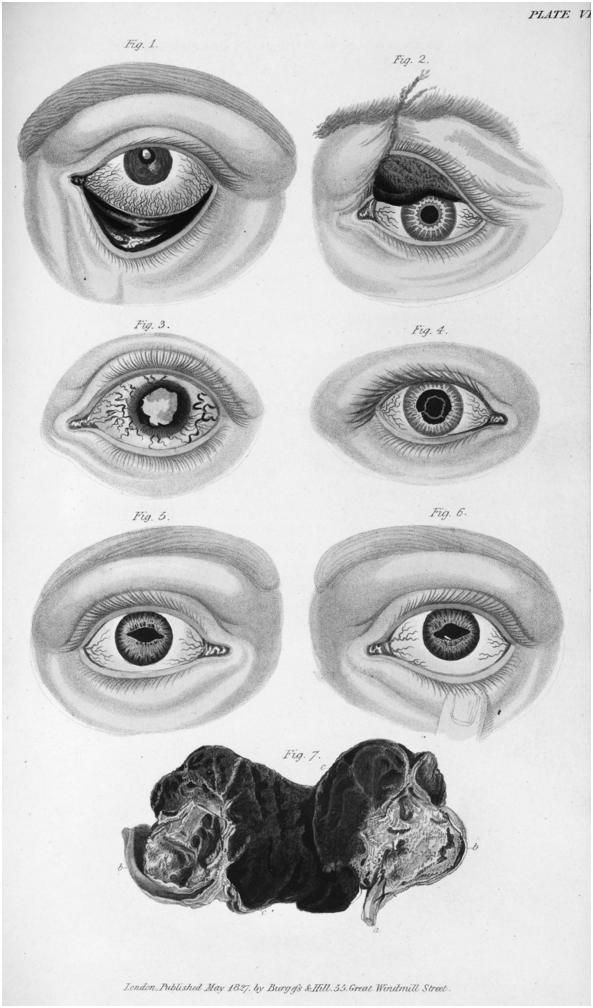
The physical fragility of human sight was also overtly registered in the scientific literature of ophthalmology. Practitioners in the emerging field quickly set about cataloguing the many afflictions and pathologies to which eyes are susceptible. Most treatises or manuals include descriptions and treatments for common conditions like cataract, glaucoma, myopia, and many different types of ophthalmia. However, they also feature more strange and stomach-turning complaints, such as ‘Eversion of the Eyelid’, ‘Warts and Mulberries’, ‘Fleshy and Fatty Fungus … of the Conjunctiva’, and ‘Ossification of the Eyeball’ (see Figure 1 for additional visual examples).Footnote 97 Ophthalmologists also drew attention to the fact that eyesight was liable to deteriorate with both time and use, a deterioration that was only accelerated by the mounting visual demands of modern life, not least of which was a notable increase in literacy and the necessity for reading.Footnote 98 In response to these many impending threats to vision, the Victorians became notably careful of their eyes, and as Almond-Brown observes, ‘spectacle dispensing’ became just one part of ‘an ever-increasing number of goods being offered to the early Victorian consumer’.Footnote 99 An active commercial industry grew up to cater to ocular anxieties, producing popular products like eye-baths, eye-waters, coloured lenses, shades, and railway glasses.Footnote 100
Afflictions of the eye.
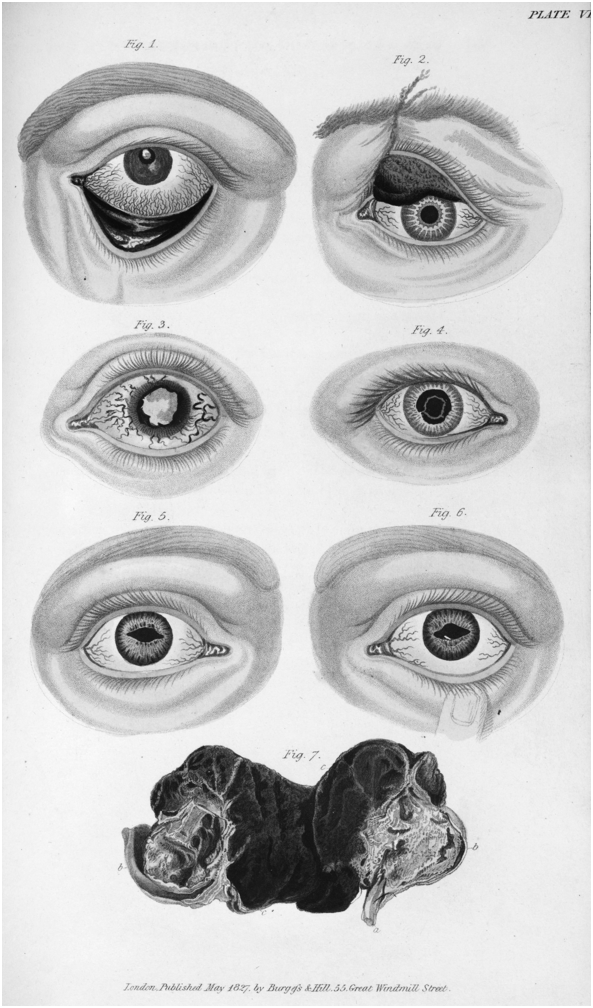
Figure 1 Long description
Six individual eyes are arranged in three rows of two, with the tumor below them. The first and second eyes have inverted upper and lower lids, respectively, where the dark flesh of the lid interiors stands out against the pale background. The third eye, which is affected by glaucoma and cataract, is bloodshot and has a pupil obscured by cloudy patches. The fourth eye has undergone a partially successful operation for cataract removal, but retains a ring or capsule around the pupil. The fifth and sixth eyes have had artificial pupils inserted, which appear as black elongated diamonds in the centre of the iris. The fungoid tumor is depicted as a fleshy, amorphous tube with a textured surface and open ends of a lighter shade.
Although insights provided by disability studies mean we are now disinclined to conceive of blindness in terms of loss or lack, Flint suggests that this condition was deployed in Victorian literature as a ‘central trope’ for ‘reminding one of the fragility of sight’.Footnote 101 Blindness has historically been made to carry a significant symbolic weight, and Mary Ann O’Farrell notes that it has served variously ‘as a sign for such abstractions as knowledge, ignorance, fidelity, insight, denial, and impartiality’.Footnote 102 While blindness is thus frequently taken up in literature on account of its symbolic potential, in Blindness and Writing (2017), Heather Tilley seeks to move beyond the metaphoric and towards an analysis that is more attentive to the material realities of the condition. Rather than approaching vision and blindness as dichotomous states, she locates her work ‘where the separation between blindness and sight breaks down’.Footnote 103 My own book aims to join Tilley’s in this space; for tears – with their power to blur, obscure, or distort – often initiate a similar breakdown of visual binaries to the one she describes.
With its focus on ocular vulnerability, ophthalmology creates a curious internal contradiction; while eyes were its main object, they were simultaneously one of its most important tools. Observation has long been a cornerstone of medical practice, theorised most famously by Foucault in his description of the ‘medical gaze’.Footnote 104 Problematising the narrative of progress that is often used to frame medicine’s development as a cumulative series of discoveries or advancements, Foucault argues that it partakes of ‘the ideological theme that guides all structural reforms’ of the late eighteenth century, playing into the pursuit of ‘the sovereign liberty of truth: the majestic violence of light’.Footnote 105 With the medical gaze, this ‘violence of light’ is ‘transported into the doctor’s eye’.Footnote 106 Ophthalmology, however, forces the medical gaze to turn back upon the organ of observation itself, as exemplified in the Victorian device that became central to the medical specialty: the ophthalmoscope.Footnote 107 Created by Hermann von Helmholtz in 1850, the ophthalmoscope encapsulates a strange combination of visual mastery and vulnerability; able to extend human sight so it might reach inside the eyeball, it is specifically designed to search out pathologies that might affect this same organ’s capacity to see in the first place. It thus always confronts the medical gaze with its own corporeal susceptibility.
Even though scholars such as Crary and Flint have made a very strong case to suggest that the Enlightenment faith in vision began to wane in the early decades of the nineteenth century, they have had less say when it comes to the outcomes of this decline. Yet it raises certain pressing questions like, where do people turn when they can no longer rely on what they see? And what alternatives are there to seeing as a way of knowing the world? One potential avenue for approaching these questions has been to consider the role played by senses other than sight, and this is evident in a renewed interest in the full spectrum of sensory experience, in what David Howes has dubbed the ‘sensual turn’ or ‘sensorial revolution’.Footnote 108 This is an approach taken by scholars such as William Cohen, David Sweeney Coombs, Annette Kern-Stähler, and Elizabeth Robertson.Footnote 109 Cohen, for instance, attends to the four senses that have been ‘traditionally cast onto the refuse heap of culture’, asserting that ‘the world enters human subjects through bodily orifices, of which the eyes are but two’.Footnote 110 Where these critics seek to escape the hegemony of vision by turning away from eyes towards other sensory organs, this book remains with eyes, but turns instead to their oft-neglected affective capacities.
To this end, I seek to avoid overuse of the dominant critical term ‘gaze’ throughout this study. While the word is useful when specifically seeking to conjure the psychoanalytic or Foucauldian connotations of vision, in many other cases, we would be better served by the term ‘look’, as it has double meanings that speak to the functional ambivalence of the eye. While one definition refers to the organ’s perceptive function (‘To direct one’s sight; to use one’s ability to see’), the other points to its expressive capacity (‘to have a certain appearance’).Footnote 111 For example, you might look (gaze) at someone and notice that they look (appear) sad. The term look, then, encompasses an important mutuality that obtains between seeing and feeling, serving to remind us that vision and emotion operate in and through the same organ. If critics want to give due consideration to the affective role of the eye, they could thus start by embracing this more inclusive and indicative word.
Books, Blots, and the Reading Eye
Whether we think of the archetypal nineteenth-century omniscient narrator, or of the many windows in Henry James’s House of Fiction each framing a ‘figure with a pair of eyes’, we gain an impression of a long-standing association that exists between vision and realism.Footnote 112 Ian Watt described the realist novel as a form centrally concerned with its correspondence to reality. This concern was often met with what Michael McKeon dubbed a ‘naïve empiricism’, manifested as a preoccupation with truth-value, probability, and the evidence of the senses.Footnote 113 Tracing the connection between this literary form and the photographic image, Nancy Armstrong asserts that the realist novel ‘equated seeing with knowing’ and was judged according to a standard ‘based on the fidelity of language to visual evidence’.Footnote 114 While this association between formal realism and visual truth has been successively dismantled by critics including McKeon and Armstrong themselves, and we are now broadly sceptical of the idea that the realist novel has any privileged access to reality, there nonetheless remains a tempting symmetry in the way the realist and the sentimental novels can be aligned respectively with the eye’s perceptive and affective functions; the former on the side of sight, omniscience, and the evidence of the senses, and the latter on that of obfuscating tears, emotional excess, and artifice. Unlike the realist novel, sentimental literature is far less interested in mimesis or correspondence to reality. However, this does not mean that these texts are not invested in truth or knowledge. They simply do not subscribe to the idea that this can only be attained through clear observation or mimetic accuracy.
With that in mind, in this book I follow Aaron Hanlon, who, in Empirical Knowledge in the Eighteenth-Century Novel (2022), poses a challenge to ‘the broader view that formal realism is the best framework for understanding the novel’s contribution to knowledge’, arguing instead that its ‘primary epistemic innovation … was not representation, but method’.Footnote 115 While Hanlon conceives of method in terms of systems of inference and inductive reasoning, with my focus on sentimentalism, I am more interested in the role of feeling and the alternative avenues to knowledge that it presents. Pointing to ‘today’s association of scientific knowledge with “hard” facts [and] literature with “soft skills” or “emotional intelligence”’, Hanlon also claims we can detect the assignation of ‘the novel’s sentimental turn as a departure from matters of empirical knowledge’.Footnote 116 It should thus be noted that the knowledge gained through affect and emotion in the sentimental literature I discuss – although arrived at differently – is no less robust than that gained through processes of observation or ratiocination.
That said, Derrida’s epistemological claim for tears as ‘the very truth of the eye’ is likely to raise more eyebrows and more objections when made in the context of sentimental literature, and for good reason. We are now well versed in the problematic power dynamics that underlie sympathy, pathos, and sentimentality, the way these phenomena frequently celebrate acts of benevolence that depend on and perpetuate racist or sexist socio-political structures. For example, describing the coincidence of ‘sentiment and abolition’ and its archetypal instantiation in Uncle Tom’s Cabin (1853), Yogita Goyal cites authors such as Richard Right and Teju Cole in illustrating that ‘in the African American literary imagination, rejecting such sentimental origins has been a powerful current’.Footnote 117 Suzanne Clark identifies a parallel feminist ‘discomfort with the sentimental’, noting it is frequently seen ‘as complicit with patriarchy, rather than with the oppressed’.Footnote 118 Sentimentality’s imbrication with histories of oppression illustrates the very real dangers that can come with its didactic or moral agendas. Yet as Clark astutely notes, ‘we are premature if we dismiss the sentimental as an aspect of bourgeois thinking which we can escape through a purified critical logic, whether the logic is conservative, liberal, or Marxist’.Footnote 119 Indeed, the repugnance that often arises in the face of sentimentality and its perceived attempts at emotional manipulation – far from achieving ‘purified critical logic’ – tends to be just as affectively charged as sentimentality itself. It is perhaps because sentimental novels are so morally didactic, that literary criticism has been reluctant to learn from them. Clark also points out that sentimentality does not align with one particular ideology or political allegiance. The same is true of the affective knowledge I am interested in here, which might just as easily give rise to liberal tears as it does conservative gut feelings.Footnote 120 While it can inform the ethical decisions made in sentimental texts, it is not inherently moral. And even if we reject the moral or political stance of sentimentality, we can still benefit from attending to its rhetorical and epistemological forms.
As with genres like romance or sensation fiction, sentimental novels aim to elicit a certain kind of affective response in their readers. Albert Rivero even describes them as ‘machines explicitly and self-consciously manufactured to feel with’.Footnote 121 While no historical period has been univocal in its response to sentimentality, Idilko Csengei argues that for eighteenth-century readers, tears were an integral part of the experience of the sentimental novel; they served as a ‘test of the sensibility of its early readers’ and were considered ‘compulsory attributes and signifiers of a feeling heart’.Footnote 122 However, the broad popularity of the genre began to wane in the late eighteenth century, and Janet Todd notes that the term ‘sentimental’ began to function as a pejorative as early as the 1770s.Footnote 123 This critical perspective gained firmer ground in the nineteenth century, as the Victorians developed what Carolyn Burdett characterises as a love-hate relationship with sentimentality. Suggesting that ‘sentimentality defines Victorian culture and tone as much as the mills of the industrial north’, Burdett also notes that the Victorians were simultaneously its vocal detractors, putting forward a critique that remained ‘remarkably consistent in its tone, its assessment and its favoured targets’.Footnote 124 Perhaps the most famous example of this critique is Oscar Wilde’s late-Victorian quip about the sentimental heroine of Dickens’s Old Curiosity Shop (1841), which states that ‘one must have a heart of stone to read the death of Nell without laughing’.Footnote 125 What is most intriguing about both Wilde’s reaction and about the love-hate dynamic of the Victorian response in general is the way they both entail a difference of affective valence rather than one of intensity; readers might laugh rather than cry, but they rarely remain unaffected. It seems that sentimentality’s call to feeling is not one that can easily be met with equanimity. This makes the sentimental novel particularly useful for thinking through the complex ways that affect moves between texts and readers, books and bodies.
Sentimentality is generally thought to deal with feelings that have undergone some form of mediation. This is how James Chandler defines it when he suggests it ‘involves a structure of vicariousness’.Footnote 126 Contrasting sentimental feelings with ‘vehement passions’, Chandler notes that the latter have a tendency to strengthen our ‘personal limits’ and ‘signal our invisible depths’, while the former could instead ‘be said to spread us thin’.Footnote 127 Terada describes something similar in her definition of pathos, which she says involves ‘mediation’ and ‘the explicitly representational, vicarious, and supplementary dimensions of emotion’.Footnote 128 This mediated quality of sentimental feeling can be understood to imply that its emotion is somehow used, depleted, or second-hand, or as Nicola Bown puts it, a form of ‘feelings on the cheap’.Footnote 129 Terada notes our propensity to dismiss the sentimental on this account: ‘When we’re aware of the second-order nature of emotion we call it “pathos” and act as though it were something other than emotion.’Footnote 130 But rather than making sentimental feeling ‘something other than emotion’, this mediation only highlights feeling’s autonomous and mobile nature. There is something determinedly overt about the way sentimentality produces affect in both texts and readers. This does not make it less than emotion, but perhaps more like self-conscious or meta-emotion: feeling that draws attention to its own existence and construction as such.Footnote 131
In contemplating the felt responses that texts evoke from readers, Sianne Ngai poses an insightful question by asking where affect is located in this interaction. Noting that aesthetic theories of reception have tended to assign it to one or other of the entities of text or reader, Ngai categorises such approaches as those which operate via either ‘sympathy’ or ‘projection’.Footnote 132 In the former, feeling is thought to originate in the text, and the emotions represented there are reproduced in the reader by the process of sympathy. In the latter, feeling is assigned to the reader, who projects their emotions onto the text, and finds them reflected back.Footnote 133 Ngai contends, however, that neither sympathy nor projection can fully account for the affective experience of reading:
We can speak of a literary text whose global or organizing affect is disgust, without this necessarily implying that the work represents or signifies disgust, or that it will disgust the reader (though in certain cases it may also do so). Exactly ‘where,’ then, is the disgust?Footnote 134
Ngai seeks to answer this question by invoking the notion of ‘tone’, which she sees as an amorphous affective product of reading, one that is ‘never entirely reducible’ to the dynamics of sympathy or projection.Footnote 135 Without properly belonging to either the text or the reader, tone arises, according to Ngai, in the meeting of the two. With this definition in mind, one might argue that sentimentality constitutes a kind of literary tone. While I am not convinced it is entirely encapsulated in what is normally understood by the term, it does involve the sort of reciprocity Ngai outlines. The affective outcome of sentimentality has most frequently been understood according to the aforementioned model of sympathy; however, the laughter and embarrassment it also occasions indicates that it is not fully comprehended by such a schema. As Michael Bell observes in his study of Victorian sentiment, ‘the feeling aroused by fiction is both liminal and subliminal. Existing in a twilight realm between the worlds of the reader and of the fiction, it constantly confounds these conceptually clear categories.’Footnote 136 Indeed, sentimental feeling seems to be mutually constituted by both text and reader, in an encounter that – compared to many other forms of aesthetic experience – carries a greater potential for polarisation.
This encounter between text and reader is also always a meeting of materialities, one that is staged repeatedly in another of the sentimental novel’s most recurrent motifs: the tear-blotted page.Footnote 137 This image is present at what is perhaps the founding moment of the sentimental tradition, in the opening letter of Samuel Richardson’s epistolary novel Pamela; or, Virtue Rewarded (1740). Grieving the death of her mistress, Pamela’s letter is stained by her tears: ‘O how my eyes run! – Don’t wonder to see the paper so blotted!’Footnote 138 Here, foundationally, tears show their faculty for dissolution, with the heroine’s running eyes initiating the running of ink. Even though Pamela’s tears blur the words on the page, they also blur the margins between body and text, for the tear-blotted page makes manifest both the physical and the affective exchange that occurs in writing and reading. Reflecting on these margins, Norbert Lennartz observes that reading relies on ‘the porousness of boundaries between reader and text’.Footnote 139 He suggests that texts have different ‘strategies of porousness’ ranging from ‘impervious[ness]’ to ‘openness’, with genres like sentimental fiction aiming to ‘absorb their readers into their tear-soaked pages’.Footnote 140 Alex Wetmore makes a similar point in noting that tear-blotted pages operate ‘at the interface of texts and sensitive bodies, imbuing the physical page with embodied sympathetic significance’.Footnote 141 While for Wetmore this trope ‘draw[s] attention to the materiality of the written page’, I am equally interested in the other side of this porous boundary or interface, namely, in the reading body.Footnote 142
Even though reading is most often understood as an intellectual undertaking, it is simultaneously always an embodied practice. This is an attribute recognised and explored in the work of critics such as Nicholas Dames, Rachel Ablow, Garrett Stewart, Robyn Warhol, Elaine Auyoung, and Peter Katz.Footnote 143 In The Physiology of the Novel (2007), for instance, Dames brings nineteenth-century science to bear on the reading body, identifying ‘a vanished interdisciplinary formation’ of literary critics and scientific writers who make up what he calls ‘physiological novel theory’.Footnote 144 Emphasising their focus on ‘reading itself’, he suggests these critics took ‘the facts of speed, pace, attention span, engrossment, mental concentration, and drift … as the central data whereby to construct a generic theory of prose fiction’.Footnote 145 Among the questions Dames poses about the different qualities of attention and consumption that characterised Victorian reading, he asks: ‘How does the eye traverse different texts differently?’Footnote 146 Taking up Dames’s question, Benjamin Kossak reads the work of I. A. Richards through ‘literary criticism that engages with eye movement’.Footnote 147 Suggesting that ‘reading [is] a quintessentially disembodied activity, and the eyes, a quintessentially disembodied sense organ’, Kossak notes this has made ‘it especially difficult to focus attention on [eyes] as physiological actors in their own right’.Footnote 148 Citing experiments that show how different forms of prose impact eye movement, he asks whether we could imagine a ‘new bodily poetics’ that ‘deliberately builds oculomotor habits in order to orchestrate its reader’.Footnote 149 I take Dames’ and Kossak’s questions about eyes and texts as important provocations in this book. While both critics offer their own persuasive answers in analyses of speed-reading and eye movement, here I suggest that sentimental literature presents another possible response to these queries.Footnote 150
Not every reader will well up before a sentimental novel; that much is clear. However, tearful reactions still serve as a reminder that the reading eye is never merely a detached or impassive conduit for the words of a text, but is instead involved in an intimate physical and affective engagement with them. In this respect, the eye is a useful organ through which to approach contemporary critical methods that advocate for feeling in reading or that engage in what we might call a hermeneutics of affect. This would include strategies such as Sedgwick’s ‘reparative reading’, Timothy Bewes’s ‘reading with the grain’, and Rita Felski’s ‘postcritical reading’.Footnote 151 Felski, for instance, attempts to establish ‘a more dialogic and capacious vision of theory’, one that does not require the reader to dispense with their affective response or their attachment to texts.Footnote 152 As per Clark’s aforementioned doubts about ‘purified critical logic’, Felski stresses that critique has always entailed ‘a certain sensibility’, even if its practitioners have been reluctant to acknowledge this fact: ‘It colors the texts we read, endows them with certain qualities, places them in a given light.’Footnote 153 Building on Felski’s visual metaphorics of colour and light, we could think of the tear as an alternative critical lens that represents such approaches to reading with feeling. Indeed, this hermeneutics of affect already seems to be one written into our bodies, evident in the combination of the visual and emotional capacities of the reading eye. While tears thus serve as a useful methodological analogy, one that will be unpacked further in the conclusion of this study, in the chapters that follow, I also try to ensure that metaphors do not distance us from the material experiences of reading eyes, and the very real physical and affective connections that they form with texts.
As this project is centred around the rise of ophthalmology in Britain at the end of the eighteenth century, it looks at sentimental texts produced before, during, and after this transition, and requires that I think about sentimentalism across boundaries of literary periodisation. Albert Rivero warns that ‘we risk critical incoherence and imprecision … in extending a study of the sentimental novel beyond its specific manifestation in the eighteenth century and the opening decades of the nineteenth’.Footnote 154 While I must accept the risk Rivero describes, I attempt to heed his caution by attending closely to historical particularities when it comes to differences between eighteenth- and nineteenth-century approaches to sentimentality and science. And in doing so, I follow researchers such as Fred Kaplan, Michael Bell, James Chandler, Carolyn Burdett, and Valerie Purton, who successfully pursue the sentimental novel beyond its eighteenth-century origins.Footnote 155
The first chapter of this book takes up the work of the philosopher Adam Smith, helping to establish a theoretical and historical frame for sentimental fiction, while also illustrating the ways that philosophical sentimentalism shares its novelistic counterpart’s preoccupation with eyes and seeing. Reading Smith’s The Theory of Moral Sentiments (1759) alongside George Berkeley’s An Essay Towards a New Theory of Vision (1709), I explore the ways that Smith’s treatise structures sympathy as a visual encounter. In an attempt to compensate for the emotional and imaginative processes that underlie his moral system, Smith depicts vision as an objective sense and the eye as an impartial instrument. But despite his best efforts to describe how seeing and feeling might attain neutrality, there are moments when his conception of vision is informed by older classical theories, ones that acknowledge a much closer physical and affective connection between observer and observed.
The subsequent chapters turn to sentimental fiction, broadly conceived, and examine a collection of novels that have a special interest in eyes and tears. Chapter 2 takes as its primary focus an early example of the genre: Samuel Richardson’s Pamela. Noting that the heroine’s weeping is subject to similar suspicions as her virtue, it draws on the work of more sexually explicit authors – such as Eliza Haywood and John Cleland – to posit that distrust of Pamela’s tears can be traced to their association with female body fluids that are more difficult to write about. In the process, I take up the question of gender as it pertains to crying, arguing that female characters like Pamela have routinely been made to shoulder all the negative connotations of tears, but are far less frequently allowed to share in their redeeming ones. The chapter seeks to highlight and redress this double standard.
This interest in women’s tears is carried into Chapter 3, which explores the novels of Frances Burney, with a focus on Camilla (1796) and The Wanderer (1814). Burney is a writer who turns to scientific discourse for both her physiological and figurative depictions of tears and vision. Representing affect in fluid form, she portrays emotional repression and expression as a blockage and flow of liquid, which, when it takes the shape of tears, becomes a means of exercising female agency. Affect also plays an integral role in processes of perception throughout Burney’s work, which insists that seeing is always attended and informed by feeling. She thus engages with the sentimental both through literary convention and philosophical foundation, for her depictions of eyes and tears suggest that feeling is as epistemologically valid as observation.
While the eye’s visual and affective functions often appear as indistinguishable components of perception in Burney’s novels, in Dickens’s work, they are frequently brought into conflict with one another. Chapter 4 examines this functional conflict as it plays out in The Old Curiosity Shop and Bleak House (1853). It illustrates how Dickens’s understanding of eyes was informed by popular scientific journalism from his weekly periodicals, and posits that his knowledge of ocular neural anatomy shaped the divergent capacities for seeing and feeling in the villains and heroines of his novels. In Bleak House, Dickens also presents tears as part of a wider fluid network of affect that flows freely in and amongst the characters and spaces of the novel. Contemplating how this fluid feeling can simultaneously flow out to meet the reader – with emotion being a key aspect of Dickens’ reception – I argue that he uses affect to move his reader’s eyes, both across the page and beyond it. With these ocular processes in mind, Dickens’s work illustrates that there are ways of reading with feeling that are already written into our bodies.
Continuing with the Victorian novel, Chapter 5 examines how certain conventions of the sentimental genre – like the tear and the Man of Feeling archetype – are taken up in the sensation fiction of Wilkie Collins. Focusing primarily on The Woman in White (1860), it argues that Collins uses the tear as a staging point from which to mount an argument about the limits of materialism. With characters such as the infamous villain Count Fosco, he highlights the dangers involved in entirely conflating emotion with physiology. While it has become customary to see the sensation novel as a genre that addresses itself specifically to the nerves, The Woman in White pre-emptively warns its readers not to strip bodily responses of their potential for meaning.
The Conclusion reflects back on the many weeping eyes considered in the course of the book, and on the insights they provide about the tear’s complicated relationship to perception and knowledge, to affect and signification, to gender and power, and to science and sentimentality. I also use this closing section to examine an advertisement for spectacles that illustrates some of the ocular challenges posed to reading eyes by the Victorian periodical press. This examination brings the study back around to affective hermeneutics and the affordances of the tear as critical lens: a figuration that encapsulates both the theme and method of the book.