




Introduction
Wildlife trafficking involves thousands of species globally (Scheffers et al. Reference Scheffers, Oliveira, Lamb and Edwards2019). When, however, it comes to policymakers, legislators and the general public, a few high-profile species stand out, including elephants, rhinos, pangolins and, in recent years, helmeted hornbills. Arguably, China has emerged as the country of greatest importance in terms of the fuelling of illegal trade in wildlife (Jiao et al. Reference Jiao, Yeophantong and Lee2021). China’s help and cooperation is pivotal to mitigate the negative effects that wildlife trafficking has on imperilled species.
Border areas are vulnerable to smuggling. Borders have an ambivalent nature both for states and residents (Kusakabe & Oo Reference Kusakabe and Oo2004). For states, they are markers of national identity for maintaining state control, but criminal networks can traffic wildlife products and other goods across them. People living there may escape state control but also experience obstacles to mobility through border demarcation. The border, however, also becomes a resource for them, since political and economic differences across the border can be exploited (Kusakabe & Oo Reference Kusakabe and Oo2004). Not surprisingly, border areas with weak law enforcement offer trading opportunities – often with impunity. Traders exploit legal loopholes and discrepancies in legislation. Numerous border towns specialize in wildlife sales and cater to consumers of wildlife products from across the border for commodities that cannot be legally acquired in their home country, as, for example, at Boten on the Laos–China border (Krishnasamy et al. Reference Krishnasamy, Shepherd and Or2018), Chian Khan on the Thai–Laos border (Robinson Reference Robinson1994), Bau on the Malaysia–Indonesia border (Kaur et al. Reference Kaur, Khairi, Rehman and Jawaid2019), Leticia in the Brazil–Colombia–Peru tri-border area (Maldonado et al. Reference Maldonado, Nijman and Bearder2009) and Mozambique towns near the border with South Africa (Vigne & Martin Reference Vigne and Martin2018a).
Here, we present wildlife trade data from the Myanmar side of the Myanmar–Thailand–China border. This region, part of the infamous Golden Triangle known in the past for opium growing and today as a hub for methamphetamine (UNODC 2021), is connected by the Mekong River in north-east Thailand, south-east Myanmar and north-west Laos, with easy access to south-west China. The area is developing at a rapid pace due to China’s Belt and Road Initiative (Comolli & Rose Reference Comolli and Rose2021). Smuggling threatens globally threatened species, both regional and from other parts of Asia and indeed Africa (Shepherd et al. Reference Shepherd, Gray and Nijman2017, Zhang et al. Reference Zhang, Gouvenia, Qin, Quan and Nijman2017). We surveyed the wildlife trade in the towns of Tachilek, on the Myanmar–Thai border, and Mong La, on the Myanmar–China border. Most visitors to Tachilek are from Thailand, while visitors to Mong La are today restricted to mainland Chinese nationals on 1-day tours. Both towns are situated in eastern Shan State, where the central Myanmar government has limited authority. In February 2021, Myanmar underwent a military coup d’état, resulting in massive social upheaval. Although Shan State is an autonomous region, Myanmar’s political turmoil and military conflict have stifled cooperation and law enforcement efforts with Shan State, and this will affect wildlife trade in an as-yet undefined manner.
We focus on trade in elephant ivory, rhino horn, pangolin scales and helmeted hornbill casques, both raw and worked. All of these species are listed in Appendix I of the Convention on International Trade in Endangered Species of Wild Fauna and Flora (CITES), to which all three countries are Party (China ratified the Convention in 1981, Thailand in 1983 and Myanmar in 1997). We present data on: (1) the number of items offered for open sale in these two markets; (2) the prices of these ivory and keratin products; (3) changes in volume and prices over time; and (4) possible linkages between these products in time and location.
Methods
Data acquisition
One of us (VN) has visited Tachilek and Mong La numerous times since 2006 and as such we were familiar with the layout of the markets and how and when the traders operated. We analyse data that we collected during our six most recent surveys: Tachilek on 26–27 July 2017 (VN with Penthai Siriwat), 6–7 December 2017 (LV with Esmond Martin) and 15–16 January 2020 (LV); and Mong La on 6 March 2015 (VN with Mingxia Zhang), 1–2 December 2017 (LV with Esmond Martin) and 18–19 January 2020 (LV) (Table 1). The 2015 survey was less detailed than the others as only a limited time could be spent in the city. In recent years, Mong La has become restricted for Western visitors, and a colleague who wishes to remain anonymous undertook the last two surveys in Mong La while LV stayed nearby.
Types of retail outlets and number of ivory items in Tachilek, Myanmar, on view in July 2014/December 2017/January 2020 and in Mong La, Myanmar, in March 2015/December 2017/January 2020.

We recorded locations, types and numbers of retail outlets selling ivory, rhino horn, pangolin skins and scales, hornbill casques and hornbill ivory. We made detailed notes on the numbers, types and prices of items and products. In Tachilek, prices were quoted in Thai Baht and in Mong La in Chinese Renminbi (Yuan). Photographs and videos helped with data recording. We conversed with shop owners, vendors and artisans about business and about their customers to ascertain demand for various products. Information was collected on uses of products. Some shop owners knew about trade routes. Where possible, we visited the same shops to observe any identical items for direct price comparisons. We estimated from the condition of items and labels how long they had been displayed in cabinets. We checked this to find out about turnover and to corroborate vendors’ views on sales. We did not purchase any wildlife products.
Verification
High-end shops displayed genuine items securely behind glass, while stalls – in addition to genuine wildlife parts – occasionally displayed faux ivory bangles, beaded bracelets and/or necklaces. Vendors that did display fake items were open about them not being the genuine article, often making this clear without prompting. Interpretation of the origins and style, especially of the ivory and rhino horn parts, is based in part on information provided to us by the vendors or based on our experience of surveying markets throughout Asia (VN and LV) and Africa (LV).
We checked the items on view for sale to establish whether they were genuine. Elephant ivory has so-called Schreger lines with obtuse angles, as opposed to mammoth (Mammuthus primigenus) ivory that has acute Schreger lines (we did not observe any mammoth ivory). Distinguishing the species of elephant is more difficult, with these lines appearing similar in Asian elephants (Elephas maximus), African savannah elephants (Loxodonta africana) and African forest elephants (Loxodonta cyclotis). Nearly all rhino horns on view were from South Africa’s white rhino (Ceratotherium simum simum), being the vast majority trafficked today (Shepherd et al. Reference Shepherd, Gray and Nijman2017, Vigne & Martin Reference Vigne and Martin2018a). These large horns have distinctive hair-like filaments and are processed into large, plain bangles, beads and pendants, and these are easily identifiable as rhino horn (bovids have narrower, more hollow horns). Pangolins were seen mostly as whole skins and scales. Species identification of scales was not feasible, but there were no difficulties identifying them as coming from pangolins. Helmeted hornbill (Rhinoplaxis vigil) casques are also keratin and are easily recognizable, being orange and red.
Analysis
No price data were collected in 2015. Exchange rates were US$1 = 32.59 Baht or 6.6 Yuan in 2017 and 30.00 Baht or 6.5 Yuan in 2020. Prices were corrected for inflation to January 2021 and then converted to US dollars. While we recorded and analysed retail starting prices, most vendors tend to reduce their items by 15–20% in Tachilek and 20–30% in Mong La when bartering, or even by 30–40% for a bulk wholesale purchase in Mong La.
We used ClustVis (Metsalu & Vilo Reference Metsalu and Vilo2015), which uses a principal component analysis (PCA) to reduce the dimensionality of multi-dimensional data, in combination with coloured heat map plots, to explore the relationships of the products surveyed. We created a presence–absence matrix for the six surveys and eight wildlife products. ClustVis uses several R packages internally, including ggplot2 for the PCA plot and heat map (R package version 0.7.7). We used the default setting for the PCA (i.e., singular value decomposition with imputation). For data pre-processing, the unit variance scaling method was used to divide the values by the standard deviation so that each row had variance equal to 1 (Metsalu & Vilo Reference Metsalu and Vilo2015).
We assume an Asian pangolin has c. 600 scales (Ullmann et al. Reference Ullmann, Veríssimo and Challender2019) and, when dried, these occupy a space of c. 1700 cm3 (12 × 12 × 12 cm). From this, we estimated the number of pangolin equivalents from the scales on view in bags or in boxes.
For ivory and rhino horn, we used distinct items (e.g., bangles, bracelets, necklaces, chopsticks) as the unit of analysis. We compared numbers from the three survey periods in Tachilek using analysis of variance (ANOVA); for Mong La, we compared numbers between 2017 and 2020 using a paired t-test. We compared asking prices both within and between markets using paired t-tests. We compared rhino horn items counted in Mong La’s surveys using a paired t-test. All data were log-transformed prior to analysis so as to approach a normal distribution. All statistical tests were two tailed with significance set at p < 0.05.
Results
Elephant ivory trade
In total, we recorded 16 435 elephant ivory items: there were 8909 or almost 3000 per survey in Tachilek and 7426 or almost 2500 per survey in Mong La (6841 or almost 3400 per survey when we exclude the partial 2015 survey; Table 1). The numbers in Tachilek did not differ significantly amongst years (ANOVA, F 2,36 = 0.018, p = 0.98), and they also did not differ between 2017 and 2020 in Mong La (t = 1.55, p = 0.147). The number of shops varied little in Tachilek between surveys, but in Mong La most selling ivory by early 2020 had shut down for renovations, and new shops – but fewer of them – had replaced them.
In Tachilek most ivory was displayed in jade shops, and in Mong La in specialist ivory and jade jewellery shops. In Tachilek turnover was low: three main shops surveyed in 2017 and 2020 still had the same items that were barely reduced in number. One vendor had sold no cigarette holders or chopsticks since 2017. Turnover in Mong La appeared to be higher but was more difficult to assess, being mostly displayed in new shops. Pendants made up at least 48% of the ivory in Tachilek and 40% in Mong La. Most pendants in Mong La were much larger (from experience we know that this better reflects the tastes of Chinese clientele): 5–6 cm oblong or round in shape and decorated with horoscope figures, dragons and the Buddha (Table 2). Pendants in Tachilek were mainly 1–3 cm in size with shapes including elephants, hearts and gourds. In Tachilek there were Thai-made thin ear picks/toothpicks sold as pendants and hand-carved trinkets from Mandalay and Yangon, all made when tourism had boomed. In Mong La the larger jewellery items were recently mass-produced from African elephant tusks made in Vietnam, Laos and China (Vigne & Martin Reference Vigne and Martin2016, Reference Vigne and Martin2017a, Reference Vigne and Martin2017b), with some processed in Mong La by machine. Small 1–3cm pendants and other trinkets of Thai and Burmese style (with ‘gold’ and ivory clasps, respectively) were displayed in two old souvenir outlets in Mong La but not in the newer shops that displayed almost exclusively Chinese-style items for Chinese clientele.
Elephant ivory items for sale in Tachilek and Mong La, Myanmar, in 2017 and 2020.

In Tachilek, prices (corrected for inflation) for nine ivory items had increased significantly between December 2017 and January 2020 (t = 4.590, p = 0.002). Prices in Mong La had increased as well, but for six types with comparable price data this increase was not statistically significant (t = 0.561, p = 0.599). Vendors’ starting prices in Tachilek in January 2020 were mostly coded on labels and were similar to those in December 2017 (Table 3). Thus, the same baby’s bangle was on sale for US$60 in 2020 compared with US$77 in 2017. The cheapest items were ear picks and toothpicks for US$15 a pair compared with US$17 in 2020. The most expensive in 2020 was a 15-cm Myanmar ‘dancing lady’ for US$3166. A couple of shops displayed large jewellery objects preferred by the Chinese: a 15-cm bead bracelet was priced at US$500.
Retail prices (mean, in US$ corrected for inflation to December 2020, with range between parentheses) for ivory items on display in Tachilek and Mong La, Myanmar, in December 2017 and January 2020.

Rhino horn trade
We observed rhino horn openly for sale only in Mong La. In 2015, small discs (US$224 g–1), bangles, one pot of rhino horn powder and a whole African white rhino horn were seen. In 2017, we observed 27 objects of 4 types in 5 shops, and in 2020, we observed 71 objects of 7 types in 4 shops. The difference in number of items seen is not significant (t = 1.474, p = 0.184; Table 4). In 2020, we also observed 12 raw pieces (US$43 g–1), 19 packets of shavings (US$11–23 g–1) and three pots of rhino horn powder (US$11 g–1) for traditional Chinese or Asian medicine. Vendors commented that the material was from the Mekong, which connects the Golden Triangle region with China and Mong La. One vendor sourced rhino horn from Laos. Most rhino horn comprised large pieces of jewellery generally for men to wear; based on the size and structure, we consider it most likely that this originated from African white rhinos.
Numbers and prices (mean, in US$ corrected for inflation to December 2020) of rhino horn products counted in Mong La, Myanmar.

Pangolin trade
No pangolin products were displayed for retail sale in Tachilek during our recent surveys. In Mong La in 2015, we observed 13 large plastic bags of pangolin scales (each thought to contain the scales of three pangolins), 16 whole skins and 1 pangolin in alcohol, or an estimated total of 44 pangolins. In 2017 in the morning market (‘wet market’), about 4 of 16 traditional medicine stalls offered pangolin scales, with the largest displaying two rolled up skins and two large plastic boxes of scales. One large shop displayed a full pangolin skin at the entrance to attract customers, a big plastic washing bowl and two large sacks filled with scales behind the counter and more in packets on a shelf. A similar shop also had a pangolin skin at the entrance and eight bags containing rolled-up pangolin skins or loose scales. In total, this represented over 100 pangolins. In 2020, we observed 4 boxes (respectively c. 11 000 cm3, 27 000 cm3, 64 000 cm3 and 91 000 cm3) containing pangolin scales, 5 skins, 1 tail, 86 carved and 6 uncarved scales and 8 packets of pangolin scale powder. These represented nearly 100 pangolin equivalents. The 2020 retail price for raw scales was US$0.50 g–1. A carved scale was US$77 and 50-g packets of pangolin scale powder were priced at c. US$0.50 g–1. Traders referred to ‘iron scales’ (darker) and ‘copper scales’ (paler and more expensive), which may refer to scales originating from different species. Pangolin powder (ground-up pangolin scales) was said to be from pangolins caught in the surrounding hills of Myanmar. Vendors commented that numbers of wild pangolins had decreased possibly due to overharvesting for trade.
Helmeted hornbill trade
We counted eight full helmeted hornbill casques: in Tachilek one in July 2017, and in Mong La five in March 2015, one in 2017 and one in 2020. The retail price for a whole casque in 2020 was US$2424. In Mong La in 2015, we furthermore observed 20 1-cm casque beads, and in 2020 we observed 2 necklaces priced at US$2308 with 108 1-cm beads (US$21/bead) and 2 bracelets with 14 small beads each. The Chinese enjoy these rare items as status symbols and (as for rhino horn) they bestow protection from evil spirits on their owners, vendors remarked.
Links amongst animal parts for sale and markets
In the cluster analysis, PC1 explained 44.5% of the observed variation and PC2 explained 38.1%. PC1 was associated with high loadings of raw rhino horn (0.45) and helmeted hornbill casques (0.47) and low loadings of raw ivory (–0.38) and ivory carvings (–0.42). PC2 was associated with high loadings for processed pangolin scales (0.55) and pangolin scales (0.54) and low loadings for helmeted hornbill casques (–0.14) and casque carvings (–0.15). In the cluster analysis, the first split was between ivory and the other products (at both border markets) and the second were between pangolin and rhino horn commodities and between helmeted hornbill and rhino horn products (Fig. 1). There is no clear temporal or spatial pattern. Surveys conducted in 2017 or 2020 do not cluster together, nor do surveys conducted in Tachilek or Mong La. The heat map shows a cold spot for ivory in Mong La in 2015 when time prevented a full survey and hotspots for helmeted hornbill casques/items in Mong La in 2015 and for rhino horn in 2020.
Eight types of wildlife products on display for retail sale during six surveys in two border wildlife markets in Myanmar. (a) Heat map analysis. (b) Results of the principal component analysis. PC = principal component.

Discussion
A persistent trade in wildlife along Myanmar’s borders
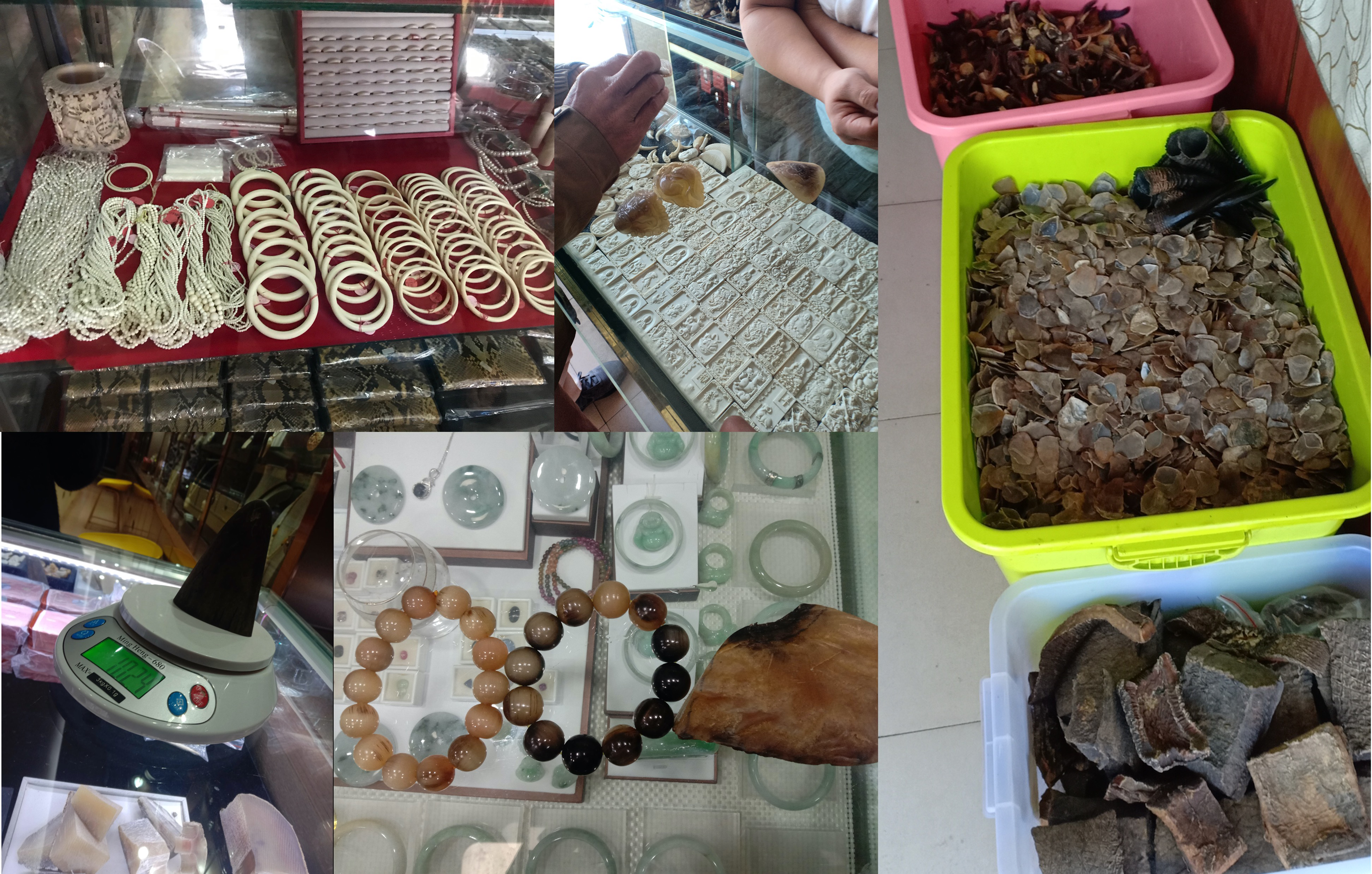
We document a consistent and persistent open market for ivory products in Tachilek and Mong La, as well as several other endangered wildlife products on display in Mong La (Fig. 2). Thousands of ivory trinkets dominated the displays in both towns. Mong La also displayed rhino horn, pangolin scales and helmeted hornbill items for mainland China’s buyers (Davies Reference Davies2005, Shepherd & Nijman Reference Shepherd and Nijman2007, Reference Shepherd and Nijman2008, Oswell Reference Oswell2010, Nijman & Shepherd Reference Nijman and Shepherd2014, Nijman et al. Reference Nijman, Zhang and Shepherd2016, Shepherd et al. Reference Shepherd, Gray and Nijman2017, Vigne & Martin Reference Vigne and Martin2018a, Reference Vigne and Martin2018b). Most shops specialized in luxury products for visitors from Thailand (Tachilek) and China (Mong La), with no obvious restrictions. Local time in Mong La follows Beijing Standard Time (1.5 h ahead of the rest of Myanmar) and c. 80% of its residents are Chinese. Mandarin/Putonghua is spoken widely in Mong La, signs are in Chinese characters and the mobile phone network and electricity providers are Chinese. The Chinese Yuan/Renminbi is used in Mong La and the Thai Baht in Tachilek. The economies of both towns (including gambling, entertainment, prostitution and sale of counterfeit products) are dependent on trade with China and Thailand, respectively. Despite CITES efforts to regulate wildlife trade, non-compliance has been a major problem in many countries where blatant illegal trade continues (Stiles Reference Stiles2004a). The fact that our surveys revealed a drop in over-the-counter turnover in ivory products and other wildlife items in Tachilek and Mong La does not negate the trade occurring behind the scenes in these regions facilitated by social media.
Wildlife products for sale in two border market towns in Myanmar in 2020. Clockwise from top left, in Tachilek: elephant ivory jewellery; and in Mong La: carved pangolin scales on top of a display cabinet with elephant ivory pendants; boxes with (1) muntjac antlers, (2) pangolin scales and serow horns and (3) dried elephant skin; rhino horn bead bracelets and a piece of raw rhino horn (bottom right); rhino horn tip on a scale.
Border towns as a resource
Border areas are usually markers of national identity for maintaining state control, but in eastern Shan State, with a lack of central control, criminal networks can traffic wildlife products and other goods across the borders. A border in effect can become a resource, allowing illegal exploitation (Kusakabe & Oo Reference Kusakabe and Oo2004). Min (Reference Min2016, Reference Min2017) conducted surveys in Mong La during 2014–2015 and in Tachilek during 2016–2017 with some of her findings aligning with ours. In Mong La she observed three pairs of elephant tusks, recorded 18 pangolin skins (mean of three per survey) and noted that the number of pangolin scales was ‘impossible to count’. The amount of wildlife she observed, however, was markedly less than what we found.
Hong (Reference Hong2015) concluded (although without providing evidence) that most animal parts in Mong La, including pangolin scales and dried elephant skins, were fake. He considered the ivory to be cow bone and the rest probably to be plastic. The only things that were real, according to him, were a set of deer antlers and perhaps some of the pangolin scales. We, in contrast, found that most of the ivory and all of the rhino horn, pangolin scales and hornbill products on display were genuine. Faux ivory, while present, was offered in stalls rather than in shops. Others who have observed wildlife in Tachilek and Mong La, including that of other species, tend to agree with us (e.g., Martin & Redford Reference Martin and Redford2002, Davies Reference Davies2005, Oswell Reference Oswell2010, Min Reference Min2016, Reference Min2017, Shepherd et al. Reference Shepherd, Gray and Nijman2017). Van Uhm and Wong (Reference Van Uhm and Wong2021) analysed decisions from court cases in China concerning the smuggling of wildlife from Myanmar into China, including from the Mong La–Daluo crossing, and found that of the 44 cases, 16 related to pangolins or pangolin parts, 8 related to elephant ivory or other parts and one related to rhino horn. This all suggests that these wildlife parts were indeed genuine. Hong (Reference Hong2015) considered Mong La a backwater vice town and reasoned that since most of the wildlife items for sale were protected under the CITES agreement and selling them in the open would invite too much unwanted attention, it made sense for traders not to offer genuine wildlife products. Rather than seeing Mong La, and indeed Tachilek, as backwater vice towns, both are in fact strategically positioned, well-organized and stable (Rippa & Saxer Reference Rippa and Saxer2016), and they cater for a clientele that wants to indulge in activities that are not tolerated on the other side of the border. The political and economic differences in border towns are exploited by businesses, including businesses focused on wildlife products (Kusakabe & Oo Reference Kusakabe and Oo2004, Avis Reference Avis2017).
Monetary value of wildlife for sale in Mong La and Tachilek
Based on a rough calculation of asking prices and volumes reported here, we estimate that the monetary value of the products openly for sale in 2017 was c. US$250 000 for Tachilek (mostly ivory), and US$2 000 000 for Mong La (mostly ivory and rhino horns). The values in 2020 for Tachilek were comparable to those of 2017 (i.e., c. US$300 000), and in Mong La we estimate the monetary value of wildlife products openly for sale at c. US$750 000 (with items being fewer in this town but generally significantly larger in size). The drain on wildlife that these two relatively small cities exert, especially Mong La, is difficult to underestimate, affecting both wild species from abroad with their products smuggled into the region and, of course, threatening the rich biodiversity of Myanmar itself (Morton et al. Reference Morton, Scheffers, Haugaasen and Edwards2021).
There appears to be no respite in raw ivory supplies for this Chinese market, virtually all smuggled from Africa, much via Vietnam and also via Laos and Thailand, moving through the Golden Triangle region (Nijman & Shepherd Reference Nijman and Shepherd2014, Vigne & Martin Reference Vigne and Martin2018a, Reference Vigne and Martin2018b). Shipments from Africa often carry both ivory and pangolin scales, and the massive quantities demonstrate that these shipments are operated by increasingly well-organized criminal networks moving vast amounts of illegal wildlife products from Africa to Asia (WJC 2020). This has become not only a threat to wildlife but also a serious form of large-scale money laundering (FATF 2020).
Temporal and spatial changes along the Myanmar, Thailand and China borders
In China, trade in rhino horn was banned following international pressure in 1993 because rhinos had been locally extirpated for their horns by poachers in most range states in Africa by as early as the mid-1980s (Western & Vigne Reference Western and Vigne1985). Today’s customers of rhino horn items prefer the largest pieces because they are easier to identify, and they may source them from across the border (Van Uhm & Wong Reference Van Uhm and Wong2021). They are purchased by Chinese as expensive status symbols giving spiritual power and protection as well as prestige to the owner, and when needed small amounts can be removed to be used as medicine. Similarly, people want authentic elephant ivory for prestige, and it is also considered to be one of the finest carving materials.
Tusks and raw rhino horn originate mainly from Africa to make items for the Chinese market, as few elephants and rhinos are left in eastern Asia. While some helmeted hornbills do occur in southern Myanmar, most casques we observed were mostly probably sourced from further south. These must all be smuggled long distances and finally cross the Golden Triangle region to be sold safely in Mong La as a close transit point on the border with China (Nijman & Shepherd Reference Nijman and Shepherd2014, Vigne & Martin Reference Vigne and Martin2018a, Reference Vigne and Martin2018b). Thailand has increased its awareness of and law enforcement regarding ivory (Shepherd & Nijman Reference Shepherd and Nijman2008). Starting in the 1990s, demand soared in Thailand for Myanmar tusks transported through the Tachilek border to Thai carvers making ivory trinkets (Vigne & Martin Reference Vigne and Martin2002), especially in Phayuha Kiri (Martin & Stiles Reference Martin and Stiles2002, Stiles Reference Stiles2004b). Thus, some items displayed for sale in Tachilek today could well be Myanmar tusks. Ivory items, however, are increasingly available online. Online trade is proving even more popular during the COVID-19 pandemic (Morcatty et al. Reference Morcatty, Feddema, Nekaris and Nijman2021), enabling many customers to buy whatever they want more easily and safely through the growing trend in online sales.
Tachilek grew in size in the 1980s and 1990s as tourists poured across the border from Thailand, giving Myanmar a chance to sell wildlife produce, including Myanmar’s worked ivory items carved in Mandalay and Yangon (Martin & Vigne Reference Martin and Vigne1997, Shepherd & Nijman Reference Shepherd and Nijman2007, Nijman & Shepherd Reference Nijman and Shepherd2014), for foreign exchange. In the 2000s, the bulk of this trade shifted to the China border, notably to Mong La, to meet the new booming Chinese market (Shepherd & Nijman Reference Shepherd and Nijman2007). Ivory, rhino horn and pangolin scales from Africa have been smuggled increasingly via Indochina, including Mong La, to meet demand in mainland China in recent years (Nijman et al. Reference Nijman, Zhang and Shepherd2016, Shepherd et al. Reference Shepherd, Gray and Nijman2017, Vigne & Martin Reference Vigne and Martin2018a, Reference Vigne and Martin2018b, Jiaming & Paing Reference Jiaming and Paing2019). Wildlife products were smuggled with ease across the 1000-km Myanmar–China border due to a relative lack of checkpoints (Ling Reference Ling, Xu and Compton2008). In the early 2000s, Chinese people flooded into Mong La for the casinos and to shop for the wildlife products that were unavailable or too expensive at home. More recently, who is allowed across the Mong La border post has been further restricted (although numerous illegal entry/exit points are situated nearby). While this has caused a drop in customers, Mong La nevertheless continues to offer native and smuggled non-native luxury items, with shops still not being inspected (Nijman & Shepherd Reference Nijman and Shepherd2014, Vigne & Martin Reference Vigne and Martin2018a, Reference Vigne and Martin2018b).
In Tachilek native wildlife products remain on offer, albeit fewer items from less high-profile species than in the 1990s to 2010s. Wildlife items can be purchased via mobile phone transactions from Tachilek to Mae Sai on the Thai side of the border. Mobile communication has transformed this form of shopping, as in Mong La (Ling Reference Ling, Xu and Compton2008), where sales are increasingly occurring online to mainland China, mostly on WeChat, and deliveries can occur easily over the border to regular customers (Jiaming & Paing Reference Jiaming and Paing2019). Vendors in Mong La and Tachilek were happy to hand out their contact details for such trade. Online trade is enabling wholesale and retail trafficking in endangered species more readily than ever (Vigne & Martin Reference Vigne and Martin2018a, Reference Vigne and Martin2018b, Jiaming & Paing Reference Jiaming and Paing2019). Advances in mobile networks are transforming the illicit wildlife trade landscape. The dominance of online trade enables sellers and buyers to connect directly, discretely and anonymously (Bird et al. Reference Bird, Hoang, Stanyard, Walker and Haysom2020), with online platforms expanding. The Internet allows both sellers and buyers to obtain wildlife products that otherwise would be difficult to find and to remain undetected, despite law enforcement increasing in sophistication. This can result in an increase in the use of cryptocurrency as payment. Tracking online trade to help law enforcement is time consuming, highlighting the desirability of automated detection. Wildlife crimes today often involve money laundering. Chinese traders may have a broker to pay for commodities across borders using a traditional system called fei qian – allowing exchanges of stored value that leave no paper trail and avoid tax. This helps Chinese traders to afford large international consignments from Africa of illegal wildlife products.
Conclusion
The biodiversity-rich area of eastern Myanmar provides a conduit for wildlife trade across this very porous border region into China. Illegal endangered wildlife products are openly traded at high prices and are offered online to Chinese buyers, particularly in Mong La. Borders with very weak law enforcement enable the trafficking of many goods. Once species are diminished locally, traders source them from other countries, before moving on again to new countries as these populations are destroyed. Globalization has made the illegal wildlife trade far more complex and threatening. There is a lack of commitment and political will to fight powerful, corrupt and criminal dealers. The fear of zoonotic diseases and accelerating habitat loss, however, are spurring new impetus to combat the illegal wildlife trade. A greater commitment from the relevant authorities in Myanmar, China and Thailand is needed to address the illegal wildlife trade and trafficking across Myanmar’s borders.
Acknowledgements
Thanks are due to those who helped us in Mong La and who have to remain anonymous, to Mingxia Zhang, Penthai Siriwat and the late Esmond Martin for help with data collection and to Karl Ammann, Daniel Stiles, Adam Oswell and Chris R Shepherd for helpful information and insights on Myanmar, notably the Golden Triangle area. We thank the editor and the reviewers for constructive comments and suggestions for improvement.
Financial support
The research was supported by Oxford Brookes University, with earlier funds from the Elephant Crisis Fund and the Aspinall Foundation.
Competing interests
The authors declare none.
Ethical standards
Our discussions with vendors followed the ethical guidelines proposed by the Association of Social Anthropologists of the United Kingdom and Commonwealth.


 Open access

