


1. Introduction
Research on projection theorems in various spaces has a long-standing tradition in geometric measure theory. Perhaps the earliest work in the field is due to Besicovich [
Reference BesicovitchBes39
] and Federer [
Reference HerbertFed47
], who characterised rectifiable sets in $\mathbb{R}^n$
in terms of the Hausdorff measure of their image under orthogonal linear projections. Inspired by their work, Marstrand [
Reference MarstrandMar54
] initiated a more extensive analysis of the effect of orthogonal linear projections on the Hausdorff measure and dimension of Borel sets, showing that the image of a planar set A under almost every orthogonal projection has the maximal possible Hausdorff dimension. More precisely: let A be any Borel set, and consider, for each
$\mathbb{R}^n$
in terms of the Hausdorff measure of their image under orthogonal linear projections. Inspired by their work, Marstrand [
Reference MarstrandMar54
] initiated a more extensive analysis of the effect of orthogonal linear projections on the Hausdorff measure and dimension of Borel sets, showing that the image of a planar set A under almost every orthogonal projection has the maximal possible Hausdorff dimension. More precisely: let A be any Borel set, and consider, for each $\theta\in [0,2\pi)$
the orthogonal projection
$\theta\in [0,2\pi)$
the orthogonal projection $P_\theta(A)\;:\;\mathbb{R}^2\rightarrow L_\theta$
, where
$P_\theta(A)\;:\;\mathbb{R}^2\rightarrow L_\theta$
, where $L_\theta$
is a line at angle
$L_\theta$
is a line at angle $\theta$
to the x-axis. Since each
$\theta$
to the x-axis. Since each $P_\theta$
is Lipschitz into a 1-dimensional target space,
$P_\theta$
is Lipschitz into a 1-dimensional target space, $\dim(P_\theta A) \leqslant \min\{1, \dim A\}$
. Marstrand’s Theorem states that the upper bound is, in fact, attained for
$\dim(P_\theta A) \leqslant \min\{1, \dim A\}$
. Marstrand’s Theorem states that the upper bound is, in fact, attained for $\mathscr{H}^{\;\;1}$
-almost every angle
$\mathscr{H}^{\;\;1}$
-almost every angle $\theta$
, where
$\theta$
, where $\mathscr{H}^{s}$
denotes the Hausdorff s-measure.
$\mathscr{H}^{s}$
denotes the Hausdorff s-measure.
Marstrand’s planar result was subsequently generalised, in various respects, to orthogonal projections of $\mathbb{R}^n$
onto m-planes by Kaufman [
Reference RobertKau68
], Mattila [
Reference PerttiMat75
], and Falconer [
Reference FalconerFal82
]. More recently, these results have been generalised and extended to further spaces with natural projection families, including the families of horizontal and vertical projections in the Heisenberg groups [
Reference Balogh, Katrin, Pertti and TysonBFMT12, Reference Balogh, Estibalitz, Katrin, Pertti and TysonBDCF+13, Reference HarrisHar20, Reference RistoHov14
], and certain families of closest-point projections in hyperbolic n-space
$\mathbb{R}^n$
onto m-planes by Kaufman [
Reference RobertKau68
], Mattila [
Reference PerttiMat75
], and Falconer [
Reference FalconerFal82
]. More recently, these results have been generalised and extended to further spaces with natural projection families, including the families of horizontal and vertical projections in the Heisenberg groups [
Reference Balogh, Katrin, Pertti and TysonBFMT12, Reference Balogh, Estibalitz, Katrin, Pertti and TysonBDCF+13, Reference HarrisHar20, Reference RistoHov14
], and certain families of closest-point projections in hyperbolic n-space $\mathbb{H}^n$
and the 2-sphere
$\mathbb{H}^n$
and the 2-sphere $\mathbb{S}^2$
[
Reference Balogh and AnninaBI16, Reference Balogh and AnninaBI19
].
$\mathbb{S}^2$
[
Reference Balogh and AnninaBI16, Reference Balogh and AnninaBI19
].
It is often straightforward to extend projection theorems from a small projection family to a larger one that contains it, see e.g. Proposition 2·10. Conversely, restricting projection theorems to a measure-zero subfamily is not always possible (e.g. the family of orthogonal projections from $\mathbb{R}^3$
to lines in the XY plane always maps the Z axis to a single point). Järvenpää et al. [
Reference Esa, Maarit, François and MikaJJLL08
] introduced the notion of restricted families of projections and provided conditions under which projection theorems hold for a one-dimensional family of projections that is induced by a curve in the Grassmanian G(n,m) of m-planes in
$\mathbb{R}^3$
to lines in the XY plane always maps the Z axis to a single point). Järvenpää et al. [
Reference Esa, Maarit, François and MikaJJLL08
] introduced the notion of restricted families of projections and provided conditions under which projection theorems hold for a one-dimensional family of projections that is induced by a curve in the Grassmanian G(n,m) of m-planes in $\mathbb{R}^n$
. Identifying more general conditions under which a restricted family retains projection theorems remains an actively-studied task [
Reference ChanghaoChe18, Reference Katrin and TuomasFO14, Reference HarrisHar21, Reference Tuomas and LauraOV18
].
$\mathbb{R}^n$
. Identifying more general conditions under which a restricted family retains projection theorems remains an actively-studied task [
Reference ChanghaoChe18, Reference Katrin and TuomasFO14, Reference HarrisHar21, Reference Tuomas and LauraOV18
].
Marstrand’s original proof of his theorem used mainly methods from planar geometry. The generalisations by Kaufman and Mattila employed potential theory. Some decades later, a further developed version of such potential theoretic methods allowed Peres-Schlag [ Reference Yuval and WilhelmPS00 ] to establish a powerful result that links dimension preservation for families of mappings with a more-easily verified (differentiable) transversality condition (see Section 2·2). Establishing (local) transversality has become a standard method for proving projection theorems [ Reference Balogh and AnninaBI16, Reference RistoHov14, Reference Pertti, Akram Aldroubi, Jaffard and MolterMat19 ]. Theorem 2·2 below summarises the consequences of local transversality in our setting. Furthermore, its control of the distortion of Sobolev dimension of measures under the given family has been applied e.g. in the study of distance set problems [ Reference PerttiMat04 , section 5] and [ Reference Yuval and WilhelmPS00 , section 8], intersections of Cantor sets [ Reference Yuval, Károly and BorisPSS03 ], and Bernoulli convolutions [ Reference Yuval and WilhelmPS00 , section 5].
Combining the above themes, we will be interested in using transversality to prove projection theorems for certain one-dimensional families of projections in a non-Euclidean setting. Namely, we will replace the rotationally-symmetric projections in Marstrand’s Theorem with projection families which arise from linear-fractional symmetries of the Riemann sphere $\hat {\mathbb{C}}$
and the real projective plane
$\hat {\mathbb{C}}$
and the real projective plane $\mathbb{RP}^2$
, and characterise the regions on which transversality and projection theorems hold. Additionally, our use of projective geometry will allow us to quickly obtain transversality and projection results in spherical and hyperbolic spaces, extending the results of [
Reference Balogh and AnninaBI16, Reference Balogh and AnninaBI19
], see also [
Reference LaurentDuf18
].
$\mathbb{RP}^2$
, and characterise the regions on which transversality and projection theorems hold. Additionally, our use of projective geometry will allow us to quickly obtain transversality and projection results in spherical and hyperbolic spaces, extending the results of [
Reference Balogh and AnninaBI16, Reference Balogh and AnninaBI19
], see also [
Reference LaurentDuf18
].
1·1. Projection families induced by group actions
Marstrand’s theorem fixes a set $A\subset \mathbb{R}^2$
and varies the mapping
$A\subset \mathbb{R}^2$
and varies the mapping $P_\theta$
. Equivalently, one can first rotate A by a rotation
$P_\theta$
. Equivalently, one can first rotate A by a rotation $R_\theta\in O(2)$
and then project it to
$R_\theta\in O(2)$
and then project it to $\mathbb{R}$
by the fixed mapping
$\mathbb{R}$
by the fixed mapping $\pi(x,y)=x$
. This phrasing emphasises the role of the rotation family O(2). We ask whether projection theory extends to cases where O(2) is replaced with another group action that arises naturally in a geometric setting.
$\pi(x,y)=x$
. This phrasing emphasises the role of the rotation family O(2). We ask whether projection theory extends to cases where O(2) is replaced with another group action that arises naturally in a geometric setting.
We consider the following general framework:
Definition 1·1. Let N,M be smooth manifolds, $S_0\subset N$
a closed subset,
$S_0\subset N$
a closed subset, $\pi\;:\; N \rightarrow M$
a mapping (called a projection) with domain
$\pi\;:\; N \rightarrow M$
a mapping (called a projection) with domain $N\setminus S_0$
, and G a group acting on N by
$N\setminus S_0$
, and G a group acting on N by $(g,p)\mapsto g(p)$
. Then the projection family
$(g,p)\mapsto g(p)$
. Then the projection family $\Pi$
induced by
$\Pi$
induced by $\pi$
and the action of G on N is given by
$\pi$
and the action of G on N is given by
 \begin{align*} \Pi\;:\; G\times N \longrightarrow M, \ \ (g,p)\longmapsto \pi(g(p))\end{align*}
on its domain $(G\times N)\setminus S$
, where
$(G\times N)\setminus S$
, where $S=\{(g, p)\;:\; g(p)\in S_0\}$
. We refer to a family
$S=\{(g, p)\;:\; g(p)\in S_0\}$
. We refer to a family $\Pi$
arising in this manner as induced by a group action. Such families are characterised by the condition
$\Pi$
arising in this manner as induced by a group action. Such families are characterised by the condition $\Pi(g, p)=\Pi(\operatorname{Id}, g(p))$
.
$\Pi(g, p)=\Pi(\operatorname{Id}, g(p))$
.
We will be predominantly interested in the case where N is $\mathbb{R}^2$
or its more symmetric compactifications
$\mathbb{R}^2$
or its more symmetric compactifications $\hat {\mathbb{C}}$
and
$\hat {\mathbb{C}}$
and $\mathbb{RP}^2$
. We will analyse several classes of projection families induced by group actions by establishing local transversality and, where it fails, using more direct arguments that allow us to draw the same conclusions concerning dimension preservation. These are stated in Theorem 2·2 and include the analogs of all classical results about orthogonal projections in
$\mathbb{RP}^2$
. We will analyse several classes of projection families induced by group actions by establishing local transversality and, where it fails, using more direct arguments that allow us to draw the same conclusions concerning dimension preservation. These are stated in Theorem 2·2 and include the analogs of all classical results about orthogonal projections in $\mathbb{R}^n$
such as the Marstrand and Besicovich–Federer projection theorems.
$\mathbb{R}^n$
such as the Marstrand and Besicovich–Federer projection theorems.
Definition 1·2. We say that a projection family $\Pi$
satisfies projection theorems if the conclusions of Theorem 2·2 hold on the domain of
$\Pi$
satisfies projection theorems if the conclusions of Theorem 2·2 hold on the domain of $\Pi$
.
$\Pi$
.
More generally, it is natural to ask under what conditions a family $\Pi$
induced by the action of G on M and a mapping
$\Pi$
induced by the action of G on M and a mapping $\pi\;:\; N\rightarrow M$
is (locally) transversal or satisfies projection theorems, when one equips N, M with Riemannian metrics and volume measures, and G with its Haar measure. Clearly, if a fiber is G-invariant then projection theorems must fail along this fiber; and it seems intuitively plausible that projection theorems should hold elsewhere. However, as we show below, proving this intuition is not always straightforward even in specific examples, and in fact, the intuition fails when applied to transversality.
$\pi\;:\; N\rightarrow M$
is (locally) transversal or satisfies projection theorems, when one equips N, M with Riemannian metrics and volume measures, and G with its Haar measure. Clearly, if a fiber is G-invariant then projection theorems must fail along this fiber; and it seems intuitively plausible that projection theorems should hold elsewhere. However, as we show below, proving this intuition is not always straightforward even in specific examples, and in fact, the intuition fails when applied to transversality.
1·2. Results
In this paper, we focus on planar projection theory, extended to two separate spaces: $\hat {\mathbb{C}}=\mathbb{C}\cup\{\infty\}$
with the group of complex linear-fractional mappings (Möbius transformations), or the projective plane
$\hat {\mathbb{C}}=\mathbb{C}\cup\{\infty\}$
with the group of complex linear-fractional mappings (Möbius transformations), or the projective plane $\mathbb{RP}^2$
with the group of real linear-fractional mappings (projective transformations). Additionally, the projective geometry perspective allows us to quickly analyse closest-point projections in hyperbolic and spherical geometries.
$\mathbb{RP}^2$
with the group of real linear-fractional mappings (projective transformations). Additionally, the projective geometry perspective allows us to quickly analyse closest-point projections in hyperbolic and spherical geometries.
We first study complex linear fractional transformations, denoted by $\operatorname{M}\!\ddot{\textrm{o}}\!\operatorname{b}$
, acting on the Riemann sphere
$\operatorname{M}\!\ddot{\textrm{o}}\!\operatorname{b}$
, acting on the Riemann sphere $\hat {\mathbb{C}}=\mathbb{C}\cup\{\infty\}$
, which is a natural family of motions to consider from the viewpoint conformal geometry and complex analysis. Möbius transformations have the form
$\hat {\mathbb{C}}=\mathbb{C}\cup\{\infty\}$
, which is a natural family of motions to consider from the viewpoint conformal geometry and complex analysis. Möbius transformations have the form
 \begin{align*} z \longmapsto \frac{a z+b}{cz+d}, \text{ where $a,b,c,d\in \mathbb{C}$ with }ad-bc=1,\end{align*}
and can be identified with the group of complex determinant-one matrices $SL(2,\mathbb{C})$
. Using a decomposition of
$SL(2,\mathbb{C})$
. Using a decomposition of $\operatorname{M}\!\ddot{\textrm{o}}\!\operatorname{b}$
into O(2) and a complementary manifoldFootnote
1
, we establish:
$\operatorname{M}\!\ddot{\textrm{o}}\!\operatorname{b}$
into O(2) and a complementary manifoldFootnote
1
, we establish:
Theorem 1·3. The family $\Pi\;:\; \operatorname{M}\!\ddot{\textrm{o}}\!\operatorname{b}\times \hat {\mathbb{C}}\rightarrow \mathbb{R}$
given by
$\Pi\;:\; \operatorname{M}\!\ddot{\textrm{o}}\!\operatorname{b}\times \hat {\mathbb{C}}\rightarrow \mathbb{R}$
given by $\Pi(g, z)=\operatorname{Re}(g(z))$
is locally transversal and therefore satisfies projection theorems on its domain
$\Pi(g, z)=\operatorname{Re}(g(z))$
is locally transversal and therefore satisfies projection theorems on its domain $\operatorname{M}\!\ddot{\textrm{o}}\!\operatorname{b}\times \hat {\mathbb{C}}\setminus \{(g, g^{-1}(\infty))\;:\; g\in \operatorname{M}\!\ddot{\textrm{o}}\!\operatorname{b}\}$
.
$\operatorname{M}\!\ddot{\textrm{o}}\!\operatorname{b}\times \hat {\mathbb{C}}\setminus \{(g, g^{-1}(\infty))\;:\; g\in \operatorname{M}\!\ddot{\textrm{o}}\!\operatorname{b}\}$
.
We ask what restricted families in $\Pi\;:\; \operatorname{M}\!\ddot{\textrm{o}}\!\operatorname{b}\times \hat {\mathbb{C}}\rightarrow \mathbb{R}$
satisfy projection theorems. For some symmetric families the answer is well known: the family corresponding to the rotations O(2) satisfies projection theorems, while families corresponding to dilations or translations are non-transversal since they simply rearrange the fibres of the projection. For other families, such as
$\Pi\;:\; \operatorname{M}\!\ddot{\textrm{o}}\!\operatorname{b}\times \hat {\mathbb{C}}\rightarrow \mathbb{R}$
satisfy projection theorems. For some symmetric families the answer is well known: the family corresponding to the rotations O(2) satisfies projection theorems, while families corresponding to dilations or translations are non-transversal since they simply rearrange the fibres of the projection. For other families, such as $(\theta, z) \mapsto \operatorname{Re}\left({\cos(\theta) z - \sin (\theta)}/{\sin(\theta)z + \cos(\theta)}\right)$
, the answer is not obvious. We prove (see Figure 1, left):
$(\theta, z) \mapsto \operatorname{Re}\left({\cos(\theta) z - \sin (\theta)}/{\sin(\theta)z + \cos(\theta)}\right)$
, the answer is not obvious. We prove (see Figure 1, left):
Groups $\Gamma$
in
$\Gamma$
in $\operatorname{M}\!\ddot{\textrm{o}}\!\operatorname{b}$
, left picture, and in
$\operatorname{M}\!\ddot{\textrm{o}}\!\operatorname{b}$
, left picture, and in $GL(3,\mathbb{R})$
, right picture, illustrated via their orbits. Projection theorems hold on the full domain of the associated family
$GL(3,\mathbb{R})$
, right picture, illustrated via their orbits. Projection theorems hold on the full domain of the associated family $\Pi$
, but transversality fails at
$\Pi$
, but transversality fails at $\gamma=\operatorname{Id}$
along the dashed line L tangent to the thicker orbit
$\gamma=\operatorname{Id}$
along the dashed line L tangent to the thicker orbit $\Gamma(\infty)$
(resp.,
$\Gamma(\infty)$
(resp., $\Gamma(\infty_Y)$
), and more generally on the set
$\Gamma(\infty_Y)$
), and more generally on the set $\{(\gamma, p)\;:\;\gamma^{-1} p\in L\}\subset \Gamma\times \hat C$
(resp.,
$\{(\gamma, p)\;:\;\gamma^{-1} p\in L\}\subset \Gamma\times \hat C$
(resp., $\Gamma \times \mathbb{RP}^2$
).
$\Gamma \times \mathbb{RP}^2$
).

Theorem 1·4. Let $\Gamma\subset \operatorname{M}\!\ddot{\textrm{o}}\!\operatorname{b}$
be a one-dimensional Lie subgroup, and
$\Gamma\subset \operatorname{M}\!\ddot{\textrm{o}}\!\operatorname{b}$
be a one-dimensional Lie subgroup, and $\Pi\;:\; \Gamma\times \hat {\mathbb{C}}\rightarrow \mathbb{R}$
the family given by
$\Pi\;:\; \Gamma\times \hat {\mathbb{C}}\rightarrow \mathbb{R}$
the family given by $\Pi(\gamma,z)=\operatorname{Re}(\gamma(z))$
. Then
$\Pi(\gamma,z)=\operatorname{Re}(\gamma(z))$
. Then $\Pi$
satisfies projection theorems on its domain, with the following natural exceptions:
$\Pi$
satisfies projection theorems on its domain, with the following natural exceptions:
-
(i) if $\Gamma$
consists of Euclidean dilations and translations, then projection theorems fail globally;
$\Gamma$
consists of Euclidean dilations and translations, then projection theorems fail globally;
-
(ii) if the orbit
$\Gamma(\infty)$
is a vertical line, then projection theorems fail along this line.


While the projection theorems confirm the expected behavior, the underlying transversality result has an artefact that we work around: transversality fails along a set corresponding to the linearisation of $\Gamma(\infty)$
, see Theorem 3·1.
$\Gamma(\infty)$
, see Theorem 3·1.
We next consider real linear fractional (projective) transformations $PGL(3,\mathbb{R})$
acting on the real projective plane
$PGL(3,\mathbb{R})$
acting on the real projective plane $\mathbb{RP}^2$
, which is the natural family of motions to consider from the viewpoint of projective geometry. The projective plane
$\mathbb{RP}^2$
, which is the natural family of motions to consider from the viewpoint of projective geometry. The projective plane $\mathbb{RP}^2$
is a compactification of
$\mathbb{RP}^2$
is a compactification of $\mathbb{R}^2$
that distinguishes points at infinity corresponding to linear directions. In
$\mathbb{R}^2$
that distinguishes points at infinity corresponding to linear directions. In $\mathbb{RP}^2$
, the projection
$\mathbb{RP}^2$
, the projection $\pi\;:\;(x,y)\mapsto (x,0)$
can be interpreted as a linear point-source projection from the infinite point
$\pi\;:\;(x,y)\mapsto (x,0)$
can be interpreted as a linear point-source projection from the infinite point $\infty_Y$
in the Y direction, and naturally extends to a mapping
$\infty_Y$
in the Y direction, and naturally extends to a mapping $\pi\;:\; \mathbb{RP}^2 \rightarrow \mathbb{RP}^1 = \mathbb{R} \cup\{\infty_X\}$
. Projective transformations have the form
$\pi\;:\; \mathbb{RP}^2 \rightarrow \mathbb{RP}^1 = \mathbb{R} \cup\{\infty_X\}$
. Projective transformations have the form
 \begin{align*} (x,y)\mapsto \left(\frac{a_{11}x+a_{12}y+a_{13}}{a_{31}x+a_{32}y+a_{33}},\frac{a_{21}x+a_{22}y+a_{23}}{a_{31}x+a_{32}y+a_{33}}\right),\text{ where }(a_{i,j})\in GL(3,\mathbb{R}).\end{align*} \vspace*{-6pt}
We prove analogs of Theorems 1·3 and 1·4 (see Figure 1, right):
Theorem 1·5.
The family $\Pi\;:\; GL(3,\mathbb{R}) \times \mathbb{RP}^2 \rightarrow \mathbb{RP}^1$
given by
$\Pi\;:\; GL(3,\mathbb{R}) \times \mathbb{RP}^2 \rightarrow \mathbb{RP}^1$
given by $\Pi(g, z)=\pi(g(z))$
on its domain
$\Pi(g, z)=\pi(g(z))$
on its domain $ (GL(3,\mathbb{R}) \times \mathbb{RP}^2 )\setminus \{(g, g^{-1}(\infty_Y))\;:\; g\in GL(3,\mathbb{R})\}$
is locally transversal and therefore satisfies projection theorems.
$ (GL(3,\mathbb{R}) \times \mathbb{RP}^2 )\setminus \{(g, g^{-1}(\infty_Y))\;:\; g\in GL(3,\mathbb{R})\}$
is locally transversal and therefore satisfies projection theorems.
Theorem 1·6. Let $\Gamma\subset GL(3,\mathbb{R})$
be a one-dimensional Lie subgroup, and let
$\Gamma\subset GL(3,\mathbb{R})$
be a one-dimensional Lie subgroup, and let $\Pi\;:\; \Gamma\times \mathbb{RP}^2 \rightarrow \mathbb{RP}^1$
the family given by
$\Pi\;:\; \Gamma\times \mathbb{RP}^2 \rightarrow \mathbb{RP}^1$
the family given by $\Pi(\gamma,p)=\pi(\gamma(p))$
. Then
$\Pi(\gamma,p)=\pi(\gamma(p))$
. Then $\Pi$
satisfies projection theorems on its domain
$\Pi$
satisfies projection theorems on its domain $ (GL(3,\mathbb{R}) \times \mathbb{RP}^2 )\setminus \{(g, g^{-1}(\infty_Y))\;:\; g\in GL(3,\mathbb{R})\}$
, with the following natural exceptions:
$ (GL(3,\mathbb{R}) \times \mathbb{RP}^2 )\setminus \{(g, g^{-1}(\infty_Y))\;:\; g\in GL(3,\mathbb{R})\}$
, with the following natural exceptions:
-
(i) if
$\Gamma$
consists of mappings of the form
$(x,y)\mapsto \left(\frac{a_{11}x+a_{13}}{a_{31}x+a_{33}},\frac{a_{21}x+a_{22}y+a_{23}}{a_{31}x+a_{32}y+a_{33}}\right)$
, or, equivalently, preserves the source
$\infty_Y$
of the projection
$\pi$
, then projection theorems fail globally;
-
(ii) if the orbit
$\Gamma(\infty_Y)$
is a vertical line or the line at infinity, then projection theorems fail along this line.


As for Theorem 1·4, the behaviour in Theorem 1·6 is expected, but transversality fails along the linearisation of the orbit $\Gamma(\infty_Y)$
, see Theorem 4·1. Importantly, this non-transversality locus may be the line at infinity
$\Gamma(\infty_Y)$
, see Theorem 4·1. Importantly, this non-transversality locus may be the line at infinity $\mathbb{RP}^2\setminus \mathbb{R}^2$
. In Example 4·5, we consider a group
$\mathbb{RP}^2\setminus \mathbb{R}^2$
. In Example 4·5, we consider a group $\Gamma\subset GL(3,\mathbb{R})$
that is conjugate to O(2) by a mapping that sends
$\Gamma\subset GL(3,\mathbb{R})$
that is conjugate to O(2) by a mapping that sends $\pi$
to the point-light-source projection mapping, and the non-transversality at infinity for the family associated to
$\pi$
to the point-light-source projection mapping, and the non-transversality at infinity for the family associated to $\Gamma$
turns into non-transversality along a line in
$\Gamma$
turns into non-transversality along a line in $\mathbb{R}^2$
that is tangent to the orbit of the light source under O(2).
$\mathbb{R}^2$
that is tangent to the orbit of the light source under O(2).
We finish by applying projective geometry to closest-point projections in hyperbolic space $\mathbb{H}^n$
and spherical space
$\mathbb{H}^n$
and spherical space $\mathbb{S}^n$
. In each of these spaces, we consider the families of m-dimensional totally-geodesic subspaces through a fixed point, and the corresponding families of closest-point projections. (Note that each of these families can be identified with the Grassmannian G(n,m) via the exponential mapping.) Finding an appropriate change of coordinates based on projective geometry, we show that each of these families is, in fact, equivalent to the Euclidean orthogonal projection families, and is therefore transversal:
$\mathbb{S}^n$
. In each of these spaces, we consider the families of m-dimensional totally-geodesic subspaces through a fixed point, and the corresponding families of closest-point projections. (Note that each of these families can be identified with the Grassmannian G(n,m) via the exponential mapping.) Finding an appropriate change of coordinates based on projective geometry, we show that each of these families is, in fact, equivalent to the Euclidean orthogonal projection families, and is therefore transversal:
Theorem 1·7. Let X be hyperbolic space $\mathbb{H}^n$
or the sphere
$\mathbb{H}^n$
or the sphere $\mathbb{S}^n$
, and p a point in X. In the spherical case, let
$\mathbb{S}^n$
, and p a point in X. In the spherical case, let $S^{n-1}\subset \mathbb{S}^n$
denote the great sphere perpendicular to p. Let
$S^{n-1}\subset \mathbb{S}^n$
denote the great sphere perpendicular to p. Let $\Pi\;:\; G(n,m)\times X\rightarrow \mathbb{R}^m$
be the family of nearest-point projections onto m-dimensional totally geodesic subspaces of X through p. Then
$\Pi\;:\; G(n,m)\times X\rightarrow \mathbb{R}^m$
be the family of nearest-point projections onto m-dimensional totally geodesic subspaces of X through p. Then $\Pi$
is locally transversal and satisfies projection theorems on all of
$\Pi$
is locally transversal and satisfies projection theorems on all of $\mathbb{H}^n$
, respectively on
$\mathbb{H}^n$
, respectively on $\mathbb{S}^n\setminus S^{n-1}$
.
$\mathbb{S}^n\setminus S^{n-1}$
.
See Theorem 5·1 for a more precise phrasing of this result.
Previously to this work, transversality was known for $\mathbb{H}^2$
and
$\mathbb{H}^2$
and $\mathbb{S}^2$
[
Reference Balogh and AnninaBI16
], and projection theorems [
Reference Balogh and AnninaBI19
] and a weaker version of transversality [
Reference AnninaIse18
] were known in
$\mathbb{S}^2$
[
Reference Balogh and AnninaBI16
], and projection theorems [
Reference Balogh and AnninaBI19
] and a weaker version of transversality [
Reference AnninaIse18
] were known in $\mathbb{H}^n$
for
$\mathbb{H}^n$
for $n\geqslant 3$
but not for
$n\geqslant 3$
but not for $\mathbb{S}^n$
.
$\mathbb{S}^n$
.
1·3. Methods
The proofs of the above results are based on direct calculations establishing transversality, combined with appropriate geometric and Lie-theoretic considerations for $\operatorname{M}\!\ddot{\textrm{o}}\!\operatorname{b}$
and
$\operatorname{M}\!\ddot{\textrm{o}}\!\operatorname{b}$
and $GL(3,\mathbb{R})$
. We establish the following auxiliary results to aid with the calculations, which are of independent interest and rely on our strong regularity and symmetry assumptions:
$GL(3,\mathbb{R})$
. We establish the following auxiliary results to aid with the calculations, which are of independent interest and rely on our strong regularity and symmetry assumptions:
-
(i) Lemma 2·3 allows us to change coordinates and reparametrise
$C^2$
projection families, in particular allowing us to speak of local transversality in coordinate charts of manifolds, as in the definition of projection families induced by group actions; -
(ii) Lemma 2·9 allows us to check transversality of symmetric
$C^2$
projection families
$\Pi\;:\; G\times N\rightarrow \mathbb{R}$
only along the identity of G rather than in specified neighbourhoods; -
(iii) Proposition 2·10 shows that transversality persists when one enlarges the parameter space of a symmetric
$C^2$
projection family, putting a special focus on identifying minimal transversal families and leads into our study of symmetric projection families with one-parameter symmetry groups.


1·4. Future directions
Our results can be seen as a first step in the study of projection theory for projection families induced by group actions. There are several immediate generalisations one can ask about, by working with new projections (e.g. point-source or ultraparallel), new groups (e.g. quasi-conformal), and new spaces (e.g. $\mathbb{R}^n$
, complex hyperbolic space, or Heisenberg groups). In higher-dimensional spaces, this would require, in view of Proposition 2·10, understanding minimal transversal families. In Heisenberg groups, projection theorems generally fail for the projection family generated by isometries and either vertical or horizontal projections, but can be expected to hold for the group of Möbius transformations.
$\mathbb{R}^n$
, complex hyperbolic space, or Heisenberg groups). In higher-dimensional spaces, this would require, in view of Proposition 2·10, understanding minimal transversal families. In Heisenberg groups, projection theorems generally fail for the projection family generated by isometries and either vertical or horizontal projections, but can be expected to hold for the group of Möbius transformations.
1·5. Structure of the paper
The paper is structured as follows: Section 2 is for preliminaries. In Section 2·1, we recall some basics on Lie groups and Grassmannians. This subsection can safely be skipped by readers who are familiar with the terminology of Lie groups. In Subsections 2·2 - 2·5, we recall the formal definition of transversality and its implications. Moreover, we prove preliminary results for families of of projections induced by group actions. In particular, we prove that transversality can be lifted to families of projections induced by larger Lie groups. In Section 3, we study projection theory in the plane for projections induced by Möbius transformations. In particular, we prove Theorems 1·3 and 1·4. In Section 4, we study projection theory in the plane for projections induced by real projective transformations. In particular, we prove Theorems 1·5 and 1·6. In Section 5, we consider closest-point projections in spherical and hyperbolic geometry, proving Theorem 1·7.
2. Preliminaries
2·1. Lie groups and Grassmannians
We now briefly recall the basic structure and introduce the notation for Lie groups, their quotients, and the particular case of the orthogonal group and Grassmannians. For a detailed account, see the textbooks [ Reference KnappKna02, Reference LeeLee13 ] and [ Reference PerttiMat95 , chapter 3].
A Lie group G is a smooth manifold with a group structure such that the product mapping $G\times G\rightarrow G$
and the inversion mapping
$G\times G\rightarrow G$
and the inversion mapping $G\rightarrow G$
are
$G\rightarrow G$
are $C^\infty$
-mappings. As a Lie group, G possesses a unique (up to rescaling) measure that is invariant under left multiplication, called the (left) Haar measure. Likewise, we have an (effectively) unique Riemannian metric on G, given by choosing an inner product on the tangent space of the identity and translating it to the full tangent bundle by left translations; different choices of inner product yield bi-Lipschitz metrics. Since the Haar measure is smooth (i.e. given in charts by integrating a smooth function), it agrees with the Hausdorff measure of the appropriate dimension, and the notion of zero-measure is compatible with Lebesgue measure when G is viewed in charts.
$C^\infty$
-mappings. As a Lie group, G possesses a unique (up to rescaling) measure that is invariant under left multiplication, called the (left) Haar measure. Likewise, we have an (effectively) unique Riemannian metric on G, given by choosing an inner product on the tangent space of the identity and translating it to the full tangent bundle by left translations; different choices of inner product yield bi-Lipschitz metrics. Since the Haar measure is smooth (i.e. given in charts by integrating a smooth function), it agrees with the Hausdorff measure of the appropriate dimension, and the notion of zero-measure is compatible with Lebesgue measure when G is viewed in charts.
The exponential map $\exp \;:\; T_{\operatorname{Id}} G\rightarrow G$
is a smooth mapping that relates the Lie algebra structure of the tangent space at the identity with the Lie group structure of G. For matrix groups, the exponential map can be written explicitly using the Taylor expansion of
$\exp \;:\; T_{\operatorname{Id}} G\rightarrow G$
is a smooth mapping that relates the Lie algebra structure of the tangent space at the identity with the Lie group structure of G. For matrix groups, the exponential map can be written explicitly using the Taylor expansion of $e^x$
, interpreted appropriately for matrices. On a small neighbourhood of 0,
$e^x$
, interpreted appropriately for matrices. On a small neighbourhood of 0, $\exp$
is a diffeomorphism onto an open neighbourhood of
$\exp$
is a diffeomorphism onto an open neighbourhood of ${\operatorname{Id}}\in G$
. Via an identification of
${\operatorname{Id}}\in G$
. Via an identification of $T_{\operatorname{Id}}G$
with
$T_{\operatorname{Id}}G$
with $\mathbb{R}^n$
, this provides exponential coordinates on G near
$\mathbb{R}^n$
, this provides exponential coordinates on G near $\operatorname{Id}$
. Further composing with any element
$\operatorname{Id}$
. Further composing with any element $g\in G$
provides exponential coordinates near g.
$g\in G$
provides exponential coordinates near g.
A Lie subgroup $\Gamma \subset G$
is a subset that is both an immersed submanifold and a subgroup of G. Connected one-dimensional subgroups are images of lines through the origin in
$\Gamma \subset G$
is a subset that is both an immersed submanifold and a subgroup of G. Connected one-dimensional subgroups are images of lines through the origin in $T_{\operatorname{Id}} G$
under the exponential map. In studying quotients of G by
$T_{\operatorname{Id}} G$
under the exponential map. In studying quotients of G by $\Gamma$
, one often imposes the condition that
$\Gamma$
, one often imposes the condition that $\Gamma$
is closed as a subset of G (non-closed examples such as the irrational line on the torus do not behave well in charts and do not provide good quotient spaces). In exponential coordinates, one locally sees
$\Gamma$
is closed as a subset of G (non-closed examples such as the irrational line on the torus do not behave well in charts and do not provide good quotient spaces). In exponential coordinates, one locally sees $\Gamma$
as a linear subspace of G, concluding that the inclusion
$\Gamma$
as a linear subspace of G, concluding that the inclusion $\iota\;:\; \Gamma\hookrightarrow G$
is a smooth embedding. Translates of this subspace under the action of G provide a smooth foliation, and a smooth section of this foliation provides a coordinate chart for the quotient (coset) space
$\iota\;:\; \Gamma\hookrightarrow G$
is a smooth embedding. Translates of this subspace under the action of G provide a smooth foliation, and a smooth section of this foliation provides a coordinate chart for the quotient (coset) space $G/\Gamma$
. One concludes that
$G/\Gamma$
. One concludes that $G/\Gamma$
is a manifold, and obtains in particular a smooth family of mappings
$G/\Gamma$
is a manifold, and obtains in particular a smooth family of mappings $g\in G$
that relate each point of
$g\in G$
that relate each point of $G/\Gamma$
to the basepoint
$G/\Gamma$
to the basepoint $[\operatorname{Id}]\in G/\Gamma$
.
$[\operatorname{Id}]\in G/\Gamma$
.
The orthogonal group O(n) consists of matrices M satisfying $M^\mathsf{T}M=\operatorname{Id}$
, with Lie algebra
$M^\mathsf{T}M=\operatorname{Id}$
, with Lie algebra $\mathfrak{o}(n)$
consisting of skew-symmetric matrices. The standard basis elements of
$\mathfrak{o}(n)$
consisting of skew-symmetric matrices. The standard basis elements of $\mathfrak o(n)$
are the matrices
$\mathfrak o(n)$
are the matrices $A_{i,j}$
for
$A_{i,j}$
for $i<j$
with a 1 in the (i,j) entry, a
$i<j$
with a 1 in the (i,j) entry, a $(\!-\!1)$
in the (j,i) entry, and 0s elsewhere. Under the exponential mapping, the mapping
$(\!-\!1)$
in the (j,i) entry, and 0s elsewhere. Under the exponential mapping, the mapping $R_{\theta_{i,j}}^{i,j}=\exp(\theta_{i,j}A_{i,j})$
acts by rotation on
$R_{\theta_{i,j}}^{i,j}=\exp(\theta_{i,j}A_{i,j})$
acts by rotation on $\operatorname{span}(e_i,e_j)\subset\mathbb{R}^n$
, and by identity on the remaining basis vectors of
$\operatorname{span}(e_i,e_j)\subset\mathbb{R}^n$
, and by identity on the remaining basis vectors of $\mathbb{R}^n$
.
$\mathbb{R}^n$
.
The Grassmannian G(n,m) consists of all m-dimensional subspaces (m-planes) through the origin in $\mathbb{R}^n$
. Fixing a specific m-plane
$\mathbb{R}^n$
. Fixing a specific m-plane $V_0$
(say, spanned by the first m basis vectors), one observes that mappings in O(n) send
$V_0$
(say, spanned by the first m basis vectors), one observes that mappings in O(n) send $V_0$
to other elements of G(n,m) and that the orbit of
$V_0$
to other elements of G(n,m) and that the orbit of $V_0$
under O(n) is all of G(n,m). One can then identify G(n,m) with the quotient space
$V_0$
under O(n) is all of G(n,m). One can then identify G(n,m) with the quotient space $O(n)/(O(m)\times O(n-m))$
by observing that
$O(n)/(O(m)\times O(n-m))$
by observing that $O(m)\times O(n-m)$
is the maximal subgroup that leaves
$O(m)\times O(n-m)$
is the maximal subgroup that leaves $V_0$
in place. One can give G(n,m) a manifold structure explicitly by considering the possible basic rotations near the identity. Note first that the rotations
$V_0$
in place. One can give G(n,m) a manifold structure explicitly by considering the possible basic rotations near the identity. Note first that the rotations $R^{i,j}_{\theta_{i,j}}$
for
$R^{i,j}_{\theta_{i,j}}$
for $i,j\leqslant m$
rotate
$i,j\leqslant m$
rotate $V_0$
within itself, the rotations
$V_0$
within itself, the rotations $R^{i,j}_{\theta_{i,j}}$
for
$R^{i,j}_{\theta_{i,j}}$
for $i,j> m$
leave
$i,j> m$
leave $V_0$
pointwise-invariant, and each of the remaining basic rotations
$V_0$
pointwise-invariant, and each of the remaining basic rotations $R^{i,j}_{\theta_{i,j}}$
moves
$R^{i,j}_{\theta_{i,j}}$
moves $V_0$
into a new direction.
$V_0$
into a new direction.
Let $W=\{(\theta_{i,j})_{i,j}\in \mathfrak{o}(n)\;:\; \theta_{i,j}=0 \text{ if } i,j\leqslant m \text{ or } i,j>m\}\subset \mathfrak o(n)$
. The exponential map identifies a neighbourhood of W near the identity with a neighbourhood of
$W=\{(\theta_{i,j})_{i,j}\in \mathfrak{o}(n)\;:\; \theta_{i,j}=0 \text{ if } i,j\leqslant m \text{ or } i,j>m\}\subset \mathfrak o(n)$
. The exponential map identifies a neighbourhood of W near the identity with a neighbourhood of $V_0\in G(n,m)$
, and the mapping
$V_0\in G(n,m)$
, and the mapping $\exp((\theta_{i,j})_{i,j})\in O(n)$
provides a smoothly-varying identification of
$\exp((\theta_{i,j})_{i,j})\in O(n)$
provides a smoothly-varying identification of $\exp((\theta_{i,j})_{i,j})V_0$
with
$\exp((\theta_{i,j})_{i,j})V_0$
with $V_0$
. One may further identify
$V_0$
. One may further identify $V_0$
with
$V_0$
with $\mathbb{R}^m$
to obtain a local smoothly-varying identification of elements of G(n,m) with
$\mathbb{R}^m$
to obtain a local smoothly-varying identification of elements of G(n,m) with $\mathbb{R}^m$
.
$\mathbb{R}^m$
.
We comment further that the exponential mapping on a Riemannian manifold M based at a point $p\in M$
identifies the Grassmannian G(n,m) with a family of smooth submanifolds of M meeting at p, by a
$p\in M$
identifies the Grassmannian G(n,m) with a family of smooth submanifolds of M meeting at p, by a $C^\infty$
mapping that is a priori only locally defined. In
$C^\infty$
mapping that is a priori only locally defined. In $\mathrm{CAT}(0)$
spaces such as real hyperbolic space, the exponential mapping is in fact a diffeomorphism between the tangent space and the manifold.
$\mathrm{CAT}(0)$
spaces such as real hyperbolic space, the exponential mapping is in fact a diffeomorphism between the tangent space and the manifold.
2·2. Transversality and projection theorems
We now define transversality and state the primary consequences of transversality for projection theory, phrased in a language suitable for geometric applications. For details, see [ Reference Yuval and WilhelmPS00 , theorem 4·9], [ Reference PerttiMat04 , chapter 5] and [ Reference PerttiMat15 , chapters 5,18].
Let $n,m,k\in \mathbb{N}$
with
$n,m,k\in \mathbb{N}$
with $k\geqslant m$
. A (k-parameter) family of mappings, is a continuous mapping
$k\geqslant m$
. A (k-parameter) family of mappings, is a continuous mapping $\Pi\;:\;\Lambda\times \Omega\to \mathbb{R}^m$
where
$\Pi\;:\;\Lambda\times \Omega\to \mathbb{R}^m$
where $\Omega\subset \mathbb{R}^n$
is open and
$\Omega\subset \mathbb{R}^n$
is open and $\Lambda\subset \mathbb{R}^k$
is open.We assume, furthermore, that
$\Lambda\subset \mathbb{R}^k$
is open.We assume, furthermore, that $\Pi$
is
$\Pi$
is $C^{L}$
-smooth for some
$C^{L}$
-smooth for some $L\geqslant 2$
. We denote individual mappings in the family by
$L\geqslant 2$
. We denote individual mappings in the family by $\Pi_\lambda (\omega)=\Pi(\lambda, \omega)$
and refer to
$\Pi_\lambda (\omega)=\Pi(\lambda, \omega)$
and refer to $\Lambda$
as the parameter space of the family. As is common in the field, we will refer to the mappings
$\Lambda$
as the parameter space of the family. As is common in the field, we will refer to the mappings $\Pi_\lambda$
as projections and to
$\Pi_\lambda$
as projections and to $\Pi$
as a projection family.
$\Pi$
as a projection family.
Definition 2·1. Let $\Pi\;:\;\Lambda \times \Omega\rightarrow \mathbb{R}^m$
be a family of mappings that is
$\Pi\;:\;\Lambda \times \Omega\rightarrow \mathbb{R}^m$
be a family of mappings that is $C^{L}$
-smooth for some
$C^{L}$
-smooth for some $L\geqslant 2$
. For
$L\geqslant 2$
. For $\lambda\in \Lambda{}$
and
$\lambda\in \Lambda{}$
and $v\neq w \in \Omega$
, define
$v\neq w \in \Omega$
, define
 \begin{equation}\Phi(\lambda,v,w)=\frac{\Pi(\lambda,v)-\Pi(\lambda,w)}{|v-w|}.\end{equation}
The family $\Pi$
is transversal on
$\Pi$
is transversal on $\Lambda\times \Omega$
if there exists
$\Lambda\times \Omega$
if there exists $C>0$
such that for all
$C>0$
such that for all $\lambda\in \Lambda$
and all
$\lambda\in \Lambda$
and all $v\neq w\in \Omega$
we have:
$v\neq w\in \Omega$
we have:
 \begin{equation} \text{ if \ } |\Phi(\lambda,v, w)|\leqslant C \,\text{ then }\, \left|\!\det \mathrm{d}_\lambda\Phi(\lambda,v, w)(\mathrm{d}_\lambda\Phi(\lambda,v, w))^\mathsf{T}\right|\geqslant C^2,\end{equation}
where $(\mathrm{d}_\lambda\Phi(\lambda,v, w))^\mathsf{T}$
denotes the transpose of the
$(\mathrm{d}_\lambda\Phi(\lambda,v, w))^\mathsf{T}$
denotes the transpose of the $(m\times k)$
-matrix
$(m\times k)$
-matrix $\mathrm{d}_\lambda\Phi(\lambda,v, w)$
.
$\mathrm{d}_\lambda\Phi(\lambda,v, w)$
.
The family $\Pi$
is locally transversal if
$\Pi$
is locally transversal if $\Lambda\times \Omega$
can be covered by neighbourhoods such that the restriction of
$\Lambda\times \Omega$
can be covered by neighbourhoods such that the restriction of $\Pi$
to each of these neighbourhoods is transversal.
$\Pi$
to each of these neighbourhoods is transversal.
In the case $m=1$
, the transversality condition (2·2) can be rewritten as:
$m=1$
, the transversality condition (2·2) can be rewritten as:
 \begin{equation}\text{ if } |\Phi(\lambda,v, w)|\leqslant C \,\text{ then }\,\max_{j\in\{1,\dots,k\}} \left| \mathrm{d}_{\lambda_j}\Phi(\lambda,v, w) \right|\geqslant C.\end{equation}
For $m=k=1$
, it further reduces to:
$m=k=1$
, it further reduces to:
 \begin{equation}\text{ if } |\Phi(\lambda,v, w)|\leqslant C \,\text{ then }\, \left| \mathrm{d}_\lambda \Phi(\lambda,v, w)\right|\geqslant C.\end{equation}
The basic intuition for the relation between projection theory and the transversality condition is as follows. Projection theorems fail for a family $\Pi(\lambda, \omega)$
if big parts of
$\Pi(\lambda, \omega)$
if big parts of $\mathbb{R}^n$
are collapsed by many projections in the family. The if-side of (2·2) detects this collapse for a given value of
$\mathbb{R}^n$
are collapsed by many projections in the family. The if-side of (2·2) detects this collapse for a given value of $\lambda$
. The then-side then guarantees that two points u,v that were collapsed under
$\lambda$
. The then-side then guarantees that two points u,v that were collapsed under $\Pi_\lambda$
move apart quickly if the value of
$\Pi_\lambda$
move apart quickly if the value of $\lambda$
is varied. (2·4).
$\lambda$
is varied. (2·4).
The following theorem combines [ Reference Yuval and WilhelmPS00 , theorem 4·9] and [ Reference Risto, Esa, Maarit and FrançoisHJJL12 , theorem 1·2].
Theorem 2·2.
Let $n,m,k\in\mathbb{N}$
with
$n,m,k\in\mathbb{N}$
with $k\geqslant m$
and let
$k\geqslant m$
and let $L\geqslant 2$
. Let
$L\geqslant 2$
. Let $\Pi\;:\; \Lambda{}\times \Omega \rightarrow \mathbb{R}^m$
be a locally transversal,
$\Pi\;:\; \Lambda{}\times \Omega \rightarrow \mathbb{R}^m$
be a locally transversal, $C^{L}$
-smooth family of mappings, then for all Borel sets
$C^{L}$
-smooth family of mappings, then for all Borel sets $A\subset \Omega$
:
$A\subset \Omega$
:
-
(i) if
$\dim A \leqslant m$
, then:-
(a)
$\dim (\Pi_\lambda A)= \dim A$
for
$\mathscr{H}^{\;\;k}$
-a.e.
$\lambda\in \Lambda{}$
; -
(b) for
$0<\alpha\leqslant\dim A$
,
$\dim(\{\lambda \in \Lambda{} \;:\; \dim(\Pi_\lambda A)<\alpha\})\leqslant (n-m-1)m+\alpha$
;
-
-
(ii) if
$\dim A > m$
, then:
-
(a)
$\mathscr{H}^{\;\;m} (\Pi_\lambda A)>0$
for
$\mathscr{H}^{\;\;k}$
-a.e.
$\lambda\in \Lambda{}$
; -
(b)
$ \dim(\{\lambda \in \Lambda{}\ : \ \\mathscr{L}^{\;\;m}(\Pi_\lambda A)=0\})\leqslant (n-m)m+m-\min\{\dim A,L-1\}$
;
-
-
(iii) if
$\dim A>2m$
, then:
-
(a)
$\Pi_\lambda A\subset \mathbb{R}^m$
has non-empty interior for
$\mathscr{H}^{\;\;k}$
-a.e.
$\lambda\in \Lambda{}$
; -
(b)
$\dim(\{\lambda \in \Lambda{} \;:\; (\Pi_\lambda A)^\circ \neq \varnothing \})\leqslant (n-m)m-(\min\{\dim A,L-1\} -2m)(1+\frac{m}{L})^{-1}$
;
-
-
(iv) if
$\mathscr{H}^{\;\;m}(A)<\infty$
, then A is purely m-unrectifiable if and only if
$\mathscr{H}^{\;\;m}(\Pi_\lambda(A))=0$
for
$\mathscr{H}^{\;\;k}$
-a.e.
$\lambda\in \Lambda{}$
.


2·3. Preservation of transversality under coordinate changes
We now show that transversality property is locally-preserved by pre- and post- composition with $C^2$
-diffeomorphisms. This assumption aligns with our standing assumption that projection families are
$C^2$
-diffeomorphisms. This assumption aligns with our standing assumption that projection families are $C^2$
-smooth.
$C^2$
-smooth.
Lemma 2·3.
Let $L\geqslant 2$
be an integer, and consider the following change of coordinates, where
$L\geqslant 2$
be an integer, and consider the following change of coordinates, where $\Lambda{},\tilde \Lambda{}\subset \mathbb{R}^k$
,
$\Lambda{},\tilde \Lambda{}\subset \mathbb{R}^k$
, $\Omega,\tilde \Omega\subset \mathbb{R}^n$
, and
$\Omega,\tilde \Omega\subset \mathbb{R}^n$
, and $U, \tilde U\subset \mathbb{R}^m$
are open domains,
$U, \tilde U\subset \mathbb{R}^m$
are open domains, $f\;:\;\Lambda\rightarrow \tilde \Lambda$
,
$f\;:\;\Lambda\rightarrow \tilde \Lambda$
, $g\;:\;\Omega\rightarrow \tilde \Omega$
, and
$g\;:\;\Omega\rightarrow \tilde \Omega$
, and $h\;:\;U\rightarrow \tilde U$
are
$h\;:\;U\rightarrow \tilde U$
are $C^L$
-diffeomorphisms, and
$C^L$
-diffeomorphisms, and $\tilde \Pi$
is given by
$\tilde \Pi$
is given by $\tilde \Pi(f(\lambda),g(\omega)) =h(\Pi(\lambda,\omega))$
.
$\tilde \Pi(f(\lambda),g(\omega)) =h(\Pi(\lambda,\omega))$
.

If $\Pi$
is
$\Pi$
is $C^L$
-smooth and locally transversal, then so is
$C^L$
-smooth and locally transversal, then so is $\tilde \Pi$
.
$\tilde \Pi$
.
We will prove a quantitative version of the transversality assertion in Lemma 2·2 (the preservation of smoothness under composition is a standard fact):
Lemma 2·4.
Under the assumptions and in the notation of Lemma 2·3, let $(\lambda_0, \omega_0)\in \Lambda{}\times \Omega$
. Then, there exists a neighbourhood
$(\lambda_0, \omega_0)\in \Lambda{}\times \Omega$
. Then, there exists a neighbourhood $\Lambda_0\times \Omega_0 \subset \Lambda\times \Omega $
of
$\Lambda_0\times \Omega_0 \subset \Lambda\times \Omega $
of $(\lambda_0, \omega_0)$
and a constant
$(\lambda_0, \omega_0)$
and a constant $C_0>0$
such that: whenever
$C_0>0$
such that: whenever $\Pi$
satisfies the transversality condition (2·2) for some constant
$\Pi$
satisfies the transversality condition (2·2) for some constant $C>0$
for a triple
$C>0$
for a triple $(\lambda,v, w)\in \Lambda_0\times \Omega_0^2$
, then
$(\lambda,v, w)\in \Lambda_0\times \Omega_0^2$
, then $\tilde \Pi$
satisfies (2·2) with constant
$\tilde \Pi$
satisfies (2·2) with constant $CC_0>0$
for the triple
$CC_0>0$
for the triple $(f(\lambda),g(v),g(w))$
.
$(f(\lambda),g(v),g(w))$
.
Furthermore, $C_0$
depends only on the local bilipschitz constants of f, g, h and bounds on
$C_0$
depends only on the local bilipschitz constants of f, g, h and bounds on $\mathrm{d} h$
and
$\mathrm{d} h$
and $\mathrm{d} f^{-1}$
. Furthermore,
$\mathrm{d} f^{-1}$
. Furthermore, $C_0$
approaches 1 as f and g approach the identity and h approaches a linear mapping, in terms of these constants.
$C_0$
approaches 1 as f and g approach the identity and h approaches a linear mapping, in terms of these constants.
For a matrix M, let $\rho(M)=\det[MM^\mathsf{T}]^{1/2}$
. Note that this determinant is always non-negative (cf. the Gram determinant). We will need the following composition result:
$\rho(M)=\det[MM^\mathsf{T}]^{1/2}$
. Note that this determinant is always non-negative (cf. the Gram determinant). We will need the following composition result:
Lemma 2·5.
There is a continuous positive function $\sigma\;:\; GL(k,\mathbb{R})\rightarrow \mathbb{R}$
satisfying
$\sigma\;:\; GL(k,\mathbb{R})\rightarrow \mathbb{R}$
satisfying $\sigma(\operatorname{Id})=1$
such that for all
$\sigma(\operatorname{Id})=1$
such that for all $A\in M^{m\times k}$
and
$A\in M^{m\times k}$
and $B\in GL(k,\mathbb{R})$
one has
$B\in GL(k,\mathbb{R})$
one has $\rho(AB)\geqslant \rho(A)\sigma(B)$
.
$\rho(AB)\geqslant \rho(A)\sigma(B)$
.
Proof. If $k<m$
, then the statement is trivial, as both sides of the equality are zero.
$k<m$
, then the statement is trivial, as both sides of the equality are zero.
Consider first the function $\tau\;:\; GL(k,\mathbb{R})\times G(k,m)\rightarrow \mathbb{R}$
which maps a pair (M,V) to the volume distortion of the mapping
$\tau\;:\; GL(k,\mathbb{R})\times G(k,m)\rightarrow \mathbb{R}$
which maps a pair (M,V) to the volume distortion of the mapping $M\vert_V\;:\; V \rightarrow M(V)$
. The function
$M\vert_V\;:\; V \rightarrow M(V)$
. The function $\tau$
varies smoothly with M and V (indeed, it can be written down explicitly using Gram matrices and an identification of V with
$\tau$
varies smoothly with M and V (indeed, it can be written down explicitly using Gram matrices and an identification of V with $\mathbb{R}^k$
). Noting that G(k,m) is compact, set
$\mathbb{R}^k$
). Noting that G(k,m) is compact, set $\sigma(B) = \min_{V\in G(k,m)}\tau(B^\mathsf{T},V)^2$
. Clearly,
$\sigma(B) = \min_{V\in G(k,m)}\tau(B^\mathsf{T},V)^2$
. Clearly, $\sigma$
is continuous and
$\sigma$
is continuous and $\sigma(\operatorname{Id})=1$
.
$\sigma(\operatorname{Id})=1$
.
Consider now an arbitrary pair A,B as in the statement of the lemma, and write $a=A^\mathsf{T}$
and
$a=A^\mathsf{T}$
and $b=B^\mathsf{T}$
. We then need to show that
$b=B^\mathsf{T}$
. We then need to show that $\det((ab)^\mathsf{T}(ab))\geqslant \det(a^\mathsf{T}a)^{1/2}\sigma(B)$
. The lemma follows immediately from the fact that
$\det((ab)^\mathsf{T}(ab))\geqslant \det(a^\mathsf{T}a)^{1/2}\sigma(B)$
. The lemma follows immediately from the fact that $\det(a^\mathsf{T} a)^{1/2}$
computes the m-volume distortion induced by
$\det(a^\mathsf{T} a)^{1/2}$
computes the m-volume distortion induced by $a\;:\;\mathbb{R}^m\rightarrow \mathbb{R}^k$
and
$a\;:\;\mathbb{R}^m\rightarrow \mathbb{R}^k$
and $\det((ab)^\mathsf{T} (ab))^{1/2}$
computes the m-volume distortion induced by
$\det((ab)^\mathsf{T} (ab))^{1/2}$
computes the m-volume distortion induced by $ab\;:\;\mathbb{R}^m\rightarrow \mathbb{R}^k$
.
$ab\;:\;\mathbb{R}^m\rightarrow \mathbb{R}^k$
.
Proof of Lemma 2·4. Let $(\lambda_0,\omega_0)\in \Lambda\times \Omega$
and let
$(\lambda_0,\omega_0)\in \Lambda\times \Omega$
and let $\Lambda_0\times \Omega_0 \subset \Lambda\times \Omega $
be a neighbourhood of
$\Lambda_0\times \Omega_0 \subset \Lambda\times \Omega $
be a neighbourhood of $(\lambda_0, \omega_0)$
that is sufficiently small so that the specific Lipschitz and co-Lipschitz constants that we will explicitly define in the sequel of this proof exist. Furthermore, we write
$(\lambda_0, \omega_0)$
that is sufficiently small so that the specific Lipschitz and co-Lipschitz constants that we will explicitly define in the sequel of this proof exist. Furthermore, we write $U_0=\Pi(\Lambda_0\times \Omega_0^2)$
and
$U_0=\Pi(\Lambda_0\times \Omega_0^2)$
and $\Psi(\lambda, v, w)\;:\!=\;\Pi(\lambda, v)-\Pi(\lambda, w)$
as well as
$\Psi(\lambda, v, w)\;:\!=\;\Pi(\lambda, v)-\Pi(\lambda, w)$
as well as $\tilde \Psi(\tilde \lambda, \tilde v, \tilde w)\;:\!=\; \tilde \Pi(\tilde\lambda, \tilde v)-\tilde \Pi(\tilde\lambda, \tilde w)$
for points
$\tilde \Psi(\tilde \lambda, \tilde v, \tilde w)\;:\!=\; \tilde \Pi(\tilde\lambda, \tilde v)-\tilde \Pi(\tilde\lambda, \tilde w)$
for points $(\lambda, v, w)\in \Lambda\times(\Omega)^2$
resp.
$(\lambda, v, w)\in \Lambda\times(\Omega)^2$
resp. $(\tilde\lambda, \tilde v,\tilde w)\in \tilde\Lambda\times(\tilde\Omega)^2$
.
$(\tilde\lambda, \tilde v,\tilde w)\in \tilde\Lambda\times(\tilde\Omega)^2$
.
Now, let $(\lambda,v, w)\in \lambda_0\times \Omega_0^2$
be a fixed triple and set
$(\lambda,v, w)\in \lambda_0\times \Omega_0^2$
be a fixed triple and set $(\tilde \lambda, \tilde v, \tilde w)=(f(\lambda),g(v),g(w)) $
. Let
$(\tilde \lambda, \tilde v, \tilde w)=(f(\lambda),g(v),g(w)) $
. Let $C>0$
a constant. We assume that the transversality condition (2·2) for the family
$C>0$
a constant. We assume that the transversality condition (2·2) for the family $\Pi$
holds for
$\Pi$
holds for $(\lambda,v, w)$
with constant C, that is,
$(\lambda,v, w)$
with constant C, that is,
 \begin{equation} \text{ if }\, \frac{|\Psi(\lambda,v, w)|}{|v- w|}\leqslant \,C \text{ then }\,\frac{ \left|\!\det[ \mathrm{d}_\lambda\Psi(\lambda,v, w)(\mathrm{d}_\lambda\Psi(\lambda,v, w))^\mathsf{T}]\right|}{|v- w|^2}\geqslant C^2.\end{equation}
We analyse pre-composition (with f and g) and post-composition (with h) separately.
For pre-composition, we assume h is the identity. Let $ C_1>0$
be the co-Lipschitz constant of g on
$ C_1>0$
be the co-Lipschitz constant of g on $\Omega_0$
and assume that
$\Omega_0$
and assume that $\tilde \Pi$
satisfies the if-part of the transversality condition (2·2) with constant
$\tilde \Pi$
satisfies the if-part of the transversality condition (2·2) with constant $CC_1$
for the triple
$CC_1$
for the triple $(\tilde \lambda, \tilde v, \tilde w)$
, that is,
$(\tilde \lambda, \tilde v, \tilde w)$
, that is,
 \begin{equation} \frac{| \tilde \Psi(\tilde \lambda, \tilde v, \tilde w)|} {\left|\tilde v-\tilde w\right|}\leqslant CC_1.\end{equation}
By definition of $C_1$
and since
$C_1$
and since $\Psi(\lambda,u,v)=\tilde \Psi(\tilde \lambda, \tilde v, \tilde w)$
by definition, equation (2·6) implies the if-part of equation (2·5). Hence also the then-part of equation (2·5) follows.
$\Psi(\lambda,u,v)=\tilde \Psi(\tilde \lambda, \tilde v, \tilde w)$
by definition, equation (2·6) implies the if-part of equation (2·5). Hence also the then-part of equation (2·5) follows.
Notice that since $\tilde{\Psi}(\tilde \lambda, \tilde v, \tilde w )= \Psi(f^{-1}(\tilde \lambda), g ^{-1}(\tilde v)), g^{-1} (\tilde w))$
, by chain rule for differentiation we can write
$\tilde{\Psi}(\tilde \lambda, \tilde v, \tilde w )= \Psi(f^{-1}(\tilde \lambda), g ^{-1}(\tilde v)), g^{-1} (\tilde w))$
, by chain rule for differentiation we can write
 \begin{equation} \mathrm{d}_{\tilde \lambda}\tilde{\Psi}(\tilde \lambda, \tilde v, \tilde w ) =\mathrm{d}_\lambda \Psi(f^{-1}(\tilde \lambda), g ^{-1}(\tilde v)), g^{-1} (\tilde w))\cdot \mathrm{d} f^{-1}(\tilde \lambda). \end{equation}
Let $C_2\;:\!=\; \min\{\sigma(\mathrm{d} f^{-1}(\tilde \lambda))\;:\; \tilde \lambda \in f(\Lambda_0)\}$
where
$C_2\;:\!=\; \min\{\sigma(\mathrm{d} f^{-1}(\tilde \lambda))\;:\; \tilde \lambda \in f(\Lambda_0)\}$
where $\sigma$
is as in Lemma 2·4. Then
$\sigma$
is as in Lemma 2·4. Then
 \begin{equation} \frac{|\!\det\left [\mathrm{d}_{\tilde\lambda} \tilde \Psi( \tilde\lambda, \tilde v, \tilde w)\mathrm{d}_{\tilde\lambda} \tilde \Psi( \tilde\lambda, \tilde v, \tilde w)^\mathsf{T}\right]|} {\left|\tilde v-\tilde w\right|^{2}}\geqslant C^2 (C_1C_2)^2. \end{equation}
Choosing $C_0\;:\!=\;\min\{C_1,C_1C_2\}$
concludes the proof for precomposition.
$C_0\;:\!=\;\min\{C_1,C_1C_2\}$
concludes the proof for precomposition.
For post-composition, we assume that f and g are the respective identity mappings. Let $C_3$
be the co-Lipschitz constant of h on
$C_3$
be the co-Lipschitz constant of h on $U_0$
. Recall that here
$U_0$
. Recall that here $\tilde \Psi( \lambda, v, w )= h(\Pi( \lambda, v))-h(\Pi( \lambda, w))$
and assume that
$\tilde \Psi( \lambda, v, w )= h(\Pi( \lambda, v))-h(\Pi( \lambda, w))$
and assume that
 \begin{equation} \frac{| h(\Pi(\lambda, v))-h(\Pi(\lambda, w))|} {\left| v- w\right|}\leqslant CC_3K, \end{equation}
where $0<K\leqslant 1$
is a constant that will be explicitely defined later. (K will be independent of the constant C as well as independent of the choice of the points
$0<K\leqslant 1$
is a constant that will be explicitely defined later. (K will be independent of the constant C as well as independent of the choice of the points $\lambda,v,w$
.) By equation (2·9) and the choice of
$\lambda,v,w$
.) By equation (2·9) and the choice of $C_3$
it follows that
$C_3$
it follows that
 \begin{equation}\frac{| \Pi(\lambda, v)-\Pi(\lambda, w)|} {\left| v- w\right|}\leqslant KC\leqslant C \end{equation}
and by (2·5)
 \begin{equation} \frac{|\!\det\left [(\mathrm{d}_\lambda \Psi( \lambda, v, w))(\mathrm{d}_\lambda \Psi( \lambda, v, w))^\mathsf{T}\right]|} {\left| v- w\right|^2}\geqslant C^2.\end{equation}
Hence by the chain rule for differentiation:
 \begin{equation} \mathrm{d}_{\lambda}\tilde{\Psi}(\lambda, v, w ) =\mathrm{d} h(\Pi(\lambda, v))\cdot \mathrm{d}_\lambda \Pi(\lambda, v)-\mathrm{d} h(\Pi(\lambda, w))\cdot \mathrm{d}_\lambda \Pi(\lambda, w) \end{equation}
 \begin{equation} = \mathrm{d} h(\Pi(\lambda, v))\cdot \left[ \mathrm{d}_\lambda \Psi(\lambda, v, w)\right] \end{equation}
 \begin{equation} +\left[ \mathrm{d} h(\Pi(\lambda, v)) - \mathrm{d} h(\Pi(\lambda, w)) \right]\cdot \mathrm{d}_\lambda \Pi(\lambda, w). \end{equation}
To abbreviate the notation in the following computations, we denote the product of matrices on line (2·13) by A and the product of matrices on line (2·14) by B. So, in particular $\mathrm{d}_{\lambda}\tilde{\Psi}(\lambda, v, w )=A+B$
. We will now show that the determinant of A is big and that B is small in a suitable sense. To this end, let
$\mathrm{d}_{\lambda}\tilde{\Psi}(\lambda, v, w )=A+B$
. We will now show that the determinant of A is big and that B is small in a suitable sense. To this end, let $C_4\;:\!=\;\min\{|\!\det \mathrm{d} h(u)|\;:\; u\in U_0\} $
. Since
$C_4\;:\!=\;\min\{|\!\det \mathrm{d} h(u)|\;:\; u\in U_0\} $
. Since $\mathrm{d} h(u)$
for
$\mathrm{d} h(u)$
for $u\in U$
is a square matrix and by (2·11), we have
$u\in U$
is a square matrix and by (2·11), we have
 \begin{equation} \frac{\det[AA^\mathsf{T}]}{\left| v- w\right|^2}= \det\left[\mathrm{d} h(\Pi(\lambda, v))\right]^2\frac{\det \left[ \mathrm{d}_\lambda \Psi(\lambda, v, w)\mathrm{d}_\lambda \Psi(\lambda, v, w)^\mathsf{T}\right]}{\left| v- w\right|^2}\geqslant C_4^2C^2. \end{equation}
Notice that in the case where h is a linear mapping, then we have $B=0$
and thus (2·15) concludes the proof for postcomposition (choose
$B=0$
and thus (2·15) concludes the proof for postcomposition (choose $K=1$
and
$K=1$
and $C_0=\min\{C_3,C_4\}$
). However, we may in general not assume that h is linear. Let
$C_0=\min\{C_3,C_4\}$
). However, we may in general not assume that h is linear. Let $C_5\geqslant 0$
be the local Lipschitz constant of the mapping
$C_5\geqslant 0$
be the local Lipschitz constant of the mapping $\mathrm{d} h\;:\; U_0 \to \mathbb{R}^{m\times m}$
in terms of the Euclidean norm
$\mathrm{d} h\;:\; U_0 \to \mathbb{R}^{m\times m}$
in terms of the Euclidean norm $|\cdot|$
on
$|\cdot|$
on $U_0$
and the supremum norm
$U_0$
and the supremum norm $\|\cdot\|_\infty$
(i.e. absolute value of maximal entry) on the space
$\|\cdot\|_\infty$
(i.e. absolute value of maximal entry) on the space $\mathbb{R}^{m\times m}$
of square matrices. (Notice that
$\mathbb{R}^{m\times m}$
of square matrices. (Notice that $C_5=0$
is the case where h is linear). By definition of
$C_5=0$
is the case where h is linear). By definition of $C_5$
and by (2·10) we have
$C_5$
and by (2·10) we have
 \begin{equation} \frac{\|\mathrm{d} h(\Pi(\lambda, v))-\mathrm{d} h(\Pi(\lambda, w))\|_\infty}{\left| v- w\right|}\leqslant C_5 \frac{|\Pi(\lambda, v)-\Pi(\lambda, w)|}{\left| v- w\right|} \leqslant C_5 C K. \end{equation}
It is an easy to check fact that the supremum norm for matrices has the following property: For matrices $M\in \mathbb{R}^{m\times m}$
and
$M\in \mathbb{R}^{m\times m}$
and $N\in \mathbb{R}^{m\times l}$
(where
$N\in \mathbb{R}^{m\times l}$
(where $l\in N$
),
$l\in N$
), $\|MN\|_\infty\leqslant m\|M\|_\infty\|N\|_\infty$
. Define
$\|MN\|_\infty\leqslant m\|M\|_\infty\|N\|_\infty$
. Define $C_6\;:\!=\;\sup\{\|\mathrm{d}_\lambda \Pi(\lambda,\omega)\|_\infty \;:\; \omega\in\Omega_0\} $
. Combining this fact with equation (2·16) yields
$C_6\;:\!=\;\sup\{\|\mathrm{d}_\lambda \Pi(\lambda,\omega)\|_\infty \;:\; \omega\in\Omega_0\} $
. Combining this fact with equation (2·16) yields
 \begin{equation} \frac{||B||_\infty}{{\left| v- w\right|}}\leqslant m \frac{\|\mathrm{d} h(\Pi(\lambda, v))-\mathrm{d} h(\Pi(\lambda, w))\|_\infty}{\left| v- w\right|} \|\mathrm{d}_\lambda \Pi_2\|_\infty\leqslant mC_5KC_6C. \end{equation}
Now consider the function $\rho\;:\; \mathbb{R}^{m\times k}\to \mathbb{R}$
defined by
$\rho\;:\; \mathbb{R}^{m\times k}\to \mathbb{R}$
defined by $\rho(M)=\det [MM^\mathsf{T}]^\frac{1}{2}$
. We equip
$\rho(M)=\det [MM^\mathsf{T}]^\frac{1}{2}$
. We equip $\mathbb{R}^{m\times k}$
with the supremum norm and
$\mathbb{R}^{m\times k}$
with the supremum norm and $\mathbb{R}$
with the Euclidean norm. Then
$\mathbb{R}$
with the Euclidean norm. Then $\rho$
is continuous on
$\rho$
is continuous on $\mathbb{R}^{m\times k}$
and it is Lipschitz on compacta in
$\mathbb{R}^{m\times k}$
and it is Lipschitz on compacta in $\mathbb{R}^{m\times k}\setminus \rho^{-1}(\{0\})$
. By continuity of
$\mathbb{R}^{m\times k}\setminus \rho^{-1}(\{0\})$
. By continuity of $\rho$
and by choosing K sufficiently small, employing equations (2·15) and (2·17), it follows that for all point triples
$\rho$
and by choosing K sufficiently small, employing equations (2·15) and (2·17), it follows that for all point triples $\lambda\in \lambda_0,v,w\in \Omega_0 $
, the matrices A and
$\lambda\in \lambda_0,v,w\in \Omega_0 $
, the matrices A and $A+B$
live in a compactum in
$A+B$
live in a compactum in $\mathbb{R}^{m\times k}\setminus \rho^{-1}(\{0\})$
. Set
$\mathbb{R}^{m\times k}\setminus \rho^{-1}(\{0\})$
. Set $C_7>0$
to be the Lipschitz constant of
$C_7>0$
to be the Lipschitz constant of $\rho$
on said compactum with respect to the metric
$\rho$
on said compactum with respect to the metric $\|\cdot\|_\infty$
on
$\|\cdot\|_\infty$
on $\mathbb{R}^{m\times k}$
and
$\mathbb{R}^{m\times k}$
and $|\cdot|$
on
$|\cdot|$
on $\mathbb{R}$
. Hence,
$\mathbb{R}$
. Hence,
 \begin{equation} | \!\det[(A+B)(A+B)^\mathsf{T} ]^\frac{1}{2}- \det[AA^\mathsf{T} ]^\frac{1}{2}|\leqslant C_7\|(A+B)-A\|_\infty\leqslant \|B\|_\infty \end{equation}
and finally
 \begin{equation} \frac{\det[\mathrm{d}_\lambda\tilde\Psi(\mathrm{d}_\lambda\tilde\Psi)^\mathsf{T}] ^\frac{1}{2}}{\left|v-w\right|} \geqslant \frac{\det[AA^\mathsf{T}]^\frac{1}{2}}{\left|v-w\right|}-C_7 \frac{\|BB^\mathsf{T} \|_\infty}{\left|v-w\right|}\geqslant (C_4-mKC_5C_6C_7)C. \end{equation}
We choose $0<K<{C_4}/{mC_5C_6C_7}$
(resp.
$0<K<{C_4}/{mC_5C_6C_7}$
(resp. $K=1$
in the case when
$K=1$
in the case when $C_5=0$
, see below equation (2·15)) and set
$C_5=0$
, see below equation (2·15)) and set $C_0\;:\!=\;\min\{KC_3, C_4-mKC_5C_6C_7\}$
. Then the assumption (2·9) together with the conclusion in equation (2·19) conclude the proof for postcomposition.
$C_0\;:\!=\;\min\{KC_3, C_4-mKC_5C_6C_7\}$
. Then the assumption (2·9) together with the conclusion in equation (2·19) conclude the proof for postcomposition.
Remark 2·6.
-
(i) A slightly more general form of Lemma 2·2 is true with the same proof. Namely, we may assume that the parameter variable
$\lambda$
depends on both the new
$\tilde \lambda$
and
$\tilde \omega$
variables. However, making the parameter
$\lambda$
depend on the choice of the point
$\tilde \omega$
does not seem like a natural scenario in the setting of projections. Moreover, notice that we cannot generally allow the space variable
$\omega$
to depend on both
$\tilde \lambda$
and
$\tilde \omega$
. Lemma 2·3 may indeed fail in that case. -
(ii) In [ Reference Yuval and WilhelmPS00 ] and [ Reference PerttiMat04 ] the regularity assumptions are much weaker: they assume the differentiability of
$\Pi(\lambda,\omega)$
in
$\lambda$
and the boundedness of (all orders of) derivatives
$\mathrm{d}_\lambda$
(locally) uniformly in
$\Omega$
. In our smooth geometric settings these technicalities can be avoided. If we disregard differentiability of
$\Pi$
on the product space and are only interested in the preservation of transversality in Lemma 2·4, then it suffices to assume
$C^1$
-smoothness for the diffeomorphisms f,g,h and the existence of the constants
$C_2, C_4,$
and
$C_5$
in the proof, defined in terms of the differentials of f and h. This makes Lemma 2·4 applicable in more general settings where much weaker regularity is assumed for projection families.


2·4. Local transversality for projection families on manifolds
In view of Lemma 2·3, we may speak of local transversality for a projection family whose domain, parameter space, and/or target are smooth manifolds, by working in coordinates.
Let $n,m,k\in \mathbb{N}$
with
$n,m,k\in \mathbb{N}$
with $k\geqslant m$
. Let N, M, and
$k\geqslant m$
. Let N, M, and $\Lambda$
be manifolds of dimension n, m, and k respectively.
$\Lambda$
be manifolds of dimension n, m, and k respectively.
As in the Euclidean case (beginning of Section 2·2) we refer to a continuous mapping $\Pi\;:\;\Lambda\times N\to M$
as a family of projections with parameter space
$\Pi\;:\;\Lambda\times N\to M$
as a family of projections with parameter space $\Lambda$
and we denote individual mappings in the family by
$\Lambda$
and we denote individual mappings in the family by $\Pi_\lambda (p)=\Pi(\lambda, p)$
.
$\Pi_\lambda (p)=\Pi(\lambda, p)$
.
Definition 2·7. Let $L\geqslant 2$
. We call
$L\geqslant 2$
. We call $\Pi$
a
$\Pi$
a $C^L$
-smooth projection family if the following regularity assumptions hold:
$C^L$
-smooth projection family if the following regularity assumptions hold: $\Lambda$
, N, and M are each equipped with a
$\Lambda$
, N, and M are each equipped with a $C^L$
-smooth atlas and
$C^L$
-smooth atlas and $\Pi$
is
$\Pi$
is $C^{L}$
-smooth.
$C^{L}$
-smooth.
Definition 2·8. A $C^L$
-smooth projection family
$C^L$
-smooth projection family $\Pi$
is called locally transversal if Definition 2·1 is satisfied in terms of the
$\Pi$
is called locally transversal if Definition 2·1 is satisfied in terms of the $C^L$
-smooth local coordinates of
$C^L$
-smooth local coordinates of $\Lambda$
, N and M.
$\Lambda$
, N and M.
2·5. Transversality for families induced by group actions
Recall that an action of a Lie group $\Gamma$
on a manifold N is smooth if the corresponding mapping
$\Gamma$
on a manifold N is smooth if the corresponding mapping $\Gamma\times N \rightarrow N$
is smooth.
$\Gamma\times N \rightarrow N$
is smooth.
We first show that transversality is easier to check for families induced by group actions:
Lemma 2·9. Let N be a smooth manifold, $\Gamma$
a Lie group acting smoothly on N, and
$\Gamma$
a Lie group acting smoothly on N, and $S_0\subset N$
a closed subset. Let
$S_0\subset N$
a closed subset. Let $S=\{(\gamma,p)\in \Gamma\times N\;:\; \gamma(p)\in S_0 \}$
. For a projection family
$S=\{(\gamma,p)\in \Gamma\times N\;:\; \gamma(p)\in S_0 \}$
. For a projection family $\Pi\;:\;\Gamma\times N \rightarrow M$
with domain
$\Pi\;:\;\Gamma\times N \rightarrow M$
with domain $(\Gamma\times N)\setminus S$
induced by the action of
$(\Gamma\times N)\setminus S$
induced by the action of $\Gamma$
on N, the following are equivalent:
$\Gamma$
on N, the following are equivalent:
-
(i) (local transversality) the family
$\Pi$
is locally transversal;
-
(ii) (local transversality near the identity) for every point
$(\gamma,v)$
in the domain with
$\gamma=\operatorname{Id}$
, there exists a neighbourhood in
$\Gamma\times N$
so that
$\Pi$
restricted to that neighbourhood is transversal;
-
(iii) (local transversality at the identity) there exists a neighbourhood U in
$(N\setminus S_0)$
and a constant
$C>0$
such that the transversality condition (2·2) holds for all triples
$(\operatorname{Id}, v, w)$
in the domain satisfying
$v, w \in U$
. (By the requirement that triples
$(\operatorname{Id}, v, w)$
should lie in the domain, we mean that
$(\operatorname{Id},v),(\operatorname{Id},w)\in (\Gamma\times N)\setminus S$
).


Proof. It is immediate from the definition of local transversality that (i) implies (ii) and that (ii) implies (iii).
To prove that (ii) implies (i), suppose that $(\gamma_0,v_0)\in (\Gamma\times N)\setminus S$
. By the assumption of (ii), the projection family
$(\gamma_0,v_0)\in (\Gamma\times N)\setminus S$
. By the assumption of (ii), the projection family $\Pi$
is transversal in a neighbourhood of
$\Pi$
is transversal in a neighbourhood of $(\operatorname{Id}, \gamma_0 v_0)$
. By Lemma 2·2, the projection family
$(\operatorname{Id}, \gamma_0 v_0)$
. By Lemma 2·2, the projection family $\tilde \Pi(\gamma,v)\;:\!=\;\Pi(\gamma \gamma_0^{-1},\gamma_0 v)$
is transversal in a neighbourhood of
$\tilde \Pi(\gamma,v)\;:\!=\;\Pi(\gamma \gamma_0^{-1},\gamma_0 v)$
is transversal in a neighbourhood of $(\gamma_0,v_0)$
. Observe that by the definition of projection families induced by group actions, we have
$(\gamma_0,v_0)$
. Observe that by the definition of projection families induced by group actions, we have $\Pi(\gamma \gamma_0^{-1},\gamma_0 v)=\pi((\gamma \gamma_0^{-1})\gamma_0 v) = \pi(\gamma v )=\Pi(\gamma, v) $
. Hence, the family
$\Pi(\gamma \gamma_0^{-1},\gamma_0 v)=\pi((\gamma \gamma_0^{-1})\gamma_0 v) = \pi(\gamma v )=\Pi(\gamma, v) $
. Hence, the family $\Pi$
is transversal in a neighbourhood of
$\Pi$
is transversal in a neighbourhood of $(\gamma_0,v_0)$
.
$(\gamma_0,v_0)$
.
We now show that (iii) implies (ii). Suppose we are interested in checking the transversality condition (2·2) for a triple $(\gamma_0, v, w)$
. By Lemma 2·4, it suffices to check transversality for the family
$(\gamma_0, v, w)$
. By Lemma 2·4, it suffices to check transversality for the family $\tilde \Pi(\gamma,v)\;:\!=\;\Pi(\gamma \gamma_0^{-1},\gamma_0 v)$
at the corresponding triple
$\tilde \Pi(\gamma,v)\;:\!=\;\Pi(\gamma \gamma_0^{-1},\gamma_0 v)$
at the corresponding triple $(\operatorname{Id}, \gamma_0 v, \gamma_0 w)$
. Furthermore, since the distortion of the transversality condition in Lemma 2·3 vanishes when the variable
$(\operatorname{Id}, \gamma_0 v, \gamma_0 w)$
. Furthermore, since the distortion of the transversality condition in Lemma 2·3 vanishes when the variable $\gamma$
approaches the identity, transversality of
$\gamma$
approaches the identity, transversality of $\Pi$
for triples of the form
$\Pi$
for triples of the form $(\operatorname{Id}, v, w)$
in fact implies transversality of
$(\operatorname{Id}, v, w)$
in fact implies transversality of $\Pi$
for triples of the form
$\Pi$
for triples of the form $(\gamma, v, w)$
(
$(\gamma, v, w)$
( $v,w\in U$
) for
$v,w\in U$
) for $\gamma$
in neighbourhood V of
$\gamma$
in neighbourhood V of $\operatorname{Id}$
in
$\operatorname{Id}$
in $\Gamma$
. Hence
$\Gamma$
. Hence $V\times U\subset \Gamma\times N$
is the neighbourhood for (ii).
$V\times U\subset \Gamma\times N$
is the neighbourhood for (ii).
Lastly, we show that, for projection families induced by group actions, it suffices to check transversality on a smaller family that is induced by the action of a closed subgroup.
Proposition 2·10. Let G be a Lie group acting on a manifold N, $\Gamma\subset G$
a closed Lie subgroup of G, M a manifold, and
$\Gamma\subset G$
a closed Lie subgroup of G, M a manifold, and $\pi\;:\; N\rightarrow M$
a smooth projection. If the projection family
$\pi\;:\; N\rightarrow M$
a smooth projection. If the projection family $\Pi\;:\; \Gamma\times N\rightarrow M$
given by
$\Pi\;:\; \Gamma\times N\rightarrow M$
given by $\Pi(\gamma,p)=\pi(\gamma (p))$
is locally transversal, then so is the projection family
$\Pi(\gamma,p)=\pi(\gamma (p))$
is locally transversal, then so is the projection family $\tilde \Pi\;:\; G \times N \rightarrow M$
given by
$\tilde \Pi\;:\; G \times N \rightarrow M$
given by $\tilde \Pi(g,p)=\pi(g (p))$
.
$\tilde \Pi(g,p)=\pi(g (p))$
.
Proof. We first prove the theorem in the case of a one-dimensional target (which is the only case we will use).
By Lemma 2·9, it suffices to prove transversality at the identity. That is, we need to show that for some $C>0$
:
$C>0$
:
 \begin{equation} \text{ if }\ \frac{| \pi( v) - \pi( w)|} {\left| v- w\right|}\leqslant C, \,\text{ then }\,\left|\mathrm{d}_g\vert_{g=\operatorname{Id}} \frac{\pi( g v) - \pi(g w)} {\left| v- w\right|} \right|\geqslant C.\end{equation}
Now, since $\Gamma\subset G$
is a closed Lie subgroup, by the Homogeneous Space Construction Theorem and Quotient Manifold Theorem [
Reference LeeLee13
, theorems 21·17 and 21·10] we have that the quotient space
$\Gamma\subset G$
is a closed Lie subgroup, by the Homogeneous Space Construction Theorem and Quotient Manifold Theorem [
Reference LeeLee13
, theorems 21·17 and 21·10] we have that the quotient space $H=G/\Gamma$
(consisting of
$H=G/\Gamma$
(consisting of $\Gamma$
-cosets of G) is a manifold; indeed, around any point of G there is a chart on G with coordinates
$\Gamma$
-cosets of G) is a manifold; indeed, around any point of G there is a chart on G with coordinates $(\vec x, \vec y)$
such that
$(\vec x, \vec y)$
such that $\vec x$
represents points in
$\vec x$
represents points in $\Gamma$
and
$\Gamma$
and $\vec y$
represents points in H. Using such a coordinate chart at the identity of G, we see G locally as a product of
$\vec y$
represents points in H. Using such a coordinate chart at the identity of G, we see G locally as a product of $\Gamma$
and H; in particular, taking
$\Gamma$
and H; in particular, taking $0_H$
to be the
$0_H$
to be the $\Gamma$
-coset passing through the identity of G, we can write
$\Gamma$
-coset passing through the identity of G, we can write $\operatorname{Id}_G=(\operatorname{Id}_\Gamma, 0_H)$
. We can then vary g either along
$\operatorname{Id}_G=(\operatorname{Id}_\Gamma, 0_H)$
. We can then vary g either along $\Gamma$
or along H, so that
$\Gamma$
or along H, so that $\mathrm{d}_g\vert_{g=\operatorname{Id}}$
can be decomposed as
$\mathrm{d}_g\vert_{g=\operatorname{Id}}$
can be decomposed as $(d\gamma\vert_{\gamma=\operatorname{Id}_\Gamma}, dh\vert_{h=0_H})$
. By transversality of the
$(d\gamma\vert_{\gamma=\operatorname{Id}_\Gamma}, dh\vert_{h=0_H})$
. By transversality of the $\Gamma$
-based projection family
$\Gamma$
-based projection family $\Pi$
, we know that
$\Pi$
, we know that $\left|\mathrm{d}_\gamma\vert_{\gamma=\operatorname{Id}_\Gamma} ({\pi( \gamma v) - \pi(\gamma w)})/ {\left| v- w\right|} \right|\geqslant C$
, which then immediately gives the then-side of (2·20), completing the proof for one-dimensional targets.
$\left|\mathrm{d}_\gamma\vert_{\gamma=\operatorname{Id}_\Gamma} ({\pi( \gamma v) - \pi(\gamma w)})/ {\left| v- w\right|} \right|\geqslant C$
, which then immediately gives the then-side of (2·20), completing the proof for one-dimensional targets.
For higher-dimensional targets, one uses the more general Definition 2·2 of transversality, and end of the proof relies on the following lemma from linear algebra.
Lemma 2·11.
Let $M=(A\; B)$
be a real block matrix. Then
$M=(A\; B)$
be a real block matrix. Then $\det MM^t \geqslant \det AA^t$
.
$\det MM^t \geqslant \det AA^t$
.
Proof. Let $\alpha = A^t:\mathbb{R}^c \rightarrow \mathbb{R}^a$
,
$\alpha = A^t:\mathbb{R}^c \rightarrow \mathbb{R}^a$
, $\beta=B^t:\mathbb{R}^c \rightarrow \mathbb{R}^b$
, and
$\beta=B^t:\mathbb{R}^c \rightarrow \mathbb{R}^b$
, and $\mu =\left[\substack{\alpha\\ \beta}\right]=M^t:\mathbb{R}^c \rightarrow \mathbb{R}^{(a+b)}$
. We need to show
$\mu =\left[\substack{\alpha\\ \beta}\right]=M^t:\mathbb{R}^c \rightarrow \mathbb{R}^{(a+b)}$
. We need to show $\det \mu^t \mu \geqslant \det \alpha^t \alpha$
. It is a standard factFootnote
2
that for any matrix
$\det \mu^t \mu \geqslant \det \alpha^t \alpha$
. It is a standard factFootnote
2
that for any matrix $T:\mathbb{R}^c\rightarrow \mathbb{R}^d$
, the quantity
$T:\mathbb{R}^c\rightarrow \mathbb{R}^d$
, the quantity $\det T^t T$
is the distortion of the c-dimensional volume element. Thus, we are trying to show that for any Borel set
$\det T^t T$
is the distortion of the c-dimensional volume element. Thus, we are trying to show that for any Borel set $A\subset \mathbb{R}^c$
,
$A\subset \mathbb{R}^c$
, $\mathscr{H}^{\;\;c}(\mu(A))\geqslant \mathscr{H}^{\;\;c}(\alpha(A))$
. This follows immediately from the fact that
$\mathscr{H}^{\;\;c}(\mu(A))\geqslant \mathscr{H}^{\;\;c}(\alpha(A))$
. This follows immediately from the fact that $\alpha(A)=\pi(\mu(A))$
for the standard projection
$\alpha(A)=\pi(\mu(A))$
for the standard projection $\pi\;:\; \mathbb{R}^{(a+b)}\rightarrow \mathbb{R}^a$
.
$\pi\;:\; \mathbb{R}^{(a+b)}\rightarrow \mathbb{R}^a$
.
Remark 2·12. The lemma fails over $\mathbb{C}$
if we take
$\mathbb{C}$
if we take $A=1$
and
$A=1$
and $B=\mathbb{i}$
, so that
$B=\mathbb{i}$
, so that $AA^t+BB^t=0$
. This explains the need for a geometric argument.
$AA^t+BB^t=0$
. This explains the need for a geometric argument.
To illustrate Proposition 2·10, consider the following simple case:
Example 2·13. Let $N=\mathbb{R}^2$
be Euclidean space, and
$N=\mathbb{R}^2$
be Euclidean space, and $\pi\;:\;\mathbb{R}^2\rightarrow \mathbb{R}$
given by
$\pi\;:\;\mathbb{R}^2\rightarrow \mathbb{R}$
given by $\pi(x,y)=x$
. It is well-known that the family of projections associated with the group
$\pi(x,y)=x$
. It is well-known that the family of projections associated with the group $\Gamma=O(2)$
of rotations around the origin is transversal. One can enlarge
$\Gamma=O(2)$
of rotations around the origin is transversal. One can enlarge $\Gamma$
to several reasonable choices of G, such as the isometry group
$\Gamma$
to several reasonable choices of G, such as the isometry group $\operatorname{Isom}(\mathbb{R}^2)$
which adds translations, the similarity group
$\operatorname{Isom}(\mathbb{R}^2)$
which adds translations, the similarity group $\operatorname{Sim}(\mathbb{R}^2)$
which adds aspect-preserving dilations, the linear group
$\operatorname{Sim}(\mathbb{R}^2)$
which adds aspect-preserving dilations, the linear group $GL(2,\mathbb{R})$
, or the group of affine motions
$GL(2,\mathbb{R})$
, or the group of affine motions $\operatorname{Aff}(\mathbb{R}^2)$
that includes all above motions. By Proposition 2·6, each of these groups will give rise to transversal families of projections.
$\operatorname{Aff}(\mathbb{R}^2)$
that includes all above motions. By Proposition 2·6, each of these groups will give rise to transversal families of projections.
3. Möbius transformations
In this section, we prove Theorems 1·3 and 1·4 concerning families of projections induced by subgroups of $\operatorname{M}\!\ddot{\textrm{o}}\!\operatorname{b}$
. We then apply Theorem 1·4 to specific projection families. Theorem 1·3 follows immediately from Proposition 2·10 and either Theorem 1·4 or the well-known transversality of the family of orthogonal projections onto lines in
$\operatorname{M}\!\ddot{\textrm{o}}\!\operatorname{b}$
. We then apply Theorem 1·4 to specific projection families. Theorem 1·3 follows immediately from Proposition 2·10 and either Theorem 1·4 or the well-known transversality of the family of orthogonal projections onto lines in $\mathbb{R}^2$
.
$\mathbb{R}^2$
.
To prove Theorem 1·2, we will analyse transversality more carefully for an arbitrary one-dimensional subgroup $\Gamma\subset \operatorname{M}\!\ddot{\textrm{o}}\!\operatorname{b}$
. We will think of
$\Gamma\subset \operatorname{M}\!\ddot{\textrm{o}}\!\operatorname{b}$
. We will think of $\Gamma$
as the image under the exponential map of a line in the Lie algebra of
$\Gamma$
as the image under the exponential map of a line in the Lie algebra of $\operatorname{M}\!\ddot{\textrm{o}}\!\operatorname{b}$
. To this end, we identify
$\operatorname{M}\!\ddot{\textrm{o}}\!\operatorname{b}$
. To this end, we identify $\operatorname{M}\!\ddot{\textrm{o}}\!\operatorname{b}$
with
$\operatorname{M}\!\ddot{\textrm{o}}\!\operatorname{b}$
with $SL(2,\mathbb{C})$
and its Lie algebra with the algebra
$SL(2,\mathbb{C})$
and its Lie algebra with the algebra $\mathfrak{sl}(2,\mathbb{C})$
of traceless 2-by-2 complex matrices.
$\mathfrak{sl}(2,\mathbb{C})$
of traceless 2-by-2 complex matrices.
Theorem 3·1. Let $\Gamma\subset \operatorname{M}\!\ddot{\textrm{o}}\!\operatorname{b}$
be an arbitrary one-dimensional Lie subgroup, parametrised as
$\Gamma\subset \operatorname{M}\!\ddot{\textrm{o}}\!\operatorname{b}$
be an arbitrary one-dimensional Lie subgroup, parametrised as $\Gamma=\{\gamma_t=\exp(At)\;:\; t\in\mathbb{R}\}$
for some non-zero
$\Gamma=\{\gamma_t=\exp(At)\;:\; t\in\mathbb{R}\}$
for some non-zero $A=(a_{ij})\in \mathfrak{sl}(2,\mathbb{C})$
. Define:
$A=(a_{ij})\in \mathfrak{sl}(2,\mathbb{C})$
. Define:
-
(i)
$S_0=\{\infty\}\subset \hat {\mathbb{C}}$
and
$S=\{(\gamma, z)\;:\; \gamma(z)=\infty\}\subset \Gamma \times \hat {\mathbb{C}}$
; -
(ii)
$L_0=\{z:\operatorname{Im}(a_{11}-a_{21}z) = 0\}\subset \mathbb{C}$
and
$L=\{(\gamma, z)\;:\;\gamma(z)\in L_0\}\subset \Gamma \times \hat {\mathbb{C}}$
; -
(iii)
$K_0= L_0\cup S_0\subset \hat {\mathbb{C}}$
and
$K= L\cup S\subset \Gamma\times \hat {\mathbb{C}}$
.


Then the projection family $\Pi\;:\;\Gamma\times \hat {\mathbb{C}}\rightarrow \mathbb{R}$
given by
$\Pi\;:\;\Gamma\times \hat {\mathbb{C}}\rightarrow \mathbb{R}$
given by $(\gamma, z)\mapsto \operatorname{Re}(\gamma(z))$
is defined on the domain
$(\gamma, z)\mapsto \operatorname{Re}(\gamma(z))$
is defined on the domain $(\Gamma\times \hat {\mathbb{C}})\setminus S$
and is locally transversal on
$(\Gamma\times \hat {\mathbb{C}})\setminus S$
and is locally transversal on $(\Gamma\times \hat {\mathbb{C}})\setminus K$
.
$(\Gamma\times \hat {\mathbb{C}})\setminus K$
.
For a geometric description of the sets $L_0$
and
$L_0$
and $K_0$
, see the proof of Theorem 1·4 below.
$K_0$
, see the proof of Theorem 1·4 below.
Proof. Linearising at $t=0$
, we have
$t=0$
, we have $\gamma_t=\operatorname{Id}+At+O(t^2)=\begin{pmatrix}1+a_{11}t & a_{12}t \\a_{21}t & 1-a_{11}t\end{pmatrix}+O(t^2)$
and
$\gamma_t=\operatorname{Id}+At+O(t^2)=\begin{pmatrix}1+a_{11}t & a_{12}t \\a_{21}t & 1-a_{11}t\end{pmatrix}+O(t^2)$
and
 \begin{equation} \Pi(t,z)= \operatorname{Re}\left(\frac{(1+a_{11}t)z+a_{12}t+O(t^2)}{a_{21}tz+(1-a_{11}t)+O(t^2)}\right).\end{equation}
Noting that $\operatorname{Re}$
commutes with differentiation with respect to the real variable t, we have
$\operatorname{Re}$
commutes with differentiation with respect to the real variable t, we have
 \begin{equation} \mathrm{d}_t \vert_{t=0} \Pi(t,z) = \operatorname{Re} \left(a_{12} +2 a_{11}z - a_{21}z^2 \right).\end{equation}
In order to show locally transversality away from K, by Lemma 2·9, it suffices to check the transversality condition (2·4) at $t=0$
locally for (v,w), that is: around every
$t=0$
locally for (v,w), that is: around every $(v_0,w_0)\in \mathbb{C}^2$
with
$(v_0,w_0)\in \mathbb{C}^2$
with $v_0,w_0\notin K_0$
there exists a neighbourhood
$v_0,w_0\notin K_0$
there exists a neighbourhood $U\subset\mathbb{C}^2$
and a constant
$U\subset\mathbb{C}^2$
and a constant $C>0$
such that
$C>0$
such that
 \begin{equation} \text{ if }\frac{\left|\Psi(0,v,w)\right|}{\left|v-w\right|}C \text{ then }\frac{\left|\mathrm{d}_t \vert_{t=0} \Psi(t,v,w)\right|}{\left|v-w\right|}>C \end{equation}
for all $v,w\in U$
, where for
$v,w\in U$
, where for $\Psi(t,v,w)\;:\!=\;\Pi(t,v)-\Pi(t,w)$
.
$\Psi(t,v,w)\;:\!=\;\Pi(t,v)-\Pi(t,w)$
.
Let $(v_0,w_0)\in \mathbb{C}^2$
,
$(v_0,w_0)\in \mathbb{C}^2$
, $U\subset \mathbb{C}^2$
an open neighbourhood around
$U\subset \mathbb{C}^2$
an open neighbourhood around $(v_0,w_0)$
,
$(v_0,w_0)$
, $C>0$
a small positive constant, and
$C>0$
a small positive constant, and $(v,w)\in U$
. We write v and w in terms of their real and imaginary parts:
$(v,w)\in U$
. We write v and w in terms of their real and imaginary parts: $v=(x+\Delta x)+(y+\Delta y)\mathbb{i}$
and
$v=(x+\Delta x)+(y+\Delta y)\mathbb{i}$
and $w=x+y\mathbb{i}$
, and note that
$w=x+y\mathbb{i}$
, and note that $\Psi(0,v,w)=\operatorname{Re}(v-w)=\Delta x$
. Assume that the if-side of (3·3) holds, that is, assume that
$\Psi(0,v,w)=\operatorname{Re}(v-w)=\Delta x$
. Assume that the if-side of (3·3) holds, that is, assume that
 \begin{equation} \frac{\left|\Delta x\right|}{\left|v-w\right|}<C.\end{equation}
Let $C_1>0$
such that
$C_1>0$
such that $C_1^{-1}(|\Delta x|+|\Delta y|) \leqslant|v-w|\leqslant C_1 (|\Delta x|+|\Delta y|)$
for all
$C_1^{-1}(|\Delta x|+|\Delta y|) \leqslant|v-w|\leqslant C_1 (|\Delta x|+|\Delta y|)$
for all $(v,w)\in U$
(i.e.
$(v,w)\in U$
(i.e. $C_1$
is the local bi-Lipschitz constant for Euclidean norm and the 1-norm). Hence it follows that
$C_1$
is the local bi-Lipschitz constant for Euclidean norm and the 1-norm). Hence it follows that
 \begin{equation} \frac{\Delta y}{|v-w|} \geqslant \frac{1-C}{C_1}. \end{equation}
First applying (3·2) and then writing out all parts in terms of $x,y,\Delta x, \Delta y$
, we have
$x,y,\Delta x, \Delta y$
, we have
 \begin{align} \frac{\left|\mathrm{d}_t \vert_{t=0} \Psi(t,v,w)\right|}{\left|v-w\right|} &=\left|\operatorname{Re} \frac{(a_{12} +2 a_{11}v - a_{21}v^2) - (a_{12} +2 a_{11}w - a_{21}w^2)}{\left|v-w\right|}\right| \end{align}
 \begin{align} &=\left|\operatorname{Re} \frac{2 a_{11}(v-w) + a_{21}(-v^2 + w^2)}{\left|v-w\right|}\right| \end{align}
 \begin{align} & = \left|\operatorname{Re} \left( p(x,y,\Delta x, \Delta y) \right)\frac{\Delta x}{\left|v-w\right|} + \operatorname{Re} ( 2 a_{11}\mathbb{i} - a_{21}(2 w\mathbb{i} - \Delta y))\frac{\Delta y }{\left|v-w\right|}\right|,\end{align}
where $p(x,y,\Delta x, \Delta y)$
is a polynomial in the variables
$p(x,y,\Delta x, \Delta y)$
is a polynomial in the variables $x,y,\Delta x$
and
$x,y,\Delta x$
and $\Delta y$
. Hence the absolute value of p is bounded from above by a finite constant
$\Delta y$
. Hence the absolute value of p is bounded from above by a finite constant $C_2>0$
depending on the neighbourhood U. Combining this with (3·4) and (3·5) yields
$C_2>0$
depending on the neighbourhood U. Combining this with (3·4) and (3·5) yields
 \begin{align} \frac{\left|\mathrm{d}_t \vert_{t=0} \Psi(t,v,w)\right|}{\left|v-w\right|}&\geqslant \frac{1-C}{C_1}\left|\operatorname{Re}( 2 a_{11}\mathbb{i} - a_{21}(2 w\mathbb{i})) - \Delta y)\right| -C_2C\end{align}
 \begin{align} &\geqslant\frac{1-C}{C_1}\left|\operatorname{Re}( 2 a_{11}\mathbb{i} - a_{21}(2 w\mathbb{i})) )\right|- \frac{1-C}{C_1}\operatorname{diam}(U) -C_2C. \end{align}
Assuming that $v_0,w_0\notin S_0$
and that
$v_0,w_0\notin S_0$
and that $\operatorname{diam} U$
and C are both sufficiently small, we have
$\operatorname{diam} U$
and C are both sufficiently small, we have
 \begin{align*} \frac{\left|\mathrm{d}_t \vert_{t=0} \Psi(t,v,w)\right|}{\left|v-w\right|}\geqslant C\end{align*}
for all $(v,w)\in U$
, as desired.
$(v,w)\in U$
, as desired.
Now it remains to prove that transversality fails on K. It clearly suffices to consider a finite point $w_0\in K_0$
. Notice that all computations and estimates up until equation (3·10) are still valid under this assumption on
$w_0\in K_0$
. Notice that all computations and estimates up until equation (3·10) are still valid under this assumption on $w_0$
, and choose
$w_0$
, and choose $w=w_0$
,
$w=w_0$
, $v=w_0+\Delta y \mathbb{i}$
(i.e.
$v=w_0+\Delta y \mathbb{i}$
(i.e. $\Delta x=0$
). By the definition of
$\Delta x=0$
). By the definition of $K_0$
and (3·8) it follows that
$K_0$
and (3·8) it follows that
 \begin{align*} \frac{\left|\mathrm{d}_t \vert_{t=0} \Psi(t,v,w)\right|}{\left|v-w\right|}=\left|\frac{ a_{21}(\Delta y)^2 }{\left|v-w\right|}\right|\leqslant |a_{21}||\Delta y|,\end{align*}
which for small $\Delta y$
cannot be bounded away from zero and transversality fails, unless
$\Delta y$
cannot be bounded away from zero and transversality fails, unless $a_{21}=0$
. In this remaining case, we either have that
$a_{21}=0$
. In this remaining case, we either have that $\operatorname{Im}(a_{11})\neq 0$
in which case
$\operatorname{Im}(a_{11})\neq 0$
in which case $L_0=\emptyset$
, or
$L_0=\emptyset$
, or $\operatorname{Im}(a_{11})=0$
, in which case
$\operatorname{Im}(a_{11})=0$
, in which case $\Gamma$
acts by translations and transversality clearly fails on
$\Gamma$
acts by translations and transversality clearly fails on $L_0=\mathbb{C}$
.
$L_0=\mathbb{C}$
.
We can now derive Theorem 1·4 from Theorem 3·1:
Proof of Theorem 1·4. Combining Theorem 3·1 and Theorem 2·2, projection theorems hold wherever we have $\operatorname{Im}(a_{11}-a_{21}z)\neq 0$
, where
$\operatorname{Im}(a_{11}-a_{21}z)\neq 0$
, where $A=(a_{ij})\in \mathfrak{sl}(2,\mathbb{C})$
is the Lie algebra of
$A=(a_{ij})\in \mathfrak{sl}(2,\mathbb{C})$
is the Lie algebra of $\Gamma$
. It remains to describe this set geometrically.
$\Gamma$
. It remains to describe this set geometrically.
If $a_{21}=0$
, then
$a_{21}=0$
, then $\Gamma$
preserves
$\Gamma$
preserves $\infty$
. If, furthermore,
$\infty$
. If, furthermore, $\operatorname{Im}(a_{11})\neq 0$
,
$\operatorname{Im}(a_{11})\neq 0$
, $\operatorname{Im}(a_{11}-a_{21}z)\neq 0$
holds for all z and we obtain transversality on all of
$\operatorname{Im}(a_{11}-a_{21}z)\neq 0$
holds for all z and we obtain transversality on all of $\Gamma\times \mathbb{C}$
. Conversely, if
$\Gamma\times \mathbb{C}$
. Conversely, if $\operatorname{Im}(a_{11})=0$
, then transversality fails everywhere; exponentiating the matrix explicitly, one sees that the group is, in fact, either a translation
$\operatorname{Im}(a_{11})=0$
, then transversality fails everywhere; exponentiating the matrix explicitly, one sees that the group is, in fact, either a translation $z\mapsto z+a_{12}t$
if
$z\mapsto z+a_{12}t$
if $a_{11}=0$
or a dilation centered at
$a_{11}=0$
or a dilation centered at $-a_{12}/(2a_{11})$
if
$-a_{12}/(2a_{11})$
if $a_{11}\neq0$
. So projection theorems fail everywhere.
$a_{11}\neq0$
. So projection theorems fail everywhere.
If $a_{21}\neq 0$
, then the set
$a_{21}\neq 0$
, then the set $L_0=\{z:\operatorname{Im}(a_{11}-a_{21}z)=0\}$
is a line, and one shows using the linearisation of
$L_0=\{z:\operatorname{Im}(a_{11}-a_{21}z)=0\}$
is a line, and one shows using the linearisation of $\gamma_t$
that
$\gamma_t$
that $L_0$
is tangent to the infinite orbit
$L_0$
is tangent to the infinite orbit $\Gamma(\infty)$
at
$\Gamma(\infty)$
at $t=0$
, see Figure 1.
$t=0$
, see Figure 1.
In most cases, projection theorems can be recovered despite the lack of transversality along $L_0$
. There are three cases:
$L_0$
. There are three cases:
-
(1) (bad case)
$L_0$
is a vertical line and
$K_0=\Gamma(\infty)$
. In this case, projection theorems fail for subsets of
$L_0$
since they are inevitably projected to a single point, but hold elsewhere; -
(2) (good case)
$L_0$
is a non-vertical line and
$K_0=\Gamma(\infty)$
. In this case, the restriction of the projection to
$L_0$
is a similarity mapping, so Hausdorff dimension and positivity of the Hausdorff measure are preserved by the projection
$\pi$
along
$L_0$
; -
(3) (artifact case)
$K_0\neq \Gamma(\infty)$
. In this case, any set of sufficiently small diameter inside
$L_0$
will be moved away from
$L_0$
by
$\gamma_t$
after some time. Indeed, the orbits of
$\Gamma$
are analytic away from their endpoints and therefore cannot overlap
$K_0$
in a relatively-open set without forcing
$K_0$
to be an orbit. Projection theorems following from transversality then apply.


This completes the proof of Theorem 3·1.
We finish the section with some examples of Möbius projection families.
Example 3·2. Classical projection theory focuses on the group ${O(2)=\{z\mapsto e^{\mathbb{i} t}z:t\in\mathbb{R}\}}$
corresponding to Lie algebra element
${O(2)=\{z\mapsto e^{\mathbb{i} t}z:t\in\mathbb{R}\}}$
corresponding to Lie algebra element $A=\begin{pmatrix}\mathbb{i}/2 & 0 \\0 & -\mathbb{i}/2\end{pmatrix}$
. We recover the well-known transversality result for this family.
$A=\begin{pmatrix}\mathbb{i}/2 & 0 \\0 & -\mathbb{i}/2\end{pmatrix}$
. We recover the well-known transversality result for this family.
Example 3·3. Compact one-parameter families $\Gamma$
of
$\Gamma$
of $\operatorname{M}\!\ddot{\textrm{o}}\!\operatorname{b}$
are conjugate to O(2) by some
$\operatorname{M}\!\ddot{\textrm{o}}\!\operatorname{b}$
are conjugate to O(2) by some $M\in SL(2,\mathbb{C})$
(one sees this by putting the generator A of
$M\in SL(2,\mathbb{C})$
(one sees this by putting the generator A of $\Gamma$
in Jordan canonical form). The group
$\Gamma$
in Jordan canonical form). The group $\Gamma$
then fixes two points, M(0) and
$\Gamma$
then fixes two points, M(0) and $M(\infty)$
. If one of these is infinite, then
$M(\infty)$
. If one of these is infinite, then $\Gamma$
simply rotates around the other point. If both are finite, we may use a translation and dilation to normalise the two points to lie on the unit circle, see the left side of Figure 2. Transversality fails along the linear orbit of
$\Gamma$
simply rotates around the other point. If both are finite, we may use a translation and dilation to normalise the two points to lie on the unit circle, see the left side of Figure 2. Transversality fails along the linear orbit of $\infty$
, but projection theorems are recovered as long as the orbit is not vertical. Conjugating the projection family by M yields a “circular point-source projection” shown on the right in Figure 2.
$\infty$
, but projection theorems are recovered as long as the orbit is not vertical. Conjugating the projection family by M yields a “circular point-source projection” shown on the right in Figure 2.
Two ways of seeing a Möbius motion-projection family. In the two pictures, the same projection is shown via its fibers (solid curves) and target (perpendicular to the fibers). The rotation family is illustrated via its orbits (dashed). In the picture on the left, the projection is normalised to $(x,y)\mapsto (x,0)$
(at the expense of complicating the motions). In the picture on the right, the rotation family is normalised to
$(x,y)\mapsto (x,0)$
(at the expense of complicating the motions). In the picture on the right, the rotation family is normalised to $z\mapsto e^{\mathbb{i} \theta}z$
(at the expense of complicating the projection). The two pictures are related by a Möbius transformation that sends the two dots on the left to 0 and
$z\mapsto e^{\mathbb{i} \theta}z$
(at the expense of complicating the projection). The two pictures are related by a Möbius transformation that sends the two dots on the left to 0 and $\infty$
on the right and the point
$\infty$
on the right and the point $\infty$
to (0,1).
$\infty$
to (0,1).
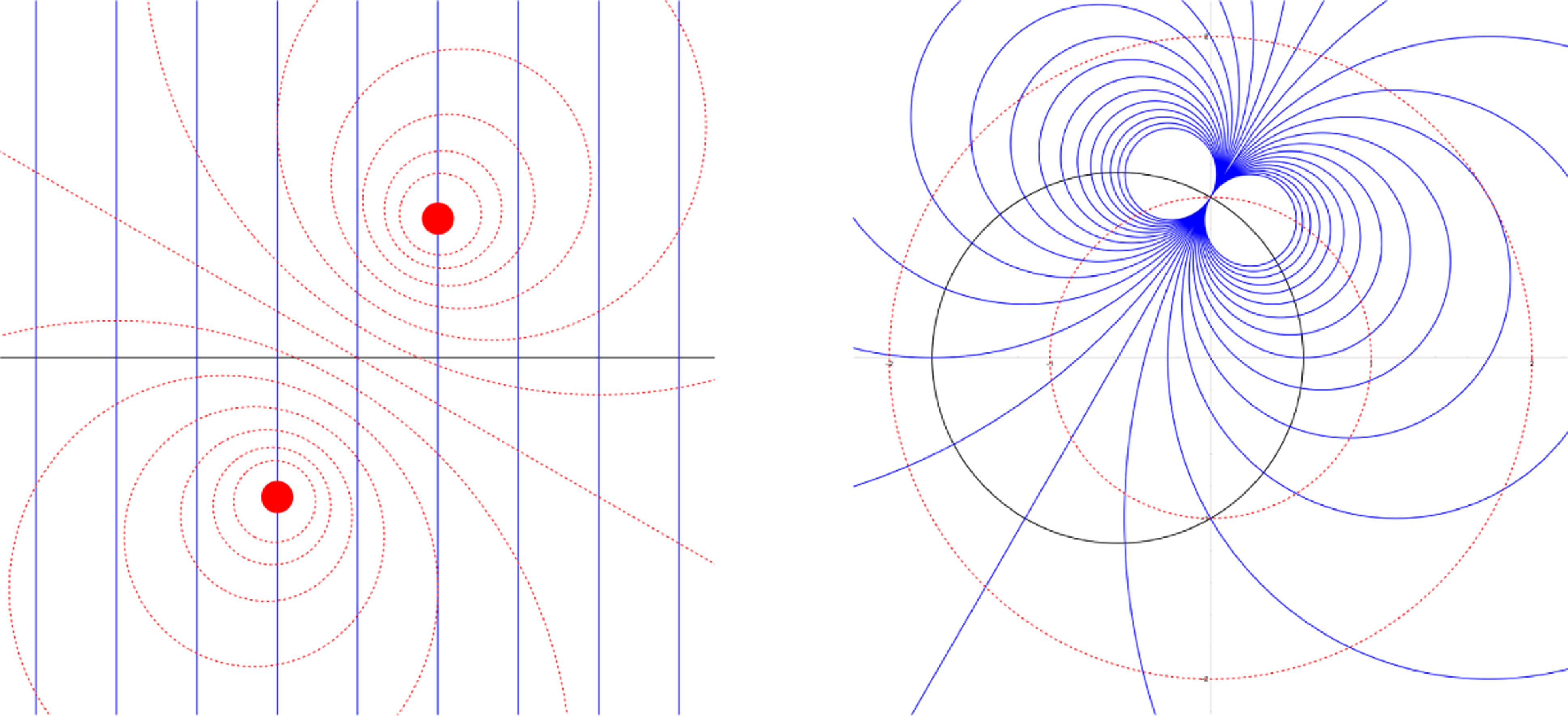
Example 3·4. Lastly, consider a loxodromic motion, shown in Figure 1. This motion is conjugate, by some $M\in \operatorname{M}\!\ddot{\textrm{o}}\!\operatorname{b}$
, to a mapping of the form
$M\in \operatorname{M}\!\ddot{\textrm{o}}\!\operatorname{b}$
, to a mapping of the form $z\mapsto e^{(a+\mathbb{i} b)t}z$
. The orbit of
$z\mapsto e^{(a+\mathbb{i} b)t}z$
. The orbit of $\infty$
is non-linear in this case, but transversality nonetheless fails along its tangent line T at
$\infty$
is non-linear in this case, but transversality nonetheless fails along its tangent line T at $\infty$
. Projection theorems hold in this case, even if the linearisation is vertical, since any subset of T moves out of it under the action of
$\infty$
. Projection theorems hold in this case, even if the linearisation is vertical, since any subset of T moves out of it under the action of $\Gamma$
.
$\Gamma$
.
4. Real projective transformations
In this section, we repeat the analysis from Section 3 within the framework of projective geometry. That is, we prove Theorems 1·5 and 1·6 and then apply Theorem 1.6 to specific projection families. Recall that our basic projection is now the mapping $\pi\;:\; (\mathbb{RP}^2\setminus \infty_Y) \rightarrow \mathbb{RP}^1=\mathbb{R}\cup\infty_X$
, which restricts to
$\pi\;:\; (\mathbb{RP}^2\setminus \infty_Y) \rightarrow \mathbb{RP}^1=\mathbb{R}\cup\infty_X$
, which restricts to $\mathbb{R}^2$
as the familiar projection
$\mathbb{R}^2$
as the familiar projection $(x,y)\mapsto x$
and also sends the infinite points to
$(x,y)\mapsto x$
and also sends the infinite points to $\infty_X$
. Writing points of
$\infty_X$
. Writing points of $\mathbb{RP}^2$
and
$\mathbb{RP}^2$
and $\mathbb{RP}^1$
in homogeneous coordinatesFootnote
3
,
$\mathbb{RP}^1$
in homogeneous coordinatesFootnote
3
, $\pi$
is given simply by
$\pi$
is given simply by $\pi(x:y:z)=(x:z)$
.
$\pi(x:y:z)=(x:z)$
.
Theorem 1·5 takes an additional consideration not needed for Theorem 1·1: namely, the family O(2) is transversal on $\mathbb{R}^2\subset\mathbb{RP}^2$
, but not on
$\mathbb{R}^2\subset\mathbb{RP}^2$
, but not on $\mathbb{RP}^2\setminus \mathbb{R}^2$
. Indeed, projection theorems fail for subsets of
$\mathbb{RP}^2\setminus \mathbb{R}^2$
. Indeed, projection theorems fail for subsets of $\mathbb{RP}^2\setminus \mathbb{R}^2$
.
$\mathbb{RP}^2\setminus \mathbb{R}^2$
.
Proof of Theorem 1·5. Since the family induced by O(2) is transversal on $\mathbb{R}^2$
, we obtain by Proposition 2·10 that the family induced by
$\mathbb{R}^2$
, we obtain by Proposition 2·10 that the family induced by $GL(3,\mathbb{R})$
is transversal on the set
$GL(3,\mathbb{R})$
is transversal on the set $\{(g, p)\;:\; g^{-1}(p)\in \mathbb{R}^2\}$
.
$\{(g, p)\;:\; g^{-1}(p)\in \mathbb{R}^2\}$
.
Let $M=\begin{pmatrix}0&0&-1\\0&1&0\\1&0&0\end{pmatrix}\in GL(3,\mathbb{R})$
, which preserves the point
$M=\begin{pmatrix}0&0&-1\\0&1&0\\1&0&0\end{pmatrix}\in GL(3,\mathbb{R})$
, which preserves the point $\infty_Y$
and sends the extended X-axis to itself. In particular, we have that
$\infty_Y$
and sends the extended X-axis to itself. In particular, we have that $\pi$
commutes with M. Applying Lemma 2·3 to the group
$\pi$
commutes with M. Applying Lemma 2·3 to the group $\Gamma=MO(2)M^{-1}$
, we have that the family induced by
$\Gamma=MO(2)M^{-1}$
, we have that the family induced by $\Gamma$
is transversal away from
$\Gamma$
is transversal away from $M(\mathbb{RP}^2\setminus \mathbb{R}^2)$
, which is the closure
$M(\mathbb{RP}^2\setminus \mathbb{R}^2)$
, which is the closure $\hat Y$
of the Y-axis. Combining this with Proposition 2·10, we have that the family induced by
$\hat Y$
of the Y-axis. Combining this with Proposition 2·10, we have that the family induced by $GL(3,\mathbb{R})$
is transversal on the set
$GL(3,\mathbb{R})$
is transversal on the set $\{(g, p)\;:\; g^{-1}(p)\in \mathbb{RP}^2 \setminus \hat Y\}$
.
$\{(g, p)\;:\; g^{-1}(p)\in \mathbb{RP}^2 \setminus \hat Y\}$
.
Combining the two transversality results, we have that $\Pi\;:\;GL(3,\mathbb{R})\times\mathbb{RP}^2\rightarrow \mathbb{RP}^1$
is transversal away from the set
$\Pi\;:\;GL(3,\mathbb{R})\times\mathbb{RP}^2\rightarrow \mathbb{RP}^1$
is transversal away from the set $\{(g,p)\;:\;g^{-1}p=\infty_Y\}$
, as desired.
$\{(g,p)\;:\;g^{-1}p=\infty_Y\}$
, as desired.
The proof of Theorem 1·6 is analogous to that of Theorem 1·4, once we prove our next Theorem 4·1, which parallels Theorem 3·1. Recall that the Lie algebra $\mathfrak{gl}(3,\mathbb{R})$
of
$\mathfrak{gl}(3,\mathbb{R})$
of $GL(3,\mathbb{R})$
consists of arbitrary 3-by-3 real matrices.
$GL(3,\mathbb{R})$
consists of arbitrary 3-by-3 real matrices.
Theorem 4·1.
Let $\Gamma\subset GL(3,\mathbb{R})$
be a one-dimensional Lie subgroup parametrised as
$\Gamma\subset GL(3,\mathbb{R})$
be a one-dimensional Lie subgroup parametrised as $\Gamma=\{\gamma_t=\exp(At)\;:\;t\in\mathbb{R}\}$
for some non-zero
$\Gamma=\{\gamma_t=\exp(At)\;:\;t\in\mathbb{R}\}$
for some non-zero $A=(a_{ij})\in \mathfrak{gl}(3,\mathbb{C})$
. Define:
$A=(a_{ij})\in \mathfrak{gl}(3,\mathbb{C})$
. Define:
-
(i)
$S_0=\{\infty_Y\}\subset \mathbb{RP}^2$
and
$S=\{(\gamma, p)\;:\; \gamma(p)=\infty_Y\}\subset \Gamma \times \mathbb{RP}^2$
; -
(ii)
$L_0=\begin{cases} \{(x,y)\;:\; a_{32}x=a_{12}\}\subset \mathbb{R}^2 & \textit{ if }a_{32}\neq 0\\ \mathbb{RP}^2\setminus \mathbb{R}^2 & \textit{ if }a_{32}=0 \,\textit{ and }\,a_{12}\neq 0\\ \mathbb{RP}^2 & \textit{ if }a_{32}=0 \,\textit{ and }\,a_{12}=0\end{cases}$
; -
(iii)
$L=\{(\gamma, p)\;:\;\gamma(p)\in L_0\}\subset \Gamma \times \mathbb{RP}^2$
; -
(iv)
$K_0= L_0\cup S_0\subset \mathbb{RP}^2$
and
$K= L\cup S\subset \Gamma\times \mathbb{RP}^2$
.


Then the projection family $\Pi\;:\;\Gamma\times \mathbb{RP}^2\rightarrow \mathbb{RP}^1$
given by
$\Pi\;:\;\Gamma\times \mathbb{RP}^2\rightarrow \mathbb{RP}^1$
given by $(\gamma, p)\mapsto \pi(\gamma(p))$
is defined on the domain
$(\gamma, p)\mapsto \pi(\gamma(p))$
is defined on the domain $(\Gamma\times \mathbb{RP}^2)\setminus S$
and is locally transversal on
$(\Gamma\times \mathbb{RP}^2)\setminus S$
and is locally transversal on $(\Gamma\times \mathbb{RP}^2)\setminus K$
.
$(\Gamma\times \mathbb{RP}^2)\setminus K$
.
Proof. As in the proof of Theorem 1·5, we will first check transversality at finite points following the steps of the proof of Theorem 1·4. Then we check transversality at the infinite points by linking it to transversality at finite points.
We have $\exp(At)=\operatorname{Id}+At+O(t^2)$
, where
$\exp(At)=\operatorname{Id}+At+O(t^2)$
, where $O(t^2)$
refers to higher-order terms in t, so that
$O(t^2)$
refers to higher-order terms in t, so that
 \begin{equation} \Pi(t,(x,y))=\frac{(1+a_{11}t)x+a_{12}ty+a_{13}t+O(t^2)}{a_{31}tx+a_{32}ty+(1+a_{33})t+O(t^2)}.\end{equation}
Differentiating at zero, we have
 \begin{align*} \mathrm{d}_t\vert_{t=0}\Pi(t,(x,y)) = a_{11}x+a_{12}y+a_{13} - x(a_{31}x+a_{32}y+a_{33}).\end{align*}
We assume that the left-hand side of the transversality condition holds for a pair of points $(x+\Delta x, y+\Delta y)$
with constant
$(x+\Delta x, y+\Delta y)$
with constant $C>0$
. Hence,
$C>0$
. Hence, ${\left|\Delta x\right|}/{\left|(\Delta x, \Delta y)\right|}\leqslant C$
and
${\left|\Delta x\right|}/{\left|(\Delta x, \Delta y)\right|}\leqslant C$
and ${\left|\Delta y\right|}/{\left|(\Delta x, \Delta y)\right|}$
is large in terms of C (this is analogous to equations (3·4) and (3·5)). One can now compute and simplify
${\left|\Delta y\right|}/{\left|(\Delta x, \Delta y)\right|}$
is large in terms of C (this is analogous to equations (3·4) and (3·5)). One can now compute and simplify $ {\left|\mathrm{d}_t \vert_{t=0} \Psi(t,v,w)\right|}/{\left|v-w\right|}$
analogous to equations (3·6) through (3·8). The analog of the right-hand term here equals
$ {\left|\mathrm{d}_t \vert_{t=0} \Psi(t,v,w)\right|}/{\left|v-w\right|}$
analogous to equations (3·6) through (3·8). The analog of the right-hand term here equals
 \begin{align} (a_{12}-a_{32}x)\tfrac{\left|\Delta y\right|}{\left|(\Delta x, \Delta y)\right|}.\end{align}
The analog of the left-hand term (containing $ {\left|\Delta x\right|}/{\left|(\Delta x, \Delta y)\right|}$
as a factor) is small compared to C and hence negligible (see equations (3·9) and (3·10)). Hence, in the finite part of
$ {\left|\Delta x\right|}/{\left|(\Delta x, \Delta y)\right|}$
as a factor) is small compared to C and hence negligible (see equations (3·9) and (3·10)). Hence, in the finite part of $\mathbb{RP}^2$
, we have local transversality at
$\mathbb{RP}^2$
, we have local transversality at $t=0$
if and only if
$t=0$
if and only if $a_{12}-a_{32}x\neq 0$
in
$a_{12}-a_{32}x\neq 0$
in $\mathbb{R}^2\subset\mathbb{RP}^2$
.
$\mathbb{R}^2\subset\mathbb{RP}^2$
.
In order to check transversality on the infinite part of $\mathbb{RP}^2$
, we conjugate A and
$\mathbb{RP}^2$
, we conjugate A and $\Gamma$
by the matrix M used in the proof of Theorem 1·6, giving
$\Gamma$
by the matrix M used in the proof of Theorem 1·6, giving
 \begin{align*} MAM^{-1}= \begin{pmatrix}{a_{33}}&-a_{32}&-a_{31}\\-a_{23}&-a_{22}&a_{21}\\-a_{13}&a_{12}&a_{11}\end{pmatrix}.\end{align*}
The family associated to $M\Gamma M^{-1}$
is then transversal at points (x’,y’) where
$M\Gamma M^{-1}$
is then transversal at points (x’,y’) where $-a_{32}-a_{12} x'\neq 0$
. By Lemma 2·3, local transversality of
$-a_{32}-a_{12} x'\neq 0$
. By Lemma 2·3, local transversality of $\Pi$
at a non-vertical infinite point with homogeneous coordinates
$\Pi$
at a non-vertical infinite point with homogeneous coordinates $(x:y:0)$
is equivalent to local transversality of the family associated to
$(x:y:0)$
is equivalent to local transversality of the family associated to $M\Gamma M^{-1}$
at
$M\Gamma M^{-1}$
at $M(x:y:0)=(0:y:-x)=(0:-y/x:1)=(0,-y/x)$
. Here, the transversality condition
$M(x:y:0)=(0:y:-x)=(0:-y/x:1)=(0,-y/x)$
. Here, the transversality condition $-a_{32}-a_{12} x'\neq 0$
reduces to
$-a_{32}-a_{12} x'\neq 0$
reduces to $a_{32}\neq 0$
, as desired.
$a_{32}\neq 0$
, as desired.
Example 4·2. The classical transversality result for orthogonal linear projections is encoded by the Lie algebra element $A=\begin{pmatrix}0&-1&0\\1&0&0\\0&0&0\end{pmatrix} = \mathrm{d}_{t}\vert_{t=0}\begin{pmatrix}\cos t&-\sin t&0 \\\sin{t}&\cos t&0\\0&0&1\end{pmatrix}$
. Transversality and projection theorems hold away from the line at infinity, where they both fail.
$A=\begin{pmatrix}0&-1&0\\1&0&0\\0&0&0\end{pmatrix} = \mathrm{d}_{t}\vert_{t=0}\begin{pmatrix}\cos t&-\sin t&0 \\\sin{t}&\cos t&0\\0&0&1\end{pmatrix}$
. Transversality and projection theorems hold away from the line at infinity, where they both fail.
Example 4·3. Curiously, for the purpose of projection theorems the rotations are equivalent to the group generated by the matrix $A=\begin{pmatrix}0&-1&0\\0&0&0\\0&0&0\end{pmatrix}$
, which gives the group of shears
$A=\begin{pmatrix}0&-1&0\\0&0&0\\0&0&0\end{pmatrix}$
, which gives the group of shears $\gamma_t(x,y)=(x+yt, y)$
. Again, we have transversality away from the line at infinity.
$\gamma_t(x,y)=(x+yt, y)$
. Again, we have transversality away from the line at infinity.
Example 4·4. Transversality and projection theorems fail globally for all groups that preserve the point $\infty_Y$
, since they commute with the projection. These include translations, dilations, and vertical shears. They also include Z-shears of the form
$\infty_Y$
, since they commute with the projection. These include translations, dilations, and vertical shears. They also include Z-shears of the form $(x,y)\mapsto ({x}/{1+xt}, {y}/{1+xt})$
and Z-rotations of the form
$(x,y)\mapsto ({x}/{1+xt}, {y}/{1+xt})$
and Z-rotations of the form $(x,y)\mapsto ( ({\cos(t) x-\sin(t)}/{\sin(t)x + \cos(t)}), ({y}/{\sin(t)x + \cos(t)}))$
.
$(x,y)\mapsto ( ({\cos(t) x-\sin(t)}/{\sin(t)x + \cos(t)}), ({y}/{\sin(t)x + \cos(t)}))$
.
Example 4·5. The family of point-source projections from a finite light source (say, (0,1)) can likewise be encoded in our framework by conjugating the standard rotation family O(2) by a mapping that sends the light source to $\infty_Y$
, say
$\infty_Y$
, say $N=\begin{pmatrix}1&0&0\\0&0&-1\\0&1&0\end{pmatrix}$
.
$N=\begin{pmatrix}1&0&0\\0&0&-1\\0&1&0\end{pmatrix}$
.
Conjugating the standard rotations by N and differentiating gives the Lie algebra generator $\begin{pmatrix}0&0&-1\\0&0&0\\1&0&0\end{pmatrix}$
. One concludes that point-source projections satisfy projection theorems but have artifact non-transversality along the line tangent to the unit circle at rotation angle
$\begin{pmatrix}0&0&-1\\0&0&0\\1&0&0\end{pmatrix}$
. One concludes that point-source projections satisfy projection theorems but have artifact non-transversality along the line tangent to the unit circle at rotation angle $\theta=0$
, and corresponding points at other values of
$\theta=0$
, and corresponding points at other values of $\theta$
.
$\theta$
.
Example 4·6. Lastly, we consider the group shown in Figure 1, where transversality fails along the linearisation of the orbit $\Gamma(\infty_Y)$
. The group in this case is conjugate by an element of
$\Gamma(\infty_Y)$
. The group in this case is conjugate by an element of $GL(3,\mathbb{R})$
to motions of the form
$GL(3,\mathbb{R})$
to motions of the form $(x,y)\mapsto (e^{2t}x, e^{3t}y)$
, which has non-linear orbits. Conjugating such that one of these orbits passes through
$(x,y)\mapsto (e^{2t}x, e^{3t}y)$
, which has non-linear orbits. Conjugating such that one of these orbits passes through $\infty$
provides a desired example.
$\infty$
provides a desired example.
5. Spherical and hyperbolic projections
We now provide transversality results for closest-point projections onto totally-geodesic subspaces in the hyperbolic space $\mathbb{H}^n$
and sphere
$\mathbb{H}^n$
and sphere $\mathbb{S}^n$
. Previously, transversality for those projections was known for
$\mathbb{S}^n$
. Previously, transversality for those projections was known for $\mathbb{H}^2$
and
$\mathbb{H}^2$
and $\mathbb{S}^2$
[
Reference Balogh and AnninaBI16
], and projection theorems [
Reference Balogh and AnninaBI19
] as well as a weaker version of transversality [
Reference AnninaIse18
] were known in
$\mathbb{S}^2$
[
Reference Balogh and AnninaBI16
], and projection theorems [
Reference Balogh and AnninaBI19
] as well as a weaker version of transversality [
Reference AnninaIse18
] were known in $\mathbb{H}^n$
for
$\mathbb{H}^n$
for $n\geqslant 3$
but not for
$n\geqslant 3$
but not for $\mathbb{S}^n$
. Our results in
$\mathbb{S}^n$
. Our results in $\mathbb{S}^n$
are new for
$\mathbb{S}^n$
are new for $n\geqslant 2$
, and in
$n\geqslant 2$
, and in $\mathbb{H}^n$
we provide a stronger transversality result (higher regularity).
$\mathbb{H}^n$
we provide a stronger transversality result (higher regularity).
We first frame the transversality statements on $\mathbb{H}^n$
and
$\mathbb{H}^n$
and $\mathbb{S}^n$
by viewing them as abstract Riemannian manifolds. We will then work with concrete models of
$\mathbb{S}^n$
by viewing them as abstract Riemannian manifolds. We will then work with concrete models of $\mathbb{H}^n$
and
$\mathbb{H}^n$
and $\mathbb{S}^n$
, as is permitted by Lemma 2·3. Let X be
$\mathbb{S}^n$
, as is permitted by Lemma 2·3. Let X be $\mathbb{H}^n$
or
$\mathbb{H}^n$
or $\mathbb{S}^n$
, and fix a point
$\mathbb{S}^n$
, and fix a point $p\in X$
. The exponential mapping
$p\in X$
. The exponential mapping $\exp_p\;:\; T_pX\rightarrow X$
maps each m-dimensional subspace of
$\exp_p\;:\; T_pX\rightarrow X$
maps each m-dimensional subspace of $T_pX$
to a totally-geodesic subspace of X. Hence,
$T_pX$
to a totally-geodesic subspace of X. Hence, $\exp_p$
induces an identification between the set of m-dimensional subspaces of
$\exp_p$
induces an identification between the set of m-dimensional subspaces of $T_pX$
(that is, the Grassmannian G(n,m)) and the set of totally-geodesic subspaces of X containing p. By further identifying each element of G(n,m) with
$T_pX$
(that is, the Grassmannian G(n,m)) and the set of totally-geodesic subspaces of X containing p. By further identifying each element of G(n,m) with $\mathbb{R}^m$
(see Section 2), we may then speak of the family of closest-point projections
$\mathbb{R}^m$
(see Section 2), we may then speak of the family of closest-point projections $\Pi\;:\; G(n,m)\times X \rightarrow \mathbb{R}^m$
. Note that closest-point projections are defined globally in
$\Pi\;:\; G(n,m)\times X \rightarrow \mathbb{R}^m$
. Note that closest-point projections are defined globally in $\mathbb{H}^n$
. In
$\mathbb{H}^n$
. In $\mathbb{S}^n$
, they are defined away from two points (depending on the element of G(n,m)) in the equator
$\mathbb{S}^n$
, they are defined away from two points (depending on the element of G(n,m)) in the equator $S_0$
dual to p.
$S_0$
dual to p.
Theorem 5·1.
Let X be hyperbolic space $\mathbb{H}^n$
or the complement
$\mathbb{H}^n$
or the complement $\mathbb{S}^n\setminus S_0$
of the equator
$\mathbb{S}^n\setminus S_0$
of the equator $S_0$
in the sphere
$S_0$
in the sphere $\mathbb{S}^n$
, and
$\mathbb{S}^n$
, and $m<n$
. Then the closest-point projection family
$m<n$
. Then the closest-point projection family $\Pi\;:\; G(n,m)\times X \rightarrow \mathbb{R}^m$
is locally transversal and therefore satisfies projection theorems.
$\Pi\;:\; G(n,m)\times X \rightarrow \mathbb{R}^m$
is locally transversal and therefore satisfies projection theorems.
Proof. In view of Lemma 2·3, transversality in any model of X passes to all $C^2$
-equivalent models, so we may work with any standard model of each space.
$C^2$
-equivalent models, so we may work with any standard model of each space.
We first consider the sphere $\mathbb{S}^n \subset \mathbb{R}^{n+1}$
, see Figure 3, with p at the north pole. Recall that totally geodesic subspaces of
$\mathbb{S}^n \subset \mathbb{R}^{n+1}$
, see Figure 3, with p at the north pole. Recall that totally geodesic subspaces of $\mathbb{S}^n$
correspond exactly to intersections of
$\mathbb{S}^n$
correspond exactly to intersections of $\mathbb{S}^n$
with linear subspaces V of
$\mathbb{S}^n$
with linear subspaces V of $\mathbb{R}^{n+1}$
. Furthermore, given a point
$\mathbb{R}^{n+1}$
. Furthermore, given a point $q \in \mathbb{S}^n$
, one can rotate both V and q into a normalised position to show that the projection of q to
$q \in \mathbb{S}^n$
, one can rotate both V and q into a normalised position to show that the projection of q to $\mathbb{S}^n\cap V$
is given by perpendicular projection of q to V followed by rescaling to norm 1.
$\mathbb{S}^n\cap V$
is given by perpendicular projection of q to V followed by rescaling to norm 1.
Closest-point projections to a totally geodesic subspace (solid curve) in the sphere and hyperbolic space, shown via the dashed fibers, and the corresponding orthogonal projections in $\mathbb{R}^2$
. The correspondence is given by radial projection from the origin (center of the sphere on the left, dot on the right) to the planes
$\mathbb{R}^2$
. The correspondence is given by radial projection from the origin (center of the sphere on the left, dot on the right) to the planes $z=-1$
and
$z=-1$
and $z=1$
, respectively.
$z=1$
, respectively.

Let $f(x_1, \ldots, x_{n+1})=(x_1/x_{n+1}, \ldots, x_n/x_{n+1})$
be the projectivization mapping, sending each half-sphere of
$f(x_1, \ldots, x_{n+1})=(x_1/x_{n+1}, \ldots, x_n/x_{n+1})$
be the projectivization mapping, sending each half-sphere of $\mathbb{S}^n\setminus S_0$
diffeomorphically to
$\mathbb{S}^n\setminus S_0$
diffeomorphically to $\mathbb{R}^n$
. The point p is sent to the origin, and each totally geodesic subspace
$\mathbb{R}^n$
. The point p is sent to the origin, and each totally geodesic subspace $V\cap \mathbb{S}^n$
of
$V\cap \mathbb{S}^n$
of $\mathbb{S}^n$
is sent to a linear subspace of
$\mathbb{S}^n$
is sent to a linear subspace of $\mathbb{R}^n$
, namely to
$\mathbb{R}^n$
, namely to $f(V)=V/\operatorname{span}(e_{n+1})$
. Furthermore, f trivially conjugates the rotation family
$f(V)=V/\operatorname{span}(e_{n+1})$
. Furthermore, f trivially conjugates the rotation family $O(n)\times \operatorname{Id}$
to the family O(n) in
$O(n)\times \operatorname{Id}$
to the family O(n) in $\mathbb{R}^n$
.
$\mathbb{R}^n$
.
We now show that f conjugates closest-point projections on $\mathbb{S}^n$
to orthogonal projections in
$\mathbb{S}^n$
to orthogonal projections in $\mathbb{R}^n$
, even though
$\mathbb{R}^n$
, even though $f\vert_{\mathbb{S}^n}$
is not a conformal mapping. Note first that f is dilation-invariant, so that instead of working with closest-point projections from
$f\vert_{\mathbb{S}^n}$
is not a conformal mapping. Note first that f is dilation-invariant, so that instead of working with closest-point projections from $\mathbb{S}^n$
to
$\mathbb{S}^n$
to $\mathbb{S}^n\cap V$
, we may work with orthogonal projections from
$\mathbb{S}^n\cap V$
, we may work with orthogonal projections from $\mathbb{R}^{n+1}$
to V. Next, rotate V using an element of
$\mathbb{R}^{n+1}$
to V. Next, rotate V using an element of $O(n)\times \operatorname{Id}$
so that it is spanned by
$O(n)\times \operatorname{Id}$
so that it is spanned by $e_1, \ldots, e_m$
and
$e_1, \ldots, e_m$
and $e_{n+1}$
, and therefore f(V) is the subspace
$e_{n+1}$
, and therefore f(V) is the subspace $\operatorname{span}(e_1, \ldots, e_m)$
. Perpendicular projection onto V is then given by
$\operatorname{span}(e_1, \ldots, e_m)$
. Perpendicular projection onto V is then given by $(q_1, \ldots, q_{n+1})=(q_1, \ldots, q_m, 0, \ldots, 0, q_{n+1})$
. Conjugating by f, we obtain a well-defined mapping
$(q_1, \ldots, q_{n+1})=(q_1, \ldots, q_m, 0, \ldots, 0, q_{n+1})$
. Conjugating by f, we obtain a well-defined mapping
 \begin{align*} (q_1, \ldots, q_n)\longmapsto(q_1, \ldots, q_m, 0,\ldots, 0)\end{align*}
by choosing any preimage of q under f, projecting perpendicularly to V, and then applying f again to return to $\mathbb{R}^n$
. We thus have that, under conjugation by f, the family of closest-point projections onto totally geodesic subspaces of dimension m passing through p in
$\mathbb{R}^n$
. We thus have that, under conjugation by f, the family of closest-point projections onto totally geodesic subspaces of dimension m passing through p in $\mathbb{S}^n$
is equivalent to the family of orthogonal projections to m-planes passing through the origin in
$\mathbb{S}^n$
is equivalent to the family of orthogonal projections to m-planes passing through the origin in $\mathbb{R}^n$
. By Lemma 2·3 and transversality of the Euclidean family of projections, we obtain the spherical part of the theorem.
$\mathbb{R}^n$
. By Lemma 2·3 and transversality of the Euclidean family of projections, we obtain the spherical part of the theorem.
The claim for hyperbolic space could be performed in the same way by starting the hyperboloid model of $\mathbb{H}^n$
and projectivising to observe the Klein model of
$\mathbb{H}^n$
and projectivising to observe the Klein model of $\mathbb{H}^n$
. We instead work directly in the Klein model of
$\mathbb{H}^n$
. We instead work directly in the Klein model of $\mathbb{H}^n$
(cf. the analogous description in [
Reference Balogh and AnninaBI19
]). That is, we view
$\mathbb{H}^n$
(cf. the analogous description in [
Reference Balogh and AnninaBI19
]). That is, we view $\mathbb{H}^n$
as the unit ball in
$\mathbb{H}^n$
as the unit ball in $\mathbb{R}^n$
with a Riemannian metric that is invariant under real linear-fractional transformations preserving the ball. We will be interested in two types of isometries: the rotations O(n) and the hyperbolic transformation given by
$\mathbb{R}^n$
with a Riemannian metric that is invariant under real linear-fractional transformations preserving the ball. We will be interested in two types of isometries: the rotations O(n) and the hyperbolic transformation given by
 \begin{align*} (x_1,\ldots, x_n)\longmapsto \left(\frac{x_1 \cosh(t)+\sinh(t)}{x_1 \sinh(t)+\cosh(t)}, \frac{x_2}{x_1 \sinh(t)+\cosh(t)}, \ldots, \frac{x_n}{x_1 \sinh(t)+\cosh(t)}\right).\end{align*}
We start by normalising the basepoint p to be the origin: starting with any p, we can use a rotation in O(n) to normalise $p=(p_1, 0, \ldots, 0)$
and then a hyperbolic transformation to furthermore take
$p=(p_1, 0, \ldots, 0)$
and then a hyperbolic transformation to furthermore take $p=0$
. It is easy to see that geodesics in
$p=0$
. It is easy to see that geodesics in $\mathbb{H}^n$
passing through 0 are straight lines, and therefore each m-dimensional totally geodesic subspace in
$\mathbb{H}^n$
passing through 0 are straight lines, and therefore each m-dimensional totally geodesic subspace in $\mathbb{H}^n$
passing through 0 is simply a restriction of an m-dimensional linear space W passing through 0. We may therefore identify this set with the Grassmannian G(n,m), with the same action of O(n) in both cases.
$\mathbb{H}^n$
passing through 0 is simply a restriction of an m-dimensional linear space W passing through 0. We may therefore identify this set with the Grassmannian G(n,m), with the same action of O(n) in both cases.
It therefore suffices to show that nearest-point projection in $\mathbb{H}^n$
to a subspace
$\mathbb{H}^n$
to a subspace $W\cap \mathbb{H}^n$
is given by orthogonal projection. As before, we may normalise W using an element of O(n) so that W is spanned by
$W\cap \mathbb{H}^n$
is given by orthogonal projection. As before, we may normalise W using an element of O(n) so that W is spanned by $e_1, \ldots, e_m$
. Given a point
$e_1, \ldots, e_m$
. Given a point $q=(q_1, \ldots, q_n)$
we may rotate along W and perpendicular to it to normalise
$q=(q_1, \ldots, q_n)$
we may rotate along W and perpendicular to it to normalise $q=(q_1, 0, \ldots, 0, q_{m+1}, 0,\ldots, 0)$
. Furthermore, we may apply a hyperbolic transformation to normalise
$q=(q_1, 0, \ldots, 0, q_{m+1}, 0,\ldots, 0)$
. Furthermore, we may apply a hyperbolic transformation to normalise $q=(0, \ldots, 0, q_{m+1}, 0, \ldots, 0)$
. The line segment joining the origin to q is a geodesic, and so q projects to 0 under closest-point projection. Note that the last normalisation of q using the hyperbolic transformation does not preserve Euclidean angles, but it does preserve orthogonal projection to W, so the closest-point projection to
$q=(0, \ldots, 0, q_{m+1}, 0, \ldots, 0)$
. The line segment joining the origin to q is a geodesic, and so q projects to 0 under closest-point projection. Note that the last normalisation of q using the hyperbolic transformation does not preserve Euclidean angles, but it does preserve orthogonal projection to W, so the closest-point projection to $W\cap \mathbb{H}^n$
is indeed given by orthogonal projection to W.
$W\cap \mathbb{H}^n$
is indeed given by orthogonal projection to W.
Thus, in the Klein model, we see that the family of closest-point projections to m-dimensional totally geodesic subspaces through the origin coincides with the family of Euclidean orthogonal projections onto m-dimensional subspaces, and therefore by Lemma 2·3 transversality passes over to hyperbolic space, as desired.
Acknowledgements
The first author was supported in part by the Swiss National Science Foundation (project no 181898) as well as an AMS Simons Travel Grant. The second author’s travel was supported in part by the U.S. NSF grants DMS 1107452, 1107263, 1107367 “RNMS: Geometric Structures and Representation Varieties” (the GEAR Network). Portions of this work were developed during visits by the authors to George Mason University, University of Bern, and University of California, Los Angeles. We thank these institutions for their hospitality. We also thank the referee for carefully reading our paper and providing insightful comments.


 Open access

