


INTRODUCTION
Non-governmental organizations (NGOs)—and in particular those promoting human rights—face intense and growing governmental backlash globally (Reference CarothersCarothers, 2016; Reference Carothers and BrechenmacherCarothers & Brechenmacher, 2014; Reference Hillebrecht, Brysk and StohlHillebrecht, 2019; Reference RothRoth, 2016). Dozens of countries have erected legal and organizational barriers or instigated campaigns of harassment and intimidation against NGOs in order to stymie or disrupt their work. A dominant tactic within this anti-NGO toolkit is laws that ban or enact burdensome regulations on NGOs receiving foreign funding (Reference Carothers and BrechenmacherCarothers & Brechenmacher, 2014, p. 7). Targeting foreign funding is especially debilitating as the vast majority of both international and domestic human rights NGOs are dependent on foreign financing (Reference Ron, Golden, Crow and PandyaRon et al., 2017, pp. 83–8). Governments have justified such restrictive measures by labeling foreign monies as undemocratic, or more extremely, as akin to treason by promoting foreign agendas (Reference BayerBayer, 2017; Reuters, 2012).
This paper examines the claim underlying these laws and regulations: that foreign funding for human rights promotion is predicated on pushing forth a specific donor-backed agenda. To this end, we focus on a resource-intensive endeavor that requires donor support: legal mobilization by human rights NGOs at the European Court of Human Rights (ECtHR). By legal mobilization, we mean “the process by which individuals make claims about their legal rights and pursue lawsuits to defend or develop those rights” (Reference EppEpp, 1998, p. 18). In our case, we are discussing legal mobilization by NGOs on behalf of individuals seeking legal recourse for violations of their human rights.
The ECtHR is an international court of last resort that holds governments to account for human rights violations, and therefore is an attractive mechanism for human rights advancement. NGOs are also an important vehicle for supporting successful case applications and providing supplemental information as third parties, as well as promoting the implementation of domestic government actions demanded by the ECtHR in order to abide by the human rights principles included in the European Convention on Human Rights on which the Court bases its decisions (Reference CichowskiCichowski, 2016; Reference DothanDothan, 2016; Reference HaddadHaddad, 2018; Reference HodsonHodson, 2011; Reference MayerMayer, 2011; Reference SundstromSundstrom, 2014; Reference van der Vetvan der Vet, 2018).Footnote 1 Reference SundstromSundstrom (2014), however, argues that different NGOs have different goals in litigation, with some aiming to find justice for individual applicants without necessarily concerning themselves with broader human rights progress or jurisprudence, and others more strategically concerned with expanding the Court's jurisprudence in certain areas or promoting the implementation of Court decisions on the ground. Litigation of the latter type is a form of legal mobilization often referred to as “strategic litigation”—that is, litigation aimed “to seek legal and social change” (Reference BarberBarber, 2012, p. 412).
Nevertheless, instigation of, and involvement in, cases before the ECtHR can be resource-intensive, particularly in terms of the skills and time required of lawyers, and the costs involved in conducting the necessary research to undergird more complex cases (Reference EppEpp, 1998). As in most cases of “repeat players” in litigation, the most successful NGOs participating in ECtHR cases are successful in part due to the resources at their disposal to focus on them (Reference GalanterGalanter, 1974; Reference Kumar and RoseKumar & Rose, 2014). As a result, the support of donors is often crucial to the capacity of NGOs to engage in litigation activities (Reference Sikkink, Dezalay and GarthSikkink, 2002, p. 52). Private philanthropic foundations have become the prominent financiers of international human rights. For example, in 2010, foundations granted $1.2 billion for human rights programs, with ~$62 million of said funding going to programs relating to “access to justice/equality before the law” and $492 million pertaining to “individual integrity, liberty, and security” (Foundation Center and International Human Rights Funders Group, 2013).Footnote 2 Scholars have pointed to the 2007–2008 global financial crisis as a critical juncture when the role of private foundations in supporting NGO litigation activities in European courts began to expand significantly, due to government austerity programs producing significant declines in state sources of funding for such activities (Reference Cliquennois and ChampetierCliquennois & Champetier, 2016, p. 98).
Although governmental repression of civil society can be a sweeping measure to stifle political opposition and dissent, there is mounting evidence that governments that are frequent abusers of human rights disproportionately target their repression toward those NGOs that engage in international human rights litigation (Reference Hillebrecht, Brysk and StohlHillebrecht, 2019). For example, in the country case we examine in detail in this paper—Russia—the first five prominent NGOs that were labeled foreign agents under a new version of the law in 2014 were “particularly well known for providing legal aid to victims of political manipulation of justice; persecuted civil society activists and peaceful protesters; lesbian, gay, bisexual, and transgender (LGBT) activists; and victims of police violence. All of them are active in strategic litigation and frequently quoted in the media” (Human Rights Watch, 2018). As of 2022, all of the organizations that repeatedly and prominently litigate against Russia before the Court had been branded as “foreign agents,” due to receiving funding from abroad, and forced to either shut down, reorient themselves, divert resources to fight the label, or submit burdensome fines and reports to the government to avoid or survive the being named a foreign agent (EU-Russia Civil Society Forum, 2013; Reference PlantanPlantan, 2020b; Reference SherwinSherwin, 2016). Notably, the Russian Supreme Court recently shut down the venerable human rights sister organizations, Memorial and Human Rights Centre Memorial, for “justifying terrorist activities” and falling afoul of the foreign agents law. On top of this, the Russian government's legislative maneuvers to silence any anti-war protest following its invasion of Ukraine in February 2022 led to remaining human rights NGOs being unable to conduct their work and their staff members fleeing the country (Reference GessenGessen, 2022; RFE/RL, 2022b). Furthermore, on March 16, 2022, due to the incompatibility of Russia's aggression against a sovereign nation with council membership, Russia was expelled from the Council of Europe. Following the expulsion, Russia will cease to be a party to the European Convention on Human Rights as of September 16, 2022. The ECtHR will continue to deal with applications of alleged violations taking place up until that date (Council of Europe, 2022; Reference LeachLeach, 2022).
In this paper, we begin to untangle the dynamics of foreign donor support for NGOs' litigation activities by focusing on the granting activities of two key private donors—the Ford and MacArthur Foundations—in the time period pre-dating the global cascade of foreign funding laws, and the eventual departure of these foundations from Russia. Through detailed matching of the granting histories of Ford and MacArthur from 1998 to 2012 with NGOs litigating before the ECtHR from 1998 to 2014, we find substantial foundation support for organizations that appear as participants in cases that have been decided at the ECtHR. The support is even more pronounced for organizations that are more frequent participants in ECtHR cases that end up in judgments, and in particular for Russia-based NGOs. Such clustering of Ford and MacArthur support for Russian NGOs is atypical among foundations, as the grants to Russian organizations make up <1% of the total dollars granted by all foundations worldwide relating to human rights litigation. We investigate four possible mechanisms of influence and directionality that would account for this substantial support of Russian NGOs by Ford and MacArthur:
1. Inducing litigation: The strongest form of donor influence is that granting foundations proactively induce or direct NGOs to engage in litigation through requirements that mandate or strongly encourage litigation. In this scenario, litigation would necessarily and directly follow external grants, and NGOs would adopt litigation activities at the potential expense of preferred, alternative activities.
2. Broad capacity-building: The second possibility is that donor preferences are articulated through broad grant categories based on country or issue but do not mandate specific strategies, such as litigation. Grants would provide general capacity-building that could be used for wide range of activities. NGOs are not nudged toward litigation by specific funding requirements or streams, but funding could provide them with the requisite financial capacity for litigation through framing and matching their activities within broader grant categories. As it is possible for broad capacity-building grants to obscure specific directives for litigation given by granting foundations, whether NGOs engaged in litigation prior to receiving such general grants is an important marker in evaluating whether such grants were indeed about capacity building.
3. Reputational effect: Third, donors could prioritize grants to specific NGOs, not directly for the activities or issues on which they engage, but because of who they are. Organizational reputation and longstanding funding relationships would justify large repeat grants for general operations, which would give these NGOs substantial material support and complete autonomy in selecting organizational tactics, including litigation.
4. NGO lobbying: Fourth, the directionality of influence may be reversed and donor preferences could be significantly shaped by NGOs' own preferences. NGOs, especially those that are prominent in the environment with longstanding funding relationships, could lobby donors to prioritize grants for litigation. This advocacy would not only benefit the lobbying NGO but would lead to increased grants to similar or emergent NGOs also engaging in litigation. We consider this story plausible, especially due to the simultaneous, and seemingly iterative, boom of NGO litigation and donor funding following the mandate of individual petition in all Council of Europe countries that began in 1998.
The first mechanism aligns with a key assumption of “foreign agent” laws, namely that the donor-recipient relationship is a principal-agent relationship, whereby foreign agendas are articulated through NGO tactics and are directly and tightly tied to external grants. It also conforms to expectations of much of the literature on international NGO funding discussed below, which finds that NGOs respond strongly to donor incentives, often becoming disconnected from the priorities of local citizens. The latter three mechanisms, however, which are somewhat mutually compatible and may be occurring simultaneously, run counter to said assumption. In each of the latter three dynamics, domestic or international NGOs, while potentially reliant on external financial support, still retain autonomy and agency in articulating and negotiating their organizational tactics, expertise, and reputations.Footnote 3
Through tracking the overlap between the content of grant descriptions and timelines of NGO litigation in relation to grants received, for two major private foundations' recipients overall, and in more detail for Russian NGOs who are “repeat players” (Reference GalanterGalanter, 1974) at the ECtHR, together with some triangulating interview evidence from NGO and former foundation staff, we find very little evidence of foundations pushing NGOs toward litigation. Rather, at least in the case of Russia, the evidence on balance points to NGOs initially deciding to pursue litigation as a strategy, and taking cases to the ECtHR, prior to foundations providing resources. Russian NGOs—with lower material capacity and greater domestic barriers than other Council of Europe members—then sought foreign foundation support for expanded litigation and training. Foundations agreed, with mutual enthusiasm about the potential of the ECtHR for promoting human rights compliance, and wanting to provide capacity to NGOs to pursue this litigation in a country in which they have long supported the growth of civil society. This resulted in a burst of support in the mid-2000s specifically focusing on grants to train an expanded set of human rights activists in how to conduct successful ECtHR litigation, and to materially support those who were already engaged in litigation activities. Before and after this brief period, these foundations' grant descriptions rarely mentioned litigation or the ECtHR, but they may well have continued to support such activity without stating so publicly in relation to particular grants awarded.
Such evidence runs counter to both the governmental claims justifying laws to limit foreign funding and some scholarship on NGOs, which asserts that foreign donors manipulate NGO strategies and goals. Nonetheless, foreign agent laws can create a vicious cycle in the absence of available foreign donor funds, in which NGO funding becomes less publicly transparent and more informal in nature, thereby potentially damaging public trust in human rights NGOs—in addition to the stigma produced by the “foreign agent” label itself. The Russian foreign agent law is an extreme example of government criminalization of foreign funding to NGOs; however, similar laws are being adopted by governments worldwide of all regime types, and present a significant threat to human rights organizations' survival, despite the inaccuracy of the accusations behind them.
RELEVANT LITERATURE
NGOs—and particularly those promoting human rights and democracy—are facing a worldwide government backlash. The backlash, or the “closing space” of civil society, consists of: burdensome registration requirements, funding restrictions, vilification and harassment, prosecutions, and physical violence (Reference Carothers and BrechenmacherCarothers & Brechenmacher, 2014; Reference Hillebrecht, Brysk and StohlHillebrecht, 2019; Reference MendelsonMendelson, 2015). Such backlash is not ad hoc in nature; states are borrowing repressive strategies from one another and the number of states employing backlash measures is rapidly increasing (Reference MendelsonMendelson, 2015). According to Civicus, 96% of the world's population lives in countries with some level of civil society restrictions, and 69% of people live in countries with extreme civil society repression (CIVICUS Monitor, 2021). Amnesty International further asserts: “This global wave of restrictions has a rapidity and breadth to its spread we've not seen before, that arguably represents a seismic shift and closing down of human rights space not seen in a generation” (quoted in Reference SherwoodSherwood, 2015).
The causes of such pronounced and sudden backlash are unsettled but coalesce around distinct changes in the post-Cold War relationships between citizens and their governments: the drastic increase in human rights and democracy organizations funded by foreign sources, the success of the bottom-up “color revolutions” in Georgia and Ukraine, increased use of information and technology by civil society, and the proliferation of counterterrorism laws on surveillance and foreign funding (Reference CarothersCarothers, 2016, pp. 363–6; Reference Kindornay, Ron and CarpenterKindornay et al., 2019; Reference MendelsonMendelson, 2015).
One of the most employed tools of NGO backlash are national laws that restrict civil society access to financial resources from abroad. Russia was one of the first countries to adopt such restrictions with the 2012 Foreign Agents Law, which required all organizations engaging in “political activities” who had received foreign funding to register as foreign agents, without specifying a definition for political activities.Footnote 4 The law also mandated the label of “foreign agent” on all media publications, allowed unscheduled inspections of the NGO, and provided for financial and criminal penalties and shutting down of the organization for those NGOs that fail to register as foreign agents. The law was further amended in 2014 to allow the government to register NGOs as “foreign agents” without their consent, and again in 2016 to expand the definition of political activity to any attempt to influence public policy. In late 2020, the law was expanded again to be applicable not only to organizations, but also to individuals who can now be designated as foreign agents. It further prohibited media distribution of information about activities of foreign agents, and allowed for prison sentences in addition to fines as available punishments for violating the law. Finally, following the Russian invasion of Ukraine in 2022, new draft legislation was proposed in the Duma to change the foreign agents law from being an amendment to existing legislation to being a self-standing law, and expanding its scope to apply not only to organizations or individuals receiving foreign funds but also to those “under foreign influence of any kind” who engage in political activity or in two newly listed activities: “collecting information about the Russian military and military logistics” or “distributing messages and materials to an unlimited number of people or participating in the creation of these messages and materials” (Meduza, 2022).
Russia's 2012 law was considered a “blueprint” for other countries; and as of 2019, ~60 countries have at least one law that restricts foreign funding for NGOs, with many countries enacting multiple kinds of restrictions and regulations (Reference ChaudhryChaudhry, 2016; Reference BaldusBaldus, 2019; Reference Bromley, Schofer and LonghoferBromley et al., 2020; Reference BuyseBuyse, 2018, p. 973). Hungary, for example, passed legislation in 2017 modeled off Russia's foreign agent law (titled LexNGO), which required NGOs receiving more than 20,000 euro annually from abroad to register as “foreign supported” and include that designation on all websites, press products, and publications.Footnote 5 In 2020, India, the world's largest democracy, amended and expanded its Foreign Contribution Regulation Act to limit foreign funding to 20% of NGO budgets along with creating onerous certification and regulation requirements.Footnote 6
The espoused justification of foreign funding laws made by governments such as these is sovereignty and noninterference. In a 2021 interview, Russian President Vladimir Putin adopted such a line of reasoning and argued that the foreign agent law was a necessary and responsive measure to protect Russia from foreign interference:
Many entities of the so-called “civil society,” the reason I say “so-called civil society” is because many of those entities are funded from abroad. Specific relevant action programs are prepared. Their core members are trained abroad. And when our official authorities see that, in order to prevent this kind of interference in our domestic affairs, we make relevant decisions and adopt relevant laws (Reference PutinPutin, 2021).
A few months after Putin's interview, the government of India made a similar argument in an affidavit to the Supreme Court in a case against the increasingly restrictive 2020 amendment to India's foreign funding law:
Genuine NGOs need not shy away from any regulatory compliance mandated under the Foreign Contribution (Regulation) Act, 2010 for quick and effective monitoring of the receipt and utilisation of foreign contribution for sake of transparency, accountability so that the foreign contribution is not received and utilised for any activities detrimental to the sovereignty and integrity of the country, public order and interests of general public and for matters connected therewith or incidental thereto.Footnote 7
Such arguments are predicated on a seemingly tight linkage between foreign money and influence: that foreign monies inherently corrupt in ways contrary to the domestic public interest, even though the NGOs may be headquartered within the country and have domestic staff.
In the case of Russia, such a linkage is further reinforced by President Putin and other Russian officials who regularly assert that the Russian foreign agent law is akin to the constitutionally tested U.S. Foreign Agents Registration Act (FARA) adopted for reasons of national security (Reference Kara-MurzaKara-Murza, 2013; RT, 2012).Footnote 8 Nevertheless, legal scholars question this comparison precisely because of the assumption about an automatic tight and instrumental relationship between foreign donors and recipient organizations. FARA requires substantiated evidence of a principal-agent relationship—such as in the “inducing litigation” mechanism articulated above—whereas the Russian foreign agent law assumes such ties exist through external funding but does not require evidence of such a direct relationship (Reference LauferLaufer, 2017; Reference OrlovaOrlova, 2019).
Many scholars dismiss the sovereignty arguments, and their underlying assumptions about the corrupting influence of foreign funding, as mere state rhetoric or “thinly veiled rationalisation[s] of power” (Reference Bloodgood, Tremblay-Boire and PrakashBloodgood et al., 2014; Reference BuyseBuyse, 2018, p. 977; Reference Wolff and PoppeWolff & Poppe, 2015, p. 1). However, social science research is ambivalent on whether funding constitutes a form of capture and control. Using the lens of political economy, some scholarship posits that donor funding has the potential to shape nearly all aspects of NGOs' work (Reference Cooley and RonCooley & Ron, 2002; Reference Witesman and HeissWitesman & Heiss, 2017). New or expanded funding opportunities can incentivize the entry of new NGOs, sometimes with inadequate qualifications, while simultaneously disincentivizing coordination across the organizations (Reference Cooley and RonCooley & Ron, 2002). The perverse incentives of funding can also shape NGO behavior to conform to donor priorities, or “measurable” results for donors at the expense of generating agendas based on local needs and priorities, or those that may be more transformative (Reference Edwards and HulmeEdwards & Hulme, 1996; Reference HendersonHenderson, 2002; Reference Mendelson and GlennMendelson & Glenn, 2002; Reference SundstromSundstrom, 2006). Such arguments have also permeated discussions among donors and activists, with increasing calls, and associated plans, to shift power from donors through “localizing” and “decolonizing” development aid (Reference ByatnalByatnal, 2021; CIVICUS, 2019).
Other scholars disagree on the degree of influence of donors as compared to other environmental or organizational factors. Reference Mitchell and SchmitzMitchell and Schmitz (2014) argue that donor incentives do not pollute the principled core values of NGOs but operate as general constraints within which NGOs pursue their normative goals. Reference SundstromSundstrom (2005, Reference Sundstrom2006) also highlights the importance of other social and political environments beyond foreign funding that determine the success of NGO mobilization, such as the necessity for their claims to resonate with domestic societal norms.
Further complicating the question of external donor influence is the fact that little is known about the funding strategies and influence of the few prominent and wealthy foundations that are the dominant international benefactors of human rights NGOs. Relevant to our focus, Reference JenkinsJenkins (2012) finds that major U.S. foundations dramatically increased their international giving in the 2000 s: from 13.8% of grants in 2002 to nearly a quarter (24.4%) of grants by 2008 (478). Further, Reference Wong, Levi, Deutsch, Seabrooke and HenriksenWong et al.'s (2017) analysis of Ford Foundation granting data from 1950 through 1989 found increasing “legalization” of the Ford Foundation's approach to human rights and social justice over time, both in the United States and overseas. They found that “projects with a more lawyerly focus – courts and legal assistance, for instance, compared with categories such as development or social advocacy – gain greater attention over time” (Reference Wong, Levi, Deutsch, Seabrooke and HenriksenWong et al., 2017). Nevertheless, Reference HaddadHaddad (2018) has found that while the Ford and MacArthur foundations both increased financial grants relating to international courts and justice over time, grants relating to certain international courts, and in particular the International Criminal Court, received far more funding than other courts, including the ECtHR. For Ford, as well as for other prominent foundations such as Open Society, foundations not only support NGOs engaging in litigation but also fund legal education and training to build litigation capacity (Levi et al., Reference Levi, Dinovitzer and Wongn.d.; Open Society Foundations, 2014).
As scholarship on NGO funding is inconclusive regarding the extent to which NGOs receiving foreign funds are shaped by the preferences of external donors (as outlined in the inducing litigation mechanism above), an empirical test, such as the one in this article, is critical. It evaluates the foundational premises on which foreign funding laws are justified and legitimated, as they proliferate across the globe and severely curtail the work of civil society. Such a test is also particularly crucial in the realm of human rights, and human rights litigation, as NGOs often take adversarial positions or initiate court cases against their governments, and therefore are often dependent on foreign funding, and are often seen as distinct threats and therefore targets of repression.
The consequences of foreign funding laws and restrictions are pronounced. Most directly, such laws limit the capacity of NGOs to operate and fulfill their missions, as many civil society organizations in lower-income or authoritarian states, and in particular human rights NGOs, rely on Western funding. Because many countries do not have large philanthropic communities to fund local NGO activity, coupled with NGOs' fear of becoming captured by national governments with which they have contentious relationships, the predominant source of NGO funding worldwide since the end of the Cold War has been Western governments and philanthropic foundations headquartered in the West (Reference Carothers and BrechenmacherCarothers & Brechenmacher, 2014, p. 53). According to Reference Ron, Golden, Crow and PandyaRon et al.'s (2017) survey of local human rights organizations in the Global South, 77% received foreign funds and most said that their organizations would collapse without foreign funding (85–87). In fact, this is exactly what happened in response to the Ethiopia's 2010 foreign funding restrictions, which specifically targeted rights groups. According to Reference Dupuy, Ron and PrakashDupuy et al. (2015), 90% of local rights groups (113 out of the previous 125) ceased to exist as a direct result of the foreign funding restriction (433). Similarly, following India's 2010 foreign funding law, which has since been amended in 2020 and made even more restrictive, foreign funding fell 60% from 2016 to 2017, and between 2011 and 2017, the registrations of over 18,000 NGOs were canceled (Reference ChauhanChauhan, 2017).
In addition to diminishing the core ability of NGOs to function, foreign funding laws label NGOs as “foreign agents” or spies, with often deleterious consequences for their public perception and safety (Reference DaucéDaucé, 2015). In the case of Russia, a 2015–2016 survey of the Russian public found that 57% of Russians reported negative associations with the term “foreign agent” and often mentioned connotations such as “spy of foreign intelligence services,” “CIA,” and “recruiter” (Reference MalkovaMalkova, 2020, p. 205). Such associations serve to legitimate further repression and are often the precursor to harassment, threats, prosecution, or physical harm (Reference BuyseBuyse, 2018, p. 972). In Russia, the foreign agents law has justified travel bans, harassment, and criminal prosecution of human rights defenders (Human Rights Watch, 2020). In a parallel example, in Sudan, civil society representatives peacefully protesting the crackdown and vilification of NGOs receiving foreign funding were violently attacked by the national security service (Amnesty International, 2013).
Another perverse impact of these restrictions is that it forces surviving NGOs to seek less traditional and more informal ways of structuring their organizations and funding them—such as working as an informal group of people or transforming into a commercial entity. Such changes may be visible neither to the public nor to the government and likely decrease the transparency of NGOs' sources of support (Reference van der Vetvan der Vet, 2018, p. 318). In a vicious cycle, this lack of transparency may well further erode public confidence in human rights organizations beyond already widespread beliefs that such organizations are not to be trusted (Reference MalkovaMalkova, 2020).
METHODS
Due to public data constraints and the opacity of many foundations, this paper utilizes multiple methodological tools and data sources to ascertain the support for and direction of influence of private philanthropic foundation support for NGO litigation at the ECtHR.
The first data source used is a private database of all global foundation grants relating to human rights litigation for the years 2013 and 2014. The data were collected by the Foundation Center and the International Human Rights Funders Group and consist of ~500 grants per year by 729 funders in 50 countries.Footnote 9 The data are not disaggregated by foundation name or grantee, but nevertheless provide the most comprehensive global snapshot of the general patterns of grant flows for litigation support by geography and issue. These data also provide an important baseline from which we can evaluate the representativeness of the preferences of the two large US private philanthropic foundations that we study in-depth.
Second, we examine the preferences of two major U.S. philanthropic foundations for supporting NGO legal mobilization at the ECtHR by conducting a matching exercise between NGOs represented in the public granting histories of the Ford and MacArthur Foundations for the years 1998–2012 and Reference Cichowski and ChrunCichowski and Chrun's (2017) database of all NGO participation at the ECtHR between 1960 and 2014. This matching exercise is illustrative in several ways. First, it allows us to capture the potential influence of foundation grants made to NGOs engaged in litigation at the ECtHR, where grant descriptions are either inaccessible or very general in nature. Donors are sometimes purposefully vague in their public grant descriptions to protect grantee organizations' safety in hostile political environments. Second, this exercise tracks the universe of NGO participation at the ECtHR in order to understand, relatively, how prominent the participatory patterns are of those NGOs that receive funding from the Ford and MacArthur Foundations.
We focus on the funding preferences of the Ford Foundation and the MacArthur Foundation for both methodological and pragmatic reasons. First, we focus on two U.S.-based foundations since our global foundation grants data snapshot shows that U.S. foundations focus much more on litigation than foundations from other regions of the world. Thus, if there is a push by funders toward litigation, it is likely to come from U.S. foundations. The Ford and MacArthur foundations were two of the largest human rights-focused funders in the U.S. private foundations ecosystem during the examined time period. These two foundations had the longest-standing articulated commitment to funding global projects related to human rights and have been sustained and substantial funders of human rights grants in terms of absolute dollars. In the late 1970 s, Ford was the first foundation to give grants to human rights organizations. During the same period, the MacArthur Foundation was founded with a focus on “international justice.” In 2014, Ford allocated the second-greatest amount of human rights grants of all worldwide foundations at $197 million (Foundation Center and International Human Rights Funders Group, 2017). During the time period examined, and immediately following, MacArthur ranked in the top 20 foundations for human rights grants with expenditures of around $30 million per year (Foundation Center, 2013). Both Ford and MacArthur are explicitly “social justice foundations,” which makes them natural foundations to examine as cases of donor support for NGOs' human rights litigation. Finally, unlike many private philanthropic foundations, Ford and MacArthur publicly disclose their entire funding histories in their annual reports on their respective websites. There are other foundations that are important supporters of human rights litigation by NGOs in European courts, such as the Open Society, Sigrid Rausing Trust, and Oak Foundation. Unfortunately, however, we have not been able to obtain access to their full granting histories due to donor policies on protecting recipients' identities. Where partial histories of these other foundations are available, we juxtapose them with Ford and MacArthur in order to contextualize Ford and MacArthur within the broader universe of human rights foundations. We also draw upon the granting history of the European Commission, the funding arm of European Union, to assess the relative prominence of private foundation funding versus state donors.
In order to explore possible causal relationships between donor support and NGO litigation efforts at the ECtHR, we also conduct brief case studies of several Russian NGOs. The specific NGOs were selected for investigation based on the results of the aforementioned matching exercise, which demonstrated a clustering of funding and litigation activity for certain Russian NGOs engaging in litigation, particularly in the mid-2000s. Notably, the examined time period pre-dates the surge of NGO foreign funding restrictions—generally seen as catalyzed by the 2012 Russian foreign agent law—along with the 2015 “undesirable organizations” law which dampened the activities of foreign donors in Russia (Reference MaynesMaynes, 2015; Reference NechepurenkoNechepurenko, 2015). Utilizing NGO annual reports and websites, detailed donor grant information, interviews with NGOs and former foundation staff, and litigation information from Cichowski and Chrun's ECtHR database (2017), we evaluate the role of donors in spurring ECtHR litigation by these various organizations.
FINDINGS
Worldwide private foundation grants for litigation purposes
At the broadest level, we find that, on average, litigation is not a dominant preference of human rights grants issued by private philanthropic foundations. It is worth noting that only 5% of overall private foundation grant funds are directed toward human rights goals (Human Rights Funders Network, 2020). According to data from the Human Rights Funders Network and the Foundation Center, whose tracking between 2014 and 2016 included human rights funding from up to 746 foundations spanning 50 countries, “litigation and legal aid” related grants have ranged between 3% and 4% of worldwide human rights related funding (Human Rights Funders Network, 2020). The human rights strategy that engendered the greatest financial support, ranging from 37% to 43% of grant dollars, was “advocacy, system reform, and implementation.” We also find that litigation-related grants tend to cluster around specific countries, notably the United States and the United Kingdom. This is consistent with what some legal literature would expect, claiming the “litigious” nature of these two common law countries (Reference KritzerKritzer, 1991; Reference BlankenburgBlankenburg, 1992; Reference KaganKagan, 2019; Reference EppEpp, 2003; Reference Engelalthough note Engel, 2016; Reference DanielsDaniels, 1985; Reference Ramseyer, Rasmusen and BuckleyRamseyer & Rasmusen, 2013). The vast majority of donor funding relating to litigation is from US-based foundations: 67% in 2013 and 79% in 2014. The United Kingdom is the second largest granting country with 19% in 2013 and 10% in 2014. Much of the grant money remains in these two countries through grants to US or UK-headquartered NGOs. In 2013, 51% of the total litigation-related grants by dollars were made to US or UK-based NGOs. In 2014, this percentage rose to 67, mostly by increasing amounts made to US-based NGOs (60%).
Ford and MacArthur Foundation funding overlapping with ECtHR litigation: Geographic clustering
The results of our matching exercise between the granting history of the Ford and Reference Cichowski and ChrunMacArthur foundations and Cichowski and Chrun's (2017) database of NGO participation at the ECtHR present mixed signals about donor support for litigation strategies. Grants to NGOs that have engaged in litigation activities at the ECtHR constitute a significant portion of total human rights grant dollars at both foundations: ~45% at Ford and 85% at MacArthur (Ford Foundation, n.d.-a; MacArthur Foundation, n.d.-a). This high degree of financial support for NGOs engaging in litigation activities at the ECtHR is seemingly unusual in foundations' grant portfolios. Between 2005 and 2012, 27% of the human rights monies of the Geneva-based Oak Foundation matched with NGOs that have engaged in ECtHR activities. For the UK-based Sigrid Rausing Trust, eight NGOs out of the likely hundreds that received funding during 2006–2012 engaged in litigation activities at the ECtHR.Footnote 10
Despite the substantial percentage of Ford and MacArthur monies allocated to NGOs engaged in litigation activities at the ECtHR, the majority of the grant descriptions of Ford and MacArthur grantee NGOs, when available, do not specifically mention litigation or strategic litigation in general or at the ECtHR. There was only a brief burst of grants issued by Ford and MacArthur in the 2000s specifically articulating litigation as a strategy within the grant descriptions. Before and after that period, litigation and the ECtHR were terms that rarely appeared in grant descriptions from these foundations.Footnote 11 Yet interview evidence suggests that despite the lack of these terms in public grant descriptions, foundation support for NGOs' ECtHR litigation activities may not have waned during later years.
According to a former staff member of one of these key foundations, this focus on ECtHR litigation, at least in grants to Russian organizations, was “one of our main priorities” from the end of the 1990s throughout the foundation's granting presence in Russia.Footnote 12 Moreover, this former staff member attested that the inspiration for adopting this emphasis came from NGOs themselves, in accordance with our “NGO lobbying” mechanism hypothesized above:
It certainly wasn't the case that … we were leading this … I would say it was responding. It's completely the opposite of what President Putin in those days portrayed as being the Piper as in ‘he who pays the Piper.’ Obviously, [NGO activists] were enthused by the fact that Russia was a member of the Council of Europe and all these possibilities opened up … The fact that people could make applications to the Court and get a clear judgment eventually was fantastic. And then what you could do with that judgment and so forth. So [we were] meeting a need, which was obvious from what the organizations were doing.
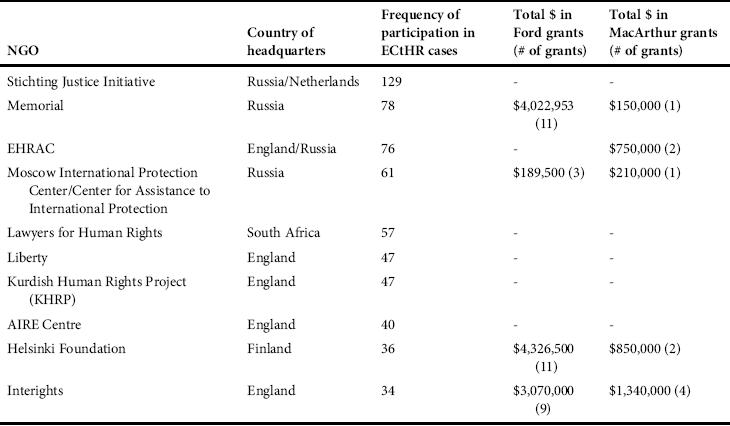
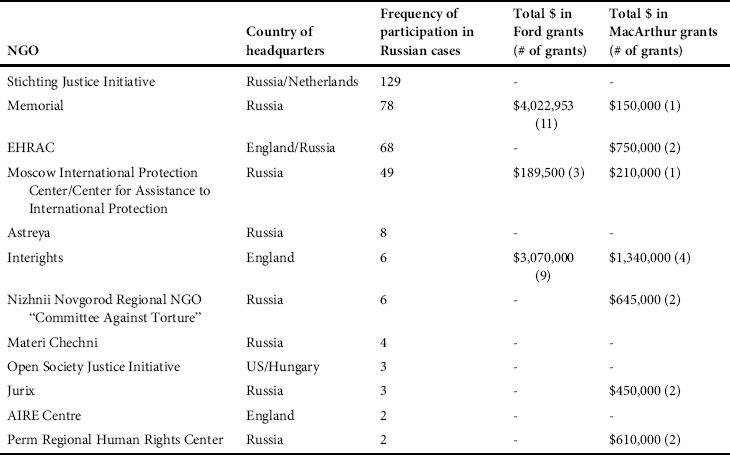
When viewed in the context of the larger dynamic of NGO participation at the ECtHR, we do not find that Ford and MacArthur have funded an overwhelming proportion of the universe of NGOs that have participated at the ECtHR. Combined, Ford or MacArthur provided funding to 14% of the human rights NGOs that have participated at the ECtHR; and moreover, we know that most of the funding from these foundations was not specifically directed towards litigation efforts. Nevertheless, of these NGOs, Ford and MacArthur tended to fund Russian NGOs and those with the greatest participatory presence at the ECtHR, two categories that often overlapped. Of the 20 NGOs with the highest instances of ECtHR participation, either by representing petitioners or filing amicus briefs, Ford and MacArthur provided funding to half of them, with nearly all of the organizations receiving more than one grant (See Table 1). With four of the top five NGO participants in ECtHR cases being Russia-based NGOs (in descending order of number of cases, they are Stichting Justice Initiative (SJI), Memorial, the European Human Rights Advocacy Centre (EHRAC), and the Moscow International Protection Centre), Ford and MacArthur also demonstrated a strong preference for funding Russian NGOs. As shown in Table 2, while SJI has not received funding from Ford or MacArthur, all of the other organizations have, with Memorial receiving by far the largest number of grants and amount of funding. Moreover, generally, the grant and case records demonstrate that Russian NGOs have a comparatively very high overlap of funding from Ford and MacArthur Foundations relative to NGOs from other Council of Europe states (see Table 1).
Ford and MacArthur Foundation funding (1998–2012) of the top 10 NGO participants at the ECtHR (1960–2014)

Source: Granting histories of MacArthur and Ford Foundations; Cichowski & Chrun, Reference Cichowski and Chrun2017.
Ford and MacArthur Foundation funding (1998–2012) of the top 10 NGO participants in Russian Cases at the ECtHR (1960–2014)

Source: Granting histories of MacArthur and Ford Foundations; Cichowski & Chrun, Reference Cichowski and Chrun2017.
As suggested by Reference Cliquennois and ChampetierCliquennois and Champetier (2016), this clustering of funding toward Russian NGOs for litigation activities at the ECtHR is also common, though not as pronounced, among a number of European-based private foundations such as Open Society, Sigrid Rausing Trust, and Oak Foundation. Two of eight NGOs funded by Sigrid Rausing that engaged in litigation activity at the ECtHR—EHRAC and Liberty—are NGOs with the greatest participatory presence at the ECtHR and NGOs most involved in Russian cases. Six percent of Oak Foundation human rights grants between 2005 and 2012 went to NGOs that were top litigants at the ECtHR with two-thirds of those grants also corresponding with those NGOs most involved in Russian cases. In terms of European state-based support for NGOs participating at the ECtHR, the European Commission has funded seven of the 20 most frequent litigating NGOs at the ECtHR, and only 6 of the 34 NGOs participating in ECtHR cases against Russia with judgments through 2014 (European Commission, 2019). However, worldwide data from the Foundation Center and International Human Rights Funders Network that tracks global giving by all foundations related to litigation does not show a general preference for Russian grantees, as they account for less than 1% for the years 2013 and 2014.Footnote 13 US-based foundations show only a slightly higher preference for grants to Russian organizations in this worldwide dataset, with less than 1% in 2013 and 6% in 2014.
Foundation grants and ECtHR litigation among Russian human rights NGOs
The high concentration of MacArthur and Ford's grants to Russian NGOs participating in ECtHR litigation leads us to delve into the Russian case in more detail. Moreover, in the context of authoritarian backlash against NGOs, Russia is a paradigmatic case of governments alleging that NGOs promote agendas that are pushed by foreign actors. As previously discussed, the 2012 Russian Law on Foreign Agents stigmatizes and materially punishes NGOs—and as of 2020, individuals and informal organizations as well—that receive funding from abroad if they conduct any activities that could be broadly interpreted as “political” in nature (“political” was defined more specifically in a 2016 revision of the law, but arguably more broadly so that even more organizations were susceptible to the categorization) (Reference Coalson and BalmforthCoalson & Balmforth, 2014; Front Line Defenders, 2016; Human Rights Watch, 2018; Meduza, 2020). The law requires such organizations to identify themselves as “foreign agents” on all public materials, to fulfill onerous reporting requirements, and—for those that have lost administrative court cases for violation of the law—to pay steep fines to the Ministry of Justice (Reference Plantan, Koesel, Bunce and WeissPlantan, 2020a, pp. 173–4; Reference DixonDixon, 2021).
The MacArthur and Ford Foundations in Russia
The MacArthur and Ford Foundations had a particular orientation in Russia and other post-Communist states in the 1990s and 2000s, which may be specific to US-based foundations, given the Cold War history of US-Soviet enmity (Reference BrownBrown, 2005, pp. 181, 194). Both of these foundations articulated their missions in Russia in rather grand terms, encompassing the transformation of post-Communist states into peaceful democratic regimes and their citizens into active members of vibrant civil societies. By studying MacArthur and Ford's activities in funding Russian NGOs' litigation at the ECtHR, we are undoubtedly capturing only a small portion of donor support for these activities. Still, the extent of connection of these two foundations—especially the MacArthur Foundation—to Russia-based NGOs participating in ECtHR litigation is striking. To supplement the specific analysis of Ford and MacArthur funding, in the next sections of the paper, we delve more deeply into the overall funding and ECtHR litigation histories of a number of relevant Russian NGOs, to examine possible directions of influence between foundation donors and NGOs using litigation as a human rights strategy.
The MacArthur Foundation opened its office in Moscow in 1992, just after the collapse of the Soviet Union, with a mission to “contribute to the transition to a civil and democratic society and to the integration of the society into the global community” (MacArthur Foundation, n.d.-b). MacArthur initially launched four thematic granting initiatives, of which one was “Law and Society” and another was “Human Rights.” In the latter years of its work in Russia, however, it shifted to having just two broad thematic areas of focus: higher education and human rights. Within its human rights program during these later years, the foundation adopted a particular focus on the ECtHR by concentrating its human rights support in three specific areas: “strengthening the regional human rights ombudsman institution, combating police abuse, and facilitating access to the European Court of Human Rights” (MacArthur Foundation, n.d.-a). The MacArthur Foundation was present in Russia until 2015, when its office was closed, in part due to concerns that the Russian government would deem it an “undesirable organization” under a new law banning organizations that pose “a threat to national security,” but also due to growing concerns about risks to foundation staff and grantees, and (perhaps even more importantly) the shifting financial priorities of the global foundation (Reference MaynesMaynes, 2015; Reference NechepurenkoNechepurenko, 2015; Reference RainsfordRainsford, 2015; Reference TaverniseTavernise, 2015).
The history of MacArthur grants to Russian NGOs related to litigation leads to several general observations. First, the MacArthur Foundation had been active in issuing grants to human rights groups from Russia, including those that litigate at the ECtHR. The grants were often quite general in their focus on access to justice, but there were also frequent issue concentrations in (1) police abuse/torture violations; (2) media freedom; and (3) right to association, which lend themselves in part to ECtHR litigation activity. Several of the later-year grants of Russian recipient human rights organizations were targeted specifically at strategic litigation activities.
Turning now to the Ford Foundation, its work in Russia and the Soviet Union is notable in that it engaged in supporting activities to increase East–West understanding even during the Cold War, beginning in the 1950s (Ford Foundation, 2008). Of course, it was not possible until the perestroika period to fund organizations in the region directly; yet Ford was one of the first donors to do so, beginning in 1989 (Ford Foundation, 2008). Ford established a physical office in Russia in 1996; that is, slightly later than MacArthur. It also closed its Moscow office earlier than MacArthur, and for somewhat different reasons. Due to huge losses to its endowment in the 2008 financial crisis, Ford decided to close its offices in Russia and Vietnam in 2009 as a cost-saving measure (“Ford Foundation to Close Offices in Russia, Vietnam”, 2009).
During the period in which it was engaged in granting activities from its Moscow office, the Ford Foundation focused on four key thematic fields among the foundation's worldwide themes. One of these was “Human Rights and Justice,” which by 2008 included particular emphasis on “strengthening the nongovernmental human rights infrastructure; and removing the key impediments to implementation of human rights, such as lack of access, arbitrary law enforcement and the limited impact of international human rights decisions” (Ford Foundation, 2008). Hence, there was some explicit focus on international human rights courts, although very few of the foundation's public grant descriptions mentioned litigation specifically.
Below, we provide very brief case sketches of the funding and litigation histories of the most frequent NGO participants in ECtHR case decisions from Russia who have received funding from the MacArthur and/or Ford foundations, in order to explore causal connections more closely.
Memorial-EHRAC
The European Human Rights Advocacy Centre (EHRAC), based now at Middlesex University in London, until recently under the leadership of Philip Leach, works in countries of the former Soviet Union to represent ECtHR case applications in partnership with local civil society organizations, and also to train human rights lawyers in refining their approaches to litigation (European Human Rights Advocacy Centre, n.d.). It had a close and formalized long-term partnership with the venerable Russian human rights organization Memorial to take strategic litigation cases to the ECtHR (Memorial Human Rights Centre, 2015). Until Memorial International was ordered liquidated in February 2022, in an appeal case to the Russian Supreme Court, for its noncompliance with the foreign agents law, it was the second most frequent NGO representing applicants in ECtHR decisions in its partnership with EHRAC (the third most frequent representing NGO) (RFE/RL, 2022). It focused historically mainly on gross human rights violations of torture and disappearance in the North Caucasus. Indeed, the partnership was founded in 2003 to litigate precisely these kinds of cases (European Human Rights Advocacy Centre, 2020). More recently, the partnership produced the primary case application against the Russian foreign funding law (Ecodefence and Others v. Russia and 48 other applications, ECtHR no. 9988/13, communicated March 2017). It also turned to represent victims of gender-based violence, and LGBTQI victims of discrimination, torture, and violation of freedoms of assembly and association.
We see these priorities reflected also in the goals of grants that EHRAC received from the MacArthur Foundation, Oak Foundation, and Open Society Foundations, which EHRAC cites as its major donor supporters. In addition, the Memorial-EHRAC program has received support from the Sigrid Rausing Foundation, the European Initiative for Democracy and Human Rights (European Commission), among other donors (European Human Rights Advocacy Centre, n.d.).
Memorial as a broader self-standing Russian network long received large amounts of grant funding from the Ford Foundation in particular, receiving 13 grants amounting to USD 5.7 million over the period 1998–2012 (Ford Foundation, n.d.-b). However, the umbrella “International Historical, Educational, Charitable and Human Rights Society Memorial” organization (“International Memorial” for short) in Russia has many separate sub-organizations, of which only the Memorial Human Rights Centre in Moscow engaged programmatically in litigation activities. Other branches of the overall organization engaged in different activities, such as historical research, monument development, and work with migrants (International Memorial, n.d.). Many of the donor-provided descriptions of grants to Memorial are quite vague, and although we do not know for certain, it is possible that funds granted to the wider International Memorial society would play a role in supporting ECtHR litigation activities, as money may be fungible across programs and departments. Among the 11 grants to Memorial, five were specifically awarded to the Memorial Human Rights Centre, which also engaged in other human rights activities aside from litigation. While Memorial's first case application was lodged at the ECtHR in 1998 (European Court of Human Rights 2004), only one of these Ford grant descriptions, from 2004, specifically mentions “legal aid.” Only one grant in the MacArthur Foundation database was given to Memorial Human Rights Centre, and it could have litigation activity associated with it, as it was aimed to “support protection of forced migrants from arbitrary law enforcement and judicial bodies” (MacArthur Foundation, n.d.-b).
Memorial's history of steady support from a few major private foundations for over a decade, as well as the lack of (at least public) focus of these grants on litigation in particular suggests support for the reputational effect and broad capacity-building mechanisms; that is, that in certain cases, donors possess considerable confidence in longstanding NGO grantees and continue to grant to them no matter what human rights strategy they choose to adopt.
Moscow International Protection Centre/Center for Assistance to International Protection
It is difficult to determine from ECtHR official records how many cases the Moscow International Protection Center has participated in, since the name of the Center rarely appears in Court records. Instead, the individual lawyers who work for the Center are named as representatives in most of these cases. Another source of confusion in gathering data on the litigation record of the Center is that the same organization appears under at least two different names in the ECtHR records: the “Moscow International Protection Centre,” and the “Centre for Assistance to International Protection.” Although Reference Cichowski and ChrunCichowski and Chrun's (2017) ECtHR Database only counts 61 total cases with the Center's participation, according to the Center itself, by the end of 2018, there had been final ECtHR decisions in over 450 cases they had represented (International Protection Centre, 2022). The Center has been engaged in litigation at the ECtHR from the very beginning of Russian citizens' eligibility at the Court, with founding director Karinna Moskalenko submitting her first case application immediately in August 1998—before any foreign donors became involved in supporting Russian litigation in a meaningful way (Reference SundstromSundstrom, 2014, p. 856). Unlike Memorial-EHRAC, the Moscow International Protection Center explicitly rejects the idea of strategic litigation and instead tries to assist all individuals who turn to them desiring to take a case to the ECtHR.Footnote 14
The Center received grants from a number of private foundations over the years, as well as from other state-affiliated donors such as the US National Endowment for Democracy (NED). Its funding profile resembled those of many of the Russian NGOs engaging in ECtHR litigation, with grants from the Oak Foundation, in addition to Ford and MacArthur Foundations. These grants, especially from the MacArthur Foundation and NED, have mostly been used to develop and implement a number of annual training programs to train lawyers, activists, and human rights ombudsman staff from Russian-speaking Council of Europe countries on how to take cases to the European Court. The MacArthur-funded program, which ended after 9 years in 2010, trained 20 to 25 people per year intensively in the use of the ECtHR mechanism; the NED-funded program brought a smaller number of lawyers and officials directly to Strasbourg (Reference SundstromSundstrom, 2014, p. 851).
However, the Center's funding has been unstable at times, and after 2010 it experienced some difficulties in obtaining funding from donors who had previously been reliable supporters. A statement from Oksana Preobrazhenskaia, the Center's director at the time, appears in the 2011 financial report of the Center, attesting to extreme challenges that arose after the MacArthur Foundation ceased funding the organization in mid-2010 and a recently developed relationship with the Oak Foundation ceased in March 2011. They had succeeded in receiving a small amount of funding from the NED but this would not be sufficient to carry on their customary activities (International Protection Centre, 2011). Then, according to the Center's website, the Russia-based organization ceased accepting foreign funding in 2012 as a result of the passage of the foreign agents law (International Protection Center, 2022). In 2017, the organization issued a plea for individual donations to support its work (International Protection Center, 2017). By then, however, Moskalenko had established a separate legal entity in Strasbourg, which received at least one large grant from MacArthur in 2015 that was explicitly for conducting similar training and litigation work at the ECtHR (MacArthur Foundation, 2015).
The history of the Center's relationships with donors highlights a few interesting dynamics. One is a possible trend we have noticed, that donors may have grown disillusioned with supporting NGO work to send applications to the ECtHR as a general endeavor, and instead turned to preferring specifically strategic litigation with the hope of yielding more systemic human rights progress by expanding the jurisprudence of the Court.Footnote 15 Thus, while “unstrategic” litigation organizations like the Moscow Center for International Protection may fall out of favor, other more strategic organizations like Memorial-EHRAC may retain their stable funding from donors.
The fact that the Center's focus on litigation dates back to Russia's eligibility to access the ECtHR in 1998, long before foundations' available grant descriptions or reports specifically mentioned litigation as a purpose of the funding, provides further evidence that foundation support for litigation, or trainings to expand litigation, were likely not initiated by donors. Instead, donors' support for these activities were more likely the result of the Center convincing them to do so, as articulated in the NGO lobbying mechanism outlined earlier.
Nizhnii Novgorod Regional NGO “Committee Against Torture”
The Nizhnii Novgorod Committee Against Torture (NNCAT) claims, quite plausibly, that it is “the largest human rights NGO in Russia specializing in professional study of the issue of torture, investigation of torture claims and provision of medical and legal assistance to torture victims” (Nizhnii Novgorod Committee Against Torture, 2018a). It was founded in 2000 by human rights activist Igor Kalyapin, and is well known for investigating allegations of torture violations—often by law enforcement. It has been particularly active in Chechnya and renowned for its unique strategy there of investigating allegations using its “Joint Mobile Group”—a program through which staff and investigative tools travel by vehicle on short trips in Chechnya (instead of having a permanent office, for safety reasons), where they document complaints of torture, kidnapping, and extrajudicial killing (Human Rights Defenders, 2018).
According to the Reference Cichowski and ChrunCichowski and Chrun (2017) database with NGOs' ECtHR participation cataloged through 2014, the Committee Against Torture participated in six ECtHR cases that resulted in decisions. According to the NNCAT website as of May 2022, they claim to have won 78 cases at the ECtHR (Nizhnii Novgorod Committee Against Torture, 2022). It appears that the first ECtHR decision in which NNCAT participated was issued in 2006, in the police torture case of Mikheyev v. Russia (ECtHR no. 77617/01, 2006), a case that was submitted to the Court with assistance from NNCAT and Interights lawyers in 2001 (Nizhnii Novgorod Committee Against Torture, 2018b).
Between the years of 2001–2016, NNCAT received a total of four grants from MacArthur, amounting to the considerable figure of USD 1.9 million. The final one of these grants, awarded in 2013, was most clearly related to strategic litigation, with the MacArthur Foundation description as follows: “Project activities will include strategic litigation to improve law enforcement practice; publicizing good practice; providing training for judges, prosecutors, and lawyers; and raising public awareness” (MacArthur Foundation, n.d.-a). The earlier grants in 2004 and 2007 were aimed more vaguely to “campaign against police abuse” and “improve police performance and accountability” (MacArthur Foundation, n.d.-b). NNCAT is one of the few litigating Russian NGOs that does not provide full donor information on its website, so we do not have a complete picture of its funding sources, although a 2013 interview with Kalyapin on the site points to grants from Open Society Foundations, the United Nations, and the Helsinki Foundation, among others (Nizhnii Novgorod Committee Against Torture, 2013). Still, we can see that the organization's ECtHR litigation activities began well before the MacArthur Foundation specifically described this activity in the public grant descriptions. Moreover, Kalyapin himself has said: “I am ready to take [funding] from anyone, but with one condition: that this person does not put conditions on me,” and further insisting that “foreign donors for 15 years, as I have been doing fundraising – searching for funds for charity – have never interfered in our work” (Nizhnii Novgorod Committee Against Torture, 2013). Indeed, several months later, the organization received a grant from the Russian state “Presidential Grants” competition to support its ongoing activities (Vedomosti, 2013).
This lends further support to the broad capacity-building and NGO lobbying mechanisms: that foundations, rather than pushing NGOs in this direction, have been following trusted NGO grantees' lead with regard to their pursuit of international human rights litigation as a strategy.
This circumstantial evidence from grant histories is bolstered by interview evidence. According to a former staff member of one of the key foreign foundations operating in Russia, their foundation did not operate according to the “reputational” mechanism outlined above, but instead through a combination of capacity-building and NGO lobbying mechanisms. While granting priorities were shaped with NGO input and encouragement, the decided-upon thematic priorities of the foundation determined which projects would be funded, rather than general faith in the organization itself. The former staff member stated: “We would invite them to make an application and we would assess the application … it would partly support the organization in general because it's what the organization is doing. But it would be definitely project funded … And if the organization decided to stop doing that kind of work, then we would discontinue the funding.”Footnote 16 Yet they also emphasized that Russian grantees that engaged in ECtHR litigation varied significantly in how much their organization focused on litigation in their overall profile; for some like the International Protection Center or the Memorial-EHRAC partnership, it was their main mission, but for others like NNCAT it was one of many types of human rights advocacy they engaged in.
CONCLUSION
The justification for restrictive foreign funding laws rests on a principal-agent relationship between donors and recipients, whereby external donors prescribe NGO agendas and tactics (International Commission of Jurists, 2014, p. 10; Reference OrlovaOrlova, 2019). Such rationale overlaps with some social science scholarship, which demonstrates persuasively that foreign donor funding typically carries strong incentives that shape NGOs' organizational forms and types of activities they conduct. However, when subject to empirical testing, the strict principal-agent premise does not hold water, at least within our study of grants from two major private foundations and Russian NGOs' litigation efforts at the ECtHR. The granting activities of the MacArthur and Ford Foundations in Russia and the funding and litigation histories of the Russian NGOs that appear most frequently in the ECtHR case records and foundations' grant records provide strong evidence that is not the case. Foreign foundation donors may have encouraged, but did not “push” Russian NGOs to turn to cases at the ECtHR as a form of human rights advocacy.
The available evidence from tracing the timelines of grants and NGO litigation activities suggests that there is less of a pattern of donors “pushing” NGOs to engage in litigation as a strategy, and more of a pattern of the NGOs themselves deciding to pursue this strategy, and donors facilitating this strategy by providing the general resource capacity that allows those NGOs in particular to engage in litigation. Alternatively, as we have noted in some of the Russian NGO cases, it is highly possible that the most trusted long-term recipients of foundation grants have persuaded foundations themselves that they should support these activities.
While scholarship on development and democracy promotion NGOs demonstrates that funding environments unduly shape NGOs' activities and programs (Reference BushBush, 2015; Reference Cooley and RonCooley & Ron, 2002; Reference SundstromSundstrom, 2006) this study suggests that donor influence is more limited than the scholarship would suggest, at least with regard to NGOs engaging in human rights litigation. This is not to say that funding is not critical, as the litigation can be resource intensive, and NGOs often depend on external funding for support—as is seen by the deleterious consequences of removing such external funding for human rights NGOs. Yet, possibly because such a strategy also requires substantial legal expertise and training, and the legal outcomes can take years to realize, the short-term incentives of funders looking for more immediate results or NGOs switching tactics to capitalize on funding opportunities may not play out with regard to litigation.
As this study uncovered no evidence of foreign funder directives to NGOs, and instead found more evidence of organically overlapping interests and even NGOs convincing donors to support human rights litigation, it has also demonstrated the premise of the Russian foreign agent legislation to be flawed, at least with respect to NGOs engaged in human rights litigation—a key target of the law. Yet, even with а flawed justification, Russia's foreign agent law has served as the model for the subsequent cascade of foreign funding laws globally, which have stymied the ability of human rights NGOs to function, and in many situations, threatened the freedom and safety of human rights defenders.
Even though more or more countries are adopting, and continuously tightening, such debilitating restrictions, the international pushback against foreign fundings laws has been inconsistent and often lacked a coordinated and robust policy response (Reference CarothersCarothers, 2016; Reference Carothers and BrechenmacherCarothers & Brechenmacher, 2014, p. 48). In 2013, President Obama worked with UN Secretary-General Ban Ki-moon and other world leaders on the margins of the UN General Assembly to develop a joint statement on “the promotion and protection of civil society” (The White House Office of the Press Secretary, 2014). The same year, pressure by Western governments in coordination with Egyptian NGOs, were able to reduce the severity of Egypt's proposed NGO funding law (Reference CarothersCarothers, 2016, p. 369). Even so, the “softened” law resulted in 42 foreign and Egyptian workers sentenced to one to 5-year prison terms and the freezing of assets and shuttering of dozens of human rights organizations and defenders (Amnesty International, 2018).
In the case of Russia, the international community has repeatedly condemned its foreign agent law, and subsequently repressive amendments, to little effect (Reference CarothersCarothers, 2016, p. 369). In 2013, during Russia's Universal Periodic Review at the UN Human Rights Council, the recently adopted foreign agent law was the most widely discussed issue, resulting in recommendations to change aspects of the law that create obstacles to legitimate NGO activities—which Russia rejected (Human Rights Watch, 2013). In 2016, the Parliamentary Assembly of the Council of Europe (PACE) adopted a resolution on ways to prevent “inappropriate restrictions on NGO activities in Europe,” which highlighted the Russian foreign agent law. It built from the 2014 Venice Commission report on the foreign agent law, and called on member states to change existing laws to align with human rights standards and refrain from adopting new restrictive NGO legislation (Parliamentary Assembly of the Council of Europe, 2016; Venice Commission, 2014). Based on another Venice Commission report in 2021, the Council of Europe Expert Council on NGO and the President of the Conference of NGOs called upon Russia to halt the most recent amendment to the foreign agent law, to no avail (Council of Europe Conference of INGOs, 2021).
In 2017, Russian NGOs, some of whom have been branded as “foreign agents” because of their litigation work at the ECtHR, including Memorial, filed the first of many complaints at the ECtHR against the Russian government for rights violations resulting from the foreign agent law.Footnote 17 Although the first complaint was submitted to the ECtHR in 2017 and NGOs have submitted additional complaints and memoranda on the increasingly deleterious effects of the law and its severe and restrictive amendments, the ECtHR has yet to make a ruling. In fact, in March 2022, shortly after Russia's invasion of Ukraine, Angelika Nußberger, member of the Venice Commission and former judge of the ECtHR, reflected on the missed red flags of Russia's pathway to authoritarianism, noting that the foreign agents law was the “alarm bell” that the Council of Europe did not adequately heed, and that “now we have aggression inside and we have aggression outside” (Business School, & School of Law, MDX London, 2022).
In contrast, the European Union did take heed with regard to the Hungarian foreign agent law (LexNGO)—at least initially. In 2017, the European Court of Justice ruled that law breached EU laws, resulting in the government repealing the law in 2021 (Amnesty International, 2021b). Nevertheless, immediately after the law's repeal, the Hungarian government proposed similar legislation, which allows the monitoring and auditing of NGOs whose assets exceed ~$66,000 to little international attention and scrutiny (Amnesty International, 2021a).
Reference Bromley, Schofer and LonghoferBromley et al. (2020) assert that foreign funding restrictions are key tools of an organized and expanding global movement of states in opposition to the liberal international order, of which NGOs, and in particular human rights NGOs, are key players. As such, foreign funding restrictions may indeed be “alarm bells” beyond the example of Russia, signaling authoritarian impulses that require timely international legal scrutiny and robust and sustained responses. Without such responses, human rights legal work becomes increasingly harder, more dangerous, and less transparent—exactly during the time when it is most needed.
ACKNOWLEDGMENTS
This article was supported in part by a Partnership Development Grant from the Social Sciences and Humanities Research Council of Canada (#890-2018-0022) and Pomona College's Hirsch Research Initiation Grant. The authors would like to thank the participants of the 2017–2019 ActInCourts workshops for their helpful comments, with special gratitude to Freek van der Vet for his feedback on multiple iterations, and Katherine Alexander, Noah Levine, Stefanie Merchant, Brynn Parkinson, Fabio Resmini, Gina Sullivan, and Nikita Tetenko for their excellent research assistance.
Funding information Partnership Development Grant from Social Sciences and Humanities Research Council of Canada, Grant/Award Number: #890-2018-0022

 Open access

