





Introduction
Every election leaves voters as winners and losers (Dahlberg and Linde Reference Dahlberg and Linde2017) who react with different degrees of democratic satisfaction. This winner-loser gap, as it is called in political science literature, is a well-studied phenomenon. Those who have voted for the winning candidate or governing party/parties express, on average, higher satisfaction with democracy and greater trust in political institutions than those who voted for the losers (Anderson, Blais, Bowler et al. Reference Anderson, Blais, Bowler, Donovan and Listhaug2005; Blais and Gélineau Reference Blais and Gélineau2007; Bernauer and Vatter Reference Bernauer and Vatter2012; Martini and Quaranta Reference Martini and Quaranta2019; Singh Reference Singh2014; Singh, Karakoç and Blais Reference Singh, Karakoç and Blais2012). This can be problematic as satisfaction with democracy as a dimension of political support for the system, also by those who support the current opposition, is essential for the stability of a democracy (Anderson and Guillory Reference Anderson and Guillory1997). Recent developments in the United States provide evidence that the absence of such acceptance can lead to political violence and heightened levels of political polarisation (Haslam, Reicher, Selvanathan et al. Reference Haslam, Reicher, Selvanathan, Gaffney, Steffens, Packer, Van Bavel, Ntontis, Neville, Vestergren, Jurstakova and Platow2023). Previous research also has shown that the magnitude of the winner-loser gap varies depending on individual-level perceptions and institutional contexts, including perceptions of electoral fairness (Esaiasson Reference Esaiasson2011; Ridge Reference Ridge2025) and the type of democratic regime (Anderson and Guillory Reference Anderson and Guillory1997; Anderson, Blais, Bowler et al. Reference Anderson, Blais, Bowler, Donovan and Listhaug2005; Bernauer and Vatter Reference Bernauer and Vatter2012; Singh Reference Singh2014).
Existing research, to our knowledge, focuses almost exclusively on eligible voters. Yet in contemporary democracies shaped by immigration, a substantial share of the population is governed without options to voice, as active voting rightsFootnote 1 often remain tightly tied to citizenship. This creates a fundamental mismatch: non-citizens are subject to political decisions and prominently targeted in election campaigns yet lack formal channels to express political preferences. Excluding these groups affects future citizens, who may enter the electorate with accumulated frustration rather than political integration (The Expert Council on Integration and Migration 2016).
In this research note, we analyse how being electorally ‘sidelined’ affects the winner-loser gap in satisfaction with democracy. We begin by examining whether this gap differs between citizensFootnote 2 and non-citizens. We define winner-loser status based on respondents’ reported vote in the last election (citizens) or their hypothetical vote choice if they would have been eligible (non-citizens).
We hypothesise that a winner-loser gap also exists for non-citizen residents but is less pronounced than for citizens, as non-citizens are less involved in the political system. In addition, we explore the temporal stability of this gap by analysing whether its persistence differs between citizens and non-citizens over a full election cycle of four years. We focus on Germany, where a substantial share of the resident population is excluded from national elections. In 2023, about 14% of adults were foreign citizens without national voting rights (Federal Statistical Office of Germany 2024). This group is heterogeneous: many are long-term residents who have not naturalised, some are EU citizens with voting rights limited to local elections, and others are more temporary residents such as students or short-term workers. In our data, non-citizens have lived in Germany for an average of 11 years and participate less in both conventional and unconventional political activities than citizens, although their political interest does not differ significantly. Consistent with prior research, they cannot be regarded as politically indifferent or transient but are often long-term members of German society with fewer formal opportunities for participation (e.g., Leal Reference Leal2002; Berger, Galonska, and Koopmans Reference Berger, Galonska and Koopmans2004). We draw on novel data from the DeZIM.panel conducted between 2021 and 2024, an offline-recruited online access panel with an oversample of persons with a migration background that includes both citizens and non-citizens (Dollmann, Jacobsen, Lietz et al. Reference Dollmann, Jacobsen, Lietz, Schmälzle, Siegel, Zimmermann, Köhler, Boerschmann, Mayer, Chouaibi and Kalter2025a, Reference Dollmann, Jacobsen, Lietz, Schmälzle, Siegel, Zimmermann, Köhler, Boerschmann, Mayer, Chouaibi and Kalter2025b). We estimate hybrid models that combine between-effects, capturing differences between individuals, and within-effects, focusing on changes within individuals over time.
We find significant gaps in satisfaction with democracy between winners and losers among citizens that remain stable over the years. This gap is significantly smaller for non-citizen residents compared to citizen residents and does not reach statistical significance. Overall, the results suggest that electoral participation enhances responsiveness to electoral outcomes: those who can vote show greater fluctuations in democratic satisfaction depending on whether they won or lost. In contrast, politically excluded individuals do not exhibit a similarly pronounced winner-loser gap. This difference is also not mediated by different levels of party identification.
The mechanisms of the winner-loser gap in political support
Electoral winners tend to report higher satisfaction with democracy (Singh, Karakoç, and Blais Reference Singh, Karakoç and Blais2012; Thomson et al. Reference Thomson, Royed, Naurin, Artés, Costello, Ennser-Jedenastik, Ferguson, Kostadinova, Moury, Pétry and Praprotnik2017) and express greater political trust (Anderson and LoTempio Reference Anderson and LoTempio2002) compared to electoral losers. This well-documented phenomenon is commonly referred to as the winner-loser gap.
While the existence of the gap is well established, the underlying mechanisms driving it remain contested. Two main explanatory mechanisms have been proposed in the literature.Footnote 3
First, the gap may be driven by emotional responses to electoral outcomes. Winning tends to cause joy, while losing may lead to disappointment, emotions that affect levels of political support, such as satisfaction with democracy (Anderson and LoTempio Reference Anderson and LoTempio2002; Baekgaard Reference Baekgaard2023; Janssen Reference Janssen2024; Singh, Karakoç, and Blais Reference Singh, Karakoç and Blais2012). However, findings remain inconclusive as to whether winning or losing has a stronger effect. Baekgaard (Reference Baekgaard2023), for example, shows that in Denmark, the winner-loser gap appears to be driven primarily by winners’ joy rather than losers’ discontent. Emotional reactions are often closely linked to group identities such as partisanship, which amplify the salience of electoral outcomes (e.g., Valentino et al. Reference Valentino, Brader, Groenendyk, Gregorowicz and Hutchings2011). Second, a utilitarian or policy-oriented mechanism may explain the gap. Winners are more likely to expect that the governing party will fulfil its campaign promises and respond to their policy preferences, thereby increasing their political support (e.g., Singh, Karakoç, and Blais Reference Singh, Karakoç and Blais2012). Previous research combining both explanations suggests that emotional reactions may dominate in the immediate aftermath of elections, whereas utilitarian considerations are more influential in the long run (Daoust, Ridge, and Mongrain Reference Daoust, Ridge and Mongrain2023b; Gärtner, Gavras, and Schoen Reference Gärtner, Gavras and Schoen2020).
Finally, research on the temporal dynamics of the winner-loser gap throughout the electoral cycle has produced mixed results. Some studies find immediate shifts in satisfaction with democracy when voters transition from winners to losers or vice versa (Blais and Gélineau Reference Blais and Gélineau2007; Curini, Jou, and Memoli Reference Curini, Jou and Memoli2012; Singh, Karakoç, and Blais Reference Singh, Karakoç and Blais2012), while others identify more long-lasting effects (Hansen, Klemmensen, and Serritzlew Reference Hansen, Klemmensen and Serritzlew2019). Still, other research finds little to no variation over time, suggesting that satisfaction with democracy may be a relatively stable attitude, largely unaffected by changing winner-loser status (Dahlberg and Linde Reference Dahlberg and Linde2016; Nemčok and Wass Reference Nemčok and Wass2021).
The winner-loser gap in political support among citizens and non-citizens
Even though the winner-loser gap in political support has been studied many times in the past, non-citizens have not yet been included. Do you feel and act like a winner or a loser when you are not able to take part in elections? Participation in national parliamentary elections is one of the few aspects of political involvement (Judd, Krosnick, and Milburn Reference Judd, Krosnick and Milburn1981; Martín and van Deth Reference Martín, Van Deth, van Deth, Ramón Montero and Westholm2007) in the host country, which excludes non-citizens. We know that immigrants’ political involvement is just one aspect of immigrants’ political and overall integration into the host society and typically follows labour market and social integration (e.g., Dollmann Reference Dollmann2022; Spies, Mayer, Elis et al. Reference Spies, Mayer, Elis and Goerres2023). Political involvement in the host country includes both attitudinal (such as satisfaction with the host country’s democracy and partisanship) and behavioural aspects (such as political participation in elections and protests) (Judd, Krosnick, and Milburn Reference Judd, Krosnick and Milburn1981; Martín and van Deth Reference Martín, Van Deth, van Deth, Ramón Montero and Westholm2007). However, even though non-citizen residents do have political attitudes and party preferences, these are often less pronounced than those of citizens (Kayran and Nadler Reference Kayran and Nadler2024; The Expert Council on Integration and Migration 2016). One reason for this is that developing political attitudes and preferences is a long-term process, particularly for those who were not socialised within the host country’s political system (e.g., Kroh and Tucci Reference Kroh and Tucci2009). Furthermore, its development is often further driven by obtaining the host country’s citizenship. This fosters a greater sense of belonging to the host country and provides greater incentives to follow political development, as one is now also able to change it (e.g., Bevelander Reference Bevelander2015; Hainmueller, Hangartner, and Pietrantuono Reference Hainmueller, Hangartner and Pietrantuono2015).
We argue that non-citizens are on average less involved in the host country’s political system, both in terms of formal participation rights and attitudinal engagement, making them generally less interested in elections and their outcomes than citizens. Their emotional reactions to election results, knowledge of campaign promises, and utilitarian expectations are therefore likely weaker, which points to a smaller winner-loser gap. However, there may be crucial instances in which election outcomes matter even more to non-citizens, particularly when immigration or naturalisation policies directly affect their legal status, security of residence, or possibility of family reunification. Yet such high-stakes elections are relatively rare, and we thus expect that, in general, the winner-loser gap is more pronounced among citizens than among non-citizen residents (Hypothesis 1).
However, not all non-citizens have lower levels of political involvement in the system. One major factor influencing whether individuals care about elections and their outcomes is party identification, a powerful social identity that shapes information processing and serves as a heuristic in the political sphere (Greene Reference Greene2002). Research shows that identifying with a political party increases voter engagement, as those with a party affiliation are more likely to turn out by about 20–30 percentage points (Dalton Reference Dalton2021). A sense of belonging to a political party raises the stakes of elections, making voting not just a formal act but also an expression of support for one’s ‘team’ (Huddy and Bankert Reference Huddy and Bankert2017). Consequently, partisans tend to be more politically engaged (Groenendyk Reference Groenendyk2013), and electoral outcomes have greater psychological significance for them (Huddy and Bankert Reference Huddy and Bankert2017). This effect contributes to a larger winner-loser gap for party identifiers (Singh Reference Singh2014).
Previous studies indicate that non-citizens exhibit lower levels of party identification due to their different political socialisation (Kroh and Tucci Reference Kroh and Tucci2009; The Expert Council on Integration and Migration 2016). We argue that differences in the winner-loser gap between citizens and non-citizens are primarily driven by disparities in party identification. Therefore, we propose that the difference in the winner-loser gap between citizens and non-citizen residents will be less pronounced among party identifiers (Hypothesis 2).
Regarding the longevity of the winner-loser gap, previous studies come to different conclusions whether the gap is stable or not (Anderson, Blais, Bowler et al. Reference Anderson, Blais, Bowler, Donovan and Listhaug2005; Hansen, Klemmensen, and Serritzlew et al. Reference Hansen, Klemmensen and Serritzlew2019; Nemčok and Wass Reference Nemčok and Wass2021). As the results are already mixed among citizens, we conduct a more exploratory analysis for the difference in the longevity of the gap between citizens and non-citizens. In going back to our explanation for hypothesis 1, we assume that the gap is more stable among non-citizens due to the fact that the changes are less pronounced. We thus hypothesise that the winner-loser gap is more stable among non-citizen residents than among citizens (Hypothesis 3).
Data and methods
Data
The analyses will be conducted with data from the DeZIM.panel, an offline recruited online access panel randomly drawn from the German population aged 18–67 (Dollmann, Jacobsen, Lietz et al. Reference Dollmann, Jacobsen, Lietz, Schmälzle, Siegel, Zimmermann, Köhler, Boerschmann, Mayer, Chouaibi and Kalter2025a, Reference Dollmann, Jacobsen, Lietz, Schmälzle, Siegel, Zimmermann, Köhler, Boerschmann, Mayer, Chouaibi and Kalter2025b). The particularity of this database is an oversampling of immigrant-origin groups. Predominantly, these subgroups include people from Turkey, other Muslim-majority countries, southern European countries Germany held working agreements with, and states of the former Soviet Union. We use four waves of the DeZIM.panel fielded one year apart (December 2021–2024) for longitudinal analyses. They all include politics as a major topic, including repeating items on satisfaction with democracy, voting behaviour, and political interest.
Methods
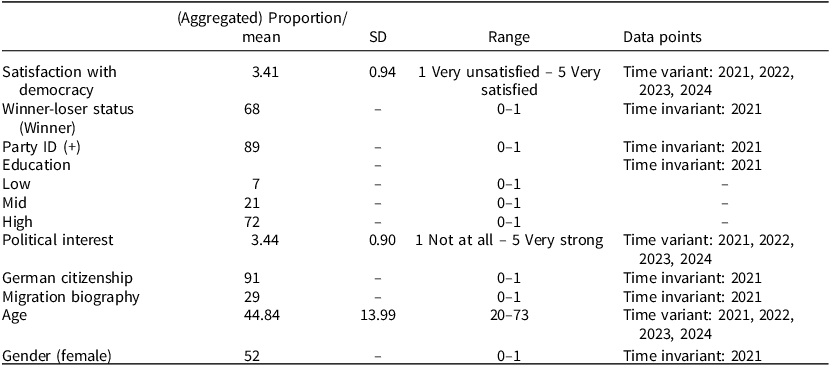
The dependent variable, political support, is multidimensional in nature (Martini and Quaranta Reference Martini and Quaranta2019). It encompasses both evaluations of specific objects (such as government performance) and more diffuse affective orientations (Dalton Reference Dalton2004; Torcal and Montero Reference Torcal and Ramón Montero2006). In this study, we focus on one widely used indicator in winner-loser gap research: satisfaction with democracy (SWD) (e.g., Blais and Gélineau Reference Blais and Gélineau2007; Curini, Jou, and Memoli Reference Curini, Jou and Memoli2012; Dahlberg and Linde Reference Dahlberg and Linde2017; Daoust, Plescia, and Blais Reference Daoust, Plescia and Blais2023a; Daoust, Ridge, and Mongrain Reference Daoust, Ridge and Mongrain2023b; Hansen, Klemmensen, and Serritzlew et al. Reference Hansen, Klemmensen and Serritzlew2019). SWD is available for four waves of the DeZIM.panel. Respondents were asked, ‘How satisfied are you with democracy as it works in Germany?’ with answers ranging from 1 (‘Very unsatisfied’) to 5 (‘Very satisfied’) (see Table 1 for variable distributions).
Descriptive statistics sample (imbalanced sample)

Source: DeZIM.panel.
Note: own calculations, unweighted, N = 2663. See for descriptive statistics for the balanced sample Table SI 1 in the online Supplementary Information.
In most previous studies, electoral winners are defined as those who voted for either the winning party/candidate or a party that became part of the governing coalition (Baekgaard Reference Baekgaard2023; Janssen Reference Janssen2024). Following this approach, we also define electoral winners as those who reported having voted for one of the parties that formed the governing coalition after the 2021 Bundestag election – namely, the Social Democrats (SPD), the Greens, or the Free Democrats (FDP). Those who voted for other parties are coded as losers. Our classification is based on a recall question asking for the party supported with the second vote in the 2021 federal election. Since the DeZIM.panel survey started only a few months after the election (from December 2021), we assume that recall bias is limited, though we are aware that such retrospective items are generally vulnerable to social desirability effects. Respondents who reported casting an invalid vote are excluded from the classification, as they cannot meaningfully be assigned to either group. For non-citizens who were not eligible to vote, we rely on a hypothetical question asking which party they would have voted for if they had been entitled to do so. While such hypothetical scenarios can raise validity concerns, we argue that the question still meaningfully captures individuals’ perceived political alignment and symbolic winner/loser status. Similar to Nemčok and Wass (Reference Nemčok and Wass2021), we exclude both actual and hypothetical non-voters from the main analyses.
Party identification is measured using a standard item that asks whether respondents feel a long-term attachment to a political party. Responses are coded as 1 (‘close to a party’) if a party is indicated, and 0 (‘not close to any party’) if none is given. ‘Don’t know’ and ‘No answer’ responses are treated as missing values.
We also control for several individual characteristics: political interest, age, gender, education, and citizenship status. Political interest is measured on a five-point scale ranging from 1 (‘Not at all interested’) to 5 (‘Very interested’). Age is used as a continuous variable. Gender is coded as 1 (‘Female’) and 0 (‘Male’). Education is categorised as low (no degree or Hauptschulabschluss), medium (Realschulabschluss), and high (Fachhochschulreife or Abitur). Citizenship status is based on the first and, if applicable, second citizenship. If either includes German citizenship, the variable is coded as 1; otherwise, it is coded as 0.
For our panel analyses, we treat political interest and age as time-varying variables. We include both the mean value and within-person deviations from the mean across waves, following Schunck (Reference Schunck2013). Although it is theoretically possible that citizenship status may change after the 2021 election, we treat it as fixed at its 2021 value, as this status determines voting eligibility in that election. Party identification, while potentially changeable over time, is also treated as fixed based on its measurement in wave 1 (2021/2022), reflecting its conceptualisation as a stable, affective orientation.Footnote 4 For more information on the core differences between foreign and German citizen samples as well as the non-citizen sample in more detail, see online Tables SI 2 and SI 3.
Analytical strategy
To analyse the winner-loser gap among citizens and non-citizensFootnote 5 more precisely, we employ linear hybrid models with an imbalanced sample, following the procedures outlined by Schunck (Reference Schunck2013). These models, also referred to as mixed-effects models, combine features of both random and fixed effects, enabling the estimation of between-individual effects (comparable to a between estimator) and within-individual effects (comparable to a fixed-effects estimator). The between-effects component captures person-specific averages of each variable across all time points, essentially estimating the relationship using a regression on the individual-level means. In contrast, the fixed-effects component eliminates all time-invariant, unobserved heterogeneity by focusing exclusively on within-individual variation. This allows us to isolate how the key independent variable, winner-loser status, is associated with changes in the dependent variable over time (Halaby Reference Halaby2004). As our third hypothesis concerns the development of the winner-loser gap over time, the within-effects estimator is particularly well suited to test this dynamic component. By analysing time-varying shifts in satisfaction with democracy, we can assess whether winner-loser differences remain stable, increase, or decrease across election cycles (see Table SI 4). We repeat the analyses with the balanced sample, only retaining individuals that took part in all four waves (see Table SI 5).
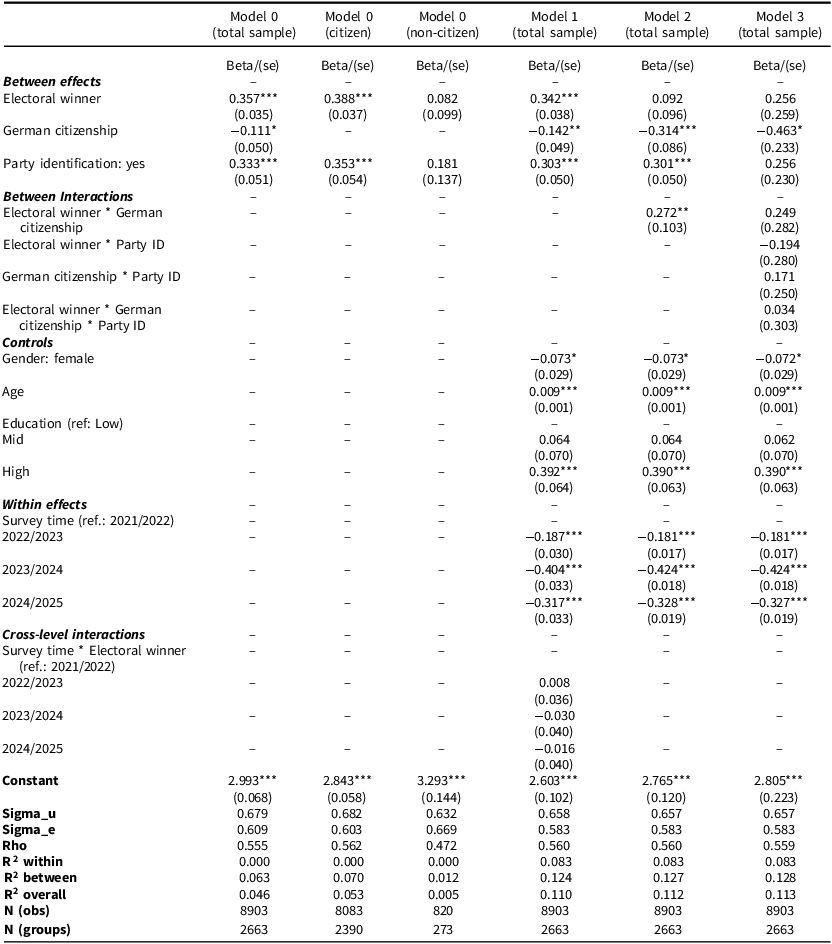
Additionally, to evaluate the robustness of our findings, we estimate a random-effects model using the full, imbalanced sample (see Appendix, Table A1 below). This serves as a sensitivity check, allowing us to examine whether the results hold under a different modelling strategy that retains both between-and within-person variance without decomposing them explicitly.
Results
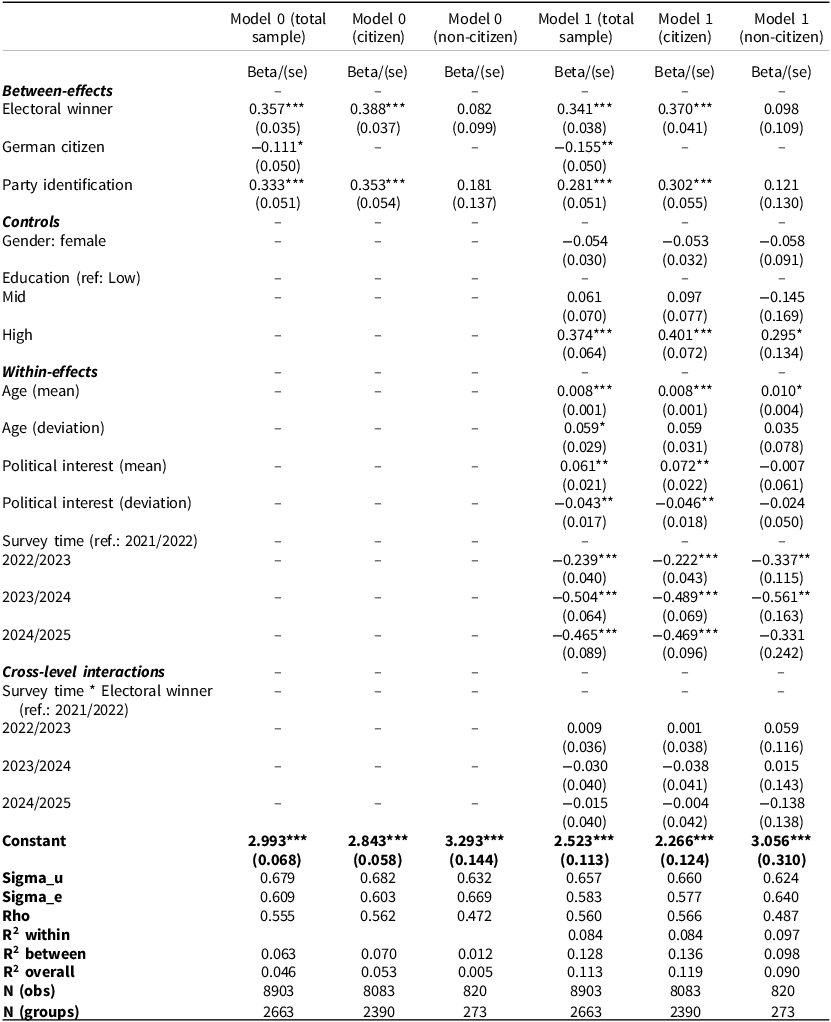
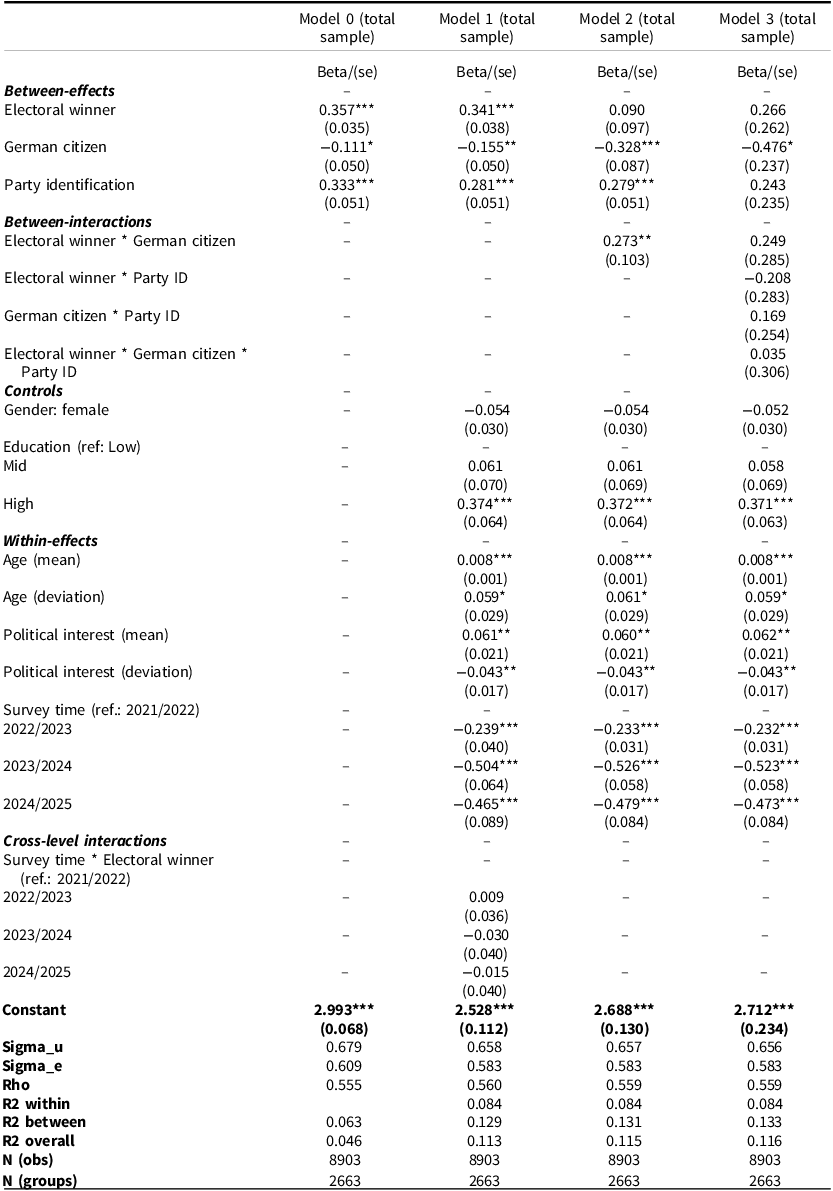
Tables 2 and 3 present the results of our linear hybrid models on satisfaction with democracy in Germany. The baseline model (Model 0), which includes neither interaction terms nor control variables, reveals a clear winner-loser gap: individuals who supported a party that entered the governing coalition report, on average, 0.36 scale points higher satisfaction with democracy in Germany. Interestingly, non-citizen residents, i.e., those excluded from voting, are, on average, 0.11 scale points more satisfied with democracy than German citizens with full voting rights.Footnote 6 Additionally, individuals who report having a party identification are more satisfied with democracy than those without such an attachment (+0.33 scale points).
Linear hybrid models predicting satisfaction with democracy (Models 0–1 for total sample, citizens and non-citizens separately, imbalanced sample, 1–4 time points)

Source: DeZIM.panel.
Note: own calculations, ***p < 0.001, **p < 0.01, *p < 0.05, clustered standard errors in parentheses, unweighted.
Linear hybrid models predicting satisfaction with democracy (total imbalanced sample, 1–4 time points)

Source: DeZIM.panel.
Note: own calculations, ***p < 0.001, **p < 0.01, *p < 0.05, clustered standard errors in parentheses, unweighted.
We begin by testing the first hypothesis, which examines whether electoral winner-loser status affects satisfaction with democracy differently for citizens and non-citizens. We first compare separate models estimated for citizens and non-citizens (Model 0 (citizen) and Model 0 (non-citizen)). Among citizens, the difference in satisfaction with democracy between winners and losers is more pronounced, whereas among non-citizens, the effect is notably weaker. To further investigate the first hypothesis, Model 2 (Table 3) introduces an interaction term between citizenship status and winner-loser status. The results confirm that the winner-loser gap is significantly larger among citizens than among non-citizens: the interaction effect amounts to 0.3 scale points. This supports the idea that electoral outcomes are more consequential for those entitled to vote than for those excluded from the electoral process.
We then turn to the second hypothesis, which asks whether party identification mediates the relationship between winner-loser status and citizenship. Model 3 includes a three-way interaction between winner-loser status, citizenship, and party ID. However, this interaction is not statistically significant, indicating that the effect of electoral outcomes on satisfaction with democracy among citizens versus non-citizens is not moderated by party identification. As a result, we must reject the second hypothesis.
Finally, we examine the longitudinal development of the winner-loser gap. As displayed in Table 2 (Model 1 for citizens and non-citizens), among citizens, none of the interaction terms between winner status and survey year are significant, suggesting that this gap remains stable across waves. At the same time, the coefficients for the survey years are negative and significant, indicating that overall satisfaction with democracy declines over time among citizens. Among non-citizen residents, no significant winner-loser gap is observed, nor do any of the interaction terms with year reach significance. This means that non-citizens’ satisfaction also declines steadily across years, but independent of electoral outcomes.
Taken together, these findings contradict hypothesis 3, which expected a more stable winner–loser gap among non-citizens. Instead, the results indicate that only citizens display a clear and enduring differentiation between electoral winners and losers, while non-citizens’ democratic satisfaction follows a uniform downward trend, but no significant winner-loser gap is perceived.
As robustness checks, we first apply a random-effects model instead of a hybrid model (Appendix, Table A1 below), which leads to very similar results. Second, we rerun the linear hybrid models with a balanced sample including only observations having data on all 4 time points, displayed in the online Supplementary Information in Table SI 5. These results do not contradict the findings of the models with the imbalanced sample presented in the main text. Last, we use different operationalisations for core variables, resulting in basically the same results. We excluded actual and hypothetical non-voters from the analyses but reran them, including non-voters – both eligible and ineligible (Table SI 6). Individuals that indicated ‘Don’t know’ for party identification were treated as missing values in the main analyses, and we reran the models including those that indicated ‘Don’t know’Footnote 7 as non-identifiers (see Table SI 7). To validate the temporal dynamics, we calculated a fixed-effects model for both the imbalanced and balanced samples (Tables SI 8 and SI 9), which confirms the results from the hybrid model.
Discussion
Do citizen and non-citizen residents in Germany differ in their democratic satisfaction depending on whether they are on the winning or losing side of an election over the course of a full electoral cycle? Using four-wave panel data on actual voters and hypothetical voters from the 2021 federal election, we find that non-citizen residents, despite being excluded from the electoral process, exhibit a slightly higher, average level of democratic satisfaction compared to their counterparts with German citizenship. However, unlike citizen residents, non-citizen residents do not display a winner-loser gap in satisfaction with democracy. More specifically, we find no significant or substantively meaningful difference in satisfaction with democracy between hypothetical winners and losers among non-citizens.
Our analyses on the base of applying hybrid models to large-N panel data provide clear and consistent support only for the first hypothesis: citizens and non-citizens differ in their reaction to electoral outcomes, with non-citizens showing no discernible winner-loser gap. The second and third hypotheses, however, cannot be confirmed. Neither party identification nor the instability of the winner-loser gap among non-citizens over time meets our expectations. In the first instance, we can also not be sure whether this is a genuine null effect or results from our study being underpowered.
We would like to note several limitations to our research. First, our sample of non-citizen residents is relatively small, which may reduce statistical power and contribute to the absence of significant effects. Nevertheless, the observed decline in satisfaction with democracy over time among non-citizens mirrors that of citizen residents, suggesting that non-citizens do indeed react to political developments, even if they cannot vote.
Second, the conceptualisation of ‘winning’ or ‘losing’ an election we use is very conventional and may be less straightforward in the case of the 2021 federal election. The formation of the unprecedented ‘Ampel’ coalition, comprising the Social Democrats, the Greens, and the Liberal Democrats, may complicate perceptions of political success. Voters who supported one of the coalition parties may not feel like clear winners given the compromises required by such an ideologically diverse government. In addition, due to data availability, we focus on second-vote shares. Germany’s two-vote system which allows voters to split their district and party votes could, nonetheless, shed light on whether district-level victories mitigate the negative effects of losing the party vote. Roughly 20–30% of voters split their votes, mostly within the same political camp. Still, the fact that we do observe a winner-loser gap among citizens, and that it remains stable over time, suggests that perceptions of political alignment continue to shape democratic satisfaction, even in more complex coalition arrangements.
Third, we use a hypothetical question wording for non-citizens while citizens receive a recall question for an actual election. This introduces a slight mismatch in question framing. However, analyses on socio-demographic profiles of immigrant-origin citizens and non-citizens showed no major difference between both groups for vote choice/party preferences, suggesting that the observed patterns are robust despite this difference in measurement. Fourth, while our findings highlight that non-citizens report high levels of satisfaction with democracy independent of electoral outcomes, they also raise further questions. To better understand long-term patterns of political support, future research should track changes in citizenship status, which might influence political attitudes and perceived efficacy. Additionally, scholars should ask how important voting actually is for individuals who are politically interested but do not feel fully part of the political community, either due to a lack of rights or a lack of perceived belonging.
Last, higher levels of education and integration are associated with greater survey participation. Our findings therefore reflect individuals who are, on average, better integrated than the overall non-citizen population and might care more about politics. We assume that, if extended to all non-citizens, the observed gap between citizens and non-citizens in democratic satisfaction would likely be even bigger.
Our study contributes to the growing literature on the correlates and consequences of winner-loser perceptions by extending the analysis of democratic satisfaction to a group that has frequently been overlooked: non-citizen residents. By incorporating this group into the analysis of electoral outcomes, we broaden existing research that has traditionally focused solely on enfranchised citizens. Our findings suggest that electoral participation heightens responsiveness to electoral results: individuals who are eligible to vote exhibit greater variation in satisfaction with democracy depending on whether they find themselves on the winning or losing side of an election. This does not imply, however, that the absence of full political rights is inconsequential for non-citizens. Rather, it highlights that the dynamics of electoral outcomes, reflected in the winner-loser gap, operate differently when individuals are structurally excluded from participation. The lack of such fluctuations should not be mistaken for democratic contentment but instead calls attention to more fundamental issues of political marginalisation and representational inequality.Footnote 8
Supplementary material
The supplementary material for this article can be found at https://doi.org/10.1017/S1475676526101108.
Data availability statement
The data is available at DeZIM (dezim-institut.de) upon submitting a request via https://fdz.dezim-institut.de/en.
Acknowledgements
An earlier draft of this paper was presented at the 2023 Annual Conference of the Methods Section of the German Political Science Association (GPSA), at the 2023 Annual Conference of the European Political Science Association (EPSA), at the 2024 General Conference of the European Consortium for Political Research (ECPR) and at the Conference on Current Directions in Research on Political Support in 2024 in Duisburg. We thank all commentators, especially Martin Elff and Sven-Oliver Proksch, for their helpful suggestions and hints. We are also thankful to Martin Kroh, Valentin Berger, Verena Benoit, Philipp Hoffmann and Lisa Walter for valuable feedback. We would like to thank the editor and the anonymous reviewers for their constructive feedback, which greatly improved the quality of this paper.
Author Contributions: CRediT Taxonomy
Madeleine Siegel: Conceptualization-Equal, Data curation-Equal, Formal analysis-Equal, Investigation-Equal, Methodology-Equal, Software-Equal, Visualization-Equal, Writing - original draft-Equal, Writing - review & editing-Equal.
Sabrina Mayer: Conceptualization-Equal, Methodology-Equal, Project administration-Equal, Supervision-Equal, Writing - original draft-Equal, Writing - review & editing-Equal.
Funding statement
This research received no external funding.
Competing interests
The authors declare no conflict of interest.
Replication package
Replication material will be made available (Stata.dta-file and do-file as well as log file) upon publication.
Appendix
Random effects models predicting satisfaction with democracy (imbalanced sample, 1–4 time points)

Source: DeZIM.panel.
Note: Own calculations, ***p < 0.001, **p < 0.01, *p < 0.05, clustered standard errors in parentheses, unweighted.


 Open access

