


Impact statement
Degraded drylands threaten the livelihoods and health of billions of people globally, and compost additions are emerging as a promising tool for increasing forage, soil carbon and water holding capacity. Drylands also host surface microbial communities, known as biocrusts, that are important for soil stabilization and other ecosystem services. We investigated manure-based and food waste-based compost impacts on surface microbial communities to understand a potential tradeoff between benefiting the vascular plant community through increased water holding capacity and nutrients, but shading biocrusts and decreasing their photosynthetic capacity and soil aggregation. Compost additions elevated maximum soil surface temperature on relatively cooler days during the initial 3 months, and the relative abundances of both bacteria and fungi (P < 0.06) shifted with compost addition after 1 year, with substantial reductions in the relative abundance of the cyanobacteria (often photosynthetic) in the biocrusts. Despite this reordering in community structure, we found no difference in organic carbon, total nitrogen or soil surface stability between compost-amended and control plots, but we could detect compost-derived carbon using stable isotope signatures. Thus, we suggest that land stewards prioritize the use of compost in areas without existing biocrust communities and instead restore function to areas with existing surface degradation.
Introduction
Dryland restoration is important for climate mitigation and food systems. Drylands cover >40% of Earth’s surface (Prăvălie, Reference Prăvălie2016) and support livelihoods for 2.3 billion people globally (Vicente-Serrano et al., Reference Vicente-Serrano, Pricope, Toreti, Moran-Tejeda, Spinoni, Ocampo-Melgar, Archer, Diedhiou, Mesbahzadeh, Ravindranath, Pulwarty and Alibakhshi2024). Dry working lands include lands with high evaporative demand relative to precipitation that are under active management for food (including livestock grazing), fiber and other resources. Many of these areas have deteriorated and lost soil carbon and productivity due to activities such as mismanaged grazing (Sanderman et al., Reference Sanderman, Hengl and Fiske2017), as well as due to the impacts of climate change (drought, erosion events, etc.; Prăvălie, Reference Prăvălie2016). Compost addition in drylands is an emerging management tool that can increase organic matter content of soils and associated water, nutrient and productivity benefits (Kutos et al., Reference Kutos, Stricker, Cooper, Ryals, Creque, Machmuller, Kroegar and Silver2023), which tend to be the focus of rangeland managers. However, the impacts of compost on dominant dryland microbial communities and functions remain to be determined.
Biological soil crusts (‘biocrusts’) are common components of global dryland surface soils, which provide key ecosystem services, but how compost additions impact biocrusts is unknown. Biocrusts can consist of algae, cyanobacteria, lichens and mosses, which impact carbon (C) and nutrient cycling and reduce erosion (Belnap et al., Reference Belnap, Weber, Büdel, Weber, Büdel and Belnap2016). Biocrusts have been estimated to reduce dust emission and redistribution of 700 Tg per year (Rodriguez-Caballero et al., Reference Rodriguez-Caballero, Stanelle, Egerer, Cheng, Su, Canton, Belnap, Andreae, Tegen, Reick, Pöschl and Weber2022), reducing exposure to pathogens, cardiopulmonary issues and vehicle accidents due to reduced visibility. In a greenhouse mesocosm experiment, biocrust inoculated onto compost-amended soils had higher cover, photosynthetic capacity and species richness than unamended controls (Garibotti et al., Reference Garibotti, Gonzalez Polo and Satti2023). However, topdressing dryland soils with compost may shade the surface, smothering photosynthetically active bacteria such as cyanobacteria (Kidron et al., Reference Kidron, Ying, Starinsky and Herzberg2017) or change nutrient availability that may favor or disfavor functions such as nitrogen fixation (Dias et al., Reference Dias, Crous, Ochoa-Hueso, Manrique, Martins-Loução and Cruz2020).
In this study, we investigated the impact of food-based and manure-based compost on bacterial (with a focus on cyanobacterial) and fungal communities using metabarcoding. We hypothesized that compost addition would increase temperature and nutrient resource conditions at the soil surface due to the darker color and higher nutrient concentration compared to the surrounding soil, and decrease the photosynthetic community of biocrusts due to shading. We hypothesized that these changes in turn could affect the functional role of biocrusts, stabilizing the soil surface in the ecosystem.
Methods
We leveraged an established field experiment on Tribal land in Sandoval County, New Mexico, USA (35.35, −106.56; elevation 1,600 m). The area receives an annual average precipitation of 220 mm, with 60% falling between July and October monsoons, with a mean average temperature of 13.8 °C, a low of −5.7 °C and a mean high of 21.8 °C (2011–2021; PRISM database 2024). The dominant vegetation is black grama (Bouteloua eriopoda), galleta (Pleuraphis jamesii) and sand dropseed (Sporobolus spp.) grasses with scattered juniper trees (Juniperus monosperma), and the soil parent material is eolian deposits over alluvium derived from sandstone and shale (Web Soil Survey 2024). The area has been fenced to exclude livestock grazing for at least 10 years. The biocrusts were observed throughout the area as thin cyanobacteria-dominated biocrusts, but we do not have quantitative baseline data on extent or abundance; no moss- or lichen-dominated biocrusts were observed.
Nine 8 × 8 m plots were established on a relatively uniform area with at least 16 m between adjacent plots. Plots had <5% slope and well-drained soils. All plots were a minimum of 1,600 m from the nearest water source to reduce over-trampling from wildlife. Plots were randomly assigned to control, wasted food-based compost addition or manure-based compost addition with three replicates each. In July 2021, each compost addition plot received 6.3 mm of compost added evenly across the plot with a shovel and rake, and control plots were lightly raked with a sterilized rake. Compost was purchased from a local, New Mexico (NM)-certified composting facility, Reunity Resources (Santa Fe, NM), that uses aerated static piles for 30 d with a minimum 60 d curing time after internal temperatures have dropped. Compost was screened to 1 cm. We sampled compost inoculum immediately before distributing it onto the plots and stored air-dried samples at 4 °C. Compost characteristics seemed to vary based on feedstock, but we do not have multiple replicates for statistical comparison (Supplementary Table A1). For example, food-based compost had total C(%) = 29.7, total N (%) = 1.2, δ13C = −24.35 and δ15N = 5.68 while manure-based compost had total C(%) = 19.9, total N (%) = 1.1, δ13C = −25.06 and δ15N = 8.77. Because the composts had slightly different densities (food-based = 0.16 g cm−3; manure-based = 0.18 g cm−3), the manure-based compost plots received 1.1 kg m−2 while the food-based compost plots received 1.0 kg m−2. Thus, food-based compost plots received ~28% more C and 29% more N compared to manure-based compost plots.
To assess soil surface temperature in compost plots and controls, we added an iButton Thermochron (Maxim Integrated, San Jose, California, USA) to the soil surface in each plot, using masking tape to adhere it to a 2.5-cm-wide steel post that was used to make 1 m2 livestock exclosures. Loggers were set to record temperature once per hour. We captured nearly complete data for the first 83 days of addition (August 25–November 16, 2021; Supplementary Figure A1; though an iButton in one control plot failed to collect data) after which iButtons were lost in the field or batteries died, resulting in incomplete data. We used the raw data output to calculate the maximum, mean and minimum daily soil surface temperature for each plot.
We sampled biocrusts after 1 year during the monsoon season (August 2022). While it is possible that some of the added material washed or blew away, compost was visible on the plots. Triplicates of biocrust communities were sampled from the top 1.5 cm of soil (and thus could include some soil deeper than the aggregated biocrust layer, depending on the depth of aggregation) using a 100-mm diameter inverted petri dish. Samples were transported to the lab, opened to allow biocrusts to air dry at room temperature, then stored dry in the dark.
To assess soil surface organic carbon, total nitrogen and the stable isotope signatures of C and N, clumps of biocrust filaments from the petri dishes stored for ~1 year were collected with forceps, and thus C and N from these samples included biocrust filaments, as well as any organic material adhered to those filaments. Then, 10 mg of the biocrust sample was weighed and placed into separate 3.5 × 5 mm silver capsules and left open. Capsules were fumigated to remove inorganic C by placing the loaded tray in a desiccator with a beaker of pure HCl. The desiccator was sealed, and the sample tray was removed after 12 h and set aside to dry in an oven at <50 °C for 30 min. Once dry, the sample capsules were each placed in a separate 5 × 9 mm tin capsule and packed tightly. For analysis of nitrogen, which is substantially less abundant in dryland soils, ~45 mg were loaded into 5 × 9 mm tin capsules and packed tightly. The compost samples were separately ground and homogenized using a coffee grinder, and ~3–4 mg of sample was weighed into 4 × 6 mm tin capsules for analysis. Bulk tissue percent organic C, total N, δ13C and δ15N values were measured using a Costech 4010 elemental analyzer connected to a Thermo Scientific Delta V Plus isotope ratio mass spectrometer at the University of New Mexico Center for Stable Isotopes. Analytical precision was measured as mean within-run standard deviations (SDs) of δ13C and δ15N values of an in-house reference material (CSI soil vial #2); mean within-run SDs were N < 0.1‰ and C were < 0.1‰.
To evaluate biocrust bacterial/archaeal and fungal community, within 1 week of sampling, samples 1 cm in diameter were cored to a depth of 1.5 cm from each petri dish, aggregated and well mixed by plot, and 0.25 g of soil were used for DNA extraction using the Qiagen DNeasy PowerSoil Kit (Germantown, MD, USA), following the manufacturer’s instructions. Sequencing was performed in the Genetics Core at the University of Arizona. Sequencing and polymerase chain reaction (PCR) parameters included the following: denaturation at 98 °C for 5 min, 34 cycles of denaturation at 98 °C for 30 s, annealing at 50 °C for 30 s, extension at 72 °C for 1 min and a final extension at 72 °C for 5 min.
For bacteria and archaea, the V4 region of the 16S rRNA gene was amplified using primers 515F and 806R. Paired sequences were analyzed via QIIME2 2024.5 (Bolyen et al., Reference Bolyen, Rideout, Dillon, Bokulich, Abnet, Al-Ghalith, Alexander, Alm, Arumugam, Asnicar, Bai, Bisanz, Bittinger, Brejnrod, Brislawn, Brown, Callahan, Caraballo-Rodríguez, Chase, Cope, Da Silva, Dorrestein, Douglas, Durall, Duvallet, Edwardson, Ernst, Estaki, Fouquier, Gauglitz, Gibson, Gonzalez, Gorlick, Guo, Hillmann, Holmes, Holste, Huttenhower, Huttley, Janssen, Jarmusch, Jiang, Kaehler, Kang, Keefe, Keim, Kelley, Knights, Koester, Kosciolek, Kreps, Langille, Lee, Ley, Liu, Loftfield, Lozupone, Maher, Marotz, Martin, McDonald, McIver, Melnik, Metcalf, Morgan, Morton, Naimey, Navas-Molina, Nothias, Orchanian, Pearson, Peoples, Petras, Preuss, Pruesse, Rasmussen, Rivers, Robeson, Rosenthal, Segata, Shaffer, Shiffer, Sinha, Song, Spear, Swafford, Thompson, Torres, Trinh, Tripathi, Turnbaugh, Ul-Hasan, van der Hooft, Vargas, Vázquez-Baeza, Vogtmann, von Hippel, Walters, Wan, Wang, Warren, Weber, Williamson, Willis, Xu, Zaneveld, Zhang, Zhu, Knight and Caporaso2018). Due to poor merging, we chose to use only forward reads to construct Amplicon Sequence Variants (ASVs) using DADA2 (Callahan et al., Reference Callahan, McMurdie, Rosen, Han, Johnson and Holmes2016). Taxonomy was assigned with the Naive Bayes classifier trained on the Silva132 (Robeson et al., Reference Robeson, O’Rourke, Kaehler, Ziemski, Dillon, Foster and Bokulich2021). The 16S community was then filtered to be only Bacteria and Archaea, removing chloroplast and mitochondria.
For fungi, the ITS2 gene region was amplified using primers fITS7 and ITS4 (Ihrmark et al., Reference Ihrmark, Bödeker, Cruz-Martinez, Friberg, Kubartova, Schenck, Strid, Stenlid, Brandström-Durling, Clemmensen and Lindahl2012). Primers were trimmed from paired reads, and 5–80 bp were cut from the trailing end of reads based on quality using cutadapt to improve merging success. Reads were then merged and analyzed via QIIME2 2024.5 and DADA2. ASVs were then clustered into Operational Taxonomic Units (OTUs) at 97% identity using VSEARCH in QIIME2 2024.5. Taxonomy was assigned with the UNITE classifier trained on the UNITE 10 release eukaryote database (Abarenkov et al., Reference Abarenkov, Nilsson, Larsson, Taylor, May, Frøslev, Pawlowska, Lindahl, Põldmaa, Truong, Vu, Hosoya, Niskanen, Piirmann, Ivanov, Zirk, Peterson, Cheeke, Ishigami, Jansson, Jeppesen, Kristiansson, Mikryukov, Miller, Oono, Ossandon, Paupério, Saar, Schigel, Suija, Tedersoo and Kõljalg2024; version 04.04.2024). The Internal Transcribed Spacer (ITS) community was then filtered to only fungi, with the common contaminant Malasseziales being filtered out as well. We referenced FUNGuild (Nguyen et al., Reference Nguyen, Song, Bates, Branco, Tedersoo, Menke, Schilling and Kennedy2016) for guild determinations.
Bacterial and fungal communities were rarefied to 51,000 and 29,000 reads, respectively. Community composition analyses were calculated on Bray–Curtis dissimilarity matrices of rarefied communities using ASVs for bacteria and OTUs (97% similarity) for fungi using the phyloseq (McMurdie and Holmes, Reference McMurdie and Holmes2013) ‘distance’ wrapper and the vegan package.
We compared surface aggregate stability before adding compost in 2021 and after 1 year in 2022 using the stability kit test (Herrick et al., Reference Herrick, Whitford, De Soyza, Van Zee, Havstad, Seybold and Walton2001), averaging the value of six replicate samples from each plot per time point.
Statistical analysis. All analyses were conducted in R (R Core Team 2024) using compost treatment as the main effect. Linear mixed effects models were used to compare daily maximum, mean and minimum soil temperature by compost treatment and daily ambient maximum, mean and minimum air temperature (respectively) with plot, ambient temperature and day of year as random effects.
We assessed the δ13C, δ15N, and the percent organic C and total N by compost treatment using linear models. We estimated the proportion of compost inocula and native soil carbon that contributed to the soil samples 1 year after addition using the simmr_mcmc function in the simmr package (Govan and Parnell, Reference Govan and Parnell2015) using average and SDs for the compost inocula (n = 2 per type of feedstock), and the control plot soil sample values of δ13C, δ15N, percent organic C and total N.
We rarefied the communities to remove the effects of read depth on diversity and compositional analyses. We chose to use qiime and dada2 to best capture the diversity of bacteria at a near-sequencing variation level. To maximize the comparability of bacterial and fungal communities, we used the same read processing methods for fungi but clustered them into OTUs to minimize the effects of possible intragenomic variation that has been found in the ITS region (Estensmo et al., Reference Estensmo, Maurice, Morgado, Martin-Sanchez, Skrede and Kauserud2021; Bradshaw et al., Reference Bradshaw, Aime, Rokas, Maust, Moparthi, Jellings, Pane, Hendricks, Pandey, Li and Pfister2023). Comparisons of soil communities by compost treatment used permutational multivariate analysis of variance (PERMANOVA) (Anderson, Reference Anderson2001) with ‘adonis2’ and were visualized with Non-metric Multidimensional Scaling (NMDS) plots. We conducted indicator species analyses with ‘multipatt’ in indicspecies (Cáceres and Legendre, Reference Cáceres and Legendre2009) to determine which taxon were indicators of each treatment and if the indicators were also found in the compost inocula. We used linear mixed-effects models in ‘lme4’ (Bates et al., Reference Bates, Mächler, Bolker and Walker2015) to compare baseline aggregate stability (before compost addition in 2021) and after 1 year (2022) by compost treatment using plot as a random effect.
Results
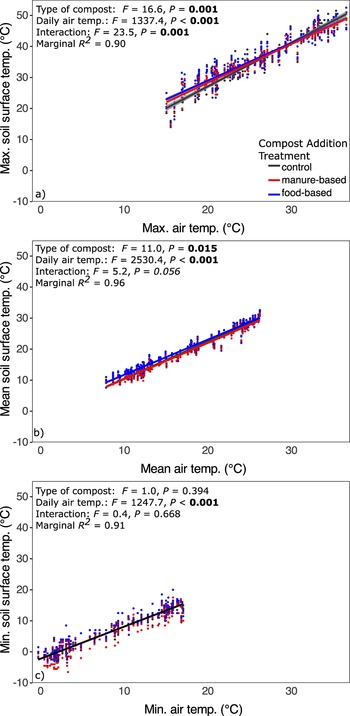
The first year of compost additions experienced warm, dry conditions and compost-affected soil surface temperatures. Ambient conditions during the study period (August 2021–July 2022) were drier than the decadal average, with 173 mm of precipitation total, with most of that total coming in a wet June 2022 (52 mm total), and slightly above average temperature (14.0 °C) (PRISM 2024). Soil surface temperature strongly correlated with air temperature (Figure 1; all P < 0.001), and the effect of compost addition on soil surface temperature was context-dependent on ambient temperature maximum and mean. In the first fall of the experiment (August–November 2021; Supplementary Figure A1), the maximum soil surface temperature was higher in the compost plots than control plots on days with cooler ambient temperatures, and slightly cooler than control plots on days with warmer ambient temperatures (compost treatment × air temperature interaction F = 23.5, P = 0.001, n = 756; Figure 1a; coefficients ± standard error [SE]: control = 0.78 ± 0.02; food-based compost = 0.78 ± 0.02; manure-based compost = 0.68 ± 0.02). Average soil surface temperature was generally higher in the food-based compost plots than other treatments, and there was weak evidence that soil surface temperatures in that treatment were more elevated than control or manure-based compost treatments during cooler ambient conditions (compost treatment × air temperature interaction F = 5.2, P = 0.056, n = 756; Figure 1b; coefficients ± SE: control = 0.66 ± 0.02; food-based compost = 0.63 ± 0.01; manure-based compost = 0.66 ± 0.01). There were no differences in minimum plot temperatures by compost treatment across any ambient air conditions (n = 756; Figure 1c).
Relationships of surface soil temperature (°C) recorded from iButtons to daily ambient temperature conditions (from PRISM) for August–November 2021 and results of linear mixed effect models. (a) Maximum, (b) mean and (c) minimum daily values (n observations = 756 [points]; n day of year = 84; n plots = 8) with 95% confidence intervals (shaded gray). Compost treatment is shown by color (control = gray, manure-based compost = red, food-based compost = blue).

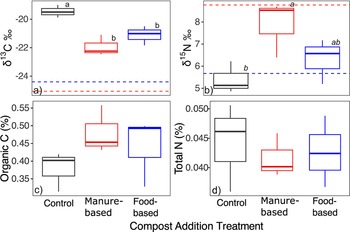
Compost additions were evident from isotopic signatures of the biocrusts after 1 year, but not in the organic C or total N. δ13C values in the biocrust with compost addition were significantly more negative than controls (F = 12.1, P = 0.008, Adj. R 2 = 0.74, n = 3 per treatment level; Figure 2a) and there was weak evidence that plots with manure-based compost additions had elevated δ15N compared to food-based compost or control plots (F = 4.3, P = 0.068, Adj. R 2 = 0.46, n = 3 per treatment level; Figure 2b). However, there were no effects of compost addition on either organic C (F = 1.4, P = 0.324, Adj. R 2 = 0.08; Figure 2c) or total N (F = 0.1, P = 0.867, Adj. R 2 = 0.0, n = 3 per treatment level; Figure 2d). Mixing models suggested that after 1 year, the food-based compost contributed 48% (±27sd) to the observed values of inoculated soil, while manure-based compost contributed 35% (±28sd), but note that we cannot distinguish between compost-derived material in different fractions of the total admixture of the soil organic C pool.
Boxplots (median, first and third quartiles, with whiskers to 1.5 × interquartile range) of a) δ13C of acid-fumigated samples, (b) δ15N of untreated samples, (c) percentage C of acid fumigated samples and (d) percentage N of untreated samples from clumps of biocrust filaments from the top 0–1.5 cm in compost addition and control plots after 1 year (n = 3 per treatment). Dotted lines indicate stable isotope values of initial compost inocula (n = 1 each; food-based compost = blue; manure-based compost = red). Differences between levels of compost addition treatments are marked with lowercase letters for post-hoc P < 0.05; lowercase letters are italicized for post-hoc 0.05 ≤ P < 0.10.

Bacterial and fungal composition in initial compost inocula and biocrust samples (0–1.5 depth) of compost addition plots and control plots after 1 year. Left: Stacked bar graphs of order-level (a) bacterial and (c) fungal community composition (colors) of compost inocula (‘food-based compost’ or ‘manure-based compost’; n = 1 each), biocrusts in compost addition plots (‘food-based’ or ‘manure-based’) or control plots (n = 3 each). Right: NMDS graphs of (b) bacterial ASV and (d) fungal OTU compositions of biocrusts in control (gray triangle), manure-based compost addition (red triangle) and food-based compost addition (blue square) plots with PERMANOVA results. Data were square root transformed with Wisconsin standardization and Bray–Curtis dissimilarity matrix.

Cyanobacterial community composition in initial compost inocula and biocrust samples (0–1.5 cm) of compost addition plots and control plots after 1 year. (a) Stacked bar graph of genus level, or higher if not classified to genus of compost inocula (‘food-based compost’ or ‘manure-based compost’, n = 1 each), biocrusts in compost addition plots (‘food-based’ or ‘manure-based’) or control plots (n = 3 each). (b) NMDS graph of cyanobacterial ASV compositions of biocrusts in control (gray triangle), manure-based compost addition (red triangle) and food-based compost addition (blue square) plots with PERMANOVA results. Data were square root transformed with Wisconsin standardization and Bray–Curtis dissimilarity matrix.

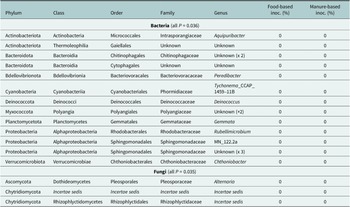
Compost additions substantially altered the relative abundance of microbial communities of biocrusts after 1 year, especially decreasing the relative abundance of cyanobacteria. Biocrust bacterial communities were not significantly different at α = 0.05 (PERMANOVA R 2 = 0.32; P = 0.054) by compost treatment (Figure 3). Actinobacteria and Bacilli were the common indicator groups of food-based compost treatments, with many of the ASVs matching those that had substantial relative abundance in the food-based compost inoculum (Table 1). There were fewer indicators of manure-based compost treatment, with Actinobacteria and Bacilli again being the most common groups (Table 2). Bacteriodia and Alphaproteobacteria were the most common indicators of the control plot, with none of the indicators found in the compost inoculum (Table 3).
Bacterial ASV and fungal OTU indicators (indicator value > 0.95) of plots receiving the food-based compost treatment

Note: ‘Food-based inoc.’ and ‘Manure-based inoc.’ columns represent the percentage of reads in each food-based and manure-based compost inoculum, respectively. P-values were FDR corrected.
Bacterial ASV and fungal OTU indicators (indicator value > 0.95) of plots receiving the manure-based compost treatment
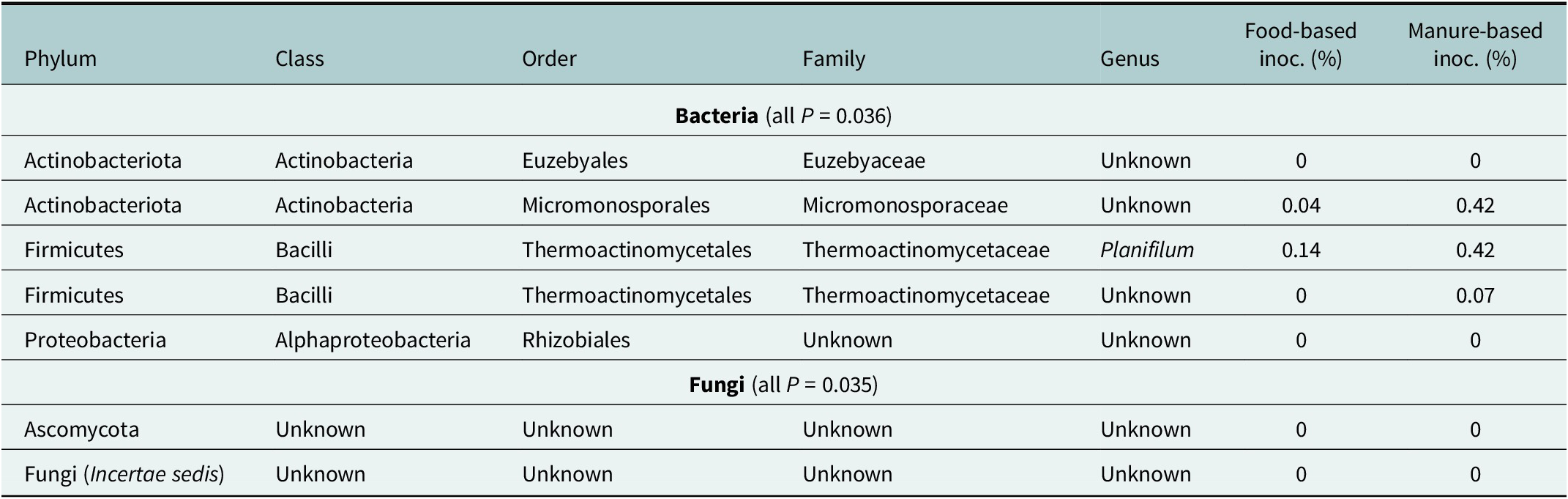
Note: ‘Food-based inoc.’ and ‘Manure-based inoc.’ columns represent the percentage of reads in each food-based and manure-based compost inoculum, respectively. P-values were FDR corrected.
Bacterial ASV and fungal OTU indicators (indicator value > 0.95) of control plots
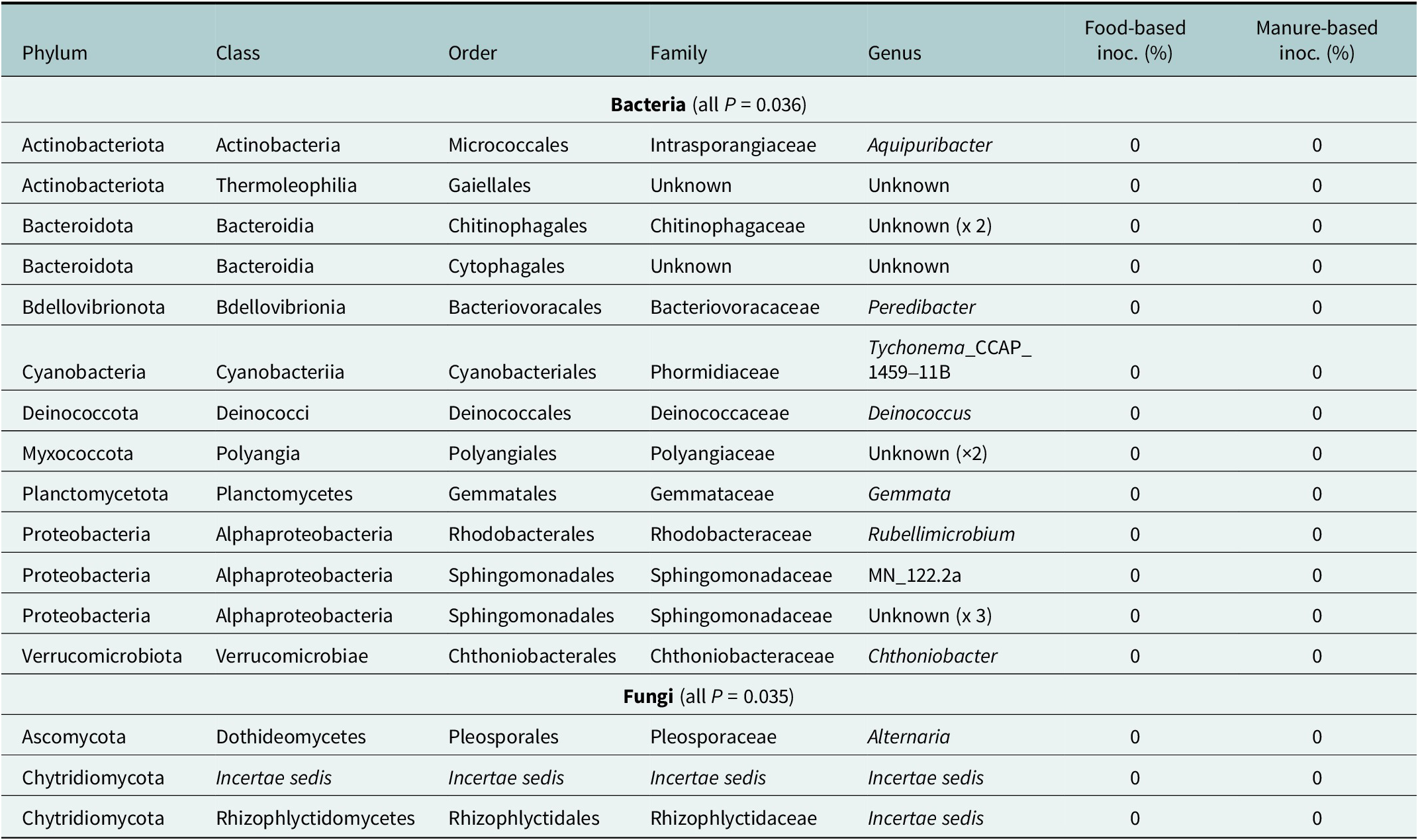
Note: ‘Food inoc. (prop)’ and ‘Manure inoc. (prop)’ columns represent the percentage of reads in each food-based and manure-based compost inoculum, respectively. P-values were FDR corrected.
Because Cyanobacteria are key components of the biocrust, we further evaluated this group separately and with higher taxonomic resolution. Cyanobacteria made up a marginal portion of the relative abundance of the compost inoculum (<0.03% of reads) but made up an average of 8.5% of reads in the native control soils. Cyanobacteria relative abundance decreased in both manure-based and food-based compost treatments compared to controls, with food-based compost addition resulting in the greatest declines, making up only an average of 0.2%, while being 3.5% of manure-based compost treatments (Figure 4). Cyanobacteria community composition was nonsignificantly different at α = 0.05 (PERMANOVA R 2 = 0.43; P = 0.058) by compost treatment (Figure 4).
Biocrust fungal communities were significantly different by compost treatment (PERMANOVA R 2 = 0.32; P = 0.041; Figure 3). Rhodotorula and Onygenales (which contain unspecified saprotrophs and pathogens) were indicators of food-based compost treatment, with the OTUs found in low relative abundance in both compost inoculum types (Table 1). Unidentified taxa, including one in Ascomycota, were the most common indicators of the manure-based compost treatment (Table 2), and Chytridiomycota, also likely saprotrophic, and Ascomycota (Alternaria), which can be pathogenic to plants, were the indicators of the control plots (Table 3).
Compost amendment had no effect on aggregate stability either in baseline conditions or after 1 year (Amendment F2,6 = 0.6, P = 0.552; Amendment × Year F2,6 = 1.2, P = 0.366, n = 3 per level per year), but there was a strong increase in stability between years, from an average of 1.49 ± 0.13 in 2021 to 3.93 ± 0.43 in 2022 (F1,6 = 141.1, P < 0.001).
Discussion
Overall, compost addition altered surface temperature, stable isotopic signatures and some aspects of microbial community composition in the shallow soil layer inhabited by biocrusts, but there were no substantial differences in aggregate stability by compost treatment. We observed a large decline in cyanobacterial relative abundance and plausible mechanisms include altered surface energy balance (higher surface temperature maxima during cool ambient days), physical shading from compost topdressing that persisted (with visual and isotopic signature evidence) at least 1 year and resource availability or soil chemistry changes that may favor Actinobacteria/Bacilli (though we did not directly test chemical characteristics of the shallow soils). Our design cannot isolate or determine the relative contribution of those mechanisms, so these hypotheses remain to be tested.
High relative cover of biocrusts, especially mosses and lichens, is known to decrease albedo, and thus degradation of those darkly pigmented surface features may cool the surface and return radiation to the atmosphere (Rutherford et al., Reference Rutherford, Painter, Ferrenberg, Belnap, Okin, Flagg and Reed2017). Compost additions have also been previously shown to increase soil temperature and can also decrease evaporation (Deguchi et al., Reference Deguchi, Kawamoto, Tanaka, Fushimi and Uozumi2009), and thus may have complicated feedbacks to net energy balances. These changes in albedo and associated properties could affect phenology and growth of plants in drylands (Maxwell et al., Reference Maxwell, Germino, Romero, Porensky, Blumenthal, Brown and Adler2023), but this was outside the scope of our study. In our system, compost was visibly darker than the surrounding soil surface, and compost addition elevated maximum and mean daily temperatures compared to control plots in the first fall growing season that we monitored.
We did not capture elevated organic carbon and total nitrogen in the shallow (0–1.5 cm depth) compost plots compared to controls, or differences due to the initial differences between compost inocula in the first year. In higher elevation sites in New Mexico, our lab group previously found that soil carbon increased with compost addition after 2 years in the top 0–10 cm of soil (Stricker et al., Reference Stricker, Cornell and Withers2025), but we could not disentangle direct compost inputs filtering down into deeper layers from enhanced root-driven carbon pool increases. In this study, we identified a strong isotopic signature of the compost (>35% of the total carbon) in the surface (0–1.5 cm) soils that reflected the compost feedstock differences despite there being no difference in organic carbon content. Because there is an optima for photosynthesis at moderate temperature and higher moisture (Grote et al., Reference Grote, Belnap, Housman and Sparks2010; Escolar et al., Reference Escolar, Maestre and Rey2015), the warmer surface temperature may have decreased carbon and nitrogen fixation inputs on top of the effect of decreased relative abundance of photosynthetic organisms. Existing organic material may also have been degraded because there is a known priming effect of adding compost to soil (Dijkstra and Keitel, Reference Dijkstra and Keitel2024). However, over time and at depths with high root abundance, modeled impacts on ecosystem C suggest the effects of C addition may persist for decades in enhanced sequestration (Ryals et al., Reference Ryals, Hartman, Parton, DeLonge and Silver2015). We have demonstrated that we may be able to assess δ13C over time and potentially at different soil depths to verify when the compost-derived C is depleted from the general soil matrix and sequestered carbon is due to enhanced productivity and/or carbon use efficiency.
We observed a shift in relative abundance of the shallow (0–1.5 cm) microbial community that our lab group did not see in a different experiment that sampled 0–10 cm (Bethany et al., Reference Bethany, Kutos, Oliver and Stricker2024). This contrast supports the hypothesis that the surface microbial communities are most affected by amendments (Farrell et al., Reference Farrell, Griffith, Hobbs, Perkins and Jones2010; Gautam et al., Reference Gautam, Sekaran, Guzman, Kovács, Hernandez and Kumar2020). Previous research has shown that some biocrust cyanobacterial communities are resistant to temperature increases (Johnson et al., Reference Johnson, Kuske, Carney, Housman, Gallegos-Graves and Belnap2012), while in other studies, temperature correlates with continental-scale distribution of some dominant taxa (Garcia-Pichel et al., Reference Garcia-Pichel, Loza, Marusenko, Mateo and Potrafka2013) and can affect the nitrogen cycling in the crust (Delgado-Baquerizo et al., Reference Delgado-Baquerizo, Maestre, Escolar, Gallardo, Ochoa, Gozalo and Prado-Comesana2014; Ferrenberg et al., Reference Ferrenberg, Tucker, Reibold, Howell and Reed2022). In a previous study using manure-based and biosolid-based composts at a lower elevation site (Bethany et al., Reference Bethany, Kutos, Oliver and Stricker2024), our lab group found that deeper soil (0–10 cm depth) microbial communities seemed to respond more to temporal differences between spring and summer conditions than to compost amendments, suggesting that climatic conditions may be an important driver of compositional change more than introduced novel microbial communities. While maximum and average soil surface temperatures were elevated in compost plots compared to control plots in cooler ambient conditions, we cannot attribute the change in composition solely to the temperature change because nutrient additions can also shift biocrust composition and function (Dias et al., Reference Dias, Crous, Ochoa-Hueso, Manrique, Martins-Loução and Cruz2020) – for example, from cyanobacteria toward Actinobacteria (Qian et al., Reference Qian, Xiao, Zhang, Yang, Xia, Farías, Torres and Wu2023), and reduced N fixation (Rong et al., Reference Rong, Zhou, Li, Yao, Lu, Xu, Yin, Li, Aanderud and Zhang2022). On our site, N-fixing taxa such as Nostoc spp. were rare in relative abundance across all plots, so we did not find a big difference with compost addition. We do not have a measure of total abundance, and thus can only discuss rank changes in relative abundance, but previous studies in crop systems have shown elevated bacterial abundance using quantitative PCR after 8 weeks (LeBlanc and Harrigian, Reference LeBlanc and Harrigian2024) and after 3 years of annual compost addition (Tian et al., Reference Tian, Wang, Li, Zhuang, Li, Zhang, Xiao and Xi2015). However, the rank changes of autotrophic versus heterotrophic microbes may affect future carbon and nutrient cycling (Gougoulias et al., Reference Gougoulias, Clark and Shaw2014).
The changes in composition in soil communities also reflected differences in feedstock for the composts. The nonphotosynthetic cyanobacteria Sericytochromatia were dominant in compost inocula, while Gastranaerophilales – are found in animal digestive systems (Monchamp et al., Reference Monchamp, Spaak and Pomati2019) – were present in manure-based compost. The taxa that persisted from compost inocula in biocrusts tended to be thermophilic and/or known for producing secondary metabolites (Hussein et al., Reference Hussein, Lisowska and Leak2015; Schmidt et al., Reference Schmidt, Vimercati, Darcy, Arán, Gendron, Solon, Porazinska and Dorador2017; Sayed et al., Reference Sayed, Abdel-Wahab, Hassan and Abdelmohsen2020), which may have aided them in surviving in the high temperature and ultraviolet conditions of the soil surface. Some soil-associated cyanobacteria persisted under compost in low relative abundance. Some filamentous cyanobacteria are known to navigate to areas in the soil profile out of direct sunlight and maintain activity when kept moist and shaded (Raanan et al., Reference Raanan, Oren, Treves, Berkowicz, Hagemann, Pade, Keren and Kaplan2016), and thus may have identified favorable microsites in the top-dressed plots in areas that had thinner areas of compost.
Managers must balance the short- and long-term benefits and costs of compost additions to assess if this management tool will help them meet their goals. While compost addition overall is expected to increase above- and below-ground carbon (Kutos et al., Reference Kutos, Stricker, Cooper, Ryals, Creque, Machmuller, Kroegar and Silver2023), in areas with robust surface biocrust communities, there may not be a benefit to soil carbon, nitrogen, or resistance to erosion. However, if a particular desired plant species is inhibited from germination or growth by the surface biocrusts (Havrilla et al., Reference Havrilla, Chaudhary, Ferrenberg, Antoninka, Belnap, Bowker, Eldridge, Faist, Huber-Sannwald, Leslie, Rodriguez-Caballero, Zhang and Barger2019), then future research could test if compost may enhance conditions for establishment due to water holding and increased surface temperatures. Finally, while we detected some differences in the microbial communities resulting from food-based compost addition versus manure-based compost additions, there were no differences in our measure of ecological impact (aggregate stability), which suggested that erosion at these small scales is neither ameliorated nor exacerbated by compost addition. Because there were not strong differences in surface temperature, biocrust organic C, aggregate stability or impacts on biocrust community relative abundance by compost feedstock, managers may opt for readily available options rather than try to optimize the selection of compost based on feedstock. We suggest that managers pilot the addition of compost or evaluate their own context and goals before full-scale implementation because we report results from a single location.
Open peer review
For open peer review materials, please visit http://doi.org/10.1017/dry.2026.10020.
Supplementary material
The supplementary material for this article can be found at http://doi.org/10.1017/dry.2026.10020.
Data availability statement
The sequencing data have been deposited in the NCBI database under BioProject PRJNA1156798. All other data have been submitted to the Environmental Data Initiative project under package ID edi.2062.1.
Acknowledgments
The authors would like to thank the Tribal land stewards for their gracious support of this work. The authors would like to thank K. Oliver and M. Patton for field and/or lab support and the UNM Center for Stable Isotopes for supporting the student project. This material is based upon work that is supported by the National Institute of Food and Agriculture, US Department of Agriculture (2021-67019-34249), the Western Sustainable Agriculture Research and Education program (OW23-379) and the Natural Resource Conservation Service (NR243A750003C007). USDA is an equal opportunity employer and service provider. Any opinions, findings, conclusions or recommendations expressed in this publication are those of the author(s) and do not necessarily reflect the view of the US Department of Agriculture.
Author contribution
ES secured funding, conducted analysis and developed tables and figures, interpretated of data and drafted the manuscript. JB conceived and designed the work, contributed to the acquisition and interpretation of the data. LBD conducted analyses and interpretation of the data. CP, LG, JL and CAT contributed to the design of the work, acquisition and interpretation of the data. All authors contributed to revisions and final approval of the manuscript.
Financial support
This material is based upon work that is supported by the National Institute of Food and Agriculture, US Department of Agriculture (2021–67019-34249), the Western Sustainable Agriculture Research and Education program (OW23–379) and Natural Resource Conservation Service (NR243A750003C007).
Competing interests
The authors declare none.




 Open access


Comments
Sep. 19, 2025
Dear Drs. Eldridge and Sala,
Please find attached our manuscript entitled “Compost additions decrease relative abundance of biocrust cyanobacteria and alter soil stable isotope signature” that we are submitting for consideration as a Research Article in the journal Drylands.
This manuscript will provide value to readers because it addresses the use of a sustainable agricultural practice, compost amendments, for management of degraded soils, and seeks to understand the effect on the existing surface microbial community in the biocrusts. The research presented addresses not only the effects of compost on traditional responses such as soil carbon and surface aggregate stability, but also investigates soil surface temperature, stable isotope values, and is the first manuscript to present associated shifts in microbial communities (bacteria and fungi) in drylands one year post compost addition.
Overall, our results indicate that compost addition can elevate mean and maximum surface temperature in the fall growing season. We found that while the stable isotope values suggested that surface soil organic carbon contained 35-48% of compost-derived carbon, the pool of organic carbon did not significantly change, suggesting complex shifts in inputs and outputs of soil C. We found that the feedstock characteristics of composts matter to the resulting biocrust microbial communities because there were differences in fungal, bacterial, and cyanobacterial composition based on compost type after one year. Dominant taxa often did not change in the soils after compost addition, but some rare taxa became more abundant, as evidenced by Indicator Species Analysis. Despite these shifts in composition, there was no difference in surface stability between compost and control plots, suggesting that despite decreased cyanobacterial relative abundance, the functional role of resistance to surface erosion remained.
I would additionally like to highlight the contribution of both graduate and undergraduate students to this manuscript through a course-based project supported by the UNM Center for Stable Isotopes. Four of the co-authors conducted field and lab work as part of a course at the University of New Mexico and substantial portions of the writing and analysis are based on their report.
Thus, this study suggests that compost amendments could become part of land manager’s strategies for implementing climate smart and sustainable practices but should be done in context of the existing function of the surface soil communities. Thank you for your time and consideration of this manuscript.
- Dr. Eva Stricker