

Introduction
Assessing the conservation status of endangered species requires several stages of analysis, such as recognition of threats and their impacts, monitoring of the population and analysing the efficacy of the management measures applied to eliminate risk factors (Soulé Reference Soulé1986, Groom et al. Reference Groom, Meffe and Carroll2006). These three aspects are closely interrelated and without proper coordination, it is very difficult to obtain successful results in conservation (Pullin et al., Reference Pullin, Knight, Stone and Charman2004, Arlettaz et al. Reference Arlettaz, Schaub, Fournier, Reichlin, Sierro, Watson and Braunisch2010). When studying, from a long-term perspective, how these three questions have been addressed in order to report on the history of the conservation of a particular species, it is helpful to examine an extensive collection of information, for which bibliometrics is a useful study tool (Zhang et al. Reference Zhang, Wang, Hu and Ho2010, Liu et al. Reference Liu, Zhang and Hong2011). In this sense, the increase in the knowledge of a target species should imply the application of such information to optimise management and conservation measures (Salafsky et al. Reference Salafsky, Margoulis and Redford2001, Pullin et al. Reference Pullin, Knight, Stone and Charman2004). Obviously, cases will exist in which both the positive and negative effects of anthropogenic variables (e.g. illegal poisoning, disturbance, habitat alteration, supplementary feeding) have an important influence on population trends of the species and, consequently, distort the linearity of the results obtained (Oro et al. Reference Oro, Margalida, Carrete, Heredia and Donázar2008, Ortega et al. Reference Ortega, Mañosa, Margalida, Sánchez, Oria and González2009). However, the expected result is that conservation measures and thus the conservation status of a species will improve with an increase in knowledge.
To analyse the above issues, the Cinereous Vulture Aegypius monachus constitutes a sound model species since it exhibits a key role in the ecosystems that it inhabits. Due to its scavenging behaviour, the Cinereous Vulture provides important ecosystem services, namely, it feeds on wildlife and livestock carcasses and helps to reduce the risks of the spread of transmissible diseases (DeVault et al. Reference DeVault, Rhodes and Shivik2003, Sekercioglu et al. Reference Sekercioglu, Daily and Ehrlich2004, Margalida et al. Reference Margalida, Carrete, Sánchez-Zapata and Donázar2012, Margalida and Colomer Reference Margalida and Colomer2012). It also inhabits areas of good conservation status and is an indicator of several habitat characteristics: to breed it requires mature forests, with specified ecological and geomorphological conditions, located far from human disturbance (Moreno-Opo et al. Reference Moreno-Opo, Fernández-Olalla, Margalida, Arredondo and Guil2012a). Spatial patterns of its foraging range are related to food availability and habitat quality and, in the case of breeding individuals, to the distance from the breeding colony (Costillo Reference Costillo2004, Carrete and Donázar Reference Carrete and Donázar2005). It is also closely related to land management and exploitation in rural areas, which can affect its populations in positive or negative ways (Donázar et al. Reference Donázar, Blanco, Hiraldo, Soto-Largo and Oria2002, Reference Donázar, Margalida and Campión2009a).
This paper presents a summary of the conservation history of the Cinereous Vulture in Spain from 1966 to 2011, as a compilation of studies and conservation work. Its objectives are: 1) to update the population status of the species in Spain based on published and unpublished data and to evaluate its trend; 2) to gather information on research, monitoring and protection efforts; 3) to assess the relationships between the number and types of publications on the species in order to discuss whether a greater study output is a cause or consequence of the numerical evolution of the population; and 4) to analyse the effects of threats to the Cinereous Vulture, as well as actions taken and results of those actions, from the perspective of conservation biology.
Methods
The study species
The Cinereous Vulture is the largest raptor in the Palearctic and its distribution range includes temperate latitudes from the Iberian to the Korean peninsulas (Del Hoyo et al. Reference Del Hoyo, Elliott and Sargatal1994). Its current population has been estimated at 7,200–10,000 pairs (BirdLife International 2008), of which around 2,000 are located in Europe (BirdLife International 2004). It is considered “Near Threatened” due to the decline of its Asian populations and to different threats: mortality caused by human action (mainly the use of illegal poisoned baits), alteration of food availability and occurrence, human disturbance and habitat loss (BirdLife International 2008). In Europe, the Cinereous Vulture is distributed within three metapopulations: Iberian Peninsula and France, Majorca Island, and the Balkan Peninsula (Del Hoyo et al. Reference Del Hoyo, Elliott and Sargatal1994). The Spanish is the largest (De la Puente et al. Reference De la Puente, Moreno-Opo and Del Moral2007) and most widely studied population in recent years (Costillo Reference Costillo2004, Carrete and Donázar Reference Carrete and Donázar2005, Morán-López et al. Reference Morán-López, Sánchez, Costillo, Corbacho and Villegas2006, Moreno-Opo et al. Reference Moreno-Opo, Fernández-Olalla, Margalida, Arredondo and Guil2012a), exhibiting a continuous recovery during the last 40 years (De la Puente et al. Reference De la Puente, Moreno-Opo and Del Moral2007).
Bibliographic search and studied variables
Numbers of breeding pairs, taken as the number of nests in which incubation began, were obtained on request from regional governments for the most recent census data. Previous censuses were extracted from different publications (González Reference González1990, Sánchez Reference Sánchez, Tewes, Sánchez, Heredia and Bijleveld van Lexmond1998, De la Puente et al. Reference De la Puente, Moreno-Opo and Del Moral2007).
To find published works on Cinereous Vulture in Spain, we performed a literature search (see Liu et al. Reference Liu, Zhang and Hong2011). We searched databases (Web of Science, Google Scholar), reviewed references in articles, and compiled a list of books, PhD theses, legal texts and abstracts in proceedings of meetings on the Cinereous Vulture. The works were grouped according to: 1) the type of publication and 2) the area of study. The first group included five categories: SCI journals, other technical-scientific articles in journals, non-technical articles (e.g. newsletters or magazine articles), books and PhD theses, and chapters or articles in abstracts of monographs, workshops or congresses. For the second group, works were grouped according to the field of study with which they dealt: surveys and censuses, biology and ecology, conservation, threats and management of the species, and others that included shared aspects of the above categories. This latter category included, for example, compilations and distribution atlases. Furthermore, works were grouped by their year of publication into five-year periods from 1966 to 2011.
To assess the effects of different threats on the population dynamics of the Cinereous Vulture, we considered the number of individuals affected by poisoning as the main non-natural mortality factor affecting avian scavengers in Spain (Margalida Reference Margalida2012), obtained from Hernández and Margalida (Reference Hernández and Margalida2008), and the number of admissions to official rescue centres due to starvation or dehydration. The latter information was provided by 10 regional administrations for the period 2001–2009 (Ministry of Environment and Rural and Marine Affairs 2010). Moreover, we used variables related to the availability of food in the regions of peninsular Spain where Cinereous Vultures breed. These included: 1) the hunting bags of the Rabbit Oryctolagus cuniculus (Guil et al. Reference Guil, Agudín, Silvestre, Higuero, Inogés, Moreno-Opo and Guil2007, Garrido Reference Garrido2011) as an index of relative abundance of one of the main prey types in the diet of the species (Costillo et al. Reference Costillo, Corbacho, Morán and Villegas2007a); 2) the hunting statistics of the two most abundant game ungulates (Wild Boar Sus scrofa and Red Deer Cervus elaphus) as the remains of hunting activity on these species are traditionally intended for scavenger consumption and are an important source of food for Cinereous Vulture (Costillo et al. Reference Costillo, Corbacho, Morán and Villegas2007a, Moreno-Opo and Guil Reference Moreno-Opo and Guil2007) and 3) an estimate of carcasses provided by extensively managed livestock (cows, sheep, goats and pigs) potentially available for scavenging raptors. In Europe, sanitary regulations compel the removal of livestock carcasses from farms to a controlled disposal facility (European Commission 2011). In order to comply, several official programmes have been implemented in Spain and have advised farmers to take out insurance policies for carcass removal (Donázar et al. Reference Donázar, Margalida and Campión2009a). These programmes have had progressively increasing coverage during the 2000s (Spanish Statistics Institute 2011, www.ine.es). In these cases, when an animal dies, an official transport vehicle turns up to remove the carcass, whereas when there is no such insurance, carcass removal may be carried out by burying the body or by contracting ad hoc an expensive means of transport, which in practice means the potential abandonment of the carcass in the field (authors’ unpubl. data). As a result, an index of the number of carcasses potentially available for scavengers was calculated by deducting the number of livestock not covered by official insurance from the total livestock population (National Entity of Agriculture Insurances 2011, www.enesa.es, Spanish Statistics Institute 2011, www.ine.es).
Lastly, we performed a review of the most important events in the conservation of the Cinereous Vulture in Spain during the study period (1966–2011). These milestones were related to the release of legal and technical documents or to biological situations relevant to three important issues for the conservation of the species (BirdLife International 2008): species protection, habitat protection and food availability.
We chose 1966 as the start date of this study since it is the first year in which scientific and technical publications on the Cinereous Vulture in Spain were published (Bernis Reference Bernis1966, Suetens and Van Groenendael Reference Suetens and Van Groenendael1966, Valverde Reference Valverde1966).
Analyses
We first tested for differences in the temporal distribution of the published papers, arranged into five-year periods, considering the topic discussed and the type of publication, through Chi-square frequency analysis.
We used linear regression (Sokal and Rohlf Reference Sokal and Rohlf1995) to determine the relationship between population size and 1) variables related to direct threats, i.e. the number of Cinereous Vultures found poisoned and number of starving individuals admitted to rescue centres and 2) variables related to potential food availability, i.e. rabbit hunting statistics, the available carcasses provided by extensive livestock, and game hunting bags. To assess possible correlations between food availability and threats, we applied linear regression analysis between the number of potentially available livestock carcasses and 1) the number of poisoned Cinereous Vultures and 2) the number of starved/dehydrated Cinereous Vultures admitted to rehabilitation centres. The regressions were performed by using a single independent and response variable per analysis, not including any permutations. The analyses were carried out using the software Statistica 6.1 (StatSoft 2002).
Results
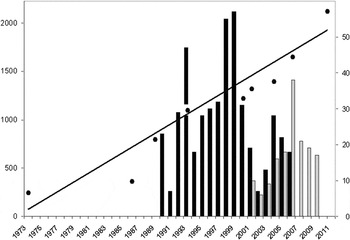
The breeding population of Cinereous Vulture in Spain in 2011 was 2,068 pairs, distributed across 35 colonies (Fig. 1). Since 1973, when the first national census found 206 breeding pairs, the number of breeding pairs has increased at an annual rate of 25.7%, assuming coverage was similar in both surveys (Fig. 1).
Breeding pairs (nests with hatching, black dots, left y-axis) of Cinereous Vulture in Spain, from the first Spanish national census in 1973 to the most recent in 2011. The number of poisoned Cinereous Vultures 1990–2006 (black columns, Hernández and Margalida Reference Hernández and Margalida2008) and the number of starved Cinereous Vultures admitted to official wildlife rescue centres in 2001–2009 (grey columns) are shown in respect to the right y-axis.
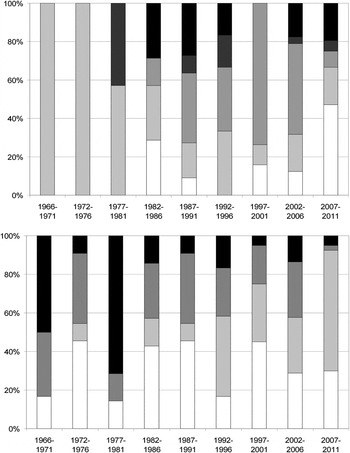
In total 164 publications on the Cinereous Vulture in Spain were found for the period 1966–2011 (Appendix S1 in online Supplementary Materials), 31.5% of which were articles in technical and scientific periodical journals not included in SCI; 30.9% were non-technical publications (newsletters, magazine articles, etc.); 17.5% were papers in SCI journals; 14.0% were abstracts in proceedings of conferences or chapters in monographs, and 5.8% were books or PhD theses. The proportion of the different types of literature published varied significantly among the different five-year periods (χ2 4 = 11.48, P = 0.021; Fig. 2), with the number of SCI articles and chapters in proceedings and abstracts in conferences having risen in recent years (SCI: r = 0.756, P = 0.018; chapters/abstracts: r = 0.741, P = 0.022). Of these publications, 32.3% dealt with conservation, threats or applied management, 31.8% presented aspects of the biology and ecology of the species, 21.9% were population censuses and 13.8% exposed common issues related to the above-mentioned categories or were compilations, atlases, etc. No significant differences were found in the proportion of different subjects among periods (χ2 3 = 4.11, P = 0.249; Fig. 2) although the total number of articles published related to conservation issues (r = 0.843, P = 0.004) and on the species’ biology and ecology (r = 0.786, P = 0.010) increased significantly in recent times.
Evolution of the proportion of publications (Y-axis) on the Cinereous Vulture in Spain in five-year periods, distributed according to the type of publication (above): SCI journals –white; other technical-scientific articles in periodic journals – light grey; legal-divulgation – medium grey; books-PhD thesis – dark grey; chapters-articles in abstracts of monographs, workshops, congresses or meetings – black) and the subject treated (bottom): biology-ecology – white; conservation-threats-management – light grey; census – dark grey; others – black).
The unique Spanish database of wildlife poisonings showed 454 Cinereous Vultures poisoned during 1990–2006, with a maximum occurring in 1998 and 1999 (Hernández and Margalida Reference Hernández and Margalida2008; Fig. 1). Data on admissions of Cinereous Vultures to rescue centres showed an increasing trend from 2001 to 2007, when a maximum of 190 admissions were recorded, which was subsequently reduced by 2009 (Fig. 1). Analysis of the most relevant historical events (Fig. 3) indicated that the current situation is positive with respect to the protection of the species and its habitat, while uncertainty remains about whether the food occurrence and availability has been favourable or unfavourable in the last decade.
Milestones in the conservation of the Cinereous Vulture in Spain 1970–2011, in relation to species protection, habitat protection and food availability. Colours of horizontal bars indicate the conservation status in relation to the ecological requirements of the species (black: negative situation; grey: unknown-neutral; white: favourable situation). 1 = Decree for the protection of raptors in Spain -1973; 2 = Royal Decree of the National Catalogue of Endangered Species -1990; 3 = Species Action Plan, European Commission 1996; 4 = First regional recovery/conservation plans -2003; 5 = Habitats Directive 92/43/CEE -1992; 6 = Special Protected Areas statement and first LIFE and land-stewardship projects -1997; 7 = Progressive recovery of rabbit populations after myxomatosis outbreak in the 1950s –1978; 8 = Outbreak of Rabbit haemorrhagic disease – 1991; 9 = Regulation CE 1774/2002 on the sanitary control of animal by-products - 2002, but progressive increase of Wild Boar/Red Deer hunting bags; 10 = Regulation CE 1069/2009 on the sanitary control of animal by-products -2011.

Since 2002 there was a progressive and significant reduction in the number of available carcasses in the wild, following the enforcement of mandatory carcass collection (Council of Europe 2002), from 36 million potential available carcasses in 2001 to 3.6 million in 2010 (r = -0.682, P < 0.001; Fig. 4). Furthermore, the number of Wild Boar and Red Deer hunted per year has multiplied by 13.5 from 1973 (r = 0.94, P < 0.001; Fig. 4). In addition, rabbit hunting statistics have shown variations without any clear trends (r = -0.11, P = 0.789). After a slight increase in abundance in the late 1980s, an alarming decrease occurred due to the effect of rabbit viral haemorragic disease (Delibes-Mateos et al. Reference Delibes-Mateos, Redpath, Angulo, Ferreras and Villafuerte2007); this has been attenuated and even reversed since 2008 (Fig. 4).
Changes in the number of rabbits hunted in the Spanish peninsular regions where Cinereous Vultures breed (black dots), the number of livestock carcasses potentially available for scavengers in Spain (x106; squares), and Wild Boar and Red Deer hunting bags in the Spanish peninsular regions where Cinereous Vultures breed (x104; grey triangles). For the Rabbit, the number of individuals hunted in 1973 is taken as a reference (starting value = 10.0, not corresponding to any unit; Guil et al. Reference Guil, Agudín, Silvestre, Higuero, Inogés, Moreno-Opo and Guil2007, Garrido Reference Garrido2011). The number of carcasses available was obtained by deducting the proportion of livestock covered by official corpses-collection insurance from the total extensive livestock population (sources; Spanish Statistics Institute, www.ine.es and National Entity of Agriculture Insurances, 2011, www.enesa.es).
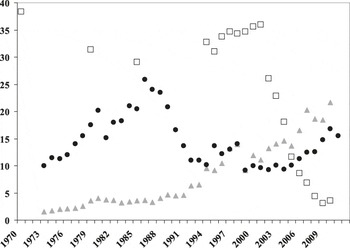
The trend in breeding pairs of Cinereous Vultures was positively correlated with the number of Wild Boar and Red Deer hunted (r = 0.984, P < 0.001). There was no correlation between Cinereous Vulture populations with any other variable related to food availability or threats. Finally, the number of emaciated Cinereous Vultures admitted into recovery centres was negatively and only marginally correlated with the decrease in available carcasses (r = -0.926, P = 0.068).
Discussion
The results obtained from the information compiled require a cautious interpretation regarding the recognition of factors affecting the population increase in Cinereous Vultures and any cause-effect relationships. This could occur due to the use of a single variable (number of breeding pairs) to assess population trends, due to the difficulty in obtaining extensive data on other demographic parameters (e.g. non-breeding population and mortality rates) that could help in understanding the mechanisms driving population trends (Oro et al. Reference Oro, Margalida, Carrete, Heredia and Donázar2008, Ortega et al. Reference Ortega, Mañosa, Margalida, Sánchez, Oria and González2009). In this sense, a common problem with censusing elusive species is that reliability improves with time due to a progressively greater knowledge of the terrain and the species, as well as due to an increasing investment in logistics. This could imply variable census effort between years and areas, and negative effects on the accuracy of the final data on population size (Katzner et al. Reference Katzner, Ivy, Bragin, Milner-Gulland and DeWoody2011, Margalida et al. Reference Margalida, Oro, Cortés-Avizanda, Heredia and Donázar2011a). Nonetheless, we used the comparison between censuses because all existing colonies were surveyed in each census and monitoring procedures in the field were similar during this period, consisting of detailed observation and nest searches from a distance (> 500 m) with the help of telecopes and binoculars (De la Puente et al. Reference De la Puente, Moreno-Opo and Del Moral2007). Despite biases that might occur during the early years of study, during the last two decades (1990–2011) in which similar effort has been applied through official monitoring programmes, the trend exhibited by the population was also positive with an annual growth rate of 13.3%.
Food availability and threats
In relation to food availability, there were both gains and losses for the Cinereous Vulture over the study period in relation to the amount of natural food, from hunting remains and dead livestock.
There was a direct relationship between the increase in the breeding population of the Cinereous Vulture and Red Deer and Wild Boar hunting bags. Hunting is increasing as a leisure activity (Garrido Reference Garrido2011) and there is presumably a concomitant increase in animal remains available to scavengers in the wider countryside. Thus, the carrion provided by hunting constitutes an important food resource for the avian scavenger guild (see Mateo-Tomás and Olea Reference Mateo-Tomás and Olea2010, Margalida et al. Reference Margalida, Colomer and Sanuy2011d) although their ingestion can have detrimental effects through poisoning by lead ammunition (Guitart et al. Reference Guitart, Sachana, Caloni, Croubles, Vandenbrouke and Berny2010). Lead poisoning has been shown to cause mortality in Cinereous Vultures (Hernández and Margalida Reference Hernández and Margalida2008, Nam and Lee Reference Nam and Lee2010), as it does in other scavenger species (Gangoso et al. Reference Gangoso, Álvarez-Lloret, Rodríguez-Navarro, Mateo, Hiraldo and Donázar2009, Hernández and Margalida Reference Hernández and Margalida2009a, Finkelstein et al. Reference Finkelstein, Doak, George, Burnett, Brandt, Church, Grantham and Smith2012), although the overall conservation implications of the impact at population level should be addressed in future studies. Changes in animal by-product regulations in the early 2000s led to the compulsory collection of livestock carcasses from the wild. This removal of potential prey provoked food shortages for scavenging raptors (Donázar et al. Reference Donázar, Margalida and Campión2009a, Reference Donázar, Margalida, Carrete and Sánchez-Zapata2009b, Margalida et al. Reference Margalida, Donázar, Carrete and Sánchez-Zapata2010) but has not been associated with a reduction in the breeding population of the Cinereous Vulture. In addition, the Rabbit, a keystone prey species for most endangered predators in Spain (Delibes-Mateos et al. Reference Delibes-Mateos, Redpath, Angulo, Ferreras and Villafuerte2007), has undergone a population decline over the last 40 years, causing dietary shifts in Spanish populations of Cinereous Vulture (Costillo et al. Reference Costillo, Corbacho, Morán and Villegas2007a, Reference Costillo, Corbacho, Morán and Villegasb). Thus, the proportion of Rabbits in the diet was reduced significantly between the 1970s and 2000s, overlapping with an increase in Red Deer and Wild Boar remains found in Cinereous Vulture pellets during the same period (Corbacho et al. Reference Corbacho, Costillo, Perales, Moreno-Opo and Guil2007). This dietary plasticity and adaptation to feeding on alternative prey when the main food resource is scarce have been also shown in the Vulnerable Spanish Imperial Eagle Aquila adalberti after the decrease in Rabbit abundance (Sánchez et al. Reference Sánchez, Margalida, González and Oria2009) and in other obligate avian scavengers as a consequence of changes in sanitary policies (Donázar et al. Reference Donázar, Cortés-Avizanda and Carrete2010). Nevertheless, other effects have been reported in the scavenger guild regarding demographic and behavioural variables (e.g. modification of foraging and dispersal patterns, trophic behaviour - increased feeding in dumps and attacks on livestock - and changes in juvenile survival rates, Donázar et al. Reference Donázar, Margalida, Carrete and Sánchez-Zapata2009b, Margalida et al. Reference Margalida, Donázar, Carrete and Sánchez-Zapata2010, Zuberogoitia et al. Reference Zuberogoitia, Martínez, Margalida, Gómez, Azkona and Martínez2010, Margalida et al. Reference Margalida, Campión and Donázar2011b).
Legal protection of breeding areas, accounting for more than 90% of the breeding pairs in Spain (Moreno-Opo and Guil Reference Moreno-Opo and Guil2007), ensured the protection of vast territories by preventing actions that irreversibly alter natural habitats. Since the 1980s, and more so since the 1990s, a large number of protected natural areas and Special Protection Areas (Council of Europe 1992) were declared and several official conservation plans were adopted. This has succeeded in minimising the negative effects of human disturbance during the breeding season and in reducing habitat loss, despite the fact that some difficulties in managing these areas to reconcile their economic use still exist (Margalida et al. Reference Margalida, Moreno-Opo, Arroyo and Arredondo2011c).
It is possible that other factors may have influenced the Cinereous Vulture population trend. Issues such as socio-cultural changes in the perception of nature conservation in Spain, the inclusion of technicians and biologists trained in wildlife protection in government bodies, changes in rates of economic progress, development of infrastructure, etc. may also correlate with the population dynamics of the species.
Research and population trends
The bibliometric analysis showed that papers published in SCI and non-SCI journals, as well as studies on conservation and works dealing with the species’ biology, increased with a similar positive trend to the breeding population of the Cinereous Vulture in Spain. This may show that a better understanding of the ecological requirements and the magnitude of the threats to the species contributes to a greater success in conservation policies (Pullin et al. Reference Pullin, Knight, Stone and Charman2004, Sutherland et al. Reference Sutherland, Pullin, Dolman and Knight2004, Arlettaz et al. Reference Arlettaz, Schaub, Fournier, Reichlin, Sierro, Watson and Braunisch2010) and, consequently, an improvement in the status of the population. However, it is difficult to establish causal links between the study effort and conservation status or population trends of species (Pullin and Stewart Reference Pullin and Stewart2006). In order to justify causality, it might be necessary to show a time mismatch between the publication of the work, its application and the verification of positive effects. Thus, it could be argued that publication of valuable scientific works comes after the realisation of an adequate basic knowledge of the species (Faaborg et al. Reference Faaborg, Holmes, Anders, Bildstein, Dugger, Gauthreaux, Heglund, Hobson, Jahn, Johnson, Latta, Levey, Marra, Merkord, Nol, Rothstein, Sherry, Sillett, Thompson and Warnock2010) or even because of the recovery of its populations. Therefore, core, accurate and well-publicised information may be as important for the conservation of an endangered species, such as the publication of scientific studies in SCI journals (Martín-López et al. Reference Martín-López, Montes, Ramírez and Benayas2009, Botrill et al. Reference Botrill, Walsh, Watson, Joseph, Ortega-Argueta and Possingham2011). Nevertheless, several examples on well-studied species exist (e.g. California Condor Gymnogyps californianus, Egyptian Vulture Neoprhon percnopterus) in which the increase in knowledge has not been parallel to their recovery (Finkelstein et al. Reference Finkelstein, Doak, George, Burnett, Brandt, Church, Grantham and Smith2012, Carrete et al. Reference Carrete, Grande, Tella, Sánchez-Zapata, Donazar, Díaz-Delgado and Romo2007, Hernández and Margalida Reference Hernández and Margalida2009b). In both cases, the increase in non-natural anthropogenic mortality factors for which impact was neither detected nor minimised provoked failures in the application of conservation measures.
Adaptive management
The Cinereous Vulture in Spain could provide an example of coevolution between the recognition of threats and the application of management actions to countert them. First, in the 1970s and 1980s the need for the legal protection of the species was promoted. Protection was subsequently implemented with the enactment of different acts and conservation plans (e.g. Ministry of Agriculture 1990, Heredia Reference Heredia, Heredia, Rose and Painter1996; Fig. 3). Later, in the 1980s and 1990s, the lack of effective habitat protection laws threatened the safety of this and other endangered raptor species, mostly in their breeding territories. This situation led to the designation of Special Protection Areas for birds (Council of Europe 1992), some of which were specifically proposed for the Cinereous Vulture, and to the implementation of demonstration projects on best land management practices.
During the first decade of the 21st century, progress has been made on the detailed study of limiting factors such as food availability and occurrence, mortality due to illegal poisoning and the exploitation of natural resources (Carrete and Donázar Reference Carrete and Donázar2005, Costillo et al. Reference Costillo, Corbacho, Morán and Villegas2007a, Reference Costillo, Corbacho, Morán and Villegasb, Hernández and Margalida Reference Hernández and Margalida2008, Margalida et al. Reference Margalida, Moreno-Opo, Arroyo and Arredondo2011c) that assist vulture management and the settlement of new breeding areas (Moreno-Opo and Guil Reference Moreno-Opo and Guil2007, Donázar et al. Reference Donázar, Margalida and Campión2009a, Del Moral and De la Puente 2010). In this regard, the best available knowledge has been used to adapt management policies to address the most pressing needs of the species (McCarthy and Possingham Reference McCarthy and Possingham2007, Salafsky et al. Reference Salafsky, Margoulis and Redford2001). As a result, 1) a new legal framework is being enforced to enable Cinereous Vultures to feed in an extensive and sustainable way, compared to the previous scenario based on fenced supplementary feeding points (European Commission 2011, Margalida et al. Reference Margalida, Carrete, Sánchez-Zapata and Donázar2012, Moreno-Opo et al. Reference Moreno-Opo, Margalida, García, Arredondo, Rodríguez and González2012b); 2) forestry activities in breeding areas of Cinereous Vulture have been evaluated to promote, where appropriate, the reconciliation of certain activities such as cork exploitation or timber harvesting instead of banning them (Donázar et al. Reference Donázar, Blanco, Hiraldo, Soto-Largo and Oria2002, Junta de Extremadura 2005, Moreno-Opo and Guil Reference Moreno-Opo and Guil2007, Margalida et al. Reference Margalida, Moreno-Opo, Arroyo and Arredondo2011c); 3) our knowledge of the toxicity of certain products has increased and has led to a ban on the most hazardous products used to illegally poison wildlife and the development of safer replacements (Hernández and Margalida Reference Hernández and Margalida2008, Council of Europe 2009); 4) Cinereous Vulture monitoring methods have been analysed, and a common monitoring framework to allow comparison of results among different Spanish regions has been proposed (De la Puente et al. Reference De la Puente, Moreno-Opo and Del Moral2007); 5) the need for protection and suitable management of the foraging habitat has been highlighted, as previously only the nesting habitat was prioritised (Carrete and Donázar Reference Carrete and Donázar2005, Moreno-Opo et al. Reference Moreno-Opo, Arredondo and Guil2010a); 6) ways of more effectively preventing the use of poisoned baits and punishing offenders have been developed (Conover Reference Conover2001, Dirección General para la Biodiversidad 2007); and 7) common databases on the threats faced by vultures at the national or international level have been revealed as an essential base for prioritising conservation measures (Mateo Reference Mateo2010, Margalida Reference Margalida2012).
Although its population trend is expected to be favourable, it is necessary to continue monitoring, studying and maintaining conservation efforts for the Cinereous Vulture and other avian scavengers in Spain. First, this will ensure the ecosystem services provided by the species, especially the recycling of carcasses in an economical and hygienic way (DeVault et al. Reference DeVault, Rhodes and Shivik2003; Margalida et al. Reference Margalida, Carrete, Sánchez-Zapata and Donázar2012; Margalida and Colomer Reference Margalida and Colomer2012), and its role as an indicator of the conservation status of the environment (Moreno-Opo et al. Reference Moreno-Opo, Fernández-Olalla, Margalida, Arredondo and Guil2012a) persists. Similarly, and since Spain hosts about 20–25% of all breeding pairs (BirdLife International 2008), this population may represent a guarantee of the global conservation of the species in light of the decline in Asian populations (BirdLife International 2008) and a source for the promotion of reintroduction and connection of the different metapopulations (Houston Reference Houston, Houston and Piper2006, Margalida et al. Reference Margalida, Carrete, Hegglin, Serrano, Arenas and Donázar2013).
Supplementary Material
The supplementary materials for this article can be found at journals. cambridge.org/bci
Acknowledgements
The regional governments of Andalucía (R. Arenas), Balearic Islands (J. Mayol), Castilla-La Mancha (I. Mosqueda), Castilla y León (J. Ezquerra) and Extremadura (J. Caldera) kindly provided the most updated censuses of the species. J. L. Tellería and L. M. González assessed the presentation of the work and reviewed a draft version of the manuscript. The authors acknowledge all the persons and institutions involved in the monitoring, protection and management of the Cinereous Vulture in Spain over these 45 years as indispensable enablers to the publication of this paper. Especially significant is the research contribution of F. Bernis, J. A. Valverde, F. Hiraldo, J. Garzón, J. Mayol, J. Jiménez, J. A. Donázar, E. Tewes, E. Costillo, C. Corbacho and R. Morán, and the monitoring and conservation efforts made by regional and national governments and BVCF, Fundación CBD-Habitat, SEO/BirdLife, Fundación BIOS, J. de la Puente, L. M. González, J. J. Sánchez, R. Galán, J. Vielva, J. Donés, R. Arenas, P. Dobado, E. Luque, A. Arredondo, J. Oria, E. Sotolargo, E. Álvarez, J. J. Iglesias, V. García, J. Caldera and C. Giner-Abati. The comments of two anonymous reviewers improved a previous version of this manuscript.



