


1. Introduction
As the complexity of societal, technological and environmental challenges deepens, designers are often required to move beyond the constraints of the present and engage with potential futures. Design futures provide a space at the intersection of design and future studies, combining forecasting practices with speculative and creative approaches (Reference Candy and DunaganCandy & Dunagan, 2017). While foresight methods have long played a central role in shaping futuring practices, they often prioritise a problem-centred approach. As a result, they tend to follow linear narratives and focus on plausible developments, rather than creating space for radical innovation.
However, the future rarely conforms to our expectations. Engaging only with possible futures risks overlooking the absurd, disruptive and preposterous aspects that provide a fertile ground for creativity and imagination. The preposterous characterises the unexpected, which is often not an anomaly but rather a defining feature of the future itself (Reference Candy and DunaganCandy & Dunagan, 2017). Therefore, embracing seemingly ridiculous (Reference Voros and PoliVoros, 2017) approaches is central to the process of designing for the future.
Existing tools and methods in the field of design futures, especially at the early stages of the process, often borrow from foresight methodologies, focusing on recognising signals and patterns, mapping trends or imagining scenarios. While these are valuable practices, they rarely address the specific need of design ideation—generating ideas that are novel: exceeding what is already known, future-oriented and encouraging reflection. Creativity is often limited to worldbuilding or narrative creation, and the design response emerges as an extension of existing knowledge, limiting the scope of outcomes to variations of the familiar and failing to acknowledge limitations of knowledge and imagination.
A contrasting approach is Future Archeologies, a design futures method which challenges issue-centric perceptions that assume the problems of the future and instead starts from a point open for subjective interpretation and reflection on future uncertainties (Reference Maciejko and LecunaMaciejko & Lecuna, 2025). It facilitates creation of preposterous artefacts-from-the-future (AftF) through tactile engagement with Future Mystery Bags (FMB), sealed bags that contain hidden items said to be from unknown futures. While providing an original approach to speculation, the method is lengthy and complex, and its testing limited. In this paper we aim to provide an accessible and practice-oriented, yet reflective approach to engaging with preposterous design futures, and therefore seek to address the following research question:
RQ: How can a visual tool help participants move beyond present-based assumptions and reflect on the limits of futures knowledge when creating artefacts-from-the-future?
We will introduce the Future Archeologies Canvas, a visual tool for collaborative engagement, that facilitates futures speculation, ideation of AftF, and reflection on the boundaries of futures perception. The Canvas aims to adapt the four-stage Future Archeologies Method (Reference Maciejko and LecunaMaciejko & Lecuna, 2025) for practice-oriented design and futuring environments, providing a hands-on tool to engage with preposterous speculation through a non-linear future lens. It offers a structured approach that is less dependent on facilitator guidance and introduces the Line of Speculation as a transitional element separating the present-based interpretations from futures speculation.
In this paper we describe the development of the Future Archeologies Canvas and evaluate its applicability in two workshops. We also elaborate on the concept of limits of futures perception and how an experience of such limits can be achieved. As a result, this work contributes to both the emerging research on visual tools in the context of design futures and to the research on limits and gaps in futures knowledge (Reference Sullivan, Hannon and HovorkaSullivan et al., 2023; Reference VirmajokiVirmajoki, 2022).
2. Literature review
2.1. Design and futures
Design is by its nature future-oriented, as it alters existing conditions and proposes alternatives to the present (Reference FryFry, 2009). Simultaneously, its role encompasses not only problem-solving but also questioning assumptions and challenging the status quo, which makes it a reflective practice. Speculation and imagination are essential in this context, as they enable designers to reach beyond what is immediately deemed possible. Both have been recognised as crucial drivers of progress and innovation, supporting inquiry and opening pathways for novel ideas (Reference Hovorka, Thoring and MuellerHovorka et al., 2025; Reference Hovorka and MuellerHovorka & Mueller, 2024).
While design plays a role in developing new artefacts, futuring can aid in uncovering their broader societal impacts using methodologies that support wider recognition of consequences, patterns and their relationship within existing systems (Reference Inayatullah and Al-RodhanInayatullah, 2013). This orientation allows for both the creation of tangible outcomes and the anticipation of their potential impacts, forming a cycle of speculation, evaluation, and reframing.
Bringing design and futuring approaches together offers advantages not only for professional designers but also for broader audiences. By combining the imaginative and reflective qualities of design with the structured, scenario-oriented practices of foresight, futures work becomes more accessible and engaging. This integration allows participants to not only imagine alternative futures but also to experience them in tangible and situated forms, broadening the scope and impact of futuring practices (Reference Candy and DunaganCandy & Dunagan, 2016; Reference Dunne and RabyDunne & Raby, 2013).
2.2. The borders of speculation
Reference Hancock and BezoldHancock & Bezold (1994) originally proposed the Futures Cone, which has since been adopted by many scholars in the field, including designers engaged with futures (Reference Dunne and RabyDunne & Raby, 2013; Reference Pilling, Lindley, Akmal and CoultonPilling et al., 2021). Foresight practitioners have a different understanding of the possible than speculative designers, the former focusing on closer and more precise timeframes than the broad and open inquiries made by the latter. Designers in the field of futures rarely try to predict the futures (Reference Bleecker, Foster, Girardin, Nova, Frey and PittmannBleecker et al., 2022; Reference Dunne and RabyDunne & Raby, 2013).
Reference Voros and PoliVoros (2017) argues for the extension of the Futures Cone beyond the possible and venturing into the preposterous—the impossible, absurd and abstract, as many ideas about the future exceed conventional predictions for tomorrow. The imagination and speculation on the preposterous allow engagement with the unexpected. However, although it is imagination that often inspires us to think about the unknown (Reference Hovorka, Thoring and MuellerHovorka et al., 2025), even in the context of new discoveries, this unknown might be less unknown than expected. Reference VirmajokiVirmajoki (2022) argues that what we consider unthinkable is flawed by our perception, our imagination is influenced by the boundaries of knowledge that we currently possess. There might be a difference in semantics, whether preposterous means impossible or rather unthinkable, yet this inquiry encourages to investigate the extent of speculation in our perception of futures. Furthermore, the limits of the knowledge in the present, and the limits of our speculation on the futures do not have to be seen through a negative lens. Understanding such absences is one of the ways to perceive the world and can encourage to speculate both on the futures we can, and cannot imagine (Reference Sullivan, Hannon and HovorkaSullivan et al., 2023).
2.3. Tools and methods in the context of futuring
The primary focus of tools and approaches in the futures space is foresight. This orientation means that most of the methodology is intended for evaluating the past and the present, extrapolating findings into the future and describing the range of outcomes in the form of scenarios (Reference BezoldBezold, 2009; Reference Inayatullah and Al-RodhanInayatullah, 2013; Reference Voros and PoliVoros, 2017). Horizon scanning facilitates recognising trends and patterns, which can be later organised and categorised using taxonomies such as PESTLE (Reference Groß and MandirGroß & Mandir, 2024). Futures wheel serves as a tool to extrapolate such trends through recognising their primary and secondary consequences, serving as a base for creating scenarios (Reference Gordon, Glenn, Moutinho and SokeleGordon & Glenn, 2018). Scenarios can be generated or compared using matrixes, where contrasting narratives are arranged according to chosen key factors that shape the considered futures (Reference RhydderchRhydderch, 2017), or under future archetypes developed by Reference DatorDator (2009): Growth, Collapse, Discipline and Transformation.
These tools and approaches share a strong emphasis on mapping a spectrum of possibilities rather than predicting a single trajectory. Scenario making is also widely adapted in design-oriented futuring approaches, functioning as a base for later stages of design work. Processes such as world-building and world-hinting (Reference Pilling, Lindley, Akmal and CoultonPilling et al., 2021) or science-fiction prototyping (Reference JohnsonJohnson, 2011) include detailed generation of scenarios. More practice-oriented methods like design fiction (Reference Bleecker, Foster, Girardin, Nova, Frey and PittmannBleecker et al., 2022), diegetic prototyping (Reference KirbyKirby, 2010) or artefacts-from-the-future (Reference Peter, Riemer and HovorkaPeter et al., 2020) aim to create design outcomes situated in such scenarios, yet through a process which includes both speculation, ideation and prototyping. This positions the design at a later stage in the process, often requiring considerable skill and time to bridge speculation and the tangible outcome.
Canvases emerged as visual tools that guide their users through a challenge, simplifying it to increase efficiency and foster collaborative engagement (Reference Thoring, Mueller and Badke-SchaubThoring et al., 2019). Canvases such as Business Model Canvas (Reference Osterwalder and PigneurOsterwalder & Pigneur, 2010) and the Idea Arc (Reference Lecuna, Thoring and MuellerLecuna et al., 2019) break down complex challenges into manageable components and invite participation across various expertise levels. However, despite their use in innovation and design, the futures field lacks canvas tools designed for speculative engagement that not only structure ideation but also support the deliberate movement beyond present-world assumptions toward limits of futures knowledge.
3. Future Archeologies Canvas
3.1. Canvas structure
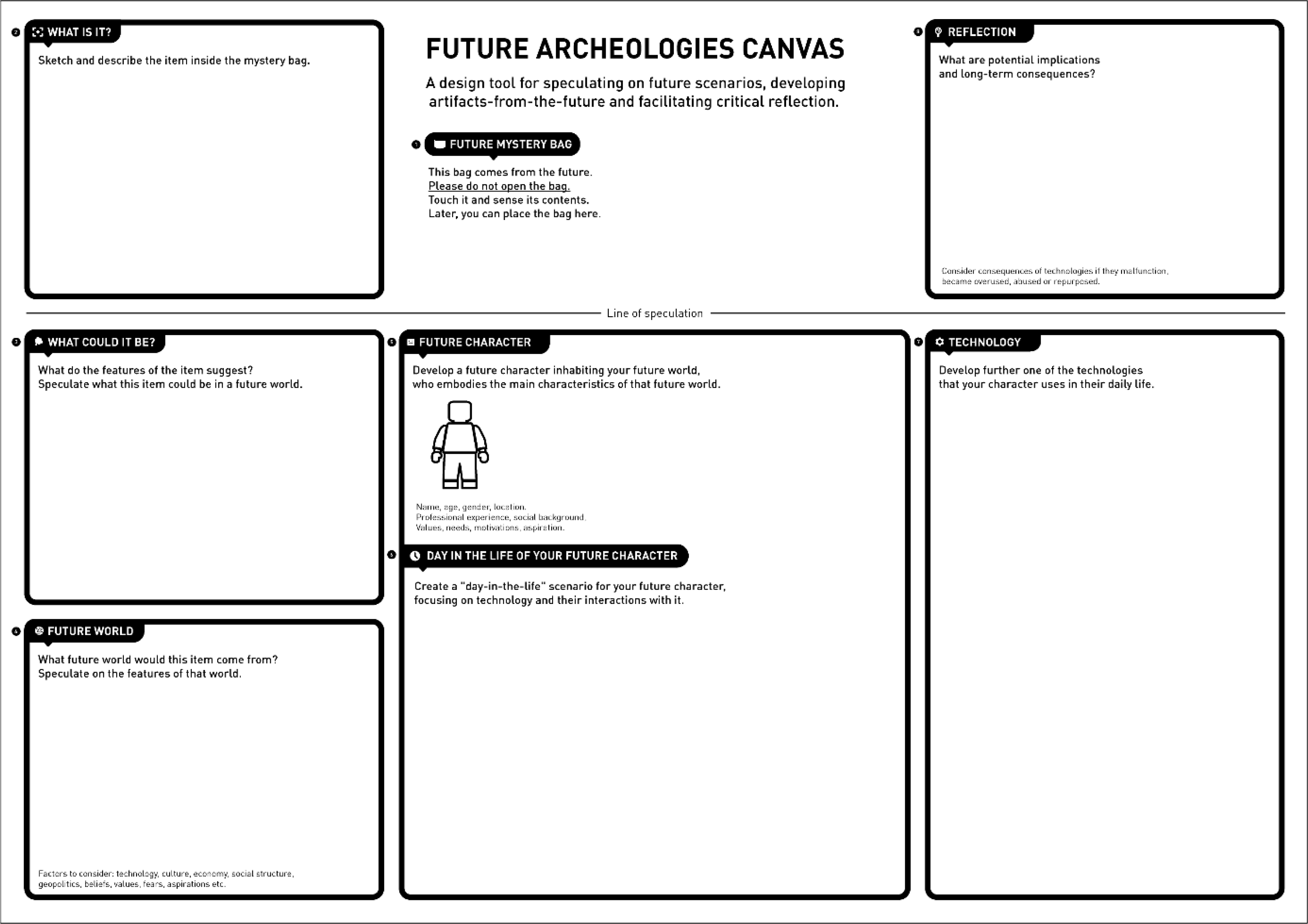
We propose a canvas that consists of eight components that follow a journey format, where each component builds on the previous one. Similarly to Future Archeologies Method, it uses tactile exploration as a starting point. The structure of the canvas encourages engagement through creative and story-telling tasks that simultaneously distinguish between each step through visual separation.
The interaction with the canvas is commenced by an exploration of the FMB, a speculation tool introduced by Reference Maciejko and LecunaMaciejko & Lecuna (2025), that facilitates a subjective engagement with the futures. Later, users build a future scenario following a story-telling approach and conclude with a reflection. The canvas is intended for collaborative teamwork, and we propose a duration of 90–120 minutes, depending on team size and efficiency.
3.1.1. Line of speculation
The visual components are arranged in a U-shape around the Line of Speculation (see Figure 1). The Line of Speculation serves as a metaphorical barrier between the present (section above the Line) and the speculative scenario created by the users (section underneath the Line). It allows to separate the process of initial engagement with the FMB: the tactile exploration and the evaluation of the item inside, from the process of speculation on what these features signify. The Line of Speculation encloses the focus on the FMB itself to that specific moment of engagement, visually and process-wise separating it from the following tasks. Later it allows users to fully immerse themselves in the future scenario that they are creating. At the end of the process, it signifies a return to reality, stepping away from the speculative future and entering a stage of reflection, where users can look at their outcomes and experiences through a perspective of both the futures and the present.
Future Archeologies Canvas

Figure 1 Long description
Panel A: A section titled WHAT IS IT? with instructions to sketch and describe an item inside a mystery bag. Panel B: A section titled FUTURE MYSTERY BAG with instructions to touch and sense the contents of the bag. Panel C: A section titled WHAT COULD IT BE? with instructions to speculate on what the item could be in a future world. Panel D: A section titled FUTURE WORLD with instructions to speculate on the features of the future world the item could come from. Panel E: A section titled FUTURE CHARACTER with instructions to develop a future character inhabiting the future world. Panel F: A section titled DAY IN THE LIFE OF YOUR FUTURE CHARACTER with instructions to create a day-in-the-life scenario for the future character. Panel G: A section titled TECHNOLOGY with instructions to develop one of the technologies that the character uses in their daily life. Panel H: A section titled REFLECTION with instructions to consider the potential implications and long-term consequences of technologies.
3.2. Canvas components
3.2.1. FMB
This bag comes from the future. Please do not open the bag. Touch it and sense its contents.
Following the Future Archeologies Method, the first component of the Future Archeologies Canvas is FMB, a speculative tool described as “a bag containing an unidentifiable item meant to represent future remains” (Reference Maciejko and LecunaMaciejko & Lecuna, 2025, p.6133). The FMB is introduced as speculative remains coming from an unknown future, and the users suspend their disbelief about the bag, accepting it as a true future artefact (Reference TuzetTuzet, 2022). They are encouraged to use active touch to sense the item inside the bag, without being able to see what it truly is.
3.2.2. What is it?
Sketch and describe the item inside the mystery bag.
This component is an extension of the interaction with the FMB. Users can tactilely discover the features of the item, such as shape, weight, texture, and describe or sketch them. However, they should not try to guess what the item is but rather investigate what they can sense.
3.2.3. What could it be?
What do the features of the item suggest? Speculate what this item could be in a future world.
The engagement with the next component crosses the Line of Speculation, where users not only interact with the physical features of the bag but start speculating on what this item could be in a future world. Following the principles of material culture studies (Reference Blandy and BolinBlandy & Bolin, 2012), they try to hypothesise on what specific features of the item inside FMB imply about its possible future origins and use. The goal of this process is to trigger creative and speculative thinking.
3.2.4. Future world
What future world would this item come from? Speculate on the features of that world.
The future world expands beyond the item itself, demanding the users to widen their speculation towards its potential context. It encourages them to imagine what kind of future world such an item would be a part of. The FMB takes on a role of reverse world-hinting (Reference Pilling, Lindley, Akmal and CoultonPilling et al., 2021), which the users can turn into world-building.
3.2.5. Future character
Develop a future character inhabiting your future world, who embodies the main characteristics of that future world.
This component engages users in creating a future character, also referred to as future persona (Reference FergnaniFergnani, 2019). Such a process allows them to create a character that they can empathise with, connecting them to the future world, and being able to embody some of its characteristics through the character.
3.2.6. Day in the life of the future character
Create a “day-in-the-life” scenario for your future character, focusing on technology and their interactions with it.
Creating a day-in-a-life scenario of the character adds a narrative component, further allowing the users to engage and empathise with the future scenario they are creating. The universal nature of daily activities and challenges allows users to connect with the character, despite their personal experiences being set in distinctive worlds. Users are encouraged to include new technologies that the character encounters in their daily life. However, it is important to move away from the contents of the FMB and include new technologies that they speculate to appear in daily future life. Including technology is crucial, as future worlds are always inhabited and influenced by technologies (Reference Hovorka, Thoring and MuellerHovorka et al., 2025).
3.2.7. Technology
Develop further one of the technologies that your character uses in their daily life.
The seventh step, technology, requires users to choose one of the technologies they mentioned in the previous component and develop it further. Sketching and describing the characteristics of their speculative technology are encouraged at this stage.
3.2.8. Reflection
What are potential implications and long-term consequences?
The last component crosses the Line of Speculation again, returning the process to the present, and encourages the users to take a critical look at the technology they created. It asks them to reflect on what would be the potential implications of such technological innovation.
4. Methodology
The Future Archeologies Canvas was designed on the foundations of Future Archeologies Method (Reference Maciejko and LecunaMaciejko & Lecuna, 2025), following the design theory for visual inquiry tools (Reference Avdiji, Elikan, Missonier and PigneurAvdiji et al., 2020). To evaluate the practicality of the canvas, we conducted two workshops. The first workshop took place during a community urban festival and was open to the public. It tested an initial iteration of the canvas. The goal of this workshop was to establish whether a canvas format is understandable by a diverse group of participants, and if it allows them to engage more efficiently with the Future Archeologies Method. Based on the observations from the first workshop, a second iteration of the canvas was created, where the Line of Speculation was added. The second workshop took part during an international specialist futures conference, and its purpose was to observe the impact of the canvas’ design on engaging with future-oriented thinking, speculation and creativity. Results of both workshops were triangulated (participant observation by the facilitators, participant feedback and filled out canvases), compared and analysed thematically, as well as evaluated against workshop goals, including completion of tasks, active participation and insight generation. The outcomes were then used to iteratively improve the canvas and inform further research.
4.1. Workshop one
4.1.1. Workshop one—overview
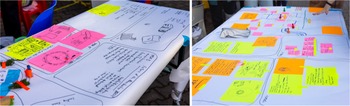
The first workshop was a part of an urban festival themed around an abandoned laboratory facility and its future. The goal was to speculate and prototype diverse, preposterous futures of the facility using the canvas as a guideline of the process. Thirteen participants attended, aged ranging from twenties to seventies and including 61,5% female and 38,5% male participants. They included students (54%), professionals (30%), community members (8%) and local politicians (8%). The workshop lasted four hours and was initiated by a short introduction to design futures. Participants were divided into three groups. Each group received the FMB, introduced as a speculative item found in the facility in an unknown far-future, a large copy of an initial version of the canvas, pens, sticky notes and prototyping materials like paper, cardboard and tape. Prompts for each canvas component were given verbally and participants worked collaboratively. Three researchers facilitated the workshop, two of whom conducted observations and evaluations. They took notes of participants’ behaviour and interaction with the canvas, conducted and documented a verbal feedback session, and evaluated the workshop outcomes.
Workshop one outcomes

4.1.2. Workshop one—observations
Observations from the first workshop confirmed its initial goal. The canvas format helped to facilitate and speed up the process of engaging with Future Archeologies, reducing the time needed to conduct such workshops and allowing participants to smoothly move between workshop stages. The canvas structured the work and, through sequential completion of the boxes, provided participants with a sense of progression and completeness. It also allowed participants from diverse backgrounds, including those with no prior design or futures experience, to engage in futuring and speculating together, bringing both “personal experiences and networking” into scenarios. The canvas played a generative role and engaged participants in new ways of thinking, highlighting the need to lean into the process and let go of initial prejudices. Additional prototyping activities in 7. Technology helped with collaboration and exchange of ideas within the teams. The workshop concluded with the final step, 8. Reflection, which started as a reflection on the implications of the scenario but we observed that the discussion moved towards a critical reflection on participants’ speculation and futures, where they expressed both optimistic (“hopeful for the future”) and doomed (“struggles in the future won’t change”) perspectives. This paradoxical tension proved productive: it facilitated open discussions within teams that allowed team members to exchange narratives, face pessimistic views and open space for alternative, more speculative imaginaries. We observed that moving from engaging with a speculative scenario back to the present encouraged reflection, which later led to the addition of Line of Speculation. The canvas has proven that it allows for certain flexibility and can be used in workshops tailored to specific topics, like the facility used in this session. However, the future scenarios and reflections expressed by the participants went beyond objects of innovations, spreading towards societal, political or ethical questions about the role of the facility and broader future outlooks.
4.2. Workshop two
4.2.1. Workshop two—overview
The second workshop was conducted at an international futures of technologies conference. The focus of the workshop was testing the finalised canvas format, speculating on diverse futures and ideating on future technologies. Twenty-one participants attended, 33,3% male and 66,6% female, including experts, academics and industry members from the fields of foresight, future studies and design futures. Participants worked in five groups and speculated on the futures based solely on the FMB. Each group collaboratively worked with a large copy of the canvas, pens and sticky notes, filling out the boxes with notes and sketches. Participants were able to work through each stage swiftly as they were familiar with the type of the tasks due to their professional backgrounds. The workshop lasted 90 minutes and was facilitated by two researchers, who additionally prompted each component of the canvas. They took notes of participants’ behaviour, interactions with each other and with the canvas. A short survey was conducted at the end of the workshop to gather feedback on how the canvas supported their thinking and collaboration during the process.
Workshop two outcomes

4.2.2. Workshop two—observations
Workshop two tested a second iteration of the Future Archeologies Canvas design. Observations focused on evaluating its conceptual and visual design, structure and components. The canvas allowed to further accelerate the engagement with Future Archeologies. Participants mentioned the structure, flow and the prompts as factors that helped to guide their thinking. We observed that the FMB triggered a playful atmosphere among participants at the beginning of the process due to their first interaction with the tool. The structured design of the canvas (“starting with defining and then speculating”) allowed to channel this atmosphere into a productive focus. Therefore, clear structure rather than impending creativity, allowed to create space for exploration and speculation. The canvas made the process more manageable and engaging, helping explore unfamiliar and novel ideas. It also played a role in facilitating collaboration. Due to the journey-like format, it worked not as a tool for dividing labour between team members, but rather as a platform for exchange of perspectives and shared meaning-making. We observed that team diversity emphasised this effect. The workshop ended with a reflection on the implications and meaning of the scenarios and technologies. Finally, the canvas primarily fostered scenario creation, while the societal and ethical dimensions appeared indirectly, through discussions. This outcome might have been influenced by participants’ professional experience. They admitted that the canvas encouraged them to engage with speculation, storytelling and future character development.
5. Discussion
5.1. The role of line of speculation
Speculating about the future requires one to engage with imagination and ideation (Reference Candy and KornetCandy & Kornet, 2019). This invites the question of where the frontiers of speculation lie and where the futures encounter really begins. In the Future Archeologies Canvas, while the initial encounter with the futures appears through engagement with the FMB, it is the Line of Speculation, both a metaphorical and visual border between the present and the futures, that differentiates between the present engagement with a speculative item and the entering of future worlds. It makes a distinction between the physical features of the FMB that can be felt and the qualities of these features that can be deduced based on our present experiences (e.g. what do we associate with the item being heavy, hard, or having indents). It also distinguishes the speculated role that these qualities imply in a world where any feature can be an absence—a void that does not have to be discovered with a rigorous plausibility for the sake of new scientific discovery, but rather a space that is open for any speculation (Reference Sullivan, Hannon and HovorkaSullivan et al., 2023).
Crossing the Line of Speculation resembles entering the Zone in Reference TarkovskyTarkovsky’s Stalker (1979), an unknown ground where anything is possible, within an internal coherence. In workshop two, this was observed when participants moved from describing the qualities of the object they could feel inside the FMB, to proposing speculative technologies and future contexts beyond present-based interpretation. However, unlike the Zone, futures are inhibited; they require the inclusion of their own techno-culture (Reference Hovorka, Thoring and MuellerHovorka et al., 2025) and signify complex systems in which each aspect of a scenario can lead to its own implications. Such implications are to be explored behind the Line. The return to the present does not dismiss the experience of the speculated future world, the Zone, but rather contributes to the further shaping of the emerging reflection. Thus, the Line of Speculation signifies not only the beginning of the speculation process but also an overarching border between the present and the abstract, which constantly interacts with, influences, and alters the experience of discovery, speculation, and reflection.
5.2. Dual impact of the canvas
Engaging wider audiences in the process of futures speculation comes with its own hardships, which are caused by a certain ungraspability of the futures. As Reference SlaughterSlaughter (2018, p. 444) writes, they “cannot be experienced directly, but only through images, thoughts, feelings and the multiple ways these are subsequently expressed in the outer world”. Future Archeologies Canvas provides a structured yet flexible pathway into this abstract terrain. This allows for a futuring experience that is not only faster, more creative, embodied and collaborative, but also more profound in its philosophical implications. The canvas guided participants from initial interpretations of the FMB to developing speculative future worlds and technologies. At the same time, crossing the Line of Speculation into the reflection component shifted discussions from speculative ideation towards questioning the broader societal and ethical implications of these ideas, encouraging participants to critically examine their assumptions and limitations in imagining the futures. The canvas, expanding on the Future Archeologies Method, facilitates indirect contemplation of how the subjectivity of future perception is reflected in thought processes and decision-making. Therefore, the canvas fulfils a dual role: it is both a generative tool for creating speculative futures and a reflective instrument for revealing the limits of our understanding.
5.2.1. Navigating limits of futures perception
This section delves deeper into the reflective dimension of the canvas, arguing that its primary impact lies in its ability to guide participants toward epistemological boundaries of futuring. By referring to limits of futures perception, we describe the boundaries of what can be known or imagined within existing systems of understanding. Reference VirmajokiVirmajoki (2022) argues that our view of the present restricts our ability to speculate about the future. This is not a failure of imagination but a crucial moment of insight in which the boundaries of our conceptual systems are made visible. We contend that the canvas is a tool for systematically inducing and navigating these limits.
How can we determine when participants have reached or crossed such limits? While conducting the workshops we observed this to happen in the late components under the Line of Speculation, such as 6. Day-in-life Scenario or 7. Technology. In such moments the flow of conversation becomes fragmented or stalls as participants struggle to articulate their ideas or find common ground. Discussions break down, while participants exhaust the limits of their speculative worlds, not realising yet that their scenarios were an embodiment of hidden thoughts, fears and wishes, rather than imaginaries of unthinkable futures. This finding becomes clear in the final step, where participants become aware of the limit of the futures knowledge, allowing this realisation to fuel their discussion as they return to the real. A reflection on their speculative technologies blends with a reflection on the meaning of the entire scenario and the path to that process.
Often in moments of such circular or breaking discussion it is a common belief that teams might not be performing, however, we observed it is precisely then, when participants might be reaching the true potential of the workshop. The canvas, with its structured progression, systematically creates the conditions for emergence of boundaries, which reveal the limits of futures knowledge. The initial encounter with the FMB and the subsequent suspension of disbelief set the stage for a departure from the familiar. The process of building a narrative frame and engaging in creative world inquiry (future world, character, day in the life) further pushes participants into uncharted territory. Finally, collective meaning-making occurs throughout the workshop, but especially during the reflection stage, where these limits are most clearly articulated and negotiated.
6. Conclusion
This paper introduced and evaluated the Future Archeologies Canvas, a visual tool designed to facilitate futures speculation, artefact creation, and critical reflection. By adapting the Future Archeologies Method into a structured canvas and testing it in two workshops, we answered our research question and demonstrated how such a tool can guide participants beyond present-world assumptions and toward limits of futures knowledge. The canvas aims to increase the efficiency and speed of futuring workshops and make them more accessible and collaborative. It incorporates the FMB to trigger speculation and supports both novices and experienced practitioners.
The canvas comprises eight components arranged as a linear journey. Its key feature is the Line of Speculation, separating engagement with the FMB from scenario creation, and critical reflection. Beyond its practical role, the canvas advances theory by showing how participants are systematically guided to their limits of futures perception—the points where existing frameworks fail to grasp speculative futures. Thus, the canvas operates both as a workshop tool and philosophical probe—generative and reflective. By embracing, rather than overcoming these limits, it opens space for unprecedented engagements with the future.
6.1. Limitations and future research
This study has several limitations. The canvas was tested in only two workshops, though the differing themes and participant groups suggest it can be used with both beginners and specialists. Broader testing, especially across cultural contexts and with longitudinal studies, would help assess its lasting impact. Future research should also incorporate more systematic quantitative user feedback to strengthen the empirical validation. Recognising the Line of Speculation as canvas component opens an opportunity to extend its applicability to other futuring processes and environments.
Long-term studies might also explore whether encounters with limits of futures knowledge shift participants’ approaches to uncertainty and complexity. Investigating the reflection component could help navigate how such limits are reached within the canvas. Further research could develop a framework for identifying limits of futures perception and a typology of accompanying phenomena. This would require further observations and could refine ways of capturing these moments—through video analysis, physiological measures, or post-workshop interviews probing perspective shifts.
Finally, future research should address pedagogical implications: how design education can cultivate engagement with limits of futures perception, how the canvas might prepare designers to navigate uncertainty and how senses beyond touch can shape how future scenarios are imagined and experienced. Beyond design, such tools could inform policy, strategy, and organizational development, offering ways to confront complex global challenges.


 Open access

