




Russell [Reference Russell and Marsh26, Reference Russell and Marsh27], as well as Wittgenstein [Reference Wittgenstein and Oswald31] in the famous Tractatus, defended versions of logical atomism. It is not a straightforward matter to explain exactly what logical atomism amounts to, in part because Russell’s and Wittgenstein’s views changed over time, and differ in various ways from each other. One idea which is central to many versions of logical atomism is the claim that there is a special class of mutually independent elementary propositions (sometimes also called atomic) from which all others can be obtained using truth-functional operations. In the Tractatus we find this idea expressed in several different ways which are not obviously equivalent. In this paper we focus on three different ideas, formally regiment them, and draw out the connections between them. Russell may have held a version of these theses as well at some point, but his most explicit developments of logical atomism in [Reference Russell and Marsh26, Reference Russell and Marsh27] arguably contradict the pure picture found in the Tractatus.
According to one conception in the Tractatus, the elementary propositions can obtain or not obtain independently of one another, and every proposition can be built from elementary propositions using successive applications of one basic truth-functional operation. Wittgenstein labels this operation N; it is the truth-function whose value is the conjunction of the negations of its arguments. These ideas are expressed in the following quotes, taken from the translation by Pears and McGuinness [Reference Wittgenstein32], with decimal numbers here and in the following referring to the numbering of statements in the Tractatus.
-
“Each item [i.e. elementary proposition] can be the case or not the case while everything else remains the same” (1.21; see also 2.061, 4.211, 4.27, 5.134, 6.3751)
-
“[…] every proposition is a result of successive applications to elementary propositions of the operation $N(\bar {\xi })$
.” (6.001)
$N(\bar {\xi })$
.” (6.001)

We will call this first idea independent generation.
Another way to get at this idea of the elementary propositions as independently and completely describing reality employs the key idea of truth tables found in the Tractatus. The independence of the elementary propositions is expressed by saying that any possible assignment of truth values to the elementary propositions is possible, and their completeness by saying that once the truth values of the elementary propositions have been fixed, the truth values of all propositions are also fixed. These ideas can be found in the following passages:
-
“There correspond to these combinations the same number of possibilities [i.e.
$2^n$
] of truth – and falsity – for n elementary propositions.” (4.28) -
“The world is completely described by giving all elementary propositions, and adding which of them are true and which false.” (4.26)

We will call this second idea free generation, due to connections with the algebraic notion of freeness which we discuss below.
A third idea we can extract from the Tractatus is that every proposition can be decomposed into a unique truth-functional operation applied to the elementary propositions. This thought is contained in the following quotes:
-
“All propositions are the results of truth-operations on elementary propositions” (5.3; see also 4.51, 5)
-
“[…] the results of truth-operations on truth-functions are always identical whenever they are one and the same truth-function of the elementary propositions.” (5.41; see also 3.25)
We refer to this third idea as unique decomposition.
The aim of this paper is systematic, rather than historical. We therefore focus on exploring the various formalizations only from a mathematical standpoint, and won’t consider to what extent various views are plausibly ascribed to the primary sources on logical atomism. However, for readers interested in a comparison between various further claims discussed in the following and relevant passages in the Tractatus, we include references to the latter using its decimal notation below.
1 Boolean algebras
We work in an algebraic framework, assuming that propositions form a Boolean algebra (cf. 4.465, 5.41). That is, propositions are objects and form a set, and truth-functional operations like negation and conjunction can be understood as functions on this set. Before stating the conditions which Boolean algebras impose on these functions, we should note that the algebraic approach is not our preferred way of regimenting talk of propositions. We prefer to use higher-order quantifiers, in particular so-called propositional quantifiers, i.e., quantifiers binding variables in the position of sentences. For more on this, see Fritz and Jones [Reference Fritz and Jones11], Fritz [Reference Fritz10], and Bacon [Reference Bacon2]. We follow the algebraic approach here for a number of reasons. First, most existing formal regimentations of logical atomism, such as Skyrms [Reference Skyrms28], are couched in algebraic terms. Second, it is interesting to consider alternative approaches to formalization, to understand the import of the choice of framework on the resulting views. Third, the algebraic results here can be used in an instrumental capacity for investigations in terms of higher-order logic, since algebraic structures can be extended in natural ways to models of higher-order logic.
Boolean algebras can be defined in a number of ways. For present purposes, a natural way of doing so requires a Boolean algebra to be a structure $\langle A,-,\wedge \rangle $
, where A is a non-empty set,
$\langle A,-,\wedge \rangle $
, where A is a non-empty set, $-$
is a function from A to A, and
$-$
is a function from A to A, and $\wedge $
is a function from
$\wedge $
is a function from $A\times A$
to A. We adopt the convention of denoting such an algebra using the Gothic letter corresponding to the Roman letter used to denote the underlying set. So,
$A\times A$
to A. We adopt the convention of denoting such an algebra using the Gothic letter corresponding to the Roman letter used to denote the underlying set. So, $\langle A,-,\wedge \rangle $
is denoted by
$\langle A,-,\wedge \rangle $
is denoted by $\mathfrak {A}$
. When dealing with multiple algebras, we sometimes disambiguate between the operations belonging to different algebras by adding the algebra as an index, writing, e.g.,
$\mathfrak {A}$
. When dealing with multiple algebras, we sometimes disambiguate between the operations belonging to different algebras by adding the algebra as an index, writing, e.g., $ - _\mathfrak{A}$
and
$ - _\mathfrak{A}$
and $\wedge _{\mathfrak {A}}$
, and similarly with various defined operations introduced below. In the present context, we can think of A as the set of propositions. We can correspondingly think of
$\wedge _{\mathfrak {A}}$
, and similarly with various defined operations introduced below. In the present context, we can think of A as the set of propositions. We can correspondingly think of $-$
as negation, which is identified with the function which maps every proposition to its negation. Analogously, we can think of
$-$
as negation, which is identified with the function which maps every proposition to its negation. Analogously, we can think of $\wedge $
as conjunction, which maps any pair of propositions to their conjunction.
$\wedge $
as conjunction, which maps any pair of propositions to their conjunction. $\langle A,-,\wedge \rangle $
is a Boolean algebra just in case any two truth-conditionally equivalent terms denote the same element. This requires some unpacking. First, from terms “x,” “y,” “z,” …denoting elements of A, we can construct terms, such as “
$\langle A,-,\wedge \rangle $
is a Boolean algebra just in case any two truth-conditionally equivalent terms denote the same element. This requires some unpacking. First, from terms “x,” “y,” “z,” …denoting elements of A, we can construct terms, such as “ $-x$
,” “
$-x$
,” “ $x\wedge y$
,” and “
$x\wedge y$
,” and “ $(x\wedge y)\wedge -z$
,” using the symbols denoting the operations of the algebra and parentheses. Second, these terms can be understood as formulas of propositional logic with primitive logical connectives for negation and conjunction. Third, let two of these terms be truth-functionally equivalent just in case they are provably equivalent in classical propositional logic. So, the condition characterizing Boolean algebras given above requires x and
$(x\wedge y)\wedge -z$
,” using the symbols denoting the operations of the algebra and parentheses. Second, these terms can be understood as formulas of propositional logic with primitive logical connectives for negation and conjunction. Third, let two of these terms be truth-functionally equivalent just in case they are provably equivalent in classical propositional logic. So, the condition characterizing Boolean algebras given above requires x and $-x$
, for example, to denote the same element, since x and
$-x$
, for example, to denote the same element, since x and $-x$
, understood as formulas of propositional logic, are classically equivalent. We can therefore think of the assumption that propositions form a Boolean algebra as capturing the idea that formulas which are provably equivalent in classical propositional logic express the same proposition.
$-x$
, understood as formulas of propositional logic, are classically equivalent. We can therefore think of the assumption that propositions form a Boolean algebra as capturing the idea that formulas which are provably equivalent in classical propositional logic express the same proposition.
The assumption that propositions form a Boolean algebra also justifies the omission of other truth-functional operations, such as disjunction, in Boolean algebras. If truth-functionally equivalent terms express the same proposition, then every term truth-functionally equivalent to a disjunction denotes the same proposition as the disjunction. For example,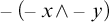 $-(-x\wedge -y)$
can be assumed to be the disjunction of x and y. Consequently, we can define, for any given Boolean algebra, a function
$-(-x\wedge -y)$
can be assumed to be the disjunction of x and y. Consequently, we can define, for any given Boolean algebra, a function $\vee $
mapping any x and y to
$\vee $
mapping any x and y to $-(-x\wedge -y)$
, and similarly for the other Boolean connectives, such as
$-(-x\wedge -y)$
, and similarly for the other Boolean connectives, such as $\to $
and
$\to $
and $\leftrightarrow $
. Along these lines, we could also have taken, e.g.,
$\leftrightarrow $
. Along these lines, we could also have taken, e.g., $-$
and
$-$
and $\vee $
as primitive in the definition of Boolean algebras, instead of
$\vee $
as primitive in the definition of Boolean algebras, instead of $-$
and
$-$
and $\wedge $
, or, to stay closer to the Tractatus, we could have used Wittgenstein’s N. Such variations in the definition of Boolean algebras are mathematically insubstantial.
$\wedge $
, or, to stay closer to the Tractatus, we could have used Wittgenstein’s N. Such variations in the definition of Boolean algebras are mathematically insubstantial.
The definition of Boolean algebras outlined so far effectively uses an infinite set of equations. Various of its finite subsets would suffice for the purposes of the definition. In the mathematical literature, this is how Boolean algebras are often defined. There, Boolean algebras are also often defined as structures with some of the further operators which we noted to be definable in terms of $-$
and
$-$
and $\wedge $
. A common choice is to let an algebra be a structure
$\wedge $
. A common choice is to let an algebra be a structure $\langle A,\wedge ,\vee ,-,\bot ,\top \rangle $
, with
$\langle A,\wedge ,\vee ,-,\bot ,\top \rangle $
, with $\wedge $
and
$\wedge $
and $\vee $
binary,
$\vee $
binary, $-$
unary, and
$-$
unary, and $\bot $
and
$\bot $
and $\top $
nullary. One can then define a Boolean algebra using a finite set of equations, for example, by defining them as distributive, bounded, and complemented lattices. The details of this won’t be important in the following; they can be found in standard textbooks dealing with Boolean algebras, such as Davey and Priestley [Reference Davey and Priestley8], Givant and Halmos [Reference Givant and Halmos13], and Koppelberg [Reference Koppelberg, Monk and Bonnet17]. We will now also see another version of this equivalence, considering lattices as certain partial orders, rather than algebraic structures.
$\top $
nullary. One can then define a Boolean algebra using a finite set of equations, for example, by defining them as distributive, bounded, and complemented lattices. The details of this won’t be important in the following; they can be found in standard textbooks dealing with Boolean algebras, such as Davey and Priestley [Reference Davey and Priestley8], Givant and Halmos [Reference Givant and Halmos13], and Koppelberg [Reference Koppelberg, Monk and Bonnet17]. We will now also see another version of this equivalence, considering lattices as certain partial orders, rather than algebraic structures.
At various points, we will appeal to an order $\leq $
which can be associated with every Boolean algebra
$\leq $
which can be associated with every Boolean algebra $\langle A,-,\wedge \rangle $
, by letting
$\langle A,-,\wedge \rangle $
, by letting $x\leq y$
just in case
$x\leq y$
just in case $x\wedge y$
is x, for all x and y.
$x\wedge y$
is x, for all x and y. $\leq $
is a partial order, which means that it is reflexive on A, transitive, and antisymmetric. We will also appeal to a number of standard notions concerning partial orders. First, to every partial order
$\leq $
is a partial order, which means that it is reflexive on A, transitive, and antisymmetric. We will also appeal to a number of standard notions concerning partial orders. First, to every partial order $\leq $
, there corresponds a strict order
$\leq $
, there corresponds a strict order $<$
, where
$<$
, where $x<y$
just in case
$x<y$
just in case $x\leq y$
and
$x\leq y$
and $x\neq y$
. Further, in a partial order
$x\neq y$
. Further, in a partial order $\leq $
, x is a lower bound of
$\leq $
, x is a lower bound of $Y\subseteq A$
if
$Y\subseteq A$
if $x\leq y$
for all
$x\leq y$
for all $y\in Y$
; x is an upper bound of Y if
$y\in Y$
; x is an upper bound of Y if $y\leq x$
for all
$y\leq x$
for all $y\in Y$
. x is a greatest lower bound of Y if x is a lower bound of Y and
$y\in Y$
. x is a greatest lower bound of Y if x is a lower bound of Y and $z\leq x$
for every lower bound z of Y; x is a least upper bound of Y if x is an upper bound of Y and
$z\leq x$
for every lower bound z of Y; x is a least upper bound of Y if x is an upper bound of Y and $x\leq z$
for every upper bound z of Y. In a partial order, the greatest lower bound of a set Y, if it exists, is unique, and denoted by
$x\leq z$
for every upper bound z of Y. In a partial order, the greatest lower bound of a set Y, if it exists, is unique, and denoted by $\bigwedge Y$
; correspondingly, the least upper bound of a set Y, if it exists, is unique, and denoted by
$\bigwedge Y$
; correspondingly, the least upper bound of a set Y, if it exists, is unique, and denoted by $\bigvee Y$
.
$\bigvee Y$
.
Let $\langle A,-,\wedge \rangle $
be a Boolean algebra, and
$\langle A,-,\wedge \rangle $
be a Boolean algebra, and $\leq $
the corresponding order. As the notation suggests, if
$\leq $
the corresponding order. As the notation suggests, if $Y=\{x,y\}$
, then
$Y=\{x,y\}$
, then $x\wedge y$
is
$x\wedge y$
is $\bigwedge Y$
, and
$\bigwedge Y$
, and $x\vee y$
is
$x\vee y$
is $\bigvee Y$
. This means that every two-element set
$\bigvee Y$
. This means that every two-element set $\{x,y\}$
has a greatest lower bound and a least upper bound. A partial order satisfying this further constraint is called a lattice. Furthermore, a lattice
$\{x,y\}$
has a greatest lower bound and a least upper bound. A partial order satisfying this further constraint is called a lattice. Furthermore, a lattice $\leq $
is bounded if there are elements
$\leq $
is bounded if there are elements $\bot $
and
$\bot $
and $\top $
such that for all x,
$\top $
such that for all x, $\bot \leq x\leq \top $
. (
$\bot \leq x\leq \top $
. ( $\bot $
and
$\bot $
and $\top $
are also called
$\top $
are also called $0$
and
$0$
and $1$
, respectively. Consequently, an element is called non-zero if it is distinct from
$1$
, respectively. Consequently, an element is called non-zero if it is distinct from $0$
, i.e.,
$0$
, i.e., $\bot $
.) If
$\bot $
.) If $\leq $
is the order derived from a Boolean algebra, it is bounded: we can take
$\leq $
is the order derived from a Boolean algebra, it is bounded: we can take $\bot $
to be
$\bot $
to be $x\wedge -x$
, and
$x\wedge -x$
, and $\top $
to be
$\top $
to be $x\vee -x$
, for any
$x\vee -x$
, for any $x\in A$
. Finally, a bounded lattice is complemented if every element x has a complement, i.e., an element y such that
$x\in A$
. Finally, a bounded lattice is complemented if every element x has a complement, i.e., an element y such that $x\wedge y=\bot $
and
$x\wedge y=\bot $
and $x\vee y=\top $
. If
$x\vee y=\top $
. If $\leq $
is the order derived from a Boolean algebra, it is also complemented: every
$\leq $
is the order derived from a Boolean algebra, it is also complemented: every $x\in A$
has a complement, namely,
$x\in A$
has a complement, namely, $-x$
.
$-x$
.
Although this won’t be essential in the following—and so readers may skip this paragraph without loss of continuity—it is worth noting that in a certain sense, Boolean algebras can also be defined as certain partial orders. First, the order $\leq $
associated with a given Boolean algebra satisfies one further property, of being distributive, which requires that
$\leq $
associated with a given Boolean algebra satisfies one further property, of being distributive, which requires that $x\wedge (y\vee z)$
is
$x\wedge (y\vee z)$
is $(x\wedge y)\vee (x\wedge z)$
, for all x, y, and z. So, such an order
$(x\wedge y)\vee (x\wedge z)$
, for all x, y, and z. So, such an order $\leq $
is always a complemented distributive lattice. In such a lattice, complements are unique. Thus, we can recover
$\leq $
is always a complemented distributive lattice. In such a lattice, complements are unique. Thus, we can recover $-$
as the function mapping every element to its complement, and
$-$
as the function mapping every element to its complement, and $\wedge $
as the function mapping any set
$\wedge $
as the function mapping any set $\{x,y\}$
to its greatest lower bounds. Thus, every Boolean algebra
$\{x,y\}$
to its greatest lower bounds. Thus, every Boolean algebra $\langle A,-,\wedge \rangle $
uniquely determines a complemented distributive lattice
$\langle A,-,\wedge \rangle $
uniquely determines a complemented distributive lattice $\leq $
, from which we can recover all the components of the original Boolean algebra. Finally, whenever
$\leq $
, from which we can recover all the components of the original Boolean algebra. Finally, whenever $\leq $
is a complemented distributive lattice, the underlying set A, together with the complementation function
$\leq $
is a complemented distributive lattice, the underlying set A, together with the complementation function $-$
and greatest lower bound function
$-$
and greatest lower bound function $\wedge $
form a Boolean algebra. Along these lines, Boolean algebras as defined here correspond bijectively to complemented distributive lattices. In this sense, Boolean algebras could also be defined as complemented distributive lattices.
$\wedge $
form a Boolean algebra. Along these lines, Boolean algebras as defined here correspond bijectively to complemented distributive lattices. In this sense, Boolean algebras could also be defined as complemented distributive lattices.
2 Regimenting logical atomism
Let us assume that propositions form a Boolean algebra. Different reasons can be given for this. Our own reasons for finding this an attractive option have to do with the prospects for more general theories of propositions, properties, and relations as articulated in higher-order logic. Among those theories, we find those which include (what corresponds to) the equations of Boolean algebras especially compelling (see Fritz [Reference Fritz9] and Bacon and Dorr [Reference Bacon, Dorr, Fritz and Jones3] for further discussion). Assuming, for mathematical tractability, that we can apply the standard mathematical framework of abstract algebra to such a theory leads us to working with Boolean algebras. Logical atomism could of course also be investigated in other settings, such as other classes of algebras, but doing so is beyond the scope of the present paper.
If $\langle A,-,\wedge \rangle $
is the Boolean algebra of propositions, the elementary propositions should form a set
$\langle A,-,\wedge \rangle $
is the Boolean algebra of propositions, the elementary propositions should form a set $E\subseteq A$
. We may then attempt to formalize the Tractarian theses discussed above. First, what algebraic conditions must elementary propositions satisfy that captures their independence? We considered three related ideas: that the elementary propositions be logically independent, that any assignment of truth values to the elementary propositions should be consistent, and that no proposition can be decomposed into the elementary propositions and a truth-functional connective in more than one way. Second, what does it mean that every proposition can be made out of the elementary propositions? Again, there are three expressions of this idea in the Tractatus: that every proposition is eventually reached by successive applications of conjunction and negation to the elementary propositions, that the assignments of truth values to elementary propositions fixes the truth values of all propositions, and that every proposition can be decomposed into at least one truth-functional connective applied to the elementary propositions. These are the three general approaches to answering these questions. By considering slight variations on each idea, they will lead us to nine conditions on a subset E of a Boolean algebra.
$E\subseteq A$
. We may then attempt to formalize the Tractarian theses discussed above. First, what algebraic conditions must elementary propositions satisfy that captures their independence? We considered three related ideas: that the elementary propositions be logically independent, that any assignment of truth values to the elementary propositions should be consistent, and that no proposition can be decomposed into the elementary propositions and a truth-functional connective in more than one way. Second, what does it mean that every proposition can be made out of the elementary propositions? Again, there are three expressions of this idea in the Tractatus: that every proposition is eventually reached by successive applications of conjunction and negation to the elementary propositions, that the assignments of truth values to elementary propositions fixes the truth values of all propositions, and that every proposition can be decomposed into at least one truth-functional connective applied to the elementary propositions. These are the three general approaches to answering these questions. By considering slight variations on each idea, they will lead us to nine conditions on a subset E of a Boolean algebra.
2.1 Independent generation
According to the first approach, the crucial feature of elementary propositions is that they are logically independent. Informally, logical independence means that for any distinct elementary propositions $e_1,\dots ,e_{n+m}$
, it is consistent for
$e_1,\dots ,e_{n+m}$
, it is consistent for $e_1,\dots ,e_n$
to be true, and for
$e_1,\dots ,e_n$
to be true, and for $e_{n+1},\dots ,e_{n+m}$
to be false. That is, the conjunction of
$e_{n+1},\dots ,e_{n+m}$
to be false. That is, the conjunction of $e_1,\dots ,e_n$
with the negations of
$e_1,\dots ,e_n$
with the negations of $e_{n+1},\dots ,e_{n+m}$
is non-zero (i.e., distinct from
$e_{n+1},\dots ,e_{n+m}$
is non-zero (i.e., distinct from $0$
). Algebraically, this is known as being independent. A useful way of defining this is as follows (in the context of a given Boolean algebra, left implicit).
$0$
). Algebraically, this is known as being independent. A useful way of defining this is as follows (in the context of a given Boolean algebra, left implicit).
Definition 2.1.
D is a finite description based on E, written $D\vartriangleleft _\omega E$
, if
$D\vartriangleleft _\omega E$
, if $D=T\cup \{-f:f\in F\}$
for disjoint finite sets
$D=T\cup \{-f:f\in F\}$
for disjoint finite sets $T,F\subseteq E$
. E is independent if
$T,F\subseteq E$
. E is independent if $\bigwedge D>\bot $
for every
$\bigwedge D>\bot $
for every $D\vartriangleleft _\omega E$
.
$D\vartriangleleft _\omega E$
.
In this definition, T and F may be empty. To see the effect this has, note that $\bigwedge \emptyset =\top $
. So, this special case of the condition requires the underlying algebra to be non-trivial, where a Boolean algebra is trivial if it has just one element. If the underlying algebra is non-trivial, this special case of the condition does not impose any further requirements.
$\bigwedge \emptyset =\top $
. So, this special case of the condition requires the underlying algebra to be non-trivial, where a Boolean algebra is trivial if it has just one element. If the underlying algebra is non-trivial, this special case of the condition does not impose any further requirements.
Other regimentations of independence could be proposed, but in our setting of Boolean algebras, arguably all of the most natural options coincide. Partly, this claim is substantiated by our observations in §2.4. Correspondingly, Humberstone [Reference Humberstone15] notes that in classical logic, the most natural ways of defining the notion of formulas being independent also coincide. However, as Humberstone notes, the situation becomes more complicated when we consider non-classical logics, such as intuitionistic logic. Correspondingly, if we worked with, say, Heyting algebras rather than Boolean algebras, we would need to think more carefully about the notion of independence. Different notions of independence in wider classes of algebras have been investigated; for recent discussion with further references, see Metcalfe and Tokuda [Reference Metcalfe, Tokuda, Bezhanishvili, Iemhoff and Yang19]. See also Humberstone [Reference Humberstone15, p. 195] for discussion of independence in the context of logical atomism, including many further references. Since we restrict ourselves to working in Boolean algebras, we can restrict ourselves to the notion of independence which is standard in mathematical work on Boolean algebras.
It is important to be clear that logical independence is not a way of characterizing elementarity algebraically, since typically, there are multiple independent sets whose union is not independent. In fact, this holds for every non-trivial Boolean algebra. Up to isomorphism, there is only one trivial Boolean algebra, which we call $\mathbf {1}$
. For any other Boolean algebra, every element is distinct from its complement. Thus, for any element x,
$\mathbf {1}$
. For any other Boolean algebra, every element is distinct from its complement. Thus, for any element x, $\{x\}$
and
$\{x\}$
and $\{-x\}$
are distinct and independent, but
$\{-x\}$
are distinct and independent, but $\{x,-x\}$
is not independent. Consequently, independence is only an algebraic requirement of elementarity, not a characterization of it.
$\{x,-x\}$
is not independent. Consequently, independence is only an algebraic requirement of elementarity, not a characterization of it.
Assuming an independent set E of elementary propositions, there is a straightforward way of making sense of the claim that every proposition is eventually reached from E by successive applications of conjunction and negation. We can define a sequence of sets $E_0\subseteq E_1\subseteq E_2\subseteq \dots $
, starting from
$E_0\subseteq E_1\subseteq E_2\subseteq \dots $
, starting from $E_0=E$
, where
$E_0=E$
, where $E_{n+1}$
contains just the negations and conjunctions of elements of
$E_{n+1}$
contains just the negations and conjunctions of elements of $E_n$
. We can then characterize the propositions which can be obtained from elements of E using truth-functional operations as the union of
$E_n$
. We can then characterize the propositions which can be obtained from elements of E using truth-functional operations as the union of $E_0,E_1,E_2,\dots $
. More formally, we can define
$E_0,E_1,E_2,\dots $
. More formally, we can define
 $$ \begin{align*} E_0&:=E\\ E_{n+1}&:=\{-x:x\in E_n\}\cup\{y\wedge z:y,z\in E_n\}\\ E_\omega&:=\bigcup_{n\in\mathbb{N}}E_n. \end{align*} $$
To say that every proposition is obtained by successive applications of conjunction and negation to elements of E is therefore naturally formalized by requiring $E_\omega $
to contain every element of A. In algebraic terminology, this requires E to generate
$E_\omega $
to contain every element of A. In algebraic terminology, this requires E to generate $\mathfrak {A}$
. It will be useful to introduce an alternative way of stating this requirement, which is equivalent to the one just stated. It uses the notion of a subalgebra. A subalgebra of a Boolean algebra
$\mathfrak {A}$
. It will be useful to introduce an alternative way of stating this requirement, which is equivalent to the one just stated. It uses the notion of a subalgebra. A subalgebra of a Boolean algebra $\langle A,-,\wedge \rangle $
is a Boolean algebra
$\langle A,-,\wedge \rangle $
is a Boolean algebra $\mathfrak {B}$
based on a subset B of A, such that the operations of
$\mathfrak {B}$
based on a subset B of A, such that the operations of $\mathfrak {B}$
are obtained by restricting the operations of
$\mathfrak {B}$
are obtained by restricting the operations of $\mathfrak {A}$
to B. A subalgebra
$\mathfrak {A}$
to B. A subalgebra $\mathfrak {B}$
of
$\mathfrak {B}$
of $\mathfrak {A}$
is a proper subalgebra of
$\mathfrak {A}$
is a proper subalgebra of $\mathfrak {A}$
if it is distinct from
$\mathfrak {A}$
if it is distinct from $\mathfrak {A}$
. The intersection of any non-empty set of subalgebras of
$\mathfrak {A}$
. The intersection of any non-empty set of subalgebras of $\mathfrak {A}$
is itself a subalgebra of
$\mathfrak {A}$
is itself a subalgebra of $\mathfrak {A}$
: for any such set S, the elements contained in every member of S are closed under the operations, and so form a subalgebra themselves. It follows that for a given set
$\mathfrak {A}$
: for any such set S, the elements contained in every member of S are closed under the operations, and so form a subalgebra themselves. It follows that for a given set $E\subseteq A$
, the subalgebras which include E are closed under intersection, and so contain a smallest element. This is the intersection of all subalgebras including E. It can be shown that its underlying set is just
$E\subseteq A$
, the subalgebras which include E are closed under intersection, and so contain a smallest element. This is the intersection of all subalgebras including E. It can be shown that its underlying set is just $E_\omega $
. We can therefore define:
$E_\omega $
. We can therefore define:
Definition 2.2. $E\subseteq A$
generates
$E\subseteq A$
generates $\mathfrak {A}$
if the smallest subalgebra of
$\mathfrak {A}$
if the smallest subalgebra of $\mathfrak {A}$
including E is
$\mathfrak {A}$
including E is $\mathfrak {A}$
itself.
$\mathfrak {A}$
itself.
The first way of regimenting logical atomism therefore requires the elementary propositions E to be independent and to generate the algebra of all propositions. We introduce an obvious label for this notion.
Definition 2.3. $E\subseteq A$
independently generates
$E\subseteq A$
independently generates $\mathfrak {A}$
if E is independent, and generates
$\mathfrak {A}$
if E is independent, and generates $\mathfrak {A}$
.
$\mathfrak {A}$
.
As in the case of independence, a set $E\subseteq A$
which independently generates
$E\subseteq A$
which independently generates $\mathfrak {A}$
does not in general do so uniquely. We return to this point in more detail in §2.4 below.
$\mathfrak {A}$
does not in general do so uniquely. We return to this point in more detail in §2.4 below.
2.2 Free generation
The second way of regimenting logical atomism draws on another Tractarian idea, implicit in Wittgenstein’s use of truth tables (cf. 4.442, 5.101). Here the idea that the elementary propositions are logically independent of one another is spelled out in terms of truth value assignments: any way of assigning truth values to the elementary propositions is coherent, in the sense that it extends to an assignment of truth values to all propositions that is well-behaved with respect to the truth-functional connectives; e.g., it maps a conjunction to true if and only if it maps both conjuncts to true. The idea that every proposition can be made from the elementary propositions using the truth-functional operations can be stated in similar terms. For if any given proposition is a truth-functional combination of elementary propositions, then its truth value is completely determined by the truth values of the elementary propositions. That is to say, there cannot be two different ways of coherently extending an assignment of truth values to the elementary propositions to all of the propositions.
The concepts appealed to here are reminiscent of the concept of a truth value assignment and valuation found in propositional logic, with elementary propositions playing the role of sentence letters, so we shall repurpose those terms. First, note that up to isomorphism, there is a unique two-element Boolean algebra, which we will call $\mathbf {2}$
. As a model of propositions, we can think of this as identifying propositions with truth values: the top element
$\mathbf {2}$
. As a model of propositions, we can think of this as identifying propositions with truth values: the top element $\top $
is the truth value true, and the bottom element
$\top $
is the truth value true, and the bottom element $\bot $
is the truth value false. The behaviour of
$\bot $
is the truth value false. The behaviour of $-$
and
$-$
and $\wedge $
conforms to the classical truth tables for negation and conjunction. For mathematical convenience, we identify
$\wedge $
conforms to the classical truth tables for negation and conjunction. For mathematical convenience, we identify $\bot $
with
$\bot $
with $0$
and
$0$
and $\top $
with
$\top $
with $1$
; by the von Neumann definition of ordinals, it follows that
$1$
; by the von Neumann definition of ordinals, it follows that $2=\{0,1\}=\{\bot ,\top \}$
. A truth value assignment is then a mapping
$2=\{0,1\}=\{\bot ,\top \}$
. A truth value assignment is then a mapping $f:E\to 2$
. A valuation is a mapping
$f:E\to 2$
. A valuation is a mapping $v:A \to 2$
which respects the truth-functional operations, i.e., such that for all
$v:A \to 2$
which respects the truth-functional operations, i.e., such that for all $x,y,z\in A$
:
$x,y,z\in A$
:
-
(i)
$v(-_{\mathfrak {A}}x)=-_{\mathbf {2}}v(x)$
, and -
(ii)
$v(y\wedge _{\mathfrak {A}}z)=v(y)\wedge _{\mathbf {2}}v(z)$
.


We say a valuation $v$
extends f when
$v$
extends f when $v(x)=f(x)$
for all
$v(x)=f(x)$
for all $x\in E$
.
$x\in E$
.
Definition 2.4. $E\subseteq A$
freely generates
$E\subseteq A$
freely generates $\mathfrak {A}$
with respect to valuations if every truth value assignment
$\mathfrak {A}$
with respect to valuations if every truth value assignment $f:E\to 2$
extends to a unique valuation
$f:E\to 2$
extends to a unique valuation $\hat {f}:A\to 2$
.
$\hat {f}:A\to 2$
.
Observe that being freely generated with respect to valuations imposes a non-trivial condition on the granularity of propositions. Propositions must be fine-grained enough to support a well-defined notion of evaluating the truth value of a proposition in terms of the truth values of its elementary components. This seems to require propositions at least be structured enough to have a well-defined notion of elementary component. (Indeed, in the next section we will make this granularity thesis precise; that all propositions have a decomposition into a unique truth-functional connective applied to the elementary propositions.) Not every Boolean algebra is like this—for instance, we will shortly see that no eight element Boolean algebra is freely generated with respect to valuations by any set of its elements.
The Tractarian picture of propositions as built up from elementary propositions suggests that a wider class of structure-sensitive operations should be well-defined. Consider, now, the operation of taking a proposition—thought of as a truth-functional combination of elementary propositions—and uniformly replacing each elementary constituent with other propositions. This is the “metaphysical” analogue of the operation of substituting the letters of a propositional formula with other formulas, so we might similarly repurpose the word “substitution.” If this notion is well-defined, then any function $f:E\to A$
mapping elementary propositions to propositions should extend uniquely to a substitution
$f:E\to A$
mapping elementary propositions to propositions should extend uniquely to a substitution $\hat {f}:A\to A$
that informally may be thought of as taking a proposition
$\hat {f}:A\to A$
that informally may be thought of as taking a proposition $x\in A$
and replacing the elementary components according to f, leaving the truth-functional operations in place. It is clear, given this informal idea of leaving the truth-functional operations “in place,” that substitutions should commute with the truth-functional connectives, i.e., such that for all
$x\in A$
and replacing the elementary components according to f, leaving the truth-functional operations in place. It is clear, given this informal idea of leaving the truth-functional operations “in place,” that substitutions should commute with the truth-functional connectives, i.e., such that for all $x,y,z\in A$
:
$x,y,z\in A$
:
-
(i)
$f(-x)=-f(x)$
, and -
(ii)
$f(y\wedge z)=f(y)\wedge f(z)$
.


We take these equations as our definition of a substitution. The extendability of functions from E to A to unique substitutions seems, intuitively, to subsume the previous condition: truth value assignments can be identified with functions $f:A\to A$
that only take on two values,
$f:A\to A$
that only take on two values, $\top $
and
$\top $
and $\bot $
.
$\bot $
.
Definition 2.5. $E\subseteq A$
freely generates
$E\subseteq A$
freely generates $\mathfrak {A}$
with respect to substitutions if every function
$\mathfrak {A}$
with respect to substitutions if every function $f:E\to A$
extends to a unique substitution
$f:E\to A$
extends to a unique substitution $\hat {f}:A\to A$
.
$\hat {f}:A\to A$
.
Clearly there is a generalization here to be made. For this, we need another algebraic concept. A homomorphism $f:A\to B$
between two Boolean algebras
$f:A\to B$
between two Boolean algebras $\mathfrak {A}=\langle A,-_{\mathfrak {A}},\wedge _{\mathfrak {A}}\rangle $
and
$\mathfrak {A}=\langle A,-_{\mathfrak {A}},\wedge _{\mathfrak {A}}\rangle $
and $\mathfrak {B}=\langle B,-_{\mathfrak {B}},\wedge _{\mathfrak {B}}\rangle $
is a function
$\mathfrak {B}=\langle B,-_{\mathfrak {B}},\wedge _{\mathfrak {B}}\rangle $
is a function $f:A\to B$
such that for all
$f:A\to B$
such that for all $x,y,z\in A$
:
$x,y,z\in A$
:
-
(i)
$f(-_{\mathfrak {A}}x)=-_{\mathfrak {B}}f(x)$
, and -
(ii)
$f(y\wedge _{\mathfrak {A}}z)=f(y)\wedge _{\mathfrak {B}}f(z)$
.


We can now introduce a more general notion of free generation for a given Boolean algebra $\mathfrak {A}$
. The more general notion is parametric on a class
$\mathfrak {A}$
. The more general notion is parametric on a class $\mathsf {T}$
of algebras. This parameter delineates the algebras which may serve as targets for the functions on elementary propositions which must be uniquely extendable. (There is actually a natural further generalization in which we parameterize the notion with respect to a category, in the sense of Mac Lane [Reference Mac Lane18], of Boolean algebras and Boolean homomorphisms that contains
$\mathsf {T}$
of algebras. This parameter delineates the algebras which may serve as targets for the functions on elementary propositions which must be uniquely extendable. (There is actually a natural further generalization in which we parameterize the notion with respect to a category, in the sense of Mac Lane [Reference Mac Lane18], of Boolean algebras and Boolean homomorphisms that contains $\mathsf {T}$
among its objects. In the generalization the homomorphism extending f must belong to and be unique with respect to the category in question. However, since we will only consider two categories in this paper—the category of Boolean algebras and homomorphisms and of complete Boolean algebras with complete homomorphisms—we won’t bother with this generalization.) Relative to this parameter, we define the following definition.
$\mathsf {T}$
among its objects. In the generalization the homomorphism extending f must belong to and be unique with respect to the category in question. However, since we will only consider two categories in this paper—the category of Boolean algebras and homomorphisms and of complete Boolean algebras with complete homomorphisms—we won’t bother with this generalization.) Relative to this parameter, we define the following definition.
Definition 2.6. Let $\mathsf {T}$
be a class of Boolean algebras.
$\mathsf {T}$
be a class of Boolean algebras. $E\subseteq A\, \mathsf {T}$
-freely generates
$E\subseteq A\, \mathsf {T}$
-freely generates $\mathfrak {A}$
if any function
$\mathfrak {A}$
if any function $f$
from E to the elements of a Boolean algebra
$f$
from E to the elements of a Boolean algebra $\mathfrak {B}$
in
$\mathfrak {B}$
in $\mathsf {T}$
has a unique extension
$\mathsf {T}$
has a unique extension $\hat {f}$
which is a Boolean homomorphism from
$\hat {f}$
which is a Boolean homomorphism from $\mathfrak {A}$
to
$\mathfrak {A}$
to $\mathfrak {B}$
.
$\mathfrak {B}$
.
In this more general notion, free generation with respect to valuations is $\mathbf {2}$
-free generation; here, we indicate a singleton class, e.g.,
$\mathbf {2}$
-free generation; here, we indicate a singleton class, e.g., $\{\mathbf {2}\}$
, using its single element
$\{\mathbf {2}\}$
, using its single element $\mathbf {2}$
for brevity. Similarly,
$\mathbf {2}$
for brevity. Similarly, $\mathfrak {A}$
is freely generated with respect to substitutions when it is
$\mathfrak {A}$
is freely generated with respect to substitutions when it is $\mathfrak {A}$
-freely generated. The latter requires that any function
$\mathfrak {A}$
-freely generated. The latter requires that any function $f:E\to A$
has a unique extension
$f:E\to A$
has a unique extension $\hat {f}$
which is a homomorphism from
$\hat {f}$
which is a homomorphism from $\mathfrak {A}$
to
$\mathfrak {A}$
to $\mathfrak {A}$
; this is also known as an endomorphism on
$\mathfrak {A}$
; this is also known as an endomorphism on $\mathfrak {A}$
. (An endomorphism on
$\mathfrak {A}$
. (An endomorphism on $\mathfrak {A}$
which is also a bijection, i.e., an isomorphism from
$\mathfrak {A}$
which is also a bijection, i.e., an isomorphism from $\mathfrak {A}$
to
$\mathfrak {A}$
to $\mathfrak {A}$
, is known as an automorphism of
$\mathfrak {A}$
, is known as an automorphism of $\mathfrak {A}$
.)
$\mathfrak {A}$
.)
We will also consider two further instances of $\mathsf {T}$
-free generation. In our terminology, the strongest notion of free generation in this context—the notion usually used in the theory of Boolean algebras—is the notion of
$\mathsf {T}$
-free generation. In our terminology, the strongest notion of free generation in this context—the notion usually used in the theory of Boolean algebras—is the notion of $\mathsf {BA}$
-free generation, where
$\mathsf {BA}$
-free generation, where $\mathsf {BA}$
is the class of Boolean algebras. Unpacking the definition,
$\mathsf {BA}$
is the class of Boolean algebras. Unpacking the definition, $E\subseteq A\, \mathsf {BA}$
-freely generates
$E\subseteq A\, \mathsf {BA}$
-freely generates $\mathfrak {A}$
when any function
$\mathfrak {A}$
when any function $f:E\to B$
, where B is the underlying set of another Boolean algebra
$f:E\to B$
, where B is the underlying set of another Boolean algebra $\mathfrak {B}$
, extends to a unique homorophism
$\mathfrak {B}$
, extends to a unique homorophism $\hat {f}:\mathfrak {A}\to \mathfrak {B}$
. Intuitively, this corresponds to the idea that the operation of “replacing” elementary propositions with elements of an arbitrary Boolean algebra is well-defined. The second notion is a more modest attempt to strengthen free generation with respect to substitutions. This is
$\hat {f}:\mathfrak {A}\to \mathfrak {B}$
. Intuitively, this corresponds to the idea that the operation of “replacing” elementary propositions with elements of an arbitrary Boolean algebra is well-defined. The second notion is a more modest attempt to strengthen free generation with respect to substitutions. This is $\mathsf {sub}(\mathfrak {A})$
-free generation, where
$\mathsf {sub}(\mathfrak {A})$
-free generation, where $\mathsf {sub}(\mathfrak {A})$
is the class of subalgebras of
$\mathsf {sub}(\mathfrak {A})$
is the class of subalgebras of $\mathfrak {A}$
. This condition takes us beyond free generation with respect to substitutions since it requires that if you have a function
$\mathfrak {A}$
. This condition takes us beyond free generation with respect to substitutions since it requires that if you have a function $f:E\to A$
, the range of its extension
$f:E\to A$
, the range of its extension $\hat {f}$
must be included in the subalgebra of
$\hat {f}$
must be included in the subalgebra of $\mathfrak {A}$
generated by the range of f.
$\mathfrak {A}$
generated by the range of f.
2.3 Unique decomposition
The third and final regimentation of logical atomism we will explore formulates precisely the Tractarian claim that every proposition can be decomposed into a unique Boolean operation applied to the elementary propositions. In this section we will explicitly formulate versions of this Tractarian theory of propositional structure and show how it is closely related to the free generation idea by making the connection between substitutions on propositional constituents and homomorphisms more precise.
What is an n-ary Boolean connective? By a connective we shall mean a family of functions $c_{\mathfrak {A}}: A^n \to A$
on each Boolean algebra
$c_{\mathfrak {A}}: A^n \to A$
on each Boolean algebra $\mathfrak {A}$
. A connective is Boolean when it is preserved by all Boolean homomorphisms. In the language of category theory, we can express this abstractly by stating that a connective is a natural transformation of the functor
$\mathfrak {A}$
. A connective is Boolean when it is preserved by all Boolean homomorphisms. In the language of category theory, we can express this abstractly by stating that a connective is a natural transformation of the functor $- ^n$
to the identity functor on the category of Boolean algebras. More concretely, we can state the condition as follows:
$- ^n$
to the identity functor on the category of Boolean algebras. More concretely, we can state the condition as follows:
-
For any Boolean homomorphism,
$h:\mathfrak {A}\to \mathfrak {B}$
and
$x_1,\ldots , x_n\in \mathfrak {A}$
,
$h(c_{\mathfrak {A}}(x_1,\ldots ,x_n)) = c_{\mathfrak {B}}(h(x_1),\ldots , h(x_n))$
.


In our official definition, we will identify an element of $A^n$
with a function
$A^n$
with a function $f:I\to A,$
where I is an n-element index set, such as
$f:I\to A,$
where I is an n-element index set, such as $\{1,\ldots , n\}$
. In this notation, the above condition becomes the following definition.
$\{1,\ldots , n\}$
. In this notation, the above condition becomes the following definition.
Definition 2.7. A Boolean connective of arity I is a family of functions $c_{\mathfrak {A}}:A^I \to A$
, for each Boolean algebra
$c_{\mathfrak {A}}:A^I \to A$
, for each Boolean algebra $\mathfrak {A}$
, such that for any Boolean homomorphism
$\mathfrak {A}$
, such that for any Boolean homomorphism $h:\mathfrak {A} \to \mathfrak {B}$
and
$h:\mathfrak {A} \to \mathfrak {B}$
and $f\in A^I$
,
$f\in A^I$
, $h(c_{\mathfrak {A}}(f)) = c_{\mathfrak {B}}(h\circ f).$
This notation has the benefit that it smoothly extends to infinitary connectives by letting the index set I be an infinite set.
The conjunctive connective $\wedge $
, i.e., the family
$\wedge $
, i.e., the family $\wedge _{\mathfrak {A}}: \mathfrak {A}^2 \to \mathfrak {A}$
, is clearly a binary Boolean connective, since by the very definition of a homomorphism,
$\wedge _{\mathfrak {A}}: \mathfrak {A}^2 \to \mathfrak {A}$
, is clearly a binary Boolean connective, since by the very definition of a homomorphism, $\wedge $
is preserved by every Boolean homomorphism h:
$\wedge $
is preserved by every Boolean homomorphism h: $h(x_1 \wedge _{\mathfrak {A}} x_2)=h(x_1)\wedge _{\mathfrak {B}} h(x_2)$
. For similar reasons
$h(x_1 \wedge _{\mathfrak {A}} x_2)=h(x_1)\wedge _{\mathfrak {B}} h(x_2)$
. For similar reasons $-$
, the family
$-$
, the family $- _\mathfrak{A}$
for each Boolean algebra
$- _\mathfrak{A}$
for each Boolean algebra $\mathfrak {A}$
defines a unary Boolean connective. The family of operations
$\mathfrak {A}$
defines a unary Boolean connective. The family of operations $\vee _{\mathfrak {A}}: A^2 \to A$
, i.e.,
$\vee _{\mathfrak {A}}: A^2 \to A$
, i.e., $(x,y)\mapsto -_{\mathfrak {A}}(-_{\mathfrak {A}}x \wedge _{\mathfrak {A}} -_{\mathfrak {A}}y)$
, is also easily shown to be preserved by every Boolean homomorphism, although in this case it is not immediate from the definition.
$(x,y)\mapsto -_{\mathfrak {A}}(-_{\mathfrak {A}}x \wedge _{\mathfrak {A}} -_{\mathfrak {A}}y)$
, is also easily shown to be preserved by every Boolean homomorphism, although in this case it is not immediate from the definition.
Another route into seeing why this definition is natural is that we can think of the Boolean connectives as those n-ary operations that can be “defined” from conjunction and negation, where the operative notion of definition is as follows (cf. Bacon [Reference Bacon1, sec. 3.2 and proposition 8]).
Definition 2.8. Let $c, d^1,\ldots ,d^m$
be connectives, that is, families of functions of any possible arity defined from and to the set A of each Boolean algebra
$c, d^1,\ldots ,d^m$
be connectives, that is, families of functions of any possible arity defined from and to the set A of each Boolean algebra $\mathfrak {A}$
. We say that connective c is defined from connectives
$\mathfrak {A}$
. We say that connective c is defined from connectives $d^1,\ldots ,d^m$
when c is preserved by every function that preserves
$d^1,\ldots ,d^m$
when c is preserved by every function that preserves $d_1,\ldots ,d_m$
, in the sense that for any Boolean algebras
$d_1,\ldots ,d_m$
, in the sense that for any Boolean algebras $\mathfrak {A},\mathfrak {B}$
and function
$\mathfrak {A},\mathfrak {B}$
and function $f:A\to B$
, if
$f:A\to B$
, if $f(d^i_{\mathfrak {A}}(x_1,\ldots ,x_{k_i}))=d^i_{\mathfrak {B}}(f(x_1),\ldots , f(x_{k_i}))$
for all
$f(d^i_{\mathfrak {A}}(x_1,\ldots ,x_{k_i}))=d^i_{\mathfrak {B}}(f(x_1),\ldots , f(x_{k_i}))$
for all $i\leq m$
and
$i\leq m$
and $x_1,\ldots ,x_{k_i}\in A$
, then
$x_1,\ldots ,x_{k_i}\in A$
, then $f(c_{\mathfrak {A}}(x_1\ldots , x_n))=c_{\mathfrak {B}}(f(x_1),\ldots , f(x_n))$
for all
$f(c_{\mathfrak {A}}(x_1\ldots , x_n))=c_{\mathfrak {B}}(f(x_1),\ldots , f(x_n))$
for all $x_1,\ldots ,x_n\in A$
.
$x_1,\ldots ,x_n\in A$
.
Of course, functions that preserve the operations $\wedge $
and
$\wedge $
and $-$
just are Boolean homomorphisms, so that Boolean connectives are connectives defined from
$-$
just are Boolean homomorphisms, so that Boolean connectives are connectives defined from $\wedge $
and
$\wedge $
and $-$
.
$-$
.
The Tractarian picture of propositions as built up uniquely from elementary propositions and Boolean connectives suggests the following condition on an algebra $\mathfrak {A}$
.
$\mathfrak {A}$
.
Definition 2.9. $\mathfrak {A}$
satisfies unique decomposition with respect to E and Boolean connectives if for every
$\mathfrak {A}$
satisfies unique decomposition with respect to E and Boolean connectives if for every $x\in A$
, there exists a unique Boolean E-ary connective c, such that
$x\in A$
, there exists a unique Boolean E-ary connective c, such that $c_{\mathfrak {A}}(\imath )= x,$
where
$c_{\mathfrak {A}}(\imath )= x,$
where $\imath :E\to A$
is the inclusion function, mapping every element of E to itself.
$\imath :E\to A$
is the inclusion function, mapping every element of E to itself.
When $E = \{e_1,\ldots , e_n\}$
is finite, this simply means every element of A is of the form
$E = \{e_1,\ldots , e_n\}$
is finite, this simply means every element of A is of the form $c_{\mathfrak {A}}(e_1,\ldots , e_n)$
for some Boolean connective c; note that the inclusion map
$c_{\mathfrak {A}}(e_1,\ldots , e_n)$
for some Boolean connective c; note that the inclusion map $\imath $
is how we represent the n-tuple of elementary propositions
$\imath $
is how we represent the n-tuple of elementary propositions $\langle e_1,\ldots , e_n\rangle $
in this notation.
$\langle e_1,\ldots , e_n\rangle $
in this notation.
Like with the concept of free generation, one can introduce variants of this notion. Let $\mathsf {D}$
be a class of Boolean algebras and
$\mathsf {D}$
be a class of Boolean algebras and $\mathsf {T}$
a subclass of
$\mathsf {T}$
a subclass of $\mathsf {D}$
containing a non-trivial Boolean algebra.
$\mathsf {D}$
containing a non-trivial Boolean algebra. $\mathsf {D}$
represents the domain of algebras on which our notion of a connective is to be defined, and
$\mathsf {D}$
represents the domain of algebras on which our notion of a connective is to be defined, and $\mathsf {T}$
the class of algebras which are the targets of the homomorphisms that must be preserved by the type of connective in question.
$\mathsf {T}$
the class of algebras which are the targets of the homomorphisms that must be preserved by the type of connective in question.
Definition 2.10. A $\mathsf {D}$
-connective of arity I is a family of functions
$\mathsf {D}$
-connective of arity I is a family of functions $c_{\mathfrak {B}}:B^I\to B$
for each Boolean algebra
$c_{\mathfrak {B}}:B^I\to B$
for each Boolean algebra $\mathfrak {B} \in \mathsf {D}$
. A
$\mathfrak {B} \in \mathsf {D}$
. A $\mathsf {D}$
-connective is a
$\mathsf {D}$
-connective is a $(\mathsf {D},\mathsf {T})$
-connective when it commutes with every homomorphism
$(\mathsf {D},\mathsf {T})$
-connective when it commutes with every homomorphism $h:\mathfrak {A}\to \mathfrak {B}$
, for
$h:\mathfrak {A}\to \mathfrak {B}$
, for $\mathfrak {A}\in \mathsf {D}$
and
$\mathfrak {A}\in \mathsf {D}$
and $\mathfrak {B}\in \mathsf {T}$
.
$\mathfrak {B}\in \mathsf {T}$
.
Thus a Boolean connective is a $(\mathsf {BA},\mathsf {BA})$
-connective. It is immediate by definition that if c is a Boolean connective, then the family
$(\mathsf {BA},\mathsf {BA})$
-connective. It is immediate by definition that if c is a Boolean connective, then the family $\{c_{\mathfrak {B}} \mid \mathfrak {B}\in \mathsf {D}\}$
is a
$\{c_{\mathfrak {B}} \mid \mathfrak {B}\in \mathsf {D}\}$
is a $(\mathsf {D},\mathsf {T})$
-connective for any
$(\mathsf {D},\mathsf {T})$
-connective for any $\mathsf {D}$
and
$\mathsf {D}$
and $\mathsf {T}\subseteq \mathsf {D}$
.
$\mathsf {T}\subseteq \mathsf {D}$
.
Another important class of connectives is the truth-functional connectives, which, using the above terminology, can be described as the $(\mathsf {BA},\mathbf {2})$
-connectives. To see why this characterization is adequate, consider any n-ary connective c. Intuitively, c is truth-functional just in case there is some truth function
$(\mathsf {BA},\mathbf {2})$
-connectives. To see why this characterization is adequate, consider any n-ary connective c. Intuitively, c is truth-functional just in case there is some truth function $t:2\times \cdots \times 2\to 2$
such that for any arguments
$t:2\times \cdots \times 2\to 2$
such that for any arguments $x_1,\dots ,x_n$
, t maps the truth values of
$x_1,\dots ,x_n$
, t maps the truth values of $x_1,\dots ,x_n$
to the truth value of
$x_1,\dots ,x_n$
to the truth value of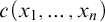 $c(x_1,\dots ,x_n)$
. Of course, in a Boolean algebra
$c(x_1,\dots ,x_n)$
. Of course, in a Boolean algebra $\mathfrak {B}$
, elements only have truth values relative to a valuation
$\mathfrak {B}$
, elements only have truth values relative to a valuation $v:B\to 2$
. More formally, we are thus lead to the following characterization: Let c be a family of n-ary functions
$v:B\to 2$
. More formally, we are thus lead to the following characterization: Let c be a family of n-ary functions $c_{\mathfrak {B}}$
on B for each algebra
$c_{\mathfrak {B}}$
on B for each algebra $\mathfrak {B}$
. c is truth-functional just in case there is a truth-function t such that for any elements
$\mathfrak {B}$
. c is truth-functional just in case there is a truth-function t such that for any elements $x_1,\dots ,x_n$
of any Boolean algebra
$x_1,\dots ,x_n$
of any Boolean algebra $\mathfrak {B}$
and any valuation
$\mathfrak {B}$
and any valuation $v:B\to 2$
,
$v:B\to 2$
, $v(c_{\mathfrak {B}}(x_1,\ldots , x_n))=t(v(x_1),\ldots , v(x_n))$
. Note that in this case, it follows directly from the case of
$v(c_{\mathfrak {B}}(x_1,\ldots , x_n))=t(v(x_1),\ldots , v(x_n))$
. Note that in this case, it follows directly from the case of $\mathfrak {B}$
being
$\mathfrak {B}$
being $\mathbf {2}$
and v being the identity map that
$\mathbf {2}$
and v being the identity map that $t=c_{\mathbf {2}}$
. More generally, then, an I-ary connective c is truth-functional when for every valuation
$t=c_{\mathbf {2}}$
. More generally, then, an I-ary connective c is truth-functional when for every valuation $v:B\to 2$
, and
$v:B\to 2$
, and $f\in B^I$
,
$f\in B^I$
, $v(c_{\mathfrak {B}}(f)) =c_{\mathbf {2}}(v\circ f)$
. Since the valuations of a Boolean algebra
$v(c_{\mathfrak {B}}(f)) =c_{\mathbf {2}}(v\circ f)$
. Since the valuations of a Boolean algebra $\mathfrak {B}$
are precisely the homomorphisms from
$\mathfrak {B}$
are precisely the homomorphisms from $\mathfrak {B}$
to
$\mathfrak {B}$
to $\mathbf {2}$
, this condition amounts to being a
$\mathbf {2}$
, this condition amounts to being a $(\mathsf {BA},\mathbf {2})$
-connective.
$(\mathsf {BA},\mathbf {2})$
-connective.
And finally, as before, we can introduce substitution theoretic notions of connectives: $(\mathfrak {A}, \mathfrak {A})$
-connectives and
$(\mathfrak {A}, \mathfrak {A})$
-connectives and $(\mathsf {sub}(\mathfrak {A}), \mathsf {sub}(\mathfrak {A}))$
-connectives. The former connectives are only defined on the algebra
$(\mathsf {sub}(\mathfrak {A}), \mathsf {sub}(\mathfrak {A}))$
-connectives. The former connectives are only defined on the algebra $\mathfrak {A}$
and must commute with all endomorphisms of the algebra, and the latter are only defined on the subalgebras of
$\mathfrak {A}$
and must commute with all endomorphisms of the algebra, and the latter are only defined on the subalgebras of $\mathfrak {A}$
and must commute with all homomorphisms between these algebras.
$\mathfrak {A}$
and must commute with all homomorphisms between these algebras.
Definition 2.11. $\mathfrak {A}$
satisfies unique decomposition into
$\mathfrak {A}$
satisfies unique decomposition into $(\mathsf {D},\mathsf {T})$
-connectives and E if for any
$(\mathsf {D},\mathsf {T})$
-connectives and E if for any $x\in A$
there is a unique
$x\in A$
there is a unique $(\mathsf {D},\mathsf {T})$
-connective c such that
$(\mathsf {D},\mathsf {T})$
-connective c such that $c_{\mathfrak {A}}(\imath )=x$
, where
$c_{\mathfrak {A}}(\imath )=x$
, where $\imath $
is the identity map on E.
$\imath $
is the identity map on E.
Unique decomposition is intuitively closely related to free generation. For the purposes of illustration, consider the notions of $\mathsf {BA}$
-free generation and unique decomposition with respect to
$\mathsf {BA}$
-free generation and unique decomposition with respect to $(\mathsf {BA},\mathsf {BA})$
-connectives. Unique decomposition tells us that propositions have a certain amount of structure, and we can use this to define a notion of substitution on propositions. At a very intuitive level, if every element of
$(\mathsf {BA},\mathsf {BA})$
-connectives. Unique decomposition tells us that propositions have a certain amount of structure, and we can use this to define a notion of substitution on propositions. At a very intuitive level, if every element of $\mathfrak {A}$
can be uniquely written as a Boolean function of elementary propositions
$\mathfrak {A}$
can be uniquely written as a Boolean function of elementary propositions $c_{\mathfrak {A}}(e_1,e_2,\dots )$
, then we are able to think of any function
$c_{\mathfrak {A}}(e_1,e_2,\dots )$
, then we are able to think of any function $f:E\to B$
as determining a “substitution homomorphism,” defined as replacing each elementary constituent
$f:E\to B$
as determining a “substitution homomorphism,” defined as replacing each elementary constituent $e_i$
of any proposition
$e_i$
of any proposition $c_{\mathfrak {A}}(e_1,e_2,\dots )$
with
$c_{\mathfrak {A}}(e_1,e_2,\dots )$
with $f(e_i)$
. The substitution homomorphism
$f(e_i)$
. The substitution homomorphism $\hat f$
can thus be defined by mapping each element of the form
$\hat f$
can thus be defined by mapping each element of the form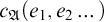 $c_{\mathfrak {A}}(e_1,e_2\dots )$
to
$c_{\mathfrak {A}}(e_1,e_2\dots )$
to $c_{\mathfrak {B}}(f(e_1),f(e_2)\dots )$
; by decomposition, every element does have this form, and by the uniqueness of this decomposition the definition is well-defined.
$c_{\mathfrak {B}}(f(e_1),f(e_2)\dots )$
; by decomposition, every element does have this form, and by the uniqueness of this decomposition the definition is well-defined.
Conversely, free generation tells us that however propositions are structured, they are structured enough to admit a well-defined notion of substitution, and this turns out to uniquely determine the Boolean structure of a proposition. For if $x\in A$
could be expressed as
$x\in A$
could be expressed as $c_{\mathfrak {A}}(e_1,e_2,\ldots )$
for some Boolean connective c, then if we were to apply this connective to the propositions
$c_{\mathfrak {A}}(e_1,e_2,\ldots )$
for some Boolean connective c, then if we were to apply this connective to the propositions $f(e_1),f(e_2),\ldots \in B$
, the result,
$f(e_1),f(e_2),\ldots \in B$
, the result, $c_{\mathfrak {B}}(f(e_1),f(e_2),\ldots )$
, should be a substitution instance of the original proposition x, namely:
$c_{\mathfrak {B}}(f(e_1),f(e_2),\ldots )$
, should be a substitution instance of the original proposition x, namely: $\hat f(c_{\mathfrak {A}}(e_1,\ldots ,e_n)) = \hat f(x)$
since connectives should commute with the substitution homomorphism
$\hat f(c_{\mathfrak {A}}(e_1,\ldots ,e_n)) = \hat f(x)$
since connectives should commute with the substitution homomorphism $\hat f$
obtained from f. Since every E-length sequence of elements of B has the form
$\hat f$
obtained from f. Since every E-length sequence of elements of B has the form $f(e_1),f(e_2),\ldots $
for some f, the stipulation
$f(e_1),f(e_2),\ldots $
for some f, the stipulation $c_{\mathfrak {B}}(f(e_1),f(e_2),\ldots ) = \hat f(x)$
totally defines a connective (which must then be shown to be a Boolean connective). This idea easily generalizes:
$c_{\mathfrak {B}}(f(e_1),f(e_2),\ldots ) = \hat f(x)$
totally defines a connective (which must then be shown to be a Boolean connective). This idea easily generalizes: $\mathsf {T}$
-free generation and unique decomposition with respect to
$\mathsf {T}$
-free generation and unique decomposition with respect to $(\mathsf {T},\mathsf {T})$
-connectives are equivalent. This informal idea is made precise in Proposition 2.12 below.
$(\mathsf {T},\mathsf {T})$
-connectives are equivalent. This informal idea is made precise in Proposition 2.12 below.
2.4 Equivalence
We now have nine logical atomist principles: independent generation, $\mathsf {T}$
-free generation, for
$\mathsf {T}$
-free generation, for $\mathsf {T}$
being
$\mathsf {T}$
being $\mathbf {2}$
,
$\mathbf {2}$
, $\mathfrak {A}$
,
$\mathfrak {A}$
, $\mathsf {sub}(\mathfrak {A})$
, or
$\mathsf {sub}(\mathfrak {A})$
, or $\mathsf {BA}$
, and unique decomposition with respect to
$\mathsf {BA}$
, and unique decomposition with respect to $(\mathsf {BA},\mathsf {BA}), (\mathfrak {A},\mathfrak {A}), (\mathsf {sub}(\mathfrak {A}),\mathsf {sub}(\mathfrak {A}))$
and
$(\mathsf {BA},\mathsf {BA}), (\mathfrak {A},\mathfrak {A}), (\mathsf {sub}(\mathfrak {A}),\mathsf {sub}(\mathfrak {A}))$
and $(\mathsf {BA},\mathbf {2})$
-connectives. How do they relate? It turns out that they are all equivalent, at least on non-trivial algebras (i.e., algebras with at least two elements). Furthermore, we can show that independent generation is equivalent, among non-trivial algebras, to
$(\mathsf {BA},\mathbf {2})$
-connectives. How do they relate? It turns out that they are all equivalent, at least on non-trivial algebras (i.e., algebras with at least two elements). Furthermore, we can show that independent generation is equivalent, among non-trivial algebras, to $\mathsf {T}$
-free generation, for every class of Boolean algebras
$\mathsf {T}$
-free generation, for every class of Boolean algebras $\mathsf {T}$
which contains some non-trivial Boolean algebra. And we will show that
$\mathsf {T}$
which contains some non-trivial Boolean algebra. And we will show that $\mathsf {T}$
-free generation is equivalent to unique decomposition into
$\mathsf {T}$
-free generation is equivalent to unique decomposition into $(\mathsf {T},\mathsf {T})$
-connectives.
$(\mathsf {T},\mathsf {T})$
-connectives.
The proofs of these results make use of an algebraic concept which has not been introduced so far. An ultrafilter of a Boolean algebra $\langle A,-,\wedge \rangle $
is set
$\langle A,-,\wedge \rangle $
is set $U\subseteq A$
such that
$U\subseteq A$
such that $-x\in U$
iff
$-x\in U$
iff $x\notin U$
, and
$x\notin U$
, and $y\wedge z\in U$
iff
$y\wedge z\in U$
iff $y\in U$
and
$y\in U$
and $z\in U$
, for all
$z\in U$
, for all $x,y,z\in A$
. This means that a set
$x,y,z\in A$
. This means that a set $U\subseteq A$
is an ultrafilter just in case its characteristic function, mapping every element of U to
$U\subseteq A$
is an ultrafilter just in case its characteristic function, mapping every element of U to $\top $
and every other element of A to
$\top $
and every other element of A to $\bot $
, is a homomorphism from
$\bot $
, is a homomorphism from $\mathfrak {A}$
to
$\mathfrak {A}$
to $\mathbf {2}$
.
$\mathbf {2}$
.
We begin by connecting our unique decomposition principles to free generation.
Proposition 2.12. Let $\mathfrak {A}\in \mathsf {T}\subseteq \mathsf {D}$
be a Boolean algebra and
$\mathfrak {A}\in \mathsf {T}\subseteq \mathsf {D}$
be a Boolean algebra and $E\subseteq A$
.
$E\subseteq A$
.
-
• If
$\mathfrak {A}$
satisfies unique decomposition into
$(\mathsf {D},\mathsf {T})$
-connectives and E, then
$E\, \mathsf {T}$
-freely generates
$\mathfrak {A}$
. -
• If
$E\, \mathsf {T}$
-freely generates
$\mathfrak {A}$
, then
$\mathfrak {A}$
satisfies unique decomposition into
$(\mathsf {T},\mathsf {T})$
-connectives and E.


Proof. Suppose that $\mathfrak {A}$
satisfies unique decomposition with respect to
$\mathfrak {A}$
satisfies unique decomposition with respect to $(\mathsf {D},\mathsf {T})$
-connectives, let
$(\mathsf {D},\mathsf {T})$
-connectives, let $\mathfrak {B}$
be some Boolean algebra in
$\mathfrak {B}$
be some Boolean algebra in $\mathsf {T}$
, and let
$\mathsf {T}$
, and let $f\in B^E$
be some function from E to B. We want to show that there exists a unique Boolean homomorphism
$f\in B^E$
be some function from E to B. We want to show that there exists a unique Boolean homomorphism $\hat {f}:A\to B$
extending f. Given
$\hat {f}:A\to B$
extending f. Given $x\in A$
, and define:
$x\in A$
, and define:
-
$\hat {f}(x) := c_{\mathfrak {B}}(f),$
where c is the unique
$(\mathsf {T},\mathsf {T})$
-connective such that
$c_{\mathfrak {A}}(\imath ) = x$
.


First we show that $\hat {f}$
extends f. Let
$\hat {f}$
extends f. Let $e\in E$
, and let
$e\in E$
, and let $\pi ^e$
be the eth projection connective: for each
$\pi ^e$
be the eth projection connective: for each $\mathfrak {C}\in \mathsf {D}$
,
$\mathfrak {C}\in \mathsf {D}$
, $\pi ^e_{\mathfrak {C}}:C^E\to C$
,
$\pi ^e_{\mathfrak {C}}:C^E\to C$
, $\pi ^e(f) = f(e)$
.
$\pi ^e(f) = f(e)$
. $\pi ^e$
clearly commutes with homomorphisms, and so is a
$\pi ^e$
clearly commutes with homomorphisms, and so is a $(\mathsf {D},\mathsf {T})$
-connective. Also
$(\mathsf {D},\mathsf {T})$
-connective. Also $\pi ^e_{\mathfrak {A}}(\imath ) = \imath (e) = e$
, since
$\pi ^e_{\mathfrak {A}}(\imath ) = \imath (e) = e$
, since $\imath $
is the inclusion mapping, and is the unique such connective by unique decomposition. Now
$\imath $
is the inclusion mapping, and is the unique such connective by unique decomposition. Now $\hat {f}(e) = \pi ^e_{\mathfrak {B}}(f) = f(e)$
, so
$\hat {f}(e) = \pi ^e_{\mathfrak {B}}(f) = f(e)$
, so $\hat {f}$
agrees with f on all
$\hat {f}$
agrees with f on all $e\in E$
as required.
$e\in E$
as required. $\hat {f}$
is also a Boolean homomorphism. Given
$\hat {f}$
is also a Boolean homomorphism. Given $x,y\in A$
let
$x,y\in A$
let $c, c'$
be
$c, c'$
be $(\mathsf {D},\mathsf {T})$
-connectives such that
$(\mathsf {D},\mathsf {T})$
-connectives such that $c_{\mathfrak {A}}(\imath )=x$
and
$c_{\mathfrak {A}}(\imath )=x$
and $c^{\prime }_{\mathfrak {A}}(\imath )=y$
. Finally, let
$c^{\prime }_{\mathfrak {A}}(\imath )=y$
. Finally, let $(c\wedge c')_{\mathfrak {C}}:C^e \to C$
, with
$(c\wedge c')_{\mathfrak {C}}:C^e \to C$
, with $\mathfrak {C}\in \mathsf {D}$
, be defined by
$\mathfrak {C}\in \mathsf {D}$
, be defined by $(c\wedge c')_{\mathfrak {C}}(f) = c_{\mathfrak {C}}(f)\wedge c^{\prime }_{\mathfrak {C}}(f)$
. Clearly any function preserving c,
$(c\wedge c')_{\mathfrak {C}}(f) = c_{\mathfrak {C}}(f)\wedge c^{\prime }_{\mathfrak {C}}(f)$
. Clearly any function preserving c, $c'$
and
$c'$
and $\wedge $
preserves
$\wedge $
preserves $(c\wedge c')$
, so
$(c\wedge c')$
, so $(c\wedge c')$
is a
$(c\wedge c')$
is a $(\mathsf {D},\mathsf {T})$
-connective. Since
$(\mathsf {D},\mathsf {T})$
-connective. Since $c_{\mathfrak {C}}(\imath )\wedge c^{\prime }_{\mathfrak {C}}(\imath ) = x\wedge y$
we know by the uniqueness of the decomposition that
$c_{\mathfrak {C}}(\imath )\wedge c^{\prime }_{\mathfrak {C}}(\imath ) = x\wedge y$
we know by the uniqueness of the decomposition that $\hat {f}(x\wedge y) = c_{\mathfrak {C}}(f)\wedge c^{\prime }_{\mathfrak {C}}(f) = \hat {f}(x)\wedge \hat {f}(y)$
. The proof that
$\hat {f}(x\wedge y) = c_{\mathfrak {C}}(f)\wedge c^{\prime }_{\mathfrak {C}}(f) = \hat {f}(x)\wedge \hat {f}(y)$
. The proof that $\hat {f}$
commutes with negation is similar. Finally this homomorphism is unique: let
$\hat {f}$
commutes with negation is similar. Finally this homomorphism is unique: let $h:A\to B$
be a homomorphism extending f, let
$h:A\to B$
be a homomorphism extending f, let $x\in A$
, and
$x\in A$
, and $x=c_{\mathfrak {A}}(\imath )$
. Then
$x=c_{\mathfrak {A}}(\imath )$
. Then $h(x) = h(c_{\mathfrak {A}}(\imath )) = c_{\mathfrak {B}}(h\circ \imath ) = c_{\mathfrak {B}}(f) = \hat {f}(x)$
. The second equation holds because c is a
$h(x) = h(c_{\mathfrak {A}}(\imath )) = c_{\mathfrak {B}}(h\circ \imath ) = c_{\mathfrak {B}}(f) = \hat {f}(x)$
. The second equation holds because c is a $(\mathsf {D},\mathsf {T})$
-connective, and so commutes with all homomorphisms between algebras in
$(\mathsf {D},\mathsf {T})$
-connective, and so commutes with all homomorphisms between algebras in $\textsf {T}$
, and the third because since h extends f,
$\textsf {T}$
, and the third because since h extends f, $h\circ \imath =f$
.
$h\circ \imath =f$
.
Now suppose that $\mathfrak {A}$
is
$\mathfrak {A}$
is $\mathsf {T}$
-freely generated by E, and let
$\mathsf {T}$
-freely generated by E, and let $x\in \mathfrak {A}$
. We want to construct a
$x\in \mathfrak {A}$
. We want to construct a $(\mathsf {T},\mathsf {T})$
-connective c such that
$(\mathsf {T},\mathsf {T})$
-connective c such that $c_{\mathfrak {A}}(\imath ) =x$
. We can define c as follows:
$c_{\mathfrak {A}}(\imath ) =x$
. We can define c as follows:
-
• Given
$\mathfrak {B}\in \mathsf {T}$
,
$f\in B^E$
, let
$c_{\mathfrak {B}}(f) = \hat {f}(x)$
.


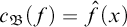
Now clearly $\hat {\imath }$
is the identity map from A to A, so that
$\hat {\imath }$
is the identity map from A to A, so that $c_{\mathfrak {A}}(\imath )=\hat {\imath }(x)=x$
as required (and
$c_{\mathfrak {A}}(\imath )=\hat {\imath }(x)=x$
as required (and $c_{\mathfrak {A}}$
is defined because
$c_{\mathfrak {A}}$
is defined because $\mathfrak {A}\in \mathsf {T}$
). It remains to show that c is a
$\mathfrak {A}\in \mathsf {T}$
). It remains to show that c is a $(\mathsf {T},\mathsf {T})$
-connective and that it is unique. Let
$(\mathsf {T},\mathsf {T})$
-connective and that it is unique. Let $h:\mathfrak {B}\to \mathfrak {B}'$
be a homomorphism between
$h:\mathfrak {B}\to \mathfrak {B}'$
be a homomorphism between $\mathfrak {B}$
in
$\mathfrak {B}$
in $\mathsf {T}$
and
$\mathsf {T}$
and $\mathfrak {B}'$
in
$\mathfrak {B}'$
in $\mathsf {T}$
. Now since
$\mathsf {T}$
. Now since $h \circ \hat {f}:\mathfrak {A}\to \mathfrak {B}'$
is a homomorphism extending f, it must be identical to
$h \circ \hat {f}:\mathfrak {A}\to \mathfrak {B}'$
is a homomorphism extending f, it must be identical to $\widehat {h\circ f}$
, and so
$\widehat {h\circ f}$
, and so $h(c_{\mathfrak {B}}(f))=h\circ \hat {f}(x)=\widehat {h\circ f}(x)=c_{\mathfrak {B}'}(h\circ f)$
as required. If
$h(c_{\mathfrak {B}}(f))=h\circ \hat {f}(x)=\widehat {h\circ f}(x)=c_{\mathfrak {B}'}(h\circ f)$
as required. If $c'$
is a another connective such that
$c'$
is a another connective such that $c^{\prime }_{\mathfrak {A}}(\imath ) = x$
then
$c^{\prime }_{\mathfrak {A}}(\imath ) = x$
then $c^{\prime }_{\mathfrak {B}}(f) = \hat {f}(c^{\prime }_{\mathfrak {A}}(\imath )) = \hat {f}(x) = c_{\mathfrak {B}}(f)$
. Since f was arbitrary,
$c^{\prime }_{\mathfrak {B}}(f) = \hat {f}(c^{\prime }_{\mathfrak {A}}(\imath )) = \hat {f}(x) = c_{\mathfrak {B}}(f)$
. Since f was arbitrary, $c= c'$
.
$c= c'$
.
The above proposition shows that three of the four types of unique decomposition we have discussed (namely $(\mathsf {BA},\mathsf {BA})$
,
$(\mathsf {BA},\mathsf {BA})$
, $(\mathfrak {A},\mathfrak {A})$
, and
$(\mathfrak {A},\mathfrak {A})$
, and $(\textsf {sub}(\mathfrak {A}),\textsf {sub}(\mathfrak {A}))$
) are equivalent to three of the four the sorts of free generation we have talked about:
$(\textsf {sub}(\mathfrak {A}),\textsf {sub}(\mathfrak {A}))$
) are equivalent to three of the four the sorts of free generation we have talked about: $\mathsf {BA}$
,
$\mathsf {BA}$
, $\mathfrak {A}$
, and
$\mathfrak {A}$
, and $\mathsf {sub}(\mathfrak {A})$
. We have not shown such an equivalence for unique decomposition with respect to truth-functional connectives, because they aren’t defined as
$\mathsf {sub}(\mathfrak {A})$
. We have not shown such an equivalence for unique decomposition with respect to truth-functional connectives, because they aren’t defined as $(\mathsf {T},\mathsf {T})$
-connectives for some
$(\mathsf {T},\mathsf {T})$
-connectives for some $\mathsf {T}$
. However, by using the notion of an ultrafilter defined above, we can see that all of these notions, including unique decomposition into truth-functional connectives, are equivalent.
$\mathsf {T}$
. However, by using the notion of an ultrafilter defined above, we can see that all of these notions, including unique decomposition into truth-functional connectives, are equivalent.
Proposition 2.13. Let $\mathfrak {A}=\langle A,-,\wedge \rangle $
be a Boolean algebra,
$\mathfrak {A}=\langle A,-,\wedge \rangle $
be a Boolean algebra, $E\subseteq A$
, and
$E\subseteq A$
, and $\mathsf {T}$
a class of Boolean algebras containing a non-trivial Boolean algebra. Then the following are equivalent:
$\mathsf {T}$
a class of Boolean algebras containing a non-trivial Boolean algebra. Then the following are equivalent:
-
1. E independently generates
$\mathfrak {A}$
. -
2.
$E\, \mathsf {T}$
-freely generates
$\mathfrak {A}$
. -
3.
$\mathfrak {A}$
satisfies unique decomposition into
$(\mathsf {T},\mathsf {T})$
-connectives and E. -
4.
$\mathfrak {A}$
satisfies unique decomposition into
$(\mathsf {BA},\mathbf {2})$
-connectives and E.


Proof. We begin by showing the equivalence of 1 and 2. Assume first that E independently generates $\mathfrak {A}$
. As noted in Koppelberg [Reference Koppelberg, Monk and Bonnet17, proposition 9.4], it follows that
$\mathfrak {A}$
. As noted in Koppelberg [Reference Koppelberg, Monk and Bonnet17, proposition 9.4], it follows that $E\, \mathsf {BA}$
-freely generates
$E\, \mathsf {BA}$
-freely generates $\mathfrak {A}$
. That
$\mathfrak {A}$
. That $E\, \mathsf {T}$
-freely generates
$E\, \mathsf {T}$
-freely generates $\mathfrak {A}$
follows immediately from this.
$\mathfrak {A}$
follows immediately from this.
So, assume now that $E\, \mathsf {T}$
-freely generates
$E\, \mathsf {T}$
-freely generates $\mathfrak {A}$
. By assumption,
$\mathfrak {A}$
. By assumption, $\mathsf {T}$
contains a non-trivial Boolean algebra
$\mathsf {T}$
contains a non-trivial Boolean algebra $\mathfrak {B}$
. To show that E is independent, consider any
$\mathfrak {B}$
. To show that E is independent, consider any $D\vartriangleleft _\omega E$
. Define a function
$D\vartriangleleft _\omega E$
. Define a function $f:E\to B$
such that
$f:E\to B$
such that $f(d)=\top $
if
$f(d)=\top $
if $d\in D$
, and
$d\in D$
, and $f(d)=\bot $
otherwise. Since
$f(d)=\bot $
otherwise. Since $\hat {f}$
is a homomorphism,
$\hat {f}$
is a homomorphism, $\hat {f}(\bigwedge D)=\top $
. As
$\hat {f}(\bigwedge D)=\top $
. As $\mathfrak {B}$
is non-trivial, it follows that
$\mathfrak {B}$
is non-trivial, it follows that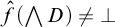 $\hat {f}(\bigwedge D)\neq \bot $
, and so
$\hat {f}(\bigwedge D)\neq \bot $
, and so $\bigwedge D>\bot $
.
$\bigwedge D>\bot $
.
To show that E generates $\mathfrak {A}$
, assume otherwise for contradiction. Then
$\mathfrak {A}$
, assume otherwise for contradiction. Then $\mathfrak {A}$
has a proper subalgebra
$\mathfrak {A}$
has a proper subalgebra $\mathfrak {A}_0$
including E. Consequently, as noted by Givant and Halmos [Reference Givant and Halmos13, chap. 20, example 15], there exists an ultrafilter
$\mathfrak {A}_0$
including E. Consequently, as noted by Givant and Halmos [Reference Givant and Halmos13, chap. 20, example 15], there exists an ultrafilter $U_0$
of
$U_0$
of $\mathfrak {A}_0$
which is extended by distinct ultrafilters
$\mathfrak {A}_0$
which is extended by distinct ultrafilters $U_1,U_2$
of
$U_1,U_2$
of $\mathfrak {A}$
. Define
$\mathfrak {A}$
. Define $f_0:E\to \{\bot ,\top \}$
such that
$f_0:E\to \{\bot ,\top \}$
such that $f_0(e)=\top $
iff
$f_0(e)=\top $
iff $e\in U_0$
. Let
$e\in U_0$
. Let $f_1,f_2:A_0\to \{\bot ,\top \}$
such that
$f_1,f_2:A_0\to \{\bot ,\top \}$
such that $f_i(b)=\top $
iff
$f_i(b)=\top $
iff $b\in U_i$
, for
$b\in U_i$
, for $i\in \{1,2\}$
. Then
$i\in \{1,2\}$
. Then $f_1$
and
$f_1$
and $f_2$
are distinct homomorphisms extending
$f_2$
are distinct homomorphisms extending $f_0$
, in contradiction with
$f_0$
, in contradiction with $E \mathsf {T}$
-freely generating
$E \mathsf {T}$
-freely generating $\mathfrak {A}$
.
$\mathfrak {A}$
.
By Proposition 2.12, $\mathsf {T}$
-free generation is equivalent to unique decomposition into
$\mathsf {T}$
-free generation is equivalent to unique decomposition into $(\mathsf {T},\mathsf {T})$
-connectives. So the only case left is unique decomposition into truth-functional connectives. We can first see that unique decomposition into
$(\mathsf {T},\mathsf {T})$
-connectives. So the only case left is unique decomposition into truth-functional connectives. We can first see that unique decomposition into $(\mathsf {BA},\mathsf {BA})$
-connectives implies unique decomposition into
$(\mathsf {BA},\mathsf {BA})$
-connectives implies unique decomposition into $(\mathsf {BA},\mathbf {2})$
-connectives. For if
$(\mathsf {BA},\mathbf {2})$
-connectives. For if $x\in A$
has a decomposition into a Boolean connective c, c is clearly also truth-functional. Moreover c is unique, for suppose
$x\in A$
has a decomposition into a Boolean connective c, c is clearly also truth-functional. Moreover c is unique, for suppose $c'$
is another truth-functional connective such that
$c'$
is another truth-functional connective such that $c^{\prime }_{\mathfrak {A}}(\imath )=x$
. Then for any
$c^{\prime }_{\mathfrak {A}}(\imath )=x$
. Then for any $f\in B^E$
, and valuation
$f\in B^E$
, and valuation $v:B\to 2$
,
$v:B\to 2$
, $v(c^{\prime }_{\mathfrak {B}}(f))= c^{\prime }_{\mathbf {2}}(v\circ f) = (\widehat {v\circ f})c^{\prime }_{\mathfrak {A}}(\imath ) = (\widehat {v\circ f})c_{\mathfrak {A}}(\imath ) = c_{\mathbf {2}}(v\circ f) = v(c_{\mathfrak {B}}(f))$
. Apart from the middle identity, these identities are relying on the fact that c and
$v(c^{\prime }_{\mathfrak {B}}(f))= c^{\prime }_{\mathbf {2}}(v\circ f) = (\widehat {v\circ f})c^{\prime }_{\mathfrak {A}}(\imath ) = (\widehat {v\circ f})c_{\mathfrak {A}}(\imath ) = c_{\mathbf {2}}(v\circ f) = v(c_{\mathfrak {B}}(f))$
. Apart from the middle identity, these identities are relying on the fact that c and $c'$
commute with valuations, and existence of
$c'$
commute with valuations, and existence of $\widehat {v\circ f}$
also appeals to
$\widehat {v\circ f}$
also appeals to $\mathbf {2}$
-free generation, which we already know is among the equivalents to
$\mathbf {2}$
-free generation, which we already know is among the equivalents to $(\mathsf {BA},\mathsf {BA})$
-decomposition. It follows that
$(\mathsf {BA},\mathsf {BA})$
-decomposition. It follows that $c^{\prime }_{\mathfrak {B}}(f) = c_{\mathfrak {B}}(f)$
by the ultrafilter lemma: if they were different there would be an ultrafilter containing one but not the other, whose characteristic function would be a valuation distinguishing them. Since f and
$c^{\prime }_{\mathfrak {B}}(f) = c_{\mathfrak {B}}(f)$
by the ultrafilter lemma: if they were different there would be an ultrafilter containing one but not the other, whose characteristic function would be a valuation distinguishing them. Since f and $\mathfrak {B}$
were arbitrary,
$\mathfrak {B}$
were arbitrary, $c=c'$
. Conversely, decomposition with respect to
$c=c'$
. Conversely, decomposition with respect to $(\textsf {BA},\mathbf {2})$
-connectives implies
$(\textsf {BA},\mathbf {2})$
-connectives implies $\mathbf {2}$
-free generation by the first part of Proposition 2.12.
$\mathbf {2}$
-free generation by the first part of Proposition 2.12.
What kinds of pairs E and $\mathfrak {A}$
satisfy independent generation (and so, equivalently, the various notions of free generation and the decomposition principles)? First, if E independently generates
$\mathfrak {A}$
satisfy independent generation (and so, equivalently, the various notions of free generation and the decomposition principles)? First, if E independently generates $\mathfrak {A}$
, then it does so uniquely, up to isomorphism, in the following sense: if E and
$\mathfrak {A}$
, then it does so uniquely, up to isomorphism, in the following sense: if E and $E'$
independently generate
$E'$
independently generate $\mathfrak {A}$
and
$\mathfrak {A}$
and $\mathfrak {A}'$
, respectively, and E and
$\mathfrak {A}'$
, respectively, and E and $E'$
have the same cardinality, then any bijection between E and
$E'$
have the same cardinality, then any bijection between E and $E'$
has a unique extension to an isomorphism between
$E'$
has a unique extension to an isomorphism between $\mathfrak {A}$
and
$\mathfrak {A}$
and $\mathfrak {A}'$
. Second, any set E independently generates some Boolean algebra
$\mathfrak {A}'$
. Second, any set E independently generates some Boolean algebra $\mathfrak {A}$
. Up to isomorphism, we may therefore speak of the Boolean algebra which is independently generated by a set of a given cardinality
$\mathfrak {A}$
. Up to isomorphism, we may therefore speak of the Boolean algebra which is independently generated by a set of a given cardinality $\kappa $
. (For a more detailed discussion of these and the following observations, see Givant and Halmos [Reference Givant and Halmos13, chap. 28].)
$\kappa $
. (For a more detailed discussion of these and the following observations, see Givant and Halmos [Reference Givant and Halmos13, chap. 28].)
To describe independently generated Boolean algebras in more detail, it is useful to present one way of generating them using a technique commonly employed in logic. Take the language of classical propositional logic, based on a set of proposition letters of some finite or infinite cardinality $\kappa $
. Quotient this set under provable equivalence: let A be the set of equivalence classes
$\kappa $
. Quotient this set under provable equivalence: let A be the set of equivalence classes $[\varphi ]$
of formulas
$[\varphi ]$
of formulas $\varphi $
under the relation of provable equivalence in classical propositional logic. This relation of provable equivalence is not only an equivalence relation, but a congruence with respect to the connectives: if
$\varphi $
under the relation of provable equivalence in classical propositional logic. This relation of provable equivalence is not only an equivalence relation, but a congruence with respect to the connectives: if $\varphi ,\psi ,\chi $
are provably equivalent to
$\varphi ,\psi ,\chi $
are provably equivalent to $\varphi ',\psi ',\chi '$
, respectively, then
$\varphi ',\psi ',\chi '$
, respectively, then $\neg \varphi $
and
$\neg \varphi $
and $\psi \wedge \chi $
are also provably equivalent to
$\psi \wedge \chi $
are also provably equivalent to $\neg \varphi '$
and
$\neg \varphi '$
and $\psi '\wedge \chi '$
, respectively. Consequently, there is a function
$\psi '\wedge \chi '$
, respectively. Consequently, there is a function $-$
which maps
$-$
which maps $[\varphi ]$
to
$[\varphi ]$
to $[\neg \varphi ]$
, and a function
$[\neg \varphi ]$
, and a function $\wedge $
which maps
$\wedge $
which maps $[\psi ]$
and
$[\psi ]$
and $[\chi ]$
to
$[\chi ]$
to $[\psi \wedge \chi ]$
, for all formulas
$[\psi \wedge \chi ]$
, for all formulas $\varphi ,\psi ,\chi $
.
$\varphi ,\psi ,\chi $
. $\mathfrak {A}_\kappa =\langle A,-,\wedge \rangle $
is a Boolean algebra, known as the Lindenbaum–Tarski algebra (of cardinality
$\mathfrak {A}_\kappa =\langle A,-,\wedge \rangle $
is a Boolean algebra, known as the Lindenbaum–Tarski algebra (of cardinality $\kappa $
).
$\kappa $
). $\mathfrak {A}_\kappa $
can be shown to be independently generated by the set E of equivalence classes of proposition letters. No two proposition letters are provably equivalent, so
$\mathfrak {A}_\kappa $
can be shown to be independently generated by the set E of equivalence classes of proposition letters. No two proposition letters are provably equivalent, so $|E|=\kappa $
. As noted above, the Boolean algebra independently generated by a set of a given cardinality is unique up to isomorphism. Thus, a Boolean algebra is independently generated just in case it is isomorphic to a Lindenbaum–Tarski algebra. One particular consequence of this is worth noting: It is well-known that the Lindenbaum–Tarski algebra based on a countably infinite language is, up to isomorphism, the only countably infinite atomless Boolean algebra. So up to isomorphism, there is a unique countably infinite independently generated Boolean algebra, which is the countably infinite atomless Boolean algebra.
$|E|=\kappa $
. As noted above, the Boolean algebra independently generated by a set of a given cardinality is unique up to isomorphism. Thus, a Boolean algebra is independently generated just in case it is isomorphic to a Lindenbaum–Tarski algebra. One particular consequence of this is worth noting: It is well-known that the Lindenbaum–Tarski algebra based on a countably infinite language is, up to isomorphism, the only countably infinite atomless Boolean algebra. So up to isomorphism, there is a unique countably infinite independently generated Boolean algebra, which is the countably infinite atomless Boolean algebra.
In the finite case, an alternative presentation is helpful as well. The powerset $\mathcal {P}(W)$
is the set of subsets of a given set W. This forms a Boolean algebra when we add the operations of relative complement and intersection (mapping any
$\mathcal {P}(W)$
is the set of subsets of a given set W. This forms a Boolean algebra when we add the operations of relative complement and intersection (mapping any $X\subseteq W$
to
$X\subseteq W$
to $W\backslash X$
and any
$W\backslash X$
and any $Y,Z\subseteq W$
to
$Y,Z\subseteq W$
to $Y\cap Z$
, respectively). We write
$Y\cap Z$
, respectively). We write $\mathfrak {P}(W)$
for this algebra. W itself can be taken to be a powerset
$\mathfrak {P}(W)$
for this algebra. W itself can be taken to be a powerset $\mathcal {P}(S)$
, which gives us the double powerset algebra
$\mathcal {P}(S)$
, which gives us the double powerset algebra $\mathfrak {P}\mathcal {P}(S)$
, whose members are sets of subsets of S. For any
$\mathfrak {P}\mathcal {P}(S)$
, whose members are sets of subsets of S. For any $s\in S$
, let
$s\in S$
, let $s^*=\{w\subseteq S:s\in w\}$
. It can be shown that
$s^*=\{w\subseteq S:s\in w\}$
. It can be shown that $\Gamma _S=\{s^*:s\in S\}$
independently generates
$\Gamma _S=\{s^*:s\in S\}$
independently generates $\mathfrak {P}\mathcal {P}(S)$
. (We will see an intuitive explanation of this observation in §3.3.) We call
$\mathfrak {P}\mathcal {P}(S)$
. (We will see an intuitive explanation of this observation in §3.3.) We call $\Gamma _S$
the set of canonical generators of
$\Gamma _S$
the set of canonical generators of $\mathfrak {P}\mathcal {P}(S)$
. Further, the function mapping any s to
$\mathfrak {P}\mathcal {P}(S)$
. Further, the function mapping any s to $s^*$
is a bijection from S to
$s^*$
is a bijection from S to $\Gamma _S$
, whence S and
$\Gamma _S$
, whence S and $\Gamma _S$
have the same cardinality. Thus, any finite set E independently generates a Boolean algebra which is isomorphic to
$\Gamma _S$
have the same cardinality. Thus, any finite set E independently generates a Boolean algebra which is isomorphic to $\mathfrak {P}\mathcal {P}(E)$
. So, a finite Boolean algebra is independently generated just in case it is isomorphic to a double powerset algebra. This does not extend to the infinite case: it follows from the characterization in terms of Lindenbaum–Tarski algebras that no infinite independently generated algebra is isomorphic to a powerset algebra.
$\mathfrak {P}\mathcal {P}(E)$
. So, a finite Boolean algebra is independently generated just in case it is isomorphic to a double powerset algebra. This does not extend to the infinite case: it follows from the characterization in terms of Lindenbaum–Tarski algebras that no infinite independently generated algebra is isomorphic to a powerset algebra.
So, the finite and infinite cases of independently generated Boolean algebras differ sharply in their structural properties. We will shortly make this more concrete, in the form of the properties of atomicity and completeness, introduced below, which finite independently generated Boolean algebras possess but infinite independently generated Boolean algebras lack. A more straightforward observation concerns the relative cardinalities of E and $\mathfrak {A}$
: assuming E independently generates
$\mathfrak {A}$
: assuming E independently generates $\mathfrak {A}$
, if E is finite, then
$\mathfrak {A}$
, if E is finite, then $|A|=2^{2^{|E|}}>|E|$
, whereas if E is infinite, then
$|A|=2^{2^{|E|}}>|E|$
, whereas if E is infinite, then $|A|=|E|$
.
$|A|=|E|$
.
Finally, it is worth illustrating that a set which independently generates a Boolean algebra does not do so uniquely (even though it does so uniquely up to isomorphism). Consider first the finite case of a double powerset algebra $\mathfrak {P}\mathcal {P}(S)$
based on a finite set S. Any permutation f of
$\mathfrak {P}\mathcal {P}(S)$
based on a finite set S. Any permutation f of $\mathcal {P}(S)$
induces an automorphism
$\mathcal {P}(S)$
induces an automorphism $\bar {f}$
of
$\bar {f}$
of $\mathfrak {P}\mathcal {P}(S)$
, where
$\mathfrak {P}\mathcal {P}(S)$
, where $\bar {f}(x)=\{f(w):w\in x\}$
. Thus, for any such permutation f, the set
$\bar {f}(x)=\{f(w):w\in x\}$
. Thus, for any such permutation f, the set $\{\bar {f}(x):x\in \Gamma _S\}$
independently generates
$\{\bar {f}(x):x\in \Gamma _S\}$
independently generates $\mathfrak {P}\mathcal {P}(S)$
. To make this more concrete, let S be the two-element set
$\mathfrak {P}\mathcal {P}(S)$
. To make this more concrete, let S be the two-element set $2=\{0,1\}$
. Then the canonical generators form the following set
$2=\{0,1\}$
. Then the canonical generators form the following set $\Gamma _2=\{0^*,1^*\}$
:
$\Gamma _2=\{0^*,1^*\}$
:
 $$\begin{align*}\{\{\{0\},\{0,1\}\},\{\{1\},\{0,1\}\}\}.\end{align*}$$
As our permutation f of $\mathcal {P}(2)=\{\emptyset ,\{0\},\{1\},\{0,1\}\}$
, let us choose the transposition of
$\mathcal {P}(2)=\{\emptyset ,\{0\},\{1\},\{0,1\}\}$
, let us choose the transposition of $\emptyset $
and
$\emptyset $
and $\{0\}$
, which maps these two elements to each other, and the other two elements to themselves. Then
$\{0\}$
, which maps these two elements to each other, and the other two elements to themselves. Then $\bar {f}$
maps the elements of
$\bar {f}$
maps the elements of $\Gamma _2$
to the elements of the following set, which therefore also independently generates
$\Gamma _2$
to the elements of the following set, which therefore also independently generates $\mathfrak {P}\mathcal {P}(S)$
:
$\mathfrak {P}\mathcal {P}(S)$
:
 $$\begin{align*}\{\{\emptyset,\{0,1\}\},\{\{1\},\{0,1\}\}\}.\end{align*}$$
Similarly, in the case of a Lindenbaum–Tarski algebra, the equivalence classes of proposition letters are not unique as independent generators. A simple example of a distinct set of independent generators is the set of equivalence classes of negations of proposition letters.
3 Complete Boolean algebras
The equivalence of the nine conditions discussed so far suggests that they do well in capturing the logical atomist picture. This coheres with some accounts in the literature, for example, Bell and Demopoulos [Reference Bell and Demopoulos6], who operate with the condition of independent generation. However, in the following, we will consider a more restricted class of Boolean algebras, and strengthened versions of the nine conditions. We begin with one possible way of motivating these restrictions.
3.1 Quantification
Logical atomists have to find a way of accommodating quantification. If there are finitely many individuals, this is easily done using conjunction and disjunction. For example, the proposition that everything is F can be identified with the conjunction of propositions $Fx$
, for every individual x (cf. 5.52). Existential quantification can be treated analogously, using disjunction. However, if there are infinitely many individuals, this idea will not obviously work, since Boolean algebras only provide finitary truth-functional operations.
$Fx$
, for every individual x (cf. 5.52). Existential quantification can be treated analogously, using disjunction. However, if there are infinitely many individuals, this idea will not obviously work, since Boolean algebras only provide finitary truth-functional operations.
One way of accommodating quantification is therefore to provide infinitary analogs of conjunction and disjunction. This can be done by assuming the algebra of propositions to be complete. A Boolean algebra is complete if every set X of elements has a greatest lower bound $\bigwedge X$
and a least upper bound
$\bigwedge X$
and a least upper bound $\bigvee X$
. Just as the greatest lower bound of two elements
$\bigvee X$
. Just as the greatest lower bound of two elements $x\wedge y$
can be understood as their conjunction, the greatest lower bound of a set of elements
$x\wedge y$
can be understood as their conjunction, the greatest lower bound of a set of elements $\bigwedge X$
can be understood as their (possibly infinite) conjunction. The same applies to disjunction and least upper bounds.
$\bigwedge X$
can be understood as their (possibly infinite) conjunction. The same applies to disjunction and least upper bounds.
The need to accommodate quantifiers therefore motivates us to only consider complete Boolean algebras in modeling logical atomism. Further, the availability of potentially infinitary truth-functional operations suggests adapting the nine conditions discussed above, taking into account not just the binary operation $\wedge $
, but the more general operation
$\wedge $
, but the more general operation $\bigwedge $
on sets. (
$\bigwedge $
on sets. ( $\bigvee $
can be defined in terms of
$\bigvee $
can be defined in terms of $-$
and
$-$
and $\bigwedge $
, just as
$\bigwedge $
, just as $\vee $
can be defined in terms of
$\vee $
can be defined in terms of $-$
and
$-$
and $\wedge $
.)
$\wedge $
.)
Although moving to complete Boolean algebras is a natural way of accommodating quantification, it is not the only way. Using the tools of algebraic logic, one could also work with Boolean-valued models of first-order logic, and require only those greatest lower bounds and least upper bounds to exist which need to exist in order to evaluate every first-order formula (see, e.g., Rasiowa and Sikorski [Reference Rasiowa and Sikorski25]). Which greatest lower bounds and least upper bounds then need to exist depends on the choice of the interpretation of non-logical constants. On the level of Boolean algebras, this will not impose any further constraints, since every Boolean algebra can be expanded to an algebraic model of first-order logic by choosing a suitable interpretation of non-logical constants. Along these lines, one could retain the focus on all Boolean algebras, but still adapt the nine conditions discussed above, taking into account now precisely the existing greatest lower bounds and least upper bounds. We leave exploring this interesting variant for another occasion.
3.2 Regimentations, revised
Let us therefore revisit the regimentations of logical atomism discussed above in the setting of complete Boolean algebras. First, we adjust the definition of finite descriptions to take into account the possibility of conjoining arbitrary sets of propositions. This allows us to consider complete descriptions, which decide, for each elementary proposition, whether to include it or its negation. This gives rise to a notion of a set being completely independent.
Definition 3.1.
D is a complete description based on E, written $D\vartriangleleft E$
, if
$D\vartriangleleft E$
, if $D=T\cup \{-f:f\in F\}$
for disjoint sets
$D=T\cup \{-f:f\in F\}$
for disjoint sets $T,F\subseteq E$
such that
$T,F\subseteq E$
such that $T\cup F=E$
. E is completely independent if
$T\cup F=E$
. E is completely independent if $\bigwedge D>\bot $
for every
$\bigwedge D>\bot $
for every $D\vartriangleleft E$
.
$D\vartriangleleft E$
.
In the definition of complete independence, it would also have been natural to use a variant of the notion of a complete description which omits the requirement that $T\cup F=E$
; we could call this an arbitrary description. It is easy to see that the definition of complete independence is not affected by this. We have chosen to work with complete rather than arbitrary descriptions since the notion of a complete description will be very useful in establishing a number of our results.
$T\cup F=E$
; we could call this an arbitrary description. It is easy to see that the definition of complete independence is not affected by this. We have chosen to work with complete rather than arbitrary descriptions since the notion of a complete description will be very useful in establishing a number of our results.
We adapt the notion of a subalgebra as follows: $\langle B,-',\wedge '\rangle $
is a complete subalgebra of a complete Boolean algebra
$\langle B,-',\wedge '\rangle $
is a complete subalgebra of a complete Boolean algebra $\langle A,-,\wedge \rangle $
if it is a subalgebra of
$\langle A,-,\wedge \rangle $
if it is a subalgebra of $\mathfrak {A}$
which preserves greatest lower bounds (and therefore least upper bounds), in the following sense: for any
$\mathfrak {A}$
which preserves greatest lower bounds (and therefore least upper bounds), in the following sense: for any $X\subseteq B$
, the greatest lower bound of X in
$X\subseteq B$
, the greatest lower bound of X in $\mathfrak {B}$
is the greatest lower bound in
$\mathfrak {B}$
is the greatest lower bound in $\mathfrak {A}$
. This gives us a complete notion of generation.
$\mathfrak {A}$
. This gives us a complete notion of generation.
Definition 3.2. $E\subseteq A$
completely generates
$E\subseteq A$
completely generates $\mathfrak {A}$
if the smallest complete subalgebra of
$\mathfrak {A}$
if the smallest complete subalgebra of $\mathfrak {A}$
including E is
$\mathfrak {A}$
including E is $\mathfrak {A}$
itself.
$\mathfrak {A}$
itself.
With this, we can adapt the notion of independent generation by defining, for any complete Boolean algebra $\mathfrak {A}$
:
$\mathfrak {A}$
:
Definition 3.3. $E\subseteq A$
completely independently generates
$E\subseteq A$
completely independently generates $\mathfrak {A}$
if E is completely independent, and completely generates
$\mathfrak {A}$
if E is completely independent, and completely generates $\mathfrak {A}$
.
$\mathfrak {A}$
.
Moving on to the notions of free generation, let a complete homomorphism from $\langle A,-,\wedge \rangle $
to
$\langle A,-,\wedge \rangle $
to $\langle B,-',\wedge '\rangle $
(both complete Boolean algebras) be a homomorphism f which preserves greatest lower bounds (and therefore least upper bounds), in the following sense: for any
$\langle B,-',\wedge '\rangle $
(both complete Boolean algebras) be a homomorphism f which preserves greatest lower bounds (and therefore least upper bounds), in the following sense: for any $X\subseteq A$
, f maps the greatest lower bound of X in
$X\subseteq A$
, f maps the greatest lower bound of X in $\mathfrak {A}$
to the greatest lower bound of
$\mathfrak {A}$
to the greatest lower bound of $\{f(x):x\in X\}$
in
$\{f(x):x\in X\}$
in $\mathfrak {B}$
. (Correspondingly, a complete endomorphism on an algebra
$\mathfrak {B}$
. (Correspondingly, a complete endomorphism on an algebra $\mathfrak {A}$
is a complete homomorphism from
$\mathfrak {A}$
is a complete homomorphism from $\mathfrak {A}$
to
$\mathfrak {A}$
to $\mathfrak {A}$
.) With this, let
$\mathfrak {A}$
.) With this, let $\mathsf {CBA}$
be the class of complete Boolean algebras along with the class of complete homomorphisms among complete Boolean algebras.
$\mathsf {CBA}$
be the class of complete Boolean algebras along with the class of complete homomorphisms among complete Boolean algebras.
We can now consider a variant of $\mathsf {T}$
-free generation, complete
$\mathsf {T}$
-free generation, complete $\mathsf {T}$
-free generation, for various classes of complete Boolean algebras
$\mathsf {T}$
-free generation, for various classes of complete Boolean algebras $\mathsf {T}$
.
$\mathsf {T}$
.
Definition 3.4. Let $\mathsf {T}$
be a class of complete Boolean algebras.
$\mathsf {T}$
be a class of complete Boolean algebras. $E\subseteq A$
completely
$E\subseteq A$
completely $\mathsf {T}$
-freely generates
$\mathsf {T}$
-freely generates $\mathfrak {A}$
if any function f from E to the elements of a complete Boolean algebra
$\mathfrak {A}$
if any function f from E to the elements of a complete Boolean algebra $\mathfrak {B}$
in
$\mathfrak {B}$
in $\mathsf {T}$
has a unique extension
$\mathsf {T}$
has a unique extension $\hat {f}$
which is a complete Boolean homomorphism from
$\hat {f}$
which is a complete Boolean homomorphism from $\mathfrak {A}$
to
$\mathfrak {A}$
to $\mathfrak {B}$
.
$\mathfrak {B}$
.
Corresponding to the four cases of free generation considered above, we will be interested in complete $\mathbf {2}$
-free, complete
$\mathbf {2}$
-free, complete $\mathfrak {A}$
-free, complete
$\mathfrak {A}$
-free, complete $\mathsf {csub}(\mathfrak {A})$
-free, and complete
$\mathsf {csub}(\mathfrak {A})$
-free, and complete $\mathsf {CBA}$
-free generation, where
$\mathsf {CBA}$
-free generation, where $\mathsf {csub}(\mathfrak {A})$
is the class of complete subalgebras of
$\mathsf {csub}(\mathfrak {A})$
is the class of complete subalgebras of $\mathfrak {A}$
.
$\mathfrak {A}$
.
Let us finally weaken the definition of a Boolean connective so as to include connectives like infinitary conjunction. By a complete Boolean connective we will mean a family of operations defined on complete Boolean algebras that are preserved by all complete homomorphisms. More generally, we define this concept for any class $\mathsf {D}$
of complete Boolean algebras and
$\mathsf {D}$
of complete Boolean algebras and $\mathsf {T}$
a subclass of
$\mathsf {T}$
a subclass of $\mathsf {D}$
containing a non-trivial algebra.
$\mathsf {D}$
containing a non-trivial algebra.
Definition 3.5. An I-ary $\mathsf {D}$
-connective is a family of I-ary functions
$\mathsf {D}$
-connective is a family of I-ary functions $c_{\mathfrak {B}}:B^I\to B$
for each complete Boolean algebra
$c_{\mathfrak {B}}:B^I\to B$
for each complete Boolean algebra $\mathfrak {B} \in \mathsf {D}$
. A
$\mathfrak {B} \in \mathsf {D}$
. A $\mathsf {D}$
-connective is a complete
$\mathsf {D}$
-connective is a complete $(\mathsf {D},\mathsf {T})$
-connective when it commutes with every complete Boolean homomorphism
$(\mathsf {D},\mathsf {T})$
-connective when it commutes with every complete Boolean homomorphism $h:\mathfrak {A}\to \mathfrak {B}$
, when
$h:\mathfrak {A}\to \mathfrak {B}$
, when $\mathfrak {A}\in \mathsf {D}$
and
$\mathfrak {A}\in \mathsf {D}$
and $\mathfrak {B}\in \mathsf {T}$
.
$\mathfrak {B}\in \mathsf {T}$
.
We will call a complete $(\mathsf {CBA},\mathsf {CBA})$
-connective a complete Boolean connective. Corresponding to the four classes of connectives we discussed, (namely
$(\mathsf {CBA},\mathsf {CBA})$
-connective a complete Boolean connective. Corresponding to the four classes of connectives we discussed, (namely $(\mathsf {BA},\mathsf {BA})$
,
$(\mathsf {BA},\mathsf {BA})$
, $(\mathfrak {A},\mathfrak {A})$
,
$(\mathfrak {A},\mathfrak {A})$
, $(\mathsf {sub}(\mathfrak {A}),\mathsf {sub}(\mathfrak {A}))$
, and
$(\mathsf {sub}(\mathfrak {A}),\mathsf {sub}(\mathfrak {A}))$
, and $(\mathsf {BA},\mathbf {2})$
), there are four corresponding classes of complete connectives that we will consider: complete
$(\mathsf {BA},\mathbf {2})$
), there are four corresponding classes of complete connectives that we will consider: complete $(\mathsf {CBA},\mathsf {CBA})$
,
$(\mathsf {CBA},\mathsf {CBA})$
, $(\mathfrak {A},\mathfrak {A})$
,
$(\mathfrak {A},\mathfrak {A})$
, $(\mathsf {csub}(\mathfrak {A}),\mathsf {csub}(\mathfrak {A}))$
, and
$(\mathsf {csub}(\mathfrak {A}),\mathsf {csub}(\mathfrak {A}))$
, and $(\mathsf {CBA},\mathbf {2})$
-connectives.
$(\mathsf {CBA},\mathbf {2})$
-connectives.
Definition 3.6. $\mathfrak {A}$
satisfies unique decomposition into complete
$\mathfrak {A}$
satisfies unique decomposition into complete $(\mathsf {D},\mathsf {T})$
-connectives and E if for any
$(\mathsf {D},\mathsf {T})$
-connectives and E if for any $x\in A$
there is a unique complete
$x\in A$
there is a unique complete $(\mathsf {D},\mathsf {T})$
-connective c, such that
$(\mathsf {D},\mathsf {T})$
-connective c, such that $c_{\mathfrak {A}}(\imath ) = x$
, where
$c_{\mathfrak {A}}(\imath ) = x$
, where $\imath $
is the identity map on E.
$\imath $
is the identity map on E.
We will aim to characterize these conditions in more direct, structural terms, and to delineate how they relate to each other. The unique decomposition principles turn out to be equivalent to free generation principles, apart from unique decomposition with respect to $(\mathsf {CBA},\mathbf {2})$
-connectives, which is unsatisfiable, as we show in §4. This leaves us with only the remaining five conditions to consider. We have been able to provide structural characterizations of three of these conditions: complete independent generation, complete
$(\mathsf {CBA},\mathbf {2})$
-connectives, which is unsatisfiable, as we show in §4. This leaves us with only the remaining five conditions to consider. We have been able to provide structural characterizations of three of these conditions: complete independent generation, complete $\mathbf {2}$
-free generation, and complete
$\mathbf {2}$
-free generation, and complete $\mathsf {CBA}$
-free generation. These will be presented in §5. The remaining two conditions of complete
$\mathsf {CBA}$
-free generation. These will be presented in §5. The remaining two conditions of complete $\mathfrak {A}$
-free generation and complete
$\mathfrak {A}$
-free generation and complete $\mathsf {csub}(\mathfrak {A})$
-free generation are more difficult to understand, and we have only been able to describe partially how they relate to each other and the other three notions. The relevant results will be discussed in §6. Before delving into these mathematical questions, it is worth mentioning a closely related way of regimenting logical atomist ideas, which also uses certain complete Boolean algebras.
$\mathsf {csub}(\mathfrak {A})$
-free generation are more difficult to understand, and we have only been able to describe partially how they relate to each other and the other three notions. The relevant results will be discussed in §6. Before delving into these mathematical questions, it is worth mentioning a closely related way of regimenting logical atomist ideas, which also uses certain complete Boolean algebras.
3.3 Possible worlds
In the literature on logical atomism, some authors have also adopted (complete) Boolean algebras, but imposed a condition which is at least apparently different from those considered above. In particular, Suszko [Reference Suszko30], Moss [Reference Moss21], and Button [Reference Button7] effectively suggest modeling the logical atomist account of propositions using double powerset algebras, as defined above. Somewhat less explicitly, one may also find this understanding of logical atomism in Ramsey [Reference Ramsey22, Reference Ramsey23].
Why double powerset algebras? First, powerset algebras provide very natural models of propositions, using the ideas of possible world semantics. Think of a set W as the set of possible worlds, and assume that the propositions are the sets of possible worlds, identifying any proposition with the set of possible worlds in which it is true (cf. 4.2, 4.4, 4.431). Since a proposition is true in a world just in case its negation is not true there, relative complement serves as the operation of negation. Similarly, a conjunctive proposition is true in a world just in case its conjuncts are true in this world; consequently, intersection serves as the operation of conjunction. Thus, on this picture, we can identify the propositional algebra with the powerset algebra $\mathfrak {P}(W)$
.
$\mathfrak {P}(W)$
.
Second, from this perspective of possible world semantics, it is natural to think that the logical atomist would take the elementary propositions to determine the possible worlds. That is, taking elementary propositions again to be logically independent, it is natural to think that for any set of elementary propositions X, there is a possible world in which every member of X is true, and every elementary proposition not in X is false. Further, since all propositions are truth-functional combinations of elementary propositions, the truth of every proposition should be determined by the truth and falsity of elementary propositions. Thus, there should only be one world in which every member of X is true and every elementary proposition not in X is false. Consequently, we should be able to identify every possible world with the set of elementary propositions true in it; more generally, we should be able to identify the possible worlds W with the sets of elementary propositions (cf. 4.27, 4.28, 4.45).
It’s important to be clear that on this picture, one world may be a subset of states of another world, but this doesn’t make the latter world more specific. Naturally, all worlds are fully specific, in the sense that they determine which states obtain and which ones don’t obtain. The matter is perhaps easier to see if we work not with worlds as sets of states, but with worlds as characteristic functions of such sets. Then, we can think of a world as an assignment of truth values to states, telling us which states obtain and which ones don’t obtain. On this presentation, it is clear that all worlds are fully specific.
Putting these ideas together, we arrive at double powerset algebras. To be precise, if we literally think of propositions as sets of worlds, we have to be a bit careful about the status of elementary propositions. (If we only think of the possible worlds account as constraining the structure of the algebra of propositions, the following issues do not arise.) By way of example, consider an elementary proposition $e\in E$
. The informal ideas sketched above suggested that the set of worlds in which e is true is
$e\in E$
. The informal ideas sketched above suggested that the set of worlds in which e is true is $e^*=\{w\subseteq E:e\in w\}$
. Since e is a proposition, it has to be the set of worlds in which it is true, and so
$e^*=\{w\subseteq E:e\in w\}$
. Since e is a proposition, it has to be the set of worlds in which it is true, and so $e=e^*$
. But
$e=e^*$
. But $e\in \{e\}\in e^*$
, whence
$e\in \{e\}\in e^*$
, whence $e\neq e^*$
. Therefore, we should strictly speaking start from a set of, say, elementary states S, with the set of worlds
$e\neq e^*$
. Therefore, we should strictly speaking start from a set of, say, elementary states S, with the set of worlds $W=\mathcal {P}(S)$
. Each state s then corresponding uniquely to an elementary proposition
$W=\mathcal {P}(S)$
. Each state s then corresponding uniquely to an elementary proposition $s^*=\{w\subseteq S:s\in w\}$
, the proposition that state s obtains. We thus arrive at the elementary propositions forming the set
$s^*=\{w\subseteq S:s\in w\}$
, the proposition that state s obtains. We thus arrive at the elementary propositions forming the set $E=\{s^*:s\in S\}$
of elements of the double powerset algebra of propositions
$E=\{s^*:s\in S\}$
of elements of the double powerset algebra of propositions $\mathfrak {P}\mathcal {P}(S)$
.
$\mathfrak {P}\mathcal {P}(S)$
.
Among finite algebras, we have seen above that this regimentation of logical atomism (relying on the possible worlds account of propositions) fits exactly the condition of independent generation and its equivalent formulations in terms of different kinds of free generation and unique decomposition, at least up to isomorphism. However, among infinite algebras, it diverges sharply from these conditions, since no infinite powerset algebra is independently generated. This follows from the fact that infinite independently generated Boolean algebras are incomplete, while all powerset algebras are complete, with intersections and disjunctions serving as greatest lower bounds and least upper bounds.
The divergence can also be shown by considering the atoms of algebras. An atom of a Boolean algebra $\mathfrak {A}$
is a non-zero element a for which there is no x such that
$\mathfrak {A}$
is a non-zero element a for which there is no x such that $\bot <x<a$
.
$\bot <x<a$
. $\mathfrak {A}$
is atomless if it has no atoms, and atomic if for every non-zero element x, there is some atom
$\mathfrak {A}$
is atomless if it has no atoms, and atomic if for every non-zero element x, there is some atom $a\leq x$
. Every powerset algebra is atomic, with the singleton sets serving as atoms. Indeed, a Boolean algebra is isomorphic to a powerset algebra if and only if it is both complete and atomic. In contrast, every infinite free Boolean algebra is not only incomplete but also atomless.
$a\leq x$
. Every powerset algebra is atomic, with the singleton sets serving as atoms. Indeed, a Boolean algebra is isomorphic to a powerset algebra if and only if it is both complete and atomic. In contrast, every infinite free Boolean algebra is not only incomplete but also atomless.
Intuitively, it is not that surprising that the double powerset condition comes apart so decisively from the conditions formulated above. The reason is that in the double powerset condition, possible worlds are essentially generated from elementary propositions by taking conjunctions of elementary propositions and their negations. If there are infinitely many elementary propositions, then these conjunctions have to be infinite. As noted, Boolean algebras which are not complete will not in general provide such an infinitary operation of conjunction. Even if the algebra under consideration is complete, the conditions formulated above do not take into account any infinitary truth-functional operations.
These observations suggest an intriguing possibility: Could it be that independent generation and its variant definitions in terms of free generation and unique decomposition come to match the double powerset condition when they are adjusted to accommodate infinitary operations? We will see below that this is not the case, although some of the conditions come close. In general, we will see that the mathematical situation becomes much more complicated once we move to complete Boolean algebras in the way sketched here. Starting to explore this territory will be the main task for the rest of this paper. In the following, results concerning E and $\mathfrak {A}$
assume implicitly that E is a set of elements of a non-trivial complete Boolean algebra
$\mathfrak {A}$
assume implicitly that E is a set of elements of a non-trivial complete Boolean algebra $\mathfrak {A}$
.
$\mathfrak {A}$
.
4 Unique decomposition
Our first order of business will be to reduce the number of cases we have to consider, by showing that, as in the Boolean case, the three unique decomposition conditions for complete $(\mathsf {T},\mathsf {T})$
-connectives reduce to the
$(\mathsf {T},\mathsf {T})$
-connectives reduce to the $\mathsf {T}$
-free generation conditions. The remaining unique decomposition principle, with respect to complete truth-functional (i.e.,
$\mathsf {T}$
-free generation conditions. The remaining unique decomposition principle, with respect to complete truth-functional (i.e., $(\mathsf {CBA},\mathbf {2})$
) connectives, turns out to be unsatisfiable. This means we can concentrate attention on the complete free generation and complete independent generation conditions.
$(\mathsf {CBA},\mathbf {2})$
) connectives, turns out to be unsatisfiable. This means we can concentrate attention on the complete free generation and complete independent generation conditions.
Proposition 2.12 generalizes smoothly, which means that complete $\mathsf {T}$
-free generation is equivalent to unique decomposition with respect to complete
$\mathsf {T}$
-free generation is equivalent to unique decomposition with respect to complete $(\mathsf {T},\mathsf {T})$
-connectives.
$(\mathsf {T},\mathsf {T})$
-connectives.
Proposition 4.1. Let $\mathfrak {A}\in \mathsf {T}\subseteq \mathsf {D}$
be a complete Boolean algebra and
$\mathfrak {A}\in \mathsf {T}\subseteq \mathsf {D}$
be a complete Boolean algebra and $E\subseteq A$
. Then
$E\subseteq A$
. Then
-
1. If
$\mathfrak {A}$
satisfies unique decomposition into complete
$(\mathsf {D},\mathsf {T})$
-connectives and E, then E completely
$\mathsf {T}$
-freely generates
$\mathfrak {A}$
. -
2. If E completely
$\mathsf {T}$
-freely generates
$\mathfrak {A}$
, then
$\mathfrak {A}$
satisfies unique decomposition into complete
$(\mathsf {T},\mathsf {T})$
-connectives and E.


Proof. The proof is almost exactly the same as the proof of Proposition 2.12 except for the addition of the word “complete,” and that in the case of 1, we must show that the constructed homomorphism $\hat f$
is a complete homomorphism. That is, we must show that it also preserves infinitary conjunctions in the sense that
$\hat f$
is a complete homomorphism. That is, we must show that it also preserves infinitary conjunctions in the sense that $\hat f(\bigwedge X) = \bigwedge \{\hat f(x)\mid x\in X\}$
for any
$\hat f(\bigwedge X) = \bigwedge \{\hat f(x)\mid x\in X\}$
for any $X\subseteq A$
. Assuming unique decomposition with respect to complete
$X\subseteq A$
. Assuming unique decomposition with respect to complete $(\mathsf {D},\mathsf {T})$
-connectives,
$(\mathsf {D},\mathsf {T})$
-connectives, $\hat f$
is defined as follows:
$\hat f$
is defined as follows:
-
$\hat {f}(x) := c_{\mathfrak {B}}(f),$
where c is the unique complete
$(\mathsf {D},\mathsf {T})$
-connective such that
$c_{\mathfrak {A}}(\imath ) = x$
.


Suppose $X\subseteq A$
. We take C to be the set of decompositions of elements of X: the set of connectives
$X\subseteq A$
. We take C to be the set of decompositions of elements of X: the set of connectives $\{c^x \mid x\in X\}$
, where
$\{c^x \mid x\in X\}$
, where $c^x$
is the unique complete
$c^x$
is the unique complete $(\mathsf {D},\mathsf {T})$
-connective such that
$(\mathsf {D},\mathsf {T})$
-connective such that $c^x_{\mathfrak {A}}(\imath )=x$
. So
$c^x_{\mathfrak {A}}(\imath )=x$
. So $X=\{c_{\mathfrak {A}}(\imath )\mid c\in C\}$
. We may define an E-ary connective
$X=\{c_{\mathfrak {A}}(\imath )\mid c\in C\}$
. We may define an E-ary connective $(\bigwedge C)_{\mathfrak {B}}:B^E \to B$
, for each
$(\bigwedge C)_{\mathfrak {B}}:B^E \to B$
, for each $\mathfrak {B}\in \mathsf {D}$
, by setting, for each
$\mathfrak {B}\in \mathsf {D}$
, by setting, for each $g\in B^E$
,
$g\in B^E$
,
 $$ \begin{align*}(\bigwedge C)_{\mathfrak{B}}(g) := \bigwedge_{c\in C} c_{\mathfrak{B}}(g).\end{align*} $$
Clearly any complete Boolean homomorphism preserving each $c\in C$
preserves
$c\in C$
preserves $\bigwedge C$
, so
$\bigwedge C$
, so $\bigwedge C$
is a complete
$\bigwedge C$
is a complete $(\mathsf {D},\mathsf {T})$
-connective. Since
$(\mathsf {D},\mathsf {T})$
-connective. Since $(\bigwedge C_{\mathfrak {A}})(\imath )= \bigwedge X$
is the unique decomposition of
$(\bigwedge C_{\mathfrak {A}})(\imath )= \bigwedge X$
is the unique decomposition of $\bigwedge X$
, we know from the definition of
$\bigwedge X$
, we know from the definition of $\hat f$
that
$\hat f$
that $\hat {f}(\bigwedge X) = (\bigwedge C)_{\mathfrak {B}}(f)$
. Applying the definition of
$\hat {f}(\bigwedge X) = (\bigwedge C)_{\mathfrak {B}}(f)$
. Applying the definition of $\bigwedge C$
, it follows that this is identical to
$\bigwedge C$
, it follows that this is identical to $\bigwedge _{c\in C} c_{\mathfrak {B}}(f)$
. Using the definition of
$\bigwedge _{c\in C} c_{\mathfrak {B}}(f)$
. Using the definition of $\hat f$
again, we conclude that this is identical to
$\hat f$
again, we conclude that this is identical to $\bigwedge _{c\in C} \hat f(c_{\mathfrak {B}}(\imath ))$
, and since
$\bigwedge _{c\in C} \hat f(c_{\mathfrak {B}}(\imath ))$
, and since $\{c_{\mathfrak {B}}(\imath )\mid c\in C\}=X$
, this is
$\{c_{\mathfrak {B}}(\imath )\mid c\in C\}=X$
, this is $\bigwedge \{\hat {f}(x)\mid x\in X\}$
.
$\bigwedge \{\hat {f}(x)\mid x\in X\}$
.
As before, unique decomposition with respect to complete $(\mathsf {T},\mathsf {T})$
-connectives is equivalent to complete
$(\mathsf {T},\mathsf {T})$
-connectives is equivalent to complete $\mathsf {T}$
-free generation. Since three of the four decomposition principles are decomposition principles with respect to complete
$\mathsf {T}$
-free generation. Since three of the four decomposition principles are decomposition principles with respect to complete $(\mathsf {T},\mathsf {T})$
-connectives (for
$(\mathsf {T},\mathsf {T})$
-connectives (for $\mathsf {T}$
being
$\mathsf {T}$
being $\mathsf {CBA}$
,
$\mathsf {CBA}$
, $\mathfrak {A}$
, and
$\mathfrak {A}$
, and $\mathsf {csub}(\mathfrak {A})$
, respectively), the status of these cases is subsumed by our discussion of the corresponding free generation principles.
$\mathsf {csub}(\mathfrak {A})$
, respectively), the status of these cases is subsumed by our discussion of the corresponding free generation principles.
The only decomposition principle we have discussed but which isn’t covered by this is decomposition with respect to complete truth-functional connectives (i.e., complete $(\mathsf {CBA},\mathbf {2})$
-connectives). But this is an empty notion. Note, first, that if
$(\mathsf {CBA},\mathbf {2})$
-connectives). But this is an empty notion. Note, first, that if $\mathfrak {B}$
is a complete atomless Boolean algebra then there are no complete valuations. It follows that if c is a complete truth-functional connective, then we may obtain a different complete truth-functional connective
$\mathfrak {B}$
is a complete atomless Boolean algebra then there are no complete valuations. It follows that if c is a complete truth-functional connective, then we may obtain a different complete truth-functional connective $c'$
, that agrees with c on every algebra except for
$c'$
, that agrees with c on every algebra except for $\mathfrak {B}$
, by setting
$\mathfrak {B}$
, by setting $c^{\prime }_{\mathfrak {B}}$
to be any function we like different from
$c^{\prime }_{\mathfrak {B}}$
to be any function we like different from $c_{\mathfrak {B}}$
. The result is a complete functional connective, since it vacuously commutes with all valuations on
$c_{\mathfrak {B}}$
. The result is a complete functional connective, since it vacuously commutes with all valuations on $\mathfrak {B}$
(there are none), and commutes with all valuations on the other algebras because c does. It follows that if
$\mathfrak {B}$
(there are none), and commutes with all valuations on the other algebras because c does. It follows that if $x\in A$
has one decomposition into c, then it has another,
$x\in A$
has one decomposition into c, then it has another, $c'$
, obtained by modifying c’s behaviour on some complete atomless Boolean algebra distinct from
$c'$
, obtained by modifying c’s behaviour on some complete atomless Boolean algebra distinct from $\mathfrak {A}$
.
$\mathfrak {A}$
.
5 Structural characterizations
The following three sections provide structural characterizations of complete $\mathsf {CBA}$
-free generation, complete
$\mathsf {CBA}$
-free generation, complete $\mathbf {2}$
-free generation, and complete independent generation, respectively.
$\mathbf {2}$
-free generation, and complete independent generation, respectively.
5.1 Complete
$\mathsf {CBA}$
-free generation

We begin with complete $\mathsf {CBA}$
-free generation, since it can be characterized using a very simple condition. The complete Boolean algebras which are completely
$\mathsf {CBA}$
-free generation, since it can be characterized using a very simple condition. The complete Boolean algebras which are completely $\mathsf {CBA}$
-freely generated are just the finite double powerset algebras. To state this more carefully, we write again
$\mathsf {CBA}$
-freely generated are just the finite double powerset algebras. To state this more carefully, we write again $e^*$
for
$e^*$
for $\{w\subseteq E:e\in w\}$
, where e is an element of a contextually salient set E, and we continue to use this notation in the following.
$\{w\subseteq E:e\in w\}$
, where e is an element of a contextually salient set E, and we continue to use this notation in the following.
Theorem 5.1.
E completely $\mathsf {CBA}$
-freely generates
$\mathsf {CBA}$
-freely generates $\mathfrak {A}$
just in case E is finite and there is an isomorphism f from
$\mathfrak {A}$
just in case E is finite and there is an isomorphism f from $\mathfrak {A}$
to
$\mathfrak {A}$
to $\mathfrak {P}\mathcal {P}(E)$
such that
$\mathfrak {P}\mathcal {P}(E)$
such that $f(e)=e^*$
for all
$f(e)=e^*$
for all $e\in E$
.
$e\in E$
.
Proof. Among finite algebras, complete $\mathsf {CBA}$
-free generation coincides with
$\mathsf {CBA}$
-free generation coincides with $\mathsf {BA}$
-free generation, i.e., independent generation. So, in these cases, the claim follows from the characterization of independent generation in §2.4. It remains to show that if
$\mathsf {BA}$
-free generation, i.e., independent generation. So, in these cases, the claim follows from the characterization of independent generation in §2.4. It remains to show that if $\mathfrak {A}$
is infinite, it is not completely
$\mathfrak {A}$
is infinite, it is not completely $\mathsf {CBA}$
-freely generated by any set E. This follows from a result of Gaifman [Reference Gaifman12] and Hales [Reference Hales14], who show that for every cardinality
$\mathsf {CBA}$
-freely generated by any set E. This follows from a result of Gaifman [Reference Gaifman12] and Hales [Reference Hales14], who show that for every cardinality $\kappa $
, there is a complete Boolean algebra of size
$\kappa $
, there is a complete Boolean algebra of size $>\kappa $
which is completely generated by a countable set. (An elegant proof was provided by Solovay [Reference Solovay29]; see also Koppelberg [Reference Koppelberg, Monk and Bonnet17, p. 191, corollary 13.2].) The required corollary of the Gaifman–Hales result is straightforward and well-known—see the title of Hales [Reference Hales14]—but since it is central for this paper, we spell out the argument.
$>\kappa $
which is completely generated by a countable set. (An elegant proof was provided by Solovay [Reference Solovay29]; see also Koppelberg [Reference Koppelberg, Monk and Bonnet17, p. 191, corollary 13.2].) The required corollary of the Gaifman–Hales result is straightforward and well-known—see the title of Hales [Reference Hales14]—but since it is central for this paper, we spell out the argument.
Assume for contradiction that $\mathfrak {A}$
is infinite, and completely
$\mathfrak {A}$
is infinite, and completely $\mathsf {CBA}$
-freely generated by E. Along the lines of the proof of Proposition 2.13, it is easy to see that E must be infinite, since the subalgebra (completely) generated by any finite set is finite. By the result of Gaifman and Hales, there is a complete Boolean algebra
$\mathsf {CBA}$
-freely generated by E. Along the lines of the proof of Proposition 2.13, it is easy to see that E must be infinite, since the subalgebra (completely) generated by any finite set is finite. By the result of Gaifman and Hales, there is a complete Boolean algebra $\mathfrak {B}$
which is completely generated by a countable set G, while being of greater cardinality than
$\mathfrak {B}$
which is completely generated by a countable set G, while being of greater cardinality than $\mathfrak {A}$
. Since E is infinite, there is a surjective function
$\mathfrak {A}$
. Since E is infinite, there is a surjective function $f:E\to G$
. By complete
$f:E\to G$
. By complete $\mathsf {CBA}$
-free generation, f can be extended to a complete homomorphism
$\mathsf {CBA}$
-free generation, f can be extended to a complete homomorphism $\hat {f}$
from
$\hat {f}$
from $\mathfrak {A}$
to
$\mathfrak {A}$
to $\mathfrak {B}$
. Since
$\mathfrak {B}$
. Since $\hat {f}$
is surjective on G, and G completely generates
$\hat {f}$
is surjective on G, and G completely generates $\mathfrak {B}$
, it follows by a transfinite induction that
$\mathfrak {B}$
, it follows by a transfinite induction that $\hat {f}$
is also surjective on
$\hat {f}$
is also surjective on $\mathfrak {B}$
. But this is impossible, since
$\mathfrak {B}$
. But this is impossible, since $\mathfrak {B}$
is of larger cardinality than
$\mathfrak {B}$
is of larger cardinality than $\mathfrak {A}$
.
$\mathfrak {A}$
.
Complete $\mathsf {CBA}$
-free generation is thus inconsistent with the existence of an infinity of propositions, and so is implausible insofar as it is plausible that there are infinitely many propositions (cf. 4.2211). The Gaifman–Hales theorem also sheds some light on the notion of complete generation: If
$\mathsf {CBA}$
-free generation is thus inconsistent with the existence of an infinity of propositions, and so is implausible insofar as it is plausible that there are infinitely many propositions (cf. 4.2211). The Gaifman–Hales theorem also sheds some light on the notion of complete generation: If $\mathfrak {A}$
is generated by E, then every element of A can be obtained from E by a finite sequence of applications of
$\mathfrak {A}$
is generated by E, then every element of A can be obtained from E by a finite sequence of applications of $-$
and
$-$
and $\wedge $
to the members of E. If
$\wedge $
to the members of E. If $\mathfrak {A}$
is completely generated by E, then to construct an arbitrary member of A, we may have to use applications of
$\mathfrak {A}$
is completely generated by E, then to construct an arbitrary member of A, we may have to use applications of $\bigwedge $
to infinite sets. However, one might naturally wonder whether we may also need to iterate the applications of
$\bigwedge $
to infinite sets. However, one might naturally wonder whether we may also need to iterate the applications of $-$
and
$-$
and $\bigwedge $
an infinite number of times. That this is the case follows from Gaifman–Hales. To make this precise, we define, analogous to §2.1:
$\bigwedge $
an infinite number of times. That this is the case follows from Gaifman–Hales. To make this precise, we define, analogous to §2.1:
 $$ \begin{align*} E^\infty_0&:=E\\ E^\infty_{n+1}&:=\{-x:x\in E^\infty_n\}\cup\{\bigwedge Y:Y\subseteq E^\infty_n\}\\ E^\infty_\omega&:=\bigcup_{n\in\mathbb{N}}E^\infty_n. \end{align*} $$
Assume for the sake of the example that E is countably infinite. Then by construction, the cardinality of $E^\infty _\omega $
cannot be greater than
$E^\infty _\omega $
cannot be greater than $\beth _\omega =\mathrm {sup}\{\aleph _0,2^{\aleph _0},2^{2^{\aleph _0}},\dots \}$
. By Gaifman–Hales,
$\beth _\omega =\mathrm {sup}\{\aleph _0,2^{\aleph _0},2^{2^{\aleph _0}},\dots \}$
. By Gaifman–Hales, $\mathfrak {A}$
may be generated by a countable set G, but be of larger cardinality than
$\mathfrak {A}$
may be generated by a countable set G, but be of larger cardinality than $\beth _\omega $
. (Similar considerations apply if we start from an uncountable set E, adjusting the cardinality bound on
$\beth _\omega $
. (Similar considerations apply if we start from an uncountable set E, adjusting the cardinality bound on $E^\infty _\omega $
.) The construction of generated elements may therefore have to be iterated into the transfinite, as we will do in the proof of Lemma 5.5. Of course, this is a consequence of the fact that only
$E^\infty _\omega $
.) The construction of generated elements may therefore have to be iterated into the transfinite, as we will do in the proof of Lemma 5.5. Of course, this is a consequence of the fact that only $-$
and
$-$
and $\bigwedge $
are treated as primitive here. If in constructing elements of complete Boolean algebras we allowed also
$\bigwedge $
are treated as primitive here. If in constructing elements of complete Boolean algebras we allowed also $\bigvee $
and all the other possible operations in complete Boolean algebras, every element of A could trivially be constructed from G in just one step (cf. 5.3, 5.32).
$\bigvee $
and all the other possible operations in complete Boolean algebras, every element of A could trivially be constructed from G in just one step (cf. 5.3, 5.32).
5.2 Complete
$\mathbf {2}$
-free generation

For much of the following, we need two more basic notions for Boolean algebras, namely, relativization and product. First, let $\langle A, -,\wedge \rangle $
be a Boolean algebra, and
$\langle A, -,\wedge \rangle $
be a Boolean algebra, and $r\in A$
. The relativization of
$r\in A$
. The relativization of $\mathfrak {A}$
to r is the Boolean algebra
$\mathfrak {A}$
to r is the Boolean algebra $\langle B,-',\wedge '\rangle ,$
where
$\langle B,-',\wedge '\rangle ,$
where $B=\{y\in A:y\leq r\}$
,
$B=\{y\in A:y\leq r\}$
, $-'x=r\wedge -x$
, and
$-'x=r\wedge -x$
, and $y\wedge 'z=y\wedge z$
, for all
$y\wedge 'z=y\wedge z$
, for all $x,y,z\in B$
. Second, if
$x,y,z\in B$
. Second, if $\langle A,-_{\mathfrak {A}},\wedge _{\mathfrak {A}}\rangle $
and
$\langle A,-_{\mathfrak {A}},\wedge _{\mathfrak {A}}\rangle $
and $\langle B,-_{\mathfrak {B}},\wedge _{\mathfrak {B}}\rangle $
are Boolean algebras, then
$\langle B,-_{\mathfrak {B}},\wedge _{\mathfrak {B}}\rangle $
are Boolean algebras, then $\mathfrak {A}\times \mathfrak {B}$
, the product of
$\mathfrak {A}\times \mathfrak {B}$
, the product of $\mathfrak {A}$
and
$\mathfrak {A}$
and $\mathfrak {B}$
, is the Boolean algebra
$\mathfrak {B}$
, is the Boolean algebra $\langle A\times B,-_{\mathfrak {A\times B}},\wedge _{\mathfrak {A\times B}}\rangle $
such that, for all
$\langle A\times B,-_{\mathfrak {A\times B}},\wedge _{\mathfrak {A\times B}}\rangle $
such that, for all $x,y,z\in A$
and
$x,y,z\in A$
and $x',y',z'\in B$
,
$x',y',z'\in B$
,
-
$-_{\mathfrak {A\times B}}\langle x,x'\rangle =\langle -_{\mathfrak {A}}x,-_{\mathfrak {B}}x'\rangle $
-
$\langle y,y'\rangle \wedge _{\mathfrak {A\times B}}\langle z,z'\rangle =\langle y\wedge _{\mathfrak {A}}z,y'\wedge _{\mathfrak {B}}z'\rangle .$


For brevity, we will often use $-$
and
$-$
and $\wedge $
for the two operations of any Boolean algebra, letting context disambiguate to which algebra the relevant operation belongs.
$\wedge $
for the two operations of any Boolean algebra, letting context disambiguate to which algebra the relevant operation belongs.
In the following, we will rely on a basic observation about products of complete Boolean algebras, namely, that any complete Boolean algebra $\mathfrak {A}$
is isomorphic to a product
$\mathfrak {A}$
is isomorphic to a product $\mathfrak {B}\times \mathfrak {C}$
of a complete atomless Boolean algebra
$\mathfrak {B}\times \mathfrak {C}$
of a complete atomless Boolean algebra $\mathfrak {B}$
and a complete atomic Boolean algebra
$\mathfrak {B}$
and a complete atomic Boolean algebra $\mathfrak {C}$
. More specifically, let x be the least upper bound of the set of atoms in
$\mathfrak {C}$
. More specifically, let x be the least upper bound of the set of atoms in $\mathfrak {A}$
. Let
$\mathfrak {A}$
. Let $\mathfrak {B}$
be the relativization of
$\mathfrak {B}$
be the relativization of $\mathfrak {A}$
to
$\mathfrak {A}$
to $-x$
, and
$-x$
, and $\mathfrak {C}$
the relativization of
$\mathfrak {C}$
the relativization of $\mathfrak {A}$
to x. Then
$\mathfrak {A}$
to x. Then $\mathfrak {B}$
is complete and atomless,
$\mathfrak {B}$
is complete and atomless, $\mathfrak {C}$
is complete and atomic, and
$\mathfrak {C}$
is complete and atomic, and $\mathfrak {A}$
is isomorphic to
$\mathfrak {A}$
is isomorphic to $\mathfrak {B}\times \mathfrak {C}$
. (See Givant and Halmos [Reference Givant and Halmos13, p. 227, corollary 2]. To see why this observation applies in particular to atomic and atomless Boolean algebras, note that the trivial Boolean algebra
$\mathfrak {B}\times \mathfrak {C}$
. (See Givant and Halmos [Reference Givant and Halmos13, p. 227, corollary 2]. To see why this observation applies in particular to atomic and atomless Boolean algebras, note that the trivial Boolean algebra $\mathbf {1}$
is both atomic and atomless.)
$\mathbf {1}$
is both atomic and atomless.)
We first note that double powerset algebras are completely $\mathbf {2}$
-freely generated by their canonical generators, in the finite as well as in the infinite case. Indeed, we can expand this observation to any product of a complete atomless Boolean algebra with a double powerset algebra, turning each canonical generator of the double powerset algebra into a generator of the product algebra by adjoining an arbitrary element of the atomless algebra. The proof of this observation appeals to another basic notion and observation which will remain important in the following: An ultrafilter U is principal if it has a least element, i.e., if
$\mathbf {2}$
-freely generated by their canonical generators, in the finite as well as in the infinite case. Indeed, we can expand this observation to any product of a complete atomless Boolean algebra with a double powerset algebra, turning each canonical generator of the double powerset algebra into a generator of the product algebra by adjoining an arbitrary element of the atomless algebra. The proof of this observation appeals to another basic notion and observation which will remain important in the following: An ultrafilter U is principal if it has a least element, i.e., if $\bigwedge U\in U$
. Equivalently, a set
$\bigwedge U\in U$
. Equivalently, a set $U\subseteq A$
is a principal ultrafilter just in case its characteristic function (mapping every element of U to
$U\subseteq A$
is a principal ultrafilter just in case its characteristic function (mapping every element of U to $\top $
and every other element of A to
$\top $
and every other element of A to $\bot $
) is a complete homomorphism from
$\bot $
) is a complete homomorphism from $\mathfrak {A}$
to
$\mathfrak {A}$
to $\mathbf {2}$
. Furthermore, the principal ultrafilters of a Boolean algebra correspond uniquely to the atoms of the algebra; in particular, if U is a principal ultrafilter, then
$\mathbf {2}$
. Furthermore, the principal ultrafilters of a Boolean algebra correspond uniquely to the atoms of the algebra; in particular, if U is a principal ultrafilter, then $\bigwedge U$
is the corresponding atom, and if a is an atom, then
$\bigwedge U$
is the corresponding atom, and if a is an atom, then $\{x:x\geq a\}$
is the corresponding principal ultrafilter.
$\{x:x\geq a\}$
is the corresponding principal ultrafilter.
Lemma 5.2. For any complete atomless Boolean algebra $\mathfrak {B}$
, set S, and function
$\mathfrak {B}$
, set S, and function $\beta :S\to B$
,
$\beta :S\to B$
, $\mathfrak {A}=\mathfrak {B}\times \mathfrak {P}\mathcal {P}(S)$
is completely
$\mathfrak {A}=\mathfrak {B}\times \mathfrak {P}\mathcal {P}(S)$
is completely $\mathbf {2}$
-freely generated by
$\mathbf {2}$
-freely generated by $E=\{\langle \beta (s),s^*\rangle :s\in S\}$
.
$E=\{\langle \beta (s),s^*\rangle :s\in S\}$
.
Proof. Consider any function $f:E\to 2$
. Let
$f:E\to 2$
. Let $\Sigma =\{s\in S:f(\langle \beta (s),s^*\rangle )=1\}$
. Define
$\Sigma =\{s\in S:f(\langle \beta (s),s^*\rangle )=1\}$
. Define $\hat {f}:A\to 2$
such that
$\hat {f}:A\to 2$
such that
 $$\begin{align*}\hat{f}(\langle b,c\rangle)=1\text{ iff }\Sigma\in c.\end{align*}$$
It is straightforward to verify that $\hat {f}$
is a complete homomorphism extending f.
$\hat {f}$
is a complete homomorphism extending f.
For uniqueness, consider any complete homomorphism g extending f. Since g is a complete homomorphism, the set $U\subseteq A$
of elements mapped by g to
$U\subseteq A$
of elements mapped by g to $1$
forms a principal ultrafilter. Thus, g maps the atom
$1$
forms a principal ultrafilter. Thus, g maps the atom $a=\bigwedge U$
to
$a=\bigwedge U$
to $1$
. By construction of
$1$
. By construction of $\mathfrak {A}$
, a must be identical to
$\mathfrak {A}$
, a must be identical to $\langle \bot _{\mathfrak {B}},\{w\}\rangle $
, for some
$\langle \bot _{\mathfrak {B}},\{w\}\rangle $
, for some $w\subseteq S$
. We show that
$w\subseteq S$
. We show that $w=\Sigma $
. Consider any
$w=\Sigma $
. Consider any $s\in S$
:
$s\in S$
: $f(\langle \beta (s),s^*\rangle )=1$
iff
$f(\langle \beta (s),s^*\rangle )=1$
iff $\langle \beta (s),s^*\rangle \in U$
iff
$\langle \beta (s),s^*\rangle \in U$
iff $\langle \bot _{\mathfrak {B}},\{w\}\rangle \leq _{\mathfrak {A}}\langle \beta (s),s^*\rangle $
iff
$\langle \bot _{\mathfrak {B}},\{w\}\rangle \leq _{\mathfrak {A}}\langle \beta (s),s^*\rangle $
iff $\{w\}\subseteq s^*$
iff
$\{w\}\subseteq s^*$
iff $w\in s^*$
iff
$w\in s^*$
iff $s\in w$
. Thus
$s\in w$
. Thus $w=\Sigma $
. With this, it follows that
$w=\Sigma $
. With this, it follows that $\hat {f}(\langle b,c\rangle )=1$
iff
$\hat {f}(\langle b,c\rangle )=1$
iff $w\in c$
iff
$w\in c$
iff $\langle \bot _{\mathfrak {B}},\{w\}\rangle \leq \langle b,c\rangle $
iff
$\langle \bot _{\mathfrak {B}},\{w\}\rangle \leq \langle b,c\rangle $
iff $\langle b,c\rangle \in U$
iff
$\langle b,c\rangle \in U$
iff $g(\langle b,c\rangle )=1$
. So
$g(\langle b,c\rangle )=1$
. So $\hat {f}=g$
.
$\hat {f}=g$
.
Next, we note that up to isomorphism, these are the only examples of complete $\mathbf {2}$
-free generation. To state this result, we assume the convention of writing
$\mathbf {2}$
-free generation. To state this result, we assume the convention of writing $\pi _i$
for the ith projection function, which maps any n-tuple with
$\pi _i$
for the ith projection function, which maps any n-tuple with $n\geq i$
to its ith coordinate. For example,
$n\geq i$
to its ith coordinate. For example, $\pi _2(\langle x,y\rangle )=y$
.
$\pi _2(\langle x,y\rangle )=y$
.
Lemma 5.3. If E completely $\mathbf {2}$
-freely generates
$\mathbf {2}$
-freely generates $\mathfrak {A}$
, then there is a complete atomless Boolean algebra
$\mathfrak {A}$
, then there is a complete atomless Boolean algebra $\mathfrak {B}$
and an isomorphism f from
$\mathfrak {B}$
and an isomorphism f from $\mathfrak {A}$
to
$\mathfrak {A}$
to $\mathfrak {B}\times \mathfrak {P}\mathcal {P}(E)$
such that
$\mathfrak {B}\times \mathfrak {P}\mathcal {P}(E)$
such that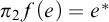 $\pi _2 f(e)=e^*$
for all
$\pi _2 f(e)=e^*$
for all $e\in E$
.
$e\in E$
.
Proof. Assume E completely $\mathbf {2}$
-freely generates
$\mathbf {2}$
-freely generates $\mathfrak {A}$
. Let c be the least upper bound of the set of atoms of
$\mathfrak {A}$
. Let c be the least upper bound of the set of atoms of $\mathfrak {A}$
,
$\mathfrak {A}$
, $b=-c$
, and
$b=-c$
, and $\mathfrak {B}$
the relativization of
$\mathfrak {B}$
the relativization of $\mathfrak {A}$
to b. As noted above,
$\mathfrak {A}$
to b. As noted above, $\mathfrak {B}$
is complete and atomless. For every
$\mathfrak {B}$
is complete and atomless. For every $w\subseteq E$
, let
$w\subseteq E$
, let $D_w=w\cup \{-e:e\in E\backslash w\}$
. Define a function f on A such that for all
$D_w=w\cup \{-e:e\in E\backslash w\}$
. Define a function f on A such that for all $x\in A$
,
$x\in A$
,
 $$\begin{align*}f(x)=\langle x\wedge b,\{w\subseteq E:\bigwedge D_w\wedge c\leq x\}\rangle.\end{align*}$$
We show that $\mathfrak {B}$
and f witness the claim.
$\mathfrak {B}$
and f witness the claim.
First, we show that for every $w\subseteq E$
,
$w\subseteq E$
, $\bigwedge D_w\wedge c$
is an atom of
$\bigwedge D_w\wedge c$
is an atom of $\mathfrak {A}$
. Let g be the characteristic function of w, mapping any
$\mathfrak {A}$
. Let g be the characteristic function of w, mapping any $e\in w$
to
$e\in w$
to $1$
and
$1$
and $e\in E\backslash w$
to
$e\in E\backslash w$
to $0$
. By complete
$0$
. By complete $\mathbf {2}$
-free generation, g has a unique extension
$\mathbf {2}$
-free generation, g has a unique extension $\hat {g}$
to a complete homomorphism from
$\hat {g}$
to a complete homomorphism from $\mathfrak {A}$
to
$\mathfrak {A}$
to $\mathbf {2}$
. Let U be the corresponding ultrafilter, the set of elements mapped by
$\mathbf {2}$
. Let U be the corresponding ultrafilter, the set of elements mapped by $\hat {g}$
to
$\hat {g}$
to $1$
. Since
$1$
. Since $\hat {g}$
is complete, U is principal, whence
$\hat {g}$
is complete, U is principal, whence $a=\bigwedge U$
is an atom. Further,
$a=\bigwedge U$
is an atom. Further, $g(x)=1$
for all
$g(x)=1$
for all $x\in D_w$
, and so
$x\in D_w$
, and so $\hat {g}(\bigwedge D_w)=1$
. Thus,
$\hat {g}(\bigwedge D_w)=1$
. Thus, $a\leq \bigwedge D_w$
, and so
$a\leq \bigwedge D_w$
, and so $a\leq \bigwedge D_w\wedge c$
. We show that
$a\leq \bigwedge D_w\wedge c$
. We show that $a=\bigwedge D_w\wedge c$
. Assume otherwise for contradiction. Then there is another atom
$a=\bigwedge D_w\wedge c$
. Assume otherwise for contradiction. Then there is another atom $a'\leq \bigwedge D_w\wedge c$
, and so a corresponding principal ultrafilter
$a'\leq \bigwedge D_w\wedge c$
, and so a corresponding principal ultrafilter $U'=\{x\in A:a'\leq x\}$
. Let h be the characteristic function of
$U'=\{x\in A:a'\leq x\}$
. Let h be the characteristic function of $U'$
, mapping every
$U'$
, mapping every $x\in U'$
to
$x\in U'$
to $1$
and
$1$
and $x\in A\backslash U'$
to
$x\in A\backslash U'$
to $0$
. Then h is a complete homomorphism from
$0$
. Then h is a complete homomorphism from $\mathfrak {A}$
to
$\mathfrak {A}$
to $\mathbf {2}$
. Further, since
$\mathbf {2}$
. Further, since $a'\leq \bigwedge D_w$
,
$a'\leq \bigwedge D_w$
, $D_w\subseteq U'$
, so h extends g. Thus h contradicts the uniqueness of
$D_w\subseteq U'$
, so h extends g. Thus h contradicts the uniqueness of $\hat {g}$
.
$\hat {g}$
.
With this observation, it is straightforward to verify that f is a homomorphism. To establish that f is surjective, it suffices to show that any $\langle x,y\rangle \in B\times \mathcal {PP}(E)$
is the image of
$\langle x,y\rangle \in B\times \mathcal {PP}(E)$
is the image of $x\vee \bigvee _{w\in y}\bigwedge D_w$
under f, which is routine. To establish that f is injective, consider any distinct members x and y of A. Then either
$x\vee \bigvee _{w\in y}\bigwedge D_w$
under f, which is routine. To establish that f is injective, consider any distinct members x and y of A. Then either $x\wedge b\neq y\wedge b$
or
$x\wedge b\neq y\wedge b$
or $x\wedge c\neq y\wedge c$
. In the former case, it is immediate that
$x\wedge c\neq y\wedge c$
. In the former case, it is immediate that $\pi _1f(x)\neq \pi _1f(y)$
. In the latter case, we may assume without loss of generality that there is an atom
$\pi _1f(x)\neq \pi _1f(y)$
. In the latter case, we may assume without loss of generality that there is an atom $a\leq x$
such that
$a\leq x$
such that $a\nleq y$
. Let
$a\nleq y$
. Let $w=\{e\in E:a\leq e\}$
. As established above,
$w=\{e\in E:a\leq e\}$
. As established above, $\bigwedge D_w\wedge c$
is an atom, and so
$\bigwedge D_w\wedge c$
is an atom, and so $\bigwedge D_w\wedge c=a$
. Thus
$\bigwedge D_w\wedge c=a$
. Thus $\bigwedge D_w\wedge c\nleq y$
. Thus, w witnesses
$\bigwedge D_w\wedge c\nleq y$
. Thus, w witnesses $\pi _2f(x)\neq \pi _2f(y)$
. So, in either case,
$\pi _2f(x)\neq \pi _2f(y)$
. So, in either case, $f(x)\neq f(y)$
.
$f(x)\neq f(y)$
.
Finally, consider any $e\in E$
, with a view to establishing
$e\in E$
, with a view to establishing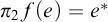 $\pi _2f(e)=e^*$
. Let
$\pi _2f(e)=e^*$
. Let $w\subseteq E$
; it suffices to show that
$w\subseteq E$
; it suffices to show that $\bigwedge D_w\wedge c\leq w$
iff
$\bigwedge D_w\wedge c\leq w$
iff $w\in e^*$
, i.e., iff
$w\in e^*$
, i.e., iff $e\in w$
. If
$e\in w$
. If $e\in w$
, the claim is immediate. Otherwise,
$e\in w$
, the claim is immediate. Otherwise, $-e\in D_w$
. As shown above,
$-e\in D_w$
. As shown above, $\bigwedge D_w\wedge c$
is an atom, and so non-zero; thus,
$\bigwedge D_w\wedge c$
is an atom, and so non-zero; thus, $\bigwedge D_w\wedge c\nleq e$
, as required.
$\bigwedge D_w\wedge c\nleq e$
, as required.
Putting these two lemmas together, we obtain the following characterization of complete $\mathbf {2}$
-free generation.
$\mathbf {2}$
-free generation.
Theorem 5.4.
E completely $\mathbf {2}$
-freely generates
$\mathbf {2}$
-freely generates $\mathfrak {A}$
just in case there is a complete atomless Boolean algebra
$\mathfrak {A}$
just in case there is a complete atomless Boolean algebra $\mathfrak {B}$
and an isomorphism f from
$\mathfrak {B}$
and an isomorphism f from $\mathfrak {A}$
to
$\mathfrak {A}$
to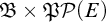 $\mathfrak {B}\times \mathfrak {P}\mathcal {P}(E)$
such that
$\mathfrak {B}\times \mathfrak {P}\mathcal {P}(E)$
such that $\pi _2 f(e)=e^*$
for all
$\pi _2 f(e)=e^*$
for all $e\in E$
.
$e\in E$
.

5.3 Complete independent generation
To characterize complete independent generation, we begin with a basic observation on complete descriptions based on complete generators of complete algebras. The observation is based on the fact that as in the finite case, we can characterize the smallest complete subalgebra of a given algebra containing a starting set of elements as the result of successively closing the starting set under complementation and greatest lower bounds, now admitting arbitrary greatest lower bounds and iterating the construction into the transfinite.
Lemma 5.5. Let $\mathfrak {A}$
be a complete Boolean algebra which is completely generated by a set
$\mathfrak {A}$
be a complete Boolean algebra which is completely generated by a set $G\subseteq A$
, and
$G\subseteq A$
, and $D\vartriangleleft G$
. Then
$D\vartriangleleft G$
. Then $\bigwedge D\leq x$
or
$\bigwedge D\leq x$
or $\bigwedge D\leq -x$
for all
$\bigwedge D\leq -x$
for all $x\in A$
.
$x\in A$
.
Proof. For every ordinal $\alpha $
, define a set
$\alpha $
, define a set $G_\alpha \subseteq A$
as follows:
$G_\alpha \subseteq A$
as follows:
 $$ \begin{align*} G_0&:=G\\ G_{\alpha+1}&:=\{-x:x\in G_\alpha\}\cup\{\bigwedge X:X\subseteq G_\alpha\}\\ G_\lambda&:=\bigcup_{\alpha<\lambda}G_\alpha \quad (\lambda \text{ a limit ordinal}). \end{align*} $$
By cardinality considerations, there is some ordinal $\alpha $
at which
$\alpha $
at which $G_\alpha $
reaches a fixed point. This set is closed under the two operations, and so a complete subalgebra, which means that
$G_\alpha $
reaches a fixed point. This set is closed under the two operations, and so a complete subalgebra, which means that $A=G_\alpha $
. It thus suffices to show by a transfinite induction that for every ordinal
$A=G_\alpha $
. It thus suffices to show by a transfinite induction that for every ordinal $\alpha $
and
$\alpha $
and $x\in G_\alpha $
,
$x\in G_\alpha $
, $\bigwedge D\leq x$
or
$\bigwedge D\leq x$
or $\bigwedge D\leq -x$
, which is routine.
$\bigwedge D\leq -x$
, which is routine.
We can now characterize complete independent generation in very similar terms to those just used to characterize complete $\mathbf {2}$
-free generation. First, we can again show that a product of a complete atomless Boolean algebra
$\mathbf {2}$
-free generation. First, we can again show that a product of a complete atomless Boolean algebra $\mathfrak {B}$
with a double powerset algebra
$\mathfrak {B}$
with a double powerset algebra $\mathfrak {P}\mathcal {P}(S)$
is completely independently generated, with one additional cardinality constraint: the atomless factor
$\mathfrak {P}\mathcal {P}(S)$
is completely independently generated, with one additional cardinality constraint: the atomless factor $\mathfrak {B}$
must be generated by a set G which is no larger than the base set S on which the double powerset algebra is constructed. To produce the witnessing set E of completely independent complete generators, we just need to adjoin to every canonical generator
$\mathfrak {B}$
must be generated by a set G which is no larger than the base set S on which the double powerset algebra is constructed. To produce the witnessing set E of completely independent complete generators, we just need to adjoin to every canonical generator $s^*$
of the double powerset algebra an element
$s^*$
of the double powerset algebra an element $\beta (s)$
of G, ensuring that the image of S under
$\beta (s)$
of G, ensuring that the image of S under $\beta $
contains each element of G. In other words:
$\beta $
contains each element of G. In other words:
Lemma 5.6. For any complete atomless Boolean algebra $\mathfrak {B}$
, set S, and function
$\mathfrak {B}$
, set S, and function $\beta :S\to B$
such that
$\beta :S\to B$
such that $\{\beta (s):s\in S\}$
completely generates
$\{\beta (s):s\in S\}$
completely generates $\mathfrak {B}$
,
$\mathfrak {B}$
, $\mathfrak {A}=\mathfrak {B}\times \mathfrak {P}\mathcal {P}(S)$
is completely independently generated by
$\mathfrak {A}=\mathfrak {B}\times \mathfrak {P}\mathcal {P}(S)$
is completely independently generated by $E=\{\langle \beta (s),s^*\rangle :s\in S\}$
.
$E=\{\langle \beta (s),s^*\rangle :s\in S\}$
.
Proof. We begin by showing that the atoms of $\mathfrak {A}$
can be described as the set
$\mathfrak {A}$
can be described as the set $\{\bigwedge D:D\vartriangleleft E\}$
. Note that
$\{\bigwedge D:D\vartriangleleft E\}$
. Note that $\{D:D\vartriangleleft E\}=\{D_w:w\subseteq S\}$
, where
$\{D:D\vartriangleleft E\}=\{D_w:w\subseteq S\}$
, where $D_w$
is defined as follows:
$D_w$
is defined as follows:
 $$\begin{align*}D_w:=\{\langle\beta(s),s^*\rangle:s\in w\}\cup\{-\langle\beta(s),s^*\rangle:s\in S\backslash w\}.\end{align*}$$
It thus suffices to show that $\bigwedge D_w=\langle \bot ,\{w\}\rangle $
, for all
$\bigwedge D_w=\langle \bot ,\{w\}\rangle $
, for all $w\subseteq S$
. We consider the two coordinates in turn.
$w\subseteq S$
. We consider the two coordinates in turn.
First, working in the atomless algebra $\mathfrak {B}$
: Let
$\mathfrak {B}$
: Let $G:=\{\beta (s):s\in S\}$
. If
$G:=\{\beta (s):s\in S\}$
. If $w\subseteq S$
, then
$w\subseteq S$
, then $\{\pi _1(x):x\in D_w\}$
includes some
$\{\pi _1(x):x\in D_w\}$
includes some $D\vartriangleleft G$
. By Lemma 5.5, for all
$D\vartriangleleft G$
. By Lemma 5.5, for all $x\in B$
,
$x\in B$
, $\bigwedge D\leq x$
or
$\bigwedge D\leq x$
or $\bigwedge D\leq -x$
. Since
$\bigwedge D\leq -x$
. Since $\mathfrak {B}$
is atomless, it follows that
$\mathfrak {B}$
is atomless, it follows that $\bigwedge D=\bot $
, and so
$\bigwedge D=\bot $
, and so $\bigwedge \{\pi _1(x):x\in D_w\} =\bot $
, as required.
$\bigwedge \{\pi _1(x):x\in D_w\} =\bot $
, as required.
Second, working in the double powerset algebra $\mathfrak {P}\mathcal {P}(S)$
: If
$\mathfrak {P}\mathcal {P}(S)$
: If $w\subseteq S$
, then
$w\subseteq S$
, then $D:=\{\pi _2(x):x\in D_w\}\vartriangleleft \Gamma _S$
. In particular,
$D:=\{\pi _2(x):x\in D_w\}\vartriangleleft \Gamma _S$
. In particular,
 $$\begin{align*}D=\{s^*:s\in w\}\cup\{-s^*:s\in S\backslash w\}.\end{align*}$$
It is routine to verify that for all $v\subseteq S$
,
$v\subseteq S$
, $v\in \bigcap D$
iff
$v\in \bigcap D$
iff $v=w$
. Thus
$v=w$
. Thus $\bigcap D=\{w\}$
, and so
$\bigcap D=\{w\}$
, and so $\bigwedge \{\pi _2(x):x\in D_w\}=\{w\}$
, as required.
$\bigwedge \{\pi _2(x):x\in D_w\}=\{w\}$
, as required.
From this initial observation, we can immediately conclude that E is completely independent: for every $D\vartriangleleft E$
,
$D\vartriangleleft E$
, $\bigwedge D$
is an atom, and so non-zero.
$\bigwedge D$
is an atom, and so non-zero.
It is also easy to conclude from this observation that E completely generates $\mathfrak {A}$
: Let
$\mathfrak {A}$
: Let $\mathfrak {A}'$
be the smallest complete subalgebra of
$\mathfrak {A}'$
be the smallest complete subalgebra of $\mathfrak {A}$
including E. By the initial observation,
$\mathfrak {A}$
including E. By the initial observation, $\mathfrak {A}'$
contains every atom of
$\mathfrak {A}'$
contains every atom of $\mathfrak {A}$
. Since every member of a powerset algebra is a union (least upper bound) of some of its atoms, it follows that
$\mathfrak {A}$
. Since every member of a powerset algebra is a union (least upper bound) of some of its atoms, it follows that $\langle \bot ,y\rangle \in \mathfrak {A}'$
, for all
$\langle \bot ,y\rangle \in \mathfrak {A}'$
, for all $y\in \mathcal {PP}(S)$
. In particular,
$y\in \mathcal {PP}(S)$
. In particular, $\mathfrak {A}'$
contains
$\mathfrak {A}'$
contains $\langle \bot ,\top \rangle $
, and so also
$\langle \bot ,\top \rangle $
, and so also $\langle \beta (s),\bot \rangle $
, for all
$\langle \beta (s),\bot \rangle $
, for all $s\in S$
. Since G completely generates
$s\in S$
. Since G completely generates $\mathfrak {B}$
, it follows that
$\mathfrak {B}$
, it follows that $\mathfrak {A}'$
also contains
$\mathfrak {A}'$
also contains $\langle x,\bot \rangle $
, for all
$\langle x,\bot \rangle $
, for all $x\in B$
. Thus,
$x\in B$
. Thus, $\mathfrak {A}'$
contains any
$\mathfrak {A}'$
contains any $\langle x,y\rangle \in \mathfrak {A}$
, as required.
$\langle x,y\rangle \in \mathfrak {A}$
, as required.
As in the case of complete $\mathbf {2}$
-free generation, we can show that up to isomorphism, these are the only examples of complete independent generation.
$\mathbf {2}$
-free generation, we can show that up to isomorphism, these are the only examples of complete independent generation.
Lemma 5.7. If E completely independently generates $\mathfrak {A}$
, then there is a complete atomless Boolean algebra
$\mathfrak {A}$
, then there is a complete atomless Boolean algebra $\mathfrak {B}$
and an isomorphism f from
$\mathfrak {B}$
and an isomorphism f from $\mathfrak {A}$
to
$\mathfrak {A}$
to $\mathfrak {B}\times \mathfrak {P}\mathcal {P}(E)$
such that
$\mathfrak {B}\times \mathfrak {P}\mathcal {P}(E)$
such that $\{\pi _1 f(e):e\in E\}$
completely generates
$\{\pi _1 f(e):e\in E\}$
completely generates $\mathfrak {B}$
and
$\mathfrak {B}$
and $\pi _2 f(e)=e^*$
for all
$\pi _2 f(e)=e^*$
for all $e\in E$
.
$e\in E$
.
Proof. The proof follows the pattern of Lemma 5.3. Assume E completely independently generates $\mathfrak {A}$
. Let c be the least upper bound of the set of atoms of
$\mathfrak {A}$
. Let c be the least upper bound of the set of atoms of $\mathfrak {A}$
,
$\mathfrak {A}$
, $b=-c$
, and
$b=-c$
, and $\mathfrak {B}$
the relativization of
$\mathfrak {B}$
the relativization of $\mathfrak {A}$
to b. As noted above,
$\mathfrak {A}$
to b. As noted above, $\mathfrak {B}$
is complete and atomless. For every
$\mathfrak {B}$
is complete and atomless. For every $w\subseteq E$
, let
$w\subseteq E$
, let $D_w=w\cup \{-e:e\in E\backslash w\}$
. Define a function f on A such that for all
$D_w=w\cup \{-e:e\in E\backslash w\}$
. Define a function f on A such that for all $x\in A$
,
$x\in A$
,
 $$\begin{align*}f(x)=\langle x\wedge b,\{w\subseteq E:\bigwedge D_w\leq x\}\rangle.\end{align*}$$
We show that $\mathfrak {B}$
and f witness the claim.
$\mathfrak {B}$
and f witness the claim.
First, we show that for every $w\subseteq E$
,
$w\subseteq E$
, $\bigwedge D_w$
is an atom of
$\bigwedge D_w$
is an atom of $\mathfrak {A}$
. That
$\mathfrak {A}$
. That $\bigwedge D_w>\bot $
is guaranteed by the complete independence of E. As E completely generates
$\bigwedge D_w>\bot $
is guaranteed by the complete independence of E. As E completely generates $\mathfrak {A}$
, it therefore follows with Lemma 5.5 that
$\mathfrak {A}$
, it therefore follows with Lemma 5.5 that $D_w$
is an atom. The remainder of the proof proceeds along the lines of the proof of Lemma 5.3.
$D_w$
is an atom. The remainder of the proof proceeds along the lines of the proof of Lemma 5.3.
Putting the last two lemmas together, we obtain the following characterization of complete independent generation.
Theorem 5.8.
E completely independently generates $\mathfrak {A}$
just in case there is a complete atomless Boolean algebra
$\mathfrak {A}$
just in case there is a complete atomless Boolean algebra $\mathfrak {B}$
and an isomorphism f from
$\mathfrak {B}$
and an isomorphism f from $\mathfrak {A}$
to
$\mathfrak {A}$
to $\mathfrak {B}\times \mathfrak {P}\mathcal {P}(E)$
such that
$\mathfrak {B}\times \mathfrak {P}\mathcal {P}(E)$
such that $\{\pi _1 f(e):e\in E\}$
completely generates
$\{\pi _1 f(e):e\in E\}$
completely generates $\mathfrak {B}$
and
$\mathfrak {B}$
and $\pi _2 f(e)=e^*$
for all
$\pi _2 f(e)=e^*$
for all $e\in E$
.
$e\in E$
.
Proof. The left-to-right direction is established in Lemma 5.7. The right-to-left direction follows from Lemma 5.6 and the fact that complete independent generation is invariant under isomorphism.
One obvious consequence of Theorems 5.4 and 5.8 is that by moving from arbitrary Boolean algebras to complete Boolean algebras, we include not only the finite double powerset algebras, but also infinite double powerset algebras. It is worth noting that in this case, the relevant generators need not be determined uniquely up to isomorphism. Recall how we noted that for any cardinality $\kappa $
, there is a Boolean algebra
$\kappa $
, there is a Boolean algebra $\mathfrak {A}$
which is independently generated by a set E of cardinality
$\mathfrak {A}$
which is independently generated by a set E of cardinality $\kappa $
. Furthermore, in this case,
$\kappa $
. Furthermore, in this case, $\mathfrak {A}$
and E determine each other uniquely, up to isomorphism:
$\mathfrak {A}$
and E determine each other uniquely, up to isomorphism: $\mathfrak {A}$
is uniquely determined, up to isomorphism, by the cardinality of E, and the cardinality of E is uniquely determined by the structure—indeed, by the cardinality—of
$\mathfrak {A}$
is uniquely determined, up to isomorphism, by the cardinality of E, and the cardinality of E is uniquely determined by the structure—indeed, by the cardinality—of $\mathfrak {A}$
. In the case of double powerset algebras, it is obvious that the cardinality of the starting set S, which is identical to the cardinality of the set of canonical generators
$\mathfrak {A}$
. In the case of double powerset algebras, it is obvious that the cardinality of the starting set S, which is identical to the cardinality of the set of canonical generators $\Gamma _S$
, determines
$\Gamma _S$
, determines $\mathfrak {P}\mathcal {P}(S)$
uniquely, up to isomorphism. If S is finite, its cardinality is also determined by the cardinality of
$\mathfrak {P}\mathcal {P}(S)$
uniquely, up to isomorphism. If S is finite, its cardinality is also determined by the cardinality of $\mathfrak {P}\mathcal {P}(S)$
, since there is a unique number n such that
$\mathfrak {P}\mathcal {P}(S)$
, since there is a unique number n such that $2^{2^n}=|\mathfrak {P}\mathcal {P}(S)|$
. This need not hold if S is infinite, since it is consistent with ZFC that there are distinct cardinals
$2^{2^n}=|\mathfrak {P}\mathcal {P}(S)|$
. This need not hold if S is infinite, since it is consistent with ZFC that there are distinct cardinals $\kappa ,\lambda $
such that
$\kappa ,\lambda $
such that $2^\kappa =2^\lambda $
. (This consistency claim can be obtained using forcing, the standard technique for independence proofs in set theory. For example, it follows as a corollary of Easton’s theorem; see Jech [Reference Jech16, p. 232, theorem 15.18].) In this case,
$2^\kappa =2^\lambda $
. (This consistency claim can be obtained using forcing, the standard technique for independence proofs in set theory. For example, it follows as a corollary of Easton’s theorem; see Jech [Reference Jech16, p. 232, theorem 15.18].) In this case, $\mathfrak {P}\mathcal {P}(\kappa )$
is isomorphic to
$\mathfrak {P}\mathcal {P}(\kappa )$
is isomorphic to $\mathfrak {P}\mathcal {P}(\lambda )$
while
$\mathfrak {P}\mathcal {P}(\lambda )$
while $\Gamma _\kappa =\kappa \neq \lambda =\Gamma _\lambda $
. In such a case, there is a double powerset algebra which is, e.g., completely independently generated by two sets of distinct cardinalities. Thus, the relevant regimentations of logical atomism admitting all double powerset algebras need not even pin down the elementary propositions up to isomorphism.
$\Gamma _\kappa =\kappa \neq \lambda =\Gamma _\lambda $
. In such a case, there is a double powerset algebra which is, e.g., completely independently generated by two sets of distinct cardinalities. Thus, the relevant regimentations of logical atomism admitting all double powerset algebras need not even pin down the elementary propositions up to isomorphism.
Another obvious consequence of Theorems 5.4 and 5.8 is that neither of the relevant constraints requires the generated algebra to be a double powerset algebra. In the case of complete $\mathbf {2}$
-free generation, it is perhaps not all that surprising that some complete Boolean algebra which is not isomorphic to a double powerset algebra is completely
$\mathbf {2}$
-free generation, it is perhaps not all that surprising that some complete Boolean algebra which is not isomorphic to a double powerset algebra is completely $\mathbf {2}$
-freely generated by one of its sets. After all, complete
$\mathbf {2}$
-freely generated by one of its sets. After all, complete $\mathbf {2}$
-free generation only captures the idea that the truth values of all propositions are uniquely determined by the truth values of the elementary propositions. The matter is perhaps more surprising in the case of complete independent generation. Along lines discussed in the proof of Lemma 5.7, if E completely independently generates
$\mathbf {2}$
-free generation only captures the idea that the truth values of all propositions are uniquely determined by the truth values of the elementary propositions. The matter is perhaps more surprising in the case of complete independent generation. Along lines discussed in the proof of Lemma 5.7, if E completely independently generates $\mathfrak {A}$
, then the atoms of
$\mathfrak {A}$
, then the atoms of $\mathfrak {A}$
correspond uniquely to the subsets of E, via the greatest lower bounds of complete descriptions in terms of E. This is as one might expect. The (arbitrary) disjunctions of atoms naturally form a double powerset structure. However, we have seen that it is consistent with complete independent generation that further elements are generated:
$\mathfrak {A}$
correspond uniquely to the subsets of E, via the greatest lower bounds of complete descriptions in terms of E. This is as one might expect. The (arbitrary) disjunctions of atoms naturally form a double powerset structure. However, we have seen that it is consistent with complete independent generation that further elements are generated: $\mathfrak {A}$
might be the product of an atomless algebra
$\mathfrak {A}$
might be the product of an atomless algebra $\mathfrak {B}$
with a double powerset algebra
$\mathfrak {B}$
with a double powerset algebra $\mathfrak {P}\mathcal {P}(S)$
. In this case, every generating element consists of a component of the atomless algebra and a component of the double powerset algebra. When we form the atoms as greatest lower bounds of complete descriptions in terms of E, the atomless components disappear. Thus, once we have formed the disjunction of all atoms, we can use this to access the atomless component of the generating elements, and so generate the rest of the algebra. Thus, aside from the expected double powerset structure containing
$\mathfrak {P}\mathcal {P}(S)$
. In this case, every generating element consists of a component of the atomless algebra and a component of the double powerset algebra. When we form the atoms as greatest lower bounds of complete descriptions in terms of E, the atomless components disappear. Thus, once we have formed the disjunction of all atoms, we can use this to access the atomless component of the generating elements, and so generate the rest of the algebra. Thus, aside from the expected double powerset structure containing $2^{2^{|E|}}$
elements, complete independent generation allows the generation of further, maybe unexpected, propositions, based on the atomless factor
$2^{2^{|E|}}$
elements, complete independent generation allows the generation of further, maybe unexpected, propositions, based on the atomless factor $\mathfrak {B}$
. It is worth noting that with the Gaifman–Hales theorem, it follows immediately that this atomless factor may be arbitrarily large: If E is countably infinite, the corresponding double powerset algebra will have cardinality
$\mathfrak {B}$
. It is worth noting that with the Gaifman–Hales theorem, it follows immediately that this atomless factor may be arbitrarily large: If E is countably infinite, the corresponding double powerset algebra will have cardinality $2^{2^{|E|}}=2^{2^{\aleph _0}}=\beth _2$
. But since there are arbitrarily large complete Boolean algebras completely generated by a countable set, the atomless factor may be arbitrarily large. The unexpected atomless factor may therefore dwarf the expected double powerset factor by an arbitrarily large degree.
$2^{2^{|E|}}=2^{2^{\aleph _0}}=\beth _2$
. But since there are arbitrarily large complete Boolean algebras completely generated by a countable set, the atomless factor may be arbitrarily large. The unexpected atomless factor may therefore dwarf the expected double powerset factor by an arbitrarily large degree.
So, in the case of complete $\mathbf {2}$
-free and completely independent generation at least, the rapprochement with the double powerset picture is incomplete. Naturally, one can close the gap by making further assumptions, such as atomicity: it follows immediately from Theorem 5.8 that a complete atomic Boolean algebra
$\mathbf {2}$
-free and completely independent generation at least, the rapprochement with the double powerset picture is incomplete. Naturally, one can close the gap by making further assumptions, such as atomicity: it follows immediately from Theorem 5.8 that a complete atomic Boolean algebra $\mathfrak {A}$
is, e.g., completely independently generated by a set E just in case there is an isomorphism from
$\mathfrak {A}$
is, e.g., completely independently generated by a set E just in case there is an isomorphism from $\mathfrak {A}$
to
$\mathfrak {A}$
to $\mathfrak {P}\mathcal {P}(E)$
which maps every
$\mathfrak {P}\mathcal {P}(E)$
which maps every $e\in E$
to
$e\in E$
to $e^*$
. Thus, to arrive at the double powerset picture, it also suffices to assume, in addition to completely independently generated, that the disjunction of the conjunctions of complete descriptions in terms of E is the top element, i.e.,
$e^*$
. Thus, to arrive at the double powerset picture, it also suffices to assume, in addition to completely independently generated, that the disjunction of the conjunctions of complete descriptions in terms of E is the top element, i.e.,
 $$\begin{align*}\bigvee_{D\vartriangleleft E}\bigwedge D=\top.\end{align*}$$
Such additional assumptions may even be taken to be part of the more general logical atomist picture (cf. 4.46, 4.461).
6 Partial characterizations
For an arbitrary complete Boolean algebra $\mathfrak {A}$
, the notions of complete
$\mathfrak {A}$
, the notions of complete $\mathfrak {A}$
-free and complete
$\mathfrak {A}$
-free and complete $\mathsf {csub}(\mathfrak {A})$
-free generation (and the equivalent decomposition principles) are much harder to understand, and we have only obtained partial results characterizing them and relating them to three notions discussed in the previous section. Our main results are summarized in Figure 1. There, indexed arrows indicate the strongest relationship we have been able to establish. For example,
$\mathsf {csub}(\mathfrak {A})$
-free generation (and the equivalent decomposition principles) are much harder to understand, and we have only obtained partial results characterizing them and relating them to three notions discussed in the previous section. Our main results are summarized in Figure 1. There, indexed arrows indicate the strongest relationship we have been able to establish. For example,  indicates that we have been able to establish that X entails Y, but that we haven’t been able to settle whether Y entails X. Complete independent generation is abbreviated as CIG, and complete $\mathsf {T}$
-free generation is abbreviated as
$\mathsf {T}$
-free generation is abbreviated as $\mathsf {T}$
, for the various choices of
$\mathsf {T}$
, for the various choices of $\mathsf {T}$
.
$\mathsf {T}$
.
Entailments among complete notions of generation.

Figure 1 Long description
At the far left is C B A. A rightward arrow labeled as not subset points to c sub U. From c sub U, two arrows branch: one upward right labeled not subset to C I G, and one downward right labeled subset to calligraphic U. From C I G, a rightward arrow labeled not subset points to bold 2, and a downward arrow labeled not subset points to calligraphic U. All arrows are labeled either subset or not subset, indicating the relationships among the sets.
6.1 Basic observations
We begin with the relationship between complete $\mathsf {CBA}$
-free generation and complete
$\mathsf {CBA}$
-free generation and complete $\mathsf {csub}(\mathfrak {A})$
-free generation. That the former entails the latter is immediate. That the entailment cannot be reversed follows by Theorem 5.1 and the following result.
$\mathsf {csub}(\mathfrak {A})$
-free generation. That the former entails the latter is immediate. That the entailment cannot be reversed follows by Theorem 5.1 and the following result.
Proposition 6.1. For every set S, the double powerset algebra $\mathfrak {A}=\mathfrak {P}\mathcal {P}(S)$
is completely
$\mathfrak {A}=\mathfrak {P}\mathcal {P}(S)$
is completely $\mathsf {csub}(\mathfrak {A})$
-freely generated by the set of canonical generators
$\mathsf {csub}(\mathfrak {A})$
-freely generated by the set of canonical generators $\Gamma _S$
.
$\Gamma _S$
.
Proof. Consider any complete subalgebra $\mathfrak {B}$
of
$\mathfrak {B}$
of $\mathfrak {A}=\mathfrak {P}\mathcal {P}(S)$
, and function
$\mathfrak {A}=\mathfrak {P}\mathcal {P}(S)$
, and function $f:\Gamma _S\to B$
. Let
$f:\Gamma _S\to B$
. Let $\hat {f}:A\to A$
such that for all
$\hat {f}:A\to A$
such that for all $x\in A$
,
$x\in A$
,
 $$\begin{align*}\hat{f}(x)=\{w\subseteq S:\{s\in S:w\in f(s^*)\}\in x\}.\end{align*}$$
It is straightforward to show that $\hat {f}$
is a complete homomorphism from
$\hat {f}$
is a complete homomorphism from $\mathfrak {A}$
to
$\mathfrak {A}$
to $\mathfrak {A}$
which extends f.
$\mathfrak {A}$
which extends f.
Recall that $\Gamma _S$
completely generates
$\Gamma _S$
completely generates $\mathfrak {A}$
. By inductions on the generation of
$\mathfrak {A}$
. By inductions on the generation of $\mathfrak {A}$
(as in the proof of Lemma 5.5), it follows that
$\mathfrak {A}$
(as in the proof of Lemma 5.5), it follows that $\mathrm {im}(\hat {f})\subseteq B$
whence
$\mathrm {im}(\hat {f})\subseteq B$
whence $\hat {f}$
is a complete homomorphism from
$\hat {f}$
is a complete homomorphism from $\mathfrak {A}$
to
$\mathfrak {A}$
to $\mathfrak {B}$
. It also follows that
$\mathfrak {B}$
. It also follows that $\hat {f}$
is the only such homomorphism extending f: Let g be a complete homomorphism from
$\hat {f}$
is the only such homomorphism extending f: Let g be a complete homomorphism from $\mathfrak {A}$
to
$\mathfrak {A}$
to $\mathfrak {B}$
extending f. By an induction, we can show that at every stage of the generation of
$\mathfrak {B}$
extending f. By an induction, we can show that at every stage of the generation of $\mathfrak {A}$
from
$\mathfrak {A}$
from $\Gamma _S$
,
$\Gamma _S$
, $\hat {f}$
and g agree on the elements generated up to this stage. The base case follows from the fact that both
$\hat {f}$
and g agree on the elements generated up to this stage. The base case follows from the fact that both $\hat {f}$
and g extend f. Successor stages follow from the fact that both
$\hat {f}$
and g extend f. Successor stages follow from the fact that both $\hat {f}$
and g are complete homomorphisms, and union stages are immediate. Thus g is identical to
$\hat {f}$
and g are complete homomorphisms, and union stages are immediate. Thus g is identical to $\hat {f}$
, meaning that
$\hat {f}$
, meaning that $\hat {f}$
is unique.
$\hat {f}$
is unique.
It is immediate that complete $\mathsf {csub}(\mathfrak {A})$
-free generation entails complete
$\mathsf {csub}(\mathfrak {A})$
-free generation entails complete $\mathfrak {A}$
-free generation. That complete
$\mathfrak {A}$
-free generation. That complete $\mathsf {csub}(\mathfrak {A})$
-free generation entails complete independent generation is shown in the next result.
$\mathsf {csub}(\mathfrak {A})$
-free generation entails complete independent generation is shown in the next result.
Proposition 6.2. If E completely $\mathsf {csub}(\mathfrak {A})$
-freely generates
$\mathsf {csub}(\mathfrak {A})$
-freely generates $\mathfrak {A}$
, then E completely independently generates
$\mathfrak {A}$
, then E completely independently generates $\mathfrak {A}$
.
$\mathfrak {A}$
.
Proof. We first show that E is completely independent. This can in fact be established from the weaker assumption that E completely $\mathsf {T}$
-freely generates
$\mathsf {T}$
-freely generates $\mathfrak {A}$
, for some class
$\mathfrak {A}$
, for some class $\mathsf {T}$
of complete Boolean algebras containing a non-trivial algebra
$\mathsf {T}$
of complete Boolean algebras containing a non-trivial algebra $\mathfrak {B}$
. Consider any
$\mathfrak {B}$
. Consider any $D\vartriangleleft E$
. Let
$D\vartriangleleft E$
. Let $f:E\to B$
be the function such that
$f:E\to B$
be the function such that $f(e)=\top $
if
$f(e)=\top $
if $e\in D$
, and
$e\in D$
, and $f(e)=\bot $
otherwise. By complete
$f(e)=\bot $
otherwise. By complete $\mathsf {T}$
-free generation, f extends to a complete homomorphism
$\mathsf {T}$
-free generation, f extends to a complete homomorphism $\hat {f}$
. Then
$\hat {f}$
. Then $\hat {f}(\bigwedge D)=\top $
, whence
$\hat {f}(\bigwedge D)=\top $
, whence $\bigwedge D>\bot $
.
$\bigwedge D>\bot $
.
To show that E completely generates $\mathfrak {A}$
, let
$\mathfrak {A}$
, let $\mathfrak {B}$
be the smallest subalgebra of
$\mathfrak {B}$
be the smallest subalgebra of $\mathfrak {A}$
including E. We show that
$\mathfrak {A}$
including E. We show that $\mathfrak {B}=\mathfrak {A}$
. Let
$\mathfrak {B}=\mathfrak {A}$
. Let $\imath $
be the identity map on E. By complete
$\imath $
be the identity map on E. By complete $\mathsf {csub}(\mathfrak {A})$
-free generation,
$\mathsf {csub}(\mathfrak {A})$
-free generation, $\imath $
extends to a complete homomorphism
$\imath $
extends to a complete homomorphism $\hat {\imath }$
from
$\hat {\imath }$
from $\mathfrak {A}$
to
$\mathfrak {A}$
to $\mathfrak {B}$
.
$\mathfrak {B}$
. $\hat {\imath }$
is also a complete homomorphism from
$\hat {\imath }$
is also a complete homomorphism from $\mathfrak {A}$
to
$\mathfrak {A}$
to $\mathfrak {A}$
extending
$\mathfrak {A}$
extending $\imath $
, so by complete
$\imath $
, so by complete $\mathsf {csub}(\mathfrak {A})$
-free generation,
$\mathsf {csub}(\mathfrak {A})$
-free generation, $\hat {\imath }$
is the only such homomorphism. But the identity map on A is such a homomorphism, so
$\hat {\imath }$
is the only such homomorphism. But the identity map on A is such a homomorphism, so $\hat {\imath }$
is the identity map on A. So
$\hat {\imath }$
is the identity map on A. So $\mathfrak {B}=\mathfrak {A}$
.
$\mathfrak {B}=\mathfrak {A}$
.
It follows immediately from Theorems 5.8 and 5.4 that complete independent generation entails complete $\mathbf {2}$
-free generation, but not vice versa. Moreover, there are complete Boolean algebras completely
$\mathbf {2}$
-free generation, but not vice versa. Moreover, there are complete Boolean algebras completely $\mathbf {2}$
-freely generated by some set, and not completely independently generated by any set.
$\mathbf {2}$
-freely generated by some set, and not completely independently generated by any set.
Proposition 6.3. Some complete Boolean algebra is completely $\mathbf {2}$
-freely generated by a set of its elements, while not being completely independently generated by any set of its elements.
$\mathbf {2}$
-freely generated by a set of its elements, while not being completely independently generated by any set of its elements.
Proof. We can derive the claim from Theorems 5.4 and 5.8 together with the fact that for any cardinality $\kappa $
, there are complete Boolean algebras all of whose completely generating sets are of cardinality
$\kappa $
, there are complete Boolean algebras all of whose completely generating sets are of cardinality $\geq \kappa $
. For example, the completion of the free Boolean algebra with
$\geq \kappa $
. For example, the completion of the free Boolean algebra with $\kappa $
many generators is only completely generated by sets of size
$\kappa $
many generators is only completely generated by sets of size $\geq \kappa $
(see Koppelberg [Reference Koppelberg, Monk and Bonnet17, p. 211, example 2]). Let
$\geq \kappa $
(see Koppelberg [Reference Koppelberg, Monk and Bonnet17, p. 211, example 2]). Let $\mathfrak {B}$
be the completion of the free Boolean algebra with
$\mathfrak {B}$
be the completion of the free Boolean algebra with $\beth _1=2^{\aleph _0}$
generators, and
$\beth _1=2^{\aleph _0}$
generators, and $\mathfrak {A}=\mathfrak {B}\times \mathfrak {P}\mathcal {P}(\aleph _0)$
. By Theorem 5.4,
$\mathfrak {A}=\mathfrak {B}\times \mathfrak {P}\mathcal {P}(\aleph _0)$
. By Theorem 5.4, $\mathfrak {A}$
is completely
$\mathfrak {A}$
is completely $\mathbf {2}$
-freely generated. Assume for contradiction that it is completely independently generated by a set E. By Theorem 5.8, E must be at least of size
$\mathbf {2}$
-freely generated. Assume for contradiction that it is completely independently generated by a set E. By Theorem 5.8, E must be at least of size $\beth _1$
. But then
$\beth _1$
. But then $\mathfrak {P}\mathcal {P}(\aleph _0)$
must be isomorphic to
$\mathfrak {P}\mathcal {P}(\aleph _0)$
must be isomorphic to $\mathfrak {P}\mathcal {P}(S)$
for some set S of cardinality
$\mathfrak {P}\mathcal {P}(S)$
for some set S of cardinality $\beth _1$
, which is impossible.
$\beth _1$
, which is impossible.
It only remains to show that complete independent generation does not entail complete $\mathfrak {A}$
-free generation. Since we have seen that complete
$\mathfrak {A}$
-free generation. Since we have seen that complete $\mathsf {csub}(\mathfrak {A})$
-free generation entails both complete independent generation and complete
$\mathsf {csub}(\mathfrak {A})$
-free generation entails both complete independent generation and complete $\mathfrak {A}$
-free generation, it immediately follows that complete independent generation does not entail complete
$\mathfrak {A}$
-free generation, it immediately follows that complete independent generation does not entail complete $\mathsf {csub}(\mathfrak {A})$
-free generation. Moreover, we can show not only that some set which completely independently generates an algebra
$\mathsf {csub}(\mathfrak {A})$
-free generation. Moreover, we can show not only that some set which completely independently generates an algebra $\mathfrak {A}$
fails to completely
$\mathfrak {A}$
fails to completely $\mathfrak {A}$
-freely generate it, but more specifically that there is a completely independently generated algebra
$\mathfrak {A}$
-freely generate it, but more specifically that there is a completely independently generated algebra $\mathfrak {A}$
such that no set which completely independently generates
$\mathfrak {A}$
such that no set which completely independently generates $\mathfrak {A}$
also completely
$\mathfrak {A}$
also completely $\mathfrak {A}$
-freely generates
$\mathfrak {A}$
-freely generates $\mathfrak {A}$
. There is a further question which we leave open here, which is whether there is a completely independently generated algebra which is not completely
$\mathfrak {A}$
. There is a further question which we leave open here, which is whether there is a completely independently generated algebra which is not completely $\mathfrak {A}$
-freely generated at all. Establishing our results on the relationship between complete independent generation and complete
$\mathfrak {A}$
-freely generated at all. Establishing our results on the relationship between complete independent generation and complete $\mathfrak {A}$
-free generation is somewhat complicated. We therefore devote a separate section to it.
$\mathfrak {A}$
-free generation is somewhat complicated. We therefore devote a separate section to it.
6.2 Complete independent generation without complete
$\mathfrak {A}$
-free generation

For the result of this section, we need a number of further notions for a Boolean algebra $\mathfrak {A}$
. First, elements
$\mathfrak {A}$
. First, elements $x,y\in A$
are disjoint if
$x,y\in A$
are disjoint if $x\wedge y=\bot $
. An antichain of a
$x\wedge y=\bot $
. An antichain of a $\mathfrak {A}$
is a set
$\mathfrak {A}$
is a set $X\subseteq A$
which is pairwise disjoint, i.e., such that any two distinct elements of X are disjoint.
$X\subseteq A$
which is pairwise disjoint, i.e., such that any two distinct elements of X are disjoint. $\mathfrak {A}$
satisfies the countable chain condition if every antichain of
$\mathfrak {A}$
satisfies the countable chain condition if every antichain of $\mathfrak {A}$
is countable. Finally,
$\mathfrak {A}$
is countable. Finally, $\mathfrak {A}$
is homogeneous if for every non-zero
$\mathfrak {A}$
is homogeneous if for every non-zero $x\in A$
, the relativization of
$x\in A$
, the relativization of $\mathfrak {A}$
to x is isomorphic to
$\mathfrak {A}$
to x is isomorphic to $\mathfrak {A}$
itself. To these standard notions, we add two non-standard notions which will be helpful as well.
$\mathfrak {A}$
itself. To these standard notions, we add two non-standard notions which will be helpful as well.
Definition 6.4. Let $\mathfrak {A}$
be a Boolean algebra and
$\mathfrak {A}$
be a Boolean algebra and $X\subseteq A$
.
$X\subseteq A$
.
-
X is weakly completely independent if every
$X_0\subseteq X$
such that
$|X\backslash X_0|=|X|$
is completely independent. -
X is divisible if there is some non-zero
$y\in A$
such that for all
$x\in X$
, either
$y\leq x$
or
$y\leq -x$
.


Using these definitions, we aim to show the following result.
Theorem 6.5. There is a complete Boolean algebra $\mathfrak {A}$
which is completely independently generated but not completely
$\mathfrak {A}$
which is completely independently generated but not completely $\mathfrak {A}$
-freely generated by any set which completely independently generates
$\mathfrak {A}$
-freely generated by any set which completely independently generates $\mathfrak {A}$
.
$\mathfrak {A}$
.
We split up the proof of this result into a number of lemmas. Theorem 5.8 tells us that to construct an algebra which is completely independently generated, we can start, without loss of generality, with a product $\mathfrak {A}=\mathfrak {B}\times \mathfrak {P}\mathcal {P}(S)$
, with S of at least the size of some set of complete generators for
$\mathfrak {A}=\mathfrak {B}\times \mathfrak {P}\mathcal {P}(S)$
, with S of at least the size of some set of complete generators for $\mathfrak {B}$
. We can easily satisfy this cardinality constraint by letting
$\mathfrak {B}$
. We can easily satisfy this cardinality constraint by letting $S=B$
. The challenge is now to ensure that complete
$S=B$
. The challenge is now to ensure that complete $\mathfrak {A}$
-free generation fails, for any completely independently generating set
$\mathfrak {A}$
-free generation fails, for any completely independently generating set $E\subseteq A$
. It turns out that this can be done by choosing
$E\subseteq A$
. It turns out that this can be done by choosing $\mathfrak {B}$
to be infinite, homogeneous, and satisfying the countable chain condition.
$\mathfrak {B}$
to be infinite, homogeneous, and satisfying the countable chain condition.
That there are algebras $\mathfrak {B}$
satisfying these conditions is well-known. For example, for any infinite set I, consider the partial order of finite partial functions from I to
$\mathfrak {B}$
satisfying these conditions is well-known. For example, for any infinite set I, consider the partial order of finite partial functions from I to $2$
, ordered by reverse subset inclusion. The corresponding partial order topology determines a complete Boolean algebra
$2$
, ordered by reverse subset inclusion. The corresponding partial order topology determines a complete Boolean algebra $\mathfrak {B}$
. This algebra is infinite and homogeneous, and so atomless, and satisfies the countable chain condition. The construction is commonly used, so we omit the details (see Koppelberg [Reference Koppelberg, Monk and Bonnet17, p. 181 and p. 64, example 6] and Bell [Reference Bell5, p. 50]).
$\mathfrak {B}$
. This algebra is infinite and homogeneous, and so atomless, and satisfies the countable chain condition. The construction is commonly used, so we omit the details (see Koppelberg [Reference Koppelberg, Monk and Bonnet17, p. 181 and p. 64, example 6] and Bell [Reference Bell5, p. 50]).
So, for the remainder of this section, let $\mathfrak {B}$
be infinite, homogeneous, and satisfying the countable chain condition. Let
$\mathfrak {B}$
be infinite, homogeneous, and satisfying the countable chain condition. Let $\mathfrak {A}:=\mathfrak {B}\times \mathfrak {P}\mathcal {P}(B)$
. Let
$\mathfrak {A}:=\mathfrak {B}\times \mathfrak {P}\mathcal {P}(B)$
. Let $E\subseteq A$
be any set which completely independently generates
$E\subseteq A$
be any set which completely independently generates $\mathfrak {A}$
, and let
$\mathfrak {A}$
, and let $G:=\{\pi _1(e):e\in E\}$
. Note that by Lemma 5.7, G completely generates
$G:=\{\pi _1(e):e\in E\}$
. Note that by Lemma 5.7, G completely generates $\mathfrak {B}$
.
$\mathfrak {B}$
.
Lemma 6.6. For $\mathfrak {B}$
and G as specified above:
$\mathfrak {B}$
and G as specified above:
-
(i)
$\bigwedge D=\bot $
for every
$D\vartriangleleft G$
. -
(ii) Every weakly completely independent set
$X\subseteq B$
is finite.


Proof. Since G completely generates $\mathfrak {B}$
and
$\mathfrak {B}$
and $\mathfrak {B}$
is atomless, (i) follows by Lemma 5.5. For (ii), assume that
$\mathfrak {B}$
is atomless, (i) follows by Lemma 5.5. For (ii), assume that $\mathfrak {B}$
has a weakly completely independent set
$\mathfrak {B}$
has a weakly completely independent set $X\subseteq B$
which is infinite. Then there is an infinite set
$X\subseteq B$
which is infinite. Then there is an infinite set $X_0\subseteq X$
such that
$X_0\subseteq X$
such that $|X\backslash X_0|=|X|$
.
$|X\backslash X_0|=|X|$
. $X_0$
is completely independent, whence
$X_0$
is completely independent, whence $\{\bigwedge D:D\vartriangleleft X_0\}$
is pairwise disjoint, and of cardinality
$\{\bigwedge D:D\vartriangleleft X_0\}$
is pairwise disjoint, and of cardinality $2^{|X_0|}$
, which is uncountable. So
$2^{|X_0|}$
, which is uncountable. So $\mathfrak {B}$
does not satisfy the countable chain condition.
$\mathfrak {B}$
does not satisfy the countable chain condition.
Next, we note that if E completely $\mathfrak {A}$
-freely generates
$\mathfrak {A}$
-freely generates $\mathfrak {A}$
, then its complete descriptions conjoin to the atoms of
$\mathfrak {A}$
, then its complete descriptions conjoin to the atoms of $\mathfrak {A}$
.
$\mathfrak {A}$
.
Lemma 6.7. If $\mathfrak {A}$
is completely
$\mathfrak {A}$
is completely $\mathfrak {A}$
-freely generated by E, then
$\mathfrak {A}$
-freely generated by E, then $\{\bigwedge D:D\vartriangleleft E\}$
is the set of atoms of
$\{\bigwedge D:D\vartriangleleft E\}$
is the set of atoms of $\mathfrak {A}$
.
$\mathfrak {A}$
.
Proof. To show that $\bigwedge D$
is an atom, for any
$\bigwedge D$
is an atom, for any $D\vartriangleleft E$
, note first that
$D\vartriangleleft E$
, note first that $\bigwedge D>\bot $
: Let
$\bigwedge D>\bot $
: Let $f:E\to \{\bot _{\mathfrak {A}},\top _{\mathfrak {A}}\}$
be the function such that
$f:E\to \{\bot _{\mathfrak {A}},\top _{\mathfrak {A}}\}$
be the function such that $f(e)=\top _{\mathfrak {A}}$
iff
$f(e)=\top _{\mathfrak {A}}$
iff $e\in D$
. By complete
$e\in D$
. By complete $\mathfrak {A}$
-free generation, f extends to
$\mathfrak {A}$
-free generation, f extends to $\hat {f}$
. Consider any
$\hat {f}$
. Consider any $d\in D$
: If
$d\in D$
: If $d\in E$
, then
$d\in E$
, then $\hat {f}(d)=\top _{\mathfrak {A}}$
. If
$\hat {f}(d)=\top _{\mathfrak {A}}$
. If $d\notin E$
, then
$d\notin E$
, then $-d\in E$
and
$-d\in E$
and $-d\notin D$
; so
$-d\notin D$
; so $f(-d)=\bot _{\mathfrak {A}}$
whence
$f(-d)=\bot _{\mathfrak {A}}$
whence $\hat {f}(d)=\top _{\mathfrak {A}}$
. So
$\hat {f}(d)=\top _{\mathfrak {A}}$
. So $\hat {f}(\bigwedge D)=\top _{\mathfrak {A}}$
, whence
$\hat {f}(\bigwedge D)=\top _{\mathfrak {A}}$
, whence $\bigwedge D>\bot _{\mathfrak {A}}$
.
$\bigwedge D>\bot _{\mathfrak {A}}$
.
To complete the argument for $\bigwedge D$
being an atom, note that
$\bigwedge D$
being an atom, note that $\pi _1(\bigwedge D)=\bot _{\mathfrak {B}}$
:
$\pi _1(\bigwedge D)=\bot _{\mathfrak {B}}$
: $\pi _1(\bigwedge D)$
is
$\pi _1(\bigwedge D)$
is $\bigwedge \{\pi _1(d):d\in D\}$
, and since
$\bigwedge \{\pi _1(d):d\in D\}$
, and since $\{\pi _1(d):d\in D\}\vartriangleleft G$
and G completely generates
$\{\pi _1(d):d\in D\}\vartriangleleft G$
and G completely generates $\mathfrak {B}$
, it follows with Lemma 6.6 (i) that
$\mathfrak {B}$
, it follows with Lemma 6.6 (i) that $\pi _1(\bigwedge D)=\bot _{\mathfrak {B}}$
. So
$\pi _1(\bigwedge D)=\bot _{\mathfrak {B}}$
. So $\bigwedge D=\langle \bot _{\mathfrak {B}},c\rangle $
for some
$\bigwedge D=\langle \bot _{\mathfrak {B}},c\rangle $
for some $\bot _{\mathfrak {C}}<c\in C$
. Thus, if
$\bot _{\mathfrak {C}}<c\in C$
. Thus, if $\bigwedge D$
is not an atom, there are distinct atoms
$\bigwedge D$
is not an atom, there are distinct atoms $a_0,a_1$
of
$a_0,a_1$
of $\mathfrak {A}$
such that
$\mathfrak {A}$
such that $a_1,a_2<\bigwedge D$
. For each atom, there is a corresponding complete homomorphism from
$a_1,a_2<\bigwedge D$
. For each atom, there is a corresponding complete homomorphism from $\mathfrak {A}$
to
$\mathfrak {A}$
to $\{\bot _{\mathfrak {A}},\top _{\mathfrak {A}}\}$
; they both map
$\{\bot _{\mathfrak {A}},\top _{\mathfrak {A}}\}$
; they both map $\bigwedge D$
to
$\bigwedge D$
to $\top _{\mathfrak {A}}$
, and so agree on E, contradicting complete
$\top _{\mathfrak {A}}$
, and so agree on E, contradicting complete $\mathfrak {A}$
-free generation.
$\mathfrak {A}$
-free generation.
Conversely, for every atom a of $\mathfrak {A}$
, there is a corresponding complete homomorphism
$\mathfrak {A}$
, there is a corresponding complete homomorphism $\mathfrak {A}$
to
$\mathfrak {A}$
to $\{\bot _{\mathfrak {A}},\top _{\mathfrak {A}}\}$
, and so some
$\{\bot _{\mathfrak {A}},\top _{\mathfrak {A}}\}$
, and so some $D\vartriangleleft E$
such that
$D\vartriangleleft E$
such that $a\leq \bigwedge D$
. As just shown,
$a\leq \bigwedge D$
. As just shown, $\bigwedge D$
is an atom, so a must be
$\bigwedge D$
is an atom, so a must be $\bigwedge D$
. Thus every atom is
$\bigwedge D$
. Thus every atom is $\bigwedge D$
, for some
$\bigwedge D$
, for some $D\vartriangleleft E$
. So
$D\vartriangleleft E$
. So $\{\bigwedge D:D\vartriangleleft E\}$
is the set of atoms of
$\{\bigwedge D:D\vartriangleleft E\}$
is the set of atoms of $\mathfrak {A}$
.
$\mathfrak {A}$
.
The next lemma is central; it shows that in the envisaged algebra $\mathfrak {A}$
, the first coordinates of any completely
$\mathfrak {A}$
, the first coordinates of any completely $\mathfrak {A}$
-freely generating set must be divisible.
$\mathfrak {A}$
-freely generating set must be divisible.
Lemma 6.8. If $\mathfrak {A}$
is completely
$\mathfrak {A}$
is completely $\mathfrak {A}$
-freely generated by E, then G is divisible.
$\mathfrak {A}$
-freely generated by E, then G is divisible.
Proof. Assume for contradiction that $\mathfrak {A}$
is completely
$\mathfrak {A}$
is completely $\mathfrak {A}$
-freely generated by E and G is not divisible. We derive a contradiction from this assumption in four steps.
$\mathfrak {A}$
-freely generated by E and G is not divisible. We derive a contradiction from this assumption in four steps.
In the first step, we identify a particular function $f:E\to A$
. Every finite subset of a Boolean algebra is divisible, so G is infinite. It follows by Lemma 6.6 (ii) that G is not weakly completely independent. So there is some
$f:E\to A$
. Every finite subset of a Boolean algebra is divisible, so G is infinite. It follows by Lemma 6.6 (ii) that G is not weakly completely independent. So there is some $G_0\subseteq G$
which is not completely independent such that
$G_0\subseteq G$
which is not completely independent such that $|G\backslash G_0|=|G|$
. As
$|G\backslash G_0|=|G|$
. As $G_0$
is not completely independent, there is some
$G_0$
is not completely independent, there is some $D_0\vartriangleleft G_0$
such that
$D_0\vartriangleleft G_0$
such that $\bigwedge D_0=\bot _{\mathfrak {B}}$
. Let
$\bigwedge D_0=\bot _{\mathfrak {B}}$
. Let $f_0$
be a function from G to B such that
$f_0$
be a function from G to B such that $f_0(g)=\top _{\mathfrak {B}}$
if
$f_0(g)=\top _{\mathfrak {B}}$
if $g\in G_0\cap D_0$
,
$g\in G_0\cap D_0$
, $f_0(g)=\bot _{\mathfrak {B}}$
if
$f_0(g)=\bot _{\mathfrak {B}}$
if $g\in G_0\backslash D_0$
, and
$g\in G_0\backslash D_0$
, and $G\subseteq \mathrm {im}(f_0)$
. Such a function exists for cardinality reasons. Define
$G\subseteq \mathrm {im}(f_0)$
. Such a function exists for cardinality reasons. Define $f:E\to A$
as
$f:E\to A$
as $\langle b,c\rangle \mapsto \langle f_0(b),c\rangle $
. By complete
$\langle b,c\rangle \mapsto \langle f_0(b),c\rangle $
. By complete $\mathfrak {A}$
-free generation, there is a complete homomorphism
$\mathfrak {A}$
-free generation, there is a complete homomorphism $\hat {f}$
from
$\hat {f}$
from $\mathfrak {A}$
to
$\mathfrak {A}$
to $\mathfrak {A}$
extending f.
$\mathfrak {A}$
extending f.
In the second step, we show that for every $D\vartriangleleft E$
,
$D\vartriangleleft E$
, $\hat {f}(\bigwedge D)=\bigwedge D$
. So consider any
$\hat {f}(\bigwedge D)=\bigwedge D$
. So consider any $D\vartriangleleft E$
. We first describe
$D\vartriangleleft E$
. We first describe $\bigwedge D$
: As shown in Lemma 6.7,
$\bigwedge D$
: As shown in Lemma 6.7, $\bigwedge D$
is an atom, whence
$\bigwedge D$
is an atom, whence $\bigwedge D=\langle \bot _{\mathfrak {B}},\pi _2\bigwedge D\rangle $
. It thus suffices to show that the two coordinates of
$\bigwedge D=\langle \bot _{\mathfrak {B}},\pi _2\bigwedge D\rangle $
. It thus suffices to show that the two coordinates of $\hat {f}(\bigwedge D)$
are
$\hat {f}(\bigwedge D)$
are $\bot _{\mathfrak {B}}$
and
$\bot _{\mathfrak {B}}$
and $\pi _2(\bigwedge D)$
. We consider them in turn.
$\pi _2(\bigwedge D)$
. We consider them in turn.
First coordinate: $G\subseteq \mathrm {im}(f_0)$
, so for every
$G\subseteq \mathrm {im}(f_0)$
, so for every $g\in G$
, there is an
$g\in G$
, there is an $e\in E$
such that
$e\in E$
such that $\pi _1\hat {f}(e)=g$
. If
$\pi _1\hat {f}(e)=g$
. If $e\in D$
, then
$e\in D$
, then $\pi _1\bigwedge \hat {f}(D)\leq g$
. If
$\pi _1\bigwedge \hat {f}(D)\leq g$
. If $e\notin D$
, then
$e\notin D$
, then $-e\in D$
; so
$-e\in D$
; so $\pi _1\hat {f}(-e)=-g$
, whence
$\pi _1\hat {f}(-e)=-g$
, whence $\pi _1\hat {f}(\bigwedge D)\leq -g$
. It follows that there is an
$\pi _1\hat {f}(\bigwedge D)\leq -g$
. It follows that there is an $X\vartriangleleft G$
such that
$X\vartriangleleft G$
such that $\pi _1\hat {f}(\bigwedge D)\leq \bigwedge X$
. By Lemma 6.6 (i),
$\pi _1\hat {f}(\bigwedge D)\leq \bigwedge X$
. By Lemma 6.6 (i), $\bigwedge X=\bot _{\mathfrak {B}}$
, so
$\bigwedge X=\bot _{\mathfrak {B}}$
, so $\pi _1\hat {f}(\bigwedge D)=\bot _{\mathfrak {B}}$
.
$\pi _1\hat {f}(\bigwedge D)=\bot _{\mathfrak {B}}$
.
Second coordinate: Consider any $\langle b,c\rangle \in D$
. If
$\langle b,c\rangle \in D$
. If $\langle b,c\rangle \in E$
, then
$\langle b,c\rangle \in E$
, then $\pi _2\hat {f}(\langle b,c\rangle )=c$
. If
$\pi _2\hat {f}(\langle b,c\rangle )=c$
. If $\langle b,c\rangle \notin E$
, then
$\langle b,c\rangle \notin E$
, then $\langle -b,-c\rangle \in E$
. So
$\langle -b,-c\rangle \in E$
. So $\hat {f}(\langle b,c\rangle )=-\hat {f}(\langle -b,-c\rangle )=\langle -f_0(-b),c\rangle $
. So
$\hat {f}(\langle b,c\rangle )=-\hat {f}(\langle -b,-c\rangle )=\langle -f_0(-b),c\rangle $
. So $\pi _2\hat {f}(\langle b,c\rangle )=c$
. So for all
$\pi _2\hat {f}(\langle b,c\rangle )=c$
. So for all $d\in D$
,
$d\in D$
, $\pi _2\hat {f}(d)=\pi _2(d)$
, whence
$\pi _2\hat {f}(d)=\pi _2(d)$
, whence $\pi _2\hat {f}(\bigwedge D)=\pi _2(\bigwedge D)$
.
$\pi _2\hat {f}(\bigwedge D)=\pi _2(\bigwedge D)$
.
In the third step, we show that for all $g\in G$
,
$g\in G$
, $\hat {f}(\langle g,\bot _{\mathfrak {C}}\rangle )=\langle f_0(g),\bot _{\mathfrak {C}}\rangle $
and
$\hat {f}(\langle g,\bot _{\mathfrak {C}}\rangle )=\langle f_0(g),\bot _{\mathfrak {C}}\rangle $
and $\hat {f}(\langle -g,\bot _{\mathfrak {C}}\rangle )=\langle -f_0(g),\bot _{\mathfrak {C}}\rangle $
. Since
$\hat {f}(\langle -g,\bot _{\mathfrak {C}}\rangle )=\langle -f_0(g),\bot _{\mathfrak {C}}\rangle $
. Since $\langle \bot _{\mathfrak {B}},\top _{\mathfrak {C}}\rangle $
is the disjunction of atoms of
$\langle \bot _{\mathfrak {B}},\top _{\mathfrak {C}}\rangle $
is the disjunction of atoms of $\mathfrak {A}$
, Lemma 6.7 entails that
$\mathfrak {A}$
, Lemma 6.7 entails that $\langle \bot _{\mathfrak {B}},\top _{\mathfrak {C}}\rangle =\bigvee \{\bigwedge D:D\vartriangleleft E\}$
. With the claim established in the second step, it follows that
$\langle \bot _{\mathfrak {B}},\top _{\mathfrak {C}}\rangle =\bigvee \{\bigwedge D:D\vartriangleleft E\}$
. With the claim established in the second step, it follows that $\hat {f}$
maps
$\hat {f}$
maps $\langle \bot _{\mathfrak {B}},\top _{\mathfrak {C}}\rangle $
to itself; consequently, it also maps
$\langle \bot _{\mathfrak {B}},\top _{\mathfrak {C}}\rangle $
to itself; consequently, it also maps $\langle \top _{\mathfrak {B}},\bot _{\mathfrak {C}}\rangle $
to itself.
$\langle \top _{\mathfrak {B}},\bot _{\mathfrak {C}}\rangle $
to itself.
Consider first any $\langle b,c\rangle \in E$
. Since
$\langle b,c\rangle \in E$
. Since $\langle b,\bot _{\mathfrak {C}}\rangle =\langle b,c\rangle \wedge \langle \top _{\mathfrak {B}},\bot _{\mathfrak {C}}\rangle $
, it follows:
$\langle b,\bot _{\mathfrak {C}}\rangle =\langle b,c\rangle \wedge \langle \top _{\mathfrak {B}},\bot _{\mathfrak {C}}\rangle $
, it follows:
 $$\begin{align*}\hat{f}(\langle b,\bot_{\mathfrak{C}}\rangle)=\hat{f}(\langle b,c\rangle)\wedge\hat{f}(\langle\top_{\mathfrak{B}},\bot_{\mathfrak{C}}\rangle)=\langle f_0(b),c\rangle\wedge\langle\top_{\mathfrak{B}},\bot_{\mathfrak{C}}\rangle=\langle f_0(b),\bot_{\mathfrak{C}}\rangle.\end{align*}$$
Similarly,
 $$\begin{align*}\hat{f}(\langle b,\top_{\mathfrak{C}}\rangle)=\hat{f}(\langle b,c\rangle)\vee\hat{f}(\langle\bot_{\mathfrak{B}},\top_{\mathfrak{C}}\rangle)=\langle f_0(b),c\rangle\vee\langle\bot_{\mathfrak{B}},\top_{\mathfrak{C}}\rangle=\langle f_0(b),\top_{\mathfrak{C}}\rangle.\end{align*}$$
Thus $\hat {f}(\langle -b,\bot _{\mathfrak {C}}\rangle )=-\hat {f}(\langle b,\top _{\mathfrak {C}}\rangle )=-\langle f_0(b),\top _{\mathfrak {C}}\rangle =\langle -f_0(b),\bot _{\mathfrak {C}}\rangle $
.
$\hat {f}(\langle -b,\bot _{\mathfrak {C}}\rangle )=-\hat {f}(\langle b,\top _{\mathfrak {C}}\rangle )=-\langle f_0(b),\top _{\mathfrak {C}}\rangle =\langle -f_0(b),\bot _{\mathfrak {C}}\rangle $
.
In the final and fourth step, the assumption that $\hat {f}$
is a complete homomorphism will be contradicted. Since
$\hat {f}$
is a complete homomorphism will be contradicted. Since $\bigwedge D_0=\bot _{\mathfrak {B}}$
,
$\bigwedge D_0=\bot _{\mathfrak {B}}$
, $\bigwedge \{\langle d,\bot _{\mathfrak {C}}\rangle :d\in D_0\}=\bot _{\mathfrak {A}}$
. However, using the observations established in the third step:
$\bigwedge \{\langle d,\bot _{\mathfrak {C}}\rangle :d\in D_0\}=\bot _{\mathfrak {A}}$
. However, using the observations established in the third step:
 $$\begin{align*}\hat{f}(\bigwedge\{\langle d,\bot_{\mathfrak{C}}\rangle:d\in D_0\})=(\bigwedge\{\hat{f}\langle d,\bot_{\mathfrak{C}}\rangle):d\in D_0\})=\langle\top_{\mathfrak{B}},\bot_{\mathfrak{C}}\rangle.\end{align*}$$
So $\hat {f}(\bot _{\mathfrak {A}})=\langle \top _{\mathfrak {B}},\bot _{\mathfrak {C}}\rangle $
, which contradicts
$\hat {f}(\bot _{\mathfrak {A}})=\langle \top _{\mathfrak {B}},\bot _{\mathfrak {C}}\rangle $
, which contradicts $\hat {f}$
being a homomorphism.
$\hat {f}$
being a homomorphism.
With this lemma, we can show that $\mathfrak {A}$
indeed fails to be completely
$\mathfrak {A}$
indeed fails to be completely $\mathfrak {A}$
-freely generated by E.
$\mathfrak {A}$
-freely generated by E.
Lemma 6.9. $\mathfrak {A}$
is not completely
$\mathfrak {A}$
is not completely $\mathfrak {A}$
-freely generated by E.
$\mathfrak {A}$
-freely generated by E.
Proof. Assume for contradiction that E completely $\mathfrak {A}$
-freely generates
$\mathfrak {A}$
-freely generates $\mathfrak {A}$
. Since
$\mathfrak {A}$
. Since $\mathfrak {B}$
is infinite and homogeneous, it is atomless. By Lemma 6.8, G is divisible. Let
$\mathfrak {B}$
is infinite and homogeneous, it is atomless. By Lemma 6.8, G is divisible. Let $y\in B$
be a witness of this. As
$y\in B$
be a witness of this. As $\mathfrak {B}$
is atomless, there is a non-zero
$\mathfrak {B}$
is atomless, there is a non-zero $x<y$
. Let
$x<y$
. Let $x'=y\wedge -x$
. Homogeneity is preserved under relativization, so
$x'=y\wedge -x$
. Homogeneity is preserved under relativization, so $\mathfrak {B}$
relativized to y is infinite and homogeneous. By homogeneity, this relativized algebra has an automorphism f mapping x to
$\mathfrak {B}$
relativized to y is infinite and homogeneous. By homogeneity, this relativized algebra has an automorphism f mapping x to $x'$
(see Koppelberg [Reference Koppelberg, Monk and Bonnet17, p. 135, proposition 9.13]). Define a function g on B such that for all
$x'$
(see Koppelberg [Reference Koppelberg, Monk and Bonnet17, p. 135, proposition 9.13]). Define a function g on B such that for all $z\in B$
,
$z\in B$
,
 $$\begin{align*}g(z)=f(z\wedge y)\vee(z\wedge-y).\end{align*}$$
It is routine to confirm that g is an automorphism of $\mathfrak {B}$
. (One way to see this is to note that if f and
$\mathfrak {B}$
. (One way to see this is to note that if f and $f'$
are automorphisms of
$f'$
are automorphisms of $\mathfrak {B}$
relativized to y and
$\mathfrak {B}$
relativized to y and $-y$
, respectively, then
$-y$
, respectively, then $z\mapsto f(z\wedge y)\vee f'(z\wedge -y)$
is an automorphism of
$z\mapsto f(z\wedge y)\vee f'(z\wedge -y)$
is an automorphism of $\mathfrak {B}$
.) Similarly, it is routine to derive that g maps every element of G to itself from the fact that y witnesses the divisibility of G.
$\mathfrak {B}$
.) Similarly, it is routine to derive that g maps every element of G to itself from the fact that y witnesses the divisibility of G.
Finally, let $\imath $
be the function mapping every element of E to itself, and
$\imath $
be the function mapping every element of E to itself, and $\imath _1$
the function mapping every element of A to itself.
$\imath _1$
the function mapping every element of A to itself. $\imath _1$
is obviously an automorphism of
$\imath _1$
is obviously an automorphism of $\mathfrak {A}$
extending
$\mathfrak {A}$
extending $\imath $
. Let
$\imath $
. Let $\imath _2$
be the function mapping every
$\imath _2$
be the function mapping every $\langle b,c\rangle \in A$
to:
$\langle b,c\rangle \in A$
to:
 $$\begin{align*}\imath_2(\langle b,c\rangle)=\langle g(b),c\rangle.\end{align*}$$
Using the fact that g is an automorphism of $\mathfrak {B}$
, it is routine to show that
$\mathfrak {B}$
, it is routine to show that $\imath _2$
is an automorphism of
$\imath _2$
is an automorphism of $\mathfrak {A}$
. Further, since g maps every element of G to itself,
$\mathfrak {A}$
. Further, since g maps every element of G to itself, $\imath _2$
maps every element of E to itself. So, both
$\imath _2$
maps every element of E to itself. So, both $\imath _1$
and
$\imath _1$
and $\imath _2$
are automorphisms—and so complete endomorphisms—of
$\imath _2$
are automorphisms—and so complete endomorphisms—of $\mathfrak {A}$
, and both extend
$\mathfrak {A}$
, and both extend $\imath $
. But since g does not map every element of B to itself,
$\imath $
. But since g does not map every element of B to itself, $\imath _2\neq \imath _1$
. This contradicts the uniqueness of
$\imath _2\neq \imath _1$
. This contradicts the uniqueness of $\hat {\imath }$
required by complete
$\hat {\imath }$
required by complete $\mathfrak {A}$
-free generation.
$\mathfrak {A}$
-free generation.
Theorem 6.5 follows immediately from this lemma.
Proof of Theorem 6.5.
By Theorem 5.8, $\mathfrak {A}$
is completely independently generated. Recall that E was assumed to be an arbitrary set which completely independently generates
$\mathfrak {A}$
is completely independently generated. Recall that E was assumed to be an arbitrary set which completely independently generates $\mathfrak {A}$
. Thus, by Lemma 6.9,
$\mathfrak {A}$
. Thus, by Lemma 6.9, $\mathfrak {A}$
is not completely
$\mathfrak {A}$
is not completely $\mathfrak {A}$
-freely generated by any set which completely independently generates
$\mathfrak {A}$
-freely generated by any set which completely independently generates $\mathfrak {A}$
.
$\mathfrak {A}$
.
6.3 Open questions and further results
We have now established all the relationships recorded in Figure 1. A number of questions remain open.
First, we have seen that any double powerset algebra $\mathfrak {A}$
is completely
$\mathfrak {A}$
is completely $\mathsf {csub}(\mathfrak {A})$
-freely generated by its canonical generators. We do not know whether these are the only examples, up to isomorphism.
$\mathsf {csub}(\mathfrak {A})$
-freely generated by its canonical generators. We do not know whether these are the only examples, up to isomorphism.
Open Question 6.10. Is every complete Boolean algebra $\mathfrak {A}$
which is completely
$\mathfrak {A}$
which is completely $\mathsf {csub}(\mathfrak {A})$
-freely generated by a set of its elements isomorphic to a double powerset algebra?
$\mathsf {csub}(\mathfrak {A})$
-freely generated by a set of its elements isomorphic to a double powerset algebra?
Second, as noted above, it is immediate that complete $\mathsf {csub}(\mathfrak {A})$
-free generation entails complete
$\mathsf {csub}(\mathfrak {A})$
-free generation entails complete $\mathfrak {A}$
-free generation. We do not know whether the converse is the case as well.
$\mathfrak {A}$
-free generation. We do not know whether the converse is the case as well.
Open Question 6.11. Is every complete Boolean algebra $\mathfrak {A}$
which is completely
$\mathfrak {A}$
which is completely $\mathfrak {A}$
-freely generated by a set of its elements also completely
$\mathfrak {A}$
-freely generated by a set of its elements also completely $\mathsf {csub}(\mathfrak {A})$
-freely generated by this set?
$\mathsf {csub}(\mathfrak {A})$
-freely generated by this set?
What we do know is that this question has a negative answer if there are infinite complete Boolean algebras with only one complete endomorphism. Of course, every algebra has at least one complete endomorphism, the function mapping every element to itself. Call a function non-trivial if it does not map every element on which it is defined to itself. We can show that an algebra $\mathfrak {A}$
without non-trivial complete endomorphisms is completely
$\mathfrak {A}$
without non-trivial complete endomorphisms is completely $\mathfrak {A}$
-freely generated by a set of its elements but not completely
$\mathfrak {A}$
-freely generated by a set of its elements but not completely $\mathsf {csub}(\mathfrak {A})$
-freely generated by any set of its elements. Indeed, we can show that such an algebra is not completely independently generated by any set of its elements; since complete
$\mathsf {csub}(\mathfrak {A})$
-freely generated by any set of its elements. Indeed, we can show that such an algebra is not completely independently generated by any set of its elements; since complete $\mathsf {csub}(\mathfrak {A})$
-free generation entails complete independent generation but not vice versa, this is a strictly stronger condition.
$\mathsf {csub}(\mathfrak {A})$
-free generation entails complete independent generation but not vice versa, this is a strictly stronger condition.
Proposition 6.12. Any infinite complete Boolean algebra $\mathfrak {A}$
without non-trivial complete endomorphisms has a set of elements which completely
$\mathfrak {A}$
without non-trivial complete endomorphisms has a set of elements which completely $\mathfrak {A}$
-freely generates it, but no set of elements which completely independently generates it.
$\mathfrak {A}$
-freely generates it, but no set of elements which completely independently generates it.
Proof. Let $\mathfrak {A}$
be an infinite complete Boolean algebra without non-trivial complete endomorphisms.
$\mathfrak {A}$
be an infinite complete Boolean algebra without non-trivial complete endomorphisms. $\emptyset $
completely
$\emptyset $
completely $\mathfrak {A}$
-freely generates
$\mathfrak {A}$
-freely generates $\mathfrak {A}$
: There is a single function
$\mathfrak {A}$
: There is a single function $f:\emptyset \to \mathfrak {B}$
, which extends to a unique complete endomorphism extending f, namely, the identity function.
$f:\emptyset \to \mathfrak {B}$
, which extends to a unique complete endomorphism extending f, namely, the identity function.
Assume for contradiction that $\mathfrak {A}$
is completely independently generated by some set
$\mathfrak {A}$
is completely independently generated by some set $E\subseteq A$
. Since A is infinite, E must be infinite as well. By Theorem 5.8,
$E\subseteq A$
. Since A is infinite, E must be infinite as well. By Theorem 5.8, $\mathfrak {A}$
is isomorphic to the product of an atomless complete Boolean algebra with
$\mathfrak {A}$
is isomorphic to the product of an atomless complete Boolean algebra with $\mathfrak {P}\mathcal {P}(E)$
. Thus
$\mathfrak {P}\mathcal {P}(E)$
. Thus $\mathfrak {A}$
contains distinct atoms
$\mathfrak {A}$
contains distinct atoms $a,a'$
. However, for any two atoms of a powerset algebra, there is an automorphism f which interchanges them. Thus,
$a,a'$
. However, for any two atoms of a powerset algebra, there is an automorphism f which interchanges them. Thus, $\mathfrak {A}$
has a non-trivial automorphism
$\mathfrak {A}$
has a non-trivial automorphism $\langle b,c\rangle \to \langle b,f(c)\rangle $
, which is a complete endomorphism. This contradicts the assumption that
$\langle b,c\rangle \to \langle b,f(c)\rangle $
, which is a complete endomorphism. This contradicts the assumption that $\mathfrak {A}$
has no non-trivial complete endomorphism.
$\mathfrak {A}$
has no non-trivial complete endomorphism.
To our knowledge, the question whether there are infinite complete Boolean algebras without non-trivial complete endomorphisms has not been considered in the literature. (The question is only interesting in the infinite case: it is easy to see that $\mathbf {1}$
and
$\mathbf {1}$
and $\mathbf {2}$
are complete and have no non-trivial (complete) endomorphisms, while all finite Boolean algebras with more than two elements are also complete but must have non-trivial (complete) endomorphisms.) However, various related conditions have been considered, and shown to be instantiated. For example, a Boolean algebra is called rigid if it has no non-trivial automorphisms. Any Boolean algebra with more than two elements has non-trivial endomorphisms, but there are certain Boolean algebras which have very few endomorphisms; these are called endo-rigid. (We omit the definition of endo-rigidity, which is complicated to state.) Endo-rigid Boolean algebras are rigid. Various complete Boolean algebras have been shown to be rigid, and certain Boolean algebras have been shown to be endo-rigid (see Bekkali and Bonnet [Reference Bekkali, Bonnet, Monk and Bonnet4] and Monk [Reference Monk, Monk and Bonnet20]). These results give us some hope that our related question has a positive answer as well:
$\mathbf {2}$
are complete and have no non-trivial (complete) endomorphisms, while all finite Boolean algebras with more than two elements are also complete but must have non-trivial (complete) endomorphisms.) However, various related conditions have been considered, and shown to be instantiated. For example, a Boolean algebra is called rigid if it has no non-trivial automorphisms. Any Boolean algebra with more than two elements has non-trivial endomorphisms, but there are certain Boolean algebras which have very few endomorphisms; these are called endo-rigid. (We omit the definition of endo-rigidity, which is complicated to state.) Endo-rigid Boolean algebras are rigid. Various complete Boolean algebras have been shown to be rigid, and certain Boolean algebras have been shown to be endo-rigid (see Bekkali and Bonnet [Reference Bekkali, Bonnet, Monk and Bonnet4] and Monk [Reference Monk, Monk and Bonnet20]). These results give us some hope that our related question has a positive answer as well:
Open Question 6.13. Is there an infinite complete Boolean algebra without non-trivial complete endomorphisms?
Finally, we have seen in Theorem 6.5 that there are completely independently generated algebras $\mathfrak {A}$
which are not completely
$\mathfrak {A}$
which are not completely $\mathfrak {A}$
-freely generated by any set which completely independently generates
$\mathfrak {A}$
-freely generated by any set which completely independently generates $\mathfrak {A}$
. A simpler argument, in some ways similar, gives us examples of algebras
$\mathfrak {A}$
. A simpler argument, in some ways similar, gives us examples of algebras $\mathfrak {A}$
not completely
$\mathfrak {A}$
not completely $\mathfrak {A}$
-freely generated by any set of elements.
$\mathfrak {A}$
-freely generated by any set of elements.
Proposition 6.14. No infinite homogeneous complete Boolean algebra $\mathfrak {A}$
is completely
$\mathfrak {A}$
is completely $\mathfrak {A}$
-freely generated by any set of elements.
$\mathfrak {A}$
-freely generated by any set of elements.
Proof. Consider any infinite homogeneous complete Boolean algebra $\mathfrak {A}$
and
$\mathfrak {A}$
and $E\subseteq A$
. Assume for contradiction that E completely
$E\subseteq A$
. Assume for contradiction that E completely $\mathfrak {A}$
-freely generates
$\mathfrak {A}$
-freely generates $\mathfrak {A}$
. Let
$\mathfrak {A}$
. Let $\imath $
be the function mapping every element of E to itself, and
$\imath $
be the function mapping every element of E to itself, and $\imath _1$
the function mapping every element of A to itself.
$\imath _1$
the function mapping every element of A to itself. $\imath _1$
is an automorphism extending
$\imath _1$
is an automorphism extending $\imath $
. It suffices to produce a second automorphism
$\imath $
. It suffices to produce a second automorphism $\imath _2$
which extends
$\imath _2$
which extends $\imath $
: automorphisms are complete endomorphisms, so the distinctness of
$\imath $
: automorphisms are complete endomorphisms, so the distinctness of $\imath _1$
and
$\imath _1$
and $\imath _2$
contradicts the uniqueness of
$\imath _2$
contradicts the uniqueness of $\hat {\imath }$
required for E to completely
$\hat {\imath }$
required for E to completely $\mathfrak {A}$
-freely generate
$\mathfrak {A}$
-freely generate $\mathfrak {A}$
. We distinguish two cases.
$\mathfrak {A}$
. We distinguish two cases.
Assume first that $\bigwedge E=\top $
. Then
$\bigwedge E=\top $
. Then $E\subseteq \{\top \}$
. Since
$E\subseteq \{\top \}$
. Since $\mathfrak {A}$
is infinite and homogeneous, it has a non-trivial automorphism
$\mathfrak {A}$
is infinite and homogeneous, it has a non-trivial automorphism $\imath _2$
. Any automorphism maps
$\imath _2$
. Any automorphism maps $\top $
to itself, so
$\top $
to itself, so $\imath _2$
extends
$\imath _2$
extends $\imath $
, as required.
$\imath $
, as required.
Assume now that $\bigwedge E<\top $
. As noted in the proof of Proposition 6.2, it follows from the assumption that E completely
$\bigwedge E<\top $
. As noted in the proof of Proposition 6.2, it follows from the assumption that E completely $\mathfrak {A}$
-freely generates
$\mathfrak {A}$
-freely generates $\mathfrak {A}$
that E is completely independent. Consequently,
$\mathfrak {A}$
that E is completely independent. Consequently, $\bot <\bigwedge E$
. Since
$\bot <\bigwedge E$
. Since $\mathfrak {A}$
is homogeneous, it is atomless. So, there is a non-zero
$\mathfrak {A}$
is homogeneous, it is atomless. So, there is a non-zero $e<\bigwedge E$
. Let
$e<\bigwedge E$
. Let $b=\bigwedge E\wedge -e$
. By homogeneity, there is an automorphism f of
$b=\bigwedge E\wedge -e$
. By homogeneity, there is an automorphism f of $\mathfrak {A}$
restricted to
$\mathfrak {A}$
restricted to $\bigwedge E$
mapping e to b. f extends to an automorphism
$\bigwedge E$
mapping e to b. f extends to an automorphism $\imath _2$
of
$\imath _2$
of $\mathfrak {A}$
, letting
$\mathfrak {A}$
, letting $\imath _2(x)=f(x\wedge \bigwedge E)\vee (x\wedge -\bigwedge E)$
for all
$\imath _2(x)=f(x\wedge \bigwedge E)\vee (x\wedge -\bigwedge E)$
for all $x\in A$
.
$x\in A$
. $\imath _2$
is non-trivial, but maps every element of E to itself, as required.
$\imath _2$
is non-trivial, but maps every element of E to itself, as required.
7 Conclusion
We began with formal conditions corresponding to some key logical atomist thoughts. We noted that in the setting of arbitrary Boolean algebras (rather than the setting of complete Boolean algebras), the natural algebraic ways of formalizing these thoughts all lead to the same notion, of an independently generated (equivalently: freely generated, uniquely decomposable) Boolean algebra $\mathfrak {A}$
. In the finite case, this gives us exactly the double powerset algebras, and so matches how a number of authors have modeled logical atomism in Boolean algebras. However, in the infinite case, these conditions come apart starkly from the double powerset picture. One question we noted above was whether harmony can be restored in the infinite domain once we move to complete Boolean algebras, and include arbitrary conjunctions (greatest lower bounds) in the various algebraic regimentations of logical atomism.
$\mathfrak {A}$
. In the finite case, this gives us exactly the double powerset algebras, and so matches how a number of authors have modeled logical atomism in Boolean algebras. However, in the infinite case, these conditions come apart starkly from the double powerset picture. One question we noted above was whether harmony can be restored in the infinite domain once we move to complete Boolean algebras, and include arbitrary conjunctions (greatest lower bounds) in the various algebraic regimentations of logical atomism.
To some extent, we have seen that this hope for a rapprochement is vindicated: For any set S, the canonical generators $\Gamma _S$
completely
$\Gamma _S$
completely $\mathsf {csub}(\mathfrak {A})$
-freely generate the double powerset algebra
$\mathsf {csub}(\mathfrak {A})$
-freely generate the double powerset algebra $\mathfrak {A}:=\mathfrak {P}\mathcal {P}(S)$
, and it follows from this that they also completely independently, completely
$\mathfrak {A}:=\mathfrak {P}\mathcal {P}(S)$
, and it follows from this that they also completely independently, completely $\mathfrak {A}$
-freely, and completely
$\mathfrak {A}$
-freely, and completely $\mathbf {2}$
-freely generate this algebra. From these, we can also conclude unique decomposition into
$\mathbf {2}$
-freely generate this algebra. From these, we can also conclude unique decomposition into $(\mathsf {csub}(\mathfrak {A}),\mathsf {csub}(\mathfrak {A}))$
-connectives and into
$(\mathsf {csub}(\mathfrak {A}),\mathsf {csub}(\mathfrak {A}))$
-connectives and into $(\mathfrak {A},\mathfrak {A})$
-connectives. However, we have also seen some ways in which these conditions don’t exactly vindicate the double powerset picture. First, complete
$(\mathfrak {A},\mathfrak {A})$
-connectives. However, we have also seen some ways in which these conditions don’t exactly vindicate the double powerset picture. First, complete $\mathsf {CBA}$
-free generation (equivalently, unique decomposition into
$\mathsf {CBA}$
-free generation (equivalently, unique decomposition into $ (\mathsf {CBA},\mathsf {CBA})$
-connectives) does not fall in line, as
$ (\mathsf {CBA},\mathsf {CBA})$
-connectives) does not fall in line, as $\Gamma _S$
does not completely
$\Gamma _S$
does not completely $\mathsf {CBA}$
-freely generate
$\mathsf {CBA}$
-freely generate $\mathfrak {P}\mathcal {P}(S)$
when S is infinite. Second, decomposition with respect to complete
$\mathfrak {P}\mathcal {P}(S)$
when S is infinite. Second, decomposition with respect to complete $(\mathsf {CBA},\mathbf {2})$
-connectives is an empty notion. Finally, there are cases of both complete independent generation and complete
$(\mathsf {CBA},\mathbf {2})$
-connectives is an empty notion. Finally, there are cases of both complete independent generation and complete $\mathbf {2}$
-free generation in which the algebra is not a double powerset algebra.
$\mathbf {2}$
-free generation in which the algebra is not a double powerset algebra.
Formal regimentation thus reveals that the informal Tractarian vision can be made precise in a number of different ways, which lead to substantially different results. Here, we have explored this in the context of formalizing talk of propositions using Boolean algebras. But similar observations are to be expected on other approaches to formalizing talk of propositions. As noted above, our own preferred approach uses higher-order logic. It would be interesting to also consider corresponding formulations of logical atomism based on this higher-order approach.
Acknowledgments
For questions and comments, thanks to audiences at the Australasian Association for Logic Conference at the Universities of Queensland and Melbourne (virtual) in 2021, the Higher-Order Metaphysics Workshop at the University of Oxford in 2023, and a Workshop on Modality & Indefinite Extensibility at the University of Oslo in 2024. Special thanks to Lingzhi Shi for comments on a draft, to Rob Trueman and Tim Button for discussions relating to the Tractatus, to Joel Hamkins for discussions relating to Boolean algebras, and finally to two anonymous reviewers whose careful reading of the submitted draft and detailed comments led to many improvements and corrections.
Funding
The first author gratefully acknowledges financial support by the Research Council of Norway through the project Infinity and Intensionality: Towards a New Synthesis, No. 314435.
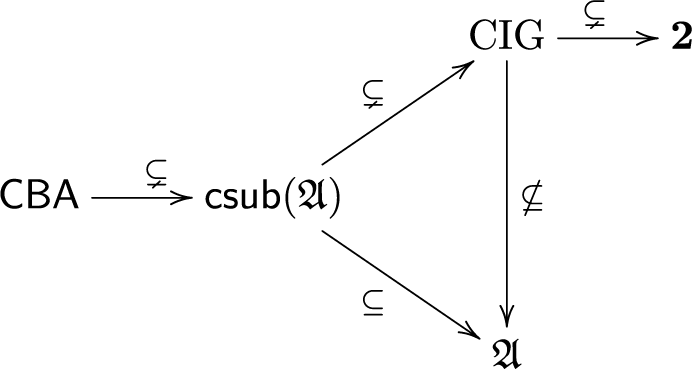

 Open access

