

Introduction
Scholars and researchers publish the outcomes of their research work in academic journals aiming to have their research read, used and cited (Harnad Reference Harnad and Tammaro2002). Academic journals are published by for-profit and not-for-profit publishers whose revenues combined exceed $25 billion annually (Musa Reference Musa2024). The profitability of these organizations is the highest amid all market sectors, varying between 25% and nearly 40% (Hanson et al. Reference Hanson, Gómez Barreiro, Crosetto and Brockington2024). For example, Springer Nature in 2024 had $2.02 billion revenue and $559 million profit (Springer Nature 2025a), whereas Elsevier (the publishing unit of parent company RELX) had an operating profit of £1.17 billion out £3.05 billion revenue (38.4% profitability) (Nicholson Reference Nicholson2025). Not-for-profit publishers do not distribute profits to the stakeholders, but pay high salaries to company managers and journal editors. For example, seeking new journal managing editors for its journals, the American Physical Society, by early 2025, offered an annual salary between $92,250 and $125,691 (STM 2025).
Publishers earn money by selling subscriptions to ‘paywalled’ journals to universities, research institutions, organizations and individuals. Today, they also generate substantial revenue via the Article Processing Charge (APC) paid by authors to have their articles published in open access (OA) either in ‘gold’ OA journals or in ‘hybrid’ journals. The word ‘gold’ refers to the fact that the OA journal will publish the article only upon payment of the APC, whereas an ‘hybrid’ journal allows authors to opt for publication of paywalled (for free) or OA (upon APC payment) articles.
In 2023, for example, six publishers only (Elsevier, Frontiers, MDPI, PLOS, Springer Nature, and Wiley) earned $2.538 billion in revenue from APCs, nearly tripling the $910 million revenue in 2019 (Haustein et al. Reference Haustein, Schares, Alperin, Hare, Butler and Schönfelder2024). Furthermore, journal subscription prices have consistently increased since the 1960s, at 5–9% annual growth rate. For example, in 2019, the average price for a Chemistry title was $5,950; Physics, $5,089; and History, $518. In 2025, said average prices had become $8,572 for a Chemistry journal, $6,924 for Physics, and $778 for History (Romaine et al. Reference Romaine, Albee, Elliott and Bosch2025).
Authors of research papers are the content creators of academic journals. However, contrary to what happens to authors of online videos published on video platforms (typically sharing about 50% of advertising revenue with content creators), authors of scientific articles are not paid by the journal publishers. To the contrary, authors who wish to have their published article openly accessible to readers, are asked by the journal to pay an ‘article processing charge’.
The reason for why scholars and researchers give away their work for free is that they work in a prestige economy (Blackmore and Kandiko Reference Blackmore and Kandiko2011), in which said academic prestige is earned primarily through publications, particularly in elite journals. Authors of articles in academic journals compete for reader’s attention (Franck Reference Franck2002). However, the academic publishing market is unique because the good exchanged, knowledge, is plentiful and growing at a fast pace, whereas readers’ attention is scarce. Since 1952, the number of research papers published annually has grown exponentially, with an annual growth rate of 5.08% and a doubling time of 14 years (Bornmann et al. Reference Bornmann, Haunschild and Mutz2021).
In general, academic journals are led by managing editors, namely employees of the publishing companies. These professionals decide which manuscripts are deemed worthy of review, namely to be sent to independent researchers acting as reviewers. As such, journal editors are the first gatekeepers of knowledge and science (McGinty Reference McGinty1999). Articles in peer reviewed (or ‘refereed’) journals are published after editorial acceptance subordinate to positive opinion of independent reviewers.
In the first two decades of the twenty-first century, many scientists started to voice their dissatisfaction with peer review. Brenner (Nobel laureate in physiology and medicine, 2002) thinks that peer review ‘is hindering science’, having become ‘a completely corrupt system’ in which ‘scientists and academics have handed over to the editors of these journals the ability to make judgment on science and scientists’ (Brenner Reference Brenner2014). For Smith, former editor of the prestigious BMJ medical journal and for 13 years chief executive of the BMJ Publishing Group, peer review is ‘a flawed process at the heart of science and journals’ (Smith Reference Smith2006). The fact that peer review often does not add value to published research is also reflected in the increasing lack of reproducibility of many findings reported in the peer reviewed literature from biomedical (Cobey et al. Reference Cobey, Ebrahimzadeh, Page, Thibault, Nguyen, Abu-Dalfa and Moher2024) to high-performance scientific computing (Bailey Reference Bailey2014).
The peer review crisis is the subject of many studies and even ongoing international conferences. In 2013, the International Congress on Peer Review and Biomedical Publication (first edition held in 1989) changed name to International Congress on Peer Review and Scientific Publication. In 2016 the Research Integrity and Peer Review ‘gold’ OA journal was launched in Great Britain, and in the subsequent decade (2016–2025) published over 150 highly read articles (Springer Nature 2025b). In 2024, these articles were downloaded 521,480 times and mentioned 6.201 times on online sources indexed by Altmetric.
Analysing the evolution of the institution of scientific peer review and the emergence of the peer-review crisis, Kochetkov concluded that post-publication peer review of preprints is the best way to achieve the purpose of scholarly communication (Kochetkov Reference Kochetkov2025). In this new system, the certification function conventionally provided by the opinion of the editor and peer reviewers (most often anonymous) is replaced by the readers’ own assessment based on open reviews and optional editor’s assessment.
We, too, have long advocated the relevance of preprints in the practice of open science (Ciriminna et al. Reference Ciriminna, Scurria, Gangadhar, Chandhab and Pagliaro2021), including in the basic scientific discipline (chemistry) featuring the lowest uptake of preprinting research (Demma Carà et al. Reference Demma Carà, Ciriminna and Pagliaro2017). Moore, in his turn, has lately argued that the shift to open science should focus less on the free accessibility of research outputs (open access) and more on the need to create a researcher-led publishing infrastructure made of journals published by universities, research institutions and research teams (Moore Reference Moore2025)
However, as early career researchers in most world’s countries know well (Nicholas et al. Reference Nicholas, Abrizah, Clark, Rodríguez-Bravo, Revez, Herman, Świgoń, Xu and Watkinson2025), researchers continue to be evaluated by hiring and promotion committees relying on citation-based metrics applied to studies published in peer reviewed journals indexed by the main research databases. Hence, rather than suggesting abolishing peer review altogether, in this study we argue that the main avenue to resolve the ongoing peer-review crisis in today’s overloaded academic publishing system, in which researchers increasingly refuse to undertake voluntary review (Beecher and Wang Reference Beecher and Wang2025), requires academic journals to pay reviewers.
Currently in its infant stage, the ‘pay to review’ model will progressively become ubiquitous, eventually driving the $25 billion academic publishing industry to share a small portion of its revenues with the research community. This study provides arguments supporting this prediction.
Sharing Revenues with Reviewers
Aware that paying reviewers is the solution to said crisis, pioneering journals and publishers (see below) have started to pay reviewers, including statisticians asked to verify the statistical methods of manuscripts sent for publication. Furthermore, in July 2025, the Office of Science Policy of the National Institutes of Health (NIH) published a notice seeking public input on a proposed policy to limit article publication costs paid using grant funds (National Institutes of Health 2025). Granting 82% of its $48 billion budget to fund medical research at more than 2,500 universities, medical schools, and other research institutions, the NIH is the world’s largest research funding agency. Option 3 of the NIH notice suggests allowing a $3,000 publication cap (including additional $1,000) to allow journals to compensate peer reviewers at $50/h, and publish reviewer comments alongside accepted papers. The additional $1,000 allowed were calculated based on payment of three reviewers for 6 h per peer review ($300.00 for each reviewer), as a survey indicated that reviewers spend 6 h per review (LeBlanc et al. Reference LeBlanc, Barnes, Saunders, Tremblay and Chaput2023), rounding up to $1,000 to account for additional costs of organizing peer review and accompanying payments.
From Heathers (Reference Heathers2020), who in 2020 launched a campaign (‘The 450 Movement’) suggesting that $450 is an appropriate payment for a peer-review report, to Seghier (Reference Seghier2025) who recently showed that paying reviewers, when done in a fair and transparent way, is a viable solution to the peer review crisis, numerous scholars have provided arguments for which publishers should pay reviewers. Noting that ‘peer review is a time-intensive and intellectually demanding process’, Algarin (Reference Algarin2025) has recently emphasized that the fact that journals ask overburdened researchers to conduct the peer review labour for free, ‘has created an unsustainable system that leads to reviewer fatigue, lower quality feedback, and, increasingly, ghost reviewing’ (Algarin Reference Algarin2025).
‘Submissions are still surging, new journals are sprouting up soliciting peer review from our already limited pool of scholars, and it can take a very long time to find willing peer reviewers’ wrote the editor recently of a social science journal (Parrish Reference Parrish2024).
Gone are the days in which scholars were willing to act as reviewers as part of their duty. Researchers abstaining from reviewing the work of peers cannot be convinced to start reviewing by making peer review ‘more inclusive and relevant, and gaining recognition for its crucial role in career progression and in the training of the researchers of tomorrow’ (Horta and Jung Reference Horta and Jung2024). It is instructive, in this respect, to look at the concrete situation from the practical perspective of academic editors at journals owned by large scientific publishers (including Springer Nature, Frontiers, and Wiley):
Finding volunteer reviewers has become a Sisyphean task. Recently, we may need to send as many as 35 invitations to secure just two reviewers for a single manuscript. This is not hyperbole but our lived editorial reality across hundreds of manuscripts annually. The responses – ‘lack of time’, ‘not my expertise’, or simply silence – paint a stark picture of a system buckling under its own weight. (Emanuele and Minoretti Reference Emanuele and Minoretti2025)
Noting that the current system in which the few academics who accept reviewer invitations increasingly send delayed, superficial reviews produced with artificial intelligence (AI) software, the same editors rightly concluded that journals and publishers ‘need to decide whether peer review is genuinely essential to science – and if so, fund it accordingly’ (Emanuele and Minoretti Reference Emanuele and Minoretti2025) introducing reviewer payment.
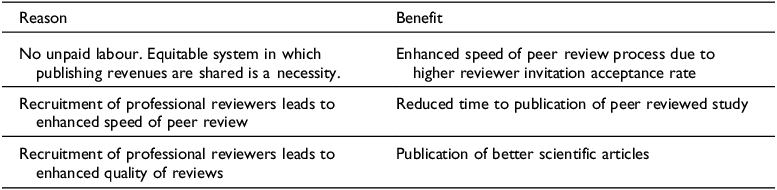
Having said that, by limiting the number of manuscripts sent yearly to each paid reviewer, journals and publishers will easily prevent the formation of rings of professional reviewers who would review just to earn as much as possible; three main reasons, and the associated benefits, support payment of reviewers (Table 1).
Main reasons for which reviewers should be paid and associated benefits

No Unpaid Labour
Scholars acting as reviewers invest a substantial amount of time, and share with the publisher of the journal unique expertise employed to assess the study sent for peer review. Not paying such work translates into an evident exploitation-based system whose lack of equity is self-evident. Conservative estimates show that the total time reviewers globally worked on over 21.8 million peer reviews of 4.7 million articles published in 2020 (and 3.95 million reviewed but rejected submissions) exceeded 130 million hours (Aczel et al. Reference Aczel, Szaszi and ND Holcombe2021). Taking into account researcher salaries in USA, China, and Great Britain, this reviewing time corresponds to $1.51 billion in the USA, $0.627 billion in China, and $0.39 billion in Great Britain of unpaid work.
The same principle, no unpaid labour, is followed by the government research funding agencies or universities when recruiting reviewers. Besides travel expenses, external reviewers for the European Research Council (ERC) typically receive €450 per day for on-site work such as participating in an evaluation meeting, monitoring activities or meetings (European Research Council 2025).
The principle, again, is general: reviewing a research proposal or a doctoral thesis embedding the outcomes of extensive research work is an intellectually demanding and time-intensive process that should always be paid as a form of fair reward.
Besides reimbursement for travel expenses, universities regularly pay honorariums to PhD thesis external examiners acting as reviewers. For example, the recommended fee for 2025 for Australia’s universities is $604 for Doctor of Philosophy theses (Universities Australia 2025), whereas Switzerland’s ETH Zurich pays external co-examiners of theses, including attending the doctoral examination, a CHF 400 fee (ETH Zurich 2025).
Surveys show that researchers widely support the emerging ‘pay to review’ model. For instance, the biomedical journal einstein between late 2022 and early 2023 conducted a survey aimed at understanding factors influencing reviewers’ decision to accept review invitations, opinions on rewarding reviewers, and preference for type of attractive compensation (de Oliveira Neto Reference de Oliveira Neto2024). A vast majority of academics who responded (82%: 269 out of 329) favoured rewarding reviewers, with the main forms of compensations being money or APC credits for future OA publications.
Enhanced Speed of Peer Review
Journals paying reviewers will benefit from a much wider pool of suitable reviewers, thereby expanding the rapidly shrinking pool of reviewers on which they conventionally rely. As mentioned in the introduction, today’s scholars work in a hypercompetitive context driven by the global uptake of the market university (Berman Reference Berman2012), in which they compete for other scholars’ attention (Hyland Reference Hyland2023). Subtracting time from the three main scholarly activities (research, teaching, and service to society) for which researchers are evaluated for hiring tenure and promotion (Pagliaro Reference Pagliaro2021), needs to be compensated financially. Otherwise, scholars will continue to increasingly abstain from peer reviewing.
Indeed, as mentioned above, an increasing number of researchers and academics refuse to accept editorial invitations to review manuscripts (Beecher and Wang Reference Beecher and Wang2025). As a result, ever longer times are required for editors to recruit reviewers, causing delays in completing the peer review process (Irfanullah Reference Irfanullah2025). ‘The impact of this deceleration’ noted Beecher and Wang (Reference Beecher and Wang2025) ‘can be gleaned by huge shifts toward gray publishers, whose main drawcard is their rapid review time’. It has now become common not only to have a paper rejected by a journal after holding it for 2–3 months, during which the editor was not able to secure reviews, but also to have the revised version of a manuscript stuck for months because the editor fails to secure a second round of peer review.
Furthermore, turnaround times have substantially lengthened, even compared with a decade ago when analysis of data based on 3,500 reviews conducted between 2013 and 2016 indicated turnaround times typically exceeding 3 months to receive the editorial decision (Huisman and Smits Reference Huisman and Smits2017).
Paid reviewers will prioritize the review work, meeting close deadlines suggested by the journal editor when delivering the manuscript for review. Indeed, the journal Biology Open recently verified that paid reviewers (£220/manuscript) delivered their reviews within the stipulated seven business days, with an average turnaround time of 4.6 business days, namely much faster than in the case of manuscript reviewed by non-paid reviewers requiring 38 business days (Gorelick and Clark Reference Gorelick and Clark2025).
The outcome has general value in all disciplines. Indeed, similar results had been obtained one decade before, when a $100 fee paid to the reviewers of the Journal of Public Economics significantly improved speed, reducing median review times by an additional 8 days relative to the four-week (28 days) deadline (Raj et al. Reference Raj, Saez and Sandor2014).
Enhanced Quality of Reviews
The enhanced speed of review of paid reviewers is not detrimental to the quality of review work. The same editors of Biology Open who paid reviewers had the reviews sent from paid reviewers evaluated by journal board members. The outcome of the editorial assessments showed that the review quality remained high, regardless of the enhanced speed in peer review (Gorelick and Clark Reference Gorelick and Clark2025).
Actually, this is third main reason for paying reviewers: enhanced quality of reviewing work, eventually leading to publication of better scientific articles. Paid reviewers indeed receive a true reward for their time and expertise, well beyond forms of recognitions used by certain publishers such as ‘certificates’, ‘badges’, or insertion of their names in peer review dedicated websites. After all, money is a societal measurement of value, expressing the value of a good or a service in monetary terms (Mwakibete Reference Mwakibete and Michalos2014). Having her/his work and time paid increases the scholar’s/reviewer’s self-confidence on the societal worth of her/his intellectual work.
The scholar completing her/his review under the terms of a paid contract will act professionally, investing even more attention in the assessment work conducted when compared with voluntary review. The reviewer will be informed that her/his review report will be published next to the article version of record, thereby enhancing transparency and accountability (Schmidt et al. Reference Schmidt, Ross-Hellauer, van Edig and Moylan2018).
Informed that her/his signed review will be published next to the article, the reviewer will likely do a better job than the three groups of >400 reviewers (all based in Great Britain) who, reviewing three previously published papers each describing a randomized controlled trial on a general medical subject to which nine major errors had been deliberately added, detected on average between 28.7 and 33.8% of the nine major errors, with training reviewers having a modest impact on improving error detection (Schroter et al. Reference Schroter, Black, Evans, Godlee, Osorio and Smith2008).
The authors of the study, three of which were employees at BMJ Publishing Group, concluded that ‘editors should not assume that reviewers will detect most major errors’ (Schroter et al. Reference Schroter, Black, Evans, Godlee, Osorio and Smith2008).
First Academic Journals Paying Reviewers
A few pioneering academic journals pay reviewers for their work. Recognizing the ‘vital work’ of reviewers, the OA (and open peer review) Journal of the Academy of Public Health pays a $500 honorarium for each peer-review (Journal of the Academy of Public Health 2025). Published in the USA by a not-for-profit publisher, the journal levies an APC of $2,000 for original research or review articles. Public health scholars and professionals are explicitly called to sign up with the journal as peer reviewers by sending a recent CV, a brief professional summary, and area of public health specialty.
Similarly, following successful outcomes with the first phase, in 2024, of testing the feasibility of ‘Fast & Fair’ at Biology Open, focusing on 20 manuscripts between July and December 2024, in the subsequent months the editors tested the scalability of the programme for 52 manuscripts submitted from January to 20 June 2025. The results were again satisfactory, with reviewers of only six out of 52 manuscripts reviewed failing to meet the 7-day turnaround time, but these manuscripts were turned around within 10 days.
Rejection rates following the first round of peer review for ‘Fast & Fair’ and conventional peer review remained similar (∼35%), suggesting that reviewers were not sacrificing on quality. By late 2025, the journal was in the process of increasing the pool of peer reviewers, in order to ‘offer Fast & Fair peer review program to more of our authors’ (Biology Open 2025).
Levying an APC of $2,200 per article, the latter monthly journal is owned by a 100-year-old not-for-profit publisher based in Great Britain publishing five life science journals (Development, Journal of Cell Science, Journal of Experimental Biology, Disease Models & Mechanisms and Biology Open).
The accelerated peer review service involving paid reviewers might be extended to all journals beyond Biology Open. In that case, the publisher would differentiate its journals from competing titles owing to a much faster review time without sacrificing quality, as happened to many ‘grey’ new OA journals, ‘whose main drawcard is their rapid review time’ (Beecher and Wang Reference Beecher and Wang2025).
Similarly, willing to professionalize peer review, the publisher of medical research journal BMJ Open, by late 2025, was in the process of hiring a freelance statistician with experience in medical statistics to provide journal editors with an expert statistical review of assigned manuscripts (BMJ Group 2025). Paid £115/review, the selected reviewer with experience as a statistician in medical research will be asked to return between one to ten reviews per week; with review time to take between 2–3 h to complete.
In other words, willing to improve reproducibility and transparency of published research in biomedicine, by hiring a dedicated statistician to act as an independent reviewer, the publisher recognizes the need to professionalize peer review because the reviews of voluntary reviewers often omit reviewing the statistical methodology employed by authors to collect and report data. On the other hand, the statistical methods section of many biomedical studies is often poorly reported (Worthy Reference Worthy2015).
Conclusions
The number of research articles published in the scholarly literature has grown exponentially since the early 1950s and doubles every 14 years. The market university began in the 1980s in the USA, and became ubiquitous with the start of the second great globalization in the early 1990s. This led universities to require both early career researchers and faculty to increase the number of publications in peer reviewed journals (‘publish or perish’). Furthermore, the recent emergence of AI tools to assist scientific writing has led to a further substantial increase in the number of manuscripts sent to journals for publication (‘submissions’).
This strain eventually led to a significant imbalance between the large and increasing number of yearly submissions to journals, and the limited number of researchers available to conduct voluntary reviews of said submissions. As a result, review times in many journals have increased noticeably, impacting negatively the work of, in particular, early-career researchers. These conflicting dynamics created the conditions for the emergence of numerous new ‘gold’ OA journals, offering short publication times through unscrupulous practice, including editors ignoring reviewer negative opinions. Furthermore, the subsequent emergence of AI is driving an increasing fraction of reviewers to use AI-based applications to produce reviews of poor quality. The overall outcome has been that peer review became unable to discriminate between poor and quality scholarly work, with the publication of peer-reviewed studies that do not add value.
This study suggests that paying peer reviewers is the avenue to resolving the ongoing peer review crisis, and predicts that the ‘pay to review’ model will progressively become ubiquitous. Showing early signs that this prediction may come true, a few pioneering journals and publishers have started to pay reviewers, including statisticians asked to verify the statistical methods of manuscripts sent for publication.
Competing interests
The author declares no competing interest.
Mario Pagliaro is Research Director at Italy’s National Research Council based in Palermo, Italy, where he leads a research Group working in a broad research field encompassing nanochemistry, solar energy, green chemistry, biomedicine, the bioeconomy, research policy and open science. ‘IntegroPectin’, ‘CytroCell’, ‘NiGraf’, ‘CytroCav’, ‘AnchoisOil’, ‘LimoFish’, ‘AnchoisFert’ and ‘HyTan’, are some of the names created by Dr Pagliaro to identify new functional materials and new enabling technologies jointly developed by his Lab. Dr Pagliaro has a keen interest in catalysis, solar energy, energy management, electrochemistry, and scholarly communication education. In 2021 he was elected ordinary member of the Academia Europaea.
Cristina Della Pina is an Associate Professor of General and Inorganic Chemistry at the University of Milan, where she is based in the Department of Chemistry. Her academic journey began at the same institution, where she earned both her master’s degree and PhD in Industrial Chemistry under the supervision of Professor Michele Rossi. She is regarded as one of Italy’s prominent experts in green chemistry and the bioeconomy. Her primary research focus revolves around heterogeneous catalysis, conducting polymers, and hybrid nanomaterials. In 2017, she was named the Best Female Assistant Professor in Chemistry in Italy by the Worldwide Women in Business (WIB) European Businesswoman Awards. She serves on multiple scientific editorial boards, acting as an editor for books on polyaniline blends and composites. At the University of Milan, she actively teaches courses in General Inorganic Chemistry, Stoichiometry, and the History of Chemistry.
Rosaria Ciriminna is a Research Director at Italy’s National Research Council, specifically based within the Institute of Nanostructured Materials in Palermo. A highly accomplished research chemist active in green chemistry, nanochemistry and bioeconomy, Dr Ciriminna is also widely recognized for excellence in undergraduate and doctoral student mentoring. Developed in collaboration with numerous renowned research teams in Italy and abroad, her team’s research ranges from the development of waste-free, circular economy processes for biomass and waste valorization into highly valued bioproducts, through to heterogeneous catalysis and sol-gel materials. Green innovations developed by her Lab include the AquaSun and SilverSil coatings, which exhibit powerful antifouling and antimicrobial properties. Starting in 2020, she has often been found amid the corresponding authors of research articles selected to celebrate International Women’s Day.

 Open access

