


1. Introduction
Creativity is an abstract concept inherent in each of us, supported by neural structures that can be activated to generate new ideas and solutions. The precise nature and definition of creativity have been subjects of extensive research over several decades, yet remain challenging to conclusively define. The common perception is that creativity is a mysterious, unconscious process (Barron & Harringto., Reference Plsek1981; Boden, 1990; Plsek, Reference Barron and Harrington1997), which provides limitedpractical utility for its intentional application in everyday contexts and within the designdomain. In this contribution, we focus on the conditions that can contribute to unleashing creative potential within human individuals.
Understanding the creative process is crucial for managing design activities and enhancing product development. In the prevailing perspectives among designers, creativity is frequently perceived as either an uncontrollable phenomenon or as contingent solely upon the application of appropriate creativity techniques. This assumption, however, overlooks the underlying neurochemical processes.
For example, Martindale (Martindale, Reference Martindale1999) demonstrated through experiments that low cortical arousal was associated with better performancein creative thinking tasks. He observed a marked decrease in cortical arousal among highly creative participants (cf. (Jauk et al., Reference Jauk, Benedek and Neubauer2012)). With regard to creativity research, which is mainly conducted through psychometric tests, experimental and comparative studies, neuroimaging, longitudinal studies and interviews in orderto comprehensively capture its cognitive, biological and social dimensions, an immense field opens up, which we are not able to narrow down in this contribution, but nevertheless want to focus on the question; which specific conditions facilitate the realization of creative potential in individuals (RQ).
This contribution attempts to collate neurobiological findings on creativity and place them in relation to one another, through a literature research on the neurobiological foundations of creativity and their influence on different cognitive styles. The research was organized in two stages. The first focus was on central, well-established studies and fundamental theories, such as the work of Barron and Harrington (Reference Barron and Harrington1981), Boden (Reference Boden1990) and Martindale (Reference Martindale1999), which examine the relationship between neuronal processes and creative performance. Based on this, the role of specific neurochemical processes such asdopamine and serotonin activity as well as the interaction between different neuronal networks for creative performance were analysed in an in-depth study using the keywords executivenetwork, default mode network and salience network in regard to their influence on creativity. This contribution makes no attempt to comprehensively review this literature.
In this contribution, the stage is set by exploring the neurobiological underpinnings of creativity, aiming to understand how different brain functions and chemical processes contribute to creative cognition. This exploration begins with a focus on cognitive styles which are recognized as foundational to the creative process. Followed by delving into the criticalrole of neural modulators that exert measurable influences on creative capabilities. By examining how these neurotransmitters interact with neural networks, it is possible to comprehend their impact on the oscillation betweendifferent cognitive styles. Building upon this foundational knowledge, it is introduced a range of practical tools and interventions that can enhance creativity. By integrating insights from neuroscience with actionable strategies, the aim to facilitate the conscious cultivation of creativity, thereby enhancing problem-solving skills and innovation in design-driven fields is addressed. This structured approach not only illuminates the science of creativity but also empowers individuals to apply these principles in everyday creative processes.
Divergent and convergent thinking
Cognitive styles as - divergent thinking fosters the generation of multiple ideas and possibilities, while convergent thinking narrows these options to identify the most effective solutions, both cognitive styles are foundational in the creative process. (Brow., Reference Runco and Acar1989; Runco & Acar, Reference Brown and Glover2012). In this section both styles are shortly reviewed in regard to their influence on creativity.
Divergent thinking is considered to be the foundation and a critical element to initiate the creative process. It underlies idea generation by proposing that more than one idea can be correct (Runco, Reference Runco2014). The more ideas one generates on a topic, the more proficient their divergent thinking becomes (Smith & Blankenship, Reference Smith and Blankenship1991). Divergent thinking engages brain networks linked to mental flexibility, emphasizing the generation of possibilities rather than reducing options. It allows to forget conventional uses and recognize alternatives (Beaty et al., Reference Beaty, Benedek, Kaufman and Silvia2015) and involves exploring the possibilities related to a task by freely wandering through thought and memory spaces (Guilford, Reference Guilford1967). This process is exploring and fostering the generation of ideas by encouraging a broad perspective (Marron et al., Reference Marron, Lerner, Berant, Kinreich, Shapira-Lichter, Hendler and Faust2018, p. 41).
In contrast, convergent thinking is a highly focused state. As its name suggests, convergent thinking is the antithesis of divergent thinking (Crople., Reference Smith and Blankenship2006; Smith & Blankenship, Reference Cropley1991). A crucial requirement for convergent thinking too is accessing the memory banks and a understanding of the external world, what demands more focus and persistence (Cropley, Reference Cropley2006).
The creative process typically oscillates between the two thinking styles. First, divergent thinking explores possibilities, followed by convergent thinking that tests ideas and hones in on solutions that feel right. Accessing memory is essential for generating possibilities, which requires the suppression of autobiographical narratives that can limit idea generation. While boundary exploration encourages creativity, it often lacks clear methods to achieve this goal effectively (Nijstad et al., Reference Nijstad, Dreu, Rietzschel and Baas2010).
Examining divergent and convergent thinking provides insight into the cognitive conditions necessary for unlocking creative potential, addressing the RQ.
3. Creativity as a neuromodulated process
Understanding creativity as a dynamic process helps clarify the principles and neural structures and circuits that drive it (Rinderle, Reference Rinderle2023, pp. 11–20). An essential aspect of the creative process is the release of neurotransmitters. Neurotransmitters are chemical messengers in the brain that transmit signals between nerve cells, influencing a wide range of bodily and cognitive functions, including mood, sleep, and learning. When expressing ourselves in new and innovative ways, this leads to a change in the function of neural structures. This change in turn leads to the release of dopamine, a neurotransmitter associated with feelings of surprise and pleasure. This process is an essential part of the creative process and underlays the development of new ideas and concepts. The term ‘process’ is particularly important as it helps to understand the neural structures involved. Therefore, this section delves into neurotransmitters, neural structures and neuronal circuits (summarized as neuronal structures) which are involved within the creative process.
3.1. Major neural networks involved
The creative performance of the human brain is a complex that is made possible by the interaction of several neural structures. And there are three main neural networks involved in this process: the Executive Network, the Default Mode Network, and the Salience Network.
The Executive Network, which is primarily located in the prefrontal cortex, plays a crucial role in controlling thinking and behavior. It enables us to direct our thoughts and actions in a very deliberate and controlled manner. In the context of creativity, the Executive Network helps to eliminate infinite possibilities and focus on relevant options. This is particularly important in creative tasks such as art or writing, where it is necessary to make the right decisions. The Default Mode Network, which includes the medial prefrontal cortex, is another important network that plays a role in creativity. It is activated when we close our eyes and focus on our internal thoughts and feelings. The Default Mode Network supports spontaneous imagination, which enables to develop new concepts when external sensory input is minimized. This network is also responsible for memory of past experiences, which serves as the basis for imagination. The Salience Network, which includes the insula, the anterior cingulate cortex, and the amygdala, parts of the hypothalamus and specific brainstem nuclei, is a network that processes information about our body surface and the external world. It helps us to decide what is most interesting in a given moment and directs our attention to the most relevant information. (Seeley, Reference Seeley2019)
The interaction of these three networks enables creative performance. The Executive Network helps to make the right decisions and governs thinking and behavior. The Default Mode Network forms the basis for imagination and is the library of previous experiences. It is also important to note that creativity is dependent on memory of past experiences. The Default Mode Network uses these memories to develop new concepts when external sensory input is minimized. This means that our creativity is also dependent on our experience and knowledge. And the Salience Network directs our attention to the most relevant information and decides what to pay attention to in a given moment. However, it should be noted that these categorizations are not absolute and that convergent and divergent thinking can activate different areas of the brain in different contexts and tasks. In summary, the three neural networks work together to create something new, as we defined creativity earlier. (Beaty et al., Reference Kruse, Martin, Hamlin, Slattery, Moriarty, Horne, Ozkalp-Poincloux, Camarda, White, Oleson, Cassotti and Doucet2016; Boot et al., Reference Khalil, Godde and Karim2017; Khalil et al., Reference Boot, Baas, van Gaal, Cools and Dreu2019; Reference Beaty, Benedek, Silvia and SchacterKruse et al., 2023)
3.2. Role of dopamine in creative processes
In general, dopamine can be regarded as a neurotransmitter (within this contribution neurotransmitter and neuromodulators are not further differentiated) involved in neuronal circuits of the brain that motivate action processes, and also such processes beyond the boundaries of our body. Dopamine has effects on motivation and engagement, which can play a role in creative processes. However, there is no comprehensive scientific consensus that dopamine directly promotes creativity, but rather influences various cognitive processes that may be involved in creative activities.
The four major circuits in the brain that utilize dopamine however, are used for four major purposes. First of all is a neural circuit that uses dopamine among other things but certainly relies on dopamine in a critical way to engage movement, including eye movements. The so-called nigrostriatal pathway. The substantia nigra is a brain area that is very dark that projects to an area called the dorsal striatum. It contains a bunch of subregions and is engaged when you undergo divergent thinking.
The second dopamine circuit associated with creativity is the one associated with convergent thinking - The mesocortical pathway - is involved in motivation and it has an emotional components too. The lateral ventral tegmental area connects to the prefrontal cortex, that area just behind the forehead. And this mesocortical area is involved in motivation and emotion and is critical for focus and persistence.
A very nearby area, just sitting right next door the so-called mesolimbic area, which is involved in desire and feelings of reward. That area is associated more typically with addictive behaviors or compulsive behaviors. This contribution focusses less on the mesolimbic pathway as it seems to be less important to divergent or convergent thinking.
The tuberoinfundibular pathway is the pathway associated with dopamine and our pituitary gland and the release of hormones, in particular that travel to the ovary or the testes. It triggers the release of estrogen and testosterone, et cetera. Dopamine is intimately involved in that circuitry but that circuit seem also a less important role to creativity.
In summary, it is important to emphasize that the so-called nigrostriatal pathway, a dopaminergic circuit, is closely linked to motor functions and divergent thinking process. This connection suggests that the generation of new ideas may also be associated with physical movement.
In addition, the mesocortical pathway is important as it is associated with motivation and emotional processes and plays a crucial role in perseveration and concentration in convergent thinking.
Understanding these circuits helps clarify how dopamine influences creative processes by initiating exploration through divergent thinking, which is primarily supported by the nigrostriatal pathway involved in movement, and subsequently transitioning to the testing of ideas via convergent thinking, linked to the mesocortical pathway that governs motivation and emotional regulation. Within gain of function studies - where an enhancement of the level of dopamine in the brain were induced - was found that both divergent and convergent thinking are enhanced when levels of dopamine are elevated (Manzano, Cervenka, et al., Reference Manzano, Cervenka, Karabanov, Farde and Ullén2010).
Tonic dopamine levels, which are influenceable by mood, affect performance in various creative processes. It appears that increasing dopamine levels through mood modulation can enhance both divergent and convergent thinking. A dopamine release can rapidly enhance creativity, with effects that can be both positive and negative depending on the situation. Dopamine activity in the nigrostriatal pathway can be measured by measuring the blink frequency, as a higher dopamine level is associated with an increased blink frequency. This correlation makes it possible to measure dopamine activity in the nigrostriatal pathway non-invasively and to investigate its effects on creativity. It seems that that when dopamine levels are elevated, the blinking reflex is more active and when dopamine levels are lower or less active in this pathway, people tend to blink less (Chermahini & Hommel, Reference Chermahini and Hommel2010). The ability to influence dopamine levels via mood and other non-pharmacological methods shows a potential way to boost creativity in the short term. Facilitating good mood elevates divergent thinking (Akbari Chermahini & Hommel, Reference Akbari Chermahini and Hommel2012). But it turns out that if dopamine levels are very high; the divergent thinking could get poor. Thus, divergent thinking is favored by having elevated levels of dopamine but not to high. These aspects make it clear that dopamine does not simply increase creativity directly, but influences complex cognitive processes and behaviours that can contribute to creative performance.
3.3. Role of serotonin in divergent and convergent thinking
Serotonin, a key neurotransmitter, plays a significant role in the brain activity associated with both divergent and convergent thinking. The 5-HT2A receptor, a specific serotonin receptor, supports these cognitive processes. Microdosing psilocybin, a psychedelic compound, has been shown to enhance the activation of serotonergic pathways and consequently improve creativity encompassing both divergent and convergent thinking. Although microdosing has been linked to increased activity of the 5-HT2A receptor, and despite its reported benefits, psilocybin remains illegal in many regions, and the practice cannot be universally recommended. (Prochazkova et al., Reference Prochazkova, Lippelt, Colzato, Kuchar, Sjoerds and Hommel2018)
The aforementioned study is used here as an example, as it strongly points to the role of serotonin in the creativity process. But instead of psilocybin, it is worthwhile to explore non-pharmacological methods to boost serotonin levels naturally, enhancing creativity through both divergent and convergent thinking. Tools such as regular physical exercise, exposure to sunlight, and dietary changes - like increasing tryptophan intake - are known to elevate serotonin levels and offer safe, effective alternatives (Young, Reference Young2007). Thus, building a foundation for an enhanced capability forward to creativity.
3-4. Summary
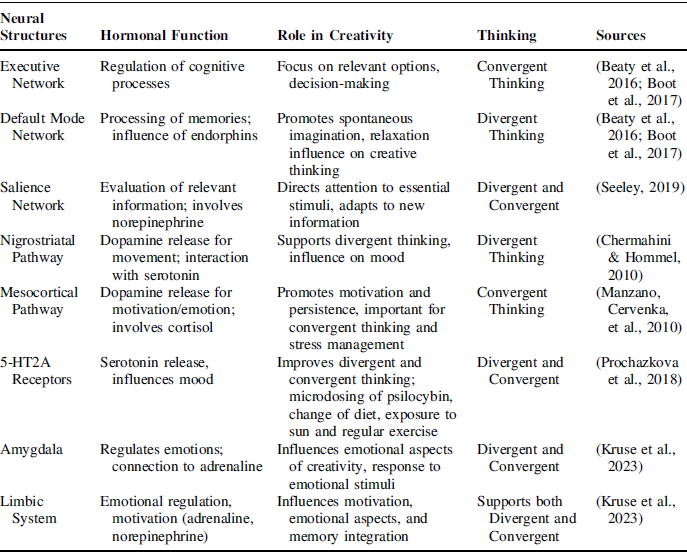
Creativity emerges through the interplay of neural networks - the Executive, Default Mode, and Salience Networks. Dopamine plays a crucial, influencing motivation and cognitive processes essential for divergent and convergent thinking via the nigrostriatal and mesocortical circuits. Additionally, serotonin, especially through the 5-HT2A receptor, supports these thinking processes. Understanding these mechanisms provides insights into enhancing creativity, highlighting the potential of non-pharmacological methods to modulate neurotransmitter levels and boost creative capabilities. Neural structures and their underlaying role in the creative process are summarized in Table 1.
Overview of the neural networks involved

4. Tools for easy application
Based on the previous considerations and their implications, literature has been identified which help to discover tools that help specifically enhance the capabilities for enhancing creativity, without overly enforcing a specific approach in the form of creativity techniques. The literature identified ranges from awareness approaches, to meditation techniques and motion-based approaches. Thus, implications and proposals are followed by the tools in the next sections. These are to understand as proposals for fostering circumstances to enhance the capabilities of individuals in regard to the task which is to solve, with no associated costs and for the purpose of creating a better world by enabling designers to create better solutions. The tools proposed aim to cultivate environments that foster the specific conditions needed to realize creative potential in individuals, as outlined in our RQ.
4.1. Open Monitoring meditation
A study by Fujino et al. indicates that open monitoring meditation, typically practiced for 10 to 30 minutes, reduces the activity in brain regions related to memory function, facilitating divergent thought processes. This form of meditation involves suppressing certain brain areas, allowing thoughts and emotions to surface without judgment, focusing on nonjudgmental awareness. Participants observe their thoughts and feelings as they arise, allowing them to pass or become fixed upon for varying durations. This practice involves closing your eyes and allowing any thoughts, emotions, or ideas to surface, merely watching them come and go, or perhaps fixating on a particular one for some time, all of which is perfectly acceptable. Importantly, whatever surfaces - surfaces. Brain imaging studies show that regular practice improves divergent thinking capabilities, enhancing the ability to perceive thoughts without judgment. This meditation is described as a perceptual exercise rather than a rigid practice with specific rules. Furthermore, regular engagement in open monitoring meditation has implications for neuroplasticity and the creative process. It is known to activate dopamine circuits, which as highlighted before can enhance creativity significantly. This activation fosters an environment conducive to creative thinking and innovation, highlighting the profound impact of this meditation technique on cognitive flexibility and creative potential. (Fujino et al., Reference Fujino, Ueda, Mizuhara, Saiki and Nomura2018)
4.1.1. Implications
The tool at hand is remarkably effective and within just a few days, and certainly within about a week or more of practice, individuals can significantly improve their divergent thinking abilities. Importantly, this improvement does not necessarily require daily practice, although daily practice can certainly expedite the process. The enhancement in divergent thinking is attributed to the increased activity of dopamine circuits, particularly along the nigrostriatal pathway. The beauty of repeating a particular practice lies in the concept of neuroplasticity: when a neural circuit is deliberately engaged repeatedly, it becomes easier to activate over time.
4.1.2. Proposal
For anyone interested in exploring and improving the creative process, dedicating even a small amount of time—perhaps just five minutes every other day - to open monitoring meditation can be highly beneficial. Engaging in this practice can be quite enjoyable, as it often feels more effortless compared to the meditation techniques associated with convergent thinking. Embracing this practice can lead to meaningful advancements in creative capabilities.
4.2. Focused attention meditation
Focused attention meditation involves the deliberate concentration on a single point, sound, or thought, which is known to enhance convergent thinking skills. This form of meditation is particularly effective in enabling individuals to quickly and accurately analyze multiple choices and persistently reach correct solutions. Focused attention meditation functions as a perceptual exercise, wherein practitioners can either sit or lie down, close their eyes, and concentrate on their breath or specific bodily sensations, such as the tops of the knees or the clasped hands. Alternatively, auditory stimuli or visual fixation on a specific point or light source can be utilized. The underlying principle is to direct cognitive focus to a distinct sensory input or concept. (Fujino et al., 2018)
4.2.1. Implications
This practice systematically strengthens the neural circuitry involved in convergent thinking tasks, thereby improving the ability to efficiently sift through options and enhance the accuracy and speed of decision-making processes. Studies indicate that regular engagement in Focused attention meditation not only boosts convergent thinking but also enhances attentional capacities and memory retention. This improvement is attributable to the practice's demand for sustained focus and the retrieval of relevant memories, both of which are essential components of the convergent thinking process. (Fujino et al., 2018)
4.2.2. Proposal
As individuals consistently apply Focused attention meditation techniques, they exhibit increased cognitive flexibility and precise memory recall, key factors in effective problem-solving and decision-making. We would suggest to practice this exercise as the open monitoring meditation every other day.
4.3. Yoga nidra
Another purely behavioral tool that selectively increase dopamine within the nigrostriatal pathway, the pathway that's involved in divergent thinking, and can do so very dramatically as much as 65% above baseline, is the so-called yoga nidra. While forcing oneself to be mostly motionless. The practice of redirecting attention to the surface of the body while engaging in long exhalation breathing, occasionally incorporating intentions or visualizations, serves as a form of self-directed relaxation. This method is characterized by minimal movement and maintaining alertness, making it particularly compelling for enhancing creativity due to its purely behavioral nature. This approach is safe, requiring no purchases, and is noteworthy for its remarkable selectivity in influencing dopamine release within neural pathways associated with divergent thinking.(cf. (Kumari & Tripathi; Kumari & Tripath., Reference Parker and Pal2023; Manzano, Theorell, et al., Reference Manzano, Theorell, Harmat and Ullén2010; Reference Kumari and TripathiParker, 2024))
A recent in vivo study, conducted on humans, provided the first demonstration of the relationship between endogenous neurotransmitter release and conscious experience, highlighting a 65% increase in dopamine release during this practice. Additionally, the study observed an increase in theta activity, a brain wave pattern linked to creative states, REM-Sleep and divergent thinking, specifically within the nigrostriatal pathway. This pathway is crucial for engaging in divergent thinking, vital for creative exploration. (Kjaer et al., Reference Kjaer, Bertelsen, Piccini, Brooks, Alving and Lou2002)
4.3.1. Implications
The study underscores the potential of this behavioral tool to selectively elevate dopamine in pathways essential for divergent thinking. Notable findings include the significant reduction in bodily movement. Participants reported feeling naturally still after the practice, with a decreased readiness for action during the session. Despite this reduction, the elevated dopamine levels prepared them for more deliberate and robust movement afterward. As physical movement decreased, an increase in visual imagery and internal mental landscapes favoured by increased brain activity in areas associated with visual imagery, such as the occipital and parietal cortex, was observed. This inverse relationship between movement and visual imagery is logical, as reduced external sensory focus enhances internal visualization capabilities. Consequently, divergent thinking is boosted, expanding the mental library of potential interactions and ideas. The study illustrates that this simple, nonpharmacological practice of lying motionless for a certain duration, even for just ten minutes, though up to 30 minutes is preferable, leads to a substantial 65% surge in dopamine release in pathways critical for divergent thinking.
4.3.2. Proposal
A crucial aspect to understand is the of periods of motionlessness and deep relaxation while awake in significantly increasing dopamine levels in the nigrostriatal pathway. This rise in dopamine enhances the brain's capacity for mental imagery, effectively broadening access to a “library” of potential solutions and elements that facilitate divergent thinking. During such relaxation states, a “dopaminergic tone” is established, describing the elevated baseline of dopamine transmission within this neural circuitry. This elevated tone primes the brain to engage more effectively in divergent thinking.
The recommended approach involves engaging in meditation or yoga nidra practices for durations ranging from 10 to 30 minutes, possibly extending to an hour if time permits. To maximize this enhanced cognitive state, we suggest to transition into divergent thinking exercises within 5 to 15 minutes following the relaxation practice. This post-relaxation period provides an optimal window for creative exploration, allowing individuals to explore novel combinations of existing elements within their specific field to achieve creative outcomes. It is important to note that the practice of divergent thinking does not occur during the yoga nidra session itself but rather in the subsequent period when the brain is optimally prepared for creative thought.
4.4. Motion
The nigrostriatal pathway, crucial in facilitating divergent thinking, is modulated by dopaminergic activity and responsible for controlling eye blinks and deliberate limb movements. This suggests a relationship between somatic movement and cognitive flexibility. Activation of this pathway broadens the cognitive repertoire, enabling the integration of diverse ideas. In adults, the neural circuits for precise movements are well-structured, but the brain also retains a network of ancillary connections, like a neural mesh overlaying main neural highways. This network, resembling a map with highways and alleys, represents potential alternative pathways for neural transmission. Emerging research indicates enhanced divergent thinking during physical activities like walking. This underscores the benefits of minimized focus on specific stimuli, which aids divergent thinking. (Chermahini & Hommel, 2010)
4.4.1. Implications
These supplementary neural pathways are generally not engaged when one is stationary but become activated during movement-centric activities such as walking, running, cycling, swimming, or pacing. The engagement of these pseudo-random pathways through physical activity reflects a behavioral strategy to invoke different elements of neural networks that seldom communicate under stationary conditions. Such movement-induced activation underscores the potential of physical activity to stimulate diverse neural interactions, thereby enhancing the brain's capacity for creative and innovative thinking through improved connectivity and pathway utilization.
4.4.2. Proposal
Individuals who suffer of creative stagnation when sitting, during writing or other creative processes, alternative approaches like voicing thoughts into the voice recorder on a walk can help. Without headphone distractions, spontaneous ideas can be captured via dictation. This allows spontaneous ideas, which seemingly arise out of nowhere, to be captured. For those individuum's seeking to enhance divergent thinking, it is advisable to explore various movement patterns, particularly those that do not require conscious attention to a specific task.
5. Proposals
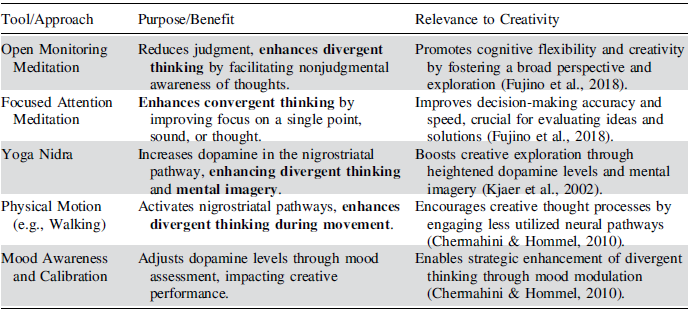
The aforementioned tools function as meditation, promoting higher states of consciousness by accessing the unconscious mind. A comprehensive overview of the proposed tools is given in Table 2 radiating about possible integrating into everyday practices and worth considering integrating it into idea factories. For individuals aiming to improve focus - convergent thinking -, focused attention meditation is recommended. Conversely, those interested in engaging in divergent thinking are advised to practice open monitoring meditation for approximately five to ten minutes. A dual meditation approach enhances divergent and convergent thinking, beginning with 5 - 10 minutes of open monitoring followed by focused attention meditation for the same duration. This sequence, positioning divergent thinking closely with convergent thinking, more closely mirrors the typical creative process. Individuals should develop their own Yoga Nidra routine that they can practice regularly to reap the benefits of increased relaxation and mental clarity. E. g., a daily session of 10 to 30 minutes could be incorporated. After a session, spontaneous ideas or thoughts can be recorded in a notebook. This practice of reflection and recording helps to capture the creative thoughts that arise in a state of deep relaxation. It is important that individuals monitor their experience of Yoga Nidra in terms of their creative capacity and adjust the duration or frequency of sessions as required.
It should be also learned to calibrate one's mood by assessing whether one's mood is low, medium, or high, using a broad scale from one to ten. Based on this assessment, individuals can decide whether to utilize an external dopamine-elevating stimulus. It is essential to consider personal objectives and starting points to determine the appropriate level of dopamine increase needed for creativity at any given moment. As highlighted in above section, mood - whether low, medium, or high - can significantly influence the ability to access divergent thinking. Therefore, it is beneficial to become aware of one's tonic level of dopamine and being mindful of the current emotional state. Thus, it is possible to choose one of the above-mentioned tools to adjust one's capacities for the required task.
The exploration of various tools and strategies in this contribution directly addresses the RQ. This contribution highlights how nuanced interventions can nurture both divergent and convergent thinking.
Overview of the tools
6. Conclusion
Creativity is one of the most fascinating facets of human cognitive functioning, especially given the limited understanding of its potential. This contribution aimed to explore the specific conditions that facilitate the realization of individual creative potential (RQ). By examining the neural structures associated with creativity and exploring behavior-based interventions, insights into how creativity can be enhanced both in everyday life and professional settings were provided. By exploring the neural structures associated with creativity, this contribution focuses on the anatomical basis for creativity and its facilitation through applied exercises and practices that anyone can use, whether in everyday life or as a designer. This contribution explores tools and strategies for promoting divergent and convergent thinking that can be applied at simple stages of the creative process, and shows that purely behavioural approaches can effectively enhance creativity.
To optimize creative performance in workshops, we suggest designing sessions to dynamically shift between phases of divergent and convergent thinking, incorporating the proposed tools. These tools can be strategically integrated to optimize the creativity of participants in an idea factory. At the beginning of a workshop, it is useful to carry out a self-assessment in order to make any necessary adjustments. This is followed by an open-monitoring meditation to open the participants' minds and promote cognitive flexibility. This short meditation exercise of around five to ten minutes allows participants to let their minds wander freely and without judgment, which can lead to a greater diversity of ideas. Physical movement can be incorporated during the brainstorming phase. Activities such as a short walk around the workshop room or a ‘walking meeting’ activate the nigrostriatal pathways, which supports creativity. Participants are encouraged to move around the room during the exchange, which promotes creative flow. Between the brainstorming and evaluation phases, a yoga nidra exercise can be performed to promote relaxation and creative imagination. A rest break of around ten minutes, during which participants lie down comfortably and listen to calming instructions, helps to reduce mental fatigue and increase receptiveness to innovative assessments. A mood awareness and mood calibration exercise are useful before the assessment phase begins. This helps participants to recognize their emotional state and adjust it if necessary in order to promote positive and productive criticism. A short exercise to rate their own mood on a scale allows participants to act to adjust their mood. This structure mirrors natural cognitive processes and enhances idea generation and refinement.
A major limitation of this article is that it is based on a selection of studies. Although these are well-founded, further studies or alternative theories could be used to obtain an even more comprehensive picture. Despite the promise of behavior-based approaches, there is a lack of comprehensive empirical research validating their long-term effectiveness. Additionally, the variability in individual differences and the dynamic nature of the creative process are not entirely addressed, potentially limiting the applicability of these methods in diverse contexts. Building on the neurobiological foundations presented in this contribution, our next step is to conduct a thorough literature review to further solidify the theoretical framework and propose refinements for creativity workshops. The proposed tools will be integrated into a master's degree program toolkit for their empirical validation.

 Open access

