


Research has shown high levels of childhood sexual abuse and other early traumas in patients with serious mental illness (Reference Goodman, Rosenberg and MueserGoodman et al, 1997; Reference Mueser, Goodman and TrumbettaMueser et al, 1998). There is evidence of a specific association between childhood sexual abuse and positive symptoms, particularly hallucinations, in patient samples (Reference Ross, Anderson and ClarkRoss et al, 1994; Reference Read and ArgyleRead & Argyle, 1999), community samples (Reference Ross and JoshiRoss & Joshi, 1992) and also in surveys of schizotypal traits in ordinary people (Reference StartupStartup, 1999).
Goodwin & Jamison (Reference Goodwin and Jamison1990) reviewed 20 studies conducted between 1922 and 1989 investigating the prevalence of hallucinations in bipolar disorder and calculated a weighted mean average of 18%. To date, no study has attempted a systematic analysis of the relationship between childhood sexual abuse or other childhood trauma and hallucinations in people with bipolar disorder. In this study we investigated this relationship in a sample of patients recruited to a multi-centre, randomised, controlled trial of cognitive–behavioural therapy.
METHOD
Participants
A total of 255 persons meeting DSM–IV (American Psychiatric Association, 1994) criteria for bipolar affective disorder were recruited to a randomised, controlled trial of cognitive–behavioural therapy for bipolar disorder. From this group 126 were randomised to receive therapy, which was conducted by five qualified therapists supervised by internationally recognised experts (Professor Jan Scott and Dr Peter Kinderman). Four of the therapists agreed to complete questionnaires recording spontaneous reports of trauma by their patients. Data were obtained for all 96 patients treated by the four participating therapists.
Initial diagnostic assignment was made by referring consultant psychiatrists and verified by a team of four trained graduate research assistants who inspected case notes and interviewed the patients before therapy and at follow-up points using the Structured Clinical Interview for DSM–IV (SCID; Reference First, Spitzer and GibbonFirst et al, 1996). Inclusion criteria were doubly ratified diagnosis of bipolar disorder in individuals aged 16 years or older drawn from four geographically distinct areas of the UK. No patient reported mood-incongruent psychotic symptoms at referral. Evidence of a lifetime history of mood-incongruent psychotic phenomena was reported for 33 of the sample.
Recruitment by centre was as follows: Manchester 22, Liverpool 25, Glasgow 25 and Cambridge 24. Individuals with substance misuse as a primary diagnosis or evidence of organic illness were excluded from the study, as were individuals displaying rapid-cycling bipolar disorder or severe comorbid borderline personality disorder. As the research assistants were employed for the purposes of the clinical trial, they were masked to the hypothesised relationship between trauma and hallucinations.
The sample comprised 32 men and 64 women. The minimum age was 22 years and the maximum 70 years (mean 40.5, s.d.=10.4). Mean age at illness onset, recorded by the research assistants on the basis of case-note and interview data, was known for 95 participants, and found to be 24.4 years (s.d.=7.8). Eighty-one participants had been hospitalised at some point in their illness, and their mean age of first hospitalisation was 29.4 years (s.d.=9.4).
Measures
Participants were seen by the trial therapists for approximately 24 one-hour sessions over a 6-month period. Direct references to childhood sexual abuse or other traumas made by participants during assessment or at other points in therapy were collected by the therapists, who completed an eight-item questionnaire for each patient. The questionnaire listed eight categories of trauma: sexual abuse; physical abuse; physical abuse with a weapon; witness to the killing or serious injury of another (including parasuicide); having a close friend or relative who was murdered or killed (including suicide); experiencing a significant accident; experiencing a natural or human-made disaster; any other trauma. These categories were based on the categorisation by Mueser et al (Reference Mueser, Goodman and Trumbetta1998) of traumas commonly experienced by those with serious mental illness, which were in turn derived from the Trauma History Questionnaire (Reference Green and SlammGreen, 1996). For each category, the therapists were asked to record detailed descriptions of the traumatic event where possible.
A report of any trauma including childhood sexual abuse was only classified as occurring in childhood if it occurred before the patient's 16th birthday. The behavioural descriptions of childhood sexual abuse were categorised according to the criteria used in the Child Maltreatment History Self-Report (CMHSR; Reference Badgley, Allard and McCormickBadgley et al, 1984), an assessment tool used in a large-scale Canadian study of childhood sexual abuse in the general population. Sexual abuse is rated in the CMHSR according to four distinct categories:
-
(a) child exposed to on more than one occasion;
-
(b) child threatened with sexual contact;
-
(c) child touched sexually;
-
(d) sexual assault (attempted or actual).
In our sample no participants reported threatened sexual contact only, and in no case did the recorded onset of illness predate the reported abuse. In order to ensure that the trauma descriptions were categorised correctly, a psychiatric social worker with extensive experience in the assessment of trauma and abuse (A.D.) reclassified the detailed descriptions. Interrater reliability, indicating consensus for allocation into designated categories, was 34/36 for recorded reports of general trauma and 15/15 for reports of childhood sexual abuse.
Data for lifetime history of experience of psychotic symptoms were collected by the four trained and supervised research assistants at the trial baseline assessment, using the lifetime version of the SCID. This provided evidence for the presence or absence of hallucinations in six distinct categories. Only participants scoring 3 (threshold or true hallucinations) on the baseline SCID were categorised as having a history of hallucinations; this was to ensure that transient stress-related dissociative symptoms or quasi-psychotic experiences of the type that may be present in borderline personality disorder were not classified as hallucinations. To minimise the risk of type-I statistical errors, and in accordance with our hypotheses, our main analyses focused on hallucinations. However, to determine whether any findings were specific to hallucinations, parallel analyses were calculated using SCID data on patients' delusions and hallucinations in the non-auditory modalities.
RESULTS
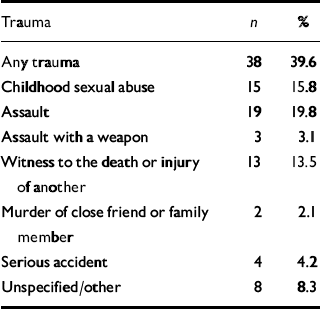
Forty-five participants (nearly half of the sample) had experienced hallucinations during their lifetime: 30 had experienced auditory hallucinations, 11 had heard voices commenting on their actions, 25 had experienced visual hallucinations, and 9 had experienced other (tactile, somatic or olfactory) hallucinations. The numbers of participants divulging particular types of trauma, classified according to the Trauma History Questionnaire categories, are given in Table 1. Fifteen of the 96 participants disclosed some kind of childhood sexual abuse to their therapists. No significant difference between the sexually traumatised and non-traumatised groups was observed for the mean age at illness onset (traumatised group 22.2 years, non-traumatised group 24.8 years; t=1.14, two-tailed P=0.26, d.f.=93), or age at first hospitalisation (traumatised group 28.1 years, non-traumatised group 29.6; t=0.54, two-tailed P=0.59, d.f.=79). As both the trauma reports and the SCID yielded categorical data, associations between trauma and hallucinations were analysed using the chi-squared statistic.
Type of trauma spontaneously reported by patients with bipolar disorder (n=96) to their therapists
| Trauma | n | % |
|---|---|---|
| Any trauma | 38 | 39.6 |
| Childhood sexual abuse | 15 | 15.8 |
| Assault | 19 | 19.8 |
| Assault with a weapon | 3 | 3.1 |
| Witness to the death or injury of another | 13 | 13.5 |
| Murder of close friend or family member | 2 | 2.1 |
| Serious accident | 4 | 4.2 |
| Unspecified/other | 8 | 8.3 |
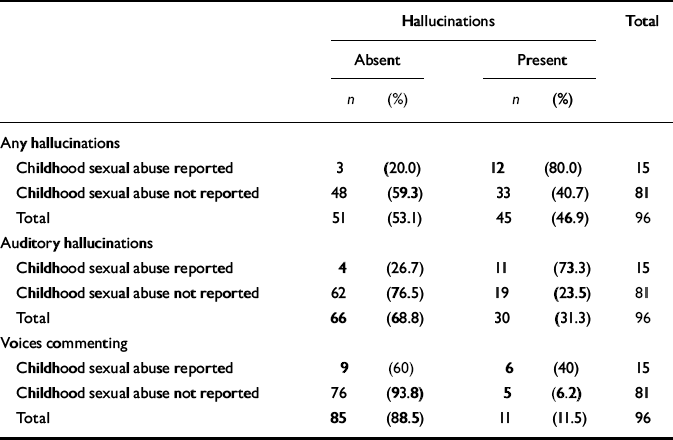
Contingency tables showing the relationships between different kinds of hallucination report and reports of childhood sexual abuse are shown in Table 2. A significant association was found between reports of any trauma and the presence or absence of auditory hallucinations (χ2=7.61, P<0.01, d.f.=1). The observed associations between reports of abuse and history of any hallucinations (χ2=6.83, P<0.005, d.f.=1), history of auditory hallucinations (χ2=14.66, P<0.001, d.f.=1), and history of voices commenting (χ2=14.28, P<0.002, d.f.=1) were even more significant. However, no significant association was found between trauma and reports of delusions, or trauma and reports of visual or tactile hallucinations. The relationship between mood-incongruent psychotic symptoms and childhood sexual abuse was not significant. Seven patients were diagnosed as having borderline personality disorder. However, the observed associations between childhood sexual abuse and hallucinations all remained when these patients were excluded from the analyses.
Contingency table showing associations between lifetime history of different types of hallucination and reports of childhood sexual abuse in the sample of patients with bipolar disorder (n=96)
| Hallucinations | Total | ||||
|---|---|---|---|---|---|
| Absent | Present | ||||
| n | (%) | n | (%) | ||
| Any hallucinations | |||||
| Childhood sexual abuse reported | 3 | (20.0) | 12 | (80.0) | 15 |
| Childhood sexual abuse not reported | 48 | (59.3) | 33 | (40.7) | 81 |
| Total | 51 | (53.1) | 45 | (46.9) | 96 |
| Auditory hallucinations | |||||
| Childhood sexual abuse reported | 4 | (26.7) | 11 | (73.3) | 15 |
| Childhood sexual abuse not reported | 62 | (76.5) | 19 | (23.5) | 81 |
| Total | 66 | (68.8) | 30 | (31.3) | 96 |
| Voices commenting | |||||
| Childhood sexual abuse reported | 9 | (60) | 6 | (40) | 15 |
| Childhood sexual abuse not reported | 76 | (93.8) | 5 | (6.2) | 81 |
| Total | 85 | (88.5) | 11 | (11.5) | 96 |
DISCUSSION
Previous studies of CSA and psychosis
Many studies have found that high levels of early trauma are reported by adult psychiatric patients. In a review of 13 studies considered to be methodologically adequate at the time, Goodman et al (Reference Goodman, Rosenberg and Mueser1997) found that women undergoing treatment for psychosis consistently reported much higher levels of abuse than did controls. In a study of their own conducted later (Reference Mueser, Goodman and TrumbettaMueser et al, 1998) these researchers estimated that 52% of 153 severely ill women patients they surveyed had experienced sexual abuse during childhood, and nearly 64% had suffered sexual abuse in later life. These figures indicate that many women with psychosis have experienced multiple episodes of abuse. Goodman et al (Reference Goodman, Thompson and Weinfurt1999) also reported that, in a further sample of 50 patients with serious mental illness (64% schizophrenia), three-quarters of the women and nearly half of the men had experienced childhood sexual abuse. Similar findings were reported in a more recent survey of first-episode patients (Reference Neria, Bromet and SieversNeria et al, 2002). In the same study, it was reported that only 5% of reports of early trauma could be attributed to aberrant behaviour of the patient (for example, placing themselves in high-risk situations).
Experience of early trauma has been specifically associated with Schneiderian symptoms (Reference Ross, Anderson and ClarkRoss et al, 1994; Reference Ellason and RossEllason & Ross, 1997) or hallucinations (Reid & Argyle, 1999). Other studies have reported that psychotic symptoms, especially hallucinations, are frequently experienced by survivors of early trauma such as sexual abuse (Reference Heins, Gray and TennantHeins et al, 1990; Reference Ensink, Romme and EscherEnsink, 1993) and later trauma such as exposure to military combat (Reference Butler, Mueser and SprockButler et al, 1996).
In a community survey, Ross & Joshi (Reference Ross and Joshi1992) reported that 46% of those who reported three or more Schneiderian symptoms had experienced childhood physical or sexual abuse, compared with 8% with no such symptoms. In surveys of schizotypal traits in the normal population it has also been found that reports of unusual experiences correlate with a reported history of childhood sexual abuse (Reference Bryer, Nelson and MillerBryer et al, 1987; Reference StartupStartup, 1999) or childhood maltreatment (Reference BerenbaumBerenbaum, 1999).
Given this apparent association between hallucinatory experiences and childhood sexual abuse in people with schizophrenia, it is obviously important to establish whether the same relationship exists between hallucinations and childhood sexual abuse in other clinical groups.
Findings of this study
Over a quarter of the participants in our study reported visual hallucinations, a proportion that is higher than in most previously reported studies of people with bipolar disorder (Reference Goodwin and JamisonGoodwin & Jamison, 1990). However, in one of the largest studies of this kind (Black & Nazrallah, 1989), the observed prevalence rate for visual hallucinations was 27%, which is almost identical to our own figure. In contrast to most previous studies, the figures arrived at in our investigation were based on lifetime experiences rather than on current symptoms.
Only 15 (16%) of our patients reported a history of childhood sexual abuse to their therapists. This finding is comparable with those obtained from population samples. For example, Salter (Reference Salter1988) summarised 14 North American studies investigating childhood sexual abuse in the general population, and reported prevalence rates ranging from 11% to 38% for women. Despite this modest prevalence of reported abuse in our sample, strong associations were observed between reported childhood sexual abuse and a history of hallucinations, especially auditory ones.
Does childhood trauma cause bipolar disorder?
Although Hyun et al (Reference Hyun, Friedman and Dunner2000) reported that a childhood history of sexual abuse was significantly more frequent in a sample of patients with bipolar disorder compared with a control sample of people with major depressive disorder, the lack of appropriate control data in our study makes it impossible for us to verify this finding. As the majority of the participants did not report childhood sexual abuse, there is certainly nothing in our findings to imply that bipolar affective disorder is in some direct way caused by trauma, or that patients with this disorder are more traumatised than other groups. Interestingly, of the 15 patients who reported childhood sexual abuse, only three reported that the perpetrator was a blood relative.
However, the findings are consistent with other studies which suggest that childhood sexual abuse and other early traumas increase the risk that individuals will experience positive symptoms, and especially hallucinations. In our study the association between childhood sexual abuse and hallucinations could not be attributed to borderline personality disorder, or to the presence of mood-incongruent psychotic symptoms. In all the recorded cases of abuse in the sample, the abuse preceded the onset of illness, including the experience of auditory hallucinations. This observation is important because it makes it unlikely that the abuse was imagined, or that the experience of trauma was in some way a consequence of illness (which would be the case, for example, if people experiencing hypomanic or manic symptoms placed themselves in situations where there was a high risk of sexual assault).
The most plausible interpretation of the present findings is, therefore, that childhood sexual abuse has an impact on the later symptom profile of patients with bipolar affective disorder, increasing their vulnerability to experiencing auditory hallucinations.
Possible mechanisms linking early trauma to hallucinations
The processes by which trauma leads to hallucinations in people with severe mental illness are not understood. However, psychological studies have suggested that hallucinations result from the misattribution of mental events to an alien or external source, and that this is most likely to occur when experiencing mental events that are automatic and low in cognitive effort (Reference Bentall, Cardena, Lynn and KrippnerBentall, 2000). As intrusive memories of trauma are typically mental events of this kind, they may be particularly likely to be experienced as hallucinations by individuals whose source-monitoring abilities are compromised by severe mental illness. Negative automatic thoughts of the kind experienced during periods of low self-esteem would also be likely to be experienced as alien under these circumstances. Both types of cognitive events are especially likely to be experienced during stressful periods, especially after an adult survivor of abuse has been further traumatised by additional negative experiences. Honig et al (Reference Honig, Romme and Ensink1998) found that many people troubled by hallucinations reported that their hallucinations began following a retraumatising experience.
Limitations
Childhood sexual abuse was only recorded when spontaneously reported to the therapist in this study. It is possible that the magnitude of the association between childhood sexual abuse and hallucinations in bipolar disorder has been underestimated by our method. Conservative criteria were used to decide whether patients had experienced such abuse; for example, two patients with a history of hallucinations were not classified as victims of childhood sexual abuse because apparent behavioural descriptions of abuse obtained by the therapists were considered ambiguous. Conversely, it may be possible that the magnitude of the association between childhood sexual abuse and hallucinations has been overestimated, in that we were not able to verify self-reports of abuse with other sources such as medical or legal documents, and had to take these self-reports at face value.
Lifetime histories of hallucinations were not validated against case-note data. However, case notes probably provide a highly inaccurate record of these kinds of experiences, which will be sometimes underrecorded, or sometimes falsely recorded on the basis of ambiguous evidence (for example, patients talking to themselves). Rosenhan (Reference Rosenhan1973) long ago noted that normal behaviour is sometimes misinterpreted by ward staff in this way. A further weakness of the study was that we were unable to analyse in which mood state hallucinations occurred, or whether auditory hallucinations in particular occurred in the depressive or manic phase of the illness. None the less, our findings suggest that some common mechanisms might be responsible for the hallucinations experienced by people with schizophrenia and those experienced by people with bipiolar affective disorder. The findings also suggest that clinicians should be sensitive to the possibility that early adverse experience may be an issue that needs to be addressed in the treatment and management of hallucinating patients with bipolar disorder.
Clinical Implications and Limitations
CLINICAL IMPLICATIONS
-
▪ Patients with a history of hallucinations may have experienced trauma during childhood.
-
▪ Childhood sexual abuse may play a role in the aetiology of positive symptoms.
-
▪ Patients with bipolar disorder with positive symptoms should be routinely asked about any traumatic experiences in childhood.
LIMITATIONS
-
▪ Trauma data were collected only from participants' spontaneous self-report to therapists; and could not be verified from other sources.
-
▪ Lifetime histories of hallucinations were not validated by case note data.
-
▪ Possible causal mechanisms linking trauma to later hallucinations were not investigated.
Acknowledgements
The data for this study were collected during a clinical trial of cognitive – behavioural therapy for bipolar disorder funded by the Medical Research Council. Permission for the data analyses was granted by the trial Data Management and Ethics Committee. We thank the grant holders for encouraging publication of this paper, and especially Professor Jan Scott for her helpful comments on an earlier draft of the manuscript. We also thank the trial research assistants, Helen Morey, Talia Gutenstein, John Davies, Yvonne Smith, Christine Healey, Sandi Secher, Carolyn Crane and Hazel Hayhurst, for collecting symptom data. Particular thanks are due to the trial coordinator, Michaela Rodger, for facilitating data retrieval.




eLetters
No eLetters have been published for this article.