

The passage of the Violence Against Women Act (VAWA) in 1994 was considered a major policy achievement by the Battered Women’s Movement, who fought for a state and federal response to the millions of women who were abused by intimate partners every year. Throughout much of the 1970s and 1980s, grassroots organizers pushed for the passage of no-fault divorce in state legislatures, held numerous rallies, and helped to open hundreds of battered women’s shelters. Their efforts put domestic violence on state and national agendas, culminating in VAWA, which provided funds to law enforcement and prosecutors for DV training and prosecution and took steps to address the problem of the use of firearms by domestic violence abusers to injure or murder their victims; a problem that had been addressed by a very limited number of states at that time. VAWA prohibited anyone who was convicted of a felony, or any spouse or ex-spouse who was under a permanent restraining order, from owning or possessing a firearm. Then, as is the case now, the presence of a firearm within an abusive relationship has deadly consequences: nearly 50% of all women who die from domestic violence are murdered with a firearm (Staff 2021). Additionally, the presence of a gun in a violent relationship increases women’s risk for homicide upwards of 500% (Campbell et al. Reference Campbell, Webster, Koziol-McLain, Block, Campbell, Curry, Gary, Glass, McFarlane, Sachs, Sharps, Ulrich, Wilt, Manganello, Xu, Schollenberger, Frye and Laughon2003). Everytown For Gun Safety (2021) also reports that an average of 57 women are shot and killed by an intimate partner every month, with the number of intimate partner homicides due to firearms on the rise.
In 1996, Senator Frank Lautenberg (D-NJ) sponsored an amendment to the Gun Control Act of 1968 that extended VAWA’s prohibition on firearm access to misdemeanor crimes, specifically “anyone convicted of a misdemeanor crime of domestic violence.”Footnote 1 It was ultimately enacted as part of an Omnibus Reconciliation Act. Lautenberg’s amendment essentially expanded VAWA beyond a felony offense and applied to individuals who were also convicted of simple assault against anyone falling under these descriptors. Moreover, its provisions were retroactive to crimes committed before its enactment. That meant that individuals who had committed misdemeanor domestic violence assaults, or general assault against a domestic violence victim prior to its enactment were prohibited from possessing a gun.
The passage of VAWA and the Lautenberg Amendment were pathbreaking because they had important agenda setting effects for domestic violence firearm laws (DVFLs) that initially trickled down to state governments. This was particularly important for the Lautenberg Amendment, which relies on state passage of DVFLs to be enforced. In this article, we explain the policy adoption of DVFLs from 1990 to 2017, shedding light on the limitations of vertical policy diffusion on a policy area that has become increasingly partisan and polarized. Specifically, we analyze the variation in state laws on gun possession or ownership for individuals who have threatened domestic violence, been arrested for domestic violence, or been convicted of a domestic violence-related crime. We do this by providing an analysis of state adoption of DVFLs in eight categories across all 50 states from 1990 through 2017.
Domestic violence firearm laws occupy a unique public policy space. On the one hand, they are a subset of public policies which attempt to improve women’s safety with family members and intimate partners. These policies transcend income, region, race, and sexual orientation and are typically supported across the political spectrum. On the other hand, DVFLs are also a form of gun control. As such, enacting laws that restrict gun ownership, even to individuals who have either committed violence against their intimate partner or threatened to do so, has become intertwined with the patterns of increasing ideological and partisan polarization that marks the last 25 years of American policy making. A simple case in point is the difference in relative support for the initial passage of VAWA versus the attempts in Congress to enact it today. In 1994, VAWA passed with bipartisan support in both the House and Senate, and two years later, the Lautenberg Amendment had nearly unanimous support in the Senate with only two Democratic Senators voting against taking away domestic violence misdemeanants gun rights.Footnote 2 In the intervening years, gun control policy has become increasingly polarized and partisan. In 2021, when the Democratic controlled House of Representatives brought VAWA reauthorization to the House floor, 172 House Republicans voted against it mainly because the reauthorized law would close the “boyfriend loophole” by extending restrictions on gun ownership to dating partners convicted of domestic violence (Obeidallah 2021). Despite the failure of the federal government to close this loophole, some states have moved beyond federal law to do so. In our discussion of policy diffusion below, we discuss how domestic violence policy is one arena in which federal action can spur states to enact policies to align with federal law, but also go beyond federal law when it is perceived to not go far enough to address a policy issue.
These laws make a difference in preventing intimate partner domestic violence-related homicides and they are at their most effective when states apply them to the fullest scope of individuals. The Centers for Disease Control defines intimate partner violence as “…physical violence, sexual violence, stalking and psychological aggression (including coercive tactics) by a current or former intimate partner (i.e., spouse, boyfriend/girlfriend, dating partner, or ongoing sexual partner)” (Breiding et al. Reference Breiding, Basile, Smith, Black and Mahendra2015). Intimate partners can be the “same or opposite sex” and if they have a “child in common and a previous relationship but no current relationship, then by definition, they fit into the category of former intimate partner” (Breiding et al. Reference Breiding, Basile, Smith, Black and Mahendra2015). Raissian (Reference Raissian2016) finds that the expanded provisions in the Lautenberg Amendment had a significant effect in reducing the number of women killed from intimate partner domestic violence, and also reduced the number of male children who died as a result of domestic violence. Diez et al. (Reference Díez, Kurland, Rothman, Bair-Merritt, Fleegler, Xuan, Galea, Ross, Kalesan, Goss and Siegel2017) found the states that removed firearms from individuals who had domestic violence-related restraining orders decreased firearm-related intimate partner homicides by 14% and Zeoli et al. (Reference Zeoli, McCourt, Buggs, Frattaroli, Lilley and Webster2018) found the states that included firearm relinquishment in these restraining orders also decreased intimate partner homicides. Zeoli et al. (Reference Zeoli, McCourt, Buggs, Frattaroli, Lilley and Webster2018) also tested the impact of federal misdemeanor domestic violence firearm prohibitions, which reduced overall, and firearm related intimate partner homicides.Footnote 3 Removing guns from intimate partners accused or convicted of abuse protects women, their children, and police; the most dangerous situation a law enforcement officer can respond to is a domestic dispute (Georgia Commission on Family Violence Reference Gilardi and Wasserfallen2018). Understanding the passage of these laws can illuminate the pathway for more states to pass effective domestic violence legislation that protects women’s lives.
Policy Diffusion and Federalism
Scholars of policy diffusion first studied horizontal policy diffusion, asking whether states adopt each other’s public policies. This area of research has produced mixed results, suggesting that states may not actually learn from one another, even when in the same region or ideologically similar (Mooney Reference Shipan and Volden2001; Shipan and Volden Reference Zeoli, McCourt, Buggs, Frattaroli, Lilley and Webster2008; Walker Reference Walker1969). Grossback et al. (2004, 540) found that states are willing to learn from each other, but that “learning depends more on the degree of ideological similarity between the states than the signals that come with region or mere adoption.” Other scholars have subsequently argued more forcefully for moving away from a neighboring or regional analysis to a network learning and ideology framework to explain policy innovation broadly, and for some specific policy areas (Graham, Shipan, and Volden Reference Gray2013; LaCombe and Boehmke Reference Mason2020; Mallinson Reference Mallinson2019; Mooney Reference Mooney2020).
Vertical policy diffusion, whereby a policy is adopted across different levels of government, happens through various mechanisms. Berry and Berry (Reference Berry, Berry, Weible and Sabatier2018) explain that the federal government or state government can diffuse a policy through coercion; a tool that is much easier for states to use as local governments are the product of state governments. The success of coercion between state and local governments is influenced by the state’s fiscal capacity as well as the local governments (Kim, McDonald III, and Lee Reference Krutz2018). The federal government can also exert pressure on states to adopt certain policies (Gray Reference Hetherington and Rudolph1973), either via mandate or through financial incentives. The other mechanisms of policy diffusion include competition between governments, innovation and learning, and normative pressures. As Berry and Berry (Reference Berry, Berry, Weible and Sabatier2018) explain, states compete with each other to have an economic advantage (e.g., states do not want to become welfare magnets), and they may learn from another state’s successful (or potentially unsuccessful) policy adoption (Gilardi and Wasserfallen Reference Godwin and Schroedel2019).
Table 1 lists the eight different kinds of DVFLs states adopt and Figure 1 provides the timeline of DVFL adoption at the state level, with markers for the passage of VAWA, its reauthorizations, and the Lautenberg Amendment. As a US Senator, Joseph Biden (D-DE) sponsored VAWA two times before it was successfully passed in 1994. He first introduced the law in June of 1990 with expanded penalties for sex offenders, provided for law enforcement and prosecution grants, as well as appropriated grant money to increase the safety of public transit for women among other provisions. The bill had 26 co-sponsors (22 Democrats and 4 Republicans) and was referred to the committee on Judiciary where it died a few months later. Senator Biden tried again, in the 102nd Congress to pass VAWA in January of 1991, this time with 56 co-sponsors across the political spectrum. It too would die in committee. His final, and successful attempt was in January of 1993 and was met with considerable media attention and co-sponsorship support (it had 67 Senate co-sponsors) and would successfully become law a year later.
Domestic violence firearm laws

a This DVFL enforces the Lautenberg Amendment.
Total number of domestic violence firearm laws (DVFLs) passed each year across the United States, 1990–2017.
Source: Author constructed data.

Not only did Joe Biden introduce VAWA in 1990, the subsequent Anita Hill testimony in Supreme Court nomination hearings (over which he presided), coupled with the electoral gains for women in 1992 brought increasing momentum to the issue of protecting women from sexual and physical assault. This policy timeline is important because it demonstrates that violence against women was on the national agenda for three years before federal law was passed, which coincides with the increase in the passage of DVFL’s in states around the same time as the passage of VAWA. As Karch (Reference Kivisto, Magee, Phalen and Bradley2012) argues “agenda setting is a crucial stage of policy making because a public policy cannot be adopted without first moving onto the agenda and becoming an option that is taken seriously” (49). Karch (Reference Kivisto, Magee, Phalen and Bradley2012, 49) goes on to argue that “highly visible examples can serve as an information shortcut and encourage decision makers to consider certain alternatives rather than others.” The work completed at the federal level both in the lead up to VAWA as well as the time before the Lautenberg Amendment was enacted are visible enough examples to catch the attention of leaders at the state level regarding domestic violence firearm laws.
The timeline presented in Figure 1 shows the rate of DVFL adoption at the state level, and reveals three important patterns: first, there was considerable attention given to domestic violence policy at the federal level in the years leading up to DVFL adoption at the state level, potentially sending a signal to states that this was an important area to address, as Karch (Reference Kivisto, Magee, Phalen and Bradley2012) argues. We can see that a considerable number of DVFLs were passed at the state level the year before VAWA was enacted (22 laws), demonstrating a more nuanced story of policy adoption for DVFLs.Footnote 4 Second, states were much more likely to pass DVFLs in the 1990s, than in the 2000s, with a considerable drop off between 2005 and 2013. Finally, the highest number of DVFL passage happens in the years surrounding VAWA’s and Lautenberg’s enactment: 22 laws in 1993, 27 laws in 1994, 18 laws in 1995, and 25 laws in 1996.
Digging deeper into the patterns of DVFL adoption also shows us that restraining order restrictions and firearm surrenders, ex parte laws, and misdemeanor and felony stalking laws were much more likely to be adopted earlier in our timeline. Concealed carry restrictions were likely to be passed around the initial passage of VAWA and the Lautenberg Amendment and then again in 2004 and 2015. Table A.1 in the Appendix lists the years, states, and number of DVFLs enacted from 1990 to 2017. The data show that states often passed more than one DVFL at a time. In 1994, for example, 11 states enacted 27 DVFLs; 6 of these states adopted multiple laws with Massachusetts adopting 5, and Virginia adopting 4. As we have noted, the issue of restricting gun ownership and possession is a controversial one, so passing multiple domestic violence firearm laws in one legislative session can be a politically successful strategy by mitigating opposition to each law by itself (Krutz Reference Levendusky2001).
The timeline of the passage of VAWA and the Lautenberg Amendment followed by waves of state passage of DVFLs suggests the presence of vertical policy diffusion, whereby the passage of a law at the federal level pushes states to pass similar laws. It appears although, that only the initial passage of these laws mattered for policy diffusion on DVFLs; VAWA has been reauthorized three times (2000, 2005, and 2013) since its original passage, without any associated waves of DVFL passage at the state level. One explanation is that the power of vertical policy diffusion dissipates with subsequent bill reauthorizations for domestic violence laws.
To assess the vertical pressure impact of federal policy on the adoption of domestic violence firearm laws at the state level, we propose:
Hypothesis 1: Federal legislation in the area of violence against women led to the passage of restrictive domestic violence firearm laws at the state level.
When it comes to the policy adoption of DVFLs, we can see that coercion is an unlikely mechanism of vertical policy diffusion. The federal government has not used mandates to coerce states to pass their own DVFLs. In fact, a review of the grant programs available to states and cities via VAWA reveals that they do not require or incentivize states to follow Lautenberg.Footnote 5 The 2000 reauthorization of VAWA did not build on the Lautenberg Amendment’s capability of reducing guns in the hands of domestic violence abusers either in terms of incentives or coercion to states. The 2005 VAWA did tie STOP grant funding (Services, Training, Officers, and Prosecutors Formula Grant Program) to states’ efforts to inform domestic violence offenders that they were prohibited from owning or possessing a gun but did not take any further steps mandating that states require the surrender of firearms (see Sacco 2019, 27–28).
Moreover, states that have no DVFLs have been awarded grants from the Violence Against Women (VAW) office, which reveals that both the mechanisms of coercion and competition between governments cannot explain the high rate of adoption of DVFLs following the initial passage of VAWA in 1994 and Lautenberg. It seems much more likely that normative pressures (sometimes also known as emulation) from the federal government in combination with grassroots feminist activism at the state and federal levels succeeded in placing violence against women on the policy agenda at both levels of government (Gilardi and Wasserfallen Reference Godwin and Schroedel2019; Weldon Reference Weldon2002, Reference Weldon2006).
The drop off in state adoption of DVFLs following Lautenberg coincides with increases in political polarization on gun control policy as well as increased Republican control of state governments. We address this phenomenon and its potential effects on DVFL adoption in the next section.
Political Polarization and the Passage of Domestic Violence Firearm Laws
Policy diffusion is not the only variable that can affect whether or not a policy is adopted. In fact, multiple diffusion scholars have noted that we should expand our understanding of policy adoption by including analyses of political or internal determents (Berry and Berry Reference Berry, Berry, Weible and Sabatier2018; Gilardi and Wasserfallen Reference Godwin and Schroedel2019). As we noted earlier, polarization around gun control has grown so much since the 1990s that we have reverted from near unanimous support in the US Senate for the Lautenberg Amendment to resolute Republican opposition of an extension of that law to cover dating partners and an effective block on the reauthorization of the VAWA in 2021. In 2017, FiveThirtyEight noted the large divide on gun control, citing their 2012 article on the same topic that said “whether someone owns a gun is a more powerful predictor of a person’s political party than her gender, whether she identifies as gay or lesbian, whether she is Hispanic, whether she lives in the South or a number of other demographic characteristics” (Enten 2017). A 2017 Pew Research study on support for gun control also shows increases in polarization. In 2000, 20% of Democrats versus 38% of Republicans felt it was important to protect gun rights. By 2017, the percentage of Republicans believing it was important to protect gun rights jumped to 76%; only 22% of Democrats felt the same way (Parker et al. Reference Parker, Horowitz, Igielnik, Oliphant and Brown2017).Footnote 6
At the same time that gun control has become more partisan, state level governments have increasingly been controlled by the Republican Party. Figure 2 shows the percentage of Republican Unified State Governments from 1990 to 2020 and shows a consistent increase in Republican control of the legislative and executive branches. In addition to Republican control of state governments, studies have shown that members of both parties, but particularly members of the Republican Party, have extreme ideological views (Levendusky Reference Mooney2009). This, in conjunction with studies showing the benefits of elites being confrontational instead of cooperative with opposing partisans (Iyengar and Westwood Reference Iyengar and Westwood2015), creates a challenging policy environment for the passage of any gun control laws, including DVFLs.
Percent of Republican Unified State Governments1990–2020.

One of the major characteristics of gun control policy is its highly partisan nature. Godwin and Schroedel (Reference Goss2000) studied the adoption of firearm restrictions in cities and counties from 1994 to 1998. Using a set of regional, population, and demographic variables they found that adoption of gun control was more likely in areas that were more populous, denser, better educated, Democratic, and with higher Asian-American populations. Godwin and Schroedel also attribute the success of passage of gun control ordinances to the efforts of advocates to portray gun control as a public health and safety issue. At the same time, they acknowledge that gun rights advocates were able to block the adoption of such laws with rhetoric that relied on the Second Amendment as well as the prospect of the costs of implementing policies on government and legal gun owners. Other scholars have also demonstrated the concerted efforts by the National Rifle Association (NRA) to construct social identity around gun ownership (Lacombe Reference Mallinson2019), and in turn, that social identity can structure other political attitudes such as ideology and views on policy, including gun control (Mason Reference Mason2018). A 2017 study on the voting habits of gun owners versus non-gun owners revealed a sharp divide in the voting habits of each group, finding that gun ownership better predicted voting behavior than education, age, and gender and did nearly as well as predicting voting behavior as ideology, race, and party identification (Joslyn et al. Reference Kim, McDonald and Lee2017).
The increase in the number of Republican and increasingly conservative controlled state governments, over the last 20 years helps explain the lack of DVFL passage at the state level. Because of the highly partisan nature of gun control policy followed by the increase in political polarization (Mason Reference Mason2015; Goss Reference Graham, Shipan and Volden2015; Hetherington and Rudolph Reference Joslyn, Haider‐Markel, Baggs and Bilbo2015; Ryan et al. Reference Weldon2020) in all levels of government we propose:
Hypothesis 2: States that are more conservative are less likely to pass restrictive domestic violence firearm laws.
The divisive nature of gun control may make legislators particularly reluctant to pass gun control laws during legislative election years. This may be especially true for DVFLs which come with significant media attention and association with high-profile domestic violence cases. Therefore, we hypothesize:
Hypothesis 3: State legislators are less likely to pass restrictive domestic violence firearm laws during a state legislative election year.
Domestic violence firearm laws provide an unique opportunity to study horizontal and vertical policy diffusion, as well as the influence of ideology on the adoption of these policies. In our next section, we detail our research design.
Research Design and Data Collection
For our study, we created a dataset with DVFLs spanning eight categories, homicide data, and political control variables for all 50 states. The selection of DVFLs we use in this study builds on the compilation by Zeoli et al. (Reference Zeoli, McCourt, Buggs, Frattaroli, Lilley and Webster2018) by supplementing it with data available from the Everytown for Gun Safety website. Footnote 7 It is our primary interest in this article to identify the factors that explain and predict which states might adopt DVFLs and in what years. We focus on explaining the variation around one dependent variable: whether a state enacted any of the eight DVFLs under study between 1990 and 2017.
Methods and Analysis
We treat the dependent variable as a binary choice: whether to adopt a DVFL or not. Within the policy literature domain, Event History Analysis (EHA) has been the most commonly employed type of analysis to explain policy adoption at the state or local level. There are a number of variants of EHA used (e.g., Berry and Berry Reference Berry and Berry1990; Godwin and Schroedel Reference Goss2000; Mooney Reference Shipan and Volden2001; Shipan and Volden Reference Zeoli, McCourt, Buggs, Frattaroli, Lilley and Webster2008; Smith Reference Smith2019). Buckley and Westerland (Reference Buckley and Westerland2004) make the argument that the fundamental assumptions underlying Event History Models are frequently violated with state policy adoption models. One of the most significant to them is that it is unrealistic to assume that policy adoptions are independent of each other over time and space. Moreover, the method of dropping states after they adopt a policy skews the distribution of the dependent variable toward 0 as time progresses, which makes accurate estimate of parameter effects more difficult.
Our data have both challenges. Our dependent variable, DVFL, is measured as 1 if the state enacted any one of the eight DVFLs in a given year, and 0 if not; as noted above, out of 1,400 observations of 50 states there are 144 state-year combinations where states passed at least one of the DVFL across these 8 categories. In our sample, as noted above, many of the states adopt one or more of these laws, or revisit an existing law to amend it. Buckley and Westerland offer several remedies to the errors produced by the violations of EHA assumptions, among them to use logistic regression with robust standard errors, and/or clustering on states. We chose to employ logistic regression, clustering on states, to analyze DVFL adoption at the state level. We code our dependent variable as a binary variable coded 1 if a state passed any law in a given year in the eight categories we delineate, and 0 if the state did not pass any law.
Our goal is to identify the factors that might explain when and why states choose to act in this policy domain on any level. As discussed earlier, federal and state policy diffusion may play a role in state policy adoption in the area of domestic violence; based on existing research, we expect vertical policy diffusion to be a more powerful predictor of state policy adoption in this arena. To assess the extent of vertical policy diffusion, we created variables measuring the passage of VAWA and subsequent related amendments and reauthorizations; for the impact of horizontal policy diffusion, we included variables measuring whether a contiguous neighboring state or states within the same region enact a DVFL. We also included a variable to measure the impact of policy innovation by states using the State Policy Innovation and Diffusion Database (Boehmke et al. Reference Boehmke, Brockway, Desmarais, Harden, LaCombe, Linder and Wallach2018). This is a broad and inclusive database that includes a range of policy topics but does not include domestic violence firearm policies specifically.Footnote 8
Gun homicides as an indicator of overall violence should also prompt state legislators to take action to keep guns out of the hands of domestic violence abusers. There are a number of ways to measure gun homicides using the Federal Bureau of Investigation (2020) Uniform Crime Reporting Data (EZASHR) that are available. We chose to use the absolute number of gun homicides rather than a per capita or percentage measure because our expectation is that the political impact of gun deaths on constituents and legislators can be powerful with even just one egregious domestic violence firearm murder. In the Appendix, we present results of models that were run with a measure of gun homicides per 100,000 residents, as well as measures of deaths of women at the hands of family members and mass shootings, defined as three or more gun deaths, to assess whether an external event like that may systematically prompt states to take action in this issue domain.
At the same time, we recognize that partisan and ideological positions on gun rights may have an impact on the likelihood of adopting a restrictive gun law, even when it is intended to save the lives of domestic violence victims. In general, the Republican Party has long been actively associated with the NRA. In 2019, Smucker demonstrated how legislators worked to dampen NRA opposition to passing DVFLs, in order to garner Republican support for a DVFL. We expect states that are under unified Republican control will be less likely to pass domestic violence firearm laws. We also construct an alternative model using the state ideology; conservative ideology is associated with support for Second Amendment rights to own guns with as few restrictions as possible. For citizen ideology, we use the data from Berry et al. Reference Berry, Fording, Ringquist, Hanson and Klarner2010, and Fording (Reference Fording2018) who compute state ideology on a scale of 1–100 through a combination of interest group ratings of members of Congress in certain issue areas, the ideology score of the congressional incumbent, their challenger (estimated if necessary), and district election results.Footnote 9 To measure support or opposition to firearm regulations, we collected data on the number of state residents who purchase hunting firearm licenses, as were used by Kivisto et al. (Reference Lacombe2019) in their study of firearm ownership and homicide.
In terms of gender, we might expect that a higher number of female legislators would yield more attention to domestic violence, as Brown (Reference Brown2014) shows in her work on African American female state legislators in Maryland. But it is also likely that gender does not influence whether or not someone supports measures for domestic violence. Whitesell (Reference Whitesell2019) did not find that women legislators were more likely to support more generous welfare policies for domestic violence survivors, arguing that “even policy makers who are usually opposed to generous welfare policies may perceive this subgroup as deserving of aid” (515–516). The data on female members of state legislatures are available going back to 1990, but the racial breakdowns of state legislators are more difficult to find for our time period. As such, we include a measure of the percentage of legislators that are female in our model. We also include a measure of whether it was a state legislative election year on the rationale that restricting access to guns is a controversial issue that could deter legislators from taking on the issue of gun control and domestic violence.
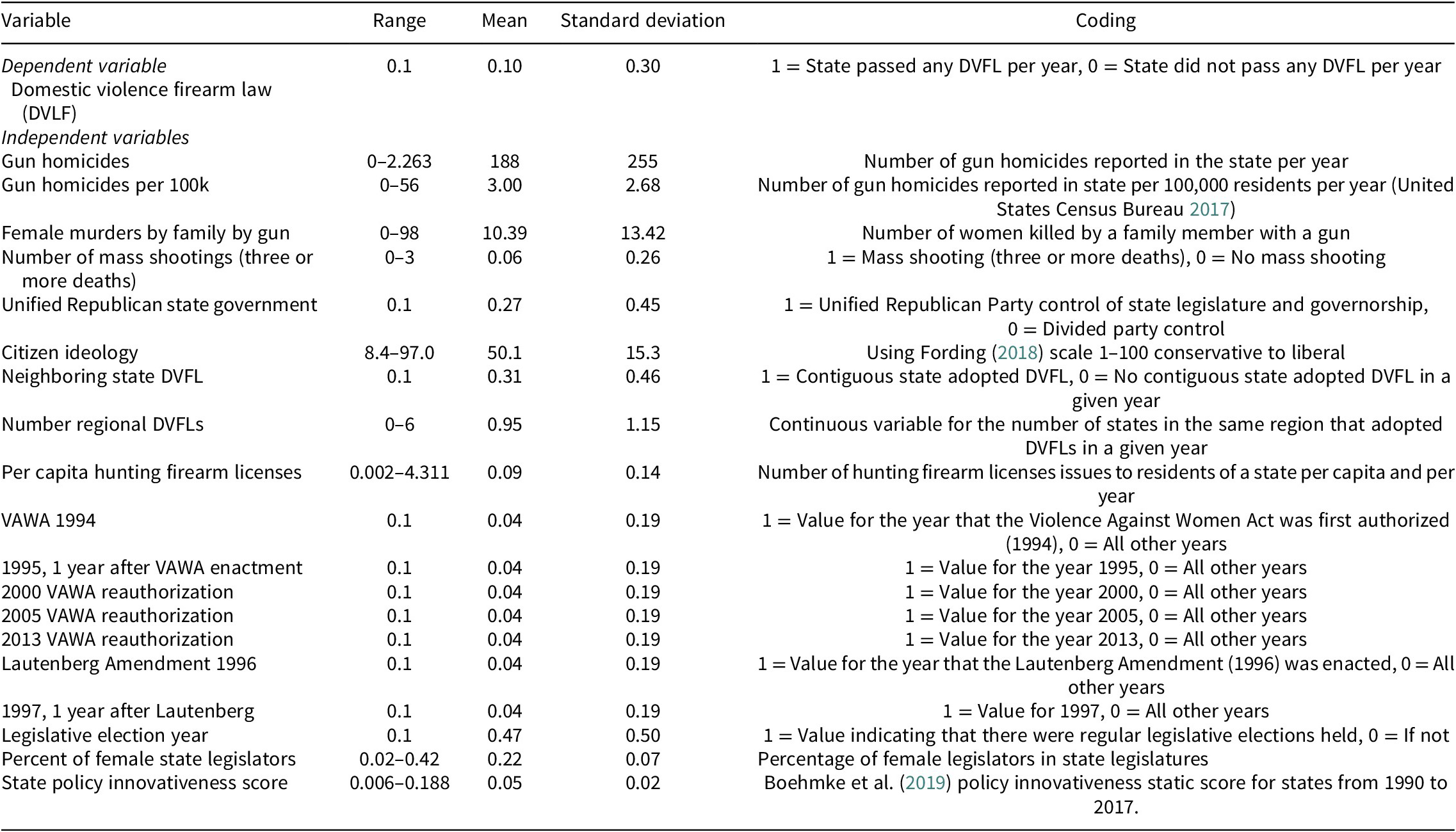
Table 2 lists the variables and their coding for all the models.
Variable statistics and coding
Results and Discussion
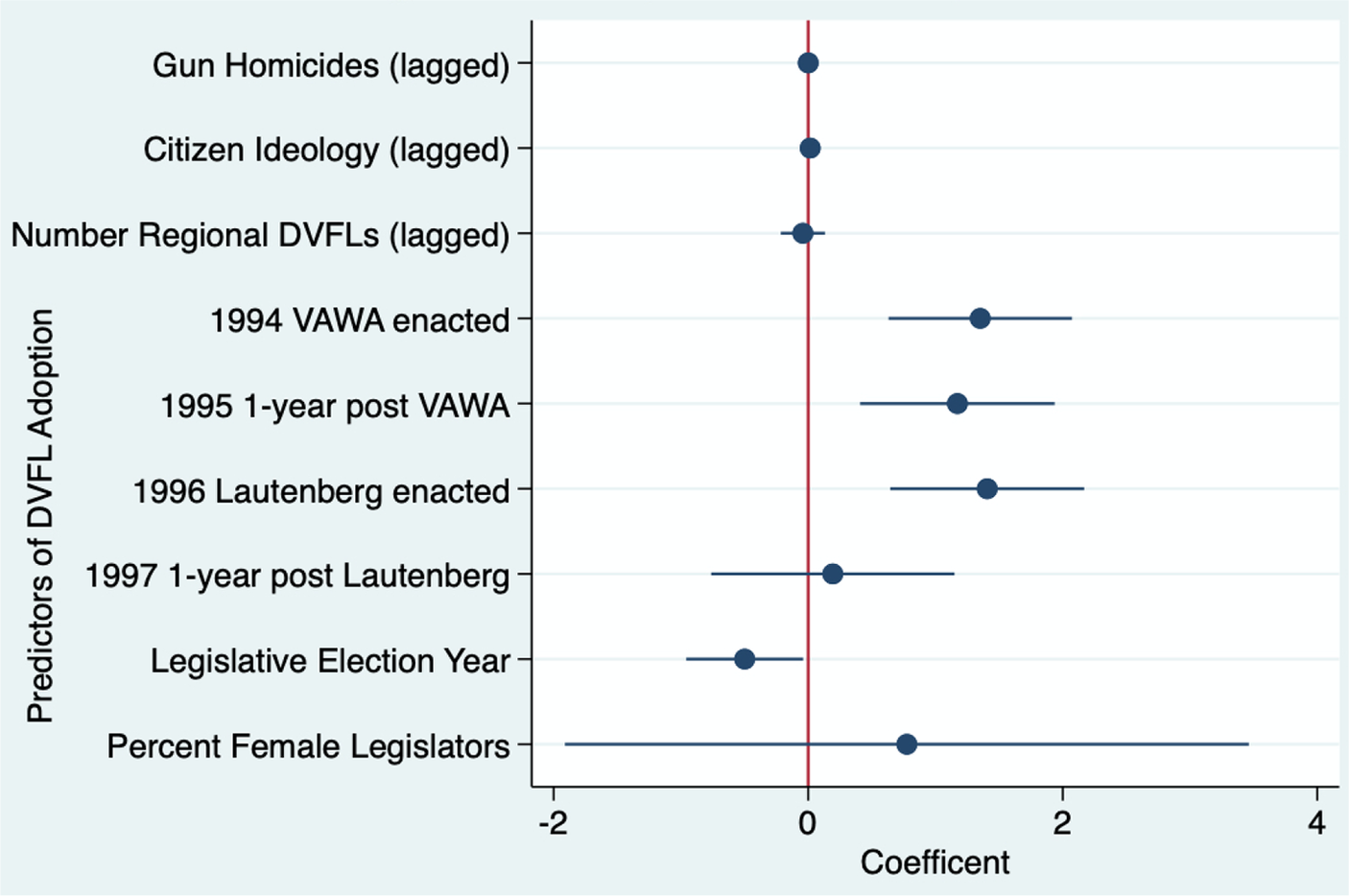
In Model 1 (represented in Figure 1 and Table 3), we report the results of predicting the probability of adopting a domestic violence firearm law as a function of the number of gun homicides (lagged), interacted with whether the state government was unified Republican, Republican control of state government, whether a neighboring state adopted a DVFL (lagged), the number of hunting firearm licenses per capita (lagged), a binary variable for 1994 which was the year of the adoption of the Violence Against Women Act (1994), a binary variable for 1995, the year after VAWA was passed by Congress, a binary variable for the Lautenberg Amendment in 1996 which addressed gun ownership and misdemeanor domestic violence, a binary variable for 1997 which was the year after the Lautenberg Amendment passed, whether it was a state legislative election year, the percent of women in the state legislature, and the State’s Policy Innovativeness Score. We present a summary of the model in Figure 3 and full results in Table 3.
Predicting domestic violence firearm law (DVFL) adoption in states
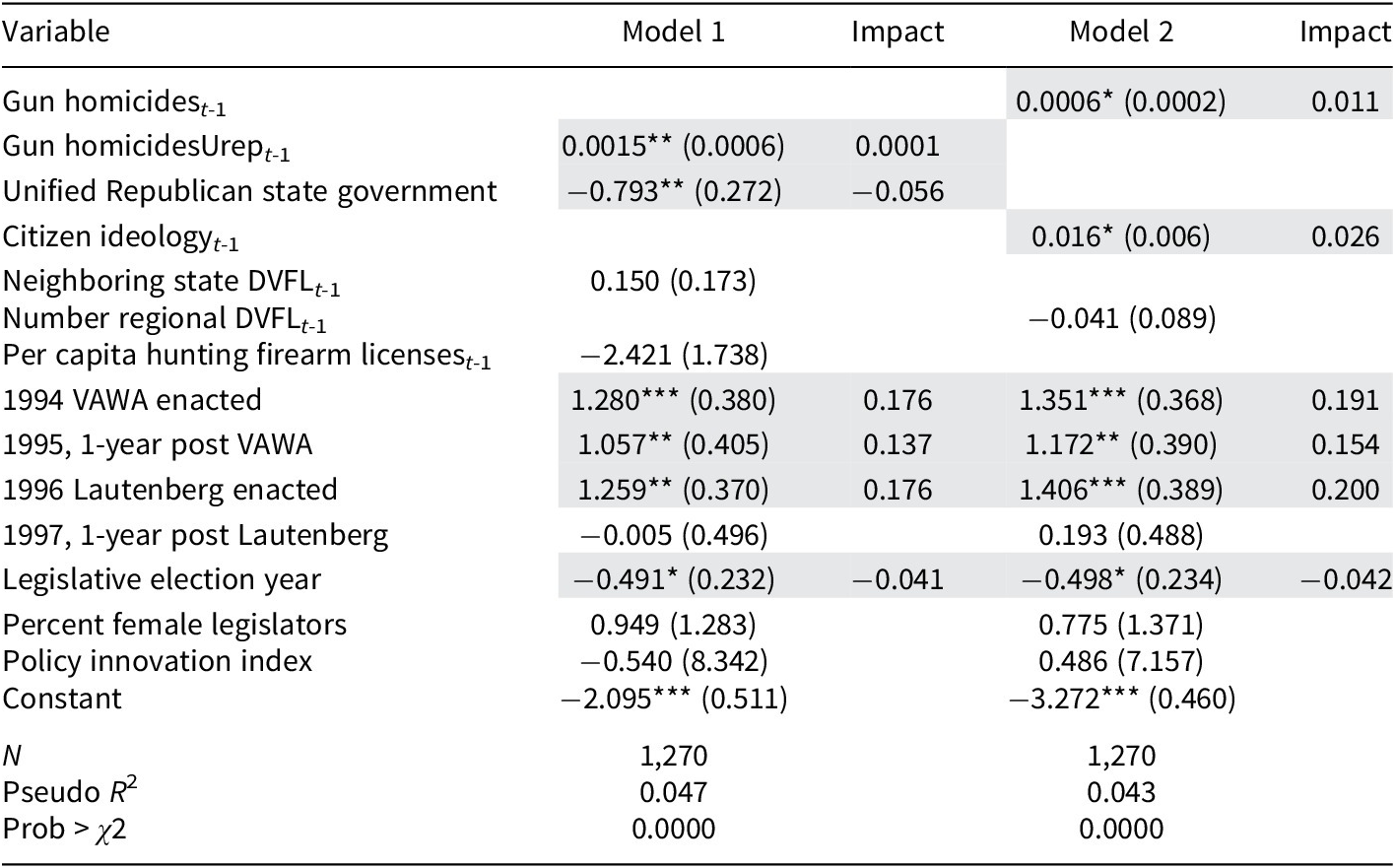
Note. Logistic regression with standard errors in parentheses, clustered on state, listed below the coefficient. The impact of statistically significant coefficients is generated through clarify and is in parentheses next to the coefficient. For binary independent variables, the impact reports the estimated change in the probability of adopting a DVFL as the value of the variable is changed from 0 to 1. For continuous variables, the impact reports the estimated change in probability of adopting a DVFL as the value of the variable is changed from its first quartile value to its third quartile value.
* p < 0.05.
** p < 0.01.
*** p < 0.001.
Predicting domestic violence firearm law (DVFL) adoption in states, Model 1.

Unified Republican state government depresses the likelihood of adopting a DVFL by 5.6% (see Table 3). We find that the number of gun homicides interacted with unified Republican State government has a statistically significant and positive effect on the adoption of a DVFL but it is extremely small; moving from the first quartile to the third quartile, the probability of enacting a DVFL goes up by 0.01%. This result may be capturing instances where a domestic violence related gun incident is so egregious that Republican controlled legislatures are forced to take limited steps to regulate gun possession among domestic violence abusers, as in the Azana spa shooting in Wisconsin in 2012 (see Smucker Reference Smucker2019). Our additional measure of latent political support for gun rights, the per capita number of paid resident hunting firearm license holders, did not exert a statistically significant effect in this model.
States appeared to respond to the initial adoption of VAWA in 1994 and continue to adopt DVFLs in the year after its adoption. The 1994 VAWA legislation increased the likelihood of enacting a DVFL by 18%, and the year after its adoption increased the likelihood of DVFL adoption by 14%. The Lautenberg Amendment in 1996 increased the likelihood of enacting a DVFL by about 18%, but there was no effect from it associated with the following year. Although there is evidence for federal vertical policy diffusion, there was no statistically significant impact of a neighboring state’s (measured as contiguous to a state’s border), impact on DVFL adoption. This follows other scholarship on policy diffusion that has not found support for horizontal policy diffusion (Mooney Reference Shipan and Volden2001; Shipan and Volden Reference Zeoli, McCourt, Buggs, Frattaroli, Lilley and Webster2008; Walker Reference Walker1969). We found that states were about 4% less likely to adopt DVFLs in years where the state legislature was up for election. We found no statistical significance associated with the percentage of female legislators or with the state’s policy innovativeness score. This supports Whitesell’s findings that being a woman does not increase support for expanded welfare policies for domestic violence survivors (2019).
We also analyzed alternative specifications of Model 1. When we replace gun homicides with gun homicides per 100,000 residents, the results hold (see Table A.3). We also tested a variable that measures the number of women who are murdered by a family member by gun and the results are similar (see Table A.4). When we run comparable measures of Democratic state control interacted with gun homicides (see Table A.2), the interactive term is statistically significant and negative, but the parameter estimate for Unified Democratic state government is not statistically significant. In this model we also find that paid hunting license holders achieves significance at the 0.05 level and reduces the likelihood of DVFL adoption by 2.6% (see Table A.2).
Part of what might be driving these conflicting results for each political party is the fact that over our time period (1990–2017), the parties switched their regional control from Democratic to Republican dominance in the south. From our data, gun homicides tend to be higher in the south overall so a state with high gun homicide numbers in the 1990s could have been Democratically controlled but by 2017, had shifted to Republican control. For example, the legislative compositions of state legislatures from 1990 to 2000 in Alabama, Arkansas, Georgia, Kentucky, Louisiana, Mississippi, Oklahoma, and Tennessee were majority Democratic for that entire decade.Footnote 10 Subsequent reauthorizations in 2000, 2005, and 2013 do not exert a statistically significant impact (see Tables A.2 and A.5). There are two potential reasons why the reauthorizations do not affect the passage of DVFLs at the state level. The first could be because none of the reauthorizations concern additional firearm regulation. Because both VAWA and Lautenberg include firearm restrictions in their legislation, this may be what was needed for emulation at the state level. A second reason why the reauthorizations did not impact the passage of DVFLs at the state level is because of the increasing levels of polarization on gun control and Republican control of legislatures that hinder passage of DVFLs after 2000.
In Model 2 (represented in Figure 4 and Table 3), we sought to assess the impact of gun homicides (lagged), citizen ideology (in lieu of party control of state government) and expanded our scope of horizontal policy diffusion by including the number of states within a shared region that adopted DVFLs. Gun homicides by themselves exert a statistically significant effect; as the value of gun homicides (lagged) moves from the first quartile to the third quartile, the likelihood of adopting a DFVL increases by 1.1%. Citizen ideology also exerts a positive and statistically significant impact; as the value of citizen ideology moves from the first quartile to the third quartile, and thus becomes more liberal, the state is 2.7% more likely to adopt a DVFL. The results for the Violence Against Women Act the year it was enacted, the year after it was enacted (1995), the Lautenberg Amendment 1996, and state legislative elections remain robust. We do not find a statistically significant impact associated with regional adoption of DVFLs.
Predicting domestic violence firearm law (DVFL) adoption in states, Model 2.
Conclusion
In this work, we demonstrate that there is a disparity in legislative action on the issue of domestic violence across states and specifically regarding policies enacted to reduce domestic violence related firearm homicides. We expected that factors both external and internal to states could account for the adoption of such policies. We explored vertical, horizontal, partisan, and ideological policy diffusion effects and found that federal action in this area increased adoption of DVFLs but that when neighboring states, or ones in the same region, adopted a DVFL, it did not necessarily encourage a state to take similar action. Federal funding tied directly to violence against women policies and programs do not require states to follow federal domestic violence firearm laws, which means the federal government does not coerce states to pass DVFLs on their own. And although states compete for these federal grants, states who enact, as well as states who do not enact DVFLs are equally likely to receive these grants. The vertical diffusion mechanism that matters for these laws is during the year (1994) and the following year (1995) of the initial passage of domestic violence laws through the Violence Against Women Act, and the year of the Lautenberg Amendment (1996).
Congress did not address domestic violence firearm prohibitions in the 2000, 2005, and 2013 reauthorizations of the Violence Against Women Act. In part, we attribute this lack of attention to domestic violence firearm legislation to Republican dominance in both chambers of Congress in 2000 and 2005, and in the House of Representatives in 2013. In this study, we found similar effects in that Republican control of state governments decreases the passage of DVFLs at the state level. Our work concludes that simply legislating more generally on the area of domestic violence is not enough to push states to adopt DVFLs in emulation of the federal government. Consequently, we should not expect to see more DVFL adoption at the state level until Congress expands federal DVFLs such as closing the “boyfriend loophole,” or ties funding to the presence of DVFLs in each state.
The lack of response from states to reauthorizations of VAWA point to a larger concern about the impact of federal legislation on state action over time. In an age of heightened polarization, reauthorization has become the typical way that Congress legislates in a policy area. Instead of trying to create brand new legislation, members of Congress amend or update existing laws to try to enact their policy preferences. However, if vertical policy diffusion dissipates with subsequent reauthorization of laws—as it did for VAWA—then the federal government becomes a less potent catalyst for policy adoption at the state level.
However, in other areas of domestic violence, the VAWA reauthorizations have allowed Congress to address prior legislative mistakes, even if it takes them decades to do so. For example, Native American women were highly vulnerable to abusive non-Native Americans who could not be prosecuted by tribal governments. The 2013 VAWA reauthorization created the Special Domestic Violence Jurisdiction Program which gave tribes jurisdiction on domestic violence offenses even when the offender was not a Native American. This program has successfully prosecuted and convicted dozens of serial abusers in tribes that have adopted the program. Secretary Deb Haaland built on this provision by creating a new unit within the Department of the Interior to address the cases of thousands of missing and murdered Native American women in 2021.
The number of gun homicides has a direct effect on the adoption of DVFLs; by itself, it increases the likelihood of adopting a DVFL. But the effects of gun homicides are overpowered by partisanship when Republicans have complete control of state governments; in that case, the overall effect is to reduce the likelihood of adopting a DVFL. For ideology, we found a consistently positive and statistically significant effect; the more liberal the citizenry, the more likely a state is to adopt a DVFL. A question for scholars in future work on domestic violence laws is whether partisanship matters for the adoption of nonfirearm related statutes, such as mandatory arrests in domestic violence cases, or laws that increase funding for DV shelters and services. We also find evidence to suggest that legislators are more reluctant to adopt DVFLs in a state legislative election year. Neither a state’s percentage of female legislators or overall score of policy innovativeness influences the adoption of DVFLs.
Our results stand at the intersection of federalism, public policy, and domestic violence in identifying the factors that prompt states to take legislative action on the ownership and possession of firearms by domestic violence abusers. Domestic violence firearm laws can be categorized in many different ways—as gun control, women’s rights, public safety—but they seem to be most affected by the passage of gun control measures at the federal level as well as the partisanship and ideology of states. As long as domestic violence firearm laws continue to be viewed as attempts to restrict gun ownership rather than public safety measures designed to protect primarily women and children, conservative and Republican dominated state legislatures will remain resistant to their adoption.
Data Availability Statement
Replication materials are available on SPPQ Dataverse at https://doi.org/10.15139/S3/XDFYCS (Sidorsky and Schiller Reference Sidorsky and Schiller2022).
Funding Statement
The authors thank Brown University and Coastal Carolina University for research funding support.
Conflict of Interest
The authors declared no potential conflicts of interest with respect to the research, authorship, and/or publication of this article.
Acknowledgments
The authors thank Caleb Apple, Isabel Culver, Cayla Kaplan, Rakhi Kundra, and Gabriela Tenorio for their research assistance, seminar participants at Brown University, University of Virginia, and the University of Illinois as well as Kelly Branham Smith, for their feedback on the project, and anonymous reviewers for this journal.
Appendix
Passage of DVFLs by year

Predicting domestic violence firearm law adoption in states

Note: Logistic Regression with standard errors in parentheses, clustered on state, listed below the coefficient. The impact of statistically significant coefficients is generated through Clarify and is in parentheses next to the coefficient. For binary independent variables, the impact reports the estimated change in the probability of adopting a DVFL as the value of the variable is changed from 0 to 1. For continuous variables, the impact reports the estimated change in probability of adopting a DVFL as the value of the variable is changed from its first quartile value to its third quartile value.
Predicting domestic violence firearm law (DVFL) adoption in states

Note. Logistic regression with standard errors in parentheses, clustered on state, listed below the coefficient. The impact of statistically significant coefficients is generated through clarify and is in parentheses next to the coefficient. For binary independent variables, the impact reports the estimated change in the probability of adopting a DVFL as the value of the variable is changed from 0 to 1. For continuous variables, the impact reports the estimated change in probability of adopting a DVFL as the value of the variable is changed from its first quartile value to its third quartile value.
Predicting domestic violence firearm law (DVFL) adoption in states

Note. Logistic regression with standard errors in parentheses, clustered on state, listed below the coefficient. The impact of statistically significant coefficients is generated through clarify and is in parentheses next to the coefficient. For binary independent variables, the impact reports the estimated change in the probability of adopting a DVFL as the value of the variable is changed from 0 to 1. For continuous variables, the impact reports the estimated change in probability of adopting a DVFL as the value of the variable is changed from its first quartile value to its third quartile value.
Predicting domestic violence firearm law (DVFL) adoption in states
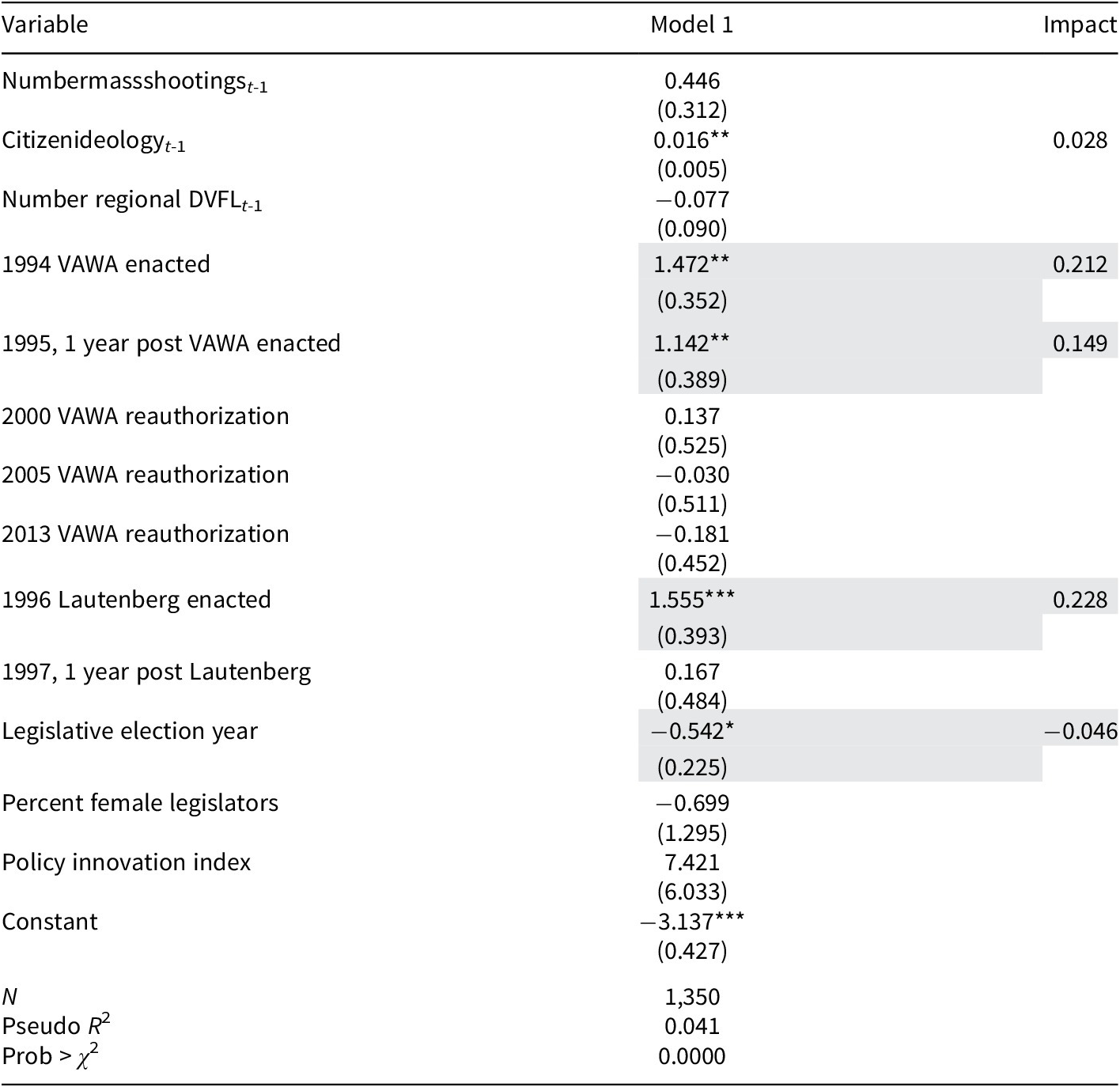
Note. Logistic regression with standard errors in parentheses, clustered on state, listed below the coefficient. The impact of statistically significant coefficients is generated through clarify and is in parentheses next to the coefficient. For binary independent variables, the impact reports the estimated change in the probability of adopting a DVFL as the value of the variable is changed from 0 to 1. For continuous variables, the impact reports the estimated change in probability of adopting a DVFL as the value of the variable is changed from its first quartile value to its third quartile value.
Author Biographies
Wendy J. Schiller is Royce Family Professor of Teaching Excellence in Political Science at Brown University, Providence, RI 02912. Her research focuses on legislative policy making.
Kaitlin N. Sidorsky is Associate Professor of Political Science at Coastal Carolina University, Conway, SC 29528. Her research focuses on women and politics, state politics, and public policy.


 Open access

