


1. Introduction
Additive manufacturing (AM) methods have transformed mechanical component design, enabling complex lattice structures that enhance material efficiency, reduce weight, and offer precise control over mechanical properties. These structures are increasingly applied in aerospace, automotive, and healthcare industries, where lightweight, high-performance components are essential (Gibson & Ashby, Reference Gibson and Ashby1999; Sun & Hao, Reference Sun and Hao2019; Maskery et al., Reference Maskery2017). A key advantage of lattice structures is their ability to exhibit controlled anisotropy, which allows for directional variation in mechanical properties tailored to specific applications. This enables optimised load distribution, energy absorption, and structural compliance, surpassing the limitations of traditional isotropic materials (Meisel & Williams, Reference Meisel and Williams2015; Zhang et al., Reference Zhang, Liu and Childs2017; Rosen, Reference Rosen2014; Kumar & Rosen, Reference Kumar and Rosen2013).
While extensive research has examined the static mechanical properties of lattice structures (Tancogne-Dejean et al., Reference Tancogne-Dejean, Diamantopoulou and Mohr2018; Maskery et al., Reference Maskery2017), their classification for motion-driven applications remains underdeveloped. Existing studies often analyse lattice behaviour in specific contexts (Howell & Midha, Reference Howell and Midha1995; Meisel & Williams, Reference Meisel and Williams2015), but a systematic framework linking tessellations to mechanical motion suitability has yet to be established. This paper introduces a motion-based taxonomy, categorising lattice structures based on their geometric response to motion, offering a new approach to compliant structure design. By shifting focus from static performance to dynamic deformation, this taxonomy bridges a key gap in Design for Additive Manufacturing (DfAM) and offers a novel perspective on selecting lattice structures for motion-driven systems (Rosen, Reference Rosen2014; Valle & Hossain, Reference Valle and Hossain2020).
Dynamic performance—the response of lattice structures to motion-specific deformation—plays a critical role in applications requiring controlled deformation. Unlike static classifications that primarily assess compressive strength and stiffness, motion-based evaluations focus on how tessellation patterns influence deformation and their ability to replicate mechanical motion (Reference Howell and MidhaHowell & Midha, 1995; Reference RosenRosen, 2014). Precise geometric deformations, rather than material-driven stress responses, can define functionality in compliant structures and energy-dissipating systems. To address this, the study introduces a taxonomy based on the suitability of lattice structures for the four fundamental mechanical motions: linear, oscillating, reciprocating, and rotary. These motion types are linked to tessellation geometry and wall thickness variations, providing a framework for optimising lattice design for motion-specific applications and extending DfAM methodologies by emphasising dynamic performance (Reference Tancogne-Dejean, Diamantopoulou and MohrTancogne-Dejean et al., 2018).
A total of 51 lattice variations are evaluated to explore the relationship between tessellation geometry, wall thickness, and mechanical motion suitability. The findings confirm clear trends in geometric deformation behaviours, supporting the taxonomy’s utility for designers and engineers in motion-specific applications (Valle & Hossain, Reference Valle and Hossain2020; Howell & Magleby, Reference Howell, Magleby and Olsen2013).
While material properties such as fatigue resistance and anisotropy influence long-term durability and stress response, the fundamental suitability of a lattice for specific motion types is shaped in part by its geometric structure. By focusing on geometric influences on lattice deformation behaviour, the research intentionally excludes material properties to isolate the effects of lattice geometry. Controlling for material variables ensures that any observed deformation behaviour is directly attributable to the geometric design of the lattice, rather than being confounded by the varying properties of different materials. This approach establishes a clearer understanding of how geometric configurations alone influence dynamic performance in lattice structures.
2. Related work
Building on the need for motion-based classification, this section reviews existing research on lattice structures in compliant mechanisms, examines classification approaches, and identifies the gap in motion-driven deformation linked to mechanical motions, justifying the framework.
Lattice structures are central to AM research due to their ability to optimise material usage and enhance mechanical performance. Through topology optimisation, these structures reduce weight while maintaining or improving strength, making them ideal for high-performance applications (Gibson & Ashby, Reference Gibson and Ashby1999; Maskery et al., Reference Maskery2017). Their geometric flexibility and energy absorption properties have driven innovations in lightweight and material-efficient systems (Reference Zegard and PaulinoZegard & Paulino, 2016).
However, existing research primarily evaluates static mechanical properties like stiffness, compressive strength, and tensile behaviour (Tancogne-Dejean et al., Reference Tancogne-Dejean, Diamantopoulou and Mohr2018; Montemayor & Brackett, Reference Montemayor and Brackett2017; Zhang et al., Reference Zhang, Almesmari and Zhang2023). While essential for structural performance, these do not fully capture how lattice geometry influences dynamic deformation. For example, Auxetic lattices, with their negative Poisson’s ratio and isotropic stiffness, suit load bearing and energy-absorbing applications (Fu et al., Reference Fu, Gao, Song and Shi2018; Valle & Hossain, Reference Valle and Hossain2020). Studies often overlook their role in motion-driven designs requiring controlled dynamic response.
2.1. Lattice structures and motion-specific design
Lattice structures share key attributes with compliant mechanisms, which achieve motion through controlled deformation rather than discrete mechanical parts like hinges or bearings. Like compliant mechanisms, they offer simplicity, reduced assembly, and multi-functionality (Howell & Midha, Reference Howell and Midha1995; Howell & Magleby, Reference Howell, Magleby and Olsen2013). Fundamentally, lattice structures can function as a subset of compliant mechanisms, using tessellated geometries and controlled anisotropy to achieve precise deformation patterns (Reference Ion, Frohnhofen, Wall, Kovacs, Alistar, Lindsay and LopesIon et al., 2016), making them ideal for motion-specific applications, with geometric flexibility and scalability (Tancogne-Dejean et al., Reference Tancogne-Dejean, Diamantopoulou and Mohr2018; Zhang et al., Reference Zhang, Liu and Childs2017).
Unlike rigid-body mechanisms, lattice structures can fill volumes and areas, offering flexibility and multi-functionality that expand their dynamic applications. Their tessellations provide structural adaptability for various dynamic conditions (Gibson & Ashby, Reference Gibson and Ashby1999; Lee et al., Reference Lee, Kim and Park2019), offering advantages in engineering applications requiring both performance and efficiency (Reference Sun and HaoSun & Hao, 2019). Additionally, lattice structures offer greater scalability, making them suitable for miniaturised systems, like medical implants, and larger applications, such as aerospace components (Reference Sun and HaoSun & Hao, 2019). Integrating controlled anisotropy allows engineers to tailor mechanical performance to dynamic application requirements (Reference Lee, Kim and ParkLee et al., 2019).
2.2. Motion-based taxonomy and lattice classification
Existing classification methods emphasise static properties such as stiffness, compressive strength, and topology-driven optimisation (Kumar & Rosen, Reference Kumar and Rosen2013; Li et al., Reference Li, Zhang, Wang and Liu2024; Tancogne-Dejean et al., Reference Tancogne-Dejean, Diamantopoulou and Mohr2018; Zhang et al., Reference Zhang, Liu and Childs2017; Zhang et al., Reference Zhang, Almesmari and Zhang2023). However, they do not systematically classify lattice structures by deformation behaviours in response to mechanical motion, remaining focused on static structural efficiency rather than how geometric tessellation governs motion-driven behaviour.
Kumar and Rosen Reference Kumar and Rosen(2013) provide a well-established classification system, categorising lattices based on structural efficiency under static loads, emphasising stiffness, anisotropy, and load-bearing capacity. Their approach optimises lattices for mechanical strength and weight reduction, making them well-suited for load-bearing applications where static stability is paramount. However, these classifications do not consider how geometric configurations facilitate motion-driven deformation, limiting their applicability in systems requiring controlled flexibility and adaptive responses.
More recently, Li et al. Reference Li, Zhang, Wang and Liu(2024) expands upon static classifications by integrating high-performance lattice designs that enhance mechanical efficiency through topology optimisation and graded materials. However, it does not systematically address motion-driven deformation, and the classification remains focused on optimising structural efficiency rather than evaluating deformation aligned with mechanical motion.
This study introduces a motion-based taxonomy that differs in three key ways. First, it isolates geometry as the primary classification factor, unlike prior models that integrate material and topology-based metrics. Second, instead of optimising lattices for fixed loads, this taxonomy links tessellation patterns and wall thickness variations to mechanical motion, structuring deformation analysis across motion-driven applications. Finally, it provides a predictive framework for selecting lattices optimised for dynamic performance, with uses in compliant mechanisms, vibration damping, and energy-absorbing structures—applications where controlled deformation is critical.
By shifting the focus from static efficiency to motion-driven deformation, this taxonomy fills a gap in lattice classification. Unlike existing models that prioritise static structural performance, it systematically evaluates geometric tessellation to determine its ability to replicate linear, reciprocating, oscillating, and rotary motions, broadening applicability in motion-driven systems
3. Experimental design
This section outlines the experimental setup, methodology, and classification process used to develop the motion-based taxonomy for additively manufactured lattice structures. The taxonomy classifies these structures according to their suitability for replicating mechanical motions. By systematically exploring variations in tessellation patterns and wall thickness, the study establishes a clear relationship between structural geometry and motion-specific performance.
3.1. Lattice structure variations and testing methodology
The experimental design evaluated 51 variations of lattice structures, each tested under mechanical stresses relevant to motion-based applications. The 17 tessellation patterns were selected to represent diverse deformation behaviours identified in prior studies (Reference Air and WodehouseAir & Wodehouse, 2022). These include chiral and re-entrant lattices for negative Poisson’s ratio effects, and non-linear beam lattices (sinusoidal and Kagome) for their curved and angled strut geometries, covering a wide range of geometries and deformation behaviours (Reference Ion, Frohnhofen, Wall, Kovacs, Alistar, Lindsay and LopesIon et al., 2016; Reference Fu, Gao, Song and ShiFu et al., 2018). Figure 1 illustrates these tessellation patterns and their respective geometric configurations.
The seventeen selected lattice types and tessellation patterns

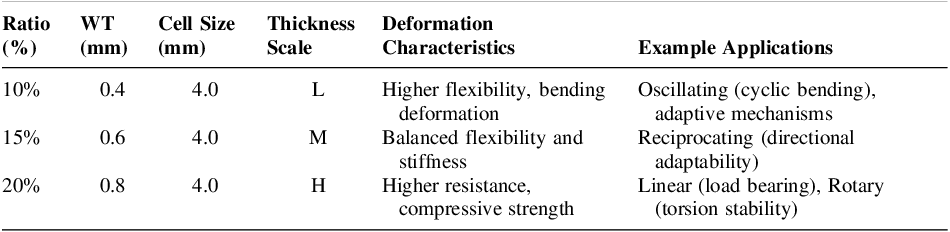
Nine of the lattice types exhibited direction-dependent behaviour, necessitating tests along two planar orientations to capture deformation differences under varying directional stresses (Maskery et al., Reference Maskery2017; Valle & Hossain, Reference Valle and Hossain2020). Wall thicknesses were varied at three standardised levels (Low, Medium, and High), corresponding to 10%, 15%, and 20% of the lattice cell size, to access their influence on deformation behaviour. A detailed discussion is provided in Section 4.2 and summarised in Table 2. All structures were tested under controlled conditions, ensuring that performance variations could be attributed solely to geometry and wall thickness, with material impact excluded at this stage.
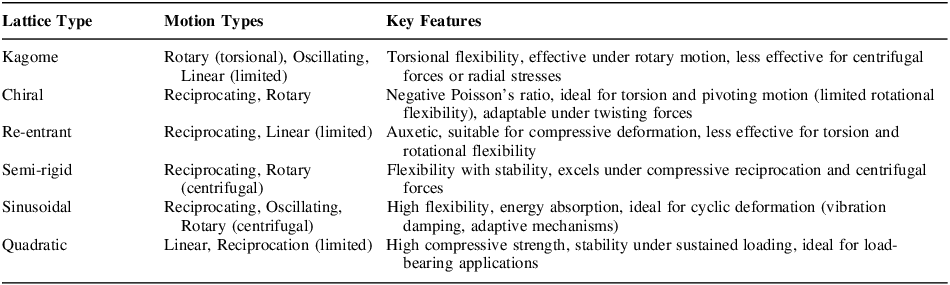
Suitable motions for each lattice type and key features

Guideline for wall thickness ratios and scaling

3.2. Classification process for motion-specific applications
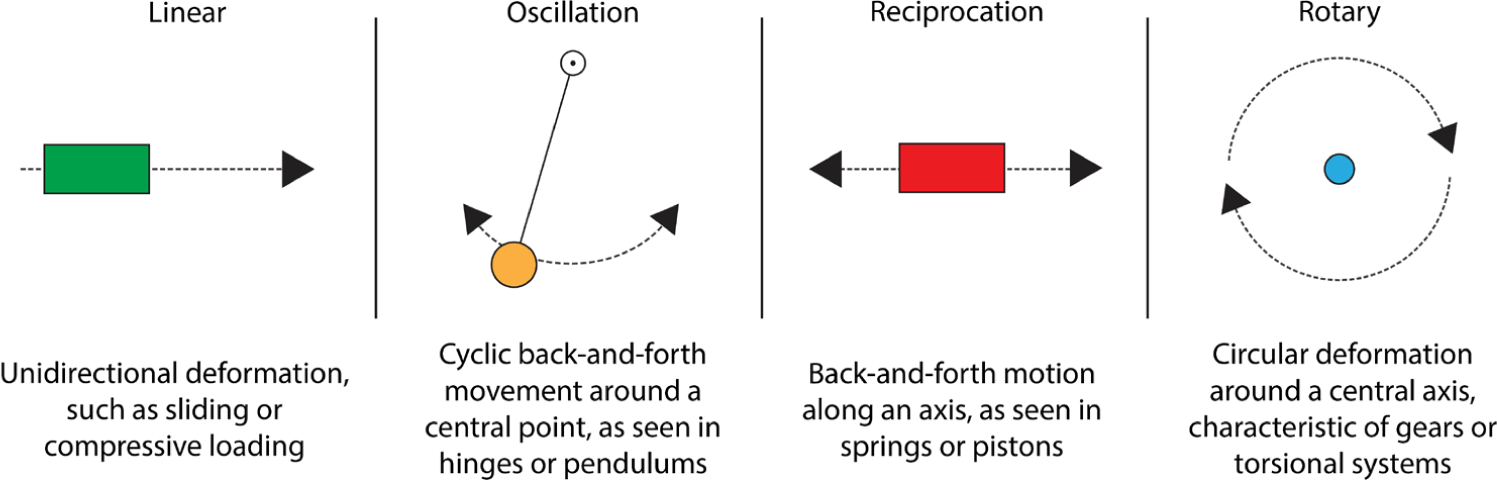
The classification of lattice structures was based on four traditional mechanical motion categories commonly used in mechanical systems (Howell & Midha, Reference Howell and Midha1995; Howell, Magleby, & Olsen, Reference Howell, Magleby and Olsen2013). These motion categories are below in figure 2.
The four basic mechanical motion types (Reference Air and WodehouseAir & Wodehouse, 2022)

Each lattice structure was assigned to these motion categories based on its deformation during mechanical testing. Direction-dependent structures were tested along planar axes to capture anisotropic behaviours for comprehensive classification (Valle & Hossain, Reference Valle and Hossain2020; Tancogne-Dejean et al., Reference Tancogne-Dejean, Diamantopoulou and Mohr2018).
3.3. Role of geometric tessellation patterns and wall thickness
Tessellation patterns play a critical role in determining the deformation characteristics of each lattice structure, while wall thickness influenced the degree of flexibility or stiffness required for specific motions (see Table 1 in Section 4.1). For example:
-
Re-entrant and chiral lattices, with auxetic properties, excelled in rotary and reciprocating motions due to multi-directional expansion and contraction (Reference Fu, Gao, Song and ShiFu et al., 2018; Reference Ion, Frohnhofen, Wall, Kovacs, Alistar, Lindsay and LopesIon et al., 2016).
-
Sinusoidal lattices showed flexibility and energy absorption, due to their curved beams, making them ideal for oscillating and reciprocating motions (Reference MaskeryMaskery et al., 2017; Reference Fu, Gao, Song and ShiFu et al., 2018).
-
Quadratic lattices provided high compressive strength and stability under linear loading, supporting applications requiring rigidity (Reference MaskeryMaskery et al., 2017).
3.4. Motion-based taxonomy
The motion-based taxonomy classifies lattice structures based on their suitability for the four fundamental motion types: linear, oscillating, reciprocating, and rotary. It systematically links geometric tessellation patterns with motion-specific deformation behaviours, providing a structured approach to identifying optimal lattice configurations for dynamic applications.
Figure 3 below visually represents this classification through a hierarchical structure, dividing the taxonomy into two main sections: tessellation patterns (blue) and motion types (red). The tessellation patterns are categorised based on their geometric arrangement and the deformation behaviours they induce under different motion types. The most common tessellation type tested is Edge-to-Edge, where two polygons intersect at multiple points, with variations classified as:
Motion-based taxonomy dendrogram

-
Regular (single polygon type),
-
Semi-regular (multiple polygon types), or
-
Uniform (symmetry around a vertex).
In contrast, Non-Edge-to-Edge tessellations occur when polygons do not share a full edge—such as when adjacent polygons have edges of differing lengths.
The motion types (red) section of the taxonomy shows how different lattices align with specific mechanical motions. Some lattice types are applicable to multiple motion types, highlighting their versatility in different dynamic applications. This visual representation helps designers and engineers select appropriate lattice structures for specific motion requirements. It also serves as a foundation for future expansions, enabling the integration of new tessellation types and broader applications in subsequent studies.
4. Results and discussion
This section discusses key experimental findings and their implications for the motion-based taxonomy of AM lattice structures. The results support the taxonomy, highlighting how lattice tessellation patterns and wall thicknesses influence the suitability for linear, oscillating, reciprocating, and rotary motions.
4.1. Influence of geometry on performance
Experimental tests on 51 lattice structures assessed how tessellation patterns and wall thicknesses influenced mechanical responses. The results indicate that lattice geometry fundamentally determines motion suitability. Table 1 summarises key findings, outlining lattice suitability for specific mechanical motions. The following sections detail the performance of each lattice type under dynamic conditions.
-
Kagome lattices excel in torsional motion, efficiently deforming under twisting forces, such as a door handle. Their torsional flexibility allows twisting around a central axis without failure, making them ideal for rotary joints. However, they perform poorly under centrifugal forces, creating radial stress. lacking the rigidity to resist these stresses, they are unsuitable for high-speed rotating or centrifugal loading applications (Reference Ion, Frohnhofen, Wall, Kovacs, Alistar, Lindsay and LopesIon et al., 2016; Reference MaskeryMaskery et al., 2017).
-
Chiral lattices excel in pivoting (rotary) motions due to their negative Poisson’s ratio and directional adaptability. These motions involve limited rotation around a fixed point, as seen in door latches or rotary switches. Their toroidal geometry, with angled beams connecting nodes, enables controlled angular deflection under twisting forces. This makes them ideal for applications requiring confined rotational movement, such as soft robotics and limited-rotation mechanisms (Reference Fu, Gao, Song and ShiFu et al., 2018; Reference Ion, Frohnhofen, Wall, Kovacs, Alistar, Lindsay and LopesIon et al., 2016).
-
Re-entrant lattices, with auxetic properties, suit reciprocating motions, deforming under cyclic compressive loading. This makes them ideal for pistons and springs requiring energy dissipation. However, they are less effective in torsional or rotary motions due to limited flexibility in those directions (Reference MaskeryMaskery et al., 2017).
-
Semi-rigid lattices performed poorly under torsional forces but excelled in centrifugal forces and compressive reciprocation, making them ideal for applications requiring flexibility and compressive resistance, such as vibration damping or suspension systems (Reference MaskeryMaskery et al., 2017).
-
Sinusoidal lattices offer high flexibility and energy absorption, making them ideal for reciprocating and oscillating motions. Their efficient deformation and recovery under cyclic loading suited applications requiring repetitive bending or deformation, such as spring-like mechanisms or vibration isolators (Reference Lee, Kim and ParkLee et al., 2019).
-
Quadratic lattices, with their rigid geometric structure, demonstrated superior performance in linear motions due to their high compressive strength and stability under loading. Their ability to withstand substantial loads makes them well-suited for structural applications, including aerospace supports and construction-based load-bearing components (Reference MaskeryMaskery et al., 2017).
These findings support the motion-based taxonomy, which classifies lattice structures based on their dynamic performance. The taxonomy provides a systematic approach to choosing the most suitable lattice geometry for specific dynamic motions.
4.2. Thickness guidelines and scalability
To guide lattice design, structures were classified into three recommended wall thickness levels: L (Low), M (Medium), and H (High), corresponding to 0.4 mm, 0.6 mm, and 0.8 mm, respectively. These thicknesses represent 10%, 15%, and 20% of the lattice cell size (4.0 mm), as shown in Table 2.
The selected percentages offer a broad range of deformation characteristics:
-
L (10%): These lattices, with high flexibility, excelled in oscillating motions. Thinner walls enabled rapid deformation and recovery, making them ideal for applications requiring adaptive deformation and energy absorption (Reference MaskeryMaskery et al., 2017).
-
M (15%): Lattices balance flexibility and rigidity, performing well under reciprocating motions. The medium thickness allowed deformation in both directions while maintaining structural integrity, making it suitable for applications like pistons or springs, where adaptability and cyclic deformation resistance are important (Reference Fu, Gao, Song and ShiFu et al., 2018).
-
H (20%): Thicker lattices provided greater rigidity, ideal for linear and rotary motions requiring strength and load bearing. The increased stiffness and resistance to deformation suited applications with constant compressive or torsional loads (Reference Sun and HaoSun & Hao, 2019).
These wall thickness guidelines align with AM practices and are scalable for different applications, from small-scale devices (e.g., medical implants) (Reference Liu, Rahaman, Hilmas, Bal and BrownLiu et al., 2021) to large-scale systems (e.g., aerospace components) (Reference Schwartz, Xie and HodgeSchwartz et al., 2019). Liu et al. Reference Liu, Rahaman, Hilmas, Bal and Brown(2021) demonstrated how lattice performance in medical implants can change with scale, emphasising the need for multi-scale testing to ensure the taxonomy’s applicability across diverse real-world applications.
4.3. Directional behaviour and anisotropy
Direction-dependent behaviours were observed in nine lattice types, requiring tests along two planar orientations to capture anisotropic responses to varying stresses. Kagome and semi-rigid lattices performed better along axes aligned with their directional properties, highlighting the importance of controlled anisotropy in dynamic lattice design (Valle & Hossain, Reference Valle and Hossain2020; Tancogne-Dejean et al., Reference Tancogne-Dejean, Diamantopoulou and Mohr2018). This behaviour was crucial in understanding how lattice geometry impacts dynamic motion suitability.
4.4. The role of wall thickness in motion suitability
The impact of wall thickness on lattice performance varied across the mechanical motion types tested. Key observations include:
-
For oscillating motions, thinner walls (0.4 mm) were advantageous, providing greater flexibility. These lattices were able to undergo cyclic deformation efficiently, absorbing and releasing energy during each oscillation. The low wall thickness allowed for quicker recovery and improved performance under cyclic bending (Reference MaskeryMaskery et al., 2017).
-
For linear motions, thicker walls (0.8 mm) proved to be more effective in providing the rigidity and stability needed to support compressive loads. The increased compressive strength and resistance to deformation at this thickness made it ideal for applications requiring load-bearing capabilities under sustained mechanical forces (Reference Sun and HaoSun & Hao, 2019).
-
For rotary motions, the relationship between wall thickness and performance was less pronounced, with medium thicknesses (0.6 mm) offering an optimal balance of flexibility and rigidity, providing torsional flexibility while maintaining sufficient stiffness to withstand forces without excessive deformation (Reference Fu, Zhang and ZhangFu et al., 2020).
-
Reciprocating motions benefited from a balance between flexibility and rigidity, with medium thickness (0.6 mm) showing consistent performance. This wall thickness allowed lattices to deform in both directions without losing structural integrity, providing effective directional adaptability during cyclic compression and expansion (Reference Meisel and WilliamsMeisel & Williams, 2015).
4.5. Discussion of findings
The experimental results demonstrate that geometric tessellation patterns and wall thickness variations significantly influence deformation behaviours, supporting the practicality of the proposed motion-based taxonomy for categorising lattice structures under dynamic mechanical movements. These findings reveal clear relationships between geometric parameters and suitability for linear, oscillating, reciprocating, or rotary motions, suggesting that this framework can effectively assist engineers and designers in selecting lattice structures for dynamic applications.
Kagome lattices, which excel in torsional rotary motions, could be used in lightweight aerospace components for controlled rotational deformation (Reference Fu, Gao, Song and ShiFu et al., 2018). Quadratic lattices are ideal for load bearing automotive structures (Reference Gibson and AshbyGibson & Ashby, 1999). In biomedical engineering, sinusoidal lattices offer flexibility and energy absorption for implants (Reference Schwartz, Xie and HodgeSchwartz et al., 2019), while semi-rigid lattices balance flexibility and compressive strength, making them ideal for prosthetics (Reference MaskeryMaskery et al., 2017). This study focused solely on geometric tessellation patterns, deliberately excluding material properties and cyclic fatigue testing to isolate geometric influences. This methodological choice ensures that observed deformation behaviours are directly attributable to geometry rather than material effects (Tancogne-Dejean et al., Reference Tancogne-Dejean, Diamantopoulou and Mohr2018; Rosen, Reference Rosen2014). While fatigue testing is essential for long-term performance validation, it does not affect the classification logic of the motion-based taxonomy. Future studies should explore how material anisotropy, graded structures, and hybrid manufacturing approaches influence motion-specific lattice behaviour under cyclic loading (Reference Li, Zhang, Wang and LiuLi et al., 2024; Reference Zhang, Almesmari and ZhangZhang et al., 2023).
While computational simulations are valuable for material-based analysis, this study focuses on an experimentally derived classification of motion-driven deformation, independent of material properties. Future work could integrate numerical modelling to enhance predictive frameworks, combining geometric classification with material-dependent simulations for broader applicability.
5. Practical implications and applications
This section explores the practical implications and applications of the motion-based taxonomy in lattice design for motion-specific requirements. By identifying lattice structures based on their motion suitability, the taxonomy helps engineers select geometric lattice types optimised for specific mechanical motions.
5.1. Benefits in design efficiency and performance optimisation
The motion-based taxonomy streamlines compliant structure design by providing a structured method to select the most suitable lattice geometry for specific motion types (linear, oscillating, reciprocating, and rotary). This approach enhances design efficiency by reducing reliance on trial-and-error testing, accelerating design iterations, and improving motion-based performance predictions (Reference MaskeryMaskery et al., 2017; Reference Lee, Kim and ParkLee et al., 2019). Additionally, by guiding engineers toward geometry-driven lattice selection, the taxonomy helps optimise designs for motion-specific applications, ensuring that lattice structures align with required mechanical behaviours. This improves structural efficiency and adaptability in motion-driven systems (Meisel & Williams, Reference Meisel and Williams2015; Zegard & Paulino, Reference Zegard and Paulino2016).
5.2. Illustrative example: applying the taxonomy
The work by Air and Wodehouse Reference Air and Wodehouse(2023) demonstrates how the taxonomy aids in selecting a geometric lattice structure for a motion-specific application. The study redesigned a spring check valve (SCV) by replacing the traditional metal spring with a compliant sinusoidal lattice. Functioning as a reciprocating one-way valve, fluid pressure opens the SCV, while the lattice restores it to the closed position when pressure drops. The lattice successfully replicated spring compression and return motion, confirming its motion-specific suitability. Figure 4 shows the original and redesigned SCV.
Original SCV and redesigned compliant SCV (Reference Air and WodehouseAir & Wodehouse, 2023)

Figure 5 presents ANSYS simulation results for the redesigned valve under compression. The lattice deformed by 4.9 mm (about 25% of its length) under a standard 16 bars of pressure, allowing fluid flow. When the pressure was decreased, the lattice returned to its original shape, stopping the fluid flow.
Deformation test of SCV redesign in ANSYS (Reference Air and WodehouseAir & Wodehouse, 2023)

These findings demonstrate the practical potential of motion-driven lattice design and illustrate how the proposed taxonomy can be applied in selecting compliant lattice structures.
5.3. Study limitations and broader research directions
The motion-based taxonomy offers significant potential beyond motion-specific applications by aiding the selection of multi-functional lattice structures. As AM advances, future research should explore how more complex lattice geometries, such as volumetric and stochastic tessellation patterns, influence dynamic deformation (Zegard & Paulino, Reference Zegard and Paulino2016; Maskery et al., Reference Maskery2017). Incorporating material selection into lattice suitability would further refine the taxonomy’s applicability by accounting for material-dependent deformation behaviours, ensuring optimal performance across diverse applications (Meisel & Williams, Reference Meisel and Williams2015; Li et al., Reference Li, Zhang, Wang and Liu2024).
This study excluded materials and manufacturing variations to isolate geometric deformation behaviours to examine its role in the motion suitability of lattice structures. While this approach allowed rigorous control, the study did not examine long-term fatigue performance, which remains crucial for real-world applications. Future research will integrate fatigue testing and material-dependent evaluations to assess the taxonomy’s applicability under cyclic loading conditions (Reference Zhang, Almesmari and ZhangZhang et al., 2023). Expanding the taxonomy to include a wider range of lattice geometries and material considerations will further strengthen its applicability, particularly in aerospace, biomedical, and energy-absorbing applications.
6. Conclusions
This paper introduces a motion-based taxonomy for classifying lattice structures in additive manufacturing, addressing a gap in existing classification systems that prioritise static properties like stiffness and compressive strength (Tancogne-Dejean et al., Reference Tancogne-Dejean, Diamantopoulou and Mohr2018; Maskery et al., Reference Maskery2017). By linking tessellation patterns and wall thickness variations to mechanical motion, this taxonomy provides a geometry-based classification framework that enables engineers to assess lattice deformation behaviours before considering material and manufacturing constraints (Reference Howell and MidhaHowell & Midha, 1995; Reference RosenRosen, 2014).
Beyond improving lattice selection, this taxonomy lays the foundation for motion-driven design methodologies in compliant mechanisms, vibration damping, and energy-absorbing structures. While further validation is needed, it establishes a structured approach to designing motion-specific lattices, shifting the focus from static classifications to dynamic performance (Kumar & Rosen, Reference Kumar and Rosen2013; Tancogne-Dejean et al., Reference Tancogne-Dejean, Diamantopoulou and Mohr2018).
Future research should expand this taxonomy to incorporate multi-material lattices, graded structures, and hybrid designs, enhancing its applicability across various engineering disciplines. Additionally, integrating material properties, manufacturability, and long-term deformation behaviour will ensure alignment with real-world constraints (Meisel & Williams, Reference Meisel and Williams2015; Valle & Hossain, Reference Valle and Hossain2020). As the field advances, refining this classification system has the potential to support computational design, improve predictive modelling, and strengthen its role in advanced manufacturing workflows (Zegard & Paulino, Reference Zegard and Paulino2016; Zhang et al., Reference Zhang, Almesmari and Zhang2023).
By systematically categorising lattice structures based on their ability to replicate linear, oscillating, reciprocating and rotary motions, this taxonomy provides a novel approach to motion-driven lattice design. Beyond its role as a practical tool for engineers and researchers developing next-generation compliant structures, it also supports education and foundational design by offering a structured framework for understanding lattice behaviour in dynamic applications.
Acknowledgements
We would like to thank National Manufacturing Institute of Scotland (NMIS) and the Lightweight Manufacturing Centre (LMC) for their support and access to resources.



 Open access

