





1. Introduction
Let k be a field, and
$S=k[x_1,\ldots ,x_N]$
 be a polynomial ring over k with the standard grading. Let
$I \subseteq S$
be a polynomial ring over k with the standard grading. Let
$I \subseteq S$
 be a homogeneous ideal generated by
$\mu $
be a homogeneous ideal generated by
$\mu $
 forms of degrees at most D. Stillman’s conjecture, now a theorem due to Ananyan and Hochster [Reference Ananyan and Hochster1], predicts the existence of an upper bound for the projective dimension of
$S/I$
forms of degrees at most D. Stillman’s conjecture, now a theorem due to Ananyan and Hochster [Reference Ananyan and Hochster1], predicts the existence of an upper bound for the projective dimension of
$S/I$
 which only depends on
$\mu $
which only depends on
$\mu $
 and D, and not on N. In fact, within this framework, N should be thought of as an unknown number, possibly very large compared to the rest of the given data.
The goal of this article is to obtain upper bounds on numerical invariants in the spirit of the conjecture of Stillman: given some information on the ideal I, independent of N, we want to bound effectively the projective dimension and the Castelnuovo–Mumford regularity of I. If the input only consists of
$\mu $
 and D, then the best available result is indeed the one due to Ananyan and Hochster [Reference Ananyan and Hochster1]. However, such a bound is not explicit except for small values of
$\mu $
and D, then the best available result is indeed the one due to Ananyan and Hochster [Reference Ananyan and Hochster1]. However, such a bound is not explicit except for small values of
$\mu $
 and D.
In our first estimate, we add input to
$\mu $
 some information on the first non-vanishing local cohomology module of
$S/I$
some information on the first non-vanishing local cohomology module of
$S/I$
 supported at
$\mathfrak {m}=(x_1,\ldots ,x_N)$
supported at
$\mathfrak {m}=(x_1,\ldots ,x_N)$
 . For simplicity, we here assume that
$\operatorname {depth}(S/I)=0$
. For simplicity, we here assume that
$\operatorname {depth}(S/I)=0$
 , and we state our result in full generality in Section 3.
Theorem A (See Theorem 3.3)
Let
$I \subseteq S$
 be a homogeneous ideal generated by
$\mu $
be a homogeneous ideal generated by
$\mu $
 forms. If
$S/I$
forms. If
$S/I$
 has a non-zero socle element of degree
$\alpha $
has a non-zero socle element of degree
$\alpha $
 , then
$\operatorname {pd}(S/I) \leqslant \mu ^{2^{\alpha }}$
, then
$\operatorname {pd}(S/I) \leqslant \mu ^{2^{\alpha }}$
 .
.
Theorem A is rather surprising to us. For instance, it implies that if
$S/I$
 has depth zero and
$\operatorname {reg}(H^0_{\mathfrak {m}}(S/I))$
has depth zero and
$\operatorname {reg}(H^0_{\mathfrak {m}}(S/I))$
 is “small” compared to
$\operatorname {pd}(S/I)$
is “small” compared to
$\operatorname {pd}(S/I)$
 , then I must be generated by “many” elements. We also note that no knowledge of the degrees of all the generators of I is needed.
As a consequence of this result, we obtain an upper bound on the projective dimension of unmixed radical ideals only in terms of
$\alpha $
 and the height (see Theorem 3.4).
In comparison with [Reference Ananyan and Hochster1], we stress the fact that, while we add additional information on the socle of
$S/I$
 , the actual estimate is not only explicit, but also comparable with well-known bounds of similar kind [Reference Caviglia and Sbarra6], [Reference Chardin7], [Reference McCullough and Peeva13].
The first author showed that bounding the projective dimension of
$S/I$
 or its Castelnuovo–Mumford regularity only in terms of
$\mu $
or its Castelnuovo–Mumford regularity only in terms of
$\mu $
 and D are two equivalent problems [Reference Peeva14, Theorem 29.5]. Indeed, in Corollary 3.5, we obtain a similar type of bound for the Castelnuovo–Mumford regularity. Regarding this invariant, we recall that McCullough and Peeva showed in [Reference McCullough and Peeva13] that not only the Eisenbud–Goto conjecture [Reference Eisenbud and Goto9] is false, but that there is no polynomial upper bound to the regularity only in terms of the multiplicity (see also [Reference Caviglia, Chardin, McCullough, Peeva and Varbaro3]).
Next, we obtain a double exponential upper bound on
$\operatorname {pd}(S/I)$
 by providing as input
$\mu , D$
by providing as input
$\mu , D$
 , and an estimate on the generators of the second module of syzygies of linear sections of
$S/I$
, and an estimate on the generators of the second module of syzygies of linear sections of
$S/I$
 . In this direction, we recall a question raised by Craig Huneke: “Is there a reasonable upper bound for the projective dimension of
$S/I$
. In this direction, we recall a question raised by Craig Huneke: “Is there a reasonable upper bound for the projective dimension of
$S/I$
 just in terms of
$\mu , D$
just in terms of
$\mu , D$
 and the maximal degree of a minimal generator of the second module of syzygies of
$S/I$
and the maximal degree of a minimal generator of the second module of syzygies of
$S/I$
 ?”. We cannot answer Huneke’s question because in our assumptions we need to take into account some linear sections of
$S/I$
?”. We cannot answer Huneke’s question because in our assumptions we need to take into account some linear sections of
$S/I$
 , but our result gives some progress toward that.
Theorem B (See Theorem 3.7)
Assume that k is infinite, and let
$I \subseteq S=k[x_1,\ldots ,x_N]$
 be an ideal generated by
$\mu $
be an ideal generated by
$\mu $
 homogeneous elements of degree at most D. Assume that
$\operatorname {depth}(S/I) = 0$
homogeneous elements of degree at most D. Assume that
$\operatorname {depth}(S/I) = 0$
 . If, for a sufficiently general linear form
$\ell $
. If, for a sufficiently general linear form
$\ell $
 , one has
$\operatorname {reg}\left (\operatorname {\mathrm {Tor}}_2\left (\frac {S}{I+(\ell )},k\right )\right ) \leqslant C$
, one has
$\operatorname {reg}\left (\operatorname {\mathrm {Tor}}_2\left (\frac {S}{I+(\ell )},k\right )\right ) \leqslant C$
 , then
$\operatorname {pd}(S/I) \leqslant \mu ^{2^{\max \{C,D\}-1}}$
, then
$\operatorname {pd}(S/I) \leqslant \mu ^{2^{\max \{C,D\}-1}}$
 .
.
Again, for simplicity in Theorem B, we assumed that
$\operatorname {depth}(S/I) = 0$
 . Our result in Section 3 is more general and does not have this requirement; however, one needs to control generators of second syzygies of more than one linear section of
$S/I$
. Our result in Section 3 is more general and does not have this requirement; however, one needs to control generators of second syzygies of more than one linear section of
$S/I$
 . Moreover, by means of standard techniques, both Theorems A and B yield upper bounds for the Castelnuovo–Mumford regularity of I (see Corollaries 3.5 and 3.8).
Now let
$t_i = \operatorname {reg}(\operatorname {\mathrm {Tor}}_i^S(S/I,k))$
 for
$i \in \mathbb {Z}_{\geqslant 0}$
for
$i \in \mathbb {Z}_{\geqslant 0}$
 . We recall a result of McCullough.
Theorem 1.1 [Reference McCullough12, Theorem 4.7]
Let
$I \subseteq S=k[x_1,\ldots ,x_N]$
 be a homogeneous ideal, and set
$c=\lceil \frac {N}{2} \rceil $
be a homogeneous ideal, and set
$c=\lceil \frac {N}{2} \rceil $
 . Then
$\operatorname {reg}(S/I) \leqslant \sum _{i=1}^c t_i + \frac {\prod _{i=1}^c t_i}{(c-1)!}$
. Then
$\operatorname {reg}(S/I) \leqslant \sum _{i=1}^c t_i + \frac {\prod _{i=1}^c t_i}{(c-1)!}$
 .
.
While McCullough’s theorem provides an upper bound on the regularity of
$S/I$
 in terms of the generating degrees of some syzygies, as Corollary 3.8 does, it does not fit into the framework of uniform bounds as the rest of this article. In fact, it requires knowledge of c, which is essentially equivalent to requiring knowledge of N.
Our extension of McCullough’s result is twofold: first of all, we pass from the need to control
$\lceil \frac {N}{2} \rceil $
 syzygies of
$S/I$
syzygies of
$S/I$
 to only requiring
$\lceil \frac {N}{r} \rceil $
to only requiring
$\lceil \frac {N}{r} \rceil $
 of them for any positive integer r. Moreover, we only need to know the value of r, not of the ratio
$\lceil \frac {N}{r} \rceil $
of them for any positive integer r. Moreover, we only need to know the value of r, not of the ratio
$\lceil \frac {N}{r} \rceil $
 itself. Specifically, given
$r \in \mathbb {Z}_{>0}$
itself. Specifically, given
$r \in \mathbb {Z}_{>0}$
 , we let

Our result is as follows.
Theorem C (See Theorem 3.9 and Corollary 3.10)
Let
$I \subseteq S = k[x_1,\ldots ,x_N]$
 be a homogeneous ideal generated by
$\mu \geqslant 2$
be a homogeneous ideal generated by
$\mu \geqslant 2$
 forms, and
$r \in \mathbb {Z}_{>0}$
forms, and
$r \in \mathbb {Z}_{>0}$
 . If
$\operatorname {reg}_{\frac {1}{r}}(S/I) \leqslant \delta $
. If
$\operatorname {reg}_{\frac {1}{r}}(S/I) \leqslant \delta $
 , then

2. Preliminaries
Throughout this article, k is a field, and
$S=k[x_1,\ldots ,x_N]$
 is a graded polynomial ring, with
$\deg (x_i)=1$
is a graded polynomial ring, with
$\deg (x_i)=1$
 for every
$i=1,\ldots ,N$
for every
$i=1,\ldots ,N$
 . We will refer to this as the standard grading on S. We let
$\mathfrak {m}=(x_1,\ldots ,x_N)$
. We will refer to this as the standard grading on S. We let
$\mathfrak {m}=(x_1,\ldots ,x_N)$
 be the ideal of S generated by elements of positive degree. If
$M = \bigoplus _{j\in \mathbb {Z}} M_j$
be the ideal of S generated by elements of positive degree. If
$M = \bigoplus _{j\in \mathbb {Z}} M_j$
 is a finitely generated
$\mathbb {Z}$
is a finitely generated
$\mathbb {Z}$
 -graded S-module, we let
$M_{\leqslant j}$
-graded S-module, we let
$M_{\leqslant j}$
 be the graded S-module generated by
$\bigoplus _{p \leqslant j} M_p$
be the graded S-module generated by
$\bigoplus _{p \leqslant j} M_p$
 . We let
$\beta _{i,j}(M) = \dim _k(\operatorname {\mathrm {Tor}}_i^S(M,k)_j)$
. We let
$\beta _{i,j}(M) = \dim _k(\operatorname {\mathrm {Tor}}_i^S(M,k)_j)$
 be the
$(i,j)$
be the
$(i,j)$
 th graded Betti number of M as an S-module, and
$t_i(M) = \text {sup}\{j \mid \beta _{i,j}(M) \ne 0\}$
th graded Betti number of M as an S-module, and
$t_i(M) = \text {sup}\{j \mid \beta _{i,j}(M) \ne 0\}$
 . We also let
$\beta _{i,\leqslant j}(M) = \sum _{p \leqslant j}\beta _{i,p}(M)$
. We also let
$\beta _{i,\leqslant j}(M) = \sum _{p \leqslant j}\beta _{i,p}(M)$
 and
$\beta _i(M) = \sum _{j \in \mathbb {Z}} \beta _{i,j}(M)$
and
$\beta _i(M) = \sum _{j \in \mathbb {Z}} \beta _{i,j}(M)$
 . The socle of M is
$\operatorname {soc}(M) = 0:_M \mathfrak {m}$
. The socle of M is
$\operatorname {soc}(M) = 0:_M \mathfrak {m}$
 . Recall that
$\operatorname {soc}(M)$
. Recall that
$\operatorname {soc}(M)$
 is a finitely generated k-vector subspace of
$H^0_{\mathfrak {m}}(M)$
is a finitely generated k-vector subspace of
$H^0_{\mathfrak {m}}(M)$
 , which is non-zero if and only if
$\operatorname {depth}(M)=0$
, which is non-zero if and only if
$\operatorname {depth}(M)=0$
 . The projective dimension of M is defined as

and the Castelnuovo–Mumford regularity is

Now let
$\preccurlyeq $
 be a monomial order on S. Given a set of polynomials
$f_1,\ldots ,f_s \in S$
be a monomial order on S. Given a set of polynomials
$f_1,\ldots ,f_s \in S$
 as input, which we may assume being monic, we will call an iteration of Buchberger’s algorithm the following procedure:
-
1. Compute the S-polynomials $S_{ij}$
 between
$f_i$
and
$f_j$
for all
$1 \leqslant i < j \leqslant s$
: $$\begin{align*}S_{ij} = \frac{\operatorname{in}(f_j)}{\gcd\left(\operatorname{in}(f_i),\operatorname{in}(f_j)\right)} f_i - \frac{\operatorname{in}(f_i)}{\gcd\left(\operatorname{in}(f_i),\operatorname{in}(f_j)\right)} f_j. \end{align*}$$
between
$f_i$
and
$f_j$
for all
$1 \leqslant i < j \leqslant s$
: $$\begin{align*}S_{ij} = \frac{\operatorname{in}(f_j)}{\gcd\left(\operatorname{in}(f_i),\operatorname{in}(f_j)\right)} f_i - \frac{\operatorname{in}(f_i)}{\gcd\left(\operatorname{in}(f_i),\operatorname{in}(f_j)\right)} f_j. \end{align*}$$
-
2. Perform a division algorithm to get a standard expression of each $S_{ij}$
in terms of
$f_1,\ldots ,f_s$
. That is, write $$\begin{align*}S_{ij} = \sum_{t=1}^s g_tf_t + r_{ij}, \end{align*}$$with $\operatorname {in}(g_tf_t) \preccurlyeq \operatorname {in}(S_{ij})$
for all t and either
$r_{ij}=0$
or
$\operatorname {Supp}(r_{ij}) \cap (\operatorname {in}(f_1),\ldots ,\operatorname {in}(f_s)) = \emptyset $
.








The outputs are the original polynomials
$f_1,\ldots ,f_s$
 , together with the remainders
$r_{ij}$
, together with the remainders
$r_{ij}$
 that are not zero, rescaled so that they are themselves monic.
It is well-known that, given an ideal
$I=(f_1,\ldots ,f_s)$
 , one can obtain a Gröbner basis of I for the monomial order
$\preccurlyeq $
, one can obtain a Gröbner basis of I for the monomial order
$\preccurlyeq $
 after a finite number of iterations of this algorithm, starting from
$f_1,\ldots ,f_s$
after a finite number of iterations of this algorithm, starting from
$f_1,\ldots ,f_s$
 and taking as the next input the output of the previous iteration.
The following remark, even if rather straightforward, will be used several times in the rest of the article. For a more general statement, which holds for orders induced by weights and also controls the first syzygies of the initial ideal of I (see [Reference Caviglia and De Stefani4, Proposition 2.4]).
Remark 2.1. Assume that I and
$f_1,\ldots ,f_\mu $
 are homogeneous, and let
$\delta $
are homogeneous, and let
$\delta $
 be a positive integer. In order to obtain a set of polynomials whose initial forms generate
$\operatorname {in}_{\preccurlyeq }(I)$
be a positive integer. In order to obtain a set of polynomials whose initial forms generate
$\operatorname {in}_{\preccurlyeq }(I)$
 up to degree
$\delta $
up to degree
$\delta $
 , one only needs to perform
$\delta -1$
, one only needs to perform
$\delta -1$
 iterations of Buchberger’s algorithm. Indeed, any subsequent iteration of the algorithm will necessarily produce S-polynomials which, in degree
$\leqslant \delta $
iterations of Buchberger’s algorithm. Indeed, any subsequent iteration of the algorithm will necessarily produce S-polynomials which, in degree
$\leqslant \delta $
 , were already obtained at a previous step and thus reduce to zero in (2). Moreover, as starting data, one can consider only those polynomials among
$f_1,\ldots ,f_\mu $
, were already obtained at a previous step and thus reduce to zero in (2). Moreover, as starting data, one can consider only those polynomials among
$f_1,\ldots ,f_\mu $
 which have degree at most
$\delta $
which have degree at most
$\delta $
 . Note that if the inputs are
$\mu $
. Note that if the inputs are
$\mu $
 polynomials, then the output of one iteration is at most
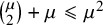
$\binom {\mu }{2}+\mu \leqslant \mu ^2$
polynomials, then the output of one iteration is at most
$\binom {\mu }{2}+\mu \leqslant \mu ^2$
 polynomials. It follows that if I can be generated by
$\mu $
polynomials. It follows that if I can be generated by
$\mu $
 elements of degree at most
$\delta $
elements of degree at most
$\delta $
 , then
$\operatorname {in}_{\preccurlyeq }(I)$
, then
$\operatorname {in}_{\preccurlyeq }(I)$
 has at most
$\mu ^{2^{\delta -1}}$
has at most
$\mu ^{2^{\delta -1}}$
 minimal generators of degree at most
$\delta $
minimal generators of degree at most
$\delta $
 .
.
Definition 2.2. An ideal
$I \subseteq S=k[x_1,\ldots ,x_N]$
 is said to be Borel-fixed if it is invariant under the action which sends each
$x_j$
is said to be Borel-fixed if it is invariant under the action which sends each
$x_j$
 to
$g \cdot x_j = \sum _{i} g_{ij}x_i$
to
$g \cdot x_j = \sum _{i} g_{ij}x_i$
 for any
$g=(g_{ij}) \in \mathrm {GL}_n(k)$
for any
$g=(g_{ij}) \in \mathrm {GL}_n(k)$
 upper triangular matrix.
In characteristic zero, Borel-fixed monomial ideals coincide with strongly stable ideals (see, e.g., [Reference Herzog and Hibi11, Section 4.2.2]). In positive characteristic, however, the class of Borel-fixed monomial ideals is strictly larger; for instance,
$I=(x_1^p,x_2^p)$
 in
$S=\mathbb {F}_p[x_1,x_2]$
in
$S=\mathbb {F}_p[x_1,x_2]$
 is Borel-fixed but not strongly stable. If
$\preccurlyeq $
is Borel-fixed but not strongly stable. If
$\preccurlyeq $
 is a monomial order, and
$I \subseteq S$
is a monomial order, and
$I \subseteq S$
 is homogeneous, then its generic initial ideal
$\operatorname {gin}_{\preccurlyeq }(I)$
is homogeneous, then its generic initial ideal
$\operatorname {gin}_{\preccurlyeq }(I)$
 is Borel-fixed [Reference Bayer and Stillman2], [Reference Galligo10].
We now recall the Taylor resolution of a monomial ideal (see, for instance, [Reference Eisenbud8, Exercise 17.11]). Let
$u_1,\ldots ,u_r$
 be monomials in S. For
$\Lambda \subseteq \{1,\ldots ,r\},$
be monomials in S. For
$\Lambda \subseteq \{1,\ldots ,r\},$
 we let
$u_\Lambda = \operatorname {lcm}(u_i \mid i \in \Lambda )$
we let
$u_\Lambda = \operatorname {lcm}(u_i \mid i \in \Lambda )$
 . If
$a_\Lambda $
. If
$a_\Lambda $
 is the exponent vector of
$u_\Lambda $
is the exponent vector of
$u_\Lambda $
 , and
$S[-a_\Lambda ]$
, and
$S[-a_\Lambda ]$
 denotes a free cyclic
$\mathbb {Z}^N$
denotes a free cyclic
$\mathbb {Z}^N$
 -graded S-module with generator in multi-degree
$a_\Lambda $
-graded S-module with generator in multi-degree
$a_\Lambda $
 , then for
$0 \leqslant i \leqslant r,$
, then for
$0 \leqslant i \leqslant r,$
 we let

If
$\{e_{\Lambda }\}_{\Lambda \subseteq \{1,\ldots ,r\}}$
 denotes a graded free basis of
$\bigoplus _{i=0}^r F_i$
denotes a graded free basis of
$\bigoplus _{i=0}^r F_i$
 , we define differentials
$d_i:F_i \to F_{i-1}$
, we define differentials
$d_i:F_i \to F_{i-1}$
 as
as

where
$\mathrm {sign}(j,\Lambda )$
 denotes
$(-1)^{s+1}$
denotes
$(-1)^{s+1}$
 if j is the sth element of
$\Lambda $
if j is the sth element of
$\Lambda $
 in the natural order. This construction provides a free resolution of
$S/I$
in the natural order. This construction provides a free resolution of
$S/I$
 , where
$I=(u_1,\ldots ,u_r)$
, where
$I=(u_1,\ldots ,u_r)$
 .
.
Remark 2.3. Note that if J is any monomial ideal generated by at most r elements, then
$\beta _i(S/J) \leqslant \operatorname {rank}(F_i) = \binom {r}{i}$
 . In particular, if
$\operatorname {pd}(S/J) \geqslant s$
. In particular, if
$\operatorname {pd}(S/J) \geqslant s$
 , then
$\binom {r}{s} \ne 0$
, then
$\binom {r}{s} \ne 0$
 , and therefore
$s \leqslant r$
, and therefore
$s \leqslant r$
 .
.
Definition 2.4. Let M be a finitely generated
$\mathbb {Z}$
 -graded S-module. A homogeneous element
$\ell \in S$
-graded S-module. A homogeneous element
$\ell \in S$
 is called filter regular for M if
$0:_M \ell = \{\eta \in M \mid \eta \ell = 0\}$
is called filter regular for M if
$0:_M \ell = \{\eta \in M \mid \eta \ell = 0\}$
 has finite length. A sequence of homogeneous elements
$\ell _1,\ldots ,\ell _r$
has finite length. A sequence of homogeneous elements
$\ell _1,\ldots ,\ell _r$
 is called a filter regular sequence for M if
$\ell _{i+1}$
is called a filter regular sequence for M if
$\ell _{i+1}$
 is a filter regular element for
$M/(\ell _1,\ldots ,\ell _i)M$
is a filter regular element for
$M/(\ell _1,\ldots ,\ell _i)M$
 for all
$0 \leqslant i \leqslant r-1$
for all
$0 \leqslant i \leqslant r-1$
 .
.
Equivalently, we have that
$\ell $
 is filter regular for M if
$\ell \notin \mathfrak {p}$
is filter regular for M if
$\ell \notin \mathfrak {p}$
 for all
$\mathfrak {p} \in \left (\operatorname {Ass}_S(M) \smallsetminus \{\mathfrak {m}\}\right )$
for all
$\mathfrak {p} \in \left (\operatorname {Ass}_S(M) \smallsetminus \{\mathfrak {m}\}\right )$
 . Clearly, any M-regular element is filter regular; moreover, we note that if k is infinite, then any sufficiently general linear form is filter regular for M. We note that if
$\ell $
. Clearly, any M-regular element is filter regular; moreover, we note that if k is infinite, then any sufficiently general linear form is filter regular for M. We note that if
$\ell $
 is filter regular for M but not M-regular, then necessarily
$\operatorname {depth}(M)=0$
is filter regular for M but not M-regular, then necessarily
$\operatorname {depth}(M)=0$
 .
.
3. Uniform upper bounds
Let
$S=k[x_1,\ldots ,x_N]$
 , and M be a finitely generated
$\mathbb {Z}$
, and M be a finitely generated
$\mathbb {Z}$
 -graded S-module. We recall that
$\operatorname {depth}(M) = \inf \{r \mid H^r_{\mathfrak {m}}(M) \ne 0\}$
-graded S-module. We recall that
$\operatorname {depth}(M) = \inf \{r \mid H^r_{\mathfrak {m}}(M) \ne 0\}$
 , where
$\mathfrak {m}=(x_1,\ldots ,x_N)$
, where
$\mathfrak {m}=(x_1,\ldots ,x_N)$
 . If
$\operatorname {depth}(M) = r$
. If
$\operatorname {depth}(M) = r$
 , we let
$\alpha (M) = \min \{i+r \mid [\operatorname {soc}(H^r_{\mathfrak {m}}(M))]_i \ne 0\}$
, we let
$\alpha (M) = \min \{i+r \mid [\operatorname {soc}(H^r_{\mathfrak {m}}(M))]_i \ne 0\}$
 .
.
Lemma 3.1. Let M be a finitely generated
$\mathbb {Z}$
 -graded S-module, and assume that
$r=\operatorname {depth}(M)>0$
-graded S-module, and assume that
$r=\operatorname {depth}(M)>0$
 . If
$\ell \in S$
. If
$\ell \in S$
 is a linear form which is M-regular, then
$\alpha (M/\ell M) = \alpha (M)$
is a linear form which is M-regular, then
$\alpha (M/\ell M) = \alpha (M)$
 .
.
Proof. Applying local cohomology to the short exact sequence
![0 yields M[-1] yields M via multiplication by l yields M all over l M yields 0.](https://static.cambridge.org/binary/version/id/urn:cambridge.org:id:binary:20260623100549291-0536:S0027763026101135:S0027763026101135_eqnu9.png?pub-status=live)
gives a long exact sequence
![Ellipsis arrow H sub m super r-1 (M) arrow H sub m super r-1 (M all over l M) arrow H sub m super r (M) [-1] arrow with dot l H sub m super r (M) arrow ellipsis](https://static.cambridge.org/binary/version/id/urn:cambridge.org:id:binary:20260623100549291-0536:S0027763026101135:S0027763026101135_eqnu10.png?pub-status=live)
First note that
$H^{r-1}_{\mathfrak {m}}(M)=0$
 . Applying the functor
$\operatorname {Hom}_S(k,-)$
. Applying the functor
$\operatorname {Hom}_S(k,-)$
 gives an exact sequence on socles:
![0 yields soc (H sub m super r-1 (M all over l M)) yields soc (H sub m super r (M)) [-1] yields with l over arrow soc (H sub m super r (M)) yields ellipsis](https://static.cambridge.org/binary/version/id/urn:cambridge.org:id:binary:20260623100549291-0536:S0027763026101135:S0027763026101135_eqnu11.png?pub-status=live)
Since the multiplication by
$\ell $
 is the zero map on socles, we get graded isomorphisms

for all
$n \in \mathbb {Z}$
 . In particular, this yields the desired equality.
Remark 3.2. If we let
$p=N-r$
 be the projective dimension of M, then one can check that
$\alpha (M) = \min \{j -p \mid \beta _{p,j}(M) \ne 0\}$
be the projective dimension of M, then one can check that
$\alpha (M) = \min \{j -p \mid \beta _{p,j}(M) \ne 0\}$
 . We note that, from this alternative description of
$\alpha (M)$
. We note that, from this alternative description of
$\alpha (M)$
 , one can get another proof of Lemma 3.1.
Theorem 3.3. Let
$I \subseteq S$
 be an ideal generated by
$\mu $
be an ideal generated by
$\mu $
 homogeneous elements, and let
$\alpha =\alpha (S/I)$
homogeneous elements, and let
$\alpha =\alpha (S/I)$
 . Then

Proof. All the invariants involved are not affected by extending the base field; thus, we may assume that k is infinite. If
$r=\operatorname {depth}(S/I)>0$
 , we can then find a regular sequence
$\ell _1,\ldots ,\ell _r$
, we can then find a regular sequence
$\ell _1,\ldots ,\ell _r$
 for
$S/I$
for
$S/I$
 consisting of linear forms. By Lemma 3.1, we may then assume that
$\operatorname {depth}(S/I) = 0$
consisting of linear forms. By Lemma 3.1, we may then assume that
$\operatorname {depth}(S/I) = 0$
 , and seek an upper bound for
$N = \operatorname {pd}(S/I)$
, and seek an upper bound for
$N = \operatorname {pd}(S/I)$
 . Our assumption guarantees that
$\beta _{N,N+\alpha }(S/I) \ne 0$
. Our assumption guarantees that
$\beta _{N,N+\alpha }(S/I) \ne 0$
 . Let
$\preccurlyeq $
. Let
$\preccurlyeq $
 be a monomial order, and
$J=\operatorname {in}_{\preccurlyeq }(I)$
be a monomial order, and
$J=\operatorname {in}_{\preccurlyeq }(I)$
 . By upper semi-continuity, we have that
$\beta _{N,N+\alpha }(S/J) \ne 0$
. By upper semi-continuity, we have that
$\beta _{N,N+\alpha }(S/J) \ne 0$
 , that is, there exists a monomial
$u \in \operatorname {soc}(S/J)$
, that is, there exists a monomial
$u \in \operatorname {soc}(S/J)$
 of degree
$\alpha $
of degree
$\alpha $
 . If we let
$J'=J_{\leqslant \alpha +1}$
. If we let
$J'=J_{\leqslant \alpha +1}$
 , then u still represents a non-zero socle element of
$S/J'$
, then u still represents a non-zero socle element of
$S/J'$
 . In particular,
$\operatorname {depth}(S/J')=0$
. In particular,
$\operatorname {depth}(S/J')=0$
 , that is,
$\operatorname {pd}(S/J')=N$
, that is,
$\operatorname {pd}(S/J')=N$
 . Since I is generated by
$\mu $
. Since I is generated by
$\mu $
 elements, by Remark 2.1, we have that
$\beta _{0,\leqslant \alpha +1}(J) = \beta _{0,\leqslant \alpha +1}(J') \leqslant \mu ^{2^\alpha }$
elements, by Remark 2.1, we have that
$\beta _{0,\leqslant \alpha +1}(J) = \beta _{0,\leqslant \alpha +1}(J') \leqslant \mu ^{2^\alpha }$
 . By Remark 2.3, we conclude that
$N \leqslant \mu ^{2^{\alpha }}$
. By Remark 2.3, we conclude that
$N \leqslant \mu ^{2^{\alpha }}$
 , as claimed.
As already noted in Remark 2.1, in place of
$\mu ,$
 we could actually use the minimal number of generators of I of degree at most
$\alpha +1$
we could actually use the minimal number of generators of I of degree at most
$\alpha +1$
 . As a consequence of this observation, and using [Reference Caviglia and De Stefani4], we obtain the following estimate for unmixed radical ideals.
Theorem 3.4. Let
$I \subseteq S$
 be a homogeneous unmixed radical ideal of height h, and let
$\alpha = \alpha (S/I)$
be a homogeneous unmixed radical ideal of height h, and let
$\alpha = \alpha (S/I)$
 . Then

Proof. By Theorem 4.2 and Proposition 4.7 in [Reference Caviglia and De Stefani4], we have that
$\beta _{0,\leqslant \alpha +1}(I) \leqslant h^{2^{\alpha +3}-3}$
 . We conclude by Theorem 3.3.
Any bound on the projective dimension of an ideal, together with the knowledge of the number and degrees of its generators, allows to obtain a double exponential bound on the Castelnuovo–Mumford regularity [Reference Peeva14, Theorem 29.5].
Corollary 3.5. Let
$I \subseteq S$
 be an ideal generated by
$\mu \geqslant 2$
be an ideal generated by
$\mu \geqslant 2$
 homogeneous elements of degree at least
$2$
homogeneous elements of degree at least
$2$
 and at most D. If we let
$\alpha = \alpha (S/I)$
and at most D. If we let
$\alpha = \alpha (S/I)$
 , then

Proof. After possibly enlarging the base field, we can go modulo a maximal regular sequence consisting of linear forms, and we may assume that
$\operatorname {depth}(S/I)=0$
 . By Theorem 3.3, we may assume that
$N = \operatorname {pd}(S/I) = \mu ^{2^\alpha }$
. By Theorem 3.3, we may assume that
$N = \operatorname {pd}(S/I) = \mu ^{2^\alpha }$
 . Our assumptions guarantee that
$N \geqslant 3$
. Our assumptions guarantee that
$N \geqslant 3$
 , and the claimed inequality now follows from [Reference Caviglia and De Stefani5, Corollary 2.13].
Theorem 3.3 allows us to recover the other implication of [Reference Peeva14, Theorem 29.5] as well: a bound on the Castelnuovo–Mumford regularity in terms of the number and the degrees of generators of an ideal provides one for its projective dimension, as proved by the first named author.
Corollary 3.6. Let
$I \subseteq S$
 be a homogeneous ideal generated by
$\mu $
be a homogeneous ideal generated by
$\mu $
 elements. Then

Proof. Let
$r=\operatorname {depth}(S/I)$
 . It suffices to observe that

and combine this with the first bound in Theorem 3.3.
We now turn our attention to our second main result. In addition to information on the minimal number of generators of an ideal I and their degrees, we require knowledge of the degrees of the generators of the first syzygy modules of sufficiently general hyperplane sections. This allows once again to obtain a double exponential bound for the projective dimension of I in terms of the given data.
Theorem 3.7. Assume that k is infinite. Let
$I \subseteq S$
 be a homogeneous ideal generated by
$\mu $
be a homogeneous ideal generated by
$\mu $
 forms of degree at most D. Let
$r=\operatorname {depth}(S/I)$
forms of degree at most D. Let
$r=\operatorname {depth}(S/I)$
 , and assume that
$t_2(S/(I+(\ell _1,\ldots ,\ell _{r+1}))) \leqslant C$
, and assume that
$t_2(S/(I+(\ell _1,\ldots ,\ell _{r+1}))) \leqslant C$
 for a sufficiently general choice of linear forms
$\ell _1,\ldots ,\ell _{r+1}$
for a sufficiently general choice of linear forms
$\ell _1,\ldots ,\ell _{r+1}$
 . If we let
$\gamma = \max \{C,D\}$
. If we let
$\gamma = \max \{C,D\}$
 , then

Proof. After going modulo general linear forms
$\ell _1,\ldots ,\ell _r$
 , we can assume that
$\operatorname {pd}(S/I) = N$
, we can assume that
$\operatorname {pd}(S/I) = N$
 . Moreover, after performing a sufficiently general change of coordinates, we may assume that
$J:=\operatorname {in}_{\mathrm {revlex}}(I)$
. Moreover, after performing a sufficiently general change of coordinates, we may assume that
$J:=\operatorname {in}_{\mathrm {revlex}}(I)$
 is Borel-fixed and that
$\ell _{r+1} = x_N$
is Borel-fixed and that
$\ell _{r+1} = x_N$
 . By assumption, we then have that
$t_2(S/(I+(x_N))) \leqslant C$
. By assumption, we then have that
$t_2(S/(I+(x_N))) \leqslant C$
 . The graded short exact sequence
![0 yields S all over I colon x sub N [-1] yields S all over I yields S all over I + (x sub N) yields 0](https://static.cambridge.org/binary/version/id/urn:cambridge.org:id:binary:20260623100549291-0536:S0027763026101135:S0027763026101135_eqnu19.png?pub-status=live)
induces a long exact sequence of
$\operatorname {\mathrm {Tor}}$
 modules
![Ellipsis arrow Tor 2 S (S all over I + (x N), k) arrow Tor 1 S (S all over I : x N, k) [-1] arrow Tor 1 S (S all over I, k) arrow ellipsis](https://static.cambridge.org/binary/version/id/urn:cambridge.org:id:binary:20260623100549291-0536:S0027763026101135:S0027763026101135_eqnu20.png?pub-status=live)
which, in turn, gives that

Since
$I:x_N \ne I$
 , if we let
$j_0 = \min \{j \mid \left [(I:x_N)/I\right ]_j \ne 0\},$
, if we let
$j_0 = \min \{j \mid \left [(I:x_N)/I\right ]_j \ne 0\},$
 then
$I:x_N$
then
$I:x_N$
 must contain a minimal generator of degree
$j_0$
must contain a minimal generator of degree
$j_0$
 . As a consequence of the above inequalities, we must have
$j_0 \leqslant \gamma -1$
. As a consequence of the above inequalities, we must have
$j_0 \leqslant \gamma -1$
 . Recall that
$\operatorname {in}_{revlex}(I:x_N) = J:x_N$
. Recall that
$\operatorname {in}_{revlex}(I:x_N) = J:x_N$
 (see [Reference Eisenbud8, Section 15.7]). Since passing to initial ideals does not change Hilbert functions, we still have
$\left [(J:x_N)/J)\right ]_{j_0} \ne 0$
(see [Reference Eisenbud8, Section 15.7]). Since passing to initial ideals does not change Hilbert functions, we still have
$\left [(J:x_N)/J)\right ]_{j_0} \ne 0$
 , and this implies that there is a monomial
$u \in (J:x_N) \smallsetminus J$
, and this implies that there is a monomial
$u \in (J:x_N) \smallsetminus J$
 of degree
$j_0$
of degree
$j_0$
 .
.
Now let
$J':=J_{\leqslant \gamma }$
 . Since the Borel group acts on S preserving degrees, and J is Borel-fixed, we have that
$J'$
. Since the Borel group acts on S preserving degrees, and J is Borel-fixed, we have that
$J'$
 is Borel-fixed as well. If we let
$\ell $
is Borel-fixed as well. If we let
$\ell $
 be a filter regular linear element for
$J'$
be a filter regular linear element for
$J'$
 , we can perform an upper triangular linear change of coordinates and assume that
$\ell =x_N$
, we can perform an upper triangular linear change of coordinates and assume that
$\ell =x_N$
 . Since
$J'$
. Since
$J'$
 is Borel-fixed, we conclude that
$x_N$
is Borel-fixed, we conclude that
$x_N$
 is filter regular for
$J'$
is filter regular for
$J'$
 . However,
$x_N$
. However,
$x_N$
 is not
$J'$
is not
$J'$
 -regular since
$ux_N \in J'$
-regular since
$ux_N \in J'$
 but
$u \notin J'$
but
$u \notin J'$
 . It follows that
$\operatorname {depth}(S/J')=0$
. It follows that
$\operatorname {depth}(S/J')=0$
 , that is,
$\operatorname {pd}(S/J')=N$
, that is,
$\operatorname {pd}(S/J')=N$
 . Now, by Remark 2.1, we have that
$\beta _0(J') = \beta _{0,\leqslant \gamma }(J') \leqslant \mu ^{2^{\gamma -1}}$
. Now, by Remark 2.1, we have that
$\beta _0(J') = \beta _{0,\leqslant \gamma }(J') \leqslant \mu ^{2^{\gamma -1}}$
 , and by Remark 2.3, we conclude that
$N \leqslant \mu ^{2^{\gamma -1}}$
, and by Remark 2.3, we conclude that
$N \leqslant \mu ^{2^{\gamma -1}}$
 , as desired.
Following the same strategy as in Corollary 3.5, we obtain the following upper bound on the regularity.
Corollary 3.8. Assume that k is infinite. Let
$I \subseteq S$
 be a homogeneous ideal generated by
$\mu \geqslant 2$
be a homogeneous ideal generated by
$\mu \geqslant 2$
 forms of degree at least
$2$
forms of degree at least
$2$
 and at most D. Let
$r=\operatorname {depth}(S/I)$
and at most D. Let
$r=\operatorname {depth}(S/I)$
 , and assume that
$t_2(S/(I+(\ell _1,\ldots ,\ell _{r+1}))) \leqslant C$
, and assume that
$t_2(S/(I+(\ell _1,\ldots ,\ell _{r+1}))) \leqslant C$
 for a sufficiently general choice of linear forms
$\ell _1,\ldots ,\ell _{r+1}$
for a sufficiently general choice of linear forms
$\ell _1,\ldots ,\ell _{r+1}$
 . If we let
$\gamma = \max \{C,D\}$
. If we let
$\gamma = \max \{C,D\}$
 , then

In order to state our last main result, we recall some notation from the introduction. For
$r \in \mathbb {Z}_{>0}$
 , we let

Note that
$\operatorname {reg}_1(S/I)$
 coincides with
$\operatorname {reg}(S/I)$
coincides with
$\operatorname {reg}(S/I)$
 , while
$\operatorname {reg}_{\frac {1}{2}}(S/I)$
, while
$\operatorname {reg}_{\frac {1}{2}}(S/I)$
 only takes into account the first half of the resolution.
Theorem 3.9. Let
$I \subseteq S$
 be an ideal generated by
$\mu $
be an ideal generated by
$\mu $
 homogeneous elements. Suppose that
$\operatorname {reg}_{\frac {1}{r}}(S/I) \leqslant \delta $
homogeneous elements. Suppose that
$\operatorname {reg}_{\frac {1}{r}}(S/I) \leqslant \delta $
 for some
$r \in \mathbb {Z}_{>0}$
for some
$r \in \mathbb {Z}_{>0}$
 . Then

Proof. Let
$s=\lceil \frac {\operatorname {pd}(S/I)}{r} \rceil -1$
 . Because
$\operatorname {reg}_{\frac {1}{r}}(S/I) \leqslant \delta $
. Because
$\operatorname {reg}_{\frac {1}{r}}(S/I) \leqslant \delta $
 , we have that

Now fix a monomial order
$\preccurlyeq $
 , and let
$J=\operatorname {in}_{\preccurlyeq }(I)$
, and let
$J=\operatorname {in}_{\preccurlyeq }(I)$
 . By upper semi-continuity, we have that
$\beta _{s,j}(I) \leqslant \beta _{s,j}(J)$
. By upper semi-continuity, we have that
$\beta _{s,j}(I) \leqslant \beta _{s,j}(J)$
 for all
$j \in \mathbb {Z}$
for all
$j \in \mathbb {Z}$
 , and it follows that

The second inequality above is a consequence of the fact that, to compute
$\beta _{s,j+s}(J) = \dim _{k}(\operatorname {\mathrm {Tor}}_s^S(J,k)_{j+s})$
 , one only needs to know J in degrees
$j-1$
, one only needs to know J in degrees
$j-1$
 and j. In particular, we have that
$\operatorname {pd}(S/J_{\leqslant \delta +1}) \geqslant \operatorname {pd}(S/I) \geqslant s+1$
and j. In particular, we have that
$\operatorname {pd}(S/J_{\leqslant \delta +1}) \geqslant \operatorname {pd}(S/I) \geqslant s+1$
 . Since I is generated by
$\mu $
. Since I is generated by
$\mu $
 elements, by Remark 2.1, we obtain that
$\beta _{0,\leqslant \delta +1}(J) =\beta _{0,\leqslant \delta +1}(J_{\leqslant \delta +1}) \leqslant \mu ^{2^{\delta }}$
elements, by Remark 2.1, we obtain that
$\beta _{0,\leqslant \delta +1}(J) =\beta _{0,\leqslant \delta +1}(J_{\leqslant \delta +1}) \leqslant \mu ^{2^{\delta }}$
 . We conclude by Remark 2.3 that
$s+1 \leqslant \mu ^{2^{\delta }}$
. We conclude by Remark 2.3 that
$s+1 \leqslant \mu ^{2^{\delta }}$
 , and hence
$\operatorname {pd}(S/I) \leqslant r \cdot (s+1) \leqslant r \cdot \mu ^{2^{\delta }}$
, and hence
$\operatorname {pd}(S/I) \leqslant r \cdot (s+1) \leqslant r \cdot \mu ^{2^{\delta }}$
 .
.
Corollary 3.10. Let
$I \subseteq S$
 be an ideal generated by
$\mu \geqslant 2$
be an ideal generated by
$\mu \geqslant 2$
 homogeneous elements. Suppose that
$\operatorname {reg}_{\frac {1}{r}}(S/I) \leqslant \delta $
homogeneous elements. Suppose that
$\operatorname {reg}_{\frac {1}{r}}(S/I) \leqslant \delta $
 for some
$r \in \mathbb {Z}_{>0}$
for some
$r \in \mathbb {Z}_{>0}$
 . Then

Acknowledgements
We thank the anonymous referee for providing useful suggestions.
Funding statement
The first named author was partially supported by a grant from the Simons Foundation (SFI-MPS-TSM-00013569, G.C.). The second named author was partially supported by the MIUR Excellence Department Project CUP D33C23001110001, PRIN 2022 Project 2022K48YYP, and by INdAM-GNSAGA.

 Open access

