

1 Introduction
During the summer of 2018, the issue of ‘transit migration’ erupted into the Spanish media, politics and society. It called attention to the situation of thousands of migrants, primarily from West Africa (Guinea Conakry, Ivory Coast, Senegal, Mali, etc.), who, after arriving irregularly on the southern Spanish coast (mainly Andalusia and the Levant, though from 2020 arrivals were concentrated in the Canary Islands), became stranded in cities near the northern border with France, such as Bilbao, Donostia-San Sebastián and especially Irun in the west, and La Jonquera or Portbou in the east. The main reason for this immobility was the reintroduction of internal border controls by French authorities. Within this social context, and as part of the project Transiteus: The Reception of Migrants in Transit in the Basque Country/Euskadi: Diagnosis and Proposals from a Guarantees-Based Perspective (US 19/05), our methodological goal was to visit and analyse different places in the Basque Country where transit migrants had a significant presence, in order to understand the legal logic and social dynamics at work in each context. Besides the border cities of Irun and Hendaia and the border itself, shelters created to respond to the emerging needs were also of interest. Among them was the Larraña Etxea shelter (Oñati, Gipuzkoa), inaugurated in September 2018, financed by the Basque Government in co-operation with the social organisation Zehar-Errefuxiatuekin (ZEHAR). When we arrived at the shelter to conduct interviews, the director’s first words were: ‘This is not a centre for migrants in transit. It is for asylum seekers.’ Initially, this statement caused confusion, as we knew that in October a group of young men had been transferred there after being hosted for several weeks by social movements in Irun and Bilbao. They had decided not to continue their migratory journey and to apply for asylum, and we intended to interview them. Had we come to the wrong centre? Why were there no longer transit migrants? What the director really meant was that, as an asylum and international protection centre, those young men had been admitted as ‘asylum seekers’, since they had formally submitted the legally required application. In formal terms, they had ceased to be ‘irregular transit migrants’ (a legally non-existent and indeterminate category) and had become asylum seekers (a legal category provided for under Law 2/2009 on Asylum). The fact that these young men were no longer categorised as transit migrants did not discourage us, despite having lost our research subject; rather, it opened the door to an unexplored line of inquiry on transit migration: transit across the different legal statuses defined by migration, immigration and asylum law.
Traditionally, transit migration has been studied from a geopolitical and institutional perspective, as a migration process toward Europe originating in neighbouring countries (Morocco, Libya, Turkey, etc.), with particular attention to ‘irregular migration’ (Collyer et al. Reference Collyer, Düvell and De Haas2012, Reference Collyer, Molodikova, Düvel, Düvell, Molodikova and Collyer2014; Düvell Reference Düvell2012; Hess Reference Hess2012). One of the main contributions of these studies has been the recognition that such mobility is ‘mixed’, encompassing highly diverse personal experiences and motivations (economic migration, political exile, etc.). This has also impacted the very definition of ‘transit country’, since such countries may also become, for a period, places of origin or destination within a migratory project, directly influencing migration and asylum policy and law. In recent years, transit migration has become a category of significant institutional interest (OHCHR 2015), particularly after the European migration and asylum crisis of 2015. It was then that the institutional concept of ‘secondary movements’ emerged, referring to the ‘phenomenon of migrants, including refugees and asylum-seekers, who for various reasons move from the country in which they first arrived (to the European Union), to seek protection or permanent resettlement elsewhere’ (Radjenovic Reference Radjenovic2017). Consequently, the socio-legal research focus has shifted to the situation of migrants in transit through (Uzureau et al., Reference Uzureau, Lietaert, Senovilla Hernández and Derluyn2022) Schengen territory as a result of the re-establishment of internal border controls and return procedures (Barbero Reference Barbero2020; Pistoia Reference Pistoia2024; van der Woude and van Berlo Reference van der Woude and van Berlo2015). Research has examined how this regulatory reconfiguration of mobility has affected the shape of ‘re-bordered’ territories (Barbero Reference Barbero2023; Donadio Reference Donadio2021; Torre Reference Torre2024), asylum matters (de Vries and Guild Reference de Vries and Guild2019; Tazzioli and Garelli Reference Tazzioli and Garelli2019), the undeniable impact of the COVID-19 pandemic (Guild Reference Guild2020; Opiłowska Reference Opiłowska2021; van der Velde et al. Reference Van der Velde, Sijtsma, Goossens and Maartense2021), the control of trafficking and smuggling (Amigoni et al. Reference Amigoni, Molinero and Vergnano2021; de Massol de Rebetz Reference de Massol de Rebetz2020), the situation of vulnerable groups such as unaccompanied minors (Orsini et al. Reference Orsini, Uzureau and Behrendt2023; Uzureau et al. Reference Uzureau, Lietaert, Senovilla Hernández and Derluyn2022), deaths caused by border regimes (Dembour and Martin Reference Dembour, Martin, Dembour and Kelly2011; McMahon and Sigona Reference McMahon and Sigona2021) as well as reception policies, solidarity practices and mobilisations (Barbero and Blanco Reference Barbero and Blanco2022; Giliberti Reference Giliberti2020; Lendaro and Sommer-Houdeville Reference Lendaro and Sommer-Houdeville2021). The notion of transit migration has also been extended to more distant contexts with particularities but also certain parallels, such as the caravans crossing Central America toward the Mexico–US border, policies of containment and the resistant political agency they generate (Basok et al. Reference Basok, Bélanger, Rojas Wiesner and Candiz2015; Ruíz-Lagier and Varela-Huerta Reference Ruíz-Lagier and Varela-Huerta2020).
Finally, all these studies – whether on border policies (police operations, border controls, detention camps, deportations…), geographies and migratory routes across the Mediterranean and the Atlantic, land border crossings (the Pyrenees, the Alps, the Balkans…), (un)quantifiable events (arrival figures, shipwrecks, deaths, push-backs…) or localised experiences (reception shelters, protests…) – have contributed to a semiotic representation of transit migration. Such representations are produced either by institutions such as the International Organization for Migration (IOM), UNHCR or Frontex to promote their interventions, or by social movements and migrant rights organisations such as Border Forensics or Migreurop, with its series The Atlas of Migration in Europe: A Critical Geography of Migration Policies. These representations of mobility have themselves become an object of study (Casas-Cortes et al. Reference Casas-Cortes, Cobarrubias and Pickles2015; Clochard Reference Clochard2022; Presti Reference Presti2020; van Houtum and Bueno Lacy Reference van Houtum and Bueno Lacy2020). In short, an interdisciplinary line of research has been consolidated on transit migration processes and their cross-border (im)mobility, with special and necessary emphasis on territorial – and even cartographic – perspectives in specific geographical contexts, where legal norms are but one factor that shapes (constrains or accelerates) movement.
In this article, I propose an innovative perspective within this field: to focus on mobility within the legal system that regulates migration and asylum movements itself – that is, transit across the map of immigration and asylum law. Put differently, alongside geographic (im)mobility, there is also legal (im)mobility as individuals transit, for a period, among the various legal (and social) categories defined by immigration and asylum law. My scientific contribution is twofold. First, to expand the field of study of ‘transit migration’ from the sociological and geographical to the legal, in a complementary way, since geographical and legal mobility can and should be analysed together. Second, to apply the theoretical metaphor of ‘law as map’ – mainly discussed in contexts of legal pluralism – to migration, border and refugee studies, where a critical study of legal itineraries and bureaucratic practices may help us understand geographic mobility dynamics (activation, suspension, change or resumption of routes).
To this end, in this article I focus specifically on the recent phenomenon of transit migration through Spain, though this perspective is surely applicable to many other geographical and legal contexts. In addition to discussing certain legal categories (irregular migrant, asylum seeker, minor, etc.), we will also examine waiting periods and requirements for attaining those categories; the itineraries or processes established by administrations as pathways to acquire new statuses; and the administrative documents that, like travel tickets, enable or certify the possibility of changing categories – or, conversely, whose absence prevents such change. Although I present four case studies/life histories of ‘migrants in transit’, these are ideal types selected from dozens of interviews with transit migrants conducted between 2018 and 2024. In these cases, in addition to geographic journeys, we have focused on detailing the different legal categories these persons have inhabited, the time spent in each and their strategies of change and mobility between categories. The fact that several years have passed since the beginning of their transit (most arrived in Spain between 2018 and 2019) has allowed us to adopt a longitudinal perspective, considering not only geographic transit but also multidirectional movement through different legal statuses of immigration law. More concretely, the normative analysis has focused, on the one hand can be eliminated, on Spanish immigration legislation (Organic Law 4/2000 or LOEx) and its regulation (RLOEx), the Asylum Law (L 2/2009) and the ‘itineraries’ outlined by reception programmes (Ministerial Order ISM/680/2022), or the Law on the Legal Protection of Minors (LO 1/1996), as well as European regulations, notably the Dublin Regulation (EU) 604/2013. In addition, we devoted considerable effort to gathering and analysing extensive administrative documentation (deportation orders, asylum decisions, judicial rulings recognising transit or nationality, etc.) derived from long-term procedural follow-ups of ‘migrants in transit’ now settled – at least for the time being – in the Basque Country and elsewhere in Spain.
Next, I will focus on sociological and anthropological literature that has used maps to explain legal relationships in various social contexts. In the following section, I will recount four paradigmatic experiences (an invisible girl, an unaccompanied minor, an asylum seeker and a Dublin case) in order to present scenarios, legal procedures and relevant dates in geographical and legal migration in transit. Then, I will group these elements, and some others, around the notions of routes/itineraries, time periods and legal documents such as transport tickets, to reinforce the idea that it is possible to conceive of transit through different legal statuses and, ultimately, to conceive of immigration and asylum law as a map.
2 Law as map: status, spaces, times
The relationship between law and maps has long been a subject of discussion among jurists, anthropologists and geographers. One of the most institutional purposes of cartography has been the interest in delimiting jurisdictions of power. This demarcation has sometimes been carried out by means of winding lines, represented by natural features such as rivers and mountains, as in the case of the Treaty of the Pyrenees (1659), where the mountain range delimits the border between the Spanish and French states; or straight lines such as those that represented the colonial division of Africa at the Berlin Conference (1884–85). In all cases, this has given rise to territorial disputes that remain unresolved. This interest in law on maps has led geographers and legal anthropologists to search for a cartographic representation of the different legal systems, a world map of law. Noteworthy here is the work of John H. Wigmore and his delimitation, not without detractors, of around sixteen legal systems that have governed the social life of the planet throughout history (1928, 1929), something similar to what William Twining did years later (Reference Twining2000). Specifically, it has been from critical perspectives on state law as a hegemonic system, such as legal pluralism, that the debate has centred on reinterpreting the law represented in maps and the legal families of states delimited by borders as ideal types, proposing a move away from legal centralism and including non-governmental laws emanating from non-state social groups geographically located in territories that have been hidden or underrepresented on official maps (Carbonnier Reference Carbonnier1972; Bavinck and Woodman Reference Bavinck, Woodman, von, von Benda-Beckmann and Griffiths Benda-Beckmann2009), or where dynamic dimensions such as spacetime determine the social, political and legal in specific periods (von Benda-Beckmann Reference von Benda-Beckmann and Fikentscher2001). ‘Laws today are maps in a metaphorical sense. Tomorrow they may eventually be so in a literal sense’, said Santos in his study on law represented metaphorically as a map (Reference Santos1987, p. 286). His goal was to trivialise modern law as the dominant conception, and to do so he resorted to tools such as scales (local in detail reflecting the diversity of legal systems and actors, and state and global with less detail, more homogenising); projection, that is, giving centrality to certain legal institutions over others relegated to the periphery; and symbolisation, that is, resorting to emotive/iconic or expressive/abstract signs to argue the distorting effect of law with respect to reality. In other words, like maps, official and dominant law, for Santos, is neither neutral nor does it intentionally produce concrete realities.
One area of law that merits examination as though it were a map is migration, immigration and asylum law, which today constitutes one of the most salient legal frameworks for governing social relations on a global scale (Dauvergne Reference Dauvergne2009; Sassen Reference Sassen2005). What is most decisive in this domain is the multiplicity of legal statuses that have been established, giving rise to what Morris (Reference Morris2003) terms ‘civic stratification’. This stratification legitimates states in (de Vries and Guild Reference de Vries and Guild2019) employing discourses, strategies, mechanisms and technologies of categorisation, the integration/recognition of rights, discrimination, containment, confinement and, where applicable, expulsion of those deemed legally different (De Genova Reference De Genova2002; Isin and Rygiel Reference Isin and Rygiel2007). Drawing on an image not far removed from traditional maps, Goldring and Landolt employ the metaphor of the popular children’s board game Chutes and Ladders to illustrate the complexity of multidirectional navigation across legal statuses of migrants (Reference Goldring, Landolt, Goldring and Landolt2012, p. 4). According to these authors, their proposal helps to make sense of the process of irregularisation by focusing on the dynamics of legal status that result from the expansion of temporary migrant status, the reduction of ‘avenues’ (a term they borrow from urban planning) for attaining the stability conferred by permanent residence and full citizenship rights, and the porous boundaries that exist between these situations. These trajectories of mobility are determined, in their view, by what they call the ‘conditionality of legal status’, referring to the conditions imposed by governmental policy and legislation attached to each legal category; the ability of actors to meet both formal and informal requirements; and the multiple ways in which these conditions are either complied with or challenged in practice.
Just as time is a determining factor in geographical (im)mobility (de Vries and Guild Reference de Vries and Guild2019; Tazzioli Reference Tazzioli2020), it also affects transit between legal statuses. As we will see, the rules governing each category of migration law impose application periods, minimum residence requirements for access to each procedure, resolution deadlines, age limits and so forth. For this reason, various authors argue that in migration law, time is one of the most important instruments for controlling and disciplining the presence of migrants within a territory. Farcy and Smit, in their study on the impact of time and temporality on migrant trajectories in Belgium (Reference Farcy and Smit2020), conclude that, due to the time aspect of legal categorisation, migrants move from one status to another in ways that increase the risk of falling back into irregularity. Thus, the migratory process, rather than a single act of linear mobility, must be seen as complex and fragmented, subject to disruptions, where the temporality of residence permits profoundly shapes personal trajectories and aspirations. Nevertheless, they also acknowledge that there is room for agency and autonomous decision-making, insofar as migrants can use the time frames set by migration law to their own advantage (for regularisation, family reunification or acquiring nationality), and to reduce or avoid unfavourable situations of risk such as falling into irregularity or being deported. Stronks, for his part, drawing on the concept of ‘temporal governance’, also reflects on how time functions as a determinant within European migration law (Reference Stronks2022). He distinguishes between ‘human time’, referring to the linear and irreversible progression of an individual’s finite life, and ‘legal time’, defined as the calculation of periods established by law, which allows for the suspension of deadlines or even retroactive recognition of earlier moments in order to apply specific legal responses – for instance, the recognition of ‘minor’ status by the Court of Justice of the European Union (CJEU) to grant protection to a person who, though no longer a minor, was underage at the time of application. He also considers the impact that age and waiting/execution times may have on different procedures, such as asylum applications, naturalisation or deportation.
In sum, while space, geographic routes and the regulation of physical border controls have been extensively studied with respect to ‘transit migration’, it is also necessary to pay attention to the itineraries that, over time, are traced both forcibly and voluntarily across the legal norms of migration, immigration and asylum law. It is reasonable to assume that migrants, in addition to reaching the long-sought physical destination of their migratory project (a particular place in which to settle), also aspire to the stability and security that a given legal status can provide in terms of the recognition of rights, access to the regulated labour market and protection from police interference.
3 Cases of geographical and legal transits
3.1 Benedicte: the girl who was invisible for eight years
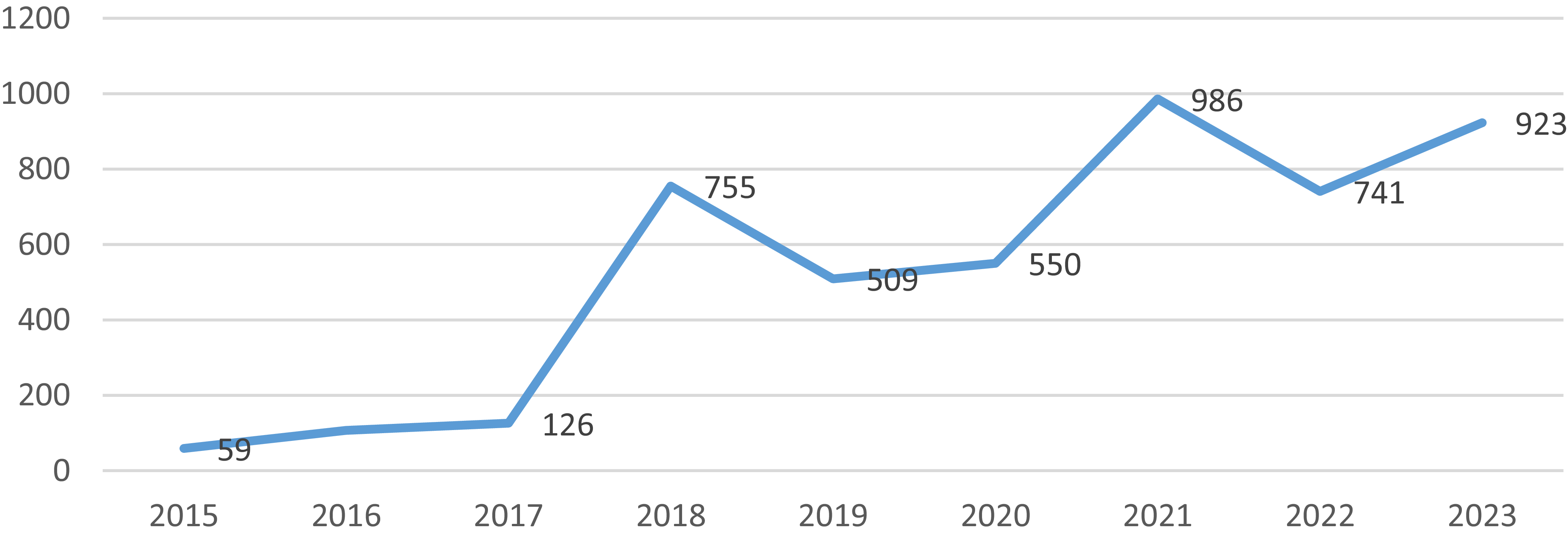
Benedicte is a girl born in Morocco in 2015, during her mother’s migratory journey from Cameroon. Her birth occurred in a private residence, without medical assistance and without the issuance of a birth certificate. Consequently, no official registration exists. While birth registration may appear almost automatic in countries of the Global North, UNICEF estimated that in 2019, in low- and middle-income countries, one in four children under the age of five (166 million) remained unregistered. In May 2018, mother and daughter arrived by small boat on the coast of Tarifa (Cádiz). That year, according to the Annual Report of the Spanish Attorney General’s Office, a total of 755 children arrived in Spain in small boats accompanied by adults (accompanied minors) who claimed a parent-child relationship with the minor. This phenomenon has been on the rise in recent years (see Figure 1 below), reflecting, on the one hand, the heterogeneous profiles of migrants in transit, particularly women accompanied by their children; and, on the other hand, highlighting the need for further academic attention to a still under-researched issue: minors migrating accompanied by adults who are either their parents or, alternatively, other relatives or mere companions, raising significant legal and social questions (Barbero Reference Barbero2025; Manzanedo Reference Manzanedo2019; Petit de Gabriel Reference Petit de Gabriel, de Nanclares and González2023).
Children who arrived by boat on the peninsular coast in the company of adults who claimed to have a maternal–paternal filial relationship.
Source: Prepared internally based on the Annual Reports of the Spanish Attorney General’s Office.

Figure 1. Long description
A line graph displays the number of children arriving by boat on the peninsular coast in the company of adults who claim to have a maternal-paternal relationship. The x-axis represents the years from 2015 to 2023, and the y-axis represents the number of children, ranging from 0 to 1200. The data points are as follows: 59 in 2015, 126 in 2017, 755 in 2018, 509 in 2019, 550 in 2020, 986 in 2021, 741 in 2022, and 923 in 2023. The graph shows a significant increase in the number of children arriving in 2018, a peak in 2021, and a slight decline in 2022 followed by an increase in 2023. All values are approximated.
After the police identification procedure, Benedicte’s mother received the receipt of the order for return due to irregular entry into Spain (Art. 58 LOEx), which included, among other information, her full name as well as the corresponding Foreigner Identification Number (NIE), a number that would identify her throughout all future immigration-related procedures (Barbero Reference Barbero2024; Moya-Malapeira Reference Moya-Malapeira2002). In contrast, Benedicte, as a minor, was not subject to any sanctioning procedure and, therefore, was not issued any document, nor was she mentioned in the paper given to her mother.
Subsequently, mother and daughter were referred to a reception centre for foreign women accompanied by minors in Montilla (Andalusia), managed by the Ödos Programme of the EMET Foundation. Unlike the vast majority of African women with children arriving in Spain with the intention of reaching other European countries, primarily France, Benedicte and her mother moved, in August 2018, to Donostia–San Sebastián (Basque Country) within the framework of the Miriam Project, which provides support to women at risk of vulnerability, with the aim of settling there. As of 10 June 2020, under the procedure for regularisation due to exceptional circumstances (Art. 31 LOEx), the mother obtained authorisation to reside temporarily for one year. However, the various applications for Benedicte’s registration, municipal census enrolment and regularisation were rejected, since there was no legally verifiable record of her existence. This was legally justified by the fact that her birth had not been registered by any authority, resulting in a de facto lack of nationality. She was an ‘invisible child’ (Barbero Reference Barbero2026). Among all the procedures, the most urgent was the municipal census registration, since, as the social system in Spain – and in the Basque Country in particular – is structured, access to health care and education largely depends on this registration.
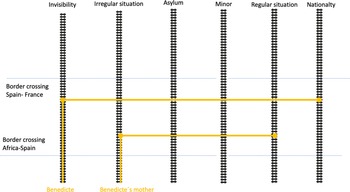
This matter was resolved through two consecutive court rulings. The initial judgment was issued on 24 November 2021 by the Court of First Instance No. 5 of Donostia/San Sebastián (Judgment 310/2021), in response to an action brought by the plaintiff (the child’s mother, legally assisted pro bono by lawyers from the Fundación Profesor Uría and supported by the Ödos Program of the EMET Foundation), seeking protection of the fundamental rights of the minor to have a nationality and to have her birth registered under Article 7 of the Convention on the Rights of the Child (CRC). The ruling of 24 November 2021 ordered the registration of the child’s birth, as well as the granting of Spanish nationality. The subsequent appeal was resolved by the Provincial Court of Gipuzkoa through Judgment 341/2022, of 11 May, which confirmed the previous ruling. After eight years of actual existence but in absolute legal non-existence, it was neither the temporary residence permit nor the recognition of stateless status that granted Benedicte legal recognition; rather, she directly obtained the most comprehensive legal status with full recognition of rights: nationality (see Figure 2).
Geographic and legal journey of Benedicte and her mother.
Source: Created by author based on life story.

Figure 2. Long description
The bar graph compares the geographic and legal journey of Benedicte and her mother across different situations and border crossings. The graph features vertical bars grouped into six categories: Invisibility, Irregular situation, Asylum, Minor, Regular situation, and Nationality. Each category contains multiple bars representing different stages of their journey. The x-axis labels the categories, while the y-axis indicates the stages of the journey. Two horizontal lines mark the border crossings: one between Africa and Spain, and another between Spain and France. Benedicte’s journey is represented by an orange line connecting the bars in the Invisibility and Irregular situation categories. Benedicte’s mother’s journey is represented by another orange line connecting the bars in the Irregular situation and Regular situation categories. The graph highlights the different legal and geographic situations Benedicte and her mother experienced during their migration. All values are approximated.
3.2 Younoussa: the transit of an unaccompanied minor
Younoussa left Guinea-Conakry when he was only fifteen years old. After crossing Mali, Algeria and Morocco, he reached Almería (Spain) by small boat at the age of sixteen. According to data from the General Commissariat for Immigration and Borders published by the Office of the Public Prosecutor for Minors, in 2018 7,026 unaccompanied foreign minors arrived in Spain by sea, in small boats or other fragile vessels. In 2018, the majority were boys (96.9 per cent), mainly from Morocco (61.89 per cent), the Republic of Guinea (14.10 per cent), Mali (8.15 per cent), Algeria (5.6 per cent), Ivory Coast (4.5 per cent) and Gambia (1.69 per cent). In 2023, 4,865 minors arrived, confirming that the arrival of minors has become a matter of serious concern and significant impact in both political debate and administrative procedures for social reception.
After the small boat in which he was travelling was rescued in the Alborán Sea, Younoussa was held for several days at the Temporary Immigrant Detention Centre (CATE) in Cádiz. In his return order of 21 July 2018, issued for irregular entry through an unauthorised border crossing, his date of birth was recorded as ‘1/1/1999’, meaning that he was registered by the police as an adult in an irregular situation. In order to avoid the temporary detention of minors and to provide them with treatment in accordance with child protection standards, for years, particularly since the approval of the Framework Protocol on Certain Procedures Regarding Unaccompanied Foreign Minors (2014), age determination proceedings have generally been carried out (12,152 proceedings in 2018). However, in Younoussa’s case, no such procedure was undertaken. There is a widespread perception among underage migrants that declaring minority status would result in their placement in a child protection centre, thereby preventing them from continuing their transit. After a few days in the CATE, upon release, a social organisation provided them with some clothing and money and arranged for buses ‘heading north’. When he arrived in the Basque Country and declared that he was a minor, he was immediately transferred to a specialised centre for unaccompanied foreign minors in Bizkaia. Although no age determination tests were conducted in this case either, his date of birth was changed in the police database to 2002, although no document was issued to him. However, after a few days, he and several other boys decided to leave voluntarily, heading toward the French border. In Irun, they slept outdoors at the train and bus station, since there were not yet any reception centres, until they contacted the Solidarity Network of Irun (Irungo Harrera Sarea, in Basque).
After several attempts to cross the French border, they managed to reach Bordeaux, where he was assisted in initiating an age determination procedure in France through a request for a birth certificate from his country of origin. When he was about to go to the Juvenile Centre in Lille, the police intercepted him at the bus station, and he was held for about twenty-four hours in the administrative detention centre. There it was verified that he had entered via Spain, and he was returned to Spain under the 2002 Spanish-French Agreement on the Readmission of Foreign Nationals in an Irregular Situation. After being handed over to officers of the National Police Station in Irun, and upon verification of his status as a minor, he was transferred to the juvenile centre in Donostia. Once again, he attempted to return to Irun to reconnect with the solidarity network.
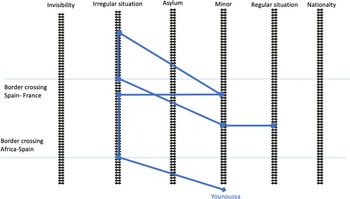
When it became clear that the possibility of returning to France to be admitted to a juvenile centre was becoming increasingly complicated, he decided to remain in Spain. He was referred to a juvenile centre in Galicia (more than 500 km from the French border). Upon his arrival, a volunteer accompanied him to the police to arrange his admission to the juvenile centre. During his stay at the centre, he completed a course in welding and assembly, as he did not pursue regular schooling due to language barriers. The centre’s management assisted him in handling his documentation process, including the residence permit he would require upon turning eighteen. However, lacking a passport, the process became complicated, since the Embassy of Guinea-Conakry does not issue passports in Spain (only in the country of origin). This is one of the common challenges faced by many unaccompanied minors: the ‘other transition’, the passage to adulthood. While under state guardianship, all their rights are guaranteed, but upon reaching majority, if the residence permit has not been processed in time, many fall into irregularity, even losing access to the vocational training programmes they had been pursuing (Vinaixa Miquel Reference Vinaixa Miquel2019). For this reason, in 2021, the Spanish government approved Royal Decree 903/2021 of 19 October, which amended the Regulation of the Immigration Act, in order to allow those former wards who, at the time of the legislative reform, were between eighteen and twenty-three years old and undocumented, to avail themselves of the procedure established in Article 198, thereby enabling them to access the authorisation foreseen for minors who reach the age of majority without documentation. Today, Younoussa holds a residence permit and a driver’s licence (see Figure 3).
Younoussa’s geographical and legal journey.
Source: Created by author based on life story.

Figure 3. Long description
The line graph illustrates Younoussa’s geographical and legal journey across different migration statuses and border crossings. The x-axis represents various migration statuses, including Invisibility, Irregular situation, Asylum, Minor, Regular situation, and Nationality. The y-axis represents two border crossings: Border crossing Spain-France and Border crossing Africa-Spain. The graph shows Younoussa’s movement through these statuses and border crossings, with lines connecting different points to indicate transitions. Younoussa starts from an irregular situation, moves through asylum and minor statuses, and eventually reaches a regular situation and nationality. The graph highlights the complexity and fluidity of Younoussa’s migration journey, showing how different statuses and border crossings interact and influence each other. All values are approximated.
3.3 Ibrahima: from transit inertia to asylum
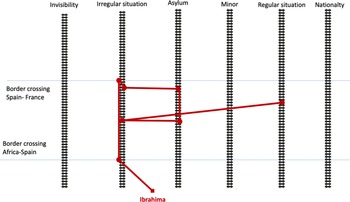
Ibrahima undertook a three-year journey from his native Guinea-Conakry, passing through the hardships of the Sahel before reaching Morocco, from where inertia led him to board a small boat bound for Europe in October 2018. They had to be rescued by the Spanish Maritime Rescue Service and disembarked at the port of Almería, where they were held in ‘a building like a prison’ until the police report and health check were completed, and a return order for irregular entry into the country was issued (Art. 58.3 LOEx). They were later transferred to Cádiz, to an Emergency Reception and Referral Centre managed by the Red Cross, where he was asked, ‘Where do you want to go? Madrid, Barcelona…?’ He explained, ‘Although I did not know where to go, since I had no family in France’, once again, as if by involuntary inertia, he followed his travelling companions toward France. He spent a month attempting to cross the border, but they were constantly sent back. The Irun Solidarity Network accompanied him to a Migrant Transit Centre run by the Red Cross, where they required a return order to identify themselves as ‘migrants in transit’. Once the maximum permitted days expired, he was on the street.
Through the NGO ZEHAR, he formalised his application for international protection (asylum) at the National Police, as required under Asylum Law 12/2009. Ibrahima, like all those who had entered irregularly by sea, could formally have applied for asylum immediately upon disembarking. However, during the asylum information session, he heard that legally he had sixty days to apply – since the expedited four-day border procedure was not applied – so he asked for ‘more time to think’. At the moment of expressing his intention to seek asylum, he was issued a provisional document known as the ‘white card’ or ‘white paper’, bearing his personal data and photograph, which provisionally identified him as an asylum applicant. Once his application was formalised, he was transferred to the newly inaugurated first reception shelter of Larraña Etxea (Oñati, Basque Country), managed by ZEHAR. During the first months, most of the centre’s residents were young men from Guinea-Conakry, Cameroon, Côte d’Ivoire or Mali. Under the humanitarian reception programme for asylum seekers, he was later assigned a place at the Refugee Reception Centre (CAR) in Vallecas (Madrid) until December 2020. He left the CAR after completing a course in mechanics and was offered an apartment in Madrid. As more than six months had passed since receiving the ‘white card’, he was authorised to work legally as a truck mechanic.
In 2020, at the height of the COVID-19 pandemic, he was notified of the denial of his asylum application, which automatically placed him in administrative irregularity and obliged him to leave Spanish territory within fifteen days. That year, only eleven men and forty women saw their asylum applications approved (compared with 743 applications in 2018 and 991 in 2019). Indeed, many people from French-speaking African countries (Guinea-Conakry, Côte d’Ivoire, Mali, Senegal, etc.), facing recognition rates in Spain of less than 5 per cent, opt to resume their journey toward France or Belgium to try again, thereby falling into the cycle of the Dublin Regulation. Ibrahima, however, filed an appeal (at the time of the interview, nine months later, he was still awaiting a response), which allowed him to remain in the reception programme and continue working.
After some time, and under the procedure for social integration (arraigo social) provided for in the Immigration Act, he applied for regularisation. The process was arduous, since he had never had a passport and the embassy was reluctant to issue one, while the criminal record certificates from his country of origin repeatedly expired (on three occasions) due to administrative delays in resolving his case. Finally, in April 2023 he obtained a one-year residence permit, which he has had to renew. He still faces a long path to Spanish nationality, requiring at least ten years of continuous legal residence as established in Article 22 of the Civil Code (see Figure 4).
Ibrahima’s geographical and legal journey.
Source: Created by author based on life story.

Figure 4. Long description
A line graph illustrating Ibrahima’s geographical and legal journey. The graph features six vertical columns labeled Invisibility, Irregular situation, Asylum, Minor, Regular situation, and Nationality. Two horizontal lines represent border crossings: one between Africa and Spain, and another between Spain and France. Red lines connect points within these columns, indicating Ibrahima’s transitions between different legal and geographical statuses. The journey starts from the Invisibility column at the Africa-Spain border, moves through the Irregular situation and Asylum columns, and eventually reaches the Regular situation column at the Spain-France border. All values are approximated.
3.4 Omar, the Dubliner
Omar, originally from Guinea-Conakry, was interviewed in August 2021 outside the Migrant Transit Reception Centre ‘Pausa’ in Bayonne (French Basque Country). He had just arrived after crossing the Spanish-French border for the second time in several months.
His migratory journey in Europe had begun on 15 April 2021, when he arrived by cayuco boat on the island of Fuerteventura (Canary Islands, Spain). He remained there for a time while his data were registered in the European biometric database EURODAC, and an administrative file for irregular entry was processed. In recent years, the lodging of asylum applications at Spain’s southern border has been a contentious issue, particularly regarding reception resources and bureaucratic management (Barbero Reference Barbero2021; López-Sala and Moreno-Amador Reference López-Sala and Moreno-Amador2020). Moreover, like many compatriots and other migrants from French-speaking countries, his goal was to reach France (or perhaps Belgium) to apply for asylum. This is what he did upon arriving in Dijon, in northeastern France. However, when the fingerprinting procedure was carried out, the EURODAC check revealed that his entry into European territory had been through Spain, and that he therefore had to be returned there to process his claim, pursuant to Regulation (EU) No. 604/2013, establishing the criteria and mechanisms for determining the Member State responsible for examining an asylum application, also known as the Dublin III Regulation (Brekke and Brochmann Reference Brekke and Brochmann2015). Although the transfer procedure to the responsible country usually takes around six months due to the various verifications required, the acceptance by the receiving state and delays in execution when appeals are lodged, as Omar told us, ‘For me everything was very quick, I was not prepared. One day in early August, I went to the police to sign, and they told me that the very same day they were going to send me back to Spain.’ Omar was placed in an administrative detention centre until his flight to Madrid was confirmed. The police handed him the resolution of the Dublin procedure, as well as a document stating ‘Laissez-Passer: Destiné au transfert du demandeur d’asile’ (‘Pass: Intended for the transfer of the asylum seeker’).
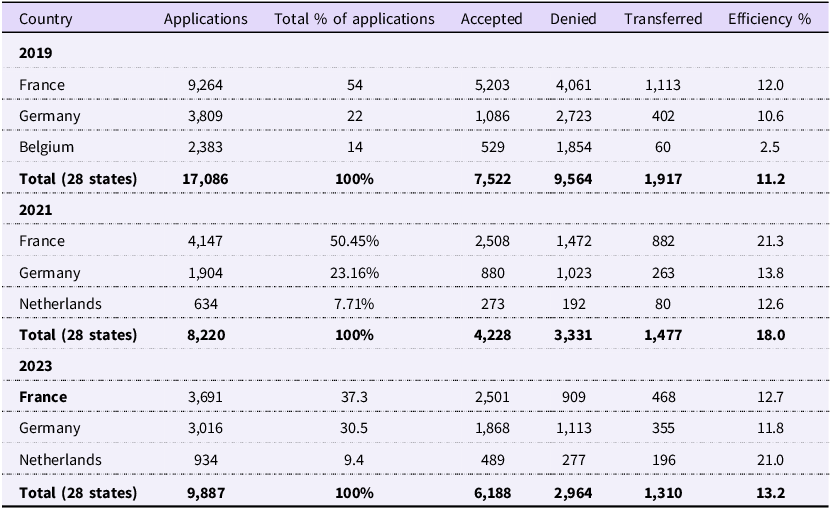
There are two figures we would like to highlight from the official statistics (Table 1). The first is the number of transfer requests received by Spain from other Member States. In the context under analysis, we must go back to 2019, one year after the ‘summer of 2018’, marked by the massive arrivals of migrants on the Andalusian coasts, and the year prior to the COVID-19 pandemic. In 2019, Spain received 17,086 transfer requests: France submitted 9,264 requests (over half of the total submitted to Spain, 54 per cent), followed by Germany (3,809, 22 per cent) and Belgium (2,383, 14 per cent). In the year when Omar was subject to the Dublin procedure – 2021, in the midst of mobility restrictions due to the pandemic – the number of requests to Spain dropped significantly, to 8,220. That year, France was also the main country submitting requests to Spain for acceptance of asylum seekers: 4,147 specifically (50.45 per cent of the total), followed by Germany with 1,904 requests (23.1 per cent) and the Netherlands with 634 (7.7 per cent). According to the most recent available data, in 2023 the number of requests rose to 9,887, with France (3,691, 37.3 per cent of the total) and Germany (3,016, 30.5 per cent) submitting almost the same proportion. In other words, France is the main state requesting returns to Spain and therefore, we can also interpret that it is the principal country of asylum seekers who entered through Spain.
Requirements for transfers to Spain from other countries under the Dublin Regulation (2019, 2021 and 2023)

Table 1. Long description
The table presents data on transfer requests to Spain from other Member States under the Dublin Regulation for the years 2019, 2021, and 2023. It includes columns for the country of origin, number of applications, total percentage of applications, number of accepted, denied, and transferred requests, and efficiency percentage. In 2019, Spain received 17,086 transfer requests, with France submitting 9,264 requests (54 percent), Germany 3,809 requests (22 percent), and Belgium 2,383 requests (14 percent). In 2021, the number of requests dropped to 8,220, with France submitting 4,147 requests (50.45 percent), Germany 1,904 requests (23.16 percent), and the Netherlands 634 requests (7.71 percent). By 2023, the number of requests rose to 9,887, with France submitting 3,691 requests (37.3 percent) and Germany 3,016 requests (30.5 percent). The table highlights the significant role of France in submitting transfer requests to Spain.
Source: Asylum statistics, Spanish Ministry of the Interior.
The second figure to bear in mind concerns the effectiveness of the measure: the proportion of requests that ultimately result in transfers being executed, which ranges between 11.2 per cent and 18 per cent in the years mentioned. This figure calls into question the considerable investment in time and material that states dedicate to implementing the responsible-state system, as well as the impact on people who, even if not ultimately transferred under Dublin, suffer the effects of the procedure itself.
Upon arriving on a commercial flight at Madrid airport, he was forced to be the last to disembark. He was met by agents of the Spanish National Police and the Red Cross, who asked whether he wanted to remain in Spain. He replied that he did not, that he wished to complete his studies and medical treatment in France. He was aware that the asylum recognition rate for Guineans in Spain is lower than in France: ‘We know that here 90% do not obtain asylum.’ Nevertheless, he returned to the organisation CEAR to request another appointment with the police, but on the scheduled day he was told that no interpreter was available. For all these reasons, he decided to leave the refugee reception programme and set out once again for the French border.
After several attempts to cross the border, he eventually succeeded by taking a path through the pre-Pyrenean mountains, reaching the Pausa Centre in Bayonne. At that time, his plan was to save money for a COVID-19 test and a bus ticket to Paris, where he would work illegally. ‘Once there, I want to apply for asylum again, but not yet, until they remove the Dublin.’ I concur with Picozza who, in her study on ‘Dubliners’ across Europe, asserts that ‘while the Dublin Regulation was purportedly established in order to solve the issue of “refugees in orbit”, the clash between its lengthy bureaucratic machinery and the self-determination of refugees resulted in an effect of hypermobility’ (Picozza Reference Picozza2017). Omar’s case is a clear example of such geographic hypermobility: after moving from the Canary Islands to France and then being returned to Madrid, shortly after being subjected to the Dublin procedure he was once again crossing the border back into France. At the same time, it also illustrates juridical hypermobility, since his legal status shifted several times in just a few months – from irregular status, to asylum seeker, to the temporary indeterminate status of a Dubliner (see Figure 5).
Omar’s geographical and legal transit.
Source: Created by author based on life story.

Figure 5. Long description
The diagram illustrates Omar’s geographical and legal transit across borders, highlighting different migration statuses and border crossings. The diagram is divided into six vertical sections labeled Invisibility, Irregular situation, Asylum, Minor, Regular situation, and Nationality. Two horizontal lines represent border crossings: one between Africa and Spain, and another between Spain and France. Green arrows indicate Omar’s movement through these sections and border crossings. Starting from the Invisibility section, Omar moves through the Irregular situation, Asylum, and Minor sections, eventually reaching the Regular situation and Nationality sections. The arrows show the progression and changes in Omar’s status as he crosses borders.
4 Reflections on mobility between legal statuses by migrants in transit
As we have seen in the cases presented, the change of legal status is intrinsically marked by routes or itineraries, administrative times, administrative documents, legal regimes and individual or imposed decisions. All these elements make up the migratory path of a foreigner ‘in transit’.
4.1 Geographical and legal routes
The notion of a ‘route’ is inextricably linked to migration in transit to and through Europe. As part of its Monitoring and Risk Analysis programme, the European Border and Coast Guard Agency Frontex has identified six routes: Eastern Land Border, Balkans, Eastern Mediterranean, Central Mediterranean, Western Mediterranean and Western African. The latter two are the routes used by the protagonists of the cases analysed in this study. At the same time, there are also routes designed to circumvent the police controls established in the different border areas. These are what have been termed ‘escape routes’ (Schwiertz and Schwenken Reference Schwiertz and Schwenken2020) – that is, routes generated by the connection or interrelation of different stopping points or stopovers, where safe passage is sought to avoid personal risks arising from natural accidents or accidents involving means of transport, information is provided on places of refuge and rest by creating a series of stopovers along the route and advice is provided on legal issues. Clearly, the interrelation between border controls and the creation of escape routes modulates migratory mobility insofar as they impact decisions taken in the migration project, not only in terms of geographical mobility (where to go), but also in legal terms (what legal status to achieve). Precisely, among the usual content provided at info points established at crossing points or shelters is how to apply for asylum, how to declare oneself a minor and how to regularise one’s status (and avoid being detained by the police, or mitigate the negative consequences through legal resources). Whether this information has been explained in person by volunteers or found on social media, it has often been decisive in continuing (or halting) not only the geographical journey but also the legal one – for example, deciding to change means of transport/legal status, such as stopping in one place to apply for asylum or declaring oneself a minor. For this reason, when we talk about itineraries within administrative procedures relating to immigration, we are referring to the different paths or procedures through which a foreigner, based on the information received, can proceed to obtain residence or work permits, as well as other procedures related to their legal status in the country, such as family reunification, regularisation through social and labour ties, change of residence and work permits or even naturalisation. The very act of crossing the border, even between two European countries, can in itself entail a change of status. Consider, for example, an applicant for international protection in Spain who immediately crosses the border into France. Their situation is not authorised in France, their status has changed radically and they can therefore be returned, either expeditiously by border controls or through the Dublin procedure. In other words, the geographical border is also a demarcation in the legal process.
In the case of Spain, when talking about the different legal statuses of ‘migrants in transit’, we must mention the SIRIA computer system (Information System on Programmes for Refugees, Immigrants and Asylum Seekers), which is used to monitor the actions of different administrations (basically, the administrative units of the Ministry of Inclusion, Social Security and Migration) and social organisations (Red Cross, ACCEM, CEPAIN, CEAR, etc.) that provide services related to migrant integration, participation and co-operation. The SIRIA computer application itself provides for a change of status (with a drop-down tab called ‘administrative legal situation’) with the following options: International Protection Applicant, Refugee/Subsidiary Protection, Humanitarian Reasons, Immigrant, Statelessness Applicant, Stateless Person and Temporary Protection. In other words, a person’s legal status can change due to a government decision (obtaining refugee status, denial of international protection, etc.), which is reflected with a single click, transitioning and retaining their history in the SIRIA database. Furthermore, although it is a large database used throughout the state reception system, it is particularly useful to deal with migrants in transit who rarely carry identification documents, as a way for any of the centres affiliated with SIRIA to access their personal record.
Within this logic of mapping the transition between ‘irregular immigrant’ and ‘asylum seeker’, CEAR and its affiliates and local sister organisations, such as the Basque ZEHAR, present the asylum procedure in infographic form as if it were a physical itinerary (Figure 6). In fact, the journey begins at one of the places specified by Law 12/2009 on asylum where they can request asylum (in territory, at the border, in a detention centre or at a diplomatic headquarters – although this route is closed in practice). Depending on the location, the time frame for processing (as well as the guarantees) varies greatly, as the procedural deadlines ‘at the border’ or ‘in a detention center’ are much shorter (four days in detention) than for the ‘in territory’ procedure (one month, free). This difference stems from established European asylum policy (continued in the New European Pact on Migration and Asylum 2024), which calls for rapid determination of refugee status upon entry into the common territory and return in the event of a negative decision.
Itineraries of the international protection and asylum application procedure in Spain (translated by Google image translation to keep original design).
Source: Spanish Commission for Refugee Aid (CEAR).

Figure 6. Long description
The flowchart details the process for applying for international protection and asylum in Spain. It is divided into three main sections: Border and CIEs, Territory, and Consular Access. Each section outlines different steps and requirements for the application process. The Border and CIEs section includes steps such as the application formalization at border posts and processing at the Asylum and Refugee Office. The Territory section involves submitting the application at authorized police stations, Foreigners Offices, and the Asylum and Refugee Office. The Consular Access section mentions the role of Spanish Embassies in facilitating the transfer of asylum seekers to Spain. The flowchart also shows the timeline for each step, including inadmissibility, denial, re-examination, and admission for processing, with further steps for urgent and ordinary procedures. The final outcomes include favorable resolutions such as refugee status, subsidiary protection, and reasons humanitarian.
CEAR has also created an infographic that links the asylum application procedure, managed by the Ministry of the Interior, with the reception programme designed by the Ministry of Inclusion, Social Security and Migration, officially called the ‘integration itinerary’ (Royal Decree 220/2022, of 29 March, of the Subdirectorate General for Immigrant Integration) (Figure 7). This Humanitarian Care Itinerary in Spain is divided into three phases (initial assessment and referral, reception while awaiting a decision and autonomy for those already recognised), with a maximum duration of eighteen months, which can be extended to twenty-four months for vulnerable persons. In addition, in the Basque Country there is a ‘phase 0’ to receive potential asylum seekers ‘while they prepare and apply for asylum’ and are received under the State Humanitarian Care Programme. The time between phases may vary depending on the availability of places, the time taken by the administration to reach a decision and the personal circumstances of each applicant (Moreno-Amador Reference Moreno-Amador2023).
Reception programme itineraries according to the asylum procedure in Spain (translated by Google image translation to keep original design).
Source: Spanish Commission for Refugee Aid (CEAR).

Figure 7. Long description
A flowchart illustrating the asylum process in Spain. The process begins with an application for asylum, which can be submitted at the border, in a CIE (Immigration Detention Center), or within the territory. The application is then reviewed for refusal or inadmissibility. If admitted to processing, the applicant undergoes a first reception phase lasting up to one month for evaluation and referral to a host device. Following this, the applicant enters temporary reception, which covers basic needs, accommodation, psychological care, legal assistance, training, job orientation, and language learning. This phase lasts between 18 and 24 months, depending on vulnerability. The application can either be refused, requiring the applicant to leave within 15 days, or approved, allowing access to the next phase. The final phase is inclusion, which provides psychological care, training, job search assistance, housing, language learning, and financial aid to promote autonomy.
4.2 Temporality in transit
There is no doubt that the speed or slowness of geographical mobility is determined by legal status. The logic of ‘greater stability (nationality/European citizenship, residence permit, refugee status) equals greater freedom of movement and security from detention’ is guaranteed. And this logic applies not only within a national territory (or within a city), but also across the increasingly frequent borders between EU Member States. Conversely, irregularity or precarious status (asylum seeker, stateless person) complicates mobility, both by denying access to certain means of rapid transport (aeroplanes, high-speed trains, etc.) to those who do not have proper documentation, and because this circumstance forces them to choose more precarious, exhausting and dangerous routes, using slower means of transport or even on foot across mountains or rivers. The latter routes are known to the police and are therefore more likely to be intercepted at border and identity checks, leading to rejections, detention or even Dublin transfers or expulsions to the country of origin. However, although it may seem contradictory, the precarious nature of documentation can also lead to (hyper)mobility, as the shortage of public resources such as shelters or hostels limits the number of days that can be spent there. For example, administrative decisions denying asylum force people to leave these resources, such as places in centres or housing for asylum seekers, which generally forces them to seek accommodation elsewhere.
Administrative procedures follow their own timetables in terms of time requirements and deadlines for resolution. Thus, we should mention that in the summer/autumn of 2018, when migration in transit from southern Spain (Andalusia or Levante) to the Spanish-French border became visible, the main identification document as a ‘migrant in transit’ was to have a return order issued no more than thirty days before the date specified in the order itself (the same period of time that the legal system allows for appealing it), with access to the shelter being denied if that date had passed. It is true that this period has also been subject to modifications and extensions of up to six months, both due to the mobility restrictions imposed by the pandemic and the difficulties of leaving the Canary Islands by sea or air when arrivals shifted to the Atlantic route. Another very important deadline in the change of legal status is the so-called ‘period of residence’, which ranges from two to three years and determines the level of social integration that justifies the granting of a residence and work permit. In this regard, it is also essential to have evidence of de facto continuous residence. To this end, the administration mainly accepts the municipal registration certificate (or the visa entry stamp for those who arrived by plane), although the date of the return order confirming the act of irregular entry through an unauthorised point and transfer to a specific port for police registration has also been accepted as the date of first entry into Spain. In the case of asylum seekers, the date of admission to the process recorded on the so-called White Card is also the date to be taken as a reference for being able to work legally after six months while awaiting the final decision. Precisely, the latest reform of the Immigration Regulations (Royal Decree 1155/2024, of 19 November) has sought to put an end to the alleged exploitation of asylum by people who, according to the authorities, did not have solid arguments to deserve international protection, but took advantage of (and contributed to) the bureaucratic collapse of the asylum offices and the delay in resolution times. Based on this reform, except for the transitional period until 20 May 2026, it was no longer possible to apply for regularisation, as the period of stay attributable to waiting for an asylum decision that will be denied will no longer count toward the two–three year period (At the time of publication of this article, the Spanish Government, through Royal Decree 316/2026, has opened an extraordinary regularization process from April 16 to June 30, 2026).
4.3 When documents become transport tickets
From the perspective of travelling across a geographical route, a fundamental element is the ticket, a valid document issued by the transport company upon payment of a fare, which allows the passenger to make the journey. From the perspective of transit between legal statuses, there are also documents that are metaphorically essential or that enable a person to make the journey between legal categories. Therefore, we must also pay attention to those multiple documents that, issued by public authorities, whether from the country of origin, the country of transit or the country of destination, have a decisive impact on transit, of course geographically, but also between legal statuses. We have identified the following generic types of documents: constitutive documents, identification documents, safe-conduct documents and sanctioning documents.
First, there are the constitutive documents, which in themselves imply a change of status, whether through the granting of a residence permit, refugee status, subsidiary international protection, statelessness, the granting of nationality or the recognition of minority status. These are therefore administrative or judicial documents that legally transfer the person from one legal category to another, with different and more favourable regimes, especially in terms of the recognition of rights and freedoms and protection against the uncertainty of expulsion. Obviously, from the point of view of the time required to acquire these documents, we must take into account both the time requirements, such as de facto and continuous residence of two–three years for regularisation through roots (Article 31 LOEx) or two, five or ten years for the acquisition of nationality through residence (Article 22 Civil Code); and the time involved in the administrative process itself, which, although there are general limits such as three months (first additional provision LOEx), in practice can take longer depending on the congestion of the bureaucracy. In these contexts of bureaucratic management, secondary documents are also required, such as birth certificates that establish the person as a native of a certain country, or of a certain age, differentiating them as a minor or an adult, each with a very different legal regime (even in matters of expulsion), according to national and international law; or criminal record certificates, which, despite their short-lived validity, establish the person as a ‘safe’ individual, worthy of being granted a residence permit or nationality.
Second, we must refer to identification documents. These are travel requirements, since in order to take a plane from the Canary Islands or a boat from Ceuta or Melilla, European/international transport regulations require a valid, current identification document with a photograph, such as an ID card (National Identity Card for Spanish citizens, or Foreigners’ Identification Card) or a passport. Many migrants dispose of their documents before arriving in Europe, or leave them with acquaintances or relatives in their country of origin or before crossing into Europe (Morocco), believing that not having a passport may make it more difficult to be returned/expelled, although this is not always the case because the authorities can determine their origin either by physical or linguistic features, or by recognition by embassy staff or their own nationals. Ironically, one of the issues that condemned the girl Benedicte to invisibility was the impossibility of travelling to her country of birth or origin to acquire nationality (or to be deported) because she did not have a passport or valid identification document. Asylum applications (White and Red Cards) also serve as identification, as they are issued by a police or government authority and include a photograph and NIE number. These asylum documents, which were initially intended simply to verify a legal fact, the admission of an application for processing, identify and constitute the person as an ‘applicant’, ceasing to be an undocumented foreigner and conferring certain rights, including freedom of movement within Spanish territory, but not to cross the border with France or take international or intra-European flights, for example. This is confirmed by both documents. The White Card sets out two key circumstances in this regard: ‘This document guarantees that its holder will not be returned until the date on which they have appeared and formalized said application (for international protection) has expired’; and it also states that ‘this document is not valid for crossing borders (Regulation EC 652/2008 Schengen Borders Code)’. The red card expresses this in a similar way, stating in both Spanish and English, ‘This document is not valid for crossing borders.’ Therefore, although the authorities were initially reluctant and restricted the passage of anyone who did not carry a passport, and even more so if they had a return order, social groups such as the Jesuit Migrant Service, CEAR and lawyers for the rights of migrants filed lawsuits in favour of freedom of movement. This has been confirmed by several rulings in the cases of Ceuta and Melilla (territories excluded from the Schengen area according to the 1994 ratification instrument) and the Canary Islands. Rulings 1128/2020, 1130/2020 and 173/2021 of the Supreme Court have established that asylum seekers, once their application has been accepted for processing (they receive the white card), have the right to freedom of movement throughout Spain and that, consequently, it is not lawful to restrict their movements from Ceuta or Melilla. In the case of the Canary Islands, which is not affected by the Schengen regulations, it was Order 94/2021 of the Contentious-Administrative Court No. 5 of Las Palmas de Gran Canaria, dated 14 April 2021, which declared the passport and asylum application to be sufficient documents (although it was later revoked by the High Court of Justice of the Canary Islands due to COVID-19 perimeter closure issues), but not for crossing the border with France or taking international or intra-European flights, for example.
Third, another type of document used for mobility are safe-conduct passes, issued by government or police authorities that allow the person to access means of transport, mainly ships or aeroplanes, or even cross borders, even without a passport or other identification document. These safe-conduct passes also grant their holders an exceptional legal status, as if they were a separate legal category. First, we can refer to the documents issued by authorities for transfer to the mainland from Ceuta or Melilla or from the Canary Islands (López-Sala and Godenau Reference López-Sala and Godenau2026), according to which a police authority states that there is no objection to the holder of the document taking a specific flight (duly identified, flight number, airline and scheduled time), within the framework of a humanitarian assistance programme of the Secretary of State for Migration of the Ministry of Inclusion, Social Security and Migration. In other words, this document identifies the person as being included in an official reception programme and allows them to travel. Something exceptional happened on 17 June 2018, when 630 people from Sudan, Algeria, Eritrea, Nigeria, Afghanistan and Pakistan, after being rescued by the NGO SOS Méditerranée’s ship Aquarius and spending eight days waiting to be assigned a safe port, finally disembarked at the port of Valencia with a forty-five-day safe-conduct issued by the government. The safe conduct specifically specified authorisation to enter and remain in Spanish territory for a period of forty-five days, thus allowing free movement until its expiration or a change in the person’s legal status, such as an application for international protection, for example. Specifically, this ‘exceptional entry authorization’ is set out in Article 4.2 RLOEx, according to which the General Commissariat for Foreigners and Borders may authorise the entry into Spain of foreigners who do not meet the requirements established in Article 4.1 RLOEx (passport, visas, proof of entry and sufficient means of livelihood…) when there are exceptional reasons of a humanitarian nature, public interest or compliance with commitments made by Spain.
Fourth we must refer to the document known as the laissez-passer, in the context of the procedure for the transfer of a person from one European State to another, as provided for in the Dublin Regulation 603/2013. Specifically, this is regulated in Article 29, which states that ‘If necessary, the requesting Member State shall provide the applicant with a laissez-passer. The Commission shall, by means of implementing acts, establish the model for the laissez-passer.’ Both the resolution of the procedure itself and the laissez-passer identify (by name, date of birth and nationality) individuals as belonging to the temporary category of ‘Dublin transferees’, enabling them to cross an internal border voluntarily or forcibly within a specific period of time. This document expressly emphasises that it is not a valid document equivalent to identification and authorisation for crossing the external border of the European Union.
Finally, fifth, we will refer to negative or punitive documents. First, it is worth mentioning return agreements, which are formally police-administrative resolutions issued to prosecute the irregular crossing of a border and which imply a negative consequence such as return to the country of origin. However, we have found that in practice they acquire different social meanings/perceptions from their original ones, such as an identification document for accessing reception centres, the impossibility of a new sanctioning procedure while it is appealable (thirty days) or even confirming presence on Spanish territory on a specific date in order to comply with the deadlines (two–three years) established in the regularisation procedure based on roots, to which we have just referred (Barbero Reference Barbero2024).
However, we also found negative documents, such as the denial of asylum applications or residence permits, which, in addition to setting a mandatory departure deadline of fifteen days, confirm the irregular situation in the territory – that is, the transition from a legal situation such as ‘being an asylum seeker’, which even allows them to work after six months, to an irregular situation, without the possibility of working legally and with the uncertainty of being detained for deportation.
5 Conclusion
Superimposing the various cases presented looks similar to a subway map (Figure 8). They are, after all, experiences of migratory journeys across the cartography of immigration and asylum law. From invisible child to national of a European Member State, from undocumented adult to ward of the state, a person returned several times under border and asylum legislation… temporary transitions toward more definitive legal statuses.
The map of Benedicte and her mother’s, Omar’s, Ibrahima’s and Younoussa’s transit across the law.

Figure 8. Long description
The diagram illustrates the legal status and border crossings of individuals including Benedicte, Omar, Ibrahim, and Younussa. It shows their transitions through various categories such as Invisibility, Irregular situation, Asylum, Minor, Regular situation, and Nationality. The diagram also highlights border crossings between Spain-France and Africa-Spain. Benedicte and her mother are shown moving from Africa to Spain and then to France, with Benedicte facing challenges in obtaining legal recognition. Omar, Ibrahim, and Younussa are depicted with different statuses and transitions, indicating their legal journeys and challenges.
In this study, we have shown that changes in legal status are mainly regulated by national immigration and asylum laws. However, supranational regulations such as European law, represented by the Dublin Regulation or the Schengen Borders Code, also have a clear impact, as well as international (humanitarian) law, such as the Convention on the Rights of the Child, which, like ‘chutes and ladders’, promotes inter-status mobility. However, if we adopt a socio-legal perspective, we must also refer to those ‘rules of (im)mobility’ mentioned by Fradejas-Garcia and Salazar, in order to highlight the relevance of social praxis and the legal information provided by different agents regarding personal decisions taken during geographical-legal transit. This includes verbal orders given by border police (external and internal), the interviews during legal assistance to which foreigners are entitled when they are subject to sanctioning or asylum procedures, the comments of interpreters in these processes, the recommendations of volunteers and employees of NGOs and social organisations that set up infopoints and, of course, the information shared by word of mouth or on social media by the migrants themselves, all of which constitutes a kind of legal consciousness (Güdük and Desmet Reference Güdük and Desmet2022; Vetters et al. Reference Vetters, Jacobs and Andreetta2024) that modulates geographical trajectories, but also legal ones. Although the trend is toward documentary stability, we see that return/deportation procedures and relapses into irregularity are frequent, leading individuals back to square one.
In short, the aim of this study was to contribute to the debate from an alternative but parallel perspective: legal transit. We have seen how, whether due to procedural or police obstacles, legal or judicial opportunities or personal decisions, people change their legal status as if they were changing train tracks. As mentioned at the beginning, we have focused on the experiences of African men and women who are the protagonists of ‘migration in transit’, which gained visibility when police controls were re-established on the Spanish-French border in 2018 (although this mobility existed long before but went unnoticed socially) until the present day. Although most of the cases mentioned in this study refer to people residing in Spain, there are cases in which there have been attempts to cross internal European borders and even residences in other states such as France. Their geographical journeys have been marked by bifurcations, detentions, returns, waiting periods and reactivations. All these processes have been motivated by legal constraints and their practical manifestations (detentions, controls, internments, etc.) and personal decisions (voluntary or involuntary, thoughtful or impulsive, individual or collective, etc.). Therefore, we can conclude that by studying the geographical route we also study the legal route, and vice versa. In the future, this approach to mapping migratory experiences can be extended to other areas. This study does not cover the Latin American or Asian populations migrating to Spain, whose geographical and legal mobility is very different, but which are also worth studying in the future.
Funding statement
This article is framed within the University-Society research project «TRANSITEUS: The reception of migrants in transit in the Basque Country/Euskadi: diagnosis and proposals from a guarantees perspective» (US 19/08) (2019–22); and the EHU Consolidation Group ‘Fundamental rights in times of crisis: protection of personal data to public administration, social rights and hate crimes’ (IT 1593-22) (2022–25).
This article is framed within the context of the EHU Consolidation Group ‘Fundamental rights in times of crisis: protection of personal data to public administration, social rights and hate crimes’ (IT 1593-22), financed by the Basque Government (Order 2021/4826 of 7 September 2021).


 Open access

