





Introduction
Advanced cancer is often associated with existential distress (Arrieta et al. Reference Arrieta, Angulo and Núñez-Valencia2013; Philipp et al. Reference Philipp, Walbaum and Koch2025), described as feelings of hopelessness and a loss of meaning and purpose in life (Masterson et al. Reference Masterson, Rosenfeld, Breitbart, Allen, Carpenter and Eichorst2018; Applebaum Reference Applebaum and Applebaum2019). Such distress can increase suicidal ideation and desire for a hastened death (McClain et al. Reference McClain, Rosenfeld and Breitbart2003; Zhang et al. Reference Zhang, Ding and Liu2024). Pharmacotherapeutic and psychotherapeutic approaches aimed at reducing existential distress have shown varied efficacy and uptake in cancer populations (Grassi et al. Reference Grassi, Caruso and Hammelef2014; Brebach et al. Reference Brebach, Sharpe and Costa2016). Current limitations in treatment options drive a need for effective and accessible therapeutic approaches, with appropriate consideration of Indigenous contexts.
As a colonized nation, the Indigenous population of Aotearoa New Zealand (henceforth Aotearoa) has faced historical policies of assimilation, cultural suppression, and loss of land (Awe-Bevan Reference Awe-Bevan2013). The ongoing forces of colonization have entrenched the disadvantage faced by Indigenous Māori, including inequities in social and structural determinants of health, leading to disparate health statistics. Māori are more likely than non-Māori to receive a cancer diagnosis (Ministry of Health 2018; Gurney et al. Reference Gurney, Stanley and Davies2025) and are less likely to survive the disease (Teng et al. Reference Teng, Atkinson and Disney2016). This is due to several factors, including barriers to accessing early detection screening and receiving high-quality care, exacerbated by institutional racism (Gurney et al. Reference Gurney, Stanley and Davies2025). Despite experiencing greater distress and reduced quality of life, uptake by Māori of supportive cancer care services in Aotearoa is also lower (Xiao et al. Reference Xiao, Baxter and Liu2025). Evidently, Western healthcare models fall short in adequately meeting the needs of Māori. Therefore, it is crucial to improve access to culturally tailored supportive care interventions to reduce, rather than exacerbate, health disparities in this population.
Meaning-Centered Psychotherapy (MCP) has shown significant promise in reducing existential distress and improving wellbeing in people following a cancer diagnosis (Breitbart et al. Reference Breitbart, Rosenfeld and Pessin2015, Reference Breitbart, Pessin and Rosenfeld2018). The experience of meaning in life can arise from values and beliefs that provide purpose (Puchalski and Romer Reference Puchalski and Romer2005; Shoji et al. Reference Shoji, Glover, Horgas, Allen, Carpenter and Eichorst2018), and an enhanced sense of meaning and purpose can buffer against existential distress and suicide risk (Zhang et al. Reference Zhang, Ding and Liu2024). Influenced by the work of Viktor Frankl (Reference Frankl1985) and originally formulated as a group therapy for patients with advanced cancer in the United States (Breitbart et al. Reference Breitbart, Pessin and Rosenfeld2018), MCP has since been adapted to be delivered individually in 7 sessions and aims to help patients connect – or reconnect – to various sources of meaning in life that can serve as resources to help one cope with challenges, limitations, and losses (Breitbart et al. Reference Breitbart, Pessin and Rosenfeld2018). Meaning-centered interventions have been shown to be helpful in cancer patient populations, improving quality of life and social relationships (Teo et al. Reference Teo, Krishnan and Lee2019), and reducing depressive symptomology (Shen et al. Reference Shen, Liu and Zhou2025).
Psychotherapeutic interventions targeted to specific cultural communities yield more efficacious outcomes than treatments not culturally adapted (Griner and Smith Reference Griner and Smith2006; Smith et al. Reference Smith, Rodriguez and Bernal2011). Internationally, there is a growing body of research investigating the applicability of MCP for diverse cultures and ethnicities (Leng et al. Reference Leng, Lui and Huang2019; Costas-Muñiz et al. Reference Costas-Muñiz, Torres-Blasco and Castro-Figueroa2020). In the United States, researchers have adapted MCP to serve Spanish-speaking Latino patients (Costas-Muñiz et al. Reference Costas-Muñiz, Garduño-Ortega and González2016; Blasco et al. Reference Blasco, Muñiz and Zamore2022) and Chinese immigrants (Leng et al. Reference Leng, Lui and Chen2016). Within these adaptations, cultural considerations were regarded, including language, context, content, therapeutic relationships, and goals (Costas-Muñiz et al. Reference Costas-Muñiz, Garduño-Ortega and González2016, Leng et al. Reference Leng, Lui and Chen2018, Reference Leng, Lui and Huang2019). Spirituality is a fundamental backbone for wellbeing within many non-Western health models, with adaptations of MCP for Latino and Chinese populations prioritizing spirituality as a vehicle for healing, strength, and meaning (Costas-Muñiz et al. Reference Costas-Muñiz, Garduño-Ortega and González2016; Leng et al. Reference Leng, Lui and Chen2016). Cultural and linguistic adaptations of MCP have been shown to be acceptable to minority populations when tailored to their language and spiritual needs (Costas-Muñiz et al. Reference Costas-Muñiz, Torres-Blasco and Castro-Figueroa2020; Lui et al. Reference Lui, Zhang and Bao2025). Research with Puerto Rican advanced cancer patients found that family-oriented contexts for death and related concepts were more acceptable than standard MCP explanations of meaning and legacy (Torres-Blasco et al. Reference Torres-Blasco, Castro-Figuero and Garduño-Ortega2021; Blasco et al. Reference Blasco, Muñiz and Zamore2022). A correlate cultural adaptation of MCP for Māori has not yet been undertaken, and given the potential benefits of MCP for this population, it warrants future investigation.
To date, only 1 clinical trial delivering MCP in Aotearoa has been conducted (Psychedelic-Assisted Meaning-Centered Psychotherapy; PAM Trial; see Wells et al. Reference Wells, Muthukumaraswamy and Morunga2024). The current study sought to qualitatively explore the experiences of patients receiving MCP in this trial, and of therapists delivering MCP within this trial to guide future MCP practice in Aotearoa. This study also aimed to shed light on the recruitment challenges faced by the parent trial, which did not achieve equal representation of Māori and non-Māori participants, as promoted by responsivity frameworks (Reid et al. Reference Reid, Paine and Curtis2017).
Methods
As outlined above, this study was conducted as part of a parent trial investigating the feasibility, acceptability, and safety of lysergic acid diethylamide (LSD) microdosing alongside MCP in patients with advanced cancer (Wells et al. Reference Wells, Muthukumaraswamy and Morunga2024). In recognition that Māori participation in such study is critical for adequate representation (Haft et al. Reference Haft, Downey and Raymond-Flesch2025), the PAM trial aimed to recruit a sample that comprised of 50% Māori through several responsive techniques. However, the trial was closed prematurely due to unexpected difficulties in sourcing the investigational drug, and, at that point, Indigenous representation was not met. A study extension was conducted where participants received MCP, but no drugs were administered. The purpose of this extension was to investigate Indigenous patients’ experiences of receiving MCP and Indigenous therapists’ experiences of delivering MCP in an Aotearoa context. This work also sought to investigate barriers to participation in MCP clinical trials for Māori and Indigenous communities. A qualitative approach was chosen to garner an in-depth understanding of the experiences, perceptions, and applicability of receiving and delivering MCP in the trial.
Participants
Participants were either 1) Indigenous cancer patients participating in the no-drug PAM Extension Trial, or 2) Indigenous psychologists with experience delivering MCP on the PAM Trial.
Procedure
Patient participants in the PAM Extension trial were recruited through social media advertisements and oncologist referrals. Psychologists who had delivered MCP in the PAM trial were recruited through direct email invitation.
Semi-structured interviews lasted approximately 1 h and were conducted in person or via videoconferencing software (Zoom). Patient participants of the PAM Extension Trial were interviewed 1 month following their last MCP session. Psychologists were interviewed after their involvement in the trial had been completed. Interviews were conducted from 21 October to 14 November 2025. All interviews were recorded using secure recording software.
Interviews began with an introduction and an opportunity to ask questions. Participants were given the option to open and close the interview in a meaningful way for them, with the interviewer offering karakia (Māori prayer). A semi-structured interview guide facilitated questioning. All interviews were transcribed verbatim by CC, manually transcribing kupu Māori (Māori words) used by participants to ensure accurate transcription. In keeping with Indigenous data sovereignty (West et al. Reference West, Hudson and Kukutai2020), recordings and transcriptions were stored on a local secure server rather than international cloud servers. Transcripts were de-identified with assigned participant numbers.
Analysis
Reflexive thematic analysis was employed to flexibly provide a rich interpretation of experience and perspective (Braun and Clarke Reference Braun and Clarke2006). A member of the research team (CC) initially familiarized themselves with transcripts, assigning codes to salient semantic (explicit meaning) and latent (underlying ideas) messages. Through an iterative process, the research team collated codes into linked themes. Themes were collaboratively refined and developed with all researchers before being defined and labelled.
Results
Patient participants (N = 2) in this study were aged 50–65 years, identified as male (n = 1) or female (n = 1), were Māori (n = 1) or Pasifika (n = 1), and were diagnosed with advanced-stage lymphoblastic leukemia (n = 1) or prostate cancer (n = 1). One patient participant had a family support person present who offered emotional support and contributed to the interview. Psychologist participants all had at least 3 years’ experience delivering MCP (N = 4) and were female registered psychologists of Māori (n = 2) and Pasifika (n = 2) descent.
Barriers to recruiting Indigenous participants into research trials
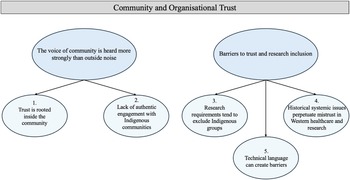
Figure 1 presents themes related to the barriers identified in recruiting Indigenous participants to research trials. Two themes address the larger concept that the voice of the community is heard more strongly than outside voices. The other themes speak to barriers for people in trusting research. Overall, there was a narrative of trust felt strongly within communities and wariness toward research organizations.
Themes related to recruiting Indigenous peoples for large research trials.

Figure 1 Long description
The diagram titled 'Community and Organisational Trust' presents themes related to recruiting Indigenous peoples for research trials. It is divided into two main sections. The first section states 'The voice of community is heard more strongly than outside noise' and includes two points: 1. Trust is rooted inside the community. 2. Lack of authentic engagement with Indigenous communities. The second section is labeled 'Barriers to trust and research inclusion' and includes three points: 3. Research requirements tend to exclude Indigenous groups. 4. Historical systemic issues perpetuate mistrust in Western healthcare and research. 5. Technical language can create barriers.
The voice of the community is heard more strongly than outside noise
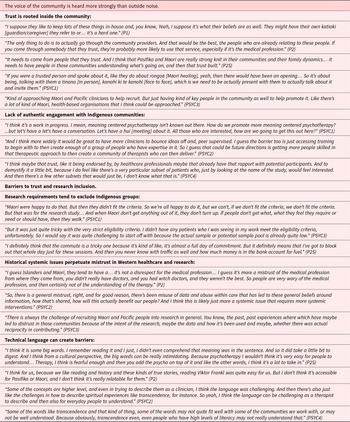
Participants expressed that community-based information sources are more trusted, hold more salience, and are held with higher regard than outside voices. Overall, participants noted a lack of information and research understanding within these inside circles (see Table 1).
1. Trust is rooted inside the community speaks to how many Indigenous peoples prefer to seek help from trusted community members before reaching for outside support. Participants spoke about how, within Indigenous circles, they have their own kaitiaki (guardians). Community and connection are strong with Māori and Pasifika, and connecting kanohi ki te kanohi (face-to-face) to establish rapport is essential. Participants reported that recruitment and recommendations for research studies need to come from trusted community sources.
Table 1.Representative participant quotes of subthemes developed under community and organizational trust

Table 1 Long description
The table compiles participant and clinician quotes about how community and organisational trust affects engagement with psychotherapy and research for Māori and Pasifika people. Quotes emphasise that trust is strongest when information and invitations come from within the community, via trusted providers, Māori and Pacific clinicians, and in-person, face-to-face conversations. Several entries describe a lack of authentic engagement, calling for hui and ongoing dialogue, more trained clinicians, and endorsement by professionals who already have rapport to reduce confusion about unfamiliar therapies. Barriers to inclusion include strict eligibility criteria that exclude willing Māori participants, limited local participant pools, and practical burdens such as travel time, traffic, and fuel costs. Historical and systemic harms are cited as drivers of mistrust, including concerns about misuse of data, lack of reciprocity, and past negative experiences with Western healthcare and research. Technical and academic language is repeatedly described as intimidating and hard to relate to, with terms like psychotherapy and transcendence seen as difficult to understand across literacy levels. Overall, the quotes suggest that culturally grounded, community-led communication and accessible language may improve trust, but the table reflects perceptions and experiences rather than measured outcomes.
Note: (P#) = Patient; (P#S) = Patient Support Person; (PSYC#) = Psychologist.
2. Lack of authentic engagement with Indigenous communities describes the limited information accessed by and targeted toward both Indigenous patients and psychologist communities. Psychologists reported that MCP is not as well-known as other therapeutic modalities and that increased access to training, resources, and skill development is required in Aotearoa. Some psychologists suggested hui (meetings) to discuss how to promote and increase awareness of MCP within communities and among trusted stakeholders and Indigenous healthcare providers.

Barriers to trust and research inclusion
Participants recognized wariness toward large organizations and research trials, acknowledging previous misuse of Indigenous knowledge. Participants recognized that although strides have been made to better represent Indigenous communities in research, inclusion is still insufficient. Low historical trust in the research process, researchers, inclusion criteria, and language proficiency contribute to the ongoing difficulty in recruiting Indigenous communities into trials.
3. Research requirements tend to exclude Indigenous groups. Participants noted that Māori were sometimes willing and eager to participate but often did not meet eligibility criteria due to exclusion criteria (e.g., family history of schizophrenia or other psychotic disorders, diabetes mellitus, current suicide risk). Some participants noted that Indigenous peoples may not reside within a practical distance to the treatment center, and as such, travel and timing were major barriers to participation. Psychologists urged that in future large trials, loosening of strict eligibility criteria is required to ensure accessibility for Indigenous communities.
4. Historical systemic issues perpetuate mistrust in Western healthcare, and research represents the ongoing impact of colonization on entrenched mistrust felt by Māori. Participants noted that Māori populations have a general mistrust of research institutions, noting past misuse of data, abuse within care, and lack of reciprocity as key contributors. One participant noted that, despite efforts to ease distrust, the underlying mistrust of the healthcare system may require more systemic intervention.
5. Technical language can create barriers, exposing the detrimental impact that the use of technical jargon can have on participation. Participants referred to terms such as “psychotherapy” as intimidating to those not familiar with such language. Patients noted that reading Viktor Frankl’s Man’s Search for Meaning (1985) would be challenging for those with lower literacy levels, and they would need support during reading. Psychologists explained that higher-level concepts such as “transcendence” were difficult to explain during sessions and that some patients had difficulty understanding them.
The experience of delivering and receiving MCP in Aotearoa
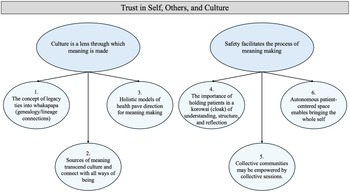
Themes related to the experience of delivering and receiving MCP are represented in Fig. 2. The first 3 themes address how culture is a lens through which meaning is made. The last 3 themes acknowledge that a safe therapeutic environment facilitates the process of meaning-making. Overall, these themes represent feelings of trust in self, others, and their own culture.
Themes regarding the experience of delivering and receiving meaning-centered psychotherapy in Aotearoa.

Figure 2 Long description
The diagram is titled 'Trust in Self, Others and Culture' and is divided into two main themes. The first theme is 'Culture is a lens through which meaning is made,' with three subpoints: 1. The concept of legacy ties into whakapapa (genealogy/lineage connections). 2. Sources of meaning transcend culture and connect with all ways of being. 3. Holistic models of health pave direction for meaning making. The second theme is 'Safety facilitates the process of meaning making,' with three subpoints: 4. The importance of holding patients in a korowai (cloak) of understanding, structure and reflection. 5. Collective communities may be empowered by collective sessions. 6. Autonomous patient-centered space enables bringing the whole self.
Culture is a lens through which meaning is made
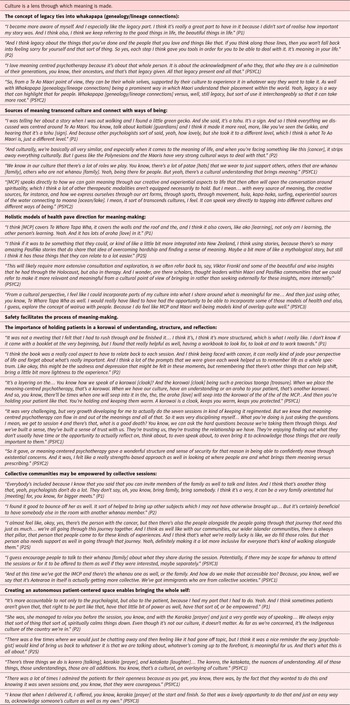
Regardless of background, participants described how culture can be a source of meaning, describing how sources of meaning for the individual mesh with holistic models of health. Participants spoke about how a person’s culture is an inherent part of them, and that when they trust their cultural connection, it can be a lens through which they pursue meaning (see Table 2 for participant quotes).
1. The concept of legacy ties into whakapapa (genealogy/lineage) describes how participants saw parallels between MCP and te ao Māori (the Māori worldview). Patients described exploring legacy as one of the most influential aspects of MCP. Psychologists spoke about how the concept of legacy follows whakapapa, allowing a person to bring themselves forward, supported by their culture and placement in the world. Participants reported that connection with the past can be accessed through writing a legacy project (one of the MCP exercises) and can aid people in connecting with their whakapapa.
Table 2.Representative participant quotes of subthemes developed under trust in self, others, and culture
Table 2 Long description
The table compiles participant and psychologist quotes grouped into subthemes about how culture and safety shape meaning-making in meaning-centred psychotherapy. Under “culture as a lens,” patients and psychologists describe legacy as tied to whakapapa, with legacy work helping people value their story, ancestors, and life meaning. Another subtheme notes that sources of meaning can transcend culture while still being expressed through culturally grounded signs, roles, spirituality, and creative or experiential practices such as art, movement, kapa haka, and connection to water and moana. A third cultural subtheme emphasizes holistic health models, including Te Whare Tapa Whā, and suggests adapting content through Māori and Pasifika stories and local thought leaders to increase relevance. Under “safety facilitates meaning making,” quotes stress that structured sessions and workbooks create security to explore existential topics, with the korowai metaphor used to describe layered protection through therapy and cultural care. Several quotes argue that collective or whānau-inclusive sessions can support both patients and those alongside them, reflecting collective community roles. Finally, an autonomous, patient-centred space is described as empowering, using practices like karakia, kōrero, and laughter to help people bring their whole selves while keeping discussion anchored to what feels meaningful. Interpretation is qualitative and illustrative, reflecting selected perspectives rather than frequencies or outcomes.
Note: (P#) = Patient; (P#S) = Patient Support Person; (PSYC#) = Psychologist.
2. Sources of meaning transcend culture and connect with ways of being paints how some patients utilize culture to connect with sources of meaning. Participants spoke of how experiential and creative sources of meaning can be found through connecting with culture, such as finding tohu (signs) in life, connecting with movement such as kapa haka (dance), and connecting with moana (ocean/waterways). Participants noted that individual sources of meaning transcend culture, with people able to experience meaning across any cultural background. Psychologists described how individuals can have many cultural roles within communities, which bring meaning.
3. Holistic models of health pave direction for meaning-making acknowledges how an individual can experience health through multiple sources. Participants described how MCP can be delivered to reflect holistic views of health, consistent with Indigenous perspectives. Social, spiritual, physical, and mental health can all be strengthened by focusing on an individual’s sources of meaning.

Safety facilitates the process of meaning-making
Participants spoke about how they needed to have trust in themselves and the person they were working with. Patients described finding MCP beneficial for their wellbeing, and for the wellbeing of their support systems. Psychologists described finding personal and interpersonal benefits from delivering MCP. Overall, participants spoke about the importance of having a safe, comfortable therapeutic space where the patient, psychologist, and support people could bring their whole selves into the therapy.
4. The importance of holding patients in a korowai (cloak) of understanding, structure, and reflection addresses how MCP creates a safe and trusting environment surrounding the patient. Patient participants described not feeling rushed and enjoying the routine of sessions. Psychologists reported finding it challenging to adhere to the MCP manualized structure, but gradually enjoying the “sense of security” it gave to be able to approach different topics, such as death and dying. Psychologists also described MCP as a korowai, and that through layering patients in a korowai of MCP, understanding, culture, and aroha (love) can allow a person to feel truly safe.
5. Collective communities may be empowered by collective sessions outlines how participants’ social wellbeing was influenced by MCP. One patient reported having a support person during sessions as beneficial, and likewise, their support person reported a meaningful experience. Psychologists reflected on social conversations that were borne from MCP outside of sessions. Participants commented on the collective nature of Māori and Pasifika communities, noting that experiencing MCP with whānau (family) is crucial so the patient is not experiencing their cancer alone.
6. Creating an autonomous patient-centered space enables bringing the whole self represents the therapeutic relationship MCP was able to foster. Participants reported enjoying how MCP is strengths-based and patient-centered. Patients reported feeling safe and empowered by the autonomy MCP provided to explore their own meaning. Psychologists described that MCP is patient-led and admired its flexibility in exploring meaning. Led by patient preferences, participants reported incorporating various culturally informed additions into sessions, including karakia (prayer), katakata (laughter), te reo Māori (Māori language), and casual kōrero (talk). Although not typically part of MCP, patients and psychologists described the spiritually calming nature of culturally-informed nuances in sessions.
Discussion
This study explored the experience of recruiting, delivering, and receiving MCP in a research trial with cancer patients and therapists in Aotearoa. Our results demonstrated that trust is central to recruiting Indigenous populations and contributes to the overall success of MCP delivery. Participants highlighted organizational mistrust as contributing to recruitment challenges, urging the development of reciprocal trusting relationships between researchers and the community in future trials. Participants reported that when conducted in a safe patient-centered therapeutic space, MCP concepts and meaning-making integrate well into Indigenous contexts. These results demonstrate that MCP can be translated into practice with Indigenous peoples and environments.
Community and organizational trust
The present study found that trust is central to recruiting Indigenous participants to clinical trials. Participants expressed that trust is more readily placed in community members, and a lack of research awareness within these communities may be limiting participation. Active engagement from community stakeholders tends to positively impact recruitment of Indigenous populations into research trials (Andrasik et al. Reference Andrasik, Broder and Wallace2021). This is consistent with a social identity framework, where individuals are more likely to exhibit trusting, altruistic behavior toward members of their in-group (Tajfel and Turner Reference Tajfel, Turner, Austin and Worchel1979; Winter and Sassenberg Reference Winter and Sassenberg2021). Review articles have noted that a lack of access to information is a recurring barrier for ethnic minority participation (George et al. Reference George, Duran and Norris2014; Glover et al. Reference Glover, Kira and Johnston2015). Future research endeavors to increase Indigenous participation should actively engage with community members to demonstrate how culturally relevant knowledge and belief systems are reflected in the work. By doing so, trusting reciprocal relationships between the community and researchers are more likely to be established.
Contributing to hesitation in participation, Indigenous participants spoke about historical mistrust of research and reflected on ongoing research practices that may inadvertently cause harm (strict research inclusion criteria and academic language). Mistrust has appeared as a barrier to participation across ethnic minority research (George et al. Reference George, Duran and Norris2014). Studies with African Americans and Indigenous Hawaiians have similarly reported mistrust related to fears of mistreatment (Scharff et al. Reference Scharff, Mathews and Jackson2010), perceptions of relinquishing rights (Herring et al. Reference Herring, Montgomery and Yancey2004), and doubts about the researcher’s agenda (Gollin et al. Reference Gollin, Harrigan and Perez2005). Within an Aotearoa context, there are historical reports of misuse of data, mistreatment, and malpractice in research (Pool Reference Pool, Kukutai and Taylor2016). High-level academic language and strict eligibility criteria act as barriers to participation, understanding, and retention for Indigenous communities (Singleton and Krause Reference Singleton and Krause2009; Premji et al. Reference Premji, Kosny and Yanar2020). In aiming to improve recruitment of Māori and Indigenous communities to large research trials, future research should draw on Indigenous language, knowledge, and values to inform participation benefits and reduce mistrust in reciprocal research benefits.
Trust in self, others, and culture
In the present study, psychologists and patients reported strong parallels between concepts from MCP and their culture. The concept of legacy resonated with Te Ao Māori (Māori worldview) concepts of whakapapa, allowing an individual to write their story supported by those who came before them. Korero whakapapa (stories told through ancestors) has a strong grounding within Te Ao Māori, with each generation assimilating their own being with the legacy of ancestral stories (Awe-Bevan Reference Awe-Bevan2013). Previous adaptations of MCP to Latino and Chinese immigrant populations have incorporated culture-specific concepts and metaphors into MCP sessions (Costas-Muñiz et al. Reference Costas-Muñiz, Garduño-Ortega and González2016; Leng et al. Reference Leng, Lui and Chen2018, Reference Leng, Lui and Huang2019). From a local perspective, whakapapa may be used interchangeably with legacy to create a stronger affiliation with the patient. Importantly, individuals may vary in their connection to culturally specific content; one size does not fit all (Torres-Blasco et al. Reference Torres-Blasco, Castro-Figuero and Garduño-Ortega2021; Blasco et al. Reference Blasco, Muñiz and Zamore2022). MCP concepts of meaning allow for individual differences in cultural identity to drive meaning-making appropriate to the patient’s needs.
This study highlighted that MCP can be viewed holistically, mirroring holistic models of health. Results showed how spiritual health is integrated into MCP and can be fostered with meaningful connections to culture and faith. Research has suggested that the Te Whare Tapa Wha model (Durie Reference Durie1985), a holistic Māori health model depicting 4 walls of a wharenui (meeting house) representing wellbeing, may fit well with existential psychotherapy (Wilson and Appel Reference Wilson and Appel2013). The literature on MCP adaptations in non-Western communities has highlighted spirituality as a primary source of strength (Costas-Muñiz et al. Reference Costas-Muñiz, Garduño-Ortega and González2016; Leng et al. Reference Leng, Lui and Chen2016). The present study mirrored the importance of spirituality for Indigenous communities and encouraged the integration of Māori concepts, stories, and kōrero whakapapa into MCP delivery. Participants highlighted the influential and impactful stories of trust, courage, and meaning through spiritual tales that may improve the connection Māori patients feel toward MCP. Research has shown the potential to interweave te ao Māori, Indigenous wisdom, and rongoā Māori (Māori healing practices) with psychotherapeutic interventions (Hanna et al. Reference Hanna, Morunga and Wells2025; Hodge et al. Reference Hodge, Forsyth and Noorani2025). MCP viewed holistically allows Māori health models to be prioritized within the therapeutic space, paving the way for meaningful connections to health through spiritual, cultural, and faith healing practices.
The present study recognized the necessity of maintaining a safe, comfortable, and supportive therapeutic environment. Our analysis showed how MCP can act as a protective korowai (cloak) of structure, reflection, and safety, enabling exploration of sources of meaning in culturally significant ways. Previous research with MCP for cancer caregivers has shown that the internal session structure and the manualized program can facilitate openness and comfort in discussing death and related concepts (Applebaum et al. Reference Applebaum, Roberts and Lynch2022). Therapists are encouraged to hold MCP flexibly, following the patient’s lead while accomplishing each session’s goals (Breitbart et al. Reference Breitbart, Lichtenthal and Applebaum2022). The structure of manualized MCP can facilitate conversations and comfort by providing a sense of protection to both those delivering and receiving the therapy.
Facilitating safe therapeutic environments for Indigenous communities includes supporting the wider collective nature of these communities, with the present study showing how MCP has the potential to aid not only the patient, but also their wider support systems. Previous research has shown that having support people present during psychotherapeutic interventions may improve engagement of Māori and Pasifika patients (Hirini Reference Hirini1997; Bennett et al. Reference Bennett, Flett and Babbage2016). Whānau (family) involvement in therapy can buffer psychosocial distress and help patients feel equipped to continue conversations with whānau beyond treatment sessions (Bennett et al. Reference Bennett, Flett and Babbage2014). Depending on the needs of the patient, participants of MCP should be encouraged to invite whānau members to sessions to observe, participate, and explore meaning alongside the patient.
The present study found that MCP therapists fostered a strong therapeutic alliance, allowing patients to bring their whole selves into a trusting space while maintaining autonomy over their experience. Research has shown that strong therapeutic bonds may enhance meaning-making processes during psychotherapy (Fortems et al. Reference Fortems, Dezutter and Dewitte2022), potentially improving therapy outcomes (Tschuschke et al. Reference Tschuschke, Koemeda-Lutz and von Wyl2020). Researchers have called for the importance of intentionality in creating safe therapeutic spaces for Māori patients through whakawhanaungatanga (meaningful connection), incorporating te reo Māori (Māori language), and enhancing mana (spiritual power) in practice (Gerbic and Muriwai Reference Gerbic and Muriwai2025). Other research has shown that utilizing native languages and particular language-led cultural cues within psychotherapy works as a tool to improve accessibility of care and psychological healing (Zipper-Weber Reference Zipper-Weber2025). Utilizing kupu Māori (Māori words) within therapeutic contexts with Māori has been shown to foster greater connection with therapeutic content when incorporated into cognitive behavioral therapy (Bennett et al. Reference Bennett, Flett and Babbage2014) and problem-solving therapy (Hatcher et al. Reference Hatcher, Coupe and Wikiriwhi2016). Maintaining a strong therapeutic alliance through patient-centered cultural session additions and autonomous patient activity may contribute to the overall success of MCP within Aotearoa.
Implications
This study is the first to explore the experience of delivering and receiving MCP within Aotearoa for Indigenous peoples. Results showed that te ao Māori may be successfully integrated into MCP concepts and delivery. Importantly, the present study included participant voices of both Māori and Pasifika decent. Māori and Pasifika make up 17.8% and 8.9%, respectively, of the population within Aotearoa (Stats NZ Tatauranga Aotearoa 2024). While only Māori are Indigenous to Aotearoa, these groups have intersecting values, heritage, and diversity, and face similar barriers to equitable health outcomes (Matika et al. Reference Matika, Manuela and Houkamau2021). Integrating the views of both Māori and Pasifika into this study allows results to be applicable to wider communities and serve populations of Indigenous Polynesian peoples. However, the current sample size was small, and results may not generalize to other Māori, Pasifika, or Indigenous populations from other countries. Care should be taken in future delivery of MCP within Aotearoa, maintaining the patient-focused nature of the therapeutic modality by prioritizing the patient’s own connection to culture.
The present results reiterated what is widely reported in the literature, that lack of trust can be a barrier to recruitment and participation. Future research aiming to recruit Indigenous groups into clinical trials needs to focus on authentic community engagement, involvement, and applicability, including clear, culturally informed advertising and relevance. Clear and transparent data collection should always be maintained, with participants having autonomy over their information. By engaging influential community members and incorporating Indigenous concepts such as language and protocols, research can improve its relevance to Indigenous peoples and create more obvious benefits for participation.
Lack of awareness was a key barrier to participation for patients and to delivery for clinicians. Increasing the accessibility of training and peer support programmes is required to encourage the use of these concepts with patients. Clinically, MCP in Aotearoa is still in its infancy and requires broader discussion and training among clinicians, community members, and researchers to improve access to psychotherapeutic care for patients.
Conclusion
MCP has cultural relevance to Aotearoa, with flexibility in cultural meaning-making processes and patient-centered therapy. In this study, patients and psychologists described how MCP can be understood holistically, offering space for broader models of health, cultural meaning-making, and culturally significant concepts of legacy. Participants reported that MCP can create a safe space for collective, autonomous, patient-led reflection. In disseminating MCP more widely and recruiting Indigenous populations into research trials, issues of awareness, trust, and historical mistrust will require extensive community consultation. Due to its holistic nature, MCP is well-positioned to hold the whole person as they explore meaning through a culturally significant lens.
Data availability statement
The dataset used and analyzed during the current study is available from the corresponding author on reasonable request.
Author contributions
C.C., A.W., and L.R. conceived and designed the study protocol. C.C. conducted all interviews and preliminary analyses. L.R., A.W., and C.C. refined the themes. C.C., A.W., L.R., and A.J.A. contributed to manuscript drafting and critical revisions.
Funding
This research was funded by a Health Research Council Emerging Researcher First Grant (#3722861) to the PI and by Mindbio Therapeutics Ltd (#6000472). The design and implementation of the study were conducted independently by the team of investigators at the University of Auckland.
Competing interests
A.J.A. reports relationships with PsyOnc Partners, LLC, and Genmab. There are no perceived or actual conflicts of interest with any other parties.
Ethical approval
Ethics approval was obtained from the Health and Disability Ethics Committee on 14 July 2022 (Ref: 13074), and approved amendments were obtained on 13 October 2025.

 Open access

