

Introduction
Large cohort studies must make choices about exposure and outcome measures. The scope and composition of these measures across the life course then come to define the study’s coverage of important issues and capacity to address them. This applies both to observational and intervention studies. To assist in choices of measures, many large cohort studies are guided by a chosen life course framework and related broad research questions. Life course frameworks broadly consider the long-term effects on health or disease risk of physical and social exposures during gestation, childhood, adolescence, young adulthood and later adult life Reference Kuh, Ben-Shlomo and Lynch1 .
Unfortunately, the potential pool of measures to consider is essentially limitless. Broadly, exposures may span genetics, demographics, personal characteristics, lifestyles and time use, environments (internal, home and external), and services/interventions (including trials). In population health research, outcomes may be considered in terms of overarching health and well-being, requiring an understanding of what health encompasses. In 2004, the Institute of Medicine defined health as ‘the extent to which individual children … are able or enabled to: (a) develop and realize their potential; (b) satisfy their needs; and (c) develop the capacities that allow them to interact successfully with their biological, physical, and social environments’ 2 . This definition emphasises health’s instrumental value, its multi-focal environmental influences and the importance of human functioning. It incorporates a developmental perspective and includes a systems view of health resulting from dynamic interactions between individuals and their environments Reference Forrest, Blackwell and Camargo3 . Consequently, it promotes the need to consider not only health status, but the pathways that ultimately promote and limit it.
During the latter half of the twentieth century, as concentrated research effort led to improved understanding of causes of disease and contributors to health, life course concepts also become more sophisticated. Halfon et al.’s review Reference Halfon, Larson and Lu4 synthesises how life course concepts have evolved over that half-century – moving from simple, mechanistic and reductionist models to contemporary models that are holistic, complex, dynamically relational and adaptive Reference Halfon, Forrest, Lerner, Halfon, Forrest, Lerner and Faustman5 . This led ultimately to Halfon and Forrest’s model of Life Course Health Development synthesising research from biological, behavioural and social science disciplines. It defines health development as a dynamic, emergent capacity that begins before conception and develops continuously over the lifespan in a complex, non-linear process.
However, most large cohort studies lack the resources to exhaustively consider all potential measures. Therefore, they typically present a life course framework either developed internally or selected from the published literature. The selected framework and ensuing research questions can have a profound impact on focusing the directions and ultimate value of the cohort. The clarity with which it communicates the cohort’s intent can further impact on researcher, funder and community support and thence cohort longevity. However, few if any cohorts make explicit how or when they selected their framework. This is surprising, given a framework’s ability to promote decision-making and communication clearly, conceptually and visually.
The Generation Victoria (GenV) cohort, currently in its pre-recruitment planning phase, provides an opportunity to explicitly select a driving framework. GenV aims to create very large, parallel whole-of-state birth and parent cohorts for discovery and interventional research. To achieve this, it plans to approach all babies born over two full years from mid-2021 (estimated to be around 150,000) and their parents in the Australian state of Victoria (population 6.5 million 6 ) for recruitment and thereafter to blend study-collected and routine data and biosamples. With philanthropic and government funding awarded in 2017 and 2018, GenV appointed its scientific team and began to develop its infrastructure (IT platform, biostore and recruitment models) and is seeking further funding at time of writing. GenV’s broad design, vision and principles (Collaboration, Inclusion, Sustainability, Enhancement, Systematised Processes and Value) were already in place. However, it was felt vital to specify its life course framework ahead of finalising GenV’s protocol in order to drive and guide coherent future choices of measures and biosamples for whom and at what time points. This scenario – where the science and the funding co-develop – is likely to increasingly become the case in the era of mega-cohorts. A clear, easily communicated guiding framework could help maintain life course theory in the face of multiple partnerships and ongoing co-design – moving away from smaller cohorts whose content was typically highly specified by a small group of academic investigators before achieving funding through traditional academic channels.
Here, we report on the process we used in 2019 to select GenV’s driving life course frameworks. We aimed to (1) summarise publicly available frameworks relevant to planning and communicating large new early-life cohorts and (2) help select frameworks to guide the content of and visually communicate GenV.
Methods
Pragmatic literature search
We identified potential frameworks from prior knowledge, our networks and a targeted literature search in June 2019 in electronic databases Medline (Ovid) and Excerpta Medica dataBASE (EMBASE Ovid). Medical Subject Headings (MeSH) and free-text words were used to interrogate each database, including the following search terms: ‘child health’, ‘life course’, ‘Developmental Origins of Health and Disease (DOHaD)’, ‘health development’, ‘framework’ and ‘conceptual model’. We excluded frameworks that do not have an existing infographic visually explaining the framework on a single page, as a pre-specified criterion.
Framework assessment matrix
We developed an assessment matrix, based on the Principles of the Life course Health Development Framework Reference Halfon, Forrest, Halfon, Forrest, Lerner and Faustman7 . The assessment matrix comprised seven items that we considered highly relevant to GenV’s aims and principles and are likely relevant to other large cohort studies. The seven criteria were: (1) Scope: broad and integrated scope; (2) Dimensions: broad and multidimensional environmental exposures; (3) Outcomes: overarching (broad) health and disease outcomes; (4) Life course: a life course perspective spanning time and space; (5) Mechanisms: inclusion of mechanisms/pathways and interactions; (6) Multi-age: applicability to all children and adults and (7) Visual Clarity: an infographic that could be readily understood by non-expert audiences without verbal input or GenV interpretation for others. Please see details in Table 1.
Framework assessment matrix

Expert consultation
We developed the assessment matrix in consultation with senior researchers with diverse expertise spanning community child health, maternity and fetal medicine, neonatology, infection, immunity, allergy, obesity and cardiovascular diseases, social research, mental health, health services, longitudinal cohort studies, genomic medicine, environmental and genetic epidemiology, biosample collection, and research translation.
Evaluation process
We summarised each of the frameworks and included its visual graphic, with permission where necessary. For each of the seven items in the assessment matrix, two researchers (JW and JH) independently rated each framework as clearly meeting the criteria (1 point) or not (0 point). A total score was calculated by adding up the scores for the seven items, with a maximum score of 7 indicating the highest relevance to GenV. Based on the total score, frameworks were arbitrarily judged to be high (6 to 7 points), intermediate (4 to 5 points) or low relevance (≤3 points) to GenV. We did not rank overall quality, since this was felt to be inherent in the ranking of the seven matrix items.
Results
We identified 14 life course frameworks from prior knowledge, our networks and a pragmatic literature search (Table 2). The majority of frameworks included a broad scope and multidimensional environmental exposures, while around half of them included overarching health and disease outcomes, a life course perspective and mechanisms. Half of them were applicable to whole populations of children and adults. We felt that only three existing infographics could readily communicate GenV’s focus and design. Two, nine and three frameworks were judged as high, intermediate and low relevance to GenV, respectively. The following section briefly describes each framework, highlighting key points and their relevance specifically for GenV.
Overview of scores of frameworks

Items: (1) broad and integrated scope/hypothesis; (2) broad and multidimensional environmental exposures; (3) overarching health and disease outcomes; (4) time and space (life course perspective); (5) mechanisms/pathways and interactions; (6) applicable to all children and adults; (7) existing infographic readily communicates GenV’s focus and design.
Relevance to GenV: high (6 to 7 points), intermediate (4 to 5 points), low (≤3 points).
Biodevelopmental framework Reference Shonkoff8 (high relevance to GenV, score 7)
Shonkoff’s 2010 article Reference Shonkoff8 offers an integrated, biodevelopmental framework to promote greater understanding of the antecedents and causal pathways that lead to disparities in health, learning and behaviour. It aims to inform the development of enhanced theories of change to drive innovation in policies and programmes. This framework (see Appendix 1) has been adapted by many studies Reference Clifford, Davies and Wake9–Reference Jimenez, Wade and Lin11 .
Strengths of this model include an integrated biodevelopmental framework and its easy-to-communicate infographic which shows antecedents and causal pathways of disparities in health, learning and behaviour. Weaknesses for GenV’s purposes include lack of emphasis on the continuous potential capacity for adaptation throughout the life course (reflecting its early-life conceptual beginnings) or intergenerational effects.
Life course health development Reference Halfon, Larson and Lu4 (high relevance, score 6)
Halfon et al. Reference Halfon, Larson and Lu4 published a transdisciplinary framework in 2004 (see Appendix 1). This framework is informed by new theoretical perspectives emerging from fields of study such as developmental psychology, systems biology, epigenetics, the developmental origins of chronic disease and evolutionary developmental biology.
The strength of this model is that it organises several different theories and conceptual models in order to make sense of the enormously challenging question of how health develops over the lifespan. However, neither of its two infographics were deemed intuitive, appealing or readily able to communicate GenV. Further, it requires animation so is not suited to static presentations.
Biosocial approach to human development, behaviour and health across the life course Reference McDade and Harris12 (intermediate relevance, score 5)
Social and biological phenomena are widely recognised as determinants of human development, health and socio-economic attainments across the life course, but understanding of the underlying pathways remains limited. In McDade and Harris’ framework Reference McDade and Harris12 , they define the ‘biosocial approach’ as one that conceptualises the biological and social as mutually constituting forces and that draws on models and methods from the biomedical and social/behavioural sciences. By bringing biology into the social sciences, they illuminate mechanisms through which socio-economic, psychosocial and other contextual factors shape human development and health (see Appendix 1).
Strengths of this model include the multilevel domains and pathways in biosocial approaches over the life course. However, this model is limited to brain and body outcomes without consideration of non-disease outcomes or outcomes during childhood itself. Its framework is therefore too narrow to guide or readily communicate GenV.
Life course approach to chronic disease epidemiology Reference Ben-Shlomo and Kuh13 (intermediate relevance, score 5)
Ben-Shlomo and Kuh define a life course approach to chronic disease epidemiology, reflecting increasing evidence that physical and social exposures during gestation, childhood, adolescence, young adulthood and later adult life have long-term effects on chronic disease risk. It includes studies of the biological, behavioural and psychosocial pathways that operate across an individual’s life course, as well as across generations, to influence the development of chronic diseases (see Appendix 1).
Strengths of this model include the life course approach across an individual’s lifespan and across generations, and its attention to capturing cohort, period and joint neighbourhood effects on parents and children. However, the scope is limited to chronic disease outcomes, and its infographic fails to be more readily communicable to epidemiologic than broader audiences.
EU LifeCycle Reference Jaddoe, Felix and Andersen14 (intermediate relevance, score 5)
The EU LifeCycle framework focuses on early life as an important window of opportunity to improve life course health trajectories for individuals themselves and also their children. The EU Child Cohort Network, bringing together extensive data from more than 250,000 European children and their parents from 10 countries, is testing specific concepts in the EU LifeCycle framework (see Appendix 1) Reference Jaddoe, Felix and Andersen14 .
Strength of this model includes its easy-to-communicate infographic. It explicitly emphasises life course risk factors across generations. However, perhaps because it is retro-fitted to studies that already exist, the LifeCycle model is limited to a small number of early-life stressors and disease outcomes (cardiometabolic, respiratory and mental), without consideration of non-disease outcomes or important outcomes during childhood itself.
AIHW person-centred framework 15 (intermediate relevance, score 4)
To guide services and/or policies to support core elements of child well-being at the national level, the Australian Institute of Health and Welfare (AIHW) has developed the AIHW person-centred framework. Developed to measure and report on health and welfare of the general population, the framework is based on social–ecological models of the determinants of health and well-being. Seven key information domains across the health and welfare sectors are included: individual health, education, family social support, household income and finance, parental employment, housing, and justice and safety (see Appendix 1).
The strength of this model is its comprehensive visual summary of multiple exposure domains across the health and welfare sectors that are both contemporary and relevant to the Australian context, and thus specifically to GenV. However, this framework is largely cross-sectional (not across the lifespan), and while its applicability to children is appealing it does not visually extend to adults. It also lacks a life course perspective to communicate mechanisms to good or poor development and health in children or adults.
MCRI complex disorders framework (intermediate relevance, score 4)
The Murdoch Children’s Research Institute (MCRI) complex disorders framework shows the influences of environmental exposures, selected population ‘omics’ and individual characteristics on an individual’s ‘bio-signature’, with a view to informing precision medicine in terms of risk stratification in early-life novel interventions and pharmacogenomics (see Appendix 1).
Strengths of this model include the comprehensive summary of exposures from environment, genes and individuals, and its focus on careful phenotyping and the potential for intervention. However, the scope is limited to disease outcomes, and while embedded in a life course framework this is not clearly visualised. Its infographic is overly complex to readily communicate GenV’s central messages regarding modifiable pathways to good and poor health.
Life course model of ageing Reference Hanson, Cooper and Aihie Sayer16 (intermediate relevance, score 4)
Previous models of ageing concentrated on its genetic basis, or the detrimental effects of accumulated damage, but also raised issues about whether ageing can be viewed as itself adaptive versus a consequence of other adaptive processes. Hanson et al.’s Reference Hanson, Cooper and Aihie Sayer16 life course model, published in 2016, places ageing in the context of the attainment of peak capacity for a body system, starting in early development when plasticity permits changes in structure and function induced by a range of environmental stimuli. This is followed by a period of decline whose rates and endpoints depend on both the peak attained and later life conditions (see Appendix 1).
The strength of this model includes the view of ageing as an adaptive process starting in early life. The life course health trajectory concept provides a theoretical basis for instituting and measuring the efficacy of interventions at critical points. However, as the scope is limited to a theoretical consideration of ageing of organs and systems, it does not provide a framework of either the range of exposures or experienced outcomes. While the model clearly applies to children, the infographic communicates this less well. It requires two infographics, both of which are required to explain the concepts and both are wordy. Thus, it does not meet our need for single overarching infographics to readily communicate GenV.
NIH ECHO model of positive health Reference Forrest, Blackwell and Camargo3 (intermediate relevance, score 4)
We found one large-scale collaborative attempt to define prospectively what exposures cohorts should capture as central to children’s health. Launched by the US National Institutes of Health (NIH) in 2016, the Environmental influences on Child Health Outcomes (ECHO) programme is a 7-year initiative designed to advance knowledge of environmental exposure effects on the health of the nation’s children. In a lengthy collaborative process, the NIH brought together 84 diverse existing children’s cohorts in its ECHO programme to workshop and define these central exposures. While these exposures appear to have been selected more by consensus than framework, the ECHO programme also conceptualised the ECHO model of positive health. This hypothesises that a person’s overall positive health comprises biological, functional, experiential and behavioural health assets. These are shaped by their environmental interactions (social, family and physical) which occur continuously over the lifespan (see Appendix 1). Thus, current health depends on past health as well as current person–environmental interactions.
Strengths of this model include multi-focal environmental influences and their interactions with positive health assets over the lifespan. However, the scope is limited to positive health, and the infographic was felt to be one of the least appealing and not intuitive in its interpretation. While it conveys time well, it does not clearly convey to us a sense of pathways to good and poor health.
Pathways to intrauterine growth retardation Reference Spencer17 (intermediate relevance, score 4)
Social inequities in child health arise as a result of the complex interrelationship of more distal social factors such as income and education with more proximal factors such as health behaviours. The pathways by which the social determinants exert their influence operate over time and across generations. Spencer Reference Spencer17 published the explanatory pathway for social inequities in intrauterine growth retardation in developed countries in 2010 (see Appendix 1).
The strengths of this model include the explanatory pathway for social inequities in intrauterine growth retardation over time including intergenerational influence. However, its infographic involves complex causal pathways specific to intrauterine growth retardation and heavily relies on words. Therefore, its value as a ready visual communication aid for GenV is limited.
New Zealand’s living standards framework 18 (intermediate relevance, score 4)
In working towards higher living standards for New Zealanders, the country’s Treasury (the government’s lead economic and financial adviser) has been developing the living standards framework since 2011 18 . This framework provides a shared understanding of what helps achieve higher living standards to support intergenerational well-being (see Appendix 1).
The strengths of this model include the 12 well-being domains and the 4 capitals that support current and future well-being. However, like the AIHW framework, it has a cross-sectional rather than life course visual perspective and does not readily communicate pathways to good or poor outcomes. It is less visual and much more wordy than the AIHW framework.
Ecological model Reference Bronfenbrenner20 (low relevance, score 2)
Bronfenbrenner’s classic ecological model provides a holistic approach to child development, being concerned with outcomes across multiple domains of development. It has driven many studies including the Longitudinal Study of Australian Children (LSAC) Reference Edwards19 . The theoretical framework is an ecological model of development, originating from Bronfenbrenner (1979) Reference Bronfenbrenner20 . In this model, children typically find themselves enmeshed in various ecosystems, from the most intimate home ecological system, to the larger school system, to the most expansive system which includes society and culture. Each of these ecological systems inevitably interact with and influence each other in all aspects of the children’s lives (see Appendix 1).
The strengths of this model include five levels of external influence and their interactions on children’s development. It is powerful, easily understood and has stood the test of time. However, as framed, it applies to children rather than to similar pathways being of equal and independent interest in adults. Of all models reviewed, it has among the least visual emphasis on life course pathways in its infographic.
Resilience models in life course Reference Cosco, Kaushal and Hardy21 (low relevance, score 2)
Over the life course, people are invariably faced with some form of adversity. The process of positively adapting to adverse events is known as ‘resilience’. Despite the acknowledgement of two common components of resilience (adversity and positive adaptation), no consensus operational definition has been agreed. Cosco et al. Reference Cosco, Kaushal and Hardy21 conducted a systematic review in 2017 to summarise the methods of operationalising resilience in 36 longitudinal studies of ageing (see Appendix 1).
The strength of this model lies in its investigation of how adverse events and positive adaptations can be framed to operationalise the concept of resilience. However, this framework is limited to resilience research, and it lacks a life course perspective to readily communicate pathways.
Multilevel factors related to paediatric health disparities Reference Ridgeway, Wang and Finney Rutten22 (low relevance, score 2)
Ridgeway et al. conducted a systematic review of 48 existing models of health disparities specific to children in 2017 Reference Ridgeway, Wang and Finney Rutten22 . This systematic review found multiple models but no consensus on one approach. However, they did discover a fair amount of overlap, such that the 48 models reviewed converged into a unified conceptual framework (see Appendix 1).
The strength of this model includes a multilevel view of factors related to paediatric health disparities. However, the model does not extend beyond these disparities, and it lacks a life course perspective to readily communicate pathways. Its communication relies wholly on words.
Frameworks selected for GenV
Primary framework
We selected Shonkoff’s biodevelopmental framework as GenV’s primary driving framework. It offers an integrated, biodevelopmental framework to promote greater understanding of the antecedents and causal pathways (as well as interactions) that lead to disparities in health, learning and behaviour in adulthood. We have adapted this with Shonkoff’s permission (see Fig. 1) to further illustrate (1) ongoing feedback loops through an individual’s life course and (2) influence of outcomes on next generation. We will further broaden the third pillar of Foundations of Healthy Development from a sole focus on Nutrition to reflect the broader environment of Events, Lifestyle and Nutrition.
GenV primary life course framework.

Secondary framework
GenV is designed to address physical, mental and social issues experienced during childhood, as well as the antecedents of a wide range of diseases of ageing in system thinking design. However, no single framework in our view adequately captured the range of exposures important for life course health for Australian children. Therefore, we have selected AIHW’s person-centred model as GenV’s secondary framework (Fig. 2), which summarises key determinants of children’s health and well-being and is specifically designed within the Australian context.
GenV secondary life course framework.

Discussion
Principal findings
Birth cohorts are profoundly shaped by their underpinning life course frameworks, but few if any report how they select them. We present and evaluate 14 published life course frameworks with existing visual representations. On our seven-item assessment matrix, two, nine and three frameworks, respectively, were ranked as high, intermediate and low relevance to GenV, but none totally communicated its scope and intent.
Shonkoff’s biodevelopmental framework was selected as GenV’s primary framework, adapted to include ongoing feedback loops through an individual’s life course and influence of an individual’s outcomes on the next generation. Because its conceptual simplicity precluded visualising the wide range of relevant exposures, we selected the AIHW’s person-centred model as a secondary framework.
We emphasise that a lower ranking does not reflect the intrinsic value or quality of any one of these frameworks – several have been conceptually groundbreaking. It simply means that it was judged less suited to our purpose of driving and communicating a large new cohort.
Strengths and limitations
To our knowledge, this is the first study to bring together multiple life course frameworks and to summarise and rank them in a transparent process that can then guide a major cohort in planning. We considered frameworks across fields and across research and policy, aiming to find a way to make GenV accessible to diverse sectors. We developed a transparent scoring system, offering a straightforward way to evaluate complex theoretical life course models that could be used by other large cohort studies.
There are some limitations. First, this paper focuses primarily on life course frameworks. Other frameworks come into play when selecting study measures, especially outcomes. These include Core Outcome Sets Reference Lee, Hind and Brown23 and overarching constructs such as health-related quality of life Reference Torrance and Feeny24 , burden of disease and disability-adjusted life years Reference Anand and Hanson25 , and the International Classification of Functioning, Disability and Health (ICF and ICF-Children and Youth) frameworks Reference Simeonsson26 . Second, we undertook this work in the context of one specific cohort. GenV’s planning immediately highlighted the literature gap that drove this paper but imposed the time and resource constraints of a major study commencing in 2021. This in turn predicated our pragmatic approach, for example, defining the seven matrix assessment items and selecting only frameworks with existing infographics that might readily communicate GenV’s focus and design. Future reviews could develop new graphics where lacking in existing strong frameworks or expand search terms to identify additional life course frameworks and/or more rigorous evaluation methods. Lastly, even though reviewed by diverse experts, the rankings were essentially opinion-driven and could be biased. While we do not expect others to use our exact matrix, we nonetheless propose that this was a more rigorous and transparent process for selecting a framework to guide a major new epidemiologic study than employed by any other cohort to date.
Implications
Ultimately, we selected two complementary life course frameworks for the forthcoming parallel mega-cohorts of children and parents in Victoria, Australia. Its transparent process and focus on visual communication are already prospectively assisting in the often fraught area of setting parameters for measures selection and consultation Reference Clifford and Wake27 . It is also helping researchers not only within but beyond GenV to better understand and visually communicate the initiative in an informed and effective way. This is important because the longevity of any major cohort depends critically on the voices of support from ‘outside the tent’.
A life course framework that considers multiple perspectives should lead to the greatest value and diversity in use of the resource. For epidemiology, strong causal inference requires the right variables at the right time in the right samples and populations, and cohorts need the clear vision to maximise this potential years in advance. Responding to an emerging view that longitudinal cohorts should ‘stop describing and start fixing’ Reference Tomlinson, Fearon and Christodoulou28 , we are embedding processes for multiple registries (the foundation for health services quality improvement) and randomised trials Reference Wake, Hu and Warren29 (the gold standard for intervention evidence) into GenV. If our framework leads to wise choices of exposures, moderators, mediators and outcomes, then GenV can explicitly place life course mechanisms at the heart of interventional ‘solution-focused’ research. For observational research, the resource should support complex epidemiologic methods Reference Ben-Shlomo and Kuh13 including causal modelling, G-estimation and simulation approaches, and multilevel modelling spanning molecular to supra-individual attributes such as the built and natural environment.
Conclusions
This summary of existing life course frameworks may prove helpful to other cohorts in planning. We identified two complementary frameworks to guide selection of exposure measures; GenV is already being aided by this transparent process and focus on visual communication. The feasibility, comprehension and validation of these frameworks could be further tested in the implementation stage.
Acknowledgements
None.
Financial support
Generation Victoria is supported by the Paul Ramsay Foundation in 2018 and 2020, the Victorian Government in 2017 and in 2019, and the Murdoch Children’s Research Institute and the Royal Children’s Hospital Foundation in 2020 (2019–1226). Research at the Murdoch Children’s Research Institute is supported by the Victorian Government’s Operational Infrastructure Support Program. JW was supported by a Melbourne Children’s LifeCourse postdoctoral fellowship (2019–2021), funded by Royal Children’s Hospital Foundation grant (2020–2023, reference number 2018–984). SG was supported by the Australian National Health and Medical Research Council (NHMRC) Practitioner Fellowship (2019–2023, reference number 155290). MW was supported by NHMRC Principal Research Fellowship (2019–2023, reference number 1160906).
Conflicts of interest
The authors declare no potential conflicts of interest, including no specific financial interests relevant to the subject of this manuscript.
Ethics approval
GenV has been endorsed by The Royal Children’s Hospital Human Research Ethics Committee (HREC 2019.011), including in-principle approval as a mechanism to support registries.
Data availability statement
No new data were generated or analysed in support of this research. It is intended in the future that GenV data access will be supported for all researchers meeting governance requirements such as the Five Safes principles. A range of materials are available at GenV’s figshare project [https://mcri.figshare.com/projects/Generation_Victoria/35822].
Appendix 1
All Images reproduced with permission.
1. Biodevelopmental framework Reference Shonkoff8

The biodevelopmental framework shows the origins and causal pathways that lead to disparities in learning behaviour and health. The basic elements of the biodevelopmental framework are organised within three sets of target domains: (a) interactions among foundations of healthy development and sources of early adversity, (b) measures of physiological adaptation and disruption and (c) both positive and negative adult outcomes in learning, behaviour and health.
2. Life course health development Reference Halfon, Larson and Lu4
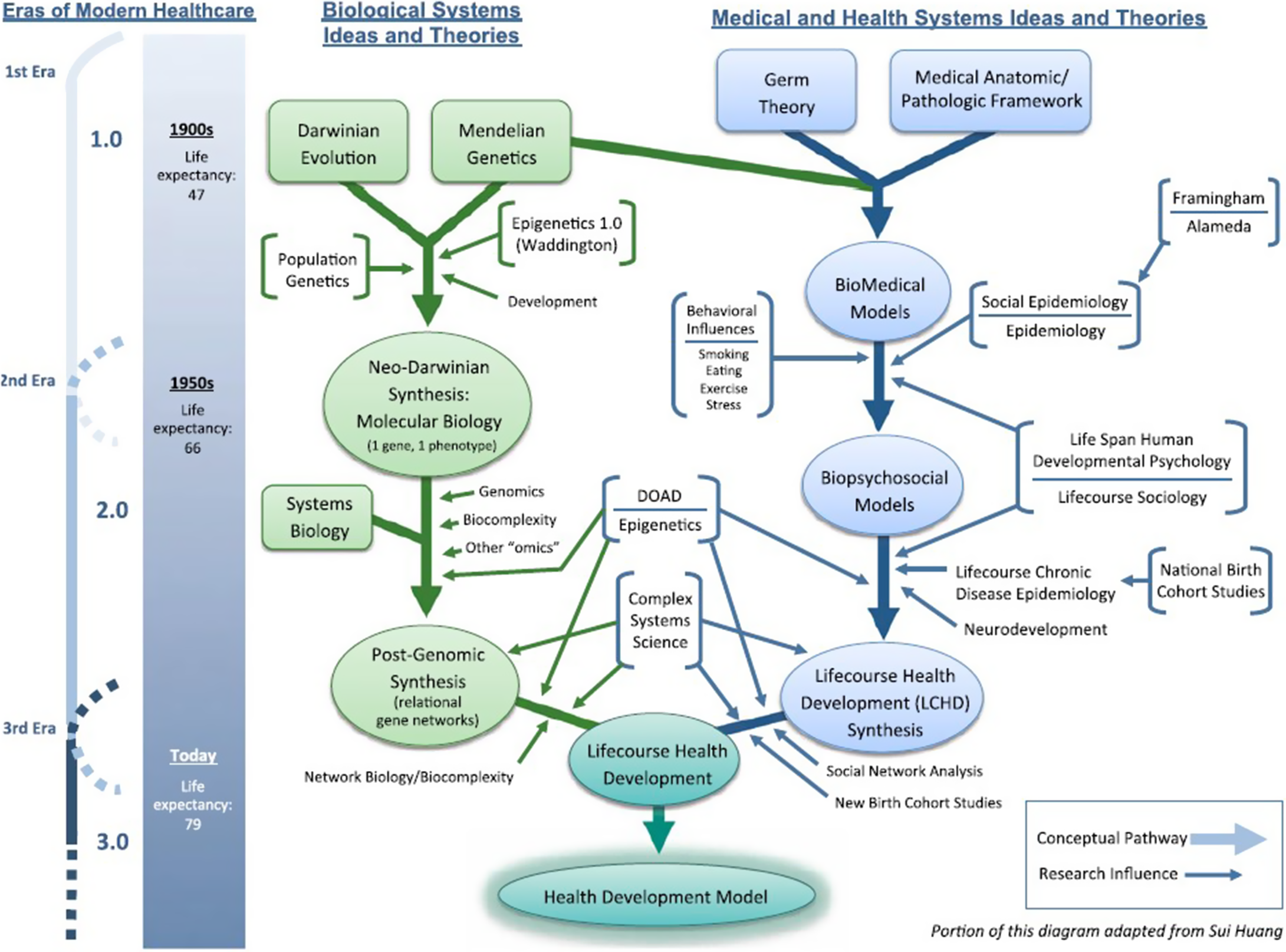
This framework diagrams the evolution of two converging and interacting streams of scientific inquiry and conceptual model building. The first stream (Biological System Ideas and Theories) shows the development of major conceptual constructs in relation to new ways of understanding how biological systems function. The second stream (Medical and Health System Ideas and Theories) shows how the biomedical model was transformed into a more hierarchical, dynamic and multiply determined biopsychosocial model, which has subsequently evolved into a complex, relational model of LCHD.
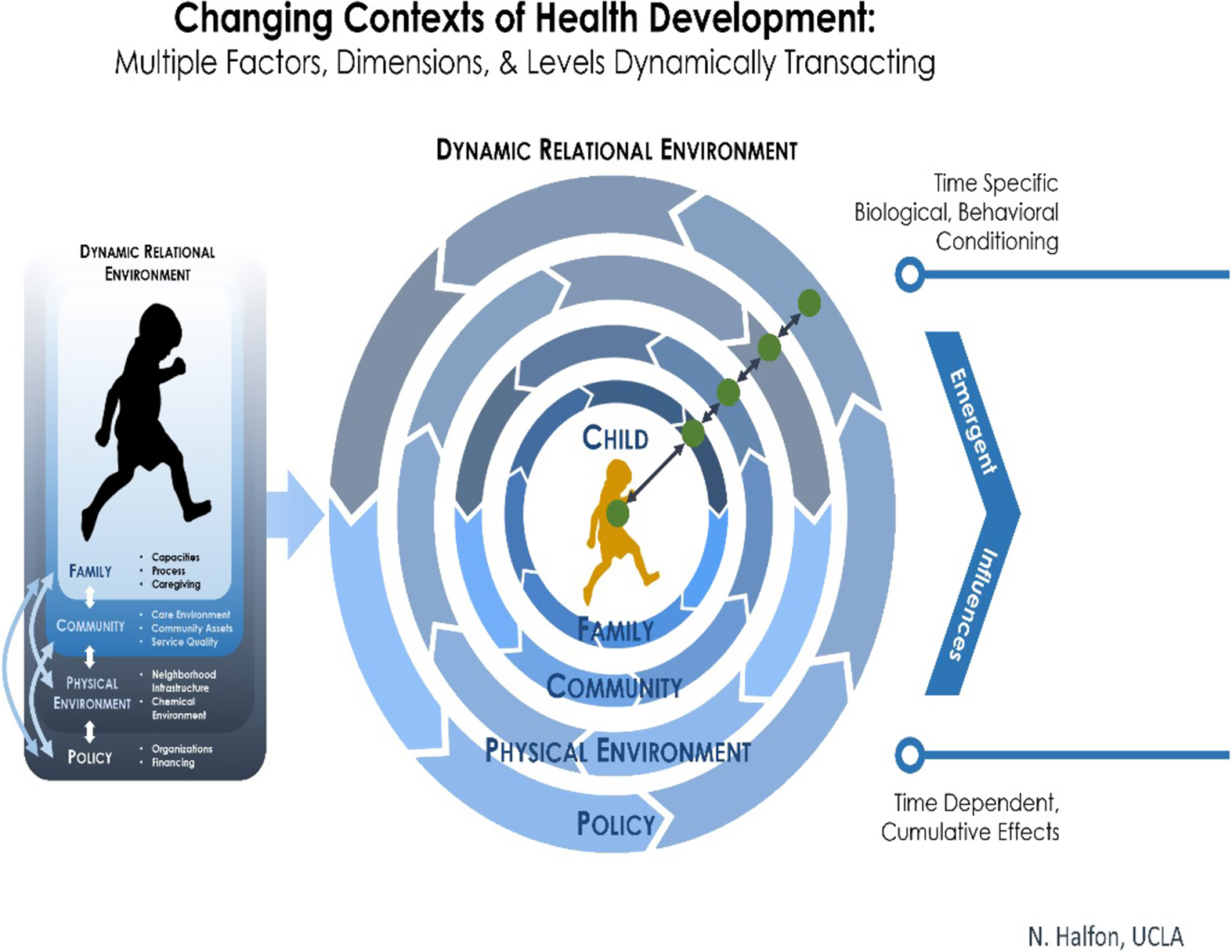
This framework summarises the dynamic relational evironments (including family, community, physical environment and policy) in children’s health development.
3. Biosocial approach to human development, behaviour and health across the life course Reference McDade and Harris12

This framework shows the conceptual model of the biosocial dynamics that shape the brain and body of the individual across all stages of the life course. The top boxes represent the set of nested and interacting social contexts ‘outside’ the body that impact the developing brain and body of an individual. Similarly, the bottom boxes represent the nested and interacting levels of biological organisation ‘inside’ the brain and body that respond to, and shape, social worlds.
4. Life course approach to chronic disease epidemiology Reference Ben-Shlomo and Kuh13

This framework shows the possible influences of hierarchical and life course exposures on disease risk across three related individuals. Grandparents, parents and children are linked across generations both by common genetic and/or social influences. The potential role of household, neighbourhood and national influences are illustrated acting across time and across individuals.
5. EU LifeCycle Reference Jaddoe, Felix and Andersen14

This framework shows that preception, fetal and early childhood stressors, developmental adaptations and subsequent life course risk factors will contribute to the early life origins of non-communicale diseases (NCDs).
6. AIHW person-centred framework

The AIHW person-centred framework shows an ecological approach to child development which places child development at centre of the framework and which is seen to occur within concentric levels of influences. The framework highlights the interrelationship of the domains in the context of children’s well-being.
7. MCRI complex disorders framework

The MCRI Complex Disorders framework shows the influences of environmental exposures, selected population ‘omics’ and individual characteristics on an individual’s bio-signature, which could further inform precision medicine.
8. Life course model of ageing Reference Hanson, Cooper and Aihie Sayer16

This framework shows the average hypothetical trajectories of functional capacity for organs and systems in individuals from low (red) and high (blue) income settings. Low-income settings are associated with a poorer start to life in terms of inherited health capital. Functional capacity develops more slowly in a low-income setting but reaches a lower peak capacity earlier in the life course. Throughout life, the environmental challenges to function are likely to be greater in the low-income setting, leading to faster and earlier decline.

This framework shows the factors acting across the life course, including:
(1) Developmental factors which are associated with later ageing.
(2) Markers of the causes of ageing.
(3) Markers of the effects of ageing.
(4) Factors which challenge the plasticity of ageing. Some of these factors give insights into underlying mechanisms and some may serve as useful biomarkers of risk or biological age.
9. NIH ECHO model of positive health Reference Forrest, Blackwell and Camargo3

This framework shows that biological, functional, experiential and behavioural health assets of a person are shaped by their environmental interactions. The repeated triangles indicate that these interactions occur continuously over the lifespan. Current health depends on past health as well as current person– environment interactions.
10. Pathways to intrauterine growth retardation Reference Spencer17

This frameworks shows the explanatory pathways to intrauterine growth retardation. The links between the social and the biological are shown in pathway from socio-economic status at mother’s birth to her own birthweight to pregnancy-induced hypertension in the index pregnancy. Mother’s birthweight is also linked to education and childhood ill health. The pathway allows for the clustering and accumulation of socially related risk and protective exposures.
11. New Zealand’s living standards framework

This framework provides a shared understanding of what helps to achieve higher living standards to support intergenerational well-being, including 12 well-being domains and the 4 capitals (for details, see https://www.treasury.govt.nz/information-and-services/nz-economy/higher-livingstandards/our-living-standards-framework).
12. Ecological model Reference Bronfenbrenner20

This frameworks shows that children typically develop in various ecosystems, from the most intimate home ecological system to the larger school system, and then to the most expansive system which includes society and culture. Each of these ecological systems inevitably interact with and influence each other in all aspects of the children’s lives.
13. Resilience models in life course Reference Cosco, Kaushal and Hardy21

This framework summarises the ways in which adverse events and positive adaptations are used in resilience operationalisations. The source of adversity varied greatly; more studies included non-acute adversity (e.g., cancer) than acute adversity (e.g., disaster). The positive adaptations to these adverse events were less varied, generally demonstrated by low levels of psychological distress.
14. Multilevel factors related to paediatric health disparities Reference Ridgeway, Wang and Finney Rutten22

This unified conceptual framework presents a multilevel view of factors related to paediatric health disparities, including evironment/community, individual characteristics and behaviours, health care providers and systems, and health and public policies.


 Open access

