




1 Introduction
The computability-theoretic and reverse-mathematical analysis of combinatorial principles has a long history and has been especially fruitful (see, for example, [Reference Hirschfeldt6]). In this article, we analyze results in a subfield of Ramsey theory called partition regularity over algebraic structures. This topic has been extensively researched by combinatorialists, with new important results in the last few years [Reference Byszewski and Krawczyk3, Reference Leader and Russell9]. However, the computability-theoretic and reverse-mathematical analysis of partition regularity over algebraic structures is something that, to our knowledge, is done for the first time.
Partition regularity, in the context that we are going to be talking about in this article, was the main topic in Richard Rado’s doctoral thesis. Rado’s goal was to generalize some of the earliest results in Ramsey theory, like Schur’s theorem and Van der Waerden’s theorem. These theorems, in their original form or restated, talk about linear equations or systems of equations that have monochromatic solutions under any finite coloring of the underlying algebraic structure that we are considering. To make this more precise, let us consider the set of positive integers $\mathbb {N}\setminus \{0\}$
as our underlying structure. If we are given a system of linear equations over
$\mathbb {N}\setminus \{0\}$
as our underlying structure. If we are given a system of linear equations over $\mathbb {N}\setminus \{0\}$
in several variables, and color
$\mathbb {N}\setminus \{0\}$
in several variables, and color $\mathbb {N}\setminus \{0\}$
with finitely many colors, can we always find a nonzero monochromatic solution? Schur’s theorem answers this question in the positive for the equation
$\mathbb {N}\setminus \{0\}$
with finitely many colors, can we always find a nonzero monochromatic solution? Schur’s theorem answers this question in the positive for the equation $x+y-z=0$
.
$x+y-z=0$
.
The systems of linear equations that have a monochromatic solution under any finite coloring of the underlying structure are called partition regular systems. We are going to give the precise definitions in Section 2.1. Rado met his goal—he found a characterization of all systems that are partition regular, separately for the homogeneous and inhomogeneous case. For the inhomogeneous case, which is the case we are going to be investigating in this article, Rado showed the following.
Theorem (Rado [Reference Rado10]).
An inhomogeneous system of linear equations is partition regular over $\mathbb {Z}$
if and only if it has a constant solution.
$\mathbb {Z}$
if and only if it has a constant solution.
Some natural questions were raised after Rado showed this result. One of these questions was what happens if we replace the integers with any other commutative ring R? Can we still characterize the systems that are partition regular over R? Significant progress towards answering this question was made by several combinatorialists, see [Reference Bergelson, Deuber, Hindman and Lefmann2, Reference Byszewski and Krawczyk3], and nearly a hundred years later, it was finally resolved by Leader and Russell in [Reference Leader and Russell9].
Theorem (Leader–Russell [Reference Leader and Russell9]).
An inhomogeneous system of linear equations is partition regular over a commutative ring R if and only if it has a constant solution.
While exploring these new results, as well as earlier papers attempting to address the same question, we came across a result by Straus from a 1975 paper [Reference Straus17]. Whether in a direct application or as an idea to follow, this theorem, that we are going to refer to as Straus’ theorem, shows up in nearly all of these papers, so we felt that it was essential to start with its analysis.
Definition 1.1. Let G be any nonempty set, $k\in \mathbb {N},k>0$
and
$k\in \mathbb {N},k>0$
and $c:G\rightarrow k$
be any coloring of G with k colors. We say that the tuple
$c:G\rightarrow k$
be any coloring of G with k colors. We say that the tuple $\left (x_{1},y_{1},x_{2},y_{2},\dots ,x_{n},y_{n}\right )\in G^{2n}$
is pairwise monochromatic for c if for all
$\left (x_{1},y_{1},x_{2},y_{2},\dots ,x_{n},y_{n}\right )\in G^{2n}$
is pairwise monochromatic for c if for all $i=1,\dots ,n$
,
$i=1,\dots ,n$
, $c(x_{i})=c(y_{i})$
.
$c(x_{i})=c(y_{i})$
.
Theorem (Straus [Reference Straus17]).
Let $n\in \mathbb {N},n\geq 1$
. Let G be an abelian group and
$n\in \mathbb {N},n\geq 1$
. Let G be an abelian group and $b\in G,b\neq 0$
an element of G. Then there is a finite k-coloring of G such that the equation
$b\in G,b\neq 0$
an element of G. Then there is a finite k-coloring of G such that the equation
 $$ \begin{align} (x_{1}-y_{1})+(x_{2}-y_{2})+\dots+(x_{n}-y_{n})=b \end{align} $$
has no pairwise monochromatic solutions, where
 $$\begin{align*}k=\begin{cases} \hspace{4mm}2n & \text{if }2\mid \mathrm{ord}(b) \text{ or } \mathrm{ord}(b)=\infty\\ \left\lceil \dfrac{2np}{p-1}\right\rceil & \text{if }\mathrm{ord}(b) \text{ is odd and }p\text{ is the largest prime divisor of }\mathrm{ord}(b) \end{cases}. \end{align*}$$
For simplicity, we refer to this result as Straus’ theorem; however, the following more general result is shown in Straus’ paper [Reference Straus17].
Theorem (Straus* [Reference Straus17]).
Let $n\in \mathbb {N},n\geq 1$
. Let
$n\in \mathbb {N},n\geq 1$
. Let $(G,+,0)$
be an abelian group and
$(G,+,0)$
be an abelian group and $b\in G,b\neq 0$
an element of G. Let
$b\in G,b\neq 0$
an element of G. Let $f_1,\dots ,f_n$
be arbitrary mappings from G to G, with
$f_1,\dots ,f_n$
be arbitrary mappings from G to G, with $m\leq n$
of them being distinct. Then there is a finite k-coloring c of G such that the equation
$m\leq n$
of them being distinct. Then there is a finite k-coloring c of G such that the equation
 $$ \begin{align} (f_1(x_{1})-f_1(y_{1}))+(f_2(x_{2})-f_2(y_{2}))+\dots+(f_n(x_{n})-f_n(y_{n}))=b \end{align} $$
has no pairwise monochromatic solutions, where
 $$\begin{align*}k=\begin{cases} \hspace{4mm}(2n)^m & \text{if }2\mid \mathrm{ord}(b) \text{ or } \mathrm{ord}(b)=\infty\\ \left\lceil \dfrac{2np}{p-1}\right\rceil^m & \text{if }\mathrm{ord}(b) \text{ is odd and }p\text{ is the largest prime divisor of }\mathrm{ord}(b) \end{cases}. \end{align*}$$
Our results apply to the more general theorem as well and they will be denoted by *.
In this article we analyze this result and its implications from a computability-theoretic (Section 3) and reverse-mathematical (Section 4) point of view.
From the computability-theoretic point of view, we show that this result does not hold computably, even in the simplest case when $n=1$
. We also show that the Turing degrees that capture the complexity of this problem are the PA degrees. The PA degrees compute paths in infinite binary (or k-branching for a fixed
$n=1$
. We also show that the Turing degrees that capture the complexity of this problem are the PA degrees. The PA degrees compute paths in infinite binary (or k-branching for a fixed $k\in \mathbb {N},k\geq 2$
) trees. They come up naturally in these types of problems since you can think of the colorings of an algebraic structure as paths through some binary (or k-branching for a fixed
$k\in \mathbb {N},k\geq 2$
) trees. They come up naturally in these types of problems since you can think of the colorings of an algebraic structure as paths through some binary (or k-branching for a fixed $k\in \mathbb {N},k\geq 2$
) tree (see Section 2.2).
$k\in \mathbb {N},k\geq 2$
) tree (see Section 2.2).
Theorem 3.1. There is a computable abelian group $(G,+,0)$
and an element
$(G,+,0)$
and an element $b\in G,b\neq 0$
such that if c is a 2-coloring of G for which the equation
$b\in G,b\neq 0$
such that if c is a 2-coloring of G for which the equation
 $$\begin{align*}x-y=b \end{align*}$$
has no monochromatic solutions, then c has PA degree.
Theorem 3.1 gives us a lower bound for this problem and it is not too hard to see that the PA degrees are the best possible bound (Proposition 3.7).
This theorem is the best possible result of this sort: if we have more than two colors, say $m>2$
colors, then for every computable group we can find a computable m-coloring with no monochromatic solutions to
$m>2$
colors, then for every computable group we can find a computable m-coloring with no monochromatic solutions to $x-y=b$
(Proposition 3.8).
$x-y=b$
(Proposition 3.8).
The proof of Straus’ theorem, which we will sketch at the beginning of the proof of Theorem 4.2, shows that you can choose your coloring such that there exists an $m>0$
such that for every
$m>0$
such that for every $k\in \mathbb {Z}$
, all the
$k\in \mathbb {Z}$
, all the $kmb$
are monochromatic. We show that for the case
$kmb$
are monochromatic. We show that for the case $n\geq 2$
, Straus’ theorem with this additional condition added does not hold computably, and moreover, the best possible bounds for this problem are again the PA degrees.
$n\geq 2$
, Straus’ theorem with this additional condition added does not hold computably, and moreover, the best possible bounds for this problem are again the PA degrees.
Theorem 3.2. Let $n\in \mathbb {N},n\geq 2$
. There is a computable group
$n\in \mathbb {N},n\geq 2$
. There is a computable group $(G,+,0)$
and an element
$(G,+,0)$
and an element $b\in G,b\neq 0$
such that, if c is a
$b\in G,b\neq 0$
such that, if c is a $2n$
-coloring of G for which the equation
$2n$
-coloring of G for which the equation
 $$ \begin{align*}(x_{1}-y_{1})+\dots+(x_{n}-y_{n})=b\end{align*} $$
has no pairwise monochromatic solutions and there is an $m>0$
such that for every
$m>0$
such that for every $k \in \mathbb {Z}$
, all the
$k \in \mathbb {Z}$
, all the $kmb$
are colored with the same color, then c has PA degree.
$kmb$
are colored with the same color, then c has PA degree.
In Theorem 3.3 we show that a more general version of Theorem 3.2 holds—we can build a computable group G and a $b\in G,b\neq 0$
such that any finite coloring that satisfies the conditions of Theorem 3.2 has PA degree.
$b\in G,b\neq 0$
such that any finite coloring that satisfies the conditions of Theorem 3.2 has PA degree.
From the reverse-mathematical point of view, we can already make some conclusions based on these results. The PA degrees suggest that Straus’ theorem might be equivalent to $\mathrm {WKL}_{0}$
over the base system
$\mathrm {WKL}_{0}$
over the base system $\mathrm {RCA}_{0}$
. Indeed, from the proof of Theorem 3.1, we notice that the
$\mathrm {RCA}_{0}$
. Indeed, from the proof of Theorem 3.1, we notice that the $n=1$
case of Straus’ theorem implies
$n=1$
case of Straus’ theorem implies $\mathrm {WKL}_{0}$
, so we have the following result.
$\mathrm {WKL}_{0}$
, so we have the following result.
Theorem 4.1. The following statements are equivalent over $\mathrm {RCA}_0\text {:}$
-
(i) $\mathrm {WKL}_0$
.
$\mathrm {WKL}_0$
. -
(ii) For every abelian group G and every element
$b\in G,b\neq 0$
, there is a k-coloring of G for which the equation
$x-y=b$
has no monochromatic solutions, where
$$\begin{align*}k=\begin{cases} \hspace{2mm}2 & \text{if }2\mid \mathrm{ord}(b) \text{ or } \mathrm{ord}(b)=\infty\\ \hspace{2mm}3 & \text{if }\mathrm{ord}(b) \text{ is odd } \end{cases}. \end{align*}$$




Following the original proof of Straus’ theorem, for the case $n \geq 2$
we show that
$n \geq 2$
we show that $\mathrm {WKL}_{0}$
implies Straus’ theorem over
$\mathrm {WKL}_{0}$
implies Straus’ theorem over $\mathrm {RCA}_{0}$
.
$\mathrm {RCA}_{0}$
.
Theorem 4.2. Over $\mathrm {RCA}_0$
,
$\mathrm {RCA}_0$
, $\mathrm {WKL}_{0}$
implies the following statement
$\mathrm {WKL}_{0}$
implies the following statement $\text {.}$
Let $n\in \mathbb {N},n\geq 1$
. For every abelian group
$n\in \mathbb {N},n\geq 1$
. For every abelian group $(G,+,0)$
and every
$(G,+,0)$
and every $b\in G,b\neq 0,$
there is a k-coloring of G such that the equation
$b\in G,b\neq 0,$
there is a k-coloring of G such that the equation
 $$ \begin{align*} (x_{1}-y_{1})+\dots+(x_{n}-y_{n})=b \end{align*} $$
has no pairwise monochromatic solutions, where
 $$\begin{align*}k=\begin{cases} \hspace{4mm}2n & \text{if }2\mid \mathrm{ord}(b) \text{ or } \mathrm{ord}(b)=\infty\\ \left\lceil \dfrac{2np}{p-1}\right\rceil & \text{if }\mathrm{ord}(b) \text{ is odd and }p\text{ is the largest prime divisor of }\mathrm{ord}(b) \end{cases}. \end{align*}$$
This result together with Theorem 3.2 suggest that the full Straus’ theorem is indeed equivalent to $\mathrm {WKL}_0$
over
$\mathrm {WKL}_0$
over $\mathrm {RCA}_0$
.
$\mathrm {RCA}_0$
.
Lastly, we give reverse-mathematical versions of Theorems 3.2 and 3.3.
Theorem 4.3. The following statements are equivalent over $\mathrm {RCA}_0,\text {:}$
-
(i)
$\mathrm {WKL}_0$
. -
(ii) Let
$n\in \mathbb {N},n\geq 2$
. Let
$(G,+,0)$
be an abelian group and
$b\in G, b\neq 0$
. Let Then there is a k-coloring of G with no pairwise monochromatic solutions to
$$\begin{align*}k=\begin{cases} \hspace{4mm}2n & \text{if }2\mid \mathrm{ord}(b) \text{ or } \mathrm{ord}(b)=\infty\\ \left\lceil \dfrac{2np}{p-1}\right\rceil & \text{if }\mathrm{ord}(b) \text{ is odd and }p\text{ is the largest prime divisor of }\mathrm{ord}(b) \end{cases}. \end{align*}$$
that satisfies the following condition: there is an
$$ \begin{align*} (x_{1}-y_{1})+\dots+(x_{n}-y_{n})=b \end{align*} $$
$m>0$
such that for every
$l\in \mathbb {Z}$
, all the
$lmb$
are colored with the same color.
-
(iii) Let
$n\in \mathbb {N},n\geq 2$
. Let
$(G,+,0)$
be an abelian group and
$b\in G, b\neq 0$
. Let and let
$$\begin{align*}k=\begin{cases} \hspace{4mm}2n & \text{if }2\mid \mathrm{ord}(b) \text{ or } \mathrm{ord}(b)=\infty\\ \left\lceil \dfrac{2np}{p-1}\right\rceil & \text{if }\mathrm{ord}(b) \text{ is odd and }p\text{ is the largest prime divisor of }\mathrm{ord}(b) \end{cases} \end{align*}$$
$N\geq k$
. Then there is an N-coloring of G with no pairwise monochromatic solutions to that satisfies the following condition: there is an
$$ \begin{align*} (x_{1}-y_{1})+\dots+(x_{n}-y_{n})=b \end{align*} $$
$m>0$
such that for every
$l\in \mathbb {Z}$
, all the
$lmb$
are colored with the same color.









Theorem 4.4. The following statements are equivalent over $\mathrm {RCA}_0\text {:}$
-
(i)
$\mathrm {WKL}_0$
. -
(ii) Let
$n\in \mathbb {N},n\geq 2$
. Let
$(G,+,0)$
be an abelian group and
$b\in G, b\neq 0$
. Then there is a finite coloring of G with no pairwise monochromatic solutions to that satisfies the following condition: there is an
$$ \begin{align*} (x_{1}-y_{1})+\dots+(x_{n}-y_{n})=b \end{align*} $$
$m>0$
such that for every
$l\in \mathbb {Z}$
, all the
$lmb$
are colored with the same color.





The most pressing open questions that came up while writing this article are the following.
Open Question 1. Are the PA degrees the best possible computability-theoretic bound for the full Straus’ theorem? If not, what are the best possible bounds?
On the reverse mathematics side, the following question is still open, even though we show one direction of the equivalence in Theorem 4.2.
Open Question 2. Is the full Straus’ theorem equivalent to $\mathrm {WKL}_0$
over
$\mathrm {WKL}_0$
over $\mathrm {RCA}_0$
?
$\mathrm {RCA}_0$
?
Our proofs do not directly translate to proofs about rings, so the same computability-theoretic and reverse-mathematical analysis does not directly apply to the Leader–Russell theorem. Therefore, we have the following open questions.
Open Question 3. What are the best possible computability-theoretic bounds for the Leader–Russell theorem? What about the reverse-mathematical bounds?
We can also consider some more refined reducibilities like Weihruach reducibility or different base systems of axioms like $\mathrm {RCA}_0^*$
and ask whether our theorems hold under these conditions. These questions are interesting to ask since the theorem by Jockusch that we use in most of our results does not necessarily hold under these new conditions.
$\mathrm {RCA}_0^*$
and ask whether our theorems hold under these conditions. These questions are interesting to ask since the theorem by Jockusch that we use in most of our results does not necessarily hold under these new conditions.
2 Background
In this section, we give the necessary background for the new results in this article.
2.1 Partition regularity
Partition regularity is a subfield of Ramsey theory that generalizes some important combinatorial results, such as Schur’s theorem and Van der Waerden’s theorem. For further details on these topics, see [Reference Graham, Rothschild and Spencer5].
Definition 2.1. Let G be a nonempty set and $k \in \mathbb {N}, k>1$
. A k-coloring of G is any map
$k \in \mathbb {N}, k>1$
. A k-coloring of G is any map $c : G \rightarrow k$
. We call the set
$c : G \rightarrow k$
. We call the set $S \subset G$
monochromatic if
$S \subset G$
monochromatic if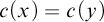 $c(x)=c(y)$
for all
$c(x)=c(y)$
for all $x,y\in S$
.
$x,y\in S$
.
Since we will mostly be talking about equations and system of equations and their monochromatic solutions, we define precisely what we mean by this.
Definition 2.2. Let G be an algebraic structure (abelian group, ring), A an $m\times n$
matrix with entries in G and
$m\times n$
matrix with entries in G and $b\in \mathbb {G}^{m},b\neq 0$
. We call the n-tuple
$b\in \mathbb {G}^{m},b\neq 0$
. We call the n-tuple $(x_1,x_2,\dots ,x_n)$
a monochromatic solution to the system of linear equations
$(x_1,x_2,\dots ,x_n)$
a monochromatic solution to the system of linear equations $Ax=b$
if
$Ax=b$
if $A\cdot [x_1,x_2,\dots ,x_n]^{\text {T}}=b$
and the set
$A\cdot [x_1,x_2,\dots ,x_n]^{\text {T}}=b$
and the set $\{x_1,x_2,\dots ,x_n\}$
is monochromatic.
$\{x_1,x_2,\dots ,x_n\}$
is monochromatic.
Theorem (Schur [Reference Schur13]).
For every finite coloring of the positive integers, there is a nonzero monochromatic solution to the equation $x+y-z=0$
.
$x+y-z=0$
.
The original statement of Van der Waerden’s theorem is the following.
Theorem (Van der Waerden [Reference van der Waerden18]).
For every finite coloring of the positive integers, there are arbitrarily long monochromatic arithmetic progressions.
With some care, this theorem can be restated as a statement about monochromatic solutions to a well-chosen system of equations. Rado’s goal in his thesis was to generalize these results.
Definition 2.3. Let A be an $m\times n$
matrix with entries in
$m\times n$
matrix with entries in $\mathbb {N}$
and
$\mathbb {N}$
and $b\in \mathbb {N}^{m}$
. We say that the system of linear equations
$b\in \mathbb {N}^{m}$
. We say that the system of linear equations $Ax=b$
is partition regular over
$Ax=b$
is partition regular over $\mathbb {N}\setminus \{0\}$
if for every finite coloring of the positive integers, the system has a nonzero monochromatic solution.
$\mathbb {N}\setminus \{0\}$
if for every finite coloring of the positive integers, the system has a nonzero monochromatic solution.
Using this notion, we can restate both Schur’s and Van der Waerden’s theorems into statements about a specific system of equations being partition regular. For example, the restated Schur’s theorem is the following.
Theorem (Schur, restated).
Let $A=\left [\begin {array}{ccc} 1 & 1 & -1\end {array}\right ]$
and
$A=\left [\begin {array}{ccc} 1 & 1 & -1\end {array}\right ]$
and $b=0.$
Then the system
$b=0.$
Then the system $Ax=b$
is partition regular over
$Ax=b$
is partition regular over $\mathbb {N}\setminus \{0\}$
.
$\mathbb {N}\setminus \{0\}$
.
Rado successfully characterized all partition regular systems over $\mathbb {N}\setminus \{0\}$
, dealing separately with the cases
$\mathbb {N}\setminus \{0\}$
, dealing separately with the cases $b=0$
and
$b=0$
and $b\neq 0$
. The case that we are going to be investigating is the case when
$b\neq 0$
. The case that we are going to be investigating is the case when $b\neq 0$
, which is sometimes referred to as inhomogeneous partition regularity. From now on, unless we specify which case we are referring to, partition regularity for us will mean inhomogeneous partition regularity. We refer the reader to [Reference Rado10] for more information on the
$b\neq 0$
, which is sometimes referred to as inhomogeneous partition regularity. From now on, unless we specify which case we are referring to, partition regularity for us will mean inhomogeneous partition regularity. We refer the reader to [Reference Rado10] for more information on the $b=0$
case. Note that, unlike the case
$b=0$
case. Note that, unlike the case $b=0$
, for the nonzero case, we do not have to worry about excluding zero solutions, so we are going to use the following definition of partition regularity over
$b=0$
, for the nonzero case, we do not have to worry about excluding zero solutions, so we are going to use the following definition of partition regularity over $\mathbb {Z}$
.
$\mathbb {Z}$
.
Definition 2.4. Let A be an $m\times n$
matrix with entries in
$m\times n$
matrix with entries in $\mathbb {Z}$
and
$\mathbb {Z}$
and $b\in \mathbb {Z}^{m},b\neq 0$
. We say that the system of linear equations
$b\in \mathbb {Z}^{m},b\neq 0$
. We say that the system of linear equations $Ax=b$
is partition regular over
$Ax=b$
is partition regular over $\mathbb {Z}$
if for every finite coloring of
$\mathbb {Z}$
if for every finite coloring of $\mathbb {Z}$
, the system has a monochromatic solution.
$\mathbb {Z}$
, the system has a monochromatic solution.
Example 2.5. Here are some examples and non-examples of partition regularity.
-
1. The system
is partition regular over
$$ \begin{align*}\begin{aligned} 2x + 3y - z + 4w &= 24 \\ x - 4y + 2z + w &= 0 \\ 3x + y - 5z + 2w &= 3 \\ x + 2y + z - 3w &= 3 \end{aligned}\end{align*} $$
$\mathbb {Z}$
for the simple reason that it has a constant solution
$(3,3,3,3)$
, so no matter how we color
$\mathbb {Z}$
, it will always have a monochromatic solution. Clearly, any other system of equations that has a constant solution will be partition regular.
-
2. The equation
$x+y=3$
is not partition regular over
$\mathbb {Z}$
. Consider, for example, the coloring where all even integers are colored red and all odd integers are colored blue. Since the solutions of
$x+y=3$
are always pairs of an even and an odd integer, there will be no monochromatic solution for this coloring.


These examples are relatively simple, but it can get much more complicated to show partition regularity/non-regularity for different systems of equations. One thing to note in this example is that, even though we did not use this explicitly, the second equation does not have a constant solution. It turns out that this condition is necessary and sufficient for partition regularity over $\mathbb {Z}$
.
$\mathbb {Z}$
.
Theorem (Rado [Reference Rado10]).
Let A be an $m\times n$
matrix with entries in
$m\times n$
matrix with entries in $\mathbb {Z}$
and
$\mathbb {Z}$
and $b\in \mathbb {Z}^{m},b\neq 0$
. The system of linear equations
$b\in \mathbb {Z}^{m},b\neq 0$
. The system of linear equations $Ax=b$
is partition regular over
$Ax=b$
is partition regular over $\mathbb {Z}$
if and only if it has a constant solution.
$\mathbb {Z}$
if and only if it has a constant solution.
A few natural questions arise from this result. If we replace $\mathbb {Z}$
with any other commutative ring, will the result still hold? If not, can we somehow characterize the rings for which the result does hold? We first need to define partition regularity over a ring. The above definition generalizes pretty naturally.
$\mathbb {Z}$
with any other commutative ring, will the result still hold? If not, can we somehow characterize the rings for which the result does hold? We first need to define partition regularity over a ring. The above definition generalizes pretty naturally.
Definition 2.6. Let R be a commutative ring, A be an $m\times n$
matrix with entries in
$m\times n$
matrix with entries in $R,$
and
$R,$
and $b\in R^{m}$
,
$b\in R^{m}$
, $b\neq 0$
. We say that the system of linear equations
$b\neq 0$
. We say that the system of linear equations $Ax=b$
is partition regular over R if for every finite coloring of R, the system has a monochromatic solution.
$Ax=b$
is partition regular over R if for every finite coloring of R, the system has a monochromatic solution.
Combinatorialists have been working on this problem ever since Rado’s original result. Bergelson, Deuber, Hindman, and Lefmann [Reference Bergelson, Deuber, Hindman and Lefmann2] showed that the result holds for a certain class of integral domains, namely, the class of integral domains that are not fields and have the property that $R/(r)$
is finite for every
$R/(r)$
is finite for every $r\neq 0$
. Byszewski and Krawczyk [Reference Byszewski and Krawczyk3] then extended the result to all integral domains and also considered the case where b has entries in some R-module and we are coloring the module instead. Finally, in 2020, Leader and Russell [Reference Leader and Russell9] showed that the same characterization holds over any commutative ring R.
$r\neq 0$
. Byszewski and Krawczyk [Reference Byszewski and Krawczyk3] then extended the result to all integral domains and also considered the case where b has entries in some R-module and we are coloring the module instead. Finally, in 2020, Leader and Russell [Reference Leader and Russell9] showed that the same characterization holds over any commutative ring R.
Theorem (Leader–Russell [Reference Leader and Russell9]).
Let R be a commutative ring, A an $m\times n$
matrix with entries in R and
$m\times n$
matrix with entries in R and $b\in R^{m}$
,
$b\in R^{m}$
, $b\neq 0$
. The system
$b\neq 0$
. The system $Ax=b$
is partition regular over R if and only if it has a constant solution.
$Ax=b$
is partition regular over R if and only if it has a constant solution.
Among all of the aforementioned papers, including the newest one by Leader and Russell, the result by Straus [Reference Straus17] appears as a common theme. This result is used in most of these papers, either directly or as a motivation behind some of the proofs.
2.2 Computability theory and reverse mathematics
In this section, we are going to present some of the computability-theoretic and reverse-mathematical background that we need for this article. For a deeper dive into computability, we refer the reader to [Reference Rogers11, Reference Soare15], and for reverse mathematics [Reference Simpson14, Reference Stillwell16].
When we say computable functions/sets, we mean functions/sets that can be computed by an algorithm in a finite amount of time. Computable algebraic structures (groups, rings) in this article will refer to algebraic structures for which both the underlying set and the algebraic operations are computable.
The Turing degrees are a measure of complexity in computability theory—you can think of two sets having the same Turing degree (or being Turing equivalent) if they are “equally hard” to compute. Among the Turing degrees, PA degrees are the ones that compute infinite paths on infinite computable binary (or k-branching for a fixed positive $k\in \mathbb {Z}$
) trees. Here, by a tree T we mean a subset of
$k\in \mathbb {Z}$
) trees. Here, by a tree T we mean a subset of $2^{< \mathbb {N}}$
(or
$2^{< \mathbb {N}}$
(or $\mathbb {N}^{< \mathbb {N}}$
) such that if
$\mathbb {N}^{< \mathbb {N}}$
) such that if $\sigma \in T$
, then every initial segment of
$\sigma \in T$
, then every initial segment of $\sigma $
is in T.
$\sigma $
is in T.
Definition 2.7. A set X has PA degree if every computable infinite binary tree has an X-computable path.
There are many equivalent statements of the PA degrees and the one we are going to use directly in Theorem 3.1 is the following.
Proposition 2.8. A degree is PA if and only if it computes a total $\{0,1\}$
-valued extension of the
$\{0,1\}$
-valued extension of the $\{0,1\}$
-valued function
$\{0,1\}$
-valued function $e\mapsto \Phi _{e}(e)$
.
$e\mapsto \Phi _{e}(e)$
.
Here and throughout the article, $\Phi _{e}$
is the eth partial computable function.
$\Phi _{e}$
is the eth partial computable function.
For Theorems 3.2 and 3.3, we use a result by Jockusch [Reference Jockusch7] about the $\text {DNC}_{k}$
degrees. We include the proof since we need to explore the reverse mathematics of this statement for some of our theorems in Section 4.
$\text {DNC}_{k}$
degrees. We include the proof since we need to explore the reverse mathematics of this statement for some of our theorems in Section 4.
Definition 2.9. A function $f:\mathbb {N}\rightarrow \mathbb {N}$
is called diagonally non-computable (DNC) if for all e,
$f:\mathbb {N}\rightarrow \mathbb {N}$
is called diagonally non-computable (DNC) if for all e, $f(e)\neq \Phi _{e}(e)$
, where
$f(e)\neq \Phi _{e}(e)$
, where $\Phi _{e}$
is the eth partial computable function. By
$\Phi _{e}$
is the eth partial computable function. By $\text {DNC}_{k}$
we denote the class of all k-bounded DNC functions, i.e., all
$\text {DNC}_{k}$
we denote the class of all k-bounded DNC functions, i.e., all $f\in \text {DNC}$
such that
$f\in \text {DNC}$
such that $f(e)<k$
for all e. The
$f(e)<k$
for all e. The $\text {DNC}_k$
principle is the principle:
$\text {DNC}_k$
principle is the principle:
 $$ \begin{align*}\forall f \exists g:\mathbb{N} \rightarrow \{0,1,\dots,k-1\}\ \text{s.t.}\ (\forall e)g(e)\neq \Phi^f_{e}(e).\end{align*} $$
Theorem (Jockusch [Reference Jockusch7]).
Let $k\geq 2$
. The degrees of functions in
$k\geq 2$
. The degrees of functions in $\text {DNC}_{k}$
coincide with the PA degrees.
$\text {DNC}_{k}$
coincide with the PA degrees.
Proof. It is well-known that the PA degrees coincide with the $\text {DNC}_2$
degrees, so we will show that the
$\text {DNC}_2$
degrees, so we will show that the $\text {DNC}_2$
degrees coincide with the
$\text {DNC}_2$
degrees coincide with the $\text {DNC}_k$
degrees for every
$\text {DNC}_k$
degrees for every $k\in \mathbb {N}, k>2$
. One direction is clear since every
$k\in \mathbb {N}, k>2$
. One direction is clear since every $\text {DNC}_2$
function is a
$\text {DNC}_2$
function is a $\text {DNC}_k$
function, for
$\text {DNC}_k$
function, for $k>2$
. For the other direction, it is enough to show that every
$k>2$
. For the other direction, it is enough to show that every $\text {DNC}_{k^2}$
function computes a
$\text {DNC}_{k^2}$
function computes a $\text {DNC}_k$
function. Let
$\text {DNC}_k$
function. Let $g\in \text {DNC}_{k^2}$
and let
$g\in \text {DNC}_{k^2}$
and let $\langle \ ,\ \rangle :\mathbb {N}\times \mathbb {N} \rightarrow \mathbb {N}$
be any pairing function that takes
$\langle \ ,\ \rangle :\mathbb {N}\times \mathbb {N} \rightarrow \mathbb {N}$
be any pairing function that takes $k\times k$
to
$k\times k$
to $k^2$
. For
$k^2$
. For $a,b<k$
compute
$a,b<k$
compute $\Phi _a(a), \Phi _b(b)$
and
$\Phi _a(a), \Phi _b(b)$
and $\langle \Phi _a(a),\Phi _b(b) \rangle $
. Find a c such that
$\langle \Phi _a(a),\Phi _b(b) \rangle $
. Find a c such that $\Phi _c(c)=\langle \Phi _a(a),\Phi _b(b) \rangle $
. For this c, find functions
$\Phi _c(c)=\langle \Phi _a(a),\Phi _b(b) \rangle $
. For this c, find functions $g_1$
and
$g_1$
and $g_2$
such that
$g_2$
such that $g(c)=\langle g_1(a,b), g_2(a,b) \rangle $
. Since
$g(c)=\langle g_1(a,b), g_2(a,b) \rangle $
. Since $g(c)\neq \Phi _c(c)$
, either
$g(c)\neq \Phi _c(c)$
, either $g_1(a,b) \neq \Phi _a(a)$
or
$g_1(a,b) \neq \Phi _a(a)$
or $g_2(a,b) \neq \Phi _b(b)$
. There are two possible cases.
$g_2(a,b) \neq \Phi _b(b)$
. There are two possible cases.
-
Case 1: For every a, there is a b such that
$g_2(a,b)=\Phi _b(b)$
. Given a, find such a b and define
$h(a)=g_1(a,b)$
. -
Case 2: There is an a such that for all b we have
$g_2(a,b)\neq \Phi _b(b)$
. Fix such an a and define
$h(b)=g_2(a,b)$
.




The function h defined in this way can be computed from g and $h\in \text {DNC}_k$
.
$h\in \text {DNC}_k$
.
In reverse mathematics, we gauge the strength of theorems over a base system of axioms in second-order arithmetic. The usual axiom system is $\mathrm {RCA}_{0}$
, which roughly corresponds to computable mathematics. The next usual base system of axioms is
$\mathrm {RCA}_{0}$
, which roughly corresponds to computable mathematics. The next usual base system of axioms is $\mathrm {WKL}_{0}$
, which consists of
$\mathrm {WKL}_{0}$
, which consists of $\mathrm {RCA}_{0}$
together with Weak König’s lemma, which is the statement that every infinite binary tree has an infinite path. From the statement, you can clearly see that there is a close connection between PA degrees and
$\mathrm {RCA}_{0}$
together with Weak König’s lemma, which is the statement that every infinite binary tree has an infinite path. From the statement, you can clearly see that there is a close connection between PA degrees and $\mathrm {WKL}_{0}$
, which will be also demonstrated in our theorems.
$\mathrm {WKL}_{0}$
, which will be also demonstrated in our theorems.
A fact that we are going to use in Theorem 4.1 is the fact that $\mathrm {WKL}_0$
is equivalent to the
$\mathrm {WKL}_0$
is equivalent to the $\Sigma _{1}^{0}$
-separation principle [Reference Simpson14].
$\Sigma _{1}^{0}$
-separation principle [Reference Simpson14].
For Theorems 4.3 and 4.4 we will need propositions about the reverse mathematics of $\text {DNC}_k$
functions. It is well known that over
$\text {DNC}_k$
functions. It is well known that over $\mathrm {RCA}_0$
,
$\mathrm {RCA}_0$
, $\mathrm {WKL}_0$
is equivalent to the
$\mathrm {WKL}_0$
is equivalent to the $\text {DNC}_2$
principle and the existence of PA degrees, so the following lemma shows that
$\text {DNC}_2$
principle and the existence of PA degrees, so the following lemma shows that $\mathrm {WKL}_0$
is equivalent to the existence of
$\mathrm {WKL}_0$
is equivalent to the existence of $\text {DNC}_k$
functions for a fixed
$\text {DNC}_k$
functions for a fixed $k\in \mathbb {N}, k\geq 2$
, over
$k\in \mathbb {N}, k\geq 2$
, over $\mathrm {RCA}_0$
.
$\mathrm {RCA}_0$
.
Lemma 2.10. Over $\mathrm {RCA}_0$
,
$\mathrm {RCA}_0$
, $\mathrm {WKL}_0$
is equivalent to the principle
$\mathrm {WKL}_0$
is equivalent to the principle $(\exists k)\text {DNC}_k$
.
$(\exists k)\text {DNC}_k$
.
Proof. One direction is clear. For the other direction, assume that there exists a $\text {DNC}_k$
function f for some
$\text {DNC}_k$
function f for some $k\in \mathbb {N}$
. There is a number of the form
$k\in \mathbb {N}$
. There is a number of the form $2^{2^m}\geq k$
for some
$2^{2^m}\geq k$
for some $m\in \mathbb {N}$
. Note that if
$m\in \mathbb {N}$
. Note that if $f\in \text {DNC}_k$
, then
$f\in \text {DNC}_k$
, then $f\in \text {DNC}_{2^{2^{m}}}$
. In the proof of Jockusch’s theorem, a
$f\in \text {DNC}_{2^{2^{m}}}$
. In the proof of Jockusch’s theorem, a $\text {DNC}_k$
function is obtained computably from a
$\text {DNC}_k$
function is obtained computably from a $\text {DNC}_{k^2}$
function in one of two possible cases. Following that proof, we obtain a
$\text {DNC}_{k^2}$
function in one of two possible cases. Following that proof, we obtain a $\text {DNC}_{2^{2^m-1}}$
function, even though we do not necessarily know which case gives us this function.
$\text {DNC}_{2^{2^m-1}}$
function, even though we do not necessarily know which case gives us this function.
Form a binary tree where the level $0$
node is the function f, and each branch represents one of the two cases in Jockusch’s theorem. Repeating the process, this tree will have
$0$
node is the function f, and each branch represents one of the two cases in Jockusch’s theorem. Repeating the process, this tree will have $2^m$
levels and the last level will give us a
$2^m$
levels and the last level will give us a $\text {DNC}_2$
function. Using
$\text {DNC}_2$
function. Using $\Pi _1^0$
-induction we can show that at every level of the tree, there is a
$\Pi _1^0$
-induction we can show that at every level of the tree, there is a $\text {DNC}_l$
function for an appropriate
$\text {DNC}_l$
function for an appropriate $l\in \mathbb {N}$
and there are finitely many functions at each level. Hence the lemma follows from the fact that this proof and Jockusch’s proof can be carried out in
$l\in \mathbb {N}$
and there are finitely many functions at each level. Hence the lemma follows from the fact that this proof and Jockusch’s proof can be carried out in $\mathrm {RCA}_0$
and the fact that the
$\mathrm {RCA}_0$
and the fact that the $\text {DNC}_2$
principle is equivalent to
$\text {DNC}_2$
principle is equivalent to $\mathrm {WKL}_0$
over
$\mathrm {WKL}_0$
over $\mathrm {RCA}_0$
.
$\mathrm {RCA}_0$
.
3 The computability of Straus’ theorem
In this section, we analyze Straus’ theorem from a computability-theoretic point of view. In Theorem 3.1 we show that it does not hold computably and we find that the PA degrees are the best possible bound for the case $n=1$
. For the case
$n=1$
. For the case $n\geq 2$
, in Theorem 3.2 we show that the PA degrees are a lower bound for the same problem with one additional condition added. Theorem 3.3 is a generalized version of Theorem 3.2 that works for any finite coloring at the same time, regardless of the number of colors.
$n\geq 2$
, in Theorem 3.2 we show that the PA degrees are a lower bound for the same problem with one additional condition added. Theorem 3.3 is a generalized version of Theorem 3.2 that works for any finite coloring at the same time, regardless of the number of colors.
In all of these theorems, we build a computable abelian group G that is isomorphic to ${\mathbb {Z}}^{(\omega )}$
, where by
${\mathbb {Z}}^{(\omega )}$
, where by ${\mathbb {Z}}^{(\omega )}$
we denote the additive group of all infinite sequences of integers, where each sequence has at most finitely many nonzero coordinates. We will represent the elements of
${\mathbb {Z}}^{(\omega )}$
we denote the additive group of all infinite sequences of integers, where each sequence has at most finitely many nonzero coordinates. We will represent the elements of ${\mathbb {Z}}^{(\omega )}$
as finite strings of integers ignoring the trailing zeroes, and represent the zero sequence by
${\mathbb {Z}}^{(\omega )}$
as finite strings of integers ignoring the trailing zeroes, and represent the zero sequence by $0$
. For example, we will write
$0$
. For example, we will write $10^{3}1$
for the infinite sequence
$10^{3}1$
for the infinite sequence $(1,0,0,0,1,0,0,0,0,\dots )$
.
$(1,0,0,0,1,0,0,0,0,\dots )$
.
During each stage of these constructions, we will have finitely many elements $G_{s}$
of G and possibly an injective mapping
$G_{s}$
of G and possibly an injective mapping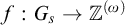 $f:G_{s} \rightarrow {\mathbb {Z}}^{(\omega )}$
. We want to define the addition on
$f:G_{s} \rightarrow {\mathbb {Z}}^{(\omega )}$
. We want to define the addition on $G_s$
according to the addition in
$G_s$
according to the addition in ${\mathbb {Z}}^{(\omega )}$
using the mapping f. In other words, for all
${\mathbb {Z}}^{(\omega )}$
using the mapping f. In other words, for all $m,n \in G_s$
, we want to define
$m,n \in G_s$
, we want to define $m+n=f^{-1}(f(m)+f(n))$
. However, at different stages, we will have different mappings so it is crucial to preserve the addition on
$m+n=f^{-1}(f(m)+f(n))$
. However, at different stages, we will have different mappings so it is crucial to preserve the addition on $G_s$
that we have previously defined. That means that if
$G_s$
that we have previously defined. That means that if $h:G_{s} \rightarrow {\mathbb {Z}}^{(\omega )}$
is an injective mapping used at a later stage, we require
$h:G_{s} \rightarrow {\mathbb {Z}}^{(\omega )}$
is an injective mapping used at a later stage, we require $f^{-1}(f(m)+f(n)) = h^{-1}(h(m)+h(n))$
.
$f^{-1}(f(m)+f(n)) = h^{-1}(h(m)+h(n))$
.
Choosing the mappings as in the following lemma is enough for this condition to be satisfied. Note that, since $(a_{1},a_{2},\dots )\in \mathbb {\mathbb {Z}}^{(\omega )}$
, it has finitely many nonzero coordinates, so any linear combination of the
$(a_{1},a_{2},\dots )\in \mathbb {\mathbb {Z}}^{(\omega )}$
, it has finitely many nonzero coordinates, so any linear combination of the $a_i$
’s is going to be finite.
$a_i$
’s is going to be finite.
Lemma 3.1. Let G be a nonempty set and ${f}:G\rightarrow \mathbb {\mathbb {Z}}^{(\omega )}$
an injective mapping. Let
${f}:G\rightarrow \mathbb {\mathbb {Z}}^{(\omega )}$
an injective mapping. Let $f(m)=(a_1,a_2,\dots )$
and let
$f(m)=(a_1,a_2,\dots )$
and let $h:G\rightarrow \mathbb {\mathbb {Z}}^{(\omega )}$
be an injective mapping defined in the following way:
$h:G\rightarrow \mathbb {\mathbb {Z}}^{(\omega )}$
be an injective mapping defined in the following way:
 $$ \begin{align*}h(m)=(\underset{i}{\sum}k_{1i}a_{i},\underset{i}{\sum}k_{2i}a_{i},\dots,\underset{i}{\sum}k_{ji}a_{i},\dots)\end{align*} $$
for all $m\in G$
, where the
$m\in G$
, where the $k_{ji}\in \mathbb {Z}$
are fixed for all
$k_{ji}\in \mathbb {Z}$
are fixed for all $i,j\in \mathbb {N}$
. Then
$i,j\in \mathbb {N}$
. Then $h^{-1}(h(m)+h(n))=f^{-1}(f(m)+f(n))$
for all
$h^{-1}(h(m)+h(n))=f^{-1}(f(m)+f(n))$
for all $m,n\in G$
.
$m,n\in G$
.
Proof. We will show that the claim holds for h defined in the following way $h(m)=(\underset {i}{\sum }k_{i}a_{i},0,0,0,\dots )$
for all
$h(m)=(\underset {i}{\sum }k_{i}a_{i},0,0,0,\dots )$
for all $m\in G$
, where the
$m\in G$
, where the $k_{i}\in \mathbb {Z}$
are fixed. The general claim will follow in a similar way. Let
$k_{i}\in \mathbb {Z}$
are fixed. The general claim will follow in a similar way. Let $m,n\in G$
and
$m,n\in G$
and $f(m)=(a_{1},a_{2},\dots )$
,
$f(m)=(a_{1},a_{2},\dots )$
, $f(n)=(b_{1},b_{2},\dots )$
. We have
$f(n)=(b_{1},b_{2},\dots )$
. We have
 $$ \begin{align*} \begin{aligned} h(m+n) & =h(f^{-1}(f(m)+f(n)))\\ &=h(f^{-1}(a_{1}+b_{1},a_{2}+b_{2},\dots))\\ &=(\underset{i}{\sum}k_{i}(a_{i}+b_{i}),0,0,0,\dots)\\ &=(\underset{i}{\sum}k_{i}a_{i},0,0,0,\dots)+(\underset{i}{\sum}k_{i}b_{i},0,0,0,\dots)\\ &=h(m)+h(n). \end{aligned} \end{align*} $$
Since h is injective, the claim follows.
We arrive at the first theorem of this article. The proof of this theorem follows a simple idea: if we have a $2$
-coloring of a group G with no monochromatic solutions to
$2$
-coloring of a group G with no monochromatic solutions to $x-y=b$
, then any two
$x-y=b$
, then any two $x_1,y_1$
such that
$x_1,y_1$
such that $|x_1-y_1|=b$
have to be colored in a different color. It follows that, if
$|x_1-y_1|=b$
have to be colored in a different color. It follows that, if $|x_1-y_1|=kb$
for some even integer k, then
$|x_1-y_1|=kb$
for some even integer k, then $x_1$
and
$x_1$
and $y_1$
have to be colored in the same color. Similarly, if
$y_1$
have to be colored in the same color. Similarly, if $|x_1-y_1|=kb$
for some odd integer k, then
$|x_1-y_1|=kb$
for some odd integer k, then $x_1$
and
$x_1$
and $y_1$
have to be colored in a different color. Following this idea, we will ensure that whenever the eth p.c. function halts, we have some
$y_1$
have to be colored in a different color. Following this idea, we will ensure that whenever the eth p.c. function halts, we have some $x_e$
and
$x_e$
and $y_e$
that are
$y_e$
that are $kb$
apart for some integer k. This is reflected in the requirements
$kb$
apart for some integer k. This is reflected in the requirements $R_e$
below.
$R_e$
below.
Theorem 3.1. There is a computable abelian group $(G,+,0)$
and an element
$(G,+,0)$
and an element $b\in G,b\neq 0$
such that, if c is a 2-coloring of G for which the equation
$b\in G,b\neq 0$
such that, if c is a 2-coloring of G for which the equation
 $$\begin{align*}x-y=b \end{align*}$$
has no monochromatic solutions, then c has PA degree.
Proof. We are going to build such a group G that will be isomorphic to $\mathbb {\mathbb {Z}}^{(\omega )}$
in stages. At each stage s, we will build a finite set
$\mathbb {\mathbb {Z}}^{(\omega )}$
in stages. At each stage s, we will build a finite set $G_{s}$
and an injective map
$G_{s}$
and an injective map $h_{s+1}:G_{s+1}\rightarrow \mathbb {Z}^{(\omega )}$
such that
$h_{s+1}:G_{s+1}\rightarrow \mathbb {Z}^{(\omega )}$
such that $h_{s}^{-1}(h_{s}(i)+h_{s}(j))=h_{s+1}^{-1}(h_{s+1}(i)+h_{s+1}(j))$
for all
$h_{s}^{-1}(h_{s}(i)+h_{s}(j))=h_{s+1}^{-1}(h_{s+1}(i)+h_{s+1}(j))$
for all $i,j\in G_{s}$
. Then
$i,j\in G_{s}$
. Then $G=\bigcup G_{s}$
and we will show
$G=\bigcup G_{s}$
and we will show $\underset {s\rightarrow \infty }{\lim }h_{s}(x)$
exists so
$\underset {s\rightarrow \infty }{\lim }h_{s}(x)$
exists so $h(x)=\underset {s\rightarrow \infty }{\lim }h_{s}(x)$
is going to be an injective map from G to
$h(x)=\underset {s\rightarrow \infty }{\lim }h_{s}(x)$
is going to be an injective map from G to $\mathbb {\mathbb {Z}}^{(\omega )}$
.
$\mathbb {\mathbb {Z}}^{(\omega )}$
.
While we are building G and h, we want to satisfy certain requirements, namely, ensuring that G is a computable group (we will denote these requirements by $A_{e}$
for addition and
$A_{e}$
for addition and $I_{e}$
for inverses) and that this group satisfies the conditions of the theorem (we will denote these requirements by
$I_{e}$
for inverses) and that this group satisfies the conditions of the theorem (we will denote these requirements by $R_{e}$
). Before the construction, we fix an element
$R_{e}$
). Before the construction, we fix an element $b\neq 0$
that will be mapped to
$b\neq 0$
that will be mapped to $1\in \mathbb {\mathbb {Z}}^{(\omega )}$
during the construction. Also, for every e, we fix two witnesses for
$1\in \mathbb {\mathbb {Z}}^{(\omega )}$
during the construction. Also, for every e, we fix two witnesses for $R_{e}$
, denoted by
$R_{e}$
, denoted by $x_{e}$
and
$x_{e}$
and $y_{e}$
. At the first stage s where we define
$y_{e}$
. At the first stage s where we define $h_{s}(x_{e})$
and
$h_{s}(x_{e})$
and $h_{s}(y_{e})$
, we define them by
$h_{s}(y_{e})$
, we define them by $0^{2e+1}1$
and
$0^{2e+1}1$
and $0^{2e+2}1$
, respectively, and this will change only when we redefine h for the purposes of
$0^{2e+2}1$
, respectively, and this will change only when we redefine h for the purposes of $R_{e}$
. Let
$R_{e}$
. Let $\{\Phi _{e}\}_{e \in \mathbb {N}}$
be the standard enumeration of the
$\{\Phi _{e}\}_{e \in \mathbb {N}}$
be the standard enumeration of the $2$
-valued p.c. functions. The requirements that we want to satisfy for all
$2$
-valued p.c. functions. The requirements that we want to satisfy for all $e\geq 0$
are the following:
$e\geq 0$
are the following: $A_{e}$
: If
$A_{e}$
: If $e=\langle i,j\rangle $
, there is an l such that
$e=\langle i,j\rangle $
, there is an l such that $h(l)=h(i)+h(j)$ $I_{e}$
: There is an element
$I_{e}$
: There is an element $-e$
such that
$-e$
such that $h(e)+h(-e)=0$ $R_{e}$
: If
$R_{e}$
: If $\Phi _{e}(e)\downarrow =0$
then
$\Phi _{e}(e)\downarrow =0$
then $h(y_{e})=h(x_{e})+kh(b)$
for some even integer k and if
$h(y_{e})=h(x_{e})+kh(b)$
for some even integer k and if $\Phi _{e}(e)\downarrow =1$
then
$\Phi _{e}(e)\downarrow =1$
then $h(y_{e})=h(x_{e})+kh(b)$
for some odd integer k.
$h(y_{e})=h(x_{e})+kh(b)$
for some odd integer k.
Construction:
Stage $0$
: Let
$0$
: Let $G_{0}=\{0,b\}$
,
$G_{0}=\{0,b\}$
, $h_{0}(0)=0$
and
$h_{0}(0)=0$
and $h_{0}(b)=1$
.
$h_{0}(b)=1$
.
Stage $s+1$
:
$s+1$
:
-
• If
$s=\langle e,3t+1\rangle $
for some
$e,t\in \mathbb {N}$
and
$e=\langle i,j\rangle $
for some
$i,j\in \mathbb {N}$
, check whether there is an l such that
$h_{s}(l)=h_{s}(i)+h_{s}(j)$
.-
– If there is such an l, let
$G_{s+1}=G_{s}$
and
$h_{s+1}(g)=h_{s}(g)$
for all
$g\in G_{s}$
. -
– If there is no such l, let l be the least natural number that has not been considered so far in the construction and set
$G_{s+1}=G_{s}\cup \{l\}$
,
$h_{s+1}(l)=h_{s}(i)+h_{s}(j)$
, and
$h_{s+1}(g)=h_{s}(g)$
for all
$g\in G_{s}$
.
-
-
• If
$s=\langle e,3t+2\rangle $
for some
$e,t\in \mathbb {N}$
, check whether there is a
$-e$
such that
$h_{s}(e)+h_{s}(-e)=h_{s}(0)$
.-
– If yes, let
$G_{s+1}=G_{s}$
and
$h_{s+1}(g)=h_{s}(g)$
for all
$g\in G_{s}$
. -
– If there is no such
$-e$
, let
$-e$
be the least natural number that has not been considered so far in the construction and set
$G_{s+1}=G_{s}\cup \{-e\}$
,
$h_{s+1}(-e)=-h_{s}(e)$
and
$h_{s+1}(g)=h_{s}(g)$
for all
$g\in G_{s}$
.
-
-
• If
$s=\langle e,3t+3\rangle $
for some
$e,t\in \mathbb {N}$
and-
– If
$h_{s}(x_{e})$
or
$h_{s}(y_{e})$
has not been defined, then let
$h_{s+1}(x_{e})=0^{2e+1}1$
and
$h_{s+1}(y_{e})=0^{2e+2}1$
,
$h_{s+1}(g)=h_{s}(g)$
for all
$g\in G_{s}$
and let
$G_{s+1}=G_{s}\cup \{x_{e},y_{e}\}$
. -
– If
$h_{s}(x_{e})$
and
$h_{s}(y_{e})$
have been defined and
$\Phi _{e}(e)[s]\downarrow =0$
, let k be a fresh large even number such that
$k>|(h_s({g_1}))_1|+|(h_s(g_2))_1|$
for all
$g_1, g_2 \in G_{s}$
, where
$(h_s({g}))_1$
is the first coordinate of
$h_s(g)$
. Then let
$G_{s+1}=G_{s}$
and for all
$g\in G_{s}$
, define where
$$ \begin{align*} h_{s+1}(g)=h_{s+1}(h_{s}^{-1}(a_{1},a_{2},\dots))=(a_{2e+3}k+a_{1}, a_{2},\dots,a_{2e+2}+a_{2e+3}, 0, a_{2e+4},\dots), \end{align*} $$
$a_{2e+3}k+a_{1}$
is in the first position,
$a_{2e+2}+a_{2e+3}$
is in the
$2e+2$
position, the
$0$
is in the
$2e+3$
position, and everything else is left unchanged. If, instead,
$\Phi _{e}(e)[s]\downarrow =1$
, choose k to be a fresh large odd number such that
$k>|(h_s({g_1}))_1|+|(h_s(g_2))_1|$
for all
$g_1, g_2 \in G_{s}$
. Define
$h_{s+1}(g)$
for all
$g\in G_{s}$
as above.
-


























The following claims show that this construction gives a group G that satisfies the theorem.
Claim 3.2. For all $s\in \mathbb {N}$
, if
$s\in \mathbb {N}$
, if $h_s$
is injective, then
$h_s$
is injective, then $h_{s+1}$
is injective.
$h_{s+1}$
is injective.
Proof. Let $h_s$
be injective and
$h_s$
be injective and $g_1,g_2\in G$
. Let
$g_1,g_2\in G$
. Let $h_s(g_1)=(a_1,a_2,\dots )$
and
$h_s(g_1)=(a_1,a_2,\dots )$
and $h_s(g_2)=(b_1,b_2,\dots )$
. Then
$h_s(g_2)=(b_1,b_2,\dots )$
. Then $h_{s+1}(g_{1})=(a_{2e+3}k+a_{1}, a_{2},\dots ,a_{2e+2}+a_{2e+3}, 0, a_{2e+4},\dots )$
and
$h_{s+1}(g_{1})=(a_{2e+3}k+a_{1}, a_{2},\dots ,a_{2e+2}+a_{2e+3}, 0, a_{2e+4},\dots )$
and $h_{s+1}(g_{2})=(b_{2e+3}k+b_{1}, b_{2},\dots ,b_{2e+2}+b_{2e+3}, 0, b_{2e+4},\dots )$
. Assume
$h_{s+1}(g_{2})=(b_{2e+3}k+b_{1}, b_{2},\dots ,b_{2e+2}+b_{2e+3}, 0, b_{2e+4},\dots )$
. Assume $h_{s+1}(g_{1})=h_{s+1}(g_{2})$
. Then all the coordinates of
$h_{s+1}(g_{1})=h_{s+1}(g_{2})$
. Then all the coordinates of $h_s(g_{1})$
and
$h_s(g_{1})$
and $h_s(g_{2})$
are equal, except possibly the first one, the
$h_s(g_{2})$
are equal, except possibly the first one, the $2e+2$
and the
$2e+2$
and the $2e+3$
one. We also have
$2e+3$
one. We also have $a_{2e+3}k+a_{1} =b_{2e+3}k+b_{1}$
and
$a_{2e+3}k+a_{1} =b_{2e+3}k+b_{1}$
and $ a_{2e+2}+a_{2e+3}=b_{2e+2}+b_{2e+3}$
. From there we get
$ a_{2e+2}+a_{2e+3}=b_{2e+2}+b_{2e+3}$
. From there we get
 $$ \begin{align*} \begin{aligned} a_{1}-b_{1} & = (b_{2e+2}-a_{2e+2})k\\ & = (b_{2e+3}-a_{2e+3})k \end{aligned} \end{align*} $$
and by our choice of k, this is only possible if $a_1=b_1$
,
$a_1=b_1$
, $a_{2e+2}=b_{2e+2}$
, and
$a_{2e+2}=b_{2e+2}$
, and $a_{2e+3}=b_{2e+3}$
. Hence,
$a_{2e+3}=b_{2e+3}$
. Hence, $h_{s}(g_1)=h_s(g_2)$
and since
$h_{s}(g_1)=h_s(g_2)$
and since $h_s$
is injective, we have
$h_s$
is injective, we have $g_1=g_2$
. This
$g_1=g_2$
. This $h_{s+1}$
is injective.
$h_{s+1}$
is injective.
Claim 3.3. $h_{s}^{-1}(h_{s}(i)+h_{s}(j))=h_{s+1}^{-1}(h_{s+1}(i)+h_{s+1}(j))$
for all
$h_{s}^{-1}(h_{s}(i)+h_{s}(j))=h_{s+1}^{-1}(h_{s+1}(i)+h_{s+1}(j))$
for all $i,j\in G_{s}$
.
$i,j\in G_{s}$
.
Claim 3.4. $h(x)=\underset {s\rightarrow \infty }{\lim }h_{s}(x)$
exists for all
$h(x)=\underset {s\rightarrow \infty }{\lim }h_{s}(x)$
exists for all $x\in G$
.
$x\in G$
.
Proof. We will show that for every $x\in G$
, there are only finitely many stages s such that
$x\in G$
, there are only finitely many stages s such that $h_{s+1}(x)\neq h_{s}(x)$
and then the claim follows. Denote the ith coordinate of
$h_{s+1}(x)\neq h_{s}(x)$
and then the claim follows. Denote the ith coordinate of $h_{s}(x)$
by
$h_{s}(x)$
by $(h_{s}(x))_{i}$
, for
$(h_{s}(x))_{i}$
, for $i,s\in \mathbb {N},i>0$
. Notice that for any
$i,s\in \mathbb {N},i>0$
. Notice that for any $x\in G$
,
$x\in G$
, $h_{s+1}(x)\neq h_{s}(x)$
can only happen at stages
$h_{s+1}(x)\neq h_{s}(x)$
can only happen at stages $s+1$
where we are considering some
$s+1$
where we are considering some $R_{e}$
, and the only coordinates that can change at that stage are
$R_{e}$
, and the only coordinates that can change at that stage are $(h_{s}(x))_{1},(h_{s}(x))_{2e+2}$
and
$(h_{s}(x))_{1},(h_{s}(x))_{2e+2}$
and $(h_{s}(x))_{2e+3}$
. We are going to refer to
$(h_{s}(x))_{2e+3}$
. We are going to refer to $(h_{s}(x))_{2e+2}$
and
$(h_{s}(x))_{2e+2}$
and $(h_{s}(x))_{2e+3}$
as the e-relevant coordinates. Notice that if all the e-relevant coordinates are
$(h_{s}(x))_{2e+3}$
as the e-relevant coordinates. Notice that if all the e-relevant coordinates are $0$
then
$0$
then $h_{s+1}(x)=h_{s}(x)$
.
$h_{s+1}(x)=h_{s}(x)$
.
Let $J>0$
be the index of the rightmost nonzero coordinate of
$J>0$
be the index of the rightmost nonzero coordinate of $h_{s}(x)$
. Then any
$h_{s}(x)$
. Then any $R_{e'}$
such that
$R_{e'}$
such that $2e'+2>J$
will not affect
$2e'+2>J$
will not affect $h_{s}(x)$
since all the
$h_{s}(x)$
since all the $e'$
-relevant coordinates are
$e'$
-relevant coordinates are $0$
. Hence there are only finitely many requirements that can change
$0$
. Hence there are only finitely many requirements that can change $h_{s}(x)$
. Once a requirement is satisfied, we never consider it again, so
$h_{s}(x)$
. Once a requirement is satisfied, we never consider it again, so $h_{s}(x)$
changes at most finitely many times.
$h_{s}(x)$
changes at most finitely many times.
Now, since $h_{s+1}(0)=h_{s+1}(0,0,0,\dots )=(0k+0,0,0,\dots ,0+0,0,0\dots )=(0,0,0,\dots )$ $h_{s+1}(b)=h_{s+1}(h_{s}^{-1}(1,0,0,\dots ))=(0k+1,0,0,\dots ,0+0,0,0,\dots )=(1,0,0,\dots )$
,
$h_{s+1}(b)=h_{s+1}(h_{s}^{-1}(1,0,0,\dots ))=(0k+1,0,0,\dots ,0+0,0,0,\dots )=(1,0,0,\dots )$
,
the values of $h(0)$
and
$h(0)$
and $h(b)$
never change throughout the construction, so we have
$h(b)$
never change throughout the construction, so we have $h(0)=0,h(b)=1$
.
$h(0)=0,h(b)=1$
.
Similarly, for every s we have, $h_{s+1}(x_{e})=h_{s}(x_{e})$
and
$h_{s+1}(x_{e})=h_{s}(x_{e})$
and $h_{s+1}(y_{e})=h_{s+1}(x_{e}) + kh_{s+1}(b)$
for some positive integer k, and hence
$h_{s+1}(y_{e})=h_{s+1}(x_{e}) + kh_{s+1}(b)$
for some positive integer k, and hence $h(y_{e})=h(x_{e})+kh(b)$
.
$h(y_{e})=h(x_{e})+kh(b)$
.
Claim 3.6. G as defined above satisfies the conditions of the theorem.
Proof. G is a computable abelian group since for all $i,j\in G$
,
$i,j\in G$
, $i+j,-i,-j$
are defined at some stage and to compute
$i+j,-i,-j$
are defined at some stage and to compute $i+j$
, we only need to find the first stage s at which
$i+j$
, we only need to find the first stage s at which $h_{s}^{-1}(h_{s}(i)+h_{s}(j))$
is defined. Let
$h_{s}^{-1}(h_{s}(i)+h_{s}(j))$
is defined. Let $c:G\rightarrow \{c_{1},c_{2}\}$
be a
$c:G\rightarrow \{c_{1},c_{2}\}$
be a $2$
-coloring of G with no monochromatic solutions to
$2$
-coloring of G with no monochromatic solutions to $x-y=b$
. Define a function g in the following way:
$x-y=b$
. Define a function g in the following way:
 $$\begin{align*}g(e)=\begin{cases} \begin{array}{@{}cc} 0, & \text{if } {c(x_{e})=c(y_{e})}\\ 1, & \text{if } {c(x_{e})\ne c(y_{e})} \end{array}.\end{cases} \end{align*}$$
If $\Phi _{e}(e)\downarrow $
, then there is a stage s at which
$\Phi _{e}(e)\downarrow $
, then there is a stage s at which $\Phi _{e}(e)[s]\downarrow $
. Hence there is an integer k such that
$\Phi _{e}(e)[s]\downarrow $
. Hence there is an integer k such that $h(y_{e})=h(x_{e})+kh(b)$
. Since c has no monochromatic solutions to
$h(y_{e})=h(x_{e})+kh(b)$
. Since c has no monochromatic solutions to $x-y=b$
, it follows that
$x-y=b$
, it follows that $c(x+b)\neq c(x)$
for any
$c(x+b)\neq c(x)$
for any $x\in G$
. Thus, if k is even, we have
$x\in G$
. Thus, if k is even, we have $c(x_{e})=c(x_{e}+kb)=c(y_{e})$
and hence,
$c(x_{e})=c(x_{e}+kb)=c(y_{e})$
and hence, $g(e)=0=\Phi _{e}(e)$
. Similarly, if k is odd, it must be the case that
$g(e)=0=\Phi _{e}(e)$
. Similarly, if k is odd, it must be the case that $c(x_{e})\neq c(y_{e})$
and hence,
$c(x_{e})\neq c(y_{e})$
and hence, $g(e)=1=\Phi _{e}(e)$
. We conclude that c computes a
$g(e)=1=\Phi _{e}(e)$
. We conclude that c computes a $\{0,1\}$
-valued extension of the function
$\{0,1\}$
-valued extension of the function $e\mapsto \Phi _{e}(e)$
, so c has PA degree.
$e\mapsto \Phi _{e}(e)$
, so c has PA degree.
Thus we built a group G that is isomorphic to a subgroup of $\mathbb {Z}^{(\omega )}$
. We claim that G is infinitely generated. Assume otherwise, and let
$\mathbb {Z}^{(\omega )}$
. We claim that G is infinitely generated. Assume otherwise, and let $g_{1},\dots ,g_{l}$
be the generators. Let L be the maximal nonzero coordinate in
$g_{1},\dots ,g_{l}$
be the generators. Let L be the maximal nonzero coordinate in $h(g_{1}),\dotsc ,h(g_{l})$
. By our construction, we will eventually add an element g to our group such that the maximal nonzero coordinate of
$h(g_{1}),\dotsc ,h(g_{l})$
. By our construction, we will eventually add an element g to our group such that the maximal nonzero coordinate of $h(g)$
is
$h(g)$
is $>L$
. Then g cannot be written as a linear combination of
$>L$
. Then g cannot be written as a linear combination of $g_{1},\dots ,g_{l}$
. Hence G is infinitely generated and since all infinitely generated subgroups of
$g_{1},\dots ,g_{l}$
. Hence G is infinitely generated and since all infinitely generated subgroups of $\mathbb {Z}^{(\omega )}$
are isomorphic to
$\mathbb {Z}^{(\omega )}$
are isomorphic to $\mathbb {Z}^{(\omega )}$
, we get that, in fact, our group G is isomorphic to
$\mathbb {Z}^{(\omega )}$
, we get that, in fact, our group G is isomorphic to $\mathbb {Z}^{(\omega )}$
.
$\mathbb {Z}^{(\omega )}$
.
Note that if the $2$
-colorings of an abelian group G are represented by a binary tree, then we can search through the tree and cut all branches where we find a monochromatic solution to
$2$
-colorings of an abelian group G are represented by a binary tree, then we can search through the tree and cut all branches where we find a monochromatic solution to $x-y=b$
. Thus we can find an infinite path in this tree that will represent a coloring with no monochromatic solutions to the equation and PA degrees compute these paths. Similarly, since the PA degrees compute paths in k-branching trees for a fixed integer
$x-y=b$
. Thus we can find an infinite path in this tree that will represent a coloring with no monochromatic solutions to the equation and PA degrees compute these paths. Similarly, since the PA degrees compute paths in k-branching trees for a fixed integer $k>2$
, we get that the PA degrees are an upper bound for the case
$k>2$
, we get that the PA degrees are an upper bound for the case $n\geq 2$
. Hence the PA degrees are the best possible bound for this problem.
$n\geq 2$
. Hence the PA degrees are the best possible bound for this problem.
Proposition 3.7. Let $n \in \mathbb {N}, n>0$
. For every computable abelian group G and every
$n \in \mathbb {N}, n>0$
. For every computable abelian group G and every $b\in G, b\neq 0$
, there is a k-coloring of PA degree with no pairwise monochromatic solution to
$b\in G, b\neq 0$
, there is a k-coloring of PA degree with no pairwise monochromatic solution to
 $$ \begin{align*}(x_{1}-y_{1})+\dots+(x_{n}-y_{n})=b,\end{align*} $$
where
 $$\begin{align*}k=\begin{cases} \hspace{4mm}2n & \text{if }2\mid \mathrm{ord}(b) \text{ or } \mathrm{ord}(b)=\infty\\ \left\lceil \dfrac{2np}{p-1}\right\rceil & \text{if }\mathrm{ord}(b) \text{ is odd and }p\text{ is the largest prime divisor of }\mathrm{ord}(b) \end{cases}. \end{align*}$$
Theorem 3.1 gives the best possible result of this sort.
Proposition 3.8. Let $n>2, n \in \mathbb {N}$
. Then for every computable abelian group G, there is a computable n-coloring c with no monochromatic solutions to
$n>2, n \in \mathbb {N}$
. Then for every computable abelian group G, there is a computable n-coloring c with no monochromatic solutions to $x-y=b$
, where
$x-y=b$
, where $b\in G, b\neq 0$
.
$b\in G, b\neq 0$
.
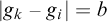
Proof. Let $G=\{g_1,g_2,g_3,\dots \}$
be a computable abelian group. It is enough to show that the claim holds for
$G=\{g_1,g_2,g_3,\dots \}$
be a computable abelian group. It is enough to show that the claim holds for $n=3$
. Let
$n=3$
. Let $c_1,c_2,c_3$
be three different colors. Color
$c_1,c_2,c_3$
be three different colors. Color $g_1$
with
$g_1$
with $c_1$
. If
$c_1$
. If $|g_1-g_2|=b$
, color
$|g_1-g_2|=b$
, color $g_2$
with
$g_2$
with $c_2$
. If not, color
$c_2$
. If not, color $g_2$
with
$g_2$
with $c_1$
. Continue in a similar manner. For
$c_1$
. Continue in a similar manner. For $g_k$
, check whether
$g_k$
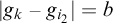
, check whether $|g_k-g_i|=b$
for all
$|g_k-g_i|=b$
for all $i<k$
. There are three situations that can occur:
$i<k$
. There are three situations that can occur:
-
• There is exactly one
$i<k$
such that
$|g_k-g_i|=b$
. Then color
$g_k$
with a different color than
$g_i$
. -
• There is no such
$i<k$
. Then color
$g_k$
with
$c_1$
. -
• There are two
$i_1, i_2<k$
such that
$|g_k-g_{i_1}|=b$
and
$|g_k-g_{i_2}|=b$
. In this case, color
$g_k$
with a different color than
$g_1$
and
$g_2$
. This is possible since we have three colors.





As we mentioned previously, the same exact proof as in Theorem 3.1 applies to the Straus* theorem with the additional caveat that we also need a mapping from G to G. We can take this mapping to be the identity mapping, and in particular, it is computable.
Theorem 3.1* There is a computable abelian group $(G,+,0)$
, an element
$(G,+,0)$
, an element $b\in G,b\neq 0$
and a computable mapping
$b\in G,b\neq 0$
and a computable mapping $f_1:G\rightarrow G$
such that, if c is a 2-coloring of G for which the equation
$f_1:G\rightarrow G$
such that, if c is a 2-coloring of G for which the equation
 $$\begin{align*}f_1(x)-f_1(y)=b \end{align*}$$
has no monochromatic solutions, then c has PA degree.
The * version of Proposition 3.7 also holds, so we get that the PA degrees are the best possible computability-theoretic bounds for the Straus* theorem in the case $n=1$
.
$n=1$
.
If we add the additional condition that there is an $m>0$
such that for every
$m>0$
such that for every $k\in \mathbb {Z}$
, all the
$k\in \mathbb {Z}$
, all the $kmb$
are colored with the same color, we get that the PA degrees are a lower bound for the case
$kmb$
are colored with the same color, we get that the PA degrees are a lower bound for the case $n\geq 2$
. The idea of the proof is similar to the case
$n\geq 2$
. The idea of the proof is similar to the case $n=1$
. By adding this condition, we know the behaviour of any
$n=1$
. By adding this condition, we know the behaviour of any $2n$
-coloring with no pairwise monochromatic solutions to
$2n$
-coloring with no pairwise monochromatic solutions to $(x_{1}-y_{1})+\dots +(x_{n}-y_{n})=b$
. Namely, if
$(x_{1}-y_{1})+\dots +(x_{n}-y_{n})=b$
. Namely, if $x_1$
and
$x_1$
and $y_1$
are such that
$y_1$
are such that $|x_1-y_1|=(km+1)b$
for some
$|x_1-y_1|=(km+1)b$
for some $k\in \mathbb {Z}$
, then they have to be colored with a different color. Otherwise, these
$k\in \mathbb {Z}$
, then they have to be colored with a different color. Otherwise, these $x_1$
and
$x_1$
and $y_1$
together with any
$y_1$
together with any $x_2$
and
$x_2$
and $y_2$
such that
$y_2$
such that $|x_2-y_2|=kmb$
are going to give a pairwise monochromatic solution to the equation
$|x_2-y_2|=kmb$
are going to give a pairwise monochromatic solution to the equation $(x_{1}-y_{1})+\dots +(x_{n}-y_{n})=b$
for any
$(x_{1}-y_{1})+\dots +(x_{n}-y_{n})=b$
for any $n\geq 2$
.
$n\geq 2$
.
Theorem 3.2. Let $n\in \mathbb {N},n\geq 2$
. There is a computable group
$n\in \mathbb {N},n\geq 2$
. There is a computable group $(G,+,0)$
and an element
$(G,+,0)$
and an element $b\in G,b\neq 0$
such that, if c is a
$b\in G,b\neq 0$
such that, if c is a $2n$
-coloring of G for which the equation
$2n$
-coloring of G for which the equation
 $$ \begin{align*} (x_{1}-y_{1})+\dots+(x_{n}-y_{n})=b \end{align*} $$
has no pairwise monochromatic solutions and there is an $m>0$
such that for every
$m>0$
such that for every $k\in \mathbb {Z}$
, all the
$k\in \mathbb {Z}$
, all the $kmb$
are colored with the same color, then c has PA degree.
$kmb$
are colored with the same color, then c has PA degree.
Proof. Similarly to the previous theorem, we are going to build such a group G in stages and at every stage s, we will define $G_{s}$
and an injective mapping
$G_{s}$
and an injective mapping $h_{s}:G_{s}\rightarrow \mathbb {Z}^{(\omega )}$
such that
$h_{s}:G_{s}\rightarrow \mathbb {Z}^{(\omega )}$
such that $h_{s}^{-1}(h_{s}(i)+h_{s}(j))=h_{s+1}^{-1}(h_{s+1}(i)+h_{s+1}(j))$
for all
$h_{s}^{-1}(h_{s}(i)+h_{s}(j))=h_{s+1}^{-1}(h_{s+1}(i)+h_{s+1}(j))$
for all $i,j\in G_{s}$
. Then
$i,j\in G_{s}$
. Then $G=\bigcup G_{s}$
. At the beginning of the construction, we fix an element
$G=\bigcup G_{s}$
. At the beginning of the construction, we fix an element $b\neq 0$
that will be sent to
$b\neq 0$
that will be sent to $1\in \mathbb {\mathbb {Z}}^{(\omega )}$
during the construction. Also, for every e, we fix
$1\in \mathbb {\mathbb {Z}}^{(\omega )}$
during the construction. Also, for every e, we fix $2n+1$
witnesses
$2n+1$
witnesses $x_{ei}, i=1,\dots ,2n+1$
, that will be sent to
$x_{ei}, i=1,\dots ,2n+1$
, that will be sent to $0^{(e-1)(2n+1)+i-1}1$
during the construction at the first stage they are defined. Let
$0^{(e-1)(2n+1)+i-1}1$
during the construction at the first stage they are defined. Let $\{\Phi _{e}\}_{e \in \mathbb {N}}$
be the standard enumeration of the
$\{\Phi _{e}\}_{e \in \mathbb {N}}$
be the standard enumeration of the $\binom {2n+1}{2}$
-valued p.c. functions. Since we want to ensure that the group we are building is computable, the requirements
$\binom {2n+1}{2}$
-valued p.c. functions. Since we want to ensure that the group we are building is computable, the requirements $A_{e}$
and
$A_{e}$
and $I_{e}$
are exactly as before:
$I_{e}$
are exactly as before: $A_{e}$
: If
$A_{e}$
: If $e=\langle i,j\rangle $
, there is an l such that
$e=\langle i,j\rangle $
, there is an l such that $h(l)=h(i)+h(j).$ $I_{e}$
: There is an element
$I_{e}$
: There is an element $-e$
such that
$-e$
such that $h(e)+h(-e)=h(0).$ $R_{e}$
: Fix a bijection from
$R_{e}$
: Fix a bijection from $\{0,1,\dots ,\binom {2n+1}{2}\}$
to
$\{0,1,\dots ,\binom {2n+1}{2}\}$
to $\{(x_{ei},x_{ej})|1\leq i \leq j \leq 2n+1\}$
. Let
$\{(x_{ei},x_{ej})|1\leq i \leq j \leq 2n+1\}$
. Let $(x_{ei_{1}},x_{ei_{2}})$
be the image of i under this bijection. If
$(x_{ei_{1}},x_{ei_{2}})$
be the image of i under this bijection. If $\Phi _{e}(e)\downarrow =i$
, then there is an integer k such that
$\Phi _{e}(e)\downarrow =i$
, then there is an integer k such that $h(x_{ei_{2}})=h(x_{ei_{1}})+(mk+1)h(b)$
.
$h(x_{ei_{2}})=h(x_{ei_{1}})+(mk+1)h(b)$
.
Construction:
Stage $0$
: Let
$0$
: Let $G_{0}=\{0,b\}$
,
$G_{0}=\{0,b\}$
, $h_{0}(0)=0$
and
$h_{0}(0)=0$
and $h_{0}(b)=1$
.
$h_{0}(b)=1$
.
Stage $s+1$
:
$s+1$
:
-
• If
$s=\langle e,3t+1\rangle $
or
$s=\langle e,3t+2\rangle $
for some
$e,t\in \mathbb {N}$
and
$e=\langle i,j\rangle $
for some
$i,j\in \mathbb {N}$
, we proceed in the same manner as before. -
• If
$s=\langle e,3t+3\rangle $
for some
$e,t\in \mathbb {N}$
and-
– If there exists a
$j\in \{1,2,\dots ,2n+1\}$
such that
$h_{s}(x_{ej})$
has not been defined, then let
$h_{s+1}(x_{ej})=0^{(e-1)(2n+1)+j-1}1$
for all such j and
$G_{s+1}=G_{s}\cup \{x_{e1},\dots ,x_{e(2n+1)}\}$
. -
– If
$h_{s}(x_{ej})$
has been defined for all
$j\in \{1,2,\dots ,2n+1\}$
and
$\Phi _{e}(e)[s]\downarrow =i$
for some
$i\in \{1,2,\dots ,\binom {2n+1}{2}\}$
, let
$j_{1}$
and
$j_{2}$
be the positions of the
$1$
in
$x_{ei_{1}}$
and
$x_{ei_{2}}$
, respectively. Let k be a fresh large number
$k>|(h_s({g_1}))_1|+|(h_s(g_2))_1|$
for all
$g_1, g_2 \in G_{s}$
, where
$(h_s({g}))_1$
is the first coordinate of
$h_s(g)$
. Then for all
$g\in G_{s}$
, if
$h_s(g)=(a_1,a_2,\dots )$
, define where
$$ \begin{align*}h_{s+1}(g)=((mk+1)a_{j{2}}+a_{1},a_{2},\dots,a_{j_{1}}+a_{j_{2}},a_{j_{1}+1},\dots,0,a_{j_{2}+1},\dots),\end{align*} $$
$a_{j_{1}}+a_{j_{2}}$
is at the
$j_{1}$
position and the
$j_{2}$
position is
$0$
. Let
$G_{s+1}=G_{s}$
.
-













The following claims are exactly as in the previous theorem and the proofs are very similar so we will omit them.
Claim 3.9. $h_{s}^{-1}(h_{s}(i)+h_{s}(j))=h_{s+1}^{-1}(h_{s+1}(i)+h_{s+1}(j))$
for all
$h_{s}^{-1}(h_{s}(i)+h_{s}(j))=h_{s+1}^{-1}(h_{s+1}(i)+h_{s+1}(j))$
for all $i,j\in G_{s}$
.
$i,j\in G_{s}$
.
Claim 3.10.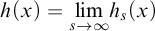 $h(x)=\underset {s\rightarrow \infty }{\lim }h_{s}(x)$
exists for all
$h(x)=\underset {s\rightarrow \infty }{\lim }h_{s}(x)$
exists for all $x\in G$
.
$x\in G$
.
Claim 3.11. h is injective.
The only claim left to prove is the following.
Claim 3.12. $G=\bigcup G_{s}$
as defined by this construction satisfies the conditions of the theorem.
$G=\bigcup G_{s}$
as defined by this construction satisfies the conditions of the theorem.
Proof. G is a computable abelian group for the same reasons as above. Let c be a coloring of G with no pairwise monochromatic solutions to $(1)$
. Define a function
$(1)$
. Define a function $g:\mathbb {N}\rightarrow \{0,1,2,\dots ,\binom {2n+1}{2}\}$
in the following way:
$g:\mathbb {N}\rightarrow \{0,1,2,\dots ,\binom {2n+1}{2}\}$
in the following way:
 $$ \begin{align*} g(e)=\text{the least }i\text{ such that }c(x_{ei_{1}})=c(x_{ei_{2}}). \end{align*} $$
Such an i exists since for every e, we have $2n+1$
witnesses and these are enough to ensure that we have a monochromatic pair among them. Assume
$2n+1$
witnesses and these are enough to ensure that we have a monochromatic pair among them. Assume $\Phi _{e}(e)\downarrow =i$
. Then there is a large k such that
$\Phi _{e}(e)\downarrow =i$
. Then there is a large k such that $h(x_{ei_{2}})=h(x_{ei_{1}})+(mk+1)h(b)$
. Now, by our assumption,
$h(x_{ei_{2}})=h(x_{ei_{1}})+(mk+1)h(b)$
. Now, by our assumption, $mkb$
and
$mkb$
and $2mkb$
are colored with the same color, so these, together with
$2mkb$
are colored with the same color, so these, together with $x_{ei_{1}}$
and
$x_{ei_{1}}$
and $x_{ei_{2}}$
give a pairwise monochromatic solution to
$x_{ei_{2}}$
give a pairwise monochromatic solution to $(1)$
. Hence, for all e, if
$(1)$
. Hence, for all e, if $\Phi _{e}(e)\downarrow $
, then
$\Phi _{e}(e)\downarrow $
, then $\Phi _{e}(e)\neq g(e)$
. Thus g is a
$\Phi _{e}(e)\neq g(e)$
. Thus g is a $\binom {2n+1}{2}$
-bounded DNC function, so c has PA degree.
$\binom {2n+1}{2}$
-bounded DNC function, so c has PA degree.
Similarly to the previous theorem, we get that the constructed group G is isomorphic to $\mathbb {Z}^{(\omega )}$
.
$\mathbb {Z}^{(\omega )}$
.
Using similar reasoning as before, the PA degrees are the best possible bounds for this problem.
However, the version of Proposition 3.8 corresponding to Theorem 3.2 no longer holds. Instead we get a generalized version of Theorem 3.2 that works for every finite coloring. Following a similar proof, we show the existence of a computable abelian group such that every finite coloring that satisfies the same conditions as in Theorem 3.2 has PA degree.
Theorem 3.3. Let $n\in \mathbb {N},n\geq 2$
. There is a computable abelian group
$n\in \mathbb {N},n\geq 2$
. There is a computable abelian group $(G,+,0)$
and an element
$(G,+,0)$
and an element $b\in G,b\neq 0$
such that, if c is a finite coloring of G for which the equation
$b\in G,b\neq 0$
such that, if c is a finite coloring of G for which the equation
 $$ \begin{align*} (x_{1}-y_{1})+\dots+(x_{n}-y_{n})=b \end{align*} $$
has no pairwise monochromatic solutions and there is an $m>0$
such that for every
$m>0$
such that for every $k\in \mathbb {Z}$
, all the
$k\in \mathbb {Z}$
, all the $kmb$
are colored with the same color, then c has PA degree.
$kmb$
are colored with the same color, then c has PA degree.
Proof. The proof is very similar to the proof of the previous theorem, so we will just point out the differences. The main difference is that we want the theorem to hold for all $N\geq 1$
at the same time. Towards this, for every
$N\geq 1$
at the same time. Towards this, for every $e\in \mathbb {N}$
and every
$e\in \mathbb {N}$
and every $N\geq 1$
, we fix
$N\geq 1$
, we fix $N+1$
witnesses to ensure that there is at least one monochromatic pair among them. Notice that for
$N+1$
witnesses to ensure that there is at least one monochromatic pair among them. Notice that for $N<2n$
, there is no N-coloring that satisfies the conditions of the theorem, so we will only consider
$N<2n$
, there is no N-coloring that satisfies the conditions of the theorem, so we will only consider $N\geq 2n$
. We will have different requirements
$N\geq 2n$
. We will have different requirements $R_e$
for all N and since these will now depend on N as well, we will denote them by
$R_e$
for all N and since these will now depend on N as well, we will denote them by $R_{\langle e, N\rangle }$
. They will be exactly the same as before, with
$R_{\langle e, N\rangle }$
. They will be exactly the same as before, with $2n$
replaced by N. The proof now follows in a very similar way. However, instead of obtaining one
$2n$
replaced by N. The proof now follows in a very similar way. However, instead of obtaining one $\binom {2n+1}{2}$
-bounded
$\binom {2n+1}{2}$
-bounded $\text {DNC}$
function, we will have a different
$\text {DNC}$
function, we will have a different $\binom {N+1}{2}$
-bounded
$\binom {N+1}{2}$
-bounded $\text {DNC}$
function for every
$\text {DNC}$
function for every $N\geq 2n$
.
$N\geq 2n$
.
Similarly to Theorem 3.1*, by taking $f_1,f_2,\dots ,f_n$
to be the identity mapping, we obtain * versions of Theorems 3.2 and 3.3.
$f_1,f_2,\dots ,f_n$
to be the identity mapping, we obtain * versions of Theorems 3.2 and 3.3.
Theorem 3.2* Let $n\in \mathbb {N},n\geq 2$
. There is a computable group
$n\in \mathbb {N},n\geq 2$
. There is a computable group $(G,+,0)$
, an element
$(G,+,0)$
, an element $b\in G,b\neq 0$
and computable mappings
$b\in G,b\neq 0$
and computable mappings $f_1,f_2,\dots ,f_n$
such that, if c is a
$f_1,f_2,\dots ,f_n$
such that, if c is a $2n$
-coloring of G for which the equation
$2n$
-coloring of G for which the equation
 $$ \begin{align*}(f_1(x_{1})-f_1(y_{1}))+\dots+(f_n(x_{n})-f_n(y_{n}))=b\end{align*} $$
has no pairwise monochromatic solutions and there is an $m>0$
such that for every
$m>0$
such that for every $k\in \mathbb {Z}$
, all the
$k\in \mathbb {Z}$
, all the $kmb$
are colored with the same color, then c has PA degree.
$kmb$
are colored with the same color, then c has PA degree.
Theorem 3.3*. Let $n\in \mathbb {N},n\geq 2$
. There is a computable abelian group
$n\in \mathbb {N},n\geq 2$
. There is a computable abelian group $(G,+,0)$
, an element
$(G,+,0)$
, an element $b\in G,b\neq 0$
and computable mappings
$b\in G,b\neq 0$
and computable mappings $f_1,f_2,\dots ,f_n$
such that, if c is a finite coloring of G for which the equation
$f_1,f_2,\dots ,f_n$
such that, if c is a finite coloring of G for which the equation
 $$ \begin{align*}(f_1(x_{1})-f_1(y_{1}))+\dots+(f_n(x_{n})-f_n(y_{n}))=b\end{align*} $$
has no pairwise monochromatic solutions and there is an $m>0$
such that for every
$m>0$
such that for every $k\in \mathbb {Z}$
, all the
$k\in \mathbb {Z}$
, all the $kmb$
are colored with the same color, then c has PA degree.
$kmb$
are colored with the same color, then c has PA degree.
The PA degrees are again the best possible bounds for Straus* in the case $n\geq 2$
with this additional condition added.
$n\geq 2$
with this additional condition added.
4 The reverse mathematics of Straus’ theorem
In this section, we will investigate the reverse mathematics of Straus’ theorem. The PA degrees as bounds in the previous theorems already indicate that Straus’ theorem might be equivalent to $\mathrm {WKL}_0$
over
$\mathrm {WKL}_0$
over $\mathrm {RCA}_{0}$
. Indeed, we show that the case
$\mathrm {RCA}_{0}$
. Indeed, we show that the case $n=1$
is equivalent to
$n=1$
is equivalent to $\mathrm {WKL}_0$
(Theorem 4.1) and we show one direction of the equivalence in the case
$\mathrm {WKL}_0$
(Theorem 4.1) and we show one direction of the equivalence in the case $n\geq 2$
(Theorem 4.2). Then, using the reverse mathematics of Jockusch’s theorem, we give a reverse-mathematical version of Theorems 3.2 and 3.3.
$n\geq 2$
(Theorem 4.2). Then, using the reverse mathematics of Jockusch’s theorem, we give a reverse-mathematical version of Theorems 3.2 and 3.3.
Theorem 4.1. Over $\mathrm {RCA}_{0}$
,
$\mathrm {RCA}_{0}$
, $\mathrm {WKL}_0$
is equivalent to the following statement.
$\mathrm {WKL}_0$
is equivalent to the following statement.
For every abelian group G and every element $b\in G,b\neq 0$
, there is a k-coloring of G for which the equation
$b\in G,b\neq 0$
, there is a k-coloring of G for which the equation $x-y=b$
has no monochromatic solutions, where
$x-y=b$
has no monochromatic solutions, where
 $$\begin{align*}k=\begin{cases} \hspace{2mm}2 & \text{if }2\mid \mathrm{ord}(b) \text{ or } \mathrm{ord}(b)=\infty\\ \hspace{2mm}3 & \text{if }\mathrm{ord}(b) \text{ is odd } \end{cases}. \end{align*}$$
Proof. Assume $\mathrm {WKL}_{0}$
. Let
$\mathrm {WKL}_{0}$
. Let $G=\{a_{1},a_{2},\dots \}$
be an abelian group and let
$G=\{a_{1},a_{2},\dots \}$
be an abelian group and let $b\in G,b\neq 0$
be an element of infinite order. Consider the tree T of all
$b\in G,b\neq 0$
be an element of infinite order. Consider the tree T of all $2$
-colorings of G with no monochromatic solutions to
$2$
-colorings of G with no monochromatic solutions to $x-y=b$
, where every level of the tree represents an element of G. We need to show that this tree is infinite, and then by an application of Weak König’s lemma, the statement
$x-y=b$
, where every level of the tree represents an element of G. We need to show that this tree is infinite, and then by an application of Weak König’s lemma, the statement $\text {(ii)}$
follows for the case when
$\text {(ii)}$
follows for the case when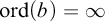 $\mathrm{ord}(b)=\infty $
. For
$\mathrm{ord}(b)=\infty $
. For $m\in \mathbb {N},m>0$
, consider the set
$m\in \mathbb {N},m>0$
, consider the set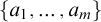 $\{a_{1},\dots ,a_{m}\}$
and consider the following graph on m vertices. Let the vertices of the graph be
$\{a_{1},\dots ,a_{m}\}$
and consider the following graph on m vertices. Let the vertices of the graph be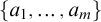 $\{a_{1},\dots ,a_{m}\}$
and say
$\{a_{1},\dots ,a_{m}\}$
and say $a_{i}$
and
$a_{i}$
and $a_{j}$
for
$a_{j}$
for $i,j\in \{1,\dots ,m\}$
are connected if and only if
$i,j\in \{1,\dots ,m\}$
are connected if and only if $|a_{i}-a_{j}|=b$
. Notice that for every
$|a_{i}-a_{j}|=b$
. Notice that for every $a_{i},i\in \{1,\dots ,m\}$
, there are at most two elements
$a_{i},i\in \{1,\dots ,m\}$
, there are at most two elements $a_{j},a_{k}\in \{a_{1},a_{1},\dots ,a_{m}\}\backslash \{a_{i}\}$
that are connected to it. We will show that this graph contains no loops. Assume
$a_{j},a_{k}\in \{a_{1},a_{1},\dots ,a_{m}\}\backslash \{a_{i}\}$
that are connected to it. We will show that this graph contains no loops. Assume $a_{i_{1}},\dots ,a_{i_{l}}$
where
$a_{i_{1}},\dots ,a_{i_{l}}$
where $l,i_1,i_2,\dots ,i_l\in \{1,\dots ,m\}$
form a loop in this exact order (
$l,i_1,i_2,\dots ,i_l\in \{1,\dots ,m\}$
form a loop in this exact order ( $a_{i_1}$
is connected to
$a_{i_1}$
is connected to $a_{i_2}$
, which is connected to
$a_{i_2}$
, which is connected to $a_{i_3}$
and so on). Without loss of generality, assume that
$a_{i_3}$
and so on). Without loss of generality, assume that $a_{i_{1}}-a_{i_{2}}=b$
. Then it must be the case that
$a_{i_{1}}-a_{i_{2}}=b$
. Then it must be the case that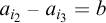 $a_{i_{2}}-a_{i_{3}}=b$
,
$a_{i_{2}}-a_{i_{3}}=b$
, $a_{i_{3}}-a_{i_{4}}=b,\dots ,a_{i_{l-1}}-a_{i_{l}}=b,a_{i_{l}}-a_{i_{1}}=b$
. This is a contradiction since if we add the left-hand sides and right-hand sides of these equations, we get
$a_{i_{3}}-a_{i_{4}}=b,\dots ,a_{i_{l-1}}-a_{i_{l}}=b,a_{i_{l}}-a_{i_{1}}=b$
. This is a contradiction since if we add the left-hand sides and right-hand sides of these equations, we get $0=lb$
, but b has infinite order. Now we can
$0=lb$
, but b has infinite order. Now we can $2$
-color
$2$
-color $a_{1},a_{2},\dots ,a_{m}$
such that there are no monochromatic solutions to
$a_{1},a_{2},\dots ,a_{m}$
such that there are no monochromatic solutions to $x-y=b$
by coloring any two connected elements with different colors. Thus T has an element of length m for every
$x-y=b$
by coloring any two connected elements with different colors. Thus T has an element of length m for every $m\in \mathbb {N}$
, so it is infinite. Hence, by Weak König’s lemma, T has an infinite path, i.e., a
$m\in \mathbb {N}$
, so it is infinite. Hence, by Weak König’s lemma, T has an infinite path, i.e., a $2$
-coloring of G with no monochromatic solutions to
$2$
-coloring of G with no monochromatic solutions to $x-y=b$
.
$x-y=b$
.
The cases when ord(b) is finite are similar. In the even case, there might be loops on an even amount of vertices, but this will not cause a problem since we can always color such a loop with two colors so that no two neighboring vertices have the same color. In the odd case, there might be loops on an odd number of vertices, which can always be colored with three colors so that no two neighboring vertices have the same color.
For the other direction, assume $\text {(ii)}$
. Notice that in the proof of Theorem 3.1, we showed that
$\text {(ii)}$
. Notice that in the proof of Theorem 3.1, we showed that $h(x)=\underset {s\rightarrow \infty }{\lim }h_{s}(x)$
exists, but, even though it made the proof more convenient, that was not necessary for the construction. With that in mind, it is not hard to see that the whole proof can be carried out in
$h(x)=\underset {s\rightarrow \infty }{\lim }h_{s}(x)$
exists, but, even though it made the proof more convenient, that was not necessary for the construction. With that in mind, it is not hard to see that the whole proof can be carried out in $\mathrm {RCA}_{0}$
. Now, consider two
$\mathrm {RCA}_{0}$
. Now, consider two $\Sigma _{1}^{0}$
formulas
$\Sigma _{1}^{0}$
formulas $\varphi _{0}(n)$
and
$\varphi _{0}(n)$
and $\varphi _{1}(n)$
in which X does not occur freely, such that
$\varphi _{1}(n)$
in which X does not occur freely, such that $\lnot \exists n(\varphi _{0}(n)\wedge \varphi _{1}(n))$
. We can use the same construction as in Theorem 3.1, but instead of acting when
$\lnot \exists n(\varphi _{0}(n)\wedge \varphi _{1}(n))$
. We can use the same construction as in Theorem 3.1, but instead of acting when $\Phi _{e}(e)$
converges for
$\Phi _{e}(e)$
converges for $R_{e}$
, we act at stages when we see that
$R_{e}$
, we act at stages when we see that $\varphi _0(e)$
or
$\varphi _0(e)$
or $\varphi _1(e)$
holds. Then the set
$\varphi _1(e)$
holds. Then the set $X=\{e|c(x_{e})=c(y_{e})\}$
is a separator for
$X=\{e|c(x_{e})=c(y_{e})\}$
is a separator for $\varphi _{0}$
and
$\varphi _{0}$
and $\varphi _{1}$
and hence
$\varphi _{1}$
and hence $\text {(ii)}$
implies the
$\text {(ii)}$
implies the $\Sigma _{1}^{0}$
-separation principle, which is equivalent to
$\Sigma _{1}^{0}$
-separation principle, which is equivalent to $\mathrm {WKL}_{0}$
.
$\mathrm {WKL}_{0}$
.
Theorem 4.1*. The following statements are equivalent over $\mathrm {RCA}_0$
:
$\mathrm {RCA}_0$
:
-
(i)
$\mathrm {WKL}_0$
. -
(ii) For every abelian group G, every element
$b\in G,b\neq 0$
and all mappings
$f:G\rightarrow G$
, there is a k-coloring of G for which the equation
$f(x)-f(y)=b$
has no monochromatic solutions, where
$$\begin{align*}k=\begin{cases} \hspace{2mm}2 & \text{if }2\mid \mathrm{ord}(b) \text{ or } \mathrm{ord}(b)=\infty\\ \hspace{2mm}3 & \text{if }\mathrm{ord}(b) \text{ is odd } \end{cases}. \end{align*}$$


It is worth noting that if $\mathrm{ord}(b)$
is finite, then
$\mathrm{ord}(b)$
is finite, then $\text {(ii)}$
in Theorem 4.1 holds computably, so we have the following proposition.
$\text {(ii)}$
in Theorem 4.1 holds computably, so we have the following proposition.
Proposition 4.1. For every computable abelian group G and every element $b\in G,b\neq 0$
of finite order, there is a computable k-coloring of G for which the equation
$b\in G,b\neq 0$
of finite order, there is a computable k-coloring of G for which the equation $x-y=b$
has no monochromatic solutions, where
$x-y=b$
has no monochromatic solutions, where
 $$\begin{align*}k=\begin{cases} \hspace{2mm}2 & \text{if } \mathrm{ord}(b) \text{ is even }\\ \hspace{2mm}3 & \text{if }\mathrm{ord}(b) \text{ is odd } \end{cases}. \end{align*}$$
Next, we investigate the reverse mathematics of the full Straus’ theorem. The reader might notice that the case $n=1$
is included in the following theorem, even though we already showed this implication in Theorem 4.1. However, the proofs of these theorems are different and the proof of Theorem 4.4 closely follows Straus’ original proof sketched below.
$n=1$
is included in the following theorem, even though we already showed this implication in Theorem 4.1. However, the proofs of these theorems are different and the proof of Theorem 4.4 closely follows Straus’ original proof sketched below.
The proof of Theorem 4.4 suggests that any other proof that relies on the algebraic structure will be similar. However, we cannot exclude the possibility that there might be a combinatorial proof that would indicate lower bounds for the case $n\geq 2$
, which would be very interesting to see.
$n\geq 2$
, which would be very interesting to see.
Theorem 4.2. Over $\mathrm {RCA}_0$
,
$\mathrm {RCA}_0$
, $\mathrm {WKL}_{0}$
implies the following statement.
$\mathrm {WKL}_{0}$
implies the following statement.
Let $n\in \mathbb {N},n\geq 1$
. For every abelian group
$n\in \mathbb {N},n\geq 1$
. For every abelian group $(G,+,0)$
and every
$(G,+,0)$
and every $b\in G,b\neq 0,$
there is a k-coloring of G such that the equation
$b\in G,b\neq 0,$
there is a k-coloring of G such that the equation
 $$ \begin{align*} (x_{1}-y_{1})+\dots+(x_{n}-y_{n})=b \end{align*} $$
has no pairwise monochromatic solutions, where
 $$\begin{align*}k=\begin{cases} \hspace{4mm}2n & \text{if }2\mid \mathrm{ord}(b) \text{ or } \mathrm{ord}(b)=\infty\\ \left\lceil \dfrac{2np}{p-1}\right\rceil & \text{if }\mathrm{ord}(b) \text{ is odd and }p\text{ is the largest prime divisor of }\mathrm{ord}(b) \end{cases}. \end{align*}$$
Proof. We start with a sketch of the proof of Straus’ theorem since our proof will follow the same idea. We will skip the algebraic details of the proof that we do not directly use. We refer the reader to [Reference Dummit and Foote4, Reference Lang8, Reference Schur13] for a deeper dive into these topics.
Proof of Straus’ theorem.
Let B be a subgroup of G that is maximal subject to not containing b, and form the quotient $G/B$
. Let
$G/B$
. Let $\bar {b}$
be the class of b in this quotient group. By maximality, every nontrivial subgroup of
$\bar {b}$
be the class of b in this quotient group. By maximality, every nontrivial subgroup of $G/B$
must contain
$G/B$
must contain $\bar {b}$
. It follows that every element of G has finite order. Thus
$\bar {b}$
. It follows that every element of G has finite order. Thus $\bar {b}$
has prime order p and
$\bar {b}$
has prime order p and $G/B$
is a p-group in which every finitely generated subgroup is cyclic. Hence, if
$G/B$
is a p-group in which every finitely generated subgroup is cyclic. Hence, if $G/B$
is finite, it is cyclic of order
$G/B$
is finite, it is cyclic of order $p^n$
and if it is infinite, it is isomorphic to
$p^n$
and if it is infinite, it is isomorphic to $\mathbb {Z}_{p^{\infty }}$
. In either case, it is a subgroup of
$\mathbb {Z}_{p^{\infty }}$
. In either case, it is a subgroup of $\mathbb {Q}/\mathbb {Z}$
.
$\mathbb {Q}/\mathbb {Z}$
.
If $p=2$
, identify
$p=2$
, identify $\bar {b}$
with
$\bar {b}$
with $\dfrac {1}{2}$
in
$\dfrac {1}{2}$
in $\mathbb {Q}/\mathbb {Z}$
and color
$\mathbb {Q}/\mathbb {Z}$
and color $[0,1)$
by a
$[0,1)$
by a $2n$
-coloring c so that each interval
$2n$
-coloring c so that each interval $\left [\dfrac {i-1}{2n},\dfrac {i}{2n}\right )$
,
$\left [\dfrac {i-1}{2n},\dfrac {i}{2n}\right )$
, $i=1,2,\dotso ,n$
is colored with a different color. Then if
$i=1,2,\dotso ,n$
is colored with a different color. Then if $c(\bar {x})=c(\bar {y})$
, we have
$c(\bar {x})=c(\bar {y})$
, we have $|\bar {x}-\bar {y}|<\dfrac {1}{2n}$
and hence, if the equation
$|\bar {x}-\bar {y}|<\dfrac {1}{2n}$
and hence, if the equation $(\bar {x}_{1}-\bar {y}_1)+(\bar {x}_{2}-\bar {y}_{2})+\dots +(\bar {x}_{n}-\bar {y}_{n})=\bar {b}$
has such a solution, it follows that
$(\bar {x}_{1}-\bar {y}_1)+(\bar {x}_{2}-\bar {y}_{2})+\dots +(\bar {x}_{n}-\bar {y}_{n})=\bar {b}$
has such a solution, it follows that
 $$\begin{align*}\dfrac{1}{2}=|\bar{b}|\leq\sum_{i=1}^{n}|\bar{x}_{i}-\bar{y_{i}}|<\dfrac{1}{2}, \end{align*}$$
a contradiction. If $p>2$
, identify
$p>2$
, identify $\bar {b}$
with
$\bar {b}$
with $\dfrac {p-1}{2p}$
and color
$\dfrac {p-1}{2p}$
and color $[0,1)$
by a coloring c with
$[0,1)$
by a coloring c with $\left \lceil \dfrac {2np}{p-1}\right \rceil $
colors so that each interval
$\left \lceil \dfrac {2np}{p-1}\right \rceil $
colors so that each interval $\left [\dfrac {(i-1)(p-1)}{2np},\min \{\dfrac {i(p-1)}{2np},1\}\right )$
,
$\left [\dfrac {(i-1)(p-1)}{2np},\min \{\dfrac {i(p-1)}{2np},1\}\right )$
, $i=1,2,\dotso ,n$
is colored with a different color. In this case, too, we get a contradiction. The desired coloring of G is the coloring where every element
$i=1,2,\dotso ,n$
is colored with a different color. In this case, too, we get a contradiction. The desired coloring of G is the coloring where every element $x\in G$
is colored with the color of its class
$x\in G$
is colored with the color of its class $\bar {x}$
.
$\bar {x}$
.
Notice that for every prime $p|\mathrm{ord}(b)$
, we can choose B to contain
$p|\mathrm{ord}(b)$
, we can choose B to contain $pb$
as well as all elements whose order is prime to p, and since we are modding out by B, all of those elements will be colored with the same color.
$pb$
as well as all elements whose order is prime to p, and since we are modding out by B, all of those elements will be colored with the same color.
We now proceed with the proof of our theorem. Consider the k-branching tree of all k-colorings of G with no pairwise monochromatic solutions to equation (1), where every level of the tree represents an element of G. We want to show that this tree is infinite and then by an application of Weak König’s lemma, the claim follows.
Let $G_{m}=\{0,b,pb,a_{3},\dots ,a_{m-1}\}\subset G$
be closed under inverses, where
$G_{m}=\{0,b,pb,a_{3},\dots ,a_{m-1}\}\subset G$
be closed under inverses, where $p=2$
if
$p=2$
if $\mathrm{ord}(b)$
is even or infinite, and p is the largest prime divisor of ord(b), otherwise. We will call
$\mathrm{ord}(b)$
is even or infinite, and p is the largest prime divisor of ord(b), otherwise. We will call $G_{m}$
a partial group, where the addition on
$G_{m}$
a partial group, where the addition on $G_{m}$
is defined the same way as the addition in G and for all
$G_{m}$
is defined the same way as the addition in G and for all $x,y\in G_{m}$
,
$x,y\in G_{m}$
, $x+y$
is defined if and only if
$x+y$
is defined if and only if $x+y\in G_{m}$
. We extend
$x+y\in G_{m}$
. We extend $G_m$
to
$G_m$
to $G^{\prime }_m$
to satisfy the following condition: for all
$G^{\prime }_m$
to satisfy the following condition: for all $x_1,y_1,x_2,y_2\in G_m$
,
$x_1,y_1,x_2,y_2\in G_m$
, $(x_1-y_1)+(x_2-y_2)\in G^{\prime }_m$
. To achieve this, start with
$(x_1-y_1)+(x_2-y_2)\in G^{\prime }_m$
. To achieve this, start with $G_m$
, close under addition once, then close under inverses and finally, close under addition again. Call this partial group
$G_m$
, close under addition once, then close under inverses and finally, close under addition again. Call this partial group $G^{\prime }_m$
. We say that B is a partial subgroup of
$G^{\prime }_m$
. We say that B is a partial subgroup of $G_{m}$
if
$G_{m}$
if $B\subset G_{m}$
and is closed under the partial addition in
$B\subset G_{m}$
and is closed under the partial addition in $G_{m}$
. Clearly, if B is a partial subgroup of
$G_{m}$
. Clearly, if B is a partial subgroup of $G_m$
then it is a partial subgroup of
$G_m$
then it is a partial subgroup of $G^{\prime }_m$
. We want to choose a partial subgroup B that contains all multiples of
$G^{\prime }_m$
. We want to choose a partial subgroup B that contains all multiples of $pb$
, that is maximal subject to not containing b and such that for any
$pb$
, that is maximal subject to not containing b and such that for any $b_{1},b_{2},b_{3},b_{4}\in B$
,
$b_{1},b_{2},b_{3},b_{4}\in B$
, $(b_{1}-b_{2})+(b_{3}-b_{4})\neq b$
. Note that there is at least one such partial subgroup, the group of all multiples of
$(b_{1}-b_{2})+(b_{3}-b_{4})\neq b$
. Note that there is at least one such partial subgroup, the group of all multiples of $pb$
, although it is not necessarily maximal. Consider all such partial subgroups of
$pb$
, although it is not necessarily maximal. Consider all such partial subgroups of $G_{m}$
and form the partial quotients that we will denote by
$G_{m}$
and form the partial quotients that we will denote by $G^{\prime }_{m}/B$
in the usual way. If
$G^{\prime }_{m}/B$
in the usual way. If $a\in G^{\prime }_m$
, denote the class of a in the quotient by
$a\in G^{\prime }_m$
, denote the class of a in the quotient by $\bar {a}$
. We say that two classes
$\bar {a}$
. We say that two classes $\bar {a}$
,
$\bar {a}$
, $\bar {b}\in G^{\prime }_{m}/B$
are equal if they have a nonempty intersection. We check whether
$\bar {b}\in G^{\prime }_{m}/B$
are equal if they have a nonempty intersection. We check whether $G^{\prime }_{m}/B$
is a partial group. Assume not. Then there are elements
$G^{\prime }_{m}/B$
is a partial group. Assume not. Then there are elements $x_{1},x_{2},y_{1},y_{2}\in G^{\prime }_{m}$
such that
$x_{1},x_{2},y_{1},y_{2}\in G^{\prime }_{m}$
such that $\bar {x}_{1}=\bar {x}_{2}$
and
$\bar {x}_{1}=\bar {x}_{2}$
and $\bar {y}_{1}=\bar {y}_{2}$
but
$\bar {y}_{1}=\bar {y}_{2}$
but $\bar {x}_{1}+\bar {y}_{1}\neq \bar {x}_{2}+\bar {y}_{2}$
. From this we get that
$\bar {x}_{1}+\bar {y}_{1}\neq \bar {x}_{2}+\bar {y}_{2}$
. From this we get that $x_{1}-x_{2}\in B$
,
$x_{1}-x_{2}\in B$
, $y_{1}-y_{2}\in B$
, so
$y_{1}-y_{2}\in B$
, so $(x_{1}-x_{2})+(y_{1}-y_{2})$
is in the group generated by B but
$(x_{1}-x_{2})+(y_{1}-y_{2})$
is in the group generated by B but $(x_{1}-x_{2})+(y_{1}-y_{2})\notin B$
. Since we want
$(x_{1}-x_{2})+(y_{1}-y_{2})\notin B$
. Since we want $b\notin B$
, we have
$b\notin B$
, we have $(x_{1}-x_{2})+(y_{1}-y_{2})\neq b$
. However, by our construction of
$(x_{1}-x_{2})+(y_{1}-y_{2})\neq b$
. However, by our construction of $G^{\prime }_m$
,
$G^{\prime }_m$
, $(x_{1}-x_{2})+(y_{1}-y_{2})\in G^{\prime }_m$
so
$(x_{1}-x_{2})+(y_{1}-y_{2})\in G^{\prime }_m$
so $(x_{1}-x_{2})+(y_{1}-y_{2})$
together with some elements of B satisfies
$(x_{1}-x_{2})+(y_{1}-y_{2})$
together with some elements of B satisfies $(b_{1}-b_{2})+(b_{3}-b_{4})=b$
. Hence, we can discard B as a partial subgroup that satisfies our conditions. After we are left with all partial subgroups that satisfy the conditions, choose one that is maximal.
$(b_{1}-b_{2})+(b_{3}-b_{4})=b$
. Hence, we can discard B as a partial subgroup that satisfies our conditions. After we are left with all partial subgroups that satisfy the conditions, choose one that is maximal.
Claim 4.2. $\bar {b}$
is in every nontrivial partial subgroup of
$\bar {b}$
is in every nontrivial partial subgroup of $G_{m}/B$
.
$G_{m}/B$
.
Proof. Let $M/B$
be a nontrivial partial subgroup of
$M/B$
be a nontrivial partial subgroup of $G_{m}/B$
and
$G_{m}/B$
and $\bar {b}\notin M/B$
. Then
$\bar {b}\notin M/B$
. Then $b\notin M$
and
$b\notin M$
and $B\subset M$
, which contradicts the maximality of B.
$B\subset M$
, which contradicts the maximality of B.
Claim 4.3. $\bar {b}$
has finite order.
$\bar {b}$
has finite order.
Proof. Since we chose B such that $pb \in B$
, we have
$pb \in B$
, we have $p\bar {b}=\bar {0}$
and hence
$p\bar {b}=\bar {0}$
and hence $\bar {b}$
has finite order.
$\bar {b}$
has finite order.
Claim 4.4. Every element of $G_{m}/B$
has finite order.
$G_{m}/B$
has finite order.
Proof. If $\bar {a}\neq \bar {0}\in G_{m}/B$
, then
$\bar {a}\neq \bar {0}\in G_{m}/B$
, then $\bar {b}\in \langle \bar {a}\rangle $
. Hence there is an
$\bar {b}\in \langle \bar {a}\rangle $
. Hence there is an $k\in \mathbb {Z}\backslash \{0\}$
such that
$k\in \mathbb {Z}\backslash \{0\}$
such that $\bar {b}=k\bar {a}$
, and since
$\bar {b}=k\bar {a}$
, and since $\bar {b}$
has finite order,
$\bar {b}$
has finite order, $\bar {a}$
has finite order.
$\bar {a}$
has finite order.
Now extend $G_{m}/B$
by taking all linear combinations of elements in
$G_{m}/B$
by taking all linear combinations of elements in $G_{m}/B$
and call the extension
$G_{m}/B$
and call the extension $G_{m}^{*}/B$
. This is possible since every element of
$G_{m}^{*}/B$
. This is possible since every element of $G_{m}/B$
has finite order. Note that this does not change the class of b, except by possibly adding some elements to it. If
$G_{m}/B$
has finite order. Note that this does not change the class of b, except by possibly adding some elements to it. If $G_{m}^{*}/B$
is a group, proceed with the proof. If not, we discard B as a possible candidate and start the construction all over until we get a B which satisfies all of our conditions including
$G_{m}^{*}/B$
is a group, proceed with the proof. If not, we discard B as a possible candidate and start the construction all over until we get a B which satisfies all of our conditions including $G_{m}^{*}/B$
being a group.
$G_{m}^{*}/B$
being a group.
Claim 4.5. $\mathrm {RCA}_{0}$
proves the following theorem: Let p be a prime number and G a group such that
$\mathrm {RCA}_{0}$
proves the following theorem: Let p be a prime number and G a group such that $|G|=n$
. Then
$|G|=n$
. Then $p|n$
if and only if there is an element g of G (and hence a subgroup) such that
$p|n$
if and only if there is an element g of G (and hence a subgroup) such that $ord(g)=p$
.
$ord(g)=p$
.
Proof. This statement follows from theorems by Lagrange and Cauchy that are standard in abstract algebra and can be found in [Reference Dummit and Foote4].
Claim 4.6. The order of $\bar {b}$
is prime and, in particular,
$\bar {b}$
is prime and, in particular, $\text {ord(}{\bar {b}}) = p$
.
$\text {ord(}{\bar {b}}) = p$
.
Proof. Assume not and let $\text {ord(}{\bar {b}})=p_{1}p_{2}m$
, where
$\text {ord(}{\bar {b}})=p_{1}p_{2}m$
, where $p_{1}$
and
$p_{1}$
and $p_{2}$
are prime and m is a positive integer. Then
$p_{2}$
are prime and m is a positive integer. Then $p_{1}||G_{m}^{*}/B|$
so there is an element
$p_{1}||G_{m}^{*}/B|$
so there is an element $\bar {g}\in G_{m}^{*}/B$
such that
$\bar {g}\in G_{m}^{*}/B$
such that $\text {ord(}{\bar {g}})=p_{1}$
. Hence
$\text {ord(}{\bar {g}})=p_{1}$
. Hence $|\langle \bar {g}\rangle |=p_{1}$
and
$|\langle \bar {g}\rangle |=p_{1}$
and $\bar {b}\in \langle \bar {g}\rangle $
, a contradiction.
$\bar {b}\in \langle \bar {g}\rangle $
, a contradiction.
Now, $\text {ord(}{\bar {b}}) = p$
since if there is another
$\text {ord(}{\bar {b}}) = p$
since if there is another $kb \in B$
such that
$kb \in B$
such that $1<k<p$
, then we would be able to eventually get
$1<k<p$
, then we would be able to eventually get $b\in B$
, which contradicts the choice of B.
$b\in B$
, which contradicts the choice of B.
Claim 4.7. $G_{m}^{*}/B$
is a p-group.
$G_{m}^{*}/B$
is a p-group.
Proof. Assume $|G_{m}^{*}/B|=p^{k}p_{1}$
, where
$|G_{m}^{*}/B|=p^{k}p_{1}$
, where $p_{1}\neq p$
. Then the claim follows by the same reasoning as the previous one.
$p_{1}\neq p$
. Then the claim follows by the same reasoning as the previous one.
Claim 4.8. $G_{m}^{*}/B$
is cyclic.
$G_{m}^{*}/B$
is cyclic.
Proof. Let $x\in G_{m}^{*}/B$
be an element of maximal order, say
$x\in G_{m}^{*}/B$
be an element of maximal order, say $p^{n_{1}}$
. Then the order of
$p^{n_{1}}$
. Then the order of $\langle p^{n_{1}-1}x \rangle $
is p. Since
$\langle p^{n_{1}-1}x \rangle $
is p. Since $H =\langle \bar {b} \rangle $
is contained in every subgroup and its order is p, it follows that
$H =\langle \bar {b} \rangle $
is contained in every subgroup and its order is p, it follows that $H = \langle p^{n_{1}-1}x \rangle $
. Let
$H = \langle p^{n_{1}-1}x \rangle $
. Let $y\in G_{m}^{*}/B$
be such that
$y\in G_{m}^{*}/B$
be such that $y\notin \langle x \rangle $
and y is of minimal order, say
$y\notin \langle x \rangle $
and y is of minimal order, say $p^{n_{2}}$
. Then there is a
$p^{n_{2}}$
. Then there is a $0<k<p$
such that
$0<k<p$
such that $p^{n_{2}-1}y=kp^{n_{1}-1}x$
. From there we get
$p^{n_{2}-1}y=kp^{n_{1}-1}x$
. From there we get $p^{n_{2}-1}(y-kp^{n_{1}-n_{2}}x)=0$
. Now, by minimality of
$p^{n_{2}-1}(y-kp^{n_{1}-n_{2}}x)=0$
. Now, by minimality of $n_{2}$
, it must be that
$n_{2}$
, it must be that $y-kp^{n_{1}-n_{2}}x\in \langle x \rangle $
, so
$y-kp^{n_{1}-n_{2}}x\in \langle x \rangle $
, so $y\in \langle x \rangle $
and hence
$y\in \langle x \rangle $
and hence $G_{m}^{*}/B$
is cyclic.
$G_{m}^{*}/B$
is cyclic.
We are now going to define a partial homomorphism from $G_{m}^{*}/B$
to
$G_{m}^{*}/B$
to $\mathbb {Q}/\mathbb {Z}$
. If
$\mathbb {Q}/\mathbb {Z}$
. If $p=2$
, send
$p=2$
, send $\bar {b}$
to
$\bar {b}$
to $\dfrac {1}{2}$
and if
$\dfrac {1}{2}$
and if $p>2$
send
$p>2$
send $\bar {b}$
to
$\bar {b}$
to $\dfrac {p-1}{2p}$
. In each case, color
$\dfrac {p-1}{2p}$
. In each case, color $\mathbb {Q}/\mathbb {Z}$
by c with
$\mathbb {Q}/\mathbb {Z}$
by c with $2n$
or
$2n$
or $\left \lceil \dfrac {2np}{p-1}\right \rceil $
colors the same way as it is colored in the original proof of Straus’ theorem. For all
$\left \lceil \dfrac {2np}{p-1}\right \rceil $
colors the same way as it is colored in the original proof of Straus’ theorem. For all $x\in G_{m}$
, let
$x\in G_{m}$
, let $c(x)=c(\bar {x})$
. Now, if we assume
$c(x)=c(\bar {x})$
. Now, if we assume $c(x)=c(y)$
, then in each case we get a contradiction.
$c(x)=c(y)$
, then in each case we get a contradiction.
Thus, for every m, there is a k-coloring of $G_{m}$
with no pairwise monochromatic solutions to
$G_{m}$
with no pairwise monochromatic solutions to $(1)$
. This means that our tree is infinite and the claim follows from Weak König’s lemma.
$(1)$
. This means that our tree is infinite and the claim follows from Weak König’s lemma.
In the following theorem, we investigate the reverse mathematical version of Theorem 3.2. The statement $(\text {iii})$
is an infinite schema of statements for every
$(\text {iii})$
is an infinite schema of statements for every $N\geq k$
, where k is as stated below.
$N\geq k$
, where k is as stated below.
Theorem 4.3. The following statements are equivalent over $\mathrm {RCA}_0.$
-
(i)
$\mathrm {WKL}_0$
. -
(ii) Let
$n\in \mathbb {N},n\geq 2$
. Let
$(G,+,0)$
be an abelian group and
$b\in G, b\neq 0$
. Let
$$\begin{align*}k=\begin{cases} \hspace{4mm}2n & \text{if }2\mid \mathrm{ord}(b) \text{ or } \mathrm{ord}(b)=\infty\\ \left\lceil \dfrac{2np}{p-1}\right\rceil & \text{if }\mathrm{ord}(b) \text{ is odd and }p\text{ is the largest prime divisor of }\mathrm{ord}(b) \end{cases}. \end{align*}$$
Then there is a k-coloring of G with no pairwise monochromatic solutions to
that satisfies the following condition: there is an
$$ \begin{align*} (x_{1}-y_{1})+\dots+(x_{n}-y_{n})=b \end{align*} $$
$m>0$
such that for every
$l\in \mathbb {Z}$
, all the
$lmb$
are colored with the same color.
-
(iii) Let
$n\in \mathbb {N},n\geq 2$
. Let
$(G,+,0)$
be an abelian group and
$b\in G, b\neq 0$
. Let and let
$$\begin{align*}k=\begin{cases} \hspace{4mm}2n & \text{if }2\mid \mathrm{ord}(b) \text{ or } \mathrm{ord}(b)=\infty\\ \left\lceil \dfrac{2np}{p-1}\right\rceil & \text{if }\mathrm{ord}(b) \text{ is odd and }p\text{ is the largest prime divisor of }\mathrm{ord}(b) \end{cases} \end{align*}$$
$N\geq k$
. Then there is an N-coloring of G with no pairwise monochromatic solutions to that satisfies the following condition: there is an
$$ \begin{align*} (x_{1}-y_{1})+\dots+(x_{n}-y_{n})=b \end{align*} $$
$m>0$
such that for every
$l\in \mathbb {Z}$
, all the
$lmb$
are colored with the same color.





Proof. The fact that $\text {(ii)}\Rightarrow \text {(iii)}$
is trivial since if you have a k-coloring that satisfies the conditions above, that coloring can be considered an N-coloring for every
$\text {(ii)}\Rightarrow \text {(iii)}$
is trivial since if you have a k-coloring that satisfies the conditions above, that coloring can be considered an N-coloring for every $N\geq k$
. Using Theorem 4.2 and the fact that Straus’ theorem proves the additional condition in
$N\geq k$
. Using Theorem 4.2 and the fact that Straus’ theorem proves the additional condition in $\text {(ii)}$
, we get
$\text {(ii)}$
, we get $\text {(i)}\Rightarrow \text {(ii)}$
. Finally, using similar reasoning as in Theorem 4.1,
$\text {(i)}\Rightarrow \text {(ii)}$
. Finally, using similar reasoning as in Theorem 4.1, $\text {(ii)}\Rightarrow \text {(i)}$
and
$\text {(ii)}\Rightarrow \text {(i)}$
and $\text {(iii)}\Rightarrow \text {(i)}$
follow from the proof of Theorem 3.2 and the fact that
$\text {(iii)}\Rightarrow \text {(i)}$
follow from the proof of Theorem 3.2 and the fact that $\mathrm {WKL}_0$
is equivalent to the existence of a
$\mathrm {WKL}_0$
is equivalent to the existence of a $\text {DNC}_k$
function for a fixed
$\text {DNC}_k$
function for a fixed $k\in \mathbb {N},k\geq 2$
.
$k\in \mathbb {N},k\geq 2$
.
Lastly, we give a reverse-mathematical version of Theorem 3.3.
Theorem 4.4. The following statements are equivalent over $\mathrm {RCA}_0\text {.}$
-
(i)
$\mathrm {WKL}_0$
. -
(ii) Let
$n\in \mathbb {N},n\geq 2$
. Let
$(G,+,0)$
be an abelian group and
$b\in G, b\neq 0$
. Then there is a finite coloring of G with no pairwise monochromatic solutions to that satisfies the following condition: there is an
$$ \begin{align*} (x_{1}-y_{1})+\dots+(x_{n}-y_{n})=b \end{align*} $$
$m>0$
such that for every
$l\in \mathbb {Z}$
, all the
$lmb$
are colored with the same color.




Proof. From Theorem 4.3, we have that $\text {(i)}\Rightarrow \text {(ii)}$
. The other direction follows directly from the proof of Theorem 3.3 together with Lemma 2.10.
$\text {(i)}\Rightarrow \text {(ii)}$
. The other direction follows directly from the proof of Theorem 3.3 together with Lemma 2.10.
As previously, the * versions of these theorems hold as well.
Acknowledgments
This work is part of the author’s doctoral thesis at the University of Chicago, jointly advised by Denis Hirschfeldt and Maryanthe Malliaris.


 Open access

