

Introduction
Having high-quality data is a necessary first step toward effective policy and programs. As the diversity of the nation’s population grows, broad race and ethnicity categories are increasingly insufficient to capture the diversity of experiences and outcomes across different communities. “Data disaggregation” refers to the collection, reporting, and analysis of information on more detailed subgroups by race, ethnicity, and other characteristics. 1 While aggregated data can mask disparities, disaggregated data allow researchers to better analyze differences between groups, and the relationships among multiple variables. Disaggregation of public health data by race and ethnicity is therefore critical to understanding and addressing health disparities and driving progress toward health equity.
The COVID-19 pandemic surfaced some important examples of how disaggregated data allow health officials to tailor health interventions to the most at-risk communities and maximize their impact and efficiency. In late 2020, for example, California’s Santa Clara County began collecting disaggregated race and ethnicity data on COVID-19 infections, revealing that Vietnamese and Filipino residents experienced higher rates of infections compared to other Asian American groups. 2 Asian Health Services, a federally-qualified health center in Alameda County, also began collecting disaggregated data for patients coming in for COVID-19 testing and found that Vietnamese residents were testing positive at nearly twice the rate of Asian Americans overall. Asian Health Services responded by conducting targeted in-language outreach in areas with large Vietnamese populations. Following the tailored interventions informed by this disaggregated data collection, COVID-19 positivity rates for Vietnamese residents dropped to levels similar to other groups, demonstrating the importance of granular data in informing effective public health responses. 3
In spite of the clear benefits of granular data to inform policies and programs, many existing state and federal data collection systems do not collect sufficiently disaggregated race and ethnicity data. This masks the nuanced realities of many communities behind larger trends and makes it more difficult to identify and address health inequities.
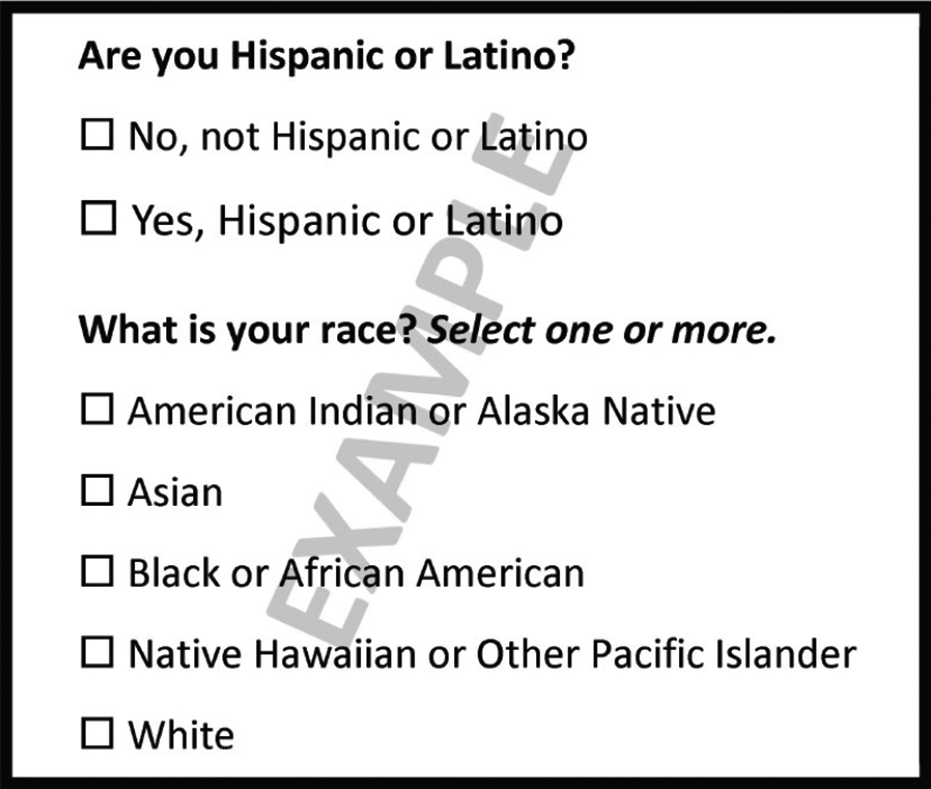
The US Office of Management and Budget’s (OMB’s) Statistical Policy Directive No. 15 (SPD 15) defines the minimum set of categories that federal agencies must use when collecting race and ethnicity data. 4 Until OMB revised SPD 15 in 2024, these standards had not been updated since 1997. The categories and question format that the 1997 SPD 15 standards required agencies to use posed significant issues for the accuracy of federal race and ethnicity data. First, the 1997 SPD 15 standards used separate questions to collect information about Hispanic origin and race (see Figure 1). This two-question format led many individuals of Latino/Latine origin who did not identify with any of the available race categories (Black, White, etc.), to skip the race question, select “some other race” when that option was available, or write in their Hispanic origin under one of the race categories. 5 Second, the 1997 SPD 15 standards did not include a distinct Middle Eastern or North African (MENA) category, instead classifying individuals of MENA origin under the “White” racial category. 6 And while the 1997 standards encouraged federal agencies to collect more detailed race and ethnicity data beyond the minimum categories, they did not require agencies to do so. 7 These issues reduced the accuracy of federal data not only for the groups mentioned above, but also for the nation’s population overall. In the health context, these data gaps likely led to missed opportunities to identify and respond to disparities in health outcomes, such as those observed during the COVID-19 pandemic. 8
Race and ethnicity questions under OMB’s 1997 Statistical Policy Directive 15.

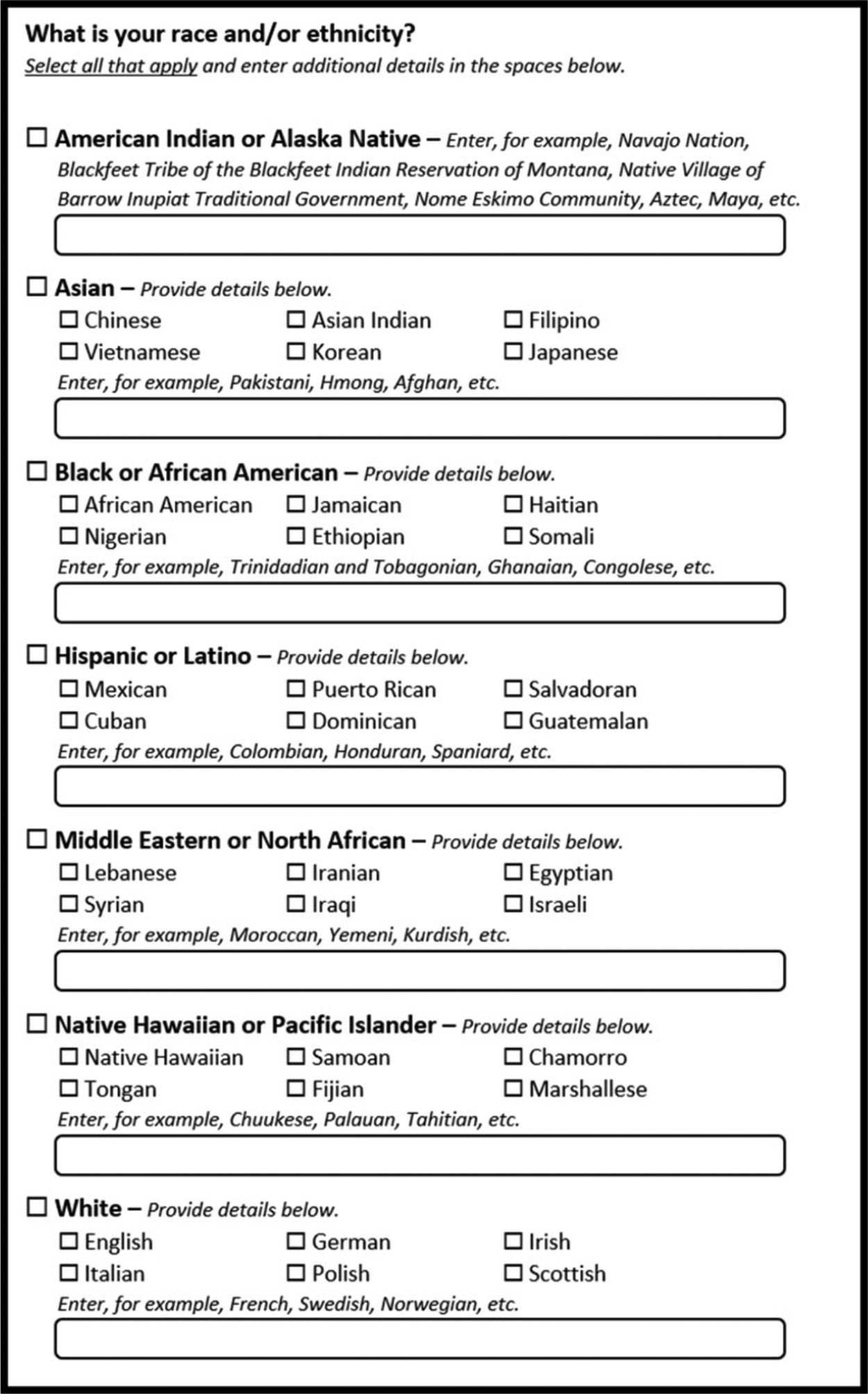
The modernized SPD 15 standards issued in March 2024 represent an important step toward addressing these issues and strengthening federal race and ethnicity data collection. The updated standards adopt a single, combined race and ethnicity question with a distinct MENA category and require agencies to collect disaggregated data for more detailed subgroups within each race and ethnicity category (see Figure 2). 9 However, the path toward full implementation of the 2024 SPD 15 standards remains uncertain. Successful implementation of the updated standards will likely depend on whether OMB holds federal agencies accountable for adopting the new question formats. When it released the updated standards, OMB initially required agencies to publish implementation plans by September 28, 2025, and achieve full implementation by March 28, 2029. However, on September 26, 2025, OMB announced a six-month delay to both deadlines without citing any reason for the change. 10
Race and ethnicity question under OMB’s 2024 Statistical Policy Directive 15.
Recent executive orders 11 instructing agencies to terminate Diversity, Equity, and Inclusion (DEI) programs and other initiatives to promote racial equity add to the uncertainty around whether the current presidential administration will support full implementation of the 2024 SPD 15 standards. Moreover, the administration’s actions during the first nine months of 2025 to remove or alter certain federal datasets, as well as significant cuts to staffing at federal statistical agencies, raise alarms about the integrity of federal data collection more broadly. 12 Growing concern about how the federal government may misuse detailed race and ethnicity data for immigration enforcement or other surveillance could also make many people less willing to share their demographic information. 13
Despite the uncertain future of disaggregated race and ethnicity data collection at the federal level, states have an important opportunity to take the lead on improving their own race and ethnicity data collection practices. While data that states report to federal agencies must be compatible with the federal standards, these standards do not govern broader state data collection policies. States can and should implement race and ethnicity data collection policies that best serve the needs of their unique populations, including disaggregating data beyond the minimum categories in the federal standards. This paper will examine the landscape of state race and ethnicity data collection laws nationwide and highlight the evolution of New York State’s and California’s race and ethnicity data collection policies as case studies on the implementation of state-level data disaggregation policy.
State Policies to Disaggregate Data by Race and Ethnicity
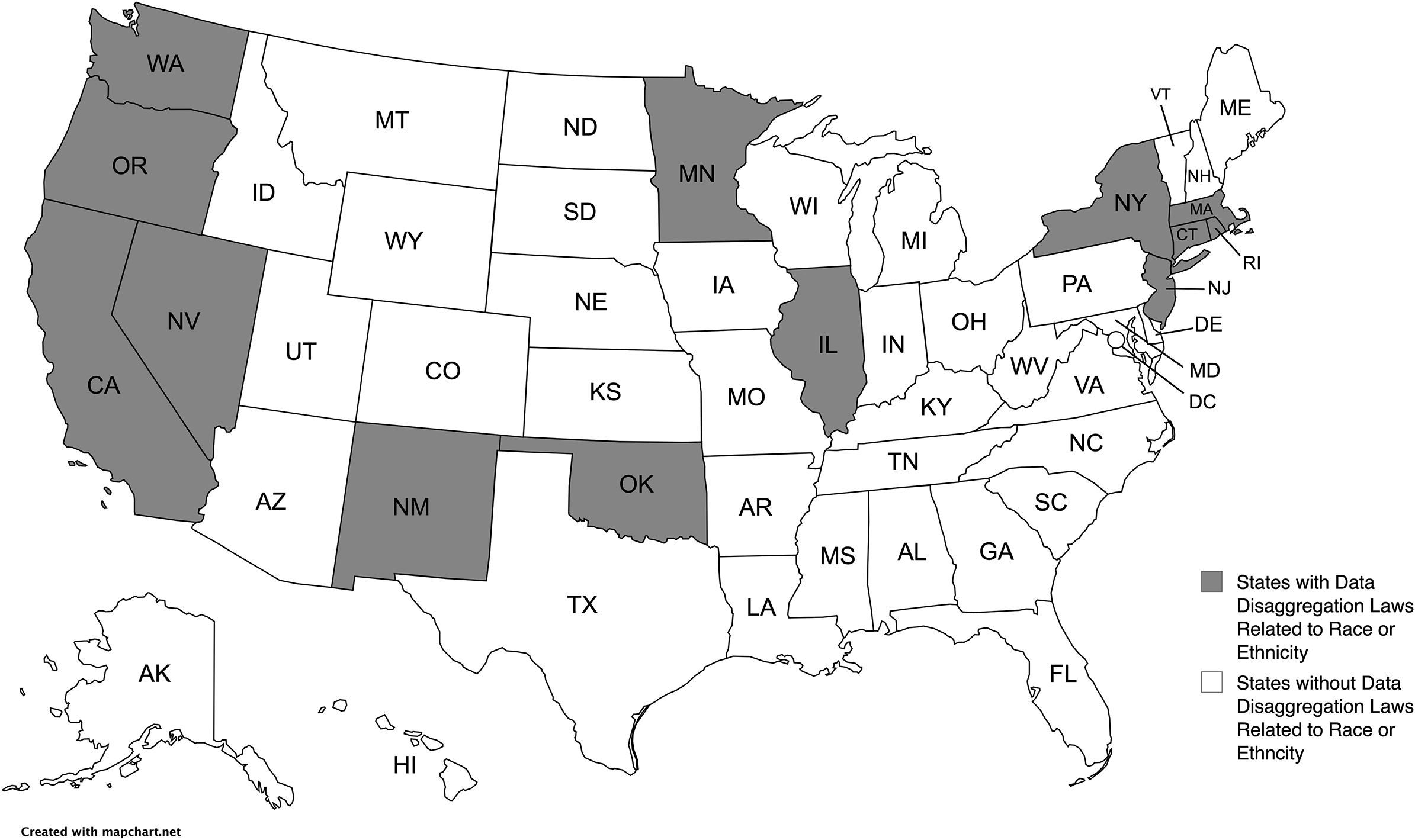
As of May 2025, 13 states have passed laws to require disaggregation of race and ethnicity data beyond the requirements of the 1997 version of SPD 15. See Figure 3. These state laws are summarized in two reports from The Leadership Conference Education Fund (The Education Fund). 14 These 13 state laws vary based on the types of racial and ethnic categories addressed. For example:
-
• Nine states require collection of disaggregated data for Asian and/or Pacific Islander groups: California, Connecticut, Massachusetts, Minnesota, New Jersey, New York, Oregon, Rhode Island, and Washington state;
-
• Six states require collection of disaggregated data for Black or African groups: California, Connecticut, Massachusetts, Minnesota, Oregon, and Washington state;
-
• Six states require collection of disaggregated data for Hispanic/Latino groups: California, Connecticut, Massachusetts, Minnesota, Oregon, and Washington state;
-
• Seven states require collection of disaggregated data for Middle Eastern and/or North African data: Connecticut, Illinois, New Jersey, Nevada, New York, Oregon, and Washington state; and
-
• Five states require collection of some disaggregated tribal data: Connecticut, Minnesota, New Mexico, Oklahoma, and Oregon.
State data disaggregation policies.
Several of these laws were passed in the last two years, evidencing momentum for data disaggregation laws. Additionally, the revised SPD 15 provides states with an opportunity to update their state laws to meet at least the federal minimum standards for state data collection. For example, Oregon updated its Race, Ethnicity, and Language, Disability (REALD) law after the release of the revised SPD 15 15 and Michigan introduced two bills to collect data on Middle Eastern and North African communities. 16
The existing state data disaggregation laws vary based on which agencies are subject to the requirements. Laws in New Jersey and New York requiring disaggregation for Asian, Pacific Islander, and Middle Eastern and North African groups apply to all state agencies. (See below for more information on New York.) In contrast, California’s law requiring collection of data for Latino groups and Mesoamerican Indigenous nations applies only to the California Department of Public Health. 17 (See below for more information on California.)
To advance the disaggregation of health and health care data by race and ethnicity, The Education Fund launched its Data Disaggregation Action Network (D-DAN) in the summer of 2023. 18 By engaging and empowering communities, state and national-level D-DAN partners work collaboratively to advance federal and state policies for the disaggregation of health-related data by race and ethnicity. Through the creation of a state and national advocacy infrastructure to engage stakeholders, policymakers, and communities on the need for disaggregated data, D-DAN works to improve data quality and accessibility to better understand disparities and achieve racial equity. In addition to grant funding, The Education Fund provides D-DAN partners with resources, technical assistance, and an infrastructure to connect and build relationships with other organizations engaged in data disaggregation education and advocacy.
Much of the work of D-DAN’s national partners has focused on the adoption and implementation of improved federal race and ethnicity data collection standards, and the 2024 SPD 15 requirements reflect many of the changes that advocates in our network called for. D-DAN’s state partners’ work focuses primarily on engaging communities to lay the groundwork for successful data disaggregation advocacy, educating policymakers on the need for data disaggregation, and working with state agencies and officials to support the successful implementation of existing state data disaggregation policies. The following sections discuss two of D-DAN’s state partners’ work to advance data disaggregation policy and implementation in New York State and California.
Beyond the Bill: Implementing Ethnicity Data Disaggregation Across New York State Agencies
Building on earlier analysis of the law’s passage in the American Journal of Public Health, this section examines the subsequent phase of New York’s Asian and Native Hawaiian/Pacific Islander Data Disaggregation Law: implementation.Reference Gundanna 19 It analyzes how the Coalition for Asian American Children and Families (CACF) navigated bureaucratic, fiscal, and political barriers to translate statutory language into operational practice across state agencies.
From Passage to Practice
When Governor Kathy Hochul signed New York’s Asian and Native Hawaiian/Pacific Islander (NHPI) Data Disaggregation Law 20 in December 2021, it marked the first statewide mandate for agencies to collect and report detailed ethnicity data across most, if not all, of the state government. CACF, whose Invisible No More Campaign successfully advocated for the law, celebrated the statute as a historic victory for visibility. Yet, as CACF’s subsequent experience has shown, adoption of a law is only the starting line: implementation is a second, longer campaign demanding persistence, transparency, and interagency coordination.
Navigating Bureaucracy
The enactment of the New York law coincided with a period of bureaucratic uncertainty. In 2022, CACF began direct outreach to agencies whose service areas overlapped most with its member organizations — initially the Department of Health (DOH), Department of Labor, Office for the Aging, Office of Children and Family Services, Office of Temporary and Disability Assistance, and the Office for the Prevention of Domestic Violence. The approach enabled CACF to apply pressure directly to agencies, but progress was uneven and heavily dependent on the responsiveness of individual agency staff.
CACF focused on connecting with the top decision-makers at such agencies: the commissioners, executive leadership team, and chiefs of staff. In conversations with agencies, staff revealed the creation of an interagency working group to convene agency staff in harmonizing standards for the implementation of the law and other demographic data laws between agencies. Still, it provided little concrete information about determinations made in the working group.
Seeking the Governor’s Help
Because of its persistence and relationship building, CACF obtained the full list of nineteen agencies that the Executive Chamber (in the Office of the Governor) had determined are required to comply with the law, as well as confirmation of agencies implementing the law to varying degrees.
A critical tool in advocacy is continued follow-up with government stakeholders. 21 CACF continued outreach with Executive Chamber staff, including sending regular reminders to the governor’s staffers. CACF sought to create a public record underscoring the need for greater transparency in agency implementation of this historic law for Asian and NHPI New Yorkers, presenting at conferences and urging more stakeholders to seek updates on the availability of detailed Asian and NHPI data from agencies.
Leveraging Federal Changes
In 2023, as part of continued outreach on implementation of the 2022 law, CACF emphasized that changes to the SPD 15 could likely result from the US Office of Management and Budget’s review of extensive public comments received, and ultimately impact New York State agencies’ own required race and ethnicity reporting to federal agencies. With new requirements coming from both the state law and the federal standards, CACF encouraged state agencies to prepare more quickly for implementation to no avail. Some agency officials were unfamiliar with the movement at federal agencies to update such standards, hearing about it for the first time from CACF. Even in 2024, following the official announcement of the modernized SPD 15 that now required federal agencies to collect and report detailed race and ethnicity data for the six most populous subgroups within each minimum category, CACF urged agencies to expeditiously implement the law in preparation for adopting the federally required subgroup categories for Asian, NHPI, and all other minimum categories. If this left an impression on the Executive Chamber or agencies, CACF observed no discernible change in their actions.
Following the Money
After many years of stalled attempts at passing an Asian and NHPI data disaggregation bill in the state legislature, CACF secured successful bill passage in both the assembly and senate. At the same time, in two successive budget sessions, CACF mobilized Asian-serving community-based organizations from around New York State to successfully lobby for appropriations of funding for agency implementation of data disaggregation totaling over $4 million. And yet, implementation still faltered. In CACF’s conversations with state agency officials, none were familiar with the appropriations that — at least on paper — funded agency implementation of the new categories.
CACF sought help from the Office of the State Comptroller (OSC) to conduct an audit of agencies’ compliance with the law, believing that agencies were noncompliant. Upon hearing that no agency leader was aware of the millions of dollars in funding for data disaggregation, CACF requested OSC to examine how much money had been utilized and remained, which revealed that the funds that CACF and community partners had fought for four years before had gone untouched by agencies and were expiring soon. OSC, at the same time, uncovered that over $21 million had been appropriated to DOH for implementation, an amount far more than CACF and advocates had sought. Although CACF was relieved that its hard-fought appropriation would not go to waste, the mystery remained of how the funding could be accessed by DOH, not to mention other agencies.
Legislative Oversight and Accountability
Over the course of its administrative advocacy, CACF worked extensively with the original legislative champion of the law, the office of Sen. Julia Salazar. Their steadfast partnership produced concrete examples of updated forms that include the new Asian and NHPI categories from Empire State Development, the Office of Cannabis Management, and the Office of Victim Services.
CACF also activated the state legislature to exercise its oversight authority to review agency action — or inaction — by collaborating with assembly and senate committee chairs to request information on implementation of the law from agencies under the jurisdiction of those committees.
Building Evidence of Compliance (or Non-Compliance)
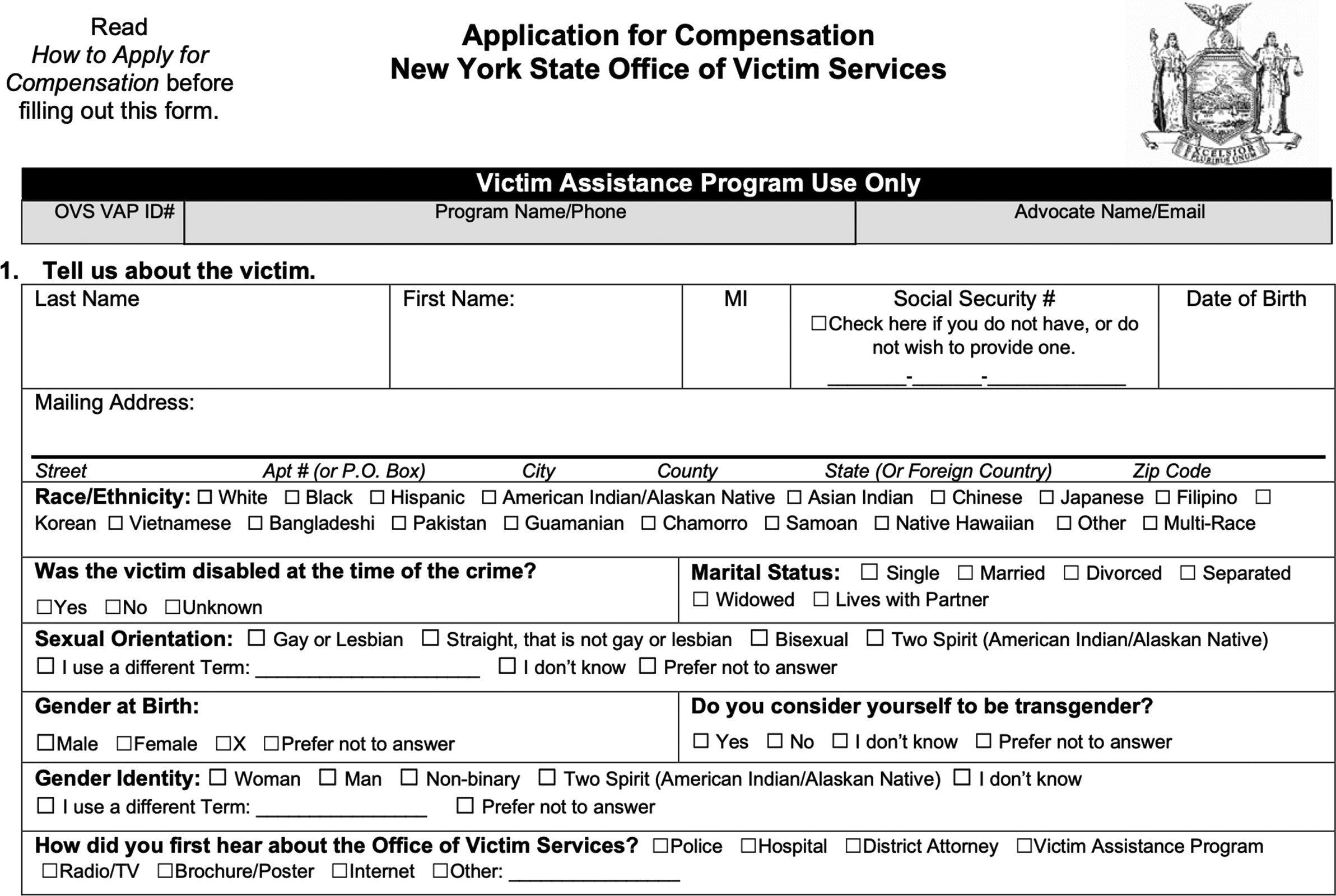
Beginning in 2024, CACF undertook a concerted effort to track agency compliance with the law by identifying race and ethnicity demographic data reports published by agencies that did or did not include detailed Asian and NHPI data. By late 2025, over three years after the law took effect, CACF found that only four of nineteen agencies had published disaggregated ethnicity data (Office of Mental Health, 22 Office of Victim Services, 23 City University of New York 24, and Office of Children and Family Services 25) and an additional five had updated forms to include detailed Asian and NHPI categories (Civil Service, Office of Addiction and Substance Abuse Supports, Empire State Development, and the Office for People with Developmental Disabilities). See Figure 4 for an updated form from the Office of Victim Services.
New York State Office of Victim Services application form including Race/Ethnicity Options.
The Office of Mental Health (OMH) is among the leaders in implementation, having published multiple dashboards with detailed Asian and NHPI data. 26 With OMH’s detailed demographic data now available, we can begin the next phase in our advocacy: understanding the relatively high proportion of responses marked as “Other” or “Unknown” despite detailed categories made available for selection in order to reduce the proportion of such responses in the future.
Advice for Other States
For jurisdictions considering their own data disaggregation statutes, New York’s experience offers several cautionary and constructive lessons:
-
• Design for implementation at the drafting stage. Mandates should specify agency reporting obligations, timelines for those, a coordinating body empowered to issue technical standards, and the same or separate entity charged with providing transparent updates on implementation. Such built-in accountability mechanisms would enable data disaggregation advocates and allied legislators to more easily push for updates from agencies.
-
• Treat disaggregated ethnicity data as a governance asset, not a compliance burden. When advocates can present ethnicity data as improving service targeting and program efficiency, especially tied to specific agency program initiatives, the value of ethnicity data may be more tangible for both agency officials and also legislators who may then be more likely to prioritize pressuring agencies.
-
• Advocate for sufficient appropriations. Funds will be needed to enable agencies to implement disaggregated ethnicity data collection alongside efforts to advance data disaggregation legislation.
-
• Identify, as early as possible, the mechanisms through which agencies can access these funds. It also will be important to assess whether any changes are needed to ensure clear and efficient access to the funds.
-
• Engage and educate committee chairs on the importance of data disaggregation to their own committee’s policy priorities. This education will help activate them as allies in securing accountability from agencies they oversee.
Results
Four years after New York’s law took effect, the state stands as both a pioneer, example, and work-in-progress for ethnicity data disaggregation. Roughly one-third of agencies have operationalized detailed ethnicity categories, a modest but meaningful advance toward illuminating the experiences of Asian and NHPI New Yorkers long rendered invisible by aggregate data. Yet full realization of the law’s promise will require structural transparency, standardized practices, devoted state funding, and sustained community partnership.
For CACF, the journey from legislative victory to bureaucratic implementation has transformed advocacy itself, from campaigning for data to ensuring the government can use it responsibly and responsively to community needs. As states across the nation explore disaggregation mandates and the federal government itself embarks on its own implementation process for the revised SPD 15 standards, New York’s experience illustrates that passing a law makes visibility possible but implementing it makes the visibility real.
We Count!: The California Latine and Indigenous Disparities Reduction Act
Latines are the largest racial and ethnic group in California, making up nearly 40% of the state’s population. Nationally, the US Census Bureau reports that more than one in four Americans are likely to be Latino by 2060. 27 Latines are diverse and vary widely in terms of ethnicity, culture, and language. Additionally, the term Latine is not all-encompassing and does not represent Indigenous communities or languages. In fact, Indigenous Mesoamericans speak over 560 Indigenous languages. According to the US Census Bureau, almost 30,000 Indigenous language speakers from Meso- and Latin America reside in the United States 28 and California has one of the largest Indigenous Mesoamerican populations in the country. Additionally, Latines experience disparate health and life outcomes dependent upon their subgroups, and that is also the case for Indigenous Mesoamericans — yet our state systems and programs currently do not collect specific data on these subgroups.
Latine subgroups and Indigenous Mesoamericans have specific needs — such as Indigenous language access — to obtain quality and reliable information and services from our state agencies and programs.
An onslaught of health disparities was brought to light by the worldwide COVID-19 pandemic. California cities and counties were reeling over how to allocate resources to address and stop infections and, in many cases, death. Many California Latine communities were overwhelmed with misinformation and disinformation that state public health officials and county staff addressed with Spanish language messaging and community outreach. Indigenous language speakers, however, could not access timely and reliable information in their languages to access vaccines in California and suffered higher deaths as a result. 29 Without disaggregated data, policymakers and researchers rely on less detailed data released by state agencies or local data that may be collected inconsistently in different jurisdictions that lead to health and related inequities.
It was clear to health advocates as well as Indigenous rights organizations that policies and systems needed to be updated to reduce health disparities for Latine and Indigenous Californians. The Latine and Indigenous Health Disparities Act was introduced in the California legislature for the first time in 2023 as Senate Bill 435. The bill was vetoed the first year, reintroduced the next year as Senate Bill 1016, and finally signed into law that fall in October 2024. The bill was cosponsored by the Latino Coalition for a Healthy California, Centro Binacional para el Desarrollo Indígena Oaxaqueño, Comunidades Indigenas en Liderazgo, and Mixteco Indigena Community Organizing Project.
The Latine and Indigenous Health Disparities Act builds on previously enacted data disaggregation legislation for the Asian American, and NHPI community in California. In 2016, the AHEAD Act — Accounting for Health and Education in API Demographics — was passed as Assembly Bill 1726. The law requires the California Department of Public Health (CDPH) to collect and release disaggregated demographic data for an expanded set of Asian and Pacific Islander populations, in addition to those already mandated by California. The cosponsors of the Latine and Indigenous Health Disparities Act designed SB 1016 after AB 1726, requiring the CDPH collect disaggregated data for the same health indicators. These included rates for major diseases, leading causes of death per demographic, subcategories for leading causes of death in California overall, pregnancy, housing, and mental health rates. Also, SB 1016, like AB 1726, only applied to the CDPH.
AB 1726 was signed into law in 2016 and finally implemented in 2022. Key lessons from the AB 1726 legislative process were considered for SB 1016’s campaign to successfully get the bill signed into law: Since then, data disaggregation advocates have collected many lessons for SB 1016 cosponsors to consider in the implementation process for the bill:
-
• Consider narrowing the application of the bill. The first iteration of the legislation (SB 435) would have applied to five different departments, including the California Department of Social Services, the Department of Health Care Services and the CDPH. These departments were relevant to cosponsors, because they administer some of the most important safety net programs for Latine and Indigenous communities — like CalFresh (SNAP) and Medi-Cal or Medicaid. However, as the bill made its way through the legislature, it was clear that, because the bill applied to many departments, it would have cost more to implement. Through conversations with AB 1726 cosponsoring organizations, it was recommended that a number of departments be amended out of the bill, which would reduce the cost of the bill and make it more amenable to state leaders, who were looking to be cost-effective. This strategy would eventually make it so that the bill only applied to the CDPH, which in turn assisted the bill in getting signed into law in 2024.
-
• Consult stakeholders responsible for implementation when determining the timeline for compliance. Another strategy that assisted SB 1016 in getting signed into law was the inclusion of an extended implementation timeline. SB 1016 cosponsors learned that AB 1726 was amended to extend the implementation timeline of the bill. This amendment proposed by the CDPH extended the implementation timeline from two to three years to five years. This assisted the department in phasing in the work it would require to implement new Asian and NHPI categories into their systems, which AB 1726 cosponsors learned were antiquated and took a significant amount of work to update. Although not ideal, since it delays when the bill would go into effect, the extended timeline provided the department with flexibility to do the work required to implement new categories into the department’s data system. SB 1016 cosponsors also agreed to an extended timeline of three years, arguing that the department had experience updating its systems with the implementation of AB 1726. SB 1016 is required to go into effect on January 1, 2028.
Now that both bills have been signed into law and are being implemented, AB 1726 and SB 1016 cosponsors work together with CDPH through a collaborative that is co-led by the department and cosponsors called the Data Disaggregation Working Group. The goal of the Working Group is to discuss, and work together to solve, bottleneck issues that arise when implementing data disaggregation legislation, and to guide the department in the implementation process of legislation through culturally informed perspectives.
Additionally, the group is discussing emerging challenges associated with implementing data disaggregation legislation, including safeguarding data. Data privacy and confidentiality are becoming critical issues for vulnerable groups like immigrants, at a time when personal identifying information that has been shared with state and federal governments is being used to harm communities — for example, for deportation purposes. Together, the Working Group continues to identify ways to continue collecting better and more detailed data that also protects the safety of all Californians.
Key Considerations
The Education Fund published case studies of four states that have passed laws requiring data disaggregation by race and ethnicity (California, Illinois, Oregon, and New York). Based on the experience of these four states — and a review of the laws in the other nine states with data disaggregation requirements — we offer several key considerations for state or local governments seeking to require the collection of disaggregated race and ethnicity data. 30
Consider advocacy and education efforts. These include:
-
• How should community and elected officials be educated about the value of disaggregated race and ethnicity data? For example, groups such as Arab American Family Services in Illinois spent more than two decades developing relationships with the community and legislators, long before a specific bill was introduced to collect data on MENA communities.
Consider the scope of the policy. This includes:
-
• What subpopulations should be included in the policy? The updated SPD 15 provides a model for the minimum standards included in a state law or policy. However, the policy also should be customized to the state’s population, with consideration for political feasibility and implementation. For example, Oregon’s REALD law includes 72 race and ethnicity subgroups. The Illinois law only added a MENA category.
-
• Should the data collection requirements apply to all state agencies or to a subset of agencies? For example, the California laws regarding additional Asian and NHPI and Latino and Indigenous populations apply only to CDPH. In contrast, the New York Asian and NHPI and MENA laws, and the Illinois MENA law, apply to all agencies.
-
• How long are agencies given to comply with the policy? Agencies will need sufficient time to create or update data collection practices. However, an implementation date that is many years out may remove the urgency from the policy implementation process. Consult stakeholders responsible for implementation when determining the timeline for compliance.
-
• Does the policy provide requirements that could help in implementation or in monitoring compliance? These could include a report from affected agencies on their progress implementing the law or policy or a work group that includes agency representatives and affected community members.
Consider implementation of the policy. This includes:
-
• Is funding provided to implement the policy? An initial appropriation from the legislature, or dedicated funds that may be used by an agency to implement the policy, will accelerate the process.
-
• Are multiple actors engaged to exert pressure on the agencies/departments that are responsible for implementing the policy? These include agency personnel, legislative sponsors, legislators who oversee the affected agencies, the executive branch (i.e., the Governor’s office), and/or the state auditor.
-
• Are legislative or administrative improvements needed to improve the collection of race and ethnicity data? As the policy is being implemented, supporters may see a need for technical or substantive changes to the initial policy.
-
• Are incentives other than funding provided to encourage compliance? These could include training, learning collaboratives, and community working groups.
Conclusion
Detailed data on race and ethnicity is vital to support data equity and provide insights into health outcomes. Collection of race and ethnicity data at the state level is more important than ever given significant cuts to federal data collection efforts in 2025.
States have the potential to require the collection and disaggregation of race and ethnicity data to make informed decisions about services and funding that reflect their specific populations. Thirteen states have adopted laws in this area. Although the laws represent a tremendous success reflecting the education and advocacy of many groups, the laws are only a starting point. To ensure that the laws are implemented — that forms are updated, that data are collected and analyzed, and that programs or services are changed — requires an ongoing and long-term commitment.