

Parallel Circuits
In an intense battle with the “Japanese military,” the Chinese army “trampled all over enemy territory.”Footnote 1 The year? 1934. This alternate reality where China triumphed and Japan failed, which is a perfect inflection of the 1930s, did not come from the imagination of a science fiction author. It came from the pen of a sportswriter who was describing, in rather colorful terms, the Chinese victory over Japan at the final soccer game of the Tenth Far Eastern Championship Games. The author, as well as his Chinese compatriots who read his column, likely knew that the triumph on the field was only an illusion and that the true battles for the very existence of the Games and for the very existence of China were set to take place in the boardrooms the next day and on actual battlefields in years to come, but that didn’t detract from this moment of blind jubilation when the sports field served as the salve that reality could not to provide.
In the Asian sporting world, 1934 was a year of some significance. The matches of the Far Eastern Championship Games were intense, but the boardroom bouts put those matches to shame.Footnote 2 Before athletes took to the fields at the final Far Eastern Championship Games in Manila in May, Japanese Amateur Athletic Association representatives made barnstorming boardroom tours through Manila and Shanghai. In fact, the Japanese delegates landed in Shanghai at the same moment that athletes from across China had gathered for the trials for the Games.Footnote 3 Negotiators above, athletes below. The narrative in this section bounces back-and-forth between these groups. In some ways, the Tenth and final Far Eastern Championship Games initially unfolded like a repeat of the coalescence of 1921, but unlike the earlier iteration, politics ended up overwhelming sportive good will.
The Japanese barnstorming boardroom tour began when a representative of the Japan Amateur Athletic Federation arrived in Manila in January 1934 to lobby for the admission of the puppet state of Manchukuo, which Japan had created after invading northeastern China in 1931, to the Far Eastern Athletic Association.Footnote 4 The acceptance of Manchukuo into the organization would have provided some semblance of international recognition for the new state, which Japan desperately needed after its failure to achieve any such recognition from the League of Nations in the preceding years. The Manchurian Incident, as Japan’s invasion is often called, would eventually precipitate Japan’s withdrawal from the League of Nations and the Far Eastern Athletic Association, but we are getting ahead of ourselves.
In Manila, Yamamoto Tadaoki (山本忠興), the Japanese Far Eastern Athletic Association representative, met with Springfield alum Regino R. Ylanan, the secretary treasurer of the Philippine Amateur Athletic Federation, and Jorge B. Vargas, the vice-president of the same organization. Later, in March, Yamamoto laid out the stakes of their meetings in stark terms, saying, “Manchukuo must be admitted; otherwise no Japanese athlete [will] be sent to Manila next May.”Footnote 5 The first round of the heavyweight boardroom bout had set the stage for the ensuing rounds. However, in Shanghai on April 9, in the highly anticipated second round of the barnstorming boardroom tour, Japan’s lead negotiator Hiranuma Ryōzō (平沼亮三) unexpectedly clinched his opponent, ending the round prematurely. Was he throwing the match?
Enter player three. Chinese negotiators refused to sit idly by while Japan attempted to legitimize their landgrab. In fact, Chinese representatives threatened a boycott of their own if Manchukuo joined into the Far Eastern Athletic Association, applying pressure on the Philippines to ignore Japanese overtures. And their pressure worked, at least momentarily, as Japan temporarily abandoned their boycott threat. Defending the Philippine decision to side with China in refusing to allow Manchukuo to join the organization, Vargas reported, “In view of the existing rules … the Philippines had to take the action taken in Shanghai.”Footnote 6 Meanwhile, according to Chinese reports, while the Japanese “galloped quickly, and their strength can’t be ridiculed,” China eventually triumphed over the “enemy’s rampant strength.”Footnote 7 Oops, we accidentally slipped back to the soccer match, which took place a month after the Shanghai negotiations. Let us linger there for a moment before returning to the boardrooms.
After torching the Philippines 2 to 0 earlier in the tournament, China defeated Japan 4 to 3 in a grueling match, resulting in yet another trophy in their soccer war chest.Footnote 8 Of the Chinese teams that took to the fields in Manila for the Far Eastern Championship Games in May, perhaps none carried more swagger than the group of famous footballers from Hong Kong. The Philippines, despite sustained efforts to improve their national soccer team, including inviting several elite Chinese soccer squads to the archipelago in 1932 and 1933, was clearly out of its league.Footnote 9 The soccer field favored China, as did the early boardroom negotiations. Jumping back to the negotiating table in Shanghai a month prior, it appeared that Filipino negotiators had occupied an equally tenuous position.
The Philippines was caught between a rock and a hard place in the Manchukuo negotiations because the government had already raised and allocated vast sums for the Games, and if either Japan or China had followed through with their threats to withdraw, they would have absorbed huge fiscal and reputational losses.Footnote 10 So, the fact that the Philippines stuck to its guns in siding with China during the Shanghai meeting appeared like a noble and potentially costly gesture. But perhaps, as pundits would later speculate, this audacity was merely theater, as Japan and the Philippines had already struck a secret deal on Manchukuo.Footnote 11
According to newspaper reports after the Games, in exchange for Japan’s attendance in Manila, Filipino negotiators had agreed to stand with Japan on the issue of Manchukuo at the final round of the boardroom bout, which was scheduled to coincide with the conclusion of the competitions.Footnote 12 Before that boardroom finale took place, however, thanks to Japan’s acquiescence in Shanghai, the athletes finally took to the fields for the competitions, while the negotiators took a break from the boardroom to tour the banquet halls and implement their charm offensives.
The Charm Offensives
Instead of borrowing a coast guard ship like the Philippine team had done in 1921, Chinese athletes and coaches disembarked for the Philippines on the President McKinley – one of the Dollar Steamships that we encountered in Chapter 2.Footnote 13 After arriving in Manila six days later but still before the start of the Games, Chinese coaches, athletes, and delegates prepared for the critical pre-competition ceremony circuit, which required charisma, tact, and subtlety. The vice-president of the Philippine Amateur Athletic Federation Jorge Vargas laid out the stakes of the banquets, declaring, “We do not lose sight of the fact that complete success shall not be attained if [the Games] fail to foster friendly feeling with the other nations participating in the meet.”Footnote 14 Fortunately for China, seasoned diplomat Chengting Thomas Wang, who headed the Chinese delegation, and famous swimmer Yeung Sau-king (Yang Xiuqiong 楊秀瓊), who headed the Chinese swim team, led the charge.
With champagne glasses clinking and laughter reverberating through elegant halls, everything seemed to be falling into place for China. According to reports, when the shining star of China’s athletic world, Yeung Sau-king, entered the Great Harmony Club, “it felt like the entire party increased in vigor.”Footnote 15 Although the Bank of China director and head of the Chinese Chamber of Commerce in the Philippines, Alfonso Sycip (Xue Fenshi 薛芬士), whom we encountered briefly in the previous chapter, gave a gracious toast, and Chengting Thomas Wang followed with a honed diplomatic speech, the “Chinese Mermaid,” as Yeung became known, stole the show, wowing the over 600 athletes, journalists, and well-to-do politicians and businesspeople in attendance on the sixth floor of the China Banking Corporation building.Footnote 16
Several days later, on May 16, 1934, at 5:15 PM, Yeung Sau-king slipped into the waters of the newly constructed Philippine aquatic center to compete in the fifty-meter freestyle final.Footnote 17 According to reports, the “competition between Chinese and Filipino athletes was extremely fierce.”Footnote 18 Dispelling any potential anxieties of readers back home, one Chinese reporter described how the “expeditionary women’s force (遠征之娘子軍),” or the Chinese swim team, left the “local Filipino women’s team in their wakes.”Footnote 19 But for Yeung Sau-king and her fellow swimmers, victory in the pool was the easy part, and her new Chinese record of 36.93 seconds almost seemed like an afterthought.Footnote 20 As observed in Chapter 7, female athletes carried an extra burden as both competitors and symbols of femininity, and they felt it necessary to develop “numerous and often competing strategies to cope with the dissonance between masculine sport and feminine womanhood,” as sports historian Susan Cahn explains.Footnote 21
A strong physical performance in the pool, which set athletes apart from their Carnival Queen sisters, necessitated an exaggerated performance of femininity in the banquet circuit to assuage fickle male reporters and onlookers. Back at the opening ceremony four days before, Yeung Sau-king and her compatriots had weathered unabashed male ogling.Footnote 22 Gan Bun Cho (Yan Wenchu 顏文初), one such ogler who appears elsewhere in this book, directed his gaze at the Chinese women athletes who followed the flag bearers in the procession at the opening ceremony, writing, “For our healthy, strong, and beautiful female athletes, their facial features, skin, and muscles were all exceedingly exemplary.”Footnote 23
Male Filipino pundits, for their part, shared Gan’s obsession, especially when discussing Filipina swimmers. One commentator, for instance, described how the “tanksplashers who are educated enough not to be ashamed to appear before the public” were a “novelty to see.”Footnote 24 Meanwhile, Filipino lawmakers infused the ceremony with the pomp of a country on the verge of independence, raising the performative responsibilities of female and male athletes alike. The opening ceremony featured school children singing the national anthem in a brand-new stadium with flags flying and crowds cheering.Footnote 25 On this international stage, the “proper” gendered performance was paramount. With this in mind, Gan assured his readers in China that Filipino and American spectators allocated appropriate applause to Chinese representatives.Footnote 26
Back at the pool, the Filipino athlete some called the “king of the pool,” male swimmer Teófilo Yldefonso, who was the first Filipino to win an Olympic medal, anchored the Filipino men’s swimming team.Footnote 27 As in years past, he secured the gold in the 200-meter breaststroke at the Games. Yldefonso no doubt garnered the respect of the home audience, but the Japanese men carried away the hardware for most of the men’s aquatic events, “breaking all existing records of the Far East except the 200-meter breaststroke.”Footnote 28 Filipino women didn’t fare much better than their male compatriots. Although they came in a close second in the 50-meter and 100-meter freestyle competitions, they simply couldn’t keep up with Chinese stars Liu Guizhen (劉桂珍) and Yeung Sau-king.
Before the Filipino “king of the pool” added another medal to his collection at the Games, back during the banquet circuit several days earlier, the Filipino “king of the banquet,” Senate President and soon-to-be Commonwealth President Manuel L. Quezon had stepped up to the podium to impress all with his elocution.Footnote 29 At yet another banquet at the Pan-Pacific Association of China on Calle Herran, Quezon no doubt earned the respect of attendees, but the chair of the Japanese Amateur Athletic Federation, Hiranuma Ryōzō, left his own indelible mark by delivering his speech entirely in Japanese to a confused audience.Footnote 30 However, it was Chengting Thomas Wang – who had been outclassed by Yeung Sau-king at the previous banquet but settled into his element in this more formal evening banquet – who blew everyone away, stating, “after the Philippines gains independence and you [Quezon] are elected the first president, we will have the opportunity to all meet together again in the Malacañang” – the presidential palace of the Philippines.Footnote 31 Charm accomplished.
The pool and the party flowed together. The ceremony and the competition became one. Wang, or the social “merman,” as one might call him, swam through the ceremony circuit with the grace of a fish, charming his hosts and capturing hearts. Meanwhile, Yeung outclassed her Filipino competitors in the pool and even put Wang to shame in the banquet circuit, charming her hosts and satisfying oglers. While the Filipino old hats Quezon and Yldefonso still demanded respect with their long and storied careers, it became clear to attendees that the Chinese visitors were the stars of this show. Unfortunately for the “Chinese mermaid” and the “Chinese merman,” however, the basketball court and the boardroom, which would decide the fate of the Far Eastern Games and Far Eastern Athletic Association respectively, were the turf of the “Filipino Islanders,” and the visitors became fish out of water.
The Triangle Offense
Chapter 7 began with a stunning Chinese basketball triumph in 1921, so it is only fitting that Chapter 9 ends with a controversial Philippine victory that mirrored a far more controversial Philippine boardroom betrayal in 1934. The new Philippine basketball team featured breakout stars, including Jacinto Ciria Cruz, who would also lead the team in Berlin two years later; Bibiano Ouano, the “foremost basketball center in the Islands”; and old timers, like Mariano Filomeno, who had competed for the Islanders in every Far Eastern Championship Games since 1923.Footnote 32 But China had its own bevy of stars with Wang Yuzeng (王玉增), Tang Baokun (唐寳堃), and team captain Chen Shikun (陳實坤) leading the way.Footnote 33 These superstars led China and the Philippines to separate victories over Japan to start the competition, setting the stage for their first head to head match.Footnote 34
According to a Filipino reporter, the first game between China and the Philippines took place in front of the “biggest crowd known in the history of the sport in the Far East.”Footnote 35 A Chinese reporter explained that an extra seven to eight hundred ticketless spectators squeezed into the overflowing stadium, causing police to lose control of the crowd.Footnote 36 Needless to say, spectators and journalists were psyched for this heavyweight matchup. But while the metaphysical stage was set for the competition between the Philippines and China, the physical stage was not. Delayed construction funds, which poured out only four months before the start of the Games, prevented the builders from pouring out the concrete for the basketball stadium.Footnote 37 As a result, Chinese and Filipino players met on a temporary wooden court setup on the open-air tennis court, which had just hosted a tennis match a few hours before.Footnote 38
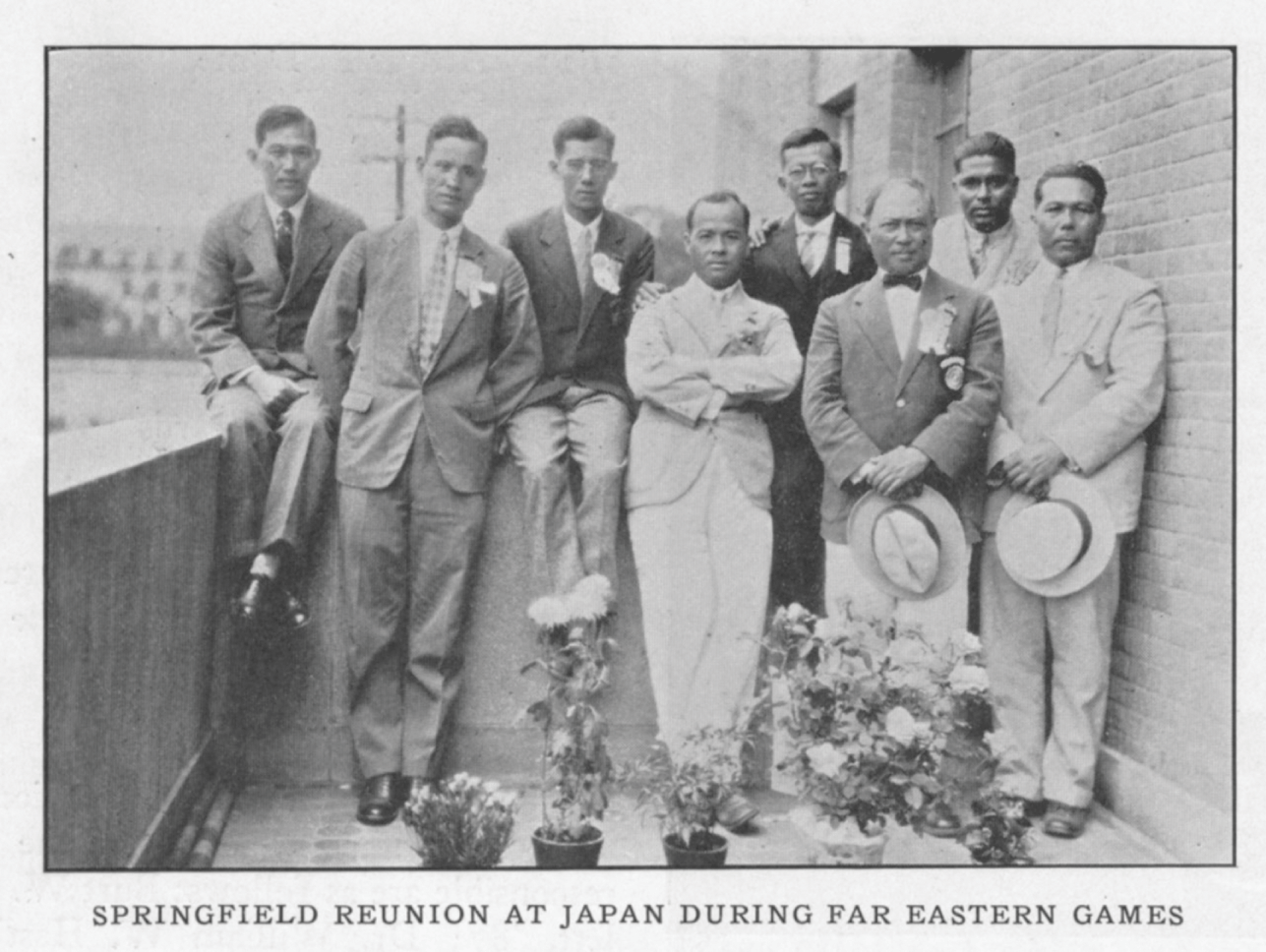
Meanwhile, after the board meetings of the Far Eastern Athletic Association in Shanghai in April, and after the ceremony circuit at the start of the Games in Manila, the stage was also set for the final boardroom bash in Manila, but the question of Manchukuo continued to hang over the deliberations like a storm cloud over an uncovered basketball court. The Chinese and Philippine diplomatic delegations, just like their star-studded basketball teams, carried a plethora of diplomatic all-stars. Chengting Thomas Wang of banquet-circuit fame and William Z. L. Sung (Shen Siliang 沈嗣良), Secretary of the China National Amateur Athletic Federation, led the charge for China. On the other side, Senate President Manuel L. Quezon, also from the prestigious banquet circuit, and Jorge B. Vargas, Vice-President of the Philippine Amateur Athletic Federation, headed up the Philippine delegation. Springfield College alumni and fellow boardroom delegates Regino Ylanan, Hoh Gunsun, and John Mo played critical, hands-on roles in the negotiations as well (Figure 9.1).Footnote 39
Springfield Reunion at the Japan Far Eastern Championship Games, 1931
Three days earlier, on the basketball/tennis court, uncooperative weather interrupted the Chinese and Filipino basketball stars. At halftime, with the Philippines up 26 to 12, the weather gods intervened, ordering a monsoon storm over the uncovered wooden court.Footnote 40 The head coach of the Philippine team, Alfredo del Rosario, swayed by the halftime score, lobbied to finish the game, waterlogged court be damned, while Chinese delegate William Z. L. Sung called for postponement given the unsafe conditions.Footnote 41 The referees initially awarded victory to the Islanders in the abbreviated match before Far Eastern Athletic Association officials intervened to overturn their decision and reschedule the game. The frustrated coaches and players then returned to their drawing boards to draft new game plans that accounted for key missing players. China had lost star Wang Yuzeng and the Philippines had lost Bibiano Ouano to injury during the game.Footnote 42
Back at the meetings, China and the Philippines also proceeded without star diplomats Chengting Thomas Wang and Manuel L. Quezon, who both called in sick.Footnote 43 Perhaps this was no coincidence, as the first board meeting ended in an impasse and the second meeting, which reportedly had an “exceedingly intense atmosphere,” dragged on for four hours, only ending when the Chinese delegation walked out in frustration.Footnote 44 After failing to reach a decision on Manchukuo, with China refusing to recognize the new member for obvious reasons, the Japanese delegation began to broach the possibility of disbanding the Far Eastern Athletic Federation altogether and replacing it with a new organization to circumvent China’s protests.Footnote 45 To this proposal, William Z. L. Sung vented his frustration, complaining that Japan “wanted to seduce the Philippines into recognizing the false organization.”Footnote 46 The temperature of the room increased, as it is wont to do on a summer day in Manila.
Back at the basketball court, after the actual storm had passed, the Islanders continued their winning streak with a less controversial defeat of China in the second round on May 18. Addressing the defeat, one Chinese commentator, in a column rife with racialized imagery, wrote, “in the second half the Philippine offense increased in speed and intensity, [with players] advancing in all directions like monkeys.”Footnote 47 With more poise and introspection, Springfield alum Thomas H. Suvoong, who served as the assistant coach of the Chinese athletic delegation, explained that inexperience playing in the tropics hampered the otherwise gallant Chinese performance.Footnote 48 After this routine Philippine victory, however, something shocking happened on the basketball courts. The Islanders fell to the Japanese team that they had soundly defeated days before, stunning the crowds in Manila.Footnote 49
An even more shocking event in the boardroom stunned newspaper readers in Manila and around the world a few days later. The Philippines also succumbed to Japan at the negotiation table. Hiranuma Ryōzō and the Japanese delegation, on May 21, their planned day of departure, scheduled a last-minute board meeting to decide the fate of the Far Eastern Athletic Association. According to conflicting reports, representatives from Japan and the Philippines tried and failed to reach a member of the Chinese delegation to inform them of the meeting.Footnote 50 With no Chinese representative present, Japan and the Philippines proceeded as a committee of two. Together, they agreed to disband the Far Eastern Athletic Association and replace it with a brand-new organization, the Amateur Athletic Association of the Orient, with Manchukuo as a member. They also scheduled a new athletic competition for Tokyo in 1938.Footnote 51 Fresh off the boat back in China, William Z. L. Sung reportedly called this “nothing less than a farce.”Footnote 52
The final basketball match between China and the Philippines had likewise been rescheduled to May 20, but unlike the last-minute board meeting, Chinese players actually received the memo and took to the court. The result for China was similar, however, as the Philippines pulled away with the victory, forty-four to thirty-three. Chinese observers cried foul, complaining that the four early fouls on star Tang Baokun, which sidelined him just like his boardroom compatriots, reflected a larger pattern of unfair officiating by the refs.Footnote 53 On the court and in the boardroom, things began to fall apart for China, but boardroom negotiators still held out hope for a last-minute intervention from the boardroom referee, Manuel Quezon. Was it possible that, as with the overturning of the referee’s decision in the first rain-shortened Sino–Philippine basketball match, the powers above would intervene and reestablish order and fairness in the final round of the boardroom bout?
The absent Manuel Quezon became the man of the hour, and his silence on the negotiations allowed Chinese and Japanese representatives, just like sports talking heads interpreting the silence of an athlete on a social media purge today, to play the speculation game. William Z. L. Sung reported that he had sent an appeal to Quezon, noting that the senate president was the “only person who clearly understood the situation.”Footnote 54 Japanese representatives of the Japanese Amateur Athletic Federation, on the other hand, apparently believed that Quezon was on their side because they sent a congratulatory telegram to the recovering statesman, writing “most hearty thanks” for “your supreme decision” on admitting Manchukuo.Footnote 55
In the end, the silence remained unbroken. Manuel Quezon and the government of the Philippines, which had informally recognized Chiang Kai-shek’s Nationalist regime in 1927 before almost any other country with a semi-official visit, as outlined in Chapter 6, ended up providing a similar recognition to Manchukuo in 1934, thereby becoming “the first government, outside of Japan, to recognize that Manchukuo was not a part of China.”Footnote 56 In other words, unlike the first basketball match when officials intervened at the eleventh hour to restore some semblance of fairness for Chinese athletes, Quezon offered no such intervention for Chinese delegates in their boardroom bout.
Reflecting back on the Games as a whole, one Filipino pundit lamented, “Years ago, we could beat the Japanese in almost any game and at any time … but today, for the Filipinos to win over the Japanese in any sport is for an hippopotamus to pass through the eye of a needle.”Footnote 57 Despite their continued supremacy in basketball and a surprise victory over Japan in baseball, Filipino athletes on the whole underperformed. In the track and field events, for instance, which the Philippines had previously dominated, Japan left with an overwhelming victory, fifty-one points to nineteen points.Footnote 58 For the Philippines, the decision to side with Japan in boardroom negotiations was not a proud one, but it was a practical one. And pundits naturally disagreed.
Commentators from the Philippines and China skewered members of the Philippine Amateur Athletic Federation for their perceived capitulation to Japan. The influential editor of the Philippine Magazine, for instance, called the action “a piece of unmatchable stupidity.”Footnote 59 Springfield alum Hoh Gunsun, who knew several of his Filipino counterparts from the Philippine Amateur Athletic Federation from their Springfield days, similarly pulled no punches, uppercutting the Philippine delegation by condescendingly inquiring how they could sell out their autonomy to Japan if their goal was to prove that they could defend their independence from Japan.Footnote 60 Hoh, showing familiarity with the political situation in the archipelago, located a weak spot for the Philippines because, just like in 1921, Filipinos had independence on their minds due to the recent passage of the Tydings-McDuffie Act, which established a framework for Philippine independence. With Japan waiting in the wings, however, many were questioning the wisdom of cutting ties with the United States.
Lead negotiator for the Philippines, Jorge Vargas, who had stood firm on the Manchukuo question in Shanghai, attempted to deflect some of the criticism with discursive gymnastics, writing, “we have nothing but the highest esteem and respect for our Chinese friends and we wish to assure them that our position has been dictated only by an impartial desire to adhere strictly to the language of the Constitution.”Footnote 61 Unfortunately for Vargas, gymnastics was not one of the recognized sports of the Far Eastern Championship Games. One Filipino commentator, who went by the name Putakte, or wasp, quipped, “Wouldn’t it be a good idea to send our athletes to Shanghai and Secretary Vargas to Tokyo to represent the Philippines in 1938?”Footnote 62
On the other hand, back in China, Springfield alumnus John Mo, who had served as the head coach of the Chinese athletic delegation, struck a diplomatic tone by avoiding the controversy of the boardroom altogether, instead highlighting the accomplishments and failures of athletes on the field.Footnote 63 When sports become inexorably tied up in politics, the wise coach knows how to channel their inner Houdini. Diplomat Chengting Thomas Wang, meanwhile, also sounded a positive note upon his return to China, saying, “Our country and the Philippines maintain extremely friendly relations, and though the Philippines has been duped by Japan, they will soon realize and regret this decision.”Footnote 64 When negotiations appear unreconcilable, the wise diplomat likewise knows how to leave open a side door.
Two sweltering weeks under the Manila summer sun were merely the trailer for the calamities of the next decade. Though the events of the weeks faded into the pages of history, the lessons echoed through the ages like the reverberations of a well-struck baseball in a hushed stadium. It would be impossible for the Philippines to remain neutral in the conflict between China and Japan in sports disputes and in war. The athletes themselves would learn that lesson, of course, as most of them ended up serving during the war, trading jerseys for a different kind of uniform, meeting their old foes on a different type of battlefield.Footnote 65 It also provided a lesson that perhaps all of us should heed: beware when using war metaphors in sports because those metaphors might come back to haunt you.
Part IV Conclusion, Game Over
Before the 1934 Games took place, a commentator in an obscure Chinese journal, perhaps with the early boardroom bouts in mind, wondered aloud whether the Far Eastern Championship Games would die of natural causes before the 1938 meeting in Tokyo.Footnote 66 History ended up confirming the author’s suspicions as the controversial Games never took place due to the Second Sino–Japanese War. It was an inglorious end to an organization that had brought together athletes, coaches, and organizers from the Japan–China–Philippines sports triangle multiple times over the course of two decades.
After the war, however, the Springfield crew were at it again. Regino Ylanan, Candido Bartolome, and Gunsun Hoh met in Manila in June of 1948 to reestablish the Far Eastern Athletic Association.Footnote 67 They agreed to formalize the arrangement at the London Olympics later that year, but when the Olympics came around, they adjusted their plans, agreeing instead to join the new Asian Games Federation, trading the sports triangle for a broader regional conglomeration. The Games would be reborn as the Asian Games in 1951 under the patronage of a new shining star in the Asian banquet circuit, Indian president Jawaharlal Nehru.Footnote 68 At the new Games, some things remained the same, like Filipino domination in basketball, but the larger more decentralized event had a different feel than the intimate triangle of old.Footnote 69
Sports bridged many divides in Asia. It linked athletes, coaches, and educators from China, the Philippine, and Japan, making visible the intense world of contact that crossed over area studies boundaries. Sports also linked together two critical sporting events in 1921 and 1934, which represented a peak and a nadir, though by no means the totality, of the broader Sino–Philippine link. The Springfield College interregnum offered a captivating contingency that enhanced the connections established during the Far Eastern Championship Games and the drama of its dissolution. Sports exposed the extensive entanglements between politics and society, as boardroom antics spilled into the arenas below, and as former athletes moved to the boardrooms above.
In the end, it is important to recognize the awesome power of sports. In a 1930 article about Filipino national hero José Rizal that appeared in a Chinese research journal, the writer noted that, if readers “just take a look at their [Filipinos’] record from the previous Far Eastern Championship Games, those who don’t know much about the character of Filipinos, can surmise that they are arduously working to improve their circumstances.”Footnote 70 In other words, this Chinese author, in an article designed to teach about Philippine history and society, used sports as the common language to engage the reader. You might not know about this fellow called Bill Clinton, but you must have heard about the legend that is Michael Jordan?

 Open access