




INTRODUCTION
The Bronze Age of Cyprus provides a remarkable setting in which to consider the social dynamics that fueled the shift from pre-urban, modestly differentiated villages to stratified society and formal urbanized polities. The pertinent time span from the fourth to second millennia BCE on Cyprus is characterized traditionally in terms of the Chalcolithic, Early, Middle and Late Bronze Ages (also referred to as the Early, Middle and Late Cypriot Periods) (e.g., Paraskeva Reference Paraskeva, Kearns and Manning2019). The culture history of these periods was originally reconstructed largely on the basis of material culture from mortuary assemblages, many excavated in the early 20th century (e.g., Gjerstad et al. Reference Gjerstad, Lindros, Sjöqvist and Westholm1934; Gjerstad and Westholm Reference Gjerstad and Westholm1937). A more recent perspective incorporates evidence from excavated settlements and reconfigures this chronology into the Chalcolithic, Prehistoric and Protohistoric Bronze Ages (e.g., Knapp Reference Knapp2013: table 2). This culture history calls for the development of an independent radiocarbon-based chronology in which to chart major changes in the structure of pre-urban and early urbanized society on Cyprus (Table 1; see discussions in Stanley-Price Reference Stanley-Price and Karageorghis1979; Coleman Reference Coleman and Ehrich1992; Knapp Reference Knapp2013:25–28).
Bronze Age chronologies for Cyprus. Chronologies based on Manning (Reference Manning, Knapp, Webb and McCarthy2013b) and Knapp (Reference Knapp2013: table 2).

The Chalcolithic Period was characterized by largely self-sufficient rural agrarian communities without central places (Knapp Reference Knapp2013:243–262; Peltenburg Reference Peltenburg, Steiner and Killebrew2014). Social leveling mechanisms may have actively counteracted growing inequality, thereby maintaining village and household autonomy (Peltenburg Reference Peltenburg1993). The subsequent Prehistoric Bronze Age featured a “wholesale change in the island’s material culture” (Swiny Reference Swiny and Papadopoulos1997:185–205; see also, Steel Reference Steel2004:119; Knapp Reference Knapp2013:263–277). This period’s initial phase in the mid-third millennium BCE is signaled by the “Philia facies,” an amalgam of new material culture that may reflect migration from Anatolia (e.g., Webb and Frankel Reference Webb and Frankel1999) or internal development on Cyprus (e.g., Knapp Reference Knapp2013:263–268). Over the course of the Prehistoric Bronze Age, unwalled agrarian villages implemented plow agriculture and localized metallurgical production coupled with expanding forest clearance for agricultural land and pyrotechnic fuel (Frankel Reference Frankel1993; Steel Reference Steel2004:148; Knapp Reference Knapp2008:68–87; Klinge and Fall Reference Klinge and Fall2010; Fall et al. Reference Fall, Falconer and Klinge2015) as local expressions of the Secondary Products Revolution (Sherratt Reference Sherratt, Hodder, Isaac and Hammond1981). The Prehistoric Bronze Age 2 is marked by intensified manufacture and ceremonial deposition of copper artifacts (Giardino et al. Reference Giardino, Gigante and Ridolfe2003; Knapp Reference Knapp2008:76–79) during an era of broadened social interaction in the early second millennium BCE when Cyprus received its first historical attestation (as Alashiya) in cuneiform texts from Alalakh and Mari in northern Syria and Upper Mesopotamia, respectively (Knapp Reference Knapp1996:17–20, 30). In the ensuing Protohistoric Bronze Age, copper metallurgy increased its role in signaling the stratification of Cypriot society, as rural settlements became more abundant in the mineral-rich foothills of the Troodos Mountains (Knapp Reference Knapp2008:74) and engaged in island-wide exchange (Frankel and Webb Reference Frankel and Webb2006:307; Webb Reference Webb, Frankel, Webb and Lawrence2013). Over this timespan in the later second millennium BCE, Cypriot society witnessed the coalescence of coastal urban polities with multi-tiered hierarchical settlement systems capped by fortified cities involved in international economic and diplomatic relations across the Eastern Mediterranean (Keswani Reference Keswani1993, Reference Keswani1996; Knapp Reference Knapp1997:53–63, Reference Knapp2013:348–359; Malbran-Labat Reference Malbran-Labat1999).
In the midst of this lengthy social trajectory, Prehistoric Bronze Age agrarian communities remained largely non-hierarchical, but experienced a suite of catalytic influences, including population growth, expanding economic exchange, increasingly gender-differentiated labor and enhanced expressions of social identity, all of which molded emergent social complexity on Cyprus (Manning Reference Manning1993:48–49; Webb Reference Webb2002:93–94, Reference Webb2009:261–264; Bolger Reference Bolger2003:193; Keswani Reference Keswani2005:382–384; Falconer et al. Reference Falconer, Monahan and Fall2014; Webb and Knapp Reference Webb and Knapp2021). While the importance of these social dynamics is increasingly clear, the Prehistoric Bronze Age chronology in which we might articulate them remains largely dependent on radiocarbon determinations from very few excavated settlements. Indeed, time remains “a contested dimension” in the study of the Eastern Mediterranean Bronze Age (Manning Reference Manning and Webb2014a:23; see also Bietak and Höflmayer Reference Bietak and Höflmayer2007; Manning Reference Manning2007; Höflmayer Reference Höflmayer2012). In particular, Cypriot Bronze Age chronology has relied on radiocarbon-dated sequences at Sotira Kaminoudhia, whose two-phase occupation dates wholly to Prehistoric Bronze Age 1, and Marki Alonia, where eight of nine phases date to Prehistoric Bronze Age 1, with the final phase (which has two radiocarbon ages) in Prehistoric Bronze Age 2 (see Manning Reference Manning and Knapp2013a, Reference Manning, Knapp, Webb and McCarthy2013b, Reference Manning, Höflmayer and Eichmann2014b). Our study introduces Bayesian modeling of 25 calibrated AMS ages from six stratified phases of occupation at Politiko-Troullia that span two centuries or more, from late Prehistoric Bronze Age 1 (represented by Phases 5–3) across the first half of Prehistoric Bronze Age 2 (in Phases 2–1a). This timeframe covers an interval of increasingly clear environmental change at the Prehistoric Bronze 1–2 transition around 2000 cal BCE, as indicated by architectural displacement and abandonment of the well (due to a lower water table) at Politiko-Troullia between Phases 3 and 2. Jointly, the radiocarbon evidence from Sotira, Marki and Troullia provides a chronological framework in which the social dynamics of the Prehistoric Bronze Age on Cyprus can be articulated at higher resolution and related to environmental disjunctions on Cyprus as well as in the Eastern Mediterranean and Middle East.
ARCHAEOLOGICAL SETTING: POLITIKO-TROULLIA
Field Investigations
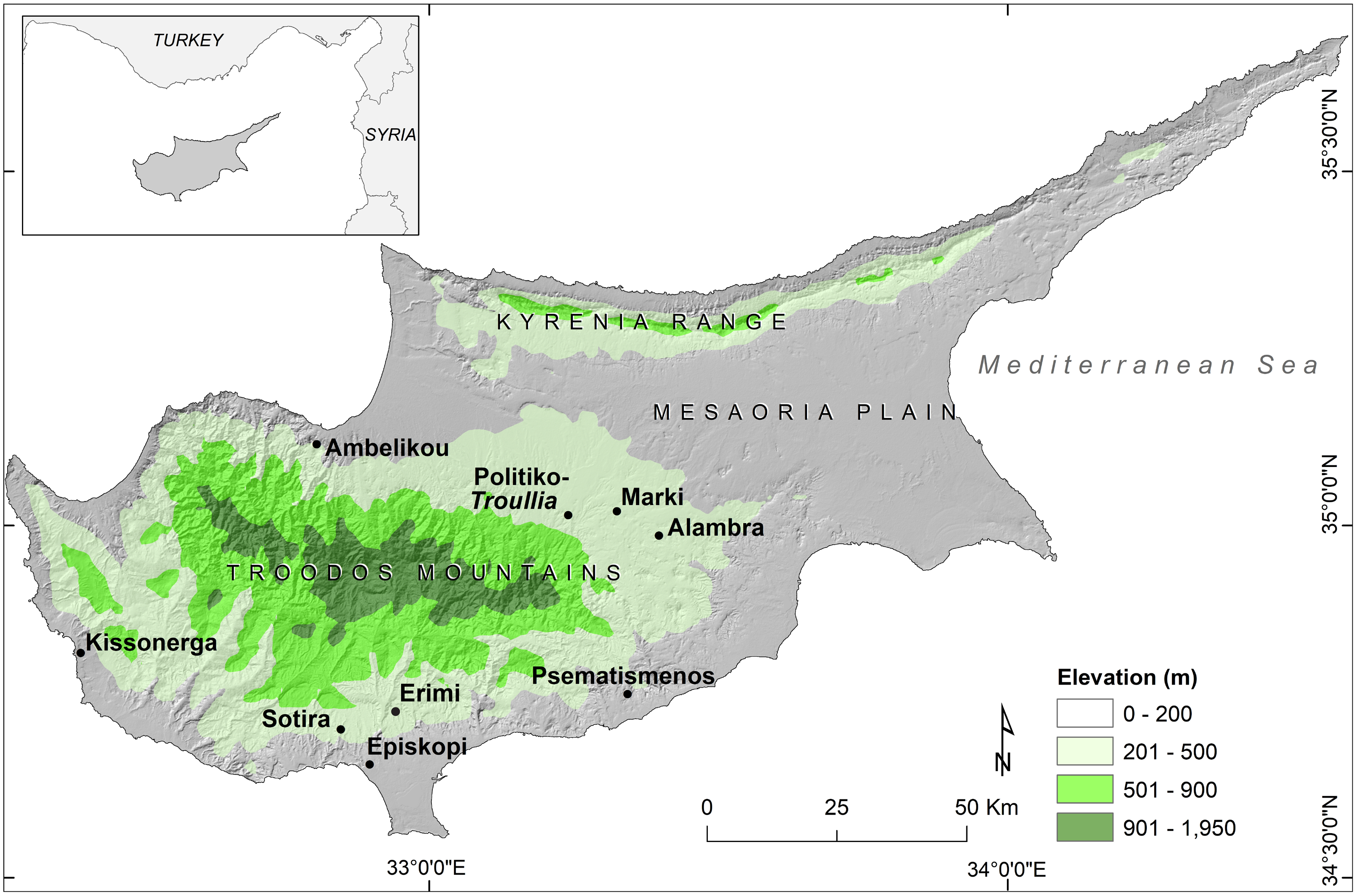
Politiko-Troullia lies in the foothills of the Troodos Mountains at the interface between the fertile Mesaoria Plain to the north and the mineral-rich pillow lavas to the southwest (Figure 1), which provide readily accessible eroded exposures of the copper-bearing Troodos ophiolite (Knapp and Kassianidou Reference Knapp, Kassianidou and Yalçin2008). Village remains lie buried in alluvial and colluvial sediments on a terrace between the Pediaios River to the east and Kamaras Creek to the west (Fall et al. Reference Fall, Falconer, Horowitz, Hunt, Metzger and Ryter2008). Perennial springs, today less than one km to the south of Politiko-Troullia (and probably adjacent to Troullia West during the Bronze Age), provided a readily accessible water source for the village’s inhabitants, with streamflow that eroded the banks of Kamaras Creek and the structures along the western edge of the village of Troullia (Figure 2)
Map of Cyprus in the northeastern Mediterranean, showing archaeological sites that provide radiocarbon ages for the Prehistoric Bronze Age of Cyprus.
Quickbird satellite false color composite image (October 2003) of Politiko-Troullia showing fields investigated by survey and excavation, agricultural terraces, topographic features, and Kamaras Creek to the west of Field 1 (see Fall et al. Reference Fall, Falconer, Horowitz, Hunt, Metzger and Ryter2008: fig. 8). Excavation units indicated by yellow squares. This study incorporates evidence from excavation areas in Troullia West, North and East in Fields 1 and 2.
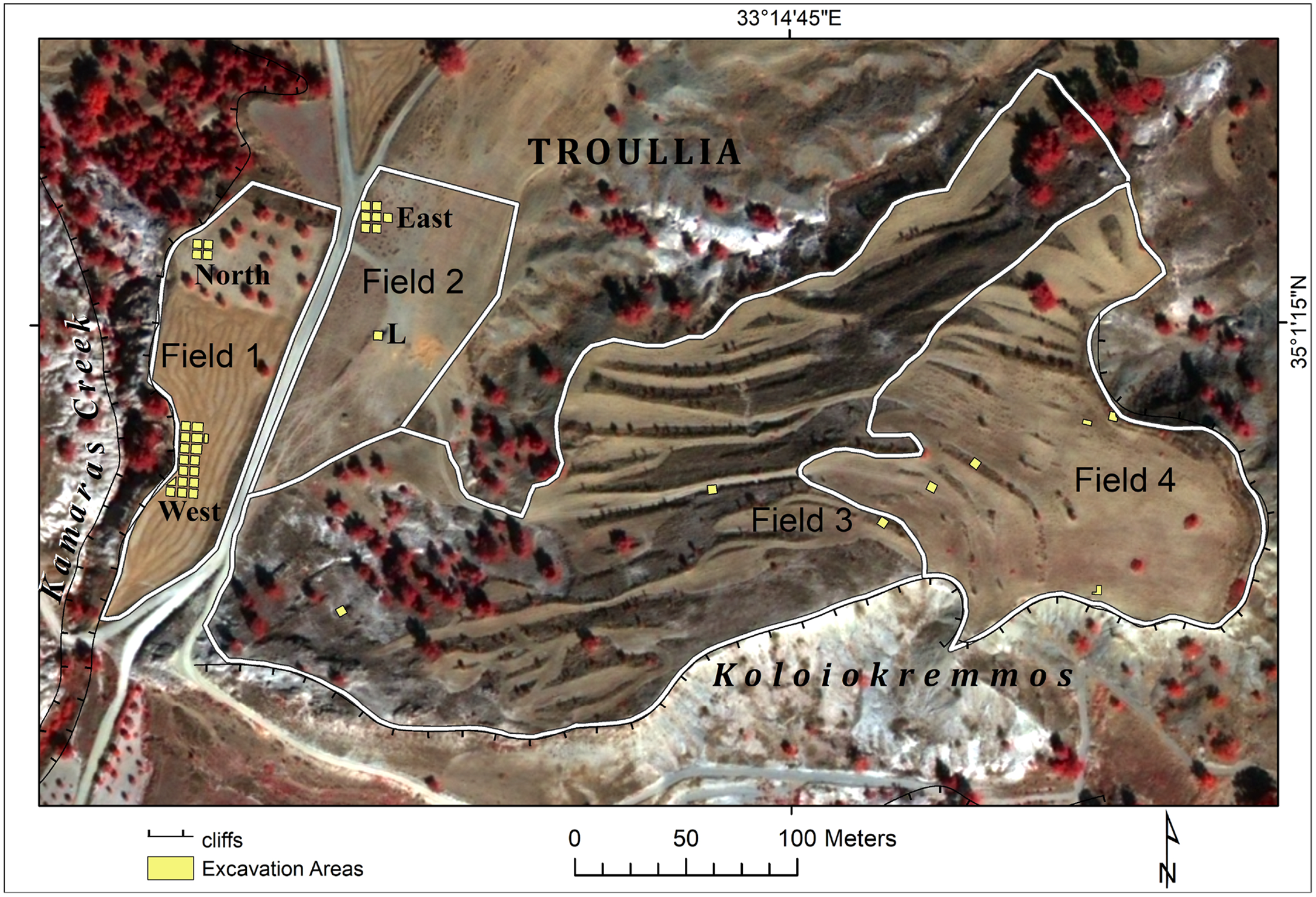
The local archaeological landscape includes material culture (primarily potsherds and ground stone) spread over about 20 ha across the fields of Troullia and the adjacent slopes of Politiko-Koloiokremmos. Surface ceramic evidence (especially Red Polished Ware sherds), with associated patterns of buried architecture revealed by soil resistivity, define the main component of Bronze Age village structures covering at least 2 ha on Politiko-Troullia, in Fields 1 and 2 (Falconer et al. Reference Falconer, Fall, Davis, Horowitz and Hunt2005). Immediately to the south, widespread Red Polished sherds and ground stone artifacts are associated with extensive agricultural terracing on the slopes of Koloiokremmos (see Figure 2, Fields 3 and 4). In concert, this evidence reflects intensive premodern management of the local landscape, including agricultural and copper ore processing (Fall et al. Reference Fall, Falconer, Galletti, Shirmang, Ridder and Klinge2012; Galletti et al. Reference Galletti, Ridder, Falconer and Fall2013; Ridder et al. Reference Ridder, Galletti, Fall and Falconer2017). Spatial analyses of these agrarian features, and rich excavated evidence of seeds, charcoal and animal bones document a mixed Bronze Age subsistence regime of grape and olive arboriculture, sheep/goat and cattle husbandry, plus hunting of wild deer and feral pigs by villagers living on the verge of oak and pine woodlands (Klinge and Fall Reference Klinge and Fall2010; Falconer and Fall Reference Falconer and Fall2013; Fall et al. Reference Fall, Falconer and Klinge2015; Ridder et al. Reference Ridder, Galletti, Fall and Falconer2017; Metzger et al. Reference Metzger, Ridder, Pilaar Birch, Falconer, Fall, Daujat, Hadjikoumis, Berthon, Chahoud, Kassianidou and Vigne2021; Pilaar Birch et al. Reference Pilaar Birch, Metzger, Ridder, Porson, Falconer and Fall2022).
Politiko-Troullia was excavated in a series of field seasons between 2004 and 2015. The site was gridded into 5 × 5 m areas, each consisting of 4 × 4 m excavation units separated by one-meter balks, arrayed primarily in three portions of the site: Troullia East, North and West (see Figure 2). Additional single areas were excavated in Area L (near Troullia East) and in a series of soundings on Politiko-Koloiokremmos. All of the areas in Troullia East, North and West, each designated by a letter, were positioned on the basis of buried architecture indicated by subsurface sensing or eroded wall exposures along Kamaras Creek. The most extensive excavations at Politiko-Troullia involved a matrix of areas in Troullia West (totaling 360 m2), which were situated where soil resistivity revealed lengthy patterns of buried stone wall alignments (Falconer et al. Reference Falconer, Fall, Davis, Horowitz and Hunt2005). The excavation areas of Troullia East (totaling 142 m2) were positioned over a particularly clear soil resistivity image of a subsurface multi-room compound. Excavations in Troullia North (totaling 81 m2) were positioned near buried stone walls exposed by erosion along the site’s edges.
The Settlement of Politiko-Troullia
The architecture of Politiko-Troullia is comprised of six stratified phases of construction and reconstruction (Falconer et al. Reference Falconer, Fall, Hunt and Metzger2012, Reference Falconer, Monahan and Fall2014; Falconer and Fall Reference Falconer and Fall2013, Reference Falconer and Fall2014). The full stratigraphic sequence (Phases 5–1a, from earliest to latest) is represented in sediments more than three meters deep in Politiko-Troullia West. Excavations in Politiko-Troullia East and North revealed architecture and associated deposits from Phases 2 and 1b. Our correlation of phases between these fields is based on the Politiko-Troullia radiocarbon chronology presented here. The major structures in Troullia West include two large rectangular open courtyards, bounded by a 2-m-wide alley on the south, which provided villagers access to the waters of Kamaras Creek in antiquity (Falconer and Fall Reference Falconer and Fall2013: figs. 7, 8, Reference Falconer and Fall2014: figs. 3, 4). The more southerly courtyard provided abundant evidence for communal activities, including feasting on Mesopotamian fallow deer (Dama dama mesopotamica), textile production, gaming stones and display of plank figures (including the largest stone plank figure excavated on Cyprus) (Falconer et al. Reference Falconer, Monahan and Fall2014). The earliest phase in Troullia West (Phase 5) includes the lowermost sediments in the alley, which are stratified below the alley walls and represent the earliest archaeological sediments at Politiko-Troullia. In subsequent Phase 4, the courtyards were constructed with adjoining rooms on their west, all situated just upslope from Kamaras Creek. The Phase 3 village retained this architectural plan, with modifications of some walls and doorways. A well in Troullia West provided intramural access to drinking water during phases 5–3 via stone steps leading down to the water table, which would have been linked with the streamflow of Kamaras Creek.
During Phases 2, 1b and 1a, the architecture in Troullia West, including the walls defining its courtyards and adjoining rooms, was shifted upslope one meter or more to the east. The latest habitation of the village in Phase 1a is represented by a two-room mudbrick structure and adjacent burned area at the northern edge of Troullia West. As part of the architectural relocation of the last three phases, the well in Troullia West was abandoned and capped with compacted limestone plaster. Numerous eroded stone walls from phases 4–1a are exposed in cross-section along the modern east bank of Kamaras Creek. This stratified architectural sequence suggests that the occupational history of Politiko-Troullia, including its comprehensive repositioning between phases 3 and 2, was linked to the geomorphological dynamics of its local landscape.
Excavation of Troullia East revealed a compound buried in sediments 0.75 m deep, which was occupied in a single stratigraphic phase. Troullia East features two roofed rooms, which were surrounded by smaller outbuildings (Fall et al. Reference Fall, Falconer, Horowitz, Hunt, Metzger and Ryter2008; Falconer and Fall Reference Falconer and Fall2013: fig. 6). An exterior workspace with a pit furnace, dense charcoal deposition, copper tongs, a limestone mold, copper slag and ore attest to a household scale metallurgical workshop (Fall et al. Reference Fall, Falconer, Horowitz, Hunt, Metzger and Ryter2008; Falconer and Fall Reference Falconer and Fall2013), in keeping with Politiko-Troullia’s proximity to local near-surface ore sources. Excavations of a multi-room structure in the upper phase of Troullia North revealed a copper workshop similar to that found in Troullia East, with an external terra cotta oven and copper slag, as well as tuyere fragments. These excavations also exposed stone wall foundations and floor deposits in a stratified lower phase of this compound.
MATERIALS AND METHODS
During the excavation of Politiko-Troullia, all excavated sediments (other than those processed by water flotation) were dry-sieved through 0.5-cm wire mesh to ensure maximum recovery of smaller sized ceramics, bones, metal and stone artifacts. Sediments with visible burned organic content were processed using non-mechanized water flotation to recover plant macrofossils. Each flotation sample was assigned a unique spatial identifier that includes the excavation area, a locus number (pertaining to a three-dimensional feature), and a bag number. We emphasized sampling of relatively shallow localized deposits in or on burned surfaces (e.g., small pits, postholes, thin occupational debris on surfaces). This strategy targets short-term depositional events and minimizes the potential for chronological mixing, leading to the recovery of well-preserved seeds and few degraded remains. All recovered plant remains 0.25 mm or larger were sorted under a binocular microscope at 6 to 40× magnification and identified using Fall’s personal reference collection, comparison with published literature (and scanning electron microscopy of charcoal pieces) following established methods of floral recovery and analysis (Falconer and Fall Reference Falconer and Fall2006:38–43, Reference Falconer and Fall2019:13–14; Klinge and Fall Reference Klinge and Fall2010; Fall et al. Reference Fall, Falconer and Klinge2015, Reference Fall, Falconer and Porson2019; Porson et al. Reference Porson, Falconer, Pilaar Birch, Ridder and Fall2021).
Twenty seed samples and five charcoal samples were selected from well-defined contexts in the six phases at Politiko-Troullia for AMS analysis by the University of Arizona Accelerator Mass Spectrometry Laboratory and the University of Georgia Center for Applied Isotope Studies (Table 2). Our most abundant seed taxon is Olea, and all five charcoal samples represent Pinus wood, which reflects the fact that pine is the most abundant taxon in our charcoal assemblage. Among our 25 samples, 20 come from small, well-defined burned sediments in earthen surfaces, shallow pits or postholes, or occupational debris built up ≤ 10 cm deep immediately on top of surfaces. The remaining five samples come from localized fill deposits associated with surfaces. All seed and charcoal samples were prepared for analysis at both AMS labs following an acid/alkali/acid pretreatment protocol. Uncalibrated ages are given in radiocarbon years before 1950 (years BP), using the 14C half-life of 5568 years. The error for each uncalibrated date is quoted as one standard deviation and reflects both statistical and experimental errors. The dates have been corrected for isotope fractionation using δ13C values.
AMS radiocarbon ages for unmodeled and modeled calibrated seed and charcoal samples from Politiko-Troullia, Cyprus. Uncalibrated 14C ages are indicated in BP with their 1σ uncertainty. Calibration based on OxCal 4.4.4 (Bronk Ramsey Reference Bronk Ramsey2009a, Reference Bronk Ramsey2017) using the IntCal20 atmospheric curve (Reimer et al. Reference Reimer, Austin, Bard, Bayliss, Blackwell, Ramsey, Butzin, Cheng, Edwards, Friedrich, Grootes, Guilderson, Hajdas, Heaton, Hogg, Hughen, Kromer, Manning, Muscheler, Palmer, Pearson, van der Plicht, Reimer, Richards, Scott, Southon, Turney, Wacker, Adolphi, Büntgen, Capano, Fahrni, Fogtmann-Schulz, Friedrich, Köhler, Kudsk, Miyake, Olsen, Reinig, Sakamoto, Sookdeo and Talamo2020). Stratigraphic phases at Politiko-Troullia run from Phase 5 (the earliest, basal stratum) to Phase 1a (the latest occupation). Samples are tabulated by phase and ordered chronologically according to conventional 14C age within each phase. Phase; Location (Troullia North, East, West); Excavation sample (Unit, Locus and Bag, e.g., A.012.41 = Unit A, Locus 012, Bag 41); Archaeological context; Species and plant part dated shown. *Outlier, A ≤ 60.
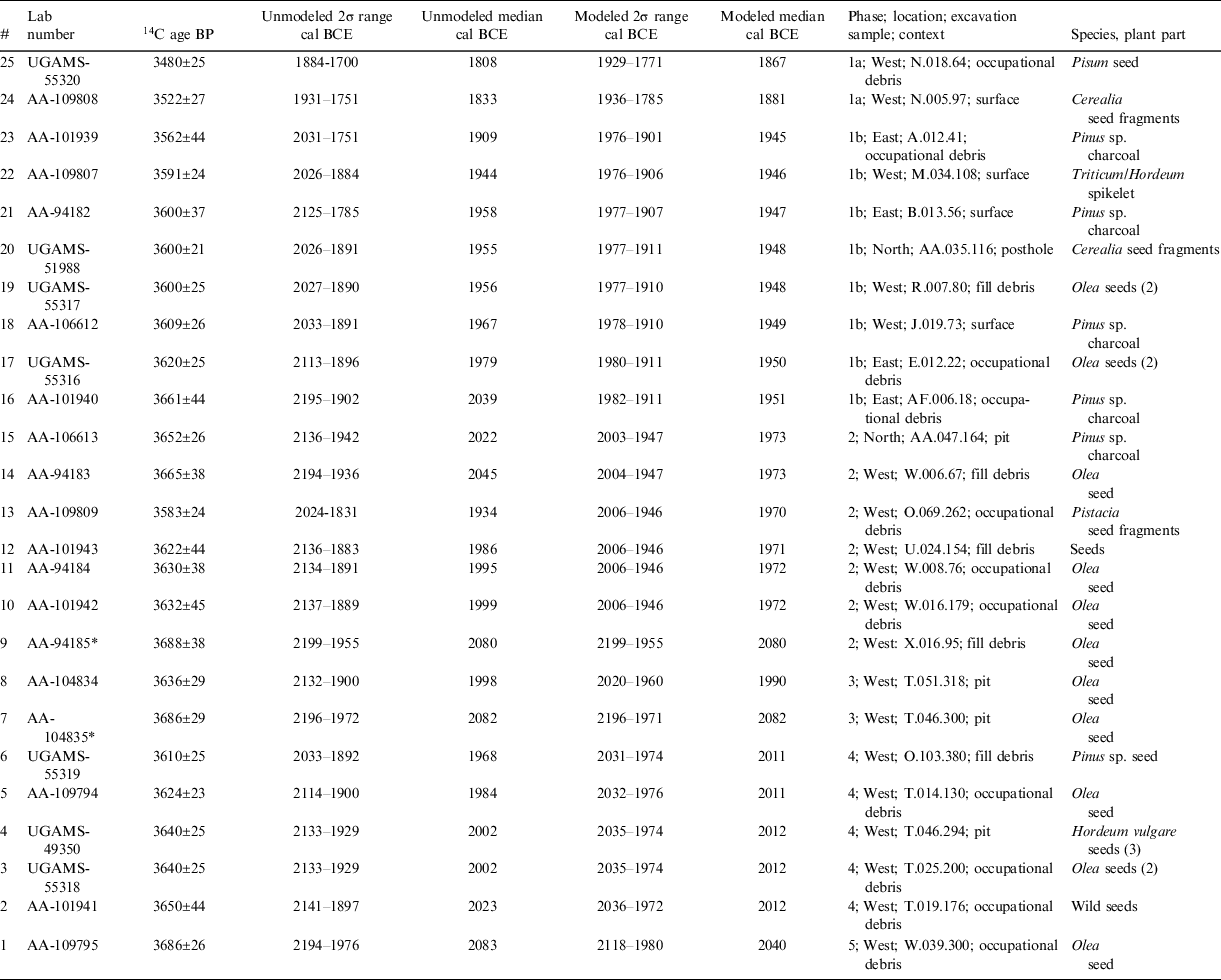
The occupational chronology for Politiko-Troullia is based on AMS 14C ages for these excavated carbonized plant remains, which have been calibrated using OxCal 4.4.4 (Bronk Ramsey Reference Bronk Ramsey2009a) and the IntCal20 atmospheric curve (Reimer et al. Reference Reimer, Austin, Bard, Bayliss, Blackwell, Ramsey, Butzin, Cheng, Edwards, Friedrich, Grootes, Guilderson, Hajdas, Heaton, Hogg, Hughen, Kromer, Manning, Muscheler, Palmer, Pearson, van der Plicht, Reimer, Richards, Scott, Southon, Turney, Wacker, Adolphi, Büntgen, Capano, Fahrni, Fogtmann-Schulz, Friedrich, Köhler, Kudsk, Miyake, Olsen, Reinig, Sakamoto, Sookdeo and Talamo2020; van der Plicht et al. Reference van der Plicht, Bronk Ramsey, Heaton, Scott and Talamo2020). The analytical tools in OxCal 4.4.4 were used for Bayesian modeling of the calibrated dates. Bayesian analysis permits probabilistic modeling of calibrated 14C determinations using prior stratigraphic information and can accommodate the non-normally distributed probabilities of calibrated 14C ages (Bronk Ramsey Reference Bronk Ramsey2009a). Agreement values (A, Amodel) can be used to assess the reliability of the individual calibrated ages in Bayesian models and the quality of overall models. Values of A calculate the likelihood of overlap of the non-modeled distribution for each calibrated age with its posterior Bayesian modeled distribution. Values of A > 60 approximate values of p < 0.05 for a χ2 significance test (Manning Reference Manning and Knapp2013a:496, fig. A5). We use values of Amodel > 60 to identify statistically robust Bayesian models, and we treat calibrated ages with A ≤ 60 as statistical outliers, which we exclude from our Bayesian modeling (Bronk Ramsey Reference Bronk Ramsey2009b). The radiocarbon ages from Politiko-Troullia were organized for modeling according to stratigraphic phases using the “Phase” function in Oxcal, in which each phase consists of a group of unordered events. Although the sediments within each phase are stratified, we did not construct a more complex model since it would be difficult to match individual sediment layers within any given phase across all of the excavation areas at Politiko-Troullia.
RESULTS
Our Bayesian modeling analyzes the 25 calibrated radiocarbon ages from Politiko-Troullia in six contiguous phases of occupation, beginning with Phase 5 and ending with Phase 1a. These ages are reported in radiocarbon years BP (Before Present, with the present defined as 1950 CE) following international convention (Stuiver and Polach Reference Stuiver and Polach1977). Our preferred Bayesian analysis (Model 1) is structured primarily by the stratigraphy of Politiko-Troullia West and also incorporates the four ages from Troullia East in Phase 1b and the date from the upper phase in Troullia North in Phase 1b, while the age from the lower phase in Troullia North is included in Phase 2. The dates from Troullia East and North are positioned in Model 1 according to their fit with the radiocarbon chronology for Troullia West. Model 1 excludes two seed ages, one from Phase 3 (AA-94185) and one from Phase 2 (AA-104835). Following the analytical methods described above, we treat these two ages as statistical outliers based on their values of A ≤ 60.
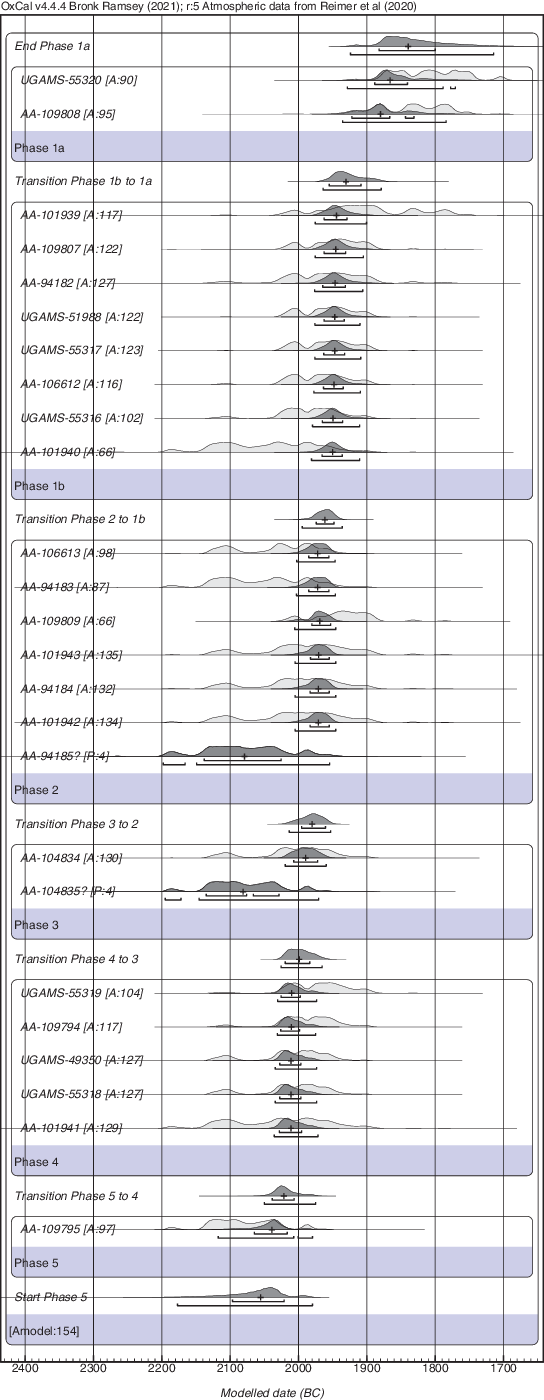
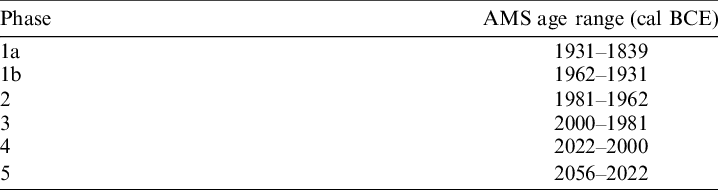
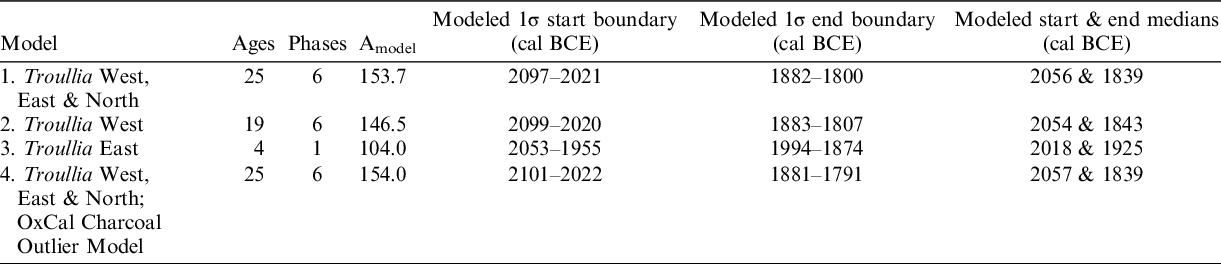
Model 1 (Amodel = 153.7) estimates the occupation of Politiko-Troullia between approximately the mid-21st and mid-19th centuries cal BCE, from the starting boundary for Phase 5 (1σ range: 2097–2021 cal BCE; median = 2056 cal BCE) to the ending boundary for Phase 1a (1σ range: 1882-1800 cal BCE; median = 1839 cal BCE) (Figure 3; Supplementary Table 1). The intervals between modeled boundary medians suggest that phases 5-1b each lasted 20–30 years (Table 3). A longer occupation for Phase 1a is estimated based on the two ages in the uppermost stratum in Troullia West, which includes a burned area possibly marking the abandonment of Politiko-Troullia. Separate models for Troullia West and Troullia East produce very similar results (Table 4). For example, the model for Politiko-Troullia West alone (Model 2; Amodel = 146.5) generates start and end boundaries, median and Amodel values very similar to those of Model 1 (Supplementary Figure 1; Supplementary Table 2). Boundary medians differ by less than 10 years between Models 1 and 2. The precision of the posterior estimates in these two models remains similar. The model for Troullia East (Model 3; Amodel = 104.0), based on fewer ages, generates a lower value for Amodel and broader start and end boundary intervals, but still accords with the time frame estimated by Model 1 (Supplementary Figure 2; Supplementary Table 3). Independent modeling of the two ages from Troullia North in Phases 1a and 1b nearly replicates the results for these two ages in Model 1. As a further consideration, the charcoal ages from Politiko-Troullia do not indicate a significant “old wood” effect of inbuilt age (Dee and Bronk Ramsey Reference Dee and Bronk Ramsey2014) on the Bayesian modeling of Politiko-Troullia. All five charcoal ages are compatible with the seed ages in Models 1 and 2, they do not skew these models early, and they have individual values of A > 60. Modeling of all 25 dates from Politiko-Troullia using the Charcoal Outlier Model in OxCal (Model 4; see Bronze Ramsey Reference Bronk Ramsey2009b; Dee and Bronk Ramsey Reference Dee and Bronk Ramsey2014) produces results (Amodel = 154.0) nearly identical to those of Models 1 and 2 (Supplementary Figure 3; Supplementary Table 4). The Outlier Model posterior values are 0 for all five charcoal ages, indicating that wood-age offsets are negligible.
Model 1: Bayesian sequencing of calibrated radiocarbon ages for 25 seed and charcoal samples from Politiko-Troullia, Cyprus; Amodel = 153.7. Light gray curves indicate single-sample calibration distributions; dark curves indicate modeled calibration distributions. Calibrations and Bayesian modeling based on OxCal 4.4.4 (Bronk Ramsey Reference Bronk Ramsey2009a) using the IntCal20 atmospheric curve (Reimer et al. Reference Reimer, Austin, Bard, Bayliss, Blackwell, Ramsey, Butzin, Cheng, Edwards, Friedrich, Grootes, Guilderson, Hajdas, Heaton, Hogg, Hughen, Kromer, Manning, Muscheler, Palmer, Pearson, van der Plicht, Reimer, Richards, Scott, Southon, Turney, Wacker, Adolphi, Büntgen, Capano, Fahrni, Fogtmann-Schulz, Friedrich, Köhler, Kudsk, Miyake, Olsen, Reinig, Sakamoto, Sookdeo and Talamo2020; van der Plicht et al. Reference van der Plicht, Bronk Ramsey, Heaton, Scott and Talamo2020). Two ages (AA-94185, AA-104835) are excluded as statistical outliers based on A ≤ 60.
AMS age ranges (cal BCE) for six stratified phases at Politiko-Troullia, Cyprus based on phase boundary medians produced by Bayesian modeling of 25 radiocarbon ages (see Figure 3). Calibration and modeling based on OxCal 4.4.4 (Bronk Ramsey Reference Bronk Ramsey2009a, Reference Bronk Ramsey2017) using the IntCal20 atmospheric curve (Reimer et al. Reference Reimer, Austin, Bard, Bayliss, Blackwell, Ramsey, Butzin, Cheng, Edwards, Friedrich, Grootes, Guilderson, Hajdas, Heaton, Hogg, Hughen, Kromer, Manning, Muscheler, Palmer, Pearson, van der Plicht, Reimer, Richards, Scott, Southon, Turney, Wacker, Adolphi, Büntgen, Capano, Fahrni, Fogtmann-Schulz, Friedrich, Köhler, Kudsk, Miyake, Olsen, Reinig, Sakamoto, Sookdeo and Talamo2020).
Summary of results from Bayesian modeling of AMS ages from Politiko-Troullia, Cyprus. Calibration and modeling based on OxCal 4.4.4 (Bronk Ramsey Reference Bronk Ramsey2009a, Reference Bronk Ramsey2017) using the IntCal20 atmospheric curve (Reimer et al. Reference Reimer, Austin, Bard, Bayliss, Blackwell, Ramsey, Butzin, Cheng, Edwards, Friedrich, Grootes, Guilderson, Hajdas, Heaton, Hogg, Hughen, Kromer, Manning, Muscheler, Palmer, Pearson, van der Plicht, Reimer, Richards, Scott, Southon, Turney, Wacker, Adolphi, Büntgen, Capano, Fahrni, Fogtmann-Schulz, Friedrich, Köhler, Kudsk, Miyake, Olsen, Reinig, Sakamoto, Sookdeo and Talamo2020).
DISCUSSION
A set of main inferences arise from the coordination of stratigraphic and chronological evidence for the occupation of Politiko-Troullia. Our initial assessment of the pottery wares and forms surveyed on Troullia West (Falconer et al. Reference Falconer, Fall, Davis, Horowitz and Hunt2005) and excavated from Troullia East (Fall et al. Reference Fall, Falconer, Horowitz, Hunt, Metzger and Ryter2008) suggested an occupation through most of the Prehistoric Bronze Age and possibly into the Protohistoric Bronze Age (i.e., from the Early through Middle Cypriot periods, and possibly into Late Cypriot). The settlement’s ceramic assemblage is dominated by Red Polished Ware, which constitutes 85–92% of the polished, painted and slipped ware sherds from each phase. White Painted and Black Polished sherds occur at frequencies up to 10%, while Red Slipped, Drab Polished and Brown Polished sherd frequencies are less than 4% in each phase. Initial ware-based analysis of the site’s stratified pottery suggested a potentially lengthy occupation (i.e., ∼500 years) from Middle Cypriot I to Late Cypriot I (Fall et al. Reference Fall, Falconer, Horowitz, Hunt, Metzger and Ryter2008). The ceramic-based chronology for these time periods in Cyprus stretches more than 500 years between 2000 and 1450 cal BCE (e.g., Knapp Reference Knapp2013: table 2).
Our radiocarbon-based chronology for Politiko-Troullia now documents a more focused, roughly two-century occupation consisting of a series of relatively brief stratigraphic phases occurring between about 2050 and 1850 cal BCE. The most pronounced stratigraphic and chronological disjunction at Politiko-Troullia West is marked by the shift from the more downslope positioning of architecture and the use of the village’s well in the earlier phases (5–3) to the more upslope architecture and abandonment of the well in the later phases (2–1a). This shift appears to have been a response to downcutting along Kamaras Creek that would have eroded the settlement’s western edge and lowered the water table feeding the village well. The timing of this event, marked by the boundary between Phases 3 and 2, is estimated slightly after 2000 cal BCE (1σ range: 1997–1962 cal BCE; median = 1981 cal BCE), which may correlate with climate changes involving increased precipitation and decreased temperature hypothesized at about 2000 cal BCE for the nearby Southern Levant (Soto-Berelov et al. Reference Soto-Berelov, Fall, Falconer and Ridder2015). This juncture, marked by geomorphological change at Politiko-Troullia, corresponds roughly with the chronological transition between Prehistoric Bronze Age 1 and 2. The majority of the ages from Politiko-Troullia then provide the most substantial stratified radiocarbon sequence for Prehistoric Bronze Age 2 habitation on Cyprus.
Other models of stratified radiocarbon evidence for the Prehistoric Bronze Age come from Sotira Kaminoudhia and Marki Alonia. Excavation of Area A at Sotira revealed two architectural phases of adjoining, largely rectilinear domestic structures associated with long, narrow alleyways (Rapp and Swiny Reference Rapp, Swiny, Swiny, Rapp and Herscher2003:5–7). Ten charcoal ages from these two phases (Swiny et al. Reference Swiny, Rapp and Herscher2003:503–505) provide the basis for Bayesian modeling of the occupation at Sotira Kaminoudhia in the 24th and 23rd centuries cal BCE, with the end of Phase II modeled at about 2200 cal BCE (Figure 4; Supplementary Table 5; Amodel = 124.0; see also Manning Reference Manning, Knapp, Webb and McCarthy2013b: fig. 10, Reference Manning, Höflmayer and Eichmann2014b: fig. 5), squarely within Prehistoric Bronze Age 1 (i.e., Philia/Early Cypriot I and II in more traditional terms). Sotira’s charcoal ages produce relatively large confidence intervals for individual modeled dates, start and end boundaries, and suggest that each of Sotira’s two phases might cover decades or stretch up to a century (see also Manning Reference Manning, Knapp, Webb and McCarthy2013b: fig. 1, table 1).
Bayesian sequencing of calibrated radiocarbon ages for 10 charcoal samples from Sotira Kaminoudhia, Cyprus; Amodel = 124.0. Light gray curves indicate single-sample calibration distributions; dark curves indicate modeled calibration distributions. Calibrations and Bayesian modeling based on OxCal 4.4.4 (Bronk Ramsey Reference Bronk Ramsey2009a) using the IntCal20 atmospheric curve (Reimer et al. Reference Reimer, Austin, Bard, Bayliss, Blackwell, Ramsey, Butzin, Cheng, Edwards, Friedrich, Grootes, Guilderson, Hajdas, Heaton, Hogg, Hughen, Kromer, Manning, Muscheler, Palmer, Pearson, van der Plicht, Reimer, Richards, Scott, Southon, Turney, Wacker, Adolphi, Büntgen, Capano, Fahrni, Fogtmann-Schulz, Friedrich, Köhler, Kudsk, Miyake, Olsen, Reinig, Sakamoto, Sookdeo and Talamo2020; van der Plicht et al. Reference van der Plicht, Bronk Ramsey, Heaton, Scott and Talamo2020).

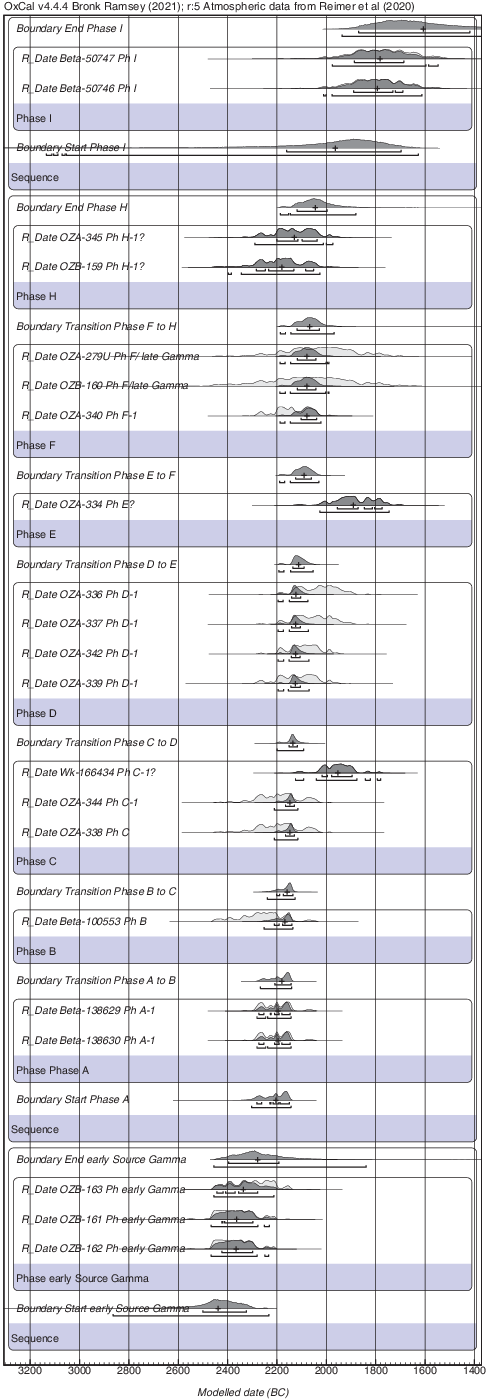
The settlement at Marki Alonia was characterized by shifting configurations of domestic compounds, most with two or more rooms and an adjoining walled courtyard. These households were periodically occupied and abandoned in varying combinations through a series of temporal episodes labeled Phases A–I (Philia/Early Cypriot to Middle Cypriot II traditionally) (Frankel and Webb Reference Frankel and Webb2006: 35–41; Webb Reference Webb2009). The evidence from each phase includes deposition related to its construction (e.g., “Phase A”) and its occupation (e.g., “Phase A-1”). Marki Alonia provides a total of 21 AMS ages, including 19 dates for seed samples and two ages for charcoal samples (Frankel and Webb Reference Frankel and Webb2006: table 3.3a), which are modeled in nine phases (Figure 5; Supplementary Table 6; Amodel = 154.3). This evidence includes five dates from levelling fill from “Source γ” whose stratigraphic placement is equivocal. Three of the Source γ ages (OZB 161–163) are the earliest from Marki Alonia and in previous analyses are modeled in a separate phase prior to Phase A, while two of the Source γ ages (OZA-279U, OZB-160) have been modeled with Phase F (following Manning Reference Manning, Knapp, Webb and McCarthy2013b:5–6, fig. 3; Peltenburg et al. Reference Peltenburg, Frankel, Paraskeva and Peltenburg2013). The best documented sequence at Marki in Phases A-H is based on 12 ages that are modeled between about 2200 and 2050 cal BCE (Manning Reference Manning, Knapp, Webb and McCarthy2013b: figs. 7, 11, table 1). The two charcoal dates from Phase I have large standard deviations, are “quite distinct from the majority of the Marki Sequence” (Manning Reference Manning, Knapp, Webb and McCarthy2013b:6) and are modeled in the 19th and 18th centuries cal BCE (see also Manning Reference Manning, Knapp, Webb and McCarthy2013b: fig. 7).
Bayesian sequencing of calibrated radiocarbon ages for 21 seed and charcoal samples from Marki Alonia, Cyprus; Amodel = 154.7. Light gray curves indicate single-sample calibration distributions; dark curves indicate modeled calibration distributions. Calibrations and Bayesian modeling based on OxCal 4.4.4 (Bronk Ramsey Reference Bronk Ramsey2009a) using the IntCal20 atmospheric curve (Reimer et al. Reference Reimer, Austin, Bard, Bayliss, Blackwell, Ramsey, Butzin, Cheng, Edwards, Friedrich, Grootes, Guilderson, Hajdas, Heaton, Hogg, Hughen, Kromer, Manning, Muscheler, Palmer, Pearson, van der Plicht, Reimer, Richards, Scott, Southon, Turney, Wacker, Adolphi, Büntgen, Capano, Fahrni, Fogtmann-Schulz, Friedrich, Köhler, Kudsk, Miyake, Olsen, Reinig, Sakamoto, Sookdeo and Talamo2020; van der Plicht et al. Reference van der Plicht, Bronk Ramsey, Heaton, Scott and Talamo2020). Two samples (OZA-334 and Wk-166434) are excluded as statistical outliers based on A ≤ 60 and two samples (OZA-345 and OZB-159) are excluded following Manning Reference Manning, Knapp, Webb and McCarthy2013b, Models 7–10.
The remaining radiocarbon determinations for the Prehistoric Bronze Age on Cyprus include 14 ages for charcoal samples from five other sites: Alambra Mouttes (4 dates) (Coleman et al. Reference Coleman, Barlow, Mogelonsky and Schaar1996: table 29), Ambelikou Aletri (2) (Håkansson Reference Håkansson1981:402), Episkopi Phaneromeni (3) (Fishman et al. Reference Fishman, Forbes and Lawn1977:189), Erimi-Laonin tou Porokou (4; excluding 3 outliers) (Scirè Calabrisotto and Fedi Reference Scirè Calabrisotto, Fedi and Bombardieri2017; Scirè Calabrisotto et al. Reference Scirè Calabrisotto, Fedi, Caforio and Bombardieri2012), and Psematismenos Trelloukkas (1) (Manning and Sewell Reference Manning and Sewell2006:68). The calibrated ages for these samples range from late Prehistoric Bronze Age 1 through Prehistoric Bronze Age 2, between the mid-23rd century and the mid-18th century BCE, with the lone exception of a single age (Beta-82995) from Alambra Mouttes, which dates around 2500 cal BCE. Due to the susceptibility of charcoal ages to the effects of inbuilt age (e.g., see discussion of “old wood” problems with the ages from Erimi [Scirè Calabrisotto et al. Reference Scirè Calabrisotto, Amadio, Fedi, Liccioli and Bombardieri2017:1927]), these dates (and those from Sotira Kaminoudhia) are best viewed as supplying terminus post quem information.
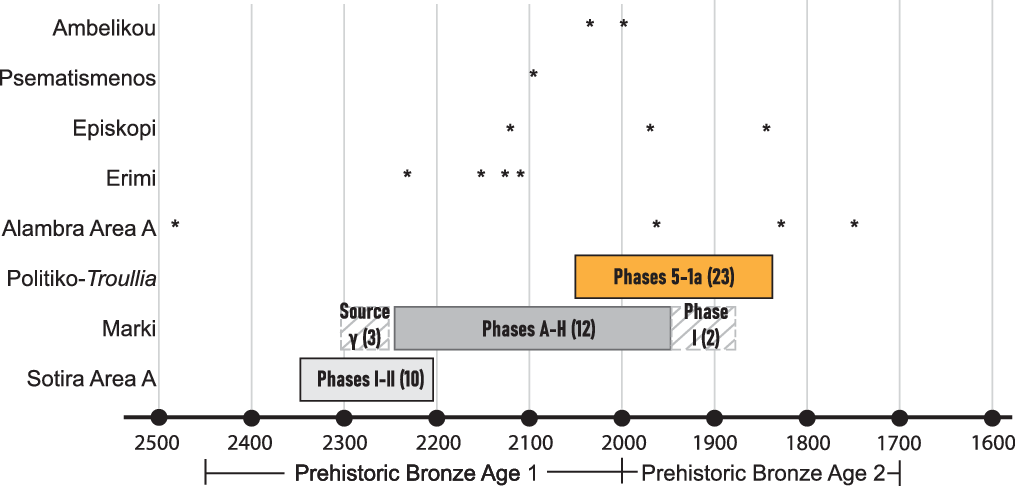
A schematic depiction of the modeled radiocarbon sequences for Politiko-Troullia, Marki Alonia and Sotira Kaminoudhia, and individual calibrated dates from five other sites (Figure 6) facilitates comparative inferences of Prehistoric Bronze Age chronology on Cyprus. In light of the potential for inbuilt age effects noted above, the charcoal ages from Sotira Area A most clearly indicate the end of its habitation about 2200 cal BCE, after two stratigraphic phases jointly covering a century or more. At Marki, following the disjunct set of dates from early Source γ, the stratigraphically-defined sequence in Phases A–H models this settlement’s best-attested occupation through about three centuries in the latter half of Prehistoric Bronze Age 1. The two distinct charcoal ages from Phase I then mark the latest evidence from Marki early in Prehistoric Bronze Age 2. The individual charcoal ages from Alambra, Ambelikou, Episkopi, Erimi and Psematismenos sporadically populate the timespan from late Prehistoric Bronze Age 1 into Prehistoric Bronze Age 2.
Schematic comparison of calibrated radiocarbon evidence from Prehistoric Bronze Age settlements on Cyprus. Bars depict Bayesian modeled sequences for calibrated radiocarbon ages from Politiko-Troullia, Sotira Kaminoudhia and Marki Alonia depicted according to modeled boundary medians (number of modeled ages for each sequence indicated in parentheses). Modeling of Troullia excludes two dates from Phases 3 and 2 that are statistical outliers. Marki excludes four ages: two from Phase H-1 and two statistical outliers (see Manning Reference Manning, Knapp, Webb and McCarthy2013b: table 1, figs. 7, 10). Radiocarbon ages from Alambra, Ambelikou, Episkopi, Erimi, and Psematismenos are plotted as individual unmodeled calibrated dates.
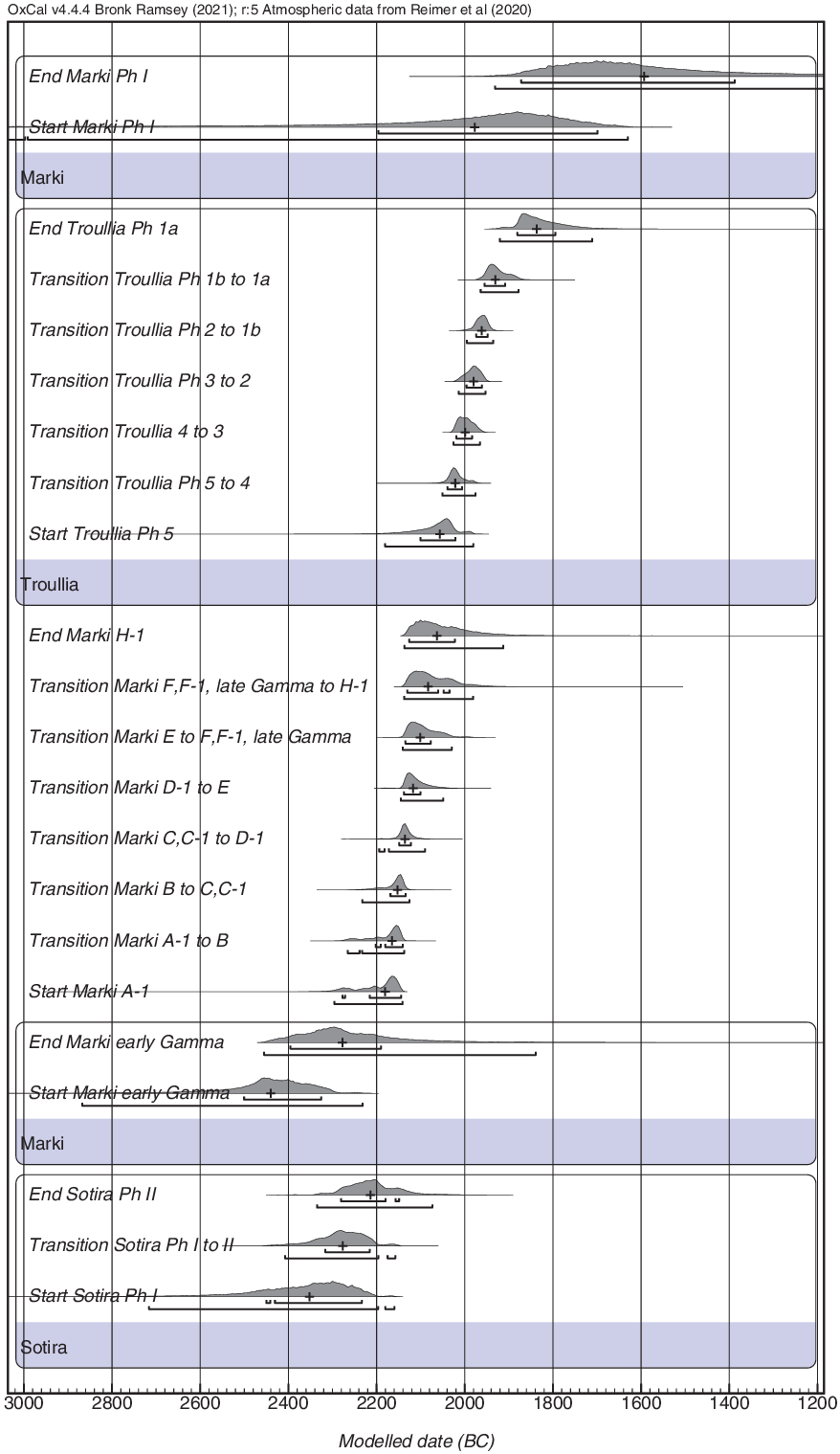
Combined Bayesian modeling of the stratified AMS ages from Sotira Kaminoudhia, Marki Alonia and Politiko-Troullia (Figure 7) now leads to a set of interrelated inferences with fundamental implications for the framework of Cypriot Bronze Age chronology and the social and environmental changes that frame its temporal structure. Bayesian modeling of the charcoal ages from Sotira Kaminoudhia places its two phases of occupation prior to about 2200 cal BCE, thereby positioning it early in Prehistoric Bronze Age 1, even if the potential effects of inbuilt age are considered (see Knapp Reference Knapp2008: table 2, Reference Knapp2013: table 2; Manning Reference Manning, Höflmayer and Eichmann2014b:215). The radiocarbon evidence from Marki Alonia Phases A-1 through H-1 situates this settlement’s best attested sequence between about 2200 and 2050 cal BCE, in the latter portion of Prehistoric Bronze Age 1. Three dates from early Source γ could reflect the Philia Facies in roughly the 24th century cal BCE, while two ages from Phase I suggest a disjunct final phase for the Marki sequence ending around 1800 cal BCE. Politiko-Troullia now provides a high-resolution Prehistoric Bronze Age chronology supported by Bayesian modeling of 25 stratified radiocarbon ages over roughly 200 years, from the 21st century cal BCE across the Prehistoric Bronze Age 1/2 transition, and through most of the 19th century cal BCE to the mid-Prehistoric Bronze Age 2. The major architectural shift at Politiko-Troullia at about 2000 cal BCE was a response to accentuated local erosion, especially stream downcutting near Politiko-Troullia at a time of decreased temperature and increased precipitation in the eastern Mediterranean at the beginning of the Middle Bronze Age in the Southern Levant (e.g., Soto-Berelov et al. Reference Soto-Berelov, Fall, Falconer and Ridder2015). The interval for the Prehistoric Bronze Age 2, in turn, approximates the timing of Levantine Middle Bronze Age reurbanization (Höflmayer et al. Reference Höflmayer, Kamlah, Sader, Dee, Kutschera, Wild and Riehl2016; Falconer and Fall Reference Falconer and Fall2017; Fall et al. Reference Fall, Falconer and Höflmayer2021). These major inferences derive from the modeling and articulation of stratified radiocarbon sequences from excavated Prehistoric Bronze Age settlements that illuminate major junctures of social and environmental change and thereby refine the radiocarbon-based chronology for Prehistoric Bronze Age Cyprus.
Bayesian sequencing of phase boundaries based on calibrated radiocarbon ages for seed and charcoal samples from Sotira Kaminoudhia, Marki Alonia and Politiko-Troullia, Cyprus; Amodel = 182.5. The dark curves indicate modeled calibration distributions. Calibrations and Bayesian modeling based on OxCal 4.4.4 (Bronk Ramsey Reference Bronk Ramsey2009a) using the IntCal20 atmospheric curve (Reimer et al. Reference Reimer, Austin, Bard, Bayliss, Blackwell, Ramsey, Butzin, Cheng, Edwards, Friedrich, Grootes, Guilderson, Hajdas, Heaton, Hogg, Hughen, Kromer, Manning, Muscheler, Palmer, Pearson, van der Plicht, Reimer, Richards, Scott, Southon, Turney, Wacker, Adolphi, Büntgen, Capano, Fahrni, Fogtmann-Schulz, Friedrich, Köhler, Kudsk, Miyake, Olsen, Reinig, Sakamoto, Sookdeo and Talamo2020; van der Plicht et al. Reference van der Plicht, Bronk Ramsey, Heaton, Scott and Talamo2020).
CONCLUSIONS
This study presents Bayesian modeling of 25 calibrated AMS ages from Politiko-Troullia as the newest contribution to elucidate a radiocarbon-based chronology for the formative pre-urban Prehistoric Bronze Age of Cyprus. Our modeling estimates the occupation of Politiko-Troullia between about 2050 and 1850 cal BCE, from the late Prehistoric Bronze Age 1 through the first half or more of Prehistoric Bronze Age 2. We identify a juncture of major architectural modification at Politiko-Troullia (∼1980 cal BCE), which was a response to local stream downcutting and may reflect wider environmental change (e.g., due to increased regional precipitation), which provides temporal resolution for the boundary between Prehistoric Bronze Age 1 and 2. The evidence from Politiko-Troullia provides improved chronological resolution for the Prehistoric Bronze Age 2 in particular, which was attested previously by small numbers of unstratified charcoal ages from three disparate settlements. Our modeling of six phases of occupation at Troullia articulates with other stratified Prehistoric Bronze Age radiocarbon sequences on the island (from Sotira Kaminoudhia and Marki Alonia) to constitute a multi-site chronology from the late third millennium through the early second millennium cal BCE as a foundation for inferring the late prehistoric social and environmental dynamics of Cyprus.
FUNDING
Funded provided by National Science Foundation grants 0613760, 1031527, 1850259, 2114406, National Geographic Society grant 7820-05, a Harris Endowment Grant from the American Society of Overseas Research, and an Ignite Planning Grant from the University of North Carolina Charlotte.
AUTHOR CONTRIBUTIONS
Falconer: conceptualization, methodology, investigation, resources, writing—original draft and editing; Ridder: methodology, analysis, visualization, data curation, writing—review and editing; Pilaar Birch: methodology, analysis, investigation, resources, data curation, writing—review and editing; Fall: conceptualization, methodology, investigation, resources, writing—original draft and editing.
DECLARATION OF COMPETING INTERESTS
The authors declare no conflicts or competing interests.
ACKNOWLEDGMENTS
Fieldwork at Politiko-Troullia and Koloiokremmos was conducted under permit from the Department of Antiquities, Republic of Cyprus, in affiliation with the Cyprus American Archaeological Research Institute, Nicosia. We thank our field crews from 2004 to 2015 and the kind hospitality offered by our host community of Pera Orinis. We thank John Meadows and three anonymous reviewers for their constructive critiques of our manuscript, which contributed to an improved publication.
Supplementary material
To view supplementary material for this article, please visit https://doi.org/10.1017/RDC.2022.99


 Open access

