





Introduction
Skin and soft tissue infections (SSTIs) are common worldwide Reference Miller, Eisenberg and Liu1 and can cause significant morbidity and mortality. Reference Vella, Derreumaux and Aris2 Staphylococcus aureus is the causative organism in a large portion of SSTIs, and this includes antibiotic-resistant strains like methicillin-resistant Staphylococcus aureus (MRSA). Reference Ray, Suaya and Baxter3 MRSA-targeting antibiotics have a risk of major adverse reactions, including clindamycin-associated Clostridioides difficile infection, vancomycin flushing syndrome, and renal toxicity. Reference Liu, Bayer and Cosgrove4 Antibiotic de-escalation after empiric treatment with MRSA-targeting agents is often desired, usually occurring after susceptibilities return. Nasal swab polymerase chain reaction (PCR) detection of MRSA has a relatively quick turn-around time, and this screening and identification of MRSA-colonized patients has been proposed as a tool for antibiotic de-escalation. Reference Coye, Foote, Stasko, Demarco, Farley and Kalia5–Reference Carr, Daley, Givens Merkel and Rose8
Screening for MRSA in the anterior nares has a high specificity for diabetic foot infections Reference Coye, Foote, Stasko, Demarco, Farley and Kalia5 and MRSA pneumonia. Reference Parente, Cunha, Mylonakis and Timbrook7 However, the relationship between MRSA colonization of the nose and whether MRSA is the causative organism for patients presenting with SSTIs is less well-characterized. Previous studies reviewed the literature on the predictive value of MRSA colonization for many types of infections, including SSTIs, but they did not report nares-only data, and they included infections that developed during hospitalization. Reference Butler-Laporte, De L’Étoile-Morel, Cheng, McDonald and Lee6,Reference Carr, Daley, Givens Merkel and Rose8 Healthcare-associated MRSA and community-associated MRSA have different genotypes, virulence factors, resistance profiles, and clinical characteristics. Reference Peng, Liu, Ma and Gao9 By only including patients who present with acute SSTIs, we can select for predominately (although not exclusively) community-associated infections. To our knowledge, our article describes the first meta-analysis that focuses on the utility of MRSA detection in the anterior nares for predicting MRSA infection among patients presenting with an acute SSTI.
Methods
This review was conducted according to PRISMA guidelines, Reference Liberati, Altman and Tetzlaff10 and the protocol was prospectively registered with PROSPERO (CRD42024524640). Six databases (PubMed, MEDLINE via Ovid, EMBASE via Ovid, Web of Science, Scopus, and the Cochrane Library) were searched from date of first entry through January 1, 2025. Title, abstract, and keywords were searched for terms including methicillin-resistant Staphylococcus aureus (or MRSA), skin (or cutaneous or derm*), skin and soft tissue infection (or SSTI or pyoderma or skin infection), and nasal (or nose or nares). The exact searches are described in Supplementary Table 1. The search was restricted to English language articles with human participants, and there were no publication date restrictions. Published and peer-reviewed studies, including observational or randomized controlled trials, were included. To avoid undefined estimates of the screening test, case reports and case series were excluded. Review articles,, conference abstracts, and grey literature were also excluded.
Studies were eligible for inclusion if: (1) they included data on the MRSA nasal carriage status of at least 15 people presenting with acute SSTIs; (2) samples of the nares and the SSTIs were obtained within 72 hours of each other; and (3) the reports included enough information to form a 2×2 contingency table. To ensure the meta-analysis results were representative of a random patient presenting with an acute SSTI and, thus more generalizable, we excluded studies if the inclusion criteria required participants to have a particular comorbid disease/illness, a specific previous treatment, or a history of MRSA infection/colonization (or lack thereof).
After de-duplicating search results, two reviewers (SB, CG) screened the titles and abstracts for relevance and for meeting the above criteria. We screened the full text of each remaining article according to the same criteria. We hand-searched the reference lists of retained articles for additional articles. For included studies, we utilized a standardized form for data collection on the methods, participant demographics, and the 2×2 table (see supplementary material). Each selected study also had a risk of bias assessment using the revised Quality Assessment of Diagnostic Accuracy Studies tool (QUADAS-2) Reference Whiting, Rutjes and Westwood11 (see supplementary material). If there was a high risk of bias in at least two of the four domains, then the studies were excluded. Throughout this process, we resolved disagreements between reviewers by consensus.
The main outcome of interest was the pooled sensitivity and specificity of the nares MRSA status for predicting SSTI MRSA status. A hierarchical bivariate model without covariates, which is numerically equivalent to the hierarchical SROC model without covariates, Reference Deeks, Bossuyt, Leeflang and Takwoingi12 estimated the pooled sensitivity and specificity. The model takes into account how different studies may have calibrated their tests differently to obtain disparate sensitivity and specificity results. We used MetaDTA, an online Rshiny app, Reference Freeman, Kerby, Patel, Cooper, Quinn and Sutton13,Reference Patel, Cooper, Freeman and Sutton14 to estimate and visualize the model. To examine heterogeneity, we completed sub-group analyses on subgroups of participants (pediatric vs adult patients) or methods (PCR vs culture) that included at least 100 people. We used a hierarchical bivariate model to estimate the heterogeneous sensitivity and specificity. We used the R package rjags Reference Plummer15 to estimate and visualize the heterogeneous models.
Results
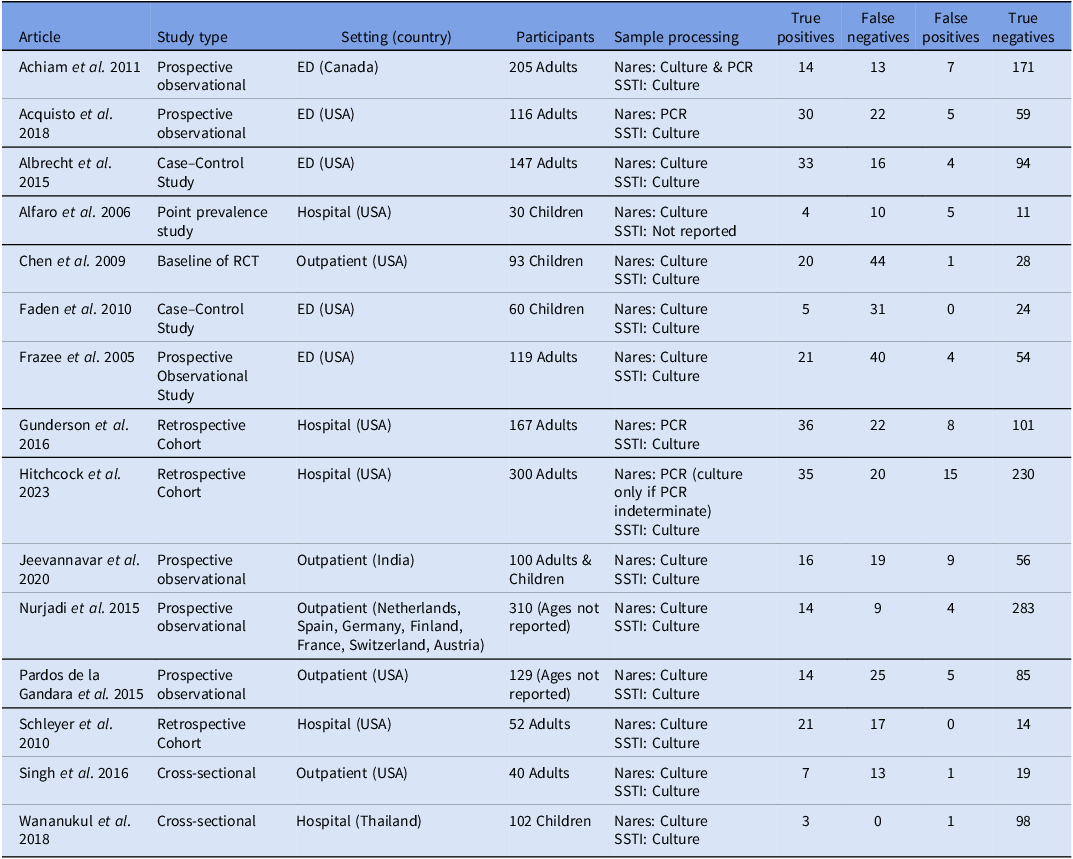
We screened the titles and abstracts of 1040 publications, with 205 remaining for full text review (see Supplementary Figure 1 for flow diagram). We excluded records based on the criteria described in our methods (see Supplementary Table 2 for full-text article exclusion rationale), leading to 15 remaining studies. Reference Achiam, Fernandes and McLeod16–Reference Wananukul, Santatipayunkul, Chatproedprai, Tempark and Chatsuwan30 We included these 15 remaining studies because a risk of bias assessment revealed that all of the studies had a low-to-moderate risk of bias (see Supplementary Table 3). Table 1 briefly summarizes the studies (see Supplementary Table 4 for additional information).
Characteristics of included studies of the meta-analysis with the individual study data on the MRSA status concordance of the SSTI and nares

We included 1,970 participants in the meta-analysis. An equal number of studies were conducted in the emergency department (5), hospital (5), and outpatient setting (5). Most studies were performed in the United States of America (USA) (11). Demographic reporting was inconsistent among studies. For example, 12 studies Reference Achiam, Fernandes and McLeod16–Reference Albrecht, Limbago and Moran18,Reference Chen, Cantey, Carroll, Ross, Speser and Siberry20–Reference Nurjadi, Friedrich-Jänicke and Schäfer26,Reference Singh, Johnson and Schlett29,Reference Wananukul, Santatipayunkul, Chatproedprai, Tempark and Chatsuwan30 included information on the sex of their participants (1106 male; 685 female), but some also incorporated non-cultured SSTI cases (ie, patients not in the meta-analysis). Only nine studies Reference Achiam, Fernandes and McLeod16–Reference Albrecht, Limbago and Moran18,Reference Faden, Lesse and Trask21,Reference Gunderson, Holleck, Chang, Merchant, Lin and Gupta23–Reference Jeevannavar, Ranugha, Betkerur and Kulkarni25,Reference Singh, Johnson and Schlett29,Reference Wananukul, Santatipayunkul, Chatproedprai, Tempark and Chatsuwan30 contained information on the sex of patients with both nares and SSTI isolate data (776 male; 459 female). For the remainder of the results, we will discuss the demographic data exclusive to the participants used in the meta-analysis (Supplementary Table 5). The patients included in the meta-analysis had an age range of 1 month to 84 years. Reference Achiam, Fernandes and McLeod16–Reference Albrecht, Limbago and Moran18,Reference Hitchcock, Seabury and Kufel24,Reference Jeevannavar, Ranugha, Betkerur and Kulkarni25,Reference Schleyer, Jarman, Chan and Dellit28–Reference Wananukul, Santatipayunkul, Chatproedprai, Tempark and Chatsuwan30 Abscess/Furuncle was the most reported SSTI (n = 714).Reference Acquisto, Bodkin and Brown 17 , Reference Albrecht, Limbago and Moran 18 , Reference Faden, Lesse and Trask 21 – Reference Jeevannavar, Ranugha, Betkerur and Kulkarni 25 , Reference Singh, Johnson and Schlett 29 , Reference Wananukul, Santatipayunkul, Chatproedprai, Tempark and Chatsuwan 30 Among the 1,051 participants in studies that reported comorbidities,Reference Acquisto, Bodkin and Brown 17, Reference Albrecht, Limbago and Moran 18 , Reference Frazee, Lynn, Charlebois, Lambert, Lowery and Perdreau-Remington 22 – Reference Jeevannavar, Ranugha, Betkerur and Kulkarni 25 , Reference Wananukul, Santatipayunkul, Chatproedprai, Tempark and Chatsuwan 30 275 (26%) had diabetes. Of the 999 participants in studies that reported social history,Reference Achiam, Fernandes and McLeod 16 , Reference Acquisto, Bodkin and Brown 17 , Reference Frazee, Lynn, Charlebois, Lambert, Lowery and Perdreau-Remington 22 – Reference Hitchcock, Seabury and Kufel 24 , Reference Schleyer, Jarman, Chan and Dellit 28 , Reference Singh, Johnson and Schlett 29 60 (6%) were homeless, 150 (15%) were IV drug users, and 26 (3%) resided in an assisted living facility or nursing home.
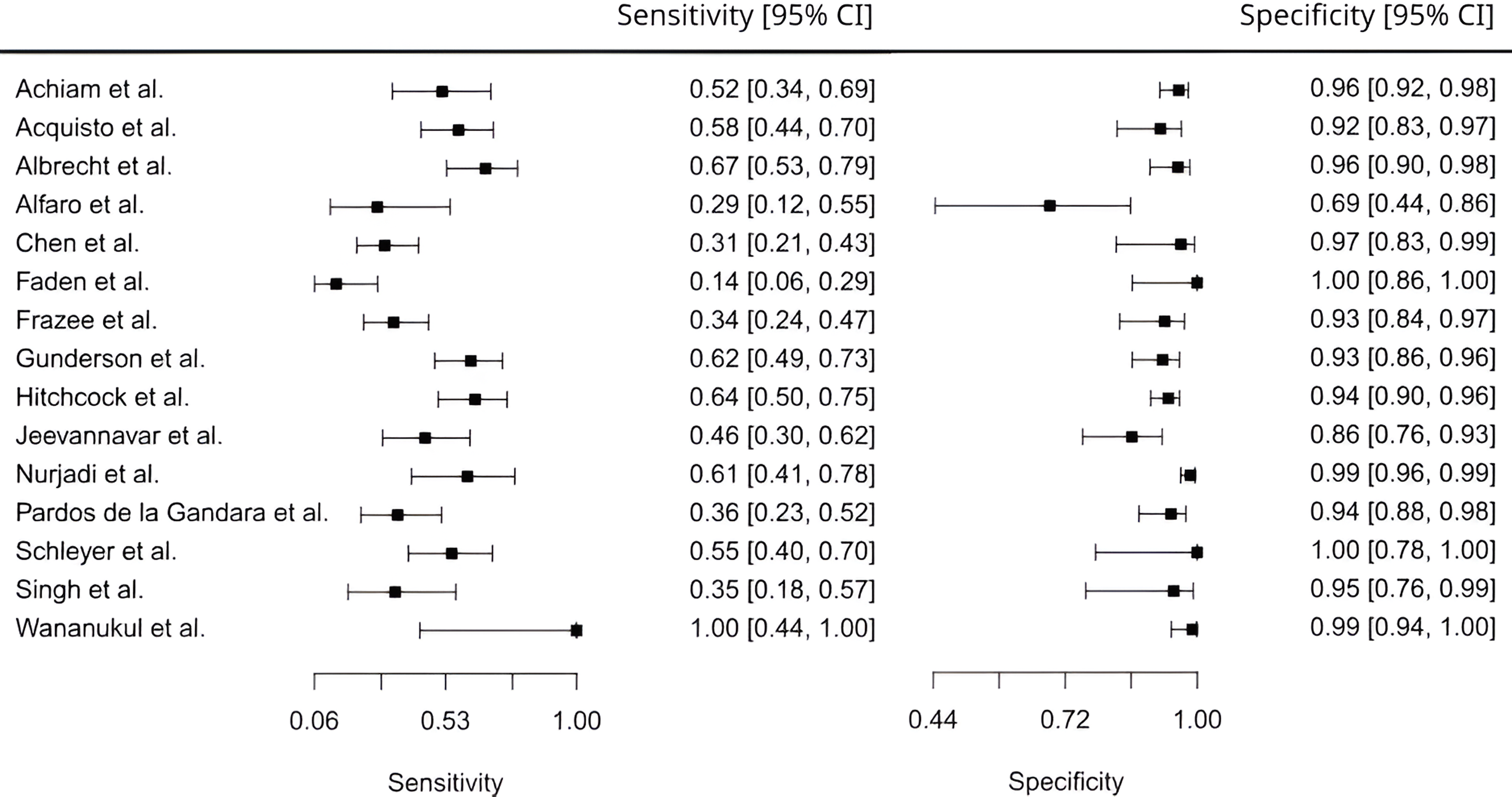
After we incorporated the specificities and sensitivities of the individual studies (Figure 1) into the statistical model, the estimate of the overall specificity was 0.949 (95% CI: 0.920–0.967) and the overall sensitivity was 0.474 (95% CI: 0.383–0.567). The pooled prevalence of MRSA SSTI was 29.1%. Using this prevalence of 29.1%, the positive predictive value (PPV) of MRSA nares swabs for predicting MRSA SSTIs was 0.798 and the negative predictive value (NPV) was 0.815.
Forest plots of individual sensitivities and specificities with 95% confidence intervals (CIs).

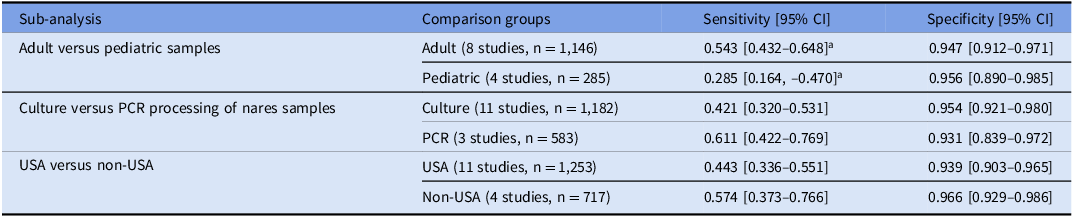
Three sub-analyses were performed to assess the heterogeneity of the studies: (1) adult versus pediatric populations, (2) nares isolate analysis with primarily culture versus PCR, and (3) USA versus non-USA studies. The sub-analyses (Table 2) found that screening was more sensitive among adults (0.543 [95% CI: 0.432–0.648]) than among children (0.285 [95% CI: 0.164–0.470]) (median difference of 0.258; P < .05). In addition, studies conducted in the USA found a significantly higher MRSA SSTI prevalence (38.8%) than those conducted elsewhere (12.3%; P < .01). This difference in baseline prevalence resulted in different predictive values for USA studies (PPV of 0.859 and NPV of 0.741) compared with non-USA studies (PPV of 0.574 and NPV of 0.928).
Results of sub-analyses assessing whether the subgroups have variable sensitivities and specificities of nasal screening for MRSA to determine if MRSA caused an acute SSTI

a Significant (P < .05) difference for the sensitivity of adult versus pediatric samples. Other sub-group analyses (eg, culture versus PCR; USA versus non-USA; specificity of adult versus pediatric samples) were not significantly different.
Discussion
This meta-analysis of 15 studies (n = 1,970)Reference Achiam, Fernandes and McLeod 16 – Reference Wananukul, Santatipayunkul, Chatproedprai, Tempark and Chatsuwan 30 revealed that the patient’s MRSA nasal carrier status (ie, carrier or non-carrier) predicted whether MRSA caused the patient’s acute SSTI with an overall specificity of 0.949 and sensitivity of 0.474. This is comparable to diabetic foot infections (specificity = 0.941; sensitivity = 0.417), Reference Coye, Foote, Stasko, Demarco, Farley and Kalia5 which is reassuring for the test’s consistency. Our meta-analysis found a pooled MRSA SSTI prevalence of 29.1% leading to a PPV of 0.798 and an NPV of 0.815. Ideally, screening tools designed to rule out diseases or infections (eg, for antibiotic de-escalation) should have a high NPV. Our meta-analysis found that the NPV of nares MRSA screening was lower for acute SSTIs than for pneumonias (NPV of 0.965 for 10% prevalence), Reference Parente, Cunha, Mylonakis and Timbrook7 indicating that screening the nares to predict whether an infection is caused by MRSA is generally less reliable for acute SSTIs than it is for pneumonias. However, the NPV of MRSA nares screening decreases as the MRSA infection prevalence increases. The global baseline MRSA prevalence of SSTIs is 41%, Reference Diekema, Pfaller and Shortridge31 but can be less than 5% in some countries. Reference Klein, Menz, Zanger, Heeg and Nurjadi32 Given the difference in MRSA SSTI prevalence between studies conducted in the USA (38.8%) and those conducted elsewhere (12.3%), our meta-analysis found that the NPV of nasal MRSA screening for patients with acute SSTIs was lower in the USA (0.741) than for studies done elsewhere (0.928). Our sub-analysis examining study location (USA vs non-USA) found that the sensitivities and specificities of MRSA nares screening did not vary by location, indicating that the test performance is similar regardless of location, but the interpretation of the test results (ie, the reliability of a negative test) may differ.
In addition to geography, patient-dependent factors, including history of MRSA infection, IV drug use, diabetes, and HIV/AIDS, can also influence the probability of MRSA SSTIs. Reference Zasowski, Trinh and Claeys33 We tried to minimize this type of bias by excluding studies that required certain conditions or treatments as part of the enrollment criteria. However, a significant portion of participants in our meta-analysis had diabetes (26%) or used drugs intravenously (15%), which may have impacted the baseline MRSA SSTI prevalence. We could not analyze the effect of co-morbidities or patient history because demographic data were not reported consistently across studies. However, we were able to analyze differences in pediatric versus adult participants. Interestingly, we found that screening was significantly more sensitive for adults (0.543) than for pediatric participants (0.285), but the specificity did not differ. The reasons underlying this finding are unclear, highlighting the need for continued research into the effect of age on the mechanisms underlying MRSA infections. In addition, the rates of MRSA infections can sometimes differ between pediatric and adult patients, 34 which would alter the NPV (and therefore the reliability and interpretation) of the MRSA nares screening test for children. Therefore, clinicians should consider the clinical context when using MRSA nares screening to guide management of patients with acute SSTIs.
We also performed a sub-analysis to examine the effect of processing nasal specimens using PCR versus culture. We found no differences in sensitivities or specificities for studies that used PCR versus culture, which aligns with previous literature, where PCR assays for MRSA are comparable to culture detection (sensitivity = 0.976, specificity = 0.949). Reference Clay, Orwig and Stevens35 Although we incorporated studies with different methods of screening (PCR and culture), the nose was the only screening site in our meta-analysis. Multiple swab sites, particularly the groin and throat, improve detection of MRSA-colonized patients. Reference Chipolombwe, Török, Mbelle and Nyasulu36 Compared with testing multiple body sites, nares-only collections have a sensitivity of 0.68 for MRSA colonization.Reference Chipolombwe, Török, Mbelle and Nyasulu 36 However, nares testing is convenient, noninvasive, and widely used, Reference Carr, Daley, Givens Merkel and Rose8 and we have substantially less data on MRSA colonization at other body sites. Further research is needed to determine the utility of using multiple screening sites for MRSA in clinical practice.
Supplementary material
The supplementary material for this article can be found at https://doi.org/10.1017/ice.2025.58.
Data availability statement
The data supporting the conclusions of this study are found within the article, supplementary material, and by consulting the works cited.
Author contribution
Conceptualization, S.B.; data curation, S.B. and C.G.; formal analysis, C.G., supervision, M.H.; writing—original draft, S.B.; writing—reviewing and editing, C.G., M.H.
Financial support
This work was supported by the University of Minnesota.
Competing interests
None declared.


 Open access

