

Hostname: page-component-5db58dd55d-f6s65 Total loading time: 0 Render date: 2026-05-25T10:02:45.943Z Has data issue: false hasContentIssue false

Inclusion body myositis and dysphagia. Presentation, intervention and outcome at a swallowing clinic

Published online by Cambridge University Press:  02 March 2022

M Shrivastava*
Affiliation:
ENT Department, Oxford University Foundation Trust, Oxford, United Kingdom
C Harris
Affiliation:
ENT Department, Oxford University Foundation Trust, Oxford, United Kingdom
S Holmes
Affiliation:
ENT Department, Oxford University Foundation Trust, Oxford, United Kingdom
S Brady
Affiliation:
Nuffield Department of Clinical Neurosciences, Oxford University Hospitals, Oxford, UK
S Winter
Affiliation:
ENT Department, Oxford University Foundation Trust, Oxford, United Kingdom
*
Author for correspondence: Dr M Shrivastava, ENT Department, Oxford University Foundation Trust, Headley Way, Oxford OX3 9DU, UK E-mail: manu.shrivastava1@nhs.net

Abstract

Objective

This study reviewed patients with inclusion body myositis who were referred for assessment of dysphagia at a tertiary swallow clinic. It describes symptoms at presentation, imaging and management strategies.

Method

A retrospective review of electronic patient records was performed between 2016 and 2020.

Results

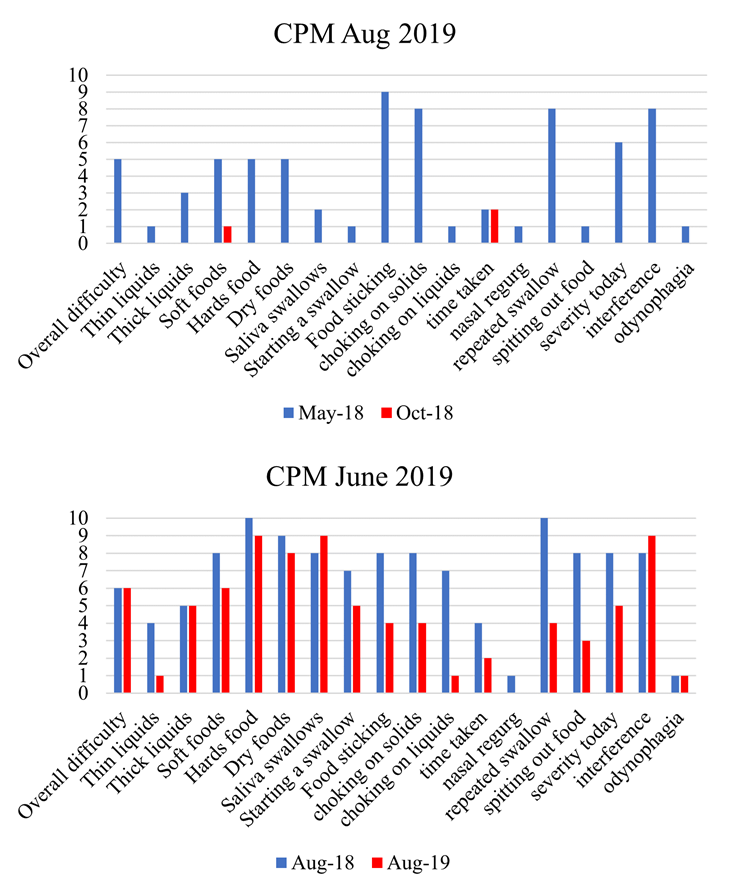
Twenty-four patients were included, with a mean age of 72 years. Baseline modified Sydney Swallow Questionnaires identified problems with hard or dry food, food sticking, and repeated swallowing. Twenty-two patients had a Reflux Symptom Index score that could indicate significant reflux. Video swallow identified specific problems, including tongue base retraction (96 per cent) and residual pharyngeal pooling (92 per cent). Seven patients (30 per cent) had features of aspiration on imaging despite a median penetration-aspiration scale score of 2. Four patients received balloon dilatation, and two patients underwent cricopharyngeal myotomy.

Conclusion

This study helped to profile features of dysphagia in patients with inclusion body myositis. More evidence is needed to determine the most effective management pathway for these patients.

Information

Type
Main Article
Copyright
Copyright © The Author(s), 2022. Published by Cambridge University Press on behalf of J.L.O. (1984) LIMITED

Access options

Get access to the full version of this content by using one of the access options below. (Log in options will check for institutional or personal access. Content may require purchase if you do not have access.)

Article purchase

Temporarily unavailable

Supplementary material: Image

Shrivastava et al. supplementary material

Shrivastava et al. supplementary material

Download Shrivastava et al. supplementary material(Image)
Image 143.1 KB