





Introduction
Affective polarization (that is, antipathy between supporters of opposing political camps) is on the rise in many democratic societies around the world (Gidron, Adams, and Horne Reference Gidron, Adams and Horne2020; Garzia, Ferreira da Silva, Maye, and Reference Garzia, Ferreira da Silva and Maye2023; Boxell, Gentzkow, and Shapiro Reference Boxell, Gentzkow and Shapiro2024). This phenomenon has garnered considerable concern from both commentators and scholars due to its supposed ‘dark’ consequences (Finkel, Bail, Cikara et al. Reference Finkel, Bail, Cikara, Ditto, Iyengar, Klar and Mason2020). Affective polarization is widely thought to reduce social cohesion and erode democratic resilience (e.g., Iyengar and Westwood Reference Iyengar and Westwood2015; McCoy, Rahman, and Somer Reference McCoy, Rahman and Somer2018; Iyengar et al. Reference Iyengar, Lelkes, Levendusky, Malhotra and Westwood2019; Tappin and McKay Reference Tappin and McKay2019; Reiljan Reference Reiljan2020; Martherus, Martinez, Piff et al. Reference Martherus, Martinez, Piff and Theodoridis2021; Kingzette, Druckman, Klar et al. Reference Kingzette, Druckman, Klar, Krupnikov, Levendusky and Barry Ryan2021; Wagner Reference Wagner2021; Kalmoe and Mason Reference Kalmoe and Mason2022; Orhan Reference Orhan2022; Berntzen, Kelsall, and Harteveld Reference Berntzen, Kelsall and Harteveld2024). In response, a variety of depolarization interventions has been proposed and tested, including efforts focused on cross-partisan dialogues, perspective-taking exercises, corrective information, and shared-identity prompts (Hartman, Blakey, Womick et al. Reference Hartman, Blakey, Womick, Bail, Finkel, Han and Sarrouf2022). The implicit or explicit assumption behind such efforts is that if we can reduce citizens’ hostility toward their political opponents, this will improve the social cohesion in divided societies and make democracies more resilient.
Yet that assumption is still an open empirical question. Most evidence linking affective polarization to its alleged problematic outcomes is correlational, and most originates in the United States (US), where the level and nature of political animosity might be unusual. Recent US experiments that successfully reduced out-party hostility (Broockman et al. Reference Broockman, Kalla and Westwood2023; Voelkel, Stagnaro, Chu et al. Reference Voelkel, Stagnaro, Chu, Pink, Mernyk, Redekopp and Ghezae2023b) report little or no parallel impact on democratic norms. This casts doubt on whether depolarization actually has such a wide-ranging positive impact. It is important to establish the downstream consequences of depolarization, in both the social and political realms, before rushing into interventions.
This study aims to take that step back. Leveraging an original nine-country survey experiment fielded in Brazil, France, Germany, Italy, Poland, Spain, Sweden, the United Kingdom, and the United States (N ≈ 18,000), we exogenously depolarize respondents in six of those democracies and trace the consequences for a wide range of outcomes. We distinguish between horizontal (interpersonal) consequences (social avoidance of out-partisans, willingness to discriminate against them, and support for aggressive action) and vertical (system-oriented) consequences (opposition to compromise, erosion of democratic norms, dissatisfaction with democracy, and political engagement). By comparing contexts that differ in their political institutions, levels of entrenched animus, and the presence of stigmatized radical right actors, we also ask when and where reductions in affective polarization may translate into an improvement of social cohesion and democratic resilience.
To do so, we fielded a survey experiment in which respondents were randomly assigned to one of three conditions: depolarizing, polarizing, or control. The depolarizing prompt asked them to reflect on similarities between their favorite political group (‘ingroup’) and their least-liked group (‘outgroup’), while the polarizing prompt asked for reflection on differences. Only the similarity treatment reliably impacted respondents’ affect, increasing warmth towards the outgroup by three to ten thermometer points in the United Kingdom (UK), Poland, Germany, Sweden, Italy, and the United States. (By contrast, the difference prompt unexpectedly failed to heighten hostility and even somewhat increased warmth in several contexts.) We leverage this successful depolarizing condition as an instrument to assess downstream consequences for interpersonal and system-oriented attitudes.
Our study yields three main findings. First, depolarization improved interpersonal outcomes in most treated countries: respondents became less inclined to avoid or discriminate against political opponents. Second, in four countries (the UK, Poland, Germany, and Sweden), depolarization also strengthened support for core democratic rights such as universal suffrage and the out-party’s right to contest elections, refuting the view that partisan animosity matters only for interpersonal outcomes. Third, downstream effects were heterogeneous across countries and in fact mostly absent in the United States and Italy, suggesting that entrenched animus or highly stigmatized party cues can make depolarization less impactful.
Our study makes three broader contributions. First, we paint a picture of the complex downstream effects of affective polarization by directly manipulating it across multiple democracies. In this way, we respond to a longstanding debate whether partisan animus is mainly a social problem or a systemic threat that corrodes democratic guardrails. Showing that the answer is mixed is relevant for a nuanced appreciation of the (alleged) dangers of affective polarization. Second, we shed more light on the conditionality of such effects, hence showing where depolarization might have a societal and democratic ‘pay-off’ and where it might not. While we cannot isolate the role of contextual factors with certainty, we argue that both social entrenchment and system and party supply shape whether warmer feelings might translate into changed behavior and norms. Third, we inform an important and growing area of policy. The results can inform governments and NGOs involved in depolarization initiatives by indicating the conditions under which small-scale similarity prompts might have the greatest downstream impact.
Theory
Affective polarization was first defined as ‘the tendency of people identifying as Republicans or Democrats to view opposing partisans negatively and copartisans positively’ (Iyengar and Westwood Reference Iyengar and Westwood2015: 691). In comparative work, the concept has been adapted to travel beyond the US two-party system (Iyengar, Lelkes, Levendusky et al. Reference Iyengar, Lelkes, Levendusky, Malhotra and Westwood2019; Gidron, Adams, and Horne Reference Gidron, Adams and Horne2020; Reiljan Reference Reiljan2020; Wagner Reference Wagner2021; Boxell, Gentzkow, and Shapiro Reference Boxell, Gentzkow and Shapiro2024; Garzia, Ferreira da Silva, Maye, and Reference Garzia, Ferreira da Silva and Maye2023; Wagner Reference Wagner2024; Iyengar and Wagner Reference Iyengar, Wagner, Torcal and Harteveld2025), but the core of the definition remains negative evaluations of citizens defined by opposing political identities, usually relative to ingroup favoritism. Some scholars have studied dislike towards (abstract) political parties or leading politicians under the banner of affective polarization, whereas others restrict their analysis to the dislike of politically opposed fellow citizens (see Röllicke Reference Röllicke2023). We adopt the latter approach and ask whether reducing such antagonism between citizens would not only improve societal cohesion but also change the way they understand and appreciate politics and democracy.
Before we continue to discuss potential consequences of affective polarization, a brief note on the term ‘consequences’ is in order. First, by employing this term, we make explicit that we do not equate affective polarization in the narrow sense with the phenomena discussed below. For instance, some authors have included social avoidance in their operationalization of affective polarization (Iyengar, Sood, and Lelkes Reference Iyengar, Sood and Lelkes2012; Knudsen Reference Knudsen2021). We would rather employ a minimal approach, restricting the concept to negative affect as such. Second, we do not discard the possibility that many of the phenomena under study are causes as well as consequences of affective polarization (for instance, avoidance might deepen affective polarization). Our aim is rather to focus on one causal direction and to assess whether experimentally reducing out-group antipathy triggers changes in these other domains.
Horizontal and vertical consequences
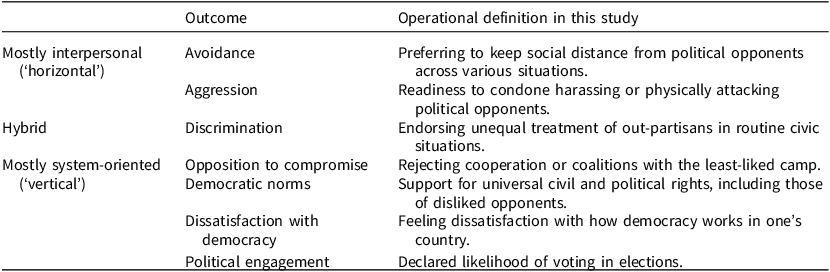
As noted, it remains contested whether partisan animus is chiefly a social problem, undermining relationships and deepening political segregation, or a systemic one that threatens democratic institutions. Hence, to categorize potential downstream consequences of affective (de-)polarization, we deploy an imperfect but useful heuristic that separates two domains of consequences: ‘horizontal’ (interpersonal) outcomes that bear directly on contact with fellow citizens and ‘vertical’ (system-oriented) outcomes that reflect evaluations of political elites, institutional rules, or democracy writ large.Footnote 1
The distinction is imperfect in practice. After all, interpersonal interactions have implications for democracy at large, and wider democratic norms inform everyday interactions. Still, it matters analytically because the psychological mechanisms may differ (Broockman et al. 2022). Interpersonal behaviors are usually governed by immediate feelings and action tendencies – approach versus avoidance (Mackie, Smith, and Ray Reference Mackie, Smith and Ray2008) – whereas evaluations of remote or even abstract institutions and elites may be shaped by ideology, elite cues, or political cost-benefit assessments. Hence, our guiding question is whether both classes of outcomes indeed follow from changes in out-group affect and whether they do so equally across political contexts.
Our study focuses on the seven (alleged) consequences listed in Table 1. The phenomena do not always fall neatly into ‘interpersonal’ versus ‘systemic’ boxes, as several have both types of implications. We therefore present them on a continuum, beginning with outcomes rooted most clearly in face-to-face interaction and moving toward those pertaining to evaluations of the political system at the more abstract level.
The ‘consequences’ included in this study

We have selected these because they are prominent in both the scholarly literature and public debate about affective polarization and are plausibly relevant in all countries under study, given the variation in political institutions and party systems. Our selection largely overlaps with, but in some respects diverges from, the concepts covered by Broockman et al. (2022) and Voelkel et al. (Reference Voelkel, Chu, Stagnaro, Mernyk, Redekopp, Pink, Druckman, Rand and Willer2023a) in their US studies.Footnote 2 Moreover, not all these outcomes are necessarily or uniformly ‘bad’. For instance, the presence of illiberal actors might warrant some unequal treatment (Melendez and Kaltwasser Reference Meléndez and Rovira Kaltwasser2021). We cannot provide a normative evaluation of every outcome here but instead concentrate on those most frequently identified as (potentially) worrisome in prior research. We also included political engagement, which is generally deemed to be a possible ‘silver lining’ of affective polarization (see Harteveld and Wagner Reference Harteveld and Wagner2023).
Why affective polarization might have horizontal and vertical consequences (or not)
This section explains in more general terms why an intervention that warms out-party feelings could plausibly move those outcomes and why it sometimes might not. We first discuss these general mechanisms, then proceed to discuss counterarguments, and subsequently argue why we might expect variation across countries. Finally, we list the main hypotheses.
Mechanisms: from feelings to attitudes, behaviors, and norms
In the case of (primarily) interpersonal (horizontal) outcomes, the relation to affective polarization is most obvious. Social Identity Theory (SIT) posits that group membership – which can extend to political group identities – shapes evaluations and behavior, often producing in-group favoritism and, under certain conditions, out-group derogation (Tajfel and Turner Reference Tajfel, Turner, Austin and Worchel1979; Abramowitz and Webster Reference Abramowitz and Webster2016). The deeper the dislike of a group, the higher the psychological burden of interacting with its members. Opting for such a ‘flight-based’ strategy of avoidance is one of the main ways for individuals to directly cope with negative affect towards a group (Mackie, Smith, and Ray Reference Mackie, Smith and Ray2008). Alternatively, citizens might adopt a ‘fight-based’ strategy instead and conduct or condone aggression or engage in acts of discrimination. In short, dislike of out-partisans inflates the psychological cost of contact, making citizens more likely to shun, snub, or even strike (directly or indirectly) at political opponents (Chopik and Motyl Reference Chopik and Motyl2016; Keith and Rohla Reference Keith and Rohla2018; Kalmoe and Mason Reference Kalmoe and Mason2022, Westwood et al. Reference Westwood, Grimmer, Tyler and Nall2022). Warming those feelings, reversely, should reduce the cost to engage as well as the need to ‘fight’.
As noted, whether reduced antipathy would spill over to system-level (vertical) attitudes is more contested. The literature identifies two complementary pathways for why it might do so (Kingzette, Druckman, Klar et al. Reference Kingzette, Druckman, Klar, Krupnikov, Levendusky and Barry Ryan2021; Kokkonen and Harteveld Reference Kokkonen, Harteveld, Torcal and Harteveld2025). The first focuses on the role of (perceived) threat: when the out-group feels more (less) menacing, citizens become less (more) willing to grant them procedural rights or accept electoral defeat. Hence, the threat perceptions associated with affective polarization foster support for illiberal measures (Gidengil, Stolle, and Bergeron-Boutin Reference Gidengil, Stolle and Bergeron-Boutin2022). A second class of mechanisms relates to the politicization of norms. Most people profess democratic principles in the abstract yet often withhold them from hated opponents (Kingzette, Druckman, Klar et al., Reference Kingzette, Druckman, Klar, Krupnikov, Levendusky and Barry Ryan2021). The intergroup dynamic of affective polarization increases the motivation to prevent victories of the opposing camp. Reversely, if hostility is reduced, any inconsistency between principle and practice becomes harder to rationalize, nudging citizens toward a more universal application of civil and political rights. Hence, improved intergroup relations might also increase willingness to accept the other group’s rights or collaborate with them. On the flipside, because warmer feelings lower the stakes, it also reduces the need to engage with politics in the first place (Ward and Tavits Reference Ward and Tavits2019).
Counterarguments: why affective polarization might matter (mostly) in the interpersonal realm
The mechanisms just outlined are intuitively appealing, and cross-sectional studies consistently find correlational evidence that citizens who loathe the other side are more willing to avoid them or become less principled in their democratic norms. However, the causal relation remains contested. As noted, Broockman et al. (2022) and Voelkel, Chu, Stagnaro et al. (Reference Voelkel, Chu, Stagnaro, Mernyk, Redekopp, Pink, Druckman, Rand and Willer2023a), in their US-based studies, show that interventions that successfully impact feelings toward out-partisans do reduce social avoidance but do not seem to impact support for democratic norms and elite accountability (whether measured directly or through vignette designs). In Broockman et al.’s (2022) reading, affective polarization shapes only those judgments that are immediately affect-laden and personally salient, whereas evaluations of elites, norms, and institutions rely on ‘other, more relevant considerations’ such as ideology, performance evaluations, or partisan incentives (Broockman et al. 2022: 826). This fact potentially confines the impact of affective (de-)polarization to the interpersonal realm.
While acknowledging the validity of these arguments, this discussion is not settled. There are theoretical reasons to expect that animus might still shape vertical attitudes under certain conditions. Letting these be guided by affective polarization may be psychologically rewarding: deeply held norms or clear material advantages might be discarded for the sake of giving expression to intergroup hostility. If so, reducing animus could reorient citizens towards more universal democratic norms. As Voelkel, Stagnaro, Chu et al. (Reference Voelkel, Stagnaro, Chu, Pink, Mernyk, Redekopp and Ghezae2023b: 15) note, determining how far-reaching the consequences of affective polarization are is central to understanding ‘the psychology underlying polarization and democracy’, with direct implications for intervention design. Moreover, the United States, where these null findings have been most prominent, may be an exceptional case. Given its deep and prolonged polarization, support for compromise or procedural rights may already be locked in by entrenched identities and partisan cues. In less polarized or more recently polarized democracies, where attitudes remain more malleable, a reduction of antagonism could still tip ambivalent citizens toward more inclusive democratic principles. Hence, we argue for a comparative perspective, to which we turn now.
Scope conditions: why downstream effects may differ across countries
We think it is plausible that the link between (de-)polarization and the outcomes under study will differ across societies. We want to highlight three plausible sources of cross-national variation. While we refrain from stating hypotheses about their implications for each country under study (any such test would be overdetermined), we do take these into the discussion of any diverging country patterns.
First, the institutional context likely matters. A large body of comparative literature on consensus versus majoritarian democracies suggests that proportional representation, coalition cabinets, and broader power-sharing can reduce the winner-loser divide and the felt threat associated with electoral defeat, because political influence is less concentrated and ‘losers’ are less permanently excluded (Anderson and Guillory Reference Anderson and Guillory1997; Lijphart Reference Lijphart1999). Majoritarian systems (like the US, Brazil, and the United Kingdom in our sample selection) concentrate power and raise the stakes of defeat (Dahlberg and Linde Reference Dahlberg and Linde2017; Janssen Reference Janssen2024), especially in the case of strong executives. In such threatening conditions, citizens may find it harder to be democratically inclusive towards their opponents. Proportional, coalition-based systems (like most other cases in our sample) generally require and normalize cross-party cooperation to varying degrees, which reduces the impact of out-party victories and, hence, leaves more room for accepting compromises or the political rights of out-groups. Indeed, a prominent finding in the literature is that co-governance tends to reduce affective polarization between coalition partners (Gidron, Adams, and Horne Reference Gidron, Adams and Horne2023; Vanagt and Kollberg Reference Vanagt and Kollberg2025). A central mechanism is that coalition cooperation can foster a superordinate coalition identity and shared incentives for accommodation and compromise, which can soften out-party affect when cooperation is salient (Bassan-Nygate and Weiss Reference Bassan-Nygate and Weiss2022; Hahm, Hilpert, and König Reference Hahm, Hilpert and König2024; Wagner and Praprotnik Reference Wagner and Praprotnik2024). Yet these institutional effects are unlikely to be uniform: comparative measures show that affective polarization can be substantial even in long-standing consensus democracies, implying that coalitions can coexist with high animosity (Reiljan Reference Reiljan2020; Wagner Reference Wagner2021; Garzia, Ferreira da Silva, and Maye Reference Garzia, Ferreira da Silva and Maye2023). Furthermore, existing evidence on whether elites can dampen conflict and polarization through their communication is mixed and may be asymmetric: some work finds congenial elite messages can reduce affective polarization (Pedersen, Christensen, and Petersen Reference Pedersen, Christensen and Petersen2026), while other studies show null effects of positive or pro-democracy appeals even as antagonistic messages heighten perceived conflict (Berntzen and Draege Reference Berntzen and Draege2026; Wuttke et al. Reference Wuttke, Sichart and Foos2024).
Second, the existing level of affective polarization could increase or reduce how much additional impact further affective polarization might have. Societies where partisan animus is low, or has risen only recently, may still feature ambivalent citizens whose stances on democratic rights have not fully crystallized. Here, reducing antipathy might bolster commitment to democratic principles in countries that score lower on affective polarization overall (like Spain in our sample), whereas in a long-polarized society like the United States entrenched views might leave less scope for impact by any limited intervention. Third, the nature of the party offer is likely equally crucial. Where the least-liked camp is a populist radical right (PRR) or otherwise stigmatized actor, denying that group equal rights is often justified as principled vigilance. Hence, the trade-off between interpersonal animosity and norms will be less apparent for many citizens, and depolarization might not matter. In short, we leave the option open that we find depolarization to have ‘vertical’ consequences in some societies rather than others. In addition, we will explore any heterogeneity based on the attributes of the countries involved.
Hypotheses
In our pre-analysis plan, we listed three main classes of hypotheses, which we report in slightly altered formulations below. They refer to the effect of depolarizing respondents on the alleged outcome indicators, compared to the control group. As will be discussed in more detail below, the main comparison differs from the pre-registration, where we expected a comparison with a polarizing condition (rather than with a control group), but this turns out not to be feasible because our experiment failed to further polarize respondents. The full original wording is reported in online Appendix K.
H1: Lower out-group hostility will correlate negatively with (a) out-group avoidance, (b) out-group discrimination, (c) support for aggression against out-groups, (d) opposition to compromise, (e) undemocratic norms, (f) dissatisfaction with democracy, and (g) engagement with politics.
H2: Compared to the control group, respondents in the depolarizing condition have lower levels of (a) out-group avoidance, (b) out-group discrimination, (c) support for aggression against out-groups, (d) opposition to compromise, (e) undemocratic norms, (f) dissatisfaction with democracy, and (g) engagement with politics.
H3: Any treatment effects on downstream measures are mediated primarily by feelings toward out-party citizens, not by warmth toward out-party elites.
Design
Data and country selection
The questionnaires were translated in cooperation with native speaker political scientists. A UK pilot (N = 2,000) of the main treatment informed us that N = 2,000 per country should yield >80% power.
We administered surveys in nine democracies (Brazil, France, Germany, Italy, Poland, Spain, Sweden, the United Kingdom, and the United States) between March and May 2022. (Due to a technical error, the US sample was re-fielded in May, while all other countries were fielded concurrently in March.) These were selected in a compromise between practical feasibility (countries covered by the survey company) and ensuring relevant systemic variation. As a result, our selection is not representative of all world regions, oversampling European societies. Still, it provides us with variation in the dimensions we identified before, spanning both majoritarian (e.g., Brazil, US) and proportional electoral rules (e.g., Italy, Sweden); different degrees of affective polarization (ranging from low in Brazil or Spain to intermediate in Sweden or Germany to high in Poland or France, in overviews such as those by Wagner [Reference Wagner2021] and Garzia, Ferreira da Silva, Maye, and (Reference Garzia, Ferreira da Silva and Maye2023); and the extent to which a highly controversial (far-right) actor is present and isolated (from government inclusion in Italy to a full cordon sanitaire in Germany).
The survey company Norstat coordinated fieldwork through national panel providers, applying identical quotas on age, gender, and region (target N = 2,000 per country). The project received institutional review board approval, which is reported in Appendix M.
Operationalization of key constructs
Identifying ingroups and out-groups
At the start of the questionnaire, respondents named (1) the party whose supporters they ‘like the most’ and (2) the party whose supporters they ‘like the least’.Footnote 3 These answers defined the respondent’s ingroup and outgroup for all subsequent items. We immediately acknowledge that affective polarization is not confined to playing out along partisan identities, as citizens may identify and loathe along ideological, candidate, or issue-based lines too (e.g., Harteveld Reference Harteveld2021; Areal Reference Areal2022; Hobolt, Leeper, and Tilley Reference Hobolt, Leeper and Tilley2021). Nevertheless, party preference remains the most widely used and cross-nationally comparable political identity marker, which is why we opted to use it here. One partial exception is Brazil: because Jair Bolsonaro frequently changed affiliation and sparked strong identification around his person (Areal Reference Areal2022), respondents evaluated ‘supporters of Bolsonaro [Bolsonaristas]’ rather than a party label. Using party groups has the benefit of avoiding reliance on cross-nationally incomparable ideological terms such as ‘liberal’ or ‘conservative’. The in-party-out-party distinction offers a degree of structural equivalence across contexts and is established as the standard in comparative research (Boxell, Gentzkow, and Shapiro Reference Boxell, Gentzkow and Shapiro2024; Wagner Reference Wagner2021; Garzia, Ferreira da Silva, and Maye Reference Garzia, Ferreira da Silva and Maye2023). However, these partisan out-groups vary in size, from nearly half the electorate in the United States and Brazil to single-digit groups elsewhere, and they also differ in nature and party family (although all cases included either a populist radical right party or a mainstream party with an arguably radical right leader). Comparisons of levels of polarization and related phenomena are valid, but point-based differences should be interpreted with these variations in mind. In our case, such descriptive patterns are secondary to our experimental focus on how changes in affect shape downstream outcomes.
Measuring affective polarization
Affective polarization is operationalized as the distance between sympathy towards the in-group (that is, the most liked group of supporters) and sympathy towards the out-group (the least liked group of supporters) on a feeling thermometer scale that runs from 0 (cold and negative) to 100 (warm and positive). This approach has its limits, as it does not take the effects towards other political groups (if present) into account. Nevertheless, we deem this consistent with the experimental setup of our study, as we manipulated reflection on the least and most liked groups only. For robustness we replicate all analyses with the traditional in-group minus out-group spread and with Wagner’s (Reference Wagner2021) weighted-spread measure (results appear in Appendix L and in footnotes where relevant). Affective polarization towards parties (used for the mediation analysis) is operationalized using feelings for the same thermometer items but asked about the ‘leading politicians of…’ the in-party and out-party.
Operationalizing downstream consequences
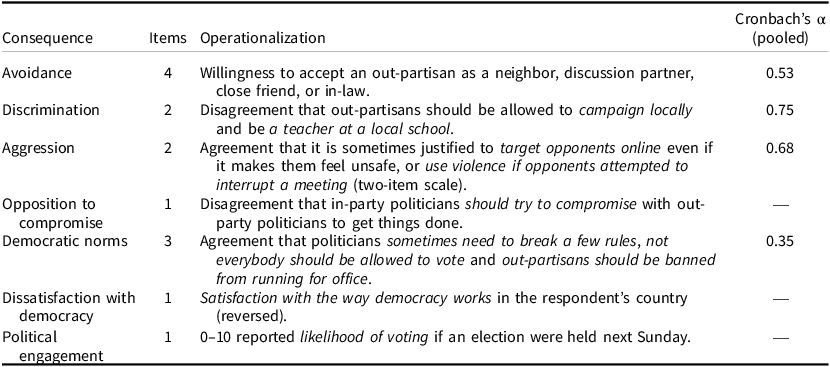
Table 2 provides an overview of the items measuring the consequences concepts and their internal consistency. Full wordings can be found in Appendix A.
Overview of consequences items
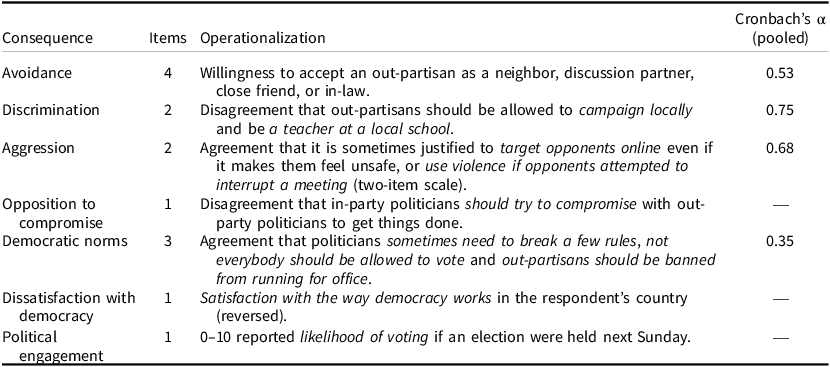
Not all batteries form reliable scales. Only the scale for Discrimination performs above an α ≥ 0.70 threshold in every country. The Aggression scale performs just below that benchmark when pooled (α = 0.68) but ranges from moderate (0.58 in Brazil) to strong (0.88 in the United Kingdom). The four indicators of Avoidance do not create a very robust scale in the pooled data but do so more strongly within several individual countries. Appendix C discusses these patterns in more detail and confirms that avoidance items appear to be used differently across contexts, a pattern that makes intuitive sense given cultural differences in which life domains (neighborhood, workplace, and family) become politically charged. We do, nevertheless, argue for the scale score to be informative too: we are interested in avoidance across life domains as an indicator of wider social segregation along political lines. To guard against misleading inferences either way, we report both the scale results and the constituent items. Readers can therefore see where findings depend on a particular indicator and where they hold across the board.
Experimental stimulus and outcomes
Stimulus and procedures
The experiment followed a three-arm, between-subjects design. Respondents were allocated with equal probability to a depolarizing condition, a polarizing condition, or a control group. The (US) literature on interventions has identified different classes of stimuli that might reduce affective polarization (for an overview, see Hartman, Blakey, Womick et al. Reference Hartman, Blakey, Womick, Bail, Finkel, Han and Sarrouf2022; Voelkel, Stagnaro, Chu et al. Reference Voelkel, Stagnaro, Chu, Pink, Mernyk, Redekopp and Ghezae2023b). For example, Broockman, Kalla, and Westwood (Reference Broockman, Kalla and Westwood2023) (mainly) used trust games involving transactions with the opposing political side, while Voelkel, Chu, Stagnaro et al. (Reference Voelkel, Chu, Stagnaro, Mernyk, Redekopp, Pink, Druckman, Rand and Willer2023a) employed stimuli such as correcting out-partisan misperceptions, priming inter-partisan friendships, or showcasing warm cross-partisan interactions. We rely on a different strategy in which we do not simulate or activate an interaction with a specific out-group member, but rather make respondents reflect on the (common or diverging) attributes of political groups as such. As noted by Voelkel, Stagnaro, Chu et al. (Reference Voelkel, Stagnaro, Chu, Pink, Mernyk, Redekopp and Ghezae2023b) in their overview of interventions, those interventions that presented relatable out-groups or highlighted cross-cutting identities were among the most successful in reducing animosity. Our stimulus arguably manipulates both dimensions.
The stimulus consisted of two steps. First, we used a short statement that informed the respondents about the presence of either similarities or differences. The depolarizing prompt read, ‘Research shows in-party and out-party supporters actually have quite a lot in common’, whereas the polarizing prompt stated these groups have ‘very little’ in common.Footnote 4 Second, respondents were asked to write down at least three such shared features or differences (depending on the condition) in an open text box. From a Social Identity Theory perspective, cueing differences (polarizing condition) or similarities (depolarizing condition) between political and non-political identities should respectively amplify or reduce out-group hostility. The writing task was used to generate more cognitive engagement. Control group respondents saw neither statement nor question box.
A UK pilot compared this reflection design with an alternative stimulus that highlighted research findings about cooperation versus hostility between the two camps. Both versions produced a significant similarity-versus-difference gap, but the attribute-reflection prompt yielded the larger effect, so we adopted it for all nine countries.
Stimulus performance
We found that, overall, users engaged seriously with the writing prompt. Of a coded subset of the answers in Poland, Brazil, Germany, and the United Kingdom, 67% of the answers mentioned at least one clearly identifiable attribute. (Most often this involved an ideological term, issue position, or political topic, which appeared in 70–80% of the valid answers across the four cases; this was followed by personality traits, which were mentioned in 35–50% of the valid answers.)
Figure 1 below documents how each prompt shifted the 0–100 feeling thermometer toward both the political in-group and out-group. As anticipated, the depolarization (similarity) intervention reduced affective polarization. In the pooled sample, the out-party thermometer warmed almost four points on the thermometer. (For comparison, this amounts to one-third of the affect gap between weak and strong partisans.) This effect is sizeable for a brief writing task.
Marginal effects of stimuli on affective polarization outcomes, compared to the control group.
Note: Marginal effects of two experimental conditions (compared to the control group) on the 0–100 feeling thermometer, with 90% confidence intervals. Based on Table E1 (pooled) and Table E2 (by country) in the Supplementary Materials.

Disaggregating by country suggests that the depolarization stimulus was successful in 6 out of the 9 countries. The United Kingdom and Poland samples show the largest reductions (≈10 and 7 points, respectively). In Germany, Sweden, and Italy, we see more modest but still sizeable gains of 3 to 5 points. More ambiguously, in the United States, the thermometer descriptively rises about three points, but this effect is not significant at a conventional level (one-tailed p ≈ 0.06). We consider true cases of null findings to be France, Spain, and Brazil, which show no meaningful change at all with point estimates near zero. In Brazil, this might be due to a possible ceiling effect: the baseline thermometer was already the warmest of the nine countries, and even warmer responses might not be plausible.
Puzzlingly, the polarization (difference) prompt did not increase dislike. Across the pooled data, out-party warmth is even slightly higher than in the control condition in several cases. The coding exercise mentioned above suggests that the lack of an effect is not likely attributable to a universal failure to engage with the task. It could instead partly be a floor effect, as feelings for some partisan groups already are near the bottom. However, this is not true to the same degree for all countries and parties, whereas the lack of an effect is rather universal. Three other explanations seem plausible. First, pre-treatment: everyday political and media discourse around polarization may already have saturated citizens with cues about differences, leaving little room for an additional reminder to make an impact. Second, a demand effect: some respondents may have guessed the researchers’ intent and avoided ‘playing along’. Still, we would not expect this to fully cancel any ‘true’ effect. This leaves us with a third, and perhaps most substantively interesting, possibility: that the exercise of reflecting on the out-group may have prompted a moment of perspective-taking and thus humanizing the out-group and subsequently (paradoxically) raising sympathy.
Because the PRR has often been found to take a unique place in the affective landscape, drawing and sending more negative affect than other party families’ supporters (Harteveld et al. Reference Harteveld, Mendoza and Rooduijn2022), we interacted the stimulus with the PRR status of the out-group. The effects of either stimulus compared to each other and to the control group were not significantly different depending on whether the out-group was PRR or non-PRR (P > 0.4). Apparently, considering similarities warmed feelings towards this generally more controversial out-group to a similar degree as towards other out-groups, which is striking in itself.
Because the different prompt did not increase dislike towards political out-groups as intended, our primary analyses below compare the depolarizing group with the control group, as announced in Section Hypotheses. The pre-registered comparisons (polarizing condition versus control group) are reported in Appendix K.
Ethical considerations
The similarity and difference statements were intentionally vague (‘research shows…’) and a very general point about groups having ‘a lot’ or ‘very little’ in common, neither of which is untrue (depending on the dimension on which one would look for such similarities or differences). Nevertheless, the design posed the ethical dilemma that one condition intended to heighten hostility between citizens. To mitigate this as much as possible, we included a debriefing restating the similarity message, reminding all participants that political camps are never fully homogeneous and often share common goals. In the event, the polarizing stimulus did not have the polarizing outcomes, and hence this issue did not materialize. The study, including the pilot phase, was approved by the institutional review board of one of the authors’ institutions (see Appendix M).
Results
We first report the cross-sectional correlations between affective polarization and the various items pertaining to the alleged consequences under study (H1). We then proceed to investigate our main hypothesis, which is about the impact of the stimulus on these consequence items (H2). In light of the pre-registration, we report this analysis for both the pooled sample and a country-by-country analysis. We also investigate if the effect is mediated by views of partisans rather than parties (H3).
Correlational evidence
Figure H1 in the Appendix replicates the cross-sectional findings of most previous studies. In our pooled nine-country sample, lower thermometer ratings for the least-liked group are positively associated with every interpersonal outcome in at least some of the subitems (avoidance, discrimination, and aggression), and the same is true for all system-oriented concepts (opposition to compromise, weaker democratic norms, greater dissatisfaction with democracy, and, more modestly, turnout intention). In short, affective polarization goes together with all of these alleged consequences. To assess whether this relationship reflects a causal effect, we turn to our survey experiment.
Pooled causal effects of the depolarization stimulus
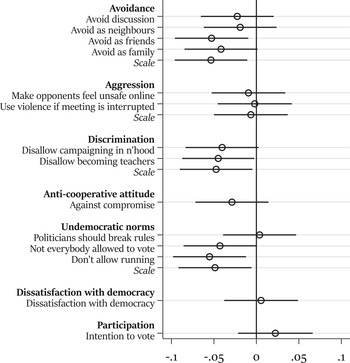
Figure 2 reports average treatment effects from pooled OLS models including all nine countries (Appendix G reports a model with only the six countries in which the similarity stimulus increased out-party warmth, which yields very similar results). As preregistered, a Bonferroni correction is applied to correct for seven outcome constructs.Footnote 5
Pooled model: effects of depolarization on consequences.

Starting with the horizontal outcomes, respondents in the depolarized condition were significantly less likely to avoid political out-group members. This is visible in the scale score and also robustly so in the case of accepting political out-groups as friends. (The main effect on the scale score but not all of the individual items likely reflects the fact that different avoidance items were impacted in the various countries, as reported in Appendix G and discussed below.) In addition, we find clear evidence that depolarized respondents were less likely to approve of discrimination against political out-groups. Support for aggression, which we found to be reversely correlated with affective polarization, did not move along with the stimulus at all. This might partly reflect a floor effect, as baseline support for these items is very low to begin with (see Appendix O). Still, we interpret the lack of a seemingly causal effect as informative, as it aligns with studies reporting a lack of cross-sectional correlations between dislike and support for aggression (Berntzen, Kelsall, and Harteveld Reference Berntzen, Kelsall and Harteveld2024; Berntzen Reference Berntzen, Torcal and Harteveld2025).Footnote 6 Hence, regarding such interpersonal outcomes, we replicate earlier studies in the US (Broockman, Kalla, and Westwood Reference Broockman, Kalla and Westwood2023; Voelkel, Stagnaro, Chu et al. Reference Voelkel, Stagnaro, Chu, Pink, Mernyk, Redekopp and Ghezae2023b) that found that depolarizing respondents can go together with an improvement (at least on the level of intentions) of such relations. At the same time, we note that this does not extend to condoning the harming of each other, the origins of which might be rooted in personality and social context more than in negative affect per se (Berntzen, Kelsall, and Harteveld Reference Berntzen, Kelsall and Harteveld2024).
The treatment also impacted ‘vertical’, system-oriented outcomes. This contrasts with the abovementioned studies that failed to find such effects (Broockman, Kalla, and Westwood Reference Broockman, Kalla and Westwood2023). The most robust impact in this regard is visible in the case of democratic norms. The scale score was significantly impacted, as were two individual items: depolarized respondents reported a higher level of support for the right of out-parties to participate in elections and for universal suffrage. This is striking: even a light and brief intervention resulted in a shift in answers that (supposedly) relate to deeply held norms. By contrast, depolarized respondents did not become more averse to condoning rule-breaking by politicians. Perhaps this item was worded more strongly or more evocatively of a norm breach (referring to ‘breaking the rules’), although this remains speculative. On a descriptive level, the depolarized group also appears to have more positive views toward political compromise, but this difference is not significantly different from the control group after the (strict) Bonferroni correction.
Some outcomes were not impacted at all. We find no evidence at all that citizens became less dissatisfied with democracy or likely to express a higher intention to vote. In the case of dissatisfaction with democracy, this might reflect the relatively stable nature of such views (although we note that a similar argument could be made about norms regarding democratic rights, which did move along with affective polarization). We also note that neither of these two items included an explicit reference to the out-group, in contrast to some of the other items. However, this is also true for (among others) the item on everybody’s right to vote, which did move in the depolarization condition. Hence, the evidence for a causal relation is weak in this case, despite consistent evidence that they are correlated with affective polarization (in our study and elsewhere; see Wagner Reference Wagner2021). This is particularly notable in the case of political mobilization (i.e., vote intention), as this has been heralded as a possible ‘silver lining’ of affective polarization (Harteveld and Wagner Reference Harteveld and Wagner2023: 739). Here, confounding factors might produce a cross-sectional correlation that might not be of a causal nature.
Appendix I decomposes the pooled treatment effects using Imai, Keele, and Tingley’s (Reference Imai, Keele and Tingley2010) mediation framework. This analysis reveals that the indirect effect via thermometer scores of parties’ supporters is consistently estimated to be (much) larger than through thermometer scores towards parties’ elites (disliking ‘the parties’ leading politicians’). This is in line with H3 and strengthens our interpretation that the depolarization stimulus (above all) impacted views of fellow citizens as intended and that this in turn indeed mattered for both horizontal and vertical consequences.Footnote 7
All in all, the pooled evidence indicates that a modest reduction in hostility toward political opponents reliably creates greater willingness for interpersonal contact across party lines and, to a lesser extent, more universalist attitudes concerning opponents’ democratic rights. The next subsection investigates whether these effects are uniform across the nine democracies.
Country-level heterogeneity
Figure 3 displays treatment effects for each outcome in all nine countries.Footnote 8 Two general conclusions emerge. First, the pooled results just reported did not rely on a single case: both interpersonal and system-oriented effects are visible in several countries. Second, however, the size and pattern of those effects vary substantially across contexts, inviting a closer look. Below, we explore these patterns in greater detail.
Effects on consequence items per country (items and scales).

To start, it is notable that downstream effects tend to be clearly weak or outright absent in two countries despite the fact that the stimulus did increase out-group warmth: Italy and the US. The case of Italy is the most puzzling, as several effects are even reversed from expected: depolarized respondents became more aggressive, opposed to compromise, undemocratic, and dissatisfied with democracy. Perhaps the experiment cued general fatigue with politics, given volatile party alignments and historically low trust in political institutions. In the case of the US, the absence of downstream effects on system-oriented outcomes is in line with findings by Broockman, Kalla, and Westwood (Reference Broockman, Kalla and Westwood2023) and Voelkel, Chu, Stagnaro et al. (Reference Voelkel, Chu, Stagnaro, Mernyk, Redekopp, Pink, Druckman, Rand and Willer2023a). More surprisingly, we did not find shifts in horizontal outcomes either. Plausibly, many of the issues under study (democracy and polarization, as well as political segregation and discrimination) are now exceedingly politicized and mediatized in the US, to an extent (still) unknown in the other societies. Hence, these attitudes might now be so entrenched among Americans that they are resistant to short-term stimuli (see Voelkel, Stagnaro, Chu et al. (Reference Voelkel, Stagnaro, Chu, Pink, Mernyk, Redekopp and Ghezae2023b) for a comparison of depolarization interventions in the US case).
Another observation about heterogeneity is that the remaining cases (UK, Germany, Sweden, and Poland) show both communalities and divergence. In each case, we observe an experimental impact on at least one interpersonal and one system-oriented indicator, though not always the same ones. At the interpersonal level, avoidance was impacted most clearly in the UK and Poland, while discrimination was also consistently affected in each of these cases. In Sweden, democratic norms remained unchanged, but support for compromise was affected. One plausible but tentative explanation for these varying impacts lies in the status of controversial populist radical right parties and the normative boundaries surrounding them. In this regard, Germany and Sweden, which have established clear cordon sanitaires and exhibit more pronounced stigmatization toward the populist radical right (particularly in Germany), stand in contrast to the situation in Poland or the UK, or indeed, any other case we examined. This might have already entrenched patterns of contact (or a lack of it) across political lines, and neither citizens’ views on compromise nor democratic norms might be impacted anymore by reflection on said out-group.
In three additional cases (France, Spain, and Brazil), the similarity prompt either failed to increase out-group warmth or did so only weakly, yet still generated select downstream effects. In France, interpersonal outcomes (notably avoidance) were modestly affected, but system-oriented indicators did not move along. Spain displayed some counterintuitive patterns, including increased support for political aggression, though most other outcomes remained unaffected. In Brazil, we observed mostly null effects, yet support for undemocratic norms declined slightly, suggesting that even though affective polarization was not systematically impacted by the stimulus, our reflection exercise may still have nudged some more universalistic democratic attitudes. Finally, we note that (in contrast to the pooled analysis) satisfaction with democracy was impacted in one case (the UK). This suggests that affective polarization can dampen satisfaction with the system, but that this is more conditional.
How do these various differences between countries (and across indicators) impact our conclusions as previously formulated? Zooming out, we can state that depolarizing citizens did not improve interpersonal relations or impact views of elites and democracy in two of the six countries in which we successfully depolarized respondents. In both cases, this could be (speculatively) attributed in part to methodological factors: an unintended reverse stimulus impact in Italy and entrenched views on dependent variables in the US. The fact that in the four other countries we see an impact on both ‘horizontal’ and ‘vertical’ consequences (albeit not always the same ones) makes us confident that affective polarization often has wider consequences than just social disharmony. At the same time, our cross-country comparison suggests that such consequences are contingent. They depend not just on affective movement but also on political context – such as the extent to which polarization is already entrenched, the centrality of these outcomes in political discourse, the presence of stigmatized parties, or the degree to which party divides are moralized. We return to these scope conditions in the Discussion.
Robustness and supplementary analyses
We conducted two sets of robustness checks. In the first (reported in Appendix G, G3), we re-estimated the pooled model with fixed effects and random-intercept multilevel specifications to account for the hierarchical nature of our data in different ways. In these models, the results are virtually unchanged, while the larger confidence intervals in the random intercept model suggest that the effect might vary over contexts (which we indeed find). Appendix G, G1, presents pooled estimates, including the three countries where the stimulus failed to move the effect. Here, too, the effects remain consistent in terms of direction and size. In sum, our evidence indicates that a brief similarity reflection robustly improves interpersonal dispositions toward political opponents and, in several democracies, strengthens support for at least some core democratic principles.
Discussion
As concerns over polarization grow, the field has witnessed a rapidly expanding menu of depolarization interventions, including citizen dialogues, perspective-taking exercises, and misperception corrections. These studies (mostly confined to the US) often rest on an implicit premise: if citizens would feel warmer toward political opponents, this would be beneficial for both social relations and democratic resilience. Our study takes a step back from that premise, first asking whether a brief similarity prompt can move affect across a range of democracies and, second, whether any such depolarization has impacts beyond the interpersonal realm. By combining a nine-country experiment with a broad battery of downstream outcomes, we provide new evidence for this debate, which has recently tilted toward skepticism following null results in the United States (Broockman, Kalla, and Westwood Reference Broockman, Kalla and Westwood2023; Voelkel, Chu, Stagnaro et al. Reference Voelkel, Chu, Stagnaro, Mernyk, Redekopp, Pink, Druckman, Rand and Willer2023a).
We found that a brief reflection on shared attributes increased sympathy toward the least-liked group in 6 out of 9 countries, by 3 to 10 thermometer points. Leveraging that exogenous shift, we find, first, robust improvements in (intended) interpersonal relations, in particular reducing avoidance and discrimination. Second, and contrary to recent US evidence, we also find evidence that the stimulus impact extends, in most cases, to the system-oriented attitudes (at least one among), in particular, greater acceptance of opponents’ democratic rights or higher support for cross-party compromise. By contrast, we found no universal downstream impact on dissatisfaction with democracy or turnout. All in all, the picture is one of both heterogeneity and homogeneity. In those cases where we could establish downstream effects, these pertained to both ‘horizontal’ and ‘vertical’ repercussions. However, beyond that, the patterns remain very heterogeneous.
Two categories of moderators in particular might explain these differences. First, the societal entrenchment of polarization. The United States, and to a lesser extent, Italy, display the weakest downstream effects. Both settings combine prolonged partisan hostility with a longstanding discussion of democracy in light of ongoing polarization. In particular, in the US, attitudes toward compromise and the limits of tolerance might have become identity markers, and hence a brief reflection exercise might simply have failed to move any of these. The second moderator might be system and party supply, including institutionalized incentives for elite cooperation. In Germany and Sweden, where (to different degrees) cordon sanitaire norms exist targeting radical right parties, we found less impact on democratic norms or acceptance of compromise than on interpersonal discrimination. One interpretation is that, for many citizens in these countries, many of which picked the radical right as their out-group, denying some rights to actors deemed ‘anti-system’ is viewed as the democratic response. By contrast, in the United Kingdom and Poland, which feature radical right actors but arguably not the same discussions about curtailing them, we found a broad and sizable impact across both horizontal and vertical consequences. Still, further research is needed to disentangle these more precisely. One promising direction would be to conduct more within-country longitudinal analysis over periods in which the level (and discussion about) polarization evolved.
Our study has several other limits too. We prioritized breadth over depth and fielded brief and quite generally worded survey item batteries designed to work in a wide range of contexts. Not all concepts were measured optimally, and our survey batteries did not always perform as intended. Our design relied on a single, short-run intervention, so future longitudinal work is needed to trace the durability of these effects.
What do these findings mean for our societal and academic debate on affective polarization? Our findings call for a contingent rather than universal reading of affective polarization’s democratic threat. In many contexts, partisan animosity does go together with an erosion of support for basic rights and political cooperation, whereas, in others, the same attitudes might have already been locked in place by ideology, elite rhetoric, or the controversial status of major parties. We therefore call for resisting both alarmism and complacency concerning the impact of affective polarization. Our findings suggest that the way affective polarization shapes democracy depends on where, when, and toward whom hostility is present. We also contribute to the debate on the mechanisms involved. Our mediation analysis confirms that changes in warmth towards citizens (rather than elites) drive the observed effects, aligning with social psychological traditions that see affective polarization rooted in intergroup conflict.
From a policy perspective, the study offers some ground for cautious optimism about the possibilities of effective interventions. A relatively low-cost similarity exercise produced a surprisingly broad range of change in the willingness to engage with each other and accept political opponents’ rights, suggesting that elaborate and costly contact-based interventions (that is, actually bringing people together) are not the only way to bring this about (see Hartman, Blakey, Womick et al. Reference Hartman, Blakey, Womick, Bail, Finkel, Han and Sarrouf2022). On the other hand, the heterogeneity of the outcomes underscores that one-size-fits-all programs are unlikely to succeed. For instance, in majoritarian, high-stakes systems, or in the case of controversial opponents, short-term prompts may not bring about much change (and perhaps should not be expected, or even wished, to). Finally, we note an unexpected but relevant observation about interventions. We found that a reflection on differences failed to increase hostility and might even have warmed feelings slightly, suggesting that an invitation to think concretely about the other camp, even in terms of how they are different, can humanize opponents. Future interventions could further invite citizens to see their opponents as people, without dismissing or reducing genuine disagreement, as this remains a promising depolarization tool.
Supplementary material
The supplementary material for this article can be found at https://doi.org/10.1017/S1475676526101273.
Financial support
This research was supported by the Research Council of Norway (grant 275308), the Swedish Research Council (grant 2018-01468), and the Dutch Research Council (grant 016.Veni.195.159). Open access funding provided by University of Amsterdam.
Competing interests
The authors declare none.
Ethics standards
The IRB approval for this research is included as online Appendix M.
Pre-registration statement
This study was pre-registered, and the pre-registration plan can be found at https://doi.org/10.17605/OSF.IO/Z59RD.
Data and replication material statement
The CONAP data used in this paper can be found here: https://doi.org/10.17605/OSF.IO/TVA3P.
The replication script for this paper can be found here: https://doi.org/10.17605/OSF.IO/Z59RD.



 Open access

