


The appeal of the Seven Wonders of the Ancient World led many authors to attempt reconstructing them on paper, thus giving rise to an exercise in speculation whose results would soon be published as engravings. These, in turn, would later provide models for series of paintings, which reflect not only a historical interest in the scholarly reconstructions but also a recognition of their aesthetic value.Footnote 1 In this regard, one of the pioneers of a pictorial appropriation of the Wonders was Maarten van Heemskerck (1498–1574), who developed a fascination for the architecture of Antiquity during his long stay in Rome, a period that witnessed the discovery and assessment of many ancient remains and monuments.Footnote 2 His endeavour led to the establishment of the canonical series of the Seven Wonders,Footnote 3 defining not only the list of works but also the iconography for each monument, which would later become fully integrated within a collective worldview.
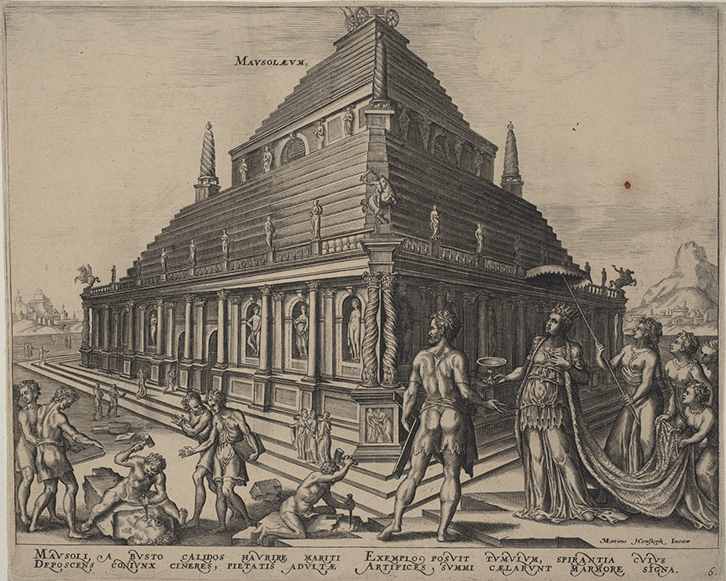
The print in Heemskerck’s Octo Mundi Miracula featuring the Mausoleum of Halicarnassus combines information from Pliny’s description of the monumentFootnote 4 with the architectural language of sixteenth-century Europe (Fig. 6.1). Yet it moves away from the process of reconstruction based purely on contemporary references that was favoured in Cesare Cesariano’s translation of Vitruvius: indeed, the latter work contains an illustration of the Mausoleum that has become a large Renaissance building in the style of Bramante, characterised by a Greek cross floor plan and crowned by a large statue of a knight, resembling St George rather than an ancient ruler (Fig. 2.2). A slightly closer reference for Heemskerck’s plate, more directly inspired by Pliny’s description, may have been provided by the pyramidal temple featured in Chapter iii of Francesco Colonna’s Hypnerotomachia Poliphili,Footnote 5 published in 1499 (Fig. 2.1), which – as will be shown later – would bear a remarkable repercussion on many later illustrations of the Mausoleum.
Maarten van Heemskerck and Philips Galle (1572). Mausolaeum, from the series Octo Mundi Miracula (Antwerp: [Theodoor Galle]), print, 22.5 x 27.2 cm (9” x 11”).
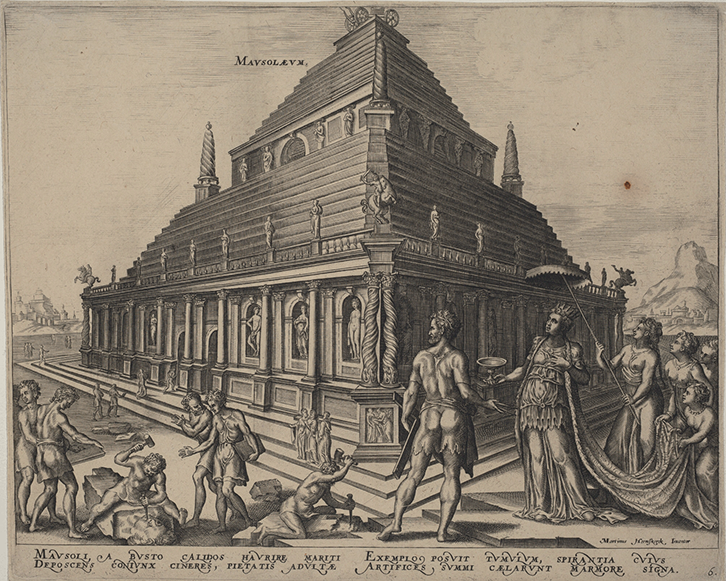
In the front row of his Mausoleum image, Heemskerck placed the main characters that would prove useful to viewers’ identification of the building and of its accompanying narrative. They are accompanied by workers performing various tasks, both constructional and ornamental, although the monument in the picture is complete and these foreground scenes thus constitute an analepsis or retrospective scene. The four men on the left, monitoring the exertions of two workmen, can be identified as the great sculptors responsible for each of the four façades of the building: Scopas, Bryaxis, Timotheos and Leochares.Footnote 6 On the right, the architect – whether he be Satyrus of Paros or Pytheos of PrieneFootnote 7 – is shown holding a pair of compasses and a framing square while talking to the main figure, Queen Artemisia II of Caria. The latter examines the building, holding the cup whose contents, her husband’s ashes admixed with wine, she intends to drink in order to become his living tomb – as a parallel to the Mausoleum itself.Footnote 8
The architecture of the building largely follows Pliny’s text, which describes the pyramid culminating in a quadriga and mentions thirty-six columns in the peripteral space he names pteron. In addition to these constructional features taken from the Naturalis historia, Heemskerck drew inspiration from architectural and decorative forms he had studied in Rome, such as the four pinnacles placed halfway up the pyramid, reminiscent of the metaeFootnote 9 of Roman circuses, and the rampant horses which may have been inspired by the statue of Marcus Aurelius. Solomonic columns such as those in the corners of Heemskerck’s Mausoleum would, at the time, have recalled similar features on the altar of the ancient Constantinian basilica of St Peter’s, which were also reflected in paintings such as the Donation of Rome in the Hall of Constantine, one of the Vatican’s Raphael Rooms. On the other hand, Heemskerck also gave free rein to his imagination, for instance by creating a plinth on which he placed the columns as well as joined pilasters and niches holding sculptures: of these features, only the thirty-six columns are mentioned in Pliny’s description of the pteron.
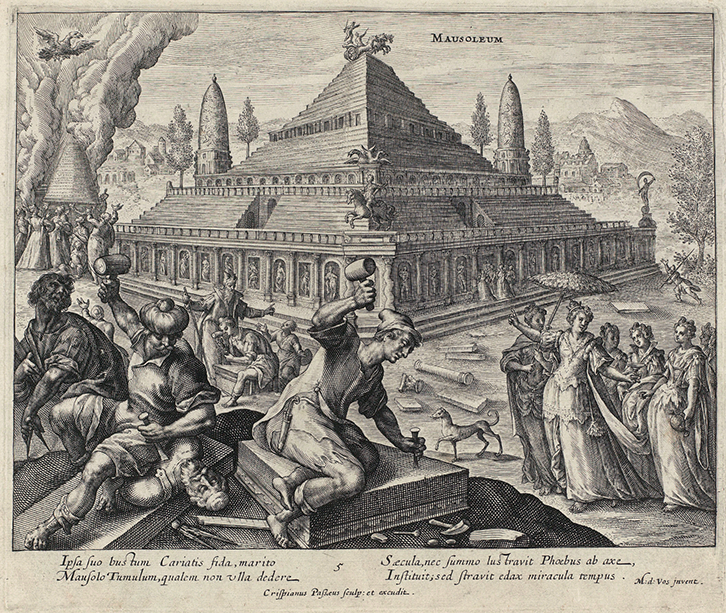
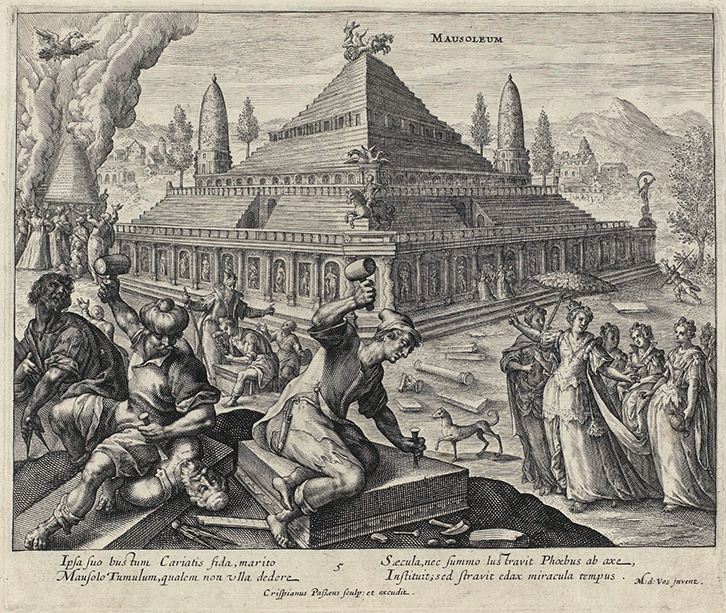
From the beginning of the seventeenth century onwards, other series of engravings of the Wonders would be published by Maarten de Vos and Antonio Tempesta, revealing a degree of continuity with Heemskerck’s work. Tempesta’s series the ‘Septem Orbis Admiranda’ (1608), which he both designed and engraved, took the baton from the Flemish painter by selecting the same compositional schemes and list of Wonders.Footnote 10 His Mausoleum, however, is very different from Heemskerck’s, becoming a classical building with little ornamentation, a conventional Renaissance structure with two storeys surrounded by loggias, along the lines of the Basilica Palladiana (see Fig. 2.5). To these, Tempesta added further features recalling Heemskerck more closely, such as the four obelisks still being erected, causing the building to remain incomplete, or the large steps supporting the monument. Closer to the Flemish painter’s works is the series Admiranda et Prodigiosa Antiquitates Opera, engraved in Crispijn van de Passe’s workshop in 1614 after designs by Maarten de Vos.Footnote 11 Yet de Vos’s Mausoleum, despite its resemblance to Heemskerck’s, is set within a far busier composition (Fig. 6.2): the monument itself contains additional features, including an entire supplementary storey, but chiefly the foreground and background scenes are granted far more importance. For instance, a funeral pyre, certainly that of Mausolus, is added next to the monument as a scene of consecratio.Footnote 12 The figure of Artemisia holding the cup, ready to drink the ashes of her deceased husband, is repeated, but the action of the sculptors in the foreground takes on greater significance.
Maarten de Vos and Crispijn van de Passe (1614). Mausoleum, from the series Admiranda et Prodigiosa Antiquitatis Opera, Quae Septem Orbis Miracula (Utrecht: Crispijn van de Passe), print, 24.4 x 31.1 cm (10” x 1’).
Maarten de Vos’s series was widely disseminated throughout Europe, and in turn became a model for other artists, as well as being engraved anew by Jacques Picart around 1660. This attests to the paradigmatic value of Heemskerck’s work and to the creation of a specific iconography, which would in turn transcend the autonomous subject matter of the Wonders, to ultimately be used in historical and geographical treatises, travel guides and scientific studies.Footnote 13 In 1635, Willem Janszoon Blaeu published an atlas, the Theatrum Orbis Terrarum, sive, Atlas Novus, completed and revised by his son Joan, which contained a map entitled Nova Totius Terrarum Orbis Geographica ac Hydrographica Tabula. This represents the outline of the continents as they were known during the first half of the seventeenth century, but the border of the print is adorned with various illustrations reflecting additional worldviews: at the top the seven planets, on the left the four elements, on the right the four seasons, and in the lower border the Seven Wonders of the World, including the image of the Mausoleum of Halicarnassus as envisioned by Maarten van Heemskerck. This plate becomes the emblem of a world map, in which the Wonders are presented as symbols that must be remembered, stages in the process of travel as memory, as order and universal canon of human creativity, without borders.Footnote 14 The presence of the Seven Wonders in this perhaps unexpected context demonstrates the status of the series as a reference within broader humanist scholarship.
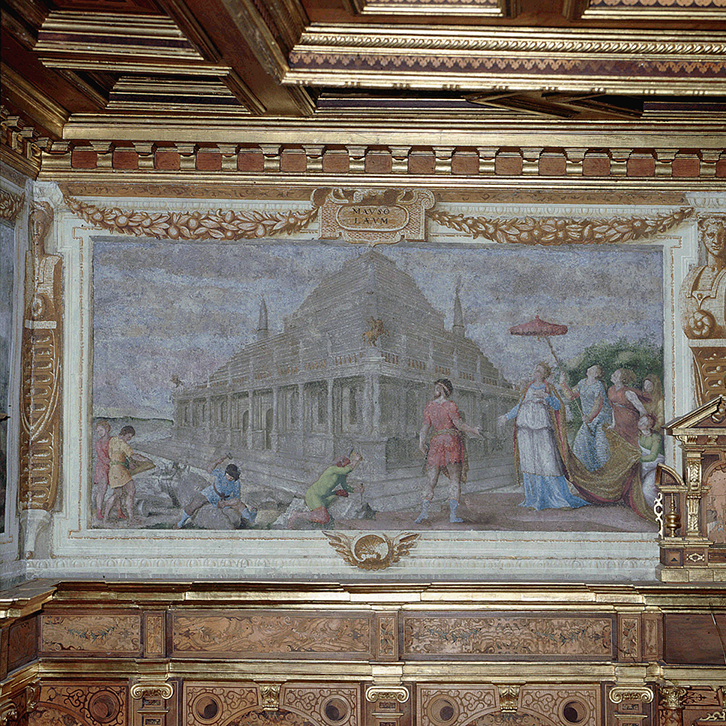
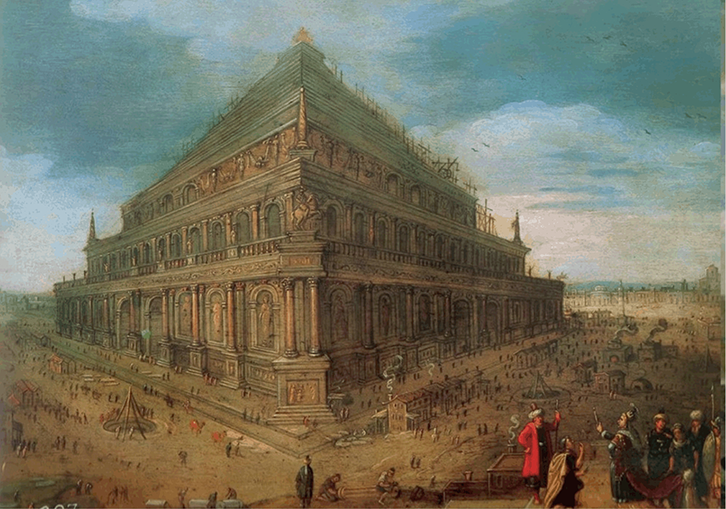
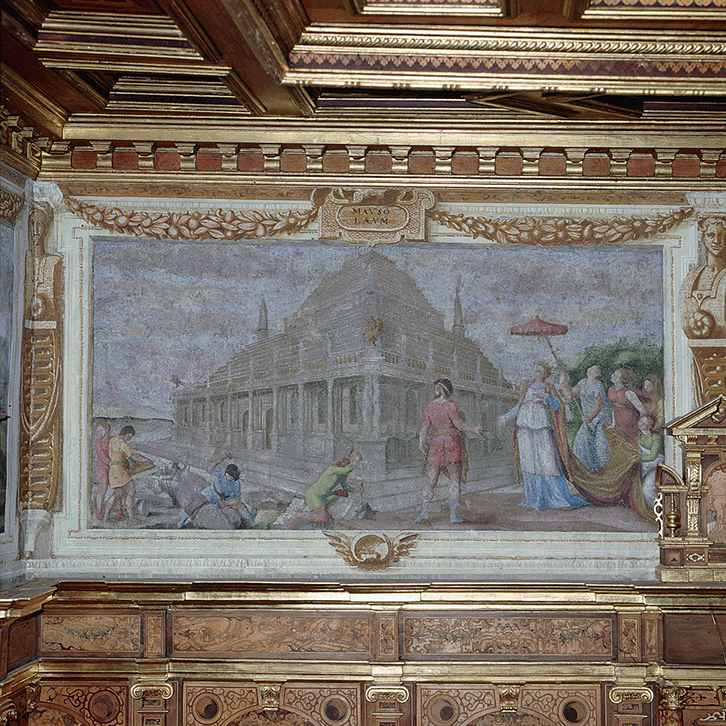
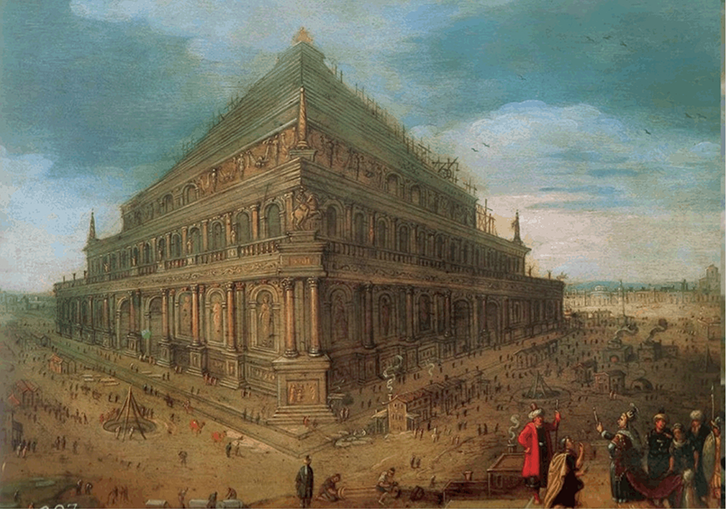
The series of engravings also paved the way for the depiction of the Seven Wonders, and specifically the Mausoleum, in painting. One of the earliest instances can be found in the decorative cycle adorning the walls of a luxurious chamber in Velthurns Castle (Fig. 6.3), the late-sixteenth-century summer residence of the Prince Bishops of Brixen in South Tyrol, which has remained practically intact to the present day. The main paintings, commissioned to Piermaria Bagnatore by Bishop Cristoforo Madruzzo in 1583–1584, were clearly modelled on Heemskerck’s series.Footnote 15 The latter also directly inspired many further paintings throughout the seventeenth century, beginning with a group of panels by Bernard Rantwyck in the Medici collection at Palazzo Pitti (c. 1611). Another series from the first quarter of the century, now located in the Royal Palace of Aranjuez (Fig. 6.4),Footnote 16 is due to artist Louis de Caullery, who spent time both in Rome, where he acquired an interest in antique subjects and urban views, and in Antwerp, where Heemskerck’s work would have been widely known.Footnote 17 Caullery’s depiction of the Mausoleum follows the older Flemish artist’s design, but shows the building still under construction, and emphasises the scaffolding, the ovens in operation and the multitude of workers, thus detracting from the figure of Artemisia II of Caria. Likewise, Wilhelm Schubert van Ehrenberg, in the second half of the seventeenth century, downplayed the historical scenes accompanying the monuments in his views of the Mausoleum of Halicarnassus and the Temple of Ephesus. Though he, too, followed Heemskerck, he granted greater prominence to the buildings, as if they were an architectural study, and diminished the scale of the figures, probably due to his specialisation in the depiction of urban and architectural perspectives.Footnote 18 The processes of appropriation and transformation of Heemskerck’s design were thus certainly determined in part by artists’ personal expertise. Geography was another important factor: several pictures based on the series, including Ehrenberg’s, were produced by painters active in Antwerp, where Heemskerck’s prints enjoyed a particularly wide circulation. Another regional connection – this time in South Tyrol – may well have led to a series of frescoes by Nikolaus Schiel, which is located in Novacella Abbey and very likely drew inspiration from Bagnatore’s wall decorations in the nearby Velthurns Castle. The abbey, one of the most important architectural ensembles in its area, contains a cloister at the centre of which stands the so-called Miracle Fountain. The latter is topped by a pavilion decorated with eight frescoes, executed between 1669 and 1673, which depict the Seven Wonders of the Ancient World, and the abbey itself as the eighth, modern Wonder.
Piermaria Bagnatore (1584). [The Mausoleum of Halicarnassus], from a fresco cycle of the Wonders.
Louis de Caullery (1621). [The Mausoleum of Halicarnassus], from a painting series of the Wonders.
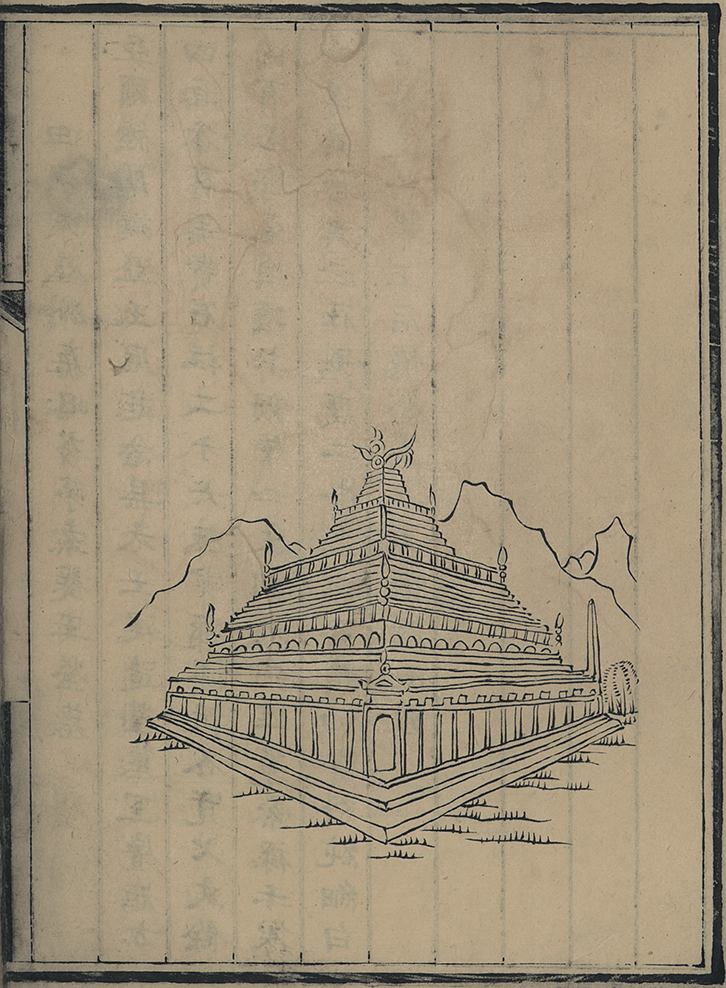
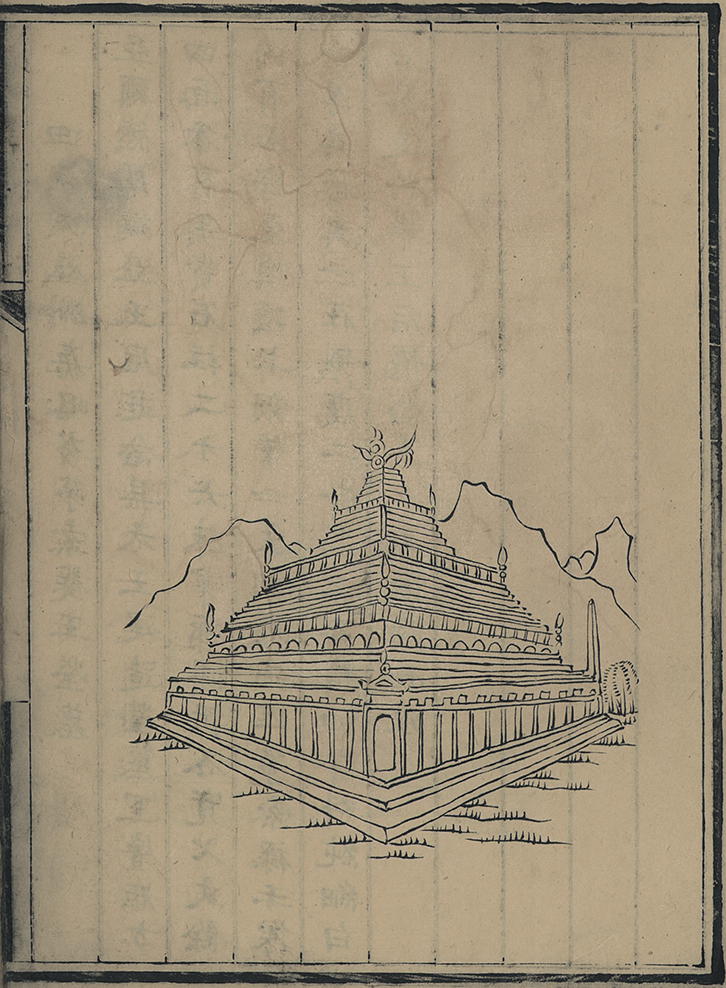
Besides these instances of a regional diffusion, the archetypal images of Heemskerck’s visual list, appearing in prints, scientific treatises, canvases and frescoes, also spread throughout Europe and beyond, serving as an exportation of the Western collective imagination to Asia and America. A particularly important case appears in a book accompanying a world map, the Kun yu tu shuo ([1674]), published by Ferdinand Verbiest, also known as Nan Huairen, a Jesuit Flemish missionary who arrived in China around 1659 (Fig. 6.5).Footnote 19 The map, in folding format, is based on Matteo Ricci’s Kun yu wan guo quan tu (1602),Footnote 20 the first European-style Chinese world map, whereas the text describes the different parts of the world, ending with a discussion of the Seven Wonders of the West and their relation to human geography. Verbiest’s images are an adaptation of Heemskerck’s series to a Chinese pictorial aesthetics and were possibly influenced by the aforementioned atlas published by Willem Janszoon Blaeu, who, like both Heemskerck and Verbiest, was Flemish.Footnote 21 Verbiest’s work, in turn, was known beyond the borders of China, notably to Japanese intellectuals of the middle of the Edo period (eighteenth century):Footnote 22 one thus encounters images of the Wonders inspired by his illustrations – and ultimately by Heemskerck – in nineteenth-century Japan, further demonstrating the extraordinarily broad diffusion of these archetypes, both in time and space.Footnote 23
Chinese Artist? [partly after Maarten van Heemskerck] ([1674]). [The Mausoleum of Halicarnassus], in F. Verbiest, Kun yu tu shuo. [s.l.].
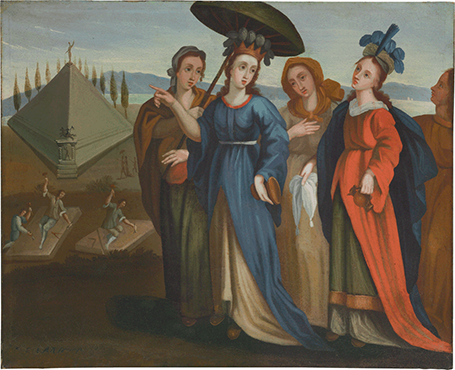
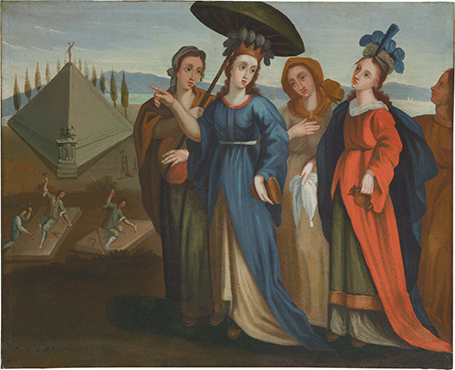
Towards the west, the images of the Seven Wonders were also exported to the Americas: in the same way that they had been adapted to East Asian aesthetics in China, the pictures were altered to suit the specificities of Peruvian culture and taste. Six paintings of the Wonders, dated between the seventeenth and eighteenth centuries, were produced by an anonymous member of the Cuzco School: although they are in some respects quite different from their model – de Vos’s reinterpretation of Heemskerck’s designs – they do contain the most basic elements of each of the Flemish artist’s images, thus distinguishing each Wonder perfectly. These paintings result from the merging of two powerful currents: the Western tradition – specifically, the Cuzco School drew much inspiration from prints produced in Antwerp – and the aspiration of native Andean and mestizo artists to express their reality and their vision of the world. In depicting the Mausoleum, as well as the other Wonders, the anonymous artist gave free rein to his imagination, hybridising aspects of pre-Columbian society with themes from Western culture (Fig. 6.6). The Mausoleum itself appears in the background, in a far more schematic form than in Heemskerck’s and de Vos’s prints (Figs. 6.1 and 6.2): indeed, the artist chose to leave out most details of the monument, which thus became little more than an excuse to depict the figures in the foreground. The latter take centre stage, especially Artemisia, who wears a headdress topped with feather plumes, in the Indigenous style, and clothing that displays a rich and intense chromatic palette. These Asian and Peruvian images reveal that, beyond the exportation of archetypal European images of the Seven Wonders, there was also at work a process perhaps best described as assimilation, which saw various civilisations integrate the Seven Wonders into their own cultural baggage and collective imaginary.
Artist of the Cuzco School [partly after Maarten de Vos] (eighteenth century). [The Mausoleum of Halicarnassus], from a painting series of the Wonders, oil on canvas, 80 x 98.1 cm (31.5” x 38.6”).
As is demonstrated both by the Cuzco painting and several other aforementioned images, Early Modern culture intrinsically linked the Mausoleum of Halicarnassus to the figure of Artemisia II of Caria, a recurrent character in Western art from the Renaissance onwards. The Queen’s chief iconographical attribute, however, was the cup containing her husband’s ashes, rather than the Mausoleum – in many paintings, the latter is entirely absent. Nevertheless, exceptions to this rule do exist: a painting by Simon Vouet shows Artemisia, without the cup, discussing the design of the Mausoleum with her architects. Elsewhere, Heemskerck’s Mausoleum is dissociated from Artemisia, yet remains a secondary feature serving a different narrative, for example in an illustration of one of Aesop’s Fables from a 1665 publication: the picture shows the lion and forest warden from the tale gazing at the great tomb of Mausolus, on which is shown a statue – absent from the Heemskerck print – of a lion resting its head on a man’s lap, which is the object of their discussion and of the fable’s moral.Footnote 24
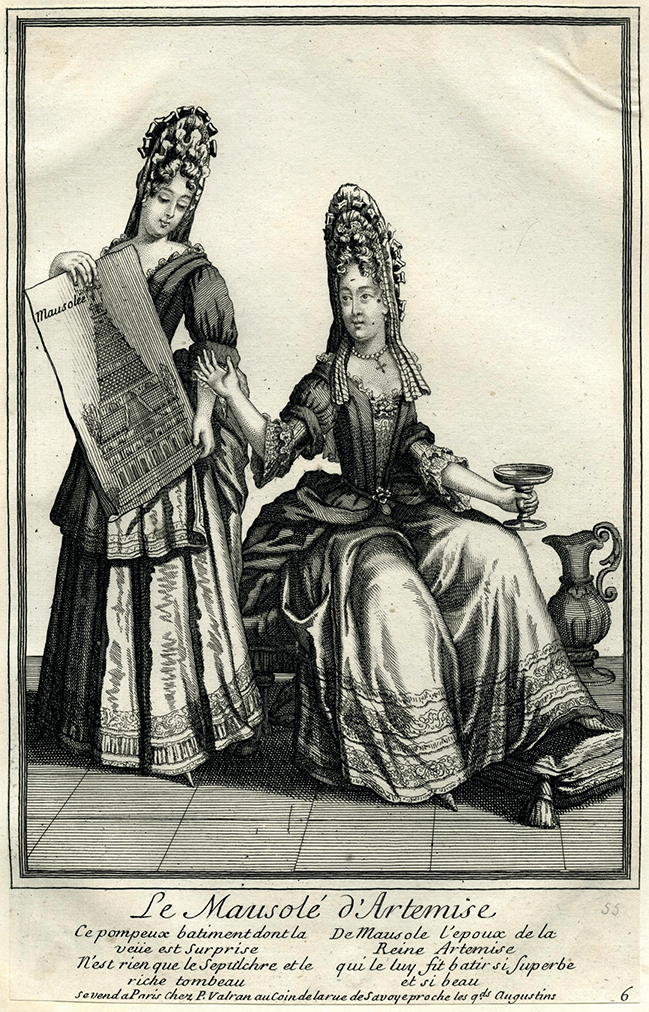
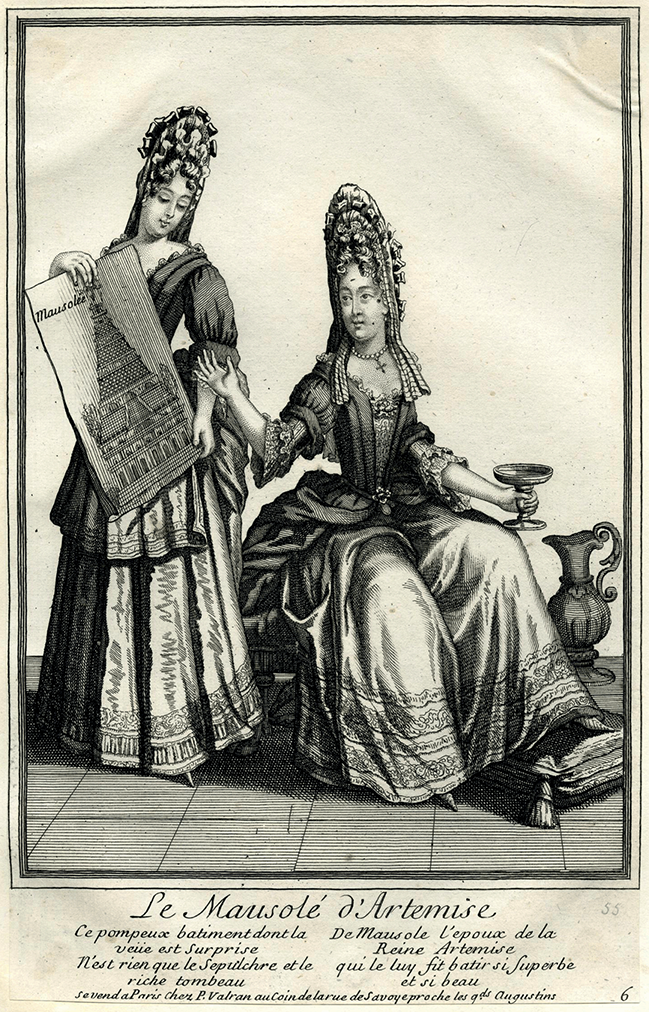
A particularly complex take on the Artemisia–Mausoleum connection appears in a print series dating from the late seventeenth century, where the Seven Wonders do not constitute the main subject of the plates, instead appearing on pictures within the pictures: figures of elegant women in the prints hold sheets of paper on which are represented the Wonders of the World, which thus become a mere accessory to be à la mode (Fig. 6.7).Footnote 25 These prints are the work of French engraver and typographer Pierre Valleran, who used the archetypes of the Wonders as an excuse to represent the fashion of his time, granting it a royal touch by combining such mythical monuments with scenes from the everyday life of a noble house. Women appear in each image, an air of nobility being conferred on them by the combination of a luxurious interior, beautiful dresses and millenary works of art: the latter, the Seven Wonders, carry values of social distinction, especially when they were originally created for royalty. The figure in the Mausoleum print is thus simultaneously a fashionable seventeenth-century woman and Artemisia II of Caria, holding in her hand the cup that contains her husband’s ashes: this conflation likely reflected the social fantasies of female viewers of the series. The Mausoleum’s design, this time, does not stem from Heemskerckian tradition, but instead from the travel guidebook Le cose maravigliose dell’alma citta di Roma, a re-edition of a work by Girolamo Francino,Footnote 26 whose representation of the monument is in turn inspired by the print in Colonna’s Hypnerotomachia Poliphili (Fig. 2.1).
Pierre Valleran (1675–1700). Le Mausolé d’Artemise, from a fashion print series, 28.5 x 18 cm (11” x 7”).
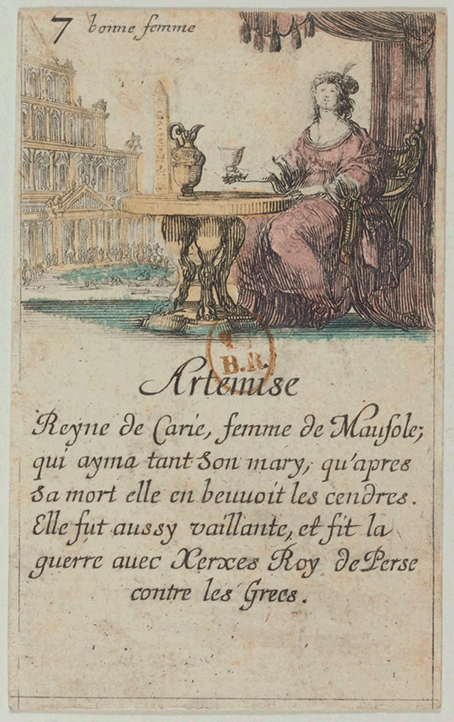
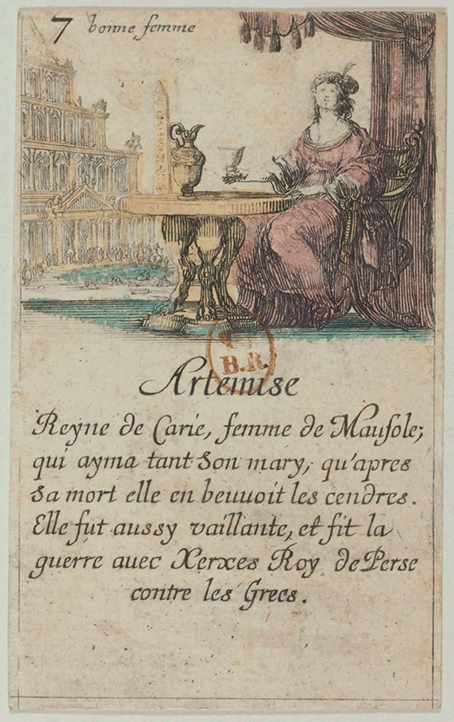
Renaissance images of the Mausoleum have thus gone from being attempts at representing historical fact on the basis of ancient sources to becoming, in the seventeenth century, the models for further models, through multiplied compositions purely serving the demands of the moment. Scenes are depicted that reflect contemporary concerns, moods and fashions, with the Wonders appearing as a legitimising attribute of position and status. This was often combined with the function of female role model that the figure of Artemisia II of Caria could bear for women and especially female regents. In France, a book written by Jesuit Pierre le Moyne in 1647, La Gallerie des femmes fortes, included prints representing outstanding women, with images of the Seven Wonders in the background. The engravings, executed by Abraham Bosse and Gilles Rousselet following drawings by Claude Vignon,Footnote 27 depicted women renowned for their heroic deeds, or related in some way – as was Artemisia – to the Wonders themselves. A similar occurrence is a card game designed by Stefano della Bella in 1644, a complete educational pack of fifty-two mounted playing cards, each of which shows a notable queen and contains a short historical account of her actions (Fig. 6.8).Footnote 28 Some of these famous women, such as Artemisia, are associated with one of the Wonders, yet these great works appear significantly diminished in the images, becoming a mere symbol or attribute to allow viewers to identify the figure: here, as in Valleran’s print, the monument chiefly functions as a somewhat abstract concept, not so much as an image in itself but rather as a qualifying element whose exact appearance matters little.
Stefano della Bella (1644). Artemise, from the playing card series Jeu des reines renommées, print, 8.8 x 5.5 cm (3” x 2”).
*****
The processes of cultural transmission that have been uncovered in the images analysed here demonstrate the artistic, ideological and symbolic significance of the Seven Wonders and, in this case, of the Mausoleum of Halicarnassus. The latter’s image, fixed in Renaissance artworks, was maintained with minor variations and few exceptions until the mid-eighteenth century and the development of new methodologies of historical enquiry. The visual journey through different representations of the Mausoleum proposed here has revealed a deep undercurrent within the classical heritage of Western civilisation, which maintains its presence in the collective imagination to the present day. Simultaneously, the various representations of the (destroyed) monument kept alive the idea of this Wonder of Antiquity as a model or archetype within modern culture: the Mausoleum of Halicarnassus, the paradigmatic monumental tomb, thus transcended its material existence to become a symbol of immortality.

 Open access