




“All through my life, culturally reinforced signals cautioned me against being branded as too smart or too successful.”
– Sheryl Sandberg Lean In: Women, Work, and the Will to Lead
1. Introduction
Cognitive skills are important personal attributes that affect one’s career success (Herrnstein & Murray, Reference Herrnstein and Murray1996). However, individual skills are not the only determinant of one’s success: a positive and welcoming environment is also important, especially for jobs based on teamwork. Yet, colleagues’ support may also be affected by gender norms, which makes the role of cognitive skills and its interplay with gender possibly more nuanced (Eagly & Karau, Reference Eagly and Karau2002; Heilman, Reference Heilman2001; Ridgeway, Reference Ridgeway2001; Rudman & Phelan, Reference Rudman and Phelan2008). Although the literature finds that men are more generous to women than to men (Dufwenberg & Muren, Reference Dufwenberg and Muren2006; List, Reference List2004), few studies examine its interaction with cognitive skills.
One manifestation of gender norms is paternalism toward women, which may motivate men to be more generous to them. For example, many men (and women) in the US believe that women who fall behind deserve more support than men in similar situations because they attribute women’s setbacks to bad luck rather than a lack of effort (Cappelen et al., Reference Cappelen, Falch and Tungodden2023). Similarly, men (and women) are more likely to attribute female leaders’ bad outcomes to bad luck rather than poor decisions, compared to how they attribute male leaders’ bad outcomes (Erkal et al., Reference Erkal, Gangadharan and Koh2023). Furthermore, many countries prohibit women from engaging in certain activities, such as close military combat (Fitriani et al., Reference Fitriani and Matthews2016).Footnote 1
The main research question addressed in this paper is whether men are less generous to women who have higher cognitive skills than they do. I hypothesize that this is indeed the case because if the paternalism derived from gender norms drives men’s higher generosity toward women, their generosity may disappear or even reverse when women violate these norms by excelling in critical skills for their career success. I test this hypothesis via a laboratory experiment.
In the experiment, participants first work on an incentivized IQ test (Raven matrices) that measures their cognitive skills. After the test, participants are randomly assigned to a group of six and receive an IQ rank relative to other group members. Then three of the six members are randomly chosen to be dictators and play three rounds of dictator game with the other three members chosen to be receivers, observing the receivers’ facial photos and first names – both of which convey information about their gender – and the relative IQ ranks. I use the dictators’ allocation as the measure of generosity, a widely used tool in experimental economics and shown to predict one’s generosity outside the laboratory (Franzen & Pointner, Reference Franzen and Pointner2013). The use of photos allows me to inform the dictators of the receivers’ gender with minimum experimenter demand effects.Footnote 2 I use dictator IQ fixed effects in the analysis to compare allocations of dictators with the same IQ but assigned different relative IQ ranks due to random group formation to cut the correlation between IQ and baseline generosity.Footnote 3, Footnote 4
I first confirm that male and female dictators’ behaviors are consistent with the literature: their allocation amounts are similar to those in a previous study with a comparable level of social distance from receivers. Male dictators allocate more to female receivers than to male receivers (albeit statistically insignificant), and female dictators allocate more than male dictators. However, I do not find evidence that male dictators are less generous to female receivers with higher IQs. The point estimate is quantitatively negligible, statistically indistinguishable from zero, and has a tight confidence interval. If anything, male dictators are slightly more generous to female receivers with higher IQs. These results are robust to the so-called “beauty premium” and hold across the entire distribution of male dictator allocations. The allocation patterns of female dictators are qualitatively similar to those of male dictators. Taken together, contrary to the hypothesis, men (and women) are no less generous to women, even when women excel in cognitive skills. Thus, the results suggest that women who excel in cognitive skills may not receive less favorable treatment than equally intelligent men in the labor market.Footnote 5
This paper contributes to the literature about people’s differential attitudes toward competent women and men. Social psychology and sociology literature find that people perceive and evaluate competent women more negatively than competent men (Heilman et al., Reference Heilman, Wallen, Fuchs and Tamkins2004; Phelan et al., Reference Phelan, Moss-Racusin and Rudman2008; Rudman, Reference Rudman1998; Rudman & Fairchild, Reference Rudman and Fairchild2004; Rudman et al., Reference Rudman, Moss-Racusin, Phelan and Nauts2012). Also, Quadlin Reference Quadlin(2018) finds female college students with a very high grade point average (GPA) receive fewer callbacks in hiring than male students with a similar GPA. However, there are studies that find the opposite: Ceci and Williams Reference Ceci and Williams(2015) and Williams and Ceci Reference Williams and Ceci(2015) find well-qualified female candidates for assistant professor positions receive equal or more favorable treatment than equally qualified male candidates in hiring. I show that although intelligence is an important factor of career success and one of the attributes men (and women) care most about (Castagnetti & Schmacker, Reference Castagnetti and Schmacker2022; Eil & Rao, Reference Eil and Rao2011; Zimmermann, Reference Zimmermann2020), excelling in intelligence is not a sufficient condition for women to receive less favorable treatments than equally intelligent men, consistent with the latter line of studies.
My paper also contributes to the literature on the role of gender in dictator games. The literature finds that female dictators allocate more than male dictators, but the difference is quantitatively modest at best (Bilén et al., Reference Bilén, Dreber and Johannesson2021). The difference is also context-dependent (Croson & Gneezy, Reference Croson and Gneezy2009; Doñate-Buendía et al., Reference Doñate-Buendía, García-Gallego and Petrović2022) and possibly driven by nonmonetary motives (Klinowski, Reference Klinowski2018). Regarding the gender of the receivers, the literature finds that dictators allocate more to female receivers than to male receivers (Engel, Reference Engel2011), and male dictators may do so more (Dufwenberg & Muren, Reference Dufwenberg and Muren2006; List, Reference List2004). My paper adds to the latter evidence by introducing IQ as an additional dimension to gender and shows that male dictators’ allocation patterns are largely unchanged when female receivers have higher IQs than male dictators.
The remainder of the paper proceeds as follows. Section 2 describes the experimental design, procedure, implementation, and data. Section 3 discusses the empirical strategy. Section 4 presents the results. Section 5 concludes.
2. Experiment
I conduct two experiments: the main and the follow-up. The main experiment collects data on dictator game allocation, and the follow-up experiment collects data on the receivers’ attractiveness and other facial characteristics. I describe each of them in detail below.
2.1. Main experiment
The main experiment consists of two parts, and participants receive instructions at the beginning of each part.
2.1.1 Pre-experiment: random desk assignment & photo-taking
Participants are randomly assigned to a partitioned computer desk. Afterward, they have their facial photos taken at a photo booth and enter their first names on their computers. The experimenters then go to each participant’s desk to check that their photo and first name are correct, to assure other participants that the checked participants’ photos and first names are real, following Isaksson Reference Isaksson(2018).
2.1.2 Part 1: IQ test
In Part 1, participants work on nine incentivized IQ questions for 9 minutes to measure their IQ. I use Bilker et al. Reference Bilker, Hansen, Brensinger, Richard, Gur and Gur(2012)’s “form A 9-item Raven test,” which measures one’s IQ 90% as accurately as the full-length Raven test but with fewer questions. Participants receive 0.5€ for each correctly solved IQ test question, but they do not receive information about how many questions they have solved correctly until the end of the experiment.
After the IQ test, participants make an incentivized guess on the number of IQ test questions they have solved correctly, which I use as a measure of their overconfidence level. They receive 0.5€ for a correct guess. They do not receive feedback on their guess accuracy until the end of the experiment.
Following Eil and Rao Reference Eil and Rao(2011), six participants are randomly grouped and privately informed about their IQ rank relative to the other five participants in the group. Ties are broken randomly. They then answer a set of comprehension questions about their IQ rank. They cannot proceed to the next part until they answer the comprehension questions correctly.
2.1.3 Part 2a: dictator game (dictators only)
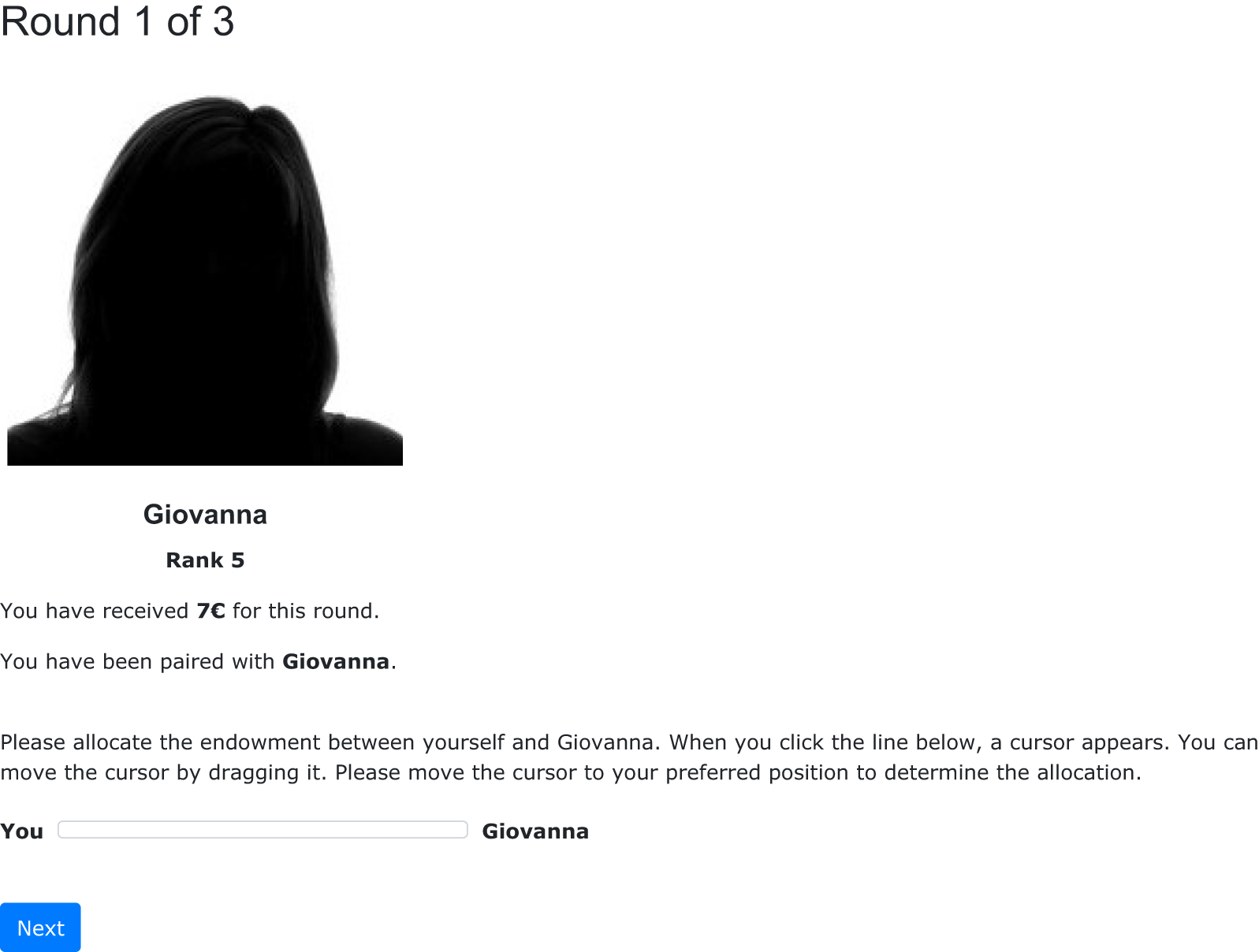
In Part 2, three participants in each group are randomly assigned the role of dictators (which I call “active participant”), and the other three participants are randomly assigned the role of receivers (which I call “passive participant”). Dictators then play dictator games with windfall money three times, each time with a different receiver from their group, one by one, using a perfect stranger-matching protocol. During the dictator game, dictators observe the receivers’ facial photos, first names, and IQ ranks; see Figure 1 for an example of a dictator’s decision screen. The use of photos follows gender economics literature (Babcock et al., Reference Babcock, Recalde, Vesterlund and Weingart2017; Coffman, Reference Coffman2014; Isaksson, Reference Isaksson2018) to minimize the experimenter demand effects.
Dictator’s allocation screen
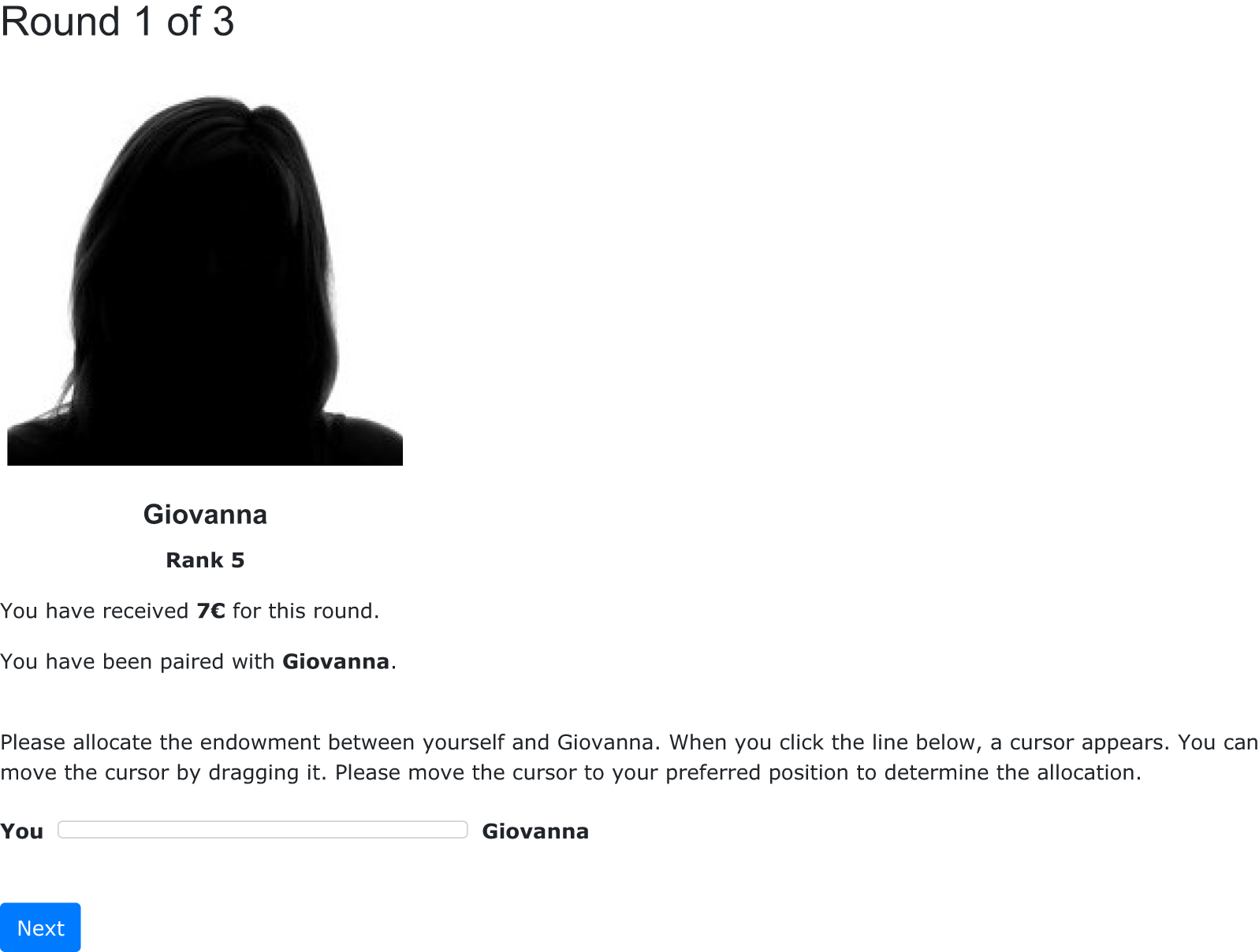
Dictators are told that their decisions are anonymous to the receivers and that their allocation will be paid as a “top-up” to the receivers’ earnings. Dictators decide allocations by moving a cursor on a slider where the cursor is initially hidden to prevent anchoring. I vary the endowment across rounds to make each dictator game less repetitive: 7€ for the 1st and the 3rd rounds and 5€ for the 2nd round. At the end of the experiment, one of the three allocations is randomly chosen for each participant as earnings for Part 2.Footnote 6, Footnote 7
2.1.4 Part 2b: belief elicitation (receivers only)
I also collect a proxy of dictators’ beliefs on how many IQ test questions the matched receivers have solved correctly. To prevent the belief elicitation from affecting/being affected by the dictator game, I exploit the random role assignment and use the receivers’ beliefs. This is a valid proxy because both dictators and receivers are exactly in the same experimental environment up to the role assignment and the role assignment is random. Specifically, while dictators are playing the dictator game, receivers are matched with the other two receivers in the same group one by one with a perfect stranger-matching protocol, and they make incentivized guesses on how many IQ test questions they have solved correctly, observing the receivers’ facial photo, first name, and IQ rank, just as dictators do. They receive 0.5€ for each correct guess.
To address the non-anonymity of showing facial photos and first names, I ask both dictators and receivers how well they know the paired participants on a scale of 4, from “Did not know at all” to “Knew very well.”Footnote 8 I ask this question twice to make sure they do not answer randomly: right after the three dictator games (for dictators) or two guesses (for receivers) and in the post-experimental questionnaire.
2.1.5 Post-experiment: questionnaire
After the dictator game and the belief elicitation, participants are told their earnings from the IQ test, the dictator game, and the belief elicitation in private. Before receiving their earnings, participants answer a short questionnaire about their demographics. In addition, receivers are asked whether I could use their photos in another experiment with a gratuity of 1.5€ (only for receivers who agreed; 149 receivers out of 193, or 77% of receivers, agreed).
2.1.6 Implementation
The main experiment was programmed with oTree (Chen et al., Reference Chen, Schonger and Wickens2016) and conducted in English in November–December 2019 at the Bologna Laboratory for Experiments in Social Science (BLESS). I recruited 390 students (195 female and 195 male) of the University of Bologna via ORSEE (Greiner, Reference Greiner2015) who (i) were born in Italy, (ii) had not participated in gender-related experiments in the past (as far as I could trace), and (iii) were available to participate in experiments in English. The first condition was to reduce the chance that receivers’ photos and first names would signal ethnicity, race, or cultural background. The second condition was to minimize the experimenter demand effects. The third condition was to run the experiment in English. As a further attempt to make the data cleaner, I excluded receivers with non-Italian-sounding names and allocations in which the dictators answered at least once that they knew the paired receivers “very well.”Footnote 9 These data screenings leave me with 388 participants, 195 dictators, and 558 dictator allocations.
The number of participants is based on the power simulation in the pre-analysis plan to achieve 80% power.Footnote 10 The experiment is pre-registered with the OSF.Footnote 11 Appendix A explains deviations from the pre-analysis plan.
I ran 24 sessions in total, and the number of participants in each session was a multiple of 6 (12–30). The average session length was 70 minutes, including registration and payment. The average payment per participant was about 10€ including the participation fee of 2.5€ and a gratuity of 1.5€ for photo use in another experiment (only for receivers who agreed).
2.2. Follow-up experiment
I conduct a follow-up experiment to collect a measure of the attractiveness and other facial characteristics of the receivers in the main experiment. It consists of one part, and participants earn a flat fee of 10€.
Participants are randomly assigned to a partitioned computer desk. Afterward, participants see photos of 100 receivers in the main experiment one by one and rate the attractiveness of each of the photos on a 5-point Likert scale. I also ask them to rate the photos in terms of how kind they look (on a 5-point Likert scale), to which extent they look Italian (on a 3-point Likert scale), and whether they know the person (yes or no) – all in one screen for each photo. The photos are randomly drawn from the pool of all receivers who agreed to show their photos in another experiment, and the order of the photos is randomized. After rating all the 100 photos, participants provide their gender and age.
The follow-up experiment was programmed with oTree and conducted in Italian in October 2023 at the BLESS. I recruited 28 students (14 female and 14 male) who (i) were born in Italy and (ii) were available to participate in experiments in English to make the subject pool as close as possible to that of the main experiment. I also restricted participants to those who had not participated in the main experiment.Footnote 12, Footnote 13, Footnote 14
2.3. Data
Appendix B describes the data in detail; I briefly summarize its key aspects here. First, most male dictators (95%) do not know the receiver at all, so it is unlikely that the relationship outside the laboratory affects dictator allocation. Second, consistent with the literature, male dictators allocate less (6.3 percentage points less, the p-value < 0.05 with a two-sided t-test) to receivers than female dictators do. Third, again somewhat consistent with the literature, dictators, especially male dictators, allocate slightly more (2.4 percentage points more; male dictators allocate 3.1 percentage points more) to female receivers than to male receivers, although the difference is statistically insignificant. Fourth, both men and women consider women to look more attractive than men, regardless of their IQ level.
3. Empirical strategy
A naive way to test whether male dictators allocate less to higher-IQ female receivers than to higher-IQ male receivers is to compare male dictators’ allocations to those receivers. However, this simple difference may be biased upward because male dictators may allocate more to more attractive receivers (Rosenblat, Reference Rosenblat2008), and men rate women more highly than men on attractiveness (see the discussion in Section 2.3). In fact, male dictators allocate more to more attractive receivers (see Appendix Figure D2, Panels A and B).Footnote 15
A difference-in-differences would eliminate the bias from the attractiveness differences, using the difference between male dictators’ allocations to lower-IQ female receivers and to lower-IQ male receivers as a comparison group. However, it introduces two other biases because low-IQ dictators are more likely to face higher-IQ receivers. First, because low-IQ dictators earned less on the IQ test than high-IQ dictators, higher-IQ receivers and dictators’ earnings are negatively correlated, potentially biasing the dictators’ allocation to higher-IQ receivers due to the wealth effects. Also, if low-IQ dictators think the differences between their earnings and the higher-IQ receivers’ earnings are larger than high-IQ dictators think, it also induces inequality aversion (Fehr & Schmidt, Reference Fehr and Schmidt1999). Second, because one’s IQ is positively associated with one’s socioeconomic background, and one’s socioeconomic background influences one’s social preferences (Falk et al., Reference Falk, Kosse, Pinger, Schildberg-Hörisch and Deckers2021), the dictators’ allocation to higher-IQ receivers may be biased upward or downward. In my sample, male dictators’ IQs (or their earnings on the IQ test) and allocations are negatively correlated, and male dictators’ IQ ranks and allocations are positively correlated (see Appendix Figure D2, Panels A and B), both of which bias the allocations to higher-IQ receivers upward.Footnote 16
To address these concerns, I estimate the following difference-in-differences equation via ordinary least squares (OLS) using male dictators’ allocation data:
 \begin{equation}
\begin{aligned}
Allocate_{ij} = &\beta_1 HigherIQReceiver_{ij}\times FemaleReceiver_j \\
&+ \beta_2 HigherIQReceiver_{ij} + \beta_3 FemaleReceiver_j + X_{ij}'\gamma + \mu_i^{IQ} + \epsilon_{ij}
\end{aligned}
\end{equation}
\begin{equation}
\begin{aligned}
Allocate_{ij} = &\beta_1 HigherIQReceiver_{ij}\times FemaleReceiver_j \\
&+ \beta_2 HigherIQReceiver_{ij} + \beta_3 FemaleReceiver_j + X_{ij}'\gamma + \mu_i^{IQ} + \epsilon_{ij}
\end{aligned}
\end{equation}where each variable is defined as follows:
• $Allocate_{ij}\in [0,1]$: dictator i’s allocation to receiver j as a fraction of endowment.
•
$HigherIQReceiver_{ij}\in \{0,1\}$: an indicator variable equals 1 if receiver j’s IQ is higher than that of dictator i.•
$FemaleReceiver_j \in \{0,1\}$: an indicator variable equals 1 if receiver j is female.• Xij: a set of additional covariates to increase statistical power. Appendix C provides a full description of the covariates.
• ϵij: the error term.



and  $\mu_i^{IQ} \equiv \sum_{k=1}^9 \theta_k^{IQ}\mathbb{1}[\text{i's IQ}=k]$ is fixed effects for the dictators’ IQ (the number of IQ test questions they have solved correctly), where $\mathbb{1}$ is the indicator function. Standard errors are clustered at the dictator level with Pustejovsky and Tipton Reference Pustejovsky and Tipton(2018)’s small cluster bias adjustment. The IQ fixed effects are included following Zimmermann Reference Zimmermann(2020), so that the coefficients in equation 1 capture allocation differences due to the receivers’ IQ, not that of the dictators. As discussed above, without the IQ fixed effects, the coefficients related to higher-IQ receiver can capture the wealth effects, inequality aversion, and the difference in the preference for allocation between high-IQ and low-IQ dictators.
The coefficient of interest is β 1, which captures the difference between the dictator allocations to higher-IQ female receivers and higher-IQ male receivers relative to the difference between the dictator allocations to lower-IQ female receivers and lower-IQ male receivers. As discussed above, because men rate women more highly than men on attractiveness, the estimates related to the female receiver can capture the effects of attractiveness differences without taking the double differences. On the other hand, as discussed in Section 2.3, men’s ratings on high-IQ women’s attractiveness and low-IQ women’s attractiveness are very similar. Also, men’s rating on high-IQ men’s attractiveness and low-IQ men’s attractiveness is very similar, justifying the difference-in-differences.
4. Results
4.1. Regression results
Table 1 presents the regression results of equation 1 with data for male dictators. Column 1 shows that the coefficient estimate on higher-IQ receivers (β 2) is 0.093 and statistically marginally significant at 10%, suggesting that male dictators allocate 9.3 percentage points more to higher-IQ male receivers than to lower-IQ male receivers. Also, the sum of the coefficient estimates on the interaction term between higher-IQ receivers and the female receivers, and on the higher-IQ receivers (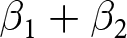 $\beta_1+\beta_2$) is 0.111 and statistically significant at 5%, suggesting that male dictators allocate 11.1 percentage points more to higher-IQ female receivers than to lower-IQ female receivers. However, as discussed in Section 3, the coefficient estimates related to higher-IQ receivers are biased because low-IQ dictators are more likely to face higher-IQ receivers. Hence, we move to Column 2, which includes dictator IQ fixed effects. Comparing the coefficient estimates of Columns 1 and 2, the only difference is the coefficient estimate on higher-IQ receivers (β 2), which is in line with the discussion in Section 3. Indeed, the dictator IQ fixed effects in Column 2 are jointly statistically significant with a p-value of 0.07.
Dictator allocations to higher-IQ female receivers – OLS, male dictators
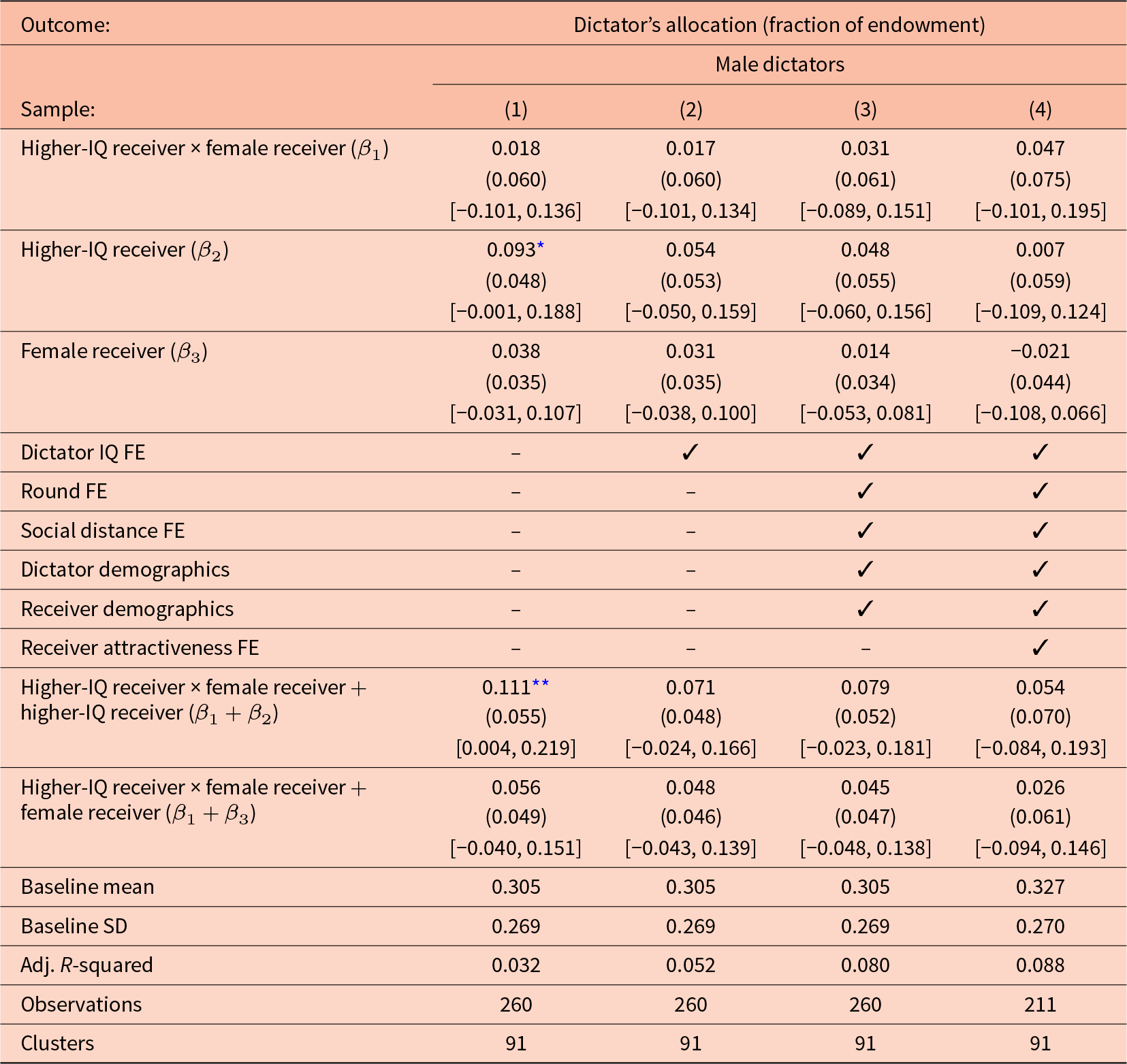
Notes: This table presents the regression results of equation 1. The standard error (in parenthesis) and the 95% confidence interval (in bracket) are reported below each coefficient estimate. The standard errors are clustered at the dictator level with Pustejovsky and Tipton Reference Pustejovsky and Tipton(2018)’s small cluster bias adjustment. Baseline mean and standard deviation are that of lower-IQ male receivers.
* Significance levels: 10% and **5%.
Column 2 shows that the coefficient estimate on female receivers (β 3) is 0.031, suggesting that male dictators may allocate slightly more to lower-IQ female receivers than to lower-IQ male receivers, albeit the difference is statistically insignificant. Also, the coefficient estimate on higher-IQ receivers (β 2) is 0.054, suggesting that male dictators may allocate more higher-IQ male receivers than to lower-IQ male receivers, albeit the difference is statistically insignificant. The sum of the coefficient estimates on the interaction term between higher-IQ receivers and female receivers, and on higher-IQ receivers (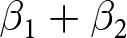 $\beta_1+\beta_2$) is 0.071, suggesting that male dictators may allocate slightly more to higher-IQ female receivers than to lower-IQ female receivers, albeit the difference is statistically insignificant. The sum of the coefficient estimates on the interaction term between higher-IQ receivers and female receivers, and on female receivers (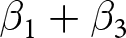 $\beta_1+\beta_3$) is 0.048, albeit statistically insignificant, suggesting that male dictators may allocate more to higher-IQ female receivers than to higher-IQ male receivers.
However, as discussed in Section 3, the comparison between allocations to higher-IQ female receivers and allocations to lower-IQ female receivers is confounded because higher-IQ receivers earn more in the IQ test than lower-IQ receivers, which may induce dictators’ inequality aversion. Also, the comparison between allocations to higher-IQ female receivers and allocations to higher-IQ male receivers is confounded because men consider women to be more attractive than men and thus may allocate more to female receivers than to male receivers.
To address these concerns, we turn to our coefficient of interest: The coefficient estimate on the interaction between higher-IQ receivers and female receivers (β 1), which is 0.017 and statistically insignificant, suggesting that male dictators’ allocation differences toward higher-IQ female and male receivers and toward lower-IQ female and male receivers are statistically indistinguishable. Column 3, which controls for dictator and receiver demographics, as well as for round and dictator-receiver social distance to increase statistical power, presents quantitatively similar empirical patterns to Column 2.Footnote 17, Footnote 18, Footnote 19 Thus, the results are inconsistent with the hypothesis that men are less generous to higher-IQ women.
A caveat is that the confidence interval is not very tight. Looking at the 95% confidence intervals of the interaction between higher-IQ receivers and female receivers (β 1), our coefficient of interest, we can reject at the 5% significance level that the effect size is no smaller than −8.9 to −10.1 percentage points and no larger than 13.4 to 15.1 percentage points. As references, Engel Reference Engel(2011) finds via meta-analysis that male dictators allocate 14.3 percentage points more to female receivers than to male receivers, and Dufwenberg and Muren Reference Dufwenberg and Muren(2006) find using a university-student sample that male dictators allocate 7.6–8.9 percentage points more to female receivers than to male receivers. To halve the confidence intervals, we need approximately 1560 participants (=390*4).Footnote 20
4.2. Distribution results
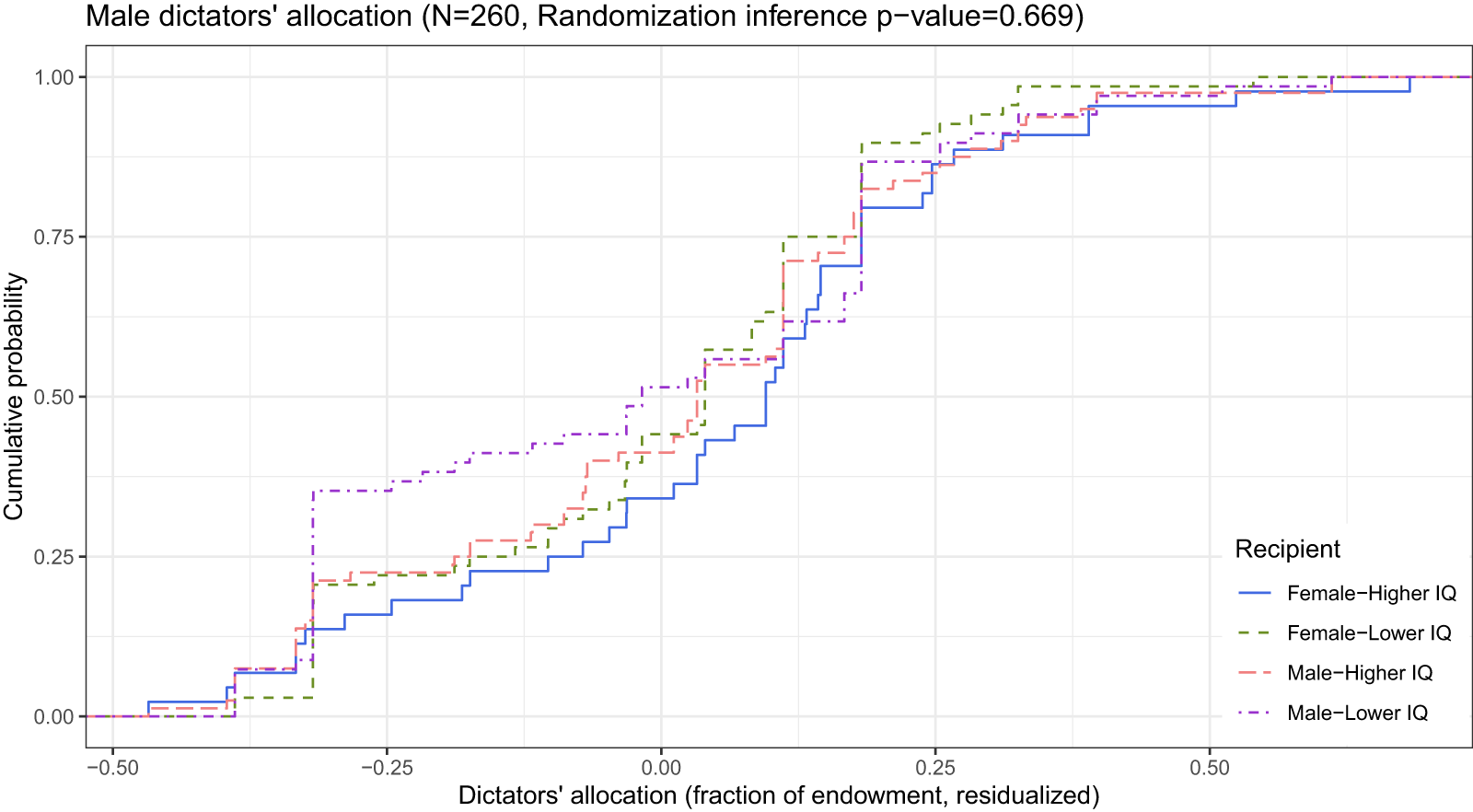
Although we did not find support for the hypothesis in mean, we may find support in distribution. To see this, Figure 2 presents the empirical cumulative distribution function (CDF) of dictator allocations by receiver types, residualized with the dictator-IQ fixed effects to give a causal interpretation to the differences,Footnote 21 and shows that the results in Section 4.1 also hold in distribution. It shows that across almost the whole dictators’ allocations, male dictators allocate slightly more to higher-IQ female receivers than to lower-IQ male receivers, higher-IQ male receivers, and lower-IQ female receivers, albeit the differences are statistically insignificant (the randomization inference p-value is 0.669, which is robust to arbitrary dependency among allocations, calculated with the Kruskal–Wallis test with 2000 random draws).Footnote 22
Dictator allocations to higher-IQ female receivers – distribution, male dictators
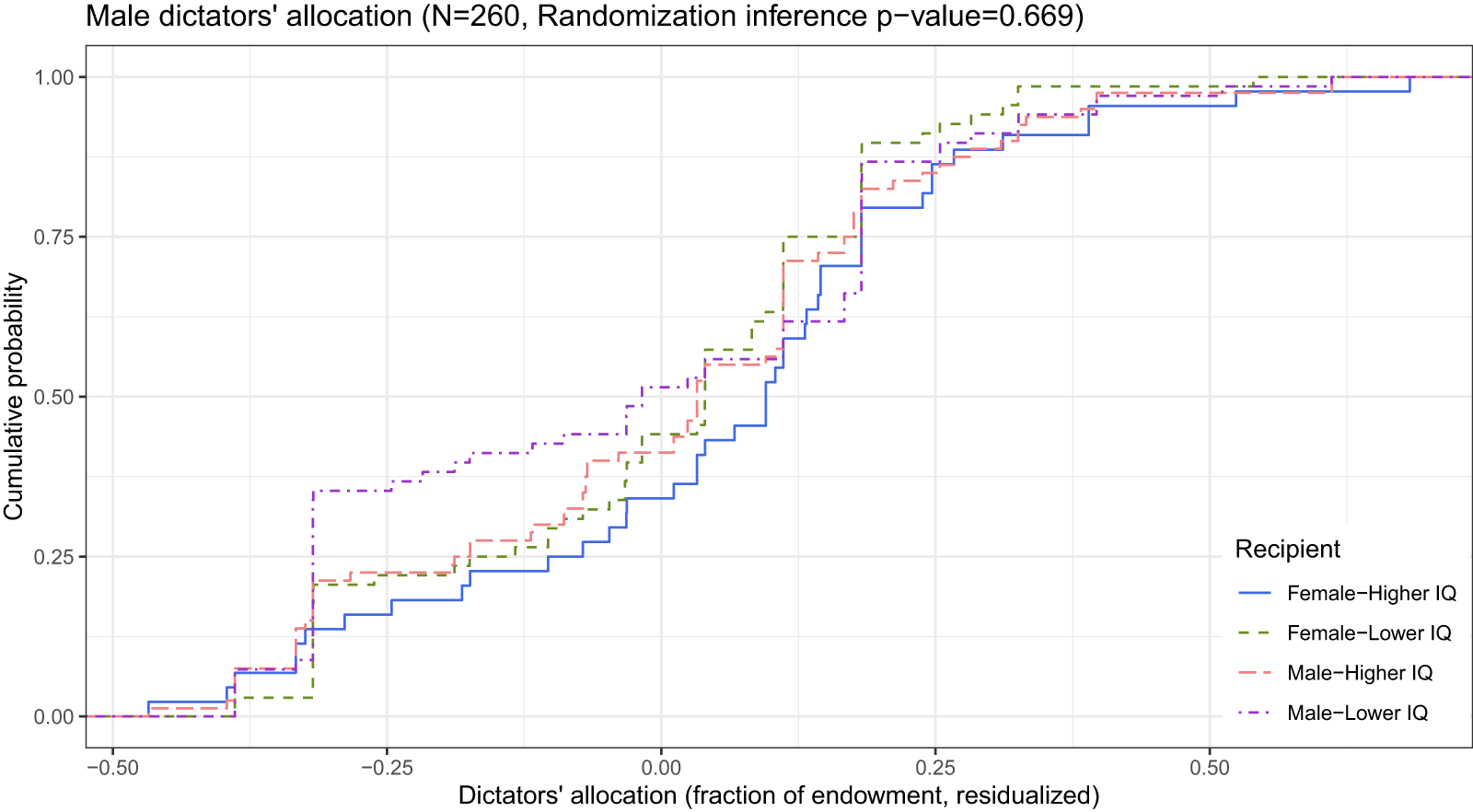
Thus, the results are inconsistent with the hypothesis that men are less generous to higher-IQ women even in distribution; rather, if anything, men are slightly more generous to higher-IQ women than to higher-IQ men.
4.3. Robustness check
4.3.1 “Beauty premium”
In the main results, I control for the possibility that dictators allocate more to more attractive receivers – the so-called “beauty premium” (Rosenblat, Reference Rosenblat2008) – by taking double differences. Yet, I further address this concern in Column 4 of Table 1. In addition to all the controls in Column 3, Column 4 controls for the receivers’ attractiveness via fixed effects (adding dummies for each level of attractiveness ratings, which are jointly significant with a p-value of 0.001) and shows that the magnitude of the coefficient of interest, the interaction term between higher-IQ receivers and female receivers (β 1), remains essentially the same as in Column 3, albeit the standard errors are larger due to a drop in the sample size by 23%.Footnote 23
4.3.2 Inequality aversion due to differential earnings in the IQ test
I control for dictators’ inequality aversion (Fehr & Schmidt, Reference Fehr and Schmidt1999) due to the differential earnings in the IQ test between higher-IQ receivers and dictators via IQ fixed effects. Yet, it assumes that male dictators believe higher-IQ female and male receivers solved the same number of IQ test questions. Thus, I examine the validity of this assumption in Column 5 of Appendix Table D1. Instead of allocation data for male dictators, Column 5 uses data for male receivers’ beliefs on the IQ levels of the other receivers.Footnote 24 It shows that male receivers believe that higher-IQ female receivers solve about 0.82 more IQ test questions (=1.109−0.291) or earn about 0.41€ more (about 6.5% of the dictator endowment) than higher-IQ male receivers. Thus, if anything, the main results are underestimated in the absence of inequality aversion.
4.3.3 IQ rank differences
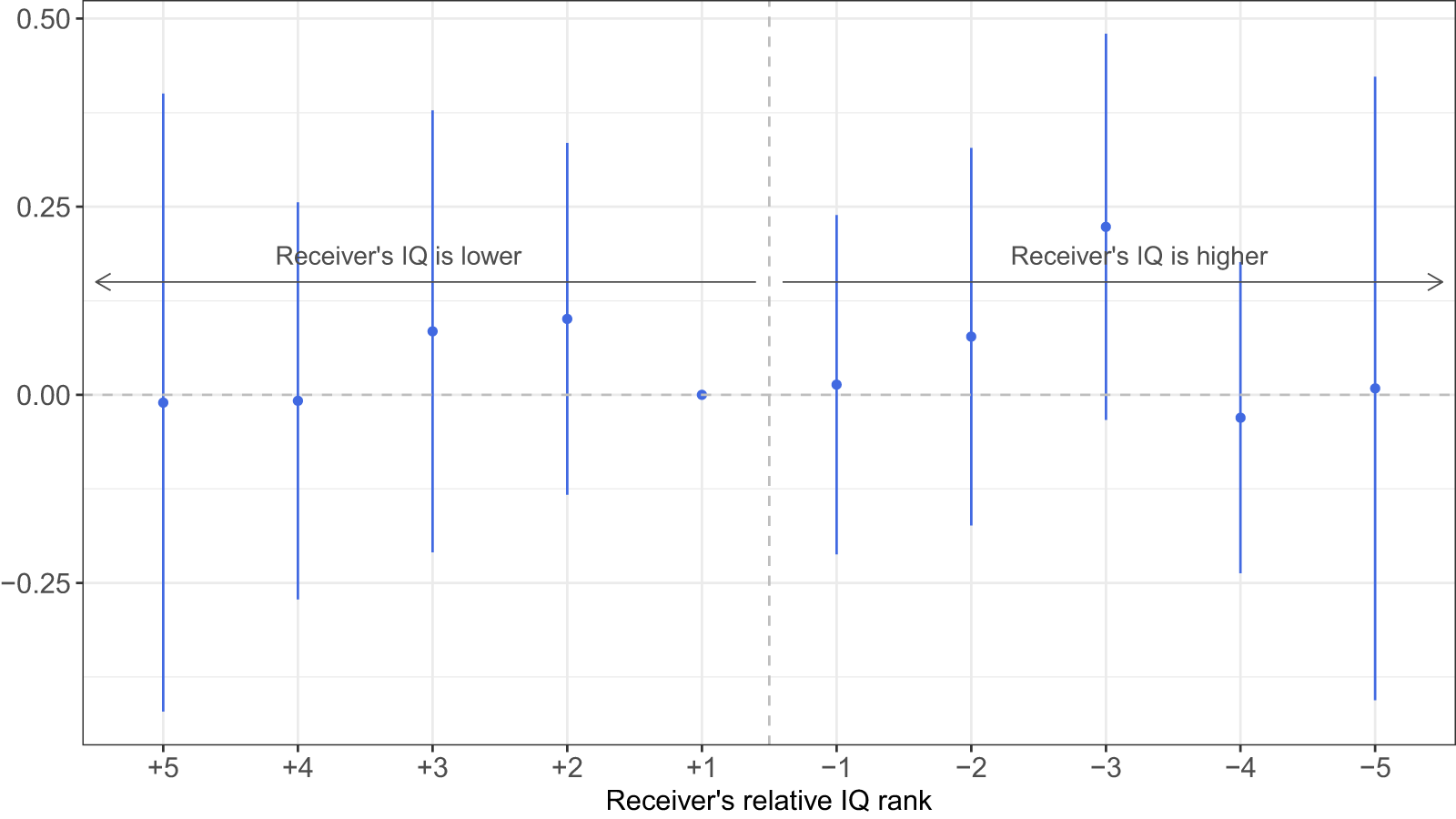
Dictators see the difference between the receivers’ and their own IQ rank. Yet, in the main results, I only consider whether the receivers’ IQ rank is higher than the dictators’ IQ rank. To investigate the heterogeneity by the difference in the IQ rank, I estimate the following equation:
 \begin{equation}
\begin{aligned}
Allocate_{ij} = &\sum_{k=-5,\ne 1}^5\beta_1^k \mathbb{1}[ReceiverIQRank_{j}-DictatorIQRank_{i}=k]\times FemaleReceiver_j \\
&+ \sum_{k=-5,\ne 1}^5\beta_2^k \mathbb{1}[ReceiverIQRank_{j}-DictatorIQRank_{i}=k] + \beta_3 FemaleReceiver_j \\
&+ X_{ij}'\gamma + \mu_i^{IQ} + \epsilon_{ij}
\end{aligned}
\end{equation}
\begin{equation}
\begin{aligned}
Allocate_{ij} = &\sum_{k=-5,\ne 1}^5\beta_1^k \mathbb{1}[ReceiverIQRank_{j}-DictatorIQRank_{i}=k]\times FemaleReceiver_j \\
&+ \sum_{k=-5,\ne 1}^5\beta_2^k \mathbb{1}[ReceiverIQRank_{j}-DictatorIQRank_{i}=k] + \beta_3 FemaleReceiver_j \\
&+ X_{ij}'\gamma + \mu_i^{IQ} + \epsilon_{ij}
\end{aligned}
\end{equation} where ReceiverIQRankj is receiver j’s IQ rank, DictatorIQRanki is dictator i’s IQ rank, and other variables are as defined in equation 1. In the main specification, HigherIQReceiverij is equal to  $\sum_{k=-5}^{-1}\mathbb{1}\lbrack ReceiverIQRank_j-DictatorIQRank_i=k\rbrack$ and the omitted category is $\sum_{k=2}^5\mathbb{1}\lbrack ReceiverIQRank_j-DictatorIQRank_i=k\rbrack$.
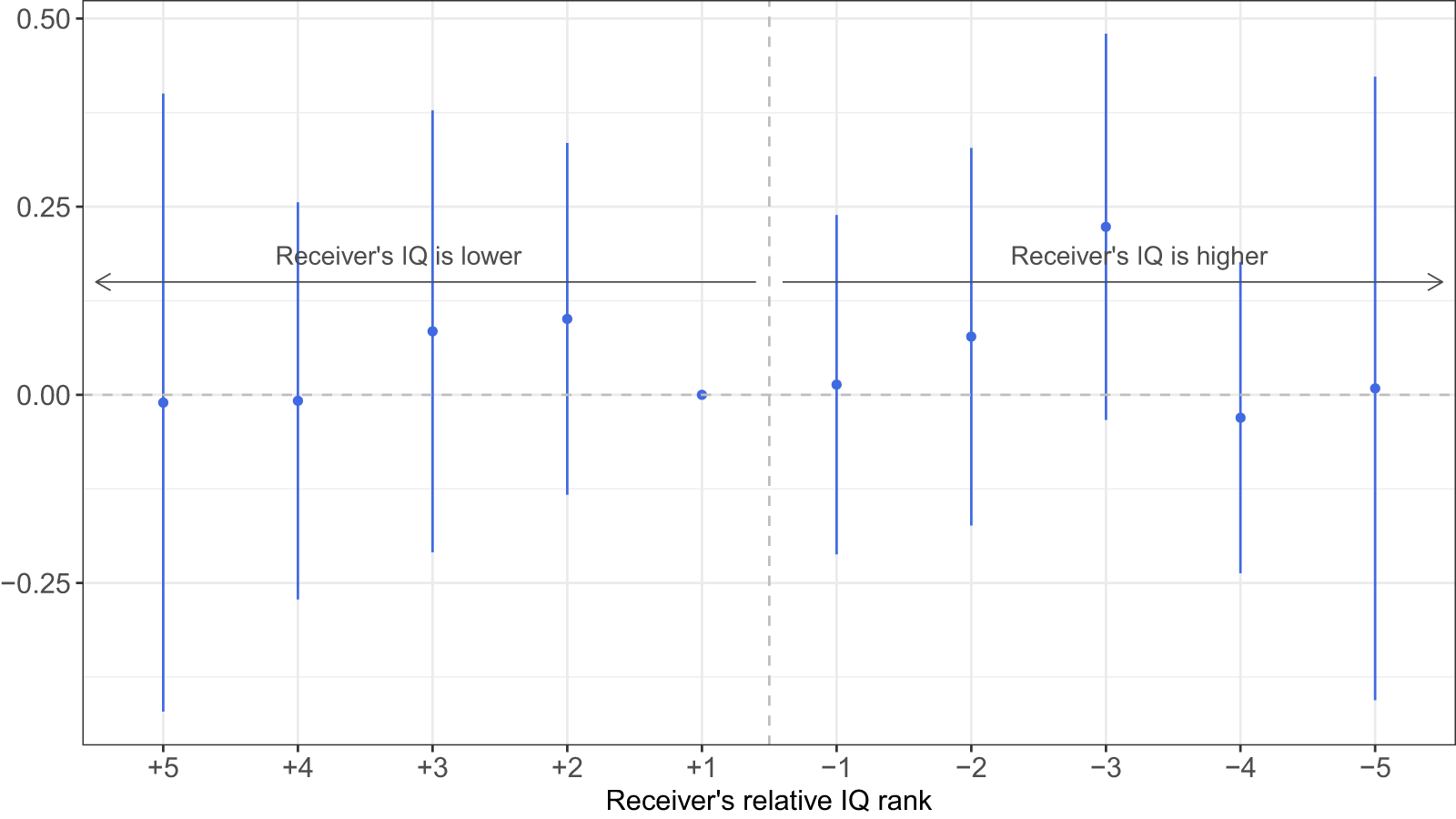
Figure 3 plots the OLS estimates of β 1s of equation 2, along with the 95% confidence intervals. We do not see any statistically or quantitatively significant heterogeneity due to the IQ rank differences – all  $\hat{\beta}_1$s are close to each other. While the estimate of $\beta_1^{-3}$ is larger than the other estimates, it is not statistically significantly different from the omitted category, and there is no consistent pattern when the receiver’s IQ is higher than that of the dictator’s as the estimates of $\beta_1^{-4}$ and $\beta_1^{-5}$ are very small.
Dictator allocations to higher-IQ female receivers – IQ rank differences, male dictators
4.3.4 Other concerns
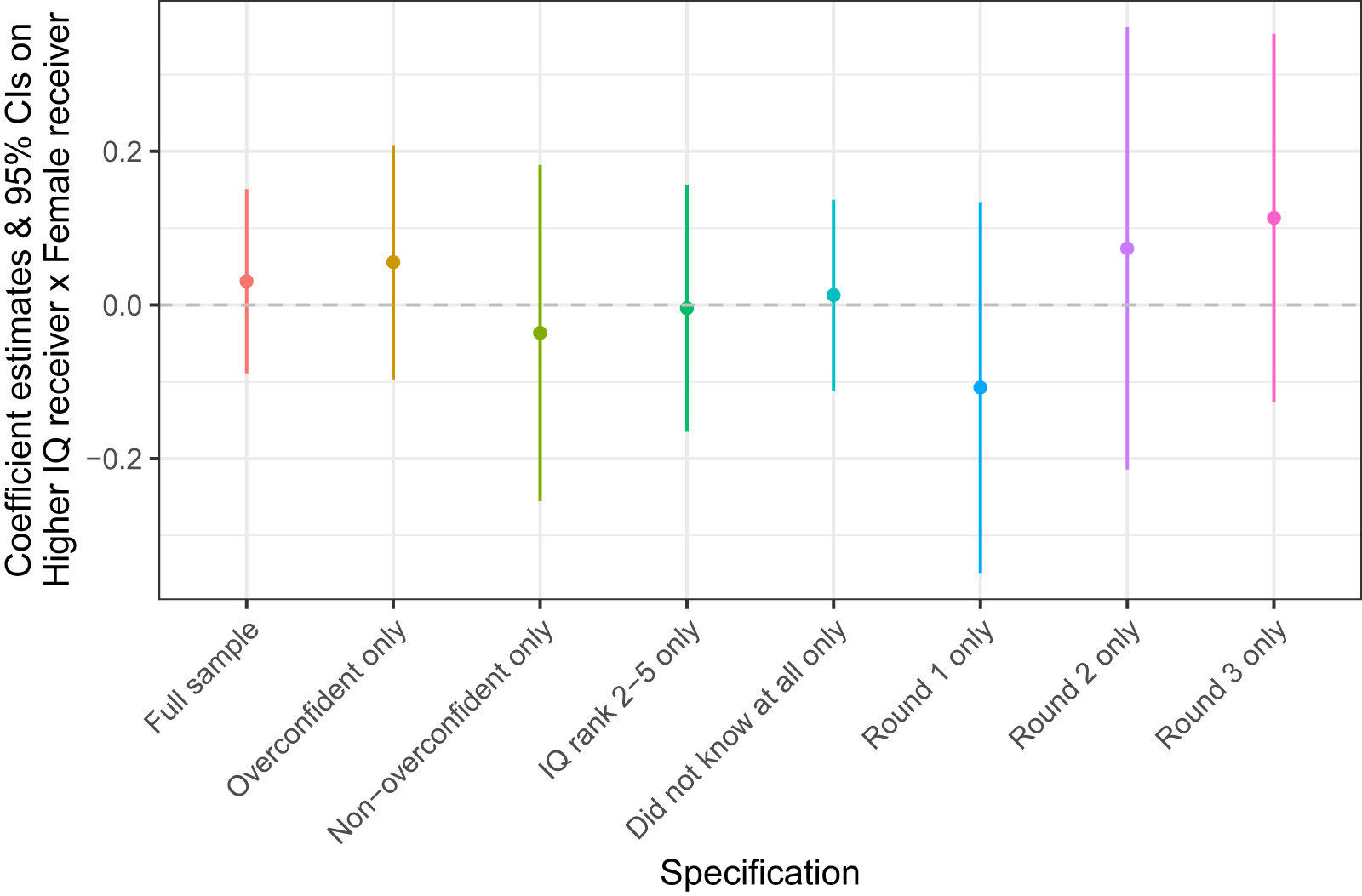
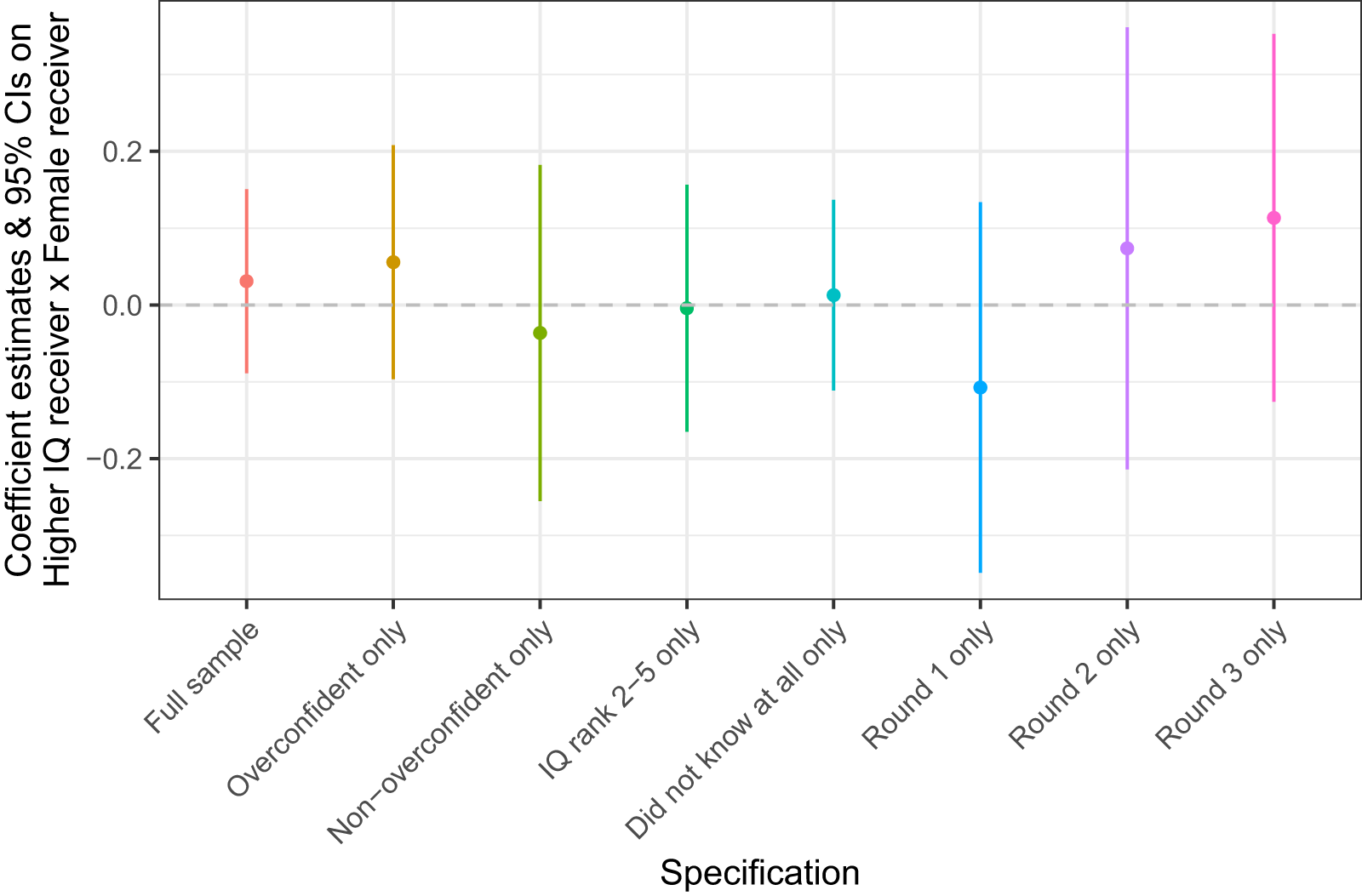
Figure 4 presents the OLS estimates of β 1 and their 95% confidence intervals of equation 1 with the same controls in Column 3 of Table 1 but with sub-samples of male dictators. “Full sample” is the same estimate as in Column 3 of Table 1, provided as a reference. As we see, the point estimates are quantitatively very close to those of the full sample, although the confidence intervals are wider due to a drop in the sample size. One noticeable heterogeneity is round effects, where male dictators allocate less in round 1 and more in rounds 2 and 3. This heterogeneity could possibly be due to the experimenter demand effect, as dictators may have realized that the experiment was about gender and IQ.
Dictator allocations to higher-IQ female receivers – sub-sample analysis, male dictators
5. Conclusions
The literature finds that men are more generous to women than to men. Still, there is scarce evidence about how men’s higher generosity toward women interacts with skills important for one’s career success, such as cognitive skills. The literature suggests that men’s higher generosity toward women may be due to paternalism and thus be reversed if women excel in those skills. To fill the gap in the literature, this paper uses a dictator game to examine whether men are less generous to women when those women excel in cognitive skills. Although male dictators allocate more to attractive receivers, consistent with the so-called “beauty premium,” and male dictators with high IQs (or those who earn more on the IQ test) allocate less, I exogenously vary the receivers’ IQ relative to that of the dictators and use difference-in-differences to control for these associations.
The results, however, are inconsistent with the hypothesis; if anything, male dictators give more to higher-IQ female receivers than to higher-IQ male receivers relative to the difference in giving between lower-IQ female and male receivers. The results hold both in mean and distribution, and female dictators’ allocation patterns are qualitatively similar to male dictators. The caveat is that the confidence intervals are not very tightly estimated. Taken together, men are no less generous to women even when women excel in cognitive skills, and thus, women who excel in cognitive skills may not receive less favorable treatment than equally intelligent men in the labor market.
One possible explanation for the results would be that the gender norm violations are offset by something else; for example, it is possible that women are more likely to appreciate other people’s work, women with high IQs do so more effectively, and men (and women) reciprocate indirectly. Indeed, Folke and Rickne Reference Folke and Rickne(2023) show that workplaces with a higher female-worker ratio have a higher incidence of appreciation for others’ work. Another potential explanation is that gendered attitudes develop as people get older, and university students – my sample – have not formed gendered attitudes yet. If this is the case, intelligent women may still receive less favorable treatment than equally intelligent men in the labor market. These two explanations are not mutually exclusive, but testing these explanations is beyond the scope of this paper. Nevertheless, my paper showed that, at least among the university student population in Italy, intelligent women would not receive less favorable treatment than equally intelligent men.
Supplementary material
The supplementary material for this article can be found at https://doi.org/10.1017/esa.2025.9.
Acknowledgements
I am grateful to Maria Bigoni, Boon Han Koh, Boris van Leeuwen, Natalia Montinari, and Bertil Tungodden for their invaluable feedback. I thank Editor Astrid Hopfensitz, two anonymous referees, and participants at the Applied Young Economist Webinar, the BEEN Meeting, and seminars at Ca’ Foscari University, NHH, and the University of Bologna for their insightful comments and suggestions. Lorenzo Golinelli provided excellent technical and administrative assistance. The main experiment was conducted in compliance with the University of Bologna’s standardized ethics protocol and personal data protection policy and was pre-registered with the OSF registry (https://osf.io/r6d8f/files). The Online Appendix A details the deviations from the pre-analysis plan. The follow-up experiment was approved by the Institutional Review Board of the Tilburg School of Economics and Management (approval no. IRB EXE 2023-044). Replication materials for this study are available at: https://doi.org/10.17605/OSF.IO/YBE4M.



 Open access

