


Introduction
The Sustainable Development Goals, established by the United Nations (2015), list the eradication of poverty in all its forms as their first objective. In this sense, homelessness could be considered the most extreme expression of both poverty and social exclusion (Vázquez et al., Reference Vázquez, Suarez, Berrios and Panadero2021). Moreover, the number of people experiencing homelessness has increased in the majority of European countries over the last decade (Baptista & Marlier, Reference Baptista and Marlier2019), including in Spain. Data from the Spanish National Statistics Institute (INE, 2012, 2022) indicate a rising number of people in this situation, especially in the decade prior to their most recent survey, with an increase of almost 25%. At the same time, the proportion of young people experiencing homelessness also appears to have increased relative to the overall population of people experiencing homelessness. The National Statistics Institute (INE, 2012, 2022) also noted that 21.1% of people experiencing homelessness were young people between the ages of 18 and 29, an increase of 36.1% compared to the percentage of young people reported a decade before.
According to the definition provided by the United Nations, “youth” encompasses the ages between 15 and 24 years. However, the United Nations also recommended that definitions of youth should be specific to context and culture, as both factors affect the experience of being young (UNESCO, S.F.). In line with this recommendation, the National Youth Institute in Spain (INJUVE) considers youth as the period up to 29 years of age (Dirección General del INJUVE y Observatorio de la Juventud en España, 2021). The age of onset of homelessness is an understudied issue in the scientific literature, although the impact of the lack of housing in young people may have especially severe repercussions. Davies and Allen (Reference Davies and Allen2017) argued that young people experiencing homelessness face multiple and overlapping difficulties, often including a poor state of both mental and physical health, frequent street victimization, and histories of physical and sexual abuse, which may contribute to the development of various mental health issues, especially in the absence of adequate care and support. Along the same lines, different authors (e.g. Grattan et al., Reference Grattan, Tryon, Lara, Gabrielian, Melnikow and Niendam2022; Heerde et al., Reference Heerde, Bailey, Toumbourou, Rowland and Catalano2020; Lenta et al., Reference Lenta, Di Iorio and Vázquez2023; Radcliff et al., Reference Radcliff, Crouch, Strompolis and Srivastav2019; Tucker et al., Reference Tucker, Davis, Perez, Klein and D’Amico2022) have emphasized that experiencing numerous severe stressful life events from an early age is frequent among young people experiencing homelessness.
Previous scientific research notes that the trajectories of people who first experience homelessness during their youth differ from those who experience homelessness later in life; so their privations and needs would also be different (Mar et al., Reference Mar, Linden, Torchalla, Li and Krausz2014). For instance, early-onset homelessness appears to be associated with the experience of a higher number of stressful life events, especially during childhood and adolescence (Lenta et al., Reference Lenta, Torrego, Di Iorio and Vázquez2026; Tucciarone, Reference Tucciarone2019). People who have suffered multiple and stressful life events at an early age are at a higher risk of experiencing homelessness, particularly youth-onset homelessness, on more occasions, and for longer periods (Broll & Huey, Reference Broll and Huey2020; Grey et al., Reference Grey, Woodfine, Davies and Azam2019; Mar et al., Reference Mar, Linden, Torchalla, Li and Krausz2014; Roos et al., Reference Roos, Mota, Afifi, Katz, Distasio and Sareen2013). Although previous research has more often focused on child victimization and abuse (Mar et al., Reference Mar, Linden, Torchalla, Li and Krausz2014; Tyler & Schmitz, Reference Tyler and Schmitz2020), systematic reviews, such as the one carried out by Grattan et al. (Reference Grattan, Tryon, Lara, Gabrielian, Melnikow and Niendam2022), identify a wide variety of stressors experienced during the first years of life as risk factors for youth homelessness—ranging from problems with school performance to economic problems in the household, housing instability, or single-parent households. In this sense, it is especially important to examine the adverse experiences faced by young people before and after experiencing homelessness.
In addition, early homelessness not only appears to be associated with situations of greater vulnerability, starting in childhood and adolescence, but it would also be related to especially deteriorated physical and mental health among young people while experiencing homelessness (Barnes et al., Reference Barnes, Gower, Sajady and Lingras2021; Calvo & Carbonell, Reference Calvo and Carbonell2023). Mortality rates among people experiencing homelessness seem to be much higher in comparison with those of the general population of the same age (Auerswald et al., Reference Auerswald, Lin and Parriott2016; Hwang, Reference Hwang2001), with studies indicating that the excess of mortality among people experiencing homelessness in relation to the general population would be even more drastic at younger ages than in adults (Nusselder et al., Reference Nusselder, Slockers, Krol, Slockers, Looman and van Beeck2013).
Likewise, various systematic reviews and meta-analyses (Armoon et al., Reference Armoon, Ghadipasha, Mohammadi, Lesage, Harooni and Griffiths2025; Borkenhagen et al., Reference Borkenhagen, Messier, Masrani, Gunn, Bahji, Barry, Seitz, Patten and Dimitropoulos2025; Burke et al., Reference Burke, Firmin and Wilens2022; Hodgson et al., Reference Hodgson, Shelton, van den Bree and Los2013) have pointed to the high prevalence of mental health problems, including alcohol abuse, among young people experiencing homelessness. This has led to proposing the existence of a bidirectional relationship between psychological problems and homelessness, showing that mental health issues may be the cause as well as the consequence of homelessness (Hodgson et al., Reference Hodgson, Shelton, van den Bree and Los2013; Johnson et al., Reference Johnson, Ribar and Zhu2017; Lurie et al., Reference Lurie, Schuster and Rankin2015). Aside from homelessness, the whole context in which individuals live is also relevant, as the probabilities of presenting a psychological disorder increase as the number of childhood adverse events increases among young people experiencing homelessness (Pan et al., Reference Pan, Liu, Zha, Seballos, Falcone, Phelan and Weleff2024), although these authors did not find an association specifically to substance abuse disorders. Nevertheless, the literature often points to the issue of alcohol and substance use disorders in this population due to its high prevalence and its association to long-term homelessness and more complex trajectories (e.g., criminal behavior, stressful life events during childhood and adolescence, etc.) (González-Arribas et al., Reference González-Arribas, Panadero and Vázquez2025; Lightfoot et al., Reference Lightfoot, Wu, Hughes, Desmond, Tevendale and Stevens2018; Liu et al., Reference Liu, Luong, Lachaud, Edalati, Reeves and Hwang2021; Moss et al., Reference Moss, Ge, Trager, Saavedra, Yau, Ijeaku and Deas2020). Moreover, the interaction between substance abuse disorders and other psychological problems like depression could be related to situations of greater complexity among young people, such as an even higher prevalence of adverse events and suicidal behavior (Lanni et al., Reference Lanni, Ducharme, Wilens and Burke2024), and greater difficulties in accessing and staying in housing programs (Burke et al., Reference Burke, Lanni, Ducharme and Wilens2024). Davies and Allen (Reference Davies and Allen2017) have pointed out that early experiences of homelessness are related to subsequent manifold post-traumatic symptoms and higher substance use, which at the same time would be associated with longer-term homelessness.
Additionally, the rates of suicidal behavior among young people experiencing homelessness, as well as self-harming behaviors, are also dramatic. Gewirtz O’Brien et al. (Reference Gewirtz O’Brien, Edinburgh, Barnes and McRee2020) has highlighted that one in three young people experiencing homelessness had engaged in self-harming behavior in the previous year, and one in 10 had attempted suicide in the same period of time, while other studies point to the gender differences and the greater prevalence of this issue among young women (Labelle et al., Reference Labelle, Berthiaume, Daigle, Breton and Houle2021).
As a result, young people experiencing homelessness require special consideration, as their situation and characteristics could substantially differ from those who first experience homelessness in adulthood. This aspect could be particularly relevant, as some studies point out that youth-onset homelessness could be associated with persistent and long-term homelessness, with increased difficulties in attaining housing stability (Patterson et al., Reference Patterson, Somers and Moniruzzaman2012). Their situations and trajectories are also closely intertwined with sociodemographic variables, related to their identity and their opportunities. For instance, women present particular trajectories and needs compared to their male counterparts (Johnson et al., Reference Johnson, Ribar and Zhu2017; Phipps et al., Reference Phipps, Dalton, Maxwell and Cleary2019), as well as LGBTQ+ individuals (Goodyear et al., Reference Goodyear, Chayama, Oliffe, Kia, Fast, Mniszak, Knight and Jenkins2024). Likewise, being racialized and the lack of educational attainment appear to be risk factors for experiencing youth homelessness (Grattan et al., Reference Grattan, Tryon, Lara, Gabrielian, Melnikow and Niendam2022).
Despite their heightened vulnerability, with particularly complex life trajectories and specific needs, research focused on youth-onset homelessness is very scarce. The limited available information in Spain about this topic shows negative consequences, such as a lack of social awareness, insufficient institutional support available, and the lack of public policies, programs, and care services tailored to young people experiencing homelessness. The design of preventive actions, interventions, and specific services for this group require a greater understanding of the factors related to early-onset homelessness and also of their current situation, with the aim of eradicating this issue and providing better support. Knowing the state of mental and physical health of people who first experienced homelessness during their youth is also key given the impact it could have on early and prolonged homelessness, and the adverse experiences that could result from it (Barnes et al., Reference Barnes, Gower, Sajady and Lingras2021).
Thus, the present work aims to analyze the characteristics of individuals who experienced youth-onset homelessness in Madrid (Spain), by comparing them in terms of past trajectories and current situation with their counterparts who experienced homelessness for the first time during adulthood. Specifically, comparisons were made in terms of (a) sociodemographic data, (b) life trajectories (homelessness history and stressful events experienced throughout their lives), and (c) physical and mental health. Although this study is exploratory and this topic has been scarcely studied, the main hypothesis is that youth-onset homelessness could be associated with higher adversity, more prolonged homelessness, and a poorer health status, based on the previous literature.
Method
Participants
All participants were over 18 years old and had spent the night prior to the interview on the street, in other places not intended for sleeping, or in shelters or specific housing programs for people experiencing homelessness in the city of Madrid (Spain). These situations correspond to operational categories 1, 2, and 3 (people living rough, people in emergency accommodation, and in accommodation for people experiencing homelessness) of the European Typology of Homelessness and Housing Exclusion (ETHOS) (FEANTSA, 2005).
In all, 392 persons who were experiencing homelessness at the time the study was carried out participated in the study. Of these, 207 were men (52.7%) and 185 were women (47.1%). About 48.9% of participants were of foreign origin. The participants’ average age was 49.3 years (SD = 12.466), and they had experienced homelessness for the first time at an average age of 39.8 years (SD = 14.343) and for a total duration of 73.1 months (SD = 92.310). There was no age limit to participate, as the aim was to compare those who had experienced youth-onset homelessness and those who had first experienced homelessness in adulthood.
Procedure
Participants were contacted on the streets, in other inappropriate places for sleeping (e.g., airports), in shelters, in day centers, and in specific housing programs for people who were experiencing homelessness, and invited to participate. This contact was facilitated by the professionals working in the venues and by the street outreach teams, who introduced interviewers to potential interviewees while they were providing assistance.
The sample size for men was representative of the number of men experiencing homelessness in Madrid (Spain), based on the latest data available at the time the research was conducted (Muñoz et al., Reference Muñoz, Sánchez and Cabrera2018). Men’s participation was randomized within each venue, with the number of male participants being proportional to the user volume in each setting. Randomization was conducted by either randomly selecting individuals out of the user list or by assigning numbers to those present at the venue each day, depending on whether each support service had a user list or not. On the streets, each man experiencing homelessness who was contacted was asked to participate until a sample of men was obtained that was proportionally slightly larger than the percentage of men sleeping on the streets reported in the most recent available count of people experiencing homelessness in Madrid (Muñoz et al., Reference Muñoz, Sánchez and Cabrera2018), taking into account that interviews were conducted throughout the year and not only during the winter period, when the cold-weather program operates in Madrid. As for women, they were overrepresented to ensure a study with a gender-sensitive approach that specifically considered their situation, and every woman who was contacted was invited to participate.
The interviews took about 60 minutes and were carried out in the preferred setting for each participant. Some were carried out in the facilities of the shelters and housing programs, in spaces that ensured the interviewees’ privacy and comfort, while others preferred to participate in the interviews in parks or cafeterias. The data were collected by a group of trained interviewers, all of them psychologists with specific training in the use of the instrument and the characteristics of the population. The information was gathered by filling out a copy of the interview, as the majority of the questions were closed-ended. They were not recorded, and participants could stop the interview and withdraw their data at any time if they wished.
Measures
A structured interview was conducted to gather the data. After explaining the objectives of the study and the anonymity of the interview, informed consent of the participants was obtained. The study was conducted in compliance with the Internal Review Board [Comité de Ética de Investigación y Experimentación Animal] of the University of Alcalá (Ref. CEIP/2021/2/027).
Life trajectories of people who had first experienced homelessness during their youth (before 30 years of age) (Dirección General del INJUVE y Observatorio de la Juventud en España, 2021) were evaluated through variables addressing stressful life events experienced both during childhood and adolescence and also throughout their lives. For the bivariate analyses, each individual item from an adapted version of the List of Stressful Life Events for People in Situations of Social Exclusion (Vázquez et al., Reference Vázquez, Panadero and Rincón2010) was used. The complete details of the adapted version employed is published in González-Arribas et al. (Reference González-Arribas, Panadero, Recalde-Esnoz and Vázquez2024). The interview also covered sociodemographic variables, including whether the participants were racialized (race/ethnicity) and whether they identified as LGBTQ+, which was determined by asking about their gender and gender identity, as well as about their sexual orientation. Information regarding their homelessness history was also considered: age of onset, total time experiencing homelessness, number of episodes of homelessness, and having experienced unsheltered homelessness (sleeping outdoors or in places not intended for sleeping), in comparison with sheltered homelessness, both throughout their lives and in the month prior to the interview. To measure onset age, duration, and number of episodes, homelessness was operationalized as having slept on the streets, in an inadequate place, or in a shelter for people experiencing homelessness for at least 1 week throughout their lives, This definition corresponds to operational categories 1, 2, and 3 of the ETHOS typology (FEANTSA, 2005).
In order to assess the participants’ physical health at the moment of the interview, the instrument included items about their perceived health status (“What is your general state of health?,” with five options: very good, good, fair, poor, and very poor), the presence of a disability (“Do you have any disability?”), having a diagnosed severe or chronic illnesses (“Did a doctor ever diagnosed you with a severe or chronic physical condition?”), and the use of health services (“In the past 12 months, have you used health services or seen a healthcare professional?”). Psychological health was assessed by asking participants whether they had received a diagnosis of mental disorder in general and psychotic or personality disorders in particular (“Has a doctor or mental health professional ever told you that you have a mental disorder/schizophrenia or a psychotic disorder/a personality disorder?”). Their use of alcohol and other substances in the month prior to the interview was also assessed in order to identify potential substance abuse (“In the past month, on how many days have you used illegal drugs or misused prescription medication?,” and “In the past month, on average, how many alcoholic drinks did you usually have on a single day?”). The number of alcoholic drinks was then converted to “standard drinks” based on their quantity and their alcohol content. In addition, we administered screening instruments to identify potential psychological problems that appear to be especially prevalent among young people experiencing homelessness (Burke et al., Reference Burke, Firmin and Wilens2022): the International Trauma Questionnaire (ITQ; Cloitre et al., Reference Cloitre, Shevlin, Brewin, Bisson, Roberts, Maercker, Karatzias and Hyland2018; Fernández-Fillol et al., Reference Fernández-Fillol, Daugherty, Hidalgo-Ruzzante and Pérez-García2020) for PTSD and complex PTSD, the Patient Health Questionnaire (PHQ-9; Kroenke et al., Reference Kroenke, Spitzer and Williams2001; Diez-Quevedo et al., Reference Diez-Quevedo, Rangil, Sanchez-Planell, Kroenke and Spitzer2001) for depressive symptoms, the anxiety subscale from the Hospital Anxiety and Depression Scale (HADS; Zigmond & Snaith, Reference Zigmond and Snaith1983; Herrero et al., Reference Herrero, Blanch, Peri, De Pablo, Pintor and Bulbena2003), and three instruments for substance abuse: the Alcohol Use Disorders Identification Test (AUDIT; Saunders et al., Reference Saunders, Aasland, Babor, De la Fuente and Grant1993; Guillamón et al., Reference Guillamón, Solé and Farran1999) for alcohol abuse, the Drug Abuse Screening Test (DAST-10; Skinner, Reference Skinner1982; Pérez-Gálvez et al., Reference Pérez-Gálvez, García-Fernández, Vicente-Manzanaro, Oliveras-Valenzuela and Lahoz-Lafuente2010), and the Severity of Dependence Scale (SDS; Gossop et al., Reference Gossop, Darke, Griffiths, Hando, Powis, Hall and Strang1995; González-Saiz et al., Reference González-Saiz, Cuevas, Barrio and Domingo-Salvany2008) for substance abuse other than alcohol.
All the instruments showed high internal consistency in this sample, (α = .849 for PHQ-9, 0.902 for the ITQ, α = .890 for the AUDIT, α = .741 for the DAST, and α = .855 for the SDS), with the exception of the anxiety subscale of the HADS (α = .385).
Data Analysis
For the statistical analysis, comparisons were made using the chi-square statistic (χ2) and computing the odds ratio (OR) for nominal variables, while Student’s t-test and Mann–Whitney’s U were used for continuous variables, depending on whether the data met the assumptions underlying the Student’s t-test or not. Effect sizes were computed using Cramer’s V for nominal variables and rank-biserial correlation coefficient (r) for continuous ones, as a measure of effect size for Mann–Whitney’s U.
Lost data on the standardized instruments were handled using person-mean imputation when the number of missing items was below 20%, as recommended by some authors (e.g., Bell et al., Reference Bell, Fairclough, Fiero and Butow2016). In the case of the ITQ and the DAST-10, as imputations were rarely recommended, all the cases with missing values were removed.
Results
About 24.9% (98) of individuals experiencing homelessness interviewed in Madrid (Spain) had first experienced homelessness during their youth (before the age of 30 years), while 72.0% (283) had first experienced homelessness later in life. About 3.1% (12) did not provide information about their age when they first experienced homelessness and were removed from the sample for the analyses.
As shown in Table 1, participants who had experienced youth-onset homelessness were, on average, significantly younger at the time the interview was carried out. There were also statistically significant differences regarding the proportion of participants identifying as LGBTQ+, being 19% of those who experienced youth-onset homelessness compared to 6.4% of those who first experienced homelessness after the age of 30. In terms of the highest level of education attained, university education was significantly less frequent among those who had experienced youth-onset homelessness, although non-university higher education was more common in this group. No statistically significant differences were observed between groups regarding gender (χ2 (1) = .012; p = .912), race/ethnicity (χ2 (1) = 2.957; p = .085) or origin (Spanish vs migrant) (χ2 (1) = 1.877; p = .171).
Statistically significant differences in sociodemographic characteristics among people experiencing homelessness in Madrid (Spain) based on age at first episode of homelessness

Table 1. Long description
The table compares two groups: those who experienced youth-onset homelessness before age 30 (n equals 98) and those who did not (n equals 283). Columns include chi-squared or U values, V or r effect sizes, Odds Ratios (O R), and 95 percent Confidence Intervals (C I).
* Age (Mean and Standard Deviation): Youth-onset group is 39.1 (13.281); non-youth-onset group is 53.2 (9.644). Statistical significance p is less than or equal to .001.
* L G B T Q plus: Youth-onset group is 18.9 percent (18 individuals); non-youth-onset group is 6.4 percent (18 individuals). O R is 3.416 with a C I of 1.695 to 6.885.
* Highest level of education attained: Significant difference with p less than or equal to .01.
* No formal education: Youth-onset 4.1 percent; non-youth-onset 3.5 percent.
* Incomplete primary education: Youth-onset 11.3 percent; non-youth-onset 7.4 percent.
* Primary education (up to age 14): Youth-onset 43.3 percent; non-youth-onset 31.9 percent.
* Secondary education (up to age 18): Youth-onset 20.6 percent; non-youth-onset 27.7 percent.
* Non-university higher education: Youth-onset 14.4 percent; non-youth-onset 9.2 percent.
* University education: Youth-onset 6.2 percent; non-youth-onset 20.2 percent.
Note: *p ≤ .05. **p ≤ .01. ***p ≤ .001.
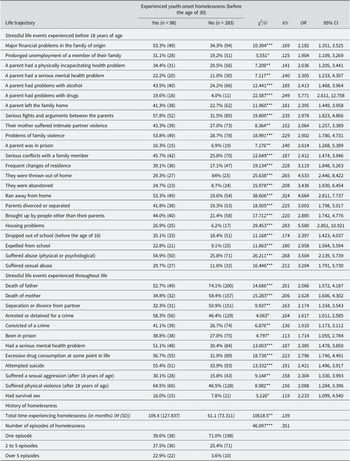
As presented in Table 2, people who first experienced homelessness in their youth had twice the odds of having been exposed to major financial problems in their family of origin, prolonged unemployment of a family member, having a parent who had an incapacitating illness, a severe mental health problem, alcohol use problems, had left the household, or had been in prison, having a mother who suffered intimate partner violence, having serious conflicts with a family member, or dropping out of school (academic failure, leaving the education system before the age of 16). In addition, they had three times the odds of having experienced conflicts between their parents, violence in their household, frequent changes of residence, having been abandoned, separation or divorce of their parents, having been expelled from school, and having suffered abuse (physical/psychological or sexual). Lastly, they also had four times the odds of having been thrown out of home or having run away, and at least five times the odds of having suffered housing problems or having a parent who had problems with drugs.
Statistically significant differences in life trajectories (stressful life events and history of homelessness) among people experiencing homelessness in Madrid (Spain) based on age at first episode of homelessness

Table 2. Long description
The table is divided into three main sections comparing those with youth-onset homelessness (n equals 98) to those without (n equals 283).
1. Stressful life events before 18 years of age:
Youth-onset individuals show significantly higher rates across all categories. Key data points include major financial problems (53.3 percent vs 34.3 percent), parent with drug problems (19.6 percent vs 4.0 percent, O R 5.771), and running away from home (53.3 percent vs 19.6 percent, O R 4.664). Other significant factors include family violence (53.8 percent vs 28.7 percent) and being thrown out of the home (29.3 percent vs 8.4 percent).
2. Stressful life events throughout life:
Youth-onset individuals report higher rates of serious mental health problems (51.1 percent vs 30.4 percent), excessive drug consumption (56.7 percent vs 31.9 percent), and attempted suicide (55.4 percent vs 33.9 percent). Conversely, the non-youth-onset group had higher rates of experiencing the death of a father (74.1 percent vs 52.7 percent) and death of a mother (58.4 percent vs 34.8 percent).
3. History of homelessness:
The youth-onset group experienced a significantly longer total time of homelessness (Mean 109.4 months vs 61.1 months). Regarding the number of episodes, 22.9 percent of the youth-onset group had over 5 episodes, compared to only 3.6 percent of the non-youth-onset group. Statistical significance is indicated by p-values ranging from less than or equal to .05 to less than or equal to .001 across the variables.
Note: *p ≤ .05. **p ≤ .01. ***p ≤ .001.
In contrast, individuals who had first experienced homelessness after the age of 30 reported more frequently separations or divorces, and the death of both their parents. In contrast, those who had experienced youth homelessness had had more problems with justice throughout their lives, including arrests, convictions, and imprisonments. Moreover, they had a higher prevalence of suicide attempts, and they were more likely to report severe mental health problems and having excessively used drugs at some point in their lives. Lastly, the prevalence of sexual assaults and physical violence (after the age of 18), as well as the rates of survival sex throughout their lives, were also higher among people who had experienced youth homelessness. No statistically significant differences were found on the rest of adverse events from the list of stressful life events for people in situations of social exclusion (González-Arribas et al., Reference González-Arribas, Panadero, Recalde-Esnoz and Vázquez2024).
Regarding the history of homelessness, people who experienced homelessness before 30, despite being younger on average, had experienced homelessness for longer periods of time and on more occasions, with 23% of individuals who had experienced homelessness on more than five occasions. Nevertheless, there were no statistically significant differences among groups regarding sleeping outdoors at least for a week at some point in their lives (χ2 (1) = 3.553; p = .059), or some day in the month prior to the interview (χ2 (1) = 3.053; p = .081), compared to sleeping in shelters for people experiencing homelessness.
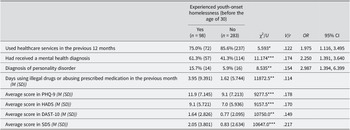
In relation to their overall mental and physical health, as shown in Table 3, the percentage of people who experienced youth homelessness who had not used healthcare services in the 12 months prior to the interview was significantly higher, although they had between two and three times the odds of having received a mental health diagnosis at some point in their lives, and, especially, a personality disorder diagnosis. On average, participants who experienced homelessness before the age of 30 had used illegal drugs significantly more frequently in the month prior to the interview. In addition, they scored significantly higher on depression (PHQ-9), anxiety (HADS), and in both screening instruments for substance dependence (DAST-10 and SDS). No statistically significant differences were observed regarding their perceived health status, the diagnosis of chronic or severe illnesses, having a disability, the presence of symptoms compatible with a PTSD or complex PTSD diagnosis, the average score on the AUDIT for alcohol dependence, or the average alcohol consumption in the month previous to the interview.
Statistically significant differences in health status among people experiencing homelessness in Madrid (Spain) based on age at first episode of homelessness

Table 3. Long description
The table consists of eight rows of health indicators compared across two primary groups: Yes n equals 98 for youth-onset homelessness before age 30, and No n equals 283. Statistical columns include chi-squared or U, V or r, O R, and 95 percent C I.
- Used healthcare services in previous 12 months: Yes 75.0 percent 72; No 85.6 percent 237; O R 1.975.
- Had received a mental health diagnosis: Yes 61.3 percent 57; No 41.3 percent 114; O R 2.250.
- Diagnosis of personality disorder: Yes 15.7 percent 14; No 5.9 percent 16; O R 2.987.
- Days using illegal drugs or abusing prescribed medication in previous month M S D: Yes 3.95 9.391; No 1.62 5.744.
- Average score in P H Q 9 M S D: Yes 11.9 7.145; No 9.1 7.213.
- Average score in H A D S M S D: Yes 9.1 5.721; No 7.0 5.936.
- Average score in D A S T 10 M S D: Yes 1.64 2.826; No 0.77 2.095.
- Average score in S D S M S D: Yes 2.05 3.801; No 0.83 2.634.
Note: Asterisks indicate p-values where one asterisk is less than or equal to .05, two asterisks is less than or equal to .01, and three asterisks is less than or equal to .001.
Note: *p ≤ .05. **p ≤ .01. ***p ≤ .001.
Discussion
People experiencing homelessness in Madrid (Spain) who had first become homeless before 30 years of age were, younger on average, but they had experienced homelessness for longer periods of time and in a higher number of episodes than individuals who first experienced homelessness at the age of 30 or older; although there were no significant differences in unsheltered sleeping. In addition, the percentage of LGBTQ+ individuals was higher. Different studies (Goodyear et al., Reference Goodyear, Chayama, Oliffe, Kia, Fast, Mniszak, Knight and Jenkins2024; Shelton, Reference Shelton2015) point out the heightened vulnerability of LGBTQ+ youth, who could be at greater risk of experiencing homelessness due to being thrown out or running away from their homes and facing structural barriers without family support. After experiencing homelessness, cisheteronormativity may increase the barriers to accessing resources and opportunities that could help them exit homelessness (Goodyear et al., Reference Goodyear, Chayama, Oliffe, Kia, Fast, Mniszak, Knight and Jenkins2024; Shelton, Reference Shelton2015).
Regarding stressful life events faced in childhood and adolescence, they were more frequently reported among individuals who had experienced early-onset homelessness. The youth-onset homelessness group had between four and six times higher odds of having had a parent who suffered drug problems, to have suffered housing problems, to have run away from home, or to have been expelled from their home. They also had at least three times the odds of having suffered child abuse and sexual abuse, to have frequently changed homes, to have been abandoned, to have parents who got divorced or separated, to have been expelled from school, to have experienced violence within their family, and to have experienced serious fights and conflicts between their parents. Lastly, participants who had experienced youth-onset homelessness were also more likely to have experienced severe economic problems in their family, prolonged unemployment in their family of origin, to have a parent who had an incapacitating physical illness, a serious mental health problem, problems with alcohol, or who left the family home, or was in prison, to have a mother who experienced intimate partner violence, serious conflicts with a family member, to have been raised by a person other than their parents, and to have dropped out of school before 16 years of age.
These findings align with previous research, which identifies experiencing multiple stressful life events during childhood and adolescence as a risk factor for homelessness (Grattan et al., Reference Grattan, Tryon, Lara, Gabrielian, Melnikow and Niendam2022; Koegel et al., Reference Koegel, Melamid and Burnam1995), and it notably highlights the relation between the accumulation of these experiences and an earlier onset of homelessness (Lenta et al., Reference Lenta, Torrego, Di Iorio and Vázquez2026; Mar et al., Reference Mar, Linden, Torchalla, Li and Krausz2014; Radcliff et al., Reference Radcliff, Crouch, Strompolis and Srivastav2019; Tucciarone, Reference Tucciarone2019). The specific events associated with subsequent homelessness, in line with the present work’s results, were diverse and covered various areas: factors related to family conflict or breakdown (Hyde, Reference Hyde2005), academic difficulties (Heerde et al., Reference Heerde, Bailey, Toumbourou, Rowland and Catalano2020; Tucker et al., Reference Tucker, Davis, Perez, Klein and D’Amico2022), and situations of precarity and poverty, mostly (Grattan et al., Reference Grattan, Tryon, Lara, Gabrielian, Melnikow and Niendam2022; Labelle et al., Reference Labelle, Berthiaume, Daigle, Breton and Houle2021). These results reflect the structural factors responsible for homelessness.
Adverse childhood experiences would entail a greater vulnerability to experiencing youth-onset homelessness (Lenta et al., Reference Lenta, Torrego, Di Iorio and Vázquez2026; Tucciarone, Reference Tucciarone2019), as people face systematic deficits in various areas from an early age, such as the acquisition of skills to develop their own life project and ensure stable housing and work (Rodríguez-Moreno et al., Reference Rodríguez-Moreno, Panadero and Vázquez2021), or the lack of adequate family support (Koegel et al., Reference Koegel, Melamid and Burnam1995).
Specifically, experiences of poverty and precarity in the family context are strong predictors of homelessness (Bramley & Fitzpatrick, Reference Bramley and Fitzpatrick2018), which illustrates the intergenerational transmission of poverty from parents to children (Vázquez & Panadero, Reference Vázquez and Panadero2016). In addition, and consistently with the results found in this work, experiencing youth-onset homelessness would be associated to a longer-term homelessness and the suffering of subsequent stressful life events (Lenta et al., Reference Lenta, Torrego, Di Iorio and Vázquez2026).
Having experienced housing problems, along with having a parent who had substance abuse problems, were the two childhood events most strongly associated with youth homelessness. Similarly, the importance of violence and abuse, academic failure, and severe physical and mental health problems among the caretakers may reflect the lack of support faced by the most vulnerable families, and specifically children and adolescents from the said families. The fact that childcare falls almost entirely on the nuclear family is an additional risk for youth from socioeconomically disadvantaged households or who have family members with needs for support that are remain unaddressed. Particularly in the familistic culture of Mediterranean societies, where the family acts as a buffer against structural inequalities (Matulič et al., Reference Matulič, Caïs and De Vicente2024), youth vulnerability becomes particularly acute when they belong to families lacking the capacity and resources to support them given the scarcity of effective programs and public services. Thus, detaching caregiving responsibilities from the family environment and strengthening community- and state-level responses that go beyond welfare-based approaches may help prevent the intergenerational reproduction of poverty.
Participants who had not experienced homelessness until adulthood only reported to a greater extent events related to separations and divorces, and the death of their parent and mother, which could be a consequence of their older average age. Meanwhile, individuals who had experienced youth-onset homelessness had been involved in more problems with justice (arrests, detentions, convictions, and imprisonments), and they had also engaged in survival sex to a greater extent. History of incarceration could also be an additional risk for experiencing homelessness, especially among individuals who come from complex family compositions and have limited social support once they leave prison (Gorden et al., Reference Gorden, Lockwood, Madoc-Jones, Dubberley, Hughes, Washington-Dyer, Wilding and Ahmed2022; Herbert et al., Reference Herbert, Morenoff and Harding2015). Likewise, youth-onset homelessness could be associated with involvement in criminal activities in order to ensure survival, but also to a higher criminalization due to their situation. Survival sex, on the other hand, has been found related to both imprisonment and homelessness (Greene et al., Reference Greene, Ennett and Ringwalt1999), and is especially important in this work when considering early and persistent homelessness.
Participants who had experienced youth-onset homelessness had also faced physical and sexual violence to a greater extent than those who had first experienced homelessness at age 30 or older. Nearly one-third reported sexual violence, and around two-thirds reported physical victimizations, in both cases at the age of 18 or older. Homelessness itself, which is particularly long-lasting among these participants, entails a greater probability to suffering victimizations (Ellsworth, Reference Ellsworth2019; Hatento Observatory on Hate Crimes against Homeless People, 2015; Panadero & Vázquez, Reference Panadero and Vázquez2024; Rivas-Rivero et al., Reference Rivas-Rivero, Panadero and Vázquez2021). Finally, this group also reported severe mental health problems to a greater extent throughout their lives, as well as a higher prevalence of suicide attempts and problematic drug use.
In terms of their health status, no statistically significant differences were found in the prevalence of severe or chronic illnesses, perceived health status, disability, or presence of a diagnosis of psychotic disorder. In contrast, participants who had experienced youth-onset homelessness reported fewer use of healthcare services in the previous 12 months and a higher prevalence of mental health diagnoses in general, and personality disorders in particular. Nevertheless, the existing barriers to accessing healthcare services in this population, especially in mental health services, makes it more difficult to compare in terms of diagnostic labels. In addition, the lack of follow-up in mental health services among this population (Canavan et al., Reference Canavan, Barry, Matanov, Barros, Gabor, Greacen, Holcnerová, Kluge, Nicaise, Moskalewicz, Díaz-Olalla, Straßmayr, Schene, Soares, Gaddini and Priebe2012; Thorndike et al., Reference Thorndike, Yetman, Thorndike, Jeffrys and Rowe2022) and the reluctance to remove diagnostic labels once assigned may contribute to diagnoses being perceived as chronic, and ultimately becoming so in practice.
Substance use during the month prior to the interview was more frequent among people who had experienced youth-onset homelessness, and scores on the screening instruments for substance dependence were also higher on average (DAST-10 and SDS). These findings are consistent with previous research, which identified a bidirectional association between adverse experiences in childhood and adolescence and the development of problems related to drug consumption in adulthood (Leza et al., Reference Leza, Siria, López-Goñi and Fernandez-Montalvo2021). In this sense, multiple studies have pointed to a cumulative relationship between the number of early stressful events, including homelessness, and the probability of developing problems associated to substance use, suggesting that drug use could be a coping strategy in the presence of adverse experiences or cumulative disadvantages (Cardoso, Reference Cardoso2018). More specifically, having experienced violence and negligence, and having a caretaker who had substance problems, increases the level of vulnerability to substance misuse in the future (González-Arribas et al., Reference González-Arribas, Panadero and Vázquez2025; Muir et al., Reference Muir, Adams, Evans, Geijer-Simpson, Kaner, Phillips, Salonen, Smart, Winstine and McGovern2023). This pattern is especially worrying in the case of youth homelessness, as precarious structural conditions and the lack of an effective support network could amplify exposure to substance use and hinder the access to specialized treatment.
People who had first experienced homelessness before the age of 30 scored higher on average on the screening instruments for depression (PHQ-9) and anxiety (HADS) symptoms, but there were no statistically significant differences regarding symptoms compatible with PTSD and complex PTSD. The critical situation of young people experiencing homelessness in terms of their mental health has been also noted by prior research (Armoon et al., Reference Armoon, Ghadipasha, Mohammadi, Lesage, Harooni and Griffiths2025; Borkenhagen et al., Reference Borkenhagen, Messier, Masrani, Gunn, Bahji, Barry, Seitz, Patten and Dimitropoulos2025; Burke et al., Reference Burke, Firmin and Wilens2022), which at the same time would also be related to stressful life events early in life (Alexander et al., Reference Alexander, Waring, Olurotimi, Kurien, Noble, Businelle, Ra, Ehlke, Boozary, Cohn and Kendzor2022; Labelle et al., Reference Labelle, Berthiaume, Daigle, Breton and Houle2021; Lanni et al., Reference Lanni, Ducharme, Wilens and Burke2024; Lightfoot et al., Reference Lightfoot, Wu, Hughes, Desmond, Tevendale and Stevens2018; Liu et al., Reference Liu, Luong, Lachaud, Edalati, Reeves and Hwang2021; Moss et al., Reference Moss, Ge, Trager, Saavedra, Yau, Ijeaku and Deas2020). Thus, adverse experiences, youth homelessness, and mental health problems, including substance abuse problems, are closely intertwined and difficult to separate.
The issue of suicidal behavior is also relevant regarding mental health given its high prevalence among youth experiencing homelessness (Gewirtz O’Brien et al., Reference Gewirtz O’Brien, Edinburgh, Barnes and McRee2020). Again, it also appears in the literature as strongly associated with childhood and adolescence adversity, as well as to longer-term homelessness (Liu et al., Reference Liu, Luong, Lachaud, Edalati, Reeves and Hwang2021; Yohannes et al., Reference Yohannes, Gezahegn, Birhanie, Simachew, Moges, Ayano, Toitole, Mokona and Abebe2023). Suicide is one of the leading causes of death among young people experiencing homelessness (Sinyor et al., Reference Sinyor, Kozloff, Reis and Schaffer2017), and mortality for suicide and drug use and dependence are strongly associated (Arnautovska et al., Reference Arnautovska, Sveticic and De Leo2014; Nilsson et al., Reference Nilsson, Hjorthøj, Erlangsen and Nordentoft2014). The results of the present work highlight the problem of suicidal behavior among people who first experienced homelessness during their youth, which are more frequent among this group, with over half of the participants having attempted suicide at some point in their lives.
However, results are limited by the difficulties to access young people experiencing homelessness in the city of Madrid (Spain). In addition, this is a cross-sectional and correlational study, which entails limitations for drawing conclusions and establishing causality. For future research, it would be appropriate to explore which events may have a greater weight on the subsequent experience of homelessness. Conclusions are also limited by the conceptualization of homelessness used in this study, which may underrepresent other realities and more “hidden” forms of homelessness that could be more frequent among young people.
Findings from the present work underscore the relevance of structural and systemic factors, calling for an institutional response that is also systemic and centered on prevention, access to housing, and sufficient economic resources (Aubry et al., Reference Aubry, Klodawsky and Coulombe2012; Vázquez et al., Reference Vázquez, Panadero and Zúñiga2018). The fact that people who experience youth-onset homelessness are also those who remain in this situation for longer periods of time, in a higher number of episodes, and who suffer more mental health problems, represents the level of complexity of their situation and the difficulties they face. The deficits they exhibit—in resources and skills, stemming from cumulative early adversity—may weaken family support and contribute to substance use and other mental health problems, thus reducing their chances of exiting homelessness (Aubry et al., Reference Aubry, Klodawsky and Coulombe2012; Booth et al., Reference Booth, Sullivan, Koegel and Burnam2002; Lightfoot et al., Reference Lightfoot, Wu, Hughes, Desmond, Tevendale and Stevens2018). This could help explain the revolving door phenomenon and the prolonged duration of homelessness, which averages nearly 9 years.
Such early homelessness, linked to numerous stressful life events in childhood and adolescence, could be a sign of the failure of multiple support systems, which did not answer effectively to the needs of the families of origin nor to the needs of the children and adolescents, who did not receive adequate support after they lost their homes, as can be shown by the high prevalence of mental health problems and their persistent and reiterated homelessness. Efforts to address this issue should focus on prevention protocols, mostly on the improvement of the support systems. This should entail identifying families and youth at risk and intervening in this cycle of intergenerational transmission of adversity and poverty. In relation to the accumulation of stressful events throughout their lives, person-centered approaches and trauma-informed care would be appropriate in order to provide adequate services. Finally, the design of policies and intervention programs tailored to the needs of youth experiencing homelessness would also be crucial, with a focus on their mental health and especially on suicide prevention and harm reduction for substance abuse. Nevertheless, mental health programs should avoid individualism and rather incorporate a contextual and intersectional perspective that considers their situation and their material conditions.
Data availability statement
Data are available on the repository e-cienciaDatos: Vázquez Cabrera, José Juan; Panadero Herrero, Sonia, Reference Vázquez and Panadero2024, “Discriminación interseccional, estigma social y trauma emocional entre mujeres en situación sin hogar (DET-MSH),” https://doi.org/10.21950/XL866D,
Author contributions
S.T.: data curation, formal analysis, investigation, and writing—original draft. S.P.: conceptualization, data curation, funding acquisition, investigation, methodology, supervision, and validation. F.C.: writing—original draft. J.J.V.: conceptualization, data curation, funding acquisition, investigation, methodology, project administration, supervision, validation, and writing—review & editing.
Funding statement
This work was supported by the “Ministerio de Ciencias, Innovación y Universidades” of Spain (PID2023-147922OB-I00). The main author also acknowledges financial support from the Comunidad de Madrid (Spain) through an FPI-CAM contract (reference number: PIPF-2023/SAL-GL-30785).
Competing interests
None.


 Open access

