





Introduction
Advance care planning (ACP) involves a voluntary discussion about end-of-life care arrangements among a patient, his/her family, and health-care providers (Rietjens et al. Reference Rietjens, Sudore and Connolly2017; Sudore et al. Reference Sudore, Lum and You2017). ACP is beneficial as it can improve patients’ health-care outcomes by providing goal-concordant care, alleviating the family caregivers’ psychological distress regarding substitute decision-making, and potentially avoiding futile treatments. In addition, it will save costs and help to reallocate scarce health-care resources (Brinkman-Stoppelenburg et al. Reference Brinkman-Stoppelenburg, Rietjens and van der Heide2014; Johnson et al. Reference Johnson, Butow and Kerridge2016; Klingler et al. Reference Klingler, In der Schmitten and Marckmann2016; Martina et al. Reference Martina, Geerse and Lin2021; Weathers et al. Reference Weathers, O’Caoimh and Cornally2016).
However, there has been a continuous debate on the effectiveness of ACP intervention for better end-of-life care, as significant improvements in proposed outcomes still need to be made. In addition, ACP discussions often use hypothetical scenarios, which experts have argued might not be able to address the demands present in clinical practice (Morrison et al. Reference Morrison, Meier and Arnold2021). So, clinicians do not appreciate the usefulness of ACP, given its time-consuming nature and the limited positive feedback. Furthermore, ACP can cause emotional distress among patients and their family caregivers (Morrison Reference Morrison2020; Morrison et al. Reference Morrison, Meier and Arnold2021).
The critical explanations for such findings are the different content and implementation of ACP under different cultural contexts with unprepared legal and health-care systems (Cheng et al. Reference Cheng, Lin and Chan2020; Korfage et al. Reference Korfage, Carreras and Arnfeldt Christensen2020; Tang et al. Reference Tang, Chen and Wen2019; Zwakman et al. Reference Zwakman, van Delden and Caswell2020). ACP development is at the infant stage in Taiwan, resulting in stakeholders needing to be more familiar with the concept, which merits a depth exploration of the topic. Although Taiwan enacted the Patient Right to Autonomy Act in 2019 to facilitate ACP conversations, and this allows advance decision (AD) forms that are legally binding (Laws and Regulations Databases of The Republic of China 2021), the uptake of ACP services has been limited (Chan et al. Reference Chan, Li and Tseng2020; Ke Reference Ke2012). By July 2022, there had been 36,159 ADs completed (Ministry of Health and Welfare 2022), accounting for only 0.18% of the Taiwanese adult population. Key barriers are as follows: (1) the awareness of the importance of ACP among health-care professionals and the general public is low (Ng et al. Reference Ng, Kuah and Loo2017; Zhu et al. Reference Zhu, Zhang and Shi2020); (2) solid training programs on communication skills, and ACP delivery experience are lacking (Lin et al. Reference Lin, Evans and Koffman2020); and (3) consensus on primary endpoints and the timing of intervention, data collection, and service evaluation with validated outcome measures has not yet been reached (Rietjens et al. Reference Rietjens, Sudore and Connolly2017; Sudore et al. Reference Sudore, Heyland and Lum2018).
Furthermore, most studies still need to report the details of the decision-making process in ACP delivery, and the relevant empirical evidence on older patients with cancer is limited to Asian culture (Lin et al. Reference Lin, Evans and Koffman2019b). Thus, to gain an in-depth understanding of this developing concept in a Taiwanese context, it is crucial to explore the contextual factors of ACP conversations in depth before scaling it up into clinical practice (Lin et al. Reference Lin, Evans and Koffman2020).
The Kipling method is suitable for elaborating on a process or a problem that seems to need improvement. The 5 Ws (who, what, where, when, and why) and the 1 H (how) help understand problems, analyze inferences, and identify fundamental facts and guide statements. Many fields applied this type of approach, including the fishing industry (MacKeracher et al. Reference MacKeracher, Mizrahi and Bergseth2021), the evolution of probiotics (Almeida et al. Reference Almeida, Machado and Andrade2020), and rehabilitation (Hayward et al. Reference Hayward, Jolliffe and Churilov2022). However, palliative care research has yet to be used, often requiring deliberate service delivery that is personal care-centered. One impetus of this study is to incorporate the 5W1H method into palliative care research to reflect methodological uptake and feasibility.
Therefore, this study aims to explore the contextual and procedural factors of ACP decision-making among older patients with cancer from the perspective of patients, family caregivers, and health-care staff in northern Taiwan.
Methods
Study design
We conducted a secondary analysis of qualitative transcripts from our previous study (Lin et al. Reference Lin, Evans and Koffman2019c) to answer our new research questions. This methodological approach is considered robust and ethically sound (Ruggiano and Perry Reference Ruggiano and Perry2019) when addressing sensitive issues, and to reduce participants’ fatigue and disturbance (Hernández-Marrero et al. Reference Hernández-Marrero, Fradique and Pereira2019; Long-Sutehall et al. Reference Long-Sutehall, Sque and Addington-Hall2011). This research used the Consolidated Criteria for Reporting Qualitative Research (COREQ) guide (Tong et al. Reference Tong, Sainsbury and Craig2007). The National Yang Ming Chiao Tung University Institutional Review Board reviewed the study protocol and gave ethical approval (ref: YM111117).
Setting and participants
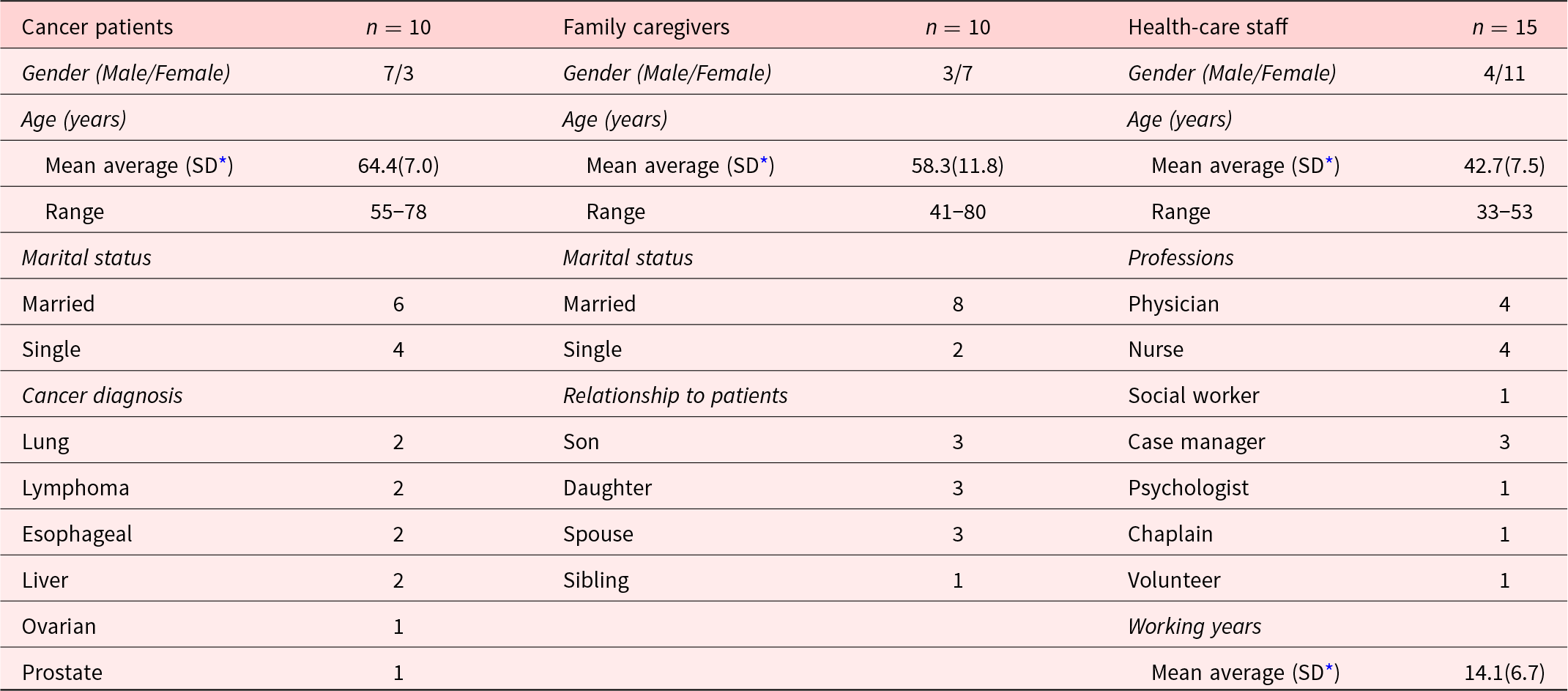
The study setting was the oncology and hospice unit in a regional teaching hospital with 605 beds in Northern Taiwan. Ten interviews with patients with advanced cancer, 10 with family caregivers, and 15 with health-care staff were used in this study collected between December 2017 and April 2018 as we reached data saturation. The duration of interviews was on average 45 minutes (range, 20–96 minutes). We display the participants’ characteristics in Table 1.
Sample characteristics

* SD = standard deviation.
Data processing and analysis
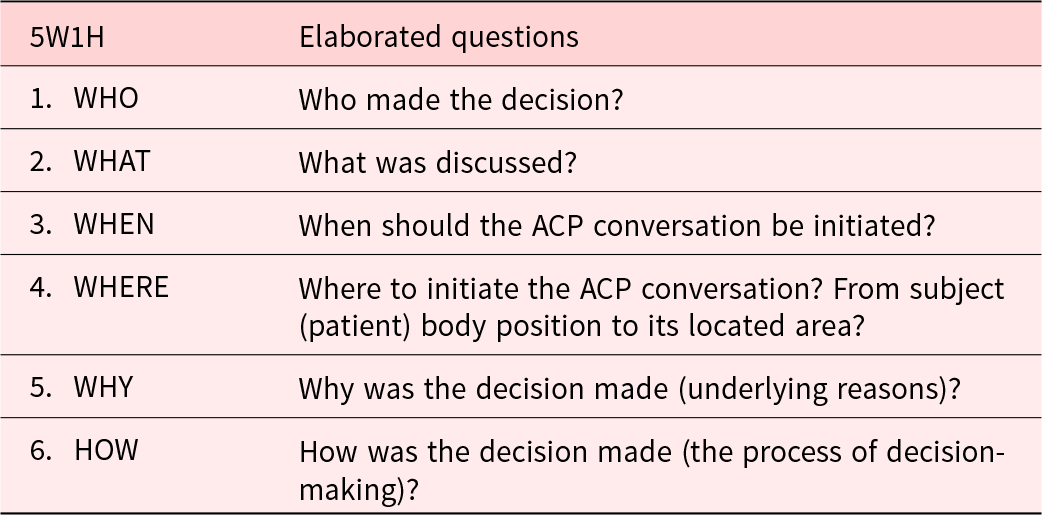
This secondary data collection specifically focused on and reanalyzed past interviews on “participants’ experience on initiating or engaging in the process of ACP” and “the facilitators and barriers that affected end-of-life care decision-making.” Details about the data collection and the tool can retrieve from the first author’s preliminary qualitative study (Lin et al. Reference Lin, Evans and Koffman2019c). Furthermore, 5 steps of thematic analysis from Braun and Clarke (Reference Braun and Clarke2006) were used to analyze. The Kipling method (5W1H) was an underpinning framework for this deductive data analysis. It was adopted to break down the process of ACP decision-making among patients with cancer, their family caregivers, and health-care staff (Jinks Reference Jinks2019). The analysis framework is provided in Table 2. Two authors (CPL, a male oncology nurse and palliative care researcher; SJS, a female psychiatric nursing researcher) analyzed the data independently and later discussed any divergence within the research group (CPL, CHC, and SJS) for consensus. NVivo analysis software (version 12) (QSR International Pty Ltd 2018) was used to manage the data and facilitate analysis.
5W1H framework for data analysis

Results
We identified 6 main themes based on the 5W1H framework as elaborating on the process of ACP decision-making among stakeholders with several supplementary subthemes related to each of the main themes detailed below (see Appendix for detail).
Theme 1: WHO made the decision?
ACP decision-making in this domain includes 2 types, individualistic and collective. Health-care staff reported that “ordinary” treatment would allow for autonomous patient decisions; however, decisions regarding a patient’s “life-sustaining” treatment would often be taken in favor of and by the family. Collective decision-making was found common in Taiwanese culture. Family members’ consensus plays a crucial role in a patient’s life-sustaining treatment decision-making.
Individualistic decision-making
Generally speaking, we prefer letting the patients decide on treatment because it is their body, after all. (HCP06: a 37 y/o male oncologist)
What life decisions do I have to make? Which of my two brothers will dare to decide? My two brothers still need to discuss this, but after the discussion, who will decide in the end? Then no, I’ll do it myself. Just let me decide. (PT04: 62 y/o female patient with ovarian cancer)
Collective decision-making
This situation happens as family members have the right to speak for the patient. The siblings often argue fiercely over this [signing Do-Not-Resuscitation forms for patients]. If all the siblings showed up, all we could do is to communicate with them and then come up with a consensus. (HCP08: a 50 y/o female head nurse)
Theme 2: WHAT was discussed?
The content of ACP conversation includes medical and nonmedical issues. The majority were medical-related issues related to the patient’s disease prognosis and the goal of future care. However, nonmedical issues such as the need for a family support network, the social expectations of the family caregivers’ responsibilities, and even death preparation are hindering the patient’s voice during medical decision-making.
Medical-related issues
We briefly talk about it [the disease prognosis] with the patient.. I would not tell him about metastases, how many tumors there are, or how much longer he might live. I indicate that I dislike talking about these because they are inaccurate. (HCP07: a 43 y/o male oncologist)
We would confirm with the patient: “What do you want for your end-of-life? Do you wish to be intubated? Or do you prefer comfort care?” Once they know their poor disease prognosis, they often request to be comfortable at the end [of their life]. (HCP08: a 50 y/o female head nurse)
Nonmedical-related issues
Once I attended one ACP that left a deep impression on my mind. Only the unwed daughter cared for the old lady, and the other three sons lived abroad … to be honest, it is evident that some families have a poor support system, and the patient doesn’t have much say in the medical decisions. (HCP14: a 34 y/o female nurse)
He [the patient] told his brothers and sisters that they don’t need to have a fancy funeral for him. Just make it simple. (FY5: a 50 y/o daughter of a patient with lung cancer)
When I was young [the 1970s], we would not discuss this [death and dying issues] with our parents as this would bring bad luck. Therefore, we would rarely bring this ACP up for discussion. (PT02: a 58 y/o female patient with colon cancer)
Theme 3: WHEN should the ACP conversation be initiated?
The ACP discussion could do at different time points of patients’ illness. However, it mostly happens when the patient’s disease becomes unstable and terminal. Therefore, it is ideal to discuss when the patient can still speak. In addition, it will facilitate autonomous patient decision-making and allow the family to prepare for the patient’s physical and psychological death.
Care plan for now
He [the patient] said he decided to receive chemotherapy because he wanted to show his daughter that her dad has struggled and fought the illness and was not scared. (FY7: a 57 y/o wife of a patient with liver cancer)
Care plan for a transitional period
We will begin discussions with him [the patient] when he has not yet reached a severe situation. It is too late to discuss this [ACP] when he gradually becoming unconscious. When he has the decisional capacity, it makes sense to assist him in making a decision. (HCP10: a 41 y/o female case manager)
Care plan for the future
If the patient is very painful and the prognosis is poor. He can plan his own life and future care. What kind of life he prefers can be mentioned when discussing with his loved one. Then write it down so that everyone can understand his wishes. (HCP11: a 48 y/o male palliative care physician)
Theme 4: WHERE to initiate the ACP conversation? From subject (patient) body position to its located area?
“Where” can refer to a particular position and place that someone or something is in or to what place they go. The initiation of discussion about the ACP is related to the patient’s subjective position including the inner body (i.e., personal perception) and their outer body (i.e., environmental factors). The content area of inner-body perspectives include the patient’s or family member’s current perception of the patient’s failing body conditions, or their past experience of contacting or caring for other individual’s illness while they were still healthy, and even the discussing hypothetical scenarios and future arrangements after death. The outer body could imply places of care and places of death that can influence patients’ (ACP) end-of-life care decisions. For example, hospitalized patients tend to receive all possible treatments. In contrast, patients cared for at home generally prefer fewer life-sustaining treatments before death. It suggests how the outer environment induces end-of-life care decision-making.
Inner-body, the past experiences, current perceptions of a failing body, and future hypothetical scenarios regarding the funeral
They [patient’s brother and sister-in-law] all agreed with not implementing life-sustaining treatment for the patient during the terminal disease stage. They have experienced a tough time taking care of other dying relatives and addressing end-of-life issues related to them. Since the doctors suggested there is no curable treatment available, then we should let the patient go peacefully. (FY6: a 65 y/o wife of a patient with prostate cancer)
I can feel this [disease progressed]. I need to be alert and make decisions [regarding end-of-life care] before I lose consciousness. (PT09: a 61 y/o female patient with liver cancer)
I told my wife: “After I die, do not make my funeral complicated. Unlike the older generation, I want a simple funeral. I do not need any religious ritual and a group to chant for me.” (PT03: a 58 y/o male patient with lung cancer)
Outer-body, dying in the patient’s home, a medical institution, or other places
Before his death, he would have no regrets as we had treated him with all possible measures [at the hospital], which that could be beneficial. (HCP06: a 37 y/o male oncologist)
We requested that he [the patient] be allowed to die at home without the tubes [life-sustaining treatment]. We have a spare room and my sister-in-law felt reluctant to let him die away from home. We would bring him home and care by ourselves until his death. (FY04: an 80 y/o wife of a lymphoma patient)
Theme 5: WHY was the decision made?
The underpinning reasons for such decision-making are threefold: (1) patients decide to reduce life-sustaining treatment for their own benefit (for self); (2) in an effort not to burden society and others (for others); and (3) patients still want to contribute even they are very sick (for greater self).
For self
I would say no to all [of the life-sustaining treatments]. This is because I know that my ribs will be broken if I receive an electric shock [Automated External Defibrillator]. And if I am intubated, I will rely on that tube to live. It is meaningless and a waste of resources. (PT06: a 66 y/o male patient with lung cancer)
For others
I do not want to burden others. I do not want my kids to come and take care of me. I do not want my disease to influence their jobs. Actually, I did not tell my parents [about my illness] as I did not want to upset them. (PT09: a 61 y/o female patient with liver cancer)
For greater self
If it (treatment) does not work, I [the patient] am willing to die earlier, and if my organs can still be used, I hope that they can help someone else in need. It should cheer me up if I can still be of help. (FY10: a 41 y/o daughter of a patient with liver cancer)
Theme 6: HOW was the decision made?
A potential ACP continuous decision-making process, including (1) autonomous decision-making; (2) shared decision-making, and (3) substitute decision-making, was present. These 3 different models represent different decision-making patterns, and these might be delivered in practice back and forth during patients’ disease trajectory.
Autonomous decision-making (according to the patient’s will)
I’m telling you, listen to the patient’s wishes. I’ve always told my family you’re just stalling for time, and it can’t last very long. It doesn’t make sense to spend money to get intubated and suffer, right? (PT08: a 62 y/o male patient with esophageal cancer)
Shared decision-making (generate consensus after discussion)
After discussion, I prefer that the doctor initiate the discussion [ACP]. Three of my children and I should reach a consensus [on end-of-life care decisions]. (PT04: a 62 y/o female patient with ovarian cancer)
Substitute decision-making (hand over the right to physicians or family members)
I trust them [the physicians] a lot. If you ask me how much I trust them, on a scale of 1 to 100, I think almost 100. Because I’ve received excellent care, I’ll just let the doctor decide if something unfortunate happens. (PT03: a 78 y/o male patient with lung cancer)
The patient should inform the family member: “I do not want these [life-sustaining treatments] if my disease progress and I lose consciousness.” You can speak for me and make decisions to let me die peacefully. (PT02: a 58 y/o female patient with colon cancer)
Discussion
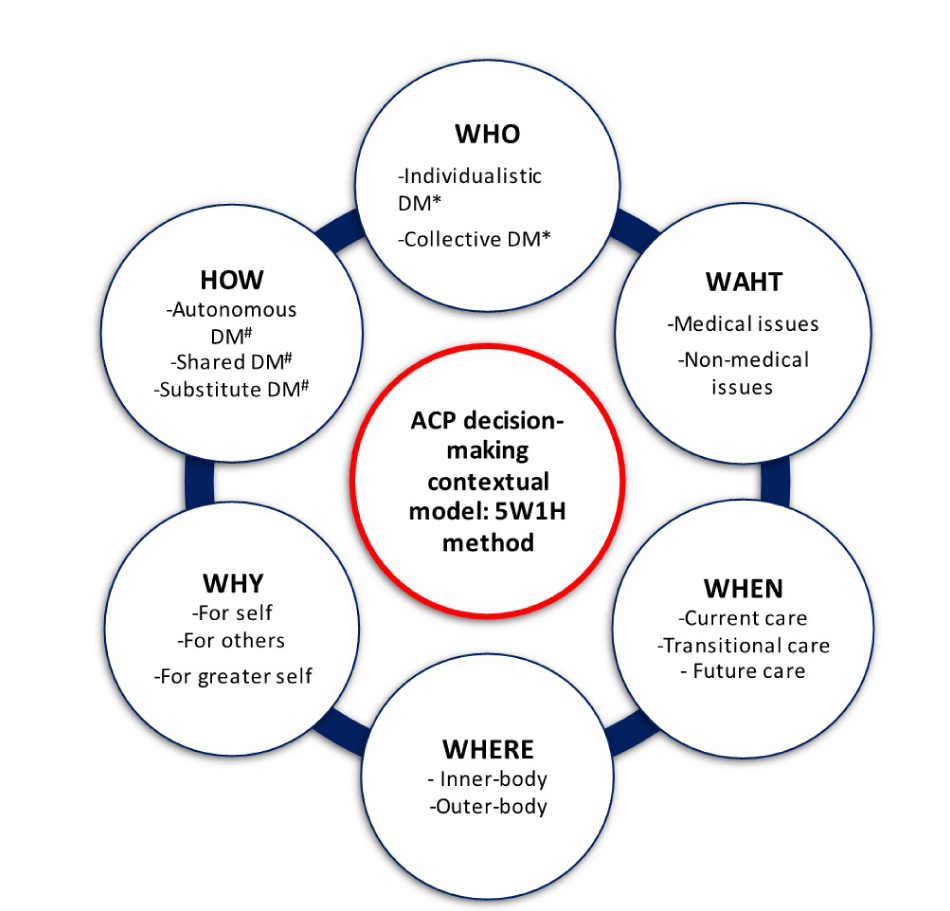
This qualitative investigation demonstrates that using the Kipling method for palliative care research is feasible. We identified the content of 6 domains for exploring the complex and dynamic process that could be related to ACP decision-making among older patients with cancer (Figure 1).
Advance Care Planning decision-making contextual model.

We found that
(1) the various different decision-makers (individualistic or collective in nature) can make different treatments choices (WHO);
(2) there are numerous expanded issues, medical and nonmedical should also be considered (WHAT);
(3) the care plans for the whole disease trajectory, including here and now, the care setting transitional period, and the future, are identified as being essential (WHEN);
(4) the ACP discussion can be influenced by a patient’s perception of body position to its located area, namely their inner-body healthy status and the outer-body environment (WHERE);
(5) the decisions made affect not only the patient but also others and the greater society (WHY); and
(6) the decision-making process should exist as a continuous spectrum including autonomous shared decision-making, and substitute decision-making. These processes might move back and forth under different context (HOW).
The different elements within the ACP decision-making process identified in this study reflect that cancer patient’s treatment preferences may sometimes be made in the context of their relationship with other and their responsibilities to others. Thus, the decisions may change over time. Additionally, the patient will need to make a decision that enhances individual and collective harmony within their Asian cultural background (Jia et al. Reference Jia, Leiter and Yeh2020). This echoes the surge concept of “relational stand of autonomy” proposed by feminism and challenges the 2 essentials that form the individualistic perspective of patient autonomy in biomedical ethics: liberty and agency; together these mean that an individual is able to think, decide, and act freely and independently (Varkey Reference Varkey2021). Therefore, relational autonomy can be considered an alternative that better explains the complex ACP decision-making process (Gómez-Vírseda et al. Reference Gómez-Vírseda, de Maeseneer and Gastmans2019). Such a concept has been considered influential in many Asian countries, including Japan, Singapore, Korea, Indonesia, and Taiwan (Cheng et al. Reference Cheng, Lin and Chan2020; Chiang et al. Reference Chiang, Wang and Hsieh2021; Martina et al. Reference Martina, Geerse and Lin2021), and endorsed internationally, for example, the 2019 Taipei Declaration on Advance Care Planning (Lin et al. Reference Lin, Cheng and Mori2019a).
Significant involvement of others, including family and clinicians, is central to an efficient and successful ACP discussion with a cancer patient. Kishino et al.’s (Reference Kishino, Ellis-Smith and Afolabi2022) mixed-method systematic review suggested addressing family emotions and concerns and also facilitating communication among patients, their family, and health-care staff to identify divergence opinions. In addition, physicians’ suggestions are necessary to facilitate the discussion between patients and their families regarding the ACP (Chiang et al. Reference Chiang, Wang and Hsieh2021; Jia et al. Reference Jia, Yeh and Lee2022). However, we need to be cautious as this might lead to family-led or physician-led conversations, and as a result, the patient’s voice would be silenced (Johnson et al. Reference Johnson, Butow and Kerridge2016). In such a situation, the patient’s self-determination rights can be overridden, and they might have no opportunity to express their end-of-life care wishes (Lin et al. Reference Lin, Cheng and Mori2019a). In summary, the ACP process is iterative and sophisticated, and there are different degrees of respect toward, and reliance on, significant others. Therefore, we suggest that health-care professionals acknowledge the value of family/clinician involvement but be flexible and cautious while assisting patient-focused and family-centric decision-making during an ACP discussion (Menon et al. Reference Menon, Kars and Malhotra2018).
ACP conversations are shaped differently based on their different contexts and local jurisdictions, which makes acculturation indispensable (Chiang et al. Reference Chiang, Wang and Hsieh2021; Jia et al. Reference Jia, Leiter and Yeh2020; McDermott and Selman Reference McDermott and Selman2018). Although Taiwan enacted the Patient Right to Autonomy Act to facilitate ACP participation in 2019, society still considers palliative care and end-of-life care discussions to be taboo, which has led to very limited ACP participation and a low AD completion rate (Lin et al. Reference Lin, Cheng and Mori2019a, Reference Lin, Evans and Koffman2020). In contrast, Singaporeans’ attitude toward death and dying is more open, and ACP has become embedded into the mainstream media targeting the general public to improve awareness (Ng et al. Reference Ng, Kuah and Loo2017). Therefore, we should not take for granted that the same ethnic group shares a similar cultural understanding of palliative care and ACP, thus leading to the same decision-making. Instead, careful exploration and investigation of the target population’s values and beliefs, the relevant health-care system and their society/environment are warranted before embarking on an ACP discussion (Chiang et al. Reference Chiang, Wang and Hsieh2021).
One of the challenges when initiating an ACP discussion is the uncertainty of the disease prognosis and the corresponding relevant medical care. For example, patients wished to maintain hope through uncertainties, but the future is unpredictable and uncontrollable (Etkind et al. Reference Etkind, Li and Louca2022; Jia et al. Reference Jia, Yeh and Lee2022). Therefore, it is difficult for patients to imagine the required future care, which hampers their willingness to participate in an ACP (Morrison et al. Reference Morrison, Meier and Arnold2021). Furthermore, there is an argument that the hypothetical end-of-life care scenarios were non-beneficial in facilitating the ACP movement (Morrison Reference Morrison2020). However, the imagination of the patient’s situational location was a significant facilitator for initiating an ACP discussion with the patient in our study. A shift to serious illness conversation that focuses on the patient’s current illness experience has been proven beneficial and is favored by patients, their families, and health-care staff (Bernacki et al. Reference Bernacki, Paladino and Neville2019; Jacobsen et al. Reference Jacobsen, Bernacki and Paladino2022; Paladino et al. Reference Paladino, Bernacki and Neville2019). Therefore, a hybrid approach is proposed, including exploring the patient’s realistic decision-making possibilities at the moment and then preparing for the near future (Bradshaw et al. Reference Bradshaw, Bayly and Penfold2021). All these considerations should facilitate the early introduction of ACP and improve its acceptability for patients with cancer in Taiwan.
Strengths and limitations of the study
The strengths of this study are as follows: (1) a framework (the 5W1H method) was adopted to support the data collection and analysis plan; (2) data source triangulation, namely patients with cancer (including people with different diagnoses), their family caregivers (including different family roles), and health-care staff (including different professionals) with different gender and age, was used to improve the trustworthiness of the findings (Carter et al. Reference Carter, Bryant-Lukosius and DiCenso2014); and (3) a structured checklist (COREQ) was used to allow comprehensive and efficient reporting. However, we acknowledge that there are limitations resulting in a need to be cautious when applying the findings in practice: (1) the comprehensiveness of the findings might be influenced as the data obtained from the primary study, while relevant, are not tailored for qualitative secondary analysis (Hinds et al. Reference Hinds, Vogel and Clarke-Steffen1997); and (2) the findings may be constrained by the willingness of the participants to be open about palliative care and ACP.
Conclusions
Using the Kipling method to explore the decision-making process of ACP among older patients with cancer can strengthen our understanding of such a challenging issue. The 6 domains demonstrate that ACP involves dynamic situations and needs complex considerations regarding end-of-life care discussions that involve interactions between patients and their important others, as well as a need to focus on planning, which is influenced by past experience, current illness, the need for future care, and how to manage funeral arrangements. Furthermore, acculturation is key to efficient ACP communication and successful delivery and this can be done by adapting to the local context and avoiding misunderstandings between stakeholders related to palliative care and ACP. The above should inform and assist patient-focus and family-centric decision-making in clinical practice.
Supplementary material
The supplementary material for this article can be found at https://doi.org/10.1017/S1478951523001256.
Acknowledgments
We acknowledge the participation and support from patients, their caregivers and health-care staff on the front line without whom this study could never have been completed.
Competing interests
All authors declare no conflict of interest with regard to the research, authorship, and/or publication of this article.


 Open access

