


1. Introduction and motivation: shared understanding in multidisciplinary teams
Collaboration in modern work environments depends on shared understanding, especially in multidisciplinary teams where individuals bring diverse skills, backgrounds, and perspectives (Reference Arias, Eden, Fischer, Gorman and ScharffArias et al., 2000; Bittner & Leimeister, Reference Bittner and Leimeister2014; Cash et al., Reference Cash, Dekoninck and Ahmed-Kristensen2020; Reference LarssonLarsson, 2003; Reference OpplOppl, 2017). Aligning team members on a common vision is crucial for project success (Reference Croft, McGivern, Currie, Lockett and SpyridonidisCroft et al., 2022; Reference Patel, Pettitt and WilsonPatel et al., 2012), but differences in disciplinary knowledge, terminology, and mental models make this process difficult (Reference ValkenburgWright & Lander, 2003; Reference Wright and LanderKleinsmann & Valkenburg, 1996). Design, as a socio-technical process (Reference Hannah, Joshi and SummersHannah et al., 2012), helps bridge these gaps by supporting collaboration through iterative and structured approaches influenced by economic, cultural, and technical factors (Reference Milne and LeiferMilne & Leifer, 2010). Tools such as concept maps provide a structured flow to capture and communicate key ideas, concepts, and information, hence facilitating a common and shared understanding between various stakeholders in a team.
This paper presents an exploration of the tool where concept maps are deployed along with a survey in a complex project to create, elicit, document, and finally analyse the shared understanding in this project team. The tool was also used intentionally to help the team to develop a clear, unified perspective on project goals and constraints (Reference Garaialde, Bowers, Pinder, Shah, Parashar, Clark and CowanGaraialde et al., 2020). Without this alignment, teams risk miscommunication and inefficiencies that hinder progress. This study examines how concept mapping improves interdisciplinary collaboration by visualizing knowledge structures and identifying assumptions (Reference Bittner and LeimeisterBittner & Leimeister, 2014; Reference Gweon, Jun, Finger and RoséGweon et al., 2017; Reference Raina, McComb and CaganRaina et al., 2019). By analysing team dynamics, we aim to identify knowledge gaps, improve collaboration, and develop better design facilitation strategies, contributing to research on collaborative design methodologies.
2. Literature survey
Interdisciplinary collaboration presents challenges due to differences in language, meaning, and problem-solving approaches, often referred to as syntactic, semantic, and pragmatic knowledge boundaries (Reference CarlileCarlile, 2002). Syntactic boundaries arise when teams lack a shared vocabulary, necessitating boundary objects—artifacts such as sketches, models, or digital representations—to facilitate communication and mutual understanding (Reference BechkyBechky, 2003). Semantic boundaries occur when different disciplines interpret the same information in divergent ways, requiring structured tools to bridge perspectives and establish common meaning. Pragmatic boundaries emerge when teams have conflicting goals or priorities, making negotiation and iterative adjustments essential for alignment (Reference Brubaker, Sheppard, Hinds and YangBrubaker et al., 2023). Addressing these challenges requires structured methodologies that enable knowledge exchange, support communication, and guide collaborative decision-making in complex projects.
Concept mapping is one such approach that visually organizes and connects ideas, making knowledge structures explicit and highlighting relationships between concepts. This method has been shown to enhance discourse, surface hidden assumptions, and improve team cohesion, particularly in interdisciplinary environments where knowledge gaps exist (Reference Van Boxtel, van der Linden, Roelofs and ErkensVan Boxtel et al., 2002). When combined with surveys, concept maps provide a dual-layered perspective—while surveys capture individual viewpoints on team dynamics and evolving project understanding, concept maps offer a structured representation of collective thought (Reference Grønbaek, Grudin, Bødker and BannonGrønbaek et al., 2017; Grudin, 1993). These tools, when used iteratively, help assess how shared understanding develops over time and inform strategies for improving team alignment.
To further enhance structured decision-making in interdisciplinary settings, this study integrates Decision Structure Matrix (DSM)—a tool that maps dependencies within a project to analyse and manage complex relationships (Reference Eppinger and BrowningEppinger & Browning, 2018). DSM has traditionally been used in engineering and manufacturing to streamline coordination by decomposing systems and identifying interdependencies (Reference Durango, Luciani, de Paula Ferreira and ArmelliniDurango et al., 2022). However, its application in interdisciplinary, creative, and participatory design settings remains underexplored. While DSM provides a structured way to model decision relationships, its inherent rigidity often requires integration with participatory and visual methods like concept mapping to remain adaptable in dynamic team environments (Reference BrowningBrowning, 2016; Reference Yassine, Worren and ChristiansenYassine et al., 2021). This study builds on these frameworks, using DSM alongside concept mapping to investigate how teams construct shared understanding, negotiate knowledge boundaries, and align decision-making processes over time. By bridging structured dependency analysis with open-ended visualization techniques, this research contributes to ongoing discussions on collaborative design methodologies, interdisciplinary communication, and team knowledge alignment. Future studies can further explore how DSM and concept mapping can be adapted across different disciplines to enhance decision-making and coordination in long-term, creative, and research-based projects.
3. Case study: the Fish Project
The Fish Project, formerly known as Campus Koi, is a multidisciplinary initiative exploring care, community building, and collaborative design through augmented and mixed-reality technologies. The project centres on nurturing virtual koi fish in a digital replica of reflecting pools on a university campus in the U.S., using geolocative technology and augmented reality to create a hybrid space for interaction. Inspired by Peirce’s (Reference Peirce1974) community of inquirers, Haraway’s (Reference Haraway2006) companion species, and Barad’s (Reference Barad2012) intra-agential theories, it examines relationships between human and non-human participants. Initially a theoretical study of Kohn’s (Reference Kohn2013) becoming with others, the project evolved in Spring 2024 under two principal investigators. The primary researcher framed it as a platform for community-oriented mobile applications, while the second expanded it into a public art initiative integrating art, science, and technology.
3.1. Goal
The Fish Project aims to redefine care—encompassing self, human, and non-human entities—by integrating technology, design, and community. Its objectives are:
-
Cultivating Shared Meaning: Fostering a collective language and vision for care through interdisciplinary co-creation (Reference Verhoeff and CooleyVerhoeff & Cooley, 2023).
-
Encouraging Community Building: Promoting meaningful connections through shared responsibility for virtual fish and their environment, forming a “community of care” (Reference PeircePeirce, 1973)
-
Challenging Boundaries: Bridging divides between human and non-human, digital and physical, using AR tools to foster mutual engagement (Reference EdwardsEdwards, 2012).
3.2. Research scope and limitations
This study examines the Fish Project as a single case study, focusing on how a multi-disciplinary team develops a shared understanding in a dynamic research setting. While the findings offer insights into collaborative design, they are limited to this type of project structure and team composition. The conclusions drawn may not be fully generalizable but serve as a foundation for broader applications. Future research could apply similar methods to other interdisciplinary projects to test findings across different domains. This paper explores and presents the findings from the application of this method to map shared understanding and project alignment.
3.3. Project development and challenges
The Fish Project began in 2010 when the primary researcher, then an Assistant Professor of New Media Studies at the University of South Carolina, explored collaborative design and shared networks of care. Between 2018 and 2023, the project transitioned to the University of Texas at Dallas, where early explorations involved colleagues and students. In Spring 2023, the project was rekindled by a new group of students and was christened Campus Koi. It started explorations with AR and geolocative technologies for collaborative care of virtual Koi, emphasizing participatory design. In Spring 2024, a second faculty researcher joined, expanding the project into a public art initiative and broadening its engagement beyond academic research. The project’s iterative nature and the autonomy given to team members created challenges in aligning its vision, milestones, and processes. Early gaps in documentation contributed to inconsistencies as new team members joined, affecting shared understanding. The project has since incorporated strategies to improve knowledge-sharing while maintaining its core focus on the fish ecosystem. This case study examines these challenges to assess shared understanding within an interdisciplinary team. Future research could apply similar methods to public art, digital humanities, and interactive media projects to evaluate the broader applicability of these findings.
4. Research design
This case study uses a mixed-method approach, combining surveys and concept maps to examine shared understanding within an interdisciplinary team. The survey collected demographic information, professional backgrounds, roles, and self-reported skills, while concept maps captured participants’ conceptual understanding of the project. Concept mapping was conducted first to minimize response bias before participants completed the survey, allowing for triangulation of findings to identify alignment, gaps, and shifts in understanding over time. To ensure ethical compliance, demographic data such as names, gender, and age were collected only to analyse team diversity and role distribution, with personal identifiers anonymized and informed consent obtained. Data privacy protocols were followed to restrict access to identifiable information. The survey analysis focused on work experience classification, skill categorization, and team composition, with years of experience standardized into defined ranges and self-reported skills validated through cross-referencing team discussions and documented project contributions. The findings were mapped onto a Design Structure Matrix (DSM) to assess shared understanding across the team. The following sections describe the survey and concept map activities, including data collection, participant engagement, and analysis methods.
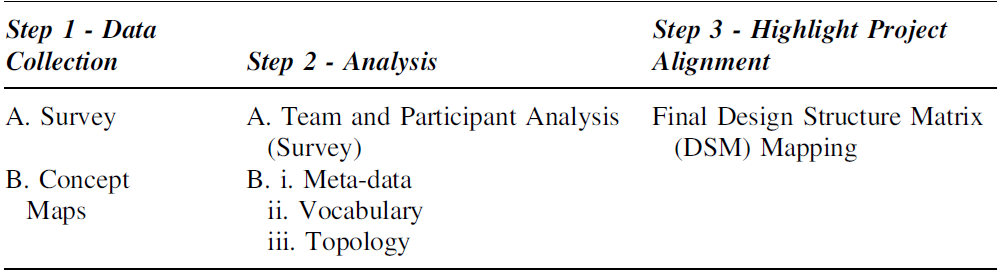
Table 1 provides the details on the three-step process adopted in this research that highlights the method to explore, identify, and highlight project alignment and shared understanding in a complex team with diverse background and multiple stakeholders at the leadership and management level. Step 1 involved an in-person and timed activity to ensure that all stakeholders and team members had the same amount of time to complete the task, minimizing unintended consequences and maintaining the validity and interpretation of the activity. Step 2 was conducted by an independent individual outside the team, with no bias or connection to the team, project, or its outcome. The survey and concept maps were analysed for various elements relevant to Step 3. Step 3 was the final stage of the process, where the final alignment was assessed and highlighted using a Decision Structure Matrix (DSM), which served as both a tool and the final output of the method.
Three-step process towards mapping project alignment

4.1. Survey activity
The survey included ten questions, with nine multiple-choice items and one open-ended question, designed to gather demographic details (age, gender, department), work experience, skills, team roles, and time spent on the project. Work experience was categorized into three ranges: 1–5 years/projects, 6–10 years/projects, and over 10 years/projects. Skills were self-reported on a four-point scale (0 = Not Applicable, 1 = Beginner, 2 = Intermediate, 3 = Expert) across Arts, UI/UX, Software, Hardware, Project Management, Marketing, and Fundraising. To improve reliability, self-reported skills were cross-checked with project contributions, team discussions, and documented outputs. The survey was distributed via email, with a one-week response period, and only responses from participants who also completed the concept map activity were included in the final analysis. The open-ended question, “Define ‘Fish Project’ (in less than three sentences),” was analysed using keyword processing techniques such as stemming, lemmatization, and frequency analysis to identify key themes related to project understanding.
4.2. Concept map activity
The concept mapping activity took place during a weekly team meeting, with five participants attending in person, two joining online, and one completing it later. Participants received a presentation on concept maps with examples, a template for structuring their maps, and 10 minutes to complete the task. To ensure independent conceptualization, they were instructed not to discuss the activity before or after completion. Concept maps were evaluated across three dimensions: metadata (readability, relevance, completeness, and complexity), topology (structural complexity using 29 metrics analysed in MATLAB), and vocabulary (keyword similarity and frequency across maps, surveys, and project descriptions). A comparative analysis between the survey and concept maps identified alignment, gaps, and variations in shared understanding. The findings were integrated into the DSM to assess team-wide conceptual cohesion.
5. Survey analysis
The survey and concept map data were analysed to examine team composition, role distribution, diversity in age and experience, and individual work experience and skills. Responses from participants who did not complete both activities were excluded for consistency. The analysis first presents team demographics, followed by an assessment of individual work experience and skills, and concludes with insights derived from concept maps. The results were mapped onto the DSM to identify and highlight the gaps in shared understanding and project alignment.
5.1. Team composition
The team was composed of eight participants (P1 to P8), with an equal gender split (50-50). 75% of the team belonged to the Department of Arts, Humanities, and Technology (AHT), while others were from Engineering and Computer Science (ECS) and Brain and Behavioural Sciences (BBS). The average team age was 35.5 years, with participants ranging from their 20s to 50s. Six participants had been involved in the project for 6–12 months, while P1 and P6 had contributed for over a year, with P6 as the project’s original conceiver. The case study categorized roles into Technical (software, hardware, implementation), Non-Technical (theory, documentation, reporting), and Hybrid roles (Technical and Managerial, Non-Technical and Managerial), with the latter aligning with leadership responsibilities similar to CTO or CEO roles.
5.2. Participant analysis: work experience and skills
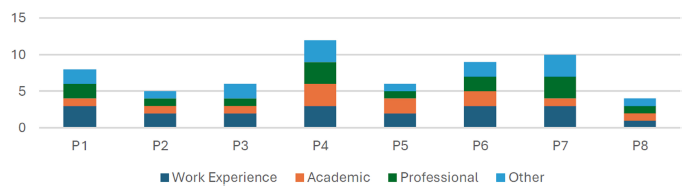
Figures 1 and 2 categorize project experience on a 1–3 scale, with 1 representing 1–5 years/projects, 2 for 6–10 years/projects, and 3 for over 10 years/projects. P4’s cumulative experience was identified to have the highest experience across all categories (individual and combined), while P1, P6, and P7 reported over 10 years of experience with varied project distributions. P8 had the least experience, and P2, P3, and P5 represented intermediate levels. The average team experience was identified to be close to 10 years, with strengths in non-academic projects, indicating practical experience applicable to design and implementation. Self-reported skills were measured on a four-point scale (0 = Not Applicable, 1 = Beginner, 2 = Intermediate, 3 = Expert) across Arts, UI/UX, Software, Hardware, Project Management, Marketing, and Fundraising. To address potential self-efficacy biases, responses were cross-referenced with project discussions and documented contributions for validation. The research acknowledges that these self-reported skills and experiences were on a honest response basis and did not conduct any further investigation to cross-validate the responses, thus, there would be no adjustment on the final scoring of this data and its analysis and will be used as is.
Distribution of Individual Work and Project Experience

Individual Skills Distribution across the Team

5.3. Concept Maps Analysis
This section analyses individual participants’ concept maps in three steps:
-
Metadata: Concept maps are evaluated for complexity based on four metrics: ‘Readability,’ ‘Relevance of Information,’ ‘Completeness,’ and ‘Complexity.’ Readability, relevance, and complexity use a geometric scale (1-low, 3-medium, 9-high), while completeness is binary (1-complete, 0-incomplete).
-
Topology: Concept maps are coded using a guidebook and converted into an Excel file, analysed in MATLAB for 29 topology-based complexity metrics (Reference Mathieson and SummersJ. L. Mathieson & Summers, 2010; Reference Mathieson and SummersJ. Mathieson & Summers, 2017; Reference Patel, Summers, Kumar and EdwardsPatel et al., 2024).
-
Vocabulary: The keywords in the vertices of the concept maps are analysed for similarity and frequency. They are also grouped into categories to be mapped to other descriptions of the project obtained by surveys or historic project documents (Reference Patel, Summers, Kumar and EdwardsPatel et al., 2024).
Figure 3 illustrates map complexity with an example of the concept map from P3. This was rated as a detailed and complicated map with the high number of vertices and edges.
Concept map of participant - P3

5.3.1. Meta-data analysis
Concept maps were introduced to complement the survey and evaluate the team’s understanding of the project across three key areas: 1) defining the “Fish Project,” 2) identifying their role, and 3) explaining how their role supports others and contributes to project execution. Participants replicated a provided digital template on letter-sized paper within a 10-minute limit. Figure 4 highlights concept map scoring, with P3 demonstrating equal complexity to P7 but outperforming on readability, relevance, and complexity (P3: 9,9,9 vs. P7: 1,1,3). Overall, P1, P2, and P3 showed a stronger understanding of the project compared to P4, P5, P6, P7, and P8.
Meta data score of concept maps from participants

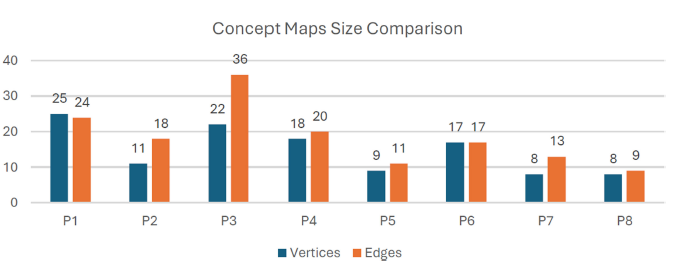
Figure 5 reinforces these trends, showing similar patterns in vertices and edges. Notably, P8 scored high on readability (9) but low on relevance and complexity, indicating gaps in understanding despite initial clarity.
Concept maps size comparison between participants

5.3.2. Topology analysis
The Average Concept Maps Score (ACMS), adjusted by a factor of eight to align with the Average Experience/Skills Score (AESS), is shown in Figure 6. Comparing ACMS to AESS reveals a correlation with notable shifts: P1 to P3 show higher ACMS and lower AESS, while P4 to P8 exhibit higher AESS but lower ACMS, with a downward slope. P3 scores the highest on ACMS, while P4 leads in AESS. Conversely, P2 has the lowest AESS, and P5, P7, and P8 have the lowest ACMS. These results suggest that age, experience, and skills influence concept map quality and project understanding (with exception to P3 which can be attributed to prior concept map knowledge, deeper project understanding, or effective performance despite limited experience). For the rest, a strong correlation between ACMS and AESS underscores the interplay of these metrics in shaping project comprehension.
Average experience/skills score vs. average concept maps score

5.3.3. Vocabulary analysis
In this section, definitions from the summary, survey, and concept maps were analysed for frequency, similarity, meaning, and context, resulting in a final list of unique, categorized keywords. Words appearing at least twice across different formats were categorized using methods such as stemming and lemmatization, revealing broad themes as understood by participants. Table 2 illustrates the counts of the keywords after applying the stemming/lemmatization process.
Keyword processing

The final list of unique keywords and categories emerged through a collaborative process of alignment and consistency across the team’s varied roles and perspectives. This participatory approach reflects the philosophical and practical nuances of the Fish Project while supporting a coherent understanding of its goals. Section 5’s DSM highlights gaps in shared understanding, offering a framework to align team contributions. These definitions act as lenses for evaluating coherence within the project, ensuring that keywords and their categories—drawn from concept maps, surveys, and the project summary—reflect a unified vision.
-
Technology: The application of tools like AR and geolocative technology to create shared and immersive care-centred experiences that bridge the digital and physical environments.
-
Community: An evolving network of human and non-human stakeholders nurturing belonging, shared identity, and mutual responsibility within the Fish Project.
-
Care: A relational practice about self, communal, and care for non-human participants, enacted through nurturing acts like tending virtual fish and cultivating shared ecosystems.
-
Work: The collective effort and interdisciplinary expertise applied to design, implement, and sustain the Fish Project as a living exploration of care and connection.
-
Design: The collaborative and iterative process of envisioning and planning solutions that integrate philosophical inquiry with practical tools, creating spaces for meaning-making.
-
Fish Ecosystem: A digital aquatic simulation that serves as a relational ecosystem, engaging users in playful yet reflective interactions, highlighting interdependence and care.
-
Campus: The physical spaces of the university such as the reflecting pools that anchor the project, providing semiotic grounds for shared, embodied interactions.
-
Experience: The dynamic engagement with the Fish Project that shapes emotions, cultivating a sense of belonging, and encouraging reciprocal interactions, both virtual and physical.
6. DSM mapping
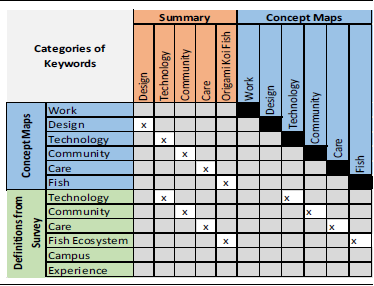
The DSM is used as a tool to identify the gaps in shared understanding between individuals and the team and it is used as the final output of this research to highlight the shared understanding and project alignment between team members or participants. Mapping categories from three sources, where definitions may reflect pre-existing documents, while concept maps and definitions from surveys reflect participants understanding and knowledge. The project summary was used as a reference to the team’s oldest foundational document. Table 3 maps categories, highlighting connectivity and gaps in understanding. Four categories—Work, Design, Campus, and Experience—lack full linkage across sources. For instance, Design is mapped in Summary and Concept Maps but is absent in Survey Definitions (highlighting inconsistency in understanding), while Work appears only in Concept Maps. Campus emerges in Survey Definitions, and not in concept maps, perhaps as an afterthought. Similarly, Experience is unique to Survey Definitions, likely emphasizing end-user engagement, but it remains unmapped in Summary and Concept Maps.
Keywords categories DSM.

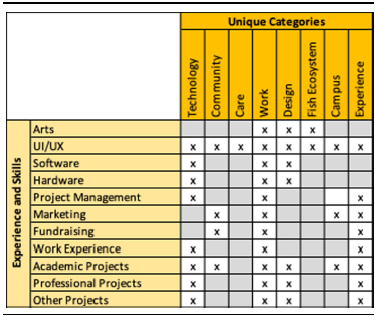
The research also mapped project experiences and the eight unique categories that were derived above, and this is illustrated in Table 4. Here categories such as “Care” and “Fish Ecosystem” were not covered in the team skills and experience. UI/UX was mapped completely in all categories perhaps highlighting that it was considered by all participants as a primary task/category needed in this project. While work was covered by all skills and experiences closely compared to Technology, Design and “Experience of the art project” itself, attributing to the fact that these were the core vision/categories aimed by the team. Community and campus score low in this mapping showing that teams should also focus more on this in their design and discussions. On the other axis, several parameters performed very low and were scarcely mapped, highlighting the need to strengthen the team in a more strategic way to cover all categories with the needed skills and experiences.
Categories vs. experience/skills DSM

7. Conclusion and limitations
The DSM presented in Table 3 and Table 4 is at the generic project level as that was sufficient in highlighting the gaps in understanding at various levels of the project and its team members. This research stopped at these DSM’s as it was able to highlight the gaps evidently and efficiently. For projects that would need further clarity and granularity, one can go one step further to create participant-level-DSM’s as well to investigate and highlight shared understanding and alignment at that level as well between specific categories of teams or specific roles of people in the team, or just to highlight alignment between any two. This can be useful when working with several team members performing the same tasks and activities to ensure granular alignment and understanding.
Addressing the gaps highlighted in the DSM is critical to aligning the team with the project scoping document and maintaining coherence. Regular use of concept maps to capture shared understanding, track project evolution, and update scoping documents. Perhaps creating a concept map as a team to highlight that as a master map for the project can also create a baseline for the shared understanding of the project. Furthermore, such concept maps can also help elicit high-level requirements for creating a robust requirements document informing future project direction.
This case study did not collect data on the participants perceptions of the project’s phase, which could explain some keywords like UI or Code which generally emerge at the embodiment stage of design, compared to the conceptual or early-stage. This case study shows that using concept maps and surveys at various stages of design process can improve the alignment of goals, timelines, and roles. Additionally, meta-data can be further rated or scored on meaning and purpose of the concept maps which can be a better metric and use of concept maps. On the DSM, a detailed mapping of skills and experience to unique keywords and categories could identify specific gaps, aiding project owners in refining roles, timelines, and milestones for improved tracking and efficiency. Future work could explore the influence of experience, tenure, and roles on shared understanding and integrate project management techniques to align new team members and creation of a participant level DSM to highlight alignment at a granular level.





 Open access

