

Introduction
Bisserka Gaydarska, Katharina Rebay-Salisbury, Paz Ramírez Valiente and Jana Esther Fries
In 2018, Robb and Harris published a new analysis of gender in Neolithic and Bronze Age Europe (Robb & Harris, Reference Robb and Harris2018). They argued that there was a clear continental-wide shift during the third millennium bc between two different conceptions of gender. If gender operated in the manner we often expect, with clear-cut categories of identity that can be matched to bodily difference, we would detect it in the Neolithic—but we do not; Neolithic gender is remarkably elusive. Thus, Robb and Harris suggested that Neolithic gender emerged contextually in specific moments and was not linked to life-long unchanging identities. In the Bronze Age, by contrast, identifying men and women in different contexts, from art to funerals to the material culture of daily life, is far more straightforward. While the content of Bronze Age gender—what a man or woman is, should be, or can do—might be very different from the present or recent European past, gender was familiar in a way that was demonstrably not the case in the Neolithic.
The arguments presented in the article provoked various reactions and responses, some in writing (e.g. Bickle, Reference Bickle2021), others in oral presentations in an EAA session in Kiel in 2021, titled ‘To Gender or Not to Gender? Exploring Gender Variations through Time and Space’. The reason to propose such a session was the four co-organizers’ shared discomfort of the central premise of Robb and Harris's article, i.e. the opposition of ‘contextual Neolithic gender’ to ‘cross-contextual Bronze Age gender’. The creation of this dichotomy was ironic as, only one year previously, one of the same authors had argued against dichotomous models in principle (Harris & Cipolla, Reference Harris and Cipolla2017). Despite efforts to avoid essentialism, ultimately readers of Robb and Harris (Reference Robb and Harris2018) are left with the impression that there is such a thing as Neolithic and Bronze Age gender, the former being under-theorized, unclear, and unstable, the latter binary, unchangeable, and ideological. Robb and Harris make correct observations, such as the differing quantities of empirical data, and fair critiques, such as of the recurring perceptions of gender as an unchanging analytical category, with a Neolithic idea of femininity or masculinity giving way to another Bronze Age idea of femininity and masculinity. Many problematic claims have thus inspired the contributors to the conference session on which this article is based, with a range of selected case studies across Europe.
Given the format of this article, we have prioritized three major issues central to Robb and Harris's arguments. First is the generalization and over-simplification of a very diverse set of data into only two entities of Neolithic gender and Bronze Age gender. The Neolithic is widely recognized as a period of fundamental change in lifeways, with many things, ideas, and concepts appearing for the first time. It began in different parts of Europe at different times and in different climatic periods. Although a recognizable conception of gender may or may not have appeared for the first time in the Neolithic, the prolonged nucleation of people in various group sizes must have sharpened the social perception and conceptualization of sexual differences. These were probably multi-generational communities with deepening links to their landscapes, animals, things, and houses, in which various ideas, concepts, explanations, and perceptions started to emerge for negotiation, contestation, and the crystallization of myths and cosmological views. Unpicking gender from that is not easy and to lump such an Early Neolithic turmoil of change (seventh–sixth millennium bc) with, for example, the equally dramatic but very different phenomenon of the Varna cemetery (fifth millennium bc) with its pronounced social differentiation or the megalithic communal graves of the Funnel Beaker culture is not methodologically sound.
Second is the astounding lack of flexibility. For example, it is not at all clear how children or the elderly fit into the binary Bronze Age gender system. Gender, rather than being static, changes through an individual's lifecycle. In combination with gender, age may be studied using the same evidence, i.e. burials and visual representations, as that used by Robb and Harris (Reference Robb and Harris2018) for the Neolithic and Bronze Age. In the Neolithic, the main differential in burials is between adults and children (Murphy & Le Roy, Reference Murphy and Le Roy2017: 6), suggesting specific social differentiations by age-stages. In visual representations, gender may be depicted by means of clothing or ornamentation, but ambiguity in gender depiction may also relate to young age categories, possibly showing children or prepubescent individuals. Even if gender is assumed to be unchangeable and an essential part of identity within a culture, it can be expressed in significantly different ways depending on other social factors such as ethnicity, religion, or status. Different norms may have operated in the same society and in the same period; to broaden our perspectives on the study of gender in prehistory, intersectionality should be considered in the construction of different gender identities that include social status, age, ethnicity, or sexuality.
Third is the assertion that gender archaeology is now mainstream and that it ‘posit[s] a single definitional entity for “gender” across all contexts’ (Robb & Harris, Reference Robb and Harris2018: 143). This overlooks the complex and diverse discussion of theory within gender archaeology in recent years, as well as the debate around the concept of gender within, for example, queer archaeology or social archaeology.
Robb and Harris also identify a theoretical stalemate in gender studies and offer their approach as a novel rethinking of Neolithic gender. We strongly disagree with such an assessment, which seems to conflate three important trends in current gender archaeology: unfortunate recurrences of the ‘add women and stir’ approach; methodological and theoretical difficulties to differentiate between social constructs (is there gender?) and analytical constructs (what kind of gender?); and inspirational theoretical insights that struggle to find wider resonance. It is hard to see gender archaeology as mainstream if a survey of gender archaeology education in the UK, Germany, and Bulgaria has shown its impact as negligible in comparison to other aspects of archaeology (Gaydarska & Gutsmiedl-Schümann, Reference Gaydarska, Gutsmiedl-Schümann, Matić, Gaydarska, Coltofean-Arizancu and Díaz-Guardaminoforthcoming). In our own (i.e. Gaydarska's and Ramírez Valiente's) struggles with gender in the Neolithic, we have already come to realize that its construction could be highly contextual (Chapman & Gaydarska, Reference Chapman and Gaydarska2007).
Thus, we believe that gender diversity across time and space is the norm and that contradictory developments within gender systems have occurred repeatedly and in parallel. Generalizing gender binarism in the European Bronze Age is oversimplifying the heterogeneous variety of gender in diverse regions, where we may find a diversification of patterns. And yet, within the fuzzy data, there appear to be some broad-scale, super-regional trends that we have to strive to uncover.
From the Copper and Bronze Age onwards, gender appears as a central concern expressed in prehistoric burial practices across different communities in Europe. Gendered burial practices that use different body orientations and the placement of bodies on different sides for men and women suggest that gender was an important principle within societies. The bodies of men and women were classified and treated differently in the funerary sphere. In tandem, material culture is employed in the construction and creation of masculinity and femininity, leading to a more strongly gendered use of objects.
Social status and distinction between people based on access to material wealth becomes increasingly important in the Bronze Age. At the intersection between gender and social status, differences in wealth begin to mask and distort gender differences—a trend that accelerates towards the beginning of the Iron Age.
Recent analytical developments in ancient DNA analysis and palaeo-proteomics (e.g. Mittnik et al., Reference Mittnik, Wang, Svoboda and Krause2016; Stewart et al., Reference Stewart, Gerlach, Gowland, Grøn and Montgomery2017; Parker et al., Reference Parker, Yip, Eerkens, Salemi, Durbin-Johnson and Kiesow2019) provide ever more accurate data on the chromosomal sex of buried individuals, which, in combination with morphological age and sex assessment, have brought new insights on gender expression in the funerary sphere in comparison to a buried person's biological sex (Rebay-Salisbury, Reference Rebay-Salisbury, Matić, Gaydarska, Coltofean-Arizancu and Díaz-Guardaminoforthcoming). This will lead to significant insights into how gender is learned and how it changes during the life course.
The aim of this article is to offer a kaleidoscope of narratives about Neolithic and Bronze Age European societies which include both explicit and more subtle expression of gender identities. While there are examples of Bronze Age binary choices, there are also more complex patterns intertwining gender with other social aspects such as personhood or kinship. Unsurprisingly, most of the narratives are based on burial evidence but, importantly, imagery and settlement data have also been considered. The concluding section consists of Robb and Harris's reflections on their original ideas and on the responses they have triggered in this article.
Complexity and Diversity of Gender Roles and Identity in the Mesolithic and Neolithic of Europe
Anne Augereau and Daniela Nordholz
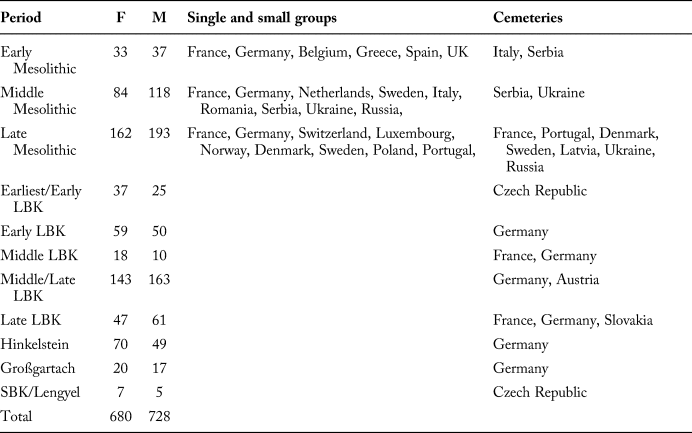
An essential contribution on the part of the humanities is the idea that gender is performative, as its enunciation, repetition, and materialization make it real and efficient (Butler, Reference Butler1990). Indeed, the differences between social groups were materialized in clothing and jewellery, in roles and division of labour, in places and spaces, in bodily postures, in technical tools and process, and so on. It is therefore relevant to look for traces of these material aspects of gender in archaeological data; indeed, according to Sørensen (Reference Sørensen2000), the archaeology of gender is primarily the archaeology of differences. By comparing diverse data from the European Mesolithic and Neolithic, we focus on the diversity of gender identity and roles from 11000 to 4000 bc through the analysis of anthropologically sexed skeletons (680 females and 728 males) from all over Europe over a timespan of c. 8000 years (Table 1).
Total number of anthropological sexed individuals over c. 8000 years.
Gender identities and roles through funerary data
For the Mesolithic, the one constant in regard to the distribution of grave goods in relation to male and female burials is that there is no constant. In some areas and at certain times, people seem focused on males in their burial practice, at other times and in different areas, burial practices varied but appear centred on females (Grünberg, Reference Grünberg2000; Nordholz, Reference Nordholz, Koch and Kirleis2019).
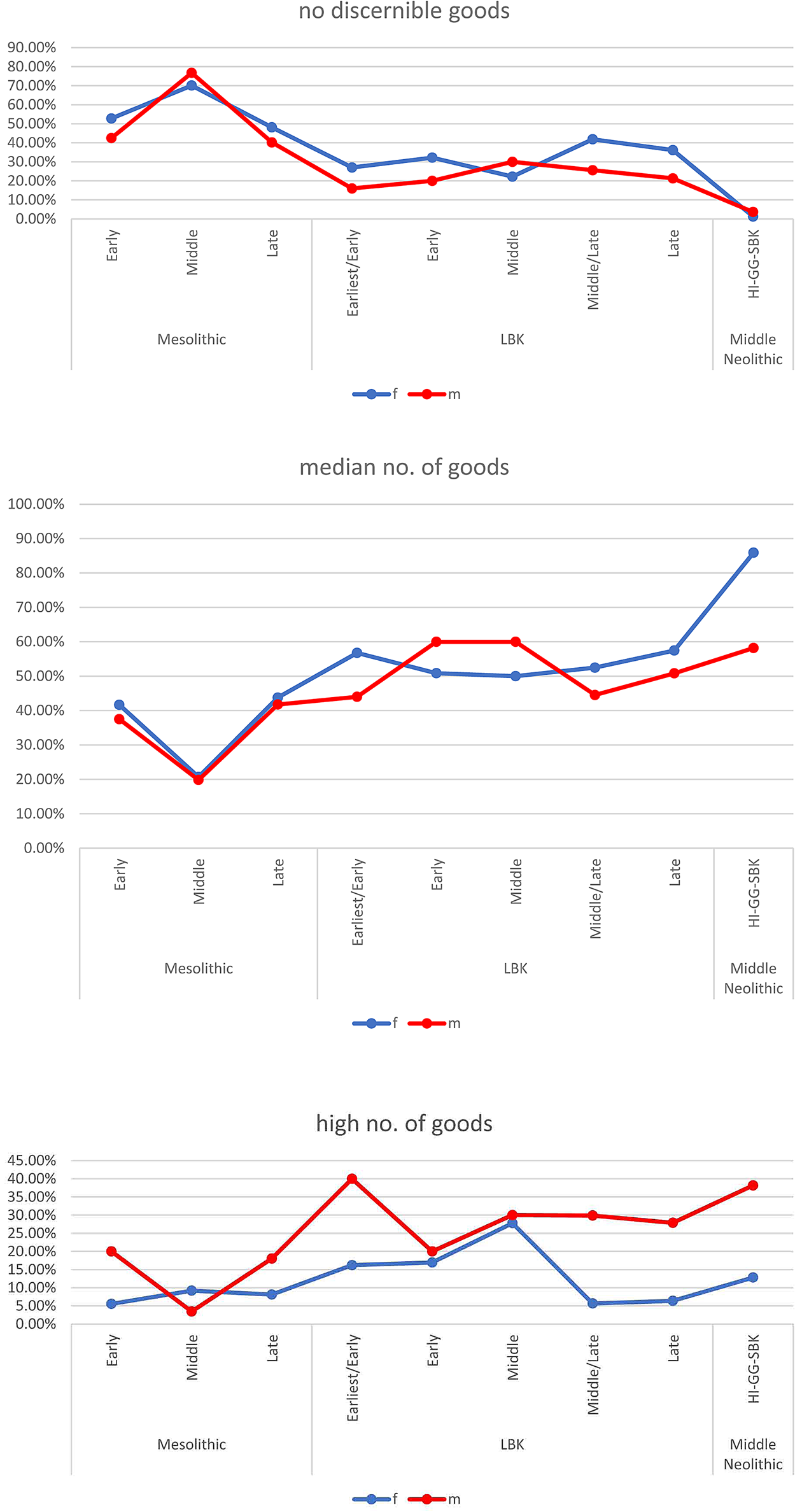
There were male burials without any grave goods, as well as male burials without any tools and therefore without any hunting-related tools, just as there were female graves with (hunting) tools, albeit in much smaller numbers than male graves (Figure 1). This distribution of grave goods, in particular of tools, leads to the following possible conclusions pertaining to the question of tool use and, by extension, to that of hunting:
a) hunters included both male and female sex;
b) hunters comprised only those people deemed to be socially masculine;
c) hunters comprised those with suitable talent, experience, and ability irrespective of sex or gender.
Distribution of grave goods in male and female burials from the Mesolithic to the Middle Neolithic in Europe (adapted from Nordholz, Reference Nordholz, Koch and Kirleis2019: fig. 1).
But all these scenarios suppose that burial practices were a reflection of the life of the individual.
Concerning the distribution of tools in burials during the Linearbandkeramik (LBK hereafter), a pattern similar to that of the Mesolithic is apparent, at least for the earliest to middle LBK phases (Augereau, Reference Augereau2021). Towards the end of the LBK, more grave goods were placed in males’ graves, with fewer females buried with tools while the proportion of males buried with tools remained the same. It could be argued that women's access to tools was more restricted than men's.
By the Middle Neolithic, both sexes were given a similar burial rite, but a clear difference in the type of grave goods emerged, which associated females with querns and males with adzes. During the Middle Neolithic, a consolidation of gender roles seems to have taken place, with specific grave goods assigned to each sex. There are, however, a few exceptions, which may suggest the possibility of biologically male individuals buried as females with feminine assemblages, i.e. querns, and biological females buried as males with masculine assemblages, i.e. adzes.
In terms of gender roles, osteological data and use-wear analysis of tools found in burials (Villotte & Knüsel, Reference Villotte and Knüsel2014; Macintosh et al., Reference Macintosh, Pinhasi and Stock2017; Masclans et al., Reference Masclans, Hamon, Jeunesse and Bickle2021) suggest that men participated in hunting, woodworking, and butchering, while women were engaged in skin-processing and fibre-working. However, such a postulated division of labour assumes that objects included in graves were representative of the individuals’ practices. In addition, many burials of both sexes did not have any discernible grave goods and many questions remain about other productive activities such as animal husbandry, cultivation, harvesting, gathering, other crafts, and caring.
Regarding gender acquisition, gender attributes existed in burials from the age of five onwards in both the LBK and the Middle Neolithic. However, the sex of the children is currently unknown in most cases and the well-known lack of attribution of gender through grave goods during childhood limits our interpretations.
In conclusion
This overview shows that sex and/or gender was highly diverse across time and space, and within each culture. While the funerary assemblages appear to show a distinct identity for women and men in the Middle to Late LBK transition, the data suggest that other distinctions beyond binary sexual categorization existed. Several groups of individuals emerge who deserve a better understanding: men without adzes, men with arrows, women and men with common tools, women with adzes, women with ornaments, etc.
In the current state of research, these data can be interpreted in different ways. On the one hand, these results could echo the findings of Robb and Harris (Reference Robb and Harris2018) about overlapping gender categories in the Neolithic. On the other hand, the multiplicity of groups of individuals based on the distribution of grave goods prevents us from making such a definitive statement. Correlation with other data is necessary, such as evidence for diet, origin, and health, in order to document the specific biographies and lifestyles of social groups (Bickle & Whittle, Reference Bickle and Whittle2013). Archaeological gender studies are not limited to a binary study of men and women and the exploration of social variability across the Mesolithic and Neolithic population remains an important task, especially the variability of female identity, roles, and status. Even so, we must take care in choosing to interpret past gendered relationships through the lens of contemporary identities.
Neolithic Gender and Kinship: Response to Robb and Harris
Penny Bickle and Daniela Hofmann
We commend Robb and Harris for refocusing attention on Neolithic gender, and for proposing the model of ‘contextual gender’ for archaeologists to work with (or against). From our own work on Neolithic identities, we found much to agree with in their article, but also aspects to challenge. For reasons of space we will focus here on two main points: first, we argue that gender has not been absent from discussions of the Neolithic, but was rather assumed to be of binary form, following biological sex closely; second, we challenge the notion that there was a single ‘Neolithic’ form of gender, and will use inter-relationships of gender and kinship systems to stress the variety of Neolithic histories.
When Robb and Harris ask, ‘why is there so little gender archaeology for the Neolithic?’, they do so from a perspective originating in the Anglo-American research tradition. In the contexts in which we work, the Early Neolithic in central Europe (the LBK), gender has been considered, but binary readings are so taken for granted that debates almost exclusively revolve around the relationships between men and women, notably in terms of their relative social status (e.g. Pavúk, Reference Pavúk1972; van de Velde et al., Reference van de Velde, Bishop, Chapman, Earle, Eggert and Gilman1979; Veit, Reference Veit1996; Jeunesse, Reference Jeunesse1997; Röder, Reference Röder, Auffermann and Weniger1998). While we would therefore not adopt this work wholesale, there is an active tradition of debate surrounding gender in these research traditions.
In addition to what Robb and Harris do not cite, they downplay that Neolithic gender is still—for better or worse—most explicitly discussed by female, non-binary, and transgender scholars, who tend to be under-represented in high-visibility publications. For example, the Oxford Handbook of Neolithic Europe (Fowler et al., Reference Fowler, Harding and Hofmann2015) quoted at the beginning of Robb and Harris's article has sixty-four male and only fifteen female authors (or one female for every four male scholars). Its sister handbook, the Oxford Handbook of the European Bronze Age (Harding & Fokkens, Reference Harding and Fokkens2020) fares better, with fifty-two male to twenty-one female (one female for every two male scholars). Thus, we contend that gender analysis in Neolithic studies is not solely understated because Neolithic gender is of a different form to that of the Bronze Age. There are important wider academic and political landscapes to acknowledge in tackling gender in this period.
Social evolutionary models, and consequent assumptions about male and female status, still haunt archaeology. Research drawn from the biological sciences, such as aDNA and isotope analysis, is increasingly also suggesting distinctly different lifeways for individuals sexed as male and female, with patterns of patrilocality fast appearing the norm for much of prehistoric Europe (Bentley et al., Reference Bentley, Bickle, Fibiger, Nowell, Dale and Hedges2012; Mittnik et al., Reference Mittnik, Massy, Knipper, Wittenborn, Friedrich and Pfrengle2019). These studies show that biological sex, at least, did include major social changes at both macro and micro scales, but tend to present a rather homogeneous image of how this shaped people's lifeways in the European Neolithic. To challenge social evolutionary models of gender, we believe that it is more productive to reflect on gender and kinship on a local and restricted temporal scale in order to restore a sense of dynamism. Specific subsistence practices do not result in specific gender forms; and each form is likely to include variations within each gender, as well as contested elements, and therefore would have been deeply entangled with other aspects of social life.
To turn to an example, the LBK (see also Augereau & Nordholz above) is largely considered to be a patrilocal society, with women moving on marriage. This is based on the spatial patterning of secondary motifs on pottery, thought to be the makers’ marks of (female) potters (Eisenhauer, Reference Eisenhauer2003), and on strontium isotopes, which show that women are more likely to have been born away from their place of death than men (Bentley et al., Reference Bentley, Bickle, Fibiger, Nowell, Dale and Hedges2012). Yet neither pattern explains the entirety of the available data. The alleged female-made motifs on pottery are not found everywhere, and mobility patterns illustrate individual and contrasting lifeways cross-cutting the gender binary (as is also the case, for example, for dietary differences, summarized in Bickle, Reference Bickle2021). While biological sex remained important to defining lifeways in the LBK, other aspects of identity such as ageing, social relationships, and regional variability cross-cut gendered patterns (Hedges et al., Reference Hedges, Bentley, Bickle, Cullen, Dale, Fibiger, Bickle and Whittle2013). Even the burial evidence, while suggesting largely two genders, does not support their strict reading as binary opposites (Bickle, Reference Bickle2021). Gender symbolism in the LBK also shows clear differences between eastern and western areas, and is dynamic over time (Masclans et al., Reference Masclans, Hamon, Jeunesse and Bickle2021). In this respect, LBK gender does not appear wholly contextual in Robb and Harris's sense. We propose that it is better understood as relational, drawing amongst other things on experiences afforded by biological sex, kin group, ageing, and regional variation, in ways which are contingent on local histories and creative elaboration of social norms. This point is crucial, because it influences how we reconstruct other aspects of Neolithic social life, such as kinship.
So far, the forms of patrilocality assumed for prehistory have implicitly been based on modern, Western gendered expectations about ‘marriage’, namely that it was heteronormative and that anything other than a freely chosen emotional bond between partners results in compromised conditions for women. Yet patrilocality (and matrilocality) cover a vast array of post-marital gendered relations, from antagonistic and suppressive, to greater equality and freedom between couples (this is further discussed in Bickle & Hofmann, Reference Bickle, Hofmann, Denaire, Grando-Válečková, Lefranc, Mauvilly and Willigen2022). It thus is important not to present gender or kinship as ‘straight-jackets’ which people are incapable of resisting or manipulating. What we identify here is that archaeology has very few models for gender to work with (Frieman et al., Reference Frieman, Teather and Morgan2020), resulting in a fall-back on either binary readings, based on biological sex, or—as an exact opposite—on an ‘anything goes’ reading of fluid and situated experience. These two extremes are unlikely to capture gender in most prehistoric societies. Our next task is to consider more closely the specifics of gender in different times and places, and to explicitly develop and test a broader range of models. Most probably, a greater openness in outlook will show a greater variety of Neolithic gendered relations.
The Relationship between Gender and a Nested Identity: An Approach to the Neolithic and Chalcolithic of Old Europe
John Chapman
Robb & Harris's article on the changing form of gender relations from the Neolithic and Chalcolithic to the Bronze Age implies the growing significance of gender through time in that it shows increasing clarity of definition and separation into binary genders. But is it possible to highlight gender in social relations without invoking other aspects of identity? Robb & Harris correctly note that Bisserka Gaydarska and I (Chapman & Gaydarska, Reference Chapman and Gaydarska2011) have approached social relations more through personhood than gender.
In my recently published synthesis, Forging Identities in the Prehistory of Old Europe (Chapman, Reference Chapman2020), I sought to develop a relational approach to identity by linking the principal nested components of identity—the individual, the dividual, the communal, and the global-local relations. A surprising conclusion was the fundamental importance of dividual relations (i.e. relations based on all links between the person and other entities, rather than relations based on individual identity). Here, I examine examples of the interface between gender and these identity components.
Preliminary observations
One approach to Robb and Harris asks whether the changing significance of intersectionality in the Bronze Age could have contributed to change in perceptions of gender. This is a big question, not to be addressed here. One factor, however, stands out for the Bronze Age: exchange in this period was so much more widespread and systematic than in the Neolithic and Chalcolithic that this must have had a major impact on Bronze Age dividuals. In the more inter-connected Bronze Age world, did networking being dominated by men make a difference to gender relations? Or did the balanced teamwork essential for Neolithic and Chalcolithic tasks such as farming, house-building, or metallurgy become more hierarchically organized in the Bronze Age?
Another way of examining these changes relates to the contexts in which relational personhood was expressed. One possible change between the Neolithic/Chalcolithic and the Bronze Age was the emergence of more contexts in which binary classifications could be highlighted (metallurgy, exchange, and craft specialization). This development would have given more opportunities for the development of ideologically important gendered coding, even if this does not demonstrate the ‘reflectionist’ view of male social dominance, i.e. the view that you can read social relations directly from material patterning. Let us now turn to the various facets of personhood.
Global-local
The evidence for the contribution of gender relations in global-local relations is the hardest to find. How did the connections between Bronze Age households and the inter-regional bronze network change relations between the aspects of identity? This change arguably increased the linkages between all forms of identity—the first time that a single material had such an effect. At the same time, the new, more profound significance of bronze made the work of everyone—women and men—in bronze-working teams more highly valued.
Communal
Communal values often informed burial traditions and settlement planning. There is much more mortuary data for ‘individual’ burials in the Bronze Age in comparison with the Neolithic and Chalcolithic emphasis on dividuality in collective burial, leading to relative ease of binary classification. However, I propose that dividuality in the mortuary domain remained as important in the Bronze Age as in the Neolithic and Chalcolithic. While gender-based body placement became commoner at some formal Copper Age cemeteries in Hungary (Tiszapolgár-Basatanya), this did not occur at others (Hajdúböszörmény). At the start of burial at the Varna cemetery, it was important to code as masculine the core of the cemetery with the ‘wealthiest’ graves (Chapman, Reference Chapman, Garwood, Jennings, Skeates and Toms1991). Did the Varna ideological template set a pattern for future change?
In settlement planning, gender relations were strongly dependent on community size. The more dispersed the settlement pattern (e.g. small, fourth-millennium cal bc Baden settlements in the western Balkans), the more overlapping and team-based the gender classification. In the broadly coeval Trypillia megasites of Ukraine, it is suggested that the global-local tension in identities was reinforced by the contrast between local women's (household) identities and megasite (masculine) identity. However, the widespread decrease in settlement size from the Neolithic/Chalcolithic to the Bronze Age suggests a shift to more overlapping gender classifications, not vice versa.
Household
Hernando (Reference Hernando2012) has developed an important perspective on evolving gender relations, that is, men's oppression made women maintain their ‘dividual’ views while men's ‘individualism’ increased in society. If this were a function of household formation, it should have happened in the Neolithic, with the emergence of the domus, rather than in the Chalcolithic or Bronze Age, as Hernando (Reference Hernando2012: 112–13) suggests, i.e. periods which were often characterized by the declining significance of households.
Dividual
Examples of dividual relations were the most common, whether in the strongly gendered mortuary zone or in the various forms of personhood defined for Old Europe. Here, gender relations were significant to the extent that personhood creation was important: but did this change from the Neolithic and Chalcolithic to the Bronze Age? In the various forms of Balkan Neolithic and Chalcolithic personhood, it is impossible to comprehend personhood without an understanding of changing gender relations throughout the life course. However, two important accounts of Bronze Age relational personhood (Brück, Reference Brück2006; Fowler, Reference Fowler2013) are curiously reticent when it comes to the contribution of gender to personhood, although recent contributions rectify this imbalance (e.g. Brück, Reference Brück2019). We are left with the ‘Warrior's Beauty’ as one of the ‘divergent, multiple masculinities’ invoked by Treherne (Frieman et al., Reference Frieman, Brück, Rebay-Salisbury, Bergerbrant, Montón Subías and Sofaer2017). To what extent was gender decoupled from the construction of self?
Individuals
The wider question for the narrative of individuality is the degree to which each person can be considered an ‘individual’. The individualizing tendencies of costume graves at Chalcolithic Varna show the importance of individual personhood in otherwise dividual biographies. The individuality of Neolithic and Chalcolithic persons can also be seen in ‘portrait’ figurines, which were valuable in gender negotiation. However, we cannot yet be sure that individual facets of identity became more important from the Neolithic and Chalcolithic to the Bronze Age.
Conclusions: did gender relations change from the Neolithic and Chalcolithic to the Bronze Age?
I remain to be convinced that gender roles changed as fundamentally as Robb and Harris have proposed. Studies of Bronze Age gender categorization (e.g. Chapman & Palincaş, Reference Chapman, Palincaş and Bolger2013) reveal much more local variability than Robb and Harris have recognized. The combination of the expanding vigour of ideological emphasis on male dominance in key Copper Age/Bronze Age contexts with the increase in the number and spread of such contexts in which binary categorization was promoted suggests nuanced changes in a period in which personhood did not carry a gendered charge.
Sex and Gender in Neolithic Figurines from Greece
Paz Ramírez Valiente
Neolithic figurines from Greece include a variety of representations of bodies with sexual anatomies, ambiguously gendered bodies, figurines without sexual attributes, or with attributes of both male and female sexes.
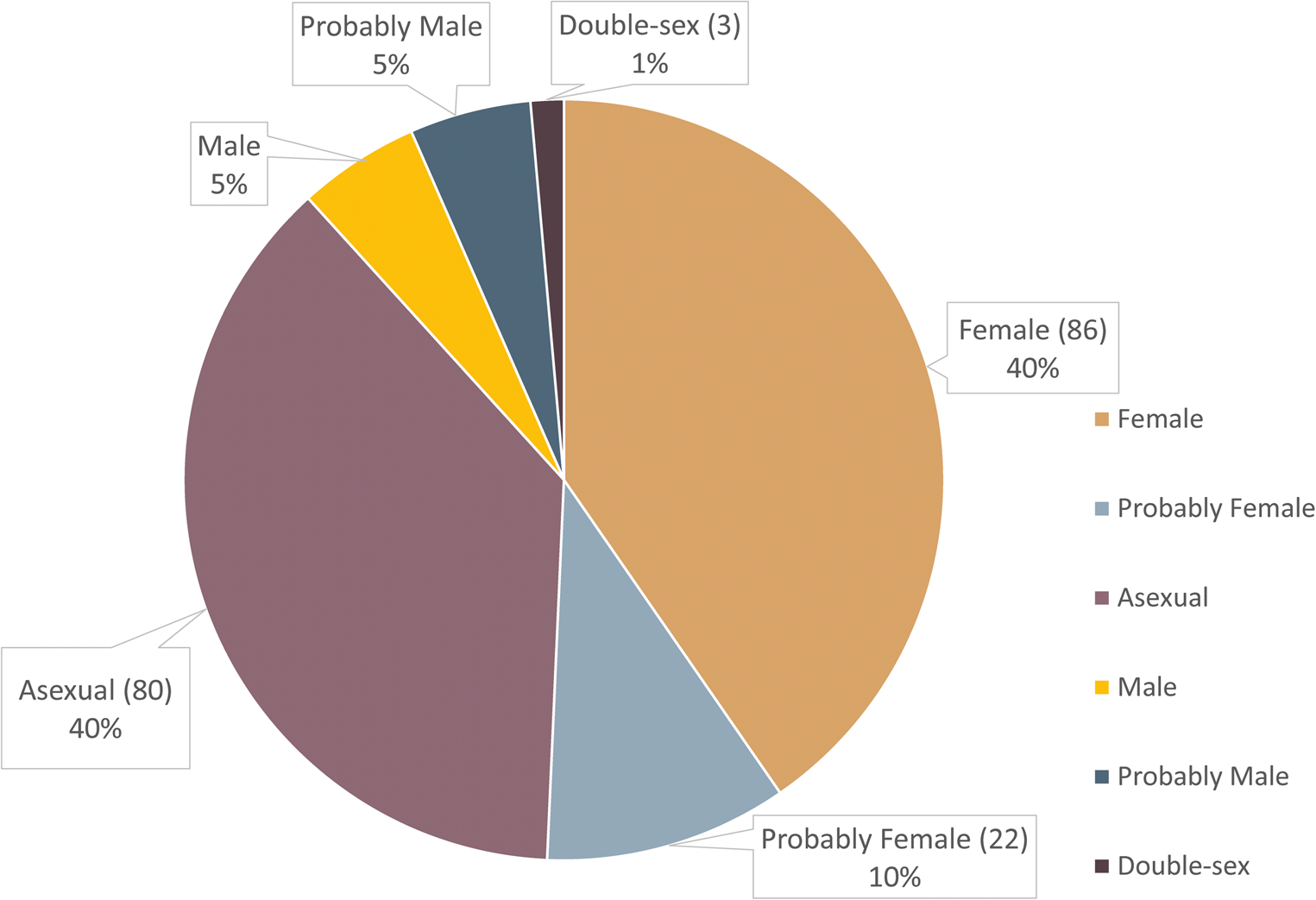
Previous studies have emphasized the predominance of female figurines (e.g. Gimbutas, Reference Gimbutas1982). The analysis of figurines categorized by sexual attributes from Neolithic Crete (126 figurines) and a sample from Thessaly (206) from the Early to Final Neolithic or Copper Age (7000–3500/3000 bc) shows that asexual and female figurines are similar in number (Figure 2). Female and probably female figurines counted together are, however, more numerous, while the number of male figurines is generally low.
Percentage and number of sex categories of Neolithic figurines from Crete and Thessaly.
Are asexual figurines ungendered representations? The archaeological contexts of figurine deposition at Knossos in Crete reveal the appearance of groups of female figurines together with ambiguously sexed (probably male or female) and asexual figurines (Mina, Reference Mina, Isaakidou and Tomkins2008b: 121, fig. 7.4). This is especially the case in Late Neolithic contexts, when figurines are deposited in groups in a small, restricted area (Evans, Reference Evans1964: 238). In those groups, asexual figurines tend to be less than 40 mm high (Figure 3d), while the associated female figurines are always larger (Figure 3a). I suggest that, beyond gender, some asexual figurines may represent young individuals, perhaps children. Ambiguously, sexed figurines with less emphatic and vague sex traits (categorized as probably female and male) perhaps represent prepubescents and adolescents, considering their smaller size (Figure 3b and 3e). Similarly, at Platia Magoula Zarkou in Thessaly, a Late Neolithic house model (ML.PMZ.619) with nine figurines has been interpreted as representing a family (Gallis, Reference Gallis1985) with two couples of males and females and four small asexual figurines depicting children.
a) Late Neolithic female figurine from Knossos; b) Probably female figurine, Knossos; c) Double-sex figurine from Magoula Kouskouro (after Gallis and Orphanidis, Reference Gallis and Orphanidis1996: fig. 125); Drawings of d) asexual figurine and e) probably male figurine from Knossos (after Ucko, Reference Ucko1968: figs. 30, 18). a) Modification of a photo ©Zde, Wikimedia, CC BY-SA 4.0 ; c) by permission of Dr Laia Orphanidis; d) and e) by permission of Amanda Vinson, Assistant Director of the Royal Anthropological Institute.
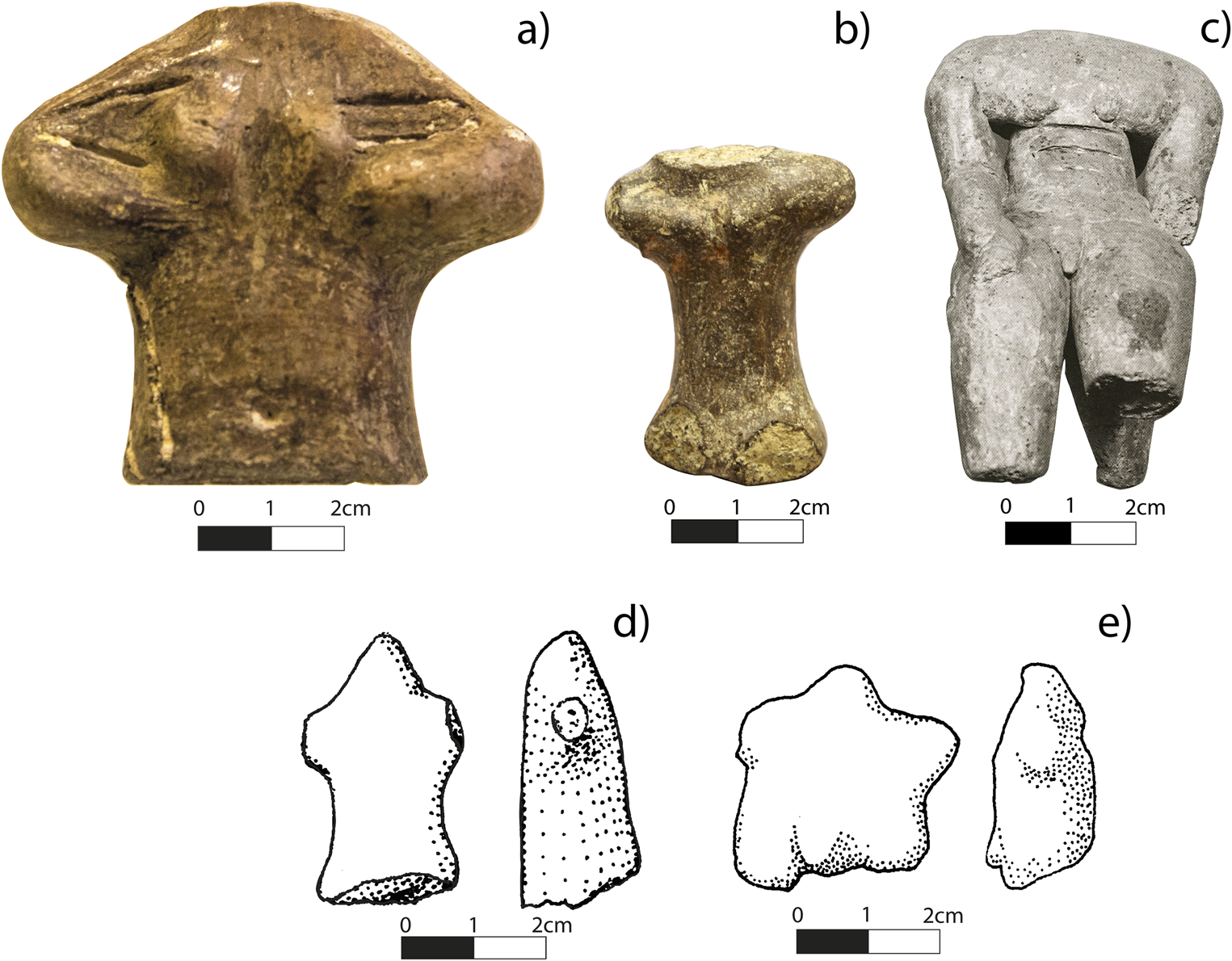
The analysis of sex by date reveals that the number of female figurines remains stable throughout the Neolithic in Crete (Mina, Reference Mina, Isaakidou and Tomkins2008b: 122, fig. 7.6). In Thessaly, the tendency is clear: female figurines are predominant in the Early and Middle Neolithic. In the same period, three figurines from the sites of Zappeio 2, Chara 1, and Nees Karyes show traits of male and female sexes (Gallis & Orphanidis, Reference Gallis and Orphanidis1996). These double-sex figurines are represented with breasts and a phallus and are always in the male posture par excellence: sitting on a stool, perhaps representing a close gender relationship between double-sex and male figurine (Figure 3c). Towards the Late and Final Neolithic, asexual figurines predominate in Thessaly. At the end of the Neolithic, schematic, sexless images dominate the assemblage, perhaps suggesting a lack of interest in gender representation in the context of use of those figurines.
The picture that emerges suggests that figurines from the Late and Final Neolithic Aegean do not show a clear transition towards greater ‘gender binarism’ in the Bronze Age as posited by Robb and Harris (Reference Robb and Harris2018). If anything, the pattern is the opposite in Thessaly and Crete, where the data for the Early Bronze Age show a predominance of asexual figurines (Mina, Reference Mina and Houby-Nielsen2009). Sex and gender are specific to the context of a figurine's use, showing diversity and contextual variety. However, the analysis of the figurine's gender suggests that aspects such as age should be considered to understand possible social differences in Neolithic communities.
A Multi-Layered Gender Approach to Greek Neolithic Figurines
Maria Mina
Gender archaeology has questioned the essentialism of traditional interpretations by highlighting the varied ways in which gender is constructed cross-culturally. Introducing cultural relativism ironically led certain archaeologists to replace gender with the concept of embodied personhood to contest biological essentialism. An a priori assumption, however, that personhood was shaped relationally in all past societies, or that culturally specific perceptions of sex and gender were absent, equally skews archaeological interpretation. As much as we need to acknowledge the possibility of genderless or non-binary models, we should also take into account the prevalent anthropological evidence that gender identity, more likely than not, consists of a biological component (Herdt, Reference Herdt1994: 80).
A way to avoid biological essentialism is to employ sex and gender distinctly and heuristically, in a way that is sensitive to the historical and cultural context under study (Mina, Reference Mina and Ursu2015). Moreover, the interchangeable use of sex and gender by proponents of an embodiment approach prevents us from exploring distinct social phenomena, as sex refers to the way societies conceptualize phenotypic sex differences, whereas gender embodies the social values attached to those differences (Sørensen, Reference Sørensen2000: 54–59; Sofaer, Reference Sofaer2006: 98–99).
Using the concepts of sex and gender analytically allows archaeologists to keep a check on inherent biases, but also to trace the mutable way in which biological differences and gender may inform social identity across time and space. The methodological approach I propose for the study of anthropomorphic figurines of the Greek Neolithic and Early Bronze Age is comparable to a sequence of layers, whose interface can reveal how or whether sex and gender shaped past identities. These analytical layers refer to the representation of the anatomical body, the modelled postures-gestures, the decorative features (garments, adornment, etc.), the position of motifs on the body, and the symbolic use of pigments.
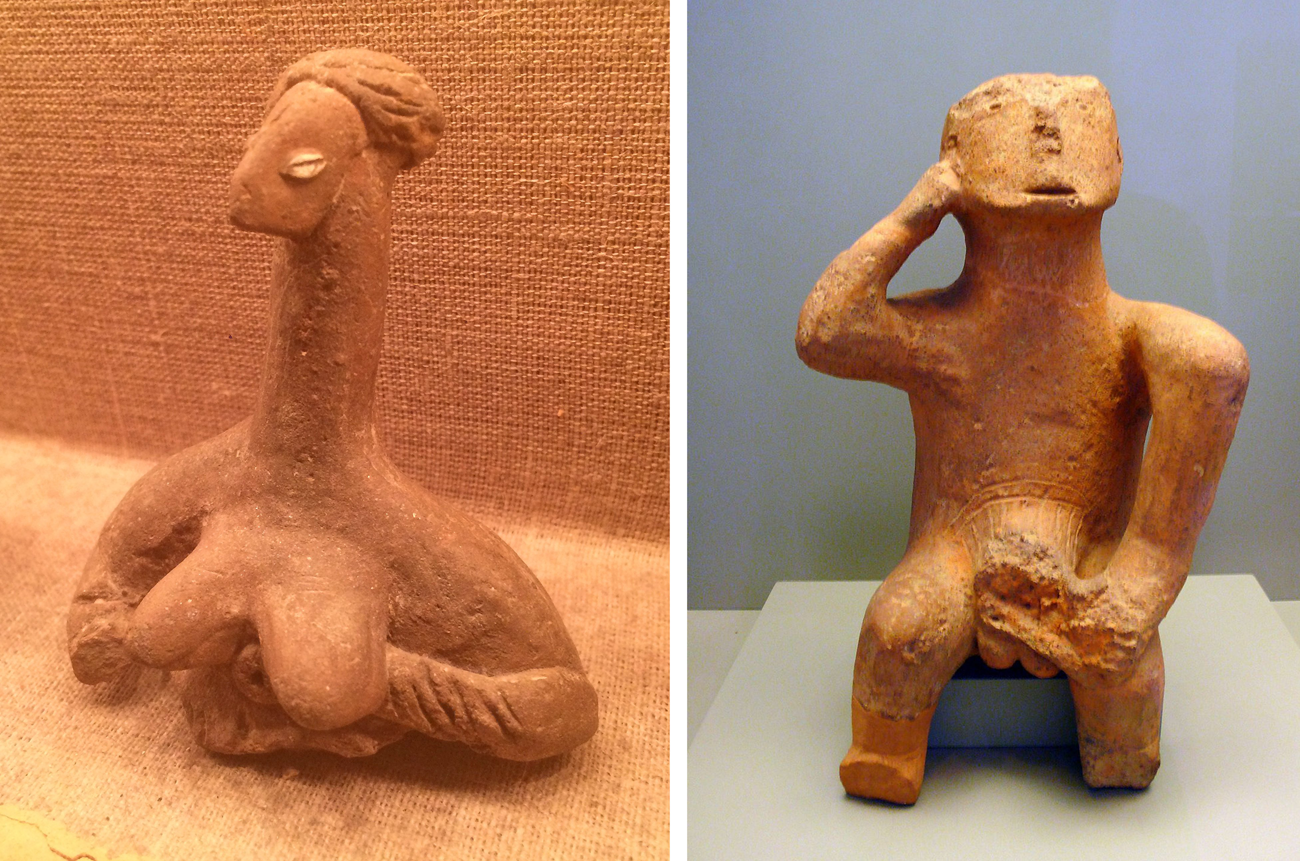
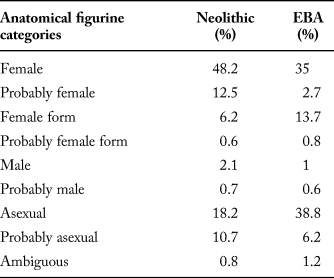
The analysis of over 1094 Neolithic anthropomorphic figurines (Table 2) indicates a predominance of primary (e.g. breasts, genitalia) and secondary (narrow waist-wide hips) reproduction-related features, accentuated further through postural-gestural modelling and decorative motifs (Figure 4; Mina, Reference Mina and Ursu2015: fig. 5). A comparison with 567 Early Bronze Age figurines shows that anatomical features continued to be depicted, albeit in a markedly less emphatic way, and that standardized conventions of body representation in terms of posture-gesture were followed. Asexual figurines in both periods share aspects with other figurine categories, representing age-related stages of female bodies, or summary anthropomorphic depictions; anatomically ambiguous figurines suggest that a non-binary gender system may have been a diachronic trend (Mina, Reference Mina2008a). Although the evidence suggests that gender identities in the Early Bronze Age became more socially constrained, it is not possible to detect social asymmetry. The introduction, however, of distinct burial grounds, the deposition of rich grave goods, and the use of new prestige objects (e.g. daggers) suggests the primacy of socially prescribed collective identities over gender in the Early Bronze Age (Mina, Reference Mina2008a).
Left: Neolithic anatomically female figurine from Thessaly with hands below modelled breasts, in the Archaeological Museum of Volos (H: 8 cm). Right: Neolithic anatomically male seated figurine from Thessaly with hand on modelled genitals, in the National Archaeological Museum, Athens (Inv. 589)4 (H: 4.9 cm). Left image adapted from photo ©Heinrich Stürzl, Wikimedia, CC BY-SA 4.0 ; right image adapted from photo ©Xuan Che, Wikimedia, CC BY 2.0.
Anatomical figurine in Greece classified by type and period.
To conclude, Greek prehistoric cultures are likely to have followed a non-binary gender model. Nevertheless, the cultural perception of anatomical features, sexuality, and reproduction did inform the construction of gender and social identity to a greater or lesser degree. Ultimately, the incorporation of sex and gender as analytic tools in archaeological research allows us to explore pending questions relating to which societies may have included non-binary or genderless models, and why the antagonistic ethos of later prehistoric cultures promoted a stronger adherence to male/female values.
Becoming Gendered or Remaining Gendered?
Eleonore Pape & Nicola Ialongo
Robb and Harris (Reference Robb and Harris2018) formulate a new hypothesis: to put it simply, in the Neolithic, the way in which society defined gender identities did not rely on overarching rules but rather these rules varied from time to time and from place to place based on local perceptions of personhoods. In the Bronze Age, on the other hand, gender was regulated by a dominant ideology, with ‘men’ and ‘women’ possessing well-defined attributes that would make them stand out. In short, gender was ‘contextual’ in the Neolithic and became ‘binary’ in the Bronze Age. This hypothesis introduces a fresh perspective to the debate on prehistoric gender.
The question we briefly address here is how we can test this hypothesis. We propose counter arguments as a preliminary test, aiming to narrow down the potential strengths and weaknesses of this interpretive framework. We will limit the discussion to selected burial sites in central Europe, as they provide abundant evidence to approach the problem. Burials are, in fact, the only archaeological source by which one can observe the correlation of biological sex and socially-defined gender in a closed context. For brevity's sake, we only consider the variables of osteological sex and allegedly gendered grave goods, and leave aside other traits like age, mobility, and status.
Neolithic gender may appear contextual because overarching attributes may not be preserved
Robb and Harris make the case of weapons as masculine attributes par excellence. Bronze Age burials are rich of weapons, which greatly help to identify ‘maleness’. As Neolithic weapons are much rarer and sometimes not easy to interpret, Neolithic maleness is less easy to detect. But what if a large part of weaponry did not survive? Granted, most of the weapons we know from the central European Bronze Age are made of metal, but we also know that, for example, wooden clubs were an important part of real-life warfare, as attested in the battlefield site of Tollense in northern Germany (1300 bc, Jantzen et al., Reference Jantzen, Brinker, Orschiedt, Heinemeier, Piek and Hauenstein2011). If we assume that we do not find wooden weapons in Bronze Age burials simply because they are not preserved, we could make the same argument for Neolithic burials. By reasoning ad absurdum, we could argue that, if we removed weapons, overarching attributes would largely disappear and Bronze Age gender would become more contextual: for example, headgear in Early Bronze Age Austria (2000–1700 bc) is associated with biological females (Neugebauer & Neugebauer, Reference Neugebauer and Neugebauer1997), while in Northern Italy in the Middle Bronze Age (1600–1350 bc) it only occurs in male burials (Salzani, Reference Salzani2005).
Even without overarching attributes, contextual information from Neolithic burials still reveals a binary gender system
The only way to understand the interplay of biologically determined sex and culturally constructed gender in prehistoric burials is to identify them separately and then observe their association. Bioarchaeologists determine sex from skeletal remains, and archaeologists determine gender based on grave goods and burial features: if both traits are associated in a binary pattern, one concludes that gender is binary.
Following Robb and Harris, we take the Early Neolithic burial site of Aiterhofen-Ödmühle in Bavaria, Germany (5500–5000 cal bc), as an example. Its publication (Nieszery, Reference Nieszery1995) provides a detailed account of the sex and gender of 173 inhumed individuals. Twenty per cent of the graves have grave goods whose interpreted gender matches the osteological sex of the individual. In c. six per cent of the graves the archaeological gender does not match the sex of the individuals (e.g. female sex with masculine grave goods). For the remaining seventy-four per cent, there is either no indication at all (33 per cent), or only the sex or the gender is known (41 per cent). The portion of the sample for which we have enough data, i.e. for which we have both sex and gender information, thus consist of twenty-six per cent of the burials. As four out of five of these burials show a correspondence of sex and gender determinations, we must conclude that gender in Aiterhofen-Ödmühle is mainly binary, while recognizing that no information on the articulation of gender exists for seventy-four per cent of burials. This limitation is not exclusive to the Neolithic. For example, the Bronze Age cemetery of Olmo di Nogara in Italy (1600–1200 bc) shows similar figures, with seventy-four per cent undetermined graves (Salzani, Reference Salzani2005). What these figures suggest is that we can only rely on a very small part of the burials to obtain insights into gender conceptions of both Neolithic and Bronze Age societies. However, if we look at this small part it would seem that, even if ‘contextual’, Neolithic gender is still mainly binary.
The pitfall of circular argumentation
Contrary to Robb and Harris, we argue that not only does Neolithic gender ‘slip through our methodological nets’, but Bronze Age gender does as well. If we look closely at how sex and gender are determined in prehistoric archaeology, it becomes apparent that the concepts are seldom separated: for example, masculine grave goods are often used to identify biological men and vice versa.
This practice is extremely common in both Neolithic and Bronze Age studies. In the Neolithic burial site of Trebur, Germany (4900–4600 bc; Spatz, Reference Spatz1999: 181), two individuals assessed as male by osteologists ended up being classified as female because their graves contained feminine attributes. The Late Bronze Age burial site of Neckarsulm in Germany (1350–1200 bc) is always considered a ‘male-only’ cemetery because traditionally feminine grave goods are absent (Knöpke, Reference Knöpke2009) even though only a small part of the burials has ‘secure’ masculine attributes. Moreover, while there are no secure biological women, there are many individuals of uncertain sex. In all, sixty-eight per cent of the burials are of individuals for which either or both sex and gender cannot be determined. This shows that circular arguments are a potential source of bias that must be addressed before proceeding to further interpretation.
Conclusion
We do not suggest that Bronze Age gender is not binary and Neolithic gender is not contextual; rather, we argue that gender can be binary and contextual at the same time. Robb and Harris's hypothesis offers a starting point to bring prehistoric gender back into focus. It still remains to be tested whether or not such a hypothesis is supported by the archaeological evidence.
Sex and Gender of Early Bronze Age Burials in Central Europe
Katharina Rebay-Salisbury
In the Late Neolithic/Copper Age, gendered burial practices first appear in the context of early metalworking societies such as Varna in Bulgaria (4590–4340 cal bc; Krauß et al., Reference Krauß, Schmid, Kirschenheuter, Abele, Slavchev and Weninger2017) and Tiszapolgár-Basatanya in Hungary (4300–4000 cal bc; Raczky & Siklósi, Reference Raczky and Siklósi2013). Around 2900/2800 bc, a second wave of the phenomenon began to extend over large parts of Europe in the context of Corded Ware communities, from the British Isles to the Upper Volga in Russia and as far as western Anatolia (Häusler, Reference Häusler2001; Primas, Reference Primas2008).
The differentiation between men and women in burial practice, i.e. by the way the bodies were placed in the grave in terms of orientation and the side on which the bodies lay, as well as through dress elements and grave goods, remained a key concern of funerary practices in large parts of central Europe until the late Early Bronze Age (2900−1600 bc).
Corded Ware communities placed men and boys on their right side, with the head at the west, in individual graves, whereas they placed women and girls on their left side, with the head at the east; both genders thus faced in the same, southward direction. Through time, a trend for the axis of the body shifting towards a north-south orientation is detectable. Bell Beaker communities, coeval with as well as later than Corded Ware groups, switched sides and buried males on their left side, head at the north, and women on their right side, head at the south; both faced east. This binary ‘Bell Beaker scheme’ remained in place during the Early Bronze Age (2200–1600 bc) in some parts of central Europe, with notable cemeteries including Singen am Hohentwiel in Germany (Krause, Reference Krause1988), Franzhausen and Gemeinlebarn in Austria (Neugebauer, Reference Neugebauer1991; Neugebauer & Neugebauer, Reference Neugebauer and Neugebauer1997), and Branč in Slovakia (Shennan, Reference Shennan1975).
Observing how the burying community placed the bodies provides insights into how prehistoric people perceived, classified, and reacted to different kinds of bodies. The gendered identities expressed in the funerary ritual may align with a person's identity and self-expression, but are first and foremost social classifications and attributions by other members of her or his community. By comparing and contrasting these observations with analyses of the buried individuals’ sex, we can make inferences about the gender intensity of a community (Schmidt, Reference Schmidt, Casella and Fowler2005) and about how important biological sex was for the construction of gender.
Bioarchaeology, in particular the analysis of sex-specific gene segments and sex-specific protein fragments in dental enamel (Stewart et al., Reference Stewart, Gerlach, Gowland, Grøn and Montgomery2017; Parker et al., Reference Parker, Yip, Eerkens, Salemi, Durbin-Johnson and Kiesow2019), has recently contributed to the accuracy of identifying the genetic sex of a buried person. Sex and gender in children before puberty, whose skeletal morphology has not yet developed sufficient sexual dimorphism for a reliable visual or metric sex assessment, can now be included in the analyses (Rebay-Salisbury et al., Reference Rebay-Salisbury, Janker, Pany-Kucera, Schuster, Spannagl-Steiner and Waltenberger2020; Gowland et al., Reference Gowland, Stewart, Crowder, Hodson, Shaw and Grøn2021).
In a recent study we applied nanoflow Liquid Chromatography-tandem Mass Spectrometry (nanoLC-MS/MS) to identify sex-specific peptides in human tooth enamel in seventy children under twelve years old at death from the Early Bronze Age cemetery of Franzhausen I, Austria (Rebay-Salisbury et al., Reference Rebay-Salisbury, Bortel, Janker, Bas, Pany-Kucera and Salisbury2022), and confirmed that the sex of the children corresponds to the gendered body position in 98.4 per cent of cases. This suggests that boys and girls were strictly classified as male or female from a very young age. In adults, for which osteological sex estimations based on skeletal morphology are available, the sex assessment matches the recorded gendered placement in 97.1 per cent of cases. Interestingly, the single exception to the ‘sex equals gender’ rule in children was a sub-adult female, and the exceptions among adult individuals concern eleven females and only two males out of 378 individuals for which osteological sex estimations are available. This may be culturally significant, as it appears that females had slightly more freedom within the constraints of their community to change gender during the course of their lives and to assume different gender roles than their sex predicted.
The exceptions to the rule do not take away from the fact that sex and gender dominate as structuring principles of the funerary ritual, and that biological sex was the basis of a strict binary understanding of gender in many Early Bronze Age communities. And this is indeed an emic perspective—it has little to do with how we interpret gender from our own understanding of gender.
The link between biology and culture in graves is complex. Burial archaeology has developed from the intuitive attribution of gender on the basis of grave goods to juxtaposing biological sex and gender expression, to a holistic contextual analysis of the material construction of femininity, masculinity, and other concepts (Sofaer & Sørensen, Reference Sofaer, Sørensen, Tarlow and Nilsson Stutz2013). This construction may be investigated independently of a buried person's sex, but the investigation of sex and gender together provides insights into the extent to which gender was based on sex, how rigid or flexible sex-based gender systems were, and provides opportunities to investigate exceptions. Scientific approaches that allow a secure sex assessment for children make visible sex-based differential treatment of girls and boys and will allow understanding of how conceptions of gender were transmitted over generations.
Reconsidering Gender in the European Bronze Age
Mark Haughton
I warmly welcome the return to gender which Robb and Harris advocate. As a discipline, we have only scratched the surface in exploring potential variation and nuance in past configurations of gender. While Robb and Harris (Reference Robb and Harris2018) focused primarily on the European Neolithic, their article said as much about the Bronze Age. In this short response, I concentrate first on this supposedly stable Bronze Age foil, and second on ‘contextual’ gender, which Robb and Harris argue characterized the European Neolithic.
Bronze Age gender as ‘mostly binary’ and ‘stable’, in Robb and Harris's terms, has long been the received wisdom. Indeed, the gender dynamics of nineteenth and twentieth century societies set the expectation of male chiefs and metalworkers before the evidence for binaries in burial orientation or furnishing was established. That evidence is far patchier than acknowledged by large-scale ‘grand narratives’; many areas and periods within the Bronze Age do not have binary burial evidence and rock art figures are often as gender ambiguous as the Neolithic art that Robb and Harris review. I argue that it is time scholars of the European Bronze Age grapple with a fundamental question: are local variations simply noise reflecting a lack of evidence, or do they intimate that our understanding of a simple, stable binary needs rethinking?
That the answer might be the latter is neatly illustrated in Scotland, where binary burial patterns occur only in the orientation of the earlier Beaker-associated graves. However, even this pattern was short-lived and lopsided, being stronger amongst the burials of males. Some argue that rare grave goods, such as necklaces and beads, had gendered associations in Bronze Age burials from Scotland (e.g. Sheridan, Reference Sheridan2008), but this is also complicated. For instance, at West Water Reservoir, in the Scottish Borders a child was buried with a complete necklace, in another, at Culduthel near Inverness, a male with a ‘rich’ Beaker assemblage was also buried with a bead (see Haughton, Reference Haughton2022). Given the low overall numbers of such burials, any variants affect the idea of a stable, binary understanding of gender.
The local picture is more complex still. At the Early Bronze Age cemetery at Dunure Road, South Ayrshire (Haughton, Reference Haughton2018), the community followed an established norm in burial practice when cremating the dead, placing them on the pyre with animal remains and worked flint. Children were only buried with adults, but adults could be buried alone or with others. When adults were buried together, the remains of children were always also present. Despite the evidence allowing us to identify these trends, there was no discernible distinction between ‘types’ of adult bodies; both males and females were given the full range of possible treatments.
At the contemporary site of Sketewan in Perth and Kinross, however, the story could not have been more different (Haughton, Reference Haughton2022). Here, the cremated remains of females were buried around a central pyre, sometimes accompanied by the cremated remains of children. At some point, the only male of this first phase was buried with an adult female. Then the entire site was covered by a cairn, and the focus shifted to burying cremated remains immediately south of the cairn. During this second phase, the burials were of males, sometimes accompanied by children. Here, then, the combination of male and female bodies was nearly always avoided, and a place that had been primarily associated with female bodies could only be made a place for male bodies through radical restructuring of the burial ground.
One site (Sketewan) thus speaks of an important distinction between male and female bodies, while the other community (Dunure Road) had no interest in distinguishing between types of adults. In neighbouring Ireland, the evidence for gender is even less frequent, with vague trends in funerary practice suggesting multiple possible small-scale divisions, but nothing that looks like the orientation or provisioning patterns that some other areas of Europe present (Haughton, Reference Haughton2022). It is difficult to square this evidence with the largely stable and binary gender that we have come to expect from the European Bronze Age, and high time, perhaps, to return to the wider evidence.
The concept of ‘contextual gender’ which Robb and Harris propose for the Neolithic is apposite, but it might equally apply to the nuanced picture of the Bronze Age in Ireland and Scotland. Repetitive funerary practices consistently emphasized types of bodies, but this rarely cohered to the binary division of sexed bodies that we might expect. In some communities, however, gender could be more significant and rigid binaries emerged, perhaps reflecting greater divisions in lived experience. In some cases, this may relate to larger, more integrated societies in which abstract concepts helped to define strangers, but not always, as the Scottish site of Sketewan suggests.
Crucially, I do not think the evidence suggests a linear development of gender with a binary understanding replacing a contextual one. Indeed, varying and ‘contextual gender’ seems to have been prevalent into the European Iron Age (Pope, Reference Pope2022). From this perspective, it is modern ideas of rigid and unchanging gender that are the clear outlier. We must therefore return to the evidence from the European Bronze Age and embrace its ambiguities and nuances. The destabilizing of binary gendered identities throughout prehistory is of critical importance to producing archaeologies that are: a) in closer accord with the range of evidence we have; b) closer to the reality of the human past; and c) appeal to people uninspired by tired binaries. While Robb and Harris have taken significant steps in this direction for the European Neolithic, a reconsideration of the Bronze Age evidence in its breadth and depth is surely overdue.
Rethinking Neolithic and Bronze Age Gender: Facing the Challenges
John Robb & Oliver Harris
Rethinking gender
The complexity of past gender is one of archaeology's most challenging conceptual issues, one that lays bare our assumptions and carries relevance to life outside academia. Rethinking complexity usually unfolds through the interplay of many views rather than from a single programmatic pronouncement. We are proud to take part in this process of collective thinking.
Our original article sought to articulate a high-level general reformulation, and in doing so we aimed to provoke renewed discussion of Neolithic and Bronze Age gender. This has clearly been achieved! We do not have space here to respond in detail to every view above. Instead, we place both our argument and responses to it within the bigger issues of gender and scale.
Empirical evidence: examining the breadth
At the heart of our model is a simple empirical generalization, based on a broad overview of extant evidence. As Gaydarska and others point out, new data, particularly molecular methods, will inevitably broaden and change the picture. Nonetheless, we have to work with the evidence available at present.
Our single biggest empirical claim is simply that we can use archaeological data to actually say something general about Neolithic gender. In other words, the fact that Neolithic gender shows a patchy, elusive, highly varied picture is not (as has traditionally been assumed) because the Neolithic evidence is somehow defective in a way from which Bronze Age evidence is magically exempt. Instead, this tells us something genuine about Neolithic gender: the picture is there, it just does not match our expectations about what evidence for gender should look like. This is an empirically-driven argument. Archaeologists have created a huge mass of potential evidence: let us use it.
But how? Traditionally, archaeologists have selectively focused on the bits that look like gender to us. For example, Bickle and Hofmann emphasize the admirable vibrancy of Linearbandkeramik gender research, something that Pape and Ialongo also illustrate. But it is important to look at the broad panorama and at silences as well as presences. The reason LBK gender is more intensively discussed than, say, gender in Neolithic Denmark, Britain, Italy, Spain, or Greece is that this specific ‘culture’ is one of very few areas that fits our pre-existing expectations of what evidence for gender should be, such as cemeteries with single burials and grave goods. Almost nowhere else in Neolithic Europe could one do a similar study. In contrast, for the Bronze Age, such analyses could be repeated. The pattern Rebay-Salisbury's example of Franzhausen I reveals, for instance, is visible repeatedly across Bronze Age Europe in multiple contexts; it is a clear pattern even if many cemeteries contain exceptions to standard forms of burial (e.g. Matić, Reference Matić2012). We can go well beyond funerary evidence to include representations, material culture, and more. When it comes to gender, something fundamental has changed.
Beyond this, the question is also about the coherence of the narrative that emerges. For example, archaeologists in virtually all theoretical schools for the last century have recognized that there was a large-scale social transformation in the third millennium bc; many of them also connect this with the emergence of new kinds of gendered persons in Bronze Age Europe. Whatever the theoretical spin, there is an empirical core to the idea that there was great social change at this point and that it involves gender. In contrast, for the Neolithic, even evidence which fits canonical criteria for gender archaeology is poorly integrated into any interpretive picture. Studies of Neolithic figurines in the Balkans, for example, have shown that what they really reveal is the absence of a dominant gendered imagery (Milenković & Arsenijević, Reference Milenković and Arsenijević2010; Lazić, Reference Lazić2015; Vuković, Reference Vuković2021) and, while this has been successfully used to critique ‘Goddess’ narratives, they have not provided an overall alternative model.
The issue of binarism seems to provoke particularly strong reactions. When we say that Bronze Age gender had a ‘binary’ component, we are asserting that people in the Bronze Age consistently recognized two contrasting kinds of people: men and women. We believe that most Bronze Age archaeologists would find this relatively uncontroversial, based on recurrent patterning in burials, iconography, and material culture. We are explicitly not saying that these were the only two kinds of people Bronze Age communities recognized, or that these categories of person structured all social contexts. Analyses of cemeteries like Mokrin in Serbia show that, although 304 of the 312 burials match expected gender patterns of burial orientation and grave goods, important exceptions will always exist (Porčić, Reference Porčić2010; Matić, Reference Matić2012). We would share with colleagues a resistance to any claim that any gender system is totalizing, excluding all alternatives, or is in some way ‘natural’, ‘universal’, or inevitable. Even the appearance of this binary component, we argue, cannot necessarily be said for the Neolithic. As Ghisleni et al. (Reference Ghisleni, Jordan and Fioccoprile2016) rightly submit, the key is to approach the evidence without a priori assumptions of how gender works, making it possible for differences to emerge within and between our categories of evidence. This allows for a situation in which the past is no longer simply either ‘binary’ or not, but rather where degrees of binary concepts can emerge more or less strongly at different moments in time.
The point emerging from the empirical evidence is not that Neolithic gender was complex and diverse, varied and emergent, and Bronze Age gender was simple and prescriptive. Both were complex, but in distinct and importantly different ways. Realizing this gives us a starting point for more in-depth analyses, for instance combining the study of gender with intersectional issues including age and personhood (see Rebay-Salisbury's and Chapman's contributions, and older contributions as well e.g. Joyce, Reference Joyce2000).
Scale and variation
Scale of analysis is a chronic issue throughout historical studies. The past does not operate on a single level, and we must be able to see empirical data at multiple scales. Of course, nobody wants to impose rigid macro-patterns on data which do not fit. But conversely, there are some pictures that can only be seen clearly from a distance. Whether we are interpreting a single pit with multiple fills, a site comprising multiple features, a regional landscape, a continent, or the history of the world, we are constantly required to move between different scales of analysis. Any analysis depends on wider scale comparisons to explore similarity and difference. The existence of widespread similarities, however, does not require us to demand uniformity or efface difference. We can discuss shared elements of belief across Christian medieval Europe without denying differences in liturgy and experience, or the existence of Jews or Muslims in that context. Ethnographers know this: however unique one group is, they always contextualize it in the broad regional background which, indeed, supplies the raw materials for local difference.
What does this mean for gender? Even the most postmodern or locally focused of analysts inevitably begin by placing their studies within some broad-brush characterization, even if they then stress ways in which their own group's gender differs from it. Such general models are not prescriptive, but define the structural possibilities, the shared space of potential that could be made real in different ways. In our case, they help us imagine the range of gendered possibilities existing in Neolithic or Bronze Age Europe; they do not demand that every individual, site, or region follow precisely the same rules. Thus, we do not reduce Neolithic gender to one thing, and Bronze Age gender to another (see Gaydarska et al.'s introduction), nor attempt to suppress the variation in Neolithic gender (see Bickle and Hofmann's contribution). What we are attempting to do, instead, is to distil the underlying logics that played out locally in many different ways.
Generalizations always provoke the question of how much they are invalidated by specific counterpoints; negotiation with counter-examples is an important means by which generalizations weather and mature over time (cf. Matić, Reference Matić2010). Haughton, for example, compares two Bronze Age Scottish cemeteries, one with gender binaries and one without. Do these two examples invalidate our broader claims? Similarly, does the absence of emerging binary gender in figurines from one part of Europe disprove a continental-wide, millennia-long emergence of new forms of gender, as Ramírez Valiente suggests? Our answer is no. First, there will be a great deal of variation at continental scales. Just as zooming into one piece of mosaic will not reveal a whole picture, specific counter-examples do not disprove a wider set of readings. Second, some exceptions also support generalizations. Half of Haughton's Bronze Age case studies offer a binary view of gender. How many sites in Neolithic Scotland would do the same? As we suggested at the start of this section, even this question is misplaced. Archaeology is always multi-scalar; the issue is with how open we are about this, and how we handle that aspect of our data. Overall, we suspect that reinvigorated research on this question will inevitably reveal some contexts where Neolithic gender takes a more binary form (see Pape and Ialongo) and some in which later manifestations of gender is not obviously marked as binary; but—much as in our own society today—such cases will provide valuable insight into the complexities of how gender works on the ground rather than overturning the larger generalization about the changing structure of gender.
The politics of writing gender
One final question is whether we actually have an obligation to write the history of gender at scales sometimes above our comfort level. If we abandon the large-scale panoramas, other people will write these histories, and they will be uninformed by evidence, theoretically retrograde, and often related to political agendas. We need to provide well-grounded, authoritative alternatives to visions of Neolithic goddess-worshipping matriarchies and marauding Bronze Age supermales. We may also have an obligation to the people we study, to give them the same rights to history as other ethnographic subjects enjoy. Do we assume that they have no regional heritage, no cultural specificity beyond the purely local level? Not only would that make them alone in history; it would also risk implicitly interpolating our own universalist views.
The single largest claim we make is simple: gender does not have to be the same in all periods. Not just differing in its content, but in its very definition, which may change slowly in a deep-time big history. We see this as theoretically indisputable, a logical extension of the entire field of gender studies. This means that we have no need of absolutes: no need to argue that gender is always performative (as Augereau and Nordholz state) or that we are required to reinstate the sex/gender dichotomy (as Mina suggests). The fact that this might force us to come up with more creative, context-specific ways of understanding gender is our problem, not gender's. Extrapolated to today's settings, this means that we must explicitly disavow any ‘originalism’, i.e. the idea that if ancient people did x, x was somehow ‘natural’ or inevitable. History is not law; it does not work on precedent. Instead, if there is a take-home message for today's gender politics, it is the historical situatedness of gender. Gender studies began, understandably, by making universal definitions about the forms gender must take. The time has come to recognize that even such definitional forms must change and evolve, even if this unfolds in timescales greater and slower than those about which we are accustomed to thinking. This insight is not confining; it liberates us. In the story of change in how humans have lived, there is the possibility that we can be free of the pasts, to be, as feminist scholars have argued, the way we hope to be today.


 Open access

