


1. Introduction
Additive manufacturing is poised to transform the food industry by enabling the precise design and production of food products tailored to specific sensory and nutritional requirements (Varvara et al., Reference Varvara, Szabo and C.2021). Among the various food materials explored for 3D printing, starch and protein-based formulations have gained significant attention due to their versatile functional properties, including structural stability, textural control, and nutrient density. Extrusion-based 3D food printing, in particular, facilitates the creation of complex geometries and textures, enhancing the appeal and functionality of food products (Hussain et al., Reference Hussain, Malakar and K.2022). A critical challenge in 3D food printing lies in achieving shape fidelity, by ensuring that the printed structures closely match the original design. This challenge, common to many additive manufacturing techniques, is especially relevant in extrusion-based processes (Feng et al., Reference Feng, Li, Zhu, Thakur and Wei2021; Minnoye et al., Reference Minnoye, Tajdari, Doubrovski, Wu, Kwa, Elkhuizen, Huysmans and Song2022), which are widely applied in food printing (Booth et al., Reference Booth, Alperovich, Chawla, Ma, Reid and Ramani2017; Huang et al., Reference Huang, Chen, Jiang, Zou, Li, Liu and Yu2020). In complex shape printing, shape fidelity—the degree of conformity between the printed part and its original CAD design—has emerged as a critical quality parameter (Scheele et al., Reference Scheele, Hartmann, Siegrist, Binks and Egan2022). The rheological and mechanical properties of the printing ink play a decisive role in determining the shape fidelity of the final printed structure.
The rapid advancements in 3D food printing technologies have opened new frontiers in designing innovative and functional food products. By leveraging precise material deposition and customization capabilities, these techniques have transformed the way food is produced and tailored to meet diverse consumer needs. Starch-based ingredients, such as mashed potatoes, and protein-rich components, like pea protein, offer promising solutions for printable food inks. Their ability to form structured networks during printing enhances both mechanical stability and textural properties, making them suitable candidates for achieving high shape fidelity in complex geometries. Advanced techniques like extrusion-based printing, inkjet printing, and binder jetting enable the creation of intricate and customizable food products, including candy, chocolate, pasta, and bio-printed meats (Moparthi et al., Reference Moparthi, L, Karyappa and Upadhyay2024; Sharma et al., Reference Taneja, Sharma, Ayush, Sharma, Mousavi Khaneghah, Regenstein, Barba, Phimolsiripol and Sharma2023; Taneja et al., Reference Sharma, Nath, Hazarika, Ojha, Nayak and Sridhar2022). These technologies support applications in personalized nutrition, sustainable food production, and waste reduction (Hamilton et al., Reference Hamilton, Mirmahdi, Ubeyitogullari, Romana, Baum and Gibson2024; Zhu et al., Reference Zhu, Iskandar, Baeghbali and Kubow2023). However, ensuring nutritional quality, meeting regulatory standards, and addressing consumer acceptance remain critical challenges for the adoption of 3D food printing technology (Zhong et al., Reference Zhong, Lewis, Sim, Bondonno, Wahlqvist, Mugera, Purchase, Siddique, Considine and Johnson2023; Zhu et al., Reference Zhu, Iskandar, Baeghbali and Kubow2023).
The proposed design process illustrated in Figure 1 outlines a systematic workflow for developing and optimizing food inks tailored for 3D printing (Khalil et al., Reference Khalil, Maleky, Pal and Egan2024). The approach integrates ingredient selection based on functional and sensory attributes with the evaluation of formulation parameters like water content, texture modifiers, and pH. Starch and protein-based inks require careful formulation adjustments to maintain extrusion consistency while achieving structural integrity. The balance between water content, textural properties, and mechanical stability is critical for ensuring printability and shape fidelity in complex designs. Key textural properties, such as firmness and adhesiveness, are measured to determine printability and shape fidelity, while CAD designs assess performance under varying geometrical constraints, including overhanging structures. Determining the success of prints in achieving their design shapes requires consideration of the ingredients and mechanical properties used to form a food ink.
Process flow of the 3D printing

Among the key factors influencing 3D food printing outcomes is shape fidelity, which reflects how accurately the final printed food replicates the original design specifications (Chirico Scheele et al., Reference Chirico Scheele, Binks, Christopher, Maleky and Egan2023; Scheele et al., Reference Scheele, Hartmann, Siegrist, Binks and Egan2022). Shape fidelity is influenced by mechanical properties of foods, such as firmness and adhesiveness, and process parameters like printing speed, nozzle size, and layer thickness (Derossi et al., Reference Derossi, Caporizzi, Azzollini and Severini2018; Hao et al., Reference Hao, Mellor, Seaman, Henderson, Sewell and Sloan2010). Recent studies have explored various food materials, such as mashed potatoes and pea proteins, to optimize textural and chemical properties for improved printability. For instance, (Zhang et al., Reference Zhang, Lou and Schutyser2018) demonstrated that incorporating xanthan gum enhanced the structural stability of 3D-printed mashed potatoes, while (Jiang et al., Reference Jiang, Zheng, Zou, Tong, Han and Wang2019) showed that adjusting protein concentration and printing temperature improved the shape fidelity of milk protein concentrate formulations. The addition of water to the food materials controls the textural and rheological properties during 3D printing process. While higher water content enhances flowability and facilitates smooth extrusion, it simultaneously reduces structural integrity, posing challenges in maintaining shape fidelity during printing. It is important to balance between the addition of water and mechanical properties (textural and rheological) of the food inks that form materials for printing.
Chemical properties, including pH and moisture content, further influence the printability and structural integrity of food inks. Optimal moisture levels, such as 70-78% for potato-based pastes, improve extrusion and shape retention (Nei et al., Reference Nei, Ando and Sotome2022). Similarly, pH adjustments can affect visual appeal and structural properties, as seen in anthocyanin-containing foods where lower pH levels result in more vibrant colors (Castañeda-Ovando et al., Reference Castañeda-Ovando, de Lourdes Pacheco-Hernández, Páez-Hernández, Rodríguez and Galán-Vidal2009; Choi et al., Reference Kan, Vargo, Machover, Ishii, Pan, Chen and Kakehi2017; Kan et al., Reference Choi, Lee, Lacroix and Han2017). These chemical and mechanical factors are critical for achieving structurally stable and aesthetically appealing 3D-printed food products and thus merit investigation to inform design decisions in creating printable food inks.
This study focuses on improving the formulation of 3D printing inks to achieve high shape fidelity, particularly in overhanging structures. Mashed potato and pea protein were chosen as representative starch and protein food materials due to their functional properties for high printability while enabling customized nutrition. Using these materials, water content is systematically varied to assess its impact on printability and structural integrity. The inks are characterized by their textural properties, including firmness and adhesiveness, to provide insights into their behavior during printing. The workflow encompasses ink preparation, CAD design, 3D printing, and mechanical characterization, aiming to identify optimal formulations for precise, stable 3D-printed food structures and the printing of the complex shape using the best printing conditions. By enabling the production of intricate, nutrient-rich food designs with enhanced structural stability, this work contributes to advancing personalized nutrition and addressing dietary needs by enabling the design and fabrication of complex food shapes. The findings also provide a novel framework for integrating material science with food design, thereby expanding the possibilities for sustainable and health-focused applications in 3D food printing.
2. Materials and methods
2.1. Ink preparation
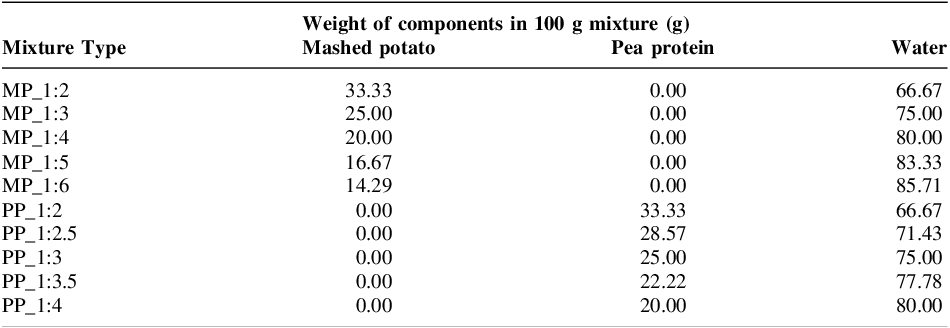
The food inks for 3D printing were prepared using mashed potato flakes (Great Value) and pea protein powder (Now SPORTS), combined with bottled water (Kirkland Signature). The mashed potato flakes contained 82% carbohydrates and 9% protein, while the pea protein powder comprised 3% carbohydrates and 73% protein. To determine optimal printability, various ratios of ingredients to water were tested. Table 1 lists the required amounts of each component to prepare a 100g mixture.
The amount of the mixture components in 100 g of the total mixture

All mixtures were prepared using a standardized protocol, as outlined in previous work (Khalil et al., Reference Khalil, Maleky, Pal and Egan2024). Water was first heated to 65°C to facilitate mixing with the dry ingredients. The mashed potato flakes and pea protein powder were each combined with the heated water in the specified ratios to prepare the mixtures. Following preparation, all mixtures were allowed to cool to room temperature (∼25°C) for 20 minutes before being loaded into syringes for printing. This cooling step ensured temperature uniformity across all samples prior to printing. The systematic variation in water ratios for each mixture type was implemented to provide an evaluation of how different ingredient proportions affect the printing process and final product quality.
2.2. Shape design
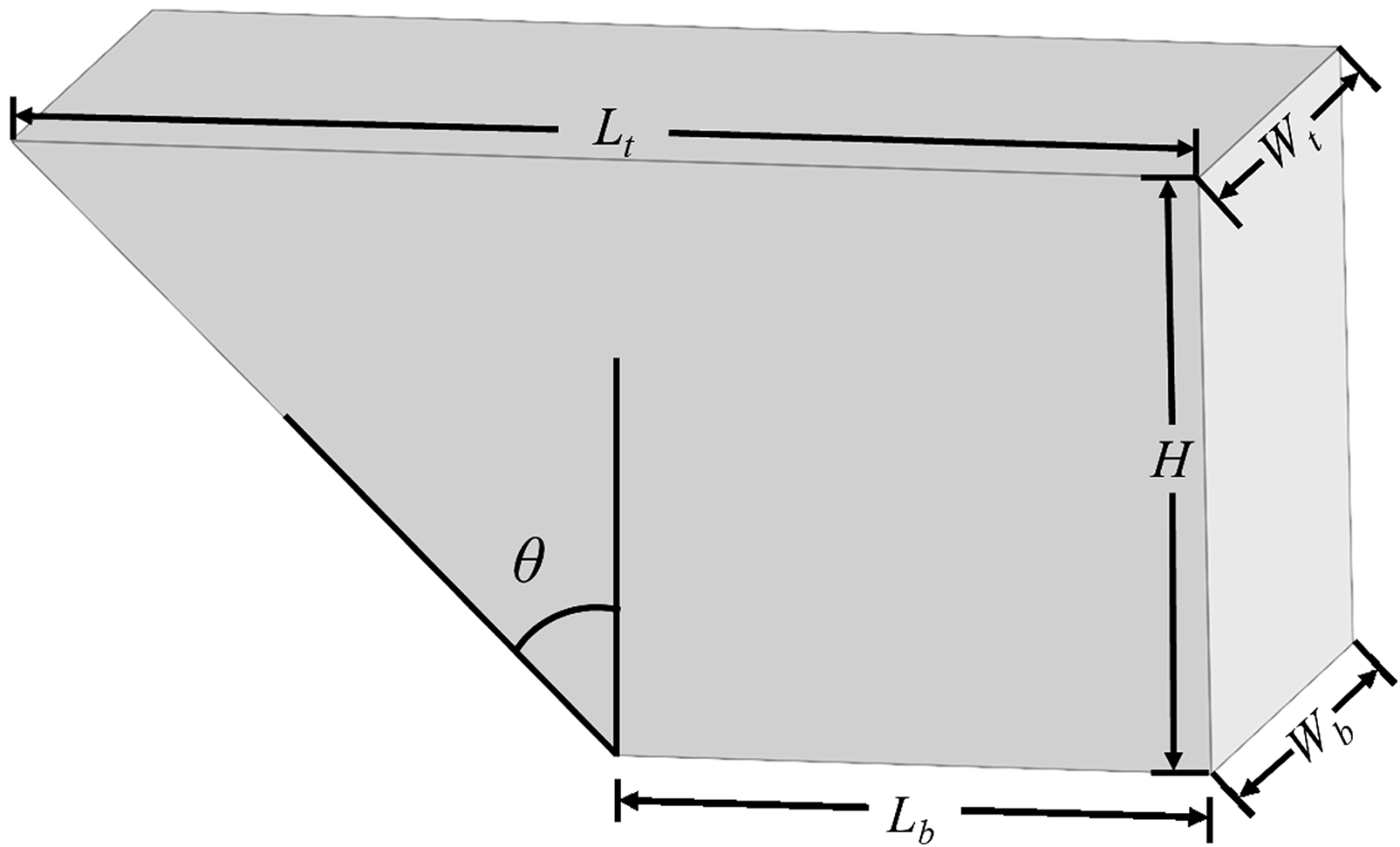
The CAD design for the 3D printing experiments was created with specific dimensions to evaluate shape fidelity under different conditions (Fig. 2). The design maintained consistent measurements for the bottom length (Lb), bottom width (Wb), top width (Wt), and height (H), all set at 20 mm. The primary variable was the overhang angle (θ), defined as the angle between the inclined plane and the vertical direction. The top length (Lt) of the printed structure varied proportionally with the overhang angle. In this study, two overhanging angles (0° and 60°) were investigated to assess their impact on fidelity.
2.3. Printing process
The 3D printing process was performed using the Procusini 3.0 Double System (Print2Taste, Germany), a food printer capable of processing standard CAD files and custom food materials. The CAD models for printed geometries were designed in SolidWorks and exported in STL format, a widely used file type for 3D printing. These STL files were then imported into the Procusini 3.0 slicing software, which is specifically designed for food printing applications. The software automatically converts the STL geometry into a specified set of directions the printer can process, generating the toolpath required for precise extrusion. The printer used a 1.2 mm diameter nozzle with a consistent printing speed of 10 mm/s. The nozzle movement speed was adjustable, ranging from 5 mm/s to 200 mm/s. During printing, the extrusion temperature was maintained at 25°C to preserve the rheological properties of the food ink. The layer height was set to 0.55 mm, with an infill density of 50%. High-resolution (3840 × 2160 resolution) images of the printed samples were captured using Olympus Tough TG-6 4K digital camera retained at a fixed distance.
Overhanging design with different design parameters. ‘θ’ denotes the overhanging angle

2.4. pH measurement
The pH of each mixture was measured using an Apera Premium Series PH60S pH tester (INSTRUMENTS), a precision instrument suitable for food science applications. Before each measurement session, the pH tester was thoroughly cleaned with distilled water and calibrated with manufacturer-provided standard solutions to ensure accuracy. For each measurement, the glass bulb sensor of the cleaned and calibrated instrument was fully immersed in the freshly prepared printing mixture. To ensure reliability and account for potential variations, three pH readings were taken for each mixture type, and the average of these triplicate measurements was recorded as the representative pH value for each formulation.
2.5. Moisture content analysis
Moisture content, a key parameter affecting print fidelity, was measured using a Torbal ATS 60 moisture analyzer (Torbal). Samples were prepared according to the protocol outlined in Section 2.1, with approximately 5 g of food ink evenly distributed in disposable aluminium pans for individual testing. The analyzer was set to a drying temperature of 150°C, following a standard drying profile for all tests. Moisture content was calculated using the formula:
 $$Moisture \ Content(\% ) = {{m_i - m_f } \over {m_i }} \times 100\% $$
Here, mi and mf are the initial weight and final weight of the sample, respectively.
2.6. Texture property analysis
Texture analysis of the prepared mixtures was performed using a texture analyzer (TA.XTPlus Connect, Texture Technologies Corp., and Stable Micro Systems, USA) (Corp., Reference Corp.2024). The mixtures were prepared according to the procedure outlined in Section 2.1, with each food ink loaded into a custom-printed cylindrical tube for testing. A cylindrical probe with a diameter of 0.5 inches and a length of 35 mm was used for the texture analysis. Compression tests followed standard methods in food science research [23, 58], with testing parameters set at pre-test and test speeds of 1.5 mm/s, a post-test speed of 10 mm/s, and a compression distance of 18 mm. Texture properties, specifically firmness and adhesiveness, were determined from the force vs. time measurements (Álvarez-Castillo et al., Reference Graça, Raymundo and de Sousa2021; Graça et al., Reference Álvarez-Castillo, Oliveira, Bengoechea, Sousa, Raymundo and Guerrero2016). Firmness was measured by the peak force recorded during the compression test, which indicates the material’s resistance to deformation. Adhesiveness was calculated by measuring the negative area under the curve, representing the work required to extract the probe from the material and reflecting the material’s resistance as the probe is withdrawn. This analysis provides insights into the textural properties affecting the printability and shape retention of the food inks in 3D printing.
3. Results and discussion
3.1. Shape fidelity analysis
3.1.1. Mashed potato printing
The shape fidelity of 3D-printed mashed potato structures was evaluated using two overhang angles (0° and 60°) across different mixture ratios (Figure 3). The results demonstrated a clear correlation between mixture printed shape and the water content in the mixture. At 0° overhang, structures printed with MP_1:2 and MP_1:3 mixtures exhibited poor shape fidelity due to their low water in the mixtures. The lower water content also led to inconsistent extrusion and frequent filament breakage, resulting in gaps and structural discontinuities.
Variation of the printed shape of overhangs using mashed potato at two overhang angles (0°, 60°) and different concentrations

The MP_1:4 mixture achieved high shape fidelity at both 0° and 60° overhang angles, attributed to its balanced water content in the mixture. This composition allowed for smooth extrusion while maintaining sufficient structural integrity to support subsequent layers. The moderate adhesiveness facilitated proper layer bonding without causing excessive deformation, particularly crucial for the 60° overhang structures where layer-to-layer adhesion significantly impacts structural stability. However, mixtures with higher water content showed deteriorating shape fidelity, particularly evident in the 60° overhang structures for MP_1:6 formulation. The high-water percentage resulted in significant sagging and deformation demonstrating that higher water content reduces the structure’s stability.
3.1.2. Pea protein printing
The shape fidelity analysis of pea protein structures revealed distinct printing behaviour patterns across different mixture ratios (Figure 4). At 0° overhang, PP_1:2 and PP_1:2.5 mixtures demonstrated poor printability despite their low moisture content. The low moisture content resulted in excessive material stiffness, leading to irregular extrusion and compromised layer formation. These issues were particularly evident in the surface quality of the printed structures, which showed visible inconsistencies and gaps.
Variation of the printed shape of overhangs using pea protein at two overhang angles (0°, 60°) and different concentrations

Both PP_1:3 and PP_1:3.5 mixtures emerged as the best formulations for achieving superior shape fidelity in both 0° and 60° overhang angles. Their balanced moisture content facilitated consistent material flow during extrusion while providing sufficient structural integrity. This balance was particularly critical for 60° overhang structures, where gravitational effects posed greater challenges due to the increased size of the overhang. For the 0° overhang, PP_1:3.5 demonstrated slightly better surface quality, ensuring smoother and more uniform finishes. However, for the more demanding 60° overhang, PP_1:3 exhibited superior structural stability.
Mixtures with higher water content (PP_1:4) showed progressively decreasing shape fidelity, especially noticeable in the 60° overhang prints. The increased moisture content and corresponding reduction in structural stability resulted in significant structural deformation. This effect was particularly evident in the overhanging sections, where the reduced material strength could not adequately support the cantilevered geometry.
3.2. pH and moisture
The pH and moisture content of mashed potato and pea protein mixtures were measured to evaluate their influence on the printability, texture, and shape fidelity of 3D-printed structures (Table 2). The initial pH of water was 7.77 ± 0.03, slightly basic. For mashed potato mixtures, the pH ranged from 5.66 ± 0.02 to 5.80 ± 0.01 across water content ratios of 1:2 to 1:6. This slightly acidic pH, typical for potato-based mixtures, may enhance sensory appeal with a tangy flavour while influencing texture and ingredient stability. In contrast, the pea protein mixtures exhibited a near-neutral pH range from 6.94 ± 0.01 to 7.06 ± 0.01, which preserves protein structure, contributing to improved textural and sensory properties and maintaining consistency during printing.
Data collection of pH of pea protein and mashed potato mixture at different ratios

Moisture content, a critical factor affecting rheological properties and shape fidelity, was systematically varied in both mixtures (Table 2). Mashed potato mixtures showed a broad moisture range from 70.26 ± 0.20% (1:2 ratio) to 86.56 ± 0.29% (1:6 ratio). The ideal moisture content was identified as 81.16 ± 0.16% at a 1:4 ratio, which balanced extrusion flowability and post-extrusion structural integrity, ensuring high shape fidelity (Figure 3). Mixtures with lower moisture content (e.g., 1:2 and 1:3) were excessively viscous, causing nozzle clogging and filament breakage, resulting in incomplete or collapsed structures. Conversely, higher moisture levels (e.g., 1:5 and 1:6) reduced viscosity, leading to sagging and deformation, particularly in overhang geometries.
Similarly, pea protein mixtures exhibited moisture content ranging from 68.10 ± 0.10% (1:2 ratio) to 80.60 ± 0.05% (1:4 ratio). The best range was found between 76.16 ± 0.03% (1:3 ratio) and 78.43 ± 0.03% (1:3.5 ratio), which provided a favourable balance of flowability and structural integrity for shape fidelity (Figure 4). Mixtures with lower moisture content (e.g., 1:2 and 1:2.5) exhibited high rigidity, leading to filament breakage and poor extrusion, while higher moisture content (e.g., 1:4) caused structural instability, resulting in deformation and poor shape retention.
Figures 3 and 4 illustrate how moisture content influences the fidelity of overhang geometries. For both mashed potato and pea protein mixtures, moisture levels between 75% and 80% consistently provided superior shape fidelity, supporting smoother extrusion and stable layer formation while maintaining the structural integrity required for complex geometries. This range represents a robust design guideline for future ink formulations aimed at achieving high-quality 3D-printed food designs.
3.3. Textural properties
The texture analysis of mashed potato and pea protein mixtures provided critical insights into their firmness and adhesiveness, key properties that influence extrusion behaviour and layer bonding during 3D food printing (Figure 5). Firmness determines the material’s resistance to deformation, ensuring structural integrity, while adhesiveness reflects the work required for layer separation, affecting inter-layer bonding and shape fidelity. For mashed potato mixtures (Figure 5a), increasing water content from a 1:2 to a 1:6 ratio led to a significant reduction in firmness and adhesiveness. Firmness decreased from approximately 4.82 N to 0.52 N, while adhesiveness declined from 2.73 N·s to 0.29 N·s. This inverse relationship between water content and textural properties aligns with findings by (Chirico Scheele et al., Reference Chirico Scheele, Binks, Christopher, Maleky and Egan2023), who demonstrated that higher moisture content in mashed potatoes reduces structural integrity in 3D-printed objects. Mixtures with lower water content (e.g., 1:2) exhibited higher firmness and adhesiveness, leading to challenges during extrusion, such as nozzle clogging and filament breakage. In contrast, mixtures with higher water content (e.g., 1:5 and 1:6) exhibited insufficient structural stability, causing sagging and deformation, particularly in overhang designs. The optimal balance for mashed potato mixtures was observed in one of the intermediate formulations (MP_1:4), where moderate firmness and adhesiveness allowed for smoother extrusion, better layer bonding, and improved shape fidelity.
Pea protein mixtures (Figure 5b) followed similar trends but exhibited higher firmness and adhesiveness values compared to mashed potato mixtures at equivalent water content ratios. As the water ratio increased from 1:2 to 1:4, firmness decreased from approximately 8.12 N to 0.69 N, and adhesiveness dropped from 2.10 N·s to 0.33 N·s. These results are consistent with (Álvarez-Castillo et al., Reference Álvarez-Castillo, Oliveira, Bengoechea, Sousa, Raymundo and Guerrero2021), who found that protein-rich formulations contribute to enhanced structural properties in 3D-printed food. The higher firmness and adhesiveness observed in pea protein mixtures provided improved shape retention during and after printing. However, excessive firmness and adhesiveness at lower water content ratios (e.g., 1:2) resulted in filament breakage and reduced fidelity. Similar to mashed potato mixtures, pea protein formulations with moderate water content, such as the 1:3 and 1:3.5 ratios, demonstrated a better balance of flowability and structural strength, ensuring smoother extrusion and more accurate layer deposition. Conversely, higher water content ratios (e.g., 1:4) resulted in reduced adhesiveness and structural stability, compromising the shape fidelity of the printed designs.
Variation of firmness and adhesiveness of different mixtures with different mixture ratios. (a) mashed potato, and (b) pea protein

Adhesiveness plays a crucial role in ensuring effective layer bonding during 3D printing, influencing both initial layer attachment and inter-layer bonding. Mixtures with lower water content exhibited higher adhesiveness, which facilitated bonding but also introduced challenges such as filament breakage and unintended bonding between sections, reducing precision and fidelity. For mashed potato mixtures, the ideal firmness is around 1.78 N with an adhesiveness of 1.64 N·s, while for pea protein mixtures, the optimal ranges are 2.85–3.21 N for firmness and 1.35–1.42 N·s for adhesiveness. As noted by (Vancauwenberghe et al., Reference Vancauwenberghe, Verboven, Lammertyn and Nicolaï2018), overly adhesive formulations, such as MP_1:2 and PP_1:2, can complicate post-printing processes, including detaching objects from the print bed or nozzle movement, further affecting structural accuracy. These findings underscore the importance of optimizing adhesiveness to avoid issues associated with excessive or insufficient bonding, thereby enhancing the quality and consistency of 3D-printed food structures. Future ink design could aim to tune these properties by adjusting the water content, incorporating textural modifiers, or blending materials to achieve target firmness and adhesiveness when considering novel material combinations.
3.4. Complex shape printing
To further validate the optimal printing conditions identified in the overhang analysis, complex geometric structures were printed using the high-performing formulations of both materials (Figure 6). The CAD design (tree shape) featured a challenging combination of curved surfaces, vertical elements and multiple overhanging elements at varying angles (Figure 6a). This design was specifically chosen to evaluate the materials’ performance under diverse geometric constraints within a single structure.
The mashed potato mixture at the optimal 1:4 ratio (MP_1:4) demonstrated good shape fidelity in reproducing the complex geometry (Figure 6b). The balanced moisture content (81.16%) and moderate textural properties (firmness: 1.78 N, adhesiveness: 1.64 N·s) enabled consistent extrusion and stable layer formation throughout the printing process. The structure maintained its designed form, with particularly good preservation of the curved surfaces and vertical elements. Minor deviations were observed in the steeper overhanging sections, where slight sagging occurred on the top layer of the tree due to gravitational effects, though the overall structural integrity remained intact.
The pea protein mixtures at the best-performing ratios of PP_1:3 and PP_1:3.5 were both suitable for replicating overhang geometries. PP_1:3.5 was selected as the representative pea protein mixture was used for the complex printing which demonstrated excellent performance, with a firmness of 2.85 N and adhesiveness of 1.35 N·s, which facilitated stable layer formation and accurate reproduction of the intended geometry (Figure 6c). These findings underscore the importance of selecting representative formulations for consistent comparison and highlight the suitability of PP_1:3.5 for intricate 3D-printed food designs under complex geometric constraints.
Complex shape printing the best printing conditions of overhangs. (a) CAD design, (b) best case for mashed potato (MP_1:4), and (c) pea protein (PP_1:3.5). Scale bar is 10 mm

Comparatively, while both materials successfully reproduced the essential features, the mashed potato mixture demonstrated better edge definition and support for overhangs. This can be attributed to its smooth extrudability, which provided enhanced structural integrity. These findings confirm the effectiveness of the characterized ink formulations for advanced 3D food printing applications.
4. Conclusions
3D food printing offers transformative possibilities for creating innovative, functional, and sustainable food products that address diverse design, nutritional, and consumer needs. This study underscores the importance of balancing key material properties, such as moisture content and firmness, to achieve high shape fidelity in extrusion-based 3D food printing. The findings provide generalizable insights into the design of food inks, demonstrating that maintaining moisture content within specific ranges—81.16% for mashed potato mixtures (1:4 ratio) and 76.16%–78.43% for pea protein mixtures (1:3 and 1:3.5 ratios)—ensures smooth extrusion flowability and structural integrity for complex geometries. These observations highlight a methodological approach to systematically tuning mechanical and chemical food ink properties, which can be applied to diverse materials and use cases. Beyond the technical aspects of food science, this work offers a framework for designing food products tailored to specific applications, such as personalized nutrition, dietary needs, or sustainable food production. The conclusions drawn here inform the optimization of food inks while also providing a pathway for expanding the applications of 3D food printing in health-focused and consumer-driven innovations.
Acknowledgements
Research was supported by the United States Department of Agriculture (USDA) Grant 2023-67017-40745 “Characterization of 3D printed protein inks with customization using machine learning.”






 Open access

