


1. Introduction
In the past, educational institutions proved to be reactionary to industry needs. The rapid development of industry has resulted in institutions struggling to educate students to meet the needs of an industry in the future. Engineering fields are most impacted by the rapid development of technology, which sees the requirements often evolve alongside the shifts in technology. The American Society of Mechanical Engineers (ASME) developed the Vision 2030 Project to ascertain industry needs and develop guidelines for institutions for decades. One critical finding was the recommendation to include well-rounded design/build experience-based learning for future students (ASME, n.d.). A decade following this project, these guidelines have been mainly formally implemented into the curriculum, as outlined through ABET in criterion 5 (ABET, n.d.). Despite this significant stride in incorporating these experiences, the industry continues to express the same concerns as a decade ago (NACE, 2023). To improve these programs further, researchers continue to investigate what impact designs and skills.
This research seeks to fully explore the impact of design problem modality (how a design problem is presented) on engineering students’ cognitive processes. This is done by observing changes in neural activity using an electroencephalograph (EEG) when students are given differing design problem modalities. This methodology, called design neurocognition, infers the cognitive process taken during design to neural activity. Participants were gathered from Florida Polytechnic University’s cornerstone course, which introduces students to the fundamental concepts and skills related to design. This examination seeks to determine overall differences between four methods of problem modality: visual, auditory, traditional written, and kinesthetic problem statement. Further, these findings could be correlated with other possible influencing factors, namely motivation and learning style observed using the Motivated Strategy Learning Questionnaire (MSLQ) and VARK survey, respectively (Reference Pintrich, Smith, Duncan and MckeachieFleming & Mills, 1992; Pintrich et al., 1991).
This research aims to provide a comprehensive overview of how design problems could be altered to accommodate the demands of students in a design-based curriculum. Brain activity changes would provide educators valuable insight in designing curricula to meet students’ motivations and/or learning styles. Through this, students could develop the desired knowledge and skills more efficiently. The following research questions examine how design modality affects a students’ ability to design.
-
How does design problem modality affect students’ neurological response while designing?
-
What motivational factors are correlated to changes in neural activity as it relates to design problem modality?
-
What learning factors are correlated to changes in neural activity as it relates to design problem modality?
2. Background
Design neurocognition is a relatively new field of study, that has already made great strides in investigating influencing factors in design. One area that showed interest was field of study, which showed that STEM degrees responded better to design and that differing STEM degrees responded differently to design. (Reference Vieira, Gero, Delmoral, Gattol, Fernandes and FernandesS. Vieira, Gero, Delmoral, et al., 2020; Reference Vieira, Gero, Gattol, Delmoral, Li, Cascini and FernandesS. L. da S. Vieira et al., 2019). Education and experience level have shown to be instrumental in design, with those having gained more education/experience responding to design completely different from those with little education/experience in design (Reference Nguyen, Nguyen and ZengCao et al., 2021; Hu et al., Reference Hu, Shealy and Milovanovic2021; Liang et al., Reference Liang, Chang and Liu2019; Reference Cao, Zhao and GuoLiu et al., 2018; Reference Liu, Li, Xiong, Cao and YuanNguyen et al., 2018) Previous work has already been conducted in examining design problem modality, specifically comparing open- and close-ended problems, as well as visual versus traditional and verbal versus kinesthetics design problems (Reference Kado and KamesC. J. Kado & Kames, 2023; Reference Kado and KamesC. Kado & Kames, 2024; S. Vieira et al., Reference Vieira, Benedek, Gero, Li and Cascini2022b). Other areas that have shown limited interest concern the impact of demographics on design and examining how other fields of design, such as DfX, influence design (Reference Hu, Shealy and MilovanovicHu et al., 2021; S. Vieira et al., Reference Vieira, Benedek, Gero, Li and Cascini2022a). This offers a brief scope of the field of design neurocognition, as this field of research offers a wide breadth of methodologies and goals.
2.1. Brain activations and the EEG
To better understand the research findings presented later in this paper, it is crucial to understand the brain’s neurological processes. The brain is divided into three primary regions: the cerebrum, cerebellum, and brainstem. The brainstem, located at the top of the spinal cord, is the most evolutionarily ancient structure. It regulates essential autonomic functions such as respiration, heart rate, and oxygen exchange while bridging the brain and the peripheral nervous system. Above the brainstem, the cerebellum plays a crucial role in coordinating balance and motor movements. This study, however, focuses primarily on the cerebrum—the uppermost part of the brain responsible for complex cognitive processes, such as learning, reasoning, and problem-solving. The cerebrum is divided into two hemispheres central to the electroencephalography (EEG) analysis employed (Reference Ackerman and AckermanAckerman, 1992).
The cerebrum is further subdivided into four lobes: frontal, parietal, temporal, and occipital. Each lobe governs distinct functions. The frontal lobe manages executive functions such as decision-making, working memory, motor control, and aspects of speech interpretation. The parietal lobe facilitates spatial awareness and object recognition. The temporal lobe processes auditory information, rhythm, and short-term memory. Lastly, the occipital lobe is specialized for visual perception. Although the brain has numerous intricate structures, EEG technology captures neural activity primarily from the brain’s surface, which is most pertinent to this investigation (Reference Ackerman and AckermanAckerman, 1992).
The brain operates through electrical signals transmitted by neurons oscillating at specific frequencies and amplitudes. This brain activity is measured via EEG and categorized into five frequency bands: delta (0-4 Hz), theta (4-8 Hz), alpha (8-12 Hz), beta (12-38 Hz), and gamma (38+ Hz). Each band corresponds to particular brain states. Delta band brain activity is linked to sleep and drowsiness, thus, excluded from this study, gamma band brain activity is often associated with heightened cognitive focus. However, gamma frequencies are challenging to interpret due to interference from muscle activity (Reference Abhang, Gawali and MehrotraAbhang et al., 2016).
In this study, particular attention is given to the theta brain activity range (4-8 Hz), which, while traditionally associated with drowsiness and light sleep, has been observed in this analysis to play a significant role in the cognitive processes under examination. Theta activity is increasingly recognized for its involvement in memory encoding, navigation, and focused attention, particularly during tasks requiring sustained mental effort. By identifying patterns in these brain activities, this study provides new insights into the dynamic neural processes underlying the tasks performed by participants.
2.2. Motivation
Student success is influenced by numerous factors, with motivation emerging as a critical area of study. Motivation itself is shaped by various aspects of a student’s life. For instance, research has demonstrated that a student’s declared major significantly impacts their motivational dynamics (Reference Kirn and BensonKirn & Benson, 2013). Another longitudinal study of engineering students revealed that motivational factors are not fixed but evolve throughout a degree program (Reference Kames, Shah and MorkosKames et al., 2018). This study utilized the Motivated Strategies for Learning Questionnaire (MSLQ) to explore these factors.
The MSLQ employs a seven-point Likert scale, where 1 represents “not true for me” and 7 signifies “very true for me.” This study focused on five motivational factors identified through the survey. Cognitive value refers to a participant’s ability to recognize and organize the tasks necessary for a successful design. Self-regulation captures a student’s capability to direct their efforts toward completing a design task or overcoming a challenge. Anxiety reflects the nervousness or stress experienced during the task. Intrinsic motivation measures the autonomy and internal reasoning that drives a participant’s engagement with the task. Finally, self-efficacy represents the participant’s internal confidence in their ability to succeed (Reference Pintrich, Smith, Duncan and MckeachiePintrich et al., 1991).
Surveys such as the MSLQ provide valuable insights into students’ psychological processes and have proven helpful for educators seeking to adapt curricula to better align with students’ needs. Por research has identified correlations between some motivational factors and specific brain regions (Reference Kado and KamesC. J. Kado & Kames, 2023). Further exploration of these relationships, particularly in conjunction with the neurophysiological data examined in this study, would enhance the utility of tools like the MSLQ for both research and practical applications.
2.3. Learning style
The retention of information and an individual’s ability to learn are influenced by a wide array of factors both within and beyond the classroom. Among the various frameworks developed to categorize individual learning preferences is the VARK learning styles model introduced by Fleming (Reference Fleming and MillsFleming & Mills, 1992). This approach identifies four primary learning modalities: visual, auditory, reading/writing, and kinesthetic. By analyzing individuals’ responses to targeted scenarios, the VARK model determines their preferred learning style, which reflects their most effective method of absorbing and processing information. The model was later expanded to incorporate multimodal learning approaches, recognizing that some individuals benefit from combining these styles (Reference FlemingFleming, 1995).
Initially designed as a tool for educators, VARK enables instructors to tailor curricula and teaching strategies to align with students’ preferences, thereby enhancing learning outcomes (Reference FlemingFleming, 2012). For the purposes of this study, the VARK framework was particularly relevant, as its categorization of learning styles parallels the fundamental ways in which problems can be presented to students. As described later, the modalities examined in this study align with VARK preferred learning styles.
3. Methodology
This study was conducted as a single-session experiment, with participants recruited from the second cornerstone design course at Florida Polytechnic University at the beginning of the semester. The cornerstone design course introduces students to fundamental design concepts, such as brainstorming and prototyping, minimizing the influence of prior instruction on design methodology.
Each participant was assigned a 45-minute time slot to allow for sufficient setup and experimentation. Before arrival, participants completed a pre-survey via Microsoft Forms, distributed through the course’s Canvas platform. The pre-survey collected demographic data as well as responses for the Motivated Strategies for Learning Questionnaire (MSLQ) and the VARK learning styles assessment. Participants were briefed on the purpose of the study, the data collection process, and their rights, as approved by Florida Polytechnic University’s Internal Review Board (IRB).
For this study, brain activity was recorded using the Emotiv EPOC Flex 32 electrode cap. This system was chosen for its continuity with prior research, ease of use, reliability, and extensive validation in EEG studies (Reference Dadebayev, Goh and TanDadebayev et al., 2022; Reference Topor, Opitz and DeanMontoya-Martínez et al., 2021; Topor et al., 2021; Vasiljevic & de Miranda, 2020). The EmotivPRO software suite facilitated setup, including a “contact quality” feature that enabled adjustments to ensure optimal electrode connectivity. A saline solution was applied as needed to achieve 100% electrode contact. Participants were instructed to minimize head movement to avoid muscle activation artifacts, which were later verified using the embedded motion sensors.
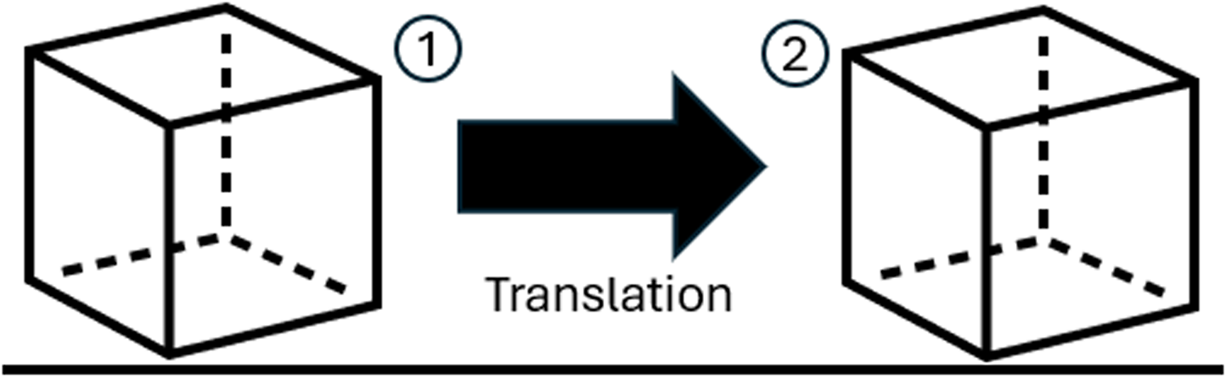
The study investigated the effects of four problem modalities on design tasks: visual, auditory, traditional (written), and kinesthetic. All tasks were based on the prompt formatting “Design a system to translate a box/cylinder horizontally/vertically.” The traditional (written) modality provided participants with a textual prompt of the task, with the auditory modality the researchers read the prompt aloud to the participant. The kinesthetic modality involved a physical demonstration of the task by the researcher and the visual modality relied on a diagram of the prompt as shown in Figure 1. These modalities were chosen as they represent the fundamental ways problems can be presented, isolating the individual effects of each design modality without the confounding effects present in a classroom. Participants were divided into groups to account for potential order effects, with the order of modality presentations counterbalanced across the groups.
Visual of kinesthetic design problem

Participants were instructed to develop as many solutions as possible for the first design problem within a 7- to 10-minute timeframe. A minimum of 7 minutes ensured consistency across participants while collecting a comprehensive data set. After this task, participants were given a 3-minute break to mitigate cognitive fatigue, as fatigue has been shown to diminish performance and brain activity in subsequent tasks (Reference Li, Huang, Xu, Jiao, Jiang, Gao and ZhangBoksem et al., 2006; Reference Boksem, Meijman and LoristLi et al., 2020). The second design problem followed the same procedure and time constraints. Upon completing both tasks, participants completed a post-experiment survey to gather qualitative insights about their experience. Using a 1-7 Likert scale, the survey assessed various aspects of the design process, including perceived problem difficulty and satisfaction with the solutions generated. Completion of this survey marked the end of the experiment.
3.1. Participants
This study was conducted across two years, gathering students from the engineering cornerstone design course at Florida Polytechnic University. The study included limited participants (n=28), as summarized in Table 1. Of the participants, 78.57% identified as male, 10.71% as female, and 10.71% as non-binary. Regarding ethnicity, 75% identified as Caucasian/White, while the remaining participants were distributed across Native American, Black/African American, Hispanic, and Asian groups, with one participant preferring not to disclose their racial identity. Geographically, most participants (96.43%) were domestic students residing in the United States, with one attending as an international student. All participants fell within the same age range of 17-20 years. Due to the limited sample size and demographic diversity, no significant conclusions could be drawn about the relationship between demographic factors and brain activity, motivation factors, or preferred learning approaches. It is important to note that this is a accurate portrayal of the university’s demographic.
Participant demographic’s

3.2. Analysis
The data analysis was conducted to address the research questions outlined at the beginning of this paper. For the first research question, brain activity was averaged across all monitored brain regions and frequency bands (Theta, Alpha, Low Beta, High Beta, and Gamma) for each design problem modality: visual, auditory, traditional (written), and kinesthetic. A paired t-test was applied to these averages and to the raw data from each frequency band across individual brain regions. A significance threshold of α < 0.05 was used to identify statistically significant differences. For discussing possible trends, results producing an α < 0.1 will also be presented.
The brain activity measured by power (POW) between the design problems was then analyzed using linear regression to investigate potential correlations between brain activity and the participants’ motivational factors and preferred learning styles. Given multiple variables, the regression analysis incorporated Akaike’s Information Criterion (AIC) to identify the best-fit model. This approach enabled the exploration of relationships between brain activity and individual differences in motivation and learning preferences, providing deeper insights into the neural dynamics underlying design problem-solving.
4. Results
This section analyzes differences in brain activity across the four problem modalities: visual, auditory, traditional (written), and kinesthetic. Variations were examined across the five brain wave frequencies and the 32 monitored brain regions. The Motivated Strategies for Learning Questionnaire (MSLQ) and VARK learning styles assessment were employed to explore potential factors influencing significant changes in brain activity. The MSLQ uses a 7-point Likert scale, where 1 represents “not true for me,” and 7 represents “very true for me.” In contrast, the VARK assessment requires participants to select one or more answers for each question, with aggregated scores used for the learning styles.
4.1. Change in brain activation
Brain activity was averaged across all frequency bands and brain regions for each problem modality. A t-test revealed significant changes in brain activity across multiple regions and bands. Additional t-tests were conducted on individual frequency bands to refine these findings and identify the specific brain waves and regions responsible for correlations. The t-test results showed that the Theta frequency was indicative of significance across all comparisons, with region Oz having an α < 0.05 and regions FT9, CP5, P7, O1, O2, and CP2 showing a significance of α < 0.1. It can be noted that the auditory and kinesthetic problems tended to induce increased brain action overall compared to traditional and written problem statements. The results are shown in the polar plot generated in Figure 1.
4.2. Correlation between brain activations and MSLQ
Significant trends were found in Theta frequency and different brain regions. To further this examination, these brain activations could be correlated with motivational factors. A linear regression analysis was used to determine which of the five motivation factors correlated to the brain activations for the significant regions and trending significant regions of the brain. The AIC Analysis determined that Intrinsic and Self-Regulation correlated with regions Oz and O2, while Intrinsic and Cognitive correlated with O1 and Cp2 when a student was given a kinesthetic problem. High cognitive and self-regulation motivation correlated with higher brain activity, while lower brain activations correlated with higher intrinsic motivation. Figure 2 shows the significant region (Oz) with the correlated motivations and the brain activations of the region.
Brain activation change in theta frequency

4.3. Correlation between brain activations and VARK
Further analysis compared brain activation for all design modalities to preferred learning styles to continue the examination. This analysis was performed in the same manner as the previous section, utilizing a linear regression to determine which of the four learning styles correlated with the brain regions that showed significant changes and those trending towards significance. The AIC analysis determined that visual, auditory, traditional, and kinesthetic learning styles interacted in some manner with Cp5, O1, Oz, and Cp2 when given a visual design problem. It was also found that visual, auditory, and traditional learning styles corresponded to a change in O1 when given a traditional problem statement. A positive correlation between visual learning style and brain activations was found in all regions, while a negative correlation was observed with the other learning styles in all regions. Figure 3 below shows the trend between the significant region (Oz) and visual learning style
Brain activations in Oz compared to MSLQ given kinesthetic problem

Brain activations in Oz compared to VARK given visual problem

5. Discussion
The findings of this study offer a unique contribution to the engineering education community by leveraging the relatively novel application of EEG technology to gain insights into design cognition. This research highlights the differences in brain activity observed in students as they engaged with various design problem modalities. Of the 32 brain regions monitored, one region demonstrated statistically significant changes in activity, while six others exhibited trends toward significance, particularly within the theta frequency band. These findings, illustrated in Figure 2, align closely with the results of (S. Vieira, Gero, Reference Vieira, Gero, Gattol, Delmoral, Li, Cascini and FernandesGattol, et al., 2020), who similarly identified correlations between theta activity and the brain regions highlighted in this study. Increased theta activity is desired in these areas as this has been linked to deductive and inductive reasoning, essential skills in the design process. Thus it would be recommended for educators to incorporate these style of design problems into their curriculum to encourage the development of these skills.
Furthermore, the observed changes in brain activity are influenced by the structural differences in the design problems, as suggested in previous research (Reference Shealy and GeroShealy & Gero, 2019). This supports the notion that problem modality can significantly impact cognitive engagement during design tasks. In addressing the first research question, the study reveals notable changes in brain activations, with particular emphasis on the theta band frequency. These correlations are predominantly localized in the rear regions of the brain, which are critical for reasoning and are sensitive to variations in problem structure. Together, these findings advance our understanding of how design problem modalities influence cognitive processes. Future research plans to investigate these findings further through incorporation in a classroom, towards developing a framework for the effective inclusion in the curriculum.
5.1. Significance of motivation
Understanding the relationship between changes in brain activity and motivational factors is essential for gaining deeper insights into how design problems can be structured to enhance performance. Positive correlations between self-regulation and cognitive motivation with brain activity suggest that students with these traits are better equipped to orient themselves toward recognizing and completing tasks. Additionally, they allocate more cognitive resources to these tasks, improving their ability to engage with and solve design problems (Reference Shealy, Gero and IgnacioShealy et al., 2022). This finding emphasizes the importance of incorporating kinesthetic and auditory design problems into educational settings. This result is desirable through the improvement of self-regulation and cognitive motivation, which enhance task performance and cognitive engagement.
Conversely, the negative correlation between intrinsic motivation and brain activity in kinesthetic design problems aligns with previous research (Reference Kado and KamesC. J. Kado & Kames, 2023), which found that specific design tasks can challenge students’ ability to sustain mental focus. This study specifically observed that intrinsic motivation, when paired with kinesthetic tasks, could lead to an increased cognitive load, potentially diminishing performance. These findings highlight the nuanced interplay between motivation factors and task modalities. In addressing the second research question, it is suggested that when educators are developing curriculum based around student motivation factors, to carefully consider intrinsic motivation when incorporating kinesthetic design problems. While this design modality is excellent for students with high self-regulation and cognitive motivation, students with lower intrinsic motivation may find the problem more difficult to focus on. In future studies, the authors plan to incorporate these findings into a classroom to develop a pedagogy for design problems influenced by student motivation factors.
5.2. Significance of learning style
A potentially significant relationship was identified between brain activity and preferred learning styles. This study found a general positive correlation between brain activation and a visual learning style when participants were presented with a visual problem. This result aligns with expectations, as the occipital region of the brain, which processes visual information, would likely be more effectively utilized by individuals who prefer visual learning. This finding supports the intuitive idea that learning preferences may enhance neural engagement when matched with a corresponding problem modality.
Interestingly, other learning styles—auditory, reading/writing, and kinesthetic—showed negative correlations with brain activations, even when participants were presented with a matching design problem. These negative correlations align with prior research indicating that learning styles have limited predictive power regarding brain activity (Reference Kado and KamesC. J. Kado & Kames, 2023; Reference Kado and KamesC. Kado & Kames, 2024). Furthermore, these findings echo concerns raised in educational research that relying on learning styles for instructional design can often hinder rather than help educators (Reference Newton and MiahNewton & Miah, 2017). Addressing the research question, this study indicates that specific learning preferences, such as visual learning, may influence neural activity in matching modalities. However, the broader use of learning styles as predictors of neural engagement appears limited and context dependent. Thus it is the recommendation of the authors that learning styles as an indicator are not of importance for incorporation into the curriculum.
6. Conclusion
This research provides a unique perspective on the role of design problem modalities in engineering education by using EEG to explore the relationship between neural activity, motivation, and learning styles. Significant changes in brain activations were observed, particularly in the theta frequency band and rear brain regions, which are critical for reasoning and problem-solving. These findings highlight the importance of the structure of design problems, as modalities cause distinct cognitive responses.
The correlation between brain activity and motivation further emphasizes the impact of self-regulation and cognitive motivation in enhancing a student’s ability to focus and allocate resources effectively. On the other hand, intrinsic motivation correlates negatively with kinesthetic tasks, potentially increasing cognitive load and reducing performance. Learning style analysis showed a positive relationship between visual learning and brain activity during visual tasks but indicated limited predictive power for other styles. This study suggests that while some personalized approaches may improve outcomes, reliance on rigid learning style frameworks is not practical. Overall, these findings provide valuable insights into how design problems can be structured to accommodate students’ cognitive and motivational needs better, paving the way for further improvements in engineering education.
6.1. Limitations and future works
A significant limitation of this study is the small number of participants, which also results in limited demographic diversity. This lack of diversity restricts the depth of analysis, preventing the exploration of additional factors that might influence participant outcomes. It is important to note that the use of an EEG, specifically with the use of an EEG cap, creates a unique challenge of working with a participant’s hairstyle, which is more difficult with certain ethnicities compared to others (Reference Penner, Wall, Guan, Huang, Richardson, Dunbar, Groh and RutherfordChoy et al., 2022; Reference Choy, Baker and StavropoulosPenner et al., 2023). This may have resulted in additional noise in the data, further affecting the limited analysis. Florida Polytechnic University is unique because there is currently a three-year design thread in the mechanical engineering department, with other engineering departments participating in the cornerstone course. This allows for a unique insight into the impact of teaching design over most of a student’s undergraduate education. With collaboration from other universities, there is also the potential of examining the impact of early exposure to design in a cornerstone setting compared to a capstone setting. Further, with other engineering programs participating in the introductory design course, the lasting effects of introducing design in other degrees be examined.



 Open access

