





1 Introduction
Let $\mathbb {G}$
be a unipotent algebraic group defined over a p-adic field F of characteristic zero. The set of rational points G of
$\mathbb {G}$
be a unipotent algebraic group defined over a p-adic field F of characteristic zero. The set of rational points G of $\mathbb {G}$
is a unipotent p-adic group with Lie algebra
$\mathbb {G}$
is a unipotent p-adic group with Lie algebra $ \mathfrak {g}$
and the exponential map
$ \mathfrak {g}$
and the exponential map $\exp $
realizes a diffeomorphism from
$\exp $
realizes a diffeomorphism from $ \mathfrak {g}$
onto G. The group G acts on its Lie algebra by the adjoint representation and on the dual space
$ \mathfrak {g}$
onto G. The group G acts on its Lie algebra by the adjoint representation and on the dual space $ \mathfrak {g}^*$
by the coadjoint representation. According to the orbit method, the unitary dual
$ \mathfrak {g}^*$
by the coadjoint representation. According to the orbit method, the unitary dual $\widehat {G}$
of G is parameterized by
$\widehat {G}$
of G is parameterized by $G \backslash \mathfrak {g}^*$
, the space of coadjoint orbits. Thus, for
$G \backslash \mathfrak {g}^*$
, the space of coadjoint orbits. Thus, for $\rho \in \widehat {G}$
, we denote by
$\rho \in \widehat {G}$
, we denote by $\Omega _\rho $
its corresponding coadjoint orbit.
$\Omega _\rho $
its corresponding coadjoint orbit.
Let $\pi $
be a unitary representation of G in a Hilbert space
$\pi $
be a unitary representation of G in a Hilbert space $\mathcal {H}_{\pi }$
. A vector
$\mathcal {H}_{\pi }$
. A vector $v \in \mathcal {H}_{\pi }$
is said to be smooth if the map
$v \in \mathcal {H}_{\pi }$
is said to be smooth if the map $g\in G \mapsto \pi (g)v \in \mathcal {H}_{\pi }$
is locally constant. We denote by
$g\in G \mapsto \pi (g)v \in \mathcal {H}_{\pi }$
is locally constant. We denote by $\mathcal {H}_{\pi }^{\infty }$
the space of all smooth vectors of
$\mathcal {H}_{\pi }^{\infty }$
the space of all smooth vectors of $\pi $
and by
$\pi $
and by $\mathcal {H}_{\pi }^{-\infty }$
its dual. If H is a subgroup of G and
$\mathcal {H}_{\pi }^{-\infty }$
its dual. If H is a subgroup of G and $\chi $
a unitary character of H, we consider the space of
$\chi $
a unitary character of H, we consider the space of $\chi $
-semi-invariant distributions of
$\chi $
-semi-invariant distributions of $\pi $
defined by
$\pi $
defined by
 $$ \begin{align*}(\mathcal{H}_{\pi}^{-\infty})^{H,\chi} =\left\{ a \in \mathcal{H}_{\pi}^{-\infty} \, \vert \, \pi_{-\infty}(h)a = \chi(h^{-1})a, \, \forall h \in H \right\},\end{align*} $$
where $\pi _{-\infty }$
is the conjugate of the restriction of
$\pi _{-\infty }$
is the conjugate of the restriction of $\pi $
to
$\pi $
to $\mathcal {H}_{\pi }^{\infty }$
. A crucial question is the description of the space
$\mathcal {H}_{\pi }^{\infty }$
. A crucial question is the description of the space $(\mathcal {H}_{\pi }^{-\infty })^{H,\chi }$
. An answer to this question has been established in this article in the following case: Assume that
$(\mathcal {H}_{\pi }^{-\infty })^{H,\chi }$
. An answer to this question has been established in this article in the following case: Assume that $\pi $
is irreducible. Let l be an element of
$\pi $
is irreducible. Let l be an element of $\Omega _\pi $
and
$\Omega _\pi $
and $\mathfrak {b}$
be a polarization at l. Set
$\mathfrak {b}$
be a polarization at l. Set $B = \exp (\mathfrak {b})$
, and realize
$B = \exp (\mathfrak {b})$
, and realize $\pi $
in the Hilbert space
$\pi $
in the Hilbert space $\mathcal {H}_{l,\mathfrak {b}}$
(see Section 4.2).
$\mathcal {H}_{l,\mathfrak {b}}$
(see Section 4.2).
In the sequel, we suppose that H is an algebraic subgroup of G. It follows that $H=\exp (\mathfrak {h})$
, where
$H=\exp (\mathfrak {h})$
, where $\mathfrak {h}$
is its Lie algebra, and that there exists
$\mathfrak {h}$
is its Lie algebra, and that there exists $f\in \mathfrak {g}^{*}$
such that
$f\in \mathfrak {g}^{*}$
such that $\chi =\chi _{f}$
, where
$\chi =\chi _{f}$
, where
 $$ \begin{align*} \chi_{f}(\exp X)=\psi(\langle f,X\rangle), X\in\mathfrak{h}, \end{align*} $$
and $\psi $
is a fixed nontrivial continuous character of
$\psi $
is a fixed nontrivial continuous character of $(F,+)$
into
$(F,+)$
into $ \mathbb C\setminus \{0\}$
. The Lie algebra
$ \mathbb C\setminus \{0\}$
. The Lie algebra $\mathfrak {h}$
must be subordinate to f, that is,
$\mathfrak {h}$
must be subordinate to f, that is,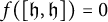 $f([\mathfrak {h},\mathfrak {h}])=0$
.
$f([\mathfrak {h},\mathfrak {h}])=0$
.
For any $f' \in f+ \mathfrak {h}^\perp $
, the subalgebra
$f' \in f+ \mathfrak {h}^\perp $
, the subalgebra $\mathfrak {h}$
is subordinate to
$\mathfrak {h}$
is subordinate to $f'$
and we have
$f'$
and we have $ \chi _f = \chi _{f'} $
.
$ \chi _f = \chi _{f'} $
.
If $(f +\mathfrak {h}^\perp )\cap \Omega _\pi \neq \emptyset $
, we construct a nonzero element of
$(f +\mathfrak {h}^\perp )\cap \Omega _\pi \neq \emptyset $
, we construct a nonzero element of $ (\mathcal {H}_{\pi }^{-\infty })^{H,\chi _f}$
: Let g be an element of G such that
$ (\mathcal {H}_{\pi }^{-\infty })^{H,\chi _f}$
: Let g be an element of G such that $g.l \in f +\mathfrak {h}^\perp $
. The linear map
$g.l \in f +\mathfrak {h}^\perp $
. The linear map
 $$ \begin{align*}I_{g.l, \pi}: \phi \in \mathcal{H}_{\pi}^{\infty} \longmapsto\int_{H/H \cap gBg^{-1}}\phi(hg)\chi_f(h) \mathop{\mathrm{\mathstrut d}}\dot{h}\end{align*} $$
defines a nonzero element of $ (\mathcal {H}_{\pi }^{-\infty })^{H,\chi _f}$
(see Proposition 4.3). Here,
$ (\mathcal {H}_{\pi }^{-\infty })^{H,\chi _f}$
(see Proposition 4.3). Here, $\mathop {\mathrm {\mathstrut d}}\dot {h}$
is a positive H-invariant measure on
$\mathop {\mathrm {\mathstrut d}}\dot {h}$
is a positive H-invariant measure on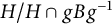 $H/H \cap gBg^{-1}$
.
$H/H \cap gBg^{-1}$
.
If $ r \in \mathfrak {g}^*$
, we denote by
$ r \in \mathfrak {g}^*$
, we denote by $\beta _r$
the skew-symmetric bilinear form on
$\beta _r$
the skew-symmetric bilinear form on $ \mathfrak {g}$
defined by (2.2) and by
$ \mathfrak {g}$
defined by (2.2) and by $ \mathfrak {g}(r)$
its radical. We then denote by
$ \mathfrak {g}(r)$
its radical. We then denote by $\Xi $
the set of elements
$\Xi $
the set of elements $r \in f+ \mathfrak {h}^\perp $
such that
$r \in f+ \mathfrak {h}^\perp $
such that $\mathfrak {h} + \mathfrak {g}(r)$
is maximal isotropic subspace for
$\mathfrak {h} + \mathfrak {g}(r)$
is maximal isotropic subspace for $\beta _r$
. Assume that
$\beta _r$
. Assume that
 $$ \begin{align} \Xi \supset (f +\mathfrak{h}^\perp)\cap \Omega_\pi. \end{align} $$
Let us denote by $C_1, \ldots , C_n$
the irreducible components of
$C_1, \ldots , C_n$
the irreducible components of $(f + \mathfrak {h}^\perp ) \cap \Omega _\pi $
. For each
$(f + \mathfrak {h}^\perp ) \cap \Omega _\pi $
. For each $1 \leq j \leq n$
, pick
$1 \leq j \leq n$
, pick $g_j \in G$
such that
$g_j \in G$
such that $g_j.l \in C_j$
.
$g_j.l \in C_j$
.
Put
 $$ \begin{align*}S_\pi= \{g \in G \, \vert \, g.(l+ \mathfrak{b}^\perp)\cap(f+ \mathfrak{h}^\perp) \neq \emptyset\}= \sqcup_{k=1}^n Hg_kB.\end{align*} $$
On the other hand, any element $a \in \mathcal {H}_{l, \mathfrak {b}}^{-\infty }$
defines a distribution
$a \in \mathcal {H}_{l, \mathfrak {b}}^{-\infty }$
defines a distribution $\tilde a$
on G by putting
$\tilde a$
on G by putting
 $$ \begin{align*}\langle \tilde a, \phi \rangle = \langle a, \tilde \phi \rangle , \, \phi \in \mathcal{C}_c^\infty(G),\end{align*} $$
where $\tilde \phi $
is the function on G defined by
$\tilde \phi $
is the function on G defined by
 $$ \begin{align*}\tilde \phi (x)= \int_B\phi(xb) \chi_l(b) \mathop{\mathrm{\mathstrut d}}{b}, \, x \in G.\end{align*} $$
Finally, denote by $(\mathcal {H}_{l, \mathfrak {b}}^{-\infty })_Z^{H,\chi _f}$
the subspace of
$(\mathcal {H}_{l, \mathfrak {b}}^{-\infty })_Z^{H,\chi _f}$
the subspace of $(\mathcal {H}_{l, \mathfrak {b}}^{-\infty })^{H,\chi _f}$
consisting of elements
$(\mathcal {H}_{l, \mathfrak {b}}^{-\infty })^{H,\chi _f}$
consisting of elements $a $
such that
$a $
such that $\tilde a$
is supported by
$\tilde a$
is supported by $ S_\pi $
. The main result of this article is as follows.
$ S_\pi $
. The main result of this article is as follows.
Theorem 1.0.1 With the above notations, we have
 $$ \begin{align*} (\mathcal{H}_{l, \mathfrak{b}}^{-\infty})_Z^{H,\chi_f} = \mathrm{Span}\{I_{g_1.l, \pi}, \ldots, I_{g_n.l, \pi}\} \end{align*} $$
and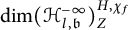 $\dim (\mathcal {H}_{l, \mathfrak {b}}^{-\infty })_Z^{H,\chi _f}$
is equal to the number of H-orbits contained in
$\dim (\mathcal {H}_{l, \mathfrak {b}}^{-\infty })_Z^{H,\chi _f}$
is equal to the number of H-orbits contained in $( f + \mathfrak {h}^\perp )\cap G.l$
.
$( f + \mathfrak {h}^\perp )\cap G.l$
.
We prove that condition (1.1) is satisfied if $\mathfrak {h}$
is a polarization at f or an ideal of
$\mathfrak {h}$
is a polarization at f or an ideal of $ \mathfrak {g}$
and also for any
$ \mathfrak {g}$
and also for any $\mathfrak {h}$
if
$\mathfrak {h}$
if $ \mathfrak {g}$
is a two-step nilpotent Lie algebra. In all these cases, we have
$ \mathfrak {g}$
is a two-step nilpotent Lie algebra. In all these cases, we have
 $$ \begin{align*}(\mathcal{H}_{l, \mathfrak{b}}^{-\infty})^{H,\chi_f} = (\mathcal{H}_{l, \mathfrak{b}}^{-\infty})_Z^{H,\chi_f}.\end{align*} $$
We do not known whether there are examples for which this equality fails to hold.
What has been done in the real case (see [Reference Fujiwara3, Reference Fujiwara and Yamagami4]) suggests that the above theorem is an important step toward the determination of the multiplicity of $\pi $
in the disintegration of
$\pi $
in the disintegration of $\mathop {\mathrm {Ind}}\nolimits _{H}^{G}\chi _f$
and toward the proof of the related Plancherel formula in the p-adic case. This theorem also extends the results obtained by Maaref in the case where
$\mathop {\mathrm {Ind}}\nolimits _{H}^{G}\chi _f$
and toward the proof of the related Plancherel formula in the p-adic case. This theorem also extends the results obtained by Maaref in the case where $\mathfrak {h}$
is a polarization at f (see [Reference Maaref9]).
$\mathfrak {h}$
is a polarization at f (see [Reference Maaref9]).
2 Coadjoint orbits and polarizations
2.1
For $g_0 \in G$
, we denote by
$g_0 \in G$
, we denote by $\varphi _{g_0}$
the automorphism of G given by
$\varphi _{g_0}$
the automorphism of G given by
 $$\begin{align*} \begin{array}{@{}ccccc} &\varphi_{g_0}:& G &\longrightarrow& G \\ & & g &\longmapsto& g_0gg_0^{-1}. \end{array} \end{align*}$$
The differential of $\varphi _{g_0}$
at the identity element induces an automorphism of the Lie algebra
$\varphi _{g_0}$
at the identity element induces an automorphism of the Lie algebra $ \mathfrak {g}$
denoted by
$ \mathfrak {g}$
denoted by $\mathrm {Ad}g_0$
. We have
$\mathrm {Ad}g_0$
. We have
 $$ \begin{align*}g_0 \exp(X)g_0^{-1} = \exp(\mathrm{Ad}g_0.X), \, \, \forall X \in \mathfrak{g}.\end{align*} $$
The map $\mathrm {Ad}: G \longrightarrow \mathrm {GL}( \mathfrak {g})$
is a morphism of Lie groups, called the adjoint representation of G.
$\mathrm {Ad}: G \longrightarrow \mathrm {GL}( \mathfrak {g})$
is a morphism of Lie groups, called the adjoint representation of G.
2.2
We designate by $ \mathfrak {g}^*$
the dual vector space of
$ \mathfrak {g}^*$
the dual vector space of $ \mathfrak {g}$
. The group G operates on
$ \mathfrak {g}$
. The group G operates on $ \mathfrak {g}^*$
by the coadjoint action:
$ \mathfrak {g}^*$
by the coadjoint action:
 $$ \begin{align*}\langle \mathrm{Ad}^*g.l,X \rangle = \langle l,\mathrm{Ad}g^{-1}.X \rangle,\, \, g\in G, l\in \mathfrak{g}^*, X\in \mathfrak{g}.\end{align*} $$
For $l\in \mathfrak {g}^*$
, we denote simply
$l\in \mathfrak {g}^*$
, we denote simply $g.l$
the coadjoint action of
$g.l$
the coadjoint action of $g \in G$
on l. The set
$g \in G$
on l. The set $ G.l =\left \{g.l, \, g\in G\right \}$
is called the coadjoint orbit of l in
$ G.l =\left \{g.l, \, g\in G\right \}$
is called the coadjoint orbit of l in $ \mathfrak {g}^*$
. We denote by
$ \mathfrak {g}^*$
. We denote by $G \backslash \mathfrak {g}^*$
the set of all coadjoint orbits.
$G \backslash \mathfrak {g}^*$
the set of all coadjoint orbits.
Let $ l \in \mathfrak {g}^*$
. We designate by
$ l \in \mathfrak {g}^*$
. We designate by $\beta _l$
the skew-symmetric bilinear form on
$\beta _l$
the skew-symmetric bilinear form on $ \mathfrak {g}$
defined by
$ \mathfrak {g}$
defined by
 $$ \begin{align} \beta_l(X,Y ) = \langle l, [X,Y] \rangle, \, \, X,Y \in \mathfrak{g} \end{align} $$
and by $ \mathfrak {g}(l) = \{X \in \mathfrak {g} \, \vert \, \langle l, [X,Y] \rangle =0, \, \forall \, Y \in \mathfrak {g} \}$
its radical.
$ \mathfrak {g}(l) = \{X \in \mathfrak {g} \, \vert \, \langle l, [X,Y] \rangle =0, \, \forall \, Y \in \mathfrak {g} \}$
its radical.
Definition 2.2.1 Let $\mathfrak {h}$
be a subalgebra of
$\mathfrak {h}$
be a subalgebra of $ \mathfrak {g}$
.
$ \mathfrak {g}$
.
-
(1) We say that $\mathfrak {h}$
is subordinate to l if
$\mathfrak {h}$
is a totally isotropic subspace for
$\beta _l$
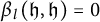
, that is,
$ \beta _l(\mathfrak {h},\mathfrak {h}) =0$
.
$\mathfrak {h}$
is subordinate to l if
$\mathfrak {h}$
is a totally isotropic subspace for
$\beta _l$
, that is,
$ \beta _l(\mathfrak {h},\mathfrak {h}) =0$
. -
(2) We say that
$\mathfrak {h}$
is a polarization at l if
$\mathfrak {h}$
is subordinate to l and of maximal dimension.




We have the following result.
Lemma 2.2.1 Let $\mathfrak {h}$
be a subordinate subalgebra to l. The following conditions are equivalent:
$\mathfrak {h}$
be a subordinate subalgebra to l. The following conditions are equivalent:
-
(1)
$\mathfrak {h}$
is a polarization at l. -
(2) For any
$ X \in \mathfrak {g}$
such that
$ \langle l, [X,\mathfrak {h}] \rangle = 0$
, we have
$X \in \mathfrak {h}$
. -
(3)
$\mathfrak {h}^{\perp \beta _l} \subset \mathfrak {h}$
(where
$\mathfrak {h}^{\perp \beta _l}$
is the orthogonal of
$\mathfrak {h}$
in
$ \mathfrak {g}$
with respect to
$\beta _l$
). -
(4)
$ \dim \mathfrak {h}= \frac {1}{2}(\dim \mathfrak {g} + \dim \mathfrak {g}(l))$
.






Proof See [Reference Rais13, Chapter III – number 3.3.a].
The next result is of proper interest.
Proposition 2.2.1 Let $\mathfrak {h}$
be an ideal of
$\mathfrak {h}$
be an ideal of $ \mathfrak {g}$
subordinate to
$ \mathfrak {g}$
subordinate to $l\in \mathfrak {g}^*$
. Then there exists a polarization at l containing
$l\in \mathfrak {g}^*$
. Then there exists a polarization at l containing $\mathfrak {h}$
.
$\mathfrak {h}$
.
Proof Let
 $$ \begin{align*}\mathfrak{g}_0 = \{0\} \subset \mathfrak{g}_1 \subset \cdots \subset \mathfrak{g}_n = \mathfrak{g}\end{align*} $$
be a non-decreasing sequence of ideals in $ \mathfrak {g}$
such that
$ \mathfrak {g}$
such that
-
—
$\dim \mathfrak {g}_{i}=i$
and
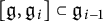
$[ \mathfrak {g}, \mathfrak {g}_{i}] \subset \mathfrak {g}_{i-1}$
, for all
$i= 1, \ldots , n$
; -
—
$ \mathfrak {g}_{\dim \mathfrak {h}}= \mathfrak {h} $
.



Put $\mathfrak {b} = \sum _{i=1}^n \mathfrak {g}_i(l_{\vert \mathfrak {g}_i})$
. From [Reference Bernat1, Chapter IV – Proposition 4.1.1],
$\mathfrak {b} = \sum _{i=1}^n \mathfrak {g}_i(l_{\vert \mathfrak {g}_i})$
. From [Reference Bernat1, Chapter IV – Proposition 4.1.1], $ \mathfrak {b} $
is a polarization at l containing
$ \mathfrak {b} $
is a polarization at l containing $\mathfrak {h}$
.
$\mathfrak {h}$
.
3 The affine space
$f + \mathfrak {h}^\perp $

3.1
Let $f\in g^*$
and
$f\in g^*$
and $\mathfrak {h}$
be a subordinate subalgebra to f. Let us denote by
$\mathfrak {h}$
be a subordinate subalgebra to f. Let us denote by $H = \exp (\mathfrak {h})$
.
$H = \exp (\mathfrak {h})$
.
-
(1) For any
$l \in f + \mathfrak {h}^\perp $
, the subalgebra
$\mathfrak {h}$
is subordinate to l. Moreover, if
$\mathfrak {h}$
is a polarization at
$f,$
then is also one at l. Indeed, if
$X, Y \in \mathfrak {h},$
then since
$$ \begin{align*}\beta_l(X,Y)= \langle l, [X, Y] \rangle = \langle f, [X, Y] \rangle = 0,\end{align*} $$
$ [X, Y] \in \mathfrak {h} $
.
Now assume that
$\mathfrak {h}$
is a polarization at f. Let
$\chi _l$
be the character of H associated with l and
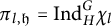
$\pi _{l, \mathfrak {h}} = \mbox {Ind}_H^G \chi _l$
. Since l and f have the same restriction to
$\mathfrak {h}$
, we have
$\chi _l = \chi _f$
. So that
$ \mbox {Ind}_H^G \chi _l = \mbox {Ind}_H^G \chi _f$
. Hence,
$\pi _{l, \mathfrak {h}}$
is irreducible and thus
$\mathfrak {h}$
is a polarization at l (see Theorem 4.2.1 below). -
(2) The affine space
$f + \mathfrak {h}^\perp $
is H-stable. Indeed, let
$l \in f + \mathfrak {h}^\perp $
and
$x = \exp (X) \in H$
. For any
$Y \in \mathfrak {h}$
, we have since
$$ \begin{align*} \langle x.l, Y\rangle &= \langle l, \mathrm{Ad }x^{-1}.Y\rangle = \langle l, \exp(- \mathrm{ad}X).Y\rangle \\ &= \sum_{n=0}^{\dim \mathfrak{g}}\frac{(-1)^n}{n!} \langle l, (\mathrm{ad} X)^nY\rangle = \langle l, Y\rangle, \end{align*} $$
$ (\mathrm {ad} X)^nY \in [\mathfrak {h}, \mathfrak {h}]$
, for all
$ n\in \mathbb N^*$
, and
$\mathfrak {h}$
is subordinate to l. It follows that
$ x.l-l \in \mathfrak {h}^\perp $
.
-
(3) The subspace
$\mathfrak {h} + \mathfrak {g}(f)$
is totally isotropic for
$\beta _f$
: Let
$X,X' \in \mathfrak {h}, Y, Y' \in \mathfrak {g}(f)$
. We have
$$ \begin{align*} \langle f, [X + Y, X'+ Y'] \rangle &= \langle f, [X,X']+ [X,Y'] + [Y, X'] + [Y, Y'] \rangle= 0. \end{align*} $$
-
(4)
$ \mathfrak {g}.f = \mathfrak {g}(f)^\perp $
: This assertion follows from the fact
$ \mathfrak {g}.f \subset \mathfrak {g}(f)^\perp $
and
$ \dim \mathfrak {g}.f = \dim \mathfrak {g}(f)^\perp $
. -
(5)
$\mathfrak {h} + \mathfrak {g}(f) $
is a maximal isotropic subspace for
$\beta _f$
if and only if
$ \dim H.f=\frac {1}{2}\dim G.f$
. Indeed, we have So that
$$ \begin{align*} \dim(\mathfrak{h} + \mathfrak{g}(f))&= \dim \mathfrak{h} +\dim \mathfrak{g}(f) - \dim(\mathfrak{h}\cap \mathfrak{g}(f))\\ &= \dim \mathfrak{h} +\dim \mathfrak{g}(f) - \dim\mathfrak{h}(f) = \dim H.f+\dim \mathfrak{g}(f). \end{align*} $$
$$ \begin{align*} & \mathfrak{h} + \mathfrak{g}(f) \mbox{ is maximal isotropic subspace for }\beta_f \\ & \iff \dim(\mathfrak{h} + \mathfrak{g}(f)) = \frac{1}{2}(\dim \mathfrak{g} + \dim \mathfrak{g}(f)) \\ &\iff \dim H.f= \frac{1}{2}(\dim \mathfrak{g} - \dim \mathfrak{g}(f)) =\frac{1}{2}\dim G.f. \end{align*} $$






















3.2
Let $f \in \mathfrak {g}^*$
. Denote by
$f \in \mathfrak {g}^*$
. Denote by $S(f, \mathfrak {g})$
the set of all subordinate subalgebras to f and
$S(f, \mathfrak {g})$
the set of all subordinate subalgebras to f and $Q(f, \mathfrak {g})$
the subset of subalgebras
$Q(f, \mathfrak {g})$
the subset of subalgebras $\mathfrak {h}$
such that
$\mathfrak {h}$
such that $\mathfrak {h} + \mathfrak {g}(f)$
is maximal isotropic subspace (for
$\mathfrak {h} + \mathfrak {g}(f)$
is maximal isotropic subspace (for $\beta _f$
).
$\beta _f$
).
Let $\mathfrak {h} \in S(f, \mathfrak {g})$
. In this paragraph, we investigate the intersection
$\mathfrak {h} \in S(f, \mathfrak {g})$
. In this paragraph, we investigate the intersection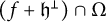 $ ( f + \mathfrak {h}^\perp ) \cap \Omega $
, where
$ ( f + \mathfrak {h}^\perp ) \cap \Omega $
, where $\Omega \in G\backslash \mathfrak {g}^*$
is a coadjoint orbit. To this end, let
$\Omega \in G\backslash \mathfrak {g}^*$
is a coadjoint orbit. To this end, let
 $$ \begin{align*} & \Xi= \{l \in f+ \mathfrak{h}^\perp \, \vert \, \mathfrak{h} \in Q(l, \mathfrak{g}) \}\\ & Z(f + \mathfrak{h}^\perp) = \{l \in f+ \mathfrak{h}^\perp \, \mbox{ such that }\dim \mathfrak{g}(l) \mbox{ is minimal when }l \mbox{ ranges over }f+ \mathfrak{h}^\perp\}. \end{align*} $$
Put $\Gamma = \Xi \cap Z(f + \mathfrak {h}^\perp ) $
.
$\Gamma = \Xi \cap Z(f + \mathfrak {h}^\perp ) $
.
Lemma 3.2.1 $\Gamma $
is a Zariski open subset of
$\Gamma $
is a Zariski open subset of $f + \mathfrak {h}^\perp $
.
$f + \mathfrak {h}^\perp $
.
Proof Let $l \in f + \mathfrak {h}^\perp $
. By point (1) of Section 3.1, the subalgebra
$l \in f + \mathfrak {h}^\perp $
. By point (1) of Section 3.1, the subalgebra $\mathfrak {h}$
is subordinate to l. By point (3),
$\mathfrak {h}$
is subordinate to l. By point (3), $\mathfrak {h} + \mathfrak {g}(f)$
is totally isotropic for
$\mathfrak {h} + \mathfrak {g}(f)$
is totally isotropic for $\beta _l$
. It follows that
$\beta _l$
. It follows that
 $$ \begin{align*} \dim \mathfrak{h} +\dim \mathfrak{g}(l) - \dim(\mathfrak{h}\cap \mathfrak{g}(l)) & = \dim(\mathfrak{h} + \mathfrak{g}(l)) \leq\frac{1}{2}(\dim \mathfrak{g} + \dim \mathfrak{g}(l)). \end{align*} $$
So that
 $$ \begin{align*}\dim(\mathfrak{h}\cap \mathfrak{g}(l)) \geq \dim\mathfrak{h} - \frac{1}{2}\dim G.l \geq r,\end{align*} $$
where $ r : =\dim \mathfrak {h} - \frac {1}{2}\dim G.l_0$
,
$ r : =\dim \mathfrak {h} - \frac {1}{2}\dim G.l_0$
, $l_0 \in Z(f + \mathfrak {h}^\perp )$
. Then we have
$l_0 \in Z(f + \mathfrak {h}^\perp )$
. Then we have
 $$ \begin{align*} l \in \Gamma &\iff \dim(\mathfrak{h} + \mathfrak{g}(l)) =\frac{1}{2}(\dim \mathfrak{g} + \dim \mathfrak{g}(l)) \mbox{ and } l \in Z(f + \mathfrak{h}^\perp) \\ & \iff \dim(\mathfrak{h}\cap \mathfrak{g}(l)) = \dim\mathfrak{h} - \frac{1}{2}\dim G.l = r. \end{align*} $$
But $\dim (\mathfrak {h}\cap \mathfrak {g}(l))>r$
means that
$\dim (\mathfrak {h}\cap \mathfrak {g}(l))>r$
means that $ \mathfrak {g}(l) \cap \mathfrak {h}\cap W \neq 0$
for every subspace W of
$ \mathfrak {g}(l) \cap \mathfrak {h}\cap W \neq 0$
for every subspace W of $ \mathfrak {g}$
of dimension
$ \mathfrak {g}$
of dimension $\dim \mathfrak {g} -r$
. From [Reference Dixmier2, Lemma 1.11.4], for a given subspace
$\dim \mathfrak {g} -r$
. From [Reference Dixmier2, Lemma 1.11.4], for a given subspace $W \subset \mathfrak {g}$
, the set of
$W \subset \mathfrak {g}$
, the set of $l \in \mathfrak {g}^*$
such that
$l \in \mathfrak {g}^*$
such that $ \mathfrak {g}(l) \cap \mathfrak {h}\cap W \neq 0$
is a closed subset of
$ \mathfrak {g}(l) \cap \mathfrak {h}\cap W \neq 0$
is a closed subset of $ \mathfrak {g}^*$
. We deduce that the set of
$ \mathfrak {g}^*$
. We deduce that the set of $l \in f + \mathfrak {h}^\perp $
such that
$l \in f + \mathfrak {h}^\perp $
such that $\dim (\mathfrak {h}\cap \mathfrak {g}(l))>r$
is closed in
$\dim (\mathfrak {h}\cap \mathfrak {g}(l))>r$
is closed in $ f + \mathfrak {h}^\perp $
and therefore its complement is open in
$ f + \mathfrak {h}^\perp $
and therefore its complement is open in $ f + \mathfrak {h}^\perp $
.
$ f + \mathfrak {h}^\perp $
.
Proposition 3.2.1 Let $l \in \Xi $
. Assume that
$l \in \Xi $
. Assume that $\Xi \supset (f+ \mathfrak {h}^\perp )\cap G.l$
. Then
$\Xi \supset (f+ \mathfrak {h}^\perp )\cap G.l$
. Then $(f+ \mathfrak {h}^\perp )\cap G.l$
is a smooth subvariety of
$(f+ \mathfrak {h}^\perp )\cap G.l$
is a smooth subvariety of $f+ \mathfrak {h}^\perp $
. Every irreducible component of
$f+ \mathfrak {h}^\perp $
. Every irreducible component of $(f+ \mathfrak {h}^\perp )\cap G.l$
is a H-orbit of dimension
$(f+ \mathfrak {h}^\perp )\cap G.l$
is a H-orbit of dimension $\frac {1}{2} \dim G.l$
.
$\frac {1}{2} \dim G.l$
.
Proof Let $l' \in (f+ \mathfrak {h}^\perp )\cap G.l$
. We have
$l' \in (f+ \mathfrak {h}^\perp )\cap G.l$
. We have
 $$ \begin{align*} \dim ( \mathfrak{g}.l' \cap \mathfrak{h}^\perp )& = \dim( \mathfrak{g}(l')^\perp \cap \mathfrak{h}^\perp)=\dim(\mathfrak{h} + \mathfrak{g}(l'))^\perp = \dim \mathfrak{g} - \dim(\mathfrak{h} + \mathfrak{g}(l')) \\ & = \dim \mathfrak{g} -( \dim H.l' + \dim \mathfrak{g}(l'))=\dim G.l' - \dim H.l'. \end{align*} $$
Since $l' \in \Xi $
, it follows from (5) of Section 3.1 that
$l' \in \Xi $
, it follows from (5) of Section 3.1 that $\dim H.l' = \frac {1}{2}\dim G.l'$
. Hence,
$\dim H.l' = \frac {1}{2}\dim G.l'$
. Hence,
 $$ \begin{align*}\dim ( \mathfrak{g}.l' \cap \mathfrak{h}^\perp ) = \dim H.l' = \dim \mathfrak{h}.l'.\end{align*} $$
Now,
 $$ \begin{align*}\mathfrak{h}.l'= T_{l'}(H.l') \subset T_{l'}((f+ \mathfrak{h}^\perp)\cap G.l)\subset \mathfrak{h}^\perp\cap \mathfrak{g}.{l'}.\end{align*} $$
Using the equality of dimensions, this yields
 $$ \begin{align*}T_{l'}(H.l') = T_{l'}((f+ \mathfrak{h}^\perp)\cap G.l).\end{align*} $$
Therefore, the tangent space to $(f+ \mathfrak {h}^\perp )\cap G.l$
at
$(f+ \mathfrak {h}^\perp )\cap G.l$
at $l'$
has dimension
$l'$
has dimension $\frac {1}{2}\dim G.l$
, which is constant. It follows that every point of
$\frac {1}{2}\dim G.l$
, which is constant. It follows that every point of $(f+ \mathfrak {h}^\perp )\cap G.l$
is smooth.
$(f+ \mathfrak {h}^\perp )\cap G.l$
is smooth.
Moreover, for each $l' \in (f+ \mathfrak {h}^\perp )\cap G.l$
, the orbit
$l' \in (f+ \mathfrak {h}^\perp )\cap G.l$
, the orbit $H.l'$
is an open subvariety of
$H.l'$
is an open subvariety of $ (f+ \mathfrak {h}^\perp )\cap G.l$
. But
$ (f+ \mathfrak {h}^\perp )\cap G.l$
. But $H.l'$
is an orbit under the action of a unipotent group, it is also a closed subset. As
$H.l'$
is an orbit under the action of a unipotent group, it is also a closed subset. As $H.l'$
is an irreducible set, it is an irreducible component of
$H.l'$
is an irreducible set, it is an irreducible component of $ (f+ \mathfrak {h}^\perp ) \cap G.l$
. Thus, every irreducible component of
$ (f+ \mathfrak {h}^\perp ) \cap G.l$
. Thus, every irreducible component of $(f+ \mathfrak {h}^\perp )\cap G.l$
is a H-orbit of dimension
$(f+ \mathfrak {h}^\perp )\cap G.l$
is a H-orbit of dimension $\frac {1}{2} \dim G.l$
.
$\frac {1}{2} \dim G.l$
.
Particular cases:
-
(1) Assume that
$\mathfrak {h}$
is a polarization at f. It follows that
$\mathfrak {h}$
is also a polarization at every element of
$ f + \mathfrak {h}^\perp $
and so that
$\Xi =f+ \mathfrak {h}^\perp = H.f= (f+ \mathfrak {h}^\perp )\cap G.l $
, for any
$l \in f+ \mathfrak {h}^\perp $
. -
(2) Assume that
$ \mathfrak {h} $
is an ideal of
$ \mathfrak {g}$
. For every
$l \in \Xi $
, we have
$(f+ \mathfrak {h}^\perp )\cap G.l = H.l$
. Indeed, set Then
$$ \begin{align*}\mathfrak{h}^{\perp \beta_l} = \{X \in \mathfrak{g} \, \vert \, \langle l, [X, Y] \rangle = 0, \, \forall Y \in \mathfrak{h}\} \mbox{ and } G(l_{\vert \mathfrak{h}}) = \{x \in G \, \vert \, x.l_{\vert \mathfrak{h}} = l_{\vert \mathfrak{h}} \} .\end{align*} $$
$ G(l_{\vert \mathfrak {h}})$
is an algebraic subgroup of G whose Lie algebra is
$ \mathfrak {h}^{\perp \beta _l} $
. A straightforward computation gives Next, observe that
$$ \begin{align*}(f+ \mathfrak{h}^\perp)\cap G.l = G(l_{\vert \mathfrak{h}}) .l.\end{align*} $$
$ \mathfrak {h}^{\perp \beta _l} = (\mathfrak {h}+ \mathfrak {g}(l))^{\perp \beta _l} =\mathfrak {h}+ \mathfrak {g}(l) $
, since
$\mathfrak {h}+ \mathfrak {g}(l)$
is a polarization at l. Therefore,
$ G(l_{\vert \mathfrak {h}}) = HG(l) $
and hence
$$ \begin{align*}(f+ \mathfrak{h}^\perp)\cap G.l = G(l_{\vert \mathfrak{h}}) .l = H.l \subset \Xi.\end{align*} $$
-
(3) Assume that
$ \mathfrak {g}$
is a two-step nilpotent Lie algebra. This means that
$[ \mathfrak {g}, \mathfrak {g}]$
is contained in the center of
$ \mathfrak {g}$
. It follows that, for any
$l \in \mathfrak {g}^*$
, we have
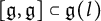
$ [ \mathfrak {g}, \mathfrak {g}] \subset \mathfrak {g}(l) $
and thus
$ \mathfrak {g}(l)$
is an ideal of
$ \mathfrak {g}$
.Let
$l \in \Xi $
. As
$ \mathfrak {g}(x.l)= \mathfrak {g}(l)$
, then
$\mathfrak {h} + \mathfrak {g}(x.l)$
is a polarization at
$x.l$
, for any
$x \in G$
. We deduce that
$\Xi \supset (f+ \mathfrak {h}^\perp )\cap G.l$
.



















4 Smooth vectors and distributions
4.1
Let X be a locally compact space such that each point has a fundamental system of open compact neighborhoods. We denote by $ \mathcal {C}_c^\infty (X)$
the space of locally constant
$ \mathcal {C}_c^\infty (X)$
the space of locally constant $\phi : G \longrightarrow \mathbb C$
whose support
$\phi : G \longrightarrow \mathbb C$
whose support $\mbox {Supp}(\phi )$
is compact. By a distribution on X, we mean a linear functional on
$\mbox {Supp}(\phi )$
is compact. By a distribution on X, we mean a linear functional on $ \mathcal {C}_c^\infty (X)$
. We say that a distribution
$ \mathcal {C}_c^\infty (X)$
. We say that a distribution $\theta $
on X vanishes on an open subset
$\theta $
on X vanishes on an open subset $Y\subset X$
if
$Y\subset X$
if
 $$ \begin{align*}\langle \theta, \phi \rangle = 0, \mbox{ for all } \phi \in \mathcal{C}_c^\infty(X) \mbox{ with } \mbox{Supp}(\phi) \subset Y.\end{align*} $$
The support of $\theta $
, denoted
$\theta $
, denoted $\mbox {Supp} (\theta )$
, is the set of points
$\mbox {Supp} (\theta )$
, is the set of points $x \in X$
such that
$x \in X$
such that $\theta $
does not vanish on any neighborhood of x.
$\theta $
does not vanish on any neighborhood of x.
4.2
A unitary representation of G in a Hilbert space $\mathcal {H}$
means a homomorphism
$\mathcal {H}$
means a homomorphism $\pi $
of G into the group
$\pi $
of G into the group $U(\mathcal {H})$
of unitary operators on
$U(\mathcal {H})$
of unitary operators on $\mathcal {H}$
such that, for every
$\mathcal {H}$
such that, for every $v \in \mathcal {H},$
the map
$v \in \mathcal {H},$
the map $G \ni x\longmapsto \pi (x).v \in \mathcal {H}$
is continuous.
$G \ni x\longmapsto \pi (x).v \in \mathcal {H}$
is continuous.
An invariant subspace of $\pi $
means a subspace
$\pi $
means a subspace $\mathcal L$
of
$\mathcal L$
of $\mathcal {H}$
satisfying
$\mathcal {H}$
satisfying $\pi (x) \mathcal L \subset \mathcal L$
, for all
$\pi (x) \mathcal L \subset \mathcal L$
, for all $x \in G$
. When there is no closed invariant subspace other than
$x \in G$
. When there is no closed invariant subspace other than $\{0\}$
and
$\{0\}$
and $\mathcal {H}$
,
$\mathcal {H}$
, $\pi $
is said to be irreducible.
$\pi $
is said to be irreducible.
Let $\rho $
be another unitary representation of G in a Hilbert space
$\rho $
be another unitary representation of G in a Hilbert space $\mathcal {H}_{\rho }$
. We say that
$\mathcal {H}_{\rho }$
. We say that $\pi $
and
$\pi $
and $\rho $
are equivalent if there is a unitary operator
$\rho $
are equivalent if there is a unitary operator $T : \mathcal {H} \longrightarrow \mathcal {H}_{\rho }$
such that
$T : \mathcal {H} \longrightarrow \mathcal {H}_{\rho }$
such that $T \pi (x)= \rho (x)T$
for every
$T \pi (x)= \rho (x)T$
for every $x \in G$
. The set of all equivalence classes of irreducible unitary representations of G is denoted by
$x \in G$
. The set of all equivalence classes of irreducible unitary representations of G is denoted by $\widehat {G}$
.
$\widehat {G}$
.
Take now a closed subgroup K of G and let $\sigma $
be a unitary representation of K acting in a Hilbert space
$\sigma $
be a unitary representation of K acting in a Hilbert space $\mathcal {H}_\sigma $
. We denote by
$\mathcal {H}_\sigma $
. We denote by $\mbox {Ind}_K^G\sigma $
the induced representation of G by
$\mbox {Ind}_K^G\sigma $
the induced representation of G by $\sigma $
. The Hilbert space
$\sigma $
. The Hilbert space $\mathcal {H}$
of
$\mathcal {H}$
of $\mbox {Ind}_K^G\sigma $
is the completion of the space:
$\mbox {Ind}_K^G\sigma $
is the completion of the space:
 $$ \begin{align*} \mathcal E(G/K, \sigma) = \left\{ \begin{matrix} \phi: G \longrightarrow \mathcal{H}_\sigma \mbox{ continuous with compact support modulo } K \, \\ \mbox{satisfying }\phi(gh) = \sigma(h^{-1}) \phi(g), \, \forall h\in K, \forall g \in G \end{matrix} \right\} \end{align*} $$
with respect to the norm
 $$ \begin{align*}|| \varphi || = \left(\int_{G/K}||\varphi(g)||^2_{ \mathcal{H}_\sigma} \mathop{\mathrm{\mathstrut d}}\dot g \right)^{\frac{1}{2}},\end{align*} $$
where $\mathop {\mathrm {\mathstrut d}}\dot g $
is a G-invariant Borel measure on the homogeneous space
$\mathop {\mathrm {\mathstrut d}}\dot g $
is a G-invariant Borel measure on the homogeneous space $G/K$
. The group G acts on
$G/K$
. The group G acts on $\mathcal {H}$
by left translations, namely,
$\mathcal {H}$
by left translations, namely,
 $$ \begin{align*}\mbox{Ind}_K^G\sigma(g) (\phi)(g') = \phi(g^{-1}g'), \, \mbox{ for } g,g' \mbox{ in } G, \, \phi \mbox{ in } \mathcal{H}.\end{align*} $$
Let $\mathfrak {b}$
be a subalgebra of
$\mathfrak {b}$
be a subalgebra of $ \mathfrak {g}$
subordinate to
$ \mathfrak {g}$
subordinate to $l\in \mathfrak {g}^*$
. Designate by
$l\in \mathfrak {g}^*$
. Designate by $\chi _l$
the character of
$\chi _l$
the character of $B = \exp (\mathfrak {b})$
defined by
$B = \exp (\mathfrak {b})$
defined by
 $$ \begin{align*} \chi_l(\exp(X)) = \psi(\langle l, X\rangle) , \, \, X \in \mathfrak{b}. \end{align*} $$
Denote by $\pi _{l,\mathfrak {b}}$
the induced representation of G:
$\pi _{l,\mathfrak {b}}$
the induced representation of G: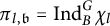 $ \pi _{l,\mathfrak {b}} = \mbox {Ind}_B^G \chi _l$
acting in the Hilbert space
$ \pi _{l,\mathfrak {b}} = \mbox {Ind}_B^G \chi _l$
acting in the Hilbert space $\mathcal {H}_{l,\mathfrak {b}}$
.
$\mathcal {H}_{l,\mathfrak {b}}$
.
Theorem 4.2.1
-
(1) The representation
$\pi _{l,\mathfrak {b}}$
is irreducible if and only if
$\mathfrak {b}$
is a polarization at l. -
(2) Let
$\pi $
be an irreducible unitary representation of G. Then there exists
$l\in \mathfrak {g}^*$
and a polarization
$\mathfrak {b}$
at l such that
$\pi $
is equivalent to
$\pi _{l,\mathfrak {b}}$
. -
(3) Let
$l_1$
,
$l_2$
be two elements of
$ \mathfrak {g}^*$
and
$\mathfrak {b}_1$
,
$\mathfrak {b}_2$
be two polarizations at
$l_1$
and
$l_2,$
respectively. The representations
$\pi _{l_1,\mathfrak {b}_1}$
and
$\pi _{l_2,\mathfrak {b}_2}$
are equivalent if and only if
$l_1$
and
$l_2$
belong to the same G-orbit.


This theorem is due to Kirillov [Reference Kirillov7] for the real case. Thereafter, Moore [Reference Moore12] has observed that Kirillov’s orbit method also applies to the group G. Recently, Martringe ([Reference Matringe10, Theorem 3.6] and [Reference Matringe11, Appendix]) gave a complete proof of the theorem for the smooth irreducible representations.
4.3
Let $\pi $
be a unitary representation of G acting on a Hilbert space
$\pi $
be a unitary representation of G acting on a Hilbert space $\mathcal {H}_{\pi }$
. A vector
$\mathcal {H}_{\pi }$
. A vector $v \in {\mathcal {H}}_{\pi }$
is said to be smooth with respect to
$v \in {\mathcal {H}}_{\pi }$
is said to be smooth with respect to $\pi $
if the map
$\pi $
if the map $G \ni g \mapsto \pi (g)v $
is locally constant. Let
$G \ni g \mapsto \pi (g)v $
is locally constant. Let ${\mathcal {H}}_{\pi }^{\infty }$
be the set of all smooth vectors of
${\mathcal {H}}_{\pi }^{\infty }$
be the set of all smooth vectors of $\pi $
. It is a G-invariant dense subspace of
$\pi $
. It is a G-invariant dense subspace of ${\mathcal {H}}_{\pi } $
. The dual of
${\mathcal {H}}_{\pi } $
. The dual of ${\mathcal {H}}^{\infty }_{\pi }$
is called the space of distributions of
${\mathcal {H}}^{\infty }_{\pi }$
is called the space of distributions of $\pi $
and is denoted by
$\pi $
and is denoted by ${\mathcal {H}}_{\pi }^{-\infty }$
. By transposition, we define a representation
${\mathcal {H}}_{\pi }^{-\infty }$
. By transposition, we define a representation $ \pi _{-\infty }$
of G into
$ \pi _{-\infty }$
of G into ${\mathcal {H}}_{\pi }^{-\infty }$
by the following formula:
${\mathcal {H}}_{\pi }^{-\infty }$
by the following formula:
 $$ \begin{align*}\langle \pi_{-\infty}(g)a,v \rangle = \langle a, \pi(g^{-1})v \rangle, \, \, \forall a \in {\mathcal{H}}_{\pi}^{-\infty}, \forall v \in {\mathcal{H}}_{\pi}^{\infty} , \forall g \in G.\end{align*} $$
4.4
In this section, we assume that $\pi $
is irreducible and denote by
$\pi $
is irreducible and denote by $\Omega _\pi $
its corresponding coadjoint orbit. Let l be an element of
$\Omega _\pi $
its corresponding coadjoint orbit. Let l be an element of $\Omega _\pi $
and
$\Omega _\pi $
and $\mathfrak {b}$
be a polarization at l. Let us realize
$\mathfrak {b}$
be a polarization at l. Let us realize $\pi = \pi _{l, \mathfrak {b}}$
in the Hilbert space
$\pi = \pi _{l, \mathfrak {b}}$
in the Hilbert space ${\mathcal {H}}_{l, \mathfrak {b}}$
.
${\mathcal {H}}_{l, \mathfrak {b}}$
.
4.4.1
Recall that an adapted complementary basis to $\mathfrak {b}$
in
$\mathfrak {b}$
in $ \mathfrak {g}$
is a basis
$ \mathfrak {g}$
is a basis $ (X_1, \ldots , X_m)$
of a subspace of
$ (X_1, \ldots , X_m)$
of a subspace of $ \mathfrak {g}$
complementary to
$ \mathfrak {g}$
complementary to $\mathfrak {b}$
such that, for
$\mathfrak {b}$
such that, for $ i = 0,\ldots , m-1$
, the subspace
$ i = 0,\ldots , m-1$
, the subspace $ F X_{i+1} \oplus \dots \oplus F X_{m}\oplus \mathfrak {b}$
is a subalgebra of
$ F X_{i+1} \oplus \dots \oplus F X_{m}\oplus \mathfrak {b}$
is a subalgebra of $ \mathfrak {g}$
. Since the Lie algebra
$ \mathfrak {g}$
. Since the Lie algebra $ \mathfrak {g}$
is nilpotent, such a basis exists (see [Reference Rais13, Chapter 5]). Putting
$ \mathfrak {g}$
is nilpotent, such a basis exists (see [Reference Rais13, Chapter 5]). Putting $B = \exp (\mathfrak {b})$
, the map
$B = \exp (\mathfrak {b})$
, the map
 $$\begin{align*} \begin{array}{@{}ccccc} \xi &:& F^m \times B&\longrightarrow& G\\ & &(t_1,\ldots, t_m, b) &\longmapsto& \exp(t_1X_1) \dots \exp(t_m X_m) b \end{array} \end{align*}$$
is a diffeomorphism from $F^m \times B$
onto G and the functional
$F^m \times B$
onto G and the functional
 $$ \begin{align*}\mathcal{C}_c^{\infty}(G/B) \ni \psi \longmapsto \int_{F^m} \psi(\exp(t_1X_1) \dots \exp(t_m X_m)B) dt_1 \dots dt_m\end{align*} $$
defines a G-invariant Borel measure on $G/B$
.
$G/B$
.
4.5
By the above analysis, the mapping
 $$\begin{align*}\begin{array}{@{}ccccccc} \eta &:& {\mathcal{H}}_{l, \mathfrak{b}}&\longrightarrow& L^2(F^m)&&\\ & &\psi &\longmapsto& \eta ({\psi}):((t_1,\ldots, t_m)&\longmapsto & \psi (\exp(t_1X_1) \dots \exp(t_m X_m) )) \end{array} \end{align*}$$
is a bijective isometric map. Thus, we obtain an irreducible unitary representation $\sigma $
of G in the Hilbert space
$\sigma $
of G in the Hilbert space $L^2(F^m)$
, equivalent to
$L^2(F^m)$
, equivalent to $\pi $
:
$\pi $
:
 $$ \begin{align*}\sigma(g) \eta ({\phi}) = \eta(\pi(g)\phi), \, \, \phi \in {\mathcal{H}}_{l, \mathfrak{b}}, \, g \in G .\end{align*} $$
Proposition 4.5.1 Keep notations and assumptions as above. The subspace $ \mathcal {C}_c^{\infty }(F^{m})$
of
$ \mathcal {C}_c^{\infty }(F^{m})$
of $ L^2(F^m)$
is stable by
$ L^2(F^m)$
is stable by $\sigma $
and we have
$\sigma $
and we have
 $$ \begin{align*}(L^2(F^m) )^{\infty} = \mathcal{C}_c^{\infty}(F^{m}).\end{align*} $$
Corollary 4.5.1 The subspace $ ({\mathcal {H}}_{l, \mathfrak {b}})^{\infty } $
is the set of functions
$ ({\mathcal {H}}_{l, \mathfrak {b}})^{\infty } $
is the set of functions $\phi : G\longrightarrow \mathbb C$
such that
$\phi : G\longrightarrow \mathbb C$
such that
-
(1)
$\phi (gb) = \chi _l(b^{-1}) \phi (g)$
, for
$ b\in B, \, g \in G $
; -
(2)
$\exists K$
an open compact subgroup of G such that
$\phi (g_0g) = \phi (g), \, \forall g \in G, g_0 \in K$
; -
(3)
$\mbox {Supp}(\phi )$
is compact modulo B.





This is an analog of Kirillov’s result for the real case (see [Reference Howe6, Proposition 3.3]).
4.6
Let $\chi $
be a character of an algebraic subgroup
$\chi $
be a character of an algebraic subgroup $H $
of G. Recall that a distribution
$H $
of G. Recall that a distribution $a \in {\mathcal {H}}_{\pi }^{-\infty }$
is said to be
$a \in {\mathcal {H}}_{\pi }^{-\infty }$
is said to be $\chi $
-semi-invariant if it satisfies
$\chi $
-semi-invariant if it satisfies
 $$ \begin{align*}\pi_{-\infty}(h)a = \chi(h^{-1})a, \, \forall h \in H.\end{align*} $$
We denote by $( {\mathcal {H}}_{\pi }^{-\infty })^{H, \chi }$
the space of all
$( {\mathcal {H}}_{\pi }^{-\infty })^{H, \chi }$
the space of all $\chi $
-semi-invariant distributions of
$\chi $
-semi-invariant distributions of $\pi $
. An interesting problem is the description of the space
$\pi $
. An interesting problem is the description of the space $( {\mathcal {H}}_{\pi }^{-\infty })^{H, \chi } $
.
$( {\mathcal {H}}_{\pi }^{-\infty })^{H, \chi } $
.
Pick $f\in \mathfrak {g}^*$
such that
$f\in \mathfrak {g}^*$
such that $ \mathfrak {h} $
is subordinate to f and that
$ \mathfrak {h} $
is subordinate to f and that $\chi = \chi _f$
. Assume that
$\chi = \chi _f$
. Assume that $ (f +\mathfrak {h}^\perp ) \cap \Omega _\pi \neq \emptyset $
. We claim that the space
$ (f +\mathfrak {h}^\perp ) \cap \Omega _\pi \neq \emptyset $
. We claim that the space $(\mathcal {H}_{\pi }^{-\infty })^{H,\chi }$
is nonzero. For this, fix
$(\mathcal {H}_{\pi }^{-\infty })^{H,\chi }$
is nonzero. For this, fix $g \in G$
such that
$g \in G$
such that $ g.l\in f +\mathfrak {h}^\perp $
.
$ g.l\in f +\mathfrak {h}^\perp $
.
Proposition 4.6.1 Keep the above notations. Let $d \dot {h}$
be a positive H-invariant measure on
$d \dot {h}$
be a positive H-invariant measure on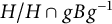 $H/H\cap gBg^{-1}$
. The linear form
$H/H\cap gBg^{-1}$
. The linear form
 $$ \begin{align} I_{g.l, \pi}: {\mathcal{H}}_{l, \mathfrak{b}}^{\infty} \ni \phi \longmapsto\int_{H/H \cap gBg^{-1}} \phi(hg)\chi_f(h) \mathop{\mathrm{\mathstrut d}}\dot{h} \end{align} $$
defines a nonzero element of $ (\mathcal {H}_{l, \mathfrak {b}}^{-\infty })^{H,\chi }$
.
$ (\mathcal {H}_{l, \mathfrak {b}}^{-\infty })^{H,\chi }$
.
Proof First, we show that the integrand is well-defined as a function on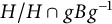 $H/H \cap gBg^{-1}$
, that is, it is constant on the cosets of
$H/H \cap gBg^{-1}$
, that is, it is constant on the cosets of $H \cap gBg^{-1}$
. Let
$H \cap gBg^{-1}$
. Let $h \in H$
and
$h \in H$
and $h' \in H \cap gBg^{-1}$
. We have
$h' \in H \cap gBg^{-1}$
. We have
 $$ \begin{align*} \phi(hh'g)\chi_f(hh')&= \phi(hg g^{-1}h'g)\chi_f(hh') = \chi_l(g^{-1}h^{\prime-1}g)\phi(hg)\chi_f(h)\chi_f(h')\\ &= \chi_{g.l}(h^{\prime-1})\chi_f(h')\phi(hg)\chi_f(h)= \phi(hg)\chi_f(h), \end{align*} $$
which proves the claim.
In the sequel, for simplicity, we assume that $g.l = f$
. Let
$g.l = f$
. Let $r_g$
be the map from G into itself defined by
$r_g$
be the map from G into itself defined by
 $$ \begin{align*}r_g(x)= xg, \, x \in G.\end{align*} $$
Let $\phi \in \mathcal {H}_{l, \mathfrak {b}}^{\infty }$
, that is,
$\phi \in \mathcal {H}_{l, \mathfrak {b}}^{\infty }$
, that is, $\phi : G\longrightarrow \mathbb C$
such that
$\phi : G\longrightarrow \mathbb C$
such that
-
(1)
$\phi (xb) = \chi _l(b^{-1}) \phi (x)$
,
$ b\in B, \, x \in G $
; -
(2)
$\exists K$
an open compact subgroup of G such that
$\phi (g_0x) = \phi (x), \, \forall x \in G, g_0 \in K$
; -
(3)
$\mbox {Supp}( \phi )$
is compact modulo B.





Then the function $\phi \circ r_g$
is locally constant with compact support modulo
$\phi \circ r_g$
is locally constant with compact support modulo $gBg^{-1}$
. From Lion–Perrin [Reference Lion and Perrin8], the integral
$gBg^{-1}$
. From Lion–Perrin [Reference Lion and Perrin8], the integral
 $$ \begin{align*} \int_{H/H \cap gBg^{-1}} \phi(hg)\chi_f(h) \mathop{\mathrm{\mathstrut d}}\dot{h} \end{align*} $$
converges.
Now we show that the linear form $I_{f, \pi }$
is nonzero. As
$I_{f, \pi }$
is nonzero. As $\phi \circ r_g \in \mathcal {H}_{g.l, g.\mathfrak {b}}^{\infty } $
, we may assume that
$\phi \circ r_g \in \mathcal {H}_{g.l, g.\mathfrak {b}}^{\infty } $
, we may assume that $g =1$
. Assume that the adapted complementary basis
$g =1$
. Assume that the adapted complementary basis $(X_1, \ldots , X_m) $
of
$(X_1, \ldots , X_m) $
of $\mathfrak {b}$
in
$\mathfrak {b}$
in $ \mathfrak {g}$
is chosen such that
$ \mathfrak {g}$
is chosen such that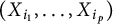 $(X_{i_1}, \ldots , X_{i_p})$
is an adapted complementary basis of
$(X_{i_1}, \ldots , X_{i_p})$
is an adapted complementary basis of $\mathfrak {b} \cap \mathfrak {h}$
in
$\mathfrak {b} \cap \mathfrak {h}$
in $\mathfrak {h}$
. We consider the isometry map
$\mathfrak {h}$
. We consider the isometry map $\eta : \mathcal {H}_{l,\mathfrak {b}} \longrightarrow L^2(F^m)$
, introduced in Section 4.5. Pick an integer s large enough such that,
$\eta : \mathcal {H}_{l,\mathfrak {b}} \longrightarrow L^2(F^m)$
, introduced in Section 4.5. Pick an integer s large enough such that, $\mathcal {O}$
being the ring of integers of F,
$\mathcal {O}$
being the ring of integers of F,
 $$ \begin{align*}\langle f, \varpi^s X_{i_r} \rangle \in \mathcal O, \, \forall r = 1, \ldots,p.\end{align*} $$
Put $\tilde {\beta }= 1_{\varpi ^s \mathcal O \times \cdots \times \varpi ^s \mathcal O } \in \mathcal {C}_c^{\infty }(F^m)$
. Let
$\tilde {\beta }= 1_{\varpi ^s \mathcal O \times \cdots \times \varpi ^s \mathcal O } \in \mathcal {C}_c^{\infty }(F^m)$
. Let $\beta = \eta ^{-1}(\tilde {\beta })$
. We have
$\beta = \eta ^{-1}(\tilde {\beta })$
. We have $\beta \in \mathcal {H}_{l, \mathfrak {b}}^{\infty }$
. We show that
$\beta \in \mathcal {H}_{l, \mathfrak {b}}^{\infty }$
. We show that $I_{f, \pi }(\beta ) \neq 0$
. As the map
$I_{f, \pi }(\beta ) \neq 0$
. As the map
 $$ \begin{align*}\begin{array}{@{}ccccc} & &F^p \times (H \cap B) &\longrightarrow& H\\ & &(t_1,\ldots, t_p, b) &\longmapsto& \exp(t_1X_{i_1}) \dots \exp(t_p X_{i_p}) b \end{array}\end{align*} $$
is a diffeomorphism, for each $ h \in H$
, we may write
$ h \in H$
, we may write
 $$ \begin{align*}h = \exp(t_1X_{i_1}) \dots \exp(t_p X_{i_p}) b, \,\quad t_1, \ldots,t_p \in F, b \in H\cap B.\end{align*} $$
We deduce that
 $$ \begin{align*} \beta(h)\chi_f(h) = \left\{ \begin{array}{@{}lr} 1 \quad \mbox{ if }\,(t_1,\ldots, t_p) \in \varpi^s \mathcal O \times \cdots \times \varpi^s \mathcal O \\ 0 \quad \mbox{otherwise}. \end{array} \right. \end{align*} $$
So that the function $h \mapsto \beta (h)\chi _f(h) $
is nonnegative and nonzero. It follows that
$h \mapsto \beta (h)\chi _f(h) $
is nonnegative and nonzero. It follows that
 $$ \begin{align*}\int_{H/H \cap B}\beta(h)\chi_f(h)\mathop{\mathrm{\mathstrut d}}\dot{h}>0.\end{align*} $$
For the $\chi $
-semi-invariance of
$\chi $
-semi-invariance of $I_{f, \pi }$
, let
$I_{f, \pi }$
, let $h_0 \in H$
and
$h_0 \in H$
and $\phi \in \mathcal {H}_{l, \mathfrak {b}}^{\infty }$
:
$\phi \in \mathcal {H}_{l, \mathfrak {b}}^{\infty }$
:
 $$ \begin{align*} \langle \pi_{-\infty}(h_0) I_{f, \pi}, \phi \rangle &= \langle I_{f, \pi}, \pi(h_0^{-1}) \phi \rangle \\ &= \int_{H/H \cap gBg^{-1}} \pi(h_0^{-1})\phi(hg)\chi_f(h)\mathop{\mathrm{\mathstrut d}}\dot{h} \\ &= \int_{H/H \cap gBg^{-1}} \phi(h_0hg)\chi_f(h)\mathop{\mathrm{\mathstrut d}}\dot{h} \\ &= \int_{H/H \cap gBg^{-1}} \phi(hg)\chi_f(h_0^{-1}h)\mathop{\mathrm{\mathstrut d}}\dot{h} \\ &= \chi_f(h_0^{-1}) \int_{H/H \cap gBg^{-1}} \phi(hg)\chi_f(h)\mathop{\mathrm{\mathstrut d}}\dot{h} \\ &= \chi_f(h_0^{-1}) \langle I_{f, \pi}, \phi \rangle= \langle \chi_f(h_0^{-1}) I_{f, \pi}, \phi \rangle. \end{align*} $$
Thus, the desired result.
Lemma 4.6.1 For all $h_0 \in H$
,
$h_0 \in H$
, $ I_{h_0f, \pi }$
is proportional to
$ I_{h_0f, \pi }$
is proportional to $I_{f, \pi }$
.
$I_{f, \pi }$
.
Proof Set $K= gBg^{-1}$
. The map
$K= gBg^{-1}$
. The map
 $$ \begin{align*}H/H\cap K \longrightarrow H/H \cap h_0Kh_0^{-1}, \, h \mod H\cap K \longmapsto h_0hh_0^{-1} \mod H\cap h_0K h_0^{-1}\end{align*} $$
is a diffeomorphism and sends a positive H-invariant measure on $H/H\cap K$
to a positive H-invariant measure on
$H/H\cap K$
to a positive H-invariant measure on $H/H\cap h_0K h_0^{-1}$
. So that we have
$H/H\cap h_0K h_0^{-1}$
. So that we have
 $$ \begin{align*} \langle I_{h_0f, \pi}, \phi \rangle &= \int_{H/H \cap h_0K h_0^{-1}} \phi(hh_0g)\chi_{h_0f}(h){\mathrm{\mathstrut d}}_{H/H \cap h_0K h_0^{-1}}\dot{h}\\ &= c\int_{H/H \cap K } \phi(h_0hg)\chi_{h_0f}(h_0hh_0^{-1}){\mathrm{\mathstrut d}}_{H/H \cap K }\dot{h}\\ &= c \chi_{f}(h_0^{-1}) \langle I_{f, \pi}, \phi \rangle , \end{align*} $$
where c is some constant. Thus, the result.
4.7
Keep the notations of Section 3.2 and the following ones. Here, we will compute the space $ (\mathcal {H}_{l, \mathfrak {b}}^{-\infty })^{H,\chi }$
, for
$ (\mathcal {H}_{l, \mathfrak {b}}^{-\infty })^{H,\chi }$
, for $l \in \Xi $
such that
$l \in \Xi $
such that $\Xi \supset (f + \mathfrak {h}^\perp )\cap G.l$
. By Proposition 3.2.1,
$\Xi \supset (f + \mathfrak {h}^\perp )\cap G.l$
. By Proposition 3.2.1, $(f + \mathfrak {h}^\perp ) \cap G.l$
is a smooth variety and every irreducible component of
$(f + \mathfrak {h}^\perp ) \cap G.l$
is a smooth variety and every irreducible component of $ (f + \mathfrak {h}^\perp )\cap G.l $
is a H-orbit of dimension
$ (f + \mathfrak {h}^\perp )\cap G.l $
is a H-orbit of dimension $\frac {1}{2} \dim G.l$
.
$\frac {1}{2} \dim G.l$
.
Let us denote by $C_1, \ldots , C_n$
the irreducible components of
$C_1, \ldots , C_n$
the irreducible components of $(f + \mathfrak {h}^\perp ) \cap G.l$
. For each
$(f + \mathfrak {h}^\perp ) \cap G.l$
. For each $1 \leq j \leq n$
, pick
$1 \leq j \leq n$
, pick $g_j \in G$
such that
$g_j \in G$
such that $g_j.l \in C_j$
.
$g_j.l \in C_j$
.
Let $\mathfrak {b}$
be a fixed polarization at l and
$\mathfrak {b}$
be a fixed polarization at l and $B = \exp (\mathfrak {b})$
. Let
$B = \exp (\mathfrak {b})$
. Let $\mathop {\mathrm {\mathstrut d}}{b}$
be a Haar measure on B.
$\mathop {\mathrm {\mathstrut d}}{b}$
be a Haar measure on B.
For each $1 \leq j \leq n$
, we consider the distribution
$1 \leq j \leq n$
, we consider the distribution $I_{g_j.l, \pi }$
defined by formula (4.1).
$I_{g_j.l, \pi }$
defined by formula (4.1).
For $\phi \in \mathcal {C}_c^\infty (G)$
, we denote by
$\phi \in \mathcal {C}_c^\infty (G)$
, we denote by $\tilde \phi $
the function on G defined by
$\tilde \phi $
the function on G defined by
 $$ \begin{align*}\tilde \phi (x)= \int_B\phi(xb) \chi_l(b)\mathop{\mathrm{\mathstrut d}}{b}, \, x \in G.\end{align*} $$
We see immediately that $\tilde \phi \in \mathcal {H}_{l, \mathfrak {b}}^{\infty }$
. So that if
$\tilde \phi \in \mathcal {H}_{l, \mathfrak {b}}^{\infty }$
. So that if $a \in \mathcal {H}_{l, \mathfrak {b}}^{-\infty }$
, we obtain a distribution
$a \in \mathcal {H}_{l, \mathfrak {b}}^{-\infty }$
, we obtain a distribution $\tilde a$
on G by putting
$\tilde a$
on G by putting
 $$ \begin{align*}\langle \tilde a, \phi \rangle = \langle a, \tilde \phi \rangle , \, \phi \in \mathcal{C}_c^\infty(G).\end{align*} $$
The support of $ \widetilde {I_{g_j.l, \pi }} $
is contained in the closed subset
$ \widetilde {I_{g_j.l, \pi }} $
is contained in the closed subset $Hg_jB$
. Indeed, let
$Hg_jB$
. Indeed, let $\phi \in \mathcal {C}_c^\infty (G)$
such that
$\phi \in \mathcal {C}_c^\infty (G)$
such that $\mbox {Supp}(\phi ) \subset G \setminus Hg_jB$
. Then
$\mbox {Supp}(\phi ) \subset G \setminus Hg_jB$
. Then $\tilde \phi (hg_j) = 0 $
, for all
$\tilde \phi (hg_j) = 0 $
, for all $h \in H$
. Hence,
$h \in H$
. Hence,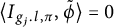 $ \langle I_{g_j.l, \pi }, \tilde \phi \rangle = 0 $
.
$ \langle I_{g_j.l, \pi }, \tilde \phi \rangle = 0 $
.
Consequently, $I_{g_1.l, \pi }, \ldots , I_{g_n.l, \pi }$
are linearly independent.
$I_{g_1.l, \pi }, \ldots , I_{g_n.l, \pi }$
are linearly independent.
Proposition 4.7.1 Let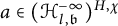 $a \in (\mathcal {H}_{l, \mathfrak {b}}^{-\infty })^{H,\chi }$
such that
$a \in (\mathcal {H}_{l, \mathfrak {b}}^{-\infty })^{H,\chi }$
such that $\tilde a$
is supported on
$\tilde a$
is supported on $Hg_jB$
. Then a is proportional to
$Hg_jB$
. Then a is proportional to $I_{g_j.l, \pi }$
.
$I_{g_j.l, \pi }$
.
Proof Take $g_j=1$
for simplicity.
$g_j=1$
for simplicity.
For $\phi \in \mathcal {C}_c^\infty (G)$
, we define a function
$\phi \in \mathcal {C}_c^\infty (G)$
, we define a function $\varphi _\phi $
on
$\varphi _\phi $
on $H/(H\cap B)$
by putting
$H/(H\cap B)$
by putting
 $$ \begin{align*}\varphi_\phi(h) = \tilde \phi(h)\chi_f(h), \, h \in H.\end{align*} $$
We have $ \varphi _\phi \in \mathcal {C}_c^\infty (H/(H\cap B))$
. This allows us to define a distribution
$ \varphi _\phi \in \mathcal {C}_c^\infty (H/(H\cap B))$
. This allows us to define a distribution $\theta $
on
$\theta $
on $H/(H\cap B)$
by
$H/(H\cap B)$
by
 $$ \begin{align*}\langle \theta , \varphi_\phi \rangle =\langle a , \tilde \phi \rangle.\end{align*} $$
This is well-defined. Indeed, let $\phi _1 , \phi _2 \in \mathcal {C}_c^\infty (G)$
such that
$\phi _1 , \phi _2 \in \mathcal {C}_c^\infty (G)$
such that $ \varphi _{\phi _1}= \varphi _{\phi _2}$
. We have
$ \varphi _{\phi _1}= \varphi _{\phi _2}$
. We have
 $$ \begin{align*}\widetilde{\phi_1-\phi_2}(h)=0 , \forall h \in H.\end{align*} $$
So that $\widetilde {\phi _1-\phi _2}=0$
on
$\widetilde {\phi _1-\phi _2}=0$
on $HB$
. Now let K be a compact open subgroup of G such that
$HB$
. Now let K be a compact open subgroup of G such that $\phi _1$
and
$\phi _1$
and $\phi _2$
are left K-invariant. A straightforward computation shows that
$\phi _2$
are left K-invariant. A straightforward computation shows that
 $$ \begin{align*}\widetilde{\phi_1-\phi_2} = \widetilde{{\textit{1}_{(KHB)^c}(\phi_1-\phi_2)}} ,\end{align*} $$
where $(KHB)^c = G \setminus KHB$
. Hence, we have
$(KHB)^c = G \setminus KHB$
. Hence, we have
 $$ \begin{align*}\langle a, \tilde \phi_1- \tilde\phi_2 \rangle = \langle a, \widetilde{\phi_1-\phi_2} \rangle = \langle a, \widetilde{{\textit{1}_{(KHB)^c}(\phi_1-\phi_2)}} \rangle = \langle \tilde a, 1_{(KHB)^c}(\phi_1-\phi_2) \rangle = 0.\end{align*} $$
Furthermore, for all $\alpha \in \mathcal {C}_c^\infty (H/(H\cap B))$
, there exists
$\alpha \in \mathcal {C}_c^\infty (H/(H\cap B))$
, there exists $\phi \in \mathcal {C}_c^\infty (G)$
such that
$\phi \in \mathcal {C}_c^\infty (G)$
such that $\alpha = \varphi _\phi $
(see Section 4.8 below).
$\alpha = \varphi _\phi $
(see Section 4.8 below).
The group H acts by left translation on $H/(H\cap B)$
. It induces an action on
$H/(H\cap B)$
. It induces an action on $ \mathcal {C}_c^\infty (H/(H\cap B))$
. For this action, the distribution
$ \mathcal {C}_c^\infty (H/(H\cap B))$
. For this action, the distribution $\theta $
is H-invariant. Indeed, for
$\theta $
is H-invariant. Indeed, for $h_0 \in H$
, we have
$h_0 \in H$
, we have
 $$ \begin{align*} L_{h_0} \varphi_\phi(h) = \varphi_\phi(h_0^{-1}h) = \tilde \phi(h_0^{-1}h)\chi_f(h_0^{-1}h)=\widetilde{L_{h_0}\phi}(h)\chi_f(h) \chi_f(h_0^{-1}), \end{align*} $$
where $ L_{h_0} \phi (x)= \phi (h_0^{-1}x), x \in G $
. Thus,
$ L_{h_0} \phi (x)= \phi (h_0^{-1}x), x \in G $
. Thus,
 $$ \begin{align*} \chi_f(h_0)L_{h_0}\varphi_\phi(h) =\widetilde{L_{h_0}\phi}(h)\chi_f(h)= \varphi_{L_{h_0}\phi}(h), \, h \in H, \end{align*} $$
Consequently,
 $$ \begin{align*} \chi_f(h_0)\langle \theta ,L_{h_0} \varphi_\phi \rangle= \langle \theta , \varphi_{L_{h_0}\phi} \rangle= \langle a , \widetilde{L_{h_0}\phi} \rangle = \langle a , \pi(h_0)\widetilde{\phi}\rangle = \chi_f(h_0)\langle a , \widetilde{\phi}\rangle. \end{align*} $$
Hence, $ \langle \theta , L_{h_0} \varphi _\phi \rangle = \langle \theta , \varphi _\phi \rangle $
, which proves our claim.
$ \langle \theta , L_{h_0} \varphi _\phi \rangle = \langle \theta , \varphi _\phi \rangle $
, which proves our claim.
Using [Reference Harish-Chandra5, Part V – Lemma 17], we see that there exists a constant $c \in \mathbb C$
such that
$c \in \mathbb C$
such that
 $$ \begin{align*}\langle \theta , \alpha \rangle = c \int_{H/H\cap B} \alpha(\dot{h}) \mathop{\mathrm{\mathstrut d}}\dot{h}, \, \, \alpha \in \mathcal{C}_c^\infty(H/(H\cap B)).\end{align*} $$
Thus, the result.
4.8
Pick an adapted supplementary basis $(X_1,\ldots ,X_m)$
of
$(X_1,\ldots ,X_m)$
of $\mathfrak {b}$
in
$\mathfrak {b}$
in $ \mathfrak {g}$
such that
$ \mathfrak {g}$
such that $(X_{i_1},\ldots ,X_{i_s})$
is an adapted supplementary basis of
$(X_{i_1},\ldots ,X_{i_s})$
is an adapted supplementary basis of $\mathfrak {h} \cap \mathfrak {b}$
in
$\mathfrak {h} \cap \mathfrak {b}$
in $\mathfrak {b}$
. Consider the map
$\mathfrak {b}$
. Consider the map
 $$\begin{align*} \begin{array}{@{}ccccc} \xi' &:& F^s \times H\cap B&\longrightarrow& H\\ & &(t_1,\ldots, t_s, b) &\longmapsto& \exp(t_1X_{i_1}) \dots \exp(t_s X_{s}) b. \end{array} \end{align*}$$
This map is a diffeomorphism. It induces a diffeomorphism
 $$ \begin{align*}\dot{\xi'} : F^s \longrightarrow H/ (H\cap B), \, \dot{\xi'}(t)= \xi'(t,e). H\cap B,\end{align*} $$
where e is the identity element of $H\cap B$
. Consequently, the map
$H\cap B$
. Consequently, the map
 $$ \begin{align*}\mathcal{C}^{\infty}_{c}(F^{s})\ni \alpha\mapsto\alpha \circ \dot{\xi'}^{-1} \in \mathcal{C}^{\infty}_{c}(H/H\cap B)\end{align*} $$
is a linear isomorphism.
Define a function $\chi _f' $
on
$\chi _f' $
on $F^s$
by
$F^s$
by
 $$ \begin{align*}\chi_f'(t_1,\ldots, t_s)= \chi_f(\exp(t_1X_{i_1}) \dots \exp(t_s X_{s})) .\end{align*} $$
Let $\alpha \in \mathcal {C}_c^\infty (F^s)$
. Choose
$\alpha \in \mathcal {C}_c^\infty (F^s)$
. Choose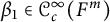 $\beta _1 \in \mathcal {C}_c^\infty (F^m)$
such that
$\beta _1 \in \mathcal {C}_c^\infty (F^m)$
such that $\beta _{1 \vert F^s}= \frac {\alpha }{\chi _f'}$
and
$\beta _{1 \vert F^s}= \frac {\alpha }{\chi _f'}$
and $\beta _2 \in \mathcal {C}_c^\infty (B)$
such that
$\beta _2 \in \mathcal {C}_c^\infty (B)$
such that $ \int _B\beta _2(b) \chi _l(b)db= 1$
. Set
$ \int _B\beta _2(b) \chi _l(b)db= 1$
. Set $\phi = (\beta _1 \otimes \beta _2)\circ \xi ^{-1}$
. Then
$\phi = (\beta _1 \otimes \beta _2)\circ \xi ^{-1}$
. Then $ \phi \in \mathcal {C}_c^\infty (G)$
and
$ \phi \in \mathcal {C}_c^\infty (G)$
and
 $$ \begin{align*}\alpha \circ \dot{\xi'}^{-1} (\dot{h})= \tilde \phi(h) \chi_f(h), \, \forall h \in H.\end{align*} $$
4.9
Put
 $$ \begin{align*}S_\pi= \{g \in G \, \vert \, g.(l+ \mathfrak{b}^\perp)\cap(f+ \mathfrak{h}^\perp) \neq \emptyset\}.\end{align*} $$
Using the following facts:
-
— The intersection of two affine subspaces is an affine subspace or the emptyset,
-
— each affine subspace is an irreducible subset,
-
— the irreducible components of
$(f+ \mathfrak {h}^\perp )\cap G.l$
are
$C_1 = Hg_1.l, \ldots , C_n = Hg_n.l$
,


we show that $S_\pi = \sqcup _{k=1}^n Hg_kB$
. Indeed, let
$S_\pi = \sqcup _{k=1}^n Hg_kB$
. Indeed, let $g \in S_\pi $
. Since
$g \in S_\pi $
. Since $B.l= l+ \mathfrak {b}^\perp $
, there exist
$B.l= l+ \mathfrak {b}^\perp $
, there exist $b \in B$
and
$b \in B$
and $k \in {[\![} 1, n {]\!]}$
such that
$k \in {[\![} 1, n {]\!]}$
such that $ gb.l \in C_k= Hg_k.l$
. Hence,
$ gb.l \in C_k= Hg_k.l$
. Hence, $g \in Hg_kB$
. Conversely, for any
$g \in Hg_kB$
. Conversely, for any $h \in H$
and
$h \in H$
and $b \in B$
, we have
$b \in B$
, we have
 $$ \begin{align*}hg_k.l \in hg_kb.(l+ \mathfrak{b}^\perp)\cap(f+ \mathfrak{h}^\perp).\end{align*} $$
So that $Hg_kB \subset S_\pi $
. Finally, if
$Hg_kB \subset S_\pi $
. Finally, if $j \neq k$
, then
$j \neq k$
, then $ Hg_jB \neq Hg_kB$
. Indeed, otherwise, the irreducible subset
$ Hg_jB \neq Hg_kB$
. Indeed, otherwise, the irreducible subset $ g_k.(l+ \mathfrak {b}^\perp )\cap (f+ \mathfrak {h}^\perp )$
of
$ g_k.(l+ \mathfrak {b}^\perp )\cap (f+ \mathfrak {h}^\perp )$
of $(f + \mathfrak {h}^\perp ) \cap G.l$
would intersect both
$(f + \mathfrak {h}^\perp ) \cap G.l$
would intersect both $C_j$
and
$C_j$
and $C_k$
, which is impossible.
$C_k$
, which is impossible.
Denote by $(\mathcal {H}_{l, \mathfrak {b}}^{-\infty })_Z^{H,\chi }$
the subspace of
$(\mathcal {H}_{l, \mathfrak {b}}^{-\infty })_Z^{H,\chi }$
the subspace of $(\mathcal {H}_{l, \mathfrak {b}}^{-\infty })^{H,\chi }$
consisting of elements
$(\mathcal {H}_{l, \mathfrak {b}}^{-\infty })^{H,\chi }$
consisting of elements $a $
such that
$a $
such that $\tilde a$
is supported by
$\tilde a$
is supported by $ S_\pi $
.
$ S_\pi $
.
Theorem 4.9.1 Let $\pi \in \widehat {G}$
be such that
$\pi \in \widehat {G}$
be such that $(f+ \mathfrak {h}^\perp ) \cap \Omega _\pi \subset \Xi $
. Let
$(f+ \mathfrak {h}^\perp ) \cap \Omega _\pi \subset \Xi $
. Let $l\in \Omega _\pi $
and let
$l\in \Omega _\pi $
and let $\mathfrak {b}$
be a polarization at l. We realize
$\mathfrak {b}$
be a polarization at l. We realize $\pi = \pi _{l, \mathfrak {b}}$
in the Hilbert space
$\pi = \pi _{l, \mathfrak {b}}$
in the Hilbert space ${\mathcal {H}}_{l, \mathfrak {b}}$
. For each H-orbit
${\mathcal {H}}_{l, \mathfrak {b}}$
. For each H-orbit $C_j$
in
$C_j$
in $(f + \mathfrak {h}^\perp ) \cap G.l$
, choose an element
$(f + \mathfrak {h}^\perp ) \cap G.l$
, choose an element $g_j \in G$
such that
$g_j \in G$
such that $g_j.l \in C_j$
.
$g_j.l \in C_j$
.
Then we have
 $$ \begin{align*}(\mathcal{H}_{l, \mathfrak{b}}^{-\infty})_Z^{H,\chi} = \mathrm{Span}\{I_{g_1.l, \pi}, \ldots, I_{g_n.l, \pi}\},\end{align*} $$
and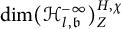 $\dim (\mathcal {H}_{l, \mathfrak {b}}^{-\infty })_Z^{H,\chi }$
is equal to the number of H-orbits contained in
$\dim (\mathcal {H}_{l, \mathfrak {b}}^{-\infty })_Z^{H,\chi }$
is equal to the number of H-orbits contained in $( f + \mathfrak {h}^\perp )\cap G.l$
.
$( f + \mathfrak {h}^\perp )\cap G.l$
.
Proof The only remaining point to prove is the direct inclusion. Let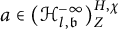 $a \in (\mathcal {H}_{l, \mathfrak {b}}^{-\infty })_Z^{H,\chi }$
and
$a \in (\mathcal {H}_{l, \mathfrak {b}}^{-\infty })_Z^{H,\chi }$
and $\phi \in \mathcal {C}_c^\infty (G)$
. We show that for each
$\phi \in \mathcal {C}_c^\infty (G)$
. We show that for each $k \in {[\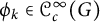 $\phi _k \in \mathcal {C}_c^\infty (G)$
satisfying
$\phi _k \in \mathcal {C}_c^\infty (G)$
satisfying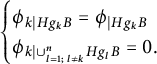 $ \begin {cases} \phi _{k \vert Hg_kB} = \phi _{\vert Hg_kB} \\ \phi _{k \vert \cup _{l=1; \, l\neq k}^n Hg_lB} =0. \end {cases}$
Set
$ \begin {cases} \phi _{k \vert Hg_kB} = \phi _{\vert Hg_kB} \\ \phi _{k \vert \cup _{l=1; \, l\neq k}^n Hg_lB} =0. \end {cases}$
Set ${}^{11}A_k= \{x \in Hg_kB \, \vert \, \phi (x ) \neq 0 \}$
. Since
${}^{11}A_k= \{x \in Hg_kB \, \vert \, \phi (x ) \neq 0 \}$
. Since $Hg_kB$
is closed in G, the set
$Hg_kB$
is closed in G, the set $A_k$
is a compact subset of
$A_k$
is a compact subset of $Hg_kB$
. Hence, there exists a compact open subset
$Hg_kB$
. Hence, there exists a compact open subset $M_k\subset G$
such that
$M_k\subset G$
such that
 $$ \begin{align*}A_k \subset M_k \quad \mbox{and} \quad (\cup_{l=1; \, l\neq k}^{l=n} Hg_lB) \cap M_k = \emptyset.\end{align*} $$
Then the function $ 1_{M_k}\phi $
satisfies the required conditions.
$ 1_{M_k}\phi $
satisfies the required conditions.
Define $ \langle a_k, \tilde \phi \rangle = \langle a, \tilde \phi _k \rangle. $
It is immediate that
$ \langle a_k, \tilde \phi \rangle = \langle a, \tilde \phi _k \rangle. $
It is immediate that $a_k \in \mathcal {H}_{l, \mathfrak {b}}^{-\infty }$
and that
$a_k \in \mathcal {H}_{l, \mathfrak {b}}^{-\infty }$
and that $\mbox {Supp} (\tilde {a_k}) \subset Hg_kB$
. We claim that
$\mbox {Supp} (\tilde {a_k}) \subset Hg_kB$
. We claim that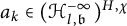 $a_k \in (\mathcal {H}_{l, \mathfrak {b}}^{-\infty })^{H,\chi }$
. Indeed, let
$a_k \in (\mathcal {H}_{l, \mathfrak {b}}^{-\infty })^{H,\chi }$
. Indeed, let $h_0 \in H$
. Since
$h_0 \in H$
. Since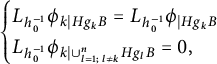 $ \begin {cases} L_{h_0^{-1}}\phi _{k \vert Hg_kB} = L_{h_0^{-1}}\phi _{\vert Hg_kB} \\ L_{h_0^{-1}}\phi _{k \vert \cup _{l=1; \, l\neq k}^n Hg_lB} =0, \end {cases}$
we deduce that
$ \begin {cases} L_{h_0^{-1}}\phi _{k \vert Hg_kB} = L_{h_0^{-1}}\phi _{\vert Hg_kB} \\ L_{h_0^{-1}}\phi _{k \vert \cup _{l=1; \, l\neq k}^n Hg_lB} =0, \end {cases}$
we deduce that
 $$ \begin{align*} \langle \pi_{-\infty}(h_0) a_k, \tilde \phi \rangle& = \langle a_k,\pi(h_0^{-1}) \tilde \phi \rangle =\langle a_k,\widetilde{L_{h_0^{-1}}\phi} \rangle = \langle a, \widetilde{L_{h_0^{-1}}\phi_k} \rangle = \langle a, \pi(h_0^{-1}) \tilde \phi_k \rangle \\ &= \langle \pi_{-\infty}(h_0) a, \tilde \phi_k \rangle = \chi(h_0^{-1}) \langle a, \tilde \phi_k \rangle = \chi(h_0^{-1}) \langle a_k, \tilde \phi \rangle = \langle\chi(h_0^{-1}) a_k, \tilde \phi \rangle. \end{align*} $$
Thus, $\pi _{-\infty }(h_0) a_k= \chi (h_0^{-1}) a_k$
and hence
$\pi _{-\infty }(h_0) a_k= \chi (h_0^{-1}) a_k$
and hence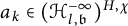 $a_k \in (\mathcal {H}_{l, \mathfrak {b}}^{-\infty })^{H,\chi }$
.
$a_k \in (\mathcal {H}_{l, \mathfrak {b}}^{-\infty })^{H,\chi }$
.
By Proposition 4.7.1, there exists $c_k \in \mathbb C$
such that
$c_k \in \mathbb C$
such that $ a_k = c_kI_{g_k.l, \pi }$
.
$ a_k = c_kI_{g_k.l, \pi }$
.
Finally, since $ ( \phi - \sum _{k=1}^n \phi _k )_{\vert S_\pi } = 0 $
, we obtain
$ ( \phi - \sum _{k=1}^n \phi _k )_{\vert S_\pi } = 0 $
, we obtain
 $$ \begin{align*}\langle a, \tilde \phi \rangle = \langle a,\widetilde{ \sum_{k=1}^n \phi_k} \rangle= \langle a, \sum_{k=1}^n \tilde \phi_k \rangle=\sum_{k=1}^n \langle a, \tilde \phi_k \rangle = \sum_{k=1}^n \langle a_k, \tilde \phi \rangle =\langle \sum_{k=1}^n a_k, \tilde \phi \rangle .\end{align*} $$
Whence, $a= \sum _{k=1}^n a_k $
.
$a= \sum _{k=1}^n a_k $
.
5 First particular case: «
$\mathfrak {h}$
is an ideal of
$ \mathfrak {g}$
»


In this case, we assume that $\mathfrak {h}$
is an ideal of
$\mathfrak {h}$
is an ideal of $ \mathfrak {g}$
and that there exists
$ \mathfrak {g}$
and that there exists $l \in f + \mathfrak {h}^\perp $
such that
$l \in f + \mathfrak {h}^\perp $
such that $\mathfrak {h} \in Q(l, \mathfrak {g})$
. We have seen that
$\mathfrak {h} \in Q(l, \mathfrak {g})$
. We have seen that $\Xi \supset (f + \mathfrak {h}^\perp )\cap G.l$
. We set
$\Xi \supset (f + \mathfrak {h}^\perp )\cap G.l$
. We set $\mathfrak {b} =\mathfrak {h} + \mathfrak {g}(l)$
, which is a polarization at l, and put
$\mathfrak {b} =\mathfrak {h} + \mathfrak {g}(l)$
, which is a polarization at l, and put $B = \exp (\mathfrak {b})= HG(l)$
and
$B = \exp (\mathfrak {b})= HG(l)$
and $\pi = \pi _{l, \mathfrak {b}}$
.
$\pi = \pi _{l, \mathfrak {b}}$
.
5.1
As H is normal in G, we have
 $$ \begin{align*}gHg^{-1} \subset B, \, \forall g \in G.\end{align*} $$
Pick $a \in (\mathcal {H}_{\pi }^{-\infty })^{H,\chi _{f}}$
,
$a \in (\mathcal {H}_{\pi }^{-\infty })^{H,\chi _{f}}$
, $\phi \in \mathcal {H}_{\pi }^{\infty }$
, and
$\phi \in \mathcal {H}_{\pi }^{\infty }$
, and $ h \in H$
. For each
$ h \in H$
. For each $g \in G$
, we have
$g \in G$
, we have
 $$ \begin{align*} \pi_\infty(h^{-1}) \phi(g ) &= \phi(hg) = \phi(gg^{-1}hg) = \chi_l(g^{-1}h^{-1}g)\phi(g). \end{align*} $$
So that
 $$ \begin{align*} \langle \pi_{-\infty}(h) a , \phi \rangle &=\langle a , \pi_\infty(h^{-1})\phi \rangle = \langle a, \chi_l(g^{-1}h^{-1} g) \phi(g) \rangle. \end{align*} $$
On the other hand, a is $\chi _{f}$
-semi-invariant:
$\chi _{f}$
-semi-invariant:
 $$ \begin{align*} \langle \pi_{-\infty}(h) a , \phi \rangle &= \langle \chi_{f}(h^{-1}) a , \phi \rangle = \langle a , \chi_f(h^{-1}) \phi \rangle. \end{align*} $$
Hence, a satisfies the following condition:
 $$ \begin{align*} \langle a, (g\longmapsto (\chi_f(h)- \chi_l(g^{-1}h g) ) \phi(g) ) \rangle = 0 , \quad \forall \phi \in \mathcal{H}_{\pi}^{\infty}, h \in H. \end{align*} $$
As before, let $ (X_1, \ldots , X_m)$
be an adapted supplementary basis of
$ (X_1, \ldots , X_m)$
be an adapted supplementary basis of $\mathfrak {b}$
in
$\mathfrak {b}$
in $ \mathfrak {g}$
. We recall that the map
$ \mathfrak {g}$
. We recall that the map $\begin {array}{ccccc} \xi &:& F^m \times B&\longrightarrow & G\\ & &(t_1,\ldots , t_m, b) &\longmapsto & \exp (t_1X_1) \dots \exp (t_m X_m) b \end {array}$
is a diffeomorphism. For
$\begin {array}{ccccc} \xi &:& F^m \times B&\longrightarrow & G\\ & &(t_1,\ldots , t_m, b) &\longmapsto & \exp (t_1X_1) \dots \exp (t_m X_m) b \end {array}$
is a diffeomorphism. For $t = (t_1,\ldots , t_m) \in F^m$
, write
$t = (t_1,\ldots , t_m) \in F^m$
, write $g_t = \exp (t_1X_1) \dots \exp (t_m X_m)$
. For
$g_t = \exp (t_1X_1) \dots \exp (t_m X_m)$
. For $g \in G$
, we may write
$g \in G$
, we may write $g = g_t b \in G$
, where
$g = g_t b \in G$
, where $b \in B$
. We have
$b \in B$
. We have
 $$ \begin{align*} (\chi_f(h)- \chi_l(g^{-1}h g) ) \phi(g) &= (\chi_f(h)- \chi_l(g_t^{-1}h g_t) ) \phi(g_t.b) \\ & = (\chi_f(h)- \chi_l(g_t^{-1}h g_t) ) \chi_l(b^{-1}) \phi(g_t) \\ & = \chi_l(b^{-1}) (\chi_f(h)- \chi_l(g_t^{-1}h g_t) ) \phi(g_t). \end{align*} $$
So a, considered as a distribution of $F^m$
, satisfies the hypothesis of the following lemma.
$F^m$
, satisfies the hypothesis of the following lemma.
Lemma 5.1.1 Let $ b : \mathcal {C}_c^{\infty }(F^m) \longrightarrow \mathbb C$
be a linear map such that
$ b : \mathcal {C}_c^{\infty }(F^m) \longrightarrow \mathbb C$
be a linear map such that
 $$ \begin{align} \langle b , (\chi_f(h)- \chi_l(g_t^{-1}h g_t) ) \phi(t_1, \ldots , t_m) \rangle = 0 , \, \forall \phi \in \mathcal{C}_c^{\infty}(F^m), \forall h \in H. \end{align} $$
Then we have
 $$ \begin{align*}\mbox{Supp} (b) \subset \left\{(t_1, \ldots, t_m)\in F^m, \exp(t_1 X_1) \dots \exp(t_m X_m).l \in f + \mathfrak{h}^{\perp}\right\}.\end{align*} $$
Proof Let $ S: = \left \{(t_1, \ldots , t_m)\in F^m, \exp (t_1 X_1) \dots \exp (t_m X_m).l \in f + \mathfrak {h}^{\perp }\right \}$
. Consider the following map:
$ S: = \left \{(t_1, \ldots , t_m)\in F^m, \exp (t_1 X_1) \dots \exp (t_m X_m).l \in f + \mathfrak {h}^{\perp }\right \}$
. Consider the following map:
 $$\begin{align*} \begin{array}{@{}ccccc} \theta &:& F^m \times H &\longrightarrow& \mathbb C\\ & &((t_1, \ldots,t_m),h) &\longmapsto& \chi_f(h)- \chi_l(g_t^{-1}h g_t) = \chi_{g_t.l}(h)(\chi_{f-g_t.l}(h)-1), \end{array} \end{align*}$$
where $g_t = \exp (t_1 X_1) \dots \exp (t_m X_m)$
. For
$g_t = \exp (t_1 X_1) \dots \exp (t_m X_m)$
. For $t = (t_1, \ldots ,t_m) \in F^m$
, we have
$t = (t_1, \ldots ,t_m) \in F^m$
, we have
 $$ \begin{align*} \theta ((t_1, \ldots,t_m),h) =0 , \forall h \in H &\iff \chi_{f-g_t.l}(h) = 1 , \forall h \in H \\ &\iff f-g_t.l \in \mathfrak{h}^\perp \iff t \in S. \end{align*} $$
Now let $t = (t_1, \ldots ,t_m) \in F^m$
such that
$t = (t_1, \ldots ,t_m) \in F^m$
such that $ t \notin S$
. From the above, there exists
$ t \notin S$
. From the above, there exists $h_0 \in H$
such that
$h_0 \in H$
such that $\theta (t, h_0) \neq 0$
. As
$\theta (t, h_0) \neq 0$
. As $\theta $
is locally constant, there exists a neighborhood
$\theta $
is locally constant, there exists a neighborhood $V_t$
of t in
$V_t$
of t in $F^m$
such that
$F^m$
such that
 $$ \begin{align*}\theta(t', h_0) = \theta(t, h_0), \forall t' \in V_t.\end{align*} $$
It follows that, for all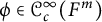 $\phi \in \mathcal {C}_c^\infty (F^m)$
such that
$\phi \in \mathcal {C}_c^\infty (F^m)$
such that $\mbox {Supp}(\phi ) \subset V_t$
, we have
$\mbox {Supp}(\phi ) \subset V_t$
, we have $\langle b , \phi \rangle =0$
. Hence,
$\langle b , \phi \rangle =0$
. Hence, $\mbox {Supp}(b) \cap V_t = \emptyset $
.
$\mbox {Supp}(b) \cap V_t = \emptyset $
.
5.2
We deduce from the above lemma that
 $$ \begin{align*}\mbox{Supp}(a) \subset \left\{t\in F^m\vert \, g_t.l \in f + \mathfrak{h}^{\perp}\right\}.\end{align*} $$
By using the equality $ (f + \mathfrak {h}^{\perp })\cap G.l = H.l$
(see the second particular case in Section 3.2), we deduce that
$ (f + \mathfrak {h}^{\perp })\cap G.l = H.l$
(see the second particular case in Section 3.2), we deduce that $ \mbox {Supp}(a) \subset \left \{0\right \}$
.
$ \mbox {Supp}(a) \subset \left \{0\right \}$
.
Let $a_0$
be the linear form on
$a_0$
be the linear form on $ \mathcal {C}_c^\infty (F^m)$
defined by
$ \mathcal {C}_c^\infty (F^m)$
defined by
 $$ \begin{align*}\langle a_0, \phi \rangle = \phi(0), \, \phi \in \mathcal{C}_c^\infty(F^m).\end{align*} $$
By direct computation, we check that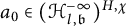 $a_0 \in (\mathcal {H}_{l, \mathfrak {b}}^{-\infty })^{H,\chi }$
and
$a_0 \in (\mathcal {H}_{l, \mathfrak {b}}^{-\infty })^{H,\chi }$
and $\mbox {Supp}(a_0) = \{0\} $
.
$\mbox {Supp}(a_0) = \{0\} $
.
Now fix an open compact subset V of $F^m$
containing
$F^m$
containing $0$
. Put
$0$
. Put $\alpha = \langle a, 1_V \rangle $
. We show that
$\alpha = \langle a, 1_V \rangle $
. We show that $ a = \alpha a_0$
.
$ a = \alpha a_0$
.
We start with the following remark: for all open compact subset $V'$
of
$V'$
of $F^m$
containing
$F^m$
containing $0$
, we have
$0$
, we have $ \langle a, 1_V \rangle = \langle a, 1_{V'} \rangle $
, because
$ \langle a, 1_V \rangle = \langle a, 1_{V'} \rangle $
, because $ 1_V- 1_{V'} $
is zero on
$ 1_V- 1_{V'} $
is zero on $V \cap V'$
.
$V \cap V'$
.
Let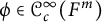 $\phi \in \mathcal {C}_c^\infty (F^m )$
such that
$\phi \in \mathcal {C}_c^\infty (F^m )$
such that $\phi (0) \neq 0$
. Put
$\phi (0) \neq 0$
. Put $V_{0} = \phi ^{-1}(\phi (0)),$
which is an open compact subset of
$V_{0} = \phi ^{-1}(\phi (0)),$
which is an open compact subset of $F^m$
. Writing
$F^m$
. Writing $ \phi = (\phi - \phi (0)1_{V_{0}} ) + \phi (0)1_{V_{0}} $
, we obtain
$ \phi = (\phi - \phi (0)1_{V_{0}} ) + \phi (0)1_{V_{0}} $
, we obtain
 $$ \begin{align*}\langle a, \phi \rangle = \langle a, 1_{V_{0}} \rangle \phi(0) =\alpha a_0(\phi).\end{align*} $$
So that $a = \alpha a_0$
.
$a = \alpha a_0$
.
Proposition 5.2.1 We have
 $$ \begin{align*}(\mathcal{H}_{l, \mathfrak{b}}^{-\infty})^{H,\chi} = \mathbb C a_0.\end{align*} $$
Consequently, we have $ (\mathcal {H}_{l, \mathfrak {b}}^{-\infty })^{H,\chi }= (\mathcal {H}_{l, \mathfrak {b}}^{-\infty })_Z^{H,\chi }$
.
$ (\mathcal {H}_{l, \mathfrak {b}}^{-\infty })^{H,\chi }= (\mathcal {H}_{l, \mathfrak {b}}^{-\infty })_Z^{H,\chi }$
.
Remark 5.2.1 Compare this result with [Reference Fujiwara3, Proposition 1].
6 Second particular case: «
$\mathfrak {h}$
is a polarization at f »

This case is studied in [Reference Maaref9].
Proposition 6.0.1 Assume that $\mathfrak {h}$
is a polarization at f.
$\mathfrak {h}$
is a polarization at f.
-
— If
$G.f = G.l,$
then
$\dim (\mathcal {H}_{l, \mathfrak {b}}^{-\infty })^{H,\chi } = 1$
and
$(\mathcal {H}_{l, \mathfrak {b}}^{-\infty })^{H,\chi } = \mathrm{Span}\{I_{f, \pi }\}$
. -
— If
$G.f \cap G.l = \emptyset ,$
then
$\dim (\mathcal {H}_{l, \mathfrak {b}}^{-\infty })^{H,\chi } = 0$
.





In particular, we have $ (\mathcal {H}_{l, \mathfrak {b}}^{-\infty })^{H,\chi }= (\mathcal {H}_{l, \mathfrak {b}}^{-\infty })_Z^{H,\chi }$
.
$ (\mathcal {H}_{l, \mathfrak {b}}^{-\infty })^{H,\chi }= (\mathcal {H}_{l, \mathfrak {b}}^{-\infty })_Z^{H,\chi }$
.
7 Third particular case: «Two-step nilpotent Lie algebra »
In this section, we assume that $ \mathfrak {g}$
is a two-step nilpotent Lie algebra. Let
$ \mathfrak {g}$
is a two-step nilpotent Lie algebra. Let $l \in \Xi $
. We have
$l \in \Xi $
. We have $\Xi \supset (f+ \mathfrak {h}^\perp )\cap G.l$
(see Section 3.2, third particular case). Without loss of generality, we assume that
$\Xi \supset (f+ \mathfrak {h}^\perp )\cap G.l$
(see Section 3.2, third particular case). Without loss of generality, we assume that $l \in f+ \mathfrak {h}^\perp $
. Then
$l \in f+ \mathfrak {h}^\perp $
. Then
 $$ \begin{align*}(f+ \mathfrak{h}^\perp)\cap G.l = (f+ \mathfrak{h}^\perp)\cap (l + \mathfrak{g}(l)^\perp) = l + (\mathfrak{h} + \mathfrak{g}(l))^\perp= HG(l).l = H.l.\end{align*} $$
Put $\mathfrak {b} =\mathfrak {h} + \mathfrak {g}(l)$
, which is a polarization at l;
$\mathfrak {b} =\mathfrak {h} + \mathfrak {g}(l)$
, which is a polarization at l; $B = \exp (\mathfrak {b})= HG(l)$
; and
$B = \exp (\mathfrak {b})= HG(l)$
; and $\pi = \pi _{l, \mathfrak {b}}$
.
$\pi = \pi _{l, \mathfrak {b}}$
.
7.1
In the following, we will describe the induced representation $\pi $
.
$\pi $
.
Let $\mathfrak {r}\subset \mathfrak {g}$
be a subspace such that
$\mathfrak {r}\subset \mathfrak {g}$
be a subspace such that $\mathfrak {g}=\mathfrak {r}\oplus \mathfrak {b}$
. Then the map:
$\mathfrak {g}=\mathfrak {r}\oplus \mathfrak {b}$
. Then the map: $ \mathfrak {r} \longrightarrow G/B, \, X\longmapsto \overline {\exp (X)}$
, is a diffeomorphism and a Haar measure
$ \mathfrak {r} \longrightarrow G/B, \, X\longmapsto \overline {\exp (X)}$
, is a diffeomorphism and a Haar measure $d_{\mathfrak {r}} X$
on
$d_{\mathfrak {r}} X$
on $\mathfrak {r}$
defines a G-invariant positive measure
$\mathfrak {r}$
defines a G-invariant positive measure $d\dot g$
on
$d\dot g$
on $G/B$
. Let
$G/B$
. Let $U_l : L^2(\mathfrak {r}, d_{\mathfrak {r}} X) \longrightarrow \mathcal {H}_{l,\mathfrak {b}}$
be the operator defined by
$U_l : L^2(\mathfrak {r}, d_{\mathfrak {r}} X) \longrightarrow \mathcal {H}_{l,\mathfrak {b}}$
be the operator defined by
 $$ \begin{align*} U_l(\varphi)(\exp(X)\exp(Y))= \chi_l(\exp(-Y))\varphi(X), \, Y \in B, X \in \mathfrak{r}, \varphi \in L^2(\mathfrak{r}, d_{\mathfrak{r}} X). \end{align*} $$
Then $U_l$
is unitary, and we obtain an irreducible unitary representation
$U_l$
is unitary, and we obtain an irreducible unitary representation $\sigma _{l}$
of G acting on the Hilbert space
$\sigma _{l}$
of G acting on the Hilbert space $L^2(\mathfrak {r}, d_{\mathfrak {r}} X)$
:
$L^2(\mathfrak {r}, d_{\mathfrak {r}} X)$
:
 $$ \begin{align*} \sigma_{l} (g)= U_l^{-1} \circ \pi_{l,\mathfrak{b}}(g) \circ U_l , \, \, g \in G. \end{align*} $$
Explicitly, we have
 $$ \begin{align*} \sigma_{l} (\exp(X)\exp(Y))\varphi(X')= \psi(\langle l, Y+ [X-X', Y] + \frac{1}{2}[X, X'])\varphi(X'-X), \end{align*} $$
where $X,X' \in \mathfrak {r}, Y \in \mathfrak {b}, $
and
$X,X' \in \mathfrak {r}, Y \in \mathfrak {b}, $
and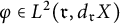 $ \varphi \in L^2(\mathfrak {r}, d_{\mathfrak {r}} X)$
.
$ \varphi \in L^2(\mathfrak {r}, d_{\mathfrak {r}} X)$
.
7.2
We have $ (L^2(\mathfrak {r}, d_{\mathfrak {r}} X))^\infty = \mathcal {C}_c^\infty (\mathfrak {r})$
.
$ (L^2(\mathfrak {r}, d_{\mathfrak {r}} X))^\infty = \mathcal {C}_c^\infty (\mathfrak {r})$
.
Let $a \in (\mathcal {H}_{\pi }^{-\infty })^{H,\chi _{f}}$
. For
$a \in (\mathcal {H}_{\pi }^{-\infty })^{H,\chi _{f}}$
. For $\phi \in \mathcal {C}_c^{\infty }(\mathfrak {r})$
and
$\phi \in \mathcal {C}_c^{\infty }(\mathfrak {r})$
and $ h = \exp (Y), \, Y \in \mathfrak {h}$
, we have
$ h = \exp (Y), \, Y \in \mathfrak {h}$
, we have
 $$ \begin{align*}\sigma_{l}(h^{-1}) \phi(X') = \psi(\langle l, -Y + [X', Y])\phi(X'), \, X' \in \mathfrak{r}. \end{align*} $$
So that
 $$ \begin{align*}\langle \sigma_{l, -\infty}(h) a , \phi \rangle = \langle a, (X'\longmapsto \psi(\langle l, -Y + [X', Y])\phi(X') )\rangle.\end{align*} $$
On the other hand, a is $\chi _{f}$
-semi-invariant:
$\chi _{f}$
-semi-invariant:
 $$ \begin{align*}\langle \sigma_{l, -\infty}(h) a , \phi \rangle = \langle \chi_{f}(h^{-1}) a , \phi \rangle = \langle a , \psi(\langle l, -Y \rangle) \phi \rangle. \end{align*} $$
Hence, a satisfies the following condition:
 $$ \begin{align*}\langle a, (X'\longmapsto \psi(\langle l, [X', Y]\rangle )\phi(X') )\rangle =0, \forall \phi \in \mathcal{C}_c^\infty(\mathfrak{r}), \forall Y \in \mathfrak{h}.\end{align*} $$
We deduce that
 $$ \begin{align*}\mbox{Supp}(a) \subset \{X' \in \mathfrak{r} \, \vert \langle l, [X', Y]\rangle = 0 ,\, \forall Y \in \mathfrak{h} + \mathfrak{g}(l) \} = \{0\}.\end{align*} $$
Hence, we obtain the following result.
Proposition 7.2.1 We have
 $$ \begin{align*}(\mathcal{H}^{-\infty})^{H,\chi}= (\mathcal{H}^{-\infty})_Z^{H,\chi}= \mathbb C \delta_0,\end{align*} $$
where $\delta _0 : \mathcal {C}_c^\infty (\mathfrak {r}) \ni \phi \longmapsto \phi (0)$
.
$\delta _0 : \mathcal {C}_c^\infty (\mathfrak {r}) \ni \phi \longmapsto \phi (0)$
.
8 Example
In the following, we consider the Lie algebra $ \mathfrak {g}$
of dimension
$ \mathfrak {g}$
of dimension $4$
defined by a basis
$4$
defined by a basis $\{e_1, e_2,e_3, e_4\}$
such that
$\{e_1, e_2,e_3, e_4\}$
such that
 $$ \begin{align*}[e_1, e_2] = e_3, \, [e_1, e_3] = e_4 .\end{align*} $$
A matrix realization of $ \mathfrak {g} \subset \mathfrak {gl}_4(F)$
is given by
$ \mathfrak {g} \subset \mathfrak {gl}_4(F)$
is given by
 $$ \begin{align*}e_1 = E_{1 , 2} + E_{2, 3} , \,\, e_2 = E_{3 , 4} ,\,\, e_3 = E_{2 , 4}, \,\, e_4 =E_{1 , 4} ,\end{align*} $$
where $E_{i, j}= (a_{r, s}) $
with
$E_{i, j}= (a_{r, s}) $
with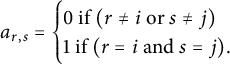 $a_{r, s}= \begin {cases} 0 \mbox { if } (r \neq i \mbox { or } s \neq j)\\ 1 \mbox { if } (r = i \mbox { and } s = j). \end {cases}$
We have
$a_{r, s}= \begin {cases} 0 \mbox { if } (r \neq i \mbox { or } s \neq j)\\ 1 \mbox { if } (r = i \mbox { and } s = j). \end {cases}$
We have
 $$ \begin{align*}[X= xe_1 + ye_2 + ze_3 + te_4, Y= x'e_1 + y'e_2 + z'e_3 + t'e_4] = (xy'- x'y) e_3+ (xz'- x'z)e_4.\end{align*} $$
So that $ [ \mathfrak {g}, \mathfrak {g}] = \mathrm{Span}\{e_3. e_4\} $
.
$ [ \mathfrak {g}, \mathfrak {g}] = \mathrm{Span}\{e_3. e_4\} $
.
8.1
This section is devoted to the case $ \mathfrak {h}=[ \mathfrak {g}, \mathfrak {g}]$
.
$ \mathfrak {h}=[ \mathfrak {g}, \mathfrak {g}]$
.
For $\lambda \in F$
, we put
$\lambda \in F$
, we put $f_\lambda = \lambda e_3^* + e_4^* $
. We have
$f_\lambda = \lambda e_3^* + e_4^* $
. We have
 $$ \begin{align*}\mathfrak{g}( f_\lambda )= \mathrm{Span}\{e_2-\lambda e_3, e_4\}.\end{align*} $$
So that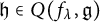 $\mathfrak {h} \in Q(f_\lambda , \mathfrak {g})$
, for all
$\mathfrak {h} \in Q(f_\lambda , \mathfrak {g})$
, for all $\lambda \in F$
. We will compute
$\lambda \in F$
. We will compute $G.f_\lambda $
. We have
$G.f_\lambda $
. We have
 $$ \begin{align*}\exp(-X).Y = x'e_1 + y'e_2 + (z'- xy'+ x'y) e_3+ (t' -xz'+ x'z + \frac{1}{2} x^2 y' -\frac{1}{2} xyx' )e_4.\end{align*} $$
So that
 $$ \begin{align*} \exp(X).f_\lambda &= f_\lambda + (\lambda y + z -\frac{1}{2} xy)e_1^* + (-\lambda x +\frac{1}{2} x^2)e_2^* - xe_3^*. \end{align*} $$
Hence,
 $$ \begin{align*}G.f_\lambda = \{ f_\lambda + \alpha e_1^* + \beta e_2^* + \gamma e_3^* \, \vert \, \alpha, \beta, \gamma \in F, \, \beta = \lambda \gamma + \frac{1}{2} \gamma^2 \} .\end{align*} $$
This gives that
 $$ \begin{align*}(f_\lambda + \mathfrak{h}^\perp) \cap G.f_\lambda = (f_\lambda + \mathfrak{b}^\perp) \cap G.f_\lambda = f_\lambda + F e_1^* = H. f_\lambda.\end{align*} $$
8.2
Finally, we deal with $\mathfrak {h} =\mathrm{Span}\{e_2, e_4\}$
and
$\mathfrak {h} =\mathrm{Span}\{e_2, e_4\}$
and $f = e_4^*$
.
$f = e_4^*$
.
As $[\mathfrak {h}, \mathfrak {h}]= 0,$
then
$[\mathfrak {h}, \mathfrak {h}]= 0,$
then $\mathfrak {h}$
is subordinate to f and
$\mathfrak {h}$
is subordinate to f and $ f + \mathfrak {h}^\perp = \{ \mu e_1^* + \nu e_3^* + e_4^* \, \vert \, \mu , \nu \in F\}$
.
$ f + \mathfrak {h}^\perp = \{ \mu e_1^* + \nu e_3^* + e_4^* \, \vert \, \mu , \nu \in F\}$
.
For $ \mu , \nu \in F$
, we have
$ \mu , \nu \in F$
, we have
 $$ \begin{align*}\mathfrak{g}( \mu e_1^* + \nu e_3^* + e_4^* )= \mathrm{Span}\{e_2-\nu e_3, e_4\}.\end{align*} $$
So that $\mathfrak {h} \in Q( \mu e_1^* + \nu e_3^* + e_4^* , \mathfrak {g})$
if and only if
$\mathfrak {h} \in Q( \mu e_1^* + \nu e_3^* + e_4^* , \mathfrak {g})$
if and only if $\nu \in F\setminus \{0\}$
. Thus,
$\nu \in F\setminus \{0\}$
. Thus,
 $$ \begin{align*}\Xi = \{ \mu e_1^* + \nu e_3^* + e_4^* \, \vert \,\mu \in F, \nu \in F\setminus\{0\} \} .\end{align*} $$
For $\nu \in F$
, we have
$\nu \in F$
, we have $ G.f_\nu = \{ f_\nu + \alpha e_1^* + \beta e_2^* + \gamma e_3^* \, \vert \, \alpha , \beta , \gamma \in F, \, \beta = \nu \gamma + \frac {1}{2} \gamma ^2 \}. $
Hereafter, take $\nu \in F\setminus \{0\}$
. We have
$\nu \in F\setminus \{0\}$
. We have
 $$ \begin{align*} (f + \mathfrak{h}^\perp)\cap G.f_\nu & = \{ f_\nu + \alpha e_1^* + \gamma e_3^* \, \vert \, \alpha, \gamma\in F, \, \nu\gamma + \frac{1}{2} \gamma^2 =0 \} \\ &= \{f_\nu + \alpha e_1^* \, \vert \, \alpha\in F \} \cup \{f_\nu + \alpha e_1^* - 2\nu e_3^* \, \vert \, \alpha\in F \} \\ &= H.f_\nu \cup H.(f_\nu- 2\nu e_3^*). \end{align*} $$
Note that $ f_\nu - 2\nu e_3^* = \exp (2\nu e_1) .f_\nu $
and
$ f_\nu - 2\nu e_3^* = \exp (2\nu e_1) .f_\nu $
and $ \Xi \supset ( f + \mathfrak {h}^\perp )\cap G.f_\nu $
, although the subalgebra
$ \Xi \supset ( f + \mathfrak {h}^\perp )\cap G.f_\nu $
, although the subalgebra $\mathfrak {h}$
is not a polarization at f nor an ideal of
$\mathfrak {h}$
is not a polarization at f nor an ideal of $ \mathfrak {g}$
.
$ \mathfrak {g}$
.
8.3
Put $ \mathfrak {b} = \mathrm{Span}\{e_2, e_3, e_4\},$
which is a polarization at
$ \mathfrak {b} = \mathrm{Span}\{e_2, e_3, e_4\},$
which is a polarization at $f_\nu $
. Let
$f_\nu $
. Let $\chi _{f_\nu }$
be the character of
$\chi _{f_\nu }$
be the character of $B= \exp (\mathfrak {b})$
defined by
$B= \exp (\mathfrak {b})$
defined by
 $$ \begin{align*}\chi_{f_\nu}(X)= \psi(\langle f_\nu, X \rangle), \, X \in \mathfrak{b}.\end{align*} $$
Let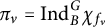 $\pi _\nu = \mbox {Ind}_B^G\chi _{f_\nu } $
. This representation can be realized in
$\pi _\nu = \mbox {Ind}_B^G\chi _{f_\nu } $
. This representation can be realized in $\mathcal {H} = L^2(F)$
, where the action of G is given by: for
$\mathcal {H} = L^2(F)$
, where the action of G is given by: for $\phi \in L^2(F)$
,
$\phi \in L^2(F)$
,
 $$ \begin{align*} & \pi_\nu(\exp(xe_1))\phi(y)= \phi(-x+y), \, x, y \in F\\ & \pi_\nu(\exp(xe_2))\phi(y)=\psi(-\nu xy + \frac{1}{2}xy^2)\phi(y), \, x, y \in F \\ & \pi_\nu(\exp(xe_3))\phi(y)= \psi(\nu x - xy)\phi(y), \, x, y \in F\\ & \pi_\nu(\exp(xe_4))\phi(y)= \psi(x)\phi(y), \, x, y \in F. \end{align*} $$
Let $a \in (\mathcal {H}_{\pi }^{-\infty })^{H,\chi _{f}}$
,
$a \in (\mathcal {H}_{\pi }^{-\infty })^{H,\chi _{f}}$
, $\phi \in \mathcal {C}_c^{\infty }(F),$
and
$\phi \in \mathcal {C}_c^{\infty }(F),$
and $ h = \exp (xe_2), \, x\in F$
. For each
$ h = \exp (xe_2), \, x\in F$
. For each $ y\in F$
, we have
$ y\in F$
, we have $ \pi _\nu (h^{-1}) \phi (y ) = \psi (-\nu xy + \frac {1}{2}xy^2)\phi (y) $
. So that
$ \pi _\nu (h^{-1}) \phi (y ) = \psi (-\nu xy + \frac {1}{2}xy^2)\phi (y) $
. So that
 $$ \begin{align*}\langle \pi_{\nu, -\infty}(h) a , \phi \rangle =\langle a , \pi_\nu(h^{-1})\phi \rangle = \langle a, (y\longmapsto \psi(-\nu xy + \frac{1}{2}xy^2)\phi(y) )\rangle .\end{align*} $$
On the other hand, a is $\chi _{f}$
-semi-invariant:
$\chi _{f}$
-semi-invariant:
 $$ \begin{align*}\langle \pi_{\nu, -\infty}(h) a , \psi \rangle = \langle \chi_{f}(h^{-1}) a , \psi \rangle = \langle a , \psi \rangle. \end{align*} $$
Hence, a satisfies the following condition:
 $$ \begin{align*} \langle a, (y\longmapsto (\psi(-\nu xy + \frac{1}{2}xy^2)-1)\phi(y)) \rangle = 0 , \quad \forall \phi \in \mathcal{C}_c^{\infty}(F), x \in F. \end{align*} $$
We deduce that $\mbox {Supp}(a) \subset \{0, 2\nu \}$
. Thus, we obtain the following proposition.
$\mbox {Supp}(a) \subset \{0, 2\nu \}$
. Thus, we obtain the following proposition.
Proposition 8.3.1 We have
 $$ \begin{align*}(\mathcal{H}^{-\infty})^{H,\chi}= (\mathcal{H}^{-\infty})_Z^{H,\chi}= \mathbb C a_0 + \mathbb C a_{2\nu},\end{align*} $$
where $a_0 : \mathcal {C}_c^\infty (F) \ni \phi \longmapsto \phi (0)$
and
$a_0 : \mathcal {C}_c^\infty (F) \ni \phi \longmapsto \phi (0)$
and $ a_{2\nu } : \mathcal {C}_c^\infty (F) \ni \phi \longmapsto \phi (2\nu )$
.
$ a_{2\nu } : \mathcal {C}_c^\infty (F) \ni \phi \longmapsto \phi (2\nu )$
.
Acknowledgements
I would like to thank Prof. Pierre Torasso for reading this manuscript and for his help. I also thank the referee for helpful suggestions.


 Open access

