


Introduction
Knowledge of the characteristics of drainage systems beneath glaciers is important in order to understand glacier movement (Reference CollinsCollins, 1979b); however, little is known about how these internal drainage networks function, and more specifically, the nature of the relationship between englacial and subglacial drainage systems. The few studies that have attempted to quantify the interaction between englacial and subglacial dis-charge have been accomplished on relatively large alpine glaciers, primarily in the Swiss and Austrian Alps (Reference CollinsCollins, 1978, Reference Collins1979b; Reference Oerter, Behrens, Hibsch, Rauert and StichlerOerter and others, 1980; Reference Gurnell and FennGurnell and Fenn, 1984). Although it is generally recognized that glacial meltwater flows through both englacial and subglacial pathways (Reference RöthlisbergerRöthlisberger, 1972; Reference ShreveShreve, 1972; Reference CollinsCollins, 1979b), previous research has suggested that the relative proportion and timing of these flow components may vary significantly from glacier to glacier (Reference Fenn, Gurnell and ClarkFenn, 1987, p. 409), and may be related to glacier size (Reference Gurnell and FennGurnell and Fenn, 1984, p. 115). This study examines the subglacial and englacial hydrology of a middle-latitude cirque glacier in an alpine environment. The objectives were (1) to examine diurnal variations of discharge and electrical conductivity, (2) to separate englacial and subglacial components of the total meltwater discharge in order to evaluate the characteristics of the flow-routing system, and (3) to assess the relationship between proglacial discharge and energy conditions at the glacier surface.
Study Area
Conness Glacier (<0.5km2) is located at an elevation of about 3400 m in a small northeast-facing cirque on the eastern side of the Sierra Nevada crest in California, U.S.A. (Figs 1 and 2). Active glaciers in the Sierra Nevada are small (the largest is Palisades Glacier (≈1.2 km2)) and entirely restricted to high-altitude northeast-facing cirques where favorable microclimatological conditions have allowed their continued existence during Holocene warming. Proglacial discharge from Conness Glacier flows into Lee Vining Creek and eventually into the closed basin occupied by Mono Lake. Lee Vining Creek is one of five streams feeding Mono Lake from which the city of Los Angeles currently appropriates water.
Location of Conness Glacier in the Sierra Nevada, California, U.S.A.

A view of Conness Glacier looking south.

This temperate glacier rests in a deep basin surrounded by high cirque headwalls and morainal ridges (40-60m high at their lower end). The end moraine forms an effective barrier to katabatic flow and the resulting cold-air pondingmay be an important factor slowing the ablation rate on the lower end of the glacier (Reference ChambersChambers, 1990). The catchment that contributes run-off to the proglacial stream is almost completely ice-covered and underlain entirely by the late Cretaceous Cathedral Peak granodiorite (Reference Bateman, Kistler, Peck and BusaccaBateman and others, 1983). Steep bedrock slopes and the lack of soil in the surrounding alpine environment suggest a negligible groundwater contribution to proglacial discharge.
A medial moraine exposed at the surface divides the glacier into two main lobes. Meltwater from the western lobe percolates through and beyond the end moraine and therefore could not be monitored. However, meltwater from the eastern lobe flows in a proglacial stream which was monitored about 50 m downstream from the ice margin before percolating through the end moraine. Field data were collected during the 10 d period 13-23 August 1989 at the peak of the ablation season while snow on the glacier surface was melting to expose bare ice.
Methods
Glacial Hydrology
Chemical characteristics of stream water have often been used to identify surface-water sources and pathways through which water is routed to the stream channel (Reference Pinder and JonesPinder and Jones, 1969; Reference BrownBrown, 1986; Reference Hooper and ShoemakerHooper and Shoemaker, 1986; Reference CaineCaine, 1989). Reference CollinsCollins (1978, Reference Collins1979b) and Reference Gurnell and FennGurnell and Fenn (1984) have used the solute concentration in meltwater run-off to separate flow into two pathways through the glacial hydrologie system. Englacial flow pases through sediment-free, ice-walled conduits or in supraglacial channels where minimal chemical enrichment occurs. Subglacial flow acquires solutes as it moves (at slower overall rates) in contact with bedrock, sediment and sediment-laden basal ice. The term englacial does not necessarily define conduit location. Englacial conduits may be located at the bed without chemical enrichment due to the passage of large volumes of water at high rates of flow that lack sufficient contact with ion-rich materials (Reference CollinsCollins, 1979b). Sub-glacial conduits, however, are located exclusively at the glacier bed.
Continuity of flow implies:
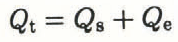
where Q is discharge (1 s−1) and the subscripts, t, e and s represent total, englacial and subglacial flow components, respectively. The solute concentration of the total discharge at the proglacial stream (Ct) is the weighted mean of englacial- and subglacial-flow contributions:

where C is solute concentration approximated by electrical conductivity (μScm−1). Solving for Qs allows the subglacial-flow component to be estimated (Reference CollinsCollins, 1979b):

Proglacial discharge (Qt) and electrical conductivity (Ct) were monitored at a stable channel cross-section where pygmy meter velocity measurements were used to establish a stage-discharge rating curve (sample size = 29; R2 = 0.94). Stage was recorded hourly from 0600 to 2200 h, and at 2400 and 0300 h during the night. However, discharge measurements during the night (2400-0800 h) were omitted because freezing temperatures produced ice at the gaging station, resulting in inaccurate stage readings. This did not pose a serious problem because discharge had decreased to low rates before freezing occurred and the ice broke up quickly in the morning as stage began to rise. Visual observations suggested that flow had declined to a trickle (probably less than 51 s−1) by the early morning hours.
Electrical conductivity provides an adequate proxy of total dissolved solids concentration (Reference Fenn, Gurnell and ClarkFenn, 1987) and was determined from 11 samples with a portable Cole-Parmer 1481-55 conductivity meter. Previous researchers have suggested that conductivity values should not be corrected to a standard temperature (Reference CollinsCollins, 1979b; Reference Gurnell and FennGurnell and Fenn, 1984); however, the instrument used automatically standardizes conductivity values to a temperature of 25 °C (accurate to within ±0.1 μiScm−1 ). The potential impact of using temperature-corrected values was examined by estimating uncorrected conductivity values from meltwater temperature (which ranged from 0 ° to 5 °C) and using a correction factor of 1.92%;−1. This suggested that temporal trends in the uncorrected values are about 30% lower (on average). Substituting uncorrected values for Cs and Ce in Equation (3) produced no change in subglacial and englacial discharges, thus using temperature-corrected conductivity values does not influence the results.
Separation of the total discharge into its englacial and subglacial flow components using Equation (3) relies upon accurate estimation of Ce and Cs (Reference CollinsCollins, 1979b; Reference Fenn, Gurnell and ClarkFenn, 1987, p. 408). Following Reference CollinsCollins (1979b), estimates were obtained for Ce by using the average electrical conductivity sampled from meltwater on the glacier surface, and for Cs by using the maximum conductivity recorded following a snowfall event on 20 August (when dilution by englacial flow was minimal). The estimates used in this study were Ce = 1.4μScm−l (std dev. = 0.2 μm1) and Cs =9.0μS Cm−1 should be regarded as a minimum estimate of the true subglacial conductivity, since it is possible that some dilution by englacial flow occurred at the time of measurement. Estimates of Ce and Cs can be subject to considerable error (Reference CollinsCollins, 1979b; Reference Fenn, Gurnell and ClarkFenn, 1987, p. 408-09); however, Reference Gurnell and FennGurnell and Fenn (1984) demonstrated that, while such errors can produce substantial variations in the magnitude of Qe and Qs, the temporal pattern of each discharge component remains relatively constant. Consequently, the values chosen for Ce and Cs, should not influence the results reported in this paper, which are temporal in nature.
The contribution of solute-rich water from non-subglacial sources (i.e. permafrost or marginal streams) is a potential source of error in this analysis. However, solute-rich meltwater from permafrost surrounding the glacier was regarded as minimal because there was no channelized water flowing into the glacier, and any unconcentrated flow trickling towards the glacier would have frozen during the night. Solute-rich flow cannot be explained by flow along the glacier margins because all marginal flow stopped when ablation ceased each night. Several low conductivity values (1.5-2.2μScm−1) recorded during the day in marginal streams suggest that their source was primarily from surface melting.
Energy Balance
The energy available for melting ice and snow at the glacier surface is

where QM is the energy available for melting, QNR is net all-wave radiation, QH is the sensible-heat flux, QE is the latent-heat flux, QP is the heat provided by precipitation and QG is the conductive-heat flux in the snow or ice (all units in kJ m−2 h−1) (Reference Wendler and WellerWendler and Weiler, 1974; Röthlis-berger and Lang, 1987). The energy-balance equation was simplified to include only QNR, QH and QE, because it is reasonable to assume that the conductive heat flux in the ice was negligible (Reference Marcus, Moore and OwensMarcus and others, 1985) and there was no rainfall during the study period.
The meteorological station was located on the lower third of the glacier at a site representative of surface conditions. QNR was measured directly, while QH and QE were calculated by the bulk-transfer approach described by Reference Male, Gray, Gray and MaleMale and Gray (1981, p.390-91). Values assumed for the bulk-transfer coefficients were DH = 1.68 and DE = 8.0 (see table 9.3 in Reference Male, Gray, Gray and MaleMale and Gray (1981, p. 392)). These values are only first approximations (Reference Male, Gray, Gray and MaleMale and Gray, 1981, p. 391); however, errors were considered minimal due to the small sensible- and latent-heat fluxes measured during the study period. All raw data were recorded on a data logger and compiled into hourly values.
Results and Discussion
Diurnal Variations of Discharge and Electrical Conductivity
The discharge hydrograph and temporal variations in electrical conductivity for the 10 d period of record are shown in Figure 3. Discharge hydrographs demonstrate diurnal cycles distinctive of ablation-controled glacial run-off. Peak discharge typically occurred between 1400 and 1600 h, except on 20 August when the peak discharge reached only 261 s−1 at 1100 h. On this day, the morning sky was overcast and at about 1300 h light snow began to fall. Diurnal hydrographs are fairly symmetrical, suggesting that there was little delay in flow as meltwater was quickly routed through the drainage system. Small glaciers are not likely to have the significant delays in flow that would produce asymmetrical diurnal hydrographs reported for larger glaciers (e.g. Reference CollinsCollins, 1979b).
Discharge (solid line) and electrical conductivity (dotted line) time-series during the study period 13-22 August 1989.

Diurnal fluctuations in electrical conductivity varied inversely with discharge (Fig. 3), as observed in other proglacial streams (Reference CollinsCollins, 1979b; Reference Gurnell and FennGurnell and Fenn, 1985; Reference Rainwater and GuyRainwater and Guy, 1961). Minimum daily conductivity values (occurring between about 1300 and 1800 h) are much smaller than previously reported values (see Reference Fenn, Gurnell and ClarkFenn, 1987, p. 408). This is probably due to the resistance of the granitic bedrock to rapid chemical breakdown and the small size of the glacier, where limited contact occurs with ionic source materials beneath the glacier and water-travel distances are short. Nevertheless, the variability in conductivity shown in Figure 3 suggests that it is possible to separate flow into its englacial and subglacial components even where conductivity values are relatively low.
Diurnal conductivity cycles are asymmetrical, with steep falling limbs (Fig. 3). Following peak discharge, the conductivity increased slowly as the proportion of solute-free englacial water declined, with peak conductivity usually occurring at 0900 h. An abrupt increase in conductivity occurs at each conductivity maximum, suggesting that a translatory-flow effect exists (Reference Gurnell and FennGurnell and Fenn, 1984), in which the sudden input of meltwater associated with the onset of ablation on the glacier surface flushes solute-rich subglacial water at a time when proglacial flow is minimal. As surface melting continues, englacial flow dilutes solute-rich subglacial flow, producing a rapid decline in conductivity.
The conductivity time-series occasionally demonstrates anomalously high values that deviate from the otherwise smooth trends in Figure 3. In such cases, an additional reading was taken immediately and in every case conductivity had dropped back down to normal levels. The possibility of instrument or operator error was eliminated by re-checking both the original sample and the follow-up sample. These anomalous conductivity readings are therefore interpolated as pulses of chemically enriched water periodically released from storage beneath the glacier. Due to limitations of discrete (hourly) sampling, it is impossible to know how frequently these pulses moved through the system unmonitored.
Flow Separation
Using Equation (3), the total meltwater discharge was separated into its englacial and subglacial components (Fig. 4). The amount of water routed through the subglacial system was substantially less than that directed through the englacial system, which contributed most of the water (≈75-95%) to the proglacial stream. The proportion of water routed subglacially through Conness Glacier (≈5-25%) appears to have been considerably less than amounts reported by Reference CollinsCollins (1979b, p. 356) for Findelengletscher (40-60%) and Gornergletscher (20-40%); however, it should be recognized that the absolute magnitude of the flow components are sensitive to the estimates used for Cs and Ce, and are therefore only approximate.
Sub glacial (dashed line), englacial (dotted line) and total discharge (solid line) time-series, 13-22 August 1989.

Most of the subglacial flow did not exit from beneath the glacier terminus. Instead, it emerged from within the lower third of the glacier and went into two main supraglacial channels. During peak proglacial discharge, conductivity in these two supraglacial streams was consistendy higher than that in the proglacial stream, or in the other supraglacial channels, indicating its subglacial origin. During the night, when ablation-derived englacial flow was minimal, these two supraglacial channels were the only significant sources of water to the proglacial stream.
Subglacial-discharge cycles in Figure 4 are symmetrical and appear to vary approximately in phase with the englacial cycles. However, cross-correlation analysis between the two time-series suggests that, on average, they are not perfectly in phase (Table 1). Instead, subglacial discharge peaked 2 h before the englacial peak, while englacial and proglacial peaks were nearly in phase.
Time lags and cross-correlation coefficients

Reference CollinsCollins (1979b) has suggested that an in–phase response between Qe and Qs indicates that englacial and subglacial conduits are widely interconnected. His inphase model for Findelengletscher differs from that observed on Gornergletscher (Reference CollinsCollins, 1979b), where subglacial discharge was out-of-phase with total dis-charge, and Tsidjiore Nouve Glacier (Reference Gurnell and FennGurnell and Fenn, 1984), where subglacial discharge peaked on the rising limb of the englacial cycle. Reference CollinsCollins (1979b) interpreted his data from Gornergletscher as implying that diurnal water-pressure peaks forced subglacial water into storage in cavities, which was not released until water pressure declined. When water pressure was high in Conness Glacier, subglacial water was presumably not diverted into cavities or into storage in basal sediments, as this would have produced an out-of-phase response. This may also indicate an absence of thick basal sediments or large subglacial cavities to store water.
On Conness Glacier, the peaking of subglacial discharge on the rising limb of the englacial discharge cycle is similar to that described by Reference Gurnell and FennGurnell and Fenn (1984) on Tsidjiore Nouve Glacier, where peak Qs preceded peak Qe by 1-13 h. They proposed a trans-latory flow effect with waters which were delayed in the basal-conduit system overnight being forced out to form a peak in subglacial discharge ahead of water queued in the englacial system (Reference Fenn, Gurnell and ClarkFenn, 1987, p. 409). The abrupt daily peaks in the conductivity series (described earlier) further support this interpretation. Although much of the surface meltwater generated during the day on Conness Glacier was observed flowing in supraglacial channels, increased water pressure in the englacial system on the rising limb of the discharge cycle was apparently sufficient to force water from the subglacial system.
The lag observed between englacial and subglacial flow on Conness Glacier is probably closely related to its small size and the relative simplicity of its drainage system. Lags measured at the proglacial outlet on large glaciers that have contributing tributary glaciers may depend on how flow is routed from tributary glaciers that have differences in travel distances and source materials. As such, Conness Glacier is a useful example of the translatory-flow effect because it lacks some of the complexity likely to occur on larger glaciers.
Energy Balance
The energy balance was dominated by the net radiation (QNR) component throughout the study period, accounting for (on average during the daylight hours) 98.4% of the energy available for surface melting (QM)- Plotting proglacial discharge (Qt) with QNR (Fig. 5) reveals that the two series correspond quite closely, with peak QT occurring an average of 1 h after the peak in QNR (Table 1). Incorporating this lag into a regression model shows that because internal-water storage and latent- and sensible-heat fluxes were minimal, QNR-1 (QNR at time is strongly correlated with proglacial discharge during the daylight hours, explaining 86% of the variance in QT (Table 2).
Net radiation (dotted line) and total discharge (solid line), 13-22 August 1989.

Regression equations

The strength of the relationships between net radiation and the different flow components are useful in examining further the routing of meltwater through the englacial and subglacial systems. The regression equations in Table 2 compare relationships between unlagged and lagged variables (as indicated in Table 1 by cross-correlation). Lagging the variables improved the R2 and reduced serial autocorrelation in the residuals. The weak relation between QNR+1 and Qs (R2 = 0.07), compared to the relation between QNR-1 and Qe (R2 = 0.70), suggests that while the subglacial system was probably integrated with the englacial system, much of the ablation-derived meltwater was transported englacially, or that the residence time of water routed subglacially was too short to acquire solutes. The strong relation between QNR-1 and Qe (R2 = 0.70) demonstrates the close association between surface ablation and englacial flow, and the englacial dominance of proglacial discharge.
The snowfall event on 20 August, which produced an immediate decrease in both net radiation and total discharge, and the most abrupt increase in electrical conductivity, further illustrates the sensitivity of this small glacier to surface-energy conditions and its rapid hydrologie response. The decrease in net radiation can be attributed to a reduction in incoming short wave due to cloud cover, and an increase in the proportion of short wave reflected due to the greater albedo of the snow. Minimal melting occurred at the glacier surface during this period of high reflectivity, as indicated by low discharge and high conductivity values recorded at the proglacial stream (Fig. 3). Because there was little storage or delay of water as it moved through the drainage system, surface-energy conditions controled the magnitude and timing of englacial flow. The energy balance observed during the ablation season under generally clear skies on Conness Glacier is probably typical of high-altitude glaciers dominated by cool, dry air masses in the middle latitudes. Ablation is likely to be controled by net radiation due to relatively high incoming solar radiation and the lower air temperatures and vapor pressures typical of their high-altitude location (Reference Röthlisberger, Lang, Gurnell and ClarkRöthlisberger and Lang, 1987, p. 220).
Conclusion
Analysis of the electrical conductivity of glacial meltwater suggests that flow separation using a simple mass-balance model is a useful technique in small alpine glaciers with relatively low solute concentrations. Diurnal hydrographs for total flow are symmetrical because run-off was dominated by ablation-derived englacial flow which was transmitted rapidly through the hydrologic system. Electrical conductivity varied inversely with discharge, and exhibited an abrupt increase at the conductivity maxima. Cross-correlation analysis indicated that subglacial discharge peaked on the rising limb of the englacial cycle, about 2 h before the englacial peak. These results suggest that increased water pressure in the englacial system generated by surface melting forced longer residence-time subglacial water from beneath the glacier in advance of the englacial flow. Solute-rich subglacial water was routed to the surface in the lower part of the glacier to flow in two main supraglacial stream channels which continued to flow through the night.
Proglacial discharge responded quickly to variations in net radiation, which was by far the most important component of the energy balance. Net radiation (lagged -1 h) explained 86% of the variance in proglacial discharge through its control of englacial flow. A brief snowfall event decreased net radiation by reducing incoming shortwave radiation and increasing surface albedo. This produced an immediate hydrologic response whereby proglacial discharge decreased and conductivity increased dramatically.
Acknowledgements
This research was conducted as part of a joint effort in cooperation with F. Chambers, S. Lamm and T. Miller to investigate the microclimatology, mass balance and hydrology of Conness Glacier. J. Knox and R. Pavlow-sky helped in the revision of an early draft of the manuscript. A. Gurnell and an anonymous reviewer made many helpful criticisms of a later version of the manuscript. J. Lecce and M. Lecce assisted in the preparation and modification of the field equipment.
The accuracy of references in the text and in this list is the responsibility of the author, to whom queries should be addressed.



