

Introduction
The satisfaction of Austrians with the functioning of their democracy remained stable at a low level in 2023. Eurobarometer surveys in spring and autumn of the year indicated that around 60 per cent of respondents in Austria were at least somewhat satisfied with the functioning of their democracy (European Commission 2023). Although this figure still lies above the EU average, it is clearly below the value of 2019, when after the last national parliamentary election, 75 per cent of Austrians were at least somewhat satisfied (European Commission 2019).
The persistently poor mood—the decline in democratic satisfaction was noted following the crisis-ridden developments of 2021/2022 (Praprotnik Reference Praprotnik2023a)—was also reflected in the approval ratings of the governing parties Austrian People's Party/Österreichische Volkspartei (ÖVP) and The Greens-The Green Alternative/Die Grünen-Die Grüne Alternative (GRÜNE) (Austria Presse Agentur 2024). The Freedom Party of Austria/Freiheitliche Partei Österreichs (FPÖ), on the other hand, benefited from the weakening ratings of the governing parties and became the strongest force in the polls. The Social Democratic Party of Austria/Sozialdemokratische Partei Österreichs (SPÖ) managed to stabilise at a low level; after internal disputes and difficulties, a change in leadership brought at least some internal peace. NEOS-The New Austria and Liberal Forum/NEOS-Das Neue Österreich und Liberales Forum (NEOS) remained stable, compared to the previous 2019 election, while extra-parliamentary actors such as the Communist Party of Austria/Kommunistische Partei Österreichs (KPÖ) and The Beer Party/Die Bierpartei saw a surge in the polls. The developments at the federal level were also reflected in regional election results. The FPÖ entered state governments, while the KPÖ saw increases in votes. The declining party affiliation, in connection with the poor mood regarding democratic satisfaction, is likely to offer some good chances for parties not currently represented in the National Council to make it into Parliament in the upcoming election year 2024.
Nevertheless, the coalition at the federal level between the ÖVP and the GRÜNE remained stable. Initiatives in the areas of environmental and climate protection, as well as anti-corruption and transparency, were able to be advanced—also due to negotiations with the opposition to achieve a two-thirds majority.
Election report
Regional elections
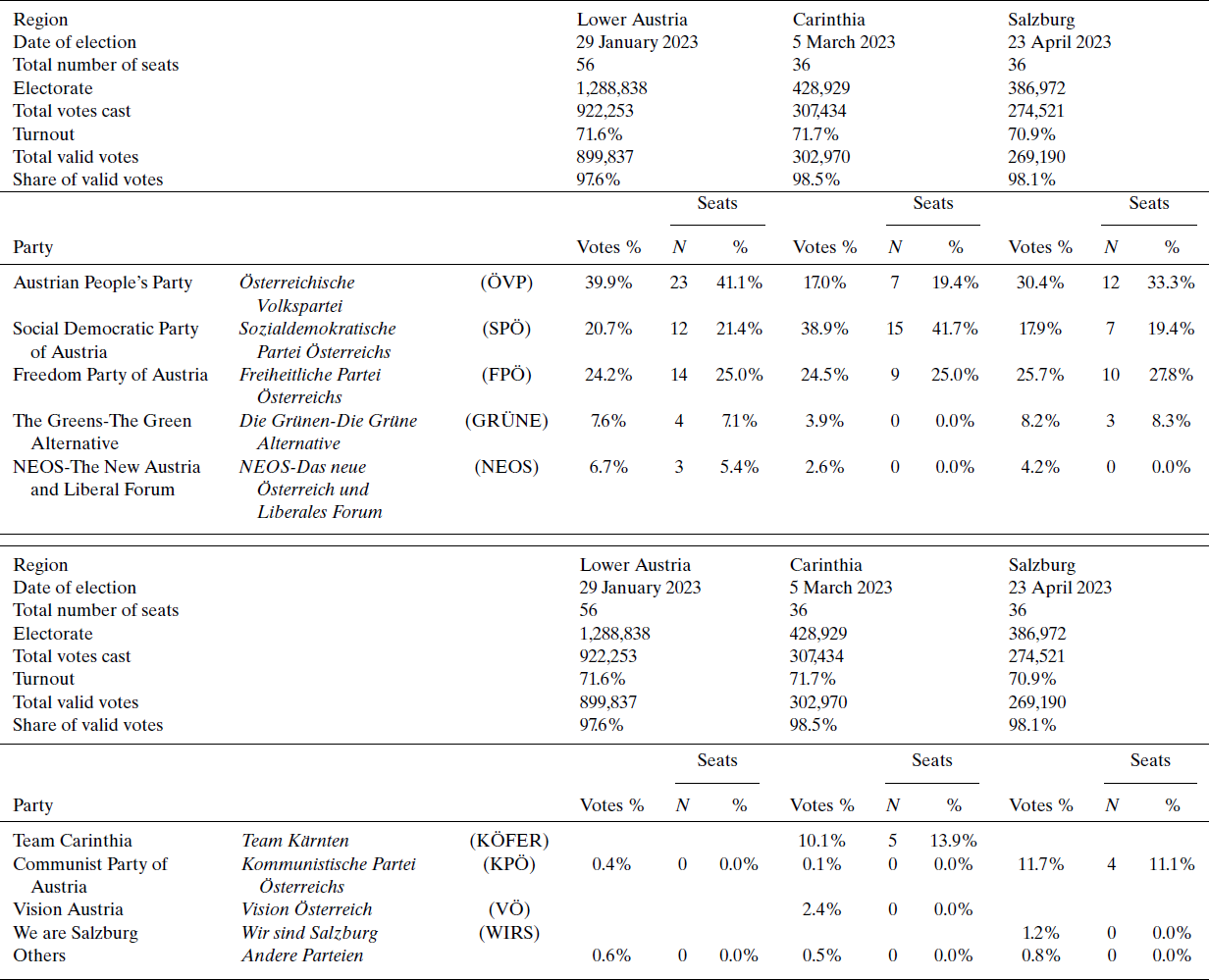
The Lower Austrian state Parliament elections on 29 January opened the round of three state Parliament elections this year (Table 1). The result can be considered historic in many respects: The ÖVP recorded its worst result ever, with a loss of 10 per cent, but remained the strongest force with 39.9 per cent of the vote. At the same time, the election brought the FPÖ its best result ever with gains of 10 per cent. The former federal political tailwind for the ÖVP in 2018 from the then ÖVP Chancellor Sebastian Kurz had disappeared, its own regional top candidate had also lost traction and, unlike in the last election, the FPÖ did not have to contend with a political scandal. On the contrary, they were able to place the issues of criticising the coronavirus policy, tougher asylum and immigration policy and criticism of the policy to combat inflation well. Interestingly, the reappraisal of the coronavirus policy was only relevant for the FPÖ electorate (ISA/SORA 2023a). The results of the SPÖ and the GRÜNE were also historic. While the SPÖ achieved its worst result ever, the Greens achieved their best result. The NEOS were able to make gains but failed to achieve club strength. As the proportional representation system (Proporz system) still applies in Lower Austria, the ÖVP, FPÖ and SPÖ were entitled to sit in government. For the first time in the history of the Second Republic, the ÖVP had not only lost its majority in the state Parliament but also in the state government. The ÖVP and the FPÖ agreed upon a common coalition program.
Results of regional (Lower Austria, Carinthia, Salzburg) elections in Austria in 2023

Notes:
1. Different party labels used on the ballot paper in Lower Austria: ÖVP: LH Johanna Mikl-Leitner—VP Niederösterreich (VPNÖ), GRÜNE: Die Grünen (GRÜNE), NEOS: NEOS—Das neue Niederösterreich (NEOS), KPÖ: KPÖ plus—offene Liste (KPÖ).
2. Different party labels used on the ballot paper in Carinthia: SPÖ: Peter Kaiser—Sozialdemokratische Partei Österreichs (SPÖ), FPÖ: Die Freiheitlichen in Kärnten (FPÖ), ÖVP: Martin Gruber—Kärntner Volkspartei (ÖVP), KÖFER: Gerhard Köfer—Team Kärnten (KÖFER), GRÜNE: Die Grünen Kärnten (GRÜNE), NEOS: Neos—Für Freiheit, Fortschritt und Gerechtigkeit (NEOS), VÖ: Vision Österreich—Landespartei Kärnten (VÖ), KPÖ: Kommunistische Partei Österreichs—Kärnten/Koroška (KPÖ).
3. Different party labels used on the ballot paper in Salzburg: ÖVP: Landeshauptmann Dr. Wilfried Haslauer—Salzburger Volkspartei (ÖVP), FPÖ: Freiheitliche Partei Salzburg—Marlene Svazek (FPÖ), SPÖ: Sozialdemokratische Partei Österreich—Team David Egger (SPÖ), KPÖ: Kay-Michael Dankl—KPÖ Plus (KPÖ), GRÜNE: Die Grünen—Liste Martina Berthold (GRÜNE), NEOS: NEOS—Freiheit, Fortschritt und Gerechtigkeit (NEOS).
Between the Lower Austria and Salzburg state parliamentary elections on 23 April, clear parallels emerged. The ÖVP, as the governing party, also suffered significant losses and managed to maintain its top position. The FPÖ gained to a similar extent, achieving its historically best result. There were slight losses for the ÖVP's former coalition partners, the GRÜNE and the NEOS. Although the SPÖ only experienced minor losses, it reached a historical low. However, the big surprise was the electoral success of the KPÖ, which secured 11.7 per cent of the vote despite previously receiving less than 1 per cent in recent state elections. The reasons for the KPÖ’s success were primarily attributed to its lead candidate and its focus on affordable housing and rising prices in general. Interestingly, about half of the KPÖ voters decided to support the party during the heated phase of the election campaign. As in Lower Austria, the coalition negotiations in Salzburg resulted in a coalition between the ÖVP and FPÖ (ISA/SORA 2023b).
The most important election of the year for the SPÖ was the one in Carinthia on 5 March. At the time of the election, it was governing in a coalition with the ÖVP, which was the first ‘real’ coalition government following the abolition of the Proporz system in 2017. Despite the importance of the election for the social democrats, the party was unable to keep the federal SPÖ leadership debate under wraps. The election resulted in heavy losses for the SPÖ, but it still remained the strongest party. The ÖVP made small gains at a lower level. According to the election analysis, both parties benefited above all from their leading figures, but voters also frequently cited their programs as a motive for voting (ISA/SORA 2023c).
The FPÖ improved slightly and, once again, it became clear that the party's coronavirus stance remained the strongest voting motive for its voter group in 2023 (ISA/SORA 2023c). The winner of the election was the regional party KÖFER, with an increase of 4.4 per cent, whose voters stated that the party best represented their own interests, was credible and had a good lead candidate (ISA/SORA 2023c). The Greens had already been ousted from the state Parliament in 2018 and failed to make a comeback. The NEOS also failed in their second attempt.
Just a month after the election, the SPÖ and ÖVP announced the renewal of their government cooperation, forming the expected coalition once again. Both top politicians had repeatedly praised their past good cooperation during the election campaign and had also expressed openness to its continuation.
Cabinet report
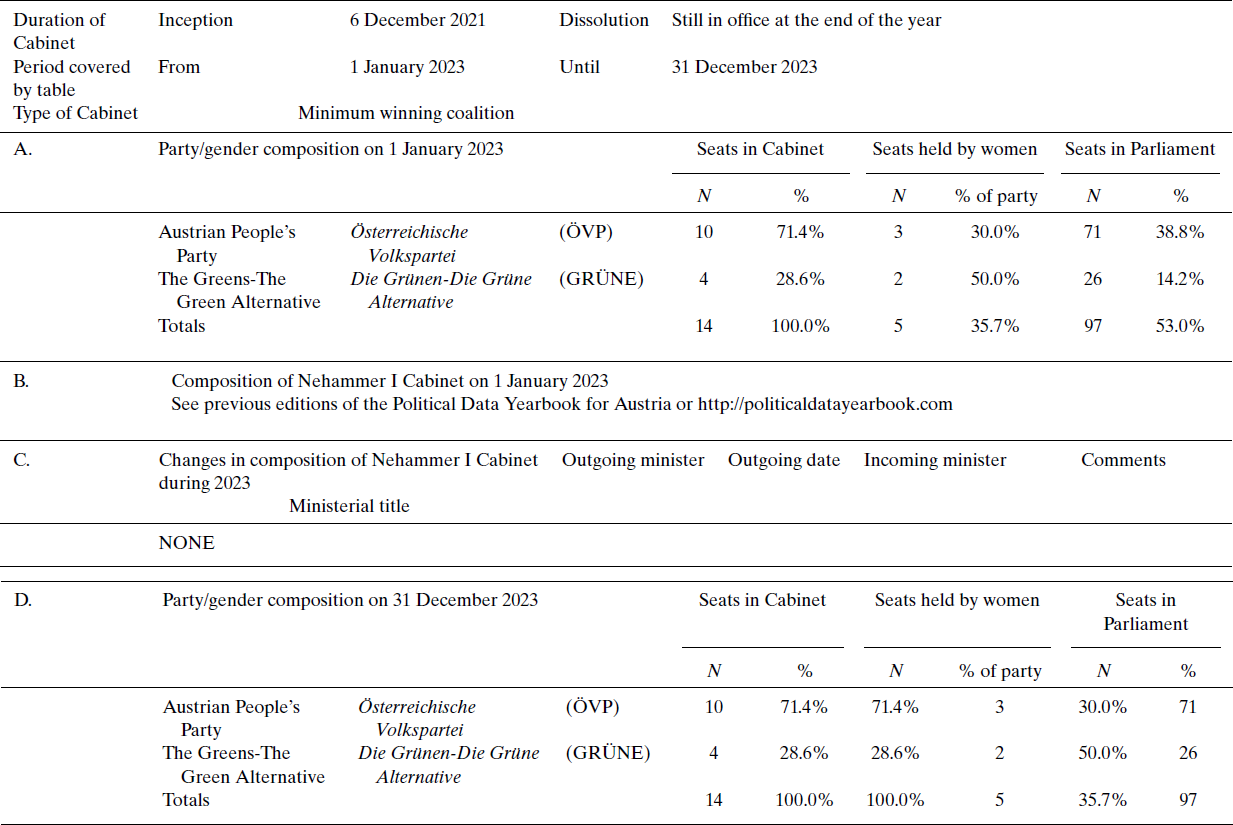
In Chancellor Nehammer's Cabinet, there were no personnel changes in 2023. Table 2 illustrates the composition of the minimal winning coalition, consisting of 10 government members from the ÖVP and four members from the GRÜNE. The proportion of women in the government is just under 36 per cent.

Parliament report
This section presents some key figures of the parliamentary year 2023 and highlights significant events that took place in Parliament during that time. Political debates and bills are discussed in the section on national political issues below.
In 2023, the National Council convened 56 plenary sessions and held 177 committee meetings. A total of 184 legislative decisions were made, with 80 originating from government proposals, 88 from Members of the National Council, another 15 from committees, and one from a federal audit report. There were no objections from the Federal Council, the second and considerably weaker chamber of the Austrian Parliament (Parlamentsdirektion 2024: 77–81). The (albeit slightly) higher number of successful National Council Members’ initiatives, compared to government initiatives, is in line with recent legislative periods, but it is not indicative of an increase in the legislature's power relative to the executive. This is because the enacted National Council Members’ initiatives are usually those introduced by politicians belonging to the government parties (Praprotnik Reference Praprotnik, Praprotnik and Perlot2023b: 174–175).
Turning to the discussion of the significant events, on 30 March, Ukrainian President Volodymyr Zelensky was invited to deliver a speech to the Austrian National Council via live broadcast. Zelensky's speech in the Austrian National Council was controversial: Representatives from the ÖVP, SPÖ, GRÜNE and NEOS expressed their solidarity with Ukraine. However, many SPÖ deputies abstained from attending the speech. FPÖ deputies opposed Zelensky's appearance and left the chamber during the Ukrainian President's speech (Parlamentsdirektion 2024: 63).
The Parliament commemorated the 75th anniversary of the Universal Declaration of Human Rights through various events: From 8 November to 28 January, 2024, a light installation, periodically augmented with different colours, drew attention to human rights. Furthermore, in 2023, the Parliament organised various events against anti-Semitism and in remembrance of Holocaust victims under the motto ‘Never Again Is Now’ (Parlamentsdirektion 2024: 38–43).
The LGBTIQ Intergroup, a cross-party working group in the Austrian Parliament, was established with a focus on human rights, equality, diversity and acceptance. All parties in the National Council except the FPÖ are represented in the group. On the occasion of Vienna Pride on 17 June, the Parliament was illuminated in rainbow colours. On 25 May, the president of the European Parliament, Roberta Metsola, visited the Parliament and delivered a statement advocating for a Europe for everybody (Parlamentsdirektion 2024: 62).
The first year in the new Parliament also emphasised democracy education, with educational projects such as the Youth Parliament or the Student Parliament, which were able to convene in the newly renovated Parliament (Parlamentsdirektion 2024: 33).
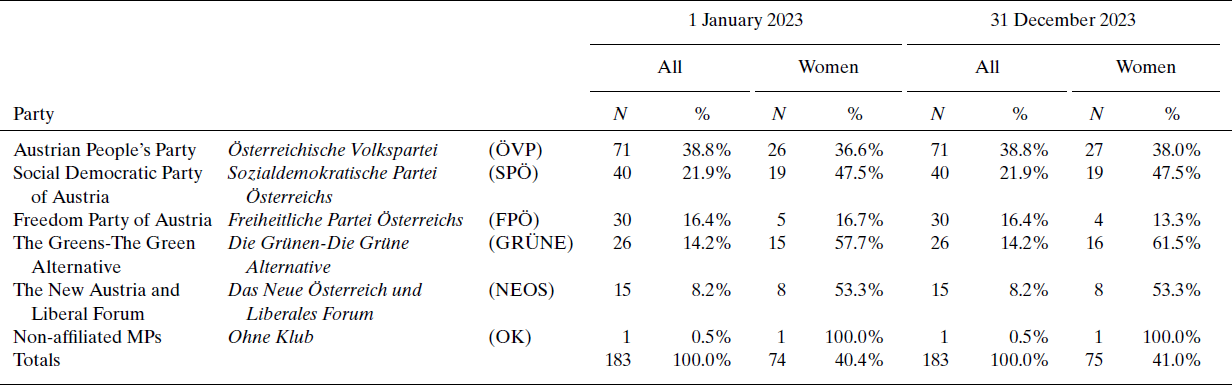
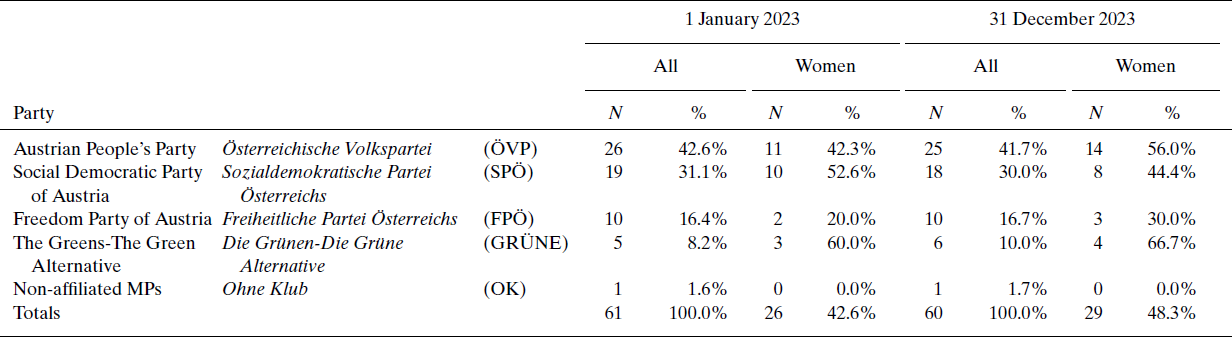
Tables 3 and 4 show the composition of the Austrian Parliament in 2023.
Party and gender composition of the lower house of Parliament (Nationalrat) in Austria in 2023

Source: Parlament Österreich (2024b).
Party and gender composition of the upper house of Parliament (Bundesrat) in Austria in 2023

Source: Parlament Österreich (2024c).
Political party report
In the summer of 2023, there was a change in leadership within the SPÖ from Pamela Rendi-Wagner to Andreas Babler (Table 5). The leadership change followed a long-standing power struggle within the party, and mishaps accompanied the poorly planned transition of leadership. Based on a decision by the party's executive committee, the embattled chairwoman Rendi-Wagner opted to conduct a non-binding member survey. She hoped that this move would finally put an end to the challenges from the region Burgenland, particularly from the state governor Hans-Peter Doskozil (SPÖ), and solidify her leadership role. Surprisingly, the expected duel did not materialise, as Traiskirchen's Mayor Andreas Babler also emerged as a candidate. Unlike the other two, Babler reserved the right not to accept the result in the event of a close decision. Indeed, the member survey resulted in a deadlock (33.7 per cent Doskozil, 31.5 per cent Babler, 31.4 per cent Rendi-Wagner; SPÖ 2023a), and only Rendi-Wagner abandoned her ambitions for the party leadership. At the special party congress on 3 June, a showdown vote occurred, erroneously declaring Doskozil as the winner (ORF.at 2023a). However, on 5 June, the error in the calculation of the result was acknowledged, and Andreas Babler emerged as the new party leader (ORF.at 2023b). At the party convention in November, Babler had himself confirmed as chairman and received 88.8 per cent of the votes (ORF.at 2023c). Doskozil declared the chapter of federal politics closed for himself, yet even thereafter, albeit more quietly, criticism from Burgenland towards the federal level persisted.

Institutional change report
There were no changes to the constitution, basic institutional framework, electoral law or any other major change to the rules of the game in 2023.
Issues in national politics
Essential debates in Austrian politics unfolded throughout the year in the areas of inflation and the Ukraine war, the terrorist attack on Israel, environmental and climate policy, anti-corruption and transparency, migration and asylum policy as well as media policy.
Inflation remained a central topic in the national debate. This was evident, for instance, in the election analyses surrounding the three state elections, with each highlighting this issue as the most intensely discussed (ISA/SORA 2023a, 2023b, 2023c). Moreover, in comparison with the EU, the inflation rate remained high (Statistik Austria 2024). Similar to 2022, inflation had a stronger impact on public debate than the war in Ukraine. With the exception of the NEOS, all parliamentary parties emphasised the necessity of Austria maintaining its neutrality. All the parliamentary parties, except the FPÖ, supported sanctions against Russia and Austria's non-military contribution to supporting Ukraine within the framework of the EU (also see section Parliament Report and parties’ reaction to Ukrainian President Zelensky's speech in Parliament).
All parliamentary parties condemned the terrorist attack by the terror organisation Hamas on Israel on 7 October in a resolution in Parliament. In the resolution, the members of Parliament expressed their full solidarity with Israel and called for the immediate release of the hostages. A two-state solution was supported (Parlamentskorrespondenz 2023a).
An exemplary instance of political competition in the realm of environmental and climate policy was the negotiations surrounding the Renewable Heat Law, which were successfully concluded in December 2023 in Parliament. The government coalition had already reached an agreement on a draft in the autumn of the previous year in the Council of Ministers, but it did not garner the necessary two-thirds majority in the National Council, prompting renewed questioning of the agreement even from within the ranks of the governing parties. The Renewable Heat Law includes the end of gas heating in new buildings (Parlamentskorrespondenz 2023b).
In the realm of anti-corruption and transparency, intense debates arose around the Freedom of Information Act, which entails the abolition of official secrecy. Official secrecy, enshrined in Article 20 of the Federal Constitutional Law in 1925, granting Austria a special status in Europe, had been a topic of domestic politics for the past decade. The government parties had already agreed on its abolition in the coalition agreement, and this time, implementation was expected to succeed—albeit with exemptions, particularly for small municipalities. In December, the government parties ÖVP and Greens announced an agreement with the SPÖ, whose votes were necessary for the two-thirds majority. NEOS and FPÖ criticised the agreement for various reasons. The vote in the National Council took place in January of the following year (Parlamentskorrespondenz 2023d). Both the Renewable Heat Law and the Freedom of Information Act saw agreements with the SPÖ and not with the FPÖ, whose votes would also have been sufficient for a two-thirds majority. The approval of the SPÖ had been secured in both areas, but the short-term complete blockade of all legislative proposals before the change in SPÖ leadership (see Political Parties section) did indeed put cooperation to a tough test for a while.
Illustrative of migration and asylum policy was Austria's veto on Romania's and Bulgaria's accession to the Schengen Agreement. Austria maintained its position against granting full accession of the two countries to the Schengen Zone, which would enable citizens to travel without border controls. Agreements were only reached concerning maritime and air space. The ÖVP justified this step at the beginning of the year citing illegal migration and referred to the Turkish–Bulgarian border as a ‘gateway to Western Europe’ (ÖVP 2023).
In the summer, with the votes of the government parties ÖVP and Greens, a new ORF (the Austrian national public broadcaster) law was passed. The law replaces the GIS fee (the broadcasting fee) with a household levy, which reduces costs for individual households overall but obliges all households to pay (not just those indicating the use of ORF services). At the same time, the scope of the ORF's high-traffic website (orf.at) was legally reduced, addressing demands from the private media market. Opposition parties sharply criticised the decision: the SPÖ found the household levy lacking in accuracy, as it applies equally to all regardless of financial status, and called for structural reforms to strengthen party independence. The FPÖ particularly criticised the household levy as unconstitutional. The NEOS criticised the existing influence of parties, the regional levy, and the absence of a fundamental debate on ORF's objectives (Parlamentskorrespondenz 2023c). In November, the Constitutional Court overturned other parts of the ORF law unaffected by the reform as unconstitutional (Verfassungsgerichtshof 2023). These new reforms necessitated by the ruling of the Constitutional Court, concerning the appointment of members to the Foundation and Audience Councils and the political influence on them, have not yet been addressed by the political sphere. Thus, the ORF is likely to become part of the public debate in the 2024 National Council election campaigns.


 Open access

