

Introduction
Since the turn of the millennium, research in the UK has documented the extent to which disabled individuals are economically disadvantaged compared with people without a dis-ability,Footnote 1 and how this remains the case even after controlling for socio-demographic characteristics such as gender and education (see Burchardt, Reference Burchardt2000; Grundy et al., Reference Grundy, Ahlburg, Ali, Breeze and Sloggett1999; Jenkins and Rigg, Reference Jenkins and Rigg2004; Kim et al Reference Kim, Parish and Skinner2019; Reference Kim, Skinner and Parish2020).
This literature has also established the importance of taking a dynamic view of the relationship between dis-ability and economic disadvantage. Burchardt (Reference Burchardt2000) highlighted that only a small proportion of those who experience dis-ability have been disabled long-term, with many more people ever experiencing dis-ability than would be reflected in a snapshot at any one time. Moreover, Jenkins and Rigg (Reference Jenkins and Rigg2004) show how static analyses conflate different elements of the relationship between dis-ability and economic outcomes: selection into dis-ability on characteristics, the effect of dis-ability onset and the effect of dis-ability duration. They demonstrate that some of the economic disadvantages associated with dis-ability pre-date the onset of dis-ability, i.e., those who become disabled are already disadvantaged. This highlights that not only is the relationship between dis-ability and disadvantage dynamic, but it is crucial to take account of other factors – such as gender, age and education – that impact outcomes prior to dis-ability onset if we are to understand the relationships between dis-ability and socio-economic outcomes and design appropriate policy responses.
Nevertheless, decades after this seminal work of Buchardt (Reference Burchardt2000) and Jenkins and Rigg (Reference Jenkins and Rigg2004), research and political debate continue to be dominated by cross-sectional data (e.g. HM Government 2021a), the employment rate of working-age disabled people remains substantially less than non-disabled people (Kim et al, Reference Kim, Skinner and Parish2020; ONS, 2022a) and disabled people are still more likely to be impoverished than nondisabled people (Disability Rights UK, 2016). Though changing dis-ability trajectories are acknowledged to an extent in UK Government policy (as controversial capability assessments illustrate), Roulstone (Reference Roulstone2015) argued that welfare reform policies have adopted a language of ‘independence’ that actually distorts the original idea of an enabling society and in so doing has narrowed who counts as disabled.
All of the above deficiencies need to be addressed if policies aimed at improving the position of disabled people are to be based on a better understanding of how dis-ability, unemployment, economic (dis)advantage and wellbeing interlink over time. In response to the limitations in existing work, and to aid policymakers’ understanding, the following research questions are addressed in this paper:
-
For working-age people in the UK, what were the dynamic effects of new onset dis-ability and duration of dis-ability on paid employment, work hours, wages, and wellbeing from 1991 to 2018?
-
To what extent are those who are already disadvantaged selected into dis-ability?
-
How are the effects of dis-ability onset and duration affected by controlling for observed and (time-invariant) unobserved characteristics of individuals?
We make a number of contributions. Firstly, using the longest panel of British data ever brought to these questions, we confirm the association between dis-ability and negative economic and wellbeing outcomes, and highlight the much greater prevalence of dis-ability experience in the population when viewed over a period of several decades than would be revealed by a purely cross-sectional analysis. Secondly, we demonstrate that there is important selection both into dis-ability and into longer experience of dis-ability on the basis of observable characteristics. Thirdly, we show the importance of controlling for time-invariant unobservable characteristics that also affect selection into dis-ability. We then highlight that, even after controlling for these forms of selection, there are significant negative effects of dis-ability onset and duration, and offer policy solutions to address them.
In the next sections we consider in more detail why longitudinal dynamic research is important, reviewing current literature on dis-ability dynamics in relation to (i) paid employment, work hours and wages, and then (ii) wellbeing. This is followed by a discussion of the policy context that forms the backdrop to the study. Turning to methodology, we then outline the British Household Panel Survey and Understanding Society data used, the definitions of key variables and the approach we took in the analysis. Following this we discuss the findings before concluding with recommendations for research, policy and practice.
Dis-ability dynamics, paid employment, work hours and income
Burchardt (Reference Burchardt2000), Jenkins and Rigg (Reference Jenkins and Rigg2004) and, more recently, Jones et al. (Reference Jones, Mavromaras, Sloane and Wei2018a; Reference Jones, Davies and Drinkwater2018b) and Jones and McVicar (Reference Jones and McVicar2020, Reference Jones and McVicar2022) argue powerfully that summary statistics on disabled people’s experiences can be misleading, and instead demonstrate the benefits of a longitudinal approach. Applying panel data techniques provides a stronger footing for causal analysis (Jones and McVicar, Reference Jones and McVicar2020), as well as allowing examination of the dynamic effects of dis-ability over the course of an individual’s life.
Despite the importance of such an approach, it remains uncommon. Jenkins and Rigg (Reference Jenkins and Rigg2004) analysing the British Household Panel Survey from 1991 to 1998, and Burchardt (Reference Burchardt2000) analysing the same data for 1991–1997, undertook dynamic analyses of dis-ability and employment. These studies suggested that employment levels fell with ‘work-limiting’ dis-ability onset and continued to fall the longer people remained disabled. Average income also fell at onset but later recovered, though not to the pre-onset level. Similarly, Jones et al. (Reference Jones, Mavromaras, Sloane and Wei2018b) use the Household, Income and Labour Dynamics Survey to assess the dynamic relationship between employment and dis-ability in Australia from 2001 to 2013. They find that the onset of work-limiting dis-ability resulted in considerable reductions in employment, with limited indication of recovery for those with chronic dis-ability compared with swift recovery for people with only one-period of dis-ability. Jones et al. (Reference Jones, Mavromaras, Sloane and Wei2018b) also indicated that dis-ability exit did not have a significant impact on hours worked when controlling for individual fixed effects, arguing that this was likely due to a failure to recover pre-onset hours of work amongst those who do exit dis-ability at some point post-onset.
Extending the work in the UK, Jones et al. (Reference Jones, Davies and Drinkwater2018a), using the Local Labour Force Survey 2004–2010, suggested that ‘work-limiting’ dis-ability onset was related to significant labour market disadvantage, reflecting the earlier findings of Jenkins and Rigg (Reference Jenkins and Rigg2004) and US researchers Meyer and Mok (Reference Meyer and Mok2013). The latter’s analysis indicated onset of dis-ability significantly reduced hours of work, with dis-ability exit not resulting in a rise in hours. However, Jones et al. (Reference Jones, Davies and Drinkwater2018a) also highlight the need for research over a longer timeframe, a gap we are able to address in this paper – following the approach of Jenkins and Rigg (Reference Jenkins and Rigg2004) but adding 19 years to the length of the panel data analysed.
Dis-ability dynamics and wellbeing
The Office for National Statistics (2022b) provide descriptive statistics from July 2014 to June 2021 indicating that disabled people continue to have a lower sense of wellbeing, including higher anxiety levels, than non-disabled people. However, more detailed dynamic longitudinal research into the wellbeing of disabled people and how this relates to employment is unusual. Notable exceptions are Oswald and Powdthavee (Reference Oswald and Powdthavee2008), Powdthavee (Reference Powdthavee2009) and, using Australian data, Jones et al. (Reference Jones, Mavromaras, Sloane and Wei2018b). The work by Oswald and Powdthavee (Reference Oswald and Powdthavee2008) and Powdthavee (Reference Powdthavee2009) actually implies improvements in life satisfaction after dis-ability onset, although for those with severe dis-ability the post-onset period is less positive in terms of health or income (Powdthavee Reference Powdthavee2009). The improvement for the former could be due to dissatisfaction with health beginning before dis-ability onset was formally recognised (Powdthavee Reference Powdthavee2009).
In contrast, Jones et al.’s (Reference Jones, Mavromaras, Sloane and Wei2018b) study indicates that the onset of work-limiting dis-ability resulted in considerable reductions in life-satisfaction. However, they found asymmetry in the onset and exit effects: exit did not lead to an improvement, contrasting the negative impact of onset. We extend the existing literature by examining the impacts of dis-ability onset on wellbeing, with the length of the panel data allowing us to trace any pre-onset effects as well as the effects of dis-ability onset and duration.
Policy context
During the timeframe of our study, significant policy changes have taken place in the UK with a view to enabling disabled people to gain and maintain work by placing conditions on employers to make reasonable adjustments and not to discriminate. This was enshrined in the 1995 Disability Discrimination Act, extended by the Disability Discrimination (Amendment) Act 2005 (including the Disability Equality Duty for public bodies) and continues in the Equality Act 2010 in England, Wales and Scotland (in Northern Ireland, the 1995 Act still applies). Adjustments that go beyond those which employers can reasonably be expected to make can be provided through the Access to Work scheme (e.g. work coaches). However, in terms of income levers, the focus has been more on reducing costs whilst getting disabled people into work. The Social Security Contributions and Benefits Act 1992 introduced Income Support, income-related benefit for people on a low income and statutory sick pay. Employees can receive statutory sick pay for 28 weeks, alongside additional money from their employer. Those identified through Personal Capability Assessments as unable to work could claim Incapacity Benefit, subject to means testing and sufficient National Insurance contributions.
However, the 1998 ‘New Deal for Disabled People’ placed the policy focus clearly on ‘work fair’ and conditionality of benefits. This was facilitated through ‘Pathways to Work’, which involved compulsory work-focused interviews and Personal Capability Assessments, designed to try to move people off benefits and (back) into employment. This was followed by the contentious Welfare Reform and Pensions Act 1999, which overhauled some of the main dis-ability benefits, reforming Incapacity Benefit, Disability Living Allowance and dis-ability elements in Income Support. The Tax Credits Act 1999 also replaced Disability Working Allowance with a Disabled Person’s Tax Credit. Jenkins and Rigg (Reference Jenkins and Rigg2004) suggest that these measures aimed to help disabled people gain or maintain work to reduce poverty. Burchardt (Reference Burchardt1999) was more pessimistic. Indeed, some argued that this was another form of the neo-liberal ‘workfare’ which came to the fore in the 1980s under the Thatcher Government. Such policies, Soldatic and Meekosha (Reference Soldatic, Meekosha, Roulstone, Watson and Thomas2013: p. 197) suggest, were set to ‘propel the “willing”, and coerce the “unwilling” into adopting, practising, and regulating their individual behavior in favor of the free market’. Roulstone and Morgan (Reference Roulstone and Morgan2009) saw this as individualising dis-ability as a personal problem whilst masquerading as ‘help’ in the co-opted language of the dis-ability movement’s demands to have the right to work and self-directed support.
After the Welfare Reform Act 2007, Employment Support Allowance replaced Incapacity Benefit, continuing the work-focused interviews and conditionality seen under ‘Pathways to Work’ but with a more stringent ‘Work Capability Assessment’. As expected, Jones and McVicar’s (Reference Jones and McVicar2022) research indicates a reduction in Incapacity Benefit and rise in Employment Support Allowance after these reforms.
Subsequently, the Welfare Reform Act 2012 brought in Personal Independence Payments, to gradually replace the Disability Living Allowance, money provided to help disabled people with additional living expenses, and also set in motion the gradual roll-out of Universal Credit from October 2013, bringing existing benefits, including income support, under one scheme. This is set to eventually replace Employment Support Allowance.
Against this backdrop, activists, MPs and researchers (e.g. Butler, Reference Butler2019; Hansard, 2020; Kim et al Reference Kim, Parish and Skinner2019) have continued to call for policy reform to improve the worsening economic wellbeing of disabled people under the above regimes. However, the ‘propel’ and ‘coerce’ rhetoric continued, for example, in the 2023 Autumn Statement in which the Secretary of State for Work and Pensions stated ‘our message is clear: if you are fit, if you refuse to work, if you are taking taxpayers for a ride – we will take your benefits away’ (HM Government, 2023). Nevertheless, the then-Government pledged to ‘improve the quality of evidence and data and use it to support policies and how we deliver them’ (Disability Unit, 2020). In this paper we aim to provide such high-quality longitudinal evidence of the effect of experiencing dis-ability on wages, hours, employment and wellbeing to help policymakers better understand the policy directions that could really help disabled people.
Data, definitions and methods
For our empirical analysisFootnote 2 we used data from Understanding Society: Waves 1–9 (2009–2018) and the Harmonised British Household Panel Survey (BHPS): Waves 1–18, 1991–2009 (University of Essex, Institute for Social and Economic Research, 2022). The BHPS began in 1991 with a nationally representative sample of around 10,000 people living in 5,500 private households in Great Britain, with the sample individuals interviewed annually through to 2008. The BHPS remained broadly representative of the population and in total surveyed 8,150 households for between 1 and 18 years by 2008. From 2009 onwards the BHPS was superseded by Understanding Society (UK Household Longitudinal Study), which continued to interview the original BHPS members but boosted the sample, which increased to approximately 40,000 households and up to 100,000 individuals. The original BHPS data have now been harmonised with the Understanding Society panel, allowing the eighteen waves of the BHPS plus the nine waves of Understanding Society to be combined as a single dataset. As such, sample members have between one and twenty-seven observations, recorded at approximately 1-year intervals.
We included people aged 16–60 years old to capture the impact of dis-ability onset during prime working years. As our interest is in the ways in which the onset of dis-ability impacts labour market and wellbeing outcomes, we did not consider either the effects of dis-ability amongst those who were disabled from birth or had onset during childhood. Similarly, the impacts of dis-ability post-retirement age are likely to be quite different and require a separate analysis, which is beyond the scope of this paper.
To extend the seminal analysis of Jenkins and Rigg (Reference Jenkins and Rigg2004), and to be comparable with much of the literature, we defined dis-ability on the basis of whether an individual reports having a work-limiting health condition.Footnote 3 For our initial analysis, highlighting the overall dynamics of dis-ability over the 27-year period of the panel, we used the largest sample of individuals available in the combined dataset who have dis-ability status recorded. After this, in our analysis of the effects of dis-ability onset and duration, we follow Jenkins and Rigg (Reference Jenkins and Rigg2004) in employing a stricter definition of dis-ability onset. We defined onset to have occurred if an individual had two consecutive annual interviews in which they recorded dis-ability and only if this was immediately preceded by two consecutive interviews in which they did not record having a dis-ability. This stricter definition of dis-ability onset means we ruled out the very short-term dis-ability transitions which may represent a different experience and dynamic to the onset of more sustained periods of dis-ability. Similarly, we ruled out entrances into dis-ability that involve churn into and out of dis-ability prior to a more sustained period, as our focus is on new onset of dis-ability following a significant period without it. For the duration analysis, following Jenkins and Rigg (Reference Jenkins and Rigg2004), we only considered an individual’s first spell of dis-ability, and we considered a dis-ability spell to end as soon as the individual recorded a non-dis-ability observation again or exited the panel.
The outcomes we considered related to both economic and subjective wellbeing. The former were captured by employment status, hours of work and hourly wage level and whether a low wage (defined as below the twenty-fifth percentile in the sample) was being earned. For employment we used a binary indicator for the individual being ‘in paid work last week’ either self-employed or as an employee.Footnote 4 We used gross hourly pay as our wage variableFootnote 5 deflated to a common base (year 2000 £); hours were defined by the sum of usual weekly work hours variable plus usual paid overtime. For subjective wellbeing we used the twelve-item General Health Questionnaire scale, which runs from 0 (least distressed) to 36 (most distressed).Footnote 6 Since its development (Goldberg and Hillier Reference Goldberg and Hillier1979), the scale has been validated and used widely in studies of wellbeing (see Jackson, Reference Jackson2007).
Following initial descriptive and graphical analysis of the dynamic nature of dis-ability and selection into dis-ability, we used more formal regression approaches to estimate onset and duration effects whilst controlling for individual characteristics that are correlated with dis-ability and also impact outcomes. Initially, we used ordinary least squares (OLS) regressions, pooling observations from all pre- and post-onset periods, and then went on to use fixed effects regressions, which allowed us to additionally control for any unobserved individual differences that were time-invariant. This onset sample and modelling approach allowed us to control as fully as possible for the non-random selection of individuals into dis-ability and separate out the effects of individual heterogeneity from the effects of dis-ability onset and duration on economic and wellbeing outcomes.
The importance of dynamic analysis
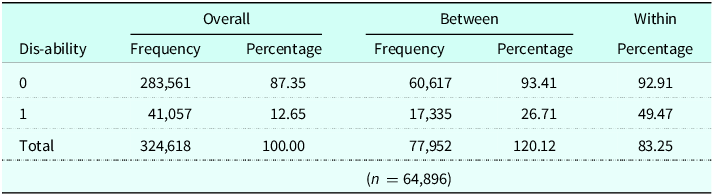
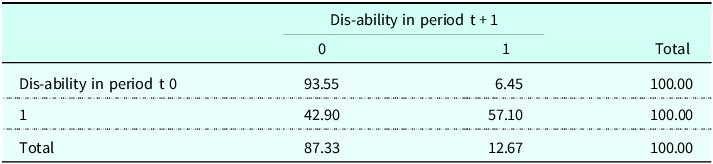
Before proceeding to examine the extent to which those already disadvantaged were ‘selected’ into dis-ability, and the impact of dis-ability onset and the duration of dis-ability on labour market and wellbeing outcomes, it is important to highlight the dynamic nature of dis-ability in the UK over the period from 1991 to 2018. Pooling twenty-seven waves of data gave us a dataset of 324,618 observations from 64,896 individuals, with each individual having five observations on average, though 10% of the sample had more than eleven observations. Table 1a shows that 12.7 per cent of observations record dis-ability, yet in total 26.7 per cent of the individuals in the sample had at least one observation in which they recorded dis-ability, with 93.4 per cent of individuals ever recording being non-disabled. For those who had ever recorded dis-ability, on average just under half of their observations recorded dis-ability. Table 1b shows the year-to-year dynamics of dis-ability for individuals within the full dataset. For any period where someone was non-disabled, in around 94 per cent of cases, their subsequent observation was also non-disabled, whereas for an observation that recorded dis-ability, in only 57 per cent of cases, the following observation would also record dis-ability; hence, there was considerable movement out of dis-ability annually.
Dis-ability prevalence overall, between and within individuals

Dis-ability period-to-period transition matrix

Table 1 highlights the importance of longitudinal analysis since dis-ability is far from a static condition and affects many more people than a simple cross-sectional analysis would reveal. Moreover, there are important differences in the characteristics of those who are disabled at a certain time, those who are not and, amongst the latter, those who go on to become disabled and those who do not, as we explore in the next section.
Selection into dis-ability
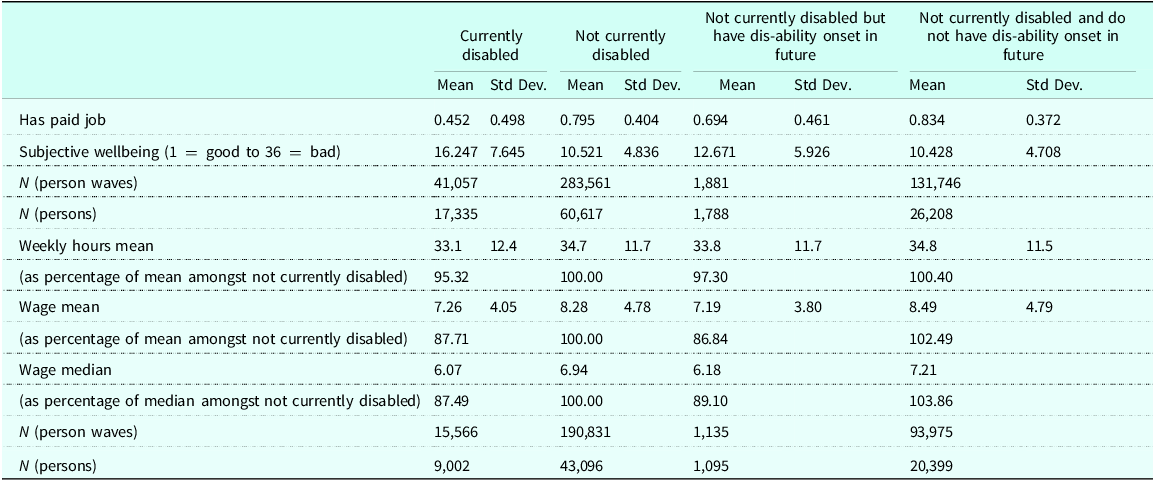
Without a longitudinal analysis, it is not possible to be certain of whether the economic and wellbeing disadvantages of those who become disabled are a result of dis-ability onset or dis-ability duration or because those who are already disadvantaged are more likely to become disabled. Following Jenkins and Rigg (Reference Jenkins and Rigg2004), in Table 2 we exploited the longitudinal nature of the dataset to show elements of the labour market status of individuals broken down by dis-ability status at a specific timepoint and future dis-ability status.
The first two columns show that those who are currently disabled are much less likely than those not currently disabled to have a paid job: 0.45 compared with 0.80. Amongst those who were employed, average weekly hours for the currently disabled were slightly lower at 33.1 per week compared with 34.7 for the not currently disabled, though this difference was statistically significant. Similarly, average wages were 12 per cent lower amongst disabled people at £7.26 per hour, compared with £8.28, with an almost identical 12.5 per cent difference in the median wage: £6.07 per hour for those currently disabled compared with £6.94 for people not currently disabled. Unsurprisingly, currently disabled people also fared worse in terms of subjective wellbeing: on average their score was 16.2 out of 36 (with 36 meaning the worst wellbeing score) compared with only 10.5 for the currently not disabled.
These first two columns of Table 2 capture the circumstances of those disabled at the time of observation and those not disabled at the time of observation over the time-period of the data, combining the effects of dis-ability onset and duration with the selection effect, i.e., the possibility that those who were disabled are disadvantaged in these dimensions prior to the onset of dis-ability. Turning to columns 3 and 4, we began to separate out the selection effect by examining the outcomes amongst those who were not disabled at the time of observation for whom we knew their future dis-ability status, and using the strict definition of onset. For everyone in this sample we observed them non-disabled for at least two consecutive years and then saw whether they had dis-ability onset in the subsequent years. We examined the labour market and wellbeing outcomes in the first of the two consecutive observations recorded as non-disabled (we refer to this as the base period), and separated those who did (column 3) and did not (column 4) go on to experience dis-ability onset. The selection effect is illustrated by the fact that, although those who were currently non-disabled but who subsequently had dis-ability onset had a higher employment rate (0.69) than the currently disabled (0.45), this was still lower than the rate for those who were not currently disabled and did not subsequently experience dis-ability onset (0.83). Similarly average wages amongst those employed were lower (£7.19 compared with £8.49), and hours were also lower by 1 hour per week in the base year. Amongst those who were not currently disabled, subjective wellbeing was worse for those who did go on to experience future dis-ability than for those who did not (average score of 12.7, compared with 10.4) but not as bad as amongst those who were disabled at that time (16.2). This suggests that there is both a selection effect (those who become disabled have worse economic and wellbeing outcomes prior to dis-ability onset) and also an onset and/or duration effect (those who become disabled have their outcomes worsened by the onset and duration of dis-ability).
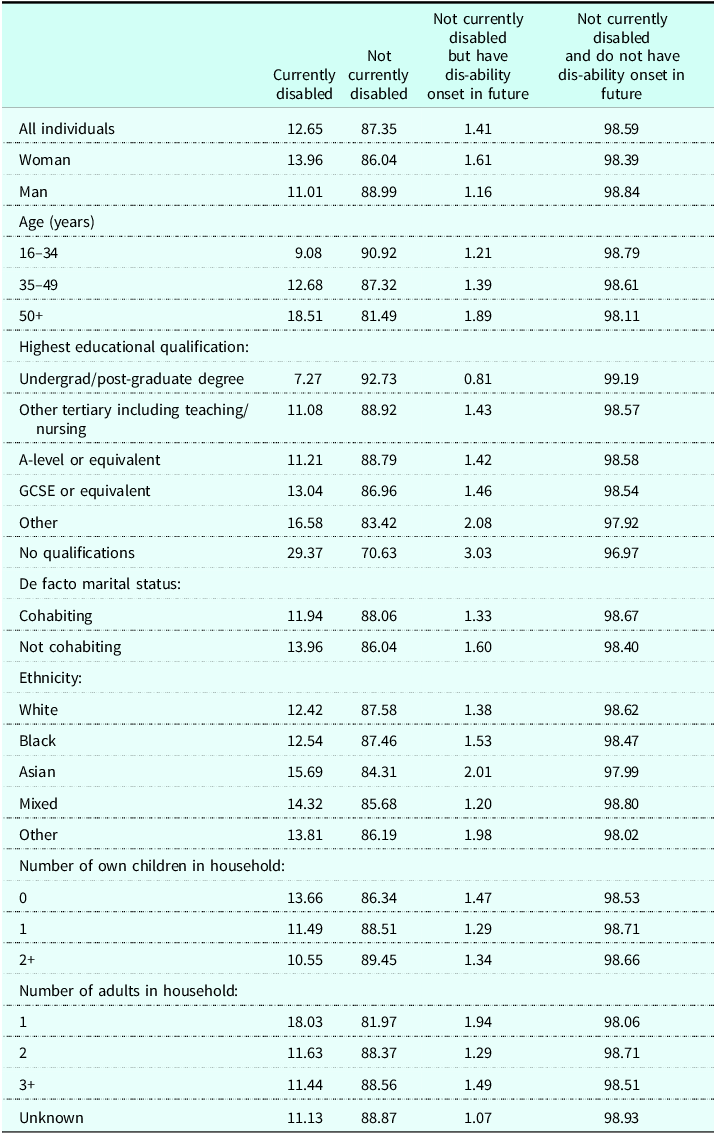
The lower panel of Table 2 reflects the selection into both current dis-ability and future onset of dis-ability on the basis of characteristics. For example, we see that, amongst those not currently disabled, the overall onset rate was 1.41 per cent, but this differed by gender (1.61 per cent for women and 1.16 per cent for men). The likelihood of onset also increased with age, rising from 1.21 per cent for the under-35-year-olds to 1.39 per cent for 35–49-year-olds and 1.89 per cent for the over-50-year-olds. There was a strong educational gradient in dis-ability onset, increasing from 0.81 per cent for graduates to 3.03 per cent for those with no qualifications. There were also different rates of onset by ethnicity: those of white ethnicity had the lowest rate (1.38 per cent), while those from Asian ethnic groups had the highest at 2.01 per cent. The presence of children in the household and the presence of more than one adult was associated with a lower likelihood of dis-ability onset compared with childless or single-adult households.
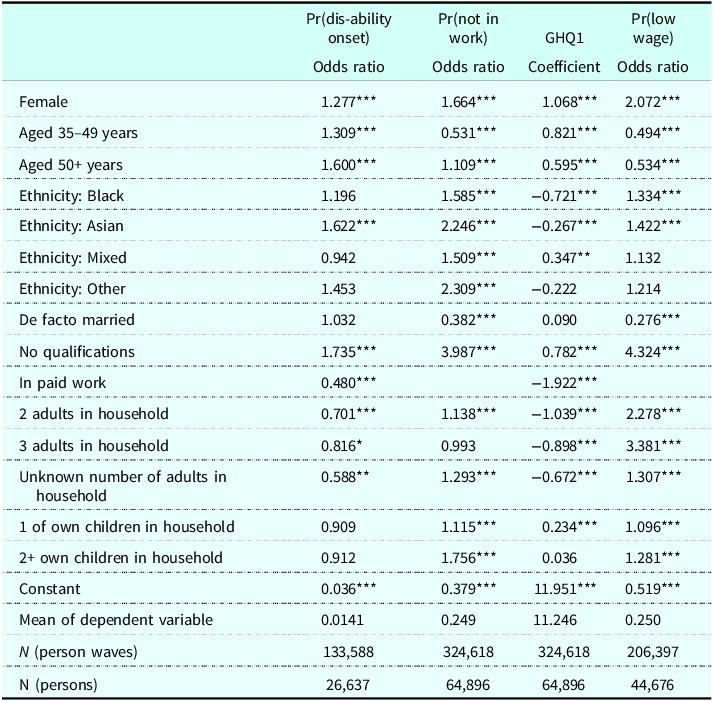
These patterns are suggestive of the drivers of selection into dis-ability, but some of these characteristics will be correlated with each other. Therefore, to investigate the selection effect more precisely, we ran a multivariate regression of dis-ability onset on a range of socio-demographic predictors. This allowed us to identify which were the key drivers of selection, whilst holding other relevant factors constant. The first column of Table 3 shows that, amongst those not currently disabled, women were 28 per cent more likely to experience onset than men, all else equal. Age is another factor that was highly predictive of onset: compared with the under-35-year-olds, those aged 35–49 years (50+ years) are 31 per cent (60 per cent) more likely to experience onset. For all non-white ethnic groups, the risk of dis-ability onset was higher than it was for white people with similar characteristics; however, it was only for those of Asian ethnicity (odds ratio 1.6) where the difference was statistically significant. Having no qualifications was another factor highly predictive of dis-ability onset (OR 1.7), whereas being in paid work (OR 0.5) or residing in a two adult household rather than a single household (OR 0.7) was associated with lower likelihood of dis-ability onset, holding all other factors equal.
Employment status, subjective wellbeing, hours and wages, by dis-ability status

Notes: Std Dev., standard deviation
Socio-demographic characteristics, by dis-ability status (row percentages)

Note: sample sizes as per panel (a). GCSE, General Certificate of Secondary Education; A-levels, advanced level qualifications.
Predictors of dis-ability onset, being out of work, subjective wellbeing and being on a low wage

Note: Regressions also include controls for year of interview and region. Omitted categories: aged 16–24 years, ethnicity: white, de facto single, some qualifications, not in paid work, 1 adult in household, no own children in household. Pr(A), probability of A; GHQ, General Health Questionnaire. *p < 0.10; **p < 0.05; ***p < 0.01.
The remaining columns of Table 3 show how these factors associated with dis-ability onset were also predictive of labour market and health outcomes, indicating their importance for the selection effect. Looking at the probability of being out of work (column 2), gender was again important: women were 66% more likely to be out of work than comparable men. The age effect was less straightforward: while those aged 35–49 years were less likely to be out of work (OR 0.5), the over-50-year-olds were more likely to be out of work (OR 1.1) than the under-35-year-olds. Compared with people of white ethnicity, every other ethnic group had an increased risk of not being in work, with odds-ratios ranging from 1.5 to 2.3. Those with no qualifications were much more likely to be out of work than comparable individuals who did have qualifications (OR 4.0). A similar pattern emerged for subjective wellbeing (column 3): women had worse scores (+1.1) than men, as did those aged 35–49 years (+0.8) and aged 50+ years (+0.6) compared with the under-35-year-olds. Having no qualifications was also associated with worse subjective wellbeing (+0.8) compared with those with qualifications. The pattern by ethnicity was not straightforward: mixed ethnicity was associated with a worse subjective wellbeing score (+0.3), whereas Black ethnicity (−0.7) or Asian ethnicity (−0.3) was associated with better subjective wellbeing. Finally, looking at the probability of being low-paidFootnote 7 (column 4), again gender was important, with women being more than twice as likely to be low-paid than comparable men, while older workers were less likely to be low-paid than younger workers (OR 0.5 for ages 35-49 years and for ages 50+ years compared with under-35-year-olds). Both Black (OR 1.3) and Asian (OR 1.4) workers were more likely to be low-paid than those of white ethnicity, and those with no qualifications were much more likely (OR 4.3) to be low-paid than those with some qualifications.
Looking across the outcomes and the model for dis-ability onset in Table 3, gender, age, ethnicity and educational attainment were key factors for selection into dis-ability and explain some of the raw differences in outcomes between the currently disabled and the not currently disabled in Table 2. However, a comparison of the outcomes for the currently disabled and those who would go on to become disabled indicated that there were also onset and duration effects that impacted the labour market and wellbeing outcomes.
Onset and duration of dis-ability
To examine the effects of dis-ability onset and duration, we now focus on the subsample who experienced dis-ability onset and describe how their labour market and wellbeing outcomes changed with onset and as a period of dis-ability extended. We have sufficient sample sizes to look at six periods prior to the onset of dis-ability and spells lasting up to 8 years.Footnote 8
Graphical results
For comparability with the previous analysis of Jenkins and Rigg (Reference Jenkins and Rigg2004), Figures 1–4 illustrate the effect of dis-ability onset and duration on outcomes of interest, allowing for the effects to differ depending on the length of the dis-ability spell. Each spell was defined by two consecutive periods in which dis-ability was not recorded followed by at least two consecutive spells in which dis-ability was recorded. The figures show the 6 years prior to the onset of dis-ability (which took place at time point zero) and spells of up to 8 years.Footnote 9 The shortest line in each figure includes all of this onset sample who each had a dis-ability spell of at least 2 years. The next line includes those with spells lasting at least 3 years – so compared with the shortest, it excludes those who had a spell of only 2 years. The subsequent lines follow this pattern such that the longest line in each figure only includes those with spells lasting at least 8 years.
In Figure 1, between 65 per cent and 75 per cent of the sample were in paid work in the years prior to the onset of dis-ability, and at the base period 2 years before onset, approximately 70 per cent of the sample were in work, with little variation between those who went on to longer or shorter spells. There is no real suggestion that employment falls before dis-ability onset (i.e. years −1 to −6), but in all cases there was a drop in employment in the period when dis-ability was first recorded (year 0). The drop was larger for those who would go on to have longer spells of dis-ability, and for all durations of spell, the probability of being in work fell further as the spell lengthened. This pattern then stabilised and even reversed slightly for spells of at least 6–8 years, with the percentage in paid employment around 25–30 per cent at this point.
Proportion in paid work pre- and post-dis-ability onset, by length of dis-ability spell.
Note: dis-ability onset at year zero.

Figure 2 shows a similar, though more volatile, pattern. Prior to dis-ability onset, hours are variable between 32 and 38 hours per week, with those who would go on to longer spells of dis-ability working more hours if anything. The reduction in hours with dis-ability onset was similar for all lengths of spell, and as spells continued, hours generally fell year-on-year. Those who went on to have spells of at least 8 years saw their hours fall on average from around 34 hours per week prior to onset to about 27 hours per week in the eighth year of the spell.
Weekly hours pre- and post-dis-ability onset, by length of dis-ability spell.
Note: dis-ability onset at year zero.

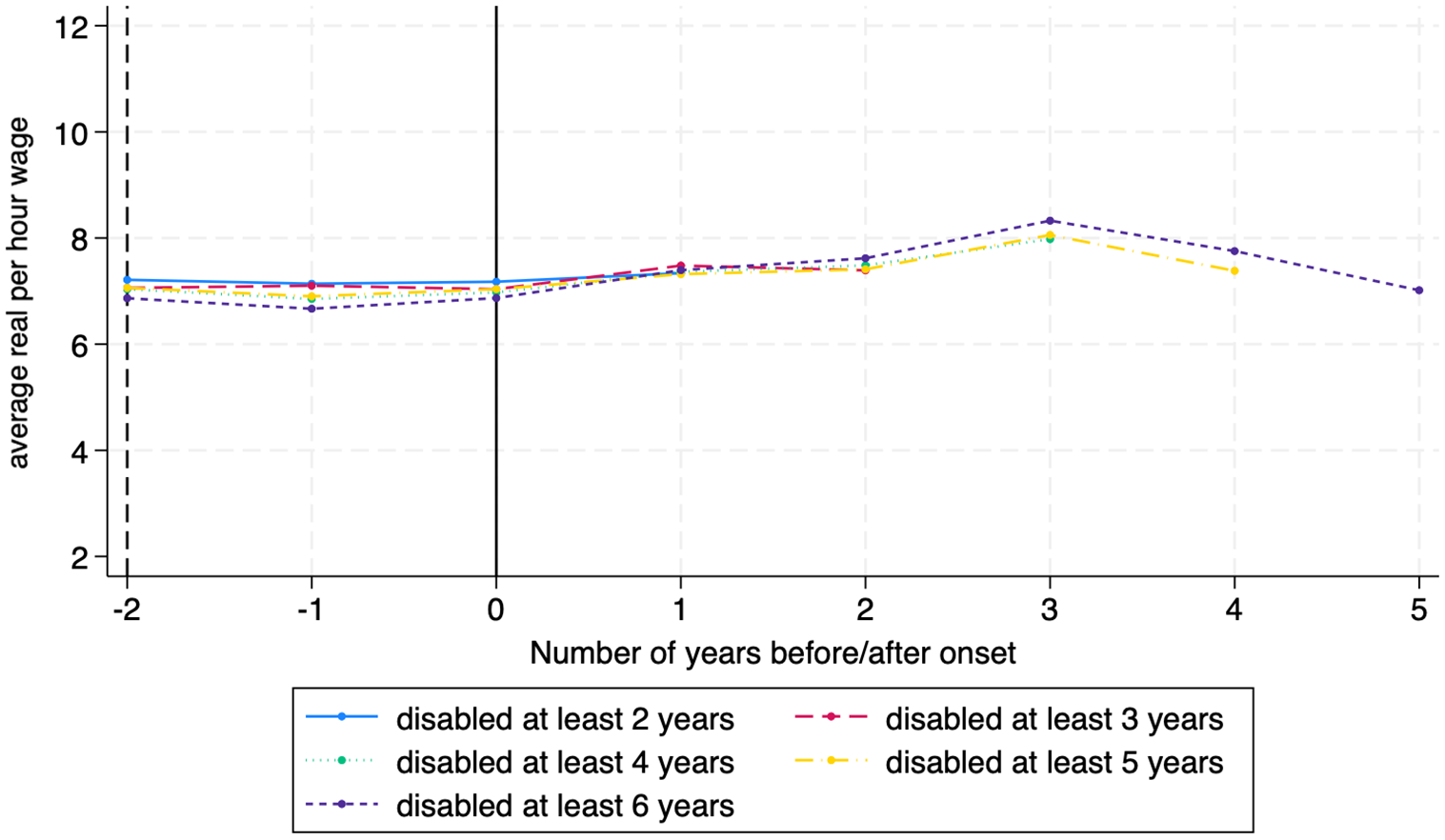
Figure 3 shows the impact on real hourly wages. The sample of individuals with wage information recorded was smaller, and there were very few observations with wages recorded for individuals with spells in excess of 6 years. Interestingly, in this figure, we see little variation in wages pre-onset, and the onset of dis-ability was not associated with a fall in wages, nor did they change on average as spells of dis-ability continued – and this was the case regardless of the length of spell. This suggests that those who were able to remain in employment despite dis-ability onset did not suffer an hourly wage penalty; however, they would on average suffer a fall in income since hours fell with onset and even more so as spells continued. Therefore, even the relatively more resilient amongst those experiencing onset would likely suffer a financial penalty.
Hourly wages pre- and post-dis-ability onset, by length of dis-ability spell.
Note: dis-ability onset at year zero.

Figure 4 shows the impact of onset and duration on subjective wellbeing. Prior to dis-ability onset, there was already a difference in wellbeing dependent on future dis-ability spell length: those who would go on to have longer spells already had worse wellbeing scores (higher value) than those with shorter spells, and it was a fairly monotonic relationship. In all cases, in the year pre-dis-ability-onset (year −1), wellbeing declined, and then there was a sharp decline in wellbeing in the year of onset. The decline was more dramatic for those who would go on to have the longest spells. However, after the sharp deterioration in wellbeing associated with dis-ability onset, the scores generally plateaued or even reduced, indicating wellbeing remaining constant or even slightly improving as a spell continued, but not back to the pre-onset level.
Subjective wellbeing pre- and post-disability onset, by length of dis-ability spell.
Notes: dis-ability onset at year zero.

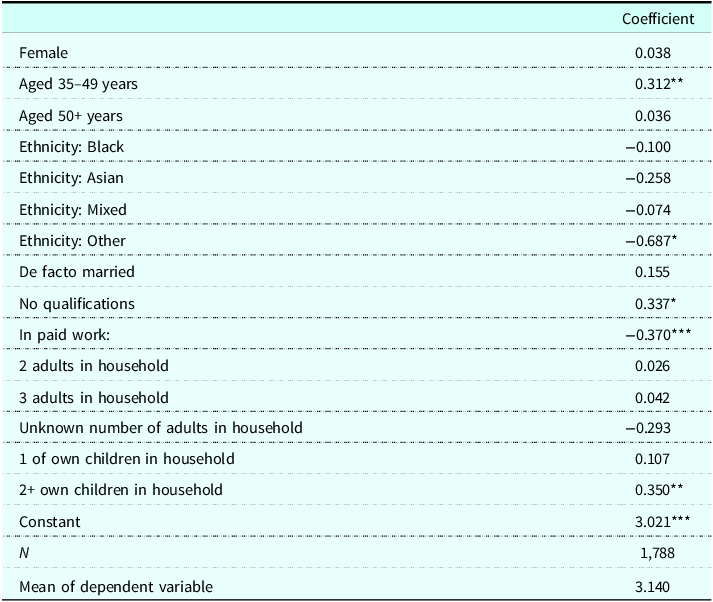
As noted, in addition to the effects of onset and duration, Figures 1–4 show that there was selection even within the group who became disabled, with those who would go on to experience longer spells often having poorer outcomes to start with and experiencing the greatest effects of onset and duration. While the selection effect for onset is reflected in the results in Table 3, the selection effect for duration visible in Figures 1, 2 and 4 is confirmed in regression estimates in Table 4. These show that the length of a spell can be predicted at onset by certain socio-demographic characteristics, in particular: being in the 35–49-year-old age bracket and having no qualifications are associated with longer spell lengths, while being in the ‘ethnicity: other’ category and being in work at dis-ability onset were associated with shorter spell lengths. This confirms that we need to control for individual characteristics when analysing these onset and duration effects – if we do not, then the coefficients on the duration effects will be biased. For example, the effect of being aged 35–49 years on outcomes will be picked up in the duration coefficients since being in this age bracket affects duration as well as outcomes.
Predictors of the length of dis-ability spell amongst those with onset of dis-ability

Note: Regression also includes controls for year of interview and region. Omitted categories: aged 16–24 years, ethnicity: white, de facto single, some qualifications, not in paid work, 1 adult in household, no own children in household. *p < 0.10; **p < 0.05; ***p < 0.01.
The results in Tables 3 and 4 show the importance of controlling for observable socio-demographic characteristics that affect selection into dis-ability and duration of dis-ability spell, and also influence labour market and health outcomes. In addition, it is also likely to be the case that there are unobserved differences between individuals that contribute to selection into dis-ability and duration whilst also affecting outcomes.
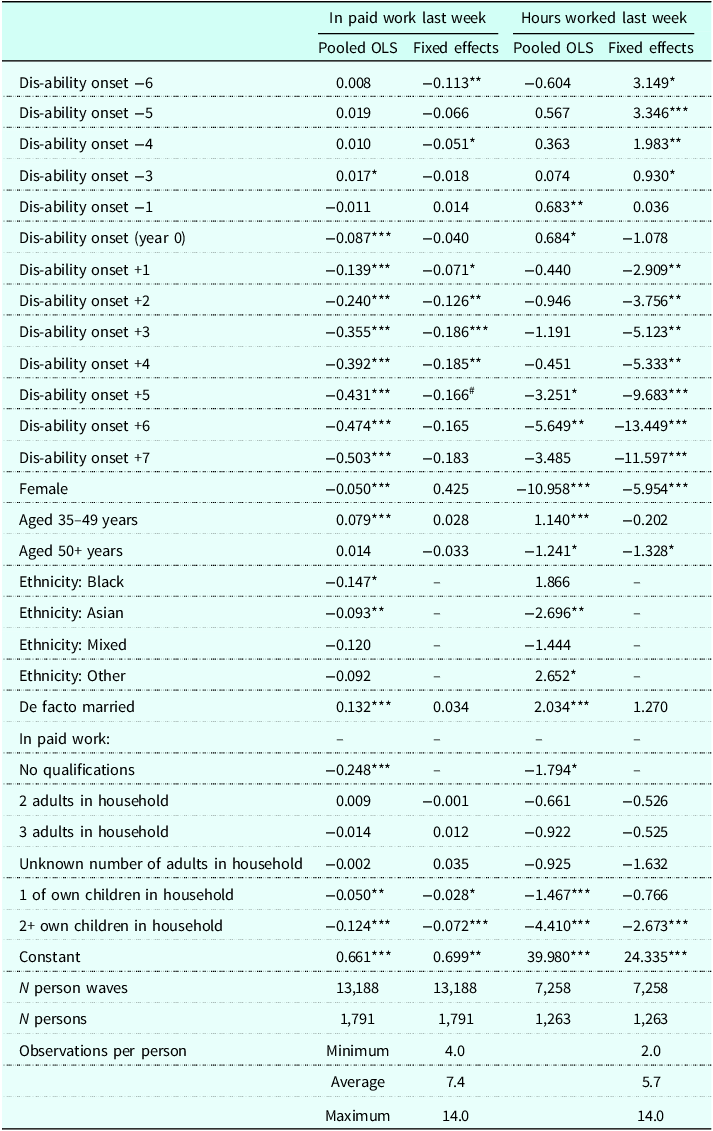
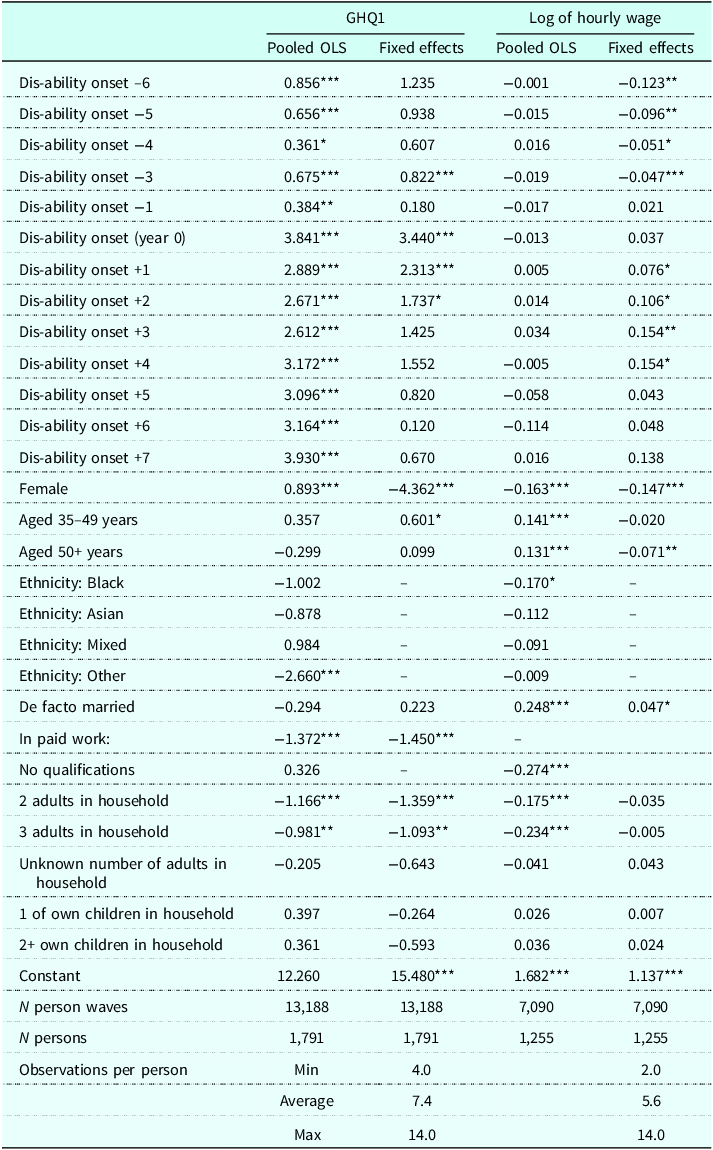
We now look to separate as far as possible selection effects from the impact of dis-ability onset and duration through a series of regression models in which we controlled for the observed and fixed unobserved characteristics of individuals, and trace how their outcomes changed with the onset of dis-ability and as a spell of dis-ability continued. In Tables 5a and b, the first column for each outcome shows the model in which we controlled for just observable characteristics (pooled OLS regressions), while the second column shows results when we also controlled for time-invariant unobservable characteristics of individuals (fixed effects regressions). In each case we can see how outcomes varied in the periods before onset and with onset and as a dis-ability spell continued.
Impact of dis-ability onset and duration on proportion in paid work and on hours worked, OLS and fixed effects models

Note: Regressions also include controls for year of interview and region. Omitted categories: aged 16–24 years, ethnicity: white, de facto single, some qualifications, not in paid work, 1 adult in household, no own children in household. # p = 0.103; *p < 0.10; **p < 0.05; ***p < 0.01.
The first column of Table 5a shows that, compared with the base period 2 years before onset, the probability of being in paid work was for the most part no higher on average in the periods leading up to dis-ability onset. The year of onset saw a −8.7 percentage point (pp) average difference, and paid work probability was lower in each subsequent year of a spell such that the probability of being in paid work for those 8 years into a dis-ability spell was 50pp lower than it was for people who were still 2 years prior to onset. However, the fixed effects estimates in column 2 show that much of the effect of onset and duration was related to the unobservable characteristics of those who moved into dis-ability and had longer spells. Once we control for the fixed unobservable characteristics – effectively comparing the outcomes of those who became disabled with their own outcomes before they themselves were disabled – we saw a small negative effect in the year of onset, but it was not statistically different to zero. There were statistically significant effects from the second period of a spell, and effects became larger and remained significant in the third, fourth and fifth periods. These effects were about half of the pooled estimates in column 1.
For hours worked, the picture is different: the pooled results suggest no difference in hours for people in most of the years prior to onset compared with people in the base period 2 years before onset but then small increases in hours in the year before and the year of onset. There were then small negative effects on hours amongst those experiencing dis-ability compared with those who were pre-onset, and this continues for those in the first few years of a spell, before much larger differences for those experiencing spells of six or more years. The fixed effects results however suggest that an individual’s work hours fell in the years prior to dis-ability onset and then fell more substantially from the second year of a spell such that they were 10 hours per week lower by the sixth year of a dis-ability spell, and 11.6 hours lower in the eighth year. This difference between the pooled OLS and fixed effects results suggests that those who experienced dis-ability onset but remained in paid work were a positive selection amongst those who experienced onset at some point, working longer hours on average. As such, compared with the rest of the sample, the falls in hours associated with a dis-ability spell were smaller than the average would be, making the impact of onset appear smaller. However, when we compared these individuals with themselves over time, we saw a more dramatic effect of dis-ability onset and duration on their work hours.
Interestingly, the pooled estimates of the effect of dis-ability onset and duration on hourly wages (Table 5b) did not find significant impacts, concurring with the picture in Figure 3. However, the fixed effects column shows that there were significant effects for periods prior to onset of dis-ability, with the coefficients indicating some significant year-on-year wage growth in the years before onset. This growth stalled with onset before some wage growth returned as spells progressed. Looking at who remained in employment amongst those with longer duration of dis-ability, we saw positive selection in terms of gender, age and education. For example, amongst those with dis-ability spells of at least 4 years, comparing those who did and did not remain wage earners, the waged were more likely to be male (38.2 per cent versus 36.6 per cent), younger (42.7 years old versus 45.0) and better educated (19.1 per cent graduates, 4.2 per cent no qualifications versus 7.3 per cent graduates and 24.4 per cent no qualifications). Even those individuals remaining employed would see their overall income fall due to the falls in hours identified in column 4 of Table 5a. The absence of wage decline is therefore only part of the story: there was an impact on income for those who maintained their employment in the form of lost wage growth and reduced hours.
Impact of dis-ability onset and duration on wellbeing and on log hourly wage, OLS and fixed effects models

Note: Regressions also include controls for year of interview and region. Omitted categories: aged 16–24 years, ethnicity: white, de facto single, some qualifications, not in paid work, 1 adult in household, no own children in household. Pr, ; GHQ, General Health Questionnaire. *p < 0.10; **p < 0.05; ***p < 0.01.
Regarding wellbeing, again there were interesting differences between the pooled OLS estimates and the fixed effects estimates. The OLS suggested that wellbeing may be lowering in the years before the onset of dis-ability, and then compared with those in the base-period two years pre-onset, wellbeing dramatically declined (+3.8) with onset and continued to be worse for those experiencing longer spells. For those in the sixth, seventh and eighth year of a spell, wellbeing scores were worse by 3.1, 3.2 and 3.9, respectively, than those of people who were pre-onset. However, again the fixed effects regressions showed that these longer duration effects were related to the unobservable characteristics of those who experienced such spells. When we compared individuals with themselves over time, there was an impact of onset (+3.4) and in the next 2 years (+2.3, +1.7) but no further impacts of longer duration on wellbeing. This implies that individuals suffered a shock to wellbeing with onset of dis-ability but that, if a spell continued beyond 3 years, wellbeing re-adjusted, and there was no further negative impact, with wellbeing reverting to pre-onset levels.
In summary, the regression estimates suggested that, even though there was selection into dis-ability, within the sample of those who would all become disabled, there were still onset and duration effects. Work likelihood fell with onset and continued to fall as spells increased in length. This was also true of work hours for those who remained in work. Wellbeing was adversely affected with onset before individuals adjusted to a new state after a few periods of dis-ability – perhaps a new ‘normal’ was established and hence wellbeing effects were muted.
Discussion and conclusions
Our analysis of a 27-year panel of UK data further substantiates previous research indicating that currently disabled people are less likely to be in paid employment and have lower work hours, lower pay and worse wellbeing than their non-disabled counterparts. Our findings also confirm the greater prevalence of dis-ability than a cross-sectional analysis would reveal, underlining how cross-sectional analysis alone misses important implications of the dynamic nature of dis-ability.
In relation to the latter, we make further contributions. Firstly, we confirm that there is a selection effect into dis-ability: those who are not currently disabled but go on to have dis-ability onset are selected in terms of their economic and wellbeing status, already having lower employment rates and hours and worse wellbeing than those who do not experience onset. This selection works through a variety of characteristics: gender, older age, (low) educational attainment, ethnicity (in particular being of Asian ethnicity) and being a single-householder. These characteristics are associated with onset of dis-ability and also increase the chances of adverse labour market and wellbeing outcomes. Moreover, within the group who will become disabled there is also a further selection: those who will experience longer spells of dis-ability have a worse starting position in the labour market and poorer initial wellbeing. Again, this works partly through socio-demographic characteristics; for example, having a lower level of education is associated with longer dis-ability spells but also predicts poorer wellbeing and initial labour market position, whereas being in work prior to dis-ability onset is associated with shorter spells and better initial wellbeing.
Secondly, the strong selection into (continued) dis-ability on observable socio-demographic characteristics suggests that those who experience dis-ability onset are also likely to be different in terms of unobservable characteristics that affect both likelihood of experiencing dis-ability and labour market and wellbeing outcomes. This makes it imperative to use methods of analysis that control as much as possible for unobservable differences even amongst the sample who all experience dis-ability onset. Our fixed effects analysis allows us to control for any time-invariant unobservable characteristics of individuals by comparing those who experience dis-ability onset with themselves pre-onset, giving a clearer picture of the impacts of dis-ability onset and duration. This is important, as while the graphical analysis and pooled OLS regressions suggest dis-ability onset reduces employment probability instantaneously, once we control for individuals’ time-invariant unobservable characteristics, we find the greatest negative impacts of dis-ability only really manifest in the labour market as spells extend beyond 1 or 2 years. For those remaining in work, while hourly wages do not fall, their previous growth is stalled, and coupled with the reduction in hours, this implies income will fall both in absolute terms and relative to what it might have been absent onset. The evidence underlines the importance of both controlling for unobserved selection into dis-ability and taking a dynamic view: dis-ability onset impacts are not static, in the labour market, the longer a person is disabled, the worse the impact – even after accounting for observable and unobservable characteristics. Even within shorter spells the impacts grow with duration. In contrast, for wellbeing the effects of dis-ability onset are instantaneous but appear to be short-lived for the majority in the data set.
Finally, the striking difference between the OLS and fixed effects regressions for hours worked shows that any analysis, even a dynamic analysis, that fails to control for selection will erroneously conclude that dis-ability onset and duration has a limited impact on hours worked. However, once we control for unobservable time-invariant characteristics, we see that those who remain in work despite dis-ability onset are a particularly positive selection of those who experience dis-ability. Upon comparison with their own experience pre-onset – which involved high work hours, commensurate with the employment patterns of the highly educated, white males who are the most likely to be able to maintain employment post-dis-ability onset – their hours worked actually do fall sharply with onset and duration of dis-ability.
Policy implications
There are three sets of policy implications following from these results. Firstly, regarding dis-ability onset: even in the fixed effects regressions, we see effects of dis-ability onset on wellbeing in particular, but also on work and hours in the initial years of a spell. As such, policy needs to be targeted at preventing the onset of work-limiting conditions to prevent these negative onset effects, through, for example, human resources services actively promoting better work–life balance to reduce the overwork that can lead to or exacerbate common conditions such as long-term pain and anxiety. Our analysis suggests that women, older workers and those with low qualifications are more vulnerable to onset, and hence, work-place policies should be particularly aware of supporting these workers.
Secondly, as spells continue, we see effects on the probability of work and hours worked escalating with the length of the spell, indicating strong duration effects. Dis-ability policy should therefore also focus on preventing extended spells of dis-ability for those who experience onset. To address this, policy/support should be quick and flexible, to get people back into work where possible/appropriate. In particular, our findings show that older individuals and those not in work are most at risk of longer spells of dis-ability, and hence, policy-responses should prioritise these key groups. Dis-ability-related services, such as mental health support and physiotherapy, must have appropriate long-term funding to avoid long waiting lists. Those who manage to maintain employment despite a dis-ability spell are strongly positively selected but still require support to maintain their work hours. Thus, for them, and all other disabled groups, reducing the likelihood of a disabling work environment through reasonable adjustments remains vital. Continuing employment despite longer dis-ability duration is associated with better wellbeing, further underscoring the need for policy to support labour market attachment.
Finally, the finding that there is strong selection into (continuing) dis-ability on observable characteristics, and that this explains a substantial proportion of the disadvantage experienced by those who become disabled, suggests there are deeper structural mechanisms in the labour market that translate particular characteristics – i.e., being female, of non-white ethnicity, and of an older age – into both poorer labour market outcomes and greater likelihood of dis-ability. Therefore, equality policy needs to target workplace disadvantage more effectively.
Our findings suggest the need to enhance the positive moves of the Equality Act 2010, and move away from the unsuccessful sanctioning found in ‘workfare’, linked to the Welfare Reform Acts of 2007 and 2012 (Roulstone, Reference Roulstone2015). More than this, there are implications for the work culture fostered within the UK. The previous Conservative Government’s National Disability Strategy (HM Government, 2021a,b,c,d) was unlikely to be enough, particularly considering the attention on the potential sanctioning of disabled people (e.g. HM Government, 2023). A more holistic approach is needed that is sensitive to (i) selection into dis-ability and (ii) duration of dis-ability. The Labour Government elected in 2024 should aim to close the income gap, not just the employment gap between disabled and non-disabled people, whilst simultaneously improving the conditions of those employed. In particular, there is a need to improve the employment conditions of women, those with low educational attainment, ethnic minorities, older people and single households to try to ensure they do not drop out of the workforce with dis-ability onset. There is also a need to enhance reasonable adjustments at work, which, combined with faster access to healthcare services, could reduce the likelihood of dis-ability onset, reduce the duration of dis-ability spells and enable people to thrive in the work that they do.
Acknowledgements
We would like to thank the thousands of people who contributed their time to complete the British Household Panel Survey and the Understanding Society survey. We would also like to thank participants at the Social Policy Association annual conference 2021 for helpful comments on an early version of the paper, and two anonymous referees and the journal editors for their insightful comments.
Competing interests
The author(s) declare none.




 Open access

