

A free virtual field trip to Antarctica
In April 2017, Victoria University of Wellington, New Zealand, launched ICE101X—Antarctica: From Geology to Human History—on the global edX platform. The free online course, which offered learners “a free virtual field trip to Antarctica”, differed from other tertiary institution-led courses about Antarctica in that its main attraction was video lectures filmed on location in Antarctica and featuring Antarctic researchers, including geologists, conservators and artists. The course attracted 5735 learners from 128 countries.
This Massive Open Online Course, or MOOC, was the third iteration of an online course offered by the Science in Society group at Victoria University of Wellington. A pilot MOOC was first offered in 2015 (“Antarctica Online”), an online course was offered as part of the university curriculum in 2016 (“SCIE302”), and the edX MOOC (“ICE101X”) was offered in 2017.
This paper tracks the development and evolution of this course in the context of (i) public engagement with Antarctica and Antarctic science, (ii) new media for education and outreach about Antarctica, and (iii) the legacy of Education, Outreach and Communication (EOC) in the International Polar Year 2007–2008 (IPY). It includes an outline of the context in which the course was developed, details of course structure and learner demographics, and examples of learners’ responses to the course content. The paper concludes with thoughts about the future of this online course, including ways in which the wider Antarctic community could get involved in generating content.
In the spirit of IPY, this paper is an interdisciplinary collaboration between a science historian/writer, an educational researcher, a geologist, a science communication scholar, and a psychology researcher, all employed and working in a university environment and involved in both research and teaching.
Personal, institutional, political and educational context
As a means of encouraging more effective and professional engagement, Salmon, Priestley, and Goven (Reference Salmon, Priestley and Goven2017) recommend articulating the contexts in which an outreach or communication initiative occurs. In that spirit, the personal, institutional, political–economic, educational and Antarctic contexts in which this course emerged are outlined here.
Personal context
This course was developed by three academics with Antarctic experience (Atkins, Priestley and Salmon) employed by Victoria University of Wellington. Priestley and Salmon, who in 2013 launched a “Science in Context” undergraduate teaching programme, were running several fully online tertiary courses. As part of this programme they were experimenting with new methods of online content creation and delivery, including moving away from classroom-style video lectures to filming lectures in field locations, such as science laboratories, a marae (a traditional communal and sacred meeting place within Māori culture), and a wind farm.
Priestley, a science writer and historian, had visited Antarctica in 2011 on an Antarctica New Zealand invited media programme and was compiling and editing an anthology of Antarctic science (Priestley, Reference Priestley2016). Salmon, who now focuses on research into public engagement with science, had in 2003–2005 spent 18 months at Halley Research Station as an atmospheric chemist with the British Antarctic Survey, was the IPY International Programme Office Education and Outreach Coordinator through 2006–2009, and was co-writing a chapter on atmospheric science for a new textbook about Antarctica (Salmon & Jones, Reference Salmon, Jones, Liggett, Storey, Cook and Meduna2015). Atkins had spent 11 field seasons in Antarctica as a geologist on a range of projects, including three seasons on the IPY ANDRILL project, taught an undergraduate interdisciplinary classroom course on Antarctica, and was writing a chapter on paleoclimate for the same textbook as Salmon (Atkins, Reference Atkins, Liggett, Storey, Cook and Meduna2015). The idea of developing a course on Antarctica was first discussed when, in mid-2014, an opportunity arose for Atkins and Priestley to join a team of geologists, led by Tim Naish, Director of Victoria University’s Antarctic Research Centre, and Richard Levy, from GNS Science, at a scientific field camp at Friis Hills in the Transantarctic Mountains.
Naish and Levy were both closely involved with ANDRILL, which was one of the flagship IPY projects for field-based EOC activities. ANDRILL EOC activities included embedding teachers as Antarctic research assistants, creating high-quality short videos, blogging, live connections to classrooms, and sending “virtual postcards” from Antarctica (Huffman et al., Reference Huffman, Levy, Lacy, Harwood, Berg and Cattadori2008). Atkins, Levy and Naish were all, therefore, aware of the need to plan and integrate EOC as an integral part of a research project, as well as the power of utilising new technologies for Antarctic EOC.
Institutional context
Priestley and Salmon’s 2014 proposal to develop an online interdisciplinary Antarctic science course for the Science in Context undergraduate minor was rejected at faculty level for internal, political reasons not canvassed here. To take advantage of the opportunity to film lectures in Antarctica, and to explore an emerging educational tool that was attracting attention internationally, the Pro-Vice-Chancellor suggested the course be developed as a MOOC, and used as an outreach tool for the university. MOOCs were a topic of much discussion at the university at this stage, with strong interest from the Chancellor, but a generally wary attitude from academic and technical support services.
Given the timeframe in which a decision had to be made (due to the need to confirm travel to Antarctica), and the value of any material that would be filmed in Antarctica, the decision was made to film material that could be used for a MOOC or for an online, credit-bearing, course offered to undergraduate students. University funding of NZD 10,000 was used to purchase filming equipment, including a Canon XF100 video camera. Preparation by Atkins and Priestley involved a small amount of informal training on how to use the recording equipment.
While the course was being planned, filmed, edited, and the first iteration offered (through 2014 and 2015), Priestley was a teacher–researcher in a Teaching and Learning Research Initiative (TLRI)project, which involved, among other things, “encouraging teacher–researchers to learn about historical thinking and threshold concepts while reflecting on their own practice” (Shep, Reference Shep2017, p. 9). The history module of Antarctica Online was used as a case study, and aspects of the module were discussed at workshops and seminars by Priestley and, after she joined the group in early 2016, Dohaney (Shep et al., Reference Shep, Dudding, Gigliotti, Plummer, Priestley, Towl and Dohaney2016). Involvement in this project informed some of Priestley’s thinking as she was developing content for the history module.
Political–economic context
The IPY catalysed an immense surge of enthusiasm, goodwill, funding and other support for polar EOC, including stimulating lasting networks, such as the Association of Polar Early Career Scientists and Polar Educators International. During the IPY, staff at the international programme office (including Salmon) were highly aware of the political profile of the IPY, and how a positive profile generated through successful EOC could be used to leverage further research funding. As an example relevant to this paper, halfway through the IPY, the New Zealand government announced NZD 4.5 million in new funding to support IPY-endorsed research, arguably as a result of a high international profile and opportunity for major international collaborations (Salmon, Reference Salmon2007). This legacy of connecting political goodwill, positive profile through EOC, and research funding remains to this day in New Zealand (Salmon, Priestley, Fontana, & Milfont, Reference Salmon, Priestley, Fontana and Milfont2017). Understanding the national context, including New Zealand’s historical, political, geographical and logistical connections with Antarctica, is therefore critical for understanding how this MOOC came about and was so (relatively) easily facilitated.
Antarctica New Zealand is the government agency charged with carrying out New Zealand’s activities in Antarctica. As noted on their website (antarcticanz.govt.nz), “demystifying science through strong outreach and education is an essential part of our mandate.” Christchurch, in the South Island of New Zealand, is Antarctica New Zealand’s base and one of five Gateway cities to Antarctica, with access via air (through Christchurch International Airport) and by sea (through the port of Lyttleton). New Zealand and the USA run a joint logistics pool, with several flights a week to McMurdo Sound during summer, meaning that Antarctica is accessible for short visits, for example from people in Antarctica New Zealand’s Community Engagement Programme (Salmon et al., Reference Salmon, Priestley, Fontana and Milfont2017; Saunders, Guenther, & Dalziel, Reference Saunders, Guenther and Dalziel2016). This relative accessibility of Antarctica (compared to other nations) was fundamental to enabling the visit on which the video lectures were filmed.
All of New Zealand’s universities, as well as many of its Crown Research Institutes, are engaged in Antarctic research (Saunders et al., Reference Saunders, Guenther and Dalziel2016) and education. Gateway Antarctica, at the University of Canterbury, offers a Postgraduate Certificate in Antarctic Studies in the form of a 14-week programme that includes a fieldtrip to Antarctica (www.canterbury.ac.nz/science/schools-and-departments/antarctica/postgraduate-study/). While many other New Zealand universities teach courses about Antarctica, student opportunities to visit are generally limited to postgraduate students accompanying scientists on field trips. Primary and secondary school students are well served by online education about Antarctica. In the 2014/2015 summer season, LEARNZ, which offers a “virtual field trip programme,” was conducting its 10th virtual field trip to Antarctica (learnz.org.nz). These field trips are designed to engage New Zealand primary and secondary school students, through their teacher, in real time with Antarctic research projects, and can be seen, to some extent, as a continuation of the legacy of the many teacher–researcher initiatives that gained a substantial profile during the IPY and which are discussed below.
Educational context
In their reflection on EOC during the last IPY, Salmon et al. (Reference Salmon, Carlson, Zicus, Pauls, Baeseman, Sparrow and Raymond2011) recommended making “maximum use of free, non-proprietary, public-friendly tools” (p. 283). When the IPY was launched, YouTube and Facebook didn’t exist, blogs were a novelty, and Google Earth was in development. The IPY EOC programme experimented with each of these tools, creating virtual tours in Google Earth (Geens, Reference Geens2007), providing a platform for scientists in the polar regions to easily share their experiences via the IPY blog (International Polar Year, 2010), and publishing YouTube videos of key players in the IPY (International Polar Year, 2009). Individual IPY projects pushed technology even further, for example through the San Francisco Exploratorium’s “Ice Stories – Dispatches from Polar Scientists” (icestories.exploratorium.edu/dispatches/); ANDRILL’s Project Iceberg (www.andrill.org/iceberg/), which included blogs, video, photographs and postcards from the field; as well as multiple live connections from expeditions by both research groups and those designed specifically for EOC, including Students On Ice (Students on Ice, 2006), Schools On Board (Barber & Barber, Reference Barber and Barber2008), and Cape Farewell (International Polar Year, 2007). Capitalising on the latest educational technologies and digital opportunities to connect global citizens with Antarctica is therefore very much in line with the legacy of the IPY. In 2014, the latest, exciting, “free, non-proprietary, public-friendly tool” came in the form of open education.
The open education movement is a worldwide trend to make education open to all learners free of charge, allowing universities to offer flexible learning opportunities beyond the traditional classroom (Marshall, Reference Marshall2018). Flexible learning allows learners to access and progress through content and activities at their own pace, enabling learners who are working or supporting children, or living in different time zones, to access course materials while balancing additional commitments. Open education led the way for MOOCs to emerge in 2006 and become popular in 2012, with prestigious institutions such as MIT, Harvard University, and Stanford University leading the trend (Marshall, Reference Marshall2018; Pappano, Reference Pappano2012).
Learner engagement in MOOCs differs substantially from more traditional university courses. In a review of 221 MOOCs, completion rates (the percentage of enrolled learners who completed the course) were found to vary from 0.7% to 52.1%, with a median of 12.6% (Jordan, Reference Jordan2014). Most learners leave the course during the first couple of weeks, and do so at an exponential rate (Perna et al., Reference Perna, Ruby, Boruch, Wang, Scull, Ahmad and Evans2014). Xiong et al. (Reference Xiong, Li, Kornhaber, Suen, Pursel and Goins2015) found that intent to earn accreditation or certification for learning led to higher levels of motivation, which in turn predicted greater engagement and subsequent retention.
A 2014 web search for MOOCs or other online courses about Antarctica yielded only one result, a Marine and Antarctic Science MOOC offered by the University of Tasmania (Johnson & Melbourne-Thomas, Reference Johnson and Melbourne-Thomas2016). But this course focused on the ocean rather than Antarctica and did not foreground lectures filmed in Antarctica. Atkins and Priestley therefore filmed lecture material in Antarctica with the understanding that this would probably be used for the first MOOC with a sole focus on Antarctica and with video lectures filmed in Antarctica.
Antarctic ambassadorship
Maher (Reference Maher2010, p.172) described ambassadorship as “the key, but often illusive [sic], item that all sides (national programmes, operators, governments) covet in the discussion around the acceptability of public visitation to the continent.” Although creating environmental advocates, or Antarctic ‘ambassadors’, was not a primary or explicit goal of the lecturers, the lecture preparation and filming was approached with the expectation that the course would inform and educate learners about the vulnerability of the Antarctic environment and its relevance and importance for the future of the planet. Therefore, we briefly consider here the broader international context of Antarctic ambassadors in which this MOOC emerged, and to which the MOOC might contribute.
The Antarctic tourism industry has promoted the idea that visitors to Antarctica become advocates or ‘ambassadors’ for Antarctic conservation (Maher, Reference Maher2010). At an international Antarctic tourism workshop in 2000, New Zealand Minister of Tourism Mark Burton described Antarctic ‘ambassadorship’ as pressing for “the preservation of the continent [by] those who have been to the ‘ICE’ and so have a first-hand experience of the values to protect” (Burton, Reference Burton2000, p. 6). The International Association of Antarctica Tour Operators, in 2011, defined their vision: “Through self-regulation, Antarctic tourism is a sustainable, safe activity that causes no more than a minor or transitory impact on the environment and creates a core of ambassadors for the continued protection of Antarctica” (International Association of Antarctica Tour Operators, 2013).
Some researchers have looked at whether students who visit Antarctica become ambassadors. One study, of undergraduate students who visited the Antarctic Peninsula embedded in tourist cruises, reported a greater awareness “of tourism impacts, specific Antarctic sustainability issues, and global issues such as climate change” (Johnston, Dawson, Childs, & Maher, Reference Johnston, Dawson, Childs and Maher2014, p.153). However, Vila, Costa, Angulo-Preckler, Sarda, and Avila (Reference Vila, Costa, Angulo-Preckler, Sarda and Avila2016) point out that there is little research on whether tourists returning from Antarctica act as ‘ambassadors’ merely by virtue of having been there and ask “how can one make tourists act as ambassadors supporting the conservation of the natural world instead of mere voyeurs scrambling to get a last peep at a vanishing paradise?” (p. 452).
Course overview
This section overviews the course learning objectives and content, with a focus on the lectures filmed in Antarctica. Due to the unconventional order in which this course was developed, module-level learning objectives were developed before higher-level course objectives.
A course built around Antarctic field excursions
Although Antarctic field lectures were filmed before any specific course objectives were articulated, the overall objectives of all iterations of the course were to develop an engaging curriculum that was accessible to a broad range of learners; to challenge misconceptions about Antarctica and climate change; and to expose learners to the range of different sorts of researchers working in Antarctica and the different perspectives from which Antarctica could be examined. A parallel goal – given the expense and effort involved in any work done in Antarctica, as well as the lack of clarity at the time of filming about how the videos would be used – was to create content that was versatile, flexible and adaptable, and could be repurposed for different audiences and uses. A unique aspect of all versions of the course, which was discussed as part of the TLRI project, was the use of immersive video lectures as the primary mode of content delivery, to create authentic ‘field experiences’.
The course was divided into modules, each led by one academic. Here we focus on the two core modules – history and geology – that were primarily filmed in Antarctica and featured in all three iterations of the course.
Antarctic science history module
The broad goals of this module were to equip learners to:
Recognise important events and locations through Antarctic science history
Evaluate the differences and similarities between Antarctic research, and the logistics required to support it, today and at different times in history
Describe the range of types of research (i.e. disciplines) taking place in, and about, Antarctica today and at different times in history
Compare and contrast narratives written at different times by different people about different aspects of Antarctic science
Articulate changes in attitudes towards, and values associated with, Antarctica over time
For this module, the lecturer (Priestley) took the learners on a journey through time (from the early explorers to the present) and space (to historic sites around Ross Island). As an established science writer, she had experience using narratives about personal experiences as a way of engaging an audience. The video lecture format – and the extremity of the experience – provided an opportunity to do this on a deeper and more intimate level. Rather than recounting a past experience, she was inviting learners to join her while she was living the experience and then use this as a way to introduce and contrast earlier visitors’ experiences. As there was an opportunity to visit Discovery Hut and Terra Nova Hut, the module had a particular focus on Robert Falcon Scott, who established these huts in 1901 and 1911, respectively.
The goal of the first lectures was to situate the viewers in Antarctica and help them to engage with the lecturer and the environment she was in.
“It’s quite cold out here. It’s minus 8 degrees, but there’s also a bit of wind, which is taking it down to minus 17 degrees with the wind chill. And I’m wearing my sunglasses. It’s very bright, it’s an overcast day so the light is coming from the snow and from above. Snow blindness is a real risk, so advice is always keep your sunnies on. …
“I’m wearing some amazing clothes provided by Antarctica New Zealand, so I’m not really feeling the cold, only around my ears. I’ve got a full layer of thermal underwear on, another couple of layers under my jacket, these insulated and windproof, waterproof salopettes, a nice cosy jacket and some amazing boots that really insulate from the cold.” (Rebecca Priestley, Welcome to Ross Island, https://tinyurl.com/ICE101xM1a)
In later lectures, Priestley addressed learners as she put on sunscreen, and invited them into her tent to see her sleeping space. The goal here was to create a sense of intimacy with the lecturer and with the physical environment early in the course.
Efforts were also made to address the popular misconception of Antarctica being a remote wilderness; for example, from a location just outside Scott Base, she said:
“It’s a pretty noisy place. As well as the occasional seal bark from down here on the sea ice, most days there are helicopters taking off and landing all throughout the day both from here at Scott Base and over at McMurdo. There are flights coming in, whether it’s the Hercules from New Zealand or other flights going down to the South Pole or some of the other stations around the continent.” (ibid)
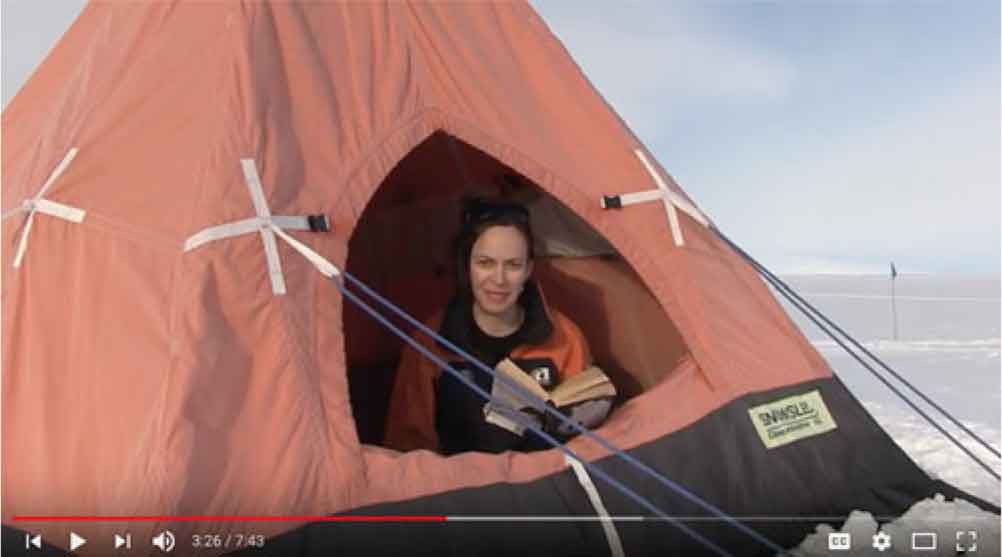
Once the learners were situated in Antarctica with the lecturer, Priestley took them back in time by telling the stories of the early explorers, International Geophysical Year scientists, and more recent scientists, and invited comparisons between what it was like for them, and what it was like now. For example, from inside a Scott Polar tent with an open window flap, shot from outside on a sunny day, she read from Scott’s journal and discussed the impact of the weather on his South Pole expedition (see Fig. 1):
“Antarctica, on a sunny summer day or a sunny summer evening like tonight, can be gorgeous, but it can get nasty very quickly and very ferociously and even today we’re totally at the mercy of the weather. And that’s something that really affected Scott’s trip to the South Pole.” (Rebecca Priestley, Scott’s Polar Tent, https://tinyurl.com/ICE101xM1d)
Rebecca Priestley reading from Scott’s journal in Antarctica.
The field lectures included references to modes of Antarctic travel (dogs and ponies vs tractors vs skidoos and helicopters), food (pemmican supplemented by seal and penguins vs today’s ‘freshies’ flown in from New Zealand), and transport to Antarctica (sailing boats vs planes). The lecturers were mainly located at Scott Base, and had easy access to historic and scientific locations at or near Scott Base and McMurdo Station (such as Hillary’s Hut, Observation Hill, Discovery Hut, the Crary Lab, and the Arrival Heights Atmospheric Research Laboratory). They also visited Terra Nova Hut at Cape Evans with a conservator from the New Zealand Antarctic Heritage Trust.
Efforts were made to keep the presentation style friendly and informal, with use of interviews with scientists, conservators and Scott Base staff, giving the lectures more of a documentary series style than a traditional university lecture.
Geology and paleoclimate module
The broad goals of this module were to equip learners to:
Identify and locate geographical features on a map of Antarctica
Describe the early geological work that occurred during the Heroic Age and explain how this work was important for current understandings of Antarctica and global geological processes
Define and describe the term geological ‘deep’ time
Describe characteristics of the major geological units discussed in the video lectures
Describe the terms ‘icehouse’ and ‘greenhouse’ and explain the relationship between these two climates and CO2, temperatures, ice sheet volume and global sea level
Explain how sediment and ice samples (derived from drilling) can be used to describe paleoclimate (i.e. past atmospheric conditions)
Explain the unique features of the Dry Valleys landscape and describe its value as record of past climate
In this module, Atkins drew on his extensive Antarctic experience working as a geologist in small field camps and large multinational drilling projects, as well many years of classroom and field teaching. The scope of the module was broad and ambitious, covering both geology and paleoclimate and involving content that was largely unfamiliar to most learners. Therefore, a major challenge was providing enough background knowledge about fundamental earth science concepts such as deep time (millions of years), plate tectonics, evolution and geological processes, which were essential for understanding the origin and significance of the rock layers and ice sheets.
This module aimed to provide a journey through half a billion years of geological time by examining progressively younger layers of rock and landscapes. The key theme throughout the module was ‘climate change through time’, highlighting how Antarctica’s environment has developed and the importance of its ice sheets to global climate and sea level.
The initial field lectures featured the lecturer (Atkins) introducing the geography and geology of South Victoria Land from scenic locations, thereby providing an immediate connection with the lecturer and a visual orientation to Antarctica followed by a brief history of geological research and some attention-grabbing facts about the global significance of Antarctica.
“Antarctica and its ice sheets are big players in the global climate system … For example, at this site, 15,000 years ago, we were under hundreds of metres of ice … and global sea level was a staggering 130 metres lower than today”. (Cliff Atkins, Welcome to the ice, https://tinyurl.com/ICE101xM2a)
Fundamental questions were posed to invite learners to join the journey of discovery and provide the human context and rationale for examining the geological record.
“So how do geologists know details about the past? When did these ice sheets first form and why did they form, how have they behaved through cycles of climate change and, importantly, what will happen to them in the coming decades and centuries as we continue to warm up the planet? Join with me as I meet other scientists and try to find answers to these big questions.” (ibid)
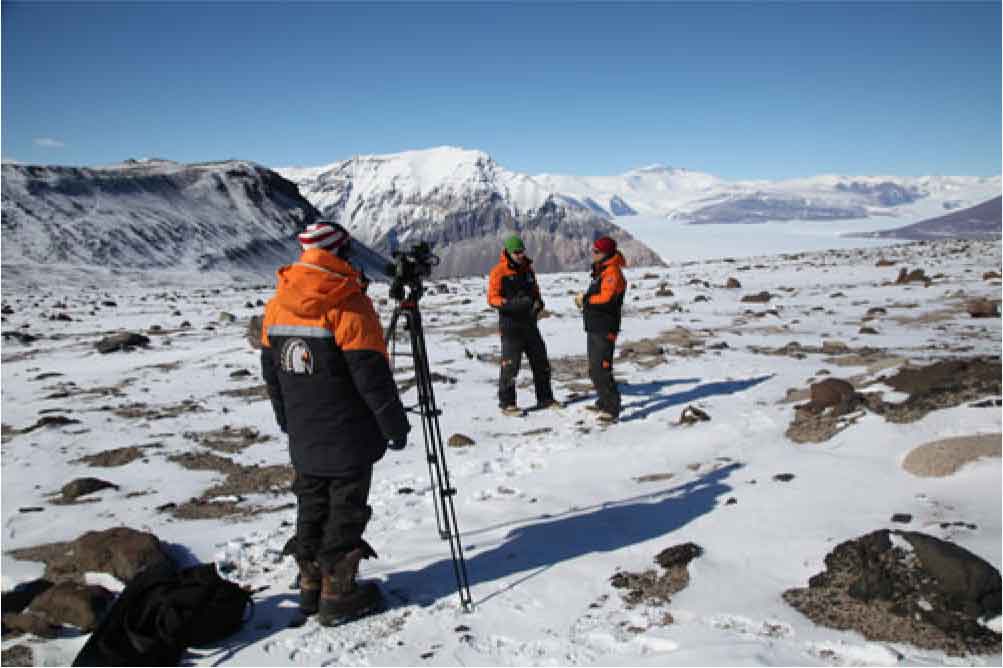
Subsequent field lectures used a documentary style format, using panoramic scenery and spectacular aerial footage of Transantarctic Mountain rock outcrops, shots of specific geological features, direct to camera descriptions, and interviews with scientists in the field (see Fig. 2). The aim was to harness the excitement of fieldwork in a frozen landscape while providing insight into how geologists use fossils as proxies to reconstruct the remarkable story of change from an ice-free greenhouse climate when Antarctica was part of Gondwanaland to the icehouse climate today.
Rebecca Priestley films Cliff Atkins talking to Nick Golledge, from the Victoria University of Wellington Antarctic Research Centre, against a backdrop of the Kukri Hills (centre) and Table Mountain, with the Royal Society Range (right) in the background.
Video footage of Atkins and another geologist excavating fossil beech tree leaves in the Transantarctic Mountains tapped into the wonder and excitement of fossil discovery and offered a powerful visual example of the value of scientific proxies for understanding the past.
“It’s so surprising and so insightful to see these [beech leaf fossils] here. I mean, there’s no question of what they are. You can imagine the environment they were in. Hardy, shrubby little beech trees, just hanging on”. (Cliff Atkins, Friis Hills Climate Records, https://tinyurl.com/ICE101xM2i)
Some of the final lectures featured field interviews with researchers to focus on how field evidence from outcrops and drill cores is used to build numerical models of ice sheet behaviour. Atkins also described the Mars-like modern landscape of the Dry Valleys, using personal experience to convey the uniqueness of this ancient hyper-arid polar desert.
“I was last here 12 years ago and I can tell that absolutely nothing has changed. I can even see individual rocks and sediment in the glaciers that is exactly the same as it was then. So this is a very slowly changing environment”. (Cliff Atkins, Exploring the Dry Valleys, https://tinyurl.com/ICE101xM2m)
Other field lectures
To take full advantage of the opportunity to film in Antarctica, Atkins and Priestley also filmed material for Salmon, who was leading a third module. In these clips, Scott Base staff, visiting scientists and visiting media representatives spoke to camera, in response to a set of questions about their experiences in, feelings about, and perceptions of Antarctica. The lecturers also shot scenic footage, social events and recreational activities.
In August 2014 (before flying to Antarctica that November), the lecturers filmed a series of interviews with natural and social scientists, artists, tour operators and other delegates at the Scientific Committee on Antarctic Research (SCAR) Open Science Conference in Auckland, New Zealand. After the trip to Antarctica, in early 2015, they filmed new material on campus at Victoria University of Wellington. Two lectures on the history of pre-Heroic Age Antarctic exploration were filmed in the university’s Antarctic Reading Room and included Priestley reading from early narratives of Antarctic exploration. Atkins interviewed several Antarctic experts using rocks and fossils as props to explain complex concepts and demonstrate how the geological record can provide precise data to reconstruct past conditions.
Atkins also filmed interviews with Antarctic geologists at an International Antarctic Earth Sciences Symposium in Goa, India and at rock outcrops in New Zealand’s Whanganui Basin to illustrate how past episodes of Antarctic ice melt impacted global sea level rise. This latter field trip included a wide-ranging discussion with paleoclimate expert Tim Naish, who also featured in the Antarctic field footage, on the value of paleoclimate science for informing our understanding and modelling of future climate change and impacts.
Additional lectures and interviews were filmed in Wellington, Dunedin and Christchurch, on Antarctic art and literature, the Deep South National Science Challenge research project, and Antarctic governance. In late 2015, Wellington artist Gabby O’Conner travelled to Antarctica with a group of sea ice physicists and filmed her own experience as an artist in Antarctica and the work of the sea ice physicists.
In August 2016, Atkins and Priestley, with Veronika Meduna (a science journalist who had been to Antarctica twice and was an Adjunct of the Science in Society group), filmed interviews with delegates at the SCAR Open Science Conference in Kuala Lumpur.
During the professional video editing process, additional material, including historical photographs, maps and diagrams – including resources developed for the ANDRILL EOC programme – was incorporated to enrich the narratives and to provide additional information for learners.
Other supporting material
For the open courses (Antarctica Online and ICE101X), learners were provided with links to open access readings such as institutional websites, news articles, and primary sources that were out of copyright. They were also provided with links to other digital resources, such as a Google Maps walk through of historic huts (Google Arts & Culture, 2012). For the full university course (SCIE302), copyrighted readings (a range of primary and secondary sources) were added. These included relevant chapters from a new Antarctic textbook “Exploring the Last Continent” (Liggett, Storey, Cook, & Meduna, Reference Liggett, Storey, Cook and Meduna2015) used to explain some of the geological and paleoclimate concepts mentioned in the course. The publisher (Springer) also provided free access to this book to ICE101X learners.
Course objectives
The stated learning objectives for the first two iterations of the course (Antarctica Online and SCIE302) were to equip learners to:
Evaluate the relevance and role of contemporary Antarctic science for addressing controversial global issues such as climate change and natural resource management
Recognise and evaluate interconnectivities and relationships between contemporary Antarctic science, politics, art, policy, history and broader society
Discuss and assess the contribution and role of field research to the broader scientific process
Compare and critique published responses to Antarctica (written, visual, online and other) by scientists, artists, journalists and many others
Explain the complex and multidimensional nature of Antarctica by describing the diverse values (political, economic, environmental, etc.) that humans apply to the continent and describing the future challenges that the region is facing
A shorter version of the course was offered to the ICE101X learners, focusing on history and geology. Learning objectives for this course were stated by module rather than at course level and – with the exception of policy, which was not covered in ICE101X – aligned with the learning objectives for Antarctica Online and SCIE302.
Course offerings and iterations
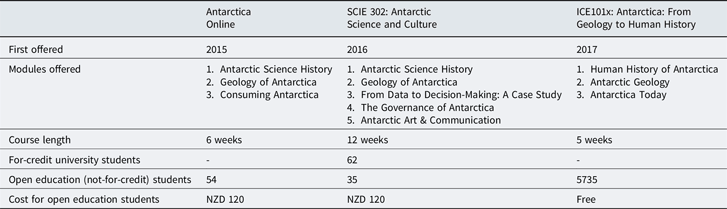
All three courses were fully online and asynchronous – learners could access the course material at any time – and included three to five modules (Table 1). The primary course material was delivered through video lectures, 5–20 minutes long, which were supplemented by readings.
Details of the three online courses on Antarctica offered by Victoria University of Wellington during 2015–2017
Antarctica Online
Antarctica Online was a not-for-credit open education course accessed through Victoria University’s Continuing Education programme (https://www.victoria.ac.nz/cceshortcourses). The course was hosted on Open Education (https://openeducation.blackboard.com), a learning management platform with the same functionality as Blackboard™. All videos were hosted on and accessed from Vimeo.
To receive a certificate of completion, after each module, learners could complete short, multiple-choice quizzes and write a blog post. The blogs were not graded, but staff provided feedback and learners commented on each other’s work. Learners also engaged with the lecturers, and each other, via a discussion forum. The blogs and discussion forum provided a rich and unexpected source of additional learning material, as many of the learners (37.0%) used these online tools to share their own experiences of being in Antarctica – as field scientists, tourists, students, base staff, tour guides or conservators.
SCIE302
SCIE302 was a 300-level Science in Society course at Victoria University of Wellington that was also available to fee-paying ‘lifelong learners’ through the university’s Continuing Education programme. Open Education was the content delivery system and Vimeo the video streaming host.
In SCIE302, material from the ‘Consuming Antarctica’ module of Antarctica Online was expanded and developed into new modules on The Governance of Antarctica and Antarctic Art and Communication, and a new module, ‘From Data to Decision Making: a Case Study’ was recorded. All learners were invited to complete quizzes and blogs, but only for-credit learners received grades and personalised feedback. Additionally, the for-credit learners were required to complete two essays. All learners were asked to participate in the discussion forum, although no marks were assigned to this participation.
ICE101X
ICE101X ‘Antarctica: From Geology to Human History’ was hosted by MOOC provider edX (edx.org) as Victoria University of Wellington’s first MOOC offering. The history and geology modules were selected as the core of the course, with some additional material – including interviews filmed at the 2016 SCAR Open Science conference in Kuala Lumpur and two ‘Artist in Antarctica’ lectures filmed by Wellington artist Gabby O’Connor – making up a short ‘Antarctic today’ module. ICE101X learners were given the opportunity, for USD 49, to be ‘verified’ and receive a certificate upon completion of the work. Non-verified learners were assessed using quiz questions drawn from video content, which could be answered as many times as they liked. Verified learners were given twice the number of quiz questions, which were drawn from video content and some of the readings, and had two attempts at the questions. To meet edX requirements, videos were edited into shorter segments, transcripts were provided for all lectures, and all readings were checked for accessibility.
Learner feedback – research design and study participants
Research design
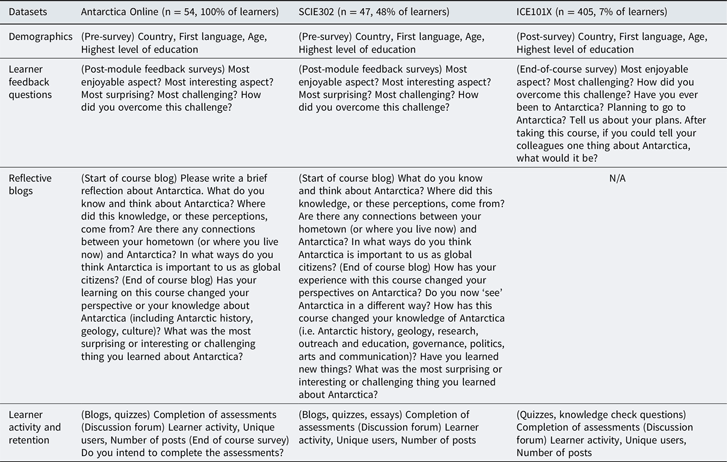
To evaluate learners’ experience of the course, a mixed methods research approach was used to report on themes emerging from a wide range of data collected during and following three iterations of the course. Table 2 lists all of the data collected from the three courses through the Open Education and edX platforms. Most of the results reported here come from optional feedback questions included in the post-module quizzes, which asked learners to share the most enjoyable, interesting, surprising and challenging aspects of the module. Additional data sources included a pre-course demographic survey, content from learners’ blogs and discussion forums, and aggregate analysis of assessment completion. Recruitment of learners as study participants was conducted at the start of the courses, with informed consent provided before any data were collected. All data were analysed after the completion of the course.
Research data: questions & feedback
Study participants
Antarctica Online learners
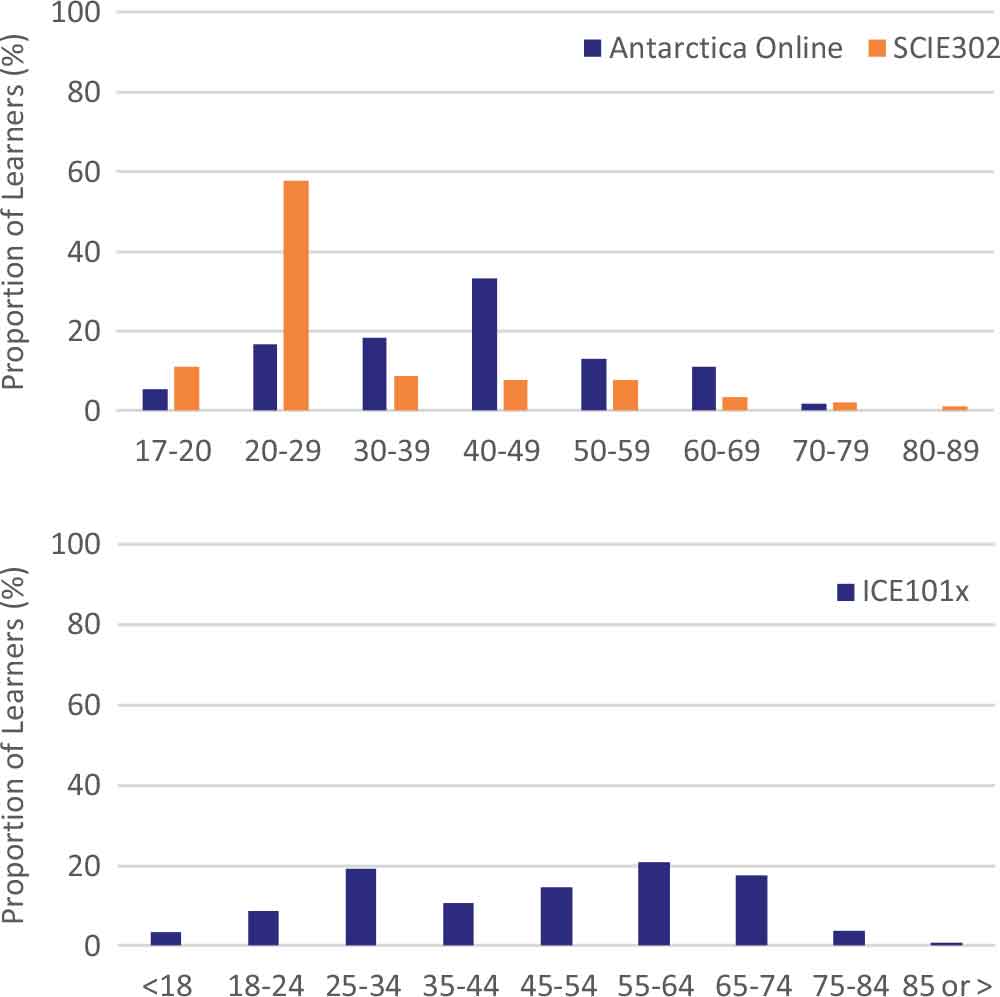
The first iteration of the course was marketed, and enrolments managed, through the university’s Continuing Education programme. Links to an online enrolment page were emailed to Antarctic Listserves and posted on social media (Facebook and Twitter). A fee of NZD 120 was charged to limit enrolments to a manageable number for what was considered to be a pilot MOOC. Most of the 54 learners were from New Zealand (55.6%), with the remainder from the USA, Australia, UK, Brazil, Germany, Canada, South Africa and Spain. Learners ranged in age from under 20 to 79 years old (Fig. 3). The learners were predominantly from a higher-education background, with 75.9% holding a Bachelor’s degree or higher.
Age distribution of learners on the online courses Antarctica Online, SCIE302 and ICE101x. Note that the age bands differ between the top and bottom graphs.
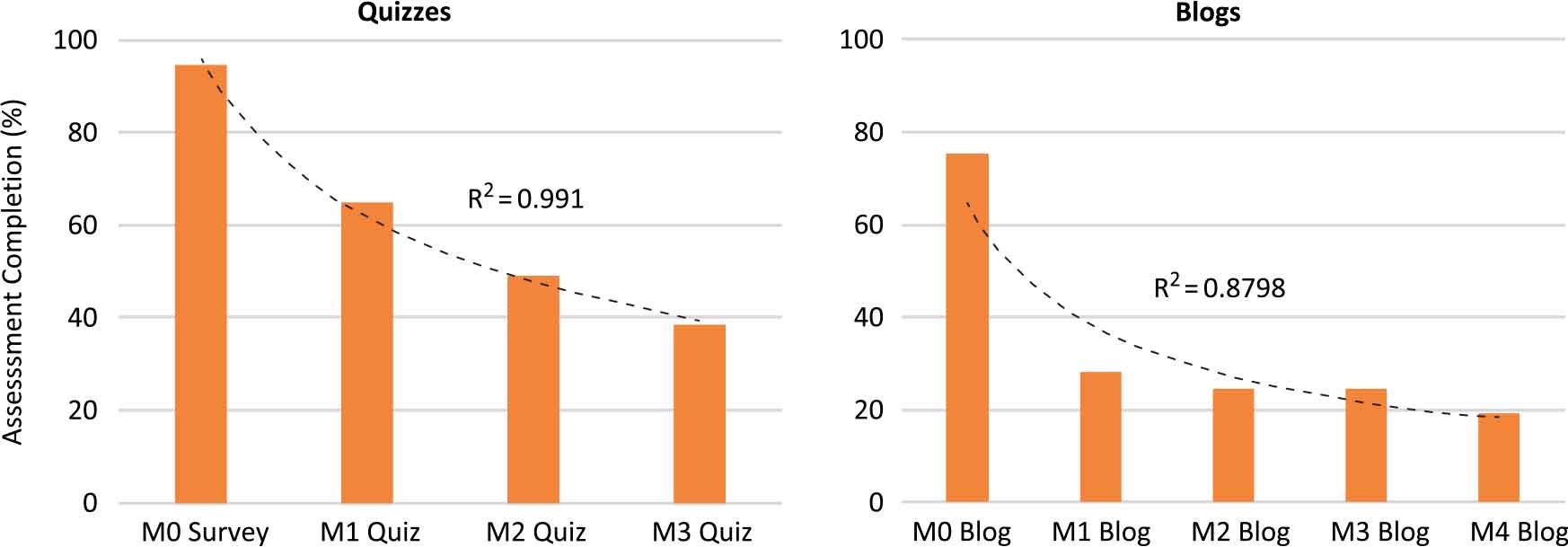
Eleven learners finished all the assessments and received a certificate of completion (20% retention). Figure 4 shows that the level of completion dropped off over time with a declining power law trend, as found in other open education courses (Perna et al., Reference Perna, Ruby, Boruch, Wang, Scull, Ahmad and Evans2014). Retention varied by assessment type; fewer learners completed the blogs than the quizzes.
Assignment completion rates for the online course Antarctica Online. The dashed lines show the declining power law trends, with R 2 values included to show closeness of fit.
SCIE302 learners
The second iteration of the course was dually marketed, and enrolments managed, through the university’s Continuing Education programme and regular enrolments service. Links to an online enrolment page were emailed to Antarctic Listservs and posted on social media.
SCIE302 included open (i.e. not-for-credit) and for-credit learners; 35 learners enrolled not-for-credit, and 62 enrolled for-credit. Of the participants who completed the demographics survey, most lived in New Zealand (78.4%), with international learners coming primarily from western countries (14.8% were from the USA, the UK, Australia or Europe). Three learners joined the course from Scott Base, New Zealand’s research station in Antarctica. Most learners (78%) reported English as their first language. Learners ranged in age from under 20 to 89 years old (Fig. 3). Eight of the for-credit learners had Bachelor’s degrees, and the others had completed primary and secondary school (a requirement for entry to the course). The open learners were a highly educated group: nearly all of them (93.1%) had completed a university degree, and 17.2% of them held a PhD. SCIE302 also had learners with Antarctic experience – three were based in Antarctica while the course was running – who shared experiences with classmates.
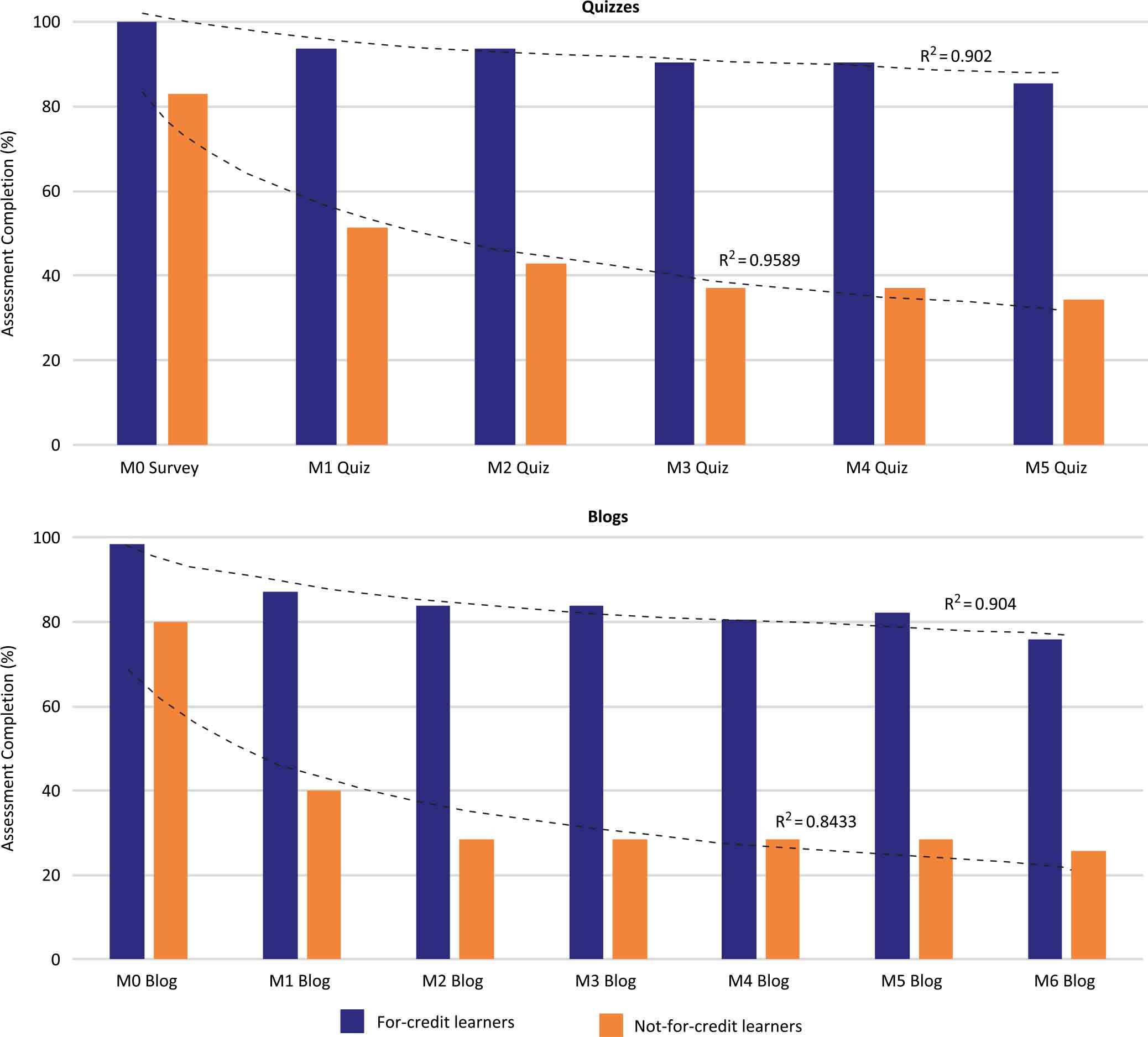
All learners completed multiple-choice quizzes and blogs after each module, and for-credit learners completed two essays. Of the 97 people who signed up for the course, 11 of the 35 not-for-credit (31.4%) learners received certificates of completion (provided to learners who completed all of the course assessments on time) and 51 of the 62 for-credit learners passed the course (82.2% completion). As with Antarctica Online, there was a decline in participation after the first assessment, in both groups of learners but more notably in the not-for-credit group (Fig. 5).
Assignment completion rates for the online course SCIE302, with similar power law relationships to Antarctica Online.
ICE101X learners
This free course was dually promoted by Victoria University, who produced media releases and promoted the course through Listservs and on social media, and by edX, who highlighted the course as one of their featured upcoming courses. On 27 April 2017, ICE101X was featured on the popular science website IFLscience (www.iflscience.com) as part of a listicle titled ‘7 Science College Courses You Can Take Completely Free From Home’. The post got thousands of shares and likes, and enrolments in ICE101X surged by 1000 in one day and continued to increase. Overall, 5735 learners signed up for ICE101X, with 141 (2.4%) enrolling in a verified certificate. Of the 5735 learners, 411 (7.2%) completed the evaluation survey at the end of the course, from which the ICE101X learner data are drawn. This group of learners ranged from under 18 years to 85 or older (Fig. 3). ICE101X learners took the course from 48 different, but mainly Western, countries; 91.5% of learners came from New Zealand, the USA, Europe, the UK, Australia or Canada. Learners spoke 33 different first languages, although the majority (74%) reported English as their first language, and 21% reported a European language as their first language. The majority of learners were well educated, with 73.3% having a university degree or postgraduate qualification. Most (61.1%) learners had taken a MOOC before.
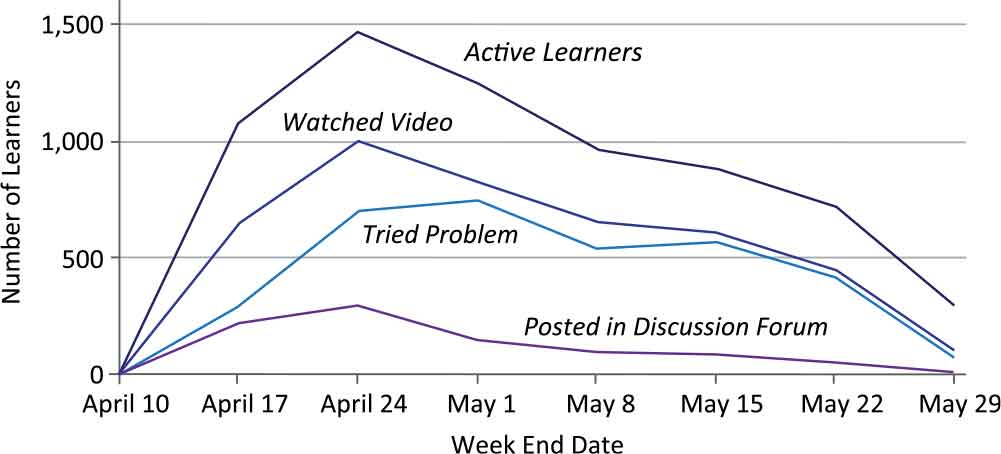
Of the 5735 learners enrolled in ICE101X, 12.7% were active by the end of the course (Fig. 6). Relative to the 8.6% (n = 498) of learners who in the pre-course survey reported that they wanted to complete the course, 10.3% (n = 593) of learners passed the course. In comparison, 70.9% (n = 100) of certificate-intended learners received a certificate of completion.
Levels of engagement with the online course ICE101x. Note that the course ran from 15 April 2017 to 19 May 2017 but learners continued to engage after this time, as the content was still available.
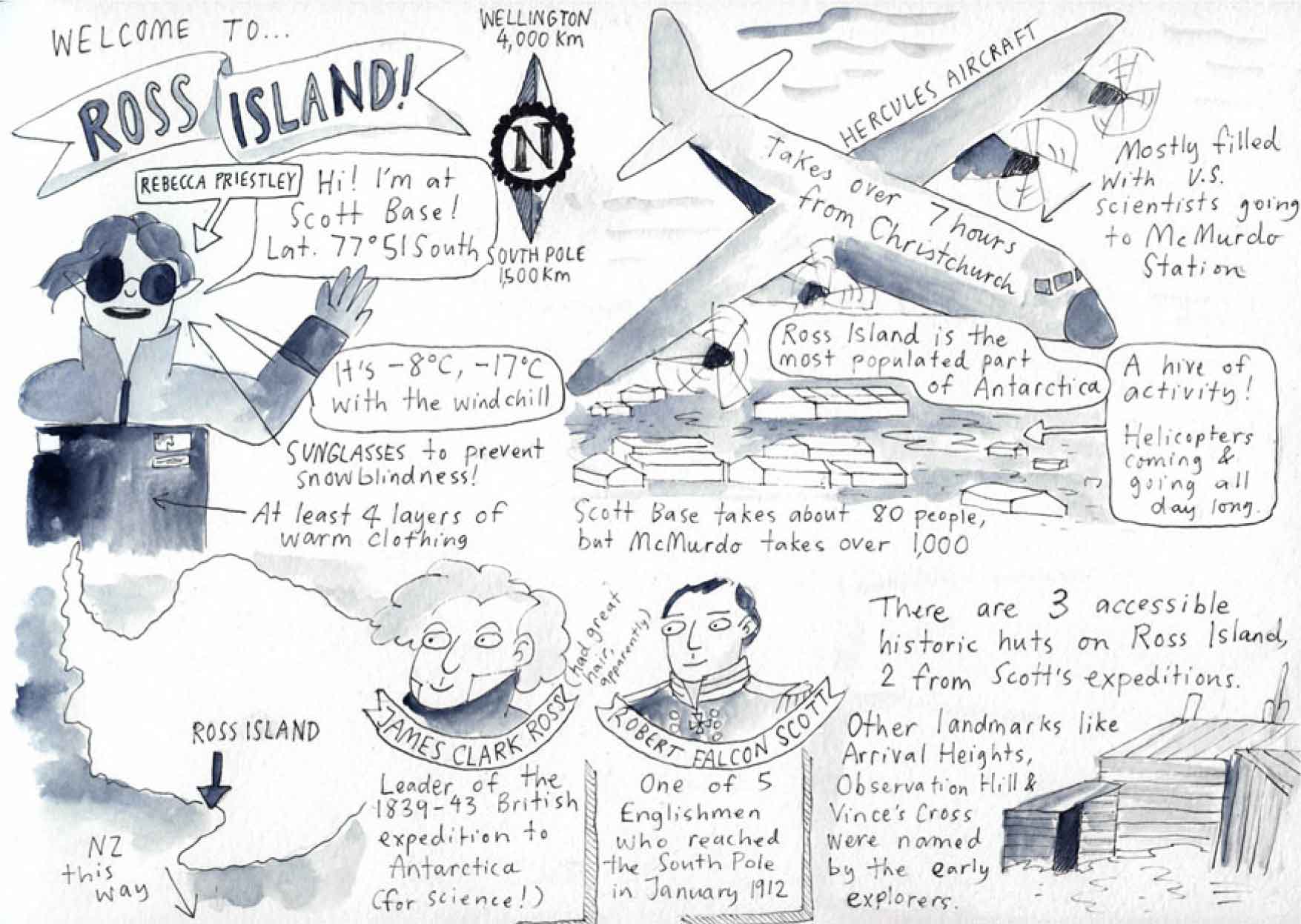
In an end-of-course survey (n = 421), 7.8% of ICE101X learners reported having been to Antarctica before. Many of these shared stories, photographs and links in the online discussion forum, and some learners who had not visited Antarctica shared Antarctic-inspired artwork. One learner, New Zealand illustrator Giselle Clarkson, shared her very distinctive ‘lecture notes’ with the class (Fig. 7).
Giselle Clarkson’s ‘lecture notes’ from the first ICE101x lecture. First posted on Twitter at https://twitter.com/giselledraws/status/853117519200108544.
Learner feedback themes
Qualitative data analysis methodology
Dohaney and Robinson collated the learner feedback responses and used conventional content analysis (Hsieh & Shannon, Reference Hsieh and Shannon2005) to describe learner experiences. Dohaney developed and implemented an initial protocol for the qualitative data analysis of Antarctica Online and SCIE302, then consulted and refined the approach with Robinson, who coded responses for ICE101X. Code checking was completed for ICE101X to verify consistency across the different iterations of the course.
First, the data were read several times at a ‘surface level’ to obtain a sense of the breadth of topics covered across the data corpus. Next, the data corpus was read in great detail, with the researcher recording their first impressions and initial assignment of topic areas. During this process, the researcher began to generate codes that described key ideas emerging from the data. The data were then imported into NVivo11 (QSR International, 2017). Initial codes were grouped into broader themes and the dataset was reread and coded again. Throughout this process, some codes were split into separate codes and others were merged. Once the data had been coded, the researcher examined all data within an individual code. Finally, definitions for each theme and code were developed and examples for each code were identified.
Analysis of the data showed emergent themes regarding functionality of the course, engagement with the course content and delivery, and changing attitudes to Antarctica. Functionality of the course is not the focus of this paper, and so is not reported here. Under the engagement theme, we report here on learner responses to the immersive field lectures and to the depth and diversity of the course content. Under the changing attitudes theme, we report here on the important ways in which learners reported changes to (1) their views on or understanding of climate change, (2) their views on the ‘consumption’ of Antarctica through science and tourism, and (3) their interest in Antarctica, and sense of protection of Antarctica, referred to here as Antarctic ambassadorship.
Online field lectures – a new way of learning
All three iterations of the course included video lectures as the primary form of course delivery. The video lectures included field lectures filmed in Antarctica, on-location interviews with scientists and other researchers at conferences and workplaces, and ‘talking head’ classroom style lectures using PowerPoint slides. Most positive feedback was for the Antarctic field lectures and on-location interviews:
“I loved the way some of the lectures were actually filmed in Antarctica as it really added life to the lectures.” (Antarctica Online, Module 2, unpublished data)
“The videos brought the science to life and seeing the rocks and the ice made it easier to understand.” (Antarctica Online, End-of-course survey, unpublished data)
“[This course was] far more interesting [than] the other online papers I have done when the lecturer is just sitting there talking.” (SCIE302, Module 1, unpublished data)
More specifically, the learners enjoyed ‘visiting’ specific locations such as the historic huts and distinctive geological sites:
“Seeing the interior of the [huts] was like stepping back in time. I especially liked this part and have since gone on to Google Maps to look at them again in detail.” (Antarctica Online, Module 1, unpublished data)
“[The] most enjoyable was watching the scenes in the field, and [the lecturer] looking at actual rocks, which link back to the theory. I liked feeling like I was on a field trip.” (Antarctica Online, Module 2, unpublished data)
“It was very cool to see the conditions and what it was like living in Antarctica. Although it’s only virtual instruction, it’s cool to think my classroom was in Antarctica.” (SCIE302, Module 5, unpublished data)
Another key feature that engaged learners were the descriptions and ‘behind the scenes’ footage of past and present Antarcticans.
“[I enjoyed] finding out more about the practicalities of getting to, living and working in Antarctica.” (Antarctica Online, Module 1, unpublished data)
“Seeing the explorers and looking into the past, exactly as it was … seeing how they lived, their food and their daily problems … such fascinating characters with interesting backstories.” (ibid)
Similarly, learners noted that they liked ‘meeting’ Antarctic scientists and getting to see their research.
“The interviews with scientists and advocates from all over the world were extremely interesting. I wanted to hear more from each person.” (Antarctica Online, Module 1, unpublished data)
“The videos make you feel that there is a distinct and coherent Antarctic community. Part of the benefit to taking this course is feeling like you might, now, be a part of that larger community.” (Antarctica Online, End-of-course blog, unpublished data)
Learners particularly enjoyed the opportunity to engage with the scientists and researchers involved in the course on a personal level:
“I really enjoyed the friendly approach of the presenters and felt like they were people I got to know a little.” (ICE101X, Post-course survey, unpublished data)
Learners also reported that the style and content of the videos was fun and created a sense of authenticity:
“Videos: real people, sometimes in Antarctica, doing real things in relation to that continent.” (ibid)
“The course was always fresh and new and lively and I enjoyed the use of jokes and FUN.” (ibid)
Some learners, though, found it difficult to adjust to the new learning style. Transcripts, which were provided for all lectures, were found to be helpful.
“It was most challenging retaining everything from some of the videos (since there was sometimes no written content … while most lecturers provide a PowerPoint).” (SCIE302, Module 1, unpublished data)
“I sometimes have difficulty watching the videos and I like to check exactly what was said by referring back to the transcripts… for other more content-dense and heavily detailed subject matter, I think having video transcripts is more helpful.” (SCIE302, End-of-course blog, unpublished data)
Depth and diversity of content
All courses taught by the Science in Society group at Victoria University of Wellington are interdisciplinary, drawing on a range of disciplines to illuminate a topic and expose learners to perspectives they may not have encountered or considered previously. Some learners enjoyed being introduced to a more nuanced picture of Antarctica, while others experienced tension between the diversity and the depth of knowledge and requested greater details on specific topics.
Several learners appreciated the importance of non-science contributions:
“I found it surprising that there is ‘Antarctic literature’ and so much of it. I had always assumed that Antarctica was a scientific continent and not of much interest to the artistic community, I now know that is not the case.” (SCIE302, Module 5, unpublished data)
“I like learning the society and ‘people’ aspects of Antarctica. It was an area where I don’t have much background knowledge (international politics, policy-making etc.). So I learned a lot of new stuff! One reason why I enjoy this course so much because it is so diverse.” (SCIE302, Module 4, unpublished data)
In particular, learners valued being able to integrate different knowledge domains:
“I really appreciated the way all the course content complemented each component. There was a real sense of how the human history and the geology of Antarctica is intertwined.” (ICE101X, Post-course survey, unpublished data)
“I feel like I’ve increased my knowledge in (takes a deep breath) … geography, history, biology, geology, oceanography, climate, politics, art, culture, cuisine, literature AND heard about feminism, female leadership, interdisciplinary working … Never thought I’d learn so much on such a wide variety of topics, over so many disciplines from one free online course!” (ibid)
“Looking back over the last 6 weeks I now feel that I have a wide and comprehensive knowledge of many aspects of Antarctica, through its history, geology and present day culture. My overall perspective of the continent has certainly changed, and I find that I now [have] a much greater appreciation for both the science and collaborative efforts being undertaken to advance human knowledge in the area.” (Antarctica Online, End-of-course blog, unpublished data)
Some learners, though, expressed a preference for a more narrow science focus in the course.
“I think we heard a bit too much in detail about the conservation hut projects and the art projects. It is fine to have that, but quite frankly with threats such as ice melting, global warming, rising sea level, CO2 going over the 400 ppm at our doorstep, conservation and art do not rank that high in the priority list. I would have liked to hear more about energy use, about future installation of solar panels….” (ICE101X Post-course survey, unpublished data)
“Week 5, feminism and art are not of much interest [to me]. Oceanography, zoology, atmospheric science, would be better inclusions. Advertising? Ice crystal art? Really!” (ibid)
Learners came from a wide range of disciplinary and educational backgrounds and some learners reported problems engaging with new disciplines, making specific mention of use of disciplinary jargon:
“Geological terminology/jargon [was challenging] as it was largely unfamiliar to me”. (SCIE302, Module 2, unpublished data)
“Knowing certain jargon in relation to the artwork and metaphoric concepts of Antarctica. It was quite confusing at times.” (SCIE302, Module 5, unpublished data)
“[It is challenging] trying to remember all the dates and explorer names and the countries they represent. It is a veritable who’s who of explorers from a number of nations… ” (Antarctica Online, Module 1, unpublished data)
Notably, many learners described difficulty visualising the geological concept of ‘deep time’:
“[It was challenging] attempting to visualize the concept of geologic time. Even 1000 years is hard to conceive – maybe 15–20 generations of human lifespans. But millions and billions of years – and some geologic features survived across that massive, unimaginable time span? Just hard to think about rationally.” (Antarctica Online, Module 2, unpublished data)
Many learners suggested that further iterations of the course run for longer and include additional topics.
“Perhaps a future course could include more study of the arts – include paintings, photographs and poetry as ‘readings’.” (Antarctica Online, Module 3, unpublished data)
“Actually, the least enjoyable part of this course was that it had to end. There are so many topics that can still be explored.” (ICE101X, Post-course survey, unpublished data)
Attitudes to climate change
In all three iterations of the course, climate change was a dominant topic of discussion. Some of the scientists featured in the geology module were paleo-climatologists researching the past climates of Antarctica to inform future policy directions, one video lecture looked at energy use in Antarctica, and some of the Scott Base interviewees spoke about the likely impact of future climate change on Antarctica. Several learners reported strong reactions to the geology-based modules and the connections to climate change:
“What surprised me the most about [the geology module] was how incredibly accurate and verifiable and predictable the drill findings dating back millions of years were. Being able to literally dig into our past, secure data, and extrapolate that data into the future accurately is positively amazing … I knew before that Antarctica had a rich geological history and had the potential to show us our future. I didn’t expect the data to make so much sense and be so clear. I can’t get the image of the oh-so-clear layers of deposit from the ANDRILL project out of my mind.” (Antarctica Online, End-of-course blog, unpublished data)
“… [being surprised by] gaining an insight into how the scientists interpret the geological evidence and analyse the composition of the rocks, fossils and air trapped in ice to piece together the story of how Antarctica has got to where it is today.” (Antarctica Online, Module 2, unpublished data)
“I always pictured Antarctica as a very stable (unchanging) land mass, a very big chuck of ice. It is so far from that, it is a land of constant change (albeit over millions of years) but it is always moving and changing.” (ibid)
Two learners from ICE101X reported that this course inspired them to change their minds about climate change:
“Up until a few years ago, I would class myself as being more of a man-made climate change sceptic, than a follower. The key thing that this course has provided, is that it has left me in no doubt that man-made climate change is real and needs to be addressed; it is not what I expected to get from the course.” (ICE101X, Post-course survey, unpublished data)
“I was immersed with stories from lives long past, adventures happening now, and information on climate change that people in my area of the USA balk at – that I balked at but don’t anymore since I’ve been offered a new understanding of what’s happening.” (ibid)
The lecturers judged some discussion posts, denying climate change, as inflammatory rather than constructive and ignored these posts.
Fostering an ongoing interest in Antarctica
While learners reported being engaged by the lectures and the course in general, some reported that their engagement with the subject material went beyond the course, extending to their wider social environment.
“Sometimes I like to mention to my friends and family how important Antarctica is as I feel it has great significance for our future. I’m hopeful to commit what I’ve learnt to memory as it’s something that I don’t really want to forget. So Antarctica has touched my heart and this course will not be the last time where Antarctica is mentioned in my life.” (SCIE302, End-of-course blog, unpublished data)
“It is not often that I rattle off pieces of information at the dinner table to try and impress my flatmates, but this course has provided me with a couple of conversation starters! We have also taken to watching Antarctic documentaries … It is safe to say that my knowledge of Antarctica has increased immeasurably, and it is a topic that I will continue to explore with interest!” (ibid)
Many learners indicated that they would continue to engage with the content after the course had ended.
“From the course I’ve compiled a list of books, websites, blogs, organisations, so I can continue learning about Antarctica even though the course is finished.” (ICE101X, Post-course survey, unpublished data)
“As someone that had no prior knowledge of Antarctica and all the research that goes on I found it absolutely amazing. It was very informative and has now opened many new doors of interest and further study, reading and my own research” (ibid)
Many learners also remarked that they would be interested in more open-access opportunities to further their understanding of Antarctica.
“I absolutely loved [the course] and have learnt so much about Antarctica through the video lectures and supporting materials. I hope there will be further opportunities to access online courses similar to this one.” (Antarctica Online, Module 3, unpublished data)
Creating new Antarctic ambassadors
Many learners, in all three versions of the course, reported developing a new awareness of and relationship with all things Antarctica:
“I began to see Antarctica all around me. It had always been there; I was just really bad at noticing it. Suddenly I have this heightened awareness, every time I look on [online], turn on the news or go to a lecture on campus, there is information making reference to Antarctica.” (SCIE302, End-of-course blog, unpublished data)
“This was an incredible journey of the senses, which has connected me emotionally to the continent forever… Antarctica now features in everyday conversations at home; what’s happening on the course, what’s in the news, new research out etc….” (ibid)
“I feel like I have finished this course with a totally changed perspective on the elusive 7th continent. I now have so much respect for those working in Antarctica, and feel strongly about the importance of the research happening there and its implications for both now and the future in the face of a changing climate and world.” (ibid)
Some learners were explicit about the ways in which they could promote awareness and protection of Antarctica, suggesting they had become Antarctic ambassadors without the environmental impact of visiting the continent:
“This class (especially from the last module) has given me hope in the importance of artists in the fight for the environment. I intend to utilize my education and artistic abilities to help bring more awareness about Antarctica and climate change.” (ibid)
“The scientists are under rated and need to somehow show the world of their incredible work they are doing in Antarctica, I had no idea [of] the in-depth work that is carried out there. This is very important to convey to the world, most people don’t know the climate is at a critical stage – I certainly will spread the [word] wherever I go.” (ICE101X, Post-course survey, unpublished data)
Some ICE101X learners were also teachers, and, in the same way that teachers taking part in an undergraduate programme that included an actual field trip to Antarctica did (Johnston et al., Reference Johnston, Dawson, Childs and Maher2014, p. 151), participants in this virtual field trip wrote about taking the knowledge back to their own students:
“Although I’ve been to Antarctica several times in an education outreach capacity, I learned so much more that I can convey to my audiences of all ages … Your course helped me improve my own content knowledge to do an even better job with my education outreach programs.” (ICE101X, Post-course survey, unpublished data)
One for-credit learner suggested that the course might be an outreach opportunity:
“This course is more than just science points, it makes students care about Antarctica. Reflecting on this, I also realise that this course could be an outreach program to the public. Turning students into advocates for Antarctica.” (SCIE302, End-of-course blog, unpublished data)
Creating or deterring Antarctic tourists?
The issue of tourism was addressed directly in Antarctica Online and SCIE302, in which staff, scientists and visitors to Scott Base were interviewed about their work and their attitudes to a range of issues, including Antarctic tourism. Most interviewees spoke positively about tourism, raising the idea that Antarctic tourists became ‘ambassadors’ for Antarctica.
In response to this material, several learners articulated new feelings, perceptions and difficulties justifying tourism:
“[It was challenging to] integrate my experiences and attitudes with some of the material around tourism in Antarctica.” (Antarctica Online, Module 3, unpublished data)
“As an Antarctic tourist and keen photographer, I felt guilt at my invasion of the wilderness.” (ibid)
When asked if they planned to visit Antarctica, most ICE101X learners replied that they were either planning to visit or hoped to visit (yes 19.5%, maybe 40.6%). When prompted on the reason for their intended visit to Antarctica, learners who responded with a “yes” said they were booked into upcoming cruises to the Antarctic Peninsula or Ross Sea region or planned to visit in the next 5–10 years. Many of the “maybe” respondents wished to visit Antarctica, but cost was a barrier:
“It would be as a tourist. At this stage it is more of a ‘wish to do’ rather than I can do it. A visit to Antarctica would possibly be the most expensive trip I would ever undertake; so the Piggy Bank needs feeding for a lot longer!” (ICE101X, Post-course survey, unpublished data)
“Would love to visit, but too expensive – will probably go when I retire.” (ibid)
Of most interest in this context, was learners for whom the course had influenced their opinion. For some learners, the course made them more inclined to visit Antarctica:
“A group of friends has a plan to organise a trip to Antarctica in a few years’ time, and I would love to join, depending on costs and schedules. It must be a fascinating place, unique, and one of those once in a lifetime journeys. I even feel more inclined to go now that I completed this course.” (ICE101X, Post-course survey, unpublished data)
“No immediate plans, but a trip to Antarctica was on my bucket list and has now [after the course] considerably moved up the bucket list.” (ibid)
For others, the course satisfied their curiosity, or made them more protective of Antarctica and less inclined to want to visit:
“In some ways, doing this course has satisfied “virtually” some of my curiosity about Antarctica, which makes me less inclined to go there myself – for example, I’ve now been on “virtual” tours through the historic huts, and to different places where science is being done. To some extent I feel that physical tourism is a risk to Antarctica, so I believe the more “virtual” visiting that is made available to the general public, the better.” (ibid)
Many learners made a distinction between visiting as a tourist and visiting in some other capacity:
“I would very much like to visit Antarctica but think that it’s wrong of humans to go there as tourists. It’s my dream to go, but I think it’s selfish and not beneficial to the environment at all, so I haven’t decided what to do.” (ibid)
“I’ve always held a fascination for the place which is difficult to explain. I love being in challenging environments and I enjoy science and learning. A visit to Antarctica seems to intersect with these traits. I would like to figure out a means of visiting as a contributor to a research program but not as a tourist. So no concrete plans as yet.” (ibid)
“I am reluctant to travel as a tourist and add to the carbon footprint but would be thrilled to experience the awe of participating at Scott Base.” (ibid)
Some learners identified MOOCs as being a sustainable alternative to tourism:
“MOOCs sometimes are a very good alternative to travelling. In many aspects much more complete, and from the point of view of sustainability, undoubtedly better than tourism.” (ibid)
“MOOCs and documentaries are a new way of modern tourism: cheap, sustainable, holistic.” (ibid)
Overall, learners from across all three iterations of the course reported positive learning experiences. They engaged with a diverse range of Antarctic topics, and reported gaining a sense of protection of Antarctica, a desire to raise awareness of Antarctic issues, and changed perceptions around climate change and Antarctic tourism. The immersive video lectures were an overwhelmingly positive highlight of the course, providing justification for the logistical, financial and time effort to get to Antarctica to film. The ‘virtual field trip’ has so far been experienced by more than 6000 learners, across many parts of the world, with more learners to come in 2018 and beyond.
The success of the course at an institutional level is indicated by SCIE302, which started as a special topic or provisional course, being approved as a permanent offering of the Science in Society group under the title SCIS313: Antarctic Science and Culture. Personal and institutional support – from Victoria University of Wellington, Antarctica New Zealand and edX – is also indicated by support for a team of three (Priestley, Atkins and Meduna), who travelled to Antarctica in January 2018 to film new material for the course.
Future directions
A revised ICE101X and a second MOOC, ICE102X, will be offered by Victoria University of Wellington on the edX platform in 2018 and 2019. With appropriate resources there is scope for an expansion of the course to more closely involve the international community and include participant contributions.
The Great Antarctic MOOC
The Antarctic research community had an opportunity to consider and discuss this MOOC at their bi-annual SCAR conferences in 2014 (Auckland, New Zealand), 2016 (Kuala Lumpur, Malaysia) and 2018 (Davos, Switzerland). The course was presented in sessions on Education and Engagement in Kuala Lumpur and Davos, and delegates were interviewed on camera in Auckland and Kuala Lumpur. Each of these interactions provided an opportunity to discuss the potential upscaling of the course, in the collaborative spirit of the IPY, towards a possible ‘Great Antarctic MOOC’. The concept attracted great enthusiasm, with tangible interest indicated from several university and research partners from across Australasia, Asia, North America and Europe.
Assuming logistical, technical, academic and financial details could be agreed upon, a Great Antarctic or Polar MOOC would be an obvious celebration of the continuing spirit of collaboration that was fostered in the IPY. It would acknowledge that no one research unit has the breadth of expertise to represent all that can be learnt from these regions. Just like the IPY itself, a collaborative, international and interdisciplinary MOOC, or series of MOOCs, that utilised the latest educational technologies and focused on the polar regions would celebrate diversity, multiple perspectives and the substantial benefits of international cooperation related to research and building awareness about these critical remote regions of the planet.
Democratisation of learning
Recent literature across education, communication and public engagement all recommend a shift away from one-way, didactic presentation of content towards creation of co-produced and deliberative spaces in which learning can occur (Davies & Horst, Reference Davies and Horst2016; Gilbert & Stocklmayer, Reference Gilbert and Stocklmayer2013). While this medium of online learning may at first glance seem incompatible with such pedagogy, the continual emergence of community-building social technologies could enable this MOOC to become a much more socially created activity. The huge success of another edX MOOC, U.Lab (https://www.edx.org/course/u-lab-leading-emerging-future-mitx-15-671-1x-0), has already demonstrated exciting possibilities for integrating international and remote expertise with physical learning groups around the world. Building on this, the Antarctic MOOC could foster new physical communities of interest around the world, including on research stations in Antarctica. In addition, learners themselves, many of whom had extensive Antarctic expertise or interesting new perspectives, could contribute to content creation within the course. As such, the course has great potential to facilitate a democratisation of learning in which the content itself, as well as the communities that participate in the course, are co-created.
Creating Antarctic ambassadors through ‘virtual field trips’ to Antarctica
While it was not a focus of the course, or the research into it, it was interesting to find that the course, as a ‘virtual field trip,’ encouraged increased awareness of Antarctic environmental issues and climate change and promoted a sense of ambassadorship, things also reported as outcomes from tourist or educational visits to Antarctica. Concerns about the environmental impact of Antarctic tourism include potential establishment of nonindigenous species, habitat destruction, sewage spills and point source pollution (Shaw, Terauds, Riddle, Possingham, & Chown, Reference Shaw, Terauds, Riddle, Possingham and Chown2014). A virtual field trip has the advantage of having a much lower environmental impact than a physical visit: for this course, for example, a two-week visit by two lecturers led to more than 6000 learners engaging with immersive content about Antarctica.
On the January 2018 trip to film new field lectures for the MOOC, staff from Auckland University of Technology were using a LIDAR scanner to film inside Sir Edmund Hillary’s Antarctic hut at Scott Base to develop “a fully immersive virtual reality experience” (AHT, personal communication) as part of a project led by the New Zealand-based Antarctic Heritage Trust. In Tasmania, environmental charity the Eden Project was reported to be planning an Antarctic visitor experience so realistic it could be “life-threatening” (Macquarie Point, 2017). There is broad potential for learners and enthusiasts to engage with Antarctica through increasingly authentic immersive tools such as field lectures, documentaries and virtual reality experiences.
Whether immersive experiences like this are used as marketing tools to encourage tourism (e.g. Beck & Egger, Reference Beck, Egger, Stangl and Pesonen2018) or serve as an alternative to tourism merits further investigation. As one small step towards this, in forthcoming MOOC offerings learners will be asked questions to determine how taking the MOOC has influenced their attitudes to tourism and Antarctic ambassadorship. This will be reported on in a future publication.
Author ORCIDs
Rebecca Priestley 0000-0001-6390-5059, Jacqueline Dohaney 0000-0002-5019-7257, Cliff Atkins 0000-0002-6513-6924, Rhian Salmon 0000-0003-4402-551X, Kealagh Robinson 0000-0002-9367-7445
Acknowledgements
This course would not be possible without the support of Antarctica New Zealand, who flew us to, and hosted us in, Antarctica, and Victoria University of Wellington, in particular the Faculty of Science and Information Technology Services. For their assistance with course development and delivery, particular thanks go to Sarah Hoyte, Kate Bazeley, Kate Turner and Laura Kranz. For video editing, we thank Matthew Wood, Jonathan King, Steve Cochran and Matt Dennes. Thanks also to all the people who agreed to contribute lectures or be filmed for the course, including members of K001, Scott Base staff and visitors, the New Zealand Antarctic Heritage Trust, Neil Gilbert, Gabby O’Connor, Veronika Meduna, researchers on the Deep South National Science Challenge and delegates at the SCAR Open Science conferences 2014 and 2016 and International Symposium on Antarctica Earth Science 2015. Funding was received from the Deep South National Science Challenge for development of the module From Data to Decision Making: A Case Study. Learner feedback was gathered, analysed and is reported here in accord with Victoria University of Wellington Human Ethics Committee approvals HEC: 22407 and HEC: 24511.


 Open access

