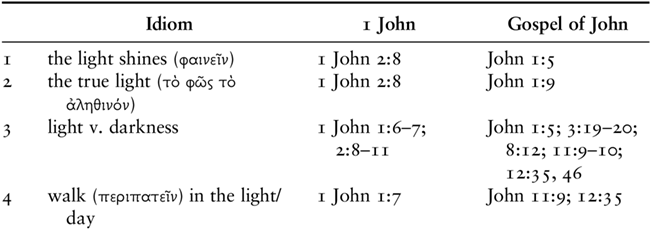
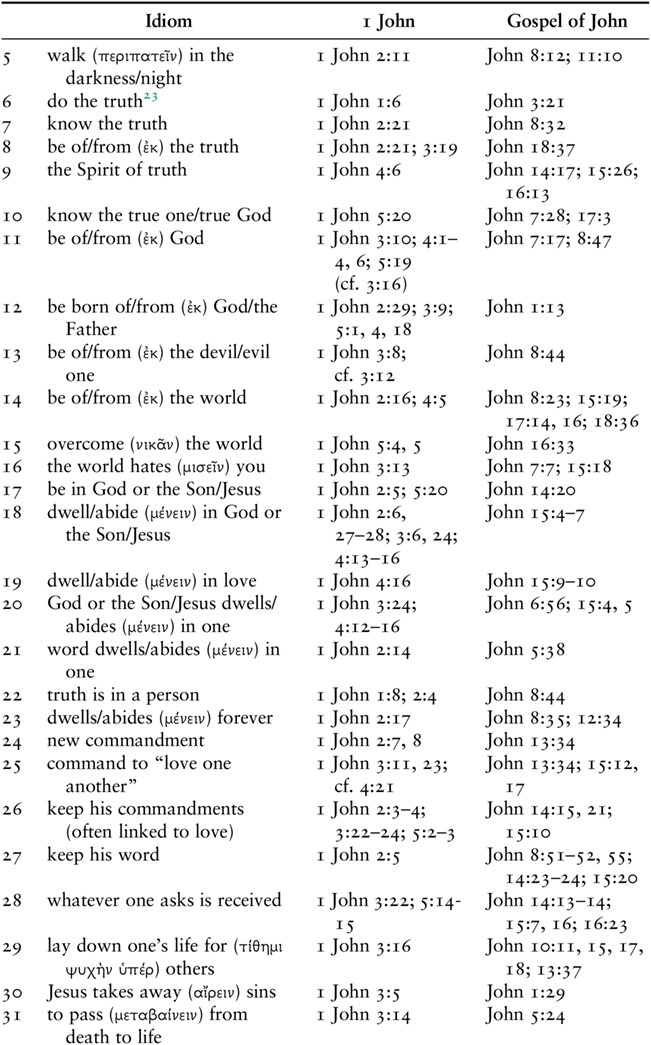
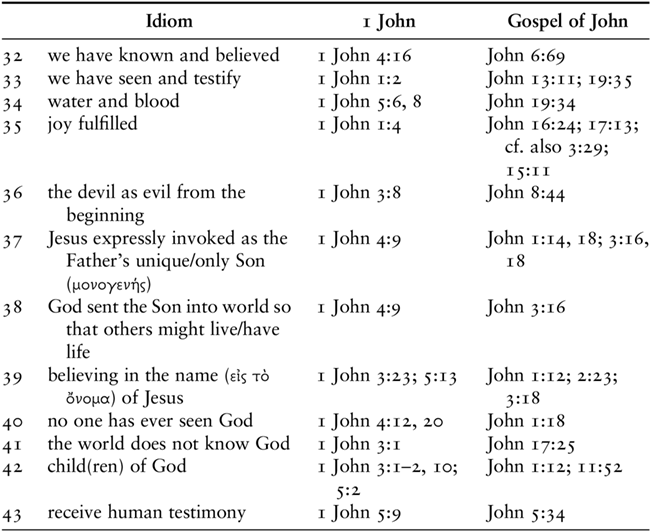
Even at a cursory glance, it is obvious that the Gospel and Epistles of John share a “family likeness,” a distinctive set of commonalities that binds them together and sets them apart from other early Christian works.1 By one measure, over forty expressions are highly characteristic of or distinctive to these texts – idioms including “dwell/abide in God,” “do the truth,” and “walk in the light.” Before the twentieth century, the reason for these linguistic convergences seemed obvious: according to tradition, all four texts were written by the same author. It was reasonable, then, to believe that these texts were similar because they bore the imprint of that one author’s idiolect, his distinctive, individual speech patterns. Nevertheless, the idea that the same author wrote all four texts was increasingly discarded through the twentieth century as critical scholars detected the activity of multiple hands in the collection.
If the four Johannine texts were not written by the same author, however, how do we explain their similarities? How could different authors produce works so strikingly similar in language and ideas? By the 1960s, scholars developed a solution to this problem. They reasoned that if the four texts do not come from the pen of a single author, they must have been written by writers embedded within a single Christian network, sect, or community – one with a distinctive tradition and even speech profile.2 Like other social groups, religious communities can develop distinctive social dialects. For instance, if one hears an individual speak of “going to Mass,” one can infer that the individual is probably a Catholic since the term “Mass” is used primarily by Roman Catholics. By analogy, scholars have speculated that behind such distinctive expressions as “dwell/abide in God” and “walk in the light” lurked an ancient Christian circle, network, or sect that gave these texts a distinctive character, a group most commonly referred to as the “Johannine Community.” In this model, the linguistic similarities between the four Johannine texts are accidental, the result of sociolinguistic factors.
There is, however, another way to explain the kinds of convergences we see in the Johannine texts. Those convergences may be due to direct literary contact and imitation. Writers in different social and geographic contexts can produce similarly worded texts if one is familiar with the work of the other and chooses to incorporate that work’s language and ideas in their own text. Interestingly, most scholars – even those who subscribe to the idea of a Johannine Community – are convinced that the Epistles show signs of dependence on the Gospel, if not also on one another.3
In this chapter, I review the evidence for this view, demonstrating that there is nothing coincidental about the linguistic similarities between the Gospel, 1 John, 2 John, and 3 John. Those convergences are deliberate, the product of direct literary borrowing. After the Gospel was written, the authors of the Epistles produced derivative works in its image, imitating and adapting its distinctive elements. In this case, the Johannine texts are not a pool of independent documents; instead, they are a single, intact literary tradition growing and flowering through the second century CE. As we will see, that tradition unfolded in four stages. The Gospel was written first. Next, a second author penned 1 John, imitating the Gospel’s distinctive language. A third author then penned 2 John, imitating both the Gospel and 1 John. And last, a final author penned 3 John, incorporating elements from all three earlier texts.4
2.1 Establishing Literary Dependence
Literary borrowing can take on many different forms. An author may harvest an extensive amount of text from an earlier work, or they may extract only a few phrases, clauses, or key ideas. They may keep most of what they borrow intact, or they may adapt what they take. Because of this spectrum of options, because of the many ways an author may choose to reuse material from earlier sources, no single criterion or test can determine whether a given text is dependent on another one. Instead, we must consider multiple possible signs of borrowing and reuse. In what follows, I will offer a brief catalog of the sorts of similarities that scholars use to establish genetic links within other literary multi-author collections such as the Synoptic Gospels (Matthew, Mark, and Luke) and the letters attributed to Paul.
Before presenting these criteria, however, it is essential to make several caveats or qualifications about their use. First, all determinations of linguistic dependence are probabilistic; there is a non-zero chance that two texts may share certain similarities by mere coincidence. And yet, certain convergences are more difficult to explain by chance; where we find them, it is more probable to assume that one text is modeled on the other.
This brings us to a second important point. Probabilities and improbabilities can multiply or stack. A given parallel may not seem remarkable or decisive in isolation. But its presence alongside other parallels increases the likelihood that it is not the product of chance. That is, these parallels become more compelling in aggregate. The reason is simple: the more parallels we find in a given text, the harder it is to cast them all as coincidental. Each parallel increases the explanatory load, the probabilistic load, on any claim that they are due to chance alone.
2.1.1 Verbatim Strings
The most obvious signs of literary dependence are strings of verbatim agreement between texts, that is, places where two texts agree word-for-word. The reason for this is simple. The human mind moves through a startling number of variables and choices when producing a single sentence. Although every person has a finite pool of vocabulary and phrase structures to build sentences from, the ways in which one can combine those structures are mathematically infinite. In this case, “the way in which people express themselves varies from person to person, even if writing about the same subject,” so that “it is unlikely that the topic will be expressed in exactly the same way (e.g., the same … grammatical syntax), and using exactly the same words (i.e., the same vocabulary).”5 Whenever we encounter strings of text that agree word-for-word, then, we should suspect literary dependence.
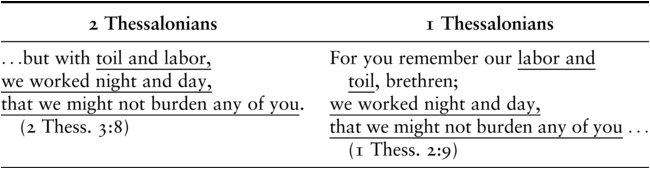
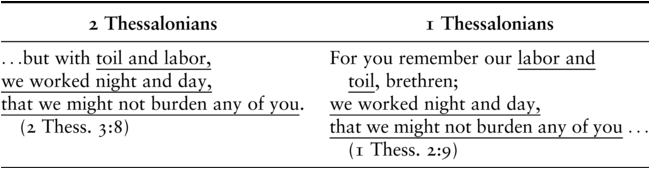
It is usually easy to find such strings, but they can vary significantly. For example, these strings may be of different lengths, and they may be juxtaposed with new or modified material. This variability is due to the fact that authors are not photocopiers; they are independent writers with different agendas, and they sometimes manipulate borrowed text to serve their aims. Some authors modify parts of their borrowed text to prevent readers from detecting their use of sources. (We can draw an analogy to a student trying to hide his plagiarism of a document by making extensive changes to the borrowed text.) Others introduce changes to improve a source text stylistically or grammatically. Still others want to alter the ideas or message of their borrowed text. In the example below, the author of the pseudonymous 2 Thessalonians reproduces text from 1 Thessalonians, albeit with minor, and sometimes trivial, changes probably meant to mask his direct copying of that earlier document (e.g., the reversal of the words “labor” and “toil”):
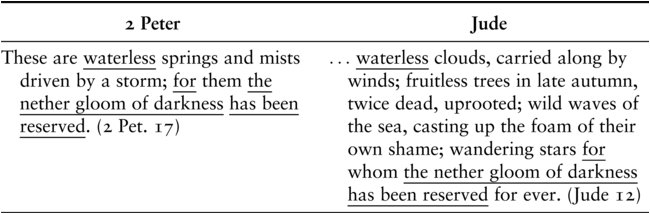
In the next example, the disguised author of 2 Peter introduces even more extensive changes and rewordings to text taken from Jude:
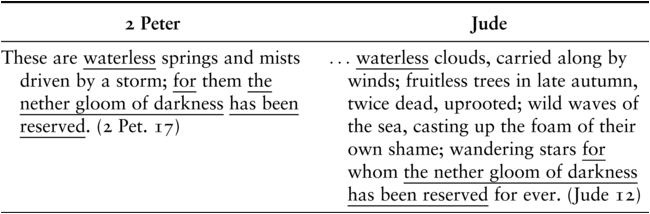
In the words of Mark Goodacre, it is the “plagiarist’s charter” to introduce changes into borrowed materials.6
Certain factors, of course, increase the likelihood that literary dependence is at play in a given verbatim string. For instance, the lengthier the continuous identical speech we find, the more likely literary dependence becomes.7 Each additional element in the sequence strains the probability of the entire string emerging by chance. Along the same lines, the more strings we find in a single document, the less likely chance is a factor. The presence of a single coincidence is more likely due to chance than several.
2.1.2 Dense Concentrations of Similarities
Although continuous strings of identical material are an obvious sign of literary borrowing, they are not the only sign. Sometimes, one may find few such strings at all. This is because some authors take still greater pains to distance their new texts from their source texts, more aggressively substituting words in a string, rearranging entire phrases, and recontextualizing materials. In these instances, we cannot rely on unbroken strings of verbatim overlap to establish literary dependence. Instead, we can look to another possible sign of copying: the dense concentration of identical language and parallel ideas. The idea is, again, probabilistic: two authors might coincidentally overlap in their language, but the more numerous the overlaps in a concentrated section, the less likely that overlap is the product of coincidence alone.
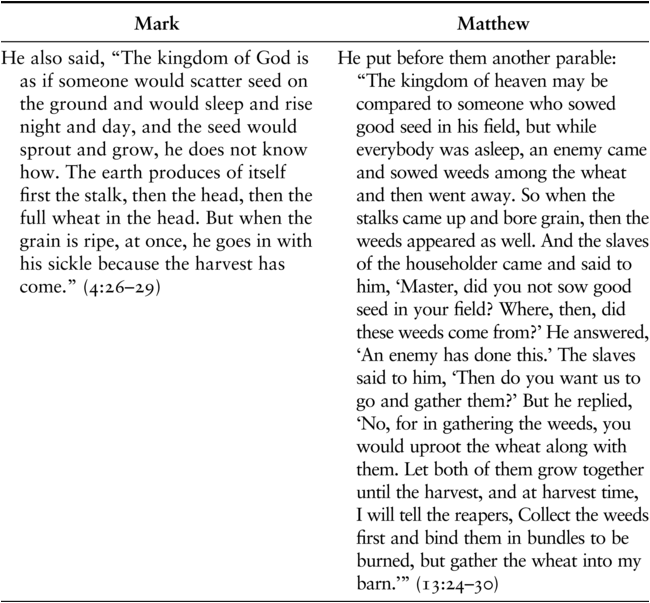
The following parables from the Gospels of Mark and Matthew do not share verbatim strings. Nevertheless, as Mark Goodacre argues, there are sound reasons to identify the parable in Matthew as a creative expansion of the parable in Mark. The first reason is that the two appear in roughly the same location in their respective narratives, wedged between the parable of the Sower (Mark 4:1–20; Matt. 13:1–23) and the parable of the Mustard Seed (Mark 4:30–31; Matt. 13:31–32). But the other critical evidence is that the two passages share a dense concentration of shared words, including, “kingdom” (βασιλεία), “person” (ἄνθρωπος), “sleep” (καθεύδω), “to sprout/grow” (βλαστάνω), “stalk” (χόρτος), “wheat” (σῖτος), “fruit/grain” (καρπός), and “harvest” (θερισμός).8
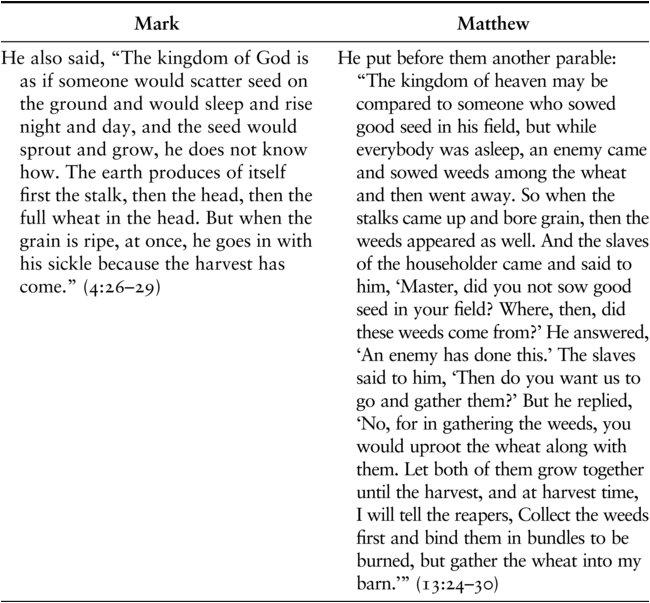
That cluster of similarities points to literary dependence here, albeit with more dramatic modifications.
2.1.3 Serial Adaptation and Conflation
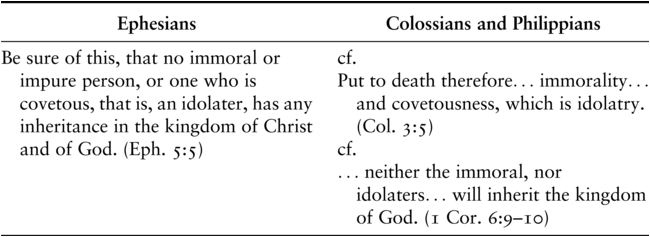
Two other signs of literary dependence are serial adaptation and conflation. Serial adaptation, or serial quotation, is when an author takes unrelated materials from multiple passages in his sources and unites them in a single passage. Conflation, by contrast, is when a later author consciously or unconsciously combines related materials in a new discussion.9 Often, as Leslie Mitton writes, the earlier materials “are associated together in their writer’s mind by some common word or idea, and so come to be ‘conflated’ … some mutual similarity serves as the link that draws them together and blends them.”10 In the example below, the disguised author of the pseudo-Pauline Ephesians blends ideas and phrases from two earlier passages attributed to Paul—passages that are themselves bound by not one, but two, common themes: “immoral/immorality” (ἀκάθαρτος/ἀκαθαρσία) and “idolater/idolatry” (εἰδωλολάτρης/εἰδωλολατρία).11
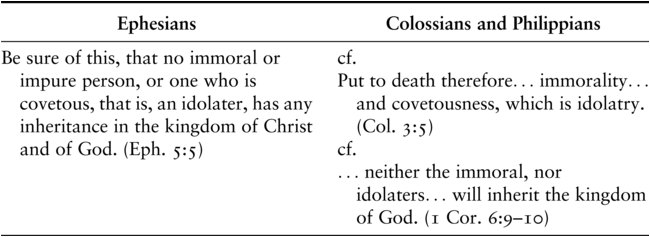
Of course, an author such as Paul might naturally reuse phrases and combine ideas that appear elsewhere in his writings. But he would be less likely to do this regularly and mechanically. In the words of E. P. Sanders, “Paul was too original a writer to construct new sentences out of fragments of old ones.”12 Instead, conflation and serial adaptation on a wider scale are more the domain of an imitator who draws heavily from source texts to piece together plausible speech for an author. Thus, as Mitton insists, when reuses and recombinations “of this kind can be shown to occur, not just as rare and peculiar coincidences, but as a regular feature,” one possesses “strong evidence of literary dependence.”13 Tellingly, the example above is hardly an isolated one; Ephesians is littered with conflations and serial adaptations.14
2.1.4 Reuse of Peculiar, Distinctive, or Unparalleled Expressions
Some parallels between texts can be purely coincidental since only a limited number of words or phrases exist to describe any idea, let alone the same idea. As Sanders puts it, “we should be surprised if many of the same words did not occur in any two passages in which Paul discusses his doctrine of righteousness,” for instance.15 But some words or phrases are less commonly encountered than others. Certain words may be rare or especially peculiar; some may even represent unique coinages or neologisms.
These parallels are especially interesting when determining literary relationships since their rarity makes them all the less likely to appear in multiple places coincidentally. If it is unusual to see any author use a particular expression, seeing two or more authors use it is much more unusual. The more we see two texts sharing the same peculiar expressions, the more skeptical we should be that these parallels are due to mere coincidence.
2.1.5 Similar Expressions Employed Differently
Since it is common for authors speaking on the same topic to take up at least some of the same words or phrases, it is especially striking when the opposite happens, that is, when one finds dense clusters of common words and phrases in passages making very different points. It is also telling when one finds parallel words and phrases with conspicuously different meanings.16 These instances point to the possible activity of an imitator, an individual interested in co-opting the language of a previous work but perhaps less interested in the precise configurations or uses of that language in their source text.
2.1.6 Similarities that Presuppose the Written Form/Medium
If we find similarities between two passages, how can we know that the author gained this new material directly from another text instead of from oral channels? One way is to see if the shared material presupposes the framework of a text, the act of writing, or the act of reading. Similarities that presuppose a literary context require a literary explanation.
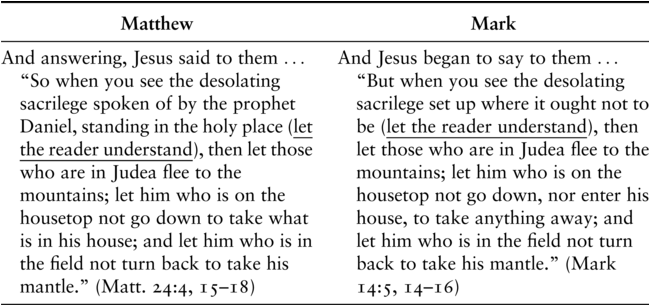
One example of this sort of similarity forms the backbone of the idea that certain gospels directly copied materials from other gospels. The Gospels of Mark and Matthew both incorporate passages set on the Mount of Olives in which Jesus turns to his disciples and warns them of events about to occur at the end of time. These two passages have substantial overlap, including extensive verbatim parallels. One of these parallels, however, is a single parenthetical comment in which the narrator of each text urges his “reader” to decipher Jesus’ enigmatic language:
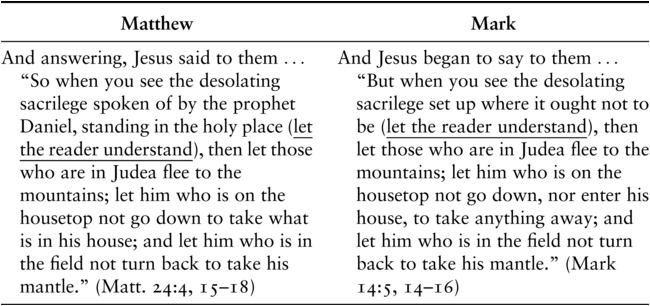
This parenthetical comment does not come from Jesus, since the scene presupposes him speaking verbally to his disciples. By the same token, the comment does not come from any oral tradition since it expressly addresses “the reader.” Instead, this parallel is one that could have only emerged from a literary source, from a written text that has been copied.17 In this instance, the author of Matthew has directly copied a narratorial comment he has found in the written text of Mark.18
2.1.7 Similarities Concentrated in the Same Locations
Certain parallels may not explicitly mention reading and writing, but they may presuppose the written form in other ways. One way is by using the same language in the same places. Here again, the issue is one of probability. Two authors may coincidentally discuss the same ideas or utilize the same words or phrases in their works. But they would not necessarily do so at analogous junctures or places in their texts – at least in the absence of some literary convention demanding that they do so (e.g., genre expectations).19 In these cases, we are hard-pressed to explain not only the coincidence of language but also the coincidence of location.
2.2 Evidence for Dependence
When we study the Johannine texts with these points in mind, we arrive at two conclusions. First, the similarities between the Gospel and Letters of John are not due to random chance but reflect literary contact and dependence. Second, these texts were written in a certain order, one that aligns with their divergent reception histories. As I will demonstrate below, the Gospel – the earliest attested Johannine work – was written first; all three letters seem to know and utilize it. The next text in this chain was 1 John, which served as a source for 2 and 3 John. These shorter letters, in turn, occupy the latest strata of this literature, with 2 John predating 3 John.20
2.2.1 John and 1 John
One way to map literary relationships across four texts is to begin with two texts and determine whether and how they might be related. Once one establishes a relative chronology of these two – that is, an ordering of which text came first – one can introduce a third and fourth text and see how each fits or does not fit within that sequence. For this exercise, I will begin with the Gospel of John and 1 John, the two longest texts in the collection, since they offer the most data for such an analysis.
2.2.1.1 Verbal Parallels
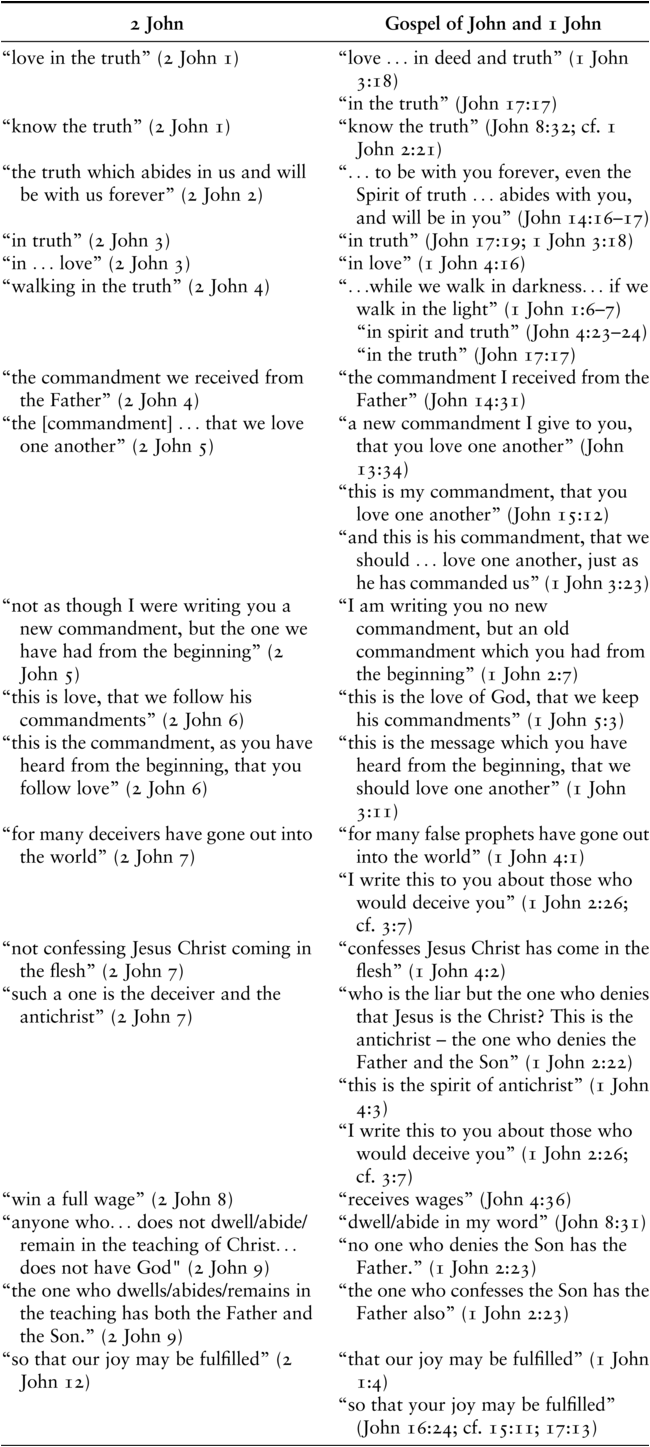
The sheer level of linguistic overlap between John and 1 John leaps off the page, even on first read. In the words of Raymond Brown, “it is difficult to find … works more similar in expression.”21 As I noted above, over forty expressions – some phrases, some clauses – are highly characteristic of the Johannine texts and present in at least John and 1 John22:
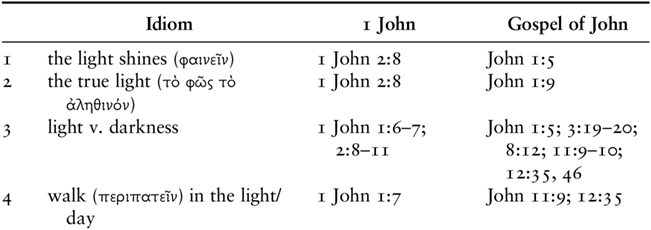
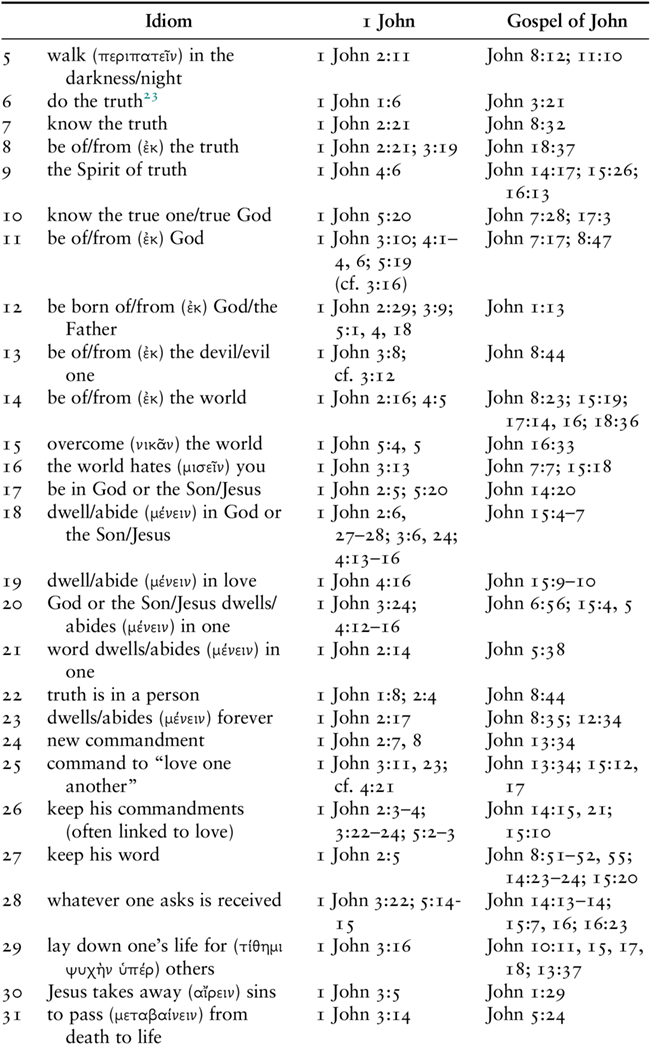
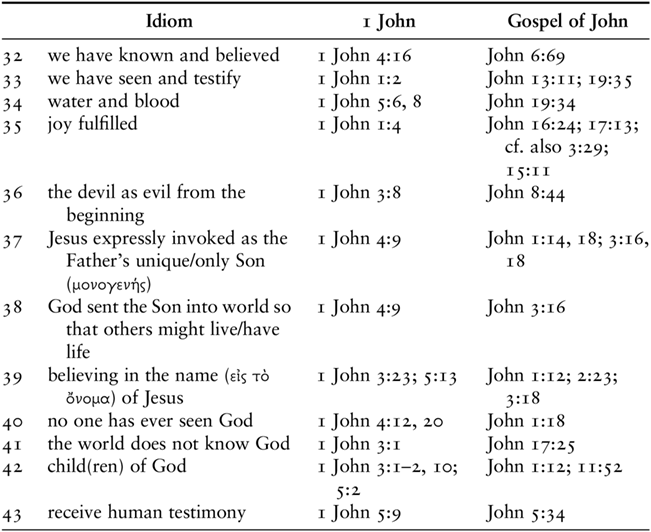
Given its brevity, 1 John is especially dense with these peculiar and distinctive expressions. If we count only those idioms in the chart above, then 65 of with 105 verses of 1 John (62.0%) show points of contact with the Gospel. Such a dense concentration of high-quality similarities is strong evidence of literary contact.
Weighing the Differences
As impressive as this overlap is, some scholars argue against literary contact between these texts by stressing their differences over and above their similarities. Judith Lieu, for one, argues that “there is no compelling evidence of a direct literary relationship between 1 John and the Gospel” since “the consistent subtle differences of wording, inference, context, and combination even where close parallels appear suggest that both writings draw independently on earlier formulations.”24 Similarly, Raimo Hakola insists that “clear differences in how common idioms and themes are developed” point away from “direct literary dependence” between the texts.25
The problem with this objection, as Mark Goodacre notes, is that “the absence of agreement … says nothing about the presence of agreement” when assessing literary relationships.26 A literary relationship exists between texts whether one is 5% derivative from the other or 95% derivative. Indeed, “only one direct-connect parallel is required to demonstrate literary dependence between two documents.”27 This is especially true since plagiarists and imitators are known to incorporate language selectively and to rework whatever language they choose to include at different rates. In short, the only positive evidence one can offer against literary dependence is the absence of similarity – not the presence of differences.
2.2.1.2 Formal Parallels
As extensive and dense as these linguistic parallels are, an even stronger case for literary contact between the Gospel and 1 John can be made from their structural similarities, that is, from their shared literary conventions and features. As George Parsenios writes, taken together or individually, “these larger structural bonds … make it extremely difficult to imagine how a ‘Johannine tradition’ does not rely on literary dependence in some form.”28
Stylistic Introductions
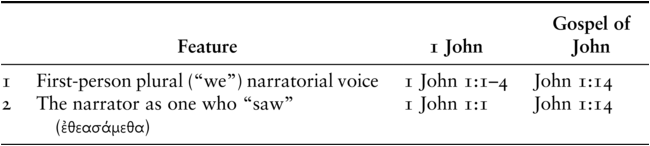
The first and most extensive structural parallel binding John and 1 John is immediately apparent to casual readers of these works. Both texts open with a prologue or proem characterized by a stylistically rich, almost poetic, style (John 1:1–18; 1 John 1:1–4). The very presence of such artful passages is surprising enough; they are not required by the genre of either text. No prior narrative gospel – neither Matthew, nor Mark, nor Luke – contains anything analogous to John’s prologue.29 But more to the point, these introductions, “though by no means identical … stand together against anything else in the NT, sharing a large number of common features in a short space.”30 The proem of 1 John is a mere 85 words long; if we add verse 5, which is a “transitional verse,” the passage is still compact at 109 words.31 And yet, nearly every clause is steeped in parallels to the Gospel.
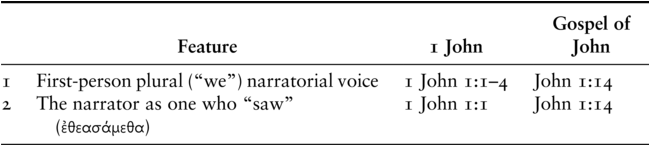
The similarities between these passages begin with the common ways they construct their narrators. Both feature a voice speaking in the first-person “we” who emphasizes that he has “seen” Jesus:
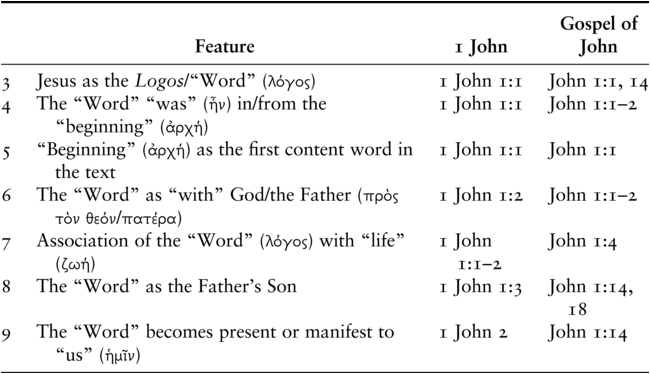
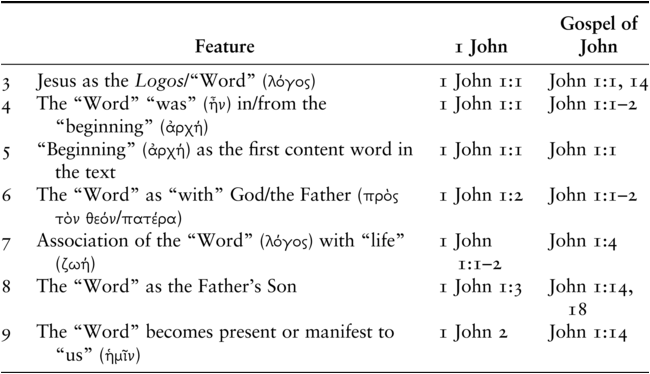
Second, both passages take up a complex vision of Jesus as the creative Logos or “Word” (λόγος) at the “beginning.” This synthesis, rooted in ancient Greco-Roman philosophy, is highly distinctive to these texts; no earlier Christian work attests the same amalgam of ideas.32 Interestingly, this synthesis is also mostly absent from subsequent sections of John and 1 John, making it a localized feature particular to the introductions of both works:33
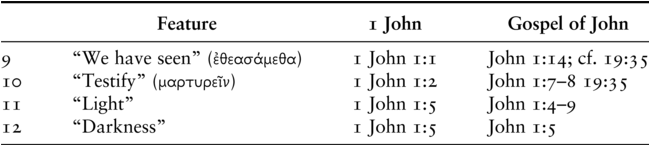
Beyond these impressive parallels, the passages share other key terms, including some taken from John 19:35 (suggesting conflation):
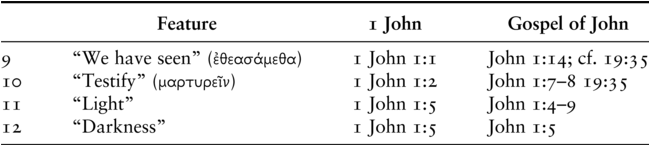
With each point of overlap, the possibility of coincidence, even within a shared social milieu, becomes remote. The statistical improbabilities stack too high. For this reason, most scholars agree that the opening lines of these texts reflect direct literary borrowing.
Those writers who disagree with this conclusion again predictably stress the subtle differences between the above passages, insisting that they point away from direct dependence and towards something like a common oral tradition. Hakola writes that the differences between these texts “suggest that 1 John 1:1–4 is not simply a reproduction of John 1:1–18 but that a shared tradition has been developed in different ways in these passages.”34 The coexistence of similarities and differences, however, is not necessarily evidence of orality, and it is a mistake to treat it as such. Written communications are also vulnerable to the kinds of interventions, both accidental and deliberate, that produce differences.35 More to the point, authors utilizing source material are especially motivated to introduce such changes. Their goal, after all, is not to reproduce a text precisely; they are not photocopiers. Instead, their aim is to reuse older materials in new ways and to new ends.
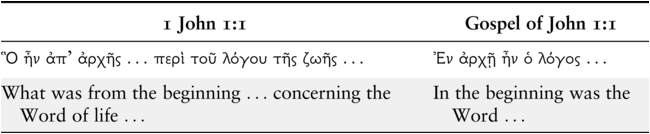
The two passages do present us with what Parsenios calls “similarity-in-difference”; they take up the same words and phrases, but not always in the same form or with the same intention.36 For instance, whereas the first line of the Gospel uses the expression “in the beginning” (ἐν ἀρχῇ; John 1:1), 1 John uses the inexact equivalent “from the beginning” (ἀπʼ ἀρχῆς; 1 John 1:1). That being said, the Gospel also uses the same expression in other passages when referring to primordial realities: “the devil was a murderer from the beginning [ἀπʼ ἀρχῆς]” (John 8:44; cf. 1 John 3:8). The author of 1 John had both possibilities at his disposal and opted to use one here.
Other differences are a matter of interpretation and a less secure ground for claiming the two texts are unrelated. For example, Hakola claims that whereas John 1 concerns a vision of Jesus as “the preexistent Word that was with God before Creation,” the phrase “Word of life” in 1 John 1 refers to something very different, supposedly, the “message” Jesus delivered from “the beginning” of his ministry.37 The problem is that 1 John 1 says that the “Word of life” is one “we have heard … we have seen with our eyes … we have looked upon and touched with our hands” (1:1). This is not a reference to a mere message; it can only be a reference to Jesus, the “Word … made flesh” (John 1:14). What Hakola sees as a significant difference may instead be a conscious decision by the author of 1 John to meld the Gospel’s use of “word” for both Jesus and his teaching, just as the author has melded two meanings of the word “beginning” in the Gospel. (There, the word “beginning” refers to creation [1:1–2; 8:44] and the start of Jesus’ ministry [8:25; 15:27; 16:4].)
Hakola, then, is correct that “1 John 1:1–4 is not simply a reproduction of John 1:1–18.”38 But this still leaves us with a critical literary question: why do so many similar features converge at precisely the opening lines of both texts? Why do these two texts, as different as they are, begin with the same clustering of themes, language, and stylistic choices? A literary problem such as this demands a literary explanation.
Certain scholars suggest that the similarities between the two passages, especially their quasi-poetic character, reflect their common dependence on a hypothetical “hymn” of the hypothetical Johannine Community.39 There is no firm evidence for a hymn behind the passage, however.40 For that matter, even if such a hymn existed, it would still be difficult to explain why that hymn should have exerted so much influence on both texts in precisely the same place: their opening lines.41 As George Parsenios writes:
This kind of close association suggests more than a coincidence arising from a common tradition. If the various terms and phrases that the texts share were randomly scattered throughout the works, then their similarities might be merely coincidental. But the fact that 1 John and John both employ common phrases and words in their opening lines suggests that one of them is imitating the other … More than a common tradition seems to be at work when two texts not only use the same words but also use them in the same places.42
Opening Line
A second similarity between John and 1 John deepens the impression that the two are connected. Specifically, both texts make similar segues from their opening lines into their respective body texts. At the conclusion of its prologue, the Gospel of John commences its narrative with the words, “and this is the testimony” (καὶ αὕτη ἐστὶν ἡ μαρτυρία; 1:19). Not coincidentally, after its preface, 1 John segues into its main line of argumentation with the words: “and this is the message” (καὶ ἔστιν αὕτη ἡ ἀγγελία; 1:5).43 Any attempt to claim that the two texts are independent of one another would have to reckon with this literary parallel as well. Oral traditions do not inform how literary texts are structured.
Statement of Purpose
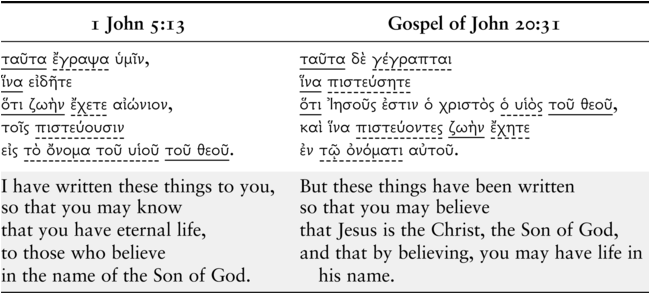
Looking beyond the formal similarities outlined above, the Gospel and 1 John share yet a third feature in common, namely, a statement of purpose towards the conclusion of each text in which the author indicates his rationale for writing. Once again, the presence of this device in both texts is surprising. Nothing in the genre of either text dictates that each should have included such a statement; for both to have this device is remarkable. The other Johannine epistles, for that matter, lack such statements.44 Still more impressively, these lines are strikingly similar, sharing a core idea and clustering the same key terms. In each, the narrator connects his act of “writing” to the notion that those who “believe” may possess “life” through “the name” of the “Son of God.” The two sentences also share a common pattern. They each begin with the term “these things” (ταῦτα), and they incorporate the same verb in their first clause, “writing” (γράφω). Both, in turn, incorporate a purpose clause, with “so that” (ἵνα) followed by a subjunctive verb and the conjunction “that” (ὅτι):
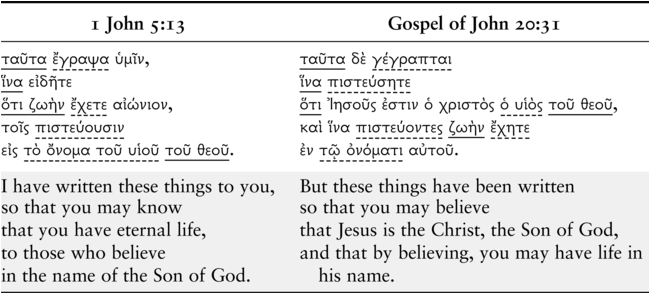
Interestingly, although the two texts begin with the same expression (“these things”), they use this expression to refer to different things. In John, “these things” refers specifically to the “signs” Jesus performs (20:30), whereas in 1 John, “these things” refers to the material that precedes the verse.45 As we have seen, using the same expressions with different referents in mind is a mark of literary imitation. There are also signs of conflation in the passage; 1 John 5:13 shares language not only with John 20:31 but also John 3:18 (“believe in the name”). The clinching evidence that these statements reflect literary dependence, however, is that each presupposes the act of writing. No oral tradition would dictate that authors state a common motivation for “writing.” Instead, we should presume a direct link between these texts and conclude that one is modeled off the other.
2.2.1.3 Direction of Influence
Up to this point, we have established that literary borrowing offers the best explanation for the shared features of John and 1 John. But if the two texts stand within a single lineage, where does this lineage begin? Which text came first and served as a model for the other? In practice, contemporary scholars have trouble disentangling their answers to these questions from the Johannine Community Hypothesis. As François Vouga writes, many models are “based on ideas about how the Johannine revelation tradition developed historically or theologically” within that hypothetical group.46 The problem, of course, is that such approaches pile speculation atop speculation; if the community’s existence is hypothetical, the complex intellectual and social histories reconstructed for it are that much more tenuous. It is hardly surprising, then, that such models also arrive at wildly divergent results. Udo Schnelle uses this sort of argumentation to unpersuasively argue that the Epistles were written before the Gospel.47 Raymond Brown, by contrast, wields it in support of the Gospel’s priority.48 If we set aside this dubious approach and focus strictly on the textual data, however, we end up with firm reasons to believe that the Gospel was written before 1 John. Specifically, 1 John seems to allude to the Gospel at various points.49
Plausibility as a Source
When determining the relationship between two texts, it is helpful to isolate those passages that show the most substantial overlap between them and decide which is more likely to have emerged independently. When comparing John and 1 John, the natural starting point for such an exercise is their opening lines:
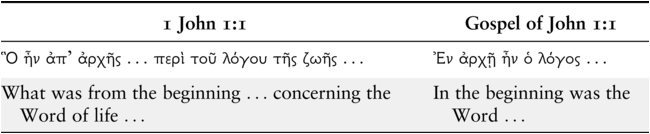
The Gospel has strong, independent motivations for using the term “beginning” (“ἀρχῇ”) in its first clause. As C. K. Barrett writes, “that John’s opening verse is intended to recall the opening verse of Genesis is certain,” a verse that reads: “in the beginning [ἐν ἀρχῇ], God created the heavens and the earth” (LXX Gen 1:1). 50 Additionally, many scholars today affirm that the author of John knew Mark and patterned his Gospel after it.51 In this case, it may be telling that Mark opens with the same noun: “beginning” (ἀρχή) (“the beginning [ἀρχὴ] of the gospel of Jesus Christ”; 1:1).
By contrast, neither of these apparent backgrounds explains the presence of “beginning” (ἀρχῇ) in the opening lines of 1 John. That passage has a weaker relationship to the Genesis creation story. In fact, to detect any connection between Genesis and 1 John, one must be familiar with the Gospel’s prologue.52 Additionally, because 1 John is written as an epistle, one would hardly expect its opening line to allude to the opening line of a gospel like Mark. It would also be difficult to explain the force of that allusion. Instead, the only compelling background and inspiration for 1 John’s use of the phrase lies in the Gospel of John’s prologue, which it imitates.
Presumed Knowledge of the Gospel
Another reason to posit the priority of the Gospel is that the argumentation of 1 John is opaque without reference to that longer text. As Vouga puts it, “only through the structure of [John] can the associations in the thought process of 1John be explained.”53 Consider, for example, 1 John’s convoluted discussion of the “new commandment.” According to the Gospel, on the night before his death, Jesus said to his disciples: “I give you a new commandment: that you love one another; even as I have loved you, that you also love one another” (13:34). The epistle alludes to this thread in the Gospel, but in an unclear way:
Beloved, I am writing you no new commandment but an old commandment that you have had from the beginning; the old commandment is the word that you have heard. Yet I am writing you a new commandment that is true in him and you because the darkness is passing away, and the true light is already shining. Whoever says, “I am in the light,” while hating a brother, is still in the darkness. Whoever loves a brother lives in the light, and there is no cause for stumbling in such a person. But whoever hates another believer is in the darkness, walks in the darkness, and does not know the way to go because the darkness has brought on blindness.
Curiously, the author begins by insisting that he is “writing … no new commandment,” but he never actually names the commandment.54 The following lines presuppose the command to “love one another,” but they are not phrased as a commandment (1 John 2:9–11). Only later in the epistle does the author expressly state the instruction to love others, but he does not call this instruction a “new commandment,” as before (3:11). Only a reader familiar with the Gospel can recognize the thrust of the “new commandment” and follow this loose and disconnected teaching in 1 John.
Something similar can be said of a later line in the epistle, in which the author affirms that Jesus came “by water and blood”:
This is the one who came by water and blood, Jesus Christ, not with the water only but with the water and the blood. And the Spirit is the witness because the Spirit is the truth. There are three witnesses: the Spirit, the water, and the blood, and these three agree.
Although the author’s argumentation in this passage confounds many interpreters, the basis for his argument is clear.55 The above lines presuppose images and details related in the account of Jesus’ crucifixion in the Gospel of John. That passage indicates that at Jesus’ death, “one of the soldiers pierced his side with a spear, and at once blood and water came out” (19:34). The passage also mentions Jesus handing over the “Spirit” to God (19:30), and it incorporates the narrator’s parenthetical language of “testifying” and “testimony” (19:35). Without having access to the specific narration of Jesus’ crucifixion provided in John alone, the imagery of 1 John 5:6–8 is entirely opaque.56
More Complicated Models
Rather than posit a single line of dependence running from John to 1 John, as I have done here, some interpreters suggest more complex models of how the two texts emerged. One line of proposals argues that the Gospel was composed in two (if not more) major editions. In these scenarios, a hypothetical, earlier edition of John was a source for 1 John, which in turn shaped or informed a later edition of John (in essence, a JohnA–1 John–JohnB model).57
As popular as these models may be in some circles, however, they are excessively speculative and best discarded. In the abstract, Occam’s razor would always have us prefer a single line of dependence between the texts to any more complicated (multistage or back-and-forth) relationship. More problematically still, there is no consensus that John passed through multiple editions, and there is hardly any agreement as to the number and boundaries of those supposed editions or layers.58 Worse, attempts to determine the boundaries of such layers and situate them in relation to 1 John – at least at the fine level some scholars have attempted – are highly prone to circular reasoning (in which one relies on 1 John to determine what material in John is redactional before concluding that a given redactional layer of John depends on 1 John). In short, these models introduce far more problems than they resolve. We are on much firmer ground with the simpler model: 1 John’s dependence on John.
2.2.2 2 John
We have established that the Gospel of John and 1 John stand in a single literary lineage. The Gospel emerged first; next, a second author wrote 1 John, resourcing the language and formal features of the Gospel. Our next task, then, is to understand how 2 John might fit into this lineage. As it stands, a broad spectrum of writers – among them, Rudolf Bultmann, Jürgen Heise, Gerd Schunack, Judith Lieu, and Ruth Edwards – have argued that 2 John represents a later text, modeled on the longer Johannine works.59 I agree with this assessment. Line for line, no Johannine work shows a higher concentration of the classic signs of literary dependence – from verbatim parallels to conflation and serial adaptation – than 2 John.
2.2.2.1 Overlap with John and 1 John
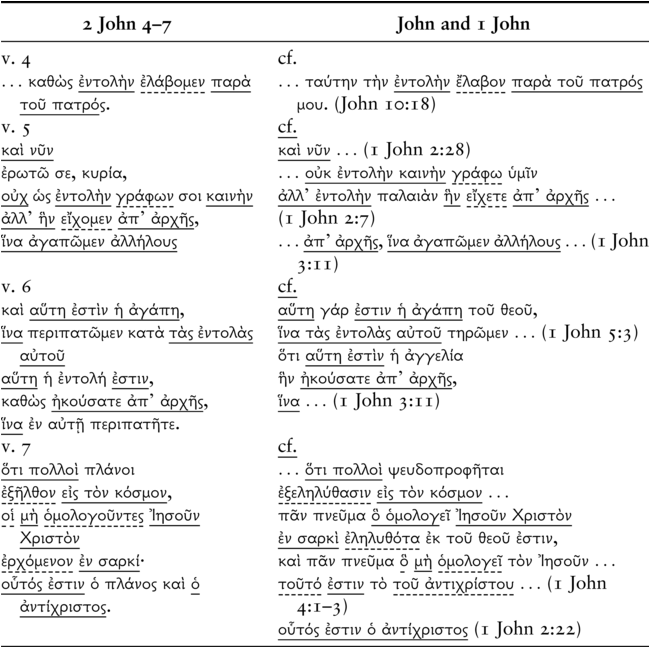
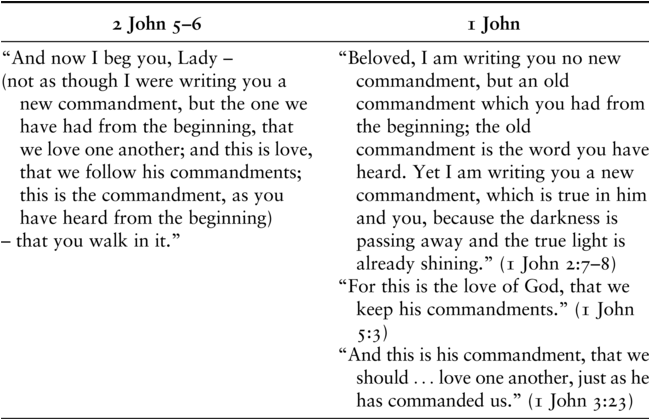
Our first clue that 2 John is a derivative work is the dramatic scale of its overlap with John and 1 John. From one perspective, 2 John is primarily a condensation of the content of 1 John. Indeed, as Hans-Josef Klauck remarks, “apart from verses 10–11, 2 John contains hardly a thought that would not also be found in 1 John.”60 But what makes this overlap especially dramatic is the sheer quantity of verbatim similarities packed within the letter. Some 80/245 words answer to the longer Johannine works (32.7%). Not surprisingly, the percentage increases if we bracket out the framing material of the letter and consider only its body (no such frames, after all, appear in the other Johannine texts). In that case, 57/151 words (37.7%) find near-precise parallels in John and 1 John. No less telling is the nature of this overlap. As seen below, several similarities rise above common vocabulary or phrases. In verses 5–7, one finds entire sentences or clauses agreeing verbatim with lines in the longer Johannine texts:
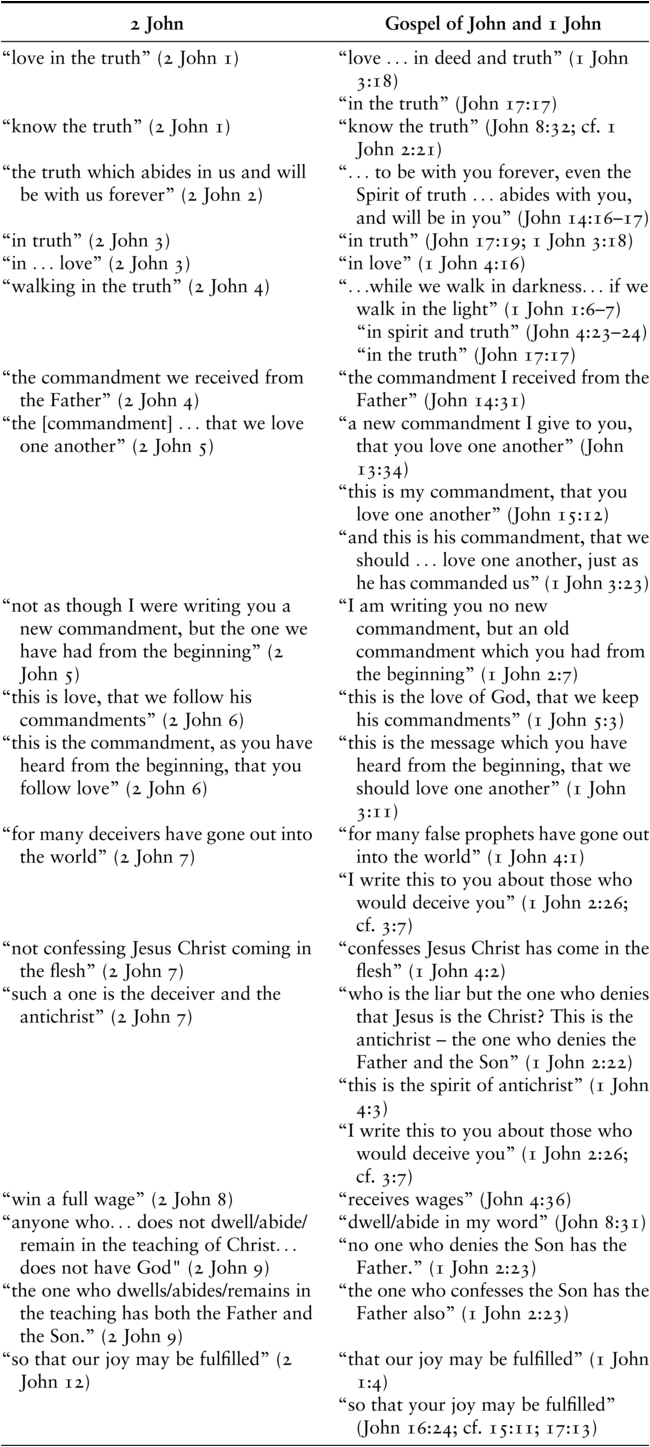
Additionally, since the parallels in 2 John answer to such a diverse set of passages, the letter is rich with examples of conflation and serial adaptation. In particular, verses 4b–7 represent an almost continuous cento of statements strewn across John and 1 John, with 51/70 words (72.9%) corresponding to words in one of six locations (John 10:18; 1 John 2:7, 22, 28; 3:11; 4:1–3; 5:3). These parallels are especially impressive when laid out in Greek (though I will translate and discuss specific examples below):61
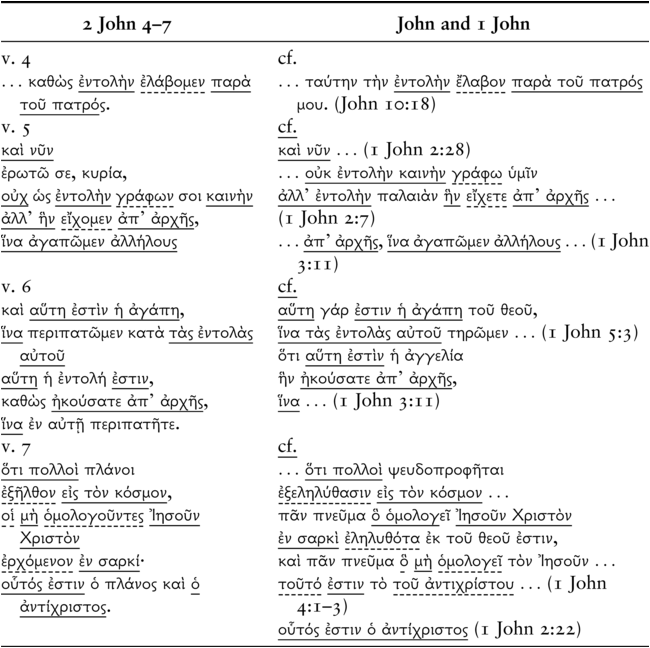
One finds examples of conflation – the combination of materials sharing elements in common – between verses 5 and 7. Specifically, verse 5 unites 1 John 2:7 and 3:11, each of which contains the expression “from the beginning” (ἀπʼ ἀρχῆς). In turn, verses 5–6 unite materials from 1 John 3:11 and 5:3, each of which incorporates the language of “love” (ἀγαπῶμεν/ἀγάπη). And verse 7 unites 1 John 2:22 and 4:1–3, each of which incorporates the clause, “this is … the antichrist” ([οὗτός/τοῦτό] ἐστιν [ὁ ἀντίχριστος/τὸ τοῦ ἀντιχρίστου]. Additionally, serial adaptation – the combination of unlike materials – is evident in the juxtaposed thoughts of verses 4–5 and verses 6–7. Last, one finds examples of the subtle rearrangement of words at multiple points in this synopsis, in vv. 5, 6, and 7. This pervasive evidence of reuse and recombination is unlikely for an author constructing an original work; it points instead to direct literary contact between works.
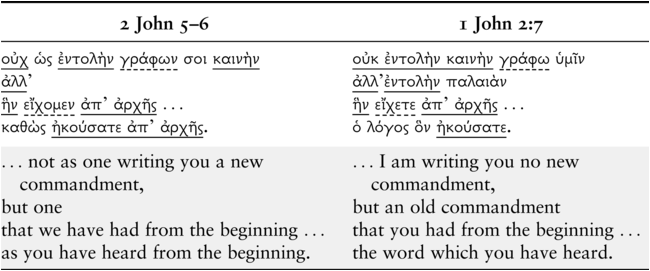
A final parallel, in turn, clinches the case for direct literary contact between the two texts, specifically, a parallel line that directly presupposes a literary context. In 1 John, the narrator notes that he is “writing” his readers a “new commandment” before indicating – without needing to – that this is not a new commandment but one his readers have “had from the beginning” (2:7). Remarkably, the narrator of 2 John draws up a nearly identical, and structurally parallel, comment:
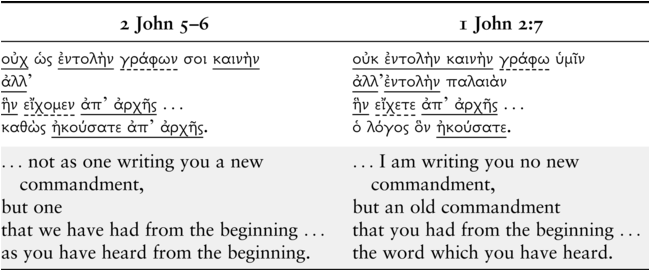
Since these parallel statements presuppose the act of “writing,” their similarities demand a literary explanation.
2.2.2.2 Direction of Influence
If we posit some literary copying between 1 and 2 John, the question arises: who copied whom? The reception history, of course, suggests that 1 John might have preceded 2 John. As it turns out, that order holds up when we examine how certain parallel lines fit into their respective texts. In multiple examples, elements shared in common between 1 John and 2 John seem to fit less comfortably in the latter, as if the author of the latter has aggressively wrested them from their more natural contexts in the former.
Staccato Argumentation
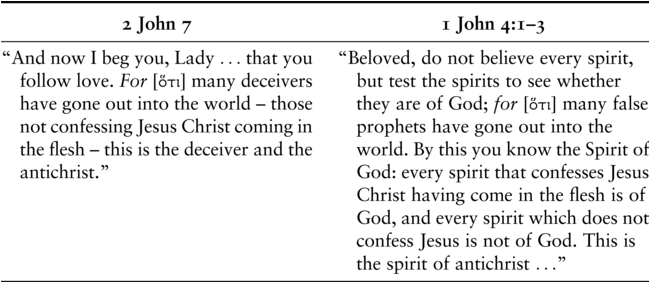
At face value, 2 John is supposed to be a letter relating important teachings to a particular “Elect Lady and her children.” Little about the letter seems organic, however. Instead, at multiple points, the text relates ideas in a rapid manner, forcing ideas together in confusing structures. For example, in verses 5–6, the “Elder” of 2 John presents a specific request of the “Elect Lady,” but as Lieu observes, “what the elder is requesting is obscured by the complex grammatical structure through the end of verse 6, exacerbated by the numerous textual variants that reflect scribal attempts to clarify their own solutions.”62 Between his actual request (“I beg you, Lady”) and the content of the command (“that you follow love”; cf. “that” in John 13:34; 1 John 3:12; 4:21), the author confusingly compresses an entire series of ideas explicated carefully across several longer passages in 1 John:
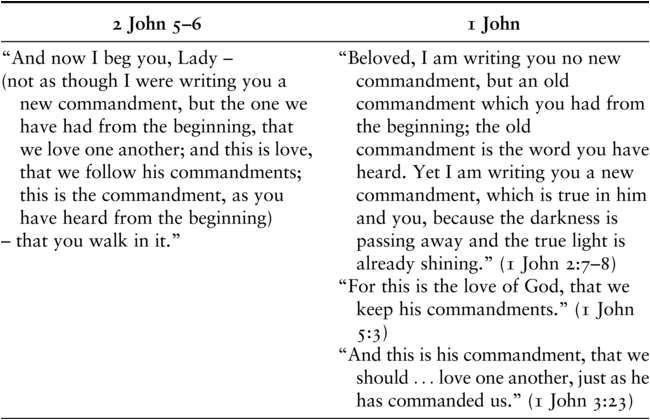
This rapid and staccato juxtaposition of arguments gives the impression of an author condensing the main points of a longer epistle into a small space.
Unclear Links
This tendency to compress arguments creates another unusual feature of 2 John: unclear transitions between its thoughts. Consider, for example, the transition between the above sentence and the next one:
And now I beg you, Lady … that you walk in [love]. For [ὅτι] many deceivers have gone out into the world – those not confessing Jesus Christ coming in the flesh – this is the deceiver and the antichrist.
Despite the causal conjunction “for” (ὅτι), the logical relationship between these two statements is unclear, and the author never develops that relationship. There is, however, another way to make sense of the conjunction. The “for” may be an element copied and pasted directly from 1 John 4:1, a verse in which “for” connects more coherent and complementary ideas, supporting a logical flow of argument:63
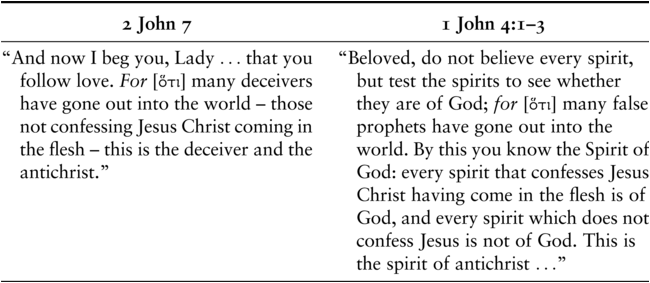
Once again, a confusing element in 2 John makes more sense when we read its parallels in 1 John.
Underdeveloped Ideas
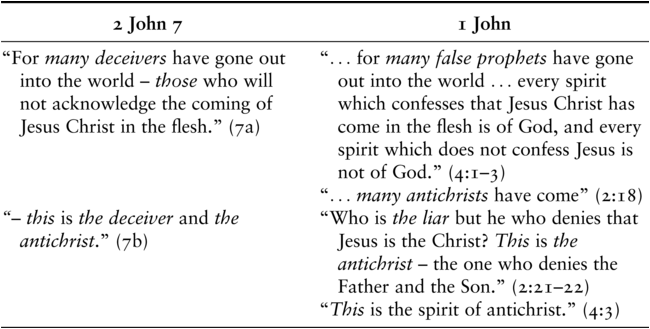
We can see the same forces at work when we compare how 1 John and 2 John introduce the idea of “antichrists.” The letter of 1 John builds a complex vision of the coming of “antichrist(s),” explaining that the expectation of a single “antichrist” is fulfilled by the coming of “many antichrists,” who have “gone out into the world” in a single “spirit of antichrist” (2:18–19; 4:1–3). By contrast, the one verse to take up this theme in 2 John (v. 7) “is so succinctly formulated that it would be difficult to understand its intention without reference to … 1 John [4:1–3] alongside the earlier explanation of the antichrist in 1 John 2:18–19.”64 The author references the existence of “many deceivers” (plural) and calls them “the antichrist” (singular) without ever elaborating on the complex relationship between these ideas, and in a jump that seems – at first glance – to be ungrammatical:
For many deceivers have gone out into the world – those who will not acknowledge the coming of Jesus Christ in the flesh – this is the deceiver and the antichrist.
That sudden shift from plural (“deceivers/those”) to singular (“this/deceiver”), however, makes much more sense if we understand the verse as a bricolage of statements from 1 John, some of which use the singular and others the plural:
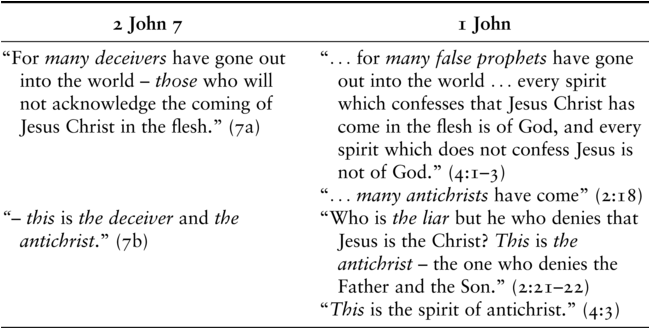
Rather than see 2 John as an independent introduction of the idea of “antichrists,” then, we should see it as something else: a conflation of expressions from 1 John 4:1 and 2:21–22, omitting important context and leaving behind an unusual shift in grammatical number.
Trivialized Language
A final feature of 2 John enhances the case for it being a highly derivative and rough cento of Johannine language. Specifically, the letter employs Johannine vocabulary differently from 1 John. In some respects, one could even say it deploys that language in unsophisticated ways. Schunack remarks that multiple examples exist in which “the same thing is no longer said [in 2 John] when the same thing is repeated.”65 More pointedly, Lieu detects a “tendency for Johannine language to become slogans in 2 John.”66
One of the words affected by this process is, interestingly, one of the signature expressions of the Johannine corpus, the language of one’s “joy” being “fulfilled.” In the Gospel, the phrase is a specialized expression, consistently referring to the spiritual state of “joy” that the human person receives from Jesus through his indwelling presence, which the world cannot “receive”:
These things I have spoken to you, that my joy may be in you, and that your joy may be fulfilled.
A little while, and you will see me no more; again a little while, and you will see me … So you have sorrow now, but I will see you again, and your hearts will rejoice, and no one will take your joy from you. On that day, you will ask nothing of me …
The expression “joy … fulfilled” also appears in 1 John, where it is arguably still linked to spiritual union and indwelling. The author indicates that his joy will be fulfilled as his readers embrace his message and join him in a spiritual “fellowship” that binds them to one another and to the Father and Son:
… that which we have seen and heard we also proclaim to you so that you may have fellowship with us, and our fellowship is with the Father and his Son Jesus Christ. And we are writing this that our joy may be fulfilled … If we say we have fellowship with him while we walk in darkness, we lie and do not live according to the truth; but if we walk in the light, as he is in the light, we have fellowship with one another, and the blood of Jesus his Son cleanses us from all sin.
In 2 John, however, this specialized expression loses its depth. The text deploys the rich, loaded expression of “joy … fulfilled” to complete a stock pleasantry, conventional for ancient Greek letters – the anticipation of a pleasurable future visit: “I hope to come to see you and talk with you face to face, so that our joy may be fulfilled” (2 John 1:12).67 We are far from a genuinely “Johannine” thought world, in which the fact that the addressees “walk in the truth” (cf. v. 4) would already ensure that their “joy” is “fulfilled.” The imitator assimilates the language of prior texts but crudely, exposing his work as a pale pastiche.
2.2.2.3 Linguistic Departures
Up to this point, we have seen 2 John as a text that extensively, even mechanically, imitates the language of earlier Johannine texts. But interestingly, there are places in the letter where the author departs from stereotypical Johannine terminology – departures that point, once again to the text’s derivative character, revealing that the work imitates several models. Perhaps the most telling of these is found in the opening greeting of the letter: “Grace, mercy, and peace will be with us from God the Father and Jesus Christ, the Father’s Son, in truth and love” (v. 3). The presence of an opening greeting is already peculiar, distinguishing 2 John from 1 John, which lacks any such feature. But as Ruth Edwards notes, the section also seems to blend very different speech profiles:
Observe … the curious juxtaposition of favorite Johannine vocabulary – ‘love’, ‘truth’, abide’ (vv. 1–2) – with untypical vocabulary (v. 3), notably charis (only once in John’s Gospel, never in 1 John), ‘mercy’ (not elsewhere in the Johannine literature), the un-Johannine ‘Father God’ (lacking the article with ‘God’ and the modifier ‘our’), and the peculiar, quasi-liturgical, description of Jesus as ‘the Son of the Father’.68
It is not especially difficult to determine the origin of these un-Johannine turns of phrase. The triple formula “grace, mercy, and peace” and invocation of the Father and Jesus evokes Paul’s signature and probably self-coined greeting in his undisputed letters (“grace to you and peace from God [the/our] father and [the/our] Lord Jesus Christ”; Rom. 1:7; 1 Cor. 1:3; 2 Cor. 1:2; Gal. 1:3; Phil. 1:2; 1 Thess. 1:1; Phlm 1:3) – a greeting emulated in several pseudepigraphal letters in Paul’s name (2 Thess. 1:2; Col 1:2; Eph. 1:2; Tit. 1:4).69 Its closest match, however, appears in two decidedly late Pauline pseudepigrapha – namely, the two letters to Timothy: “Grace, mercy, and peace from God the Father and Christ Jesus …” (1 Tim. 1:2; 2 Tim. 1:2).70 Since the (un-Johannine or less typically Johannine) terms “grace” and “mercy” fit more comfortably into Pauline and Deutero-Pauline texts, including 1 and 2 Timothy (e.g., 1 Tim. 1:13, 16; 2 Tim. 1:16. 18), the direction of influence would seem to run from that literature to 2 John.
What is particularly interesting is how the author of 2 John has assimilated this (Deutero-)Pauline greeting. As Edwards writes, the author seems to have taken “typical Johannine vocabulary in the phrase ‘in truth and love’” and “tacked [it] on to the Pauline-style greeting.”71 This pattern suggests two things about our author – first, his self-consciousness about straying too far from his Johannine models, and secondly, his tendency to maintain his authorial facade by doubling down, even crassly, on stereotypical Johannine language.72
As we saw, another peculiarity of the letter is its use of the adjective “elect” or “chosen” (ἐκλεκτός). The term appears in no other Johannine text, but it plays a prominent role in 2 John. In the letter’s prescript, “the Elder” identifies his addressees as an “Elect Lady and her children” (ἐκλεκτῇ κυρίᾳ καὶ τοῖς τέκνοις αὐτῆς; v. 1). Then, at the end of the letter, he introduces another set of figures, writing, “the children of your elect sister greet you” (ἀσπάζεταί τὰ τέκνα τῆς ἀδελφῆς σου τῆς ἐκλεκτῆς; v. 13). Most likely, the two “elect” women mentioned are probably not literal persons but personifications of local Christian communities – a fact confirmed in the verses that follow.73 For one, the text never enhances its portrait of “the Elect Lady” with texture or personal details. On the contrary, the letter refers to the “Elect Lady” in the third person as soon as it introduces her, that is, in its very prescript (“her children”; v. 1) – a move that may point to some level of abstraction. The letter also casually drifts between second-person singular (vv. 4–7, 13) and second-person plural (vv. 8–12) forms of address, suggesting that the “Elect Lady” and the “children” may be interchangeable entities, or that the “Lady” herself is a plural entity. It may also be telling that the Elder sends greetings not from “the elect sister” herself but from “the children of your elect sister” (v. 13). If the sister were a real person, one might expect the Elder to relate personal greetings from her as well.74
Tellingly, the construction of a church as an “Elect Lady” aligns 2 John with other Christian texts that apply feminine metaphors to individual churches (e.g., 2 Cor. 11:2) or the collective “church” (Eph. 5:23–33), some outrightly personifying these as women. The narrator of the Shepherd of Hermas addresses the personified “Church” as “Lady” (Κυρίᾳ).75 The most compelling parallels to the “Elect Lady” language of 2 John, however, lie in the pseudonymous letter of 1 Peter, a work with apparent Pauline influence that might have influenced 2 John in turn.76 Like the narrator of 2 John, the narrator of that letter identifies himself as an “elder” (more precisely, a “fellow elder” [5:1]). He also addresses his letter to a “chosen” set of addressees (1:2; cf. 2:9), echoing Paul’s language (Rom. 8:33; cf. Rom. 9:11; 11:5, 7, 28; 1 Thess. 1:4). Most strikingly of all, 1 Peter closes with greetings to an elect woman – specifically, “to her, in Babylon, who is also elect” (ἡ ἐν Βαβυλῶνι συνεκλεκτὴ; 5:13) – likely a reference to the Christian community of Rome.77
2.2.3 3 John
Few scholars today consider 3 John a derivative work, mainly because they believe its contents are too realistic to be the product of imitation and creative writing – a problematic assumption, as I will argue in a later chapter. But eight of the fifteen total verses of the letter (vv. 1, 3–4, 11–15) contain elements parallel to the contents of other Johannine texts, some displaying features consistent with the techniques of a literary imitator. More importantly, as I noted in the last chapter, the letter also contains a bevy of linguistic features that would suggest a very different speech profile and location for its author – another sign that its relationship with the other Johannine texts is more likely due to direct literary dependence.
2.2.3.1 Linguistic Departures
The best starting point for recognizing 3 John as a derivative text is to recognize how different it is from the others. As Judith Lieu observes, 3 John has an “uneven relationship with the rest of the Johannine literature, which otherwise is characterized by a consistent … set of language patterns; although undoubtedly Johannine, and appealing to those values, 3 John uses its own vocabulary.”78 For one, the letter is peculiar for concentrating “language which was becoming technical in other parts of the church” but which is conspicuously absent in other Johannine texts.79
For instance, no other Johannine texts use the term “church” – a curiosity given that both 1 and 2 John presuppose church settings. (2 John 10 seems to reference a local church with the word “house.”) By contrast, 3 John uses the term “church” not once, but three times (“ἐκκλησία”; 3 John 6, 9, 10). Perhaps not coincidentally, the term “church” is richly represented in other early Christian writings, beginning with the letters of Paul.
Other usages point more directly to a Pauline contribution. Third John is also the only Johannine text to refer to itinerants as “brothers” (3 John 5) and to use the term “fellow workers” (συνεργοί; 3 John 8) – characteristically Pauline language (Phil. 2:25; 1 Thess. 3:2).80 No less interestingly, the epistle uses the term “send forward” (προπέμπειν), a term that carries “a technical meaning in missionary contexts of patronage or financial sponsorship for the journey” in Pauline texts (Rom. 15:24; 1 Cor. 16:6; 2 Cor. 1:16; Tit. 3:13) and some other early Christian literature (Acts 15:3; Polycarp, Phil. 1.1), but not in earlier Greek works.81
A few other linguistic features suggest a more eclectic field of influences for the author. One is the use of the metonym “the Name” for God or Jesus: “they have gone out for the sake of the Name” (3 John 7). No other Johannine text uses this sort of language. The expression is also rare in the New Testament, appearing elsewhere only in Acts 5:41 (“they were counted worthy to suffer dishonor for the Name”). Parallels exist in other second-century texts, however.82 The letter’s terminology for “gentiles” (ἐθνικοί; 3 John 7) is shared with only Matthew (5:47; 6:7; 18:17). No less unusual is the health wish at the beginning of the letter – a secular convention found in no other New Testament writing: “I pray in all respects that you are prospering and are well, just as your soul prospers” (3 John 2). A wish that an addressee may “prosper” (εὐοδοῦσθαι) is rare in all the extant letters from antiquity.83 It is that much more curious in a Johannine text. The verb “prosper” is found in no other Johannine text, and the notion of one’s “soul” (ψυχή) “prospering” (εὐοδοῦσθαι) evokes no known thread in the theology of the other texts.
The concentration of so many peculiarities in such a brief letter is remarkable. Together, they suggest a different extraction and field of influences for 3 John relative to its predecessors. They also sharpen the contrast between those lines of 3 John evidently modeled on previous Johannine works and the author’s own speech. In short, they intimate that the “Johanninisms” in the letter may be more ornamental than natural – deliberate attempts to imitate or co-opt the language of the Gospel and earlier epistles to position the letter in the same tradition.
Special Explanations
The linguistic peculiarities of 3 John are a known problem in the study of this text, one that has always required special explanations. In her analysis, Lieu speculates that the conspicuous presence of “distinctive, non-Johannine vocabulary” in 3 John and its “firmer links with secular conventions and language” may indicate a decline or diminishing of the so-called Johannine dialect in the Johannine Community: “3 John would express how the Elder wrote naturally, thus betraying that Johannine language had become something of a code to be adopted as appropriate but not constituting the author’s habitual way of thinking.”84 In turn, Lieu surmises that instances in which the author uses “Johannine” expressions may serve a particular function in his work – specifically, they may serve to “defend his ‘Johannine’ status and claim the Johannine mantle.”85
The idea that 3 John’s takes up Johannine language as a signaling device suits one peculiarity of the letter, namely, the unnaturally high frequency of some signature Johannine terms within it. The term “truth” appears six times in 3 John (in 3 John 1, 3, 4, 8, 12), “testify/testimony” appears five times (in 3 John 3, 6, 12), and “love/beloved” six times (1:1, 2, 5, 6, 11). To quote Ruth Edwards, these amount to “a remarkable number of occurrences for such a short letter.”86 Would we expect all correspondence from the Elder to layer the same language so densely? Or does the density of this language point to its artificiality, a straining to appear “Johannine?”
Nevertheless, Lieu’s speculation that this signaling reflects the decline of a hypothetical “Johannine language” feels overdetermined. If the strategy is literary, it requires only a literary explanation; it does not require positing multiple hypothetical dialects in a community, let alone an entire scenario of dialect attrition and death. As I see it, there is another, more compelling, scenario in which we can make sense of this unusual code-switching. Rather than identify that code-switching as the strategy of a real, known author reaffirming a distant Johannine tradition, we can interpret it as the strategy of a pseudepigraphal author co-opting the style of earlier texts. Such an author would be very motivated to gesture towards “his ‘Johannine’ status and claim the Johannine mantle.” In fact, there is good reason to think that the overtly “Johannine” language in 3 John reflects a program of strategic imitation and co-opting: the letter contains several features suggestive of literary dependence.
2.2.3.2 Overlap with John and 1 John
As we saw above, 2 John is especially rich – even oversaturated – with signs of literary dependence on the Gospel of John and 1 John. But a text hardly needs so many parallels for it to be derivative. A literary relationship, after all, can exist between texts whether one is 95% derivative from the other or 5% derivative.
Along these lines, 3 John has fewer direct parallels with the larger Johannines than 2 John. It is not a mere cento of earlier Johannine works but has an independent character, a unique style, and – as we have seen – a distinctive linguistic profile. Nevertheless, several correspondences point to the letter’s independent knowledge of the longer Johannine texts. We can point to a structural overlap (an instance of conflation) and several verbal parallels.
Structural Overlap
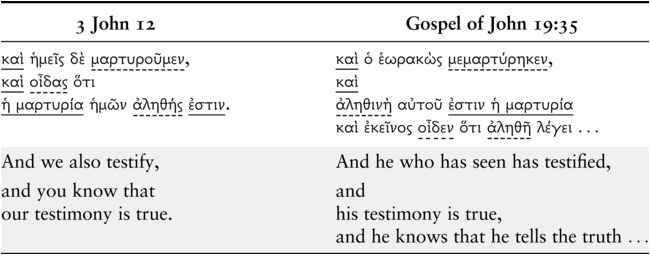
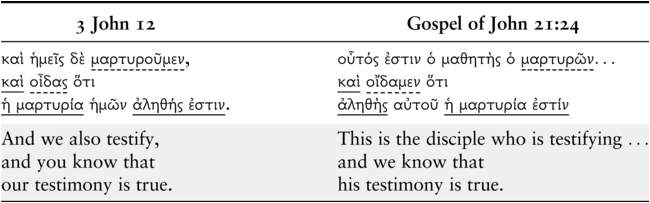
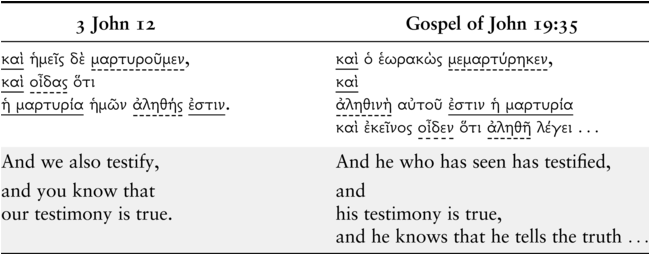
One would hardly expect a common formal or structuring element in texts as different as the Gospel and 3 John. One, after all, is an extended narrative account; the other is a brief letter that adheres tightly to ancient epistolary conventions. And yet, the two texts do share a specific literary convention – namely, narratorial affidavits. These affidavits also follow a particular pattern: the narrator first “testifies” to a fact he is writing before affirming that the “testimony” is true.
Two such affidavits appear in the Gospel: the first in chapter 19 and the second in chapter 21, a chapter likely to be a secondary addition to the text. Interestingly, the affidavit in 3 John melds elements of these parallel texts in a clear example of conflation. That affidavit is structurally comparable to the one in John 19:
But the affidavit in 3 John also shares important features with the one in John 21, specifically, (a) the use of the first plural (“we”) and (b) the idea that some party “knows” the “testimony is true”:
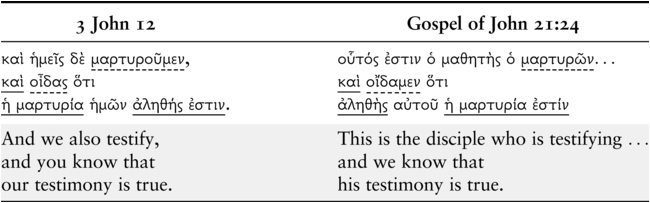
As Hans-Joseph Klauck insists, the similarities between the affidavits in the Gospel and 3 John leave “no doubt” of “a relationship between these texts.”87
Beyond conflation, another feature of 3 John’s affidavit suggests its derivative character: it is situated in a very different context and deployed for very different ends from those of its counterparts in the Gospel. The two affidavits in John find a background in depositions of eyewitness testimony, in which witnesses to an event swear to the historical accuracy of their reports.88 In John 19, the narrator introduces his affidavit parenthetically to confirm the historicity of an unusual narrative detail, namely, that when “one of the soldiers pierced [Jesus’] side with a spear … there came out blood and water” (19:34). (The extraordinary presence of “water” here is a supernatural sign meant to confirm Jesus’ earlier teaching that those who believe will have the “living water” of the Spirit within them [7:38–39].)89 Accordingly, the narrator self-consciously insists on the eyewitness origins and reliability of his account: “he who has seen this has testified, and his testimony is true, and he knows that he tells the truth” (19:35).90 The affidavit in John 21 serves the same function, confirming the historical accuracy of the descriptions that precede it. By contrast, 3 John wrests the formula from this matrix, stripping it of any connection to historical reporting. Instead, it deploys the formula in a very different context: the recommendation of a third party.91 The Elder validates the credentials of a man named Demetrius: “Demetrius is well spoken of by everyone… We also testify, and you know that our testimony is true” (3 John 11–12). Here we have a classic fingerprint of literary borrowing: similar expressions employed differently.
Verbal Overlap
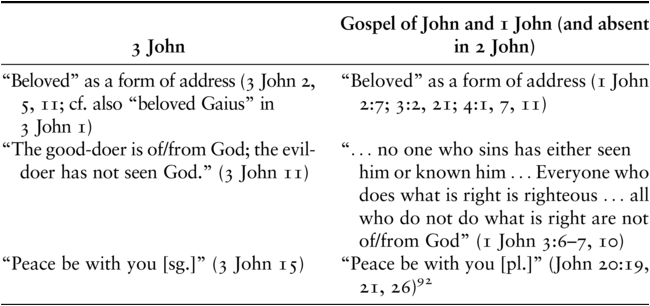
Besides the above, 3 John shares other – specifically, verbal – forms of overlap with the larger Johannine texts not shared with 2 John:
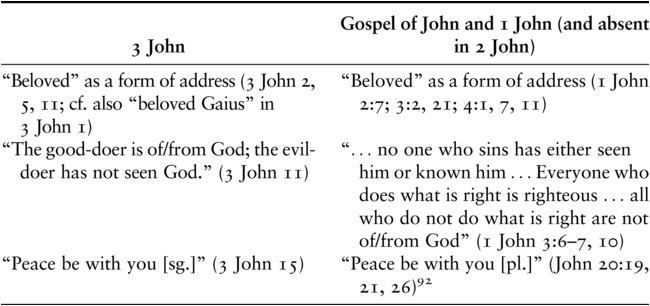
The first of these parallels provides solid evidence of a direct relationship between 3 John and 1 John. The specific term “beloved” (ἀγαπητός) appears nowhere else in the Johannine corpus except in these two letters, each of which uses the term as the narrator’s regular, even preferred, form of address for his readers.93
2.2.3.3 Overlap with 2 John
As interesting as 3 John’s overlap with the larger Johannine texts is, its correspondences with 2 John are far more extensive. I have highlighted several macro-similarities between the two letters; the two are of roughly the same length, and both adhere tightly to a standard Greek epistolary form. But the two texts also share strong linguistic ties, veering multiple times into verbatim or near-verbatim similarities.
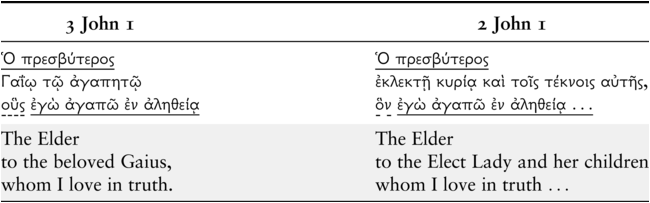
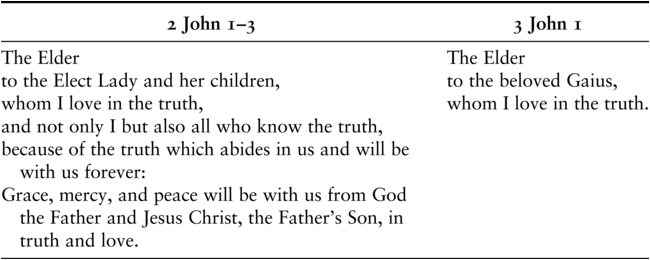
Those similarities begin to take shape in the prescripts of both texts. The two letters depart from the traditional form of Greek prescripts by adding a highly distinctive element. In each, the Elder describes his addressee as one “whom I love in truth”:
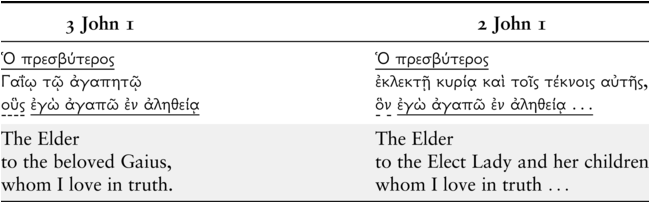
The expression draws apparent inspiration from 1 John 3:18, which encourages the “little children” to “love … in deed and truth” (ἐν ἔργῳ καὶ ἀληθείᾳ).
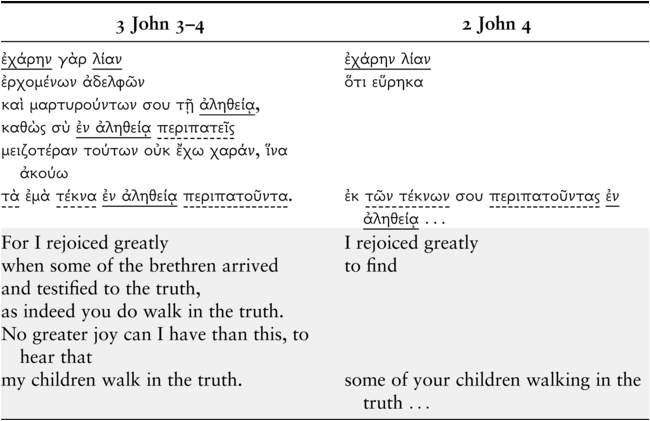
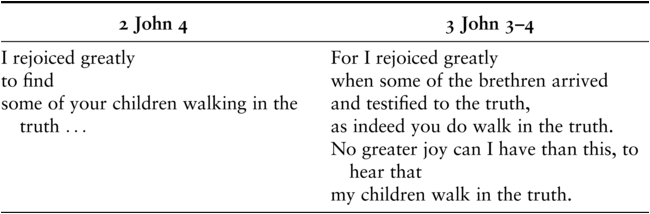
These parallels continue into the body of each letter. In both 2 and 3 John, the Elder opens his correspondence by claiming that he “rejoiced greatly” upon receiving good reports that certain “children” “walk in the truth” (2 John 4; 3 John 3–4). The fact that both letters open with such statements is not unusual; it was a standard convention of ancient Greek letter writing to open one’s correspondence with a reaction to recent reports by messengers, letters, or other sources about the other party in the correspondence.94 What is unusual, however, is that both statements communicate the same essential idea, with an unmistakable likeness in thought and language:
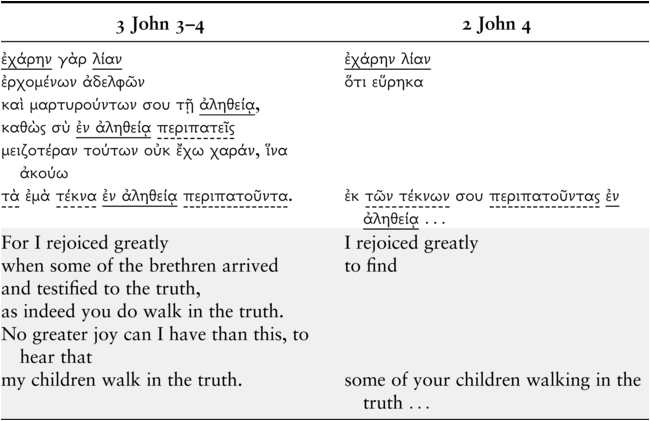
Two features of these lines enhance the case for contact between them. First, the language of “walking in the truth” is highly distinctive, occurring only in 2 and 3 John. (The closest analogs in the larger Johannine texts are articulated around images of light/darkness, specifically, “walking in the light/darkness” [1 John 1:6–7; 2:11; 8:12; cf. John 12:35] and “walking in the day/night” [John 11:9–10]). Second, the language appears in both epistles precisely and only at this juncture. And last, despite sharing that highly distinctive phraseology, the two passages employ this expression differently. In 2 John, the Elder rejoices “to find some of your [i.e., the Elect Lady’s] children walking in the truth”; in 3 John, by contrast, the Elder explains that he has “no greater joy” than to hear “that my children walk in the truth.” This variance means we cannot trace the linguistic overlap to a single, stock, letter convention; no such convention is evident here. Instead, we have a similarity-in-difference very much suggestive of the imitator’s craft, in which critical words are arranged into new patterns or applied in different ways.
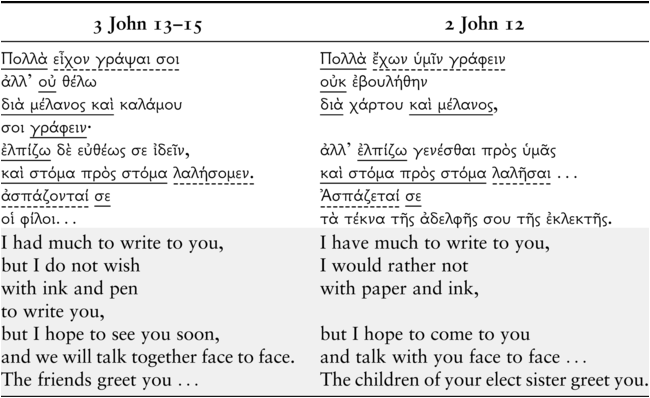
Similar observations apply to the last and most significant site of overlap between these letters, namely, their postscripts. These sections contain the densest concentration of verbatim correspondence in the epistle, with some 17/27 words agreeing (62.9%), including a five-word string:
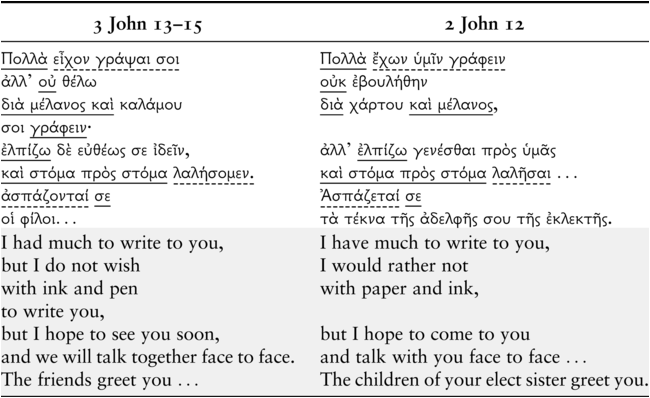
At first glance, this level of similarity may not seem remarkable; after all, one expects some formulaic language in the framing sections of letters. But minute differences between these passages suggest the deliberate, surgical adaptations typical of an imitator. The phrase “write … with paper and ink” in 2 John – the sort of phrase we would expect an author would take up as a stock formula or expression – is instead reversed (“ink and pen”) with a minute substitution (“paper” for “pen”) in 3 John. (Compare the similar reversals we saw between 1 Thess. 2:9 and 2 Thess. 3:8.). Other rearrangements and substitutions also pepper the two passages.
2.2.3.4 Direction of Influence
In light of the above evidence, it is safe to situate 3 John within the same literary chain as the other works. But where does it fit in this chain? Is it an early text or a late text? In my view, it is almost certainly the last of the four texts to be written.
3 John and the Longer Johannines
We have every reason to conclude that 3 John was written after the Gospel of John and 1 John. First – and this point cannot be stated enough – it is prima facie difficult to assign priority to a text that enters the historical record no earlier than the third century, and even then, only in a fragment appearing in a fourth-century source. But it is virtually unthinkable to do so when we know that the text was held as suspect according to the earliest writers to cite it and for centuries after. None of this suits the image of 3 John as the earliest document, modeled by the other better-established texts.
Second, when we recognize that 3 John must be linked to other texts in direct, literary relationships, we must contend with the fact that 3 John makes little sense as a possible model or source text for the Gospel and 1 John. It is highly unlikely that a single, stray personal letter almost devoid of theological engagement would spur a literary tradition of the kind and scope of the Johannine literature. But even if we insisted on this possibility, we would be surprised by how little 3 John would have directly contributed to the other texts. We would be puzzled, for example, by the absence of some of 3 John’s core expressions in the other Johannine texts – certainly the repeated term “church,” but also other salient expressions in the letter (e.g., “the Name” as a designation for God, “good-doers,” “evil-doers,” and “soul prospering”). We would also be surprised to see such pivotal expressions as “walking in the truth” and “Elder” passed over by the Gospel and 1 John, but somehow incorporated in 2 John – a text modeled after them. In the end, all that makes 3 John distinctive points to it being a later and peripheral entrant in the Johannine lineage, not a core text.95
3 John and 2 John
If 3 John does not predate the Gospel of John or 1 John, we should situate it on or near the stratum occupied by 2 John. This position suits the close kinship of these letters in other respects, from their strong verbatim similarities to their troubled reception histories. But did 3 John precede 2 John? Or did 2 John precede 3 John? The question is not easy to answer because the texts in question are so brief.
One attempt to break this stalemate contends that 3 John may be the earlier text because it sometimes has simpler – arguably, more primitive – language. Consider, for example, how much more elaborate the opening verses of 2 John are than the opening of 3 John:
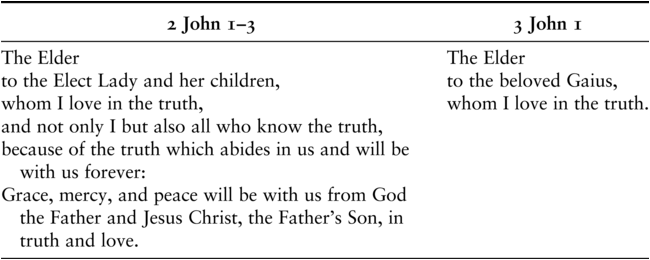
Citing these verses, Judith Lieu claims that the likeliest evolutionary route would have started with a brief text and moved to a more elaborate one.96 In his work on literary dependence in the gospels, however, Mark Goodacre cautions against correlating brevity and simplicity with earlier sources. “In source criticism,” he notes, “there is no such rule as ‘the simpler, the earlier.’ [Authors] may well expand material they inherit; they may distill or summarize it. Earlier sources may feature more elaborate material; they may feature less elaborate material.”97
Applied to the case before us, it is possible that 2 John elaborated the bare prescript of 3 John. But the opposite is also possible; it may be that 3 John merely opted to take only the essential features of 2 John’s prescript, leaving those materials it deemed extraneous behind. Notably, 2 John’s prescript is longer than non-Christian examples in the same period, many of which avoid extended honorifics and elaborate greeting formulae.98 One can imagine that the author of 3 John shortened his prescript to conform more closely to these ancient examples, if not for stylistic reasons, then for efficiency in a letter meant to fit onto a single papyrus sheet. Note too that many pseudo-historical or literary letters from antiquity – a category in which I will place 3 John – omit the conventional greeting.99
The decisive blow against Lieu’s appeal to primitivity, however, is the fact that this appeal cannot be carried through consistently. In another section, 2 John has the simpler language, and 3 John seems to elaborate that language with trite uses of quasi-Johannine expressions, specifically, “testified to the truth” (cf. John 5:33; 18:37) and “(no) greater X” (cf. John 15:13):
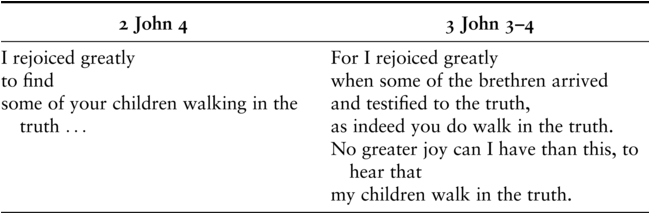
In short, these comparisons produce ambiguous results.
If we cannot rely on this sort of internal data, we might consider other data, beginning with the reception history of these letters, and just as well.100 That reception history has proven fairly accurate so far, producing the very ordering we have reconstructed so far (John, then 1 John, then 2/3 John). Interestingly, that reception history suggests 2 John’s priority over 3 John. Recall again that our earliest mention of 2 John predates our earliest mention of 3 John by half a century. Although it is possible that our many second-century sources merely overlooked 3 John, it is also possible that 3 John did not exist until the late second or early third century. In this case, we should also be reluctant to claim 3 John preceded 2 John.
The idea that 2 John was probably written before 3 John also finds support in sources that suggest that 1 and 2 John sometimes circulated together without 3 John. Again, several writers – among them, Irenaeus, Clement of Alexandria, and the author of the Muratorian Fragment – only mention 1 and 2 John. And as we saw, certain manuscripts show minute differences in the translation of 1 and 2 John on the one hand and 3 John on the other. Tellingly, we do not find evidence of the converse; that is, there are no indications that 1 and 3 John ever circulated together without 2 John. This state of affairs presents a challenge for those who would argue that 3 John was the earlier and more secure text – a text so authoritative by the time 2 John was written that the author of the latter would seek to co-opt its authority. The most plausible scenario is that 2 John entered circulation before 3 John. The evidence, as limited as it is, moves in only one direction.
We do not have to build this case on external data alone, however. As I see it, one other internal feature of the two texts makes 2 John’s priority even more likely, namely, the fact that both letters refer to their narrators in shadowy terms as “the Elder.” This epithet is consistent with the style of 2 John, which uses vague epithets throughout (e.g., “Elect Lady and her children,” “Lady,” “children of your elect sister”). By contrast, it sits less comfortably within 3 John, which always assigns proper names to individual characters (“Gaius,” “Diotrephes,” and “Demetrius”).101 Most likely, 2 John pioneered the use of the title “Elder” before 3 John later co-opted it.
2.2.4 Number of Authors
When we examine the texts closely, it becomes clear that the similarities between the four Johannine texts are not coincidental. Instead, these works were produced through processes of direct literary borrowing. Individual authors imitated the style and language of earlier works when developing their own. The only question that remains, then, is how many authors are represented in the collection.
Occam’s razor would incline us to hypothesize as few authors as possible, all things being equal. In this case, however, all things are not equal. When we examine the four texts closely, it is hard to avoid the conclusion that the Gospel and Epistles are the literary products of four distinct authors, one each for John, 1 John, 2 John, and 3 John. We need three authors to make sense of the literary borrowing of (a) 1 John from John and (b) 2 John from 1 John. But given the distinct linguistic profile of 3 John and the evidence of 3 John’s use of 2 John, we have ample ground to posit a fourth hand in the collection.
Positing four authors for the Gospel and Epistles of John makes good sense for one other reason. One point that is not remarked upon enough is how different the Johannine works are from one another despite the many literary parallels between them.102 We explored the traits that distinguish the Gospel from the Epistles in Chapter 1, but the Epistles are also remarkably different from one another. In terms of language, we can contrast 1 John – a text riddled with grammatical peculiarities and a convoluted style – with the smoother and more organized Greek of 3 John. But the differences in the form of these epistles are even more striking. First John lacks conventional epistolary features. By contrast, “no other New Testament letter, not even Philemon, has so completely the form of a Hellenistic private letter as II and III John.”103 Similarly, 1 John is starkly anonymous, never directly identifying its author or audience. By contrast, 2 John uses a system of cryptic designations; the author adopts the vague title “the Elder,” and he addresses his audience – evidently a congregation – in veiled language as “the Elect Lady” and speaks of her “Elect Sister.” And both of these strategies stand in dramatic contrast to 3 John, which speaks in concrete terms of “churches” and freely weaves specific first names (“Gaius,” “Diotrephes,” and “Demetrius”). If a single author wrote even two of these texts, why would he adopt such profoundly different strategies across them? The likeliest explanation is that different minds composed each text.
2.3 Conclusion
At the outset of this chapter, I referred to the Gospel and Letters of John as a “family of texts.” In the end, this metaphor seems apt in more than one respect. It suits the likeness of these texts, their resemblance to one another. But it also works as a genetic metaphor, implying direct lines of relationship between them. Upon closer inspection, these texts are not independent creations; instead, they fall into a single line of descent, a single genealogy. That line of descent is literary; the authors of these texts read earlier works in the line and, crucially, imitated what they read. The Gospel of John was written before any other text, setting this literary tradition in motion. Soon after, another pen wrote 1 John, a text that incorporates dozens of distinctive expressions from the Gospel and models several of its structural features. Finally, other writers wrote the epistles we now know as 2 and 3 John.
As I have noted throughout this chapter, the idea that the four texts were produced this way hardly lies outside the mainstream of Johannine scholarship. On the contrary, most scholars assume direct links between the four texts. What scholars have failed to do is to bring this empirically grounded insight into conversation – or better, collision – with the “Johannine Community” hypothesis. If the four Johannine texts show signs of literary contact, their similarities would neither require nor demonstrate that they were all written within a common community, as so many scholars claim. Writers in very different intellectual, geographic, and/or temporal contexts could have produced similar works as long as they had access to previous models.
We might draw an analogy here to one of the best-known problems in biblical studies: the Synoptic problem. The Gospels of Mark, Matthew, and Luke share common ideas and language, but no one insists that the three were all written within the same geographical setting or narrow social matrix. The reason is simple: literary contact sufficiently explains their overlap. If the author of Matthew possessed a copy of Mark, he could reproduce any number of phrases from that text, even if he was embedded in a different religious-social-cultural matrix hundreds of miles away. We can draw another, even more helpful analogy from the relationship between the genuine letters of Paul and those pseudonymously written in his name. Like the Johannine epistles, these letters do not come from the same author, but they share many linguistic features in common. And yet, scholars do not credit their similarities to a common sociolect but to direct imitation; the pseudonymous letters written in the name of Paul deliberately imitate the language of Paul’s authentic letters to present themselves falsely as works by the same author. Lurking behind these texts is a loose lot of writers separated by geography and time – even decades and centuries.
If we build upon these insights, we have no reason to constrain ourselves to imagine only a single “community” setting for the Gospel and Epistles. Instead, we can imagine other matrices for these texts and other links between their respective authors. For example, we can speculate that the Johannine authors, like the Synoptic authors, hailed from different geographical, social, and linguistic matrices and were indirectly connected through their literary products. In this scenario, what similarities exist between their writings would be due to their access to earlier works and their desire to imitate those works.
As it stands, we already have good reason for suspecting that some or all of the Johannine texts emerged in different contexts, namely, the subtle but notable differences in outlook, ideas, and phraseology we have cataloged across this study so far. As I noted in the last chapter, those differences were crucial in building the current consensus that now assigns the Gospel and Epistles of John to more than one author. But as Hakola insists, the same “marked differences” also “suggest that the gospel and the epistles have emerged in different situations.”104 What Hakola calls evidence of “different situations” – that is, different situations in the life of a single community – might as well be something else: evidence of different “communities” (to use that expression).105 That is, the distinct linguistic and ideological traits of each text may point to their origin in different intellectual, social, and geographical contexts, just as the major and minor differences between works such as Mark, Matthew, and Thomas – works that also share direct extensive literary relationships – suggest they were written by authors of different extractions.106 When we recognize this possibility, the search for the origins of the Epistles becomes more challenging but potentially more rewarding as well. Through these letters, we are poised to see new corners of the early Jesus movement, lost for centuries but still reflected in ancient words.