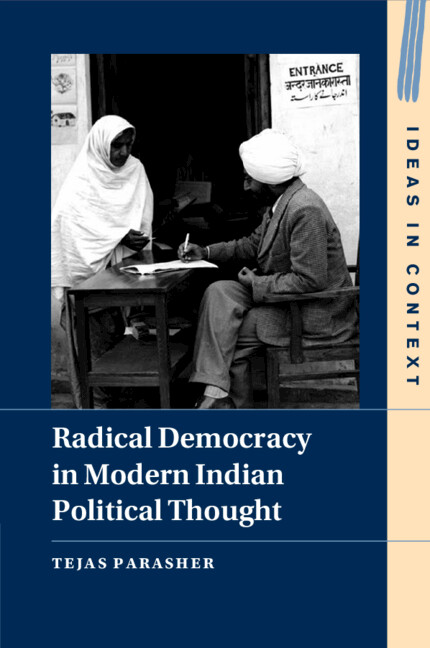

Between the 1910s and the 1970s, an eclectic group of Indian thinkers, constitutional reformers, and political activists articulated a theory of robustly democratic, participatory popular sovereignty. Taking parliamentary government and the modern nation-state to be prone to corruption, these thinkers advocated for ambitious federalist projects of popular government as alternatives to liberal, representative democracy. Radical Democracy in Modern Indian Political Thought is the first study of this counter-tradition of democratic politics in South Asia. Examining well-known historical figures such as Dadabhai Naoroji, M. K. Gandhi, and M. N. Roy alongside long-neglected thinkers from the Indian socialist movement, Tejas Parasher illuminates the diversity of political futures imagined at the end of the British Empire in South Asia. This book reframes the history of twentieth-century anti-colonialism in novel terms – as a contest over the nature of modern political representation – and pushes readers to rethink accepted understandings of democracy today.
Co-winner, 2024 APSA Foundations of Political Theory First Book Award, American Political Science Association
Winner, 2024 Political Theory Prize, European Consortium for Political Research
Loading metrics...
* Views captured on Cambridge Core between #date#. This data will be updated every 24 hours.
Usage data cannot currently be displayed.
This section outlines the accessibility features of this content - including support for screen readers, full keyboard navigation and high-contrast display options. This may not be relevant for you.
Accessibility compliance for the HTML of this book is currently unknown and may be updated in the future.
