





Nomenclature
- BPR
-
bypass ratio
- CLRT
-
conventional long-range twin (kerosene-fuelled)
- EI
-
emission index
- ERF
-
effective radiative forcing
- ESFC
-
energy-specific fuel consumption (W/N)
- ETAis
-
isentropic efficiency
- Fn
-
nett thrust (kN)
- HVLLR
-
aircraft variant – hydrogen very large aircraft long range for this aircraft HVLLR45 and HVLLR67 indicate tank gravimetric efficiencies of 0.45 and 0.67, respectively.
- nmi
-
nautical miles
- NOx
-
nitrogen oxides
- P3
-
combustor inlet pressure, kPa
- PTL
-
power to liquid sustainable aviation fuel
- RF
-
radiative forcing
- SAF
-
sustainable aviation fuels (here referring only to hydrocarbon fuels)
- SFC
-
specific fuel consumption (kg/s/MN)
- T3 or T3
-
combustor inlet temperature (K)
- T4 or T4
-
turbine entry temperature (K)
- t
-
tonnes
- $\eta_{\textrm{grav}}$
-
tank gravimetric efficiency = fuel weight/(fuel + tank weight)
-
$\Phi$
-
equivalence ratio


1.0 Objectives
Hydrogen as a civil aviation fuel is a leading option for green aviation [Reference Brewer5, 6, 8, Reference Huete, Nalianda and Pilidis13, Reference Huete, Nalianda and Pilidis14, Reference Kaufman18, Reference Rolt, Nalianda, Rompokos and Williamson33, Reference Sun and Sethi37, 40, Reference Verstraete42]. Switching jet engine fuel to hydrogen promises to decarbonise civil aviation, provided hydrogen production is carbon-free. Hydrogen also removes other harmful emissions such as unburnt hydrocarbons, aromatic compounds, sulphur oxides, soot and smoke, and has great potential for combustors designed to generate minimal NOx. Sustainability is a very high priority, and different pollutants have different impact on the environment [Reference Lee, Pitari and Grewe19]. Presently, hydrogen is viewed as just one of several options to decarbonise civil aviation. However, the use of hydrogen produced with nuclear or renewable electricity by electrolysis can deliver true-zero, holistic green civil aviation. Hydrogen presents a host of very large challenges whose solution will be very expensive. This makes it very unattractive to many, however sustainability is expected to trump economics, as in other sectors. The investigation carried out here indicates that the investments are very worthwhile for holistic environmental performance. It is also widely believed that hydrogen will demonstrate good economic performance in the longer term. The evaluation presented here assumes that it is reasonable to expect that technical issues will be resolved, and certification of hydrogen aircraft will take place. The objective of the present work is to show realistic potential rather than provide specific technical solutions.
To show the holistic environmental performance of hydrogen, this study makes two key contributions. Firstly, it challenges the logic of the globally accepted hydrocarbon SAF pathway to sustainability. It proposes our community asks some key questions and recommends that our industry accelerates along the hydrogen pathway to ‘green’ aviation. The second is a quantitative analysis of hydrogen effectiveness on non-CO2 emissions. To offer a quantitative view of non-CO2 abatement performance, a study was carried out comparing three aircraft, one conventional based on a modern, state-of the art airframe (conventional long-range twin, CLRT) and two hydrogen fuelled ones; HVLLR45 (hydrogen very large aircraft long range with tank gravimetric efficiencies of 0.45) and HVLLR67 (hydrogen very large aircraft long range with tank gravimetric efficiencies of 0.67) considered to be representative of the hydrogen first (possibly by 2035) and second (possibly by 2050) innovation waves, respectively. This multidisciplinary study encompassed the analysis of aircraft and engine performance, NOx emissions, energy consumption and route alteration to avoid contrails formation. The calculations were conducted at an appropriate level of precision to set future research and development agendas.
2.0 Hydrogen for ‘Greening’ Aviation
Figure 1a reflects a commonly held view on the two major alternatives widely proposed for net-zero aviation. Sustainable aviation fuels (SAF, a variety of synthetic and biokerosene drop-in fuels) and hydrogen. They are compared with conventional jet fuel, in terms of their carbon footprints. The left side bar shows conventional fuel. The darker part of the bar shows the carbon footprint for manufacturing or producing the fuel from crude oil and transporting it to airports. The hatched and much larger part of the bar shows the CO2 emitted in flight.
(a) Current fuel rationale. (b) Sharing carbon drawdown investment benefits.

The middle column shows the equivalent production and in-flight carbon footprints of hydrocarbon based SAFs. The darkest part of this bar, reflecting the carbon footprint of SAF fuel production, does not represent the full energy requirement to produce the SAF, which is many times larger than that of conventional fuels [34], making it much more expensive. Notwithstanding the much larger energy needed to synthesise SAFs. The production carbon footprints are similar because SAF production in a large scale envisages a major deployment of renewable and/or nuclear energy. A wide range of SAF production routes are considered, so the values shown here encompass many options and are averaged assuming the large-scale production of a range of SAFs, including power-to-liquid (PTL) electrofuels [2]. The latter rely on Fischer–Tropsch processes to combine carbon captured from the atmosphere with hydrogen from electrolysis using renewable or nuclear electricity. This produces a synthetic fuel with very similar in-flight carbon emission characteristics to conventional fuels. These power to liquid SAFs are believed to be one of very few scalable options to fully meet aviation demand. They require a similar amount of hydrogen as flying with pure hydrogen. Another alternative seen as promising is the cultivation of marine, possibly genetically modified, algae to produce biofuel feedstock for a Fischer–Tropsch process. This pathway is seen with optimism because of the high yield of algae and large areas can be devoted to cultivation without competing with food production. Furthermore, the hydrogen requirements of this option are lower. The top part of the SAF column in Fig. 1a shows the CO2 emitted in flight, a footprint that is very similar to that of conventional fuels.
The green part of the SAF column, below the axis, reflects the carbon extraction from the atmosphere associated with SAFs. This carbon extraction, or drawdown, can be via mechanical, biological, phytological, chemical and/or other means, depending on whether it is done for biofuels or PTL. This drawdown component is the basis of the environmental utility of hydrocarbon based SAFs. It is currently linked with SAF production on the basis of fiscal and legislative schemes.
The third column illustrates the use of hydrogen and shows the carbon footprint of producing hydrogen by electrolysis. No carbon is emitted in flight. Similarly to SAF production, the energy requirement to produce hydrogen is vastly larger than that of conventional fuels and envisages large scale use of electrolysers using renewable or nuclear electricity. In all cases, the boxes ‘T’ show the total net footprint of each type of fuel.
However, Fig. 1a may not be a useful way of comparing the future environmental performance of these fuels. Firstly, the manufacturing or production carbon footprints reflect the composition of existing or projected future grids. Given international commitments to decarbonise electricity grids and energy deployment, the production CO2 footprints, including that of conventional fuels, should be expected to shrink in the future.
Secondly, and more importantly, carbon drawdown technologies can be deployed for every fuel, including kerosene and hydrogen. Figure 1b illustrates this fact. It then becomes clear that the environmental benefits for conventional fuels and hydrogen, could be greater than for SAF. In Fig. 1b the carbon drawdown columns have been illustrated to be of the same size. If the CO2 is not used in Fischer-Tropsch, then it will need to be sequestrated instead, to provide the carbon offset. The energy and cost of sequestration should be considered. There is limited potential for pumping CO2 underground and separating carbon will consume significant amounts of renewable energy. Even just a few per cent of that (for aviation) will impose great requirements. On the other hand, the effectiveness of drawdown could be better if no compromises have to be made to deliver fuel-suitable feedstocks. Furthermore, there is the issue of scale independence; if the carbon drawdown is not needed for fuel production, the columns for conventional fuels and hydrogen could be made larger or smaller. The topic of drawdown deserves much more investment and attention than it is receiving at the moment.
Thus, several questions must be asked: should our community divert part of the large SAF investments into the acceleration of drawdown technologies, while using conventional fuels? Wouldn’t this approach neutralise the carbon footprint of conventional fuels as effectively as SAFs? Should the remaining investments to produce SAFs be diverted to accelerate the development of hydrogen-based propulsion technologies to fully decarbonise aviation in the longer term?
The above indicates the aviation carbon mitigation of hydrogen is superior to other alternatives. Furthermore, in terms of non-CO2 emissions, hydrogen has much better potential to reduce NOx emissions, and there are techniques (equally helpful with other fuels) that can be used to abate contrails and cirrus clouds. Finally, the global warming potential of the additional amount of water vapour emitted during flight is expected to be negligibly small compared to CO2 at standard 35,000 ft cruising altitude, while cruising at altitudes lower than it is practically zero [Reference Sasi, Mourouzidis, Roumeliotis, Nikolaidis, Pachidis and Normal35, Reference Svensson, Hasselrot and Moldanova38], making hydrogen a holistic green fuel.
3.0 The Three Aircraft of the study
The need to decarbonise is urgent and ‘green’ aircraft may be introduced in innovation waves [Reference Huete, Nalianda and Pilidis13]. In the first wave, existing state of the art technology would be used to permit a viable aircraft to enter service as soon as possible. For the first innovation wave, operationally viable aircraft would not be economically competitive without incentives like those provided for the early development of renewable electricity. The focus of the very large research and development (R&D) investments would be around the implementation and certification of the hydrogen fuel systems, to ensure the excellent safety record of civil aviation is not compromised in any way.
A major challenge with the use of hydrogen is the low density of the fuel, even in its liquid form. The fuel is to be stored at 21.5 K and 2–3 bar so insulation will require a great deal of attention. Tank design philosophy was based on analytical studies from previous Cranfield work [Reference Goldberg, Nalianda, Singh and Pilidis9–Reference Goldberg, Nalianda, MacManus, Pilidis and Felder11, Reference Huete, Nalianda and Pilidis13, Reference Rolt, Nalianda, Rompokos and Williamson33]. Tanks need sufficient insulation to reduce heat leakages into the liquid hydrogen so that there is no need for an active cooling system, or venting of hydrogen gas, during normal operation. The tanks considered here include aluminium alloy double-walled vacuum-insulated tanks with boil-off rates below 0.15% per hour. The weight of the tanks, for the first innovation wave, is 1.22 times the weight of the hydrogen inside. This results in a gravimetric efficiency (ratio of weight of hydrogen to weight of hydrogen plus tank) of around 45%. This value is adopted for the aircraft of the first innovation wave analysed here. For the second innovation wave the gravimetric efficiency with foam-insulated tanks is conservatively assumed to be 67%. Widebody designs will permit a more effective implementation of hydrogen because they can house larger tanks for increased design range, made viable by the higher gravimetric efficiency [Reference Huete and Pilidis15]. It is expected that with investments in research and development, gravimetric efficiency could be increased to over 70% in the second and later innovation waves. The third innovation wave is expected to use the cryogenic properties of hydrogen in synergy with superconducting electrical systems to permit the integration of turbocryoelectric systems to give better efficiency than can be achieved with conventional fuels or SAFs.
Figure 2 shows the airframe of the aircraft used for the study [Reference Huete, Nalianda and Pilidis14]. The aircraft has two decks and a hold below. The mid-deck is wider than the top one and is used for fuel tanks. The top deck is used for passengers. This model, the HVLLR, was selected from the four variants originally examined. The estimated vehicle capability, of the family for an introduction accelerator philosophy, is good. It does not match the payload or the very high ranges of current aircraft using conventional fuels, but it fares very well as an introductory accelerator technology to decarbonise aviation. Furthermore, the range offered covers 97-98% of existing aircraft departures and accounts for 90% of total fuel consumption. Table 1 shows details of the proposed aircraft and a comparison with a hypothetical long-range twin it would compete against.
Top level aircraft weight breakdown

HVLLR airliner. Image courtesy [21], modified by the authors [Reference Huete, Nalianda and Pilidis13].

For the present study, two versions of HVLLR (Figs 2 and 3) are selected for evaluation and comparison with a conventionally fuelled long-range twinjet twin aisle airliner of a similar passenger capacity, the CLRT. HVLLR45 corresponds to the first innovation wave and HVLLR67 to the second; the hydrogen tank gravimetric efficiencies are 0.45 and 0.67, respectively. The three aircraft have the same passenger carrying capacity but the design range of HVLLR45 is 4800 nmi, HVLLR67 somewhat longer, while the conventional aircraft has a range of 8700 nmi. The two HVLLRs can achieve the long-range capability of the CLRT with one stop. These aircraft are evaluated in four case-study flights of approximately 1000, 2000, 4000 and 8000 nmi.
HVLLR layout image: Ssolbergj and Tillier Creative Commons licenced, modified by the authors.
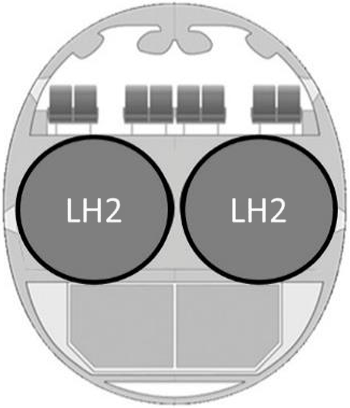
The aircraft are not exactly comparable, but an objective of the investigation is to permit the use of very similar turbofan engines to compare CO2 and non-CO2 emissions integrated on aircraft of similar passenger capacities. HVLLR45 and HVLLR67 use the same engine here.
4.0 The powerplants
The selected base powerplant is the Cranfield interpretation of a modern three-spool turbofan [16, 31], including local evaluations based on performance techniques [Reference Palmer and Pilidis28] and models [Reference Nikolaidis26]. This gas turbine uses conventional fuel and is the powerplant used for the conventional aircraft. This turbofan was used as the baseline for the hydrogen-fuelled turbofan of this exercise. The products of hydrogen combustion in air have different properties to those exhibited by the combustion products of conventional fuel (Fig. 4). In particular, the specific heat (Cp) is higher, permitting a greater work output for a given turbine pressure ratio. This feature could be exploited in different ways.
Comparison of specific heat of conventional kerosene fuel and hydrogen combustion products with temperature and equivalence ratio. Cranfield evaluation using Wagner and Pruß [Reference Wagner and Pruß43].
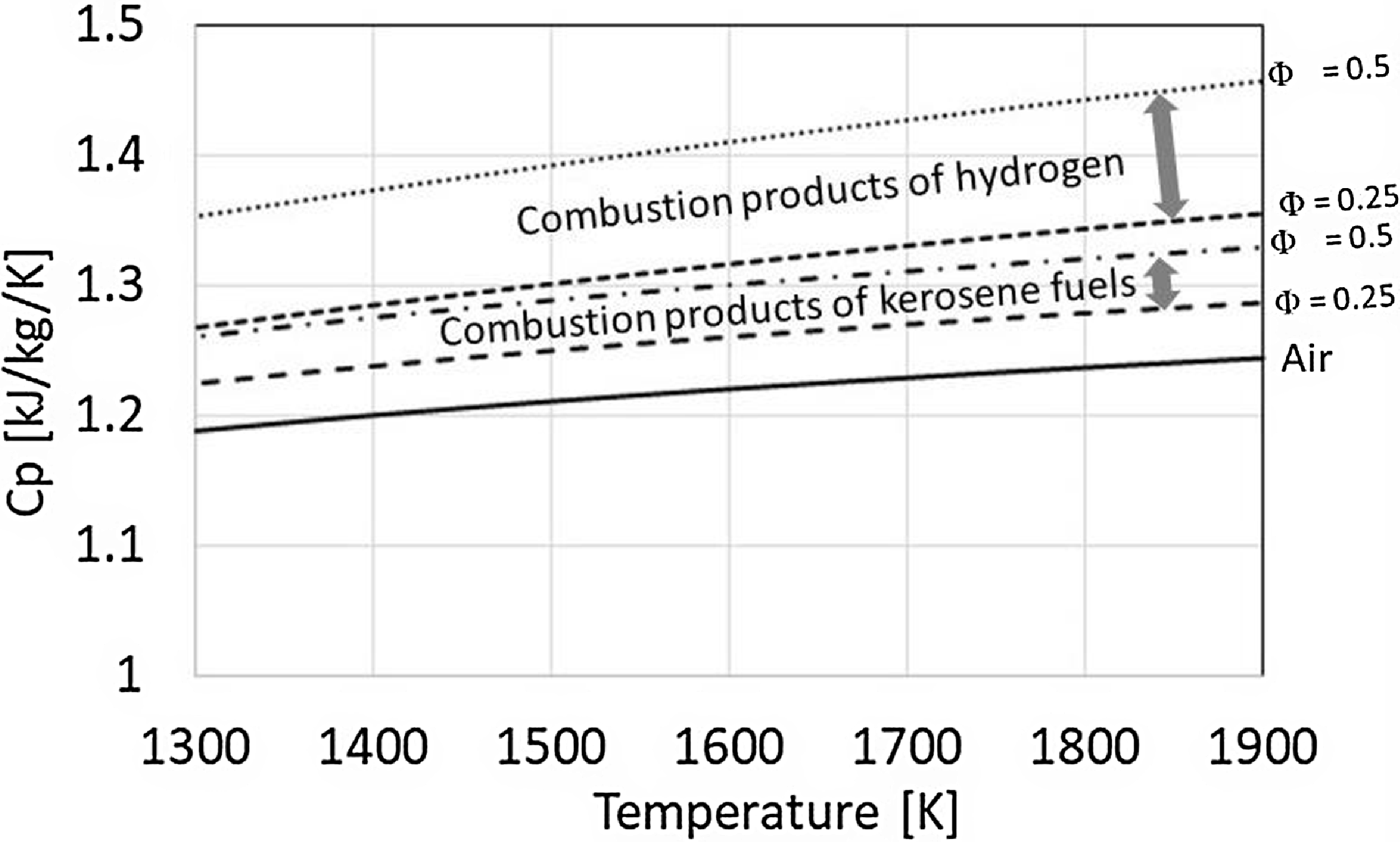
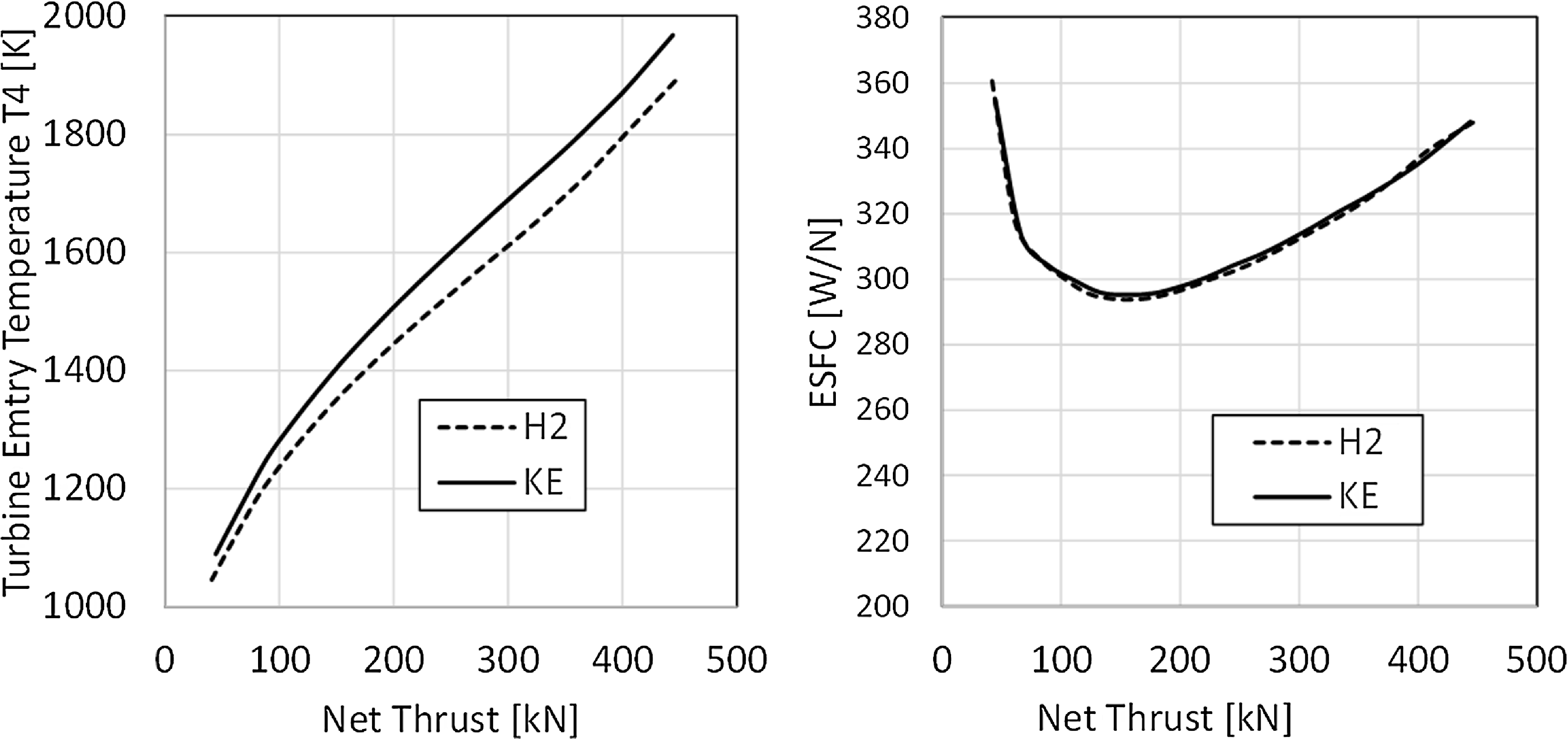
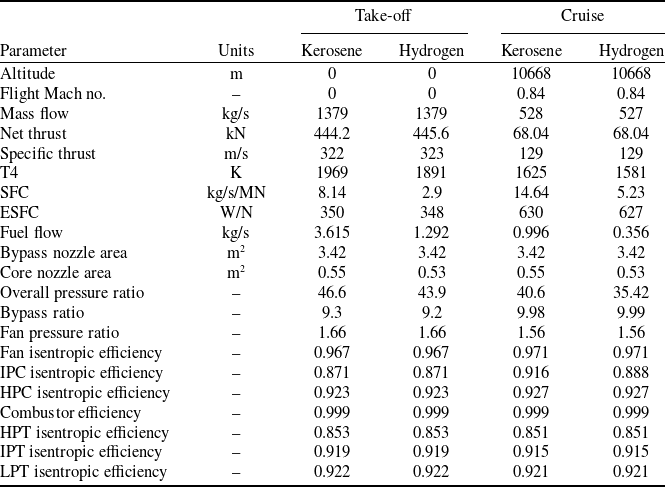
Given the emphasis of the present study, the hydrogen powerplant was envisaged with the primary objective of reducing the turbine entry temperature (T4), while keeping the same fan diameter and delivering about the same ESFC across a wide operating range. Naturally this is not the only design choice to capitalise on the opportunities opened by hydrogen, but it is a useful one considering that one of the focal points of this study is NOx. Table 4 shows the characteristics of both powerplants at the take-off and cruise conditions. The lower T4 of the hydrogen-fuelled turbofan is evident. The engine mass flow is the same and this is taken as the indication that the fan diameter is the same. Figure 5 shows the comparative T4 and ESFC of the two turbofans.
Comparison of standard day T4, and ESFC vs Thrust for the conventional (KE) and hydrogen (H2) turbofans used in the study.
5.0 Non-CO2 Emissions and abatement Strategies
In this study two key non-CO2 pollutants are considered nitrogen oxide emissions and contrails. To abate NOx the strategy of Sun et al. [Reference Sun and Sethi37] and Rolt et al. [Reference Rolt, Nalianda, Rompokos and Williamson33] is adopted here, assuming it reaches mature status. Hydrogen, contrary to the beliefs of many [34], offers great opportunities to abate NOx. The strategy to avoid contrails is that advocated by many experts, for example Teoh et al. [Reference Teoh, Schumann and Stettler39], based on judicious changes of altitude to avoid contrail forming regions in the atmosphere.
Four factors, after significant research and development, are expected to enable lower combustion NOx emissions with hydrogen than hydrocarbons. First, as shown in the previous section 4.0, the hydrogen powerplant can have a similar cycle with a lower T4. In the present case it is of the order of 50 K. Second is the opportunity to use the favourable low-equivalence ratio stability features to design a combustor with a much leaner flame and a lower flame temperature. Within the EU project ENABLEH2 [Reference Rolt, Nalianda, Rompokos and Williamson33, Reference Sun and Sethi37] combustors with ‘micromix’ mini-injectors were explored to achieve low NOx. The third opportunity for low NOx combustor designs opened by hydrogen is that the characteristics of the flame permit a lower residence time in the component. Figure 8 illustrates, in a semi qualitative manner, the impact of residence time on NOx formation. The fourth opportunity arises from the injection of fuel as a gas, with its inherently better opportunities for mixing fuel and air.
The chart shown in Fig. 6 compares the combustion temperatures of hydrogen and conventional fuel for a range of equivalence ratios, including dissociation effects. This figure clearly shows that, at the same equivalence ratios, hydrogen delivers higher flame temperatures because hydrogen enables higher energy addition for each molecule of oxygen in the combustion process. This observation may explain why there is a common misconception that hydrogen will give rise to higher flame temperatures and NOx emissions than conventional fuels.
Temperature as a function of equivalence ratio for hydrogen and conventional fuels [Reference Brand, Sampath, Shum, Bayt and Cohen4] plus author’s annotations.

Using the lower T4 (Table 2) results of the present study, conceptually, four grey arrows (T4H – for T4 Hydrogen, TFH – for flame temperature hydrogen, T4K – for T4 conventional fuel and TFK for flame temperature conventional fuel) have been added to the chart in Fig. 6 to show a large reduction in flame temperature that may be possible capitalising on the properties of hydrogen. Based on the figure, the approximate temperature reduction could be between 150 and 200 K. Such reduction can have a significant impact on NOx emissions. This is possible because hydrogen gas turbines can run with lower T4 at the same overall thermal efficiency, and (assuming the technology is mastered) should run much leaner due to the much wider range of flame stability. Also notable from this image, is the much lower equivalence ratio where the hydrogen flame will be stable. This is key to designing a hydrogen combustor with significantly lower NOx emissions.
Cycle parameters of the turbofans used in this exercise
All these features combined, once the technology is mastered, should enable the delivery of very low NOx combustor designs. A notional design is shown in Figs 7 and 8. This micromix design incorporates a very large number of fuel injectors of a very small size (0.3 mm) to allow the careful introduction of the fuel through many orifices to enhance mixing and reduce NOx.
NOx production vs residence time at different temperatures. Adapted from Lefebvre & Ballal [Reference Lefebvre and Ballal20].

A low NOx hydrogen combustor concept courtesy (ENABLEH2, 2023).

When the powerplants of the study were analysed, notable is the comparison of equivalence ratios of the conventional one with the hydrogen one. Figure 9 shows the overall combustor equivalence ratio of the two powerplants of the study where for most of the operational range the hydrogen combustor will be operating above the stability limits of the fuel, while the reverse is the case with the kerosene fuel combustor. This opens avenues of combustor design, staging and control that can yield lower flame temperatures than conventional combustors, many challenges will need to be met, for example liner cooling. In a conventional combustor staging will be required where part of the flow will deliver high flame temperatures, emitting NOx. Figure 7, shown here as a qualitative indicator, illustrates how NOx emissions are influenced by residence time in the combustor. Hydrogen, with its higher flame velocity should, again after extensive research, deliver shorter combustors with low dilution and lower residence times producing lower NOx than hydrocarbon fuels.
 \begin{align}{\textrm{EINO}{x}} = 0.007549{*}{T_4}{*}{\left( {\frac{{{P_3}}}{{3027}}} \right)^{0.37}}{*}{e^{\frac{{1.8{T_3} - 1471}}{{345}}}}{*}{e^H}\end{align}
Juxtaposition of combustion properties and powerplant operability.

Equation (1) – used for future NOx predictions of conventional fuel combustors for dry air. Attributed to Antoine and Kroo [Reference Antoine and Kroo1] and Lukachk and Waltz [Reference Lukachk and Waitz22] and adjusted for units (K for temperature and kPa for pressure).
 \begin{align}{\textrm{EINO}{x}} = 0.0756*P_3^{0.4}*{e^{\frac{{{T_3}}}{{191}}}}*{{\Phi }^{1.95}}*{e^H}\end{align}
Equation (2) – used for future NOx predictions of hydrogen gas combustors for dry air. (ENABLEH2 2023 D3.3)
Hydrogen-low NOx technology is in its infancy but, given the above, hydrogen promises combustor design with lower NOx than conventional fuels. The remarkable and continuous progress achieved by civil aviation following extensive research, development and implementation of novel concepts, instils optimism that success will materialise with R&D investments like ENABLEH2 [Reference Rolt, Nalianda, Rompokos and Williamson33, Reference Sun and Sethi37]. Given that the objective of this investigation is to explore potential rather than to deliver a combustor design the assumption is made that within 15 years, R&D investments will permit operational deployment of low-NOx hydrogen gas turbine combustion technology. There is an expectation that abatement technologies will also significantly reduce the NOx emissions of turbofans using conventional fuels.
Figure 10, among other things, shows regulations and expected improvements by 2050. NOx emissions from the International Civil Aviation Organisation (ICAO) emissions database for kerosene-fuelled hypothetical powerplants (with and without water injection) plus two 2050 (turbofan and geared open rotor) engines predicted using Equation (1) are plotted against Committee on Aviation Environmental Protection (CAEP) limits. Dp/Foo is the ratio of pollutant mass emitted over the standard landing and take-off (LTO) cycle, to the sea level static thrust. The favourable outcomes of the two future engines were ascertained after careful evaluations and encompassed in the algorithm of Equation (1).
NOx emissions (ICAO emissions database) for kerosene-fuelled hypothetical powerplants (composite picture from Rolt [Reference Rolt32] and Block Novelo [Reference Block Novelo3]).

Within ENABLEH2 (2023 D3.3) a similar study was conducted to deliver an equivalent algorithm for hydrogen. This is shown in Equation (2). These algorithms are for dry air. Assuming a relative humidity of 60%, the curve fit equation of ${e^H}$
against altitude (km) is defined in Equation (3) (Ref, (Reference Sun and Sethi37) based on Ref. (Reference Norman, Lister, Lecht, Madden, Park, Penanhoat, Plaisance and Renger27)). These equations were considered to be suitably representative and were adopted in this evaluation.
${e^H}$
against altitude (km) is defined in Equation (3) (Ref, (Reference Sun and Sethi37) based on Ref. (Reference Norman, Lister, Lecht, Madden, Park, Penanhoat, Plaisance and Renger27)). These equations were considered to be suitably representative and were adopted in this evaluation.
 \begin{align}{e^H} = 1.0 + \;0.03354*{\textrm{Altitude}}\; - \;0.00299*{\textrm{Altitud}}{{\textrm{e}}^2} + \;0.000089*{\rm{Altitud}}{{\rm{e}}^3}\end{align}
The other non-CO2 emission analysed here arises from the observation that aircraft flying at cruise altitudes are known to contribute to global cloudiness through the formation of persistent contrails. Persistent contrails, essentially thin line-shaped ice clouds are formed due to mixing of the warm water vapour emitted from the engine with ambient air at low temperatures. This may then lead to local liquid saturation, followed by the condensation of water on ambient aerosols and exhaust particles (essentially soot), also emitted from the engine, and freezing. Contrails are created at high altitudes (above ∼8 km), where the ambient conditions favour their formation. Contrails that last for more than ten minutes are referred to as persistent or long-lived contrails and those that exist for shorter periods of time are referred to as non-persistent or short-lived contrails [Reference Kärcher17]. Persistent contrails may also tend to spread and hence cover a large area, while no longer retaining their linear shape. Once they grow wider, they are referred to as contrail cirrus clouds. Persistent contrails and contrail cirrus clouds are known to cause an energy imbalance in the atmosphere between the incoming solar radiation and the outgoing infrared radiation, which can be quantified using metrics such as radiative forcing (RF) or effective radiative forcing (ERF), both expressed in ${\rm{mW}}/{{\rm{m}}^{}}$
. A positive RF indicates that heat is trapped in the atmosphere and will contribute to global warming [Reference Kärcher17]. As per current estimates the RF attributed to contrail cirrus is estimated to be 111.4
${\rm{mW}}/{{\rm{m}}^{}}$
. A positive RF indicates that heat is trapped in the atmosphere and will contribute to global warming [Reference Kärcher17]. As per current estimates the RF attributed to contrail cirrus is estimated to be 111.4 ${\rm{mW}}/{{\rm{m}}^{}}$
albeit, with a large uncertainty (33–189
${\rm{mW}}/{{\rm{m}}^{}}$
albeit, with a large uncertainty (33–189 ${\rm{mW}}/{{\rm{m}}^{}}$
) associated with the value and the confidence levels indicated as low [Reference Schumann36]. While the uncertainty in the estimation has significantly reduced over the years (±70%), the effect is still considered to be much higher than CO2, which has an estimated RF of 34.3
${\rm{mW}}/{{\rm{m}}^{}}$
) associated with the value and the confidence levels indicated as low [Reference Schumann36]. While the uncertainty in the estimation has significantly reduced over the years (±70%), the effect is still considered to be much higher than CO2, which has an estimated RF of 34.3 ${\rm{mW}}/{{\rm{m}}^{}}$
, with a significantly lower uncertainty and high confidence level in the estimation (31-38
${\rm{mW}}/{{\rm{m}}^{}}$
, with a significantly lower uncertainty and high confidence level in the estimation (31-38 ${\rm{mW}}/{{\rm{m}}^{}}$
).
${\rm{mW}}/{{\rm{m}}^{}}$
).
The Schmidt–Appleman criterion is used to predict the formation of contrails, attributed to the increase in relative humidity (RH) that may occur in the exhaust plume as a consequence of the mixing of the high temperature and moist (but unsaturated) exhaust gases with cold air prevalent at high altitudes [Reference Schumann36]. The criterion is used to predict the threshold temperature for contrail formation. This depends on the ambient relative humidity, temperature and the parameter G, which may be calculated using the following Equation (4).
 \begin{align}G = {{{c_p}\;p{\rm{\;}}} \over \varepsilon }{{E{I_{H2O}}} \over {\left( {1 - \eta } \right)Q}}\end{align}
In Equation (4), ${c_p}\;$
is the specific heat capacity of air; p is the ambient pressure;
${c_p}\;$
is the specific heat capacity of air; p is the ambient pressure; $E{I_{H2O}}$
is the water emission index (EI) of the fuel or quantity of water produced per unit of fuel burnt; ε is the molar mass ratio of water and air (0.622); η is the engine overall propulsion efficiency (which is a function of the true air speed and performance characteristics of the aircraft) and Q is the fuel heat value. The water emission index is an important parameter in the equation. For kerosene this parameter is approximately 1.26, which means the combustion of 1 kg of kerosene will produce 1.26 kg of water, but when hydrogen is burned in the gas turbine, the emission index is 9.0.
$E{I_{H2O}}$
is the water emission index (EI) of the fuel or quantity of water produced per unit of fuel burnt; ε is the molar mass ratio of water and air (0.622); η is the engine overall propulsion efficiency (which is a function of the true air speed and performance characteristics of the aircraft) and Q is the fuel heat value. The water emission index is an important parameter in the equation. For kerosene this parameter is approximately 1.26, which means the combustion of 1 kg of kerosene will produce 1.26 kg of water, but when hydrogen is burned in the gas turbine, the emission index is 9.0.
The contrail formation process is well represented on the water phase diagram (Fig. 11), which plots the partial pressure of water vapour e (in Pa), essentially the moisture content, against temperature. The mixing process of the exhaust vapour with the ambient air is represented as a straight line (referred to as the mixing line) with parameter G defining its slope. In order to assess contrails, depending on the ambient conditions (temperature and relative humidity) at a required altitude, and the magnitude of parameter G, the position of the theoretical/notional mixing line can be calculated, and consequently the contrail formation threshold temperature. According to the formation process of contrails, liquefication of water vapour is necessary for contrail formation. Therefore, if the slope is such that the mixing line intersects the water saturation curve, the vapour will condense into liquid form, and if the ambient temperature is lower than the threshold temperature, contrails will form. If the conditions are such that vapour does not condense into liquid while mixing with ambient air, then contrails will not form. Once contrails form, if the ambient conditions are such that at the temperature, the prevailing vapour pressure is lesser than the corresponding saturation vapour pressure with respect to ice (below the sublimation curve), the contrail is expected to be non-persistent. In this condition, ice crystals will sublimate soon after forming (ice sub-saturation condition). If, however, at the temperature, the vapour pressure is lesser than vapour condensation pressure relative to water, but greater than vapour condensation pressure relative to ice, contrails forming will be persistent as the region will be considered as an ice super-saturated region (as indicated by the point D on in Fig. 11).
Contrail formation process on a temperature–water vapour pressure diagram.

Several strategies could be adopted to avoid the formation of contrails. At Cranfield, two approaches were evaluated and compared. The first comprised the inclusion of water capture equipment, the second examined routing aircraft to avoid contrail forming regions in the atmosphere. The second approach is used here. This requires significant research, given that the prediction of the location of contrail forming regions is, currently, insufficiently precise. In addition to the aforementioned atmospheric meteorology research, this approach would require significant development of air traffic management approaches to incorporate the meteorological information. Figure 12 shows a flight case evaluated here, corresponding to 3915 nautical miles, comparing the baseline flight that would pass through an ice super-saturated region and form contrails with a trajectory avoiding the formation of contrails. The ice super-saturated regions were placed in the flight trajectories in a realistic but arbitrary manner.
Flight trajectories for baseline and avoiding contrail forming regions.

There are conflicting factors when comparing the propensity of kerosene and hydrogen to form contrails. Two factors are the presence of particulates and the water content in the exhaust. Contrail formation is enhanced by the presence of particulates to act as nuclei for the formation of ice particles. It is also enhanced by the increased concentration of water in the exhaust. Kerosene fuel results in more particulates, while hydrogen produces more water. Extensive further research is required to ascertain the relative importance of these factors. In the present study it was assumed that the flight trajectory deviations needed to avoid contrail formation were similar for the three aircraft of the study.
6.0 Case study outcomes
Four trips were analysed, of approximately 1000, 2000, 4000 and 8000 nautical miles. Table 3 shows the flight routes examined. The hydrogen fuelled HVLLRs, given their restricted range, would need to accomplish the longer flight with an intermediate refuelling stop. This flight is exemplified by the London to Perth flight, and the HVLLRs would need an intermediate stop in Mumbai. Using the Cranfield aircraft model Orion [Reference Nalianda, Goldberg and Mastropierro25], coupled with the Cranfield gas turbine model Turbomatch [Reference Nikolaidis26], suitable representations of the aircraft and engines described above were prepared and deployed to examine the following flights. This combination of Orion and Turbomatch has been used extensively by the team to prepare preliminary quantitative estimates of a wide range of technical, environmental, economic and policy options [Reference Goldberg, Nalianda, MacManus, Pilidis and Felder11, Reference Goldberg, Nalianda, Sethi, Pilidis, Singh and Kyprianidis12, Reference Nalianda23, Reference Nalianda and Singh24].
Flights examined in the present case study (internet sources)

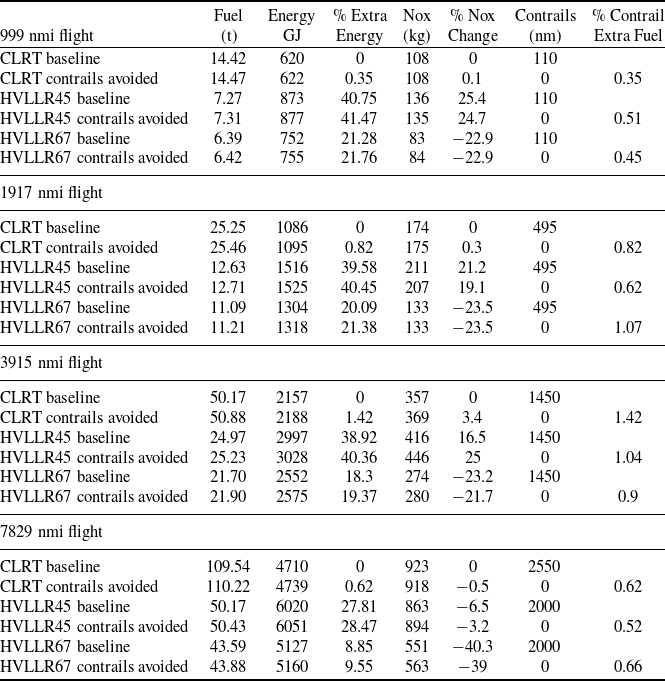
The Orion/Turbomatch models for the three aircraft and engines were prepared, run, and many parameters were predicted. Figure 13 shows the changes in T4 as the flights proceed. This figure shows two flights for each type of aircraft, the 3915 nmi flight and the 7829 nmi flight. The flight distances are slightly longer than the nominal values quoted in Table 3. The HVLLRs complete the 7829 nmi flight with an intermediate stop, Mumbai in the present example. All airport atmospheric conditions were assumed to be standard, sea level, and the flights shown are the baseline flights, i.e. without contrail avoidance routing. The peaks in T4 at the start and end of each flight denote the take-off and thrust reverse phases. It can be noted that due to its greater weight, HVLLR45 needs to operate at higher T4 than HVLLR67 because it needs more thrust everywhere. The CLRT aircraft, in the early part of the 7829 nmi flight, needs to operate at higher T4 given the much higher fuel weight. The 3915 nmi flights for the HVLLRs are identical to the first leg of the 7829 nmi flight, given that the HVLLRs need to do the latter flight with a stop. Figure 14 shows the change in aircraft weight with distance for nine different flights. It can be noted that in all cases the gradients of weight decline of the CLRT are steeper than the HVLLRs, due to the much lower heating value of conventional fuel. The steps in the 8000 nm flights for the HVLLRs arise from refuelling at the 4000 nmi stop. The analysis yielded many other variables. Two types of flight were executed for each aircraft and for each trip. A baseline flight that would pass through a contrail forming region while the other would change altitude to avoid these contrail forming regions and reduce environmental impact (Fig. 12). Table 4 shows outcomes of both NOx and contrail abatement. The contrails formed are measured in nautical miles. To avoid the formation of contrails, the flight deviations needed result in a fuel penalty of the order of one per cent. This appears to be independent of the fuel used because of the assumption that the deviations needed are the same for both fuels.
Outcomes for non-CO2 emissions of using hydrogen-fuelled gas turbines
Evolution of T4 versus distance for each aircraft and mission. Notice that the CLRT aircraft has two black continuous lines, one for the 3915 and one for the7829 nmi range flight.

Evolution of aircraft weight versus distance for each aircraft and mission. Notice that the CLRT aircraft has two black continuous lines, one for the 3915 and one for the7829 nmi range flight.

Table 4 also shows NOx. Here the impact of hydrogen tank weight on the HVLLR is notable. HVLLR45 produces more NOx in the shorter flights than CLRT, notwithstanding the presumed use of a low-NOx hydrogen combustor. HVLLR67, with its much lighter tank, requires less thrust and permits the derating of the propulsion system to a lower T4, hence its NOx characteristics are more attractive. The two HVLLRs consume more energy than the CLRT. There are fundamental and circumstantial reasons for this. The fundamental reasons arise from the use of hydrogen as fuel. Hydrogen requires a heavy tank of considerable volume, so the hydrogen aircraft are heavier without fuel (Table 1). Because of the additional volume, they experience more drag than the CLRT. The circumstantial reasons, here, arise from design optimisation. CLRT is based on public information for a carefully optimised aircraft, while the two HVLLR aircraft have been derived from existing designs and have not been optimised. Furthermore, they are of a shape, tube and wings, improved over decades of development specifically for the use for conventional fuels and, probably, not the best for hydrogen fuelled aircraft. In this exercise, the fuel consumption outputs for HVLLR45 include an additional 2% penalty relative to Table 2 to pre-heat the hydrogen. In the case of HVLLR67 this penalty is not applied on the basis that a second innovation wave airliner would make use of better thermal management.
7.0 Conclusion
The primary conclusion of this study is that, subject to satisfactory progress from a very large technology investment, aircraft with hydrogen-fuelled gas turbines can be effective at abating both CO2 and non-CO2 emissions, although not evaluated here, this includes sulphur oxides. This work questions the rationale of SAFs given that, in flight, they emit as much CO2 as conventional fuels. The comparisons presented are between kerosene and hydrogen aircraft because the use of SAFs should be questioned as their in-flight CO2 footprint is similar to that of kerosene. The decarbonising or drawdown options of SAFs can and should be used with other fuels. SAF fuelled aircraft would not be expected to perform differently in terms of CO2 and NOx inflight. There is an expectation that SAF would create fewer contrails, so altitude changes may be probably smaller. Decarbonising technologies can (or must?) also be applied to conventional fuels and to hydrogen, offering cheaper and faster pathways to total decarbonisation.
Three aircraft were compared, one conventional based on a modern, state-of the art airframe (CLRT) and two hydrogen fuelled ones; HVLLR45 and HVLLR67 considered to be representative of the hydrogen first (2035?) and second (2050?) innovation waves, respectively. The energy consumption of the aircraft was evaluated and the aircraft of the first innovation wave, HVLLR45, consumed 20–40% more energy than the CLRT, while that of the second innovation wave, HVLLR67, consumed 10–20% more energy than the CLRT. If careful optimisations were carried out the two HVLLRs might see their performance improved by a few percent, and the energy penalties of 10–40% shown in the present study could be somewhat lower. So, it can be argued that the observations made here are pessimistic. This confirms the view that the hydrogen aircraft of the first innovation wave will be viable but will consume more energy. Those of the second innovation wave will be approaching similar performance to conventional aircraft. The hydrogen aircraft incur an energy penalty of 5% (including possible optimisation benefits) to 40%, because the aircraft were heavier (when empty), had a larger volume with higher drag, were not optimised and were of a shape, tube and wings, improved over decades of development for conventional fuels. Energy efficiency is useful but operating economics and life-cycle environmental impacts are much more important, the relative importance of the latter increasing very quickly. Given the very low maturity of hydrogen in aviation it can be expected that, at least initially, progress in hydrogen designs would yield performance improvements more quickly than with conventional designs, closing this energy gap.
In terms of non-CO2 emissions, hydrogen offers options predicted to be better than carbon-based fuels, fossil or synthetic. In terms of contrails the fuel penalties appear to be similar, but hydrogen does not add CO2 into the atmosphere. In terms of NOx, substantial improvements appear possible via turbofans and combustion chamber designs benefitting from the advantageous properties of hydrogen: the much lower lean stability limit, the higher specific heat of hydrogen products, the faster flame velocity yielding lower residence times and the use of a gaseous fuel.
Many expect that, in the long-term, hydrogen will be cheaper than conventional fuels, and much cheaper than SAFs, primarily because the price of electricity will continue to fall. A primary issue facing hydrogen is the very large perceived transition cost, that includes aircraft development, airport infrastructure and hydrogen production and liquefaction facilities. In terms of airport infrastructure, the concept of hydrogen hubs [Reference Pantelis, Huete, Nalianda, Jarzebowska and Pilidis29], capitalising on the superior tankering characteristics of hydrogen, has great potential to phase airport investments much more slowly, spreading this investment over a substantially longer period and alleviating annual budgets.
The environmental credentials of hydrogen are very good and warrant investments in hydrogen system development. This is needed for on board, land and hydrogen provision and technologies. The work here highlights the specific need to learn more about the impact of particulates in forming contrails, the clear prediction and identification of contrail forming regions in the atmosphere, further aircraft and engine design optimisations, further development of low NOx hydrogen combustion technologies, etc.
The above study makes many assumptions about comparability, technology readiness and technology acquisition to capitalise on the beneficial properties of hydrogen. With the appropriate investments of funds and talent these benefits should crystallise. Optimism is warranted; history yields some very encouraging lessons. An evaluation of the requirements of a decarbonised UK [Reference Pilidis, Igie, Sethi, Sampath and Nilolaidis30] predicts that aviation would be the primary hydrogen consumer, using about half of the total hydrogen produced (about 25,000 tonnes per day for all UK applications). This volume and experience will greatly reduce the cost of hydrogen. They also predicted that, as a result, Britain would need to quadruple its electricity supply in 15–20 years. History shows that this happened twice in the past [41] in the 1920–30s and 1940–50s. Many consider aviation to be going through its third revolution. During the second revolution, arising from the introduction of the jet engine, astonishing progress took place. For example, in 1941, the De Havilland Mosquito was introduced, which was able to reach flight speeds of more than 400 mph at 28,000 ft, and 14 years later the Boeing B52 with a max cruising speed of 650 mph and a service ceiling of 50,000 ft went into service. The latter aircraft could fly 40–50% faster, its range was four times longer, and it was 19 times heavier.
These outcomes, facts and observations should instil optimism about a successful and sustainable future of civil aviation, where sustainability includes protection of the environment and a continuing, healthy growth of the sector.


 Open access

