





1. Introduction
The volume of water that people withdraw and use annually is equivalent to twice the global groundwater recharge to meet various demands (Abbott et al., Reference Abbott, Bishop, Zarnetske, Hannah, Frei, Minaudo and Pinay2019). Those demands are overwhelmingly agricultural, and, even in some of the more regulated settings (e.g., California), groundwater is over-extracted to meet them (Aeschbach-Hertig & Gleeson, Reference Aeschbach-Hertig and Gleeson2012; Lall et al., Reference Lall, Josset and Russo2020). Supply-side solutions, such as solar pumps, have accelerated groundwater depletion and drawn attention to the need for an alternative approach that addresses demand and works with processes of recharge (Balasubramanya et al., Reference Balasubramanya, Garrick, Brozović, Ringler, Zaveri, Rodella, Buisson, Schmitter, Durga, Kishore, Minh, Kafle, Stifel, Balasubramanya, Chandra and Hope2024). While nature-based solutions (NbS) have offered an alternative focused on ecosystems, their potential to date has been limited by localized implementation and monitoring approaches. These approaches struggle to address governance challenges and measure cumulative or large-scale social and ecological effects (Gleeson et al., Reference Gleeson, Cuthbert, Ferguson and Perrone2020; Keesstra et al., Reference Keesstra, Nunes, Novara, Finger, Avelar, Kalantari and Cerdà2018). Accordingly, groundwater depletion presents a collective action problem that undermines social and ecological resilience, particularly amid the population growth and changing climate of the Anthropocene (Gajurel et al., Reference Gajurel, Maheshwari, Hagare, Ward and Singh2024; Gleeson et al., Reference Gleeson, Cuthbert, Ferguson and Perrone2020; Huggins et al., Reference Huggins, Gleeson, Castilla-Rho, Holley, Re and Famiglietti2023; Kuang et al., Reference Kuang, Liu, Scanlon, Jiao, Jasechko, Lancia and Zheng2024). We suggest that social infrastructure provide the means to address groundwater depletion by promoting cooperation that addresses the immediate effects of depletion and the associated distributional conflicts. Growing evidence demonstrates the importance of combining technological innovations with social infrastructure, which ‘encompasses formal and informal institutions (e.g., norms about water), social networks, and cultural values’ (Stoler et al., Reference Stoler, Jepson, Wutich, Velasco, Thomson, Staddon and Westerhoff2022: 4; cf. Klinenberg, Reference Klinenberg2018). In this article, we conduct a narrative review of existing evidence to assert that social infrastructure is key to sustainable and resilient agricultural groundwater solutions (Dalin et al., Reference Dalin, Taniguchi and Green2019; Maleksaeidi & Karami, Reference Maleksaeidi and Karami2013; Rosegrant et al., Reference Rosegrant, Ringler and Zhu2009; Scanlon et al., Reference Scanlon, Fakhreddine, Rateb, de Graaf, Famiglietti, Gleeson and Zheng2023; Uhlenbrook et al., Reference Uhlenbrook, Yu, Schmitter and Smith2022).
Historically, supply-side engineering approaches were treated as a panacea for overcoming water scarcity when the ‘combination of timing, place, and water quality on the planet [did] not match human demand’ (van Noordwijk et al., Reference van Noordwijk, van Oel, Muthuri, Satnarain, Sari, Rosero and Hofstede2022: 115). Despite their implementation, humans and ecosystems have become increasingly susceptible to water scarcity (Mekonnen & Hoekstra, Reference Mekonnen and Hoekstra2016; Srinivasan et al., Reference Srinivasan, Lambin, Gorelick, Thompson and Rozelle2012) and evidence shows that supply-side solutions, like reservoirs, can actually increase risks of water shocks by encouraging overuse and reducing the buffer available for times of shortage (Di Baldassarre et al., Reference Di Baldassarre, Wanders, AghaKouchak, Kuil, Rangecroft, Veldkamp and Van Loon2018). While such hard infrastructure advances have improved agricultural productivity and well-being in many areas of the world, they have also had unexpected consequences that underscore the need for change (Anderies et al., Reference Anderies, Janssen and Schlager2016; Burke, Reference Burke, Llamas and Custodio2003; Gleick, Reference Gleick2018). For example, technological advances such as solar-based groundwater pumping promise to improve productivity but tend to overlook the actual economic and environmental costs (Balasubramanya et al., Reference Balasubramanya, Garrick, Brozović, Ringler, Zaveri, Rodella, Buisson, Schmitter, Durga, Kishore, Minh, Kafle, Stifel, Balasubramanya, Chandra and Hope2024; Closas & Rap, Reference Closas and Rap2017). Consequently, more attention is being paid to interventions that address the ‘human impact on the water cycle’ and emphasize environmental benefits (van Noordwijk et al., Reference van Noordwijk, van Oel, Muthuri, Satnarain, Sari, Rosero and Hofstede2022: 115).
Scholars and practitioners have pointed to NbS for water management that addresses a range of challenges, from flooding to water scarcity (Seddon et al., Reference Seddon, Chausson, Berry, Girardin, Smith and Turner2020; United Nations Environment Programme, 2022). Their potential to be self-sustaining, scalable, and generate multi-dimensional benefits for social and ecological resilience is promising, yet largely unfulfilled (Gleeson et al., Reference Gleeson, Cuthbert, Ferguson and Perrone2020; Keesstra et al., Reference Keesstra, Nunes, Novara, Finger, Avelar, Kalantari and Cerdà2018; Nesshöver et al., Reference Nesshöver, Assmuth, Irvine, Rusch, Waylen, Delbaere and Wittmer2017; Turner et al., Reference Turner, Devisscher, Chabaneix, Woroniecki, Messier and Seddon2022). Furthermore, NbS rely on social infrastructure which, like hard infrastructure, is often a form of public good that is undersupplied unless communities and governments invest in it (Albert et al., Reference Albert, Schröter, Haase, Brillinger, Henze, Herrmann and Matzdorf2019; Hirons, Reference Hirons2021; López, Reference López2005). In this context, we ask, how can social infrastructure be implemented within agricultural groundwater NbS to overcome the collective action challenge of groundwater depletion?
Here, we conduct a narrative review of how social infrastructure has been implemented in NbS for agricultural groundwater management, with a focus on groundwater quantity. Narrative reviews are a form of non-systematic evidence synthesis used to formulate critical insights from fields where a topic has been approached in diverse ways and developed associated definitional issues, such as NbS (Siddaway et al., Reference Siddaway, Wood and Hedges2019; Sukhera, Reference Sukhera2022). In our review, we focused on how social infrastructure has been used in NbS implementation to achieve conditions thought to ensure good institutional fit by matching institutions with local social and ecological conditions, resulting in coordination and sustainable resource management spanning multiple generations (Agrawal, Reference Agrawal2001; Carlisle & Gruby, Reference Carlisle and Gruby2019; Epstein et al., Reference Epstein, Pittman, Alexander, Berdej, Dyck, Kreitmair and Armitage2015; Jagers et al., Reference Jagers, Harring, Löfgren, Sjöstedt, Alpizar, Brülde and Steffen2020). Accordingly, we take a long-term perspective on NbS, drawing from archaeological and anthropological studies of ancient civilizations to contemporary approaches adopted since the term ‘NbS’ became a prominent initiative over the past 10–15 years. In particular, we emphasize how social infrastructure has been implemented within NbS to (1) enable coordination, (2) monitor and manage changing groundwater conditions over time, and (3) achieve social fit by considering the cultural values and norms of the people affected. We first review these concepts in the context of managing groundwater depletion in agricultural systems before describing the narrative review methods. The third section then provides an overview of our findings, followed by a discussion of how social infrastructure has been implemented according to our three dimensions of interest. Based on our findings, we conclude that social infrastructure is an integral component to effective agricultural groundwater NbS that use hard and natural infrastructure but that more needs to be done to manage the demand-side of extraction. We also suggest that future research should support NbS designs that rely on social and natural infrastructure, rather than hard infrastructure, with particular attention to ecological fit between agricultural practices and their local environments.
2. Groundwater sustainability and collective action
NbS are an effort to innovate resource management approaches to benefit people and nature with an increasing focus on resilience and sustainability (Cohen-Shacham et al., Reference Cohen-Shacham, Andrade, Dalton, Dudley, Jones, Kumar, Maginnis, Maynard, Nelson, Renaud, Welling and Walters2019, Cohen-Shacham et al., Reference Cohen-Shacham, Walters, Janzen and Maginnis2016). Applied to agricultural groundwater management, NbS could improve the resilience of groundwater supplies and in turn support resilient agriculture, broadly understood as agriculture that persists, changes, adapts, and transforms in response to the world around it while retaining key functions (Bennett et al., Reference Bennett, Baird, Baulch, Chaplin-Kramer, Fraser, Loring and Lapen2021; Huggins et al., Reference Huggins, Gleeson, Castilla-Rho, Holley, Re and Famiglietti2023). For agricultural systems, groundwater NbS will require a good ‘fit’ between the temporal and spatial extent of the problem and the preferences of the people who interact with them. In other words, groundwater NbS need social infrastructure that is calibrated to local context, just as other forms of infrastructure require appropriate technical design and adaptation to local conditions to function effectively (Smit and Wandel, Reference Smit and Wandel2006). Advantageously, groundwater irrigation has been foundational focus in collective action literature, providing insights on managing depletion that can inform our approach to NbS implementation (Blomquist, Reference Blomquist1992; Lopez-Gunn, Reference Lopez-Gunn2003; Nagrah et al., Reference Nagrah, Chaudhry and Giordano2016; Ostrom, Reference Ostrom1990; Shalsi et al., Reference Shalsi, Ordens, Curtis and Simmons2022). While we note strides by other scholars, such as those looking at Coupled Infrastructure Systems (CIS) (e.g., Svensson et al., Reference Svensson, Garrick and Jia2019), we instead draw on understandings from Common-Pool Resource (CPR) and political ecology scholarship and combine them with diverse case studies on agricultural groundwater NbS. This approach allows us to clarify definitional issues and enable more systematic approaches to reviewing papers with social infrastructure components in the future. In this section, we first review how NbS are defined before providing an overview of existing literature on collective action for groundwater irrigation. This allows us to articulate the opportunity for NbS to improve groundwater management and agricultural resilience if deployed with social infrastructure as a core or even sole element. We focus on three conditions from the collective action literature that may limit the effectiveness of social infrastructure in this regard: the costs of coordination (including participation), monitoring and managing change over time, and fit to the social context of those affected by or involved with the NbS.
We use the term ‘social infrastructure’ to maintain consistency with the focus on nature as infrastructure in the NbS space, and consider hard infrastructure to be human-made physical structures. We frame social infrastructure as an integral part of an effective NbS based on three arguments. First, all commonly accepted definitions (Table 1) of NbS allow for the inclusion of social infrastructure (e.g., Cohen-Shacham et al., Reference Cohen-Shacham, Walters, Janzen and Maginnis2016; UNESCO, 2018). Second, these definitions often align with the objectives of many resource management institutions. For example, in a report for the IUCN, Cohen-Shacham et al (Reference Cohen-Shacham, Walters, Janzen and Maginnis2016) defines NbS as ‘actions to protect, sustainably manage, and restore natural and modified ecosystems that address societal challenges effectively and adaptively, simultaneously providing human well-being and biodiversity benefits’ (Annex 1). Finally, an NbS composed exclusively of social and natural infrastructure can succeed whereas the one consisting of exclusively hard infrastructure cannot, as our review will demonstrate.
Commonly used definitions of NbS among practitioners

Poor social infrastructure leads to negative outcomes, unintended consequences, and failure in the long run. If NbS are to be implemented at the scale that environmental challenges like groundwater depletion demand, they must have a social infrastructure that manages heterogeneity and large spatial and temporal distances. This approach is referred to by practitioners as either a large-scale or landscape-scale approach, such as the Bureau of Land Management in the United States who use ‘landscape-scale approach’ to refer to multiscale management of human and ecological conditions (BLM, 2023). In agricultural contexts specifically, the landscape-scale approach intends to look beyond the individual farm or field and consider other ecosystems, land uses, and their connections (Milder et al., Reference Milder, Buck, DeClerck, Scherr, Ingram, DeClerck and Del Rio2012; Sayer et al., Reference Sayer, Sunderland, Ghazoul, Pfund, Sheil, Meijaard and Buck2013). For groundwater management, this requires social infrastructure that can address hydrologic connectivity, complexity, and associated coordination challenges, such as obtaining comprehensive data.
From a collective action and CPR perspective, groundwater is considered hard to manage because it is hard to exclude users if they have the financial ability to dig a well (Schlager, Reference Schlager2007). This challenge is perpetuated by a feedback loop where groundwater extraction is harder to monitor due to its low visibility and thus is less regulated (ibid.). The challenge of excludability and enforcement makes it easy for individuals to extract without issue, but collective depletion will eventually diminish individual supply. In many small-scale cases, especially in California and the Western US, this has motivated individuals to participate in collective action to manage their groundwater resources (Lubell et al., Reference Lubell, Blomquist and Beutler2020; Shalsi et al., Reference Shalsi, Ordens, Curtis and Simmons2022). However, as the scale of the groundwater resource and its users increase, coordinating these individuals becomes increasingly challenging and is plagued by high transaction costs (Ayres et al., Reference Ayres, Edwards and Libecap2018), particularly for transboundary management which poses ‘large-scale’ collective action challenges involving multiple groups and interests. Transaction costs are inherent in solving large-scale collective action problems (Huitema et al., Reference Huitema, Mostert, Egas, Moellenkamp, Pahl-Wostl and Yalcin2009; Taylor & Singleton, Reference Taylor and Singleton1993). For example, defining property rights is considered foundational for excluding users and monitoring resource usage. However, this can generate prohibitively high transaction costs, as demonstrated in California, where heterogeneity of both users and basins drove high transaction costs in 445 basins and led to expensive litigation (Ayres et al., Reference Ayres, Edwards and Libecap2018).
A second and related condition for sustained large-scale collective action is monitoring and managing change. This is particularly challenging with asynchronous and lagged changes that make causal relationships difficult to detect and are misaligned with patterns of human resource use and governance (Epstein et al., Reference Epstein, Pittman, Alexander, Berdej, Dyck, Kreitmair and Armitage2015; Jagers et al., Reference Jagers, Harring, Löfgren, Sjöstedt, Alpizar, Brülde and Steffen2020). Groundwater is particularly vexing in this regard as it can have variable flow patterns and timings with prolonged storage periods (i.e., residence times) (Gleeson et al., Reference Gleeson, Cuthbert, Ferguson and Perrone2020). Groundwater interventions that target infiltration could consequently take years to yield results depending on the hydrogeology (ibid.). Meanwhile, farmers respond to contemporary global market conditions, seasonal growing conditions, episodic weather events and disease, and the availability of inputs (Garrick et al., Reference Garrick, Alvarado-Revilla, de Loë and Jorgensen2022). These competing and asynchronous timelines, especially if compounded by a crisis (e.g., drought), can make supply-side approaches more appealing than demand-side approaches, which rely on coordination and a diverse portfolio of alternatives to existing over-extractive practices (Marston & Cai, Reference Marston and Cai2016). For instance, research done in the San Luis basin in Colorado found that despite having theoretically good institutional design in all other aspects, groundwater irrigators were ultimately unable to manage the effects of drought on their system of resource use because it relied on predictability (Cody et al., Reference Cody, Smith, Cox and Andersson2015).
We consider social fit to be the fit between institutions and social systems, accounting for cross-scale linkages and heterogeneity (Epstein et al., Reference Epstein, Pittman, Alexander, Berdej, Dyck, Kreitmair and Armitage2015). Social fit has been discussed in the context of agricultural groundwater governance in terms of the existence and enforcement of clearly defined boundaries on who gets access (Marston et al., Reference Marston, Zipper, Smith, Allen, Butler, Gautam and Yu2022). Focusing on fit highlights not only the limits of groundwater self-governance due to large numbers of water users, but also the limits of externally imposed regulations to curb groundwater use (Molle and Closas, Reference Molle and Closas2020). In their comparison of three groundwater basins in Spain, for example, Lopez-Gunn (Reference Lopez-Gunn2003) found that the one basin that had not been over-extracted had devised its own rules and included all basin well owners within its water user association. This led to further collaboration with the state on water rights definition and allocation, monitoring, and sanctioning. Similarly, Shalsi et al (Reference Shalsi, Ordens, Curtis and Simmons2019) found that irrigators in South Australia coordinated with government departments and successfully recovered their groundwater resource from depletion and salinization. With greater attention to the specific social aspects that contributed to social fit, Bhalla et al (Reference Bhalla, Baggio, Sahu, Kahil, Tarhouni, Brini and Wildemeersch2024) found that the loss of social norms led to the collapse of groundwater user groups in Tunisia. Evidence from surface water irrigation, primarily in Nepal, also suggests that irrigation systems managed by farmers tend to outperform those managed by governments because farmers experienced the effects of depletion directly and thus designed a system that reportedly had better fit between rules and context (in Lam, Reference Lam1998: Schlager, Reference Schlager2007; Tang, Reference Tang1992). Based on the existing literature, these three conditions of overcoming coordination costs, monitoring and managing change, and achieving social fit are necessary for effective agricultural groundwater governance, and thus for the social infrastructure of NbS.
3. Methods
We conducted a narrative review to examine how social infrastructure has been used to address groundwater depletion. Narrative reviews are a form of non-systematic evidence synthesis that are useful for capturing a wider variety of studies and formulating critical insights in fields that are under-developed or scattered across diverse conceptualizations and quantitative approaches (Siddaway et al., Reference Siddaway, Wood and Hedges2019; Sukhera, Reference Sukhera2022). This method was selected because of the rapidly growing diversity and quantity of papers on groundwater NbS, often utilizing different terminology, which confounded a standardized approach to searching and synthesizing evidence systematically. Furthermore, while systematic and bibliometric reviews are useful for summarizing insights within a specific field (e.g., Gajurel et al., Reference Gajurel, Maheshwari, Hagare, Ward and Singh2024), narrative reviews are better equipped for reviewing current evidence from a different perspective to that field (Greenhalgh et al., Reference Greenhalgh, Thorne and Malterud2018). We selected a narrative review because we were interested in applying a collective action lens to better understand and articulate the social elements of agricultural groundwater NbS. Here we first describe our process and then the definitions we used for key terms relevant to our methods.
Articles had to meet four thematic criteria to be included: (1) describe an NbS, (2) identify how the NbS addressed groundwater quantity, (3) demonstrate groundwater was used for agricultural purposes, and (4) discuss one of the three conditions of interest for collective action. For this initial exploratory stage of the review, the article had to describe the case explicitly as an NbS. As these initial articles were read, emergent and recurring themes were identified to capture areas where substantial evidence had been gathered and areas where evidence was promising but relatively new. As we read our initial selection of papers, we abductively developed a simple but comprehensive analytical framework for extracting and coding cases from each paper (Table 2). Abduction uses emergent evidence for initial framework design and updates the framework inductively and iteratively as more evidence is gathered to develop theory about why a phenomenon is occurring (Meyfroidt et al., Reference Meyfroidt, Roy Chowdhury, de Bremond, Ellis, Erb, Filatova and Verburg2018). Beyond expected categories related to the characteristics of the NbS, we were able to identify three types of NbS: those that relied on hard infrastructure, social infrastructure, and both hard and social. Additionally, we found some articles utilized agricultural terminology to identify which process associated with groundwater recharge was being modified by a particular NbS: sowing, storing, and harvesting (e.g., Ribeiro, Reference Ribeiro2021). We carried these terms forward in our review because they effectively described and bounded the primary intervention of an NbS, which was particularly useful given the complex and interconnected nature of processes that lead to groundwater recharge. Note that cross-counting was possible within and between infrastructure types and intervention types.
Analytical framework used to code each case

We considered this exploratory and abductive stage complete when additional articles did not introduce new concepts to our analytical framework, i.e., thematic saturation (Saunders et al., Reference Saunders, Sim, Kingstone, Baker, Waterfield, Bartlam and Jinks2018). We then sought out cases through database searches and citation tracing that captured our analytical framework and stopped the review when data saturation on a particular case was reached. These articles did not need to refer to a case as NbS if another paper had already done so in the exploratory stage. Part of this stage was citation tracing, where we identified relevant sources by selecting from the cited literature of an informative source, often a review on a related topic (Wohlin, Reference Wohlin2014). For instance, Cassin and Ochoa-Tocachi (Reference Cassin and Ochoa-Tocachi2021) produced a useful review of traditional practices for the book Nature-based Solutions and Water Security from which we identified a further 17 references. Since this was not a systematic review and traditional practices were an emergent theme in our framework, drawing many references from one source was appropriate and allowed us to deepen our investigation of each case. While conducting this deeper investigation, evidence of the social infrastructure for certain cases was insufficient to characterize it with certainty. In these instances, the case was not coded as having social infrastructure because evidence was insufficient, but they were still included in our final case list to identify cases where future research could follow up on high-level evidence that social infrastructure was present but just understudied. Finally, a quality check was performed to ensure only the most relevant, credible, and informative articles on a case were retained (Sye & Thompson, Reference Sye and Thompson2023). The final list of cases is provided in Supplementary Table S1, and the papers are provided in Supplementary Table S2. Note that each line represents a unique combination of case and geography with the exception of Wadi Terrace Systems and water banking, which were listed as occurring in many different places but without specific details or further articles on how they varied between geographies. These were retained as one case to avoid misinterpretation of how this NbS type was implemented in each specific place, but we plotted them individually in our maps to illustrate geographic spread.
For our review, we considered groundwater management as any intervention that deliberately managed water below the soil surface, including NbS aiming to improve soil moisture to facilitate percolation to groundwater, and thus our definition reflects the diverse ways in which the literature considers an NbS to target groundwater. We coded cases as ‘sow’, ‘store’, and/or ‘harvest’ based on their primary intervention, rather than their secondary impacts or ultimate objective. For example, a case involving a dam to slow runoff and increase infiltration was coded as ‘sow’ because its primary intervention was to increase the amount of water infiltrating into groundwater systems, despite its ultimate impact being increased withdrawal (i.e., harvesting). We acknowledge that these three processes and their feedback are interconnected but distinguish them because the primary point of intervention reveals how the people implementing the NbS understand groundwater processes. For example, an NbS designed to sow water is working to augment supply without controlling demand, leaving it exposed to Jevons paradox, i.e., increasing demand that keeps pace with or outpaces increasing supplies (e.g., Grafton et al., Reference Grafton, Williams, Perry, Molle, Ringler, Steduto and Allen2018). Finally, we do not engage with the definitional challenges around ‘NbS’ or related concepts (e.g., green infrastructure), but we acknowledge and account for them in our analysis by discussing environmental impacts and study limitations (Pauleit et al., Reference Pauleit, Zölch, Hansen, Randrup and Konijnendijk van den Bosch2017).
Our definition of hard infrastructure encompasses any human-made structures, including ones that enhance nature (e.g., ‘green-grey infrastructure’) where social infrastructure refers to social factors (including social norms, capacities, and knowledge) (cf. Anderies et al., Reference Anderies, Janssen and Schlager2016; Hodgson, Reference Hodgson2006; Latham & Layton, Reference Latham and Layton2022; Stoler et al., Reference Stoler, Jepson, Wutich, Velasco, Thomson, Staddon and Westerhoff2022). We also noted an analytical distinction between hard and social infrastructure that were modern versus traditional. Here, we use the term ‘traditional’ to refer to NbS that are ‘culturally transmitted from generation to generation, emerge from place-based understanding of the relationships between living beings, including humans, with the environment and each other, and have evolved through adaptive learning processes in specific places over time’ (Cassin & Ochoa-Tocachi, Reference Cassin and Ochoa-Tocachi2021: 286). This encompasses practices that are Indigenous, local, and ancestral and reflects a growing interest in how intergenerational practices and different interpretations of nature–human relationships could change how NbS are implemented (Reed et al., Reference Reed, Brunet, McGregor, Scurr, Sadik, Lavigne and Longboat2024).
A major aspect that emerged from our review of the literature that we had not come across in more technical NbS articles focused on engineering and deployment was the prevalence of research on traditional NbS for groundwater management in traditional agricultural systems, as reviewed by Cassin and Ochoa-Tocachi (Reference Cassin and Ochoa-Tocachi2021). Our authorship team lacks Indigenous representation in both identity and specific topic expertise. We therefore acknowledge the limitations of our analysis and hope that by covering the topic in a collective action context, we further highlight the need for more institutional and financial support for experts researching the topic of traditional practices (Reed et al., Reference Reed, Brunet, McGregor, Scurr, Sadik, Lavigne and Longboat2024).
4. Findings
This section presents an overview of findings from the narrative review. A detailed description of each case can be found in the Supplementary Material (S1). There was a clear reliance on sowing approaches in our cases. In total, 42 unique cases of NbS intervening in groundwater quantity for agricultural purposes were identified from 34 references. Of these cases, sowing was the primary intervention for 95% (40 cases), while 21% (9 cases) involved storage, and 43% (18 cases) involved harvesting (Figure 1). Of the 40 cases intervening by sowing, 19 only used sowing, four also used storing, 13 used harvesting, and four used sowing, storing and harvesting. Of the nine cases involving storing, one used storing only, and none used harvesting. Of the 18 cases involving harvesting, one used harvesting only.
Maps showing cases (based on center point of approximate study location) that intervened via (a) sowing, (b) storage, and (c) harvesting with round points indicating presence of an intervention type and crosses indicating absence.

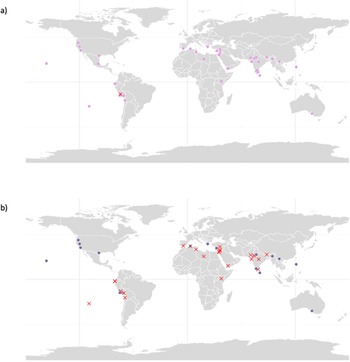
Regarding types of NbS, 41 cases had references that explicitly mentioned hard infrastructure, while 15 mentioned social infrastructure (Figure 2). Specifically, 14 cases incorporated both hard and social infrastructure, compared to only one case using exclusively social infrastructure and 27 cases using only hard infrastructure. When sowing was the primary intervention (i.e., in 40 cases), 14 cases described both social and hard infrastructure and 26 cases described only hard infrastructure. When storage was the primary intervention, four of the cases included both infrastructure types while five had only hard infrastructure described. When harvesting was the primary intervention, eight of the cases utilized both infrastructure types, nine cases were described as having only hard infrastructure, and one case reportedly relied solely on social infrastructure. No clear geographic patterns emerged across intervention types or infrastructure combinations overall.
Maps showing cases that included (a) hard infrastructure and (b) social infrastructure harvesting with circles indicating presence of an infrastructure type and crosses indicating absence.

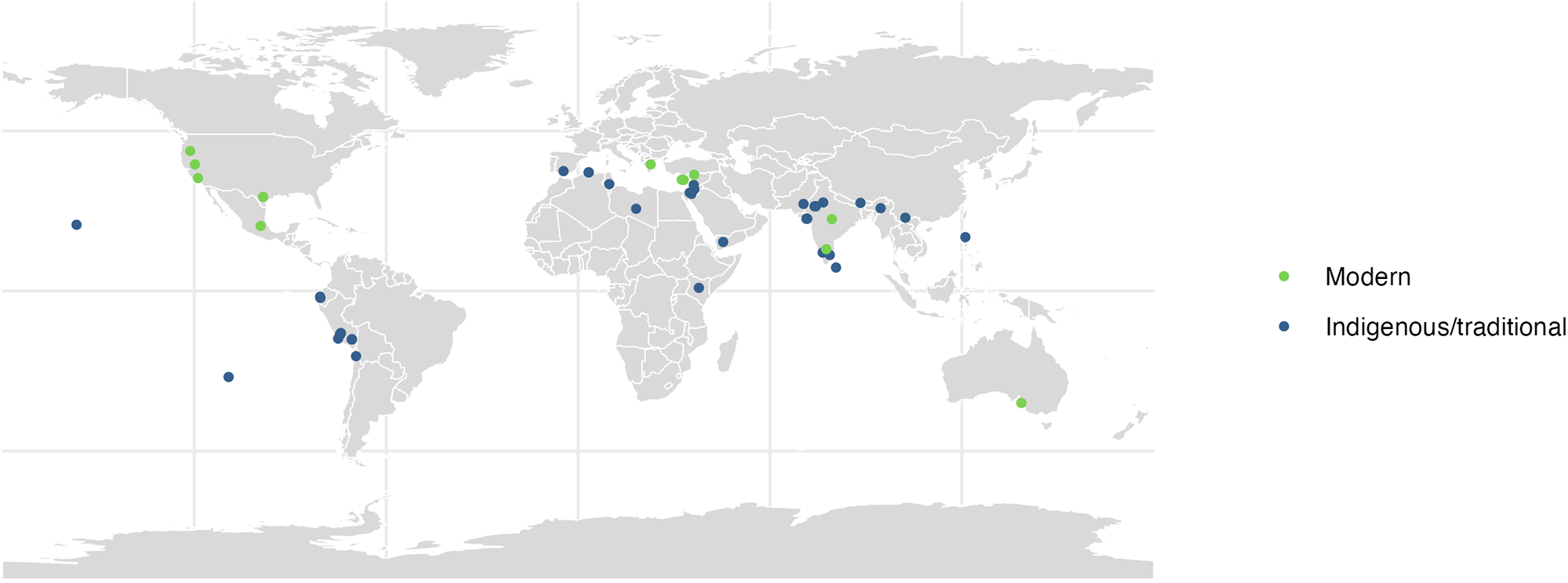
Of the 32 cases describing a traditional NbS (Figure 3), nine used both hard and social infrastructure, 22 described only hard infrastructure, and one case mentioned only social infrastructure. These traditional NbS cases were predominantly located in the Global South.
Map showing cases that were based on traditional practices (dark blue points) or based on modern practices (green point exclusively)

We also found that groundwater NbS in agricultural settings addressed diverse challenges, ranging from mediating the effects of regular weather events (e.g., capturing snowmelt via acequias in Spain or collecting monsoonal rains using ahar pynes in India) to managing saltwater intrusion and natural salinization (e.g., the puna in Rapa Nui or virdas in Gujarat) (see Supplementary Information S1). While many practices were reported to improve groundwater quantity and deliver related benefits like agricultural development, in other cases the benefits were either unmeasured or ambiguous (e.g., hafaer in Syria). In some cases with social infrastructure, there were also reported conflicts and potential for capture by elites (Edwards Aquifer or the johadi system in Rajasthan or the negarim system in Jordan). In cases where managed aquifer recharge (MAR) was used (e.g., Paphos, Cyprus), there was a risk of contamination related to the injection of wastewater (Qadir et al., Reference Qadir, Boelee, Amerasinghe, Danso, Drechsel, Qadir and Wichelns2015). This was also true for unmanaged aquifer recharge in the Mezquital Valley, where treated wastewater was spread onto fields and caused unplanned recharge that was then applied to irrigated crops (Qadir et al., Reference Qadir, Boelee, Amerasinghe, Danso, Drechsel, Qadir and Wichelns2015).
5. Discussion
Overall, it was unsurprising to find that most cases were focused on augmenting supply through either sowing or, in fewer cases, storage. The finding that supply-side approaches prevail, even when there is a focus placed on identifying cases where social infrastructure may be strong, reflects the broad reliance on supply-side approaches globally (van Noordwijk et al., Reference van Noordwijk, van Oel, Muthuri, Satnarain, Sari, Rosero and Hofstede2022). While certain efficiency techniques offer technical demand-side solutions, it is well documented that efficiency technologies need to be complemented by social infrastructure that regulates who uses groundwater and how much they can use (Grafton et al., Reference Grafton, Williams, Perry, Molle, Ringler, Steduto and Allen2018). For example, in Jordan an intricate three-part technical solution of negarim (diamond-shaped runoff grid plots), polymers added to soil, and the introduction of fruit trees was used to improve the storage efficiency of soil and thus reduce groundwater demand (Oweis & Hachum, Reference Oweis and Hachum2006). Limitations of this system according to the study’s authors are conflicts and disputes over water rights as groundwater supplies increase. Nevertheless, the case demonstrates the potential for groundwater NbS to manage demand, rather than an exclusive focus on augmenting supply. This case and others that we coded as being harvest-oriented often focused on improving soil moisture to reduce crop demands and to indirectly increase vertical percolation to groundwater as more water is applied to the soil (Sorensen et al., Reference Sorensen, Finch, Ireson and Jackson2014). However, because of the focus on supply-side approaches in present definitions of NbS, systematic review methods would likely exclude these cases from a groundwater NbS study despite their relevance for groundwater recharge and managing groundwater demand.
An additional insight from our review was that few studies evaluated whether the NbS they were reportedly describing benefited nature, which aligns with the ambiguity of the definition of NbS reported elsewhere (Pauleit et al., Reference Pauleit, Zölch, Hansen, Randrup and Konijnendijk van den Bosch2017). While there is a diversity of definitions, most of the definitions commonly used by practitioners include environmental benefits and not just mimicry or integration of a natural process (cf. UNESCO, 2018; see Table 1). This, along with the supply-side focus of our agricultural groundwater NbS, raises questions about the effectiveness of NbS to change how we manage groundwater in agricultural systems and in other settings (e.g., using tree-planting to offset carbon emissions) (Seddon et al., Reference Seddon, Smith, Smith, Key, Chausson, Girardin and Turner2021). For instance, some articles describing traditional NbS cases appeared to assume that traditional hard infrastructure was inherently an NbS, without explicit substantiation of the environmental benefits of the practice. This was especially evident for traditional practices that had modern analogs that were not described as NbS in any literature we found during our search process, implying that environmental benefits were assumed because the case was traditional rather than modern. An example of this would be the amunas, concrete-lined canals used by the Indigenous Huarochiran communities of Peru that mimic the natural recharge processes of fissures to groundwater (Apaza et al., Reference Apaza, Arroyo and Alencastre2006). However, this mimicry is the general premise of most water transmission systems, including modern canals which did not appear in search results or our included literature as NbS. While amunas rely on Indigenous technology with a distinct social infrastructure that resulted in improved crop productivity, without known environmental benefits it is unclear whether they should be considered an NbS according to most definitions.
Indeed, our study was limited by both the diversity of definitions used for NbS and the dominance of traditional NbS in the final case list. First, the diversity of NbS definitions made it challenging to bind the review. In particular, Managed Aquifer Recharge (MAR) was sometimes considered an NbS by the NbS literature, but the MAR literature infrequently referred to MAR as such. Instead, MAR appears to often get segmented into other bodies of literature, such as that on ‘green infrastructure’ which has definitional overlap but is not synonymous with NbS (Hanson et al., Reference Hanson, Wickenberg and Alkan Olsson2020). For instance, Dillon et al (Reference Dillon, Stuyfzand, Grischek, Lluria, Pyne, Jain and Sapiano2019) provides a widely cited quantification of MAR globally and do not use the term ‘NbS’ once. The sheer diversity of search terms used to identify MAR in Kebede et al (Reference Kebede, Kumar, Mekonnen and Clement2024) further alludes to this definitional challenge. Consequently, our literature search identified some modern MAR while missing other known cases and reviews (e.g., Sprenger et al., Reference Sprenger, Hartog, Hernández, Vilanova, Grützmacher, Scheibler and Hannappel2017). This challenge extends beyond our study: for example, Sprenger et al (Reference Sprenger, Hartog, Hernández, Vilanova, Grützmacher, Scheibler and Hannappel2017) documented the start of MAR in Europe in Glasgow around 200 years ago, but Martos-Rosillo et al (Reference Martos-Rosillo, Durán, Castro, Vélez, Herrera, Martín-Civantos and Peña2021) describe Medieval Spanish acequias de careo, which are channels dug to trap flood runoff and snowmelt and recharge groundwater that pre-date Glaswegian MAR.
Another distinctive feature of our review was the dominance of traditional NbS in our included cases. We attribute this to a long-standing anthropological interest in cultural practices of traditional societies (e.g., Scarborough et al., Reference Scarborough, Dunning, Tankersley, Carr, Weaver, Grazioso and Lentz2012) and a growing interest from other fields as well (e.g., Díaz et al., Reference Díaz, Settele, Brondízio, Ngo, Agard, Arneth, Balvanera, Brauman, Butchart, Chan, Lucas, Ichii, Liu, Subramanian, Midgley, Miloslavich, Molnár, Obura, Pfaff and Zayas2019; Forrest & Cicek, Reference Forrest and Cicek2021; Martin et al., Reference Martin, Roy, Diemont and Ferguson2010), which resulted in many of these studies discussing social factors and thus being included. At the same time, information can be missing from the archaeological record because it disproportionately reflects physical over non-physical aspects of societies (Neustupný, Reference Neustupný1995). There is consequently a risk that there is permanently lost or missing information on the strengths and challenges that these societies faced in NbS implementation, and this may explain the surface-level descriptions of social factors in some of our included traditional cases.
In the remainder of this section, we discuss our cases with specific reference to our question: how can social infrastructure be implemented within agricultural groundwater NbS to overcome the collective action challenge of groundwater depletion? We discuss this collective action challenge in terms of institutional fit, focusing on social infrastructure that can improve coordination, monitor and manage change, and achieve social fit.
5.1. Enabling coordination
Achieving coordination in agricultural groundwater systems is necessary and difficult because of issues excluding users, encouraging participation, and overcoming transaction costs (Ayres et al., Reference Ayres, Edwards and Libecap2018; Schlager, Reference Schlager2007). Coordination becomes increasingly difficult as the scale of the resource and its users increase, demanding larger solutions that address the increasing size and diversity of the users (Jagers et al., Reference Jagers, Harring, Löfgren, Sjöstedt, Alpizar, Brülde and Steffen2020). On the other hand, scaling up can account for large-scale tradeoffs and expand the suite of options for addressing them, such as benefit sharing and issue linkage, with the caveat that increasing options comes with increasing costs (Boyd et al., Reference Boyd, Richerson, Meinzen-Dick, De Moor, Jackson, Gjerde and Dye2018; Nelson et al., Reference Nelson, Mendoza, Regetz, Polasky, Tallis, Cameron and Shaw2009). Additionally, as the number of objectives increases with scale, issues of equity become core in deciding who wins, who loses, and by how much (Hegwood et al., Reference Hegwood, Langendorf and Burgess2022). We found that few NbS cases in our review discussed tradeoffs or how they were navigated by social infrastructure. If social infrastructure overlooks these considerations, it can lead to inequitable outcomes that entrench mistrust and hinder future cooperation. These potential inequities underscore the need for both a large-scale approach and social infrastructure that can account for and consider the different perceptions, incentives, and challenges actors might face that encourage or discourage their participation in agricultural groundwater NbS (Gajurel et al., Reference Gajurel, Maheshwari, Hagare, Ward and Singh2024; Wight et al., Reference Wight, Garrick and Iseman2021).
Everard (Reference Everard2015) provide a useful case study on participation and coordination where equity and cross-scale governance were considered through a phased approach where centralized governance and pilots are followed by decentralization and devolution to community governance. This case study describes the work of NGO Tarun Bharat Sangh (TBS) in Alwar District, Rajasthan, India. TBS scaled up one pilot project in Gopalpura in 1985 to achieve catchment-scale outcomes by involving over 700 villages in johadi restoration, with many villages restoring their traditional village decision-making bodies (Gram Sabha) as well (Everard, Reference Everard2015). TBS coordinated this ‘scaled-up’ success by only expanding to villages where there was financial capacity and demand for the projects, on the basis that these factors indicated interest in participation and the building of social infrastructure (ibid.). Financial capacity included sweat equity via volunteer labor known as shramdan, a culturally significant collective action practice.
TBS then coordinated these projects across scales by encouraging the formation of Pad Yatra (Arwari Water Parliament) in 1998 which would meet twice a year to manage basin-level issues and resolve conflicts (Everard, Reference Everard2015). Additionally, in 1998 TBS launched Rashtriya Jal Biradari (National Water Brotherhood) to bring together diverse people (farmers, social groups, voluntary organizations, NGOs, water experts, etc.) to drive progress on water, soil and forest management, re-establishment of community water rights, and other community-identified issues (ibid.). We suggest that this approach simplified coordination by reducing transaction costs through an early centralized and small-scale approach that responded to participation levels, allowing them to gather information at smaller scales first and make coordination more efficient in the long run. This then lowered transaction costs enough that a decentralized approach became feasible. However, conflict did arise between the state government and the community over the threat of community empowerment, which would have generated transaction costs as well (Everard, Reference Everard2015). This highlights an important caveat that even when social fit is achieved locally, there may still be conflict arising from misfits at other scales that require systemic change (Epstein et al., Reference Epstein, Pittman, Alexander, Berdej, Dyck, Kreitmair and Armitage2015; Smit and Wandel, Reference Smit and Wandel2006).
5.2. Monitoring and managing change
Managing groundwater for agricultural purposes presents many temporal mismatches, requiring monitoring and adaptive management to changing groundwater conditions (Garrick et al., Reference Garrick, Alvarado-Revilla, de Loë and Jorgensen2022). The sometimes unpredictable behavior and timing of groundwater flows combined with the seasonality and vulnerability of agriculture to market pressures and natural disasters make it hard to obtain reliable data and act on it with efficacy (Gleeson et al., Reference Gleeson, Cuthbert, Ferguson and Perrone2020). This acquisition of data is yet another transaction cost associated with collective action for groundwater governance. It was challenging to identify approaches where monitoring and managing change were described, particularly for traditional approaches. While strides have been made to obtain better data globally, such as satellite monitoring of irrigation use (e.g., Foster et al., Reference Foster, Mieno and Brozović2020) and groundwater depletion (Richey et al., Reference Richey, Thomas, Lo, Reager, Famiglietti, Voss and Rodell2015), high costs, resolution issues, and difficulty integrating them into transparent decision-making processes remain a barrier. Furthermore, none of these approaches measure issues associated with social infrastructure, such as institutional capacity or the incidence of legal disputes (Gorelick & Zheng, Reference Gorelick and Zheng2015). Ultimately, all of these challenges contribute to high transaction costs that increase with scale, but the hope is that they prevent environmental and social externalities that are more costly. The most illustrative case in this regard was water banking, an institutional mechanism used in the western United States to augment groundwater supply and adaptively manage storage and harvesting over longer time periods (O'Donnell & Colby, Reference O'Donnell and Colby2010).
Through this mechanism, water is transferred voluntarily, often via a market exchange, on a temporary, intermittent, or permanent basis to an authority responsible for ensuring that the water is kept in storage. Examples include the Central Arizona Project (CAP), California Semitropic Groundwater Storage Program, the Oregon Deschutes Groundwater Mitigation Bank, the Edwards Aquifer Authority Groundwater Trust, and the Nevada Truckee-Meadows Groundwater Bank (Clifford et al., Reference Clifford, Landry and Larsen-Hayden2004). Groundwater banking improves reliability, secures against future demands, and provides a storage mechanism for conserved water and for more water market activity (Colby et al., Reference Colby, O'Donnell and Bark2010). However, drawbacks identified by the American experience are related to coordination in defining and enforcing groundwater rights, particularly for transboundary aquifers, as well as aligning the timing of mitigation with impacts. Instead, groundwater has been historically managed as an open access resource, causing resistance from users to governmental pumping regulations (cf. Allen & Smith, Reference Allen and Smith2023; Ayres et al., Reference Ayres, Edwards and Libecap2018; Garrick, Reference Garrick2018). Alternatively, governmental agencies have purchased land to protect it and the aquifer below. For example, city government in San Antonio Texas purchased properties in sensitive recharge zones over the Edwards Aquifer and converted them into nature reserves to improve recharge and service its mixed urban–agricultural–industrial user base (Singh & Zaragoza-Watkins, Reference Singh, Zaragoza-Watkins, Babbitt, Gibson, Sellers, Brozovic and Saracino2018). This also facilitated natural remediation of runoff by the soil, although it is too early to assess the quantitative outcomes of this intervention over time (ibid.). In tandem, the authority transfers water from the Edwards Aquifer to the Carrizo-Wilcox aquifer through an MAR project called H2Oaks to protect endangered species and buffer supply against drought (Miller et al., Reference Miller, Milman, Burson, Tracy and Kiparsky2021). The land it owns for this project is leased to farmers, maintaining agricultural production (ibid.). However, how this solution will evolve over longer periods of time is unknown.
5.3. Achieving social fit
Achieving social fit, or a fit between the solutions and the social system they affect, can strengthen social infrastructure through multiple layers of governance nested in a way that supports participation and cross-scale coordination, thereby building legitimacy (Carlisle & Gruby, Reference Carlisle and Gruby2019). Revitalized traditional NbS may be especially effective at achieving social fit because they simultaneously match deeply held traditional knowledge-practice-value systems while also leveraging modern resources and adapting to modern governance structures and value systems (Cassin & Ochoa-Tocachi, Reference Cassin and Ochoa-Tocachi2021).
For instance, in Peru, the revitalization of Indigenous practices has been accomplished through national support and partnership between Indigenous communities and an urban water utility with greater financial resourcing than traditional communities have access to (ibid.). Today there is dedicated support at the national level, with the Ministry of Agriculture running a national water sowing and harvesting program and Lima’s urban water utility SEDAPAL restoring the upper catchments of the city’s major rivers (the Chillon, Rimac, and Alto Mantaro) (Cassin & Ochoa-Tocachi, Reference Cassin and Ochoa-Tocachi2021). In addition to restoring the catchments ecosystems, SEDAPAL has worked with the Huamantanga community to revitalize and replicate pre-Inca infiltration systems called amunas-mamanteo. Amunas-mamanteo provide water during the dry season for subsistence agriculture using impermeable canals to transmit wet season flows to a network of infiltration (permeable) canals and ponds (Cassin & Ochoa-Tocachi, Reference Cassin and Ochoa-Tocachi2021). This modern and scaled approach to traditional NbS is possible because it strategically combines traditional and modern resources and values.
TBS’s work in Rajasthan, India, took a similar approach, combining traditional practices and modifying aspects of them to match modern values and norms of gender equality, navigate modern governance structures, and build social capital. The 8,600 johadi that TBS revived throughout the Arvari catchment were based on a traditional NbS dating back to at least the 1660s (Davies et al., Reference Davies, Everard and Horswell2016; Everard, Reference Everard2015). In addition to the johadi hard infrastructure, TBS re-introduced traditional village decision-making bodies (Gram Sabha) but updated it to include and empower women through decision-making responsibility, education, and self-help groups (Everard, Reference Everard2015). TBS and local communities not only saw water tables rise from depths of 100–120 m to just 3–13 m, but also agro-economic improvements. Between 1985 and 2015, the area under single cropping grew from 11% to 70% and under double cropping from 3% to 50%. Agro-forestry and social forestry were also supported by the johadi social infrastructure, resulting in an increase in forested area from 7% to 40% (Everard, Reference Everard2015). Thus, the economic improvements go beyond direct groundwater quantity improvements because of the multiple ecological and social benefits of the social infrastructure that this NbS introduced. Moreover, the Gram Sabha supported decision-making processes beyond groundwater management that were relevant for building social capital (education, forest protection, zoning, etc.) because TBS viewed social capital as ‘central to regeneration of ecosystems and their associated services contributing to a return to prosperity’ (Everard, Reference Everard2015: p. 130). In this case, TBS recognized that agriculturalists were motivated by non-market benefits and that incorporating them into their NbS projects was essential to success (Everard, Reference Everard2015).
Alternatively, some traditional practices have been restored with successful outcomes and without much change from their original format. The amunas used by Huarochiran communities in Peru, for example, are operated and maintained through extensive social infrastructure (Apaza et al., Reference Apaza, Arroyo and Alencastre2006). Water allocations and other governance decisions are made in a democratic assembly by the 120 comuneros with rights to the land (Cassin & Ochoa-Tocachi, Reference Cassin and Ochoa-Tocachi2021). Maintenance of the canals (e.g., cleaning gates) is done through rituals and religious festivities and the ponds and springs where water is harvested are protected by being marked as sacred (Cassin & Ochoa-Tocachi, Reference Cassin and Ochoa-Tocachi2021). Locals have reported doubled and tripled spring discharge volumes, and sustained production of heirloom crops, such as prickly pears and peaches in Santiago de Tuna, has become possible (Apaza et al., Reference Apaza, Arroyo and Alencastre2006; Ribeiro, Reference Ribeiro2021).
A final note on social fit is that it is necessary but not sufficient. Ecological fit remains equally important for achieving sustainable social-ecological resilience (Huggins et al., Reference Huggins, Gleeson, Castilla-Rho, Holley, Re and Famiglietti2023). Only one case captured by our review targeted harvesting without also targeting sowing or storage, and it involved reducing harvesting by cultivating crops from different ecological niches to manage groundwater variability in the Peruvian Andes (Ribeiro, Reference Ribeiro2021). Although this case could be considered incidental groundwater management and mostly a drought response, its mimicry of natural vegetation growth patterns to manage agricultural groundwater use warrants its inclusion as an NbS and underscores the need for NbS to consider ecosystems in terms of fit rather than as just a blueprint for design.
6. Key takeaways and next steps
We examined how social infrastructure can be implemented within agricultural groundwater NbS to overcome the collective action challenge of groundwater depletion with a focus on three conditions: (1) enabling coordination, (2) monitoring and managing change over time, and (3) achieving social fit. Overall, we were able to identify a limited set of case studies where these conditions were at least partly addressed. However, most of our identified studies focused on supply-side interventions and discussions about demand management or ecological benefits were sparse.
Despite seeking articles out, there were only a few strong and detailed examples of deliberately designed social infrastructure described as part of an agricultural groundwater NbS. This echoes findings for NbS more broadly that governance and politics are less studied (cf. Lubell et al., Reference Lubell, Blomquist and Beutler2020) and points to a need for future research to consider how social infrastructure from other types of resource management approaches could be translated to our context, but also the need for NbS researchers to at least reflect on the social infrastructure in place. For practitioners, such knowledge will be critical to designing NbS that are effective in the long term for large-scale systems. The example of both TBS in Rajasthan and SEDAPAL in Lima illustrates the benefits of researching the social setting of an NbS and integrating appropriate social infrastructure directly into their projects (Cassin & Ochoa-Tocachi, Reference Cassin and Ochoa-Tocachi2021; Everard, Reference Everard2015). Moreover, while they embraced traditional methods, they revised them to meet modern demands and values, such as gender equality in the case of TBS and scaling across boundaries in the case of SEDAPAL (ibid.).
Another avenue for future research and dedicated practice is on demand-side NbS, particularly those that use exclusively or primarily social and natural infrastructure and not hard infrastructure. The only example of this we were able to identify was the limited information about niche-specific agricultural practices in the Peruvian Andes. Yet, adapting agriculture to ecological context should be a primary goal for NbS, which have the goal of benefiting nature as well as people (Seddon et al., Reference Seddon, Smith, Smith, Key, Chausson, Girardin and Turner2021). This might include practices like shifting irrigated crops to rain-fed when irrigation becomes nonviable due to widespread groundwater depletion (cf. Rosa, Reference Rosa2022).
In conclusion, social infrastructure is an integral component to effective agricultural groundwater NbS that use hard and natural infrastructure, yet evidence or direct recommendations on how it can be implemented are limited. Our review points to the need for researchers to explicitly evaluate social infrastructure in their research on agricultural groundwater NbS and NbS more broadly, and urges practitioners to consider and design social infrastructure that complements their NbS.
Supplementary material
The supplementary material for this article can be found at https://doi.org/10.1017/sus.2025.10020.
Acknowledgements
We thank Tom Iseman for insightful comments.
Author contributions
I.J. and D.G. conceived and designed the study. I.J. conducted data gathering and analysis. I.J., D.G., and C.W. wrote the article.
Funding statement
This work was supported by The Nature Conservancy (I.J., D.G.); and Solutionscapes at the University of Waterloo (D.G.), which is funded by the Government of Canada’s Environmental Damages Fund.
Competing interests
None.





 Open access

