In 2026, a person born at the time of the Third Plenum of the Eleventh Party Congress, the historic event in 1978 that launched China’s impressive economic growth, is forty-eight years old. Now consider the age not of a person but of a system. In 1953, China’s first Five Year Plan went into effect, marking the beginning of central planning in the People’s Republic of China. The classical phase of China’s central planning lasted a total of twenty-five years.
For forty-eight years China has been attempting to reform a system that was operational for twenty-five years, and the project is by no means over. At the time of writing, the end of China as a statist economy is not advancing but receding in sight. In fact, it is debatable whether we are still in an era of reforms. I define the start of reforms as an official act of de-Maoification by the Communist Party of China (CPC). In 1978 the CPC repudiated some of the specific acts of Mao Zedong – his large-scale purges and the destruction of intraparty democracy and of the economy under his reign. It was far from a wholesale denunciation but the language was unusually frank and direct by the customary coy standards of the CPC when it comes to an admission of its own errors. By this definition, the reform era ended in 2018 when the CPC removed the term limit on presidency, reinstating a signature feature of the Mao era – the life tenure of its leader.
China has made progress in economic reforms since 1978, from socialism to state capitalism, and then to statism, in Chinese, 国家主义, the system I believe is Xi Jinping’s China. Whether the pace is impressive or not is very much in the eye of the beholder. The history of Chinese reforms is one of drama and incremental progress, interspersed by quite a few episodes of reversals. Reforms are not a long march but are more like a treadmill. Barry Naughton proposed a pathway for China to transition to a market economy, by Growing Out of Plan, the title of his 1996 book. Since 1978, China has grown greatly in GDP terms – as opposed to personal income, a vital distinction I will make throughout this book – and it now has the second largest GDP in the world. China may have grown out of central planning, but it would be a stretch to say that China has grown into a market economy. GDP growth by itself does not make a market economy.
At some point, we have to conclude that, contrary to their regular declarative affirmations, the Chinese leaders desire this glacial pace of reforms as an intended goal, not as a forced outcome thrust upon them. It is not that Chinese leaders lack policy expertise, or that they are unable to push forward reforms because of powerful vested interests in the status quo. (As far as I know, no official has gone to jail because he opposed reforms.) It comes down to a question of willingness and commitment. It is time for us to draw the obvious conclusion that the Chinese leaders want to keep the highly statist system as it is, and that they believe this is the most optimal arrangement for them. This statist system has given them GDP growth, so far, but has not required them to give up any of their power. If you were a rational autocrat, would you want to reform all the way to a genuine market economy?
One of the most influential ideas in studies of the Chinese economy is gradualism.1 It posits that Chinese reforms progressed linearly and incrementally, and initially modest reforms endogenously led to deeper reforms over time. Reform is a self-reinforcing process; opening the rural economy will lead to an opening of the urban economy and opening the domestic economy will lead to an opening of the external economy, and so on and so forth. Reforms can logically be thought of as being on autopilot with a built-in momentum that propels a forward motion. Reforms beget reforms.
Policymakers exist in this framework but they are “endogenized.” Until recently, Chinese leaders were widely viewed as pragmatic, rational, and excelling at long-term thinking. They carefully planned and paced the speed and sequence of reforms to maximize the economic upside while minimizing unwanted spillovers and unintended downside. This apolitical conception makes gradualism parsimoniously attractive: You just need to understand economics to understand politics. If politics is derivative of economics, why spend energy to understand politics, especially the black box of messy Chinese high politics?
I have long disagreed with this perspective. In the 2008 edition of this book, I argued that the financial reversals in rural China during the decade of the 1990s exposed a big hole in this gradualist narrative, but I admit that a weaker version of the gradualist theory can still hold. Progress of reforms does not have to be uniform across the board and as long as China makes progress in certain areas of the economy, such as state-owned enterprise (SOE) privatization and globalization, a reversal in rural China is not sufficient to dethrone the entire gradualist theory.
This defense understates the wider repercussions of rural reversals but, be that as it may, let me concede that it is a reasonable defense of the gradualist perspective – until the era of Xi Jinping. Under Xi, it is all but impossible to sustain the notion that reforms themselves beget further reforms and that politics is a mere bystander to economics. Xi Jinping’s policies have damaged the Chinese economy, but from an academic perspective they had a clarifying effect on several hotly debated topics regarding the Chinese political economy. Politics matter; high politics matter highly.
This book does not delve into the nitty-gritty of the Chinese high politics, an impossible task given the opacity of the system. Instead, it frames the changes, transition, and evolution of Chinese high politics in terms of its impact on high economics – the economic policymaking of the Chinese government. This way of framing policy and politics brings us to the topic of the China Model, the widely held view that the Chinese economy succeeded because of the smart power of the government and its statist economic system.
If you are looking for a gap between theory and reality, this is it. The China Model is ahistorical, and it gets cause and effect backward. The emergence of the China Model is a story of the 1990s when China moved away from the more liberal policies of the 1980s. The China Model enabled the growth of GDP, although no more efficaciously than the directionally liberal decade of the 1980s, but it caused personal income growth to slow down dramatically. It is an extractive model, with the weightiest burden falling on the rural Chinese population, who were taxed heavily, directly and indirectly, to finance urbanization, infrastructural construction, and industrial policy.
To show the flaws of framing Chinese growth in terms of the China Model requires getting a lot of data and details right. Crucially, we need to get the decade of the 1980s right – its performance, its reforms, and the nature of its politics. This is the approach I have adopted in this book. I focus on the “input” side of Chinese economic performance. By “input,” I do not mean the quantity and quality of capital, labor, or technology analyzed in growth accounting studies of the Chinese economy. Rather, “input” refers to policy, broadly defined to include economic reforms and their political foundations.
The economic reforms I discuss are those that affect the factors of production, not just specific products. For example, changes in drug pricing or lowering import tariffs are too specific to qualify as reforms in my analysis. More significant are factor market reforms – of labor, capital, and land – which can lead to a redistribution of power, beneficial rights, and decision-making authority. Examples of such factor market reforms include land contracting, financial reforms, and privatization. Globalization is also a factor market reform because it introduces foreign ownership into the economy.
Government plays a vital role in the production process, and political reforms are a version of factor market reforms as they alter decision-making dynamics. However, superficial changes, such as the reorganization or consolidation of government ministries, which have occurred in China with some regularity, do not constitute genuine reforms in my book. True political reforms must change the underlying power structures, although not always or necessarily in ways that reduce governmental power. Measures like establishing social protection and funding public health and education are labor market reforms. These reforms establish labor rights and rearrange the relationships between labor, capital, and government.
In this book, I make three interrelated broad claims. First, Chinese economic performance in crucial areas has been highly varied, with the most significant improvements in the average Chinese livelihood occurring during the 1980s. Second, Chinese reforms did not progress linearly or uniformly. This is particularly evident in the area of the rural economy. By far the most liberal period in terms of rural reforms was the 1980s, but these reforms were reversed in the 1990s. The reversals under Xi Jinping are better known, but those reversals were not singular in the history of Chinese reforms. My third claim is that the trajectories of economic reforms closely followed the trajectories of Chinese politics. Economics did not dictate politics; politics dictated economics.
An accurate account of Chinese reforms and growth experiences must begin with a detailed look at the 1980s, the takeoff period of the Chinese economy and a decade that is as remarkable and consequential as it is obscure. Much of this period is either oversimplified or misunderstood, making it crucial to set the historical record straight. There are also analytical reasons to get the 1980s right. The takeoff story reveals that the true China miracle occurred when the country embraced elemental basics of market economics and financial and ownership diversifications, and those reforms occurred when Chinese politics was moving in a liberal direction. This is the directionally liberal model in my way of describing that era of Chinese reforms.
In order to use history to make an argument, we need a benchmark, a baseline, and a yardstick to evaluate the merits and demerits of different policy choices and approaches. Some scholars adopt a cross-sectional approach, comparing China with Russia, or with India, or with Latin America, or with another – often cherry-picked – region.
There is a right way to make this comparison and there is a wrong way to do it. The wrong way is a mechanical comparison, stacking up China’s 8 percent against, say, India’s 5 percent and declaring China the winner. The right way is to compare China with India based on their own respective economic potentials. The winner is the country that has fulfilled or even outperformed its own economic potentials, not necessarily the country with a faster GDP growth rate. This is a conditional approach, that – sadly – is missing in many of the pronouncements on the Chinese economy.
In this book, I eschew this cross-sectional comparison altogether. I compare China against itself – itself in the near past with itself today. I admit that this is not a perfect method. Things change and evolve over time and there is no guarantee that time-series comparisons are strictly “apple to apple,” but it is a far cleaner method than undertaking case analytics of paired countries, countries that often differ in myriad dimensions. The ceteris paribus condition runs out pretty quickly when the number of observations is limited.
A big question that we can shed light on by delving deeply into the 1980s is the so-called China puzzle, and the China Model that was conjured up to resolve that puzzle.2 The “China puzzle” is that China’s economic development violates a standard economic framework. Economist Yingyi Qian (Reference Qian1999, 3) succinctly summarizes the sense of this puzzle: “[T]he Chinese path of reform and its associated rapid growth seemed to defy the necessity part of the conventional wisdom: Although China has adopted many of the policies advocated by economists, such as being open to trade and foreign investment and macroeconomic stability, violations of the standard policy prescriptions are also striking.”
Notice what Qian did not mention as “the necessity part of the conventional wisdom” – financial liberalization and private-sector development. This is where a China puzzle and historical illiteracy become intertwined. Let’s dig into the history and get this detail right: The fastest income growth on the part of the absolute majority of the Chinese population occurred in the decade of robust mass flourishing of entrepreneurship and proactive financial liberalization. I leave it to others to debate the finer points on whether these reforms qualify as conventional wisdom of the economics discipline, but one cannot possibly claim to have the right debate when one does not have the right facts.
Let’s turn to some of these facts – stylized here and detailed in the next chapter.
1.1 How China Took Off
Jean Oi’s book Rural China Takes Off (Reference Oi1999) captures the essence of China’s initial growth spurt. It was rural – not merely agricultural – China that experienced rapid development. Both farm and nonfarm incomes increased significantly. Tens of millions of Chinese farmers ventured into businesses such as trading commodities, processing foods, launching construction projects, and producing basic consumer goods. The rural economy quickly turned around, and the overall Chinese economy boomed. Between 1978 and 1982, rural income nearly doubled, and during the first half of the 1980s income inequality, which was mainly driven by the rural–urban disparity, fell. Within a single decade, the poverty headcount in rural China declined by 154 million, based on the official poverty line.3
One of the deepest puzzles in the history of Chinese economic reforms is why the supply response of rural entrepreneurship was so instantaneous and substantial. In the late 1970s, China was not “business-friendly,” and the economic policy change seemed modest. The country was just two years past the Cultural Revolution. Hua Guofeng, Mao’s trusted successor, was the titular chairman of the CPC, and Mao’s radical ideology still held sway in many areas of Chinese society. Historically, the Chinese state’s record in keeping its promises and delivering on commitments was not stellar, to put it mildly.
Also, the repudiation of Mao’s economics was indirect and it came from the vantage point of central planning rather than of market economics. Officials purged during the Cultural Revolution returned to their old posts en masse. They were still steeped in the Soviet system. The de facto economic tsar was Chen Yun, responsible for transplanting the Soviet economic model to China in the 1950s, and he was critical of Mao on the grounds that he damaged central planning.
Despite all of this head wind, Chinese entrepreneurs forged ahead. They raised capital and created sprawling businesses. Entrepreneurs like Nian Guangjiu, profiled in Chapter 2, netted millions in profits and collectively created tens of millions of jobs. They felt reasonably confident about the security and predictability of the investment and political environments, trusting the Chinese state to uphold reforms. To understand this mass flourishing, we must consider the economic and political baselines of China in 1978.
1.1.1 A Decade of Rural Entrepreneurship
The rapid turnaround of the rural situation in the 1980s was a result of three interrelated developments. The first was the contracting-out of the cultivated land to farmers by the state, which turned farmers into residual claimants of the agricultural income. This reform improved the incentive for Chinese farmers but, as important as it was, its effect was limited to the agricultural income of the farmers. Over the course of the 1980s, a rising portion of rural household income came from nonagricultural sources. This was a result of rural entrepreneurship, the famous phenomenon of township and village enterprises (TVEs), the second consequential development in that decade.
The TVE phenomenon is widely misunderstood in the academic community. TVEs are believed to be owned publicly, although at lower levels of the government, such as townships and villages. (They are known as collective TVEs.) There is no other way to put it – this view is just wrong. In Chapter 2, I present detailed documentary evidence, including the official statistical manual, that shows a huge gap between the Chinese definition of TVEs and the Western understanding of TVEs. The Chinese define TVEs as a geographic phenomenon – that TVEs are businesses located in townships and villages. Western academic literature is based on an ownership understanding of TVEs – that TVEs are owned by townships and villages.
As if wanting to help researchers get the details right, some of the senior Chinese officials I quote in Chapter 2 issued pointed statements to reject this ownership definition of the TVEs, but these statements had minimal impact on Western scholarship, which routinely refers to TVEs as owned by local governments. How big is this gap between these two understandings of TVEs? Data from the Ministry of Agriculture show that as early as 1985, out of 12 million businesses classified as TVEs, more than 10 million were private. If we get this fact right, TVEs, as it turns out, are a huge private-sector success story.
The takeoff of rural entrepreneurship was rooted in a third consequential development – financial reforms. And here the ignorance – and lack of any curiosity – about this topic among scholars is astounding. In 1990, 835 million Chinese people were classified as rural, and the rural financial reforms improved financial access for hundreds of millions of Chinese rural residents. It was one of the most historic economic developments of our times, a development very few people know about.
Going through thousands of pages of bank documents, I have uncovered evidence that China implemented financial reforms at the start of the reform era. These financial reforms encompassed two areas – improving access to finance for the private sector and permitting or even encouraging private entry into the financial service sector.
A telling example is rural cooperative foundations (RCFs). RCFs arose from the privatization of assets controlled by the communes. The proceeds were pooled by RCFs to meet the short-term liquidity needs of the villagers and over time they began to act as deposit businesses and acquired a quasi-banking function, putting them in competition with state-owned banks. RCFs grew to be nationwide in scale. By 1990, RCFs operated in 38 percent of Chinese rural townships.
RCFs operated in the open. The People’s Bank of China (PBoC), China’s central bank, initially refused to recognize RCFs. However, the Ministry of Agriculture, the most reformist agency in the Chinese government, stepped in and gave them legal recognition. This is classic of the 1980s. Regions had agency; so did central ministries. Financial reforms took place not as an unintended, clandestine sideshow of private-sector development but as a deliberate policy action. Any account of China’s takeoff without acknowledging the fact and the role of financial liberalization is ipso facto incomplete.
1.1.2 The Deng Xiaoping Effect
How did Chinese reforms happen? Simple. Thanks to Deng Xiaoping. According to the standard narrative, Deng Xiaoping announced reforms, and Chinese entrepreneurs sprang into action. This explanation has the advantage of being very simple, but it begs an obvious question, “Why should Chinese entrepreneurs trust Deng Xiaoping?” Researchers went straight from Deng Xiaoping to the rural economic takeoff without pausing to ponder any intermediate step between Deng and the rural entrepreneurs.
One answer is that there was no need to pause because the reforms were so modest. Consider the view that dual-track reforms were a “modest” change – fixing the grain procurement quota and assigning residual rights to the rural population (Lau, Qian, and Roland Reference Roland2000; Rodrik Reference Rodrik2008). True, the mechanics of the reforms were straightforward, but for the reforms to achieve their designed goal it was critical for rural Chinese people to trust that the grain quotas would not be instantaneously ratcheted up each time they were exceeded. In this regard, the track record of Chinese planners is really poor, having ratcheted up production quotas at will in the past. The dual-track mechanics may appear modest; the political and psychological requirement of it is not.
How did rural Chinese people come to believe that the world had changed so much that risks of reneging by the state had diminished? The question is so monumentally important that any account of the Chinese reforms remains definitionally incomplete without at least an attempt to answer this question. I have a conjecture, and this conjecture needs to pass two plausibility tests. One is whether the posited cause is a reasonable approximation of the prisms of a would-be Chinese entrepreneur at that time; the other is the postulation that a would-be Chinese entrepreneur had the ease of knowledge that Chinese politics of the 1978 vintage were objectively different from those of the Cultural Revolution.
One scenario passes these two tests with flying colors – Deng Xiaoping was now in charge. This was the most objective – and objectively large and visible – difference between 1976 and 1978. By the Deng effect, I do not mean his power, his reformist ideas, and his visions, factors others have stressed (Vogel Reference Vogel2013). Or that Deng was the “architect in chief” the way the Chinese official media often described him. Sure, he might have proposed reforms and prevailed over his conservative opponents but none of these would have mattered for rural Chinese people’s sense of security and confidence if Deng lacked credibility with them.
The credibility of Deng Xiaoping is the key factor here. Deng was observably and objectively different from Mao. Deng’s biggest reformist credential is that he had been purged by Mao – twice, as a matter of fact. That was not an obscure fact, thus satisfying the ease of knowledge requirement I imposed. Everyone knew he had been purged and that his son had been crippled by Mao’s Red Guards. Keep in mind that it was mass entrepreneurship that flourished in the 1980s, not a few knowledgeable urban elites. People had to believe that the policy change under Deng was permanent rather than cyclical. No other Chinese leaders commanded the kind of automatic and instantaneous credibility that he did.4 Seeing Deng in charge, to the hundreds of millions of Chinese rural laborers, the world had really changed.
Mass entrepreneurship is unlikely to flourish in an environment of chaos and caprice. This is another way that Deng mattered: He stabilized Chinese politics. A Chinese joke at that time was telling. In 1976, inside a Beijing jail, three prisoners, A, B, and C, struck up a conversation:
Prisoner A: “Why are you in jail?”
Prisoner B: “I am in jail because I opposed Deng Xiaoping.”
Prisoner A: “Oh, that is strange. I supported Deng Xiaoping.”
They turned to Prisoner C: “Why are you in jail?”
Prisoner C: “I am in jail because I am Deng Xiaoping.”
Anybody who lived through the 1970s would appreciate this joke. The politics of the Cultural Revolution were “nasty, brutish, and short,” to quote Hobbes, but they were also brittle. One day, Liu Shaoqi was a loyal Communist, chairman of the state, and Mao’s successor, but a day later he was tossed aside as “a traitor and a capitalist roader.” Lin Biao, the successor to the deposed successor of Mao, was Mao’s “closest comrade in arm” and his “best student” but then he betrayed Mao and tried to assassinate him. After Lin’s downfall, Mao launched a nationwide campaign to purge Lin’s allies and influences. The campaign had a confusing theme, “Criticize Lin Biao and Confucius,” lumping Lin Biao together with Confucius, China’s philosophical sage, who was born in 551 bce, in an apparent attempt to put in his place Mao’s loyal premier, and Lin’s nemesis for that matter, Zhou Enlai. Paradoxically, Mao simultaneously went after his opponent and the opponent of his opponent.
Chinese politics then was confusing and confused. The Cultural Revolution is known for purges, violence by the Red Guards, the rustication of youth, and power struggles in Zhongnanhai. But there is another distinguishing feature – chaos. Deng Xiaoping was purged together with Liu Shaoqi and then he resurfaced and took over the day-to-day management of the Chinese government, only to be purged again. All of these rapid-fire events took place within a span of eight years. There was, to use an economist’s term, a high level of “intertemporal inconsistency.”
We need to put ourselves in this chaotic and confusing milieu of the brittle politics of the Cultural Revolution to appreciate the extent that Chinese politics had changed under Deng Xiaoping. That change did not show up in some of the standard measures of political institutions but it supplied a source of and cause for confidence on the part of grassroot rural entrepreneurs.
1.1.3 A Frictional Autocracy
Once the initial credibility effect of Deng Xiaoping kicked in, other changes needed to happen to lock in the incentives and the mindset of those going into entrepreneurship. The institutional changes – albeit far short of a regime change – accomplished that.
Mao’s death only brought about a minuscule change in the nature of the Chinese political system. Polity IV, a database that measures democracy and autocracy, moved China from a score of −8 in 1976 to a score of −7 in 1980, a meager nod in the direction of democracy. (A score of −10 means most autocratic and a score of 10 means most democratic.5) Whether at −8 or −7, China was squarely in the autocratic zone. If Polity IV had been their guide, Chinese agricultural laborers would not have been emboldened enough to go into private businesses. The political risks would have been prohibitively high.
Autocracies have a commitment problem. The CPC has never been shy about changing its policy abruptly and capriciously and administering retroactive punishments. In the late 1950s, many intellectuals answered the clarion call by Mao to criticize the CPC, only to find that Mao had changed his mind, and he then persecuted those who spoke out as “rightists.” Rural Chinese people were keenly aware of the CPC’s commitment deficit, as illustrated by a legendary tale of how the first spark of agricultural reforms was lit. In a spontaneous action in December 1978, eighteen households in the village of Xiaogang in Anhui province banded together in secret and wrote a pledge in blood that, if their ringleader was arrested, the rest would support his family for life.6
Over time, that palpable fear went away. In my 2023 book, I described the Chinese politics of the 1980s as a “frictional autocracy” (Huang Reference Huang2023). A frictional autocracy is one in which an autocrat faces frictions rather than an unimpeded path toward the objectives he wants to achieve. Making changes from the top down is more difficult, either in a forward direction or in reversal. While frictions themselves do not automatically lend themselves to reforms, a frictional autocracy is gravitationally liberal as it is more permissive of divergent views and voices. In au autocracy, a divergent view, by definition, is a liberal view, just as a divergent view in a liberal democracy is illiberal. A liberal autocracy and an illiberal democracy are alike in one aspect – there are different viewpoints in tension and in contention with each other.
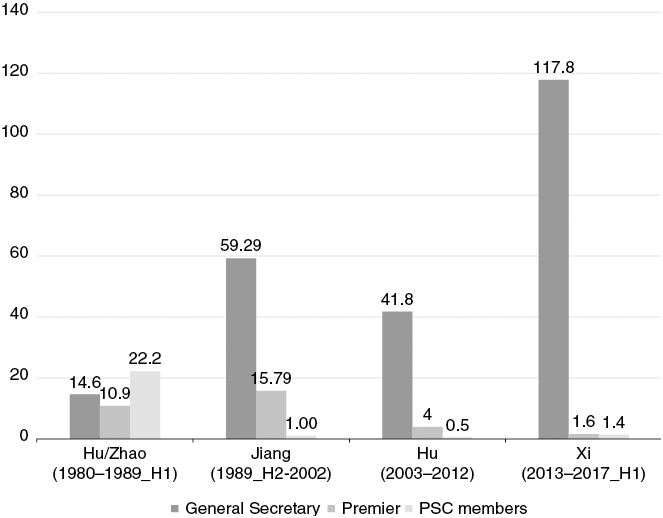
In the 1980s, China was that frictional, liberal autocracy. Chinese politics were intramurally contentious – with different factions vying for power, influence, and policy decisions – and, crucially, there was a degree of power sharing. The top leadership of the 1980s was known as “two and [a] half,” with Deng Xiaoping and Chen Yun as two coprincipals with more or less equal stature and prestige. Li Xiannian was the half, a rung down in the power hierarchy (Vogel Reference Vogel2013). The power sharing was formalized, and the distributiveness of power reached its apex in 1988. Five different individuals held top positions of the state – the general secretary of the CPC (Zhao Ziyang), the premier (Li Peng), the presidency (Yang Shangkun), the chairman of the Military Affairs Commission (Deng Xiaoping), and the chairman of the Central Advisory Commission (Chen Yun). Deng also enacted term limits and created the norms of mandatory age requirements that institutionalized Chinese politics further.
These changes did not flip China into a constitutional democracy and the Chinese autocrat was not shackled, to use the term by Acemoglu and Robinson (Reference Acemoglu and Robinson2020), but the Chinese politics became more predictable and more stable, and the usual speediness of a one-party autocracy diminished. The one-party rule itself was not a source of stability. Chaos reigned supreme under Mao’s one-party rule. Stability came from the institutionalization that Deng presciently enacted, a lesson that does not seem to have registered with Xi Jinping.
1.1.4 The Policy Signals
Intertemporal inconsistency is a feature of extreme autocracy. Think of Xi Jinping’s 180-degree reversal on zero-COVID-19 controls. Credibility was not a high concern of his, a sure sign of an absolute autocrat. Absolute autocrats do not need credibility because they compel compliance through the force of command and coercion. They are not good at, nor do they care about, the art of persuasion. This is why absolute autocrats often say things riddled with flagrantly logical inconsistencies and overtly factual contradictions.
One way to tell a frictional autocrat from an absolute autocrat is that a frictional autocrat pays attention to the psychology of the citizens. The Chinese leaders of the 1980s were keenly cognizant and mindful of the credibility effects of their words and actions. They worded their policy pronouncements carefully to project predictability and they went out of their way to repeatedly stress the continuity and the durability of the reforms. They also took highly symbolic acts, such as returning assets to former capitalists and convening direct and public meetings between top leaders and private entrepreneurs. Emerging from the highly ideological environment of the Cultural Revolution, this high-profile gesture mattered enormously.
The Chinese leaders also accompanied these high-visibility acts with some candid critiques of the Chinese system itself. Consider the following assessment by a Chinese leader issued on August 18, 1980: “As far as the leadership and cadre systems of our Party and state are concerned, the major problems are bureaucracy, over-concentration of power, patriarchal methods, life tenure in leading posts and privileges of various kinds.”
That assessment came from Deng Xiaoping, and it was an incisive diagnosis of the problems of the Chinese political system. Notice the date of the speech – 1980, at the very beginning of rural reforms. The SOEs were not spared. Commenting on a complaint by twenty farmers about their difficulties to get into the transportation business, Hu Yaobang wrote the following in a blistering tone (Chai Hongxia, Shi Bipo, and Gao Qing Reference Chai, Shi and Gao1997, 127): “There are two issues here. One is that some basic-level cadres and SOE managers took advantage of scarce supplies and engaged in hoarding and monopolistic practices. They jacked up prices and extorted and blackmailed the masses. The other issue is that SOE managers are incompetent, and they use the name of SOEs to exclude and attack individual enterprises.”
1.2 What Can We Learn from China’s Takeoff?
Getting details right yields right lessons about China’s takeoff and its subsequent experiences. This is a book of factual details, not of novel perspectives, and I approached the subject matter like a historian. Sadly, it is not fashionable to be a historian on the Chinese economy compared with being an armchair theorist. There was a time when economists theorized TVEs as a bulwark against the “private pillaging of public assets” even though the true underlying ownership of TVEs was private in the first place. Statist financial controls were justified on the ground of information asymmetry and broader public welfare functions of the state even though the period of steepest poverty reduction occurred during an era of financial liberalization.
I draw four lessons from the facts and data that I have reviewed. One is that the baseline effect is huge and we need to get it right. Second, what I call “directional liberalism” contributed to the incentive effect of Chinese entrepreneurs. The third is that politics and economics are complements rather than substitutes. The fourth is that rural China makes, and it can break, China.
These are not the lessons the Chinese leaders since 1989 have drawn. They believe, with rising vigor of conviction, that the power of the state in building infrastructure, scaling technology, and developing cities created China’s miracle. I believe that this view gets China wrong, and it has led to many of the ills of the Chinese economy, such as its macro imbalances, overcapacity, slowing personal income growth relative to GDP growth, poor productivity performance, and a gaping hole in the human capital of rural China.
1.2.1 Incentives and Baseline Effects
Economist Steven Radelet had a memorable quip about China’s rapid turnaround. “In 1976,” he said, “Mao single-handedly and dramatically changed the direction of global poverty with one simple act: he died.”7
This is true. His death set off reforms that launched China’s economic takeoff. But there is another side of the story. Mao also made a lasting contribution to poverty alleviation while he was alive. His disastrous policies had kept so many people poor. About two-thirds of the poverty reductions China achieved in the 1980s was attributable to the correction of Mao’s economic mismanagement (Ravallion Reference Ravallion2021). In 1976, the level of poverty was incredibly high relative to China’s economic potentials. Given that gap, reasonable and common-sensical policies produced immediate and sizable gains and progress.
China lifted so many people above poverty because there were so many poor people in the first place. This is a baseline effect. We should use more of this baseline thinking in our analysis of Chinese reforms. What was the political baseline in 1978? How did that political baseline affect the psychology of China’s would-be entrepreneurs? We do not have data but the following conjecture is eminently plausible: A would-be Chinese entrepreneur in 1978 did not view and assess her political world from the perspective of a Westministerian system of checks and balances. She compared China in 1978 with China in 1976. Once we get this basic scenario straight, so much of the “surprise” about why Chinese entrepreneurship boomed without Western institutions is superfluous. The absence of Western institutions is irrelevant to our inquiry because it was irrelevant to the cognitive horizon of our entrepreneur in question.
Her political baseline was the Cultural Revolution from 1966 to 1976, the totalitarian world of Mao Zedong. Now we ask, “Did the Chinese political system circa 1978, as arbitrary and as absent of the rule of law compared to a Westministerian system, mark a substantial marginal change from the Cultural Revolution?” The answer is a resounding “yes,” and that is the answer that mattered to her perceptions of risks and rewards of going into business.
The Cultural Revolution was a tough period for private businesses, to put it mildly. The ideology was antagonistic toward capitalism. Private businesses were strictly forbidden and in urban China all vestiges of capitalism – known at the time as “the tail of capitalism” – were wiped out. (There was some leeway in rural China, an important point to which I will return later.) Anyone who went into private business faced instantaneous risks of being arrested and of being persecuted.
Now imagine a change from being imprisoned instantaneously to a situation in which imprisonment was no longer instantaneous. Economists often tout security of property as a precondition for economic growth, but security of property presupposes security of the person holding the property, the proprietor. We often gloss over this distinction between the security of the proprietor and the security of the property itself. China did not then, or ever, have a strong protection of property rights but soon after the Cultural Revolution China moved quickly toward establishing security of the proprietor. One would think not getting arrested has an impact on incentives.
If we do not get the baseline right, we also cannot correctly calibrate the impact arising from the departures from the baseline. Two explanatory camps of Chinese growth do not sufficiently take into account that baseline. One holds that China took off because the policy changes were modest. This is the premise of the gradualist school. You start the reform slowly by taking small, incremental steps and then initial successes feed back into the policy process to produce another round of reforms. Modesty is a virtue.
Another theory holds that the Western model of economic growth is all wrong, with its fixation on rights and the rule of law. Look at China. It is an antithesis to democracy, and it thrived without the rule of law. It must be the case, this theory deduces, that China has figured out a unique “playbook,” the one rooted in China’s own tradition, culture, and institutions.
Both ideas ignore the baseline of China in the late 1970s. Modesty is in the eye of a beholder. A reallocation of profit retentions, an approach used to contract out farmland, may appear modest to us in an ivory tower, but against the backdrop of extreme antagonism toward capitalism this change was nothing short of radical. The “modesty” view is glaringly incongruous with the tale of eighteen households in Xiaogang village writing their pledge in blood. Also, the method required some remnants of capitalistic practices, which only existed in the countryside, and signals that policy and political changes were here to say.
The idea that Chinese boom violated the basic cannons of economics would have us believe that in 1978 a would-be Chinese entrepreneur contemplating to go into business was flipping through the pages of the American constitution and asking agonizingly, “Do I have Western property rights security?” That is just not a realistic representation of that entrepreneur’s frame of mind. Her likely question was, “Do I have more personal security in 1978 than in 1976?” The answer is yes because she, as a proprietor, became more secure. It was that directional change that explains China’s entrepreneurial response. While Polity IV may lump them close to each other, to the hundreds of millions of the Chinese, there was a world of difference between Mao Zedong and Deng Xiaoping.
1.2.2 Directionally Liberal Model
Entrepreneurship boomed at a time when China lacked even a hint of constitutional democracy, a phenomenon that has produced a cottage industry of books and articles all eagerly pontificating how growth can happen under – or is even facilitated by – an autocratic system.
This is the China Model in its most essential elements. It asserts that Chinese growth came from its own unique brand of political economy that is neither a central planning system nor a conventional market economy. The foundation of that model is a meritocratic autocracy that is smart, strategic, and always focused on the long term. China boomed precisely because it did not reform its politics and rule of law is dismissed as a Western fixation that has no economic utility for China.
This conceptualization of Chinese growth model is implicitly conditioning the decision framework of Chinese entrepreneurs on the level of political institution rather than on its movement. There is an easy way to demonstrate the flaw with this approach: It is unable to explain why Chinese entrepreneurs sprang into action under Deng whereas they are retreating today under Xi Jinping.
For my approach, it is easy. Deng was moving China away from Mao’s totalitarianism, whereas Xi is moving China toward it. Let me frame this statement in rule-of-law language: Chinese entrepreneurship boomed when the country was moving toward the rule of law; it is now retreating because the country is moving away from it. The rule of law matters tremendously but we need a dynamic framework to capture its relevance and importance.
China was not, and never has been, a democracy. This is true, but the reformist leaders made several moves very early on with a clear intention of signaling an improvement in property rights security. They did not do so through constitutional reforms but through enhancing the legal and political security of entrepreneurs. In the 2008 edition of this book, I coined the term “directional liberalism” to explain why the private sector surged forward immediately after the Cultural Revolution.
Two things can be true at the same time. One is that China is not a liberal democracy; it has never been even at its most liberal moment, and it may never be. The other is that China can, at a particular time (e.g., the 1980s), move in a liberal direction. In my account, the trajectory of reforms is correlated with that movement rather than with the static characteristics of Chinese system at a particular moment in time. China boomed, in GDP but also in personal income, when it had a directionally liberal model of growth.8
The operative variable here is the movement of politics rather than a given position of politics. The directionality of politics matters, not its level. Economic agents may still invest and expand their businesses even if China does not have the rule of law but that requires two conditions. One is that the investment returns have to be abnormally high in order to compensate for the risks of not having the rule of law. This condition is especially important to foreign investors, who have a menu of choices when they make investments. A combination of low returns and absence of the rule of law is the reality of Xi’s China today.
The other condition is that China is moving in the direction of the rule of law. This distinction between direction and level clarifies so much muddled thinking about Chinese institutions and Chinese growth. During the entire reform era, China was never in the vicinity of a democracy. Its Polity score is stuck stubbornly at −7. From this shabby level of political liberalism, Xi is taking China backward, moving the country away from that of Deng Xiaoping in the direction of Mao Zedong. Is it any surprise that entrepreneurs are not investing and foreign businesses are leaving?
1.2.3 Political and Economic Complements
“All good things go together” is a quip that the economist Jagdish Bhagwati used to convey a liberal creed that growth is associated with many other desirable things in life – reduction of poverty, improving literacy, and equity. Let me borrow this line of thinking and ask whether liberal politics and liberal economics have gone together in China.
A view known as authoritarian advantage holds that an enlightened strongman represents the best hope for reforms.9 Powerful people lose from reforms, and you need a strongman to overcome their opposition. In the Chinese context, Deng Xiaoping is often held up as a strongman. Did illiberal politics go with liberal economics in China?
Deng was never the kind of strongman as implied by this view. He was first among equals, but he also shared power and prestige with other revolutionary elders. Many conservative elders were fiercely critical of rural reforms, but rural reforms nevertheless proceeded and progressed on their own accord. Deng did not issue decrees to command reforms to go forward, nor did he purge his conservative critics, such as Chen Yun, the guru of central planning, or Deng Liqun, a CPC ideologue, a man obsessed with the fact that rural businesses broke the private ownership threshold Karl Marx had stipulated – an entity with eight or more employees. It was serendipity that propelled reforms, according to Deng:10
In the rural reform our greatest success – and it is one we had by no means anticipated – has been the emergence of a large number of enterprises run by villages and townships. They were like a new force that just came into being spontaneously. These small enterprises engage in the most diverse endeavours, including both manufacturing and trade. The Central Committee takes no credit for this.
The Chinese economy took off because Deng’s CPC created space for experimentation and initiatives. The reformist leadership deserved full credit but let’s be clear about what that credit is. It is for the virtue of their omission, not for the virtue of their commission. Serendipity itself was not serendipitous; it did not happen under Mao, nor under Xi in today’s China. The liberal political environment of the 1980s enabled that serendipity.
Deng’s famous motto “it does not matter whether a cat is black or white as long it catches mice” is emblematic of his pragmatism, as many people have noted, but the significance of that way of thinking goes beyond pragmatism. It is an empirical approach, an idea that one waits for an outcome whether a mouse is caught before making a decision over what to do. For an autocrat to be willing and to have the awareness to defer his judgment to facts and data on the ground is nothing short of extraordinary. That empirical policy ethos permeated Chinese policymaking in the 1980s. On rural issues, reformers advocated placing the burden of adjustments on government policies in deference to rather than in defiance of the facts on the ground, a world of difference from the technocratic approach that prevailed after 1989.
Deng and Xi are autocrats but they differ at a fundamental level on their deference to facts and on their attitude toward criticisms. Deng was a frictional autocrat and he encountered and occasionally tolerated myriad opposition to his ideas. He managed, compromised, and balanced multiple forces in Chinese politics and society. Until 1989, prominent Chinese intellectuals, such as Fang Lizhi and Liu Binyan, criticized Deng by name. (This right to criticize Chinese leaders was formally enshrined in a 1978 landmark CPC document. I will discuss that document in Chapter 6.) Try the same thing with Xi Jinping and you will find out his response in jail.
Economists celebrate China’s experimental approach (Naughton Reference Naughton1996 and Weber Reference Weber2021), and rightly so, but there is a crucial precondition for that gradualism to work. The fractious politics under Deng created space for reforms and experimentations and the broad welfare gains from reforms then strengthened the momentum and built support for further reforms. In other words, endogenous reforms were endogenized by a tolerant political environment.
Every single important political reform, as noted by Pei (Reference Pei2006, 11), such as the term limit, the mandatory retirement of government officials, the strengthening of the National People’s Congress (NPC), legal reforms, experiments in rural self-government, and loosening control of civil society groups, was instituted in the 1980s. They contributed to the rising and cumulative sense that the reforms were irreversible, and that proprietors and property grew more secure. The timing here is critical. These directional changes in Chinese political system occurred prior to or in parallel with China’s economic takeoff. Politics preceded growth, not the other way around.
An enlightened strongman bravely pushing reforms forward is a version of Waiting for Godot. The wait is long; the arrivals are few. Or never. Strongmen do not have a stellar track record in carrying China forward on a reformist path. The only person who imperfectly fits the bill is Zhu Rongji, a canonical strongman in economic policymaking, who was instrumental in forcing Chinese bureaucracy to open to globalization and to privatize SOEs. (For historical accuracy, however, both open-door policy and privatization already began in the early 1980s, and Zhu did not invent these policies.) There is another and largely unknown side to his reformist ledger. As I will show later, the group of Shanghai technocrats who took over China after Tiananmen reversed rural financial reforms and taxed rural economy heavily. A strongman has the power to reform but also the power to reverse reforms. You cannot make an omelet without breaking eggs; the uncertainty is whether the omelet is reforms or their reversals.
Many held out the same hope for Xi Jinping. He would launch reforms after he cracked down on corruption; he would launch reforms after he consolidated his power base. So go many variants of that surreal claim. But Xi refused to oblige. As he consolidated his power, his economic retrogressions accelerated. Can anybody today argue with a straight face that economic reforms are not moving forward because Xi does not have enough power?
1.2.4 Rural China Makes, and Breaks, China
In 1978, China was overwhelmingly rural, and the takeoff of the rural economy produced the greatest good for the greatest number. But rural China matters not just economically; it matters also politically and institutionally. The stellar performance of the rural economy dramatically altered the policy discourse and the political landscape in Beijing. Reformers gained instant credibility, which enabled them to overcome, blunt, and silence the pushbacks from the conservatives.
Rural China became a source of institutional spillovers. By 1978, overt capitalism had been thoroughly eradicated in China, but remnants lay dormant in the countryside, ready to resurface when opportunities arose. Rural China was more prepared for capitalism in general and particularly for an arm’s length form of capitalism. Compared to urban China, the CPC exerted a lighter touch in rural areas, creating a more permissive environment for market activities and private ownership.
Urban China was the epicenter of Mao’s political movements and it is the CPC’s seat of power. Central planning and the Cultural Revolution decimated capitalism in the cities, but not entirely in the countryside. Agriculture was never as planned as industry, and rural residents lacked – and continue to lack – basic job and social security protections compared to urban residents. Even at the height of the commune system, Chinese peasants possessed some parcels of land for private cultivation (自留地).11 During the commune era, although these private plots were not tradable, the revenue rights were semiprivate. The degree of private appropriability varied substantially in the 1960s and 1970s, depending on the twists and turns of Chinese politics. Sometimes these rights were substantial; other times, they were not. Nonetheless, remnant capitalism existed in rural China before 1978.
A common explanation for the strong entrepreneurial response is that the policy changes were modest. The dual-track system allowed farmers to sell their crops at market prices after fulfilling their quotas to the state. At conferences on the Chinese economy, you often hear the phrase “low-hanging fruit” to describe China’s reforms in the 1980s.
But modest compared to what? That view is context-free, situationally vacuous, and a tad condescending. The dual-track system may be operationally straightforward but it requires economic agents to intuitively grasp the concept of residual claims, something we should not take for granted. Chinese reformers tried the dual-track approach in the urban economy but the experiment failed to elicit incentive responses similar to those in agriculture. The contexts in which the dual-track reforms are attempted matter tremendously.
Among scholars of comparative economics, there is a widespread view that the Soviet – and later Russian – economy failed to take off because its leadership opted for shock therapy rather than for the gradualist reforms, Chinese style. Like many perspectives offered at 30,000 feet from the ground, this view is ahistorical. Mikhail Gorbachev tried the gradualist approach and launched land-leasing reforms closely modeled after the Chinese rural reforms, but unlike the Chinese farmers, who jumped on the offer, the Soviet farmers refused to sign up for a leasing deal with the state. In the documentary Inside Gorbachev’s USSR, an official recalled a Soviet farmer explaining why he did not want to lease the land, “You are paying me a salary, right? If I lease from you and there is no rain, I still have to work, but who will pay me? I have a loss, and I have nothing to eat.”12
In the hyperindustrialized economy, this Soviet farmer rested on the safety net of a basic salary in a way that completely eluded the Chinese farmers. The upside of the residual value is much larger to someone who faces risks than someone who does not, a notion that every venture capitalist knows well, and this is why venture capitalists structure compensations to the entrepreneurs they backed loaded with stock options rather than with high salary.
The baseline effect is again at work. The knowledge of residual claims depended on the existence of capitalistic residues and, in the late 1970s, rural China still retained a few rudimentary capitalistic traits, a fundamentally different situation from urban China and the industrialized Soviet Union at the time of perestroika. In these two latter settings, there were no longer any residues of residual values and residues of risks. The fruits were hanging low only because the trees were not tall in the first place. The “modesty” judgment of the dual-track reform ignores the crucial rural context of China’s experiment.
Rural reforms were truly gradualist and experimental in the way that Naughton and Weber described. The initial successes of the TVEs created competitive pressures on urban SOEs and the reformist leaders used those pressures to prod the reforms and restructuring of the SOEs. The scaling of the TVEs also demanded formal and legislative attention and in 1984 the CPC passed a series of laws and regulations formalizing the status of private enterprises. Rural reforms were the catalyst.
A further analytical implication has to do with the effects of ex ante rural entrepreneurship. The financial reforms of the 1980s, even though limited to the rural areas, had a disproportionately contributory effect on the overall entrepreneurial and market development because rural China was already predisposed toward capitalism in the first place. This is why the supply response – surging private-sector investments and rural entrepreneurship – was so elastic with the respect of seemingly incremental policy changes.
By the same token, rural financial reversals and urban biases in economic policies produced a disproportionate effect in the opposite direction. The reversals in the 1990s stunted the development of rural capitalism and seeded and fueled urban-centric capitalism. Urban capitalism is state capitalism, a form of capitalism closer to and deeply enmeshed with the seat of power. The nature of Chinese capitalism underwent a transformation and a switch – from a more arm’s length version to one that is more connected with the state.
Is this rural lens still valid for today’s China, a country much more urbanized than it was in 1978? As of 2022, according to official statistics, 65.2 percent of Chinese people live in cities. China is majoritarian urban by that measure, but this is a geographical definition of urbanization, defined as the ratio of urban residents to the total population.
Urbanization is both a geographical and a legal concept. Think of the difference between a H-1B holder and a citizen in the United States. Both reside in the United States and are identical in terms of their geographical status, but they differ in terms of their rights and obligations. A critical difference is that a person with a H-1B status “earns” his residency through the job he holds. His residency is an employment-based entitlement.
Many of Chinese geographical urbanites are similar to these H-1B holders. They hold a rural Hukou status, the legal status tied to their rural birthplace. They can reside in the cities but they lack many of the rights of their fellow Chinese urban citizens, including an elemental right to reside in a city in the first place. Many municipal governments in China have evicted rural Hukou holders at will from their jurisdictions under myriad pretexts.
In 2023, there were estimated 297.5 million migrant workers in China. This was 21 percent of Chinese population and, like H-1B holders, their urban residency was contingent on their employment. In a fundamental sense, rural migrant workers are urban residents, not urban citizens. Citizenship, even in the confined political space of China, denotes certain rights, which are denied to the rural Chinese. Rural labor migrants have weaker and fewer rights than urban citizens in their relationships to land or real estate assets. This engrained inequality of the Hukou system between residency and citizenship fueled China’s investment-intensive growth in the past but its extractive nature is a threat to its future prospects, a topic I will discuss at length later in the book.
In important ways, Chinese rural labor migrants enjoy fewer rights than H-1B holders in the United States. The children of H-1B holders can attend local schools but Hukou denies rural migrants access to urban schools and healthcare facilities, forcing them to leave behind tens of millions of children in their home villages. (They are known in China literally as “left-behind children.”) This disenfranchisement has produced a devastating effect on rural human capital development by forcing a geographical partitioning between parents and their children, which resulted in severe parental underinvestment in education and early childhood cognitive developments.
Unbeknown to many Western observers, China in fact has “shockingly poor” human capital in its rural regions (Khor et al. Reference Khor, Pang, Liu, Chang, Mo, Loyalka and Rozelle2016). I will go into this topic in greater detail in Chapter 6 but suffice it to say that China faces a realistic prospect of a middle-income trap because of this deficiency of quantity and quality of rural human capital (Rozelle and Hell Reference Rozelle and Hell2020). In the 1980s, rural China jump-started Chinese growth; it can derail it if the country does not get it right.
1.3 The Rise of the China Model
The rural financial reforms were one of the most consequential economic events in modern China, but like so much else about rural China they are virtually unknown, not only among Western China scholars but also among Chinese policymakers. In 2016, Meijuan Qian and I published a paper in China Economic Review offering statistical evidence on how the financial reforms in the 1980s improved credit access for rural households (Qian and Huang Reference Qian and Huang2016). After our paper was published, a top official at the PBoC approached me – through his secretary, who was visiting the US – and asked, “Did that really happen?” This official had no knowledge of what happened in the 1980s, a fact made all the more remarkable because our research draws from the reams of documents his bank issued and the household surveys conducted by the Chinese government.
One reason is that the rural financial reforms were completely reversed by the post-Tiananmen leadership. Nicholas Lardy’s China’s Unfinished Revolution, which argued that China never implemented financial reforms, was published in 1998, the same year the PBoC declared RCFs illegal organizations. In the 1990s, the Chinese state arrested rural financial entrepreneurs, executed at least one of them, recentralized local credit unions, and imposed stringent eligibility requirements on rural households. Credit access declined steeply, TVEs experienced a financial squeeze, and rural household income slowed down in growth.
The rural reversal ushered in the next phase of the Chinese reform treadmill – what I call the “Shanghai Model.” The name was derived from the fact that the model was transplanted from Shanghai to Beijing after the officials from Shanghai took over China in 1989. The post-Tiananmen leadership resurrected an ingrained, deep feature of a centrally planned economy – urban bias. They shifted policy attention and the focus of reforms to SOE restructuring, privatization, and mercantilist globalization. Other components of this policy model complemented and augmented this urban bias, a techno-national policy agenda, industrial policy, and infrastructural building, the elements that collectively formed the development model that took over Chinese policymaking after 1989.
The Shanghai Model is the blueprint of what many in the West celebrate as the famous “China Model.” The China Model is not central planning. The China Model is state capitalism. It is still capitalistic but there is a fundamental difference between state capitalism and the directionally liberal model of the 1980s – their venue. The contracting-out of land, TVEs, and financial reforms all took place in the politically extensive and residually capitalistic rural China; the SOE privatization, globalization, and urbanization took place primarily in urban China, the seat of the CPC power and control. The most salient change is that Chinese capitalism became urban and, by implication, more politically intensive. If there is one thing that sharply differentiates between the 1980s and the 1990s, this is it.
GDP growth continued under state capitalism, but its citizens derived smaller and smaller benefits from rapid GDP growth. Personal income and consumption shrank as proportions of Chinese GDP and over the years China accumulated a massive overcapacity as its supply overshot its aggregate demand. The China Model managed to absorb that overcapacity in two sequential phases: during the first phase, in the 1990s and until 2008 through mercantilism, and then during the second phase through a massive real estate boom. China experienced high GDP growth during both phases. The first phase was based on some real economic fundamentals – high-income markets of the West; the second phase was heavily driven by the real estate bubble that has a fragile economic foundation. One way to describe the economic difficulties in China today is that these two drivers of the China Model are closing, and the only way to absorb that overcapacity is to write it down, which is the definition of an economic slowdown.
An irony unappreciated by the China Model partisans is that one can make a legitimate case that Chinese statism was successful partially because of Western liberalism of the hedonistic consumption and an unconstrained discounting of the future on the part of the West. The predecessors of Xi implicitly understood the dependency of the China Model on the West, but that obvious linkage eluded Xi Jinping. He damaged the relationships with the West while accelerating the buildup of the supply side, further aggravating China’s overcapacity. This is the situation in which the China Model has found itself at the time that this book goes to the press.
1.3.1 A Great Reversal
The rural financial reforms never progressed beyond the 1980s. Starting in 1993, the Chinese government restructured rural finance by recentralizing the management of local savings and loans organizations, restricting and criminalizing many forms of private finance. Based on the data from the 1990s, scholars wrote that private finance functioned at the edge of law by providing much-needed liquidity to credit-constrained entrepreneurs and that private finance was limited to Zhejiang (Allen, Qian, and Qian Reference Allen, Qian and Qian2005). This is all true, but what these researchers did not tell you is that private finance was vibrant in Zhejiang because in the 1990s Zhejiang did not crack down on private finance as much as the rest of the country did. In the 1980s, private finance was a nationwide phenomenon, and it was by no means limited to Zhejiang. The informality of private finance was a result of a policy decision in the 1990s that outlawed private finance.
In the 1990s, the man in charge of the Chinese economy and finance was a consummate technocrat from Shanghai, Zhu Rongji. In the 1980s, he served under Jiang Zemin as the mayor of Shanghai and then its general secretary after Jiang went to Beijing. In 1991, he was appointed executive vice premier, governor of the PBoC between 1993 and 1995, and premier from 1998 to 2003. He was known as China’s “economic czar.”
Deng praised Zhu as “one of the few cadres who really understands how the economy works.”13 Maybe he thought that he was replacing Zhao Ziyang with another reformer. Zhu was a reformer but he was a very different kind of reformer compared with Zhao Ziyang. Zhao had his roots in Chinese agriculture, the venue of residual capitalism. He created an agricultural miracle in Sichuan by reforms and decentralization. Zhu hailed from an urban and industrial background – a background that was by definition dominated by an experience steeped in SOEs. An engineer by training, he was technocratically cosmopolitan and strong-willed and decisive in temperament, in sharp contrast to the soft-spoken and extraordinarily open-minded Zhao Ziyang.
This is a Tiananmen effect in a nutshell: China transitioned from the economic personality of Zhao to that of Zhu. Zhao saw in TVEs income improvement and employment generation; Zhu saw in them low-tech products and a distraction from his techno-national aspirations. Zhao created fiscal decentralization as an incentive device but Zhu feared chaos and coordination failures. Zhao cared about the tangible gains of ordinary Chinese citizens as the end goal of growth rather than seeing economy as an abstraction of power, historical glory, and shiny technology, in contrast to Zhu’s imperative for the central government to achieve rapid technological and industrial upgrading. Zhao was a system person, attentive to relationships and complex interactions and with a faith in the power of incentives; Zhu was a commanding-heights developmentalist impatient with the status quo and with a faith in the power of power.
Chapter 3 will detail the rural financial reversals and here is a preview. In 1993, the PBoC started restricting credit flows to rural economy by reducing loans to the nonagricultural activities engaged in by rural households. It recentralized finance (as well as the fiscal system). The PBoC wrested the controls from the members of the rural credit coops (RCCs), credit unions in rural China. In the 1980s, the members of the RCCs had begun to reclaim voting rights over the management of the RCCs. In 1998, the State Council banned RFCs and the government also arrested financial entrepreneurs.
Meijuan Qian and I used two waves of rural household surveys, one from 1986 to 1991 and the other from 1995 to 2002, and found that financial access on the part of rural households experienced a steep reduction over time. In 1986, approximately 34 percent of rural households indicated they had received either formal or informal loans; by 2002, this proportion had crumbled, to only 10 percent.
We conducted regression analysis of data pooled from both waves and we found that a dummy variable approximating the policy shift in the 1990s was consistently negative and statistically significant on our measures of rural household access to finance. Policy changes, rather than business factors such as profitability, singularly drove the credit constraints.14
Private-sector access to capital to engage in nonfarm activities became very difficult in the 1990s, showing up as an immediate decline of the rural private fixed-asset investment activities. (See Table 1.2 of the 2008 edition for details.) In the 1980s, the rural private share of fixed-asset investments accounted for 19.2 percent of China’s total fixed-asset investments. From 1993 to 2001, the share went down to 9.5 percent and then 5.5 percent during the period 2002 to 2005.
Was this due to a policy change or to structural changes, such as declining agriculture? The timing of the decline offers a clue. Structural changes occur gradually, whereas the decline here was compressed within a short period. Also, much of the rural fixed-asset investment was nonagricultural in the first place so industrialization would have boosted rural fixed-asset investments rather than reducing them. The rising credit constraints, documented by Meijun Qian and me in our paper, drove this decline.15 What came next was slowing rural income growth relative to GDP growth. A new economic era dawned and economic gravity shifted to the state-centric urban China.
1.3.2 The Era of State Capitalism
Economic researchers have debated for a long time the causes and the effects of China’s low consumption share of GDP. Let’s be clear: The onset of this structural imbalance began with the policy reversals in rural China. After Tiananmen, Chinese policymakers viewed rural China as a burden on the rest of the country rather than as a contributory force to the economy. The Shanghai technocrats designed policies and programs over education, land rights, labor migration, and Hukou with an intention of reducing that burden. In the 1990s, the credit squeeze turned rural Chinese into net savers, who funded urbanization, the costs of SOE restructuring, and various ambitious state programs on technology and higher education.
An extractive model prevailed and that model is state capitalism. State capitalism is based on a strong techno-national philosophy, an economic ideology that underlies the three generations of the Chinese leaders since 1989. The Shanghai technocrats considered rural businesses a drain on national resources and wanted them to focus on agricultural production. This technocratic view converged with the central planning wing of the CPC; Li Peng, China’s premier from 1987 to 1998, was a fierce critic of TVEs.
That view on technology – that high-tech firms are high-tech congenitally and statically – is incredibly static, and wrong. (As an example, Samsung started out not as an electronic firm but as a vegetable vendor.) The Shanghai technocrats did not believe that given the right environment businesses can be dynamic and evolutionary, and that technology develops endogenously because of market competition. They also had a view that size denotes technology, a view of technology that led Zhu Rongji to believe that a company called GM somewhat represented the frontier of the world’s automotive technology. He personally oversaw the gas-guzzling Buick project in Shanghai.
Techno-nationalism drove every single important policy action on the part of the Shanghai technocrats. Take privatization. In the 1990s, the scale of privatization was substantial, belying a widespread view that China did not adopt a shock therapy in its reforms. Estimates are that some 30 to 50 million SOE workers were laid off in the 1990s (Naughton Reference Naughton2018), possibly the single largest shock therapy in history.
China’s privatization was rooted in a technological rationale, not an economic one. The program was formally known as “grasping the big and letting go of the small.” The small SOEs were let go to cut the losses on the government budget so that the state had more resources to support technologically advanced SOEs. This approach was extraordinarily costly in social terms. Privatizing the loss-making SOEs rather than the state-owned monopolies generated modest revenues to the government, revenues the government could have used to cushion the blows of unemployment. The Shanghai technocrats privatized in a classic autocratic fashion – targeting labor-intensive SOEs for privatization without first establishing a rudimentary social safety net. They then used the coercive power of the state to suppress the discontent on the part of the laid-off workers.
Shanghai technocrats pushed a globalization agenda. The signature event was China’s accession to the WTO, secured by the forceful tactics of Zhu Rongji. Zhu valued globalization as a techno-national tool, a belief that underpinned his Janus-faced approach toward finance. Under his leadership, the Chinese government actively and proactively courted Wall Street, opening China’s initial public offering business to American investment banks and creating a joint venture, the China International Capital Corporation, between China Construction Bank and Morgan Stanley, all at the exact same moment that Zhu Rongji cracked down hard on rural private finance. It was a fervent faith among the Chinese policymakers that globalization was a way for China to source and adopt the most advanced technology of the world, and years later Xi acted on a similar set of beliefs, except that this time around he convinced himself that China no longer needed globalization on the ground that the technological capabilities of the rising East enabled a safe disengagement from the declining West.
Globalization was on the more positive side of the legacies of the Shanghai technocrats, but interestingly not in the way the Shanghai technocrats intended. The globalization agenda of the Shanghai technocrats was heavily technological, but in the 1990s, much to their chagrin, the bulk of the foreign direct investment (FDI) that came into China was labor-intensive and export oriented (Huang et al. Reference Huang, Ma, Yang and Zhang2016). For a long period of time, Chinese officials constantly complained about the low-tech content of Chinese FDI. Little did they know that the labor-intensive FDI saved China from their mismanagement of rural China. Labor-intensive globalization generated employment opportunities for rural labor migrants and lessened the negative shock of their income slowdown. Market access to the rich markets of the West powered Chinese growth. While rural income growth elasticity with respect to GDP growth plummeted during the Jiang era, his mercantilist export surpluses kept the momentum of the GDP growth and prevented an even worse outcome in the counterfactual absence of globalization. In effect, the Shanghai technocrats performed a switch: They suppressed the potentials of a high-growth but low-income market of the rural Chinese in exchange for a low-growth but high-income market of Western consumers. The switch was unintended and inadvertent but, be that as it may, the right policies of the Shanghai technocrats canceled out some of the effect of their policy errors.
1.3.3 The Shanghai Model
A third signature policy of that era is a state-centric massive urbanization program. Nothing symbolized the centrality of the urban bias of the Shanghai technocrats more potently than Pudong. Foreign business executives marveled at Pudong – skyscrapers rising from the rice paddies – as a symbol of a prosperous China.
Let’s be very clear about the essence of the Pudong model: It was partly a Potemkin project and partly based on predation. Shanghai received generous subsidies from the central government to develop Pudong, a categorically different situation from Shenzhen. Although lumped together as a single genre of Chinese development, the difference between Shanghai and Shenzhen is vast. In the early 1980s, Shenzhen was mired in controversies, and it never received much financial support from the central government. The boom of Shenzhen was self-funded by organic economic activities – foreign companies and domestic entrepreneurs establishing operations there. Shenzhen generated employment externalities – job opportunities for itself but also for other provinces that had a labor surplus. It was more of a market success story.
The building of Pudong was a tax on the rest of the country and it pioneered in a method that soon became prevalent in the rest of the country – land taking. The state, as the monopoly acquirer facing no competition, requisitioned vast tracts of land from rural households at low cost and then auctioned off the land-use rights at prevailing market prices to the developers. The sizable spreads between acquisition costs and proceeds from land contract auctions then funded government buildings, salaries, industrial policy parks, subsidies showered on businesses, welfare and pension obligations to urban residents, and, last but not least, corruption.
Did Pudong model produce GDP growth? Yes, it did but it set a precedent for a developmental model based on extractive transfers from the disenfranchised rural Chinese to the relatively enfranchised urban Chinese. It shifted income shares from households to the government and to the capital sectors of the economy.
Pudong was a visible and visceral announcement of the arrival of Shanghai Model. Shanghai technocrats then scaled and, by their ascendancy to national leadership positions, legitimized the Shanghai Model. This is the origin of the China Model, essentially a scaled-up Shanghai Model. From the early 1990s, localities throughout the country eagerly sought FDI by scrambling to build their own mini Pudongs, but they did so with a significant handicap. They did not have the cosmopolitan prestige of Shanghai, its business fundamentals, market demand, and subsidies from the central government. They made up those shortcomings by squeezing costs – the costs of land and costs of construction labor. They took rural land by coercion, forcibly evicting long-term residents, and demolishing their housing stock, often with violence. In the 1990s and well into the first decade of the 2000s, forcible takings of rural lands led to numerous and sometimes deadly protests. This is not surprising. The rural Chinese who lost their land were compensated at a fraction of the revenues the local governments received in the land auctions; some were not compensated at all.
The Shanghai Model was destructive in multiple ways. Some of the infrastructure China built is productive but many projects are not. The precious savings of the Chinese households were converted into ghost cities, bridges to nowhere, and excesses of real estate projects. That model of development denied property rights to the rural Chinese, the sell side of the market, and prevented them from capitalizing on the urban boom China experienced. A sure path to wealth accumulation was preempted. To add insult to injury, the Shanghai Model compounded that damage by short-changing the human capital of the rural Chinese. China underinvested in public education and health in rural China.
The Shanghai technocrats reversed all the political reforms that Zhao Ziyang had put in place. This was expected. After all, the fall of Zhao paved for their rise, but there is another, and deeper, reason. The implementation of the Shanghai Model hinged on disenfranchising rural Chinese, most crucially in terms of their incumbency relationships with the land they occupied. Inevitably, the issues of land – the control, the use, and the allocation of beneficial rights – were to feature centrally in Chinese economic development.
The most logical and the most administratively straightforward course of action is for the state to recognize and formalize the land rights that the rural Chinese acquired through incumbency. Had the Shanghai technocrats truly followed a gradualist strategy and learned from the successful East Asian model, that would have been a natural policy course to pursue.
But this is not what they did. They prioritized urban Chinese and assigned to them comparatively stronger real estate rights to stimulate urban development while categorically refusing to legislate the land incumbency of the rural Chinese into ownership rights. There is a method to this aspect of Shanghai Model. The security of rights on the demand side and the insecurity of rights on the supply side combinatorically supercharged China’s urban development. Pudong was built so quickly precisely because the rural residents of Pudong lacked any rights. Is it any wonder that the Shanghai technocrats and their successors never implemented reforms that are unambiguously good for the Chinese economy, such as abolishing Hukou and strengthening the land rights of the rural Chinese? Is it any wonder that Shanghai technocrats and their successors refused to loosen any of the autocratic features of the political system, those features that deployed and enforced the disenfranchisement of rural Chinese?
The disenfranchisement of the rural Chinese helped create a nation of laborers, not of mass consumers. The rural migrant labor contributed to the output production in excess of the returns on their labor and the absence of a social safety net acted to pry savings out of their income. The China Model can be expressed by three factors: declining labor share of GDP, high savings share of income, and those two ratios applied to some 60 percent of the Chinese population. Those three factors in essence are the manifestations of many of the macroeconomic dysfunctions of the Chinese economy today.
The urbanization and industrialization on the Chinese scale created vast wealth, but that wealth effect completely bypassed the rural Chinese and went straight to the claimants on the factors of production – the landowner, that is, the government; the power holder, that is, officials; and the capital owner, that is, the developers. In 2019, a rural household received just $53 in per capita asset income. Some economists have characterized the China Model as “Pareto-optimal.” Maybe in a very narrow, technical sense of Pareto optimality that rural Chinese did not lose their standard of living and they did not become absolutely worse off. But in an economy that grew at 8 to 9 percent a year for decades in a row this is a very low threshold indeed.
1.3.4 Transitioning to Statism
The next stage of the Chinese economy is statism, a stage where the state not only encroaches upon but has taken over many market functions and the private sector. This stage of the Chinese economy is commonly associated with Xi Jinping, in part because his crackdowns on the private sector in 2020 and 2021 were extreme and overt. But, to be fair to Xi, the statist transition started quietly under Hu Jintao and Wen Jiabao.
There are two kinds of statism, social and economic statism. Social statism assigns a greater role to the state in providing and funding social safety, such as education and health. To their credit, Hu and Wen began to strengthen social protection of Chinese citizens and they set up a rudimentary social insurance program for rural Chinese, an underrated achievement of theirs. They partially reversed the sorry state of rural economy bequeathed to them by their predecessors. Rural income relative to GDP growth improved, and this improvement was on top of a strong GDP performance.
In their second term, they pivoted to economic statism, less as an ideological move than as a default of their hurried response to the tsunami of the 2008 Global Financial Crisis. Their sizable stimulus program, known in Chinese as Siwanyi, naturally latched onto those specialties of the Chinese state – building infrastructure and cities and demolishing everything in their path. A lost opportunity for Hu and Wen is that they did not focus the thrust of Siwanyi on the final demand side of the Chinese economy – income growth and support of the household sector of rural Chinese. They did not advance land and Hukou reforms beyond a few isolated local experiments.
Social statism was eclipsed by an emerging phenomenon known in the Chinese economic parlance as guojin mintui, “the advancing of the state and the retreat of the private sector.” This was economic statism – the displacement of the private actors and market functions by the state. The guojin mintui planted the seeds of the statism of Xi Jinping in more ways than one. Xi’s brand of economic statism is more overt, confident, and sharp-edged. A crucial component is asserting the state’s control rights into the private sector.
1.3.5 Asserting Control Rights of the State
Xi commands clarity of policy signals and goals. He was upfront about scaling the control by the state and about curtailing capitalism. Under Hu and Wen, encroaching upon market functions and private actors was a side show; Xi’s statism has an ideological rationale and intentionality. And Xi went way beyond crowding-out and encroachments; he actively cracked down on the private sector and even nationalized private firms. Quantitative changes led to qualitative changes and the velocity of China’s statist movement accelerated.
Statism is not the same as central planning. Statism cohabits with private property and market rather than stamping them out. Statism also differs from state capitalism. Under state capitalism, capitalists still wield substantial agency. They initiate investment projects, develop products, and execute sales. Under statism, the agency shifts to the state. The capitalists do the bidding of the state and they are no longer in the driver’s seat.
A crucial feature of statism is how control rights are allocated independent of the allocation of revenue rights. Statism wrests some of the key control rights away from the private and market actors. This was done through enforcing a long dormant provision in the CPC Constitution – a provision that requires the establishment of a CPC branch in organizations with three or more CPC members. Xi rigorously enforced that provision and he also enacted legislative acts that substantially blurred the boundary between the state and private businesses. In economics language, that move attenuates the control rights of private shareholders.
Under state capitalism, the control and revenue rights are correlated with each other, not perfectly but reasonably so. Under statism, the state, without even a pretense of revenue rights, inserts itself into strategic, and even operational, aspects of private firms. The proximity between revenue and control rights collapsed.
1.4 China’s Pivotal Moment
How do we explain the twists and turns of Chinese reforms? How is it that Chinese reforms ended up as a treadmill rather than as a continuous forward motion? On the surface, it is puzzling. The Maoist orthodoxy should have expired both actuarially – the last of the revolutionary elders was to die in 2015 – and ideologically, through globalization of ideas, values, and capabilities. Chinese policymakers gained expertise in market economics and sophistication in macroeconomic management. Technical barriers no longer stand in the way.
A long-held view among China scholars is that reforms are endogenous of prior reforms. This is an accurate description of how reforms unfolded in the 1980s. In 1989, that began to change.
1.4.1 The Shanghai Technocrats
Since 1989, every party secretary of Shanghai except one, Chen Liangyu, has ascended to apex positions in the central government. Two out of the three general secretaries of the CPC, Jiang Zemin (1989–2002) and Xi Jinping (2012–), hailed from Shanghai. Hu Jintao (2002–12) was a lone exception, but that exception was not so exceptional; his Politburo overflowed with officials from Shanghai or allies of Jiang Zemin.
Jiang Zemin and Xi Jinping were just the tip of the iceberg. The premiership went to Zhu Rongji (1998–2003) and Li Qiang (2023–), both party secretaries of Shanghai before being vaulted to the center. An ideological counterpart to Zhu in economics is Wang Huning. Wang, brought to Beijing by Jiang from Fudan University, has been a fixture in the leadership teams of Jiang Zemin, Hu Jintao, and Xi Jinping. Other Shanghai officials like Huang Ju, Han Zheng, Yu Zhengsheng, and Zeng Qinghong are part of the Who’s Who of Chinese elite politics. Since 1989, the Shanghainese have taken over China.
There was nothing economically natural about this Shanghainese takeover of China. In the 1980s, Shanghai’s economic performance was subpar compared to the rest of the country, and the pace of its reforms lagged behind neighboring regions like Zhejiang. Shanghai also underperformed in terms of indigenous entrepreneurship and personal income growth. For technocrats, Shanghai, embarrassingly, created fewer patents than Zhejiang and Guangdong.
The rise of Shanghai technocrats was driven by politics. During the Tiananmen turmoil, Jiang shut down a liberal newspaper in Shanghai and in May 1989 he held up Wan Li in Shanghai for a few days. Wan was an ally of Zhao Ziyang and the chairman of the NPC, China’s legislature. Jiang defused a potentially explosive situation by preventing Wan from presiding over an emergency session of the NPC during the unfolding crisis in the capital.
In the rest of this book, I will refer to these leaders from Shanghai as “technocrats.” Let me define that term. The standard usage of technocracy implies independence of decision-making from politics. Politicians yield to experts like finance ministers or central bankers. This is not the usage I invoke in this book. In China, finance ministers, central bankers, and economic experts have little decision-making power, and these leaders from Shanghai were consummate politicians themselves.
I use the term to refer to an outlook, an approach, and a model of economic development. This outlook has two components. One is an ingrained belief that the leaders know best. They believe they know what is good for the economy better than the collective judgment of the masses, even if the masses number in the millions or hundreds of millions. Xi is a classic technocrat in this sense. In the aftermath of COVID-19, China experienced high youth unemployment, sagging investor and consumer confidence, and deflation, all telltale signs of weak demand, but none of these signs dissuaded Xi from his conviction that the real problem lay on the supply side, and the supply side of a particular kind, the high-tech sector. His proud definition of productivity, “new-quality productive forces” (新质生产力), is soaked in technocratic biases.
The other component is an unbridled faith that economic development equates to “modernity.” This modernity can mean science and technology, urban development, or advanced infrastructure. The belief is not wrong; high levels of economic development are typically associated with these features. However, technocrats view these features primarily as the means of economic development rather than only as its outcomes. They define productivity narrowly, not as a residual in a production function as economists define productivity. To them, productivity means high tech. In this conception, the efficiency gains from resource allocation to the private sector do not constitute productivity.
The Shanghai technocrats were “de-marketized” in that they were deeply suspicious of the spontaneous, organic activities, even if engaged in by millions or tens of millions of economic agents. Since the 1990s, the street vendor economy (地摊经济), a source of income to many urban poor, which blossomed in the 1980s, has faced constant crackdowns by urban administrators. But, on the other hand, the Shanghai technocrats have enthusiastically organized land auctions, technology transfer markets, and carbon trading. The technocrats are not antimarket, just against markets that do not align with their vision and are not of their own creation.
The Shanghai technocrats are not antireform, just not in favor of reforms not conceived by them. They reformed selectively, with a design approach rather than accommodating government operations and policies to the situations on the ground, a significant departure from the ethos of the 1980s. They embraced mercantilist globalization, believing it would bring advanced technology and management know-how. They shunned empowerment reforms, such as rural financial access and Hukou reforms, in favor of urbanization and high-tech zones. In housing reforms, they privileged the rights expansion of the urban minority over that of the rural majority.
1.4.2 The Ascent of Crony Capitalism
By any conventional measures, China is deeply corrupt, and Xi Jinping knows it. The debate is about the economic effect of corruption. Irrelevant or even positively conducive to growth, according to one view (Ang Reference Ang2020). Yes, Chinese GDP boomed during the “gilded age” of massive wealth accumulation and crony capitalism. Known for his strong anticorruption stance, Xi brought down corruption, but also GDP growth as the collateral damage of his campaign. On the surface, there is something to the progrowth quality of the Chinese brand of corruption.
This claim is based on a correlation between corruption and GDP growth, and it hinges on two unstated assumptions. One is that the growth would suffer in the absence of corruption; the other is that the GDP growth is the only relevant metric. Both assumptions are fundamentally flawed. We do not have to concoct out of thin air a counterfactual scenario of a China less burdened by corruption; that was the China before Tiananmen. And that China witnessed a booming economy and a dramatic improvement of the rural welfare. For sure, China of the 1980s was no Denmark, but neither was it the gilded age in the pages of Ang.
Tiananmen crackdown emboldened and legitimized corruption. Consider the following political optics. Zhao Ziyang, who had proposed to have members of the Politburo – starting with himself – investigated for corruption, was himself investigated and ousted. The student leaders who called for a clean government were jailed. A greenlight was lit for corruption, and corruption came crashing in. Years later, Xi Jinping seized corruption as a central issue in his power consolidation and wiped out his political rivals. Crony capitalism nourished the power grab.
In my 2023 book, I presented evidence on the degree to which monetization of power reached levels unthinkable from the vantage of the 1980s (Huang Reference Huang2023). My research assistants and I created a dataset of corruption cases based on the reporting in People’s Daily between 1980 and 2012. We used a keyword search of nine legal terms in anticorruption laws and regulations to identify a total of 568 corruption cases. Some reported on the case values of corruption, and we used this information to map out the trajectory of the scale of corruption since 1989.
The mean value of corruption cases during the era of Jiang Zemin was thirty-three times that of the era of Hu Yaobang and Zhao Ziyang, an enormous increase.16 During the Hu Jintao era, the corruption value rose by another tenfold. (Using the median value of corruption cases and percentage ratios to GDP, all yields similar qualitative results.) The nature of the corruption cases also changed. Before 1989, corruption was an auditing and control problem, with many of the infractions committed by the accountants. After 1989, it was the government officials, and corruption became an issue of the exercise of power. While many view corruption as endemic during the Hu Jintao era, possibly because of the exposure of the family fortunes of Wen Jiabao, the data are clear about the pivotal moment of Chinese crony capitalism: it was 1989.17
Let’s consider the effect of corruption. Chinese GDP grew robustly under the gilded age of Jiang and Hu, but the Chinese GDP performance was just as stellar under Hu–Zhao of the 1980s. The idea that you need corruption – defined as “access money” – to grow GDP ignores the fact that there are different ways to grow GDP. In a decentralized model, growth is generated by tens of millions of entrepreneurs in rural, politically thin China. Access is more open, and bribery is not required to gain and entice that access. Meijuan Qian and I provided quantitative evidence on this point. We showed that the political status of rural households began to affect loan access in the 1990s but not in the 1980s. Political status, denoted as whether there was a CPC member or a cadre in a rural household, did not impact loan access in the 1980s but it did in the 1990s (Huang and Qian Reference Huang and Qian2018). Crony capitalism arrived in a directionally illiberal China.
Sun Dawu, an agri-business entrepreneur in Hebei, personified the regression results Qian and I produced. Currently in jail on an eighteen-year sentence, Sun was arrested twice, once in 2003 and another time in 2021 for “illegally absorbing public funds” (among other charges). He refused to bribe Chinese bankers and turned to his employees and pooled capital from them. That practice, widespread in the 1980s without incident, was criminalized by the Shanghai technocrats and Sun paid a price accordingly.
The post-Tiananmen turn to crony capitalism did not slow down GDP, but rural income relative to GDP growth collapsed in the range of 40 to 60 percent in the gilded age of Jiang Zemin. Even if corruption did not affect growth, it affected the distribution of the growth. More benefits go to the government and government officials in their private capacity and to the capital providers than to the households. Presumably, 800 million rural Chinese would care about that distribution effect more than the casual insouciance shown by some American academics.
1.4.3 The Turn to Strongman Rule
After Tiananmen, Deng Xiaoping, Chen Yun, and other elders worried that Jiang Zemin was too weak. His economic credentials in Shanghai were less than stellar and he did not have a network of allies in Beijing. To buttress his power, they proceeded to recentralize power in the position of the CPC general secretary. In 1988, five different individuals held top positions of the state; in 1993, only two individuals, Jiang Zemin and Li Peng, held these positions. Jiang was the general secretary of the CPC, the president, and the chairman of the Military Affairs Commission. Li Peng was the premier. An institution that was the power base of the retired revolutionary elders, the Central Advisory Commission (CAC), was abolished. Other than term limits and mandatory-age retirements, all other political reforms from the 1980s were immediately rescinded. Institutionally, China moved from a frictional autocracy to a frictionless autocracy.
Posthumously, Deng Xiaoping and Chen Yun probably got more than what they wished – an unfettered autocrat in Xi Jinping. After the Cultural Revolution, Deng and Chen thoughtfully distributed political power in order to prevent another Mao-like autocrat, but in the aftermath of Tiananmen they forgot their own lesson and they demolished the distributed power structure they constructed. In doing so, they laid down the path for a future ambitious absolute autocrat.
Xi Jinping is not another Mao. Not yet, but he is on his way. The Economist magazine dubbed him “Chairman of Everything.” He abolished the term limit and made himself, in effect, president for life. His conduct is increasingly befitting an absolute autocrat. He sidelined Li Keqiang, the former premier, and Li Qiang, the current premier, does not seem to have much power. He pressed on the devastating zero-COVID-19 controls and then lifted them without any precautionary preparations. He promoted his own allies to be the foreign and defense ministers and then sacked them a few months later. He cracked down hard on the private sector and then he tried to woo them back. China has degenerated into an unmistakably personal autocracy.
When did the pivot toward a one-man rule occur? We need a numerical measure to answer that question. The measure I have developed points, once again, to Tiananmen. While the level of Jiang’s autocracy pales in comparison with that of Xi, Xi did not start it. It was Tiananmen that represented a directional change, from one of defused leadership to one that was concentrated and centralized.
My measure of strongman rule is based on the frequency with which the names of CPC leaders appeared in the editorials of the People’s Daily. My research assistants and I collected 3,116 editorials from January 1, 1980, to July 18, 2017.18 We included three groups of leaders in our database: general secretary of the CPC, premier of the State Council, and those Politburo Standing Committee (PSC) members besides the general secretary and the premier. The assumption is that the strongman is indicated by the editorial prominence of the general secretary of the CPC at the expense of other leaders.
Figure 1.1 presents this measure of strongman rule through the four leadership eras: (1) Hu Yaobang-Zhao Ziyang from 1980 to the first half of 1989, (2) Jiang Zemin from the second half of 1989 to 2002, (3) Hu Jintao from 2003 to 2012, and (4) Xi Jinping from 2013 to the first half of 2017. The vertical axis records the annual average times the names of the Chinese leaders who appeared in the editorials.
Frequency counts of Chinese leaders in the People’s Daily editorials, 1980–2017: annual averages of the four leadership eras.
Notes: The numerical values of these variables are indicated in the graph.
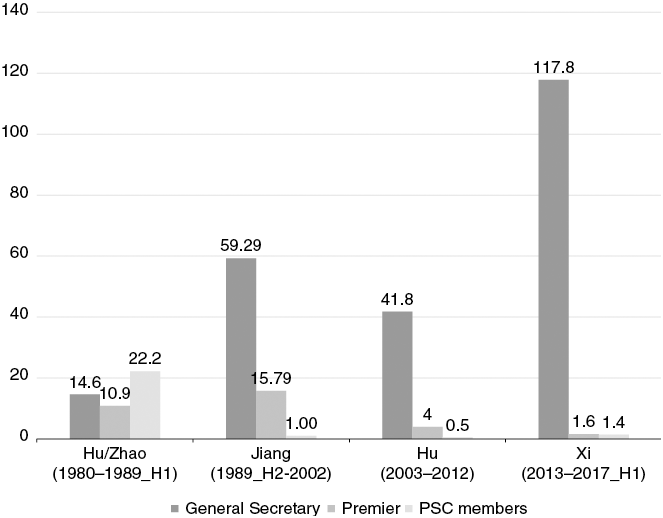
The pattern is straightforward and clear. During the Hu–Zhao era, the bar – of the darkest gray – representing the general secretary of the CPC indicates a frequency of 14.6 counts per annum; this went up to 59.29 during the Jiang era, a threefold increase and a dramatic change unambiguously associated with the post-Tiananmen leadership transition. There was a dip during the Hu Jintao era, declining to 41.8 counts per annum, but that was short-lived. Under Xi the frequency shot up to 117.8. Xi is unquestionably a strongman and his stratospheric level gives us some confidence in the validity of this measure. (The measure only covers up to the first half of 2017.)
Another change is that after Tiananmen the general secretary towered over the other two groups of leaders, the premier and the PSC members. The three bars during the Hu–Zhao era are low and of a roughly similar height, meaning that the three groups of the leaders appeared at a similar frequency. Contrast that pattern with that after Tiananmen. Under Jiang, the frequency of his premier, 15.8, pales in comparison with his own frequency, at 59.29. Under Hu Jintao and Xi Jinping, you could read People’s Daily editorials without knowing that China had a premier – he was invisible in the editorials. The PSC members simply faded away, garnering a frequency count close to zero, a sharp drop from 22.2 in the 1980s.
There is a widespread view that collective leadership collapsed only after the ascendancy of Xi. This claim is not supported by our data. The biggest change happened after Tiananmen rather than under Xi. The frequency of the general secretary name counts during the Jiang era is 4.06 times that of the Hu–Zhao era (59.29/14.6), compared with a multiple of 2.8 between the Xi era and the Hu era (117.8/41.8). Collective leadership collapsed and the strongman rule commenced after Tiananmen and long before Xi Jinping.
1.4.4 The Long Shadow of Tiananmen
In 2023, China received 35.6 million foreign tourists, compared with 97.8 million in 2019.19 There are now only 350 American students studying in China; in 2009 that number was 15,000.20 China’s export to the United States has declined. Within China, there is a palpable sense of insecurity. Some entrepreneurs are leaving China, taking their assets abroad. Others are voting with their feet, even risking their lives trekking their way to the United States as illegal immigrants. China is a different country compared with ten or twenty years ago.
All of these happened under Xi Jinping’s watch. This is true, but what led to Xi Jinping? Specifically, what led to the ability of a single leader to roll back so much of what China has built and accomplished within such a short period of time and to have done so with apparent ease?
Rome was not built in one day; nor was the autocratic bandwidth of Xi Jinping. Tiananmen cast a long shadow, both in the foreground and in the background of the rise of Xi. A direct thread runs from Tiananmen to Xi Jinping: Shanghai technocrats picked Xi Jinping to succeed Hu Jintao. Jiang Zemin and Zeng Qinghong agitated for Xi over the objections of Hu Jintao, who favored Li Keqiang.
This is a significant revelation. Keep in mind that Xi himself came from Shanghai and a rumor in Beijing is that he was very impressed with Shanghai during his short stint there. Also keep in mind that Li Keqiang was a bit closer to the policy model of the 1980s. He was in favor of a humbler approach to emphasize an economy’s tangible gains to the Chinese people.
Would Zhao Ziyang – or Zhao’s chosen successor – have picked Xi if Tiananmen had not derailed him? Unlikely. The pool of candidates would have been entirely different if Zhao had not been toppled. The type of people whom Zhao favored were economic pragmatists who proved themselves first in poor provinces, such as Wan Li from Anhui and Tian Jiyun from Sichuan. Xi, from the perches of cushy, rich provinces of Fujian and Zhejiang, would not fit the bill.
But my argument that Tiananmen paved the road for Xi does not depend on this counterfactual speculation about Zhao’s judgment call. The argument rests on the fact that Tiananmen reversed all the political reforms of the 1980s and in so doing they took out the frictions from the Chinese system that could have acted as a brake on an ambitious future autocrat. In my 2023 book, I laid out this argument in detail and I singled out how the demise of the CAC paved the way for Xi’s autocratic rise (Huang Reference Huang2023).
A fundamental feature of the pre-Xi Chinese politics from 1978 to 2012 is regency rule. In the 1980s, Deng Xiaoping, Chen Yun, and other elders closely watched over Hu Yaobang and Zhao Ziyang, two leaders on the frontline in charge of day-to-day functions of the government. From 1989 to 1997, Jiang himself was hamstrung by Deng, who at one point contemplated sacking Jiang. Jiang then returned the favor by incessantly interfering in the leadership of Hu Jintao, a situation Hu clearly resented. Maybe for that reason, Hu chose to abdicate the regency power that was his to exercise: a fateful decision on his part, as it turned out. Xi is the first leader since 1976 who exercises unvarnished power without any elders watching over his shoulders.
We do not get to choose our parents, just as incumbent leaders do not choose their predecessors. In an autocracy, former leaders are the only group of individuals who are not beholden to the incumbent leaders. They command axiomatic legitimacy and standing. This is the significance of the CAC, an obscure and defunct institution I briefly mentioned previously. The CAC could have acted as an institutional platform to exercise that regency power formally and legitimately, providing the only unencumbered check and balance function on the autocrat.
The CAC was created by Deng Xiaoping in 1982 to entice the revolutionary elders to retire from their positions. Deng could not do it just by wielding a stick; he had to dangle a carrot in front of them. The CAC was that carrot. Retired elders were given the full privileges they had before, and they retained the right to offer counsel and to participate in the Politburo meetings. In the 1980s, the CAC occasionally overshadowed the Politburo and in 1987 and 1989 it played an infamous role in the ousters of Hu Yaobang and Zhao Ziyang. That was a regency rule run amok.
Deng abolished the CAC after 1989 to buttress the power of Jiang Zemin. Imagine a CAC still in place in 2018 and in 2022. Would Xi’s personal ambitions to demolish term limit, to make himself president for life and to wipe the plate clean of all his rivals from the Politburo have sailed through so easily? The nature of counterfactual history is that we will never know, but it is not an unreasonable conjecture that an institutionalized regency rule would have slowed down some of his actions or even stopped them in their tracks.
1.5 Conclusion
At each of the critical junctures of Chinese reforms, such as 1978, 1989, 2012, and 2018, politics shaped economic policies. In 1978, embryonic political openness led to emergent and organic rural reforms. This process was rudely disrupted by the rise of politically conservative Shanghai technocrats, who implemented an urban-centric reform approach. The unencumbered leadership of Xi Jinping later rewrote the CPC’s objective function, upending the pillars of China’s growth model.
The history of Chinese economic reforms can be seen as a tale of two Chinas: a rural, market-driven China versus an urban, state-controlled China. The pace of transition depended on which of these two Chinas held political and decision-making power. In the 1980s, rural China dominated, leading to many desirable economic and social outcomes. After Tiananmen, urban China asserted itself and state-driven capitalism prevailed.
These two distinct paths entailed real economic consequences, in particular the relationships between personal income and GDP growth. They also influenced China’s subsequent institutional development. A central factor in economic development is land. Rapid growth elevates most strongly the value of those assets in fixed supply, such as land. China’s shift to an urban-centric strategy had significant implications for land reforms and the allocation of appreciating land values.
Consider a continuation of the 1980s reform scenario. Financial access, for instance, requires collateral, and land is the most valuable collateral asset. Output contracting would naturally lead to specialization and divisions of labor and thus mechanisms for transfers of land titles. If China had continued its rural reform path, rural land reforms that strengthened the rights of the rural Chinese would have been a logical next step.
The Shanghai technocrats and their successors emphatically refused to take that step. They rejected reforms of the land system and they explicitly prohibited rural Chinese from using land as a collateral asset. I believe that this was dictated by the incentives of an urban-centric strategy the Shanghai technocrats pioneered first in Shanghai and then scaled to the rest of the country. They strengthened the property rights of businesses and urban residents to stimulate the demand side while weakening the protection of the rural land rights on the supply side. Urban development, high-tech parks, and land grants to industrialists required rapid land conversions, which necessitated weak rights on the seller side to solve the hold-up problems. Unlike other successful East Asian economies, China has maintained state ownership of land assets and systematically disenfranchised its rural citizens, leading to significant negative impacts on income distribution and wealth accumulation.
“Personnel is policy,” as the saying goes. In my opinion, the Shanghai technocrats who took control of China in 1989 bear the ultimate culpability for the country’s current trajectory. At a fundamental level, the rise of Shanghai technocrats changed Chinese politics. The revolutionary elders who oversaw the post-Tiananmen power transition changed politics to enable that transition and then the utilitarianly conservative Shanghai technocrats reversed Zhao Ziyang’s political agenda. While Zhao sought to expand political space to facilitate economic reforms, the Shanghai technocrats used state power to implement their preferred reforms and prioritize large-scale infrastructure and urban development.
These cumulative political retrogressions paved the way for a more formidable statist model down the road. By abandoning transparency reforms, the separation of power initiatives, and crackdowns on nascent Internet dissent, Jiang and Hu fostered a thriving environment of crony capitalism, an issue Xi Jinping seized with great efficacy. He used the anticorruption campaign to consolidate his power and narrowed the fledging space that emerged in Chinese society. Next he used the augmented power he acquired first to demolish any rivalry – real or imagined – within the CPC and then to target China’s private sector. The rest is history.
My argument is that the seeds of these developments were planted after Tiananmen. The Shanghai technocrats took over the country and they promptly rolled back the political reforms of the 1980s. While they continued to adhere to Deng’s economic mantra of “Reform and Opening-Up” (改革开放), the Shanghai technocrats inadvertently weakened the politics of Deng Xiaoping. Deng himself would not see it that way, but the political reforms of Zhao Ziyang formed an outer protective region in a concentric circle of political reforms. Dismantling Zhao’s reforms exposed the reforms of Deng Xiaoping to the disruption by a future autocrat.
Xi Jinping rose to that challenge. He overturned the ideas and legacy of Deng Xiaoping, hitherto the third rail of Chinese politics. In 2018, he abolished the term limit and mandatory retirement, the last remnant of political reforms from the 1980s, and he downplayed economic growth and shifted away from Deng’s pro-Western foreign policy. In that sense, Xi is both incremental and transformative. He benefited from and built upon the economic and political legacies of Tiananmen but he demolished the remaining reform consensus held by the Shanghai technocrats.
I wrote this book as a historian as well as an analyst. I want to get the history right in order to get the explanation right about the Chinese performance. To help a reader to navigate the central ideas of the book, I created Table 1.1, which presents a preview of the policy milestones and the associated features of the Chinese economy, the details of which I will lay out step by step in the rest of this book. Here I highlight one detail from this table: Chinese growth has alternated between equity and inequity. Let me be specific here. Throughout this book, I use equity/inequity to refer to that which exists between the household and the government/capital sectors. I focus on this intersectoral equity issue because it is far more consequential than the interhousehold equity issue, common fare in economic and sociological studies. Since 1989, an increasing share of GDP growth has gone to the government sector as well as to the capital sector, much of which is controlled by the government. The lopsided gains at the expense of Chinese households have a substantial impact on the structure of the Chinese economy and on the future developmental prospects of the country.
| CPC general secretary | Hu Yaobang, Zhao Ziyang | Jiang Zemin | Hu Jintao | Xi Jinping |
|---|---|---|---|---|
| Panel 1: Nature of development | ||||
| A. Growth and equityFootnote a | Growth with equity | Growth with inequity | Growth with inequity | Equity with diminished growth |
| B. Growth models | Rural, emergent, gradualist | Urban/techno-national; onset of mercantilism | Rural priority shifting to urban asset intensity; techno-national; peak mercantilism | Urban/techno-nationalistic; asset intensity; declining mercantilism |
| C. Salient growth drivers | Personal income growth | High-income markets | High-income markets (before 2008), real asset (after 2008) | Falling high-income markets and real assets |
| Panel 2: Political and policy developments | ||||
| A. Top posts of CPC, military and state | 3 persons | 1 person | 1 person | 1 person |
| B. Power centersFootnote b | 5 | 2 | 2 | 2 |
| B. Political reforms | Term limit, age requirement; separation of party and state and transparency; village elections | Partial reversals | Partial reversals | Complete reversals |
| C. Major policy milestones | Rural reforms and financial liberalization, special economic zones | Privatization and SOE restructuring, WTO, infrastructure, housing reforms, fiscal and financial recentralization | Rural tax relief, stimulus program, infrastructure, small Hukou and land experimentation | Antipoverty, anticorruption, regulatory crackdowns, COVID lockdowns |
| Panel 3: Performance characteristics | ||||
| A. GDP growth | Strong | Strong | Strong | Weakening |
| B. Productivity (TFP) | Strong | Strong | Weakening (esp. since 2008) | Weakening |
| C. Investment intensity | Moderate | Rising | Strong | Strong |
| D. External sector | Current account deficits, low FDI | Labor-intensive FDI, rising current account surpluses | FDI, peak current account surpluses | Strong and then weak FDI, declining current account surpluses |
Notes:
a Equity is defined as that between the household sector and the government/capital sectors. It is operationalized as personal income growth to GDP growth having a ratio above or close to 1.
b General secretary, president, chairman of the Military Affairs Commission, premier, Central Advisory Commission
In Chapter 2, I will present an operationalization of this idea. Equity is operationalized as a ratio of personal income to GDP growth above or close to the value of 1; a value significantly below 1 is considered inequitable growth in my book. I pay particular attention to whether or not rural income to GDP growth ratio exceeds or falls short of a value of 1. The moral dimension is related to the priors that I laid out in the preface of this book. Rural Chinese are the least enfranchised in Chinese society and, until recently, the most numerous population segment in China. In a Rawlsian sense, their welfare should weigh heavily in our evaluation.
My book is organized chronologically, starting with the takeoff era of the 1980s in Chapter 2. This is also the most logical sequence because I use that decade as the baseline to assess subsequent reforms and reversals. Chapter 3 details the reform reversals in the 1990s and Chapter 4 examines the basis of the developmental model the post-Tiananmen leadership – the Shanghai Model. Chapter 5 is about the eras of Hu Jintao and Xi Jinping. In Chapter 6, I will address some of the topics that are featured prominently in media and policy circles, such as productivity performance, overcapacity, real estate bubble, and structural imbalances of the Chinese economy. I will conclude on a call for China to move away from the China Model, the statist economic model that is increasingly of the state, by the state, and for the state rather than generating welfare gains for the Chinese people.
This book is about a trajectory from a hopeful era of mass flourishing of rural entrepreneurship and edging political openness to a China that is now at risk of reverting to the economic and political rigidities at the dawn of the reform era. To tell this story effectively, we need a baseline to anchor our perspective. That baseline is the China of the 1980s, to which I will turn.