


In the field of educational psychology, self-regulated learning (SRL) has been widely examined due to its power to describe, explain and predict student learning behavior and outcome. Among the various SRL models, some models take a goal-oriented approach that suggest that monitoring, regulating and controlling one’s learning include cognitive, motivational and social factors (e.g., Schunk, Reference Schunk, Zimmerman and Schunk2001; Zimmerman, Reference Zimmerman1998). Typically, four phases or processes are proposed, which include a preparatory phase of task analysis (e.g., goal-setting and strategic planning) and self-motivation (self-efficacy beliefs, achievement goals and outcome expectations) as the first phase; monitoring as the second phase; control as the third phase; and reaction and reflection as the last phase (e.g., Borkowski, Chan, & Muthukrishna, Reference Borkowski, Chan, Muthukrishna, Schraw and Impara2000; Winne & Hadwin, Reference Winne, Hadwin, Hacker, Dunlosky and Graesser1998).
Mounting evidence has suggested students’ achievement goals are significantly associated with features of SRL, especially facets of SRL reflecting motivation and epistemic beliefs (e.g., Ho & Liang, Reference Ho and Liang2015; Huang, Reference Huang2016; Madjar, Weinstock, & Kaplan, Reference Madjar, Weinstock and Kaplan2017). Recent research into achievement goal profiles nonetheless also revealed that the adoption of average all goals and low goal pursuit profiles was prevalent (Wormington & Linnenbrink-Garcia, Reference Wormington and Linnenbrink-Garcia2017). These goal configurations have been found to lead to a series of maladaptive learning processes and outcomes. Given the considerable need for additional insights regarding these understudied goal pursuits from both theoretical and applied viewpoints (Pahljina-Reinić & Kolić-Vehovec, Reference Pahljina-Reinić and Kolić-Vehovec2017), we sought to examine how to optimize learning motivation, beliefs and performance by addressing different combination patterns of achievement goals. Specifically, the purpose of this study was to (a) identify different achievement goal profiles and (b) examine how students’ achievement goal profiles may be associated with a collection of motivational and cognitive variables and achievement outcomes. The motivational constructs under consideration include task value, self-efficacy and test anxiety; and the cognitive construct refers to epistemic beliefs. Findings of this study will not only expand the consideration of multiple goal endorsement in learning settings but also shed further lights on how to optimize the learning processes that enable effective development of achievement motivation and epistemic beliefs.
Achievement goals: A multiple goal perspective
Achievement goal orientations are theorized as integrated patterns of beliefs that shape how learners approach, engage in and respond to achievement-related tasks (Ames, Reference Ames1992; Elliott & McGregor, Reference Elliot and McGregor2001; Wigfield & Cambria, Reference Wigfield and Cambria2010). Achievement goals reflect the purpose (Maehr, Reference Maehr, Ames and Ames1989) or cognitive-dynamic focus (Elliot, Reference Elliot, Maehr and Pintrich1997) of competence-related behavior. Two types of orientations to achievement goals have been widely investigated: performance-goal orientation and mastery-goal orientation. An orientation toward performance goals focuses on demonstrating competence or achieving at higher levels relative to others. An orientation toward mastery goals focuses on learning, gaining expertise and personal improvement. Given inconsistent empirical findings about learning processes and outcomes of learners with performance goals (Pintrich & Schunk, Reference Pintrich and Schunk2002), goal theorists later introduced an approach-avoidance distinction (Elliot, Reference Elliot1999; Elliot & Harackiewicz, Reference Elliot and Harackiewicz1996) that evolved into the now common 2 × 2 achievement goal model (Elliot & McGregor, Reference Elliot and McGregor2001). In this model, learners with performance-approach goals strive to demonstrate high ability, and performance-avoidance learners intend to avoid appearing incompetent to peers or those in authority (Elliot & Harackiewicz, Reference Elliot and Harackiewicz1996). Likewise, individuals with mastery-approach goals tend to focus on learning to master content and individuals with mastery-avoidance goals tend to avoid learning less than they could (Elliot & McGregor, Reference Elliot and McGregor2001).
Much research has focused on how specific goals relate to particular outcomes. However, recent research (e.g., Blankert & Hamstra, Reference Blankert and Hamstra2017; Gonçalves, Niemivirta, & Lemos, Reference Gonçalves, Niemivirta and Lemos2017) has supported the multiple goal perspective that people concurrently strive for multiple goals or seek a single outcome for multiple reasons. The multiple-goal perspective assumes learners can adopt performance and mastery goals simultaneously (Senko, Hulleman, & Harackiewicz, Reference Senko, Hulleman and Harackiewicz2011). If individuals simultaneously pursue multiple goals, it is important to investigate goals in a way that considers a person’s goal configuration versus classifying a person as having one or another goal orientation exclusively (Barron & Harackiewicz, Reference Barron and Harackiewicz2001).
Many multiple goal studies have investigated a dichotomous or trichotomous goal model. For instance, based on the trichotomous goal model (which included mastery, performance-approach and performance-avoidance goals), Carr (Reference Carr2006) found that children with goal profiles of (a) multiple goals, (b) high mastery and performance-approach but low performance-avoidance or (c) high mastery and low performance goals typically exhibited the most positive motivational responses. In contrast, children with a low mastery but high-performance goal profile typically experienced more maladaptive motivational outcomes. In Smith and Sinclair’s (Reference Smith and Sinclair2005) study, seven goal groups were identified. Learners with mastery and performance-approach goals appeared most self-efficacious about their studies and most self-regulated among all the groups, while learners with performance-avoidance goals were dominantly the lowest in self-efficacy and self-regulation. Valle and others (Reference Valle, Núñez, Cabanach, Rodríguez, Rosário and Inglés2015) also identified seven multiple goal profiles, and reported that high levels of mastery goals appeared to be a powerful protective factor in maintaining high interest in academic work, as well as high control beliefs and self-efficacy. Zhang, Watermann, and Daniel (Reference Zhang, Watermann and Daniel2016) found that mastery-oriented 4th-graders displayed significantly higher achievement scores than students who simultaneously endorsed mastery goals alongside performance goals. In Gonçalves et al.’s (Reference Gonçalves, Niemivirta and Lemos2017) recent study, mastery-social-focused students showed the highest level of agency beliefs for effort, and the lowest level of ability attributions, whereas performance-goal-oriented students showed the lowest level of effort attribution coupled with the highest level of ability attribution.
To date, few studies have adopted the 2 × 2 goal framework to examine students’ multiple goal profiles. For example, Cano and Berbén (Reference Cano and Berbén2009) identified four goal clusters in Spanish undergraduates: “mastery goals”, characterized by low scores on mastery approach and mastery avoidance, and moderately low performance-approach scores; “moderately high mastery approach”, characterized by low performance-avoidance goals and moderately high mastery approach; “low performance approach”, characterized by a combination of moderately high mastery approach, high mastery avoidance and low performance approach; and “performance approach”, characterized by high scores in all types of goals. Luo, Paris, Hogan, and Luo (Reference Luo, Paris, Hogan and Luo2011) found four types of goal clusters: multiple-goal group, mastery and low-performance goal group, mastery and high-performance goal group, high mastery and performance-approach while low performance-avoidance goal group.
Goal researchers have recommended using person-centered methods over variable-centered methods (such as correlation and regression techniques) because variable-centered methods “do not adequately take into account variations in how different achievement goals are integrated within individuals” (Meece & Holt, Reference Meece and Holt1993, p. 589). Person-centered methods (such as a cluster approach) reveal the relevance of moderate achievement goal scores and capture naturally occurring goal profiles. This approach is considered especially useful for dealing with the increased complexity of multiple goal models because it invites studying how multiple, related constructs may interact with one another and recovers underlying structures in a given data set (Wormington & Linnenbrink-Garcia, Reference Wormington and Linnenbrink-Garcia2017), and has been applied to unpack the combined effects of achievement goals on desirable outcomes in a more holistic manner (Linnenbrink-Garcia et al., Reference Linnenbrink-Garcia, Middleton, Ciani, Easter, O’Keefe and Zusho2012). In this study, we adopted the clustering analysis approach to analyze university students’ goals under the 2 × 2 goal framework.
Relations of 2 × 2 goal profiles to various measures
Profiles of goals in recent studies have revealed that the patterning of goals within individuals can be greatly diversified and linked to a series of measures in various ways. Based on recent literature, outcomes within epistemic beliefs, motivation, and academic achievement as a function of multiple goal profiles are presented below.
Epistemic beliefs
Epistemology concerns the nature of knowledge and how a person views knowing and learning (Hofer & Pintrich, Reference Hofer and Pintrich1997). Epistemological beliefs have been typically viewed as systems of implicit assumptions and beliefs about the nature of knowledge/knowing (i.e., structure, stability, source and justification of knowledge) and its acquisition held by students (i.e., beliefs about learning; Bruning, Schraw, & Ronning, Reference Bruning, Schraw and Ronning1999). In effect, many researchers have differentiated beliefs about knowledge/knowing from beliefs about learning, with the former considered as genuine epistemological beliefs and the latter as only reflecting non-epistemological dimensions (e.g., Muis & Gierus, Reference Muis and Gierus2014; Schraw, Reference Schraw2013). From this perspective, beliefs about the simplicity (simple knowledge), certainty (certain knowledge), and source/justification of knowledge (omniscient authority) are considered to be genuine epistemic beliefs. Hence, only these three variables were included in the current study. Students’ beliefs about learning are also related to epistemological thinking, but are not considered here for theoretical clarity.
Muis (Reference Muis2007) extended the traditional SRL models by arguing that students’ epistemic beliefs constitute another cognitive condition of the task and thus are a key element to task analysis. When schemas for knowledge of a task are activated, schemas for beliefs about knowledge and knowing are also activated. The activation of epistemic beliefs schemas hence provides the opportunity for those beliefs to have an impact on other facets of SRL. Goals affects cognitive activities (Barzilai & Zohar, Reference Barzilai and Zohar2014), and strongly influence the way individuals perceive and confront achievement tasks (Darnon, Muller, Schrager, Pannuzzo, & Butera, Reference Darnon, Muller, Schrager, Pannuzzo and Butera2006; Levy, Kaplan, & Patrick, Reference Levy, Kaplan and Patrick2004). Recently, researchers have found that the pursuit of certain types of achievement goals could result in different views on knowledge. For example, both mastery and performance goals predicted Japanese university students’ beliefs about English learning, with performance goals being a stronger predictor (Nakayama, Heffernan, Matsumoto, & Hiromori, Reference Nakayama, Heffernan, Matsumoto and Hiromori2012). In Wang’s (Reference Wang2001) cluster analyses, the highly motivated group (high mastery/high performance group) had high incremental/high entity beliefs, whereas the less motivated group (low mastery/low performance group) had low incremental/low entity beliefs. Given that the conceptualization of achievement goals becomes more complicated and few studies have tested this relationship in a multiple-goal context, more research is needed on how different types of goals relate to epistemic beliefs.
Motivations
According to Humphreys and Revelle (Reference Humphreys and Revelle1984), motivation is a construct “that has traditionally been used to describe and explain differences in intensity and direction of behavior. It is the state that results from a combination of individual needs and desires” (p. 157). Therefore, in this study, we considered motivation as a multifaceted construct that includes self-efficacy, task value and anxiety (also see Wolters & Pintrich, Reference Wolters and Pintrich1998). Specifically, we adopted the adapted general expectancy-value model of motivation (Pintrich & De Groot, Reference Pintrich and De Groot1990), wherein three different motivational components were identified: an expectancy component, a value component, and an affective component.
The expectancy component is concerned with students’ beliefs about their capabilities to perform given academic tasks at designated levels (i.e., self-efficacy, Schunk, Reference Schunk1991). The value component involves students’ interest in and perceived importance and usefulness of the tasks (e.g., task value; Eccles, Wigfield, Harold, & Blumenfeld, Reference Eccles, Wigfield, Harold and Blumenfeld1993). This motivational component essentially concerns the reasons for doing a task. The affective component concerns students’ emotional reactions to the task. Among the various affective reactions to schoolwork, test anxiety is one of the most important in learning contexts (Wigfield & Eccles, Reference Wigfield and Eccles1992), which taps into students’ worry and concern over exams (Pintrich, Smith, Garcia, & McKeachie, Reference Pintrich, Smith, Garcia and Mckeachie1991).
Each of these motivational variables is critical for students’ academic study (Wolters & Pintrich, Reference Wolters and Pintrich1998) and has shown relationships to personal goals (Pajares & Valiante, Reference Pajares and Valiante2001). Achievement goal theorists argue that highly mastery-approach, goal-oriented students attempt to gain rich insight in learning and will therefore engage in deep cognitive processing to increase their comprehension (Graham & Golan, Reference Graham and Golan1991; Pintrich & DeGroot, Reference Pintrich and De Groot1990), and this engagement and effort will in turn increase self-efficacy and reduce anxiety. Huang’s (Reference Huang2016) meta-analysis confirmed that mastery goals promoted positive outcomes while avoidance goals generated negative outcomes.
Past empirical findings with multiple goal profiles generally lent support to the above argument. Luo and others (Reference Luo, Paris, Hogan and Luo2011) reported that the approach goal group was most self-efficacious and valued math most. Liu, Wang, Tan, Ee, and Koh (Reference Liu, Wang, Tan, Ee and Koh2009) found that students with very high scores on all four types of goals had the most adaptive profiles, typically expressing the highest perceived competence and value in project work. In contrast, the goal cluster with lowest scores across all four goals, and the avoidance-goal-dominant cluster did not perceive value in project work. In Daniels et al.’s (Reference Daniels, Haynes, Stupnisky, Perry, Newall and Pekrun2008) study, the performance goal cluster also reported more anxiety and boredom than the mastery cluster or a low-motivation cluster. Luo et al.’s (Reference Luo, Paris, Hogan and Luo2011) study also found that the moderate multiple goal and performance-oriented groups reported higher test anxiety than the approach goal group. These limited findings indicate that more investigations are needed to understand how goal profiles relate to motivation.
Academic achievement
Mounting evidence indicates that students’ academic goals are important correlates of learning and performance (Meece, Anderman, & Anderman, Reference Meece, Anderman and Anderman2006), as they shape learners’ plans for information selection and processing as well as the standards learners use to metacognitively monitor learning (Zhou & Winne, Reference Zhou and Winne2012). However, findings about how specific types of achievement goals affect academic performance are mixed. For example, Cano and Berbén (Reference Cano and Berbén2009) found the students with high master-approach goals but low performance goals showed the highest examination marks in mathematics. This contrasted with students characterized as weak goal-oriented who achieved the worst marks. Luo and colleagues (Reference Luo, Paris, Hogan and Luo2011) found that goal profiles with a high mastery and performance approach combined with low performance avoidance is most beneficial for math achievement of secondary school students in Singapore. In contrast, Daniels and colleagues (Reference Daniels, Haynes, Stupnisky, Perry, Newall and Pekrun2008) found similar academic performance levels between a multiple goal group, a mastery-dominated group, and a performance-dominated group. All these groups achieved higher than a group low in all four types of goals.
The current study
Understanding achievement motivation is critical for improving achievement and optimizing the learning experience. Five decades of research on achievement motivation has demonstrated that goals, values, and beliefs are primary influences on achievement motivation, yet little is known about how these primary components of motivation function as a coherent set within individuals (Conley, Reference Conley2012). We acknowledge several important findings from prior studies: (a) Conceptualizing achievement goals as a profile could offer a more valid picture of relationships among goals and student learning. (b) Specific goal profiles have been linked to motivation, epistemic beliefs and academic performance but (c) consensus is weak regarding the number and constitution of the clusters because different multiple goal profiles are found with different samples, cultures and subject areas. (d) Goal frameworks adopted in previous research vary across studies. As Hulleman, Schrager, Bodmann, and Harackiewicz (Reference Hulleman, Schrager, Bodmann and Harackiewicz2010) noted, inconsistent achievement goal-outcome relationships like these depend on the goal scale chosen, individual items used to assess goal strivings, and socio-demographic characteristics of the sample under study.
Although there is ample research concerning achievement goals and their relationships with both motivation and academic achievement (e.g., Chen, Reference Chen2012; Diseth, Reference Diseth2011; Diseth & Kobbeltvedt, Reference Diseth and Kobbeltvedt2010), our study extends and advances the field in three ways. First, few studies have attempted to integrate four different types of achievement goals, as described in the 2 × 2 framework, to investigate their relations with other motivational constructs and achievement measures (for recent exceptions, see Putwain, Sander, & Larkin, Reference Putwain, Sander and Larkin2013; Roussel, Elliot, & Feltman, Reference Roussel, Elliot and Feltman2011). In particular, we incorporated the avoidance orientation (both performance and mastery avoidance orientation). From a multiple goal perspective, avoidance goals could negate positive relationships associated with pursuit of approach goals. Therefore, individuals endorsing what have been considered theoretically favorable goal profiles could be at risk of dampened motivation if they simultaneously endorse avoidance goals. Hence, including avoidance achievement goals could help interpret some conflicts in prior research in terms of what types of goal profiles support learning processes (e.g., improved motivation) and promote achievement (e.g., learning outcomes), by surfacing the factors (i.e., avoidance goals) that hamper learning and achievement.
Second, only limited empirical studies relate achievement goals to beliefs students hold about knowledge or personal epistemologies (e.g., Muis & Franco, Reference Muis and Franco2009). As Molden and Dweck (Reference Molden and Dweck2006) and Hofer (Reference Hofer2000) note, there is a need to examine possible linkages between epistemic beliefs, students’ academic motivation and achievement. To date, there has been no empirical evidence to support the posited relationship between epistemic beliefs and multiple goal profiles. Therefore, including this variable extends multiple goal research into a new territory.
Based on the foregoing considerations, we posed two research questions:
Research Question 1: What types of achievement goal profiles (represented by goal clusters) would emerge in this sample?
Research Question 2: What are the associations of achievement goal profiles and the academic motivation, epistemic beliefs, and achievement of undergraduate students? The motivation constructs include self-efficacy, task value, and anxiety. Based on extant research, we investigated four hypotheses in this study:
Hypothesis 1: Multiple-goal learners valuing mastery or approach goals would more likely hold a strong sense of self-efficacy and task value.
Hypothesis 2: Multiple-goal learners valuing mastery or approach goals would hold more sophisticated epistemic beliefs and achieve better academically.
Hypothesis 3: Multiple-goal learners valuing avoidance goals would display weak self-efficacy and lower task value.
Hypothesis 4: Multiple-goal learners valuing avoidance goals would have less sophisticated epistemic beliefs and relatively lower achievement.
Method
Participants
A convenience sample enrolled in an introductory educational psychology course at a Canadian university was used in this study. The course was obligatory for year 2 undergraduates in the faculty of education, taught in a single class with a size of 238. One hundred and sixty-four students agreed to participate in this research voluntarily (84.1% female; 83.5% Caucasian). The ages ranged from 19 to 21 years old. All participants completed all measures.
Measures
The 12-item Achievement Goal Questionnaire (AGQ; Elliot & McGregor, Reference Elliot and McGregor2001) examines achievement goals along both mastery-performance and approach-avoidance dimensions. It measures students’ achievement goal orientations about the course in which they are enrolled. Non-overlapping, three-item subscales each assess one of four achievement goals: mastery-approach, mastery-avoidance, performance-approach, and performance-avoidance. Each item provides a scale from 1 (not at all true of me) to 7 (very true of me). Higher ratings reflect a stronger orientation toward one achievement goal. Previous studies reported a clear four-factor structure with each of the achievement goal factors represented by unique three items that had high internal consistency (e.g., Elliot & McGregor, Reference Elliot and McGregor2001). Our confirmatory factor analysis (CFA) showed an acceptable model fit for this structure: χ2 = 103.68, df = 48, p < .001, CFI = .93, IFI = .93, TLI = .90, RMSEA = .08, SRMR = .06 (Hu & Bentler, Reference Hu and Bentler1999). Each item loaded on its designated factor; loadings ranged between .57 and .90. Internal consistency alpha values in our sample for scales reflecting mastery-approach, performance-approach, mastery-avoidance, or performance-avoidance goals were .84, .79, .82, and .76, respectively.
Students’ self-reported motivation related to the course was measured by three subscales selected from the Motivated Strategies for Learning Questionnaire (MSLQ; Pintrich et al., Reference Pintrich, Smith, Garcia and Mckeachie1991): task value (six items), self-efficacy (eight items) and test anxiety (five items). Participants responded to each statement using a 7-point Likert scale (1 = not at all true of me, 7 = very true of me) in terms of their learning behavior in the course. A three-factor structure provided an acceptable fit for the data, χ2\/df = 1 .78, p < .001, CFI = .94, IFI = .94, TLI = .93, RMSEA = .07, SRMR = .08. Internal consistency alpha values for task value, self-efficacy, and test anxiety in our sample were .91, .92, and .78, respectively.
The Epistemic Beliefs Inventory (EBI; Schraw, Bendixen, & Dunkle, Reference Schraw, Bendixen, Dunkle, Hofer and Pintrich2002) was used to measure students’ beliefs about knowledge. As most researchers concur that beliefs about the certainty and simplicity of knowledge constitute genuine epistemological beliefs, whereas beliefs about innate ability reflect some other non-epistemological dimensions (Schraw, Reference Schraw2013), we only included three subscales in this study: simple knowledge, certain knowledge, and omniscient authority.
Some prior literature, however, documented less than optimal psychometric properties of the EBI, and the expected factor structure has not consistently emerged in published studies (Bendixen, Schraw, & Dunkle, Reference Bendixen, Schraw and Dunkle1998; Laster, Reference Laster2010; Teo & Chai, Reference Teo and Chai2011; Schraw et al., Reference Schraw, Bendixen, Dunkle, Hofer and Pintrich2002). In the absence of self-report measures with stronger psychometric properties, and considering concern for participant fatigue, this shorter measure of personal epistemology was chosen.
In light of prior findings, we first computed an exploratory factor analysis (EFA) to the 17 items of simple knowledge, certain knowledge, and omniscient authority, using principal axis factoring with a promax rotation and not constraining factors to be generated. We interpreted the scree plot to suggest two factors should be retained. We then calculated a second EFA to the same set of items, constraining the solution to a two-factor model, and selected only items loading on factors at .45 or higher. Hence, two factors were retained with expected items: five items for simple knowledge (loadings of .47 to .68) and three items for omniscient authority (loadings of .48 to .62). A total of nine items (six items for certain knowledge, one item for simple knowledge, and two items for omniscient authority) were disregarded. A two-factor structure provided an acceptable fit for the data, χ2/df = 1.98, p < .001, CFI = .91, IFI = .92, TLI = .87, RMSEA = .08, SRMR = 06. Internal consistency alpha coefficients for simple knowledge and omniscient authority were .66 and .66 respectively.
Students’ academic performance was measured by scores from the midterm and final exams for the course. Each exam included 30 multiple-choice questions tapping the main content covered by the textbook and requiring either an accurate understanding or an application of the concept. The Cronbach’s alpha value for each of these exams was .81.
Procedure
Data were collected as part of regular instructional activities and examinations in the course. In week 2, after the course had been introduced by the lecturer in week 1 and students had an opportunity to survey the textbook, students were instructed to think about the course when they completed online the AGQ, MSLQ and EBI. All participants took the midterm examination in week 8 and the final examination in week 14. Only data from students who submitted a consent form were analyzed.
Results
The distributions of scores were tested for normality and multivariate outliers, which led to removing one participant. The final sample size was 163.
Correlational analyses
Correlations among the main variables are displayed in Table 1. As expected, mastery-approach goals showed moderate, positive, and significant correlations with most motivational variables except test anxiety. Notably, performance-avoidance goals showed significant positive correlations with simple knowledge and omniscient authority. Approach-oriented goals showed significant positive correlations with task value and self-efficacy, whereas avoidance-oriented goals were positively associated with test anxiety. Surprisingly, no significant correlations were found between goal reports and achievement measures, although the majority of correlations were in the expected direction.
Correlations (N = 163)

Note: **p < .01, *p < .05.
Cluster analyses
Cluster analysis is not only the most appropriate procedure to establish profiles in a sample of participants (Hair, Anderson, Tatham, & Black, Reference Hair, Anderson, Tatham and Black1995) but also one of the most recommended solutions to identify multiple goals (Pastor, Barron, Miller, & Davis, Reference Pastor, Barron, Miller and Davis2007). As in the hypotheses, we had established that different groups of students (clusters) with certain levels in the four types of goals should be obtained, which defined different motivational profiles. Cluster analyses thus allowed us to identify groups characterized by different motivational profiles, which were the result of different combinations of the four types of achievement goals.
All scores were standardized to z scores for a cluster analysis (Daniels et al., Reference Daniels, Haynes, Stupnisky, Perry, Newall and Pekrun2008; Huberty, DiStefano & Kamphaus, Reference Huberty, DiStefano and Kamphaus1997; Kuan & Roy, Reference Kuan and Roy2007). Acknowledging our sample size, we used Ward’s hierarchical cluster method to establish clusters of participants as a function of the four subscales reflecting their achievement goals. Ward’s method was chosen to minimize the within-cluster differences and to avoid problems with “long chaining” of the observations found in other methods (Aldenderfer & Blashfield, Reference Aldenderfer and BlashWeld1984). The optimum solution was determined according to accepted guidelines (Bråten & Olaussen, Reference Bråten and Olaussen2005; Everitt, Landau & Leese, Reference Everitt, Landau and Leese2001; Lam, Reference Lam2006). First, we identified relatively large change in the agglomeration coefficients (Hair et al., Reference Hair, Anderson, Tatham and Black1995). The percentage change was calculated for six through two clusters. The largest percentage change was observed when transitioning from two to three clusters (18.15%), so a three-cluster solution appears most feasible at first. Notwithstanding, we examined four- and five-cluster solutions; they yielded relatively larger agglomeration coefficients as well (15.76% and 11.87% respectively). This assisted us in judging the number of meaningful clusters.
Second, because the selection and interpretation of clusters is not strongly guided by established statistical tests, we used cross-validation to examine the stability of cluster solutions. The three-, four- and five-cluster solutions were each estimated twice using a random selection without replacement of half of the sample. Only the five-cluster solution replicated well.
Third, based on Romensburg’s (Reference Romesburg1985) recommendation, we performed discriminant function analyses separately for each solution to validate the presumed multiple-goal character of the clusters. Results show 95.1% of original grouped cases were correctly classified. Finally, the five-cluster solution was judged for interpretability and clarity relative to past empirical findings. Jointly applying all these criteria led us to adopt a five-cluster solution, as described in Table 2. A multivariate analysis of variance (MANOVA) detected strong differences among these five achievement goal clusters, F multivariate (4, 158) = 49.38, p < .001; η2 = .53.
Means (standard deviations) for goal clusters

Students labeled Highly Motivated (cluster 1, N = 55) reported relatively high levels of all four achievement goals; means on each goal were at least 5.05 on the 7-point response scale. Highly motivated students were keen on mastering content and achieving better. Beyond eagerness for higher marks, these students also worry about exposing failures without contradicting their pursuit of normatively higher performance. In other words, while students aim for positive results, they care equally about not suffering negative results. For them, the certainty of not doing poorly becomes a baseline to guarantee future high performance.
Students labeled High-Mastery-Approach-Low-Performance-Approach (cluster 2, n = 17) were characterized by fairly high mastery-approach and extremely low performance-approach goals. The remaining two types of goals were at an average level. Mastering the task seemed to be the main focus, without much eagerness to outperform peers.
The third cluster of students labeled Performance-Avoidance-Dominant (n = 25) showed stronger performance-avoidance goals relative to the other three types of goals. Students in this group sought to avoid low marks as much as possible.
The fourth cluster (High-Approach-Low-Avoidance, n = 33) possessed a fairly strong mastery-approach goal with a somewhat higher level of performance-approach goals but a lack of avoidance goals. They tended to strive for mastery and preparing for tests as a path to achieve higher marks without much worry about failure.
The fifth cluster (High-Mastery-Approach-Low-Performance-Avoidance, n = 33) blended very strong mastery-approach goals with relatively low performance-avoidance goals. The level of worry about poorer performance compared to others was the lowest compared to other clusters.
To examine whether student motivation, epistemic beliefs and achievement varied by cluster, we used a MANOVA with cluster membership as the classification variable. Results showed a significant overall difference among clusters, F multivariate (4, 158) = 3.53, p < .001; η2 = .19. This omnibus test was followed with univariate analyses of variance (ANOVAs) for each outcome variable (Table 3). The graphic presentation of the results is provided in Figure 1.
Relationships among main constructs.
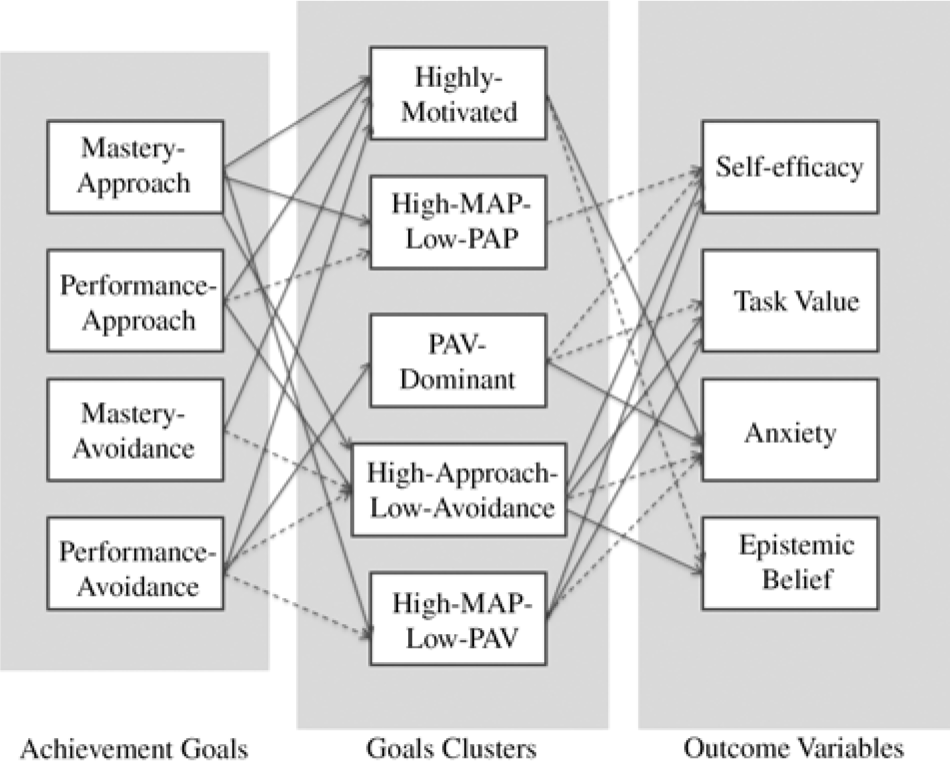
Means and standard deviations with clusters and F values for each outcome variable

Cluster differences in self-reported motivation
Statistically detectable differences among clusters were observed, F(4,158) = 10.06, p < .001), on all three motivation variables (Table 4). Tukey’s HSD post hoc contrasts indicated that Performance-Avoidance Dominant students (cluster 3) scored significantly lower than all the other four clusters in task value. In terms of self-efficacy, both the Performance-Avoidance Dominant (cluster 3) and High-Mastery-Approach-Low-Performance-Approach students (cluster 2) scored significantly lower than the rest. Surprisingly, the Highly Motivated cluster (1) reported significantly higher scores in test anxiety than the High-Mastery-Approach-Low-Performance-Approach cluster (2), the High-Approach-Low-Avoidance cluster (4), and the Low-Performance-Avoidance cluster (5).
Tukey’s post hoc analysis of mean differences between clusters

Note: ***p < .001, **p < .01, *p < .05.
Cluster differences in epistemic beliefs
Statistically detectable univariate difference among clusters was observed both on simple knowledge and omniscient authority, F(4,158) = 2.33, p < .05. Tukey’s HSD post hoc analysis showed that the Highly Motivated cluster (1) scored significantly higher than the High-Approach-Low-Avoidance cluster (4) and the High-Mastery-Approach-Low-Performance-Avoidance cluster (5) in omniscient authority. The Highly Motivated cluster (1) also scored significantly higher than the High-Approach-Low-Avoidance cluster (4) in simple knowledge.
Cluster differences in academic achievement
No group differences were statistically detectable on academic achievement, although students in the High-Mastery-Approach-Low-Performance-Avoidance cluster (5) obtained consistently high scores in both exams whereas the Performance-Avoidance-Dominant cluster (3) scored lowest.
Discussion
As Boekaerts, de Koning, and Vedder (Reference Boekaerts, de Koning and Vedder2006) pointed out, insight into the content and structure of students’ goals will help researchers describe how divergent goals give meaning, direction and purpose to classroom behavior. We extended past research by examining undergraduates’ goal orientations as profiles and how profiles relate to motivation, epistemic beliefs and academic performance. This research integrates different factors that impact learning processes. Our multiple goal clusters corroborate previous cluster-analytic research: different aspects of achievement goals co-exist in multidimensional rather than independent unidimensional form. Moreover, multidimensional profiles predict self-reported motivation and epistemic beliefs in different ways.
Achievement goal profiles
With regard to the first research question, goal profiles we identified somewhat replicated previous studies using the same analysis technique. Similar to Liu et al. (Reference Liu, Wang, Tan, Ee and Koh2009) and Cano and Berbén (Reference Cano and Berbén2009), we also identified a cluster (Highly Motivated cluster) with relatively high scores on all four types of goals, confirming that some students simultaneously hold strong approach and avoidance goals. This is not counterintuitive. In today’s undergraduate education, a high mark is important no matter how it is achieved. In each of the other clusters we identified, there was one goal at quite a relatively high or low level, but no group with relatively low scores across all four goals as Daniels et al. (Reference Daniels, Haynes, Stupnisky, Perry, Newall and Pekrun2008) and Liu et al. (Reference Liu, Wang, Tan, Ee and Koh2009) reported. For example, the High-Mastery-Approach-Low-Performance-Approach students had fairly high mastery-approach and extremely low-performance approach goal scores while the mastery-avoidance and performance-avoidance goals were observed to be at an average level. Participants within this cluster report exerting more effort to master content but were not eager to outperform others.
Achievement goal profiles and motivational outcomes
As to the second research question, our finding showed the link between multivariate profiles of goals and motivational variables. The hypotheses were in general supported. Specifically, the High-Approach-Low-Avoidance cluster and the Low-Performance-Avoidance cluster reported higher levels of task value and self-efficacy, and lowest levels of test anxiety. The major difference between these clusters concerns mastery-avoidance goals: the Low-Performance-Avoidance cluster had the second highest score whereas the High-Approach-Low-Avoidance cluster had the lowest. In a context where the other three goals were at similar levels, a relative prominence of mastery-avoidance goals did not differentially affect motivational variables. Possibly, although mastery-avoidance goals have been postulated as maladaptive (Elliot, Reference Elliot1999), our results showed that mastery-avoidance goals might not be able to influence one’s motivation as strongly as other goals. Given little empirical evidence, more research is needed to investigate how this goal operates distinctly during learning process.
Students who adopted stronger approach goals than avoidance goals appeared least worried about tests and held a more positive view of learning. This matches prior research that, in general, goal measures classified as approach orientation tend to be linked to a more positive processes and outcomes (characterized by a positive orientation towards learning and self in our study; see also Ames & Archer, Reference Ames and Archer1988), whereas those classified as avoidance tend to be associated with a more negative, maladaptive processes and outcomes (Elliot, Reference Elliot1999).
In addition, the Highly Motivated cluster reported the most test anxiety but expressed a medium level of task value and self-efficacy. This finding differs from Liu et al.’s (Reference Liu, Wang, Tan, Ee and Koh2009) observation that students in this group typically had significantly higher perceived competence for learning and task value. With the highest scores on all the four goals, a mixed motivational profile could be accounted for by strong interactions among these goals. Avoidance goals are associated with more anxiety but approach goals sustain relatively high positive beliefs about self and tasks.
Similar to the Highly Motivated, High-Approach-Low-Avoidance, and High-Mastery-Approach-Low-Performance-Avoidance students, the High-Mastery-Approach-Low-Performance-Approach students exhibited a higher level of mastery-approach goal relative to other goal orientations but was distinguished by extremely low performance-approach goals. Individuals with this goal configuration reported a significantly lower efficacy without suffering anxiety. Perhaps when mastery-approach goals are fairly strong, the facilitative role of performance-approach goals is not evident, as reflected by the medium or low level of most outcome variables in this cluster. This is in line with Pintrich and Garcia’s view (Reference Pintrich, Garcia, Maher and Pintrich1991).
Given conflicting views on whether a combination of performance-approach goals and mastery goals promotes optimal learning, our results offer counterevidence to the proposition that students with a high mastery/low performance-approach goal profile enjoyed the highest level of achievement (e.g., Bouffard, Boisvert, Vezeau, & Larouche, Reference Bouffard, Boisvert, Vezeau and Larouche1995; Meece & Holt, Reference Meece and Holt1993). The absence of avoidance goals in those results implied that the positive motive manifested through mastery goals alone seemed to be dampened by also adopting avoidance-oriented goals.
The Performance-Avoidance-Dominant cluster scored lowest in task value and efficacy and higher in text anxiety. This group demonstrated the most fear of displaying incompetence, another form of extrinsic motivation. In this context, individuals’ low self-efficacy and task value may stem from negative focus on performance goals, which are construed as grounded in fear of failure and low competence expectancies (Elliot & Church, Reference Elliot and Church1997). From a multiple goal perspective, individuals could be at risk of dampened motivation when they simultaneously endorse stronger performance-avoidance goals (Carr, Reference Carr2006). The negative processes and outcomes (e.g., low task value and self-efficacy) associated with performance-avoidance goals could negate the positive concomitants associated with pursuit of mastery or performance-approach goals.
Achievement goal profiles and epistemic beliefs
Our data also showed differences among the goal cluster profiles in terms of students’ beliefs about simple knowledge and omniscient authority. Students higher in all four types of goals (the Highly Motivated cluster) seemed more likely to believe knowledge is simple. We speculate that strong multiple-goal students (as in the Highly Motivated cluster) might hold a variety of epistemic beliefs, ranging from naive to sophisticated, given different types of goals had distinctive relationships to beliefs. Students higher in approach orientation (the High-Approach-Low-Avoidance cluster) held the most sophisticated beliefs and recognized that knowledge is complicated. This is inconsistent with early theorizing that (performance-)approach-oriented students believe knowledge is relatively simple in nature (DeBacker & Crowson, Reference DeBacker and Crowson2006; Ravindran, Greene, & DeBacker, Reference Ravindran, Greene and DeBacker2005). With regard to omniscient authority, the significant differences between the Highly Motivated cluster and the High-Approach-Low-Avoidance cluster indicated that (performance-)avoidance goals played a dominant role over other types of achievement goals in predicting omniscient authority – clusters with stronger orientations in performance-avoidance goals reported stronger beliefs in authority. Further research should be conducted to provide more empirical evidence.
Achievement goal profiles and academic achievement
In contrast to previous findings (e.g., Cano & Berbén, Reference Cano and Berbén2009; Daniels et al., Reference Daniels, Haynes, Stupnisky, Perry, Newall and Pekrun2008; Dina & Efklides, Reference Dina and Efklides2009; Zhang et al., Reference Zhang, Watermann and Daniel2016), we did not find a significant difference among clusters in academic achievement. Prior studies reveal that the only consistent relationship seems to be the negative relationship between a performance-avoidance goal and performance across tasks (Elliott, Shell, Henry, & Maier, Reference Elliott, Shell, Henry and Maier2005; Sideridis, Reference Sideridis2005). Hulleman and colleagues’ (Reference Hulleman, Schrager, Bodmann and Harackiewicz2010) recent meta-analysis also showed that relationships between achievement goals and achievement are not large (p. 435, Table 10; rs ranging from −.13 to .11). Thus, several possible reasons may explain why we did not detect differences. In our study, students’ achievement goals were measured in the second week of the semester, while the exams occurred in weeks 8 and 14. This temporal span allowed that goals may have changed over time. Also, the placement of other writing tasks (one think paper and one concept map) alongside the exams could affect individual goal adoption over time. We did not use these two assessments because their evaluations were completed by different teaching assistants. Although with the same scoring rubric, there could still be variances in the scoring. Further, the sample consisted of second-year undergraduates who possibly held different goals from final-year students or working adults. This could also affect their relationships with academic achievement (see meta-analytic results by Hulleman et al., Reference Hulleman, Schrager, Bodmann and Harackiewicz2010). Finally, the effect of goal patterns could vary by different outcome variables. That is, we might not have an optimal goal profile strong in all aspects of learning (e.g., motivation, beliefs, and achievement), as goal orientations affect different components of learning in different ways. Thus, it would not be surprising to find some goal patterns with more positive motivation profiles still perform at a lower level.
Implications and limitations
The findings have both theoretical and practical implications. Regarding theory, the results have deepened the current knowledge about how different types of achievement goals interplay within the motivation and cognition puzzle and how dynamic and context sensitive this interplay is. Future studies are needed with different learning settings and samples to examine the robustness of these findings to lay a foundation for subsequent intervention designs that aim to promote motivational and cognitive orientations. Regarding practice, findings from this research suggest that students come into the classroom with multiple goal orientations, and pedagogical approaches need to be more flexible to allow students to learn effectively, given students’ goal combinations. Monitoring from teachers will be necessary when goals are observed to interfere with student learning processes and outcomes. Since the High-Approach-Low-Avoidance cluster in this study displayed a motivational profile that was most positive towards learning and self but least anxious about exams in this study, teachers and institutions can create environments that persuade goal orientation endorsement by emphasizing strong approach goal orientations and lessen avoidance orientations to learning. This can be done in many ways. For example, teachers can set up mechanisms that encourage students to make errors and learn from their mistakes while at the same time rewarding students’ progress and performance through such exploration. Such a mechanism will engender mastery of course content and advance student performance while diminishing anxiety of exams.
Our findings are subject to some limitations. First, self-report instruments were used to measure non-achievement variables. Self-report instruments may suffer social desirability biases. This could be an issue especially for the EBI, whose factor analyses only produced two factors, with the certain knowledge subscale missing. DeBacker, Crowson, Beesley, Thoma, and Hestevold (Reference DeBacker, Crowson, Beesley, Thoma and Hestevold2008) noted that sample sizes using the EBI have been generally modest, which could affect results. Future studies may seek alternative instruments of epistemic beliefs or combine self-reported measures with trace methodologies to capture the data of such variables. Related to this is the use of AGQ in this study to measure achievement goals. Hulleman et al. (Reference Hulleman, Schrager, Bodmann and Harackiewicz2010) noted that researchers endorsing the multiple goals perspective tend to utilize the AGQ, focusing on the normative comparison component of the performance goal construct, whereas others tend to focus on the self-presentation component of this construct (e.g., Patterns of Adaptive Learning Survey-PALS; Midgley et al., Reference Midgley, Maehr, Hruda, Anderman, Anderman, Freeman and Urdan2000). Thus, because we focused on one perspective, other studies adopting an alternative view and instrumentation may generate different results.
Third, person-centered analyses are subjective because researchers choose a solution and results, like any analysis, depend on variables chosen to mark cluster. Most recently, researchers (Pastor et al., Reference Pastor, Barron, Miller and Davis2007; Tapola & Niemivirta, Reference Tapola and Niemivirta2008; Tuominen-Soini, Salmela-Aro, & Niemivirta, Reference Tuominen-Soini, Salmela-Aro and Niemivirta2008) are turning toward model-based cluster analytic techniques, such as latent profile analysis (LPA), which offers more rigorous criteria for determining the number of clusters to retain and represent students’ cluster membership fractionally to better distinguish among students and predict achievement-related outcomes. Future studies may prefer this method. Fourth, because surveys were administered at the beginning of the semester, students might not have developed a clear sense of the course completely which could affect responses to some survey items. Also, measures of learning outcomes were collected weeks after self-report measures were collected. As noted previously, this temporal distance could affect relationships among students’ perceptions of their learning processes and achievement.
Conclusion
The present study was conducted with two objectives. First, we identified the primary goal profiles of Canadian undergraduate students in their university study. Second, we examined the effects of multiple goal profiles on motivational, cognitive, and achievement variables in order to identify the adaptive profiles of achievement goals. The findings confirmed that the existence of multiple goal profiles in students and the relationship between achievement goals and the above outcome variables is not straightforward.
Financial Support
None.


 Open access

