


Introduction
Two broad trends are apparent in Western democracies today. First, their societies have become significantly more diverse over the past few decades, primarily due to immigration (de Haas, Castles, and Miller Reference de Haas, Castles and Miller2019). Second, their democratic systems are facing challenges, with the zeitgeist being decreasing satisfaction with democratic systems (Foa et al. Reference Foa, Klassen, Slade, Rand and Collins2020) and reduced trust in democratic institutions (Valgarðsson et al. Reference Valgarðsson, Jennings, Stoker, Bunting, Devine, McKay and Klassen2022; cf. Wuttke, Gavras, and Schoen Reference Wuttke, Gavras and Schoen2022).
A number of scholars and commentators have suggested a link between these trends—that is, that sustained immigration and growing diversity have undermined public support for political systems. For example, in a public lecture and accompanying essay, William Galston claims that “as public concerns about population flows across national borders have intensified throughout the West, this issue has done more than any other to weaken support for liberal-democratic norms and institutions” (Galston Reference Galston2018, 15). Steven Levitsky and Daniel Ziblatt, in discussing the future of American democracy, make the point even more starkly: “It is difficult to find examples of societies in which shrinking ethnic majorities gave up without a fight” (Levitsky and Ziblatt Reference Levitsky and Ziblatt2018, 208–9).
A wider reading of the social science literature provides considerable support for such arguments. Three lines of evidence stand out. First, a diverse society has long been thought infertile ground to sustain democratic institutions (Horowitz Reference Horowitz1985; Levitsky and Ziblatt Reference Levitsky and Ziblatt2018), whether because of conflict (Montalvo and Reynal-Querol Reference Montalvo and Reynal-Querol2005) or poor governance (Alesina, Baqir, and Easterly Reference Alesina, Baqir and Easterly1999). Second, diversity has been linked with lower social trust (Alesina and La Ferrara Reference Alesina and La Ferrara2000, Reference Alesina and La Ferrara2002; Putnam Reference Putnam2007) and immigration concerns with lower political trust (Macdonald Reference Macdonald2021; McLaren Reference McLaren2011, Reference McLaren2015). Third, some argue that immigration produces a conservative or authoritarian backlash (Abrajano and Hajnal Reference Abrajano and Hajnal2015; Ignazi Reference Ignazi1992; Norris and Inglehart Reference Norris and Inglehart2019), featuring not only xenophobic reactions, but also support for undemocratic actors and policies.
Despite these apparently converging arguments, no research has directly analyzed the link between immigration flows and public support for political systems. I focus in this paper on this link—that is, the question of whether immigration erodes system support. My regional focus is Europe, where mass immigration has created significantly more diverse societies over the past few decades. My approach is time-series, cross-sectional (TSCS), with the longitudinal dimension being especially important to tease apart the deeply intertwined links between immigration flows and political cultures. As explanatory variables, I include several measures of immigration, using both objective measures of immigrant inflows and stocks of foreign-born residents as well as attitudinal measures of immigration perceptions. As outcome variables, I include all three varieties of support for political systems that exist in the scholarly literature: trust in the national political institutions, satisfaction with one’s democracy, and support for democracy in principle. These TSCS measures of opinion are produced using all available cross-national survey data and Claassen’s (Reference Claassen2019) Bayesian latent variable model.
Despite this comprehensive approach, I find little to no evidence that immigration harms system support. If anything, larger foreign-born shares of national populations tend to be positively, not negatively, associated with democratic satisfaction, support, and trust. While immigration flows show negative (although insignificant) short-run effects in certain specifications, the long-run effects are neutral to positive given the strong role played by immigration in increasing the foreign-born population share. Moreover, immigration flows from Muslim-majority countries—arguably the most threatening form of immigration for nativist Europeans—in fact exhibit positive short-run effects on institutional trust. It appears that democratic polities can reap the considerable economic benefits of immigration without eroding the public attitudes that sustain their political systems.
Existing Research on Immigration and Democratic Attitudes
Theory and evidence from three literatures suggest that immigration might present challenges to democratic attitudes. The first of these literatures considers whether diversity increases the risks of democratic breakdown. A second literature examines the consequences that immigration and diversity have on social capital and trust. The third investigates whether immigration triggers a conservative and authoritarian backlash. I consider each of these lines of argument in turn.
Diversity and Democratic Breakdown
Scholars have long been concerned that democracy struggles to take root and thrive in diverse societies, with such views evident in early works such as Almond (Reference Almond1956), Dahl (Reference Dahl1971), and Rabushka and Shepsle (Reference Rabushka and Shepsle1972). The mechanism by which diversity is thought to threaten democracy is conflict. Specifically, diversity is believed to hinder compromise, erode tolerance, lead to a politics of ethnicity, and ultimately to increase the likelihood of intergroup conflict (Fish and Brooks Reference Fish and Brooks2004). All of these factors undermine democracy or prevent democratization.
Countervailing evidence has emerged, however (e.g., Fearon and Laitin Reference Fearon and Laitin2003). Some have argued that religious diversity threatens democracy while linguistic diversity does not (Gerring, Hoffman, and Zarecki Reference Gerring, Hoffman and Zarecki2018). Others have claimed that it is polarization—that is, the division of society into two large groups—rather than diversity per se that poses a problem for democracy (Montalvo and Reynal-Querol Reference Montalvo and Reynal-Querol2005). Indeed, cases where a dominant group is faced by a large and possibly growing minority also tend to be cases where democracy breaks down or fails to emerge (Horowitz Reference Horowitz1985). As Levitsky and Ziblatt (Reference Levitsky and Ziblatt2018, 208–9) note, in discussing the future of American democracy, “[i]t is difficult to find examples of societies in which shrinking ethnic majorities gave up without a fight.”
And what might the symptoms of such a “fight” be? Before democracy itself is eroded, it seems plausible that publics would lose faith in democracy: become dissatisfied with their democratic systems, mistrust the institutions that have permitted this demographic shift, and perhaps lose support for democracy itself. In other words, the pernicious effects of diversity on democracy might extend to public evaluations of democracy as well (Haseth, Holum, and Jakobsen Reference Haseth, Holum and Jakobsen2022).
Conflict is moreover not the only way in which diversity might harm democracy and public support. Other mechanisms exist that may account for such a link. These include the quality of governance, economic performance, and social capital. Looking at the quality of governance and economic performance (I will consider social capital in the next section), there is evidence that both are harmed by diversity (Alesina, Baqir, and Easterly Reference Alesina, Baqir and Easterly1999; Alesina and La Ferrara Reference Alesina and La Ferrara2005; Easterly and Levine Reference Easterly and Levine1997). And there is also evidence that both, in turn, affect democratic attitudes such as political trust and democratic support. Trust, for example, is thought to be bolstered by economic growth and high-quality governance (Rothstein and Teorell Reference Rothstein and Teorell2008; Torcal Reference Torcal, Zmerli and van der Meer2017). Support for democracy, while relatively impervious to economic indicators (Claassen and Magalhães Reference Claassen and Magalhães2022), is believed to be shaped by the quality of the political process (Mattes and Bratton Reference Mattes and Bratton2007), including perhaps the effectiveness of governance (Magalhães Reference Magalhães2014). Both economic performance and the quality of governance may then act as mechanisms whereby increasing diversity erodes democratic attitudes.
Immigration, Diversity, and Social Capital
As mentioned above, another possible mediator between increasing diversity and weakening democratic attitudes is social capital. This is the focus of our second literature of interest. In the first rigorous analyses of the diversity–social-capital connection, Alesina and La Ferrara find that individuals living in more diverse communities tend to participate less frequently in social groups (Reference Alesina and La Ferrara2000) and show lower levels of trust in other people (Reference Alesina and La Ferrara2002). Yet it was Putnam’s essay (Reference Putnam2007) that became the touchstone of this literature. He argued that diversity caused (American) citizens to “hunker down,” harming social solidarity, trust in others, and associational life. A number of contradictory studies have emerged in the large literature that followed Putnam (see van der Meer and Tolsma Reference van der Meer and Tolsma2014), but there remains substantial evidence that immigration and diversity can present challenges to the social capital of communities.
In addition, there is a connection between social capital and democratic attitudes, notably in the shared focus on trust, whether social or political (Newton, Stolle, and Zmerli Reference Newton, Stolle, Zmerli and Uslaner2017; cf. Uslaner Reference Uslaner and Uslaner2017). Indeed, although not his primary focus, Putnam (Reference Putnam2007) presented evidence that diversity is correlated not only with lower social trust, but also with lower trust in (local) government. This possible link between immigration and political trust has been further investigated in several studies by McLaren (Reference McLaren2011, Reference McLaren2012, Reference McLaren2015). She shows that public concern about the negative effects of immigration is associated with lower levels of trust in political institutions. Immigration concern is thought to undermine trust because it weakens the “connections” between citizens on the one hand and “elites and institutions” on the other (McLaren Reference McLaren2015, 1). Although the analysis is largely cross-sectional—involving pooled European Social Survey (ESS) data—McLaren (Reference McLaren2011) reaches similar findings in tests using British Election Study panel data. Citrin, Levy, and Wright (Reference Citrin, Levy and Wright2014) make an analogous argument, showing that opposition to immigration is associated with less satisfaction with democracy as well as lower trust, again using pooled ESS data.
One of the issues with analyzing the effects of perceptions of immigration, rather than actual administrative data on flows and stocks, is that perceptions might become distorted when citizens are dissatisfied or distrustful. In other words, the causal effect may run in the reverse direction (or indeed, both directions). Macdonald (Reference Macdonald2021) finds evidence consistent with this point. Using longitudinal and experimental data, he argues that it is political trust that causes an increase in support for immigration. Low political trust, it is claimed, renders citizens “less willing to support a larger role for government in formulating immigration policy, as they are less likely to trust its ability to manage this policy effectively” (Reference Macdonald and Cornacchione2021, 1403). Macdonald and Cornacchione (Reference Macdonald and Cornacchione2021) extend these conclusions to a European setting using cross-sectional and panel survey data.
Yet other interpretations of the negative correlations between immigration opinion and political support are possible. Kokkonen and Linde (Reference Kokkonen and Linde2022) argue that “nativists” show lower support for democracy. In their view, the link between hostility to immigration and (lower) system support exists because of features of the nativist ideology, rather than flows of immigrants or numbers of foreign-born residents. Nativists, like authoritarians, are both predisposed to xenophobia and hostile to certain liberal democratic institutions such as minority and civil rights.
In sum, diversity has been argued to have deleterious effects on social trust and cohesion, although many other scholars dispute this claim. A more recent set of studies extends this line of thinking to argue that perceptions of immigration—if not actual immigration flows—additionally lower institutional trust and democratic satisfaction. Once again, however, there is some dispute as to how to interpret this association, including in which direction causation occurs.
Immigration and Conservative Backlash
The third way in which immigration might undermine political support is via a conservative backlash. Several authors have noted this phenomenon, describing it as a “cultural backlash” (Norris and Inglehart Reference Norris and Inglehart2019), “white backlash” (Abrajano and Hajnal Reference Abrajano and Hajnal2015) or “silent counterrevolution” (Ignazi Reference Ignazi1992). These backlashes in essence comprise conservative or authoritarian reactions to the overall liberalizing trajectory of popular values and public policies. Immigration, and the demographic changes that follow, are a particular source of threat and anxiety to conservative or traditionally minded native-born citizens. Backlashes may be triggered by the perception (or reality) of a liberal policy overreach, which, in turn, arises because of a “spiral of silence” dynamic whereby policies drift too far from what the “silent” majority perceive to be majority values (Norris and Inglehart Reference Norris and Inglehart2019).
These backlashes manifest most obviously in increased support for anti-immigrant and far-right parties and candidates. Indeed, a large number of studies have investigated the links between immigration and support for far-right and populist parties. This link is, for the most part, robustly supported, with both stocks and flows of immigrants being correlated with greater support for the far right (Arzheimer Reference Arzheimer2009, Reference Arzheimer and Rydgren2018; Golder Reference Golder2003; cf. Hill, Hopkins, and Huber Reference Hill, Hopkins and Huber2019).
This link between immigration and authoritarian populist parties may also have consequences for support for political systems, my focus in the present paper. Populist parties have been implicated in many of the cases of democratic backsliding we have observed over the past decade (e.g., Houle and Kenny Reference Houle and Kenny2018; Levitsky and Loxton Reference Levitsky and Loxton2013). Support for such parties is furthermore associated with lower political trust (Hooghe, Marien, and Pauwels Reference Hooghe, Marien and Pauwels2011; Hooghe and Dassonneville Reference Hooghe and Dassonneville2018). It may well be the case that immigration harms system support at the same time that it engenders support for far-right or authoritarian populist parties.
Yet there is also evidence that runs against these arguments—that is, that immigration causes a populist backlash, and that this dynamic harms support for the political system. Regarding the former, recent work shows that immigration creates public tolerance and acceptance in the medium to long term, even as it may prompt threat and backlash in the short term (Claassen and McLaren Reference Claassen and McLaren2021; Kaufmann Reference Kaufmann2014). And regarding the latter, Harteveld et al. (Reference Harteveld, Kokkonen, Linde and Dahlberg2021) show that satisfaction with democracy may in fact increase when right-wing populist parties come to power, because satisfaction increases more among the supporters of such parties than it decreases among their opponents.
In sum, there is some reason to expect a backlash effect whereby immigration prompts an authoritarian reaction that erodes popular support for the system. However, there is also evidence that any such effect may be mixed, perhaps playing out differently over time.
My review of these literatures suggests grounds for suspecting that immigration may indeed undermine public support for political systems. Several theoretical mechanisms exist: immigration increases diversity, which could increase intergroup conflict and reduce economic performance; immigration may undermine trust in other people and perhaps also trust in the political system; and immigration is argued to lead to an authoritarian backlash against democratic institutions. At the same time, counterarguments and countervailing evidence against all these mechanisms exist. Direct tests of the effects of immigration flows on political support are also rare, with researchers tending to examine the links between immigration opinion and political support. There is therefore considerable need to analyze whether immigration actually has negative effects on support. In the next section I describe the methods used in the present paper to test for such effects.
Methods
Research Design
My analysis of the immigration–political-support connection is shaped by two design choices: a national level of analysis; and a time-series, cross-sectional design. I discuss each of these in turn.
A national level of analysis is certainly not the only perspective that could be taken when considering the effects of immigration on political support. Political support is primarily measured at an individual level. Although immigration flows and stocks are macro measures, they need not be counted at the national level; their effects may play out at smaller, subnational levels of aggregation.
There is nevertheless considerable merit in the national level of analysis that is adopted here. The attention of many citizens is focused on the national political arena: even if they have a distorted picture of true levels of immigration (e.g., McLaren Reference McLaren2015), the national situation likely shapes their opinion regarding the political system. Moreover, the survey questions used to gauge political support tend to focus on national-level institutions such as the national legislature or the national democratic system itself (see the next subsection for details). In addition, when policymakers act to restrict (or liberalize) immigration, their laws generally hold at the national level, rather than at regional or local levels. In sum, the nation is both a valid and compelling level of analysis for examining the effects of immigration on political support.
I also take a time-series, cross-national approach to the research question. In other words, my observations of immigration and support vary both across time (annual measures are available) as well as country. Cross-national variation is widespread in the comparative literature. It is the time-series or longitudinal variation that is scarcer but also more valuable. Such variation permits a focus on within-country fluctuations in immigration and system support rather than the between-country patterns that are likely confounded by historical processes of state formation and migration. Longitudinal variation also allows me to model longer-run public opinion dynamics. This is likely to be important when analyzing the effects of immigration since, as recent research has argued, immigration has differing effects on public opinion in the short versus the medium run (Claassen and McLaren Reference Claassen and McLaren2021; Kaufmann Reference Kaufmann2014).
Sample of Cases
I focus on 30 European states for which measures of both immigration and system support are available. There are a number of advantages to this sample. First, in the period of analysis (which runs from the 1990s to 2020 for most cases), European states experienced high rates of immigration, leading to rapidly increasing diversity. In some countries, this rate of migration occurred against the backdrop of an already diverse population; in others, it commenced when the national population was initially rather homogeneous. At the same time, the “Great Recession” of 2008–12 disrupted and changed migration flows, allowing within-country variation that is crucial for the design used in the present paper. The so-called refugee crisis of 2015, prompted by the Syrian civil war, again increased migration. These variations in diversity and rates of immigration grant me the variation needed to identify their effects on system support.
Second, there is also considerable variation in my dependent variables of democratic support, satisfaction, and institutional trust across the region, as well as variation across time within the region. Eastern Europe has also been particularly vulnerable to democratic backsliding. This suggests that there should be sufficient variation in democratic evaluations to identify any effect of diversity, should there be any.
Third, as McLaren (Reference McLaren2015) argues, European citizens have not traditionally viewed their nations as nations of immigrants, unlike settler-colony states such as Australia, Canada, and the United States. If immigration does exert any effects on support for political systems, then it seems likely that this effect will be evident in Europe.
Measuring Support for Political Systems
I use three measures of support for political systems as dependent variables. These correspond with the three main measures of system support used in the literature: principled support for democracy (and rejection of authoritarian rule); satisfaction with the functioning of democracy; and trust in the institutions of the regime (e.g., Norris Reference Norris and Norris1999). These three measures can also be mapped onto Easton’s intermediate “object” of political support, the regime. A lack of support for and trust in the regime (or the “system,” as many citizens might understand it) is generally regarded by scholars to be a hazardous situation for a democracy (e.g., van der Meer and Zmerli Reference van der Meer, Zmerli, Zmerli and van der Meer2017).
My national-level measures of political trust, support for, and satisfaction with democracy are obtained by aggregating individual-level public opinion data originally gathered by the World Values Survey (WVS), Global Barometer surveys, and other cross-national survey projects. These survey data are fragmented across multiple different questions. They are also sparsely distributed across time, with large gaps in most national time series. To address these difficulties, I use Claassen’s TSCS estimates of support for and satisfaction with democracy (Claassen Reference Claassen2022; Claassen and Magalhães Reference Claassen and Magalhães2022). I supplement these with new dynamic national estimates of institutional trust that I obtain using Claassen’s (Reference Claassen2019) Bayesian latent variable model.
Since the trust estimates are novel, I pause to provide a description of how these were created.Footnote 1 Specifically, I used a raw dataset of 6,852 nationally aggregated responses to 33 survey questions on institutional trust, fielded in 2,181 national surveys in 55 countries from 1981 until 2020.Footnote 2 I included survey measures of trust in the institutions of the national political system: parliaments, legal systems (or courts), political parties, the civil service, and police. These items were strongly intercorrelated when examining the raw, aggregated survey data. Each item also shows a positive and significant relationship with the latent variable, as seen in the item classification curves included in the supplementary materials. Survey measures of trust in these institutions were collected from cross-national survey projects that fielded surveys more than once in more than one country. There were nine such survey projects: (1) the Consolidation of Democracy in Central and Eastern Europe project; (2) Central and Eastern Eurobarometer; (3) European Quality of Life Surveys; (4) European Social Surveys; (5) Eurobarometer; (6) European Values Study; (7) the International Social Survey Programme; (8) the New Europe Barometer; and (9) the WVS.Footnote 3
Measuring Immigration
I include several measures of immigration. The primary measures are based on administrative data of migration flows and stocks. The main measure of annual immigration flows is the immigration rate, which is the number of immigrants arriving each year as a percentage of the population. I also use the immigration rates from Muslim-majority countries and from non-EU countries (including the UK) as alternative measures of immigration flows. This helps to establish whether the source of immigrants matters as much as their numbers. Data on these are available from three sources: the OECD, Eurostat, and the DEMIG database. I use the Eurostat data as a starting point; where values were missing, I include the OECD and then the DEMIG data using multilevel linear models with intercepts and slopes varying by country. This allows the three datasets to be combined in a flexible way without overfitting.
The measure of immigrant stocks is the proportion of a country’s population in any given year that was born in a foreign country. Measures of the proportion foreign-born are available from the OECD and Eurostat. I again use the Eurostat data as a starting point; where values were missing, I include the OECD estimate by means of a multilevel linear model with intercepts and slopes varying by country. Missing values are interpolated in a number of countries (Germany, Greece, Ireland, Italy, Latvia, Lithuania, Norway, Poland, Slovakia, and Switzerland). One value (Romania in 2019) was extrapolated based on the foreign-born stocks of previous years.
Finally, I also include TSCS measures of immigration opinion; specifically, public concern about immigration as an issue. This allows me to evaluate whether immigration concern affects democratic attitudes over and above the brute facts of demographic flows. I extend the “immigration concern” estimates employed by Claassen and McLaren (Reference Claassen and McLaren2021) up until 2020. These measures are created by using Claassen’s Bayesian latent variable model to integrate various survey measures of immigration as the “most important political issue.”
Trends in Immigration and Political Support
I pause to present some descriptive results: time-series plots of the immigration rate and institutional trust for the 30 European cases (see figure 1).Footnote 4 There are three findings of note. First, institutional trust is relatively volatile for a measure of system support. In this way, it is closer to satisfaction with democracy than support for democracy (see the supplementary materials). This malleability suggests that macro-trust can in principle react to exogenous shocks, such as increased immigration.
Immigration Rates and Institutional Trust across Europe
Note: the annual rate of immigration as a percent of the national population is shown in green. Annual levels of institutional trust are shown in blue—this variable is standardized to have a mean of zero and a standard deviation of one.

Second, there is evidence that trust reacts strongly to one such exogenous shock: the economic crisis of the “Great Recession” of the late 2000s. In countries that experienced this recession most severely—Portugal, Ireland, Italy, Spain, and Greece—commensurate collapses in institutional trust can be seen. In some cases, these recessions also reduced immigration flows, as we would expect, suggesting that the economic climate is an important confound to be considered when unpacking the relationship between immigration and institutional trust.
Finally, this figure allows us to examine the trust and immigration time series for any prima facie relationship between the two series. There is little bivariate evidence that such a relationship exists. Focusing on moments when immigration increased dramatically reveals, at best, a mixed impact. While the influx of refugees into Germany in 2015 significantly increased the rate of immigration, it did not harm institutional trust. The concurrent inflow of refugees to Austria did, however, appear to dampen trust slightly. Earlier, in the years leading up to the recession of 2008–10, immigration spikes occurred in several countries, including Iceland, Ireland, Spain, Portugal, and Slovenia. In Portugal and Slovenia, trust remained unharmed by these increases in immigration; In Iceland and Ireland, decreases in trust are not easy to untangle from the direct effects of the recession itself; only in Spain does it appear that trust decreased during this immigration spike.
In sum, trust fluctuates over time, particularly in response to economic crises. There is little bivariate evidence, however, that rates of immigration play a role. In only two cases (Austria in the mid-2010s and Spain in the early 2000s) is increasing immigration apparently associated with decreasing trust. To more clearly unpick these effects I turn to dynamic fixed effects models, which I describe in the next subsection.
Empirical Strategy
With key independent and dependent variables that vary across time as well as across country—that is, TSCS data—I employ methods of data analysis for TSCS designs. In particular, I rely on dynamic fixed effects models. These models focus on within-country variation and jettison any between-country variation in measures of political support and diversity; this is desirable as such variation may be confounded by country-specific historical events that jointly shaped national identities, nation-states, and democratic cultures.
I lag each covariate one year, except for opinion covariates, which are specified as exerting contemporaneous effects on the opinion dependent variables. Two lags of each dependent variable are also included. These absorb much of the serial correlation in the political-support opinion series. They also control for the possible “reverse” effects of political support on immigration flows. Dependent variables are specified as first differences rather than levels; in other words, I use the error-correction form of the dynamic TSCS model (this only affects the coefficients for the first lag of dependent variables).
To tackle time-varying confounds, I include several control variables (the country fixed effects control for all time-invariant, country-varying factors). Most notably, I control for the confounding effect of economic growth and recession by including two lags of economic growth (data from the World Bank), in the form of the lagged level of economic growth and its immediate change between year t − 1 and the present year. I also include the lagged unemployment rate (data also from the World Bank). Given that my dependent variables focus on the political system, I include two control variables that capture aspects of the institutional quality of this system: corruption and (liberal) democracy indices (both from the Varieties of Democracy [V-Dem] dataset). Since rates of immigration are possibly affected by the immigration regime and the political tenor of government, I include two additional controls in certain models: the share of lower-house seats occupied by far-right parties (data from the PopuList project) and an index measuring the extent to which immigration policy attempts to integrate immigrants.Footnote 5
I later employ a smaller TSCS dataset created using European Social Survey (ESS) data. This allows me to examine the effects of diversity on the democratic attitudes of the native-born, among other robustness tests. Since there are only seven to eight waves of ESS trust and democratic satisfaction data available, I use a more limited model specification. Retaining country fixed effects, I drop the lagged dependent variables. I now proceed to discuss the results of these analyses.Footnote 6
Results
The main analyses are laid out in three tables, tables 1 through 3, focusing respectively on the three dependent variables of institutional trust, democratic satisfaction, and support for democracy. I include six models for each dependent variable; a basic model including only the primary measures of migration flows and immigrant stocks (and country fixed effects); a second model to which controls are added; a third model to which additional controls are included; and three further models that show the effects of alternative measures of migration: the migration rates from Muslim-majority and non-EU countries, as well estimates of national immigration concern. The primary specification is model 2, which uses the main measure of migration and does not include controls such as far-right seats that are potentially endogenous to dependent variables such as trust and satisfaction.
Immigration and Institutional Trust
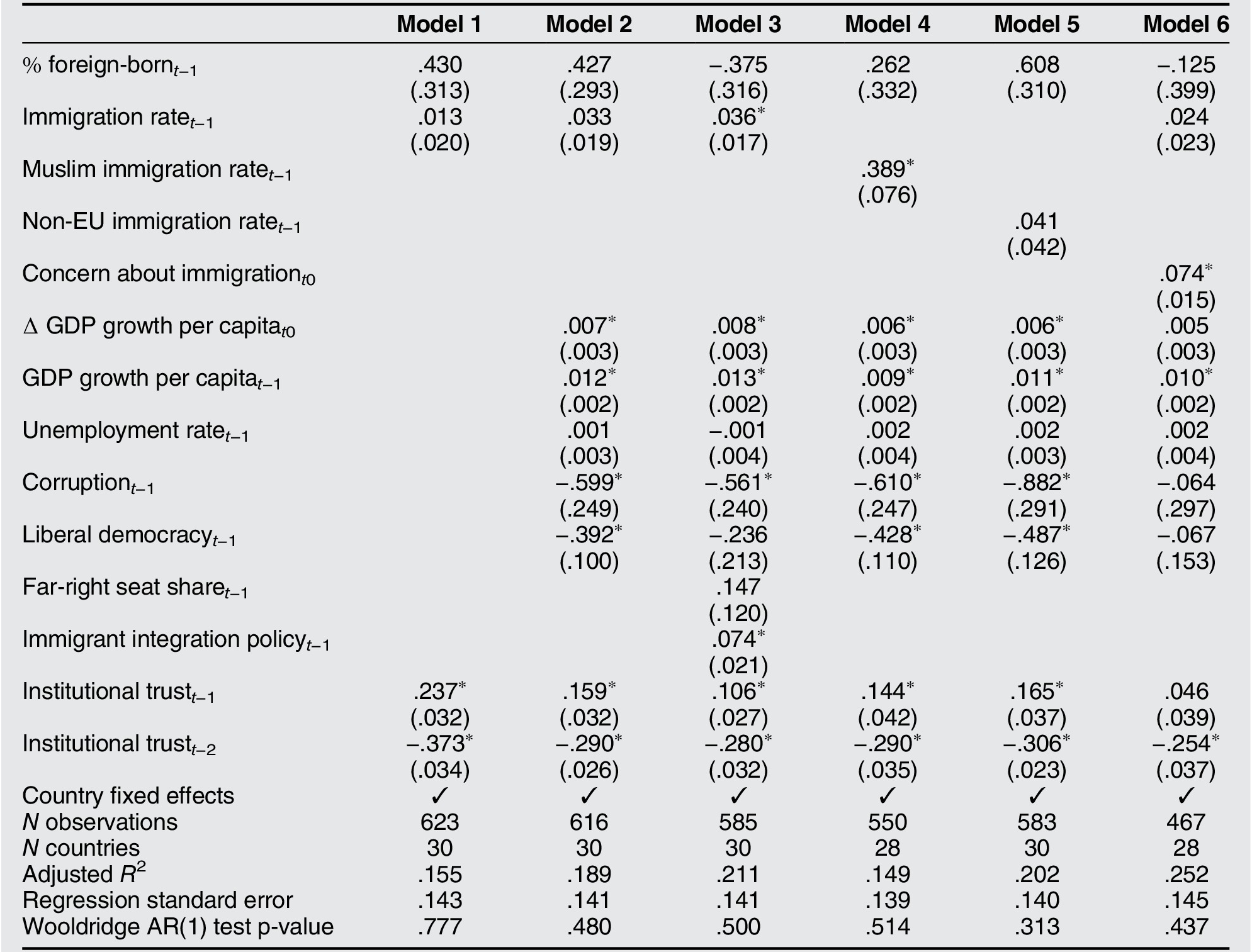
Note: ∗p < 0.05. Dynamic fixed effects error-correction models of institutional trust, with Driscoll-Kraay standard errors in parentheses. T ranges from 5–31 years (model 4) to 7–36 years (model 1).
Immigration and Satisfaction with Democracy
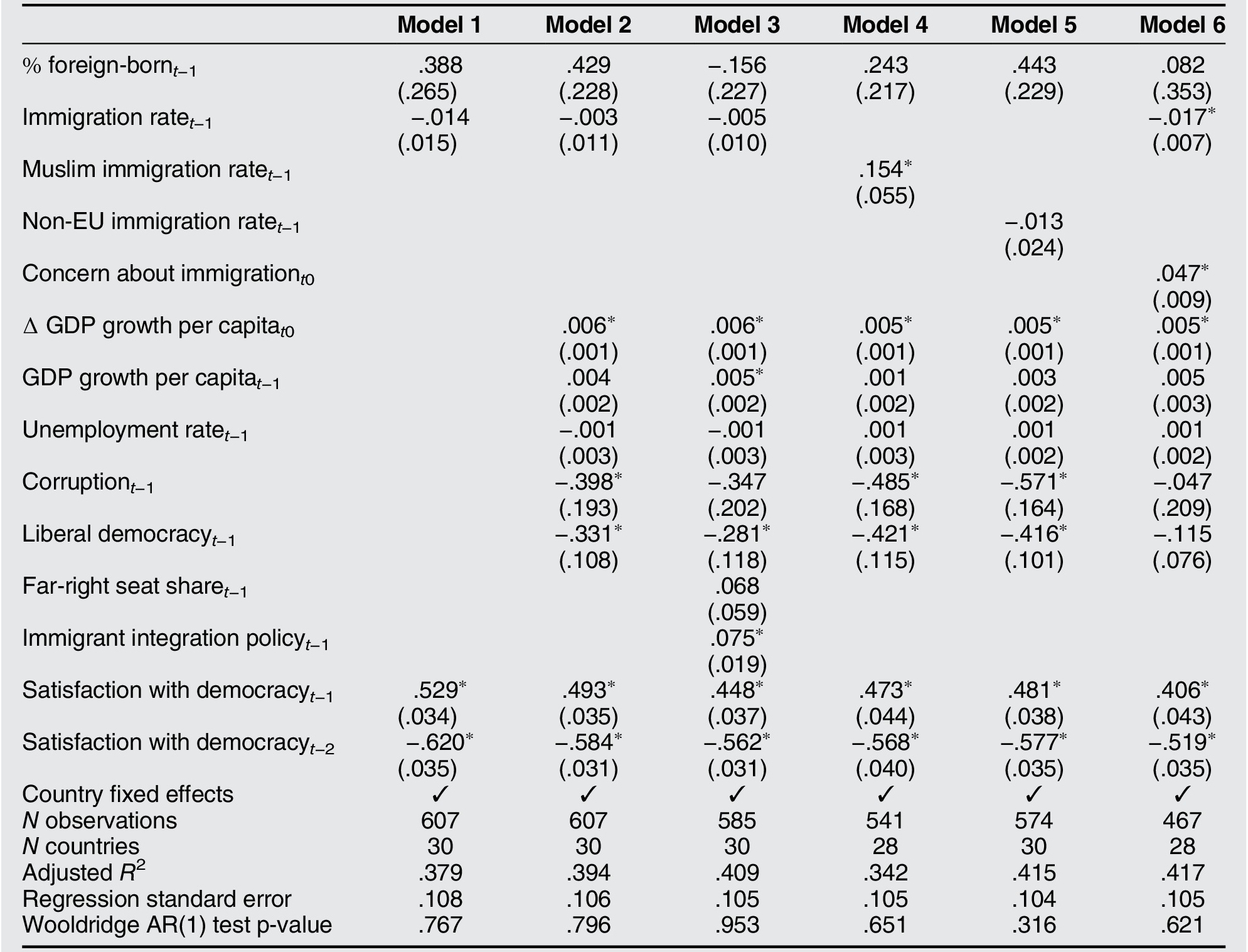
Note: ∗p < 0.05. Dynamic fixed effects error-correction models of satisfaction with democracy, with Driscoll-Kraay standard errors in parentheses. T ranges from 5–30 years (model 4) to 7–30 years (model 1).
Immigration and Democratic Support
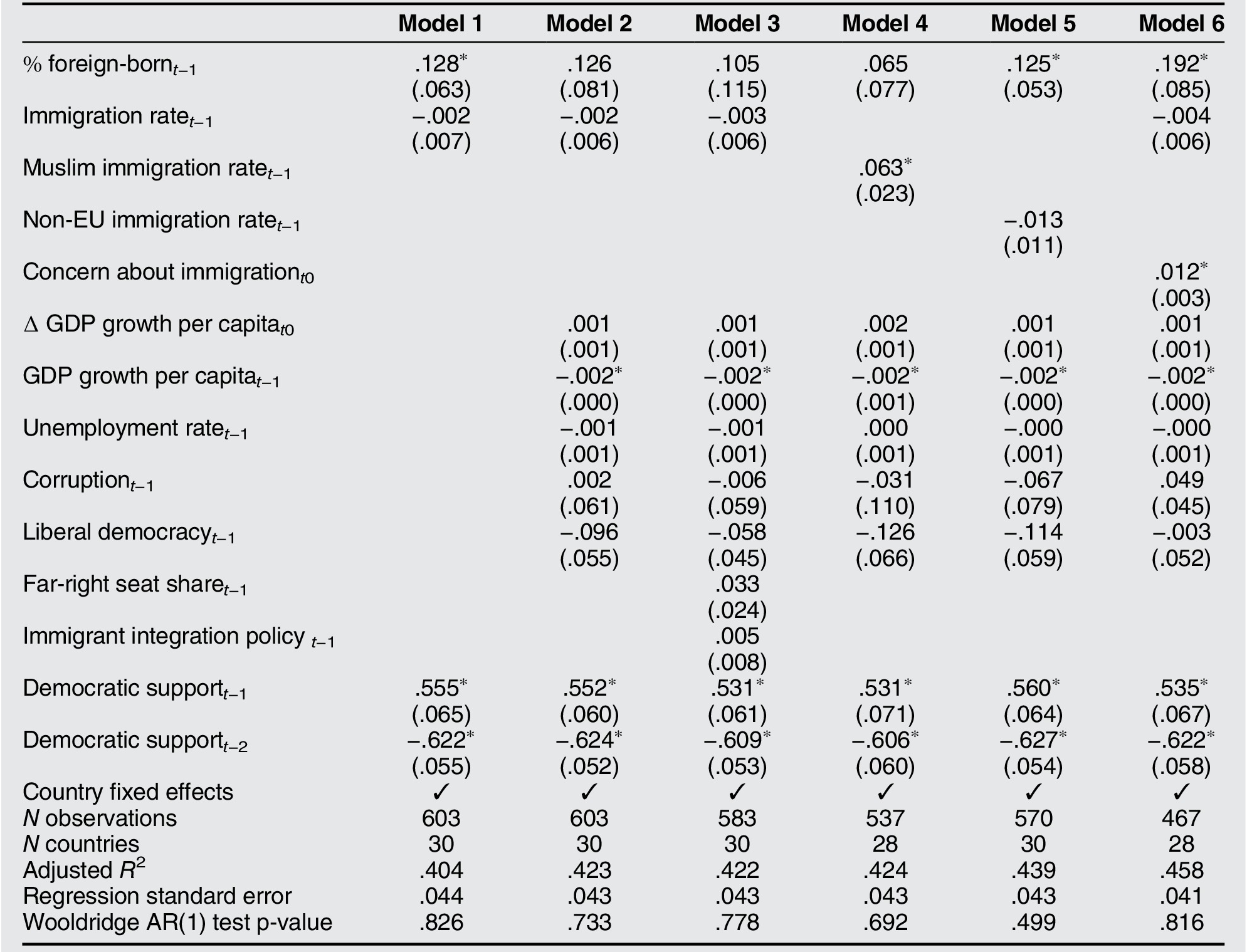
Note: ∗p < 0.05. Dynamic fixed effects error-correction models of support for democracy, with Driscoll-Kraay standard errors in parentheses. T ranges from 5–30 years (model 5) to 7–30 years (model 1).
The proportion of the population that is foreign-born tends to be positively associated with subsequent within-country change in support for political systems. This can be seen for all dependent variables, especially in model 2, which includes basic controls. The magnitude of this effect varies considerably, however, dropping noticeably in model 3 when far-rights seats and immigrant integration policy are factored in. It is occasionally significant but certainly not always. Nevertheless, it seems clear that increases in the size of the population who have an immigrant background pose no threat to the public’s attachment to democratic institutions.
The next measure of immigration to be considered is the annual immigration rate. This tends to have a negative but insignificant relationship with subsequent democratic satisfaction and support, and a positive but insignificant relationship with trust. The effect varies, in other words, but is weak and usually insignificant. In sum, there is no evidence that increases in migration undermine subsequent trust, democratic satisfaction, or democratic support.
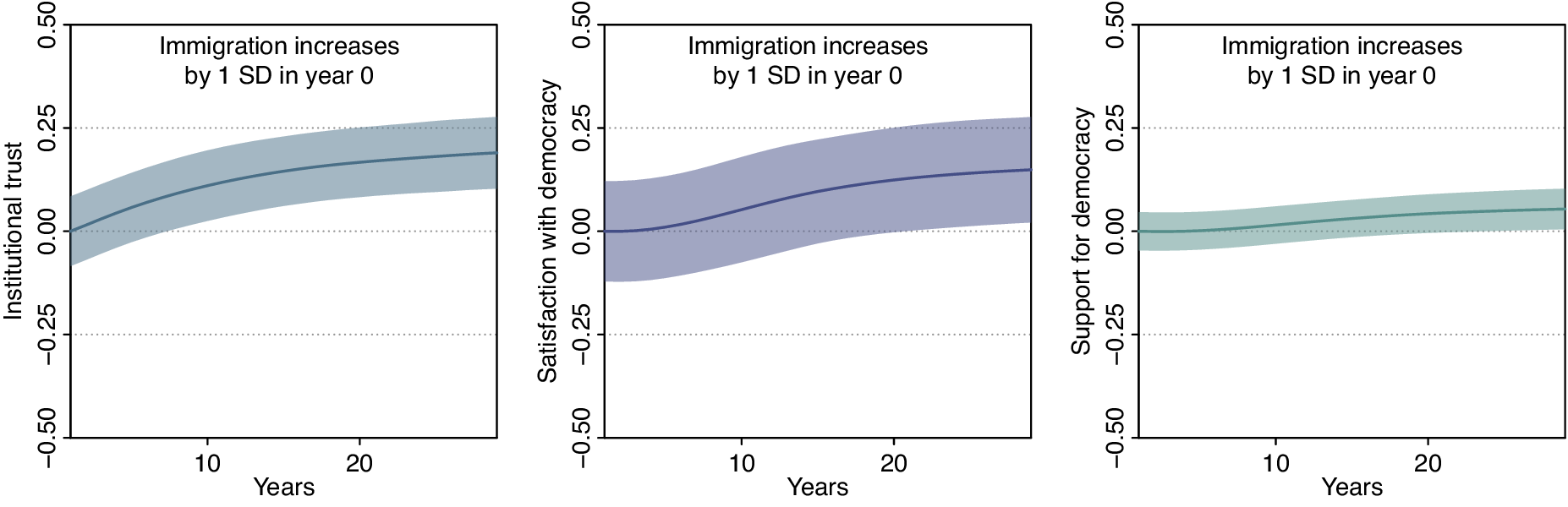
Both of these associations represent short-run effects however. In the longer run, an increase in the immigration rate may continue to exert an effect many years after the fact. Indeed, the serial correlation of the three dependent variables tends to be very high, around 0.9,Footnote 7 which indicates that the short-run effects reported in tables 1 to 3 will accumulate over many years. A related point is that an increase in the rate of immigration will also exert effects via the increasing population size of immigrants that will result. In other words, immigration flows create immigrant stocks in the medium to long run. The effects of immigration flows and immigrant stocks are ultimately intertwined (e.g., Claassen and McLaren Reference Claassen and McLaren2021). And both may play out over time.
To evaluate both these considerations, I turn to the simulated dynamic effects shown in figure 2. These simulations reveal that any small negative effect of an increase in immigration on, for example, democratic satisfaction (figure 2b) is counterbalanced and reversed by the positive effect of a diverse population on satisfaction. Indeed, after around 20 years, a within-country standard-deviation increase in the immigration rate has, if anything, a positive effect on democratic satisfaction (figure 2b). The positive long-run effect on institutional trust is even stronger, albeit still within the margin of error. Democratic support shows little evidence of being affected by immigration over the long run, befitting its status as a more deeply rooted democratic orientation.Footnote 8 It is clear from these simulations that immigration does not erode system support, even over the long run.
Long-Run Effects of Changes in Immigration Rates
Note: Simulated long-run effects of a one standard-deviation increase in within-country rates of immigration. Based on model 2 from tables 1 to 3. The effects of immigration on the subsequent stock of foreign-born residents are included via a separate demographic model. Being a within-sample analysis of a counterfactual, rather than a forecast, uncertainty in regression coefficients and lags, but not error variances, is included.
Thus far, my analyses have revealed no negative consequences of immigration and diversity on support for political systems in Europe.Footnote 9 However, this finding may be affected by my measures of immigration, which include migrants from all source countries. Some researchers have argued that the effects of immigration might vary depending on the source. In particular, there is considerable evidence that immigrants from Muslim-majority countries are the most threatening to native-born citizens of many European countries (e.g., Adida, Laitin, and Valfort Reference Adida, Laitin and Valfort2016; Strabac and Listhaug Reference Strabac and Listhaug2008).
Following this logic, model 4 in tables 1 to 3 focuses specifically on the effects of immigration from Muslim-majority countries. In fact, the results show that this measure of immigration tends to be positively associated with changes in system support. Greater within-country inflows of migrants from Muslim-majority countries are therefore associated with higher, not lower, levels of institutional trust and democratic satisfaction (there is no significant association with democratic support). I also include a second alternative measure of immigration in model 5, the immigration rate from outside the EU (including from the UK). These results are weak, insignificant, and similar to those obtained from the general immigration-rate measure.
Finally, I consider the relationship between public concern about immigration and system support (model 6). Net the effects of actual immigration flows, within-country increases in concern about immigration are associated with greater institutional trust, democratic satisfaction, and democratic support. When the public is more concerned about immigration as an issue, they also tend to exhibit more trust in democratic institutions and satisfaction with democracy.
I have measured trust, satisfaction, and democratic support using national survey samples. These samples include both native-born citizens as well as immigrants and other foreign-born residents. Yet if immigration has differential effects on the political attitudes of these groups—which seems quite possible—my conclusions regarding the lack of any impact of immigration on system support could be misplaced. For example, if immigration reduces native-born citizens’ trust in national institutions but increases foreign-born residents’ trust, then the net effect might be close to zero and insignificant—that is, the results generally observed.
My solution is to examine the effects of immigration on the democratic attitudes of native-born citizens only. Since few cross-national survey projects ask respondents if they were born in their current country of residence, I use data only from the ESS for this analysis, aggregating these data to the national level. The ESS includes most of the countries that feature in my larger dataset. But there are only seven to eight waves of data (for institutional trust and democratic satisfaction respectively). This reduction in the T dimension of the dataset has implications for the modeling strategy. The inclusion of both lagged dependent variables and country fixed effects is inadvisable when the T dimension is limited in this way, because Nickell bias increases as T decreases. I therefore do not include lagged dependent variables, but I retain country fixed effects. To address the increased serial correlation that results from the former, I used Beck-Katz panel-corrected standard errors clustered by country.
The results for institutional trust are reported in table 4 and for democratic satisfaction in table 5 (The ESS does not regularly field questions pertaining to democratic support). To allow us to more readily compare the effects when using the entire sample versus only native-born respondents, I include results for both in each table. As the tables reveal, results are very similar regardless of whether foreign-born residents are included or excluded. The effects of foreign-born population size tend to be slightly weaker when foreign-born residents are excluded, although the association remains positive (albeit insignificant). The effects of immigration are virtually unchanged. Although these models do not include lags of my opinion variables, the results shown in tables 4 and 5 strongly suggest that including foreign-born residents in my measures of democratic attitudes does not dramatically alter the inferences I have drawn thus far.
Immigration and Institutional Trust, ESS Only
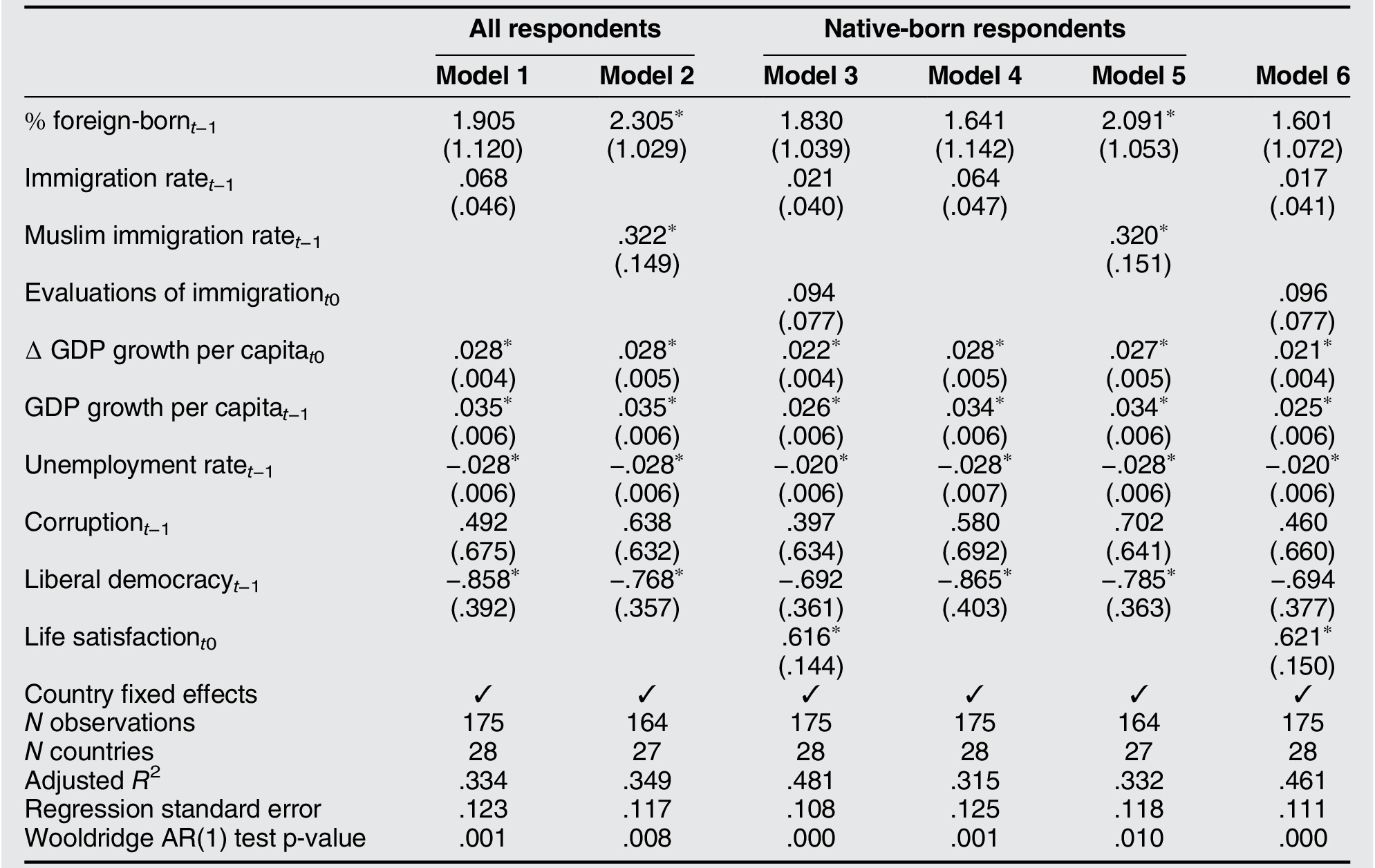
Note: ∗p < 0.05. Fixed effects regressions of institutional trust, using aggregate opinion data only from the ESS (2002–18). First three columns include ESS opinion variables calculated using all respondents; last three columns include ESS opinion variables calculated using only respondents who were born in their country of residence. Beck-Katz panel-corrected standard errors, clustered by country to account for serial correlation, are reported in parentheses. T ranges from 1–8 years (all models).
Immigration and Satisfaction with Democracy, ESS Only
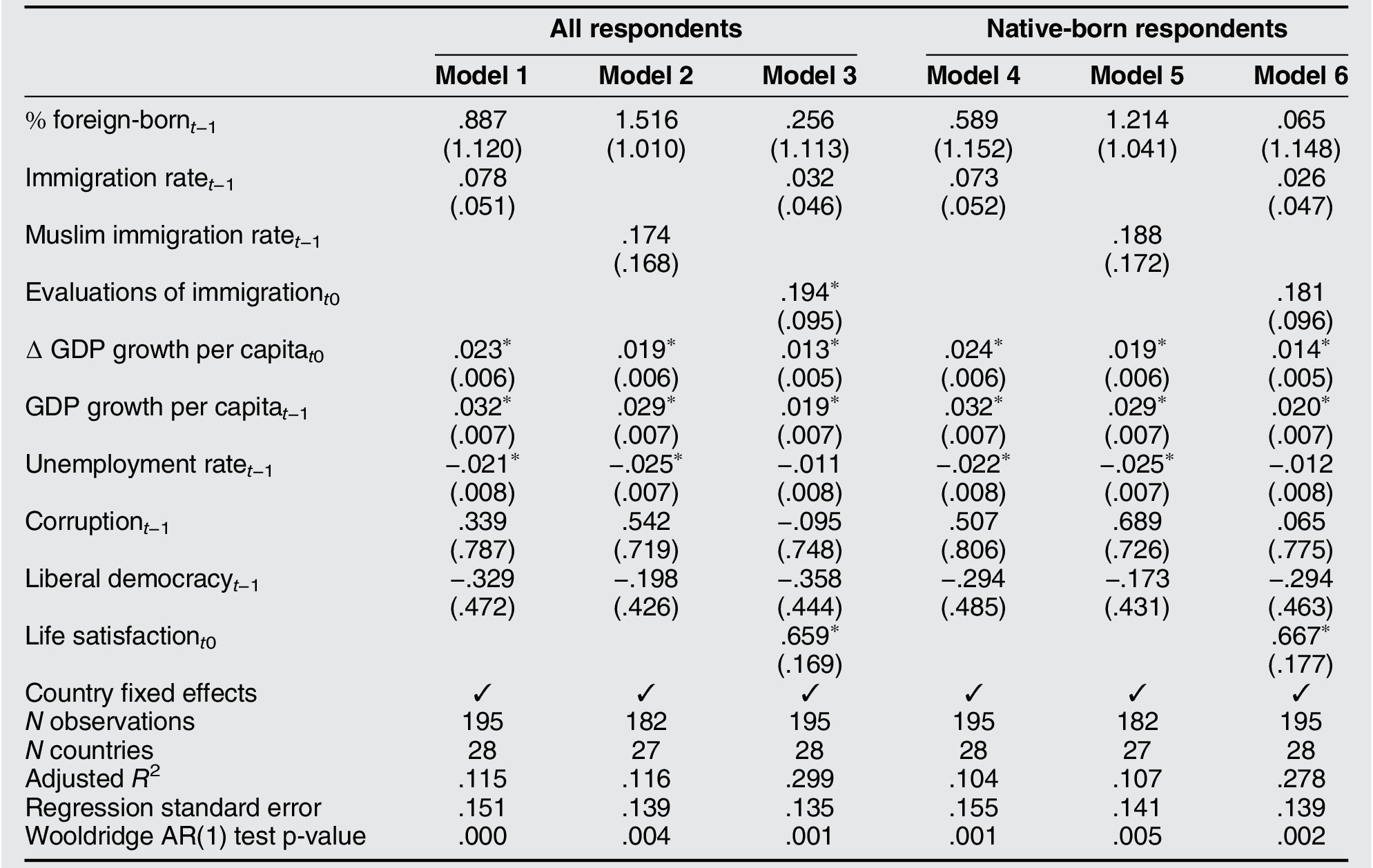
Note: *p < 0.05. Fixed effects regressions of satisfaction with democracy, using aggregate opinion data only from the ESS (2002–18). First three columns include ESS opinion variables calculated using all respondents; Last three columns include ESS opinion variables calculated using only respondents who were born in their country of residence. Beck-Katz panel-corrected standard errors, clustered by country to account for serial correlation, are reported in parentheses. T ranges from 1–9 years (all models).
The ESS panels permit other useful analyses. These are the data that McLaren (Reference McLaren2012, Reference McLaren2015) uses to argue that public concern about immigration undermines trust. I can test the claim using the same data, although now at the national level of analysis. Specifically, I include the measure of evaluations of immigration that was used by McLaren (along with a measure of life satisfaction that McLaren argues may work as a confound). I find no negative effect of public evaluations of immigration on either institutional trust or democratic satisfaction.
Conclusion
Decades of mass immigration have created diverse societies in most Western democracies. This paper has examined whether immigration, and the resulting demographic changes, have eroded the attitudes that sustain and legitimize European democracies. I find little evidence that European publics have turned against their political systems, even though these are the systems that facilitated mass immigration. This is despite a comprehensive analysis that includes a variety of measures of immigration and support for political systems as well as a focus on the opinions of native-born residents, who would seem most likely to blame the system for immigration.
Immigration is presented by some authors as a double-edged sword, a force that may bring economic benefits but which can sever the gossamer strands binding societies and supporting political systems (e.g., Collier Reference Collier2013; Galston Reference Galston2018). A number of existing studies have already cast doubt on the claim that immigration and diversity undermine social cohesion (see van der Meer and Tolsma Reference van der Meer and Tolsma2014). This study also suggests that immigration does not pose a threat to national political cultures. Democratic societies can reap the economic benefits of immigration without eroding the public attitudes that sustain their political systems.
Immigration can of course still exert political effects via the election of far-right and anti-immigrant parties and candidates. However, there is evidence that the election of such parties does not in fact dampen support for the political system (Harteveld et al. Reference Harteveld, Kokkonen, Linde and Dahlberg2021; cf. Hooghe and Dassonneville Reference Hooghe and Dassonneville2018). Regardless, this paper has shown that any deleterious effects of far-right parties on the political culture cannot be attributed back to immigration itself.
Acknowledgments
I appreciate the helpful feedback provided by Alexander Kustov, Jonas Linde, Rahsaan Maxwell, Lauren McLaren, and Viktor Valgarðsson. This project received funding from the ESRC via the NORFACE Joint Research Programme “Democratic Governance in a Turbulent Age,” which is cofunded by the European Commission through Horizon 2020 under Grant Agreement No. 822166.
Supplementary Material
To view supplementary material for this article, please visit http://doi.org/10.1017/S1537592722004194.


 Open access

